Tag Archives: Las Vegas

29th Movember 2016

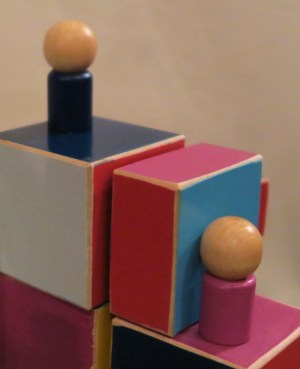
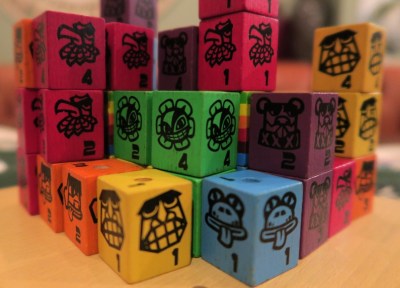
Different week, different people, different sickness, same late start…  After Burgundy had finished worrying the pub staff by changing his supper order (given how fast Blue can polish off a pizza he thought he might be able to eat a Hawaiian quicker than his usual ham, eggs & chips – he was wrong), we split into two groups, with the first playing the “Feature Game”, The Climbers.  This is a great three dimensional strategy game that looks like it is designed round a set of children’s building blocks. It’s appearance belies its true nature however, and, although it looks like a kiddie’s dexterity game, it is really a strategy game with almost no dexterity component at all.  Red and Magenta thought it looked cool and Burgundy had read the rules on line so was also keen to give it a go, so the group was pretty much self-selecting with Blue making up the foursome.
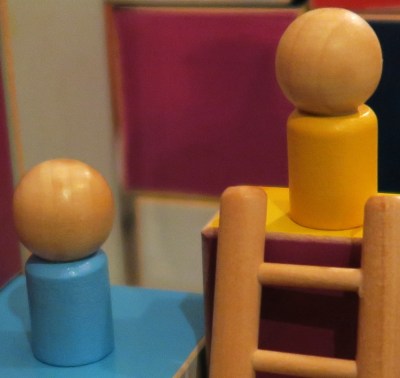
The Climbers
– Image by boardGOATS

We began by placing the two Triple-height blocks in the centre and randomly piling the rest of the bricks round it, covering all the visible surfaces, then Blue started explaining the rules.  It was at about this point that we realised that Burgundy had read a very different set.  The game was originally released in German as Die Aufsteiger.  Since it is very language independent, when they were  translated into English, a few changes were made to the rules and when the second edition was brought out the rules were revised again with some of the additions listed as optional variants.  This means that there are effectively three different sets of rules and to make things worse, lots of people have their own “House Rules” as well.  Since nobody had played it very much we decided to stick to the rules as written in the copy we had, without the addition variants.
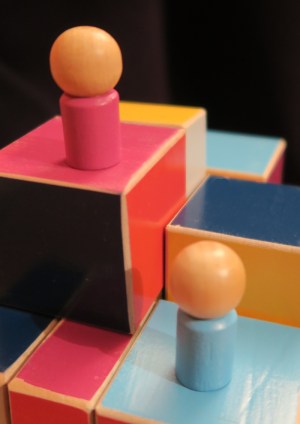
The Climbers
– Image by boardGOATS

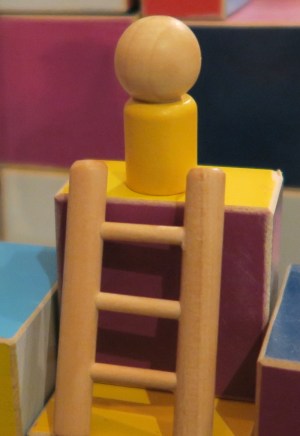
The game is played in turn order with each turn comprising three steps.  Firstly, the active player can move a block, any block so long as there isn’t anything on it, and they can place it anywhere, in any orientation as long as there is sufficient space.  Next the active player can move their Climber as far as they like within the rules.  Climbers can climb up any step below their head height unaided as long as the face they are climbing onto is grey or their own colour.  They can also use their long and/or short ladders to climb larger distances, but they are fragile and therefore single use (though that’s not very green as Red pointed out).  Finally, the active player may place a blocking stone which prevents a brick being moved or used until that player’s next turn.  Probably the most difficult part of the game is the concept of “space”.  There are three different sized coloured blocks:  Cubes (2a x 2a x 2a), Half-height (2a x 2a x a) and Double-height (2a x 2a x 4a).  These blocks have each face painted a different colour, the five that correspond to the player colours and one side that is grey.  There are also two Triple-height blocks that are plain grey and are the base of the setup.

The Climbers
– Image by boardGOATS

The square faces of the blocks can be considered to consist of four smaller squares – this is the basic unit (a x a).  This basic “a2” unit is sufficient space for one Climber.  Blocks can be placed offset, like bricks in a wall sitting on two or more other bricks, so long as these basic “a2” units are observed and remain whole.  The undersurface of each block must also have full contact with the blocks underneath – there cannot be any holes or overhangs.  If a Climber is sat in an inconvenient place, he can be “nudged” out of the way using a block, provided that he isn’t knocked off or moved onto a different block.  This can make space for placing a block, or for a Climber:  Climbers can only sit on their own colour or grey and need an “a2” unit each.  Thus, several Climbers can sit on a large grey face.  The winner is the player who’s Climber is highest at the end of the game.
The Climbers
– Image by boardGOATS

Red and Magenta started climbing one side, with Blue and Burgundy progressing up the other.  Red stole a bit of a march as everyone else got in each others’ way leaving Magenta to fight a rear-guard action on her side.  Meanwhile, Blue and Burgundy fought for supremacy, until Blue managed to extricate one of the large grey blocks and use it to simultaneously screw up Burgundy and create a second summit at a similar height to the one Red was occupying.  With this second peak to fight over, there were effectively two races competing against each other, but it wasn’t long before first Burgundy, then Blue and Magenta were forced to take a pause in climbing.  It was at this point that we realised the mistake we’d all made.  Players can choose whether to climb or not, but the game ends when all players successively don’t (or can’t) finish their turn on a higher level.  With all three of us failing to climb, that left Red with potentially the final turn.  Although she was highest, Blue and Magenta were blocks at the same height, so we had to invoke the tie-breaker which meant the first player to reach that level would win.  Since Red had got there first, she had no incentive to move and, in was thrilled to finish in first place in what had been a hard-fought game.
The Climbers
– Image by boardGOATS

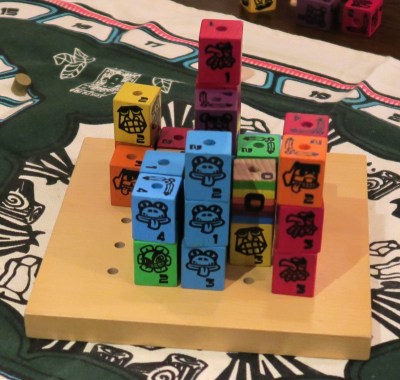
Green, Black and Purple joined the others playing with children’s building blocks, with a game of Totemo, an early Tony Boydell gem (he of Snowdonia and Guilds of London).  This game consists of of colored wooden blocks that have a small dowel attached on one end and a hole in the other. This allows them to be placed in the wooden peg-board.  The game starts with one of the multi-colored wild pieces placed in the center of the board.  Each player starts their turn with three wooden totem pieces.  To place a piece, all totem pieces it touches must abide by the color wheel.  So, for example, a purple block may be placed on its own or adjacent to purple, red or blue blocks; the more blocks it touches, the higher its score.  There are also several blocks with two feathers on top which are totem toppers and cannot be placed on the bottom level. In addition, no other totem piece can be placed on top of them.  Players can only place one totem piece per turn unless they land on a space seeded with a bonus marker.  At the start of the game, several bonus markers are placed round the board – landing on these enables the active player to place another block, up to a maximum of three.
Totemo
– Image by boardGOATS

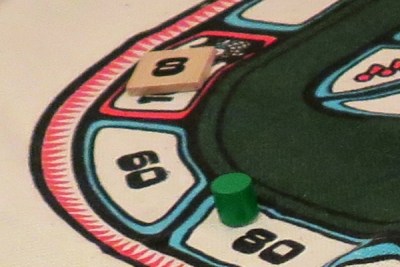
At the end of their turn, the active player replenished their set of totem blocks.  Each round, the start player moves the round marker until it gets closer to the tee-pee indicating the last round. Alternatively, the game can also end if there are no more totem blocks in the bag.  With apologies for not ironing the playing cloth and quick recap of the rules, the game was under way.  The first rounds were, typically, feeler rounds with players just trying to do the best they could.  Black and Purple had played the game many times before while Green, had played it only once and that was a few years ago.  Black and Purple managed to make use of the bonus markers by landing on the correct space on the scoring track and began to pull away from Green who was stuck with red bricks he could only place on their own since there was a predominance of blue bricks on the board.
Totemo
– Image by boardGOATS

This forced Green to change his strategy from simply trying to get the highest score possible to getting the exact score to land on a bonus tile and go again each time.  He started this new approach with a bang, placing all three of his blocks in one go and shot into a healthy lead.  Throughout the game players were each left with one or two blocks they couldn’t easily place, either because they were the wrong colour or were “toppers”.  The game took longer than it should have as everyone was guilty of over analysis at different times, but Black and Purple slowly caught up with Green, and going into the final round were both in the lead once again. Unfortunately neither could quite reach their respective bonus spaces and just added a modest amount to the final score. Green however, placed all three of his blocks and took the lead by more than ten points, with it winning the game.
Totemo
– Image by boardGOATS

With both games finishing together and nobody up for a late night we decided to opt for a large group game, and prompted by Magenta, we quickly settled on Las Vegas.  This is a very simple game where players begin their turn by rolling their dice, then they assign some of them to one of six casinos.  Each casino is numbered one to six and has a jackpot drawn at random from a deck of money.  Players must use all the dice of one number to bet on the casino of that number.  Once everyone has placed all their dice the player who placed the most dice on a casino takes the highest value currency card. The really clever bit is that before any money is handed out, any “draws” are removed, which leads to a lot of barracking.  This time we included the Slot Machine from the 2015 Brettspiel Advent Calendar.  This is like a seventh casino, except that it can hold dice of any number, but each number can only be added once (though a player must add all the dice they have of that number).

Las Vegas
– Image used with permission of BGG contributor punkin312

We also added the extra dice for more players from the Boulevard expansion, as well as “bigguns”, large dice which count as two in the final reckoning.  Green kicked off the first round, which turned out to be very unproductive for both Blue and Burgundy who struggled to get anything of any value.  Burgundy struggled in the second round as well, as did Black and their problems were compounded by the small number of high value notes that were repeatedly drawn.  Meanwhile, Red was struggling to keep her eyes open, so while everyone else was playing the long game, she was played her dice as quickly as she could then dozing while everyone else finished the round without her.  The problem with everyone playing small numbers of dice in the early part of the game and hanging on to dice for as long as possible was that it slowed the game down considerably, not that anyone really minded on this occasion.  It wasn’t until the last round that we began to realise that this strategy didn’t really work, a conclusion that was reinforced by the fact that a slightly embarrassed Red won the game, some $50,000 ahead of Magenta and Blue in second and third.

Las Vegas
– Image by boardGOATS

Learning outcome:  Sometimes sleeping through a game isn’t a disadvantage.

9th February 2016

Blue was delayed by washing machine shenanigans and Green by pancakes, so while Burgundy, Black and Purple were entertained by food, Red and Magenta distracted them with a few quick rounds of Love Letter.  Magenta took the first two rounds winning the second by drawing the princess as the penultimate card; the third round went to Black when he played a Prince and asked Purple to discard her card which turned out to be the Princess.  With the arrival of Green and Blue had finishing her pancakes, we decided to play our “Feature Game” which was Ticket to Ride and its variants.

Love Letter
– Image used with permission of BGG contributor henk.rolleman

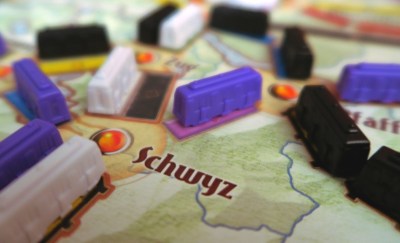
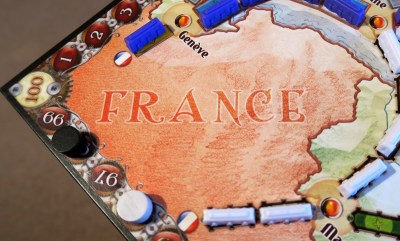
Which variant was the subject of some debate as we had all played different versions and everyone wanted to try a different one.  For example, Blue had never played the original USA version, but all those that had didn’t want to play again; similarly while Green was interested in playing Märklin, Black and Purple weren’t keen; they were interested in Switzerland or Nordic Countries, but Magenta, Blue and Green were unenthusiastic about that.  And so it went on, in fact, the only thing everyone agreed on was that we should split into a three and a four and nobody wanted to play Europe edition (as everyone had played that a lot). In the end, the group of three was based round Black and Purple who wanted to play with the Switzerland map and setup, and were joined by Burgundy who was fairly flexible.  That left the group of four who decided to go for Nederland as none of them had played it before.

Ticket to Ride: Europe
– Image by boardGOATS

The basic Ticket to Ride game can be summarised as follows:  players take it in turns to carry out one of three possible actions and when one player has two pieces left or fewer, everyone gets one more turn before the game ends and points are tallied.  The first action is to lay trains on the map, but in order to do this, they must spend train cards in the colour featured on the map.  Thus, if a player wants to claim a four car route, they must play four cards of the corresponding colour and finally place four of their plastic carriages on the board in the correct location scoring points as they do so.  If they do not have cards to claim the route they want then they can, instead, choose two cards, either from the five face up cards next to the board, or from the face down draw pile.  “Laying trains” scores points, but a large number of a player’s points are scored at the end through tickets which give points to players that have connected several short routes together to connect two more distant cities.  Each player starts the game with some tickets (chosen from a larger number), but on their turn may, instead of drawing cards or claiming routes, draw more tickets.  At the end of the game, tickets which have been successfully completed score points, while unfulfilled tickets score negatively.

Ticket to Ride: Europe
– Image by BGG contributor stormrover

Although this is a fairly complete summary of the rules for the original base game, each different version has slight modifications and variations that change the game slightly.  The “Swiss trio” got under way first as Burgundy was quite familiar with the rule modifications:  tunnels, ferry routes and country-to-country tickets; locomotive cards can only be used for ferries and tunnels, but can be drawn from the face-up cards without penalty.  The game was very close with Purple trying to make a long route from east to west, Black travelling north to south and Burgundy doing a bit of both. The tunnels were a bit of a hindrance with everyone struggling to get through the Alps without paying extra.

Ticket to Ride: Switzerland
– Image by boardGOATS

As the ticket scoring came to a close, Burgundy had his nose in front and looked to have the win in the bag, but carefully counting up the trains gave Black the bonus for the longest route and with it, the win by just two points.  Burgundy was particularly cheesed off as he had attempted to claim a tunnel on his final turn that would have given him the longest route, but the fates conspired against him.  It was only later that we realised that there hadn’t been a recount for the points awarded as trains were placed on the map and as, invariably points tend to get missed out, a recount is generally sensible.

Ticket to Ride: Switzerland
– Image by boardGOATS

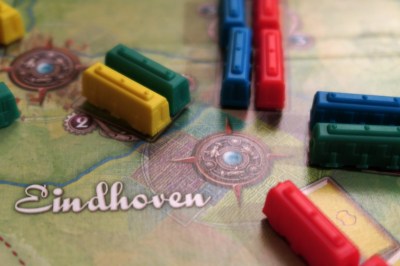
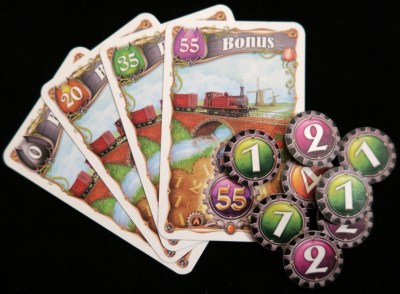
Meanwhile, Blue, Green, Red and Magenta had worked out the rules changes applicable to Nederland.  There are no ferry routes or country-to-country tickets and obviously, no tunnels, however, in this low-country with countless canals and rivers, there are bridges instead. and these have a toll.  Each player starts with “toll tokens” to a total value of thirty.  Most of the routes are double routes, so can be claimed by two different players, this feature is common with all other versions of Ticket to Ride when playing with the maximum number of players, but in this game they are used for all games.  The first player to claim a double route pays the marked toll to the bank, but the second player to claim that route pays the toll to the player who got there first.  These tolls become quite critical in the end game as there are bonus points available for players who manage to conserve toll tokens, and these bonuses are sizable with fifty-five points going to the player with the most tokens at the end of the game and thirty-five and twenty for second and third.  Players who can’t afford to build, can borrow from the bank, but that removes them from the race for bonus points as well as costing points at the end of the game.

Ticket to Ride: Nederland
– Image by boardGOATS

As is traditional, everyone began by moaning about where their starting tickets were.  Beyond that, nobody really knew quite what to expect, but it was clear that this wasn’t a game where players could ill-afford to hoard train cards and wait as they were likely to find themselves paying tolls to other players and giving them bonus points.  As such, everyone got going quickly and Red led the way placing several long routes giving her an early lead.  Everyone else caught up, and as players started to run low on trains, they realised they had to watch the number of toll tokens they had left else they would have to begin to borrow and that would put them out of the running for the bonuses.  Blue picked up extra tickets first, but they left her with a really tough decision as most of her track was in the north-west and the tickets she had were pretty much everywhere else.  After a very long time thinking, she decided to keep them all and go for broke.  The others soon followed, picking up more tickets, and Green had several goes with some corresponding to routes he had already claimed.  It was only a couple of turns after she had drawn her extra tickets that Magenta counted her trains and started to make some uncomfortable sounding noises suggestive of possible problems ahead.

Ticket to Ride: Nederland
– Image by boardGOATS

Blue triggered the end of the game and it was all too close to call with less than ten points between first and last before the tickets and bonus points were added on. Green was the first to count up and there was a stunned silence when we found he had a massive one hundred and thirty-seven points from the tickets to add to his train total of fifty-two.  Red had a couple of tickets that she had failed to complete so her ticket total took a bit of a bruising, but her problems were nothing to Magenta’s.  She only realised she didn’t have enough pieces to complete all her tickets when it was too late, so all her hard work to fulfil her initial tickets was almost completely negated as she finished with a ticket total of just one!  Blue had managed to complete all her routes and was pretty much neck-a-neck with Green which, like the other game, left it all down to the bonus points for toll tokens.  Red took the fifty-five points for the most remaining toll tokens, giving her a very respectable one-hundred and fifty-four and third place.  Blue picked up an extra thirty-five points and finished forty points ahead of Green who finished with the fewest toll tokens and therefore didn’t add to his score.

Ticket to Ride: Nederland
– Image by boardGOATS

Pine had appeared towards the end of the game and, after a brief explanation of the rules, had commented on the name of the game in German:  Zug um Zug, which translates to “step by step”, although Zug also means train.  This kind of double-entendre is not uncommon in Euro game titles and prompted a discussion of other games with similar “jokes”.  Blue mentioned Tier auf Tier which literally translates to the English title “Animal upon Animal”, a children’s game where players stack wooden animals, creating “tiers”.  Magenta brought up her favourite game, Bohnanaza, where “Bohn” is the German for bean.  Green chipped in with his offering of Citadels, which is called “Ohne Furcht und Adel” in German which literally means “without fear and noble” (colloquially translated as “without fear and nobility”).  This is actually a pun on “Ohne Furcht und Tadel”, which means “without fear or blemish”.  It is an old-fashioned expression seldom used now except perhaps when describing a perfect performance by Michael Schumacher for example, that refers to somebody being very valiant and chivalrous (ala King Arthur and the Knights of the Round Table).  Interestingly, when trying to find the correct literal translation, Green submitted “Ohne Furcht und Adel” to Google and got “Citadels” in return, perhaps a measure of how embedded games are in German life.

Animal Upon Animal
– Image by BGG contributor dr.mrow

With eight of us, and nobody terribly keen to play anything too cerebral, we decided to go for something light, 6 Nimmt got a mention, but we settled on Las Vegas, using the extra dice for more players players and the wild cards from the Boulevard expansion, and the Slot Machine from the 2015 Brettspiel Advent Calendar.  This was a Christmas gift and had its first outing in January when it was the “Feature Game”, but as a light dice game that plays a wide range of player numbers it is quite versatile.  On their turn, each player begins by rolling their dice, then assigning some of them to one of the six casinos.  Each casino is numbered one to six and has a jackpot drawn at random from a deck of money.

Las Vegas
– Image used with permission of BGG contributor ckirkman

On their turn, players must use all the dice of one number to bet on the casino of that number.  Once everyone has placed all their dice the player who placed the most dice on a casino takes the highest value currency card. The really clever bit is that before any money is handed out, any “draws” are removed, which leads to a lot of barracking.  The Slot Machine is like a seventh casino, except that it can hold dice of any number, but each number can only be added once (though a player must add all the dice they have of that number).  The game was a lot of chaotic fun with with lots of chit-chat and before long we had worked our way through the card deck and spent an hour doing it.  Although there is a lot of down-time with so many players, it didn’t seem to matter very much and it was quite relaxing to chat about things.

Las Vegas
– Image by boardGOATS

We found Slot Machine definitely added a useful extra option to the game, however, the “wild cards” were less interesting.  This inspired a discussion about the value or otherwise of expansions.  In an evening essentially devoted to expansions, it was interesting consider whether the addition of expansions took a simple game that everyone liked and made it unnecessarily more complex, or whether it breathed new life into a game people had become tired of.  In the case of Ticket to Ride at least, it was clear that with a game that players had become almost too familiar with, the extra maps provided a nice alternative.  Meanwhile, the game was providing an interesting background to the discussion and the end results were almost incidental.  Magenta redeemed herself after the disastrous ticket fiasco, finishing with $390,000 and third.  Second place went to Red with $420,000, but with her second victory of the night, Blue took home the bacon with $460,000, more than twice that of last place.

Las Vegas
– Image used with permission of BGG contributor joeincolorado

Learning outcome:  Germans *do* have a sense of humour!

12th January 2016

With Red, Magenta and Blue moaning about work and only Burgundy waiting for real food, when Pine rolled up we began straight away with our “Feature Game”, the light filler, Las Vegas. This is a very simple dice game, but actually quite a lot of fun.  On their turn, each player begins by rolling their dice, then assigning some of them to one of the six casinos.  Each casino is numbered one to six and has a jackpot of over $50,000, drawn at random from a deck of money.  Thus, each jackpot could be anything from $50,000 to $180,000 and comprise one to five notes.  On their turn, players must use all the dice of one number to bet on the casino of that number.

Las Vegas
– Image used with permission of BGG contributor punkin312

Once everyone has placed all their dice the player who placed the most dice on a casino takes the highest value currency card. The player with the most money after four rounds is the winner.  The snag is that before any money is handed out, any dice leading to a draw are removed. It is this rule that makes the game interesting, raising the decisions above the trivial and, in our view, making it a better and much more fun game than Qwixx which we played two weeks ago.  Although the game only plays five (without the Boulevard expansion), Blue had added an extra set of purple dice just in case, so when Green walked in just before the game started, he was able to join in.

Las Vegas
– Image used with permission of BGG contributor punkin312

In the early part of the round, each player has to decide whether to conserve dice or whether to make a statement and go in big.  As the round progresses, players must choose where to place their bets then try to finesse their position before being forced to place their last die or dice based solely on chance.  The factors that go into the decision include the value of the rewards available, the current position and the number of notes as well as the probabilities of other players interfering.  The probabilities are non-trivial too, because rolling multiples can change the number of dice available for the next roll.

Las Vegas
– Image used with permission of BGG contributor ckirkman

In the first round, everyone made the same mistake and committed too many dice too early, but after that, we all got the hang of it and the game was quite close.  Players keep their winnings hidden, but since everyone had had rounds with lean pickings as well as generous ones, we all felt we were in with a chance.  The last round began with it all to play for and everyone taking it in turns to roll lots of sixes.  At the end of the game, we announced our totals in turn:  Green finished with $260,000, Pine with $250,000, Burgundy and Blue tied with £270,000, but Magenta just pipped them with $280,000.  Red, however, took longer to count up her cash for good reason and finished well clear with $360,000.

Las Vegas
– Image used with permission of BGG contributor joeincolorado

With the arrival of Black and Purple, we decided to split into two groups.  The only game that everyone really wanted to play was Isle of Sky: From Chieftain to King, so since we only had the one copy, five went for that leaving the three others to find something else to play.  Isle of Skye is a tile laying game where players play a sort of solitaire Carcassonne, bidding for tiles and scoring a the end of each of the six rounds.  We’ve only played the game once on a Tuesday in November, but it has proven to be very popular at other local meetings too, so everyone playing had played before and the game was quick to get going.

Isle of Skye: From Chieftain to King
– Image used with permission of BGG contributor henk.rolleman

Burgundy had played it a few times and, unusually, generally seems to struggle with this game.  This time he started well, and took the lead from the start, unfortunately however, he struggled to pick up scrolls, so suffered in the end game scoring.  One of the peculiarities of this game is the fact that from round three, at the start of the round players get one extra gold coin per player in front of them on the score track, increasing to four extra coins by the final round.  This really adds up, and a player who takes advantage of this bonus can have a large impact on the score track.  Black made hay on the bonus sitting at the back for most of the game, however, he failed to use the gold and finished with fifty-one unspent coins.

Isle of Skye: From Chieftain to King
– Image used with permission of BGG contributor Punkin312

Between Burgundy at the front and Black at the rear, Purple, Pine and Magenta were jostling for position.  Without sheep and cattle featuring strongly in the scoring tiles this time, Pine felt he would struggle, but he made a surge for the front in the final scoring.  Magenta who had spent a lot of the game at the back of the pack with Black gradually moved through the field in the later rounds and finished four ahead of Burgundy in joint first with Pine on sixty-six, with Pine taking it on the tie-breaker.

Isle of Skye: From Chieftain to King
– Image by boardGOATS

Meanwhile, Blue, Green and Red were playing an aggressive game of Citadels.  This is a slightly older, role selection game.  Everyone starts with a hand of district cards and the start player, “The King”, also has a hand of eight Character cards.   The Character cards are shuffled and one is placed face down blind.  The King can then choose one Character card and pass the rest on to the next player.  The cards are drafted in this way until (in the three player game) everyone has two and the remaining card joins the first card, face down to one side.  Thus, each player has two Character cards and each Character card has a number and a special ability.  “The King” then calls the characters in turn, by number and name, and the player who has that card then immediately carries out their turn.

Citadels
– Image used with permission of BGG contributor themilkcrate

A turn consists of either taking money or drawing two cards from the deck, then paying the monetary cost to build one of the district cards from their hand.  The game ends at the end of the round in which a player builds his eighth district card.  The scores are then added up with players receiving points for their buildings equalling the total cost to build them, plus bonuses for being the first player to build eight district cards, bonuses for having at least one district in each of the five colours and for achieving a total of eight buildings before the game ends.  We played with some of the Characters from the Dark City expansion so “The Witch” replaced “The Assassin”, “The Tax Collector” replaced “The Thief” and “The Navigator” replaced “The Architect”.  We also chose a random selection of the valuable “purple buildings”, a factor that turned out to be quite critical to the game play in the end.

Citadels
– Image used with permission of BGG contributor Nodens77

Blue took an early lead, building a couple of “purple buildings”, in particular, the very annoying Ball Room.  The “purple buildings are expensive to build, but generally come with some sort of special power, in the case of the Ball Room, if the owner is also The King, every player must say “Thanks, Your Excellency” before taking their turn otherwise it is forfeit.  Without “The Thief” in play, Blue was able to let her money build up and was hoping to build the Library, when Red played “The Magician” and swapped hands with her.  Unimpressed, in the next round Blue played the same trick, giving Red the apparently rather useless Armory in exchange.  To make sure Red didn’t nick it back, Blue built the Library quickly, her third purple building giving her a healthy lead though she, like Green was struggling to get the blue cards she wanted to pick up the bonus for having a building of each colour.  Green meanwhile was having other problems of his own, compounded by the fact that he forgot to be obsequious and therefore lost a turn.

Citadels
– Image used with permission of BGG contributor kilroy_locke

Red made persistent assaults on Blue, but it was when Blue had six district cards built and was trying to find a way to close out the game that Red decided to use that “rather useless Armory” to destroy Blue’s valuable Library.   Discussion ensued as Blue had originally decided to ditch the Armory as it was too restrictive, but Red wasn’t so sure.  Green resorted to looking it up on-line and found a wealth of discussion none of which really answered our questions.  After a brief hiatus, we decided to let Red go ahead as Blue was so far in front, although it wasn’t that far as it turned out.  Both Green and Blue hadn’t seen a blue district card all game so missed out on the three point bonus and, as Red completed her eighth building first, she also took an extra two points for that, finishing on thirty-seven.  Green and Blue tied for second place though arguably Green should not have been able to take his last turn since he forgot to “Thank, Her Excellency” again…

Citadels
– Image by boardGOATS taken from boardgamegeek.com

Citadels is one of those rare games that plays a wide player count, nominally from two to eight players.  However, while there is a consensus that it does not play all numbers equally well, the on-line jury is still out as to where its “sweet spot” is.  In fact, some people appear to think it is best with small numbers, while others prefer it with more players.  We’ve played Citadels a few times on a Tuesday, a couple of times with just two players, but also with five.  Blue and Green had been involved on each occasion and Blue in particular had quite enjoyed the game with just two players, but had hated it with five.  With two she felt it was a game where players could really try to get inside the head of their opponent whereas with five she felt it was horribly chaotic and difficult to follow what was going on.  Knowing this, Green had thought three might have some of the features of the head-to-head game while adding more dimension to the game play and, despite losing, Blue agreed, that three was an excellent number of players for this game.

Citadels
– Image by BGG contributor lolcese

While Citadels was finishing, the other players filled the time with a couple of rounds of an old favourite, Dobble.  The first round was a warm up which Magenta ducked out of as she has a bit of a reputation as the “Dobble Queen”.  This was played with the conventional “Towering Inferno” variant, where players call out matches and grab cards from the central pile.  In the second round, Magenta joined in so “The Poisoned Gift” variant was chosen, otherwise known as “Gang up on Magenta”.  In this version, instead of grabbing cards from the middle for yourself, you match them and stick them on someone else’s pile (usually Magenta’s), with the aim to finish with as few cards as possible.  Everyone accordingly rained cards down on Magenta who duly lost with Black winning by one from Pine and Burgundy.

Dobble
– Image used with permission of BGG contributor msaari

Time was ticking on, so we decided to play a quick game of Saboteur.  This is a team game where you don’t know who your team mates are.  With eight players, there is a team of five or six Dwarves trying to find the treasure, and two or three Saboteurs, trying to stop them.  On their turn, the active player can play a tunnel card to progress towards the three possible treasure locations, play an action card or discard a card face down (a very Saboteur-like action).  The action cards come in a variety of flavours:  broken tool cards that are played in front of other players and prevent them from laying tunnel cards; tool cards than cancel out broken tool cards; map cards that allow players to look at one of the possible treasure locations to see whether it contains the gold or not, as well as rockfall cards that allow players to remove tunnel cards that have already been placed.

Saboteur
– Image used with permission of BGG contributor mikehulsebus

The game is supposed to consist of three rounds with the winning team taking prize cards, however, last time we played, we decided that the addition of prizes meant the game inevitably outstayed its welcome.  We felt it would be better to play one round, and if we wanted, play a second, but treat them as separate games, which is exactly what happened this time.  In the first “game”, Magenta and Purple claimed the gold was at one side, while Black and Blue claimed it was in the middle – clearly we had two of our Saboteurs, but which pair looked guilty?

Saboteur
– Image used with permission of BGG contributor mikehulsebus

After a couple of rounds, Magenta showed her true colours and played a broken tool card in a Saboteur-like manner and she and Purple were promptly stomped on.  Suitably, after everyone had doubted him for so long, Black was the one to finally find the gold.  Green had had enough and headed off, but Pine, Red and Magenta agreed to stay for one more go.  This time Red decided to have a go at Pine from the very start – maybe it was the pointiness of his ears or the way he carried his pick axe, but she claimed he was definitely a Saboteur.  Everyone else was less quick to condemn, and before long it became clear that it was Red and Purple (again!) who were guilty and, although it was closer, the Dwarves still got to the gold first.

Saboteur
– Image used with permission of BGG contributor mothertruckin

With people leaving, there was just time for Black, Purple, Burgundy and Blue to squeeze in a quick game of The Game.  We started dreadfully, and two piles were very quickly closed off.  Somehow we managed to keep going though and, despite an appalling run of luck and a couple of us making dodgy decisions, Black was eventually able to draw the last card from the deck.  Playing just one card at a time made things a little easier, but we still had over twenty cards to get rid of.  Sadly, it was not to be; the poor start had done its damage and we finished with a total of eleven cards in hand.

The Game
– Image by boardGOATS

Learning Outcome:  When a game is *that* popular, bring it again!