Tag Archives: Namiji

19th December 2023

It was party time so everyone was arrived early for the Un-Christmas Dinner—everyone that is, but Blue and Pink who eventually arrived armed with piles of Christmas crackers, party poppers, tree decorations, Christmas cards, raffle prizes, GOAT Award ballot papers, mince pies and festive cake.  Opening the crackers was a necessity before food arrived to avoid the bits landing in people’s supper, so when food arrived, it nestled amongst all sorts of gaming detritus.  As the staff at The Jockey served pizzas, pies, baguettes, cheese with crudités, burgers and chips, gamers called out the awful GOATy jokes from the crackers.
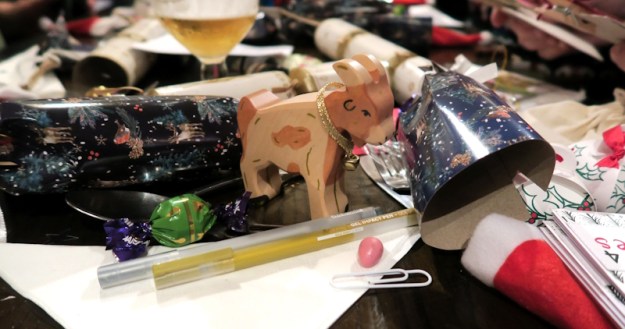
"Un-Christmas Party" 2023
– Image by boardGOATS

During the interval between main courses and dessert, GOAT Award voting forms and Christmas cards were handed out and people began thinking about the games we’ve played over the year.  Ivory collected Christmas Cards and Green collated the ballots before he announced the winners.  The GOAT Poo prize, for the worst game of the year went Dice Hospital when 7 Wonders was relegated as a previous winner.  The Golden GOAT went to Tapestry, while the epic three-way tie in Tapestry won “Moment of the Year”.  With the formalities and food finally complete, there was just the raffle, a copy of Carcassonne: Winter Edition and the Ukraine Map, which were won by Sapphire, then everyone abandoned the carnage (and Purple who helped clean up), to play something festive.
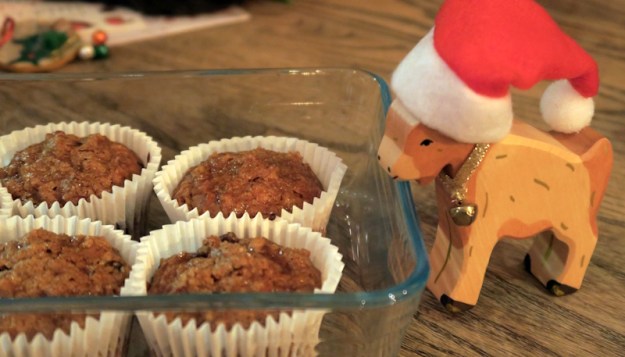
"Un-Christmas Party" 2023
– Image by boardGOATS

There was a bit of the usual indecisiveness, but eventually Blue, Ivory, Pink, Green and Pine settled down to play the “Feature Game” which was Jokkmokk: The Winter Market while Black, Cobalt, Jade, Sapphire and Lime set up Snow Tails.  Jokkmokk is a very simple game that makes use of the time-track mechanism seen in Tokaido and Namiji (played last time)—that is to say, it is an extended game of leap-frog where the player at the back jumps into an empty space of their choice and then carries out the action associated with it.  Like those games, the compromise is between moving to a preferred space which may be further forward and will ultimately will give fewer turns.  It is much simpler than both Tokaido and Namiji, however.

Jokkmokk: The Winter Market
– Image by boardGOATS

Jokkmokk is a card-driven set collecting game and is made more interesting by a large number of mini-decks, five or six of which are combined for each game.  For the first game, the group chose to use the “First Game” selection of decks (Dalecarlian Horse, Antique, Hot Dog, Patchwork, Present).  Blue went for the Patchwork cards while everyone else fought over kettles (Antiques) and Hot Dogs).  Blue’s strategy nearly paid off giving her ninety-nine points and second place, but Ivory was more efficient than everyone else with his mixture of Horses, Hot Dogs and Kettles, which gave him a hundred and one points and victory.  The game was bright and breezy and, although simple, really didn’t outstay its welcome, so the group decided to “do a Lime” and play it again.

Jokkmokk: The Winter Market
– Image by boardGOATS

This time, this time the group played with the “Gift of Giving” selection of decks (Donation, Bell, Sparkler, Snowflake, Mystery Box, Presents).  Pink went for Sparklers, knowing he would lose half his points if he had the most, but hoping to have so many that it wouldn’t matter.  Green started collecting Bells, as did Blue and Ivory, going for different colours.  Lots of Gifts were given and a good time was had visiting the fair.  Pink’s ninety points were just three more than Ivory’s total, but Blue’s hundred and seven points gave her victory at the second attempt.  Meanwhile, on the next table, the others had finally started playing Snow Tails, spectated by Purple, who had finished helping clear the table after dinner.
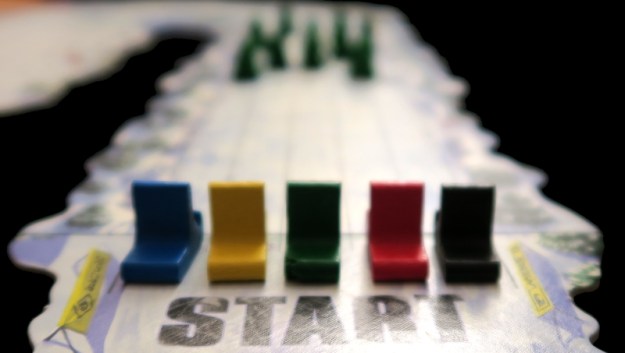
Snow Tails
– Image by boardGOATS

Snow Tails is a very popular game in the group, but somehow, one that is a little tricky to get to grips with.  The games is a card-driven sled-race with the winner the first to navigate the course.  Unfortunately, the course they chose was the one depicted in the main rules, which isn’t really intended to be a course design as it is quite long and features a Chasm right at the start, a couple of hairpins and some Saplings as well.  Each player starts with their own personal deck of cards, with five in hand.  On their turn, players can play up to three cards as they can so long as they are all the same value:  one for each sled dog, and one on the break.
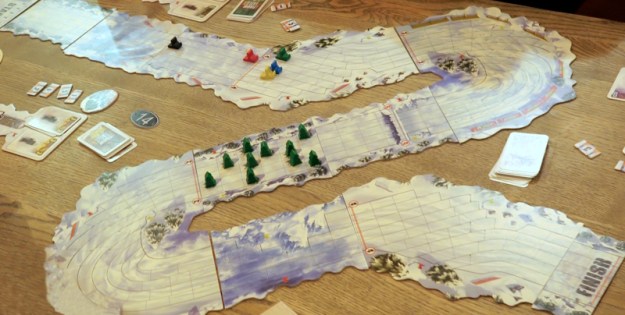
Snow Tails
– Image by boardGOATS

The speed, the number of spaces the sled moves forward, is the total for the dogs minus the value for the Break.  Sleds will additionally drift sideways the difference between the dog speeds, and if the sled is balanced (i.e. the dogs are pulling equally), the player gets a bonus speed equal to the players position in the race.  Each time a sled exceeds the Speed Limit on a corner, hits the side of the track or a Sapling, the player takes a Dent card—a useless card that just blocks the player’s hand making things difficult.  The more Dent cards a player has, the more difficult the game gets, as Black soon demonstrated.  The first game of Jokkmokk had already finished and the sleds were only just off the Start line and through the first Chasm.

Snow Tails
– Image by boardGOATS

Lime claimed the “Big Paws” token for the player with the most “Analysis Paralysis”, though to be fair, everyone suffered a bit.  Jade commented that he’d been planning to play it with his nieces, but was now rethinking the idea.  As a result, the group shortened the track (to give them a chance to finish before midnight), and from there, the game went a bit more smoothly.  Jade was first to cross the Finish line, chased by Cobalt and then Sapphire in what had been a quite epic game.  And with that, the party was over for another year, though people lingered and chatted for quite a while before everyone left the pub staff to lock up.

"Un-Christmas Party" 2023
– Image by boardGOATS

Learning Outcome:  Always plan your Christmas shopping early.
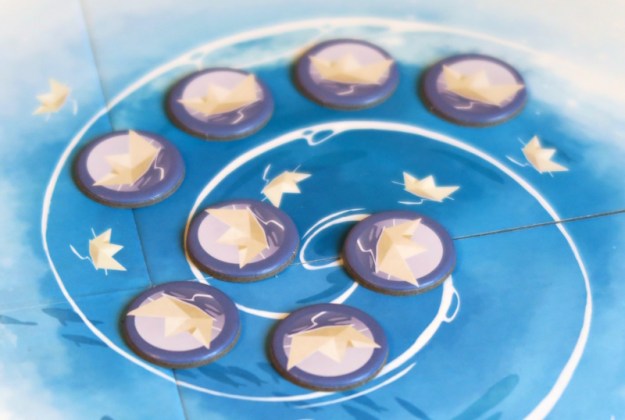
12th December 2023

Blue and Pink were just finishing their supper when Plum and Byzantium arrived, soon followed by Pine, Black and Purple, Teal, Ivory, and finally Lime.  With ten then, the first question was whether to play two games with five each, or three games with fewer.  And then it was who would play the “Feature Game“, Namiji, and who would play something else.  The decision was pretty much made when Ivory said he’d brought Roll for the Galaxy and lots of people looked interested.  Roll for the Galaxy is somehow a game a lot of people struggle with, so who played what almost sorted itself out, with the outstanding question being whether there would be a third game.

Namiji
– Image by boardGOATS

In the end, it was easier to play two games than try to come up with a third, so Ivory took Plum, Teal, and Byzantium to the other side of the room to recap the rules for Roll for the Galaxy, while Blue taught the others Namiji.  Although this was new to everyone, it is extremely to the group favourite, Tokaido.  Both games are based on a time-track, that is to say, players are traveling along a path playing a kind of “leap-frog” where the player at the back jumps forward into an empty space and then carries out the action associated with it.  The player can move forward as far as they like, but the desire to jump into a chosen space is tensioned against the fact that the further forward a player moves, the longer it will likely be until their next turn.

Namiji
– Image by boardGOATS

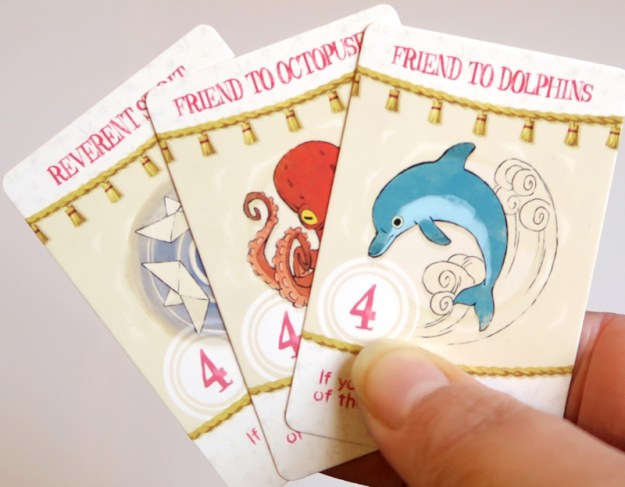
Both Namiji and Tokaido have with elements of set collecting, indeed the different actions are very, very similar between the two games, and although players are Japanese fishermen, sailing south of the Japanese archipelago in Namiji, the rubric says they are just “a few miles away from the famous Tokaido road” and that games are barely that far apart.  The “Stations” in Namiji are: Angling, Net Casting, the Crustacean Trap, the Whirlpool, the Sacred Rock, the three Panoramas and the Dock.  The last four are roughly analogous to the Temple, the Hot Springs, the Panoramas and the Inn in Tokaido.  The Angling, Net Casting and Crustacean Trap stations are a little bit different.

Namiji
– Image by boardGOATS

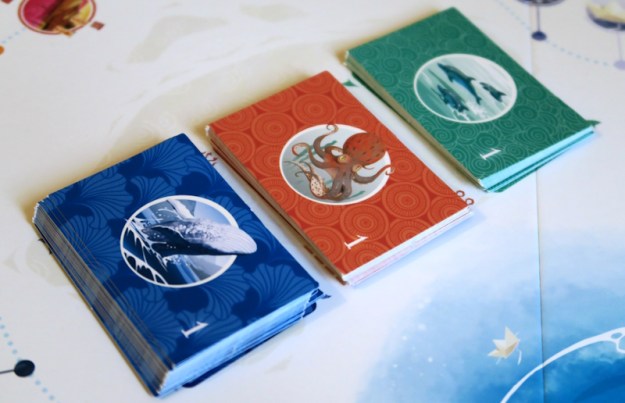
Like the Village and the Encounters, these have set-collecting elements, but fish caught when Angling or Casting are laid out in the player’s boat with points scored for rows where the colours or types are the same.  The Crustacean Trap is a push-your-luck draw from a bag where players score a point for each Crustacean drawn (up to a maximum of five), but if two crabs are drawn in the same haul, the whole lot are lost.  The biggest difference between the two games is that there is no money, which has the effect of knocking some of the slightly rougher corners off.  For example, the Inn is much harsher in Tokaido than the Dock in Namiji.

Namiji
– Image by boardGOATS

Because Food cards have to bought at the Inn and these have different costs and duplicates cannot be bought, sometimes players have to go without which costs them six points.  This is enough to effectively put a player out of the running.  In contrast, in Namiji, they are a bit of a non-event.  There are two types of card drawn at the Dock:  Food and Upgrades.  As in Tokaido, Food gives points—fewer than in Tokaido, and variable without the cost or the limit of one type per player.  Upgrades grant players permanent abilities for the rest of the game (triggered when landing on their corresponding Station.  The game ends when everyone returns to port—as in Tokaido, there are bonus points for lots of things, and that includes being early back at port (with decreasing numbers of points as players arrive later).

Namiji
– Image by boardGOATS

Although the rules were simple and the game was mostly known, the debate started when Blue had barely left the table.  The discussion centred on whether the player chosen to be first should go at the front of the track (and thus actually “go” last) or whether they should take the first turn (and therefore actually start at the back).  Black opined that the that the turn order (randomly picked) was the order players should be placed on the track, while Pine felt the person picked should be the one start.  In the end, after studying the rules (which failed to answer the question), the group went with Pine’s view, and finally started sailing.

Namiji
– Image by boardGOATS

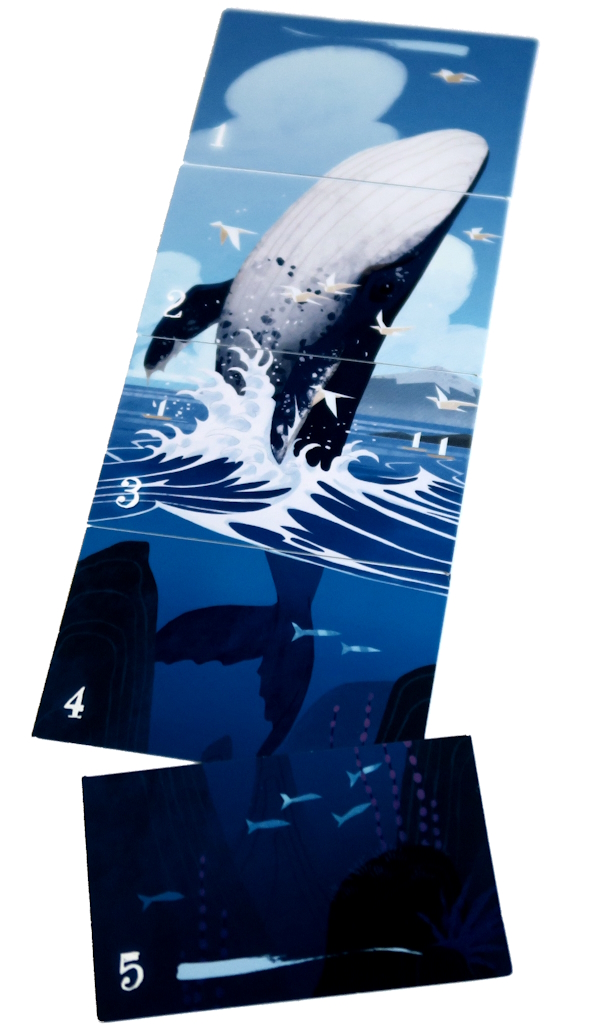
Pink was the first to complete the first Panorama (the Squid), soon followed by Lime who out-competed Purple and Pine to complete the lucrative Whale Panorama taking the bonus points for it too.  Black concentrated on setting his paper hats sailing into the Whirlpool to jettison negative points and top-scored for his catch (though there aren’t any bonus points for that).  Pine concentrated on collecting Cards and then was the first to get back to port.  Ultimately, Namiji is a game that rewards players for concentrating on one thing, and in this case that was Lime, who’s twenty-five points for his Panoramas made all the difference giving him clear victory ahead of Pine in second and Black and Pink jointly in third.

Namiji
– Image by boardGOATS

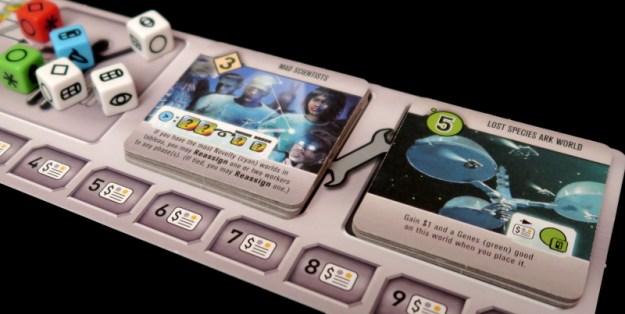
Meanwhile, on the other side of the room, Ivory had just about finished explaining the rules for Roll for the Galaxy when Blue arrived. In principle, the rules are quite simple, but playing the game well is much more difficult.  The game is based on the card game, Race for the Galaxy.  In both games, there are five phases, and players choose one each to activate.  This is important, because with more players more phases are likely to happen.  That is to say, while it is possible that everyone chooses the same phase which is the only one to happen, it is much more likely that two, three or four will be picked giving people more things to do in each round.

Roll for the Galaxy
– Image by boardGOATS

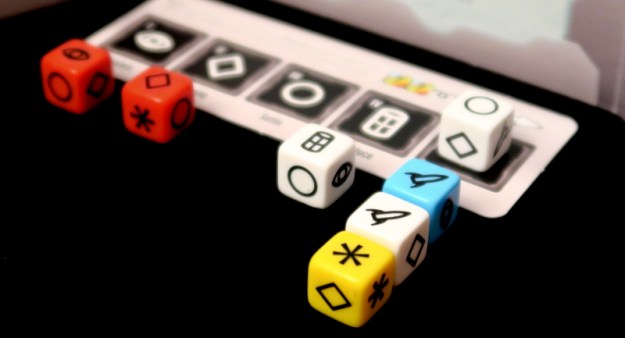
In Roll for the Galaxy, at the start of the round, players simultaneously “shaky-shaky” their dice in their Cup and roll in secret.  Then, behind their screen they secretly assign them to the different phases.  Most are assigned according to the face that was rolled, but any one can be used to decide which phase the player wants to happen.  Additionally, any one die can be used to “Dictate” the behaviour of one other die.  Once everyone has assigned their dice, everyone reveals their choices and the phases for the round are finalised.  Each player then gets to carry-out the actions indicated by their dice, returning unused dice to their Cup.

Roll for the Galaxy
– Image by boardGOATS

There are five phases in each round: Explore, Develop, Settle, Produce and Consume.  Explore allows players to choose tiles that they build in either the Develop or Settle phases, while Produce places goods on Production Worlds that can be turned into points or Credits in the Consume phase.  Used dice (those consumed or used to build) are then placed in a player’s Citizenry and only return to their Cup on payment of one Credit per die.  Thus, the game is very smooth with dice being assigned simultaneously, then moving to either of the player’s stacks of tiles to be used to pay for building, or onto one of their Production Worlds where it stay until it is Consumed.

Roll for the Galaxy
– Image by boardGOATS

Since what players can do depends on the roll of the dice, at first glance, it seems like the decisions are made by chance.  However, that just makes the decisions more key, if nuanced.  Which Worlds to build, which phase to choose, whether to Dictate to reassign a die, whether to consume to give points or cash, and overall, which strategy to choose.  And although the roll of the dice plays a big part, there are lots of dice and plenty of rolls, so the luck averages out, though players have to surf their luck.  The game ends at the end of the round when a player builds their twelfth World, or when the pile of Victory points runs dry, and in this sense, although the game is about rolling dice, it is still a race, a race to build an engine, score points and finish the game.

Roll for the Galaxy
– Image by boardGOATS

The game began with the rattle of the simultaneous “shaky-shaky” as dice rattled in everyone’s Cups.  At the start of the game everyone wanted to Explore and build, but what depended on strategy.  Blue started with a military strategy dictated by her first Development which gave points for red dice at the end.  Ivory also planned his game around his Developments and their bonus points, but built his engine based on reduced costs to build and to Dictate.  Teal and Sapphire chose to follow a conventional “Produce-Consume” victory point strategy, while Plum tried a bit of everything.

Roll for the Galaxy
– Image by boardGOATS

Roll for the Galaxy is a little bit “multi-player solitaire”, with everyone concentrating on their own engine and deciding what they want to do.  However, the winner has to take advantage of the fine margins and that means watching what other players are doing and anticipating and then taking advantage of their choice of phase when they can.   This time, the end was triggered by Ivory, who accelerated quickly out of the traps thanks to his early choice of Development Worlds, and ultimately finished with thirty-six points for his buildings and ten bonus points giving him a runaway victory.  A very creditable second place went to Byzantium, the only player who had never played either Roll or Race for the Galaxy before, with Blue completing the podium.

Roll for the Galaxy
– Image by boardGOATS

Learning Outcome:  Sometimes when you win you have a Whale of a time!

UK Games Expo 2022

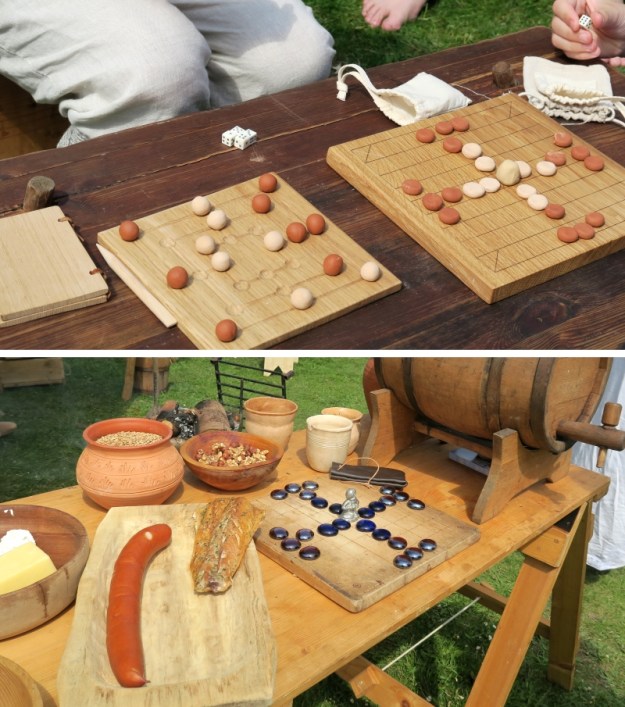
Today was the first day of the fifteenth UK Games Expo.  After the cancellation two years ago and the subdued event last year, it was almost back to normal this year.  On arrival, outside the NEC, there were vikings in their camp, playing Hnefatafl with their visitors.

Hnefatafl
– Image by boardGOATS

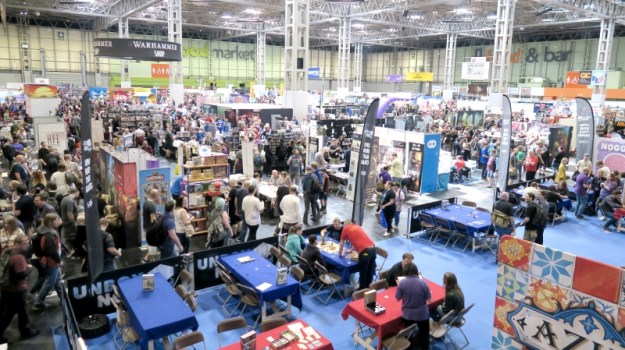
It seems blinging games has been a thing for over a millennia, as the vikings were proudly showing off their pimped out copy.  Inside, the halls were busy, but not overcrowded, though of course this was Friday, traditionally the “quiet day”.

UKGE 2022
– Image by boardGOATS

Just inside the door was the Burley Games stand with a shelf of variants of Take it Easy!—an unwanted reminder of playing games remotely through Teams for eighteen months, albeit as one of the games that worked quite well in that format.

UKGE 2022
– Image by boardGOATS

Nearby was the Oink Games stand, showing off the newly Spiel des Jahres nominated, SCOUT and just round the corner, the staff from the Oxford-based Osprey Games were obviously delighted that their game Cryptid had received a Kennerspiel nomination and were keeping their fingers crossed that it would go one further.

SCOUT
– Image by boardGOATS

Hall One was also the home to Fire Tower, a clever puzzle game with the tag line, “fight fire with fire”.

Fire Tower
– Image by boardGOATS

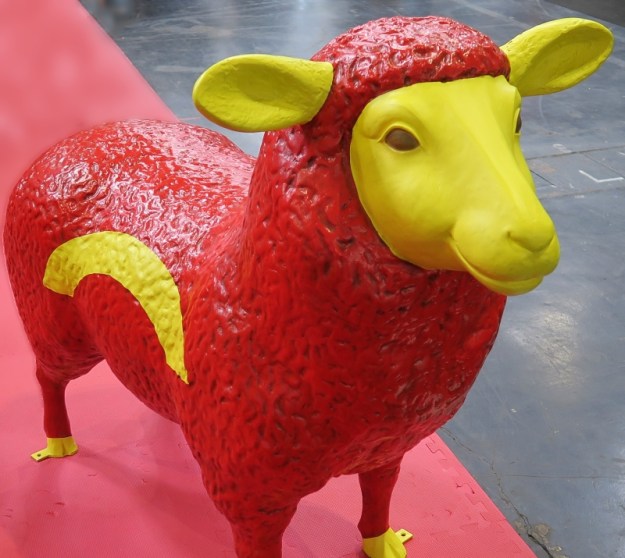
As well as a very smiley sheep from Catan, there were also a lot of designers about, including Tony Boydell, Alan Paul, Andy Hopwood, Bez Shahriari, Rob Harper and Matt Dunstan, all sharing their games and chatting with gamers.

UKGE 2022
– Image by boardGOATS

There were a number of interesting little British games, including Daring Dustbunnies and Deckchairs On The Titanic, which were on neighbouring stands, while Surprised Stare were selling a special tribute to the festive weekend called Corgi Dash (based on the 1986 Spiel des Jahres winner, Heimlich & Co.).

UKGE 2022
– Image by boardGOATS

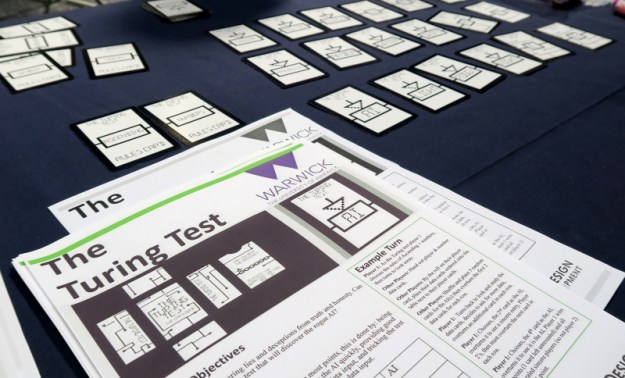
Universities of Warwick, Chester and Canterbury were all present, variously advertising their courses in game design and demonstrating how gaming can be used as a learning device.  One Warwick (IATL) computer science student showed a game he designed to demonstrate the Turing Test and how people are poor at understanding randomness.

UKGE 2022
– Image by boardGOATS

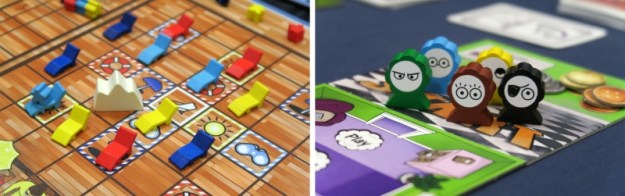
There were also previews of upcoming games.   These included Namiji, a game which has the same theme and uses the same basic mechanic as Tokaido, but increases the complexity with more challenging steps along the way.  Namiji was demonstrated at Essen in 2019, but like so many things, fell foul of the global pandemic in the interim.

Ticket to Ride: San Francisco
– Image by boardGOATS

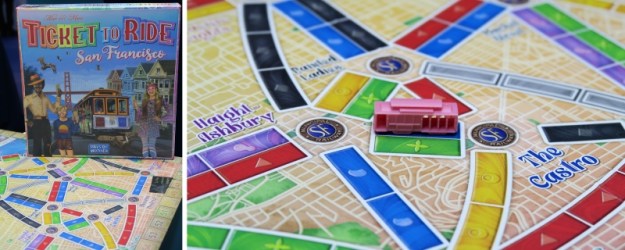
The new Ticket to Ride game which will be released later this year was also available to see and play.  It is based round the city of San Francisco and features street cars and follows the successful format of a new map and a slight rules tweak.

UKGE 2022
– Image by boardGOATS

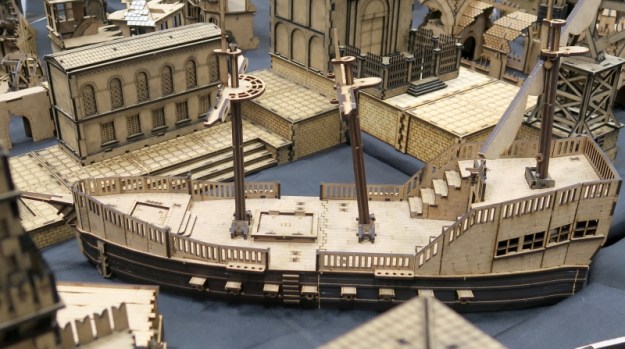
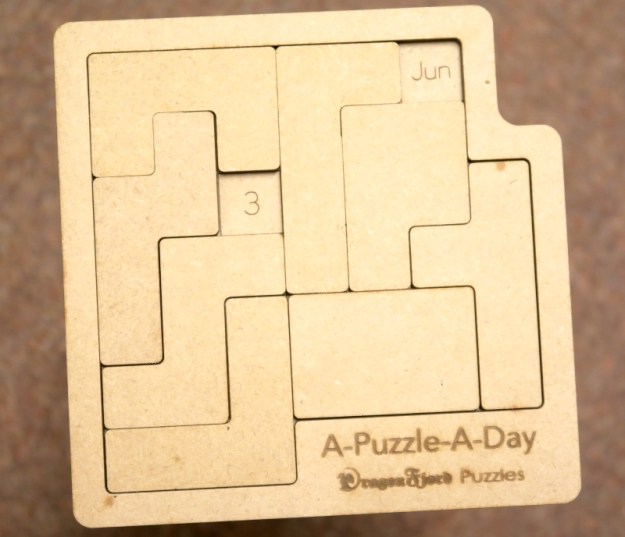
Aside from games, there were also a lot of stands selling books, costumes, props, and scenery—these days, the distinctive aroma of singed wood pervades the aisles of games conventions as an homage to the laser cutter, which is used to make everything from wooden boxes, to houses, coasters and puzzles.

UKGE 2022
– Image by boardGOATS

All in all, the return to face-to-face conventions was a date to remember.  UK Games Expo continues until 4pm Sunday 6th June.

Essen 2019 – Update

Sunday was the last day of this year’s Internationale Spieltage, the largest games fair in Europe (and arguably the world), known to gamers worldwide simply as “Essen”.  Although there was a lot of buzz about some of the hot games like Maracaibo and Cooper Island, it is the smaller, less well-known games that really make the fair what it is.  For example, Firefly Dance, is a fun little memory game with gorgeous little light-up fireflies activated with a wooden magic wand.

Firefly Dance
– Image by boardGOATS

Some games sold out within minutes: the last copy of Tapestry went in less than half an hour, and other early sell-outs included Alubari: A Nice Cup of Tea, A Fistful of Meeples and Point Salad.  There were lots of good deals to be had, including Passing Through Petra, one of the hot games from last year which was reduced from €60 to just €15.  Part of this might have been to attract attention to the Renegade Games stand because according to staff their entire supply of this year’s releases were “stuck in customs”.  This included their copies of Paladins of the West Kingdom (the sequel to last year’s smash hit, Architects of the West Kingdom).

Ticket to Ride Map Collection: Volume 7 – Japan & Italy
– Image by boardGOATS

There were also a number of other unusual games available, for example, Wsiąść do Pociągu: Polska, the new Poland map for Ticket to Ride, as well as the more widely available new Japan/Italy Map Collection.  There were other expansions as well, including the European Birds expansion to Wingspan, Sagrada: The Great Facades – Passion and Terraforming Mars: Turmoil.  In addition to expansions, there were several stand-alone re-implementations of old favourites, including the new 6 Nimmt! Brettspiel (boardgame), Glen More II: Chronicles and Azul: Summer Pavilion.

Azul: Summer Pavilion
– Image by boardGOATS

Games fairs are also about demonstrations of games that have not yet been released.  There were many of these, but one of the highlights was perhaps Namiji which is the sequel to Tokaido and will be the subject of a crowd-funding campaign in a month’s time.  So there is much to look forward to  from the Essen haul, old games as well as new, which will make the coming months very exciting indeed.

Namiji
– Image by boardGOATS