Tag Archives: Pandemic

Boardgames in the News: Games on Radio 4

BBC Radio 4 often has short articles on games and from occasionally has longer programs that are dedicated to games or playing.  Recent examples include the “Why we Play” series and an episode of “Start the Week” discussing Videogames.  There has also been an episode of the magazine program “All Consuming“, dedicated to board games.  This is presented by Charlotte Stavrou and Amit Katwala and discusses everything from the Ancient Egyptian game of Senet to more recent classics like Azul, Monopoly and The Settlers of Catan.

Azul
– Image by boardGOATS

During the program, there are interviews with Dan Jolin, co-founder of the magazine, Senet and the World Monopoly Champion, Nicolo Falcone; there is also a visit to the Orc’s Nest in Covent Garden.  Traditional and historical games like Mancala, Chess, The Game of the Goose, Snakes and Ladders and Backgammon are discussed at length together with their history.  Moving on to more modern games, Articulate!, Splendor, Ticket to Ride, and Pandemic all get a mention.  The presenter, Amit Katwala also visits the hugely prolific designer Reiner Knizia in his office in Munich where he keeps a library of all his games including The Quest for El Dorado, Samurai, Lost Cities, Gold Rush, and Lord of the Rings.  There, they discuss how “critical mass” is important for success—reaching enough people is the key Dr. Knizia explains, and is why games like Go and Chess are so popular.

All Consuming
– Image from bbc.co.uk

Last week there was also an episode of the comedic science program, “The Infinite Monkey Cage” with presenters Brian Cox and Robin Ince featuring Marcus de Sautoy from the Maths Department in Oxford, games designer Dave Neale and comedienne Jessica Fostekew. This begins with an introduction about playing Cluedo, moving on to a discussion about the definition of a game—something the philosopher Ludwig Wittgenstein apparently struggled with.  One possible definition discussed is that playing a game is a voluntary attempt to overcome unnecessary obstacles.  From there, conversation progresses to how people often refuse to play with those who are perceived as being good at playing games; Marcus de Sautoy explaining the maths behind his strategy for winning at Monopoly, and why Snakes and Ladders is so popular.

Senet
– Image by boardGOATS

There is also a game of Rock-Paper-Scissors (which makes interesting radio) with discussion about the World Championships, how to win and the fact that it isn’t as random as one might think.  There is a lot of discussion about modern Euro games as well as more traditional games and historical games, with Senet, The Mind, Cheat, Escape from Colditz, Rummikub, Royal Game of Ur, Scrabble and some of those mentioned above amongst those featuring.  The discussion touches on John Nash and Game Theory, the Prisoner’s Dilemma, The Ultimatum Game and the Golden Ratio.  For those who are interested in board games and gaming, this episode of The Infinite Monkey Cage is well worth a listen and both it and the episode of All Consuming are currently available on BBC Sounds.

The Infinite Monkey Cage
– Image from bbc.co.uk

Boardgames in the News: Role-playing Climate Resilience

It was nearly ten years ago that Stuart West, a Professor of Evolutionary Biology in the Department of Zoology, Oxford, used playing board games as a teaching tool to understand evolution and published his results in the prestigious scientific journal, Nature.1 Now, Matt Leacock‘s new game, Daybreak has been reviewed in the journal Science.2

Daybreak
– Image from amazon.com

Matt Leacock is best known for the cooperative game, Pandemic.  However, while thirty of his forty-seven published games are cooperative (including the well popular Forbidden Games series), he has also been instrumental in the innovation of legacy games, co-designing both the Pandemic Legacy series of games and the recent Ticket to Ride Legacy: Legends of the West.

Daybreak
– Image from amazon.com

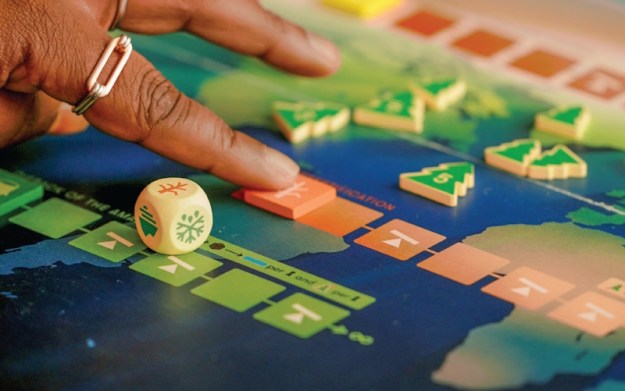
Daybreak is cooperative game about climate action where players controls a world power, Europe, the United States, China, and the Majority World, each of which has different energy demand and sources, emissions, resilience, and vulnerable populations.  The idea is that players deploy policies and technologies to deal with the engine of global heating and to try to build resilient societies that protect people from life-threatening crises.

Daybreak
– Image from amazon.com

The author of the article is Science‘s books and culture editor, Valerie Thompson who concludes that the trade-offs in the game reflect those seen in real life.  Most importantly, however, where climate change is concerned, we only stand a chance if we work together.

1 West, S., Nat. (2015), 528, 192; doi:10.1038/528192a.
2 Thompson, V., Science. (2023), 382(6673), 890; doi:10.1126/science.adl4244.

13th June 2023

Lime was first to arrive, soon followed by Blue and Pink, and then Pine who were all delighted to see the return of our favourite bar staff.  There was a lot of chat about the recent changes at The Jockey (which is currently managed by the Healy Group who also run the Punch Bowl in Abingdon), and as everyone else arrived, people seemed more interested in gossiping than playing games.  It was a relatively quiet night with quite a few people away.  Black and Purple sent a message to say they were thinking of us, but when Green received a photo from Black and Purple of their current view, it just made everyone else jealous.

Black and Purple in Cornwall
– Image by Black

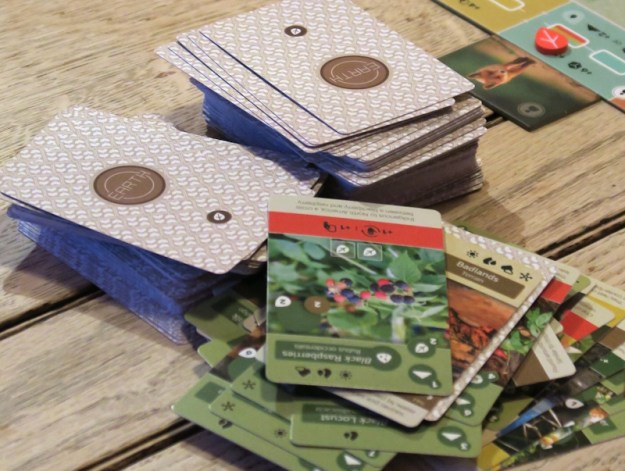
Jade arrived with his shiny new copy of Earth which he’d picked up from UK Games Expo.  It is a game where players are building themselves an ecosystem and was to be the “Feature Game“.  Earth is a sumptuously illustrated, card-driven engine-builder that is often compared to Wingspan.  We played that Last time after a bit of a break, and remembered how much we liked it, so had decided to give Earth a go this time.  The heat was getting to some people, but Ivory was quite keen to give Earth a go, and they were soon followed to the next table by Green (who had played it online) and then Teal.  Everyone was pretty new to the game:  Ivory and Teal had not played it before and Green and Jade had only played a couple of times.

Earth
– Image by boardGOATS

Although there is a lot to explain before starting, Earth itself is not actually all that complicated. Players are building a four by four grid of Flora and Terrain cards which represents their island and during the game they will plant flora, water it and allow it to grow.  On their turn, players do one of four things: Planting (paying the cost in Soil tokens), Composting (gaining Soil and placing cards from the deck in their discard pile), Watering (place Sprouts and gain Soil) & Growing (draw new cards and place growth tokens).  A bit like Puerto Rico, once the active player has chosen which action they are taking, everyone else gets to do a subsidiary, slightly weaker version of the same action.  For example, when Planting, the active player plants two cards, draws four and keeps one, while the other players plant one and draw one.
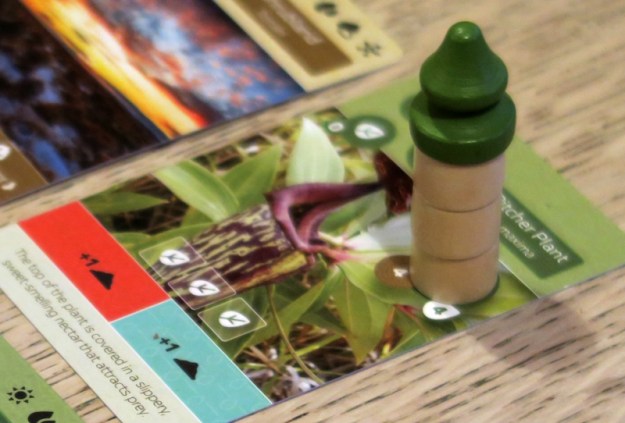
Earth
– Image by boardGOATS

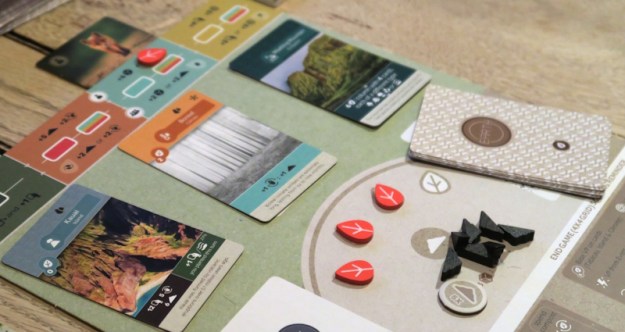
Once everyone has completed the action for the turn, everyone activates all the cards in their island that match the colour of the action chosen, starting with the card in the top left and working across each row in turn.  This means, not only is it important which cards are played, but also where they are located in the player’s island.  At the end of the game (triggered when one player has completed their island), players score points for each flora card, any Trunks and Canopies they have grown, their Sprouts and their pile of “Composted” or discarded cards.  Players also score points for achieving objectives on the Fauna cards revealed at the start of the game and for completing their island first.
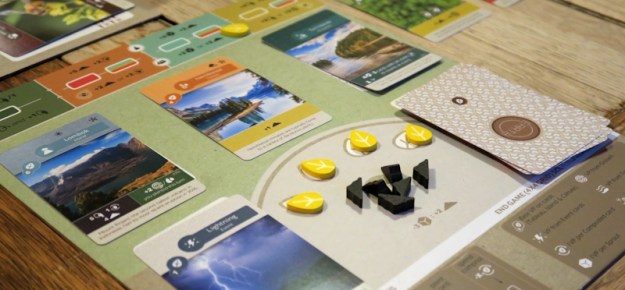
Earth
– Image by boardGOATS

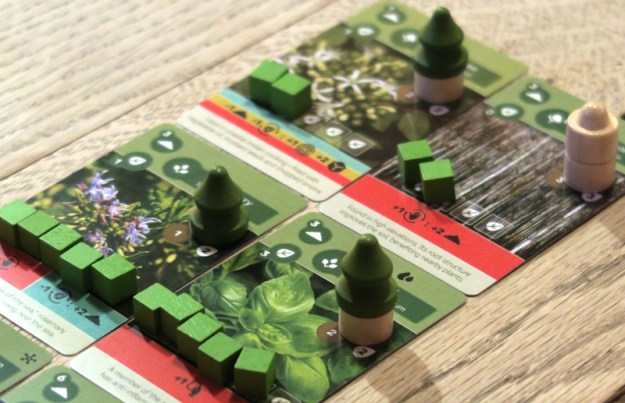
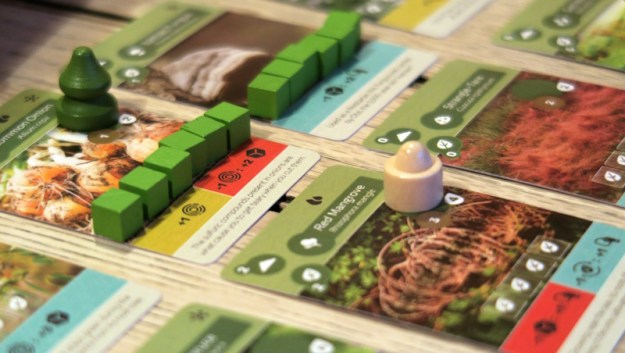
As in Wingspan, Flora cards have actions that take effect when they are planted and when activated, many of the Terrain cards have ongoing effects and/or end-game scoring opportunities.  When Planting, players must place the cards either orthogonally or diagonally adjacent to an existing card, and although they can never exceed a four by four grid, like in Kingdomino, players can extend on either side of their island until the maximum size is reached.  Each Flora card has a maximum growth and when this is achieved the final wooden Growth token placed on it is a Canopy showing it will score extra points at the end of the game.
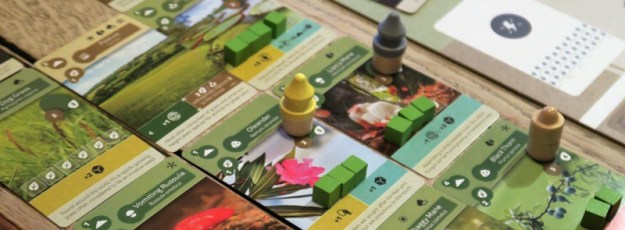
Earth
– Image by boardGOATS

The challenge in Earth is really in deciding what actions to do and which cards to play into your tableaux.  Teal found that simply building his tableaux was enough to think about without considering the extra goal cards and end game scoring.  Jade and Green both agreed that was the same for their first game too.  Ivory started and played his first few turns, selecting the green Plant action, so his tableaux filled up quickly. The rest of the group needed to choose other actions in order to get the soil and cards to play, so by the time it came back to ivory he was able to plant again.  He had already had his eye on the bonus cards and was quickly planting as many cards as he could, successfully—he was the first to claim a bonus.
Earth
– Image by boardGOATS

Green started with a high scoring climate card which gave him fewer cards at the start, but better in game bonuses, an approach to the game that nearly paid off. He went for the brown scoring cards, but Ivory just pipped him at the post for that particular shared bonus, which helped up his score as well.  Teal spent the first half of the game, learning and began to fall behind.  It wasn’t until Ivory claimed the first shared bonus that he remembered those cards.  Early on he gained lots of Sprouts which are worth points, however, it is possible to gain a whole lot of Sprouts in the latter stage of the game and use those early actions for other more beneficial things.
Earth
– Image by boardGOATS

Jade was quietly working away to build a tableaux engine that worked for him, but was falling behind Ivory and Green on the shared bonuses.  Jade managed to pick up some of the Fauna bonuses later, but mostly after the others so they weren’t as highly scoring.  Green went for brown scoring cards because he kept picking them up from his nearest pile (there were two draw piles), and eventually reverted to the other pile to find green Flora cards.  Unfortunately, he just couldn’t find the double powers he needed for the shared bonus.  On the opposite side of the table, Teal didn’t come across any brown scoring cards, only realising why at the end of the game—it seams the shuffling had left something to be desired. The Event cards also seemed to be clustered towards the bottom of the draw pile.
Earth
– Image by boardGOATS

Ivory came out on top with a very high score of two hundred and thirty-six with Green just eighteen points behind and Jade in third.  There was much discussion about similarities between Earth and other games. Green felt it was similar to Terraforming Mars, the others thought it was more like Wingspan.  After some thought, Green came round to this idea as it is about playing cards which then provide  more actions and bonuses that can be played on those cards (eggs in Wingspan, Sprouts in Earth; tucked cards & cached food in Wingspan, Growth in Earth).  The others could also see Green’s thoughts about Terraforming Mars though as the game has lots of pretty and individual cards that can be played or rejected, with some providing actions, some bonuses and the all important Events.  Everyone really liked it and definitely wanted to play it again, though better shuffling would be a good idea.
Earth
– Image by boardGOATS

Meanwhile, the rest of the group carried on chatting all agreeing they should play something, but nobody terribly keen to commit to anything.  Eventually, Blue suggested Bohnanza, and as Pine agreed, Pink had to go along with it.  This is an old favourite, though Pink had gone off it a bit as he felt he always did badly—unfortunate really given the number of copies of the game that he owns.  The game is very simple:  keeping their cards in the order they are drawn, players must plant the first bean card from their hand and may plant the second if they have space.  They then turn over the top two cards from the deck and can play these or trade them as they prefer.

Bohnanza
– Image by boardGOATS

Finally, once both of these have been planted, the active player may trade cards from their hand before drawing three replacement cards.  Players can harvest their Bean Fields whenever they like, but the amount of money they get depends on how many Bean cards it has in it and what the beans are—scarce ones give a better return, but are harder to get.  Everyone knows the game quite well, though Lime had recently acquired and been playing a new anniversary edition and it seems some of the rules are slightly different for that.

Bohnanza
– Image by boardGOATS

This time, everyone bought a third Bean Field (which makes it easier to hang on to the rarer beans a little longer).  Indeed, Lime was so determined to use his, he ended up not trading, just so that he had something to plant!  As usual it was quite a close game with fine margins.  So little things like Blue harvesting her Red Beans only to immediately draw another and Pine gifting Pink a Wax Bean or Lime trading with Pine instead of Blue made a difference in the final score, though nobody knew it at the time.  Ultimately, Pink was the victor, beating Blue by just two Bean Thalers with Lime a couple behind her in third.  On the plus-side, Pink can’t complain that he never wins any more.
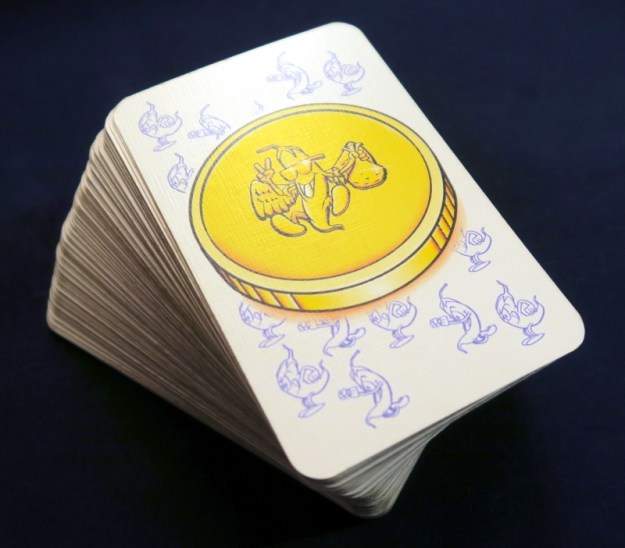
Bohnanza
– Image by boardGOATS

Earth was still underway, and for once in a way, Bohnanza had played relatively quickly, so there was plenty of time for something else.  Nobody was very focused, and eventually the group settled on the cooperative game, Forbidden Desert.  This is a sort of sequel to Forbidden Island, which itself is a simplified version of the popular gateway game, Pandemic.  All three of these games use the same mechanism as Zoo Break, which we played recently.  Essentially, the active player carries out actions and then they reveal cards from a deck which generally make life difficult: releasing wild animals, causing the island to gradually sink, spreading disease, or in the case of Forbidden Desert, burying the play area with sand.

Forbidden Desert
– Image by boardGOATS

The premise of Forbidden Desert is that the team have crash-landed in the desert and need to find the components of a flying machine and take them to the launch pad to escape.  The game is played on a five by five grid of square Tiles, with a gap in the centre representing the sand storm.  Each player has a character with special powers.  This time, Lime was the Climber, Pink was the Navigator, Pine was the Explorer, and Blue was the Water Carrier.  On their turn, players can take up to four actions:  Move (one action per Desert Tile), Remove Sand from the Desert Tile they are on or an adjacent one, Excavate a Desert Tile (i.e. turn it over), or Pick up one of the four component parts of the flying machine.

Forbidden Desert
– Image by boardGOATS

Lime started.  Once he had cleared some sand and turned over a couple of Desert Tiles, he started turning over Sand Storm Cards.  These indicate which direction Tiles should move to fill the hole, and how many Tiles should be moved, one, two or three.  Each of the Desert Tiles moved then have a Sand Tile placed on them—a single Sand Tile needs to be cleared before the Desert Tile can be Excavated, but two or more additionally obstruct players preventing them from passing (except for Lime who, as the Climber, can cross Sand Dunes of any height).
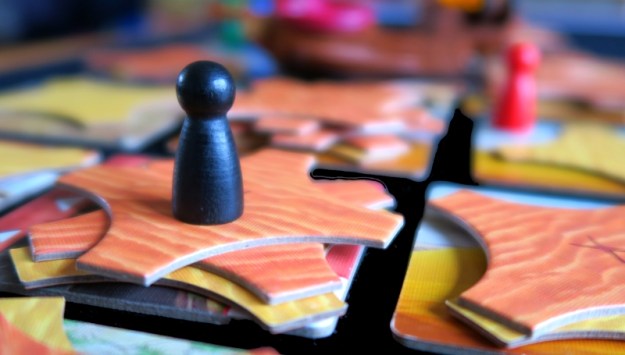
Forbidden Desert
– Image by boardGOATS

Pine went next and used his special ability—everyone else could clear orthogonally adjacent Tiles, but he could to work diagonally as well.  It wasn’t long before the first “Sun Beats Down” card appeared.  These cause everyone to use water, so as the water carrier (and the only one who could make multiple visits to the Oases and collect water, Blue topped up Lime, who had started with less water than everyone else.  The group gradually started revealing tiles, finding a Duneblaster, a Solar Shield and a Time Throttle, but the Storm picked up and before long the group were turning over more Sand Storm Cards.  Pink located the Propeller for the flying machine and then the engine, the group were making progress, but it was all too slow.
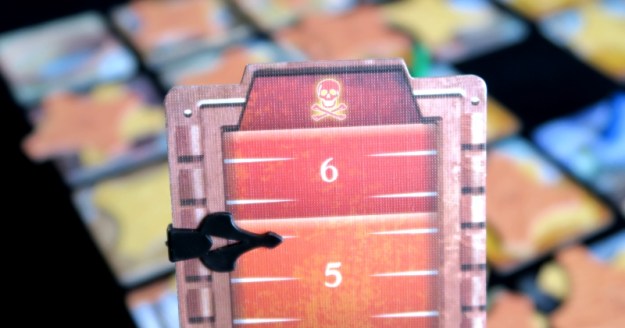
Forbidden Desert
– Image by boardGOATS

Before long it became apparent that the Sand Storm was getting the better of the group and the hiding in the Tunnels wasn’t helping.  Determinedly, the group fought against the rising tide of Sand making good use of their Duneblaster, but it only delayed the inevitable.  Blue, Pine and Lime were discussing a plan to play a Storm Tracker, but when they were briefly side-tracked, Pink played on without it and everyone suffered as a result.  So Pine labelled him as a Saboteur as a consequence.  In such a finely balanced game at such a critical point, it could have made a difference, but in all probability it only hastened the inevitable demise as the group were sadly buried under the ever growing sand dunes and ran out of Sand Tiles (one of the end game conditions).  It was a deflating end to the evening, but given the heat, probably appropriate.
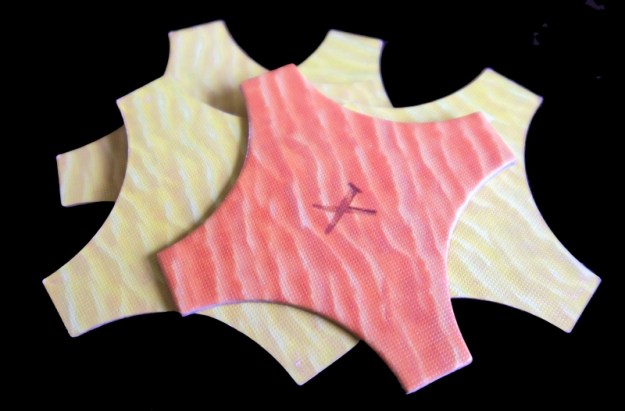
Forbidden Desert
– Image by boardGOATS

Learning outcome:  Shuffling is an important skill.

Boardgames in the News: Asmodee Changes Hands Again and Lots of Money is Made

Asmodee started life as a small French company best known for clever little Snap-variant card game, Dobble.  However, a series of mergers, buyouts and distribution agreements has left the company with a stake in some of the best known modern games including Ticket to Ride, Settlers of Catan, Pandemic and Carcassone.  As a result, the company is arguably the most dominant force in the world of modern board games.

Dobble
– Image adapted by boardGOATS

Paris-based private equity house Eurazeo had owned Asmodee for four years, when three and a half years ago, they sold it to another private equity firm, PAI Partners.  At the time, Asmodee, had an enterprise value of €1.2 billion, making €565 million for Eurazeo and its investors and giving a return of about 35%.  Over the last year, Asmodee acquired Plan B Games, the US retailer Minature Market and, following its success during the global pandemic, the games online platform Board Game Arena.  This activity was building towards another potential sale and last autumn, with PAI Partners making preparations to sell Asmodee for a reported €2 billion.

PAI Partners
– Image from paipartners.com

Then, just before Christmas a deal was announced with Sweden’s Embracer Group AB for €2.75 billion.  Embracer Group AB were formerly Nordic Games Licensing AB and THQ Nordic AB and are a Swedish video game company based in Karlstad.  Under this deal, Asmodee would continue to operate much as before, as an operating group within the Embracer Group.  No reorganization is expected and Asmodee’s CEO Stéphane Carville together with his management team would continue in their current roles.

Embracer Group AB
– Image from embracer.com

9th September 2021

Burgundy, Pink, Blue, Green and Lilac arrived early for food, and while they were waiting squeezed in a very quick game of No Thanks!.  Lilac was new to the game, but it didn’t take long to explain: take the card in the middle and any chips on it, or add a chip to the pile to pass the problem on to the next person.  At the end of the game, players total up the face value of their cards and the winner is the player with the lowest score.  The clever part is that any runs only score for the lowest card, but some cards are removed from the deck before the start.

No Thanks!
– Image by boardGOATS

Blue started off picking up cards, but unfortunately for her she continued picking up cards and was unable to connect them leaving her with a massive score of eighty two.  Lilac finished a very creditable joint second with fourteen, tying with Burgundy.  Green was the eventual winner though with only ten points for his cards and seven chips left over giving a final score of just three.  As the game came to an end food arrived and as they tucked in, everyone else started to arrive too.  It was about then that Pink got himself into a spot of bother, appearing to suggest that Blue should look more like Keira Knightley…

No Thanks!
– Image by boardGOATS

Everyone was aghast, and as Pink tried to explain that he was referring to how organised she was in The Devil Wears Prada, until Burgundy commented, “When you reach the centre of the earth you should stop digging.  It was only some considerable time afterwards that Pink realised that Ms Knightley wasn’t in Devil Wears Prada after all, but it was actually Anne Hathaway (she of cottage fame).

Fossilis
– Image by boardGOATS

After a bit of ribbing and some shenanigans with gnocchi and ice cream, the group split into two and settled down for the “Feature Game“, which was Fossilis.  This is a game with an unusual theme where players are collecting dinosaur fossils for their museum.  It uses an “action point” mechanism which is perhaps best known from the “Mask Trilogy” of games (Tikal, Java, Mexica), but has been widely used over the last twenty years in games as varied as Torres, Bus, Pandemic, Tawantinsuyu, Takenoko, Dinosaur Island and many more.

Fossilis
– Image by boardGOATS

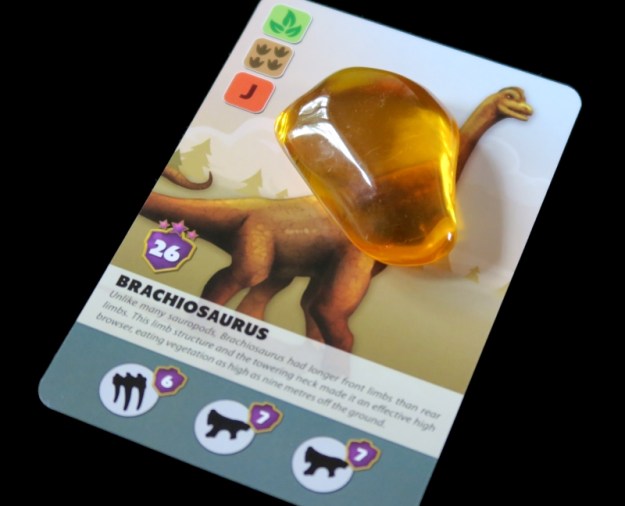
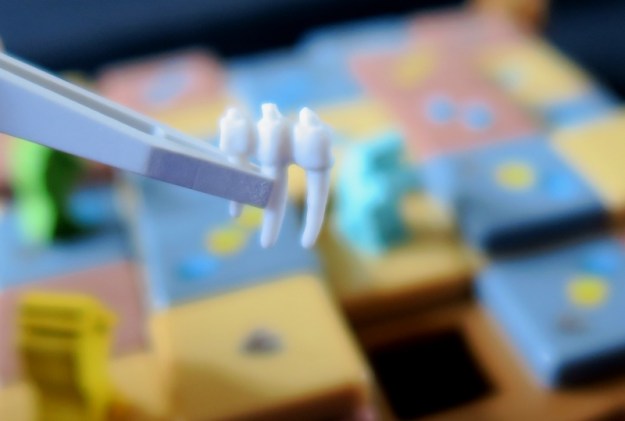
It is a very simple idea: each action has a cost and players have a set number of “points” they can spend doing actions on their turn.  In some games this mechanism is present, but hidden, while in others it is the main driver of the game; Fossilis falls into the latter category.  Players have four action points to spend on their turn, using them to move stone, clay or sand (dig), collect plaster (for making fossils) or use tweezers to fish in a nearby pit (in a manner reminiscent of Operation) to find a hammer or use plaster to claim a fossilised bone.  Once per turn, players can also trade eggs, resin and “footprints” for Tool or resource cards, and take a dinosaur card from the market and add it to their lab.

Fossilis
– Image by boardGOATS

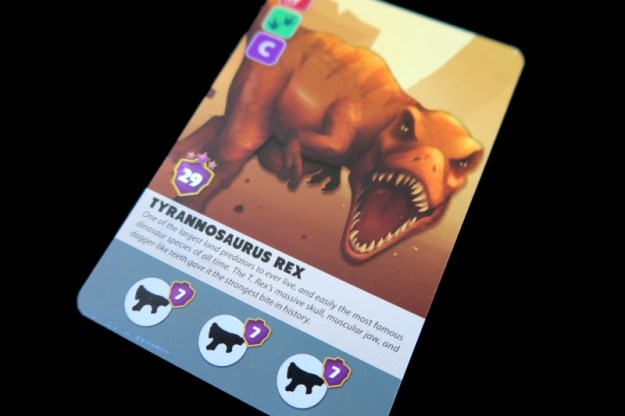
The idea of the dinosaur cards is that they allow players to exchange fossilised bones for identified dinosaur bones which are more valuable.  If a player manages to collect all the bones for a given dinosaur, they are more valuable still.  At any point during their turn a player can claim a dinosaur from the market if they can complete it fully, otherwise, dinosaurs have to go via their lab. This is not the only way to score points though—dinosaurs also have three characteristics and at the end of the game, players who have more than three of a type score points for it.

Fossilis
– Image by boardGOATS

Players also score points for a full set of nine and having the majority of in a characteristic.  The game uses an interesting timer, where a set amount of plaster is made available and when this has been used an event card is revealed.  After the event has been resolved, the pool of plaster is replenished and the game continues.  Once the third event has been revealed, there is one final pool and one last round before the final scoring.  The player with the most points is the winner.  This time we had two games running, one with Pine, Ivory, Green and Lilac, while Burgundy, Blue, Purple, Pink and Black played on the next table.

Fossilis
– Image by boardGOATS

On the first table, Ivory & Pine were new to the game. Pine said he had always been useless at Operation, but liked the dinosaur theme, while Ivory admitted to being initially sceptical about it. Ivory went through the game without any additional hammer bonuses instead concentrating on getting all nine of the dinosaur characteristics using the supplies to good effect.  Pine took an early lead collecting artefacts for tools and supplies.  Green obtained the Jack Hammer power tool and in the later part of the game used it to open up centre of the dig site only to destroy the first skull found in the game and mangle a hammer, thus making that square useless.

Fossilis
– Image by boardGOATS

Lilac had won her previous game of Fossilis (played against Green, Purple and Black a few days earlier) and tried the same strategy of gaining extra points for complete dinosaurs. Unfortunately she got the bonus too late in the game to make it work for her and with Pine and Green targeting the same dinosaur characteristics they ended up cancelling each other out.  That left only one winner, Ivory, who trampled Pine as he passed leaving him in second place.  Although the game clearly took longer than the advertised forty-five minutes the game moved along swiftly and finished well before the other table.

Fossilis
– Image by boardGOATS

Adding the fifth player clearly slowed things down for several reasons.  Firstly, although people tried to plan their turn in advance, inevitably the game state changed meaning players had to start again.  Worse, players struggled to see into the dig site to see what was available in the pits.  This meant players often had to wait for their turn and have the dig site passed to them and plan from there.  The length of the game was exacerbated when the Patronage event card appeared and everyone except Purple took six pieces of plaster.  Purple and Black had played the game a few days before, but Burgundy, Pink and Blue were new to the game, though Burgundy had done some research online.

Fossilis
– Image by boardGOATS

Burgundy’s research suggested that the best strategy was not to focus on completing dinosaurs fully, but to concentrate on getting as many dinosaurs as possible.  This leads to a loss of value for the dinosaurs when they are scored during the game, but can pay off at the end of the game when the bonuses for characteristics are scored.  This is because each dinosaur has three characteristics each of which can score three times:  once if the player has three, twice if they also have the most, and three times if they have a full set of nine.  This can more than make up for points “lost” by failing to complete it fully.

Fossilis
– Image by boardGOATS

Pink had not done any research in advance so tried the opposite and focussed on completing his dinosaurs and took a skill tile that enabled him to pick up the top tool tile for free every time he did so.  Blue took a skill tile which allowed her to move stone for one less action point while Black took a skill which allowed him to work on two dinosaurs in his lab at once.  Purple could have done with a skill tile that would help her stay on the dig site or get back on for free, because people kept pushing he off, but unfortunately there wasn’t anything like that available.

Fossilis
– Image by boardGOATS

In the closing stages, Blue and Pink had a significant advantage, but Burgundy picked up a few more dinosaurs at the end of the game and then started raking in the bonus points.  He finished some twenty points ahead of Blue and Pink who were separated by a single point and took second and third.  There was quite a bit of chit chat about the game as they ended.  Ivory said he liked it, much more than he was expecting and would definitely like to play it again. As for Pine, well, the game has dinosaurs and anything with dinosaurs gets his approval, even if some of them look like they’ve been drawn by that kids, playing that game where they drawing different parts and put them together at the end.

Fossilis
– Image by boardGOATS

Blue was less impressed.  The feeling on the other table was that the scoring was off a little and there wasn’t a strategy that would beat the “get as many dinosaurs as you can” plan.  Certainly five players was too many and perhaps three would be a sweet-spot.  Pink was keen to give it another go, but although everyone else on that table would play it again if someone else wanted to, they all said there were other games they would choose first.  That said, it is a fantastic theme and very unusual and the deluxe edition of the game comes with a lot of expansions to add variety, and it is possible that they might add changes to the balance of scoring too.

Fossilis
– Image by boardGOATS

Green, Lilac, Ivory and Pine finished a long way ahead of the other table, and as Lilac had never played Love Letter, it got its third outing in as many sessions. They were a tired little group though and in the end, Lilac chose to sit it out and watch.  The game is a really simple one where players start their turn with a card, then draw another and choose one to play.  The aim of the game is to be the player with the highest card at the end of the round, or in practice, be the last player standing.  The winner of each round gets a token and the first to a given number is the winner.

Love Letter
– Image by boardGOATS

Pine started well, guessing Green’s card before he even had a chance to play. He went on to win the first two rounds. In the third round, Pine did it again to Green, but Ivory won the round.  There was one more each to both Pine and Ivory and Green was beginning to wonder if he’d ever get a go.  Green then promptly won two rounds on the trot; with three players, the winning line is five tokens, so suddenly Green thought he was in with a chance.  Then Pine won two more rounds to complete his rout, winning his fifth token and with it, the game.

Love Letter
– Image by boardGOATS

Learning Outcome:  The thigh bone is not necessarily still connected to the hip bone…

Boardgames in the News: Fake Games from a High Street Name

As reported previously, fake and counterfeit goods are not uncommon online, especially with purchases from certain auction sites.  Even companies like Amazon are not immune though, thanks to co-mingling of stock with that from other third-party sellers and returned items.  More recently, however, there have been lots of reports of issues with copies of Pandemic, Dead of Winter, Carcassonne, Catan, and Harry Potter: Hogwarts Battle bought from Zavvi.  This is of note, not because of the games (which have been targeted before), but because Zavvi is a reputable high street name.

Pandemic
– Image by BGG contributor kilroy_locke

Zavvi is owned by The Hut Group (aka THG), along with a range of other companies that sell everything from lipstick to language services.  The Hut Group also own I Want One of Those (aka IWOOT) who have recently been selling quite a lot of games at a good price including Sagrada, Horrified, and Ticket to Ride: London.  There doesn’t appear to be any question of the authenticity of these games, but IWOOT have been selling copies of Dead of Winter, Pandemic, Carcassonne and Hogwarts Battle too and these also seem to be fakes, presumably from the same, communal supply as the Zavvi games.

Harry Potter: Hogwarts Battle
– Image by BGG contributor zgabor

Both Zavvi and IWOOT have been reluctant to acknowledge that the games are fake insisting to customers that they “do not handle fake goods”, they “source all stock direct from the brand suppliers”, and “items sold by ourselves are not counterfeit”.    Neither Zavvi nor IWOOT are known for selling counterfeits.  So, assuming it is against company policy, how their supply chain became contaminated is an interesting question and it is possible that they themselves have been the subject of a deception.  It seems unlikely that these fakes were supplied through the usual UK distribution channels, but it is possible they were bought in good faith from another supplier.

Dead of Winter: A Crossroads Game
– Image by BGG contributor mikehulsebus

Perhaps the biggest issue here is the poor Customer Service people have reportedly received, including standard unhelpful replies or an offer of only a partial refund.  It seems persistence is the only answer, though reporting the company to the Trading Standards and/or the finance handling service (credit card company or PayPal), can help.  For those struggling with IWOOT, suggesting to Customer Services that they look at “ISM ticket 1195382” can also help (ISM is the Ivanti Service Manager ticketing system).

Boardgames in the News: The Truth about Covid and Board Games at Christmas

Over the last couple of days, the Government’s  Scientific Advisory Group for Emergencies (SAGE) are widely reported to have advised people to avoid playing board games this Christmas.  This has been covered by Metro, The Mirror, and The Sun, but also more reputable sources including The Evening Standard, Sky News and The BBC.  This is obviously very bad news for an industry at a time when they would be expecting to maximise their annual sales and instead are struggling.  It would also seem to be at odds with the WHO advice from April this year, which encouraged the playing of games while people were confined to their homes.  So, did SAGE really say that playing games at Christmas will put older people at risk,?

Dixit on Killing Eve
– Image from bbc.co.uk

It is hard to find, but the original article (archived) seems to be one published on 26th November entitled, “EMG and SPI-B:  Mitigating risks of SARS-CoV-2 transmission associated with household social interactions“.  It is sixteen pages long and is a report summarising current evidence on how to mitigate risks of transmission of SARS-CoV-2, with a particular focus on activities in the home when hosting a small number of visitors or larger family celebrations.

Article on Christmas Games & Covid
– Image by boardGOATS from gov.uk

The report extensively analyses the risks in such gatherings and ways these can be mitigated, including avoiding physical contact, and the difficulties associated with gatherings in a crowded, potentially poorly ventilated area, where people are sharing facilities.  The section that covers games is in the appendix, where there is a table covering “Behaviours and Activities”.  This examines a range of scenarios and how transmission may occur.  Games get a mention under “Activities involving fomites” (objects which are likely to carry infection):

“Games that may be traditionally played such as board games, cards, etc, giving of gifts, sharing of objects and vessels during religious observances. Direct evidence for fomite transmission is limited, however viral RNA has been found on high touch surfaces in close proximity to infected people and there is evidence that shared cigarettes and drinking vessels are associated transmission.”

It continues:

“Risks can be reduced through substituting activities for those that minimise sharing of objects, for example through playing quiz-based games rather than those which involved lots of shared game pieces. Any objects which are likely to have direct contact with the mouth pose a particularly high risk.”

So, far from suggesting people should avoid playing board games, the original document indicates the chance of transmission by playing games is small as most people don’t suck the pieces.  Further, this is in the context of people spending a significant amount of time in the same household, in a small space, and sharing other facilities and food so there are many, much higher risks.  Therefore, the bottom line is that if you are sharing Christmas with someone who has the virus, you are likely to caught from them it long before you get out your copy of Pandemic.

Pandemic: Contagion
– Image by boardGOATS

Boardgames in the News: Carcassonne Catches Catan

Board Game Geek (BGG) is arguably the foremost website for information on board games.  It includes a forum for discussion, but also an extensive database currently comprising nearly a hundred and twenty thousand games with associated reviews, photos, publication details and rules clarifications.  There are over two million registered users of the site, many of whom use the BGG to record the games they own, log each time they play, and register their ratings of games in the database.

The Settlers of Catan
– Image by boardGOATS

For many years, the most rated game according to the BGG website was The Settlers of Catan but it has now been overtaken by Carcassonne (95,496 and 95,499 ratings respectively as of 1am BST on Sunday 19th July).  Over the coming weeks the numbers will fluctuate and the tide will ebb and flow, but it looks like Catan, which was released in 1995 (five years before Carcassonne), has been caught.  The race is not over, however, Pandemic is not far behind…

Carcassonne
– Image by boardGOATS

Boardgames in the News: Gaming at a Distance

With so many people tucked up at home there has been some debate as to whether this will encourage people to play games more.  Among gamers, there has been a lot of discussion about solo games where players compete against the game, but this loses the social aspect.  Online gaming is also an option; this can enable playing with real people, but loses the tactile element of gaming that so many people love.  In most cases though, people are not “home alone”, they are with family, so perhaps this is an opportunity to play games with them?

Cities of Splendor
– Image by boardGOATS

The occasional board game column in The Guardian has published a list of twenty family games including some modern family classics like, Ticket to Ride: London, Splendor, Kingdomino, Dobble and (inevitably) Pandemic.  It also includes a few, more recent games, like Wingspan, and Just One, as well as some less well known games like Patchwork Express, Legacy of Dragonholt and Blue Lagoon.

Wingspan
– Image by boardGOATS

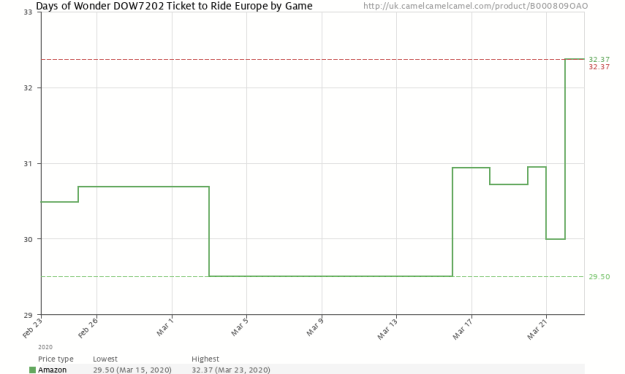
There has some suggestion that there has been a flurry of buying games to play with their families, but is there any real evidence of this?  Anecdotally, there have been comments that prices of games have increased on Amazon.co.uk which could indicate an increase in sales.  The website camelcamelcamel.co.uk tracks prices on Amazon, and it seems to indicate that prices for many popular light games have increased in the last week.

Ticket to Ride: Europe on camelcamelcamel.co.uk (23/03/20)
– Image by boardGOATS from camelcamelcamel.co.uk

There is another possible reason though: Amazon has suspended warehouse services (storage and shipping) of non-medical supplies and “high-demand” products for third party sellers.  This would have the effect of pushing prices up.  A lot of Friendly Local Games Shops sell online though, and many of these have sales on at the moment, so why not support one of the small businesses that are struggling at the moment, and leave Amazon to deal with toilet rolls and hand sanitiser?

Boardgames in the News: Covid-19, UK Games Expo and Other Stories

In all probability, the Covid-19 Pandemic will be a crisis the like of which this country hasn’t seen for eighty years.  It is estimated that Covid-19 is fatal in around 1-3% of cases;  if 50% of the world population get the disease, around 1% of the seven billion people on this planet will die.  That’s a lot of people, seventy million in fact—roughly the population of the UK.  To put it in perspective, around twenty million people died as a result of  the First World War, that’s approximately 1% of the world population at the start of the conflict (around two billion).  The death toll in World War I occurred over four years, but it is likely the impact of Covid-19 will take place over a period of months.

Covid-19
– Image from bioworld.com

So, Covid-19 is likely to be devastating, but not necessarily in ways people expect.  Yes, loved ones will die and every loss is a tragedy to those affected.  It may be the society changes that are longer lasting though.  For example, more and more people are working from home, this is better for the environment, but not necessarily good for mental health unless managed properly.  The recent Government advice to “Avoid pubs … and other such social venues” has emptied local pubs and coffee shops, and decimated the takings in businesses that already run on tight margins.  Board game cafés like The Ludoquist and Thirsty Meeples have closed and The Dice Cup, while still open, is clearly struggling.

Closed Sign
– Image from squaremeal.co.uk

All over the UK Games Clubs have been suspended or and conventions have been postponed, including Ellesmere Port and Chester Centurions, the Epsom Games Day, SpringCON, Salute 2020, Hemel Games Club, STAG, TringCon, Oxford Meeples and boardGOATS, while others like Variable Mages are considering their options.  Z-man Games have also announced the cancellation of their Carcassonne and (ironically) Pandemic tournaments.  All these use local amenities, pubs, halls and cafés that rely on the support of regular custom.  If these close, it is unlikely they will reopen, and, as Joni Mitchell once said, we won’t know what we’ve lost ’til it’s gone.

UK Games Expo Logo
– Image from ukgamesexpo.co.uk

If people work together though, we will get through this.  A shining example is that of the UK Games Expo which was originally scheduled for the last weekend in May.  The organisers have just announced that it has been rescheduled for Friday 21st to Sunday 23rd August.  Sadly, this clashes with Tabletop Scotland, but they have very graciously agreed to postpone the Perth event to allow the UKGE to take place.  It is with such understanding, cooperation and consideration that we will beat this thing.  And beat it we will, as long as we work together.

– From RetroTop10 on youtube.com