Tag Archives: Saboteur 2

The evening began with the usual friendly chit-chat.  This time, it was mostly focussed on whether or not we would be able to go back to our beloved Jockey for the next meeting (spoiler: we won’t).   But we also discussed at length why Van Diemans in the village was so called, whether it had anything to do with Tasmania or U2, and who Mr. Van Dieman was anyhow (spoiler: nobody knew the answers to any of these, but the street name is spelled differently to the “land”).  We then began to set up the “Feature Game” which was the Fortune expansion for Tiny Towns.
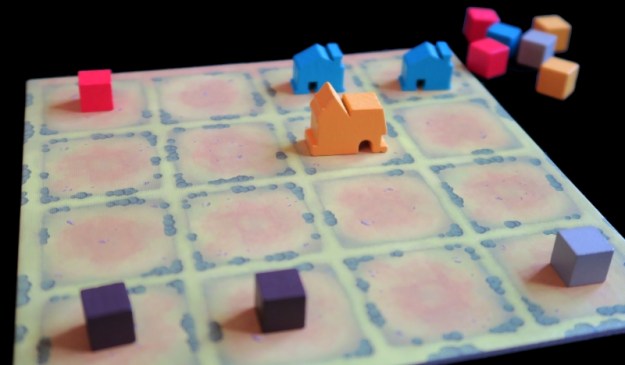
Tiny Towns
– Image by boardGOATS

Tiny Towns is a cute little area control, resource management and town building game with a strong spacial element.  We have played the game several times: after a couple of plays of the minimalistic base game, we have since added the alternative building cards, then the Monuments, and felt we were now ready to add the first expansion, Fortune.  The basic idea is very simple:  players place resources, one per space on their four-by-four town plan.  When they have the right combination of resources in the right arrangement, they can be replaced with a building.  This frees up some spaces, but makes one unavailable for the rest of the game which makes planning essential.  Different buildings give points in different ways, and to add variety, there are alternative buildings available for each type.
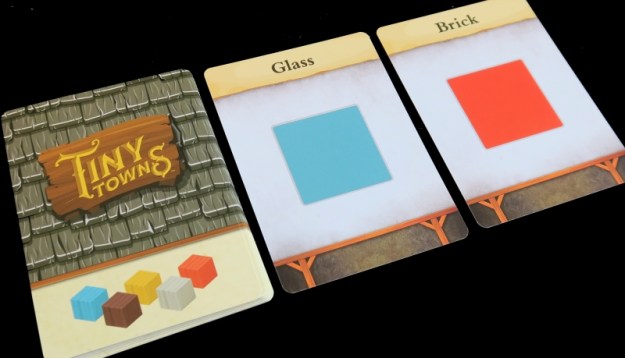
Tiny Towns
– Image by boardGOATS

In person, the game plays up to four with players taking it in turns to choose the resource that everyone must place.  Playing online, we use the “Town Hall Variant” which uses a deck of cards to give two resources while every third is a free choice.  For ease with so many, we also play a sort of “Roll and Write” variant where players print their player board and draw the buildings when they build them.  Monuments are special buildings that act as a sort of private goal with everyone having their own Monument deck to draw two cards from at the start of the game, picking one to keep.
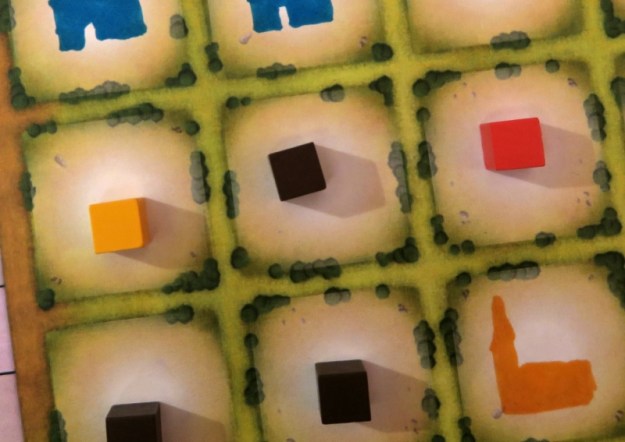
Tiny Towns
– Image by boardGOATS

The Fortune expansion allows a little additional flexibility giving players the opportunity to acquire gold and then spend it so they can choose their own resources.  Players receive gold for building two buildings in the same round.  This requires slightly more planning and leads to a little more restriction, but the reward is flexibility later in the game, or an extra point if the gold is unspent.  Players can only hold a maximum of four gold coins at any one time though (or five if they have built a Monument that provides extra storage space).

Tiny Towns: Fortune
– Image by boardGOATS

We also chose to play with the optional “Cavern” rule which is really more of a “hole in the ground” where players can throw resources.  It only holds two resources and players cannot recover these resources and use them later in the game (hence, more of a bottomless pit than a Cavern).  This time we played with both the Cavern rule and the Fortune expansion. Playing with both the Cavern and the Fortune expansion gave a lot of flexibility, perhaps too much flexibility as it took away a lot of the tension and challenge that makes the original game, though it was a lot less stressful as a result.  Playing again, we’d probably play with one or the other, but perhaps not both, as they do a similar thing.
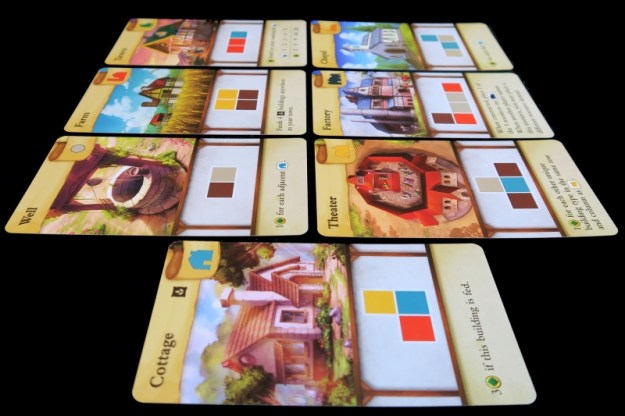
Tiny Towns
– Image by boardGOATS

We started by drawing the cards for the buildings.  They were the Cottage (always included of course), the Farm, the Fountain, the Cathedral, the Gamblers’ Den, the Market, and the Trading Post.  The Cathedral and Gamblers’ Den were from the Fortune expansion, with most of the others being optional alternative cards from the base game.  There was some debate whether the seven points a Cathedral would give was worth the effort and how the Trading Post works.  With all the little rules niggles ironed out we started.  There were the usual complaints when people wanted one thing and got something else.
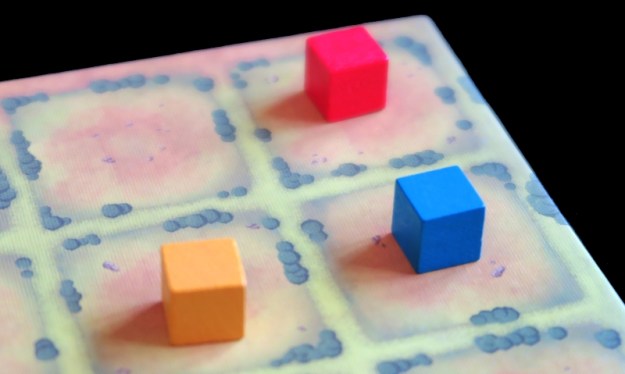
Tiny Towns
– Image by boardGOATS

The game began with a lot of stone and wood, which players were mostly able to augment with their choice in every third round.  Most people made a point of building a up a stash of coins in the early part of the game while there was space available to work with.  Players gradually drop out when they can no-longer place resources in their town.  Blue was the first to drop out and early too, having used her Trading Post to provide additional resources and her Masons’ Guild Monument to build extra buildings.

Tiny Towns
– Image by boardGOATS

Others soon started following though, and it wasn’t long before Ivory was posting his traditionally high opening score.  At his opening bid of forty-one there were lots of agonised groans, and with good cause as it turned out.  Three others were within three points of him and several others were not much further away.  Burgundy, Pink and Blue scored thirty-eight, thirty-nine and forty respectively, but despite recounts, nobody was quite able to catch Ivory.
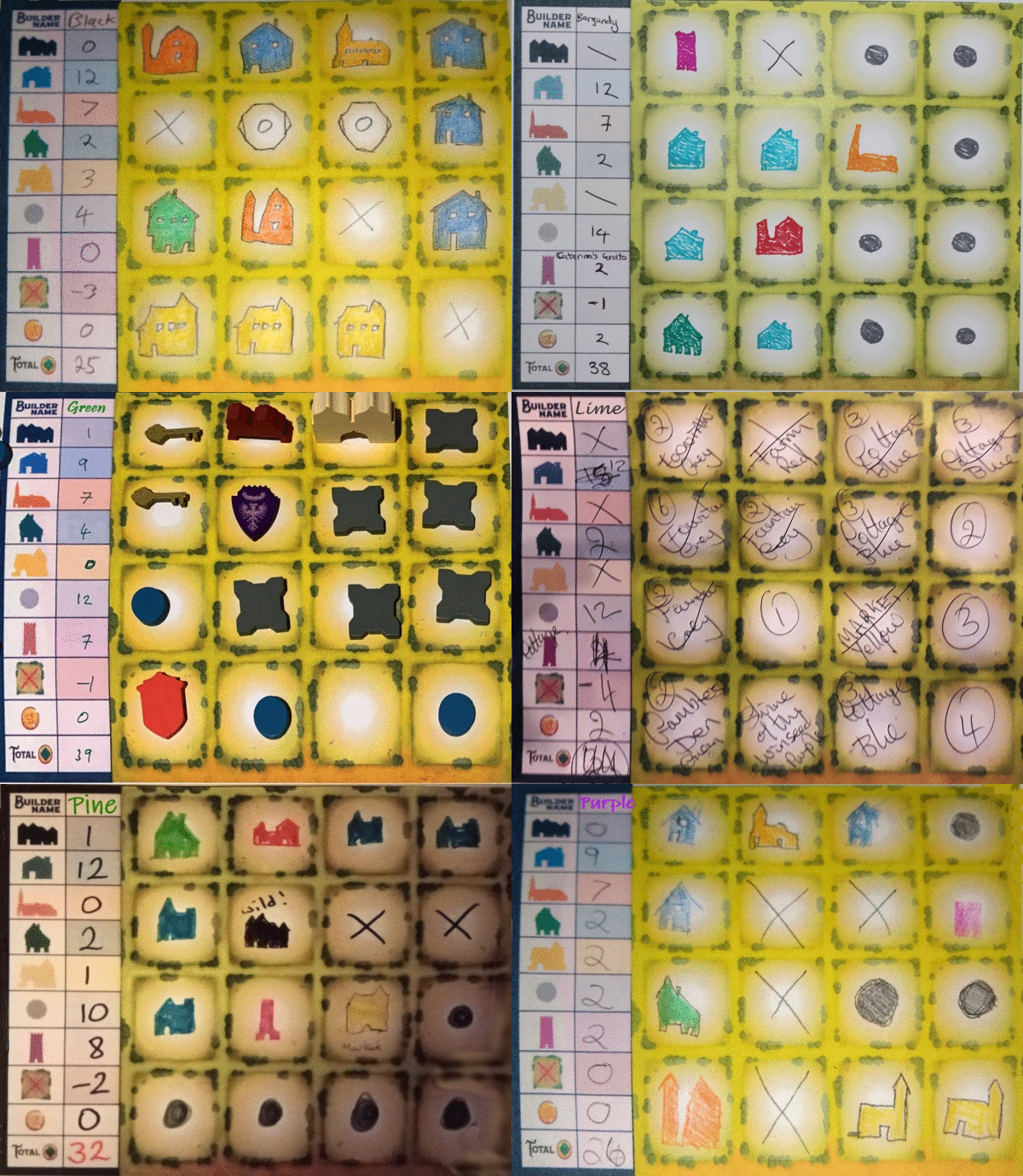
Tiny Towns: Fortune
– Image by boardGOATS

It had been a very good game and everyone had really enjoyed it, but time was marching on.  So once Lime and Ivory had taken their leave, the rest of the group moved on to Board Game Arena and after some debate, decided to play Saboteur.  This is a hidden traitor game that we have played quite a bit. The idea is that there are two teams: Lovely Loyal Dwarves and Nasty Evil Saboteurs.  The Dwarves are playing cards trying to find gold, while the Saboteurs are trying to stop them by pushing the tunnel in the wrong direction and breaking their tools.
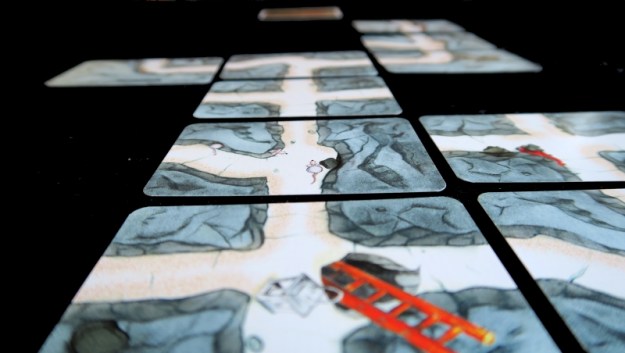
Saboteur
– Image by boardGOATS

There is a bit of a flaw in the game, however.  In order to keep a level of ambiguity, the number of Saboteurs/Dwarves is always slightly vague.  In real life, this is done by drawing cards from a deck containing one more card than the number of players.  The problem is though, the swing of two players from the Saboteurs to the Dwarves means it goes from extremely difficult for the Saboteurs to nigh-on impossible.  This is particularly the case with the smaller numbers of players, six or seven, say.

Saboteur
– Image by boardGOATS

For this reason, we decided to see if we could include something from the Saboteur 2 expansion, to level things up.  Not wanting to introduce too much change too suddenly, we only included the “Selfish Dwarf”.  This basically gives one of the Dwarves a slightly different goal—while he is also digging for the treasure, he only wins the round if he is the one to actually find it.  At the start of the first round, it was immediately obvious that Green was a Saboteur—he is a natural Saboteur and we always assume he is anyhow, with or without evidence.  This time he was definitely a Saboteur, though and it quickly became apparent that Black was also a Saboteur.

Saboteur on Board Game Arena
– Image by boardGOATS from boardgamearena.com

It became apparent that something was amiss when Pink and Pine appeared to join them with even Purple behaving a little suspiciously.  Blue in particular was very confused as although nobody else knew it yet, she knew she was a saboteur (she checked several times just to be certain!), but there were already more Saboteurs than was possible given the number of players.  In the end, Pine decided to trust Blue and that put the final nail in the Dwarves attempts to find the wealth.  The Dwarves got nowhere close at all just heading endlessly south, which gave a rare victory for the Saboteurs, who turned out to be Pink, Green and Blue.
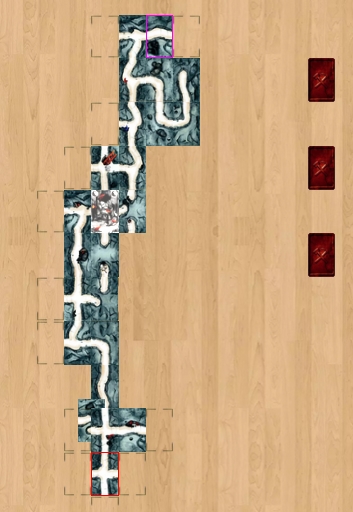
Saboteur on Board Game Arena
– Image by boardGOATS
from boardgamearena.com

This was only the second win for the Saboteurs since we’ve been playing online, with the previous occasion being very recent, the last time we played the game, in fact.  The Saboteurs were very pleased with themselves and their efforts, and the Selfish Dwarf, who turned out to be Burgundy, had just got nowhere too.  The second round the Dwarves made much better progress from the start.  There was a little debate about where the gold was, but once they had concluded it was at the bottom they made a bit of a beeline towards it.  Somehow, things weren’t quite that simple though.

Saboteur on Board Game Arena
– Image by boardGOATS from boardgamearena.com

The Dwarves had a lot of misfortune with the cards they had and just as it looked like they might make it, they didn’t have the cards.  And then Pine put the boot in and that was that—two wins out of two for the Saboteurs who, this time, were Pine, Pink and Purple.  The game is played over three rounds with the winning team getting gold at the end of each round.  So with one round to go everyone felt sure that the Dwarves would be able to make up for it in the final round.
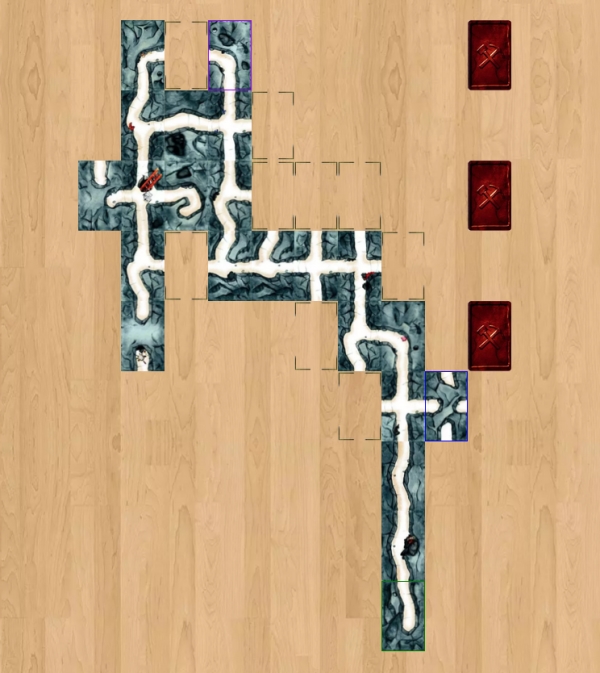
Saboteur on Board Game Arena
– Image by boardGOATS
from boardgamearena.com

Once again, it became apparent early on that Pink was a Saboteur, third time in three rounds.  Despite his protestations (he always protests, Saboteur or not), Green was behaving very suspiciously and disappeared under a hail of broken tools as the Dwarves tried to limit the damage he could cause.  The real question was whether there was another Saboteur or not, and if there was, who was it?  Suspicion fell on Black thanks to the number of cards he was discarding and how generally unhelpful he was being, but nobody was quite certain.

Saboteur on Board Game Arena
– Image by boardGOATS from boardgamearena.com

In the end, the Dwarves simply ran out of cards—although they knew where they were going they didn’t quite make it giving the Evil saboteurs a completely unprecedented three wins from three with Pink winning all three rounds.  The question is, what caused it?  Well, it certainly was significant that in all three cases, the Dwarves were playing with the maximum quota.  It is possible that the Selfish Dwarf contributed slightly too, but Pink who seemed to be the architect of their success, afterwards said he felt that the Saboteurs did well because in each case he started his evil deeds early in the round instead of waiting.  It will be interesting to see if that works next time we Saboteur.

Saboteur
– Image by boardGOATS

Learning Outcome:  Saboteurs really CAN win!

17th May 2016

Red and Blue were late arriving, so while they fed on lamb burger and chips, everyone else settled down to a quick game of Sushi Go! (with added Soy Sauce). This is probably the quickest and simplest of the drafting games.  Drafting is very simple mechanism:  everyone begins with a hand of cards and simultaneously chooses one and passes the rest on.  Once the cards have been revealed, players pick up the hand they’ve been given and again choose a card before passing the hand on.  In this way the hands progressively get smaller with players adding cards to their display.  It is a mechanism used to great effect in more complex games like 7 Wonders and Between Two Cities, where other mechanisms are added to give the game more substance (engine building and semi-cooperative tile laying in these two examples).  In Sushi Go!, the aim of the game is to collect sets of cards, with points awarded for different achievements depending on the type of card.  For example, the player to collect the most maki rolls scores six points while anyone who collects three sashimi gets ten and so on.

Sushi Go!
– Image used with permission of BGG contributor henk.rolleman

Everyone except Burgundy did reasonably well in the first round, with Green getting his nose in front thanks to some well-timed wasabi and a pair of tempura while Purple and Pine fought for the maki roll bonus.  In the second round Burgundy managed reduce his deficit, and Green’s lead took a big dent.  With Black as his main threat, however, Green felt sure he had the situation well under control as he was sat to Black’s left so was the one passing him cards in the last round.  In the end, despite everything, it was a really tight game with almost everyone scoring thirty points before the puddings were evaluated.  As the only one, Burgundy paid the full price for failing to pick up a single pudding card.  In contrast, because of the seating order in the last round Green had been able to ensure that Black was unable to challenge him for the title of “Pudding King” leaving Green the winner by a healthy margin.

Sushi Go!
– Image used with permission of BGG contributor kladan

With the lamb burgers dealt with, we moved onto our “Feature Game” which was Cargo Noir.  We had two copies, so decide to set them up side by side so we could all play.  This game is nearly ten years old and hasn’t been as popular as other games by Days of Wonder, so most of us had not played it before.  The exact reason for the lack of enthusiasm could be the artwork which is 1950s style and quite drab in colour, so is perhaps less appealing than, for example the highly successful Ticket to Ride and Small World.  Perhaps more significant though is the game play which appears to have a bit of “Marmite Factor” with some people raving about it while others seem to loath it with equal passion.  This is curious because at it’s heart, Cargo Noir is just an auction game, built around set collecting, but with a little bit of bite.

Cargo Noir
– Image by BGG contributor fabricefab

At the beginning of the game each player has three ships and at the start of their turn, each ship will be located at one of the harbours, in the casino and the black market.  On their turn, the first evaluate the status of each of their ships and resolve any auctions; then they trade any sets of goods for cards (which are worth victory points at the end of the game), before finally repositioning any left over ships.  So, like lots of games, Cargo Noir is basically about turning money into points.  Aside from the starting handful of money, the only other source is the casino and ships placed there yield two coins (yes, it IS the only casino in the world that gives out money!).  These can be used to bid for the goods available in the harbours.

Cargo Noir
– Image used with permission of BGG contributor ronster0

Each ship can visit one harbour and takes with them a stack of money.  If it is the only ship in the harbour at the start of the players next turn, then the player gets all the goods laid out in the harbour.  If they are not alone, the player can either leave the ship there and add enough money to the stack to win the current bid, or remove the ship from the board taking nothing.  Thus, the trick is to bid enough to keep others away, but not enough to risk bankruptcy.  The final location ships can visit is the black market, which enables players to either trade one of their existing commodities for one on display, or to draw a free tile at random from the bag which can be very useful as it gives a tile without spending money.  Players get “credits” (but no money) for sets goods where all the tiles are either all the same or all different.  Since larger sets give more “credits”, the ability to trade a commodity can enable players to buy more valuable cards.

Cargo Noir
– Image by BGG contributor DaveyJJ

There are some serious limitations for players to consider, for example at the start of the game each player can only carry forward a maximum of six goods to the next round – everything else must be sold.  Similarly, having three ships can be seriously restrictive.  So, some of the victory cards yield fewer points at the end of the game, but give smugglers an edge during it, providing extra cargo ships for example, or giving them access to a warehouse to store extra goods enabling them to build up more credits and buy more valuable cards.  Players who choose to buy a syndicate card can even get money from the bank when they withdraw from a bidding war, which has the potential to provide a nice little earner while damaging opponents, if used wisely.  The game lasts a fixed number of rounds (depending on the number of players) and the player with the most points wins.

Cargo Noir
– Image used with permission of BGG contributor duchamp

With two copies and seven of us (most of whom were unfamiliar with it), we decided to split into two groups both playing the same game.  In the four player game, Pine (who started) got off to a flying start while everyone else struggled, getting caught in bidding wars.  A few rounds in, Red briefly got her nose in front, but Pine was better positioned and galloped away.  As the game came to a close, Blue fought her way back into the game quickly buying two extra ships and engaging in a “collect as much as possible and sell immediately” approach which sort of worked, but it was too little too late.  Meanwhile, Green collected a massive amount of uranium together, but couldn’t quite make enough on the last round to make a big impact leaving Pine to win with a healthy margin despite finishing with just four ships.

Cargo Noir
– Image used with permission of BGG contributor duchamp

The other game was very close with Purple doing her best to scupper the plans of Burgundy and Black, but doing more damage to herself in the process.  The game finished with Burgundy taking it by just five points which was particularly galling for Black as he was one coin away from getting the additional five he needed for the draw.  There was a lot of discussion as to whether we liked the game.  Green was of the opinion that there was too much downtime and it was time you couldn’t do very much with as the previous player had the ability to completely upset any plans made in advance.  Red also had misgivings, saying she quite liked it, but wouldn’t bother to go out and buy a copy; Blue commented that as she already had a copy the question was more whether it should be kept, and it would certainly stay for a while yet.  Pine on the other hand, had really enjoyed it (despite the faces he pulled at the start), but in general, consensus seemed to be that it was “OK”, even “quite nice”, but not a “great game”.  It was also perhaps better with three than four and the downtime would have been very significant if playing with five.

Cargo Noir
– Image by BGG contributor thornatron

Green decided to get an early night so the rest of us decided to finish with an older, large group game, Saboteur. This is a bit of an old favourite, and is one of the original hidden traitor/social deduction games.  The idea is that each player is either a Dwarf or a Saboteur and players take it in turns to play cards with the Dwarves aiming to get to the treasure, while the Saboteurs try to stop them.  There are two types of cards that can be played:  tunnels and special cards.  The tunnels come in different shapes and must be played in the correct orientation, so Dwarves try to push the path in the right direction, while Saboteurs try to play disruptive cards while trying to look like they’ve done the best they can with the hand available.  Meanwhile, special cards include “rockfall” cards which can be played to remove a tunnel card already played and maps which can be used to see where the gold is hidden.  Most importantly, however are “broken tool” cards which can be played on another player to prevent them building tunnel cards until they (or another kind-hearted soul) plays a matching “fixed tool” card to remove it.

Saboteur
– Image used with permission of BGG contributor mikehulsebus

We usually play with a few house-rules.  The rules suggest that the game should be played over three “rounds” with the winning team semi-randomly receiving “gold” cards; the overall winner is then the player whose gold cards depict the most gold pieces.  Now, we find that the game can sometimes outstay its welcome and the addition of the gold at the end of the rounds feels like an attempt to make more out of the game, but in actuality just makes it more frustrating as there is a large amount of randomness in their allocation.  So firstly we dispense with this aspect altogether and treat each round as a game in its own right.  That way, we can play one or two games/rounds and then move on, or play extras if everyone is enjoying themselves or time dictates.  Secondly, the teams are drawn from a pool cards so that there is an unknown number of Saboteurs around.  Although it’s nice to have this additional uncertainty, we’ve always found (particularly with six players) that the minimum number of Saboteurs makes the game very easy for the Dwarves, so we tend to play with a fixed number of Saboteurs.  This time, we debated whether to add the expansion, Saboteur 2, but decided against it as the characters seemed to be completely random draw and we didn’t really have time to think about the implications properly – maybe next time.

Saboteur
– Image used with permission of BGG contributor mothertruckin

The first “game” was very cagey with everyone looking very “saboteur-y” and everyone accusing everyone else of “saboteur behaviour”.  In the event, it turned out that all the dwarves had poor hands, and it was fairly clear that the Saboteurs had won when first Pine and then Blue outed themselves to ensure that the Dwarves didn’t make it home.  The accusations were already flying about as the cards were being dealt out with Pine commenting that it was highly unlikely that he would be a Saboteur twice in a row and even more unlikely that Blue would be too.  This quickly degenerated into a discussion of probability and how the probability was actually exactly the same as last time as the two events were independent, even though the probability of the identical set of Saboteurs is relatively unlikely.  Unlikely it may have been, but this time it happened.  In an effort to do something different and in the hope that her behaviour would look different, Blue outed Pine as a Saboteur since everyone was already somehow suspicious.  Nobody really fell for it however, and it was a fairly easy win for the Dwarves.

Saboteur
– Image used with permission of BGG contributor mikehulsebus

Since we’d had two games with the same Saboteurs, we decided to play a third.  This time things were going reasonably well for the Saboteurs as the Dwarves were struggling with poor cards again.  Red was already looking shifty, so when the Dwarves suddenly got it together and headed in the right direction quickly, nobody was terribly surprised when she outed herself because by playing a “rockfall” card. As she drowned under a hailstorm of “broken tool” cards, Red declared that the other Saboteur was going to have to pull their finger out or it would be all over.  Black was sat to her left, but miscounted the distance to the gold and played a map card.  This left Purple and Pine to finish the game and everyone question why Black hadn’t played his rockfall card, especially Red who was quite vehement in her criticism of Saboteurs who don’t pull their weight!  With that, much hilarity ensued and eventually everyone headed home.

Saboteur
– Image used with permission of BGG contributor mothertruckin

Learning Outcome:  If you are going to try to win, don’t leave it too late.