Tag Archives: Salmon Run

Boardgames in the News: When is a Meeple not a Meeple?

Answer:  When it’s not a Hans im Glück Meeple, apparently.  The term Meeple was allegedly coined nearly quarter of a century ago by Alison Hansel while paying the tile laying game, Carcassonne.  It was a conjunction of “my” and “people” and was used to refer to the characteristic wooden people-shaped pieces.  Since then it has been modified and the suffix “-eeple” has now come to mean game token (usually one that is wooden and shaped).

Carcassonne
– Image by boardGOATS

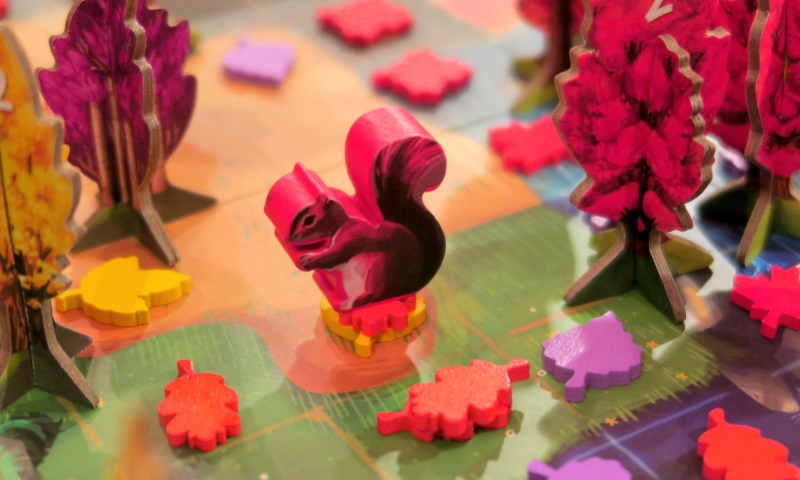
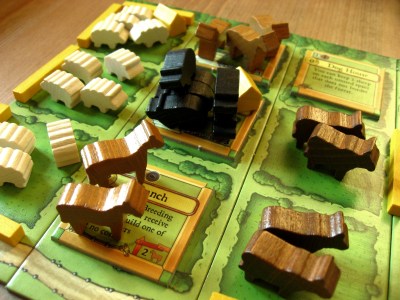
In this way, The term “Meeple” is now used to refer to all sorts of other wooden game pieces.  This includes the sheep, pigs and cows in Agricola or Keyper, which are often collectively referred to as “animeeples”; wheat and vegetable resource tokens which are commonly called “vegimeeples” (or even “vegeeples”), and players of Ice Flow or Salmon Run might talk about “fish-eeples” while those with Bosk might move their “squirreeple”.  As such, one might well be forgiven for thinking that the term Meeple is open source and can be used freely.

Bosk
– Image by boardGOATS

So Cotswold Games (formerly Cogito Ergo Meeple) might be forgiven for thinking the same when they crowdfunded their game, Meeple Inc..  That was until they received a “cease and desist” request from “a company” asking them “to remove all references to ‘meeples’ from the game as they have registered the word (and the shape) as an intellectual property in the EU.”  As a result, the a worker placement game where players compete to build the greatest board games in the world has been renamed Tabletop Inc. and now features “Mumans”.

– Image by boardGOATS

Whether this was necessary and whether Hans im Glück actually have the right to do this would need to be tested in court, but given the nature of the creation ans widespread use of the word “Meeple”, it is questionable.  Further, they only claim it as Intellectual Property in the EU—what about the rest of the world?  This point has exercised Corey Thompson (co-owner of YouTube channel Above Board TV and co-host of the industry-focused Board Games Insider podcast) and Marian McBrine (Gen Con Event Manager), who have responded by applying for the trademark in the US.

– Image by boardGOATS

Although they intend to protect the US trademark from predatory action (should they be successful in their application), Corey Thompson and Marian McBrine also plan to make it available to anyone who wishes to use it.  In the long term, this may prove unnecessary.  The trademark eventually issued in the EU in 2019 was for a range of of products (including software, jewellery, books, tableware and sporting goods), but not for toys and games.  This was limit followed an objection from board game publisher CMON, who argued (with considerable evidence) that the word was already in widespread use for general board game playing pieces.

Glen More
– Image by boardGOATS

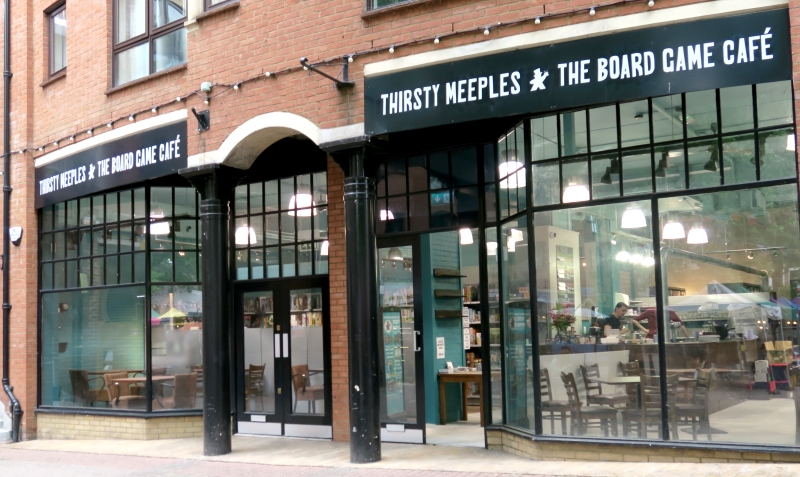
This objection was partially accepted by the EU Intellectual Property Office, but Hans im Glück has since registered “Meeple” as a trademark in Germany covering toys and games.  It was under this and the EU trademark covering the shape of the “original” Meeple figure that they issued the “Cease and Desist” to the folks at Cotswold Games/Cogito Ergo Meeple.  Although they are the first to publicly declare that they have received notification from lawyers, there are a huge number of well known games that could be affected (including Meeple Circus, A Fistful of Meeples, Meeple War, Meeple Quest and Rampage (aka Terror in Meeple City)), but also Oxford’s own board game café, Thirsty Meeples.

Thirsty Meeples
– Image by boardGOATS

There has been considerable community backlash though, so maybe Hans im Glück will adopt a gentler approach going forward.  At some point, however, it is likely that someone will test this in court and, in the meantime, there is a lot of ill-feeling which may lead to a loss of custom.

28th May 2024

When Blue, Pink and Cobalt arrived for food, the pub was really busy and they struggled to find a table, ending up in the Bar.  Their food had arrived by the time the others started to turn up, and although there was another free table by this time, it wasn’t conducive to playing games.  Green, who we’d been missing in recent weeks arrived with Lilac for the first time in absolutely ages so there was a lot of catching up to do.  It wasn’t long before more tables began to clear, and the group managed to find several together in the restaurant area, and once the feeders had bolted the remains of their supper they joined the group and everyone began to decide what they’d play.
Little Town
– Image by boardGOATS

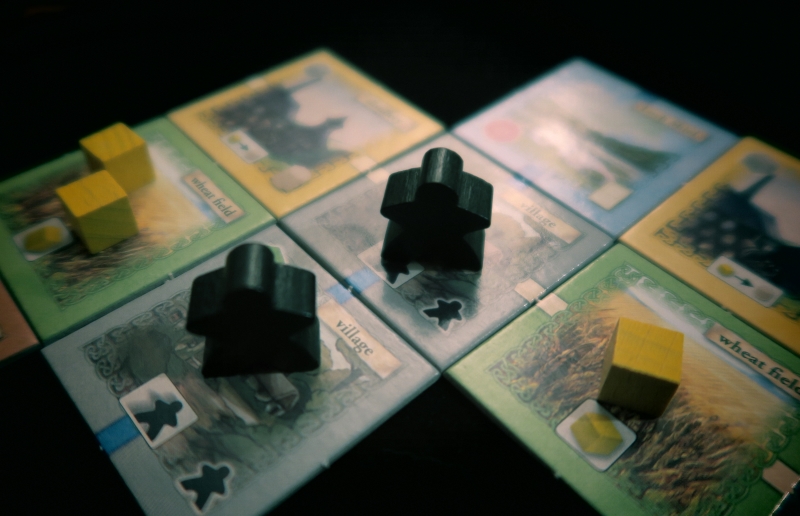
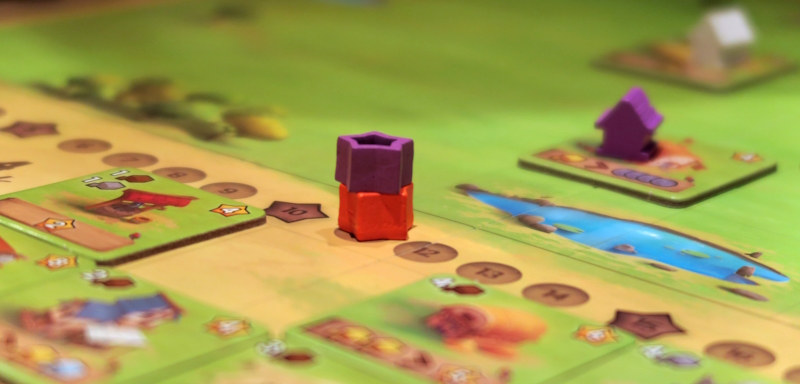
First up was the “Feature Game“, Little Town, a resource management, worker placement and tile placement game where players take on the role of architects guiding teams building a small town.  There were two games of this—one with Blue, Pink and Teal, and the other with Black Purple and Lime.  It is quite a simple little game:  players start with a set number of Workers (four in the three-player game) and building Markers (six for three players).  On their turn, they can place a Worker in an empty space on the central player board/map, or spend resources and build a Construction, placing a Marker on it.
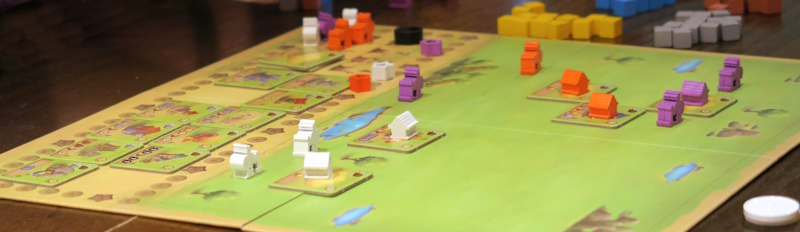
Little Town
– Image by boardGOATS

When they place a Worker, the player activates the eight spaces surrounding it.  These can include Woodland, Mountain, or Lake to get Wood, Rock or Fish.  Wood and Rock are useful to build, while Fish is important for players to feed their Workers at the end of the round (one Fish or Wheat per Worker, every round).  Players can also activate Constructions, their own for free, and another player’s by paying them one Coin.  There are twelve Buildings and five Wheat fields available for construction at the start of the game—once they are built, they are not replaced.
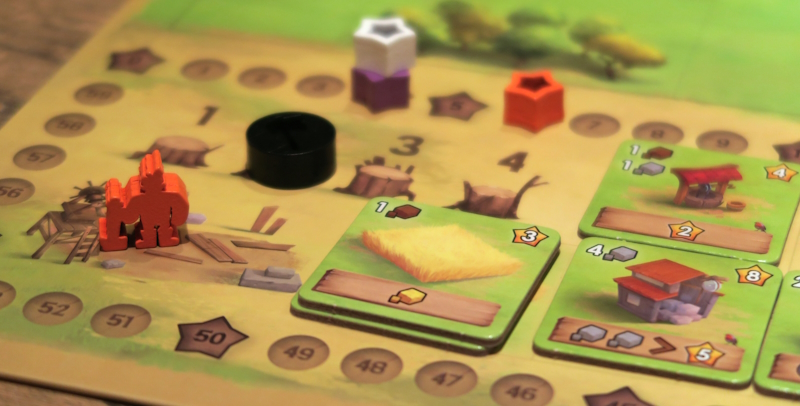
Little Town
– Image by boardGOATS

There are twenty-nine buildings in the base game which can be drawn at random, but this time, both groups used the basic set (marked with a robin).  This meant that some of the Objective cards which are Building dependent could not be used, so in the end, only the cards that didn’t require specific Buildings were used.  The Objectives therefore included things like “Gather at least five resources in the same turn” or “Have more Buildings than Workers”—these are scored during the game.  Buildings come in two types:  Those that give Resources when activated, and those that can be used to convert Resources into other Resources, Coins or Points.  The game lasts four rounds, after which players score for each of their Buildings and one point for any three unused Coins.
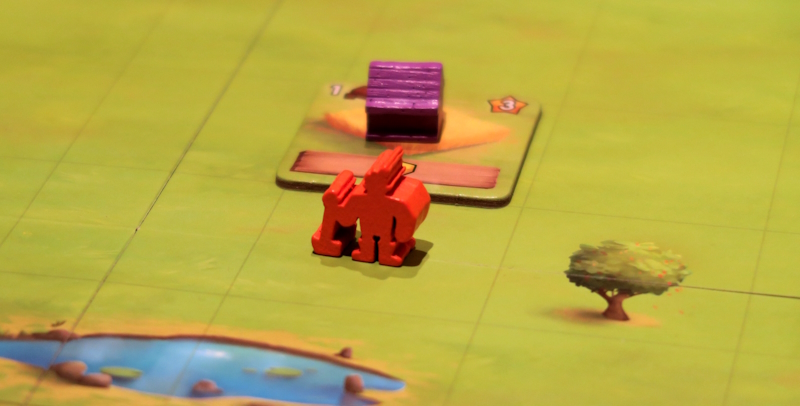
Little Town
– Image by boardGOATS

Once the rules had been outlined, both groups started playing.  Before they’d got more than a turn in, however, Cobalt commented that he was surprised that Blue hadn’t got metal coins to go with the game, at which point, Blue produced her utility set and both groups swiftly made the substitution.  Unfortunately, these new coins were a little slippery leading to a couple of rounds of “Hunt the Game Piece”.  Little Town is a really good little game though, accessible, but with meaningful decisions and one that doesn’t outstay its welcome.  Despite starting with essentially the same setup, the two games, progressed quite differently.

Little Town
– Image by boardGOATS

Pink and Blue built Points engines converting Coins and Wheat respectively, while Cobalt converted a Coin into Wheat and Fish, then and Wheat into lots of Coins.  On the neighbouring table, however, the Coin to Wheat and Wheat to Coins buildings were owned by different people, Black and Lime respectively while Purple was busy converting Wood into Points.  Both games were quite tight, with Lime’s forty-two beating Black into second place by just two points.  The other game was even tighter though.  Pink rolled back his final move following a suggestion by Blue to pick up an extra point, but she would have done better to keep her mouth shut as that extra point meant he tied for the lead with Blue on fifty-five.
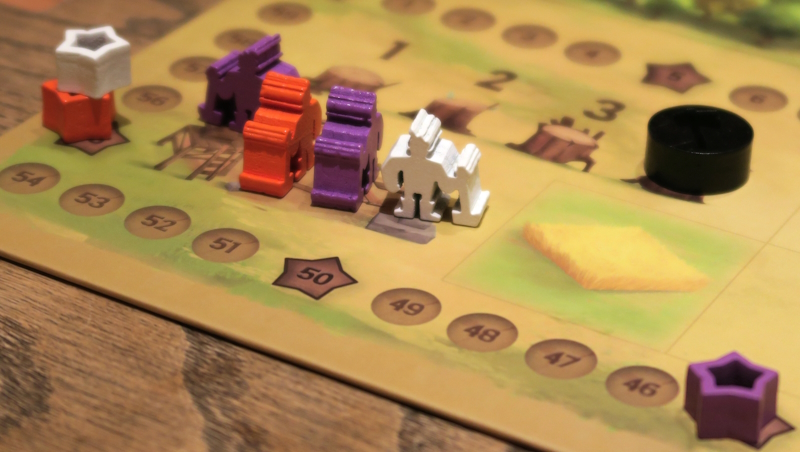
Little Town
– Image by boardGOATS

It was as players were discussing the game and starting to pack away that Pink spotted a way of getting another extra point, but this was deemed too late and the game was deemed a tie.  Packing away, there was some confusion as the manifest indicated there should be twenty-nine Objective cards, whereas Blue’s copy had thirty.  Despite several recounts (and confirmation that there weren’t any in the Goodie Buildings mini expansion), the issue couldn’t be solved, and the group came to the conclusion that one more than expected was better than one less…

Little Town
– Image by boardGOATS

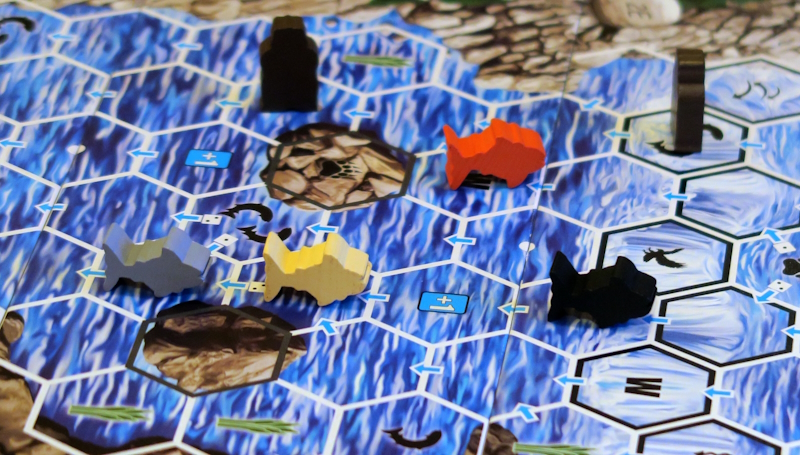
Meanwhile, on the next table Teal was leading a game of Salmon Run with Green, Pine and Lilac.  This is a game that was played quite a few times in the group some years ago when it was first released, but the last time it got an outing was in 2015—nearly ten years ago.  Teal had decided that his copy had been sitting on the shelf unplayed and unloved for too long and it was time for it to move on.  It got a stay of execution though, and as a result, it got a Tuesday night outing.  A fast paced, deck-building, race game, Salmon Run is a sort of cross between Dominion and Flamme Rouge.  Although the game is not particularly complex, the first game was a learning game.
Salmon Run
– Image by boardGOATS

The idea is players are Salmon, racing to be first to get to the Spawning Pool.  The board is modular and therefore the River can be changed to give variety and replayability.  Players start with a deck of cards containing three Swim Forward, three Swim Right, three Swim Left, one Wild and one Bear and draw four of these.  On their turn, players can play up to three cards, however, playing three means they will draw a Fatigue card.  These will ultimately reduce players’ choice and slow their Salmon down, so mostly players stick to playing two, replenishing their hand to four cards at the end of their turn.

Salmon Run
– Image by boardGOATS

Depending on the modules used, the River includes obstacles like Rocks, Currents and Rapids, as well as special spaces which allow players to pick up special cards (that can be used to counter Currents, Rapids and Eagles) to add to their Swim deck.  Teal began by moving a Bear onto the space with Pine’s Salmon, giving him a Fatigue card.  Then, much to Pine’s annoyance, Lilac and then Green did the same before fianally Lilac did it again.  Pine was very unimpressed—for one who loves wildlife, he really wasn’t happy about repeated visits from all those bears!

Salmon Run
– Image by boardGOATS

Green I played a Rapids card and there was some discussion where the card should be discarded to, but in the end there was no catching Teal, who was first to the Spawning Pool, and was some four spaces ahead Lilac, his closest challenger.  As Little Town was still going on both tables, the group decided to play a second time now they knew how to play as they thought they’d be quicker (which they were). The River was a changed a little to make it a bit more challenging and then the Salmon began their second run.  This time, Pine, Teal and Lilac went one way round the rapids, while Green went the other.

Salmon Run
– Image by boardGOATS

This time the bear was moved away from players by Teal so nobody got caught. As the River took a bend to the right, Green ended up with only Swim Left cards so had to just discard and bang his salmonny head against the rocks, falling behind. Teal and Pine had both picked up a lot of Fatigue cards, but they both got to the Spawning Pool.  As Pine had one less though, he was the winner of the second game.  It had been a lot of fun (despite the Bear attacks, and the headaches from banging against the rocky bank), so maybe the stay of execution deserves to be extended a while longer.

Salmon Run
– Image by boardGOATS

With both games finished and the late start, there wasn’t time for something long, so as is often the case in such circumstances, instead of lots of discussion, the group decided to play the old favourite, 6 Nimmt!.  With ten, the group decided to play the game over one round, which meant everyone started with ten cards, a lot more than usual.  This didn’t seem to improve the quality, however, a sentiment that was epitomised by one comment, “These are all bad with a capital F…”  The first few rounds were a little slower than usual as everyone had more cards to choose from than usual.

6 Nimmt!
– Image by boardGOATS

Once everyone had chosen their card, they were simultaneously revealed and added to the end of the appropriate row, with players picking up cards when theirs was the sixth card to be added.  Nobody managed to avoid picking up cards, but unusually, the scores were all quite close—so close that the winners, Green and Blue, tied with nine, while Pink took third place with eleven and Cobalt top-scored with twenty-three.  One game is rarely enough when it comes to 6 Nimmt!, and everyone was keen for another mad ten-player game.  This time the scores were more diverse: Lilac succeeded in avoiding the chaos and won with a clear round, while Teal added thirty-six to his first round twenty two to finish with the most points overall (Cobalt only took seventeen in the second game).

6 Nimmt!
– Image by boardGOATS

Blue took second place in the second game with five (giving her the best combined game total of fourteen), while Pine came in third with ten points.  Green was the most consistent with nine and eleven, but Lilac claimed the nearest to a “Mike Game” with one exceptional round and one awful one, though her bad wasn’t as bad as his usually were.  Everyone was just packing up when the evening came to a smashing end as the wine glass that Lime had carefully put safely to one side bit the dust.  Oh well, less washing up…

6 Nimmt!
– Image by boardGOATS

Learning Outcome:  Little Towns can give quite big games.
Boardgames in the News: What is a Meeple?

Reading our game reports, a fairly commonly used term is “Meeple”.  The word is used so widely amongst Euro gamers, that it was adopted for the name of the Oxford boardgame café, Thirsty Meeples, however, non-gamers are completely unfamiliar with it.  So, what does it mean and where does it come from?

Carcassonne
– Image used with permission of BGG contributor wizardless

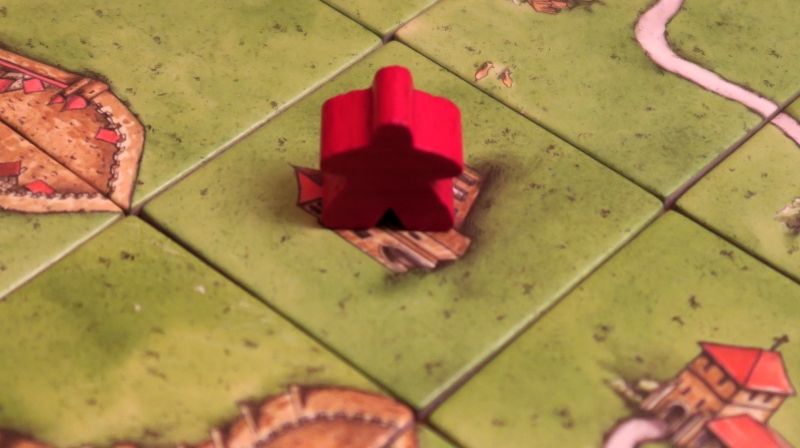
The term was allegedly coined in 2000 by Alison Hansel while paying the tile laying game, Carcassonne. In Carcassonne, players draw a tile and then add it to a growing map before placing a wooden figure on the tile. Thus, meeple was a conjunction of “my” and “people” and was used specifically to refer to the characteristic wooden people-shaped pieces used in Carcassonne and more recently, games like Keyflower. Since then, the range of game pieces available has increased hugely and the term has been adapted and broadened.

Keyflower
– Image used with permission of BGG contributor punkin312

For example, Agricola has a wide range of resource tokens, including sheep, pigs and cows, which are often collectively referred to as “animeeples”. Similarly, the wheat and vegetable resource tokens are often referred to as “vegimeeples” or even “vegeeples”. So, the suffix “-eeple” has now come to mean game token, interestingly, usually one that is shaped. Thus, people playing games like Ice Flow or Salmon Run might talk about “fish-eeples”, devotees of Caverna may discuss “dog-eeples” and “donkeeples”, and players of the Arctic Bounty expansion for Fleet might comment on “crab-eeples”, though they may also be collectively referred to, simply as meeples.

Agricola: All Creatures Big and Small
– Image by boardGOATS

So, generically, a meeple is a game piece, usually made of wood, and often, but not necessarily with two arms, two legs and a head…

Meeples
– Image by boardGOATS


19th May 2015

With more new people, most of the regulars and a few less regulars, it was always going to be a busy evening.  So, as it was, we started out with three games.  The first group began with Eight-Minute Empire, a game that we’ve played before on a Tuesday, however, not with this group – only one person playing this time was familiar with it.  It is a quick little area control and set collecting game, though in truth, it only plays in eight minutes if everyone really knows what they are doing and nobody suffers from “Analysis Paralysis”.  On their turn, the active player starts by picking up a card:  they can choose whether to take the first available card which has no cost, or take another and pay the appropriate number of coins from their limited supply.  Each card is a resource which provides points at the end of the game, the number depending on how many of that resource the player has;  each card also has an action associated with it, which can be place armies on the map, move them about, ship them across the sea, build a city etc.  Players score points for having the majority in a countries and controlling the most countries in each continent, as well as for sets of resources.

Eight-Minute Empire
– Image used with permission of BGG contributor henk.rolleman

Cyan started heading over the seas, Yellow went in the other direction and Green ominously began amassing armies in the start region. Orange and White started with a mixture of expansion and growth.  As the game progressed, Cyan was spreading himself thinly over two continents while Orange headed north leaving the main continent behind and Yellow, White and Green fought over the regions in the middle.  White was also doing a fine trade in rubies while Cyan was collecting anvils.  This gave Cyan a dilemma when a double anvil turned up:  although he had the money to pay the two it would cost, he was playing a miserly game and decided to let it pass.  As it happened, it stayed on the table for nearly the full round until White swiped it from under Cyan’s nose.  Everyone saw the mass of Green in the middle, and, thinking he was an experienced player, decided to gang up on him.  With three players going after Green in the last round they did a good job of removing his dominance in the centre, leaving White the winner with eleven points, though the rubies really helped Yellow in second place just two points behind.

Eight-Minute Empire
– Image by BGG contributor lhapka

After a brief drinks break, the group then went on to play Salmon Run.  This was another game that we had played before, but was new to the majority of the players this time so it took a while to remember how it worked.  In essence, it is a race game that uses a hand-drafting mechanism, so players have their own personal draw piles a bit like Dominion.  The game is modular with a range of possible river sections.  This time the group opted for a short game with only four boards, which was enough to give everyone a flavour of the game, ready to give it a proper run through next time.  After a couple of rounds, everyone started to get the hang of it and salmon were zig-zagging their way up stream dodging bears, eagles and rapids, jumping waterfalls and trying to be the first to get to the spawning pool without being too tired.  Throughout the game the group remained uncertain of the the rules though, and at one point Green got himself blocked with no cards in his hand to help him.  After checking, he realised he could in fact play a card and do nothing (the fish banging its head against the wall). Unfortunately this meant he ended up way behind the others.  Before long, Cyan leapt the last waterfall and landed in the spawning pool with a splash.  It was a tight game with three other players teetering on the brink and ready to make the final jump, but in the end no-one else managed to get across leaving Cyan the clear winner.

Salmon Run
– Image used with permission of BGG contributor kilroy_locke

The second group started out with a repeat of a quick game we played last time, called Yardmaster.  This little train themed card game is turning out to be surprisingly popular with our group, partly at least because it packs a surprising amount of punch for such a simple filler game that plays so quickly.  This time, it was just Burgundy turned the tables on Blue who failed to get the luck of the cards.  Then Purple and and Black turned up to join them for the the “Feature Game”, Machi Koro, which has just been nominated for the Spiel des Jahres.  This card game is a sort of cross between The Settlers of Catan and Dominion, where players take the role of mayor and roll dice and choose cards in order to make it the most successful town.  On their turn, the active player rolls the die (or dice if appropriate) and anyone who owns a card gets money in a similar way to the resource allocation in The Settlers of Catan.  Then, the active player can use their money to buy cards, building up their portfolio in a similar way to Dominion.  The winner is the first player to build all four of their land-mark buildings.

Machi Koro
– Image used with permission of BGG reviewer EndersGame

There are two ways of setting up:  all the cards can be available in separate stacks at the start of the game, alternatively, the cards can be shuffled together and dealt out until there are ten different buildings available (others become available when a pile is exhausted).  The latter makes for a more strategic and interesting game, but when learning it is easier to see how the card combinations work by dealing out all the cards.  With so many people new to the game, all the cards were laid out at the start so everyone could see what their options were.  Blue was the only one who had played it before, so to off-set some of that advantage, she decided to try buying a building she had not bought before.  In her previous games, the Café (which rewards the owner with $2 from the active player when they roll a three) had been fairly ineffective, so she bought one.  Purple promptly rolled a three, and had to hand over some cash.  When this happened a second time, suddenly everyone started building Cafés and the gloves were off.

Machi Koro
– Image used with permission of BGG reviewer EndersGame

Blue built her Station first which allowed her to roll both dice and go for the higher number and value buildings and Purple and Burgundy were quick to follow.  Black was obviously not enjoying himself as much as the rest, and didn’t seem to be building much.  Eventually, he build a handful of Restaurants and Cafés, but otherwise just sat and accrued cash.  Blue and Purple had built their third landmark before Black had built one and it was looking like he wasn’t really focussing on the game at all.  Eventually, Blue built her Radio Tower winning the game.  Since there is nothing in the rules about what happens next, the rest of the group played on.  Burgundy managed to build his third and fourth landmarks in quick succession to take second place leaving Black and Purple to fight it out.  When Black suddenly completed his set (much to Purple’s disgust) his strategy became clear:  by building his most expensive landmarks first, he got a larger benefit from them, which enabled him to quickly complete the smaller ones.  Without two dice, his income was reduced, but since he had the majority of the red cards, he picked up money on when others rolled nines.  Although it hadn’t paid off this time, it looked like an interesting approach, though it was clear that Black was not terribly keen to play it again since, as he commented later, he is not keen on dice as a randomising factor, though he is quite happy to use cards.  Perhaps we’ll try a “dice deck” of cards next time and see if he likes it more…

Coloretto
– Image by BGG contributor SergioMR

Meanwhile, the third group had played an assortment of quicker games beginning with Coloretto.  This cute little set collecting game has been getting played a lot recently on Tuesdays, and, as Teal and Violet were new to the group, Red thought it would be a nice gentle game to start with.  Teal began by collecting a few choice colours, but quickly amassed a positive rainbow of chameleons.  Violet was much more selective and her favouritism for yellow chameleons proved to be particularly sensible in such a close fought game, and gave her clear victory over Red and Teal.  After briefly licking his wounds, Teal then regrouped and proceeded to thrash Red and Violet in a quick game of Dobble.

Dobble
– Image used with permission of BGG contributor msaari

Red had been enviously watching Blue and Burgundy playing Yardmaster across the room (which might explain her poor showing in Dobble).  So, as soon as they had finished, she decided to introduce Teal and Violet to it.  As the most experienced player, Red was in a good position to get revenge for getting beaten in Coloretto and her complete drubbing in Dobble.  The game was quite close, but a crucial coup of a green number one at the very last minute swept her sorting yard into play, making Red the clear winner.

Yardmaster
– Image used with permission of BGG contributor moonblogger

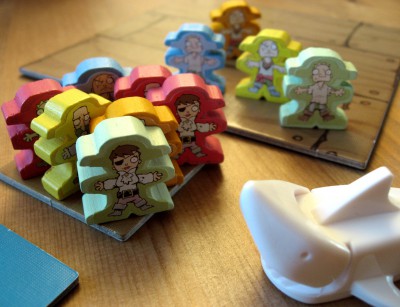
With one victory each, Red got out another of her favourite games, Walk the Plank!.  This is a very simple if silly game, with a lot of opportunity to attack the others playing.  One of the big successes in the group, it has really earned it’s keep as one of the few genuinely popular KickStarter games.  This time was no different to previous games and everyone engaged whole-heartedly in trying to force their opponents off the plank and into the murky depths of the ocean.  Since it had been one game all, this could be seen as the groups tie-breaker and it was Teal who’s pirates managed to resist the temptation to jump into the shark-infested water the longest giving him two wins to Red and Violet’s one.

Walk the Plank!
– Image by boardGOATS

With the second group still playing Machi Koro, Red Teal and Violet joined Cyan, Green and White for a quick game of Pick Picknic.  Like Walk the Plank!, Pick Picknic uses simultaneous card selection, but adds negotiation and a dash of chance and “double think”.  The idea is that there are six yards of different colours, if someone plays the only chicken card of a given colour, they get all the grain at that coloured farm.  If multiple players go for the same coloured yard, then players can either agree to share the corn in any way that is mutually acceptable or roll the die for all of it.  Foxes don’t eat corn, however, they only eat chickens, so if someone plays a fox card, they will eat any chicken cards of that colour.  The game was really close and much hilarity ensued when when Cyan and Green, fighting over a yard managed to roll a tie five times in a row.  In the final count, White finished the winner, just four corn ahead of Green and six clear of Violet.

Pick Picknic
– Image used with permission of BGG contributor kilroy_locke

With people beginning to head off and everyone else reluctant to make it a late night, the remaining players began to look for something short-ish and fun.  Purple suggested Plague & Pestilence again, but when that wasn’t greeted enthusiastically, she proposed 6 Nimmt! instead.  Having had an outing last time, as well as at the Didcot group a few days ago, it is starting to become a bit of a regular.  In this case however, it was clear that everyone had fond memories of Burgundy collecting handfuls of cards and wanted to see if he was going to do it again.  Sadly, that was clearly not his intent and he finished the first round with just eight, only one behind the leader, Green.  Green didn’t keep the lead for long though as he was repeatedly forced to pick up high scoring cards finishing with a nice round forty.  Purple improved on her relatively poor first round, but still had quite a few more than Burgundy, Black and Blue.  It was fitting perhaps then, that it was Burgundy who, despite having a terrible hand played a blinder to finish just one point ahead of Black and two ahead of Blue.

6 Nimmt
– Image by boardGOATS

Learning Outcome:  A long game can be very satisfying, but lots of little games can be lots of fun.

3rd September 2013

First up this week, while we waited for the others to arrive, was Toc Toc Woodman (aka Clack Clack Lumberjack).  This Is a dexterity game that consists of a segmented plastic tree where the am of the game is to knock bits of bark off with an axe, while not removing the core segments.  As the game progresses, the tree becomes increasingly unstable with the inevitable consequences…  Honours were just about even when we were saved from a tie-breaker by the last of the late arrivals.

– Image by BGG contributor EndersGame

Next we started our “Feature Game”, Keyflower.    Although we have played it before and it is a very popular game with most club members, we had one player who was unfamiliar with it, so we chose to play it without any of the additional tiles.

Keyflower
– Image by boardGOATS

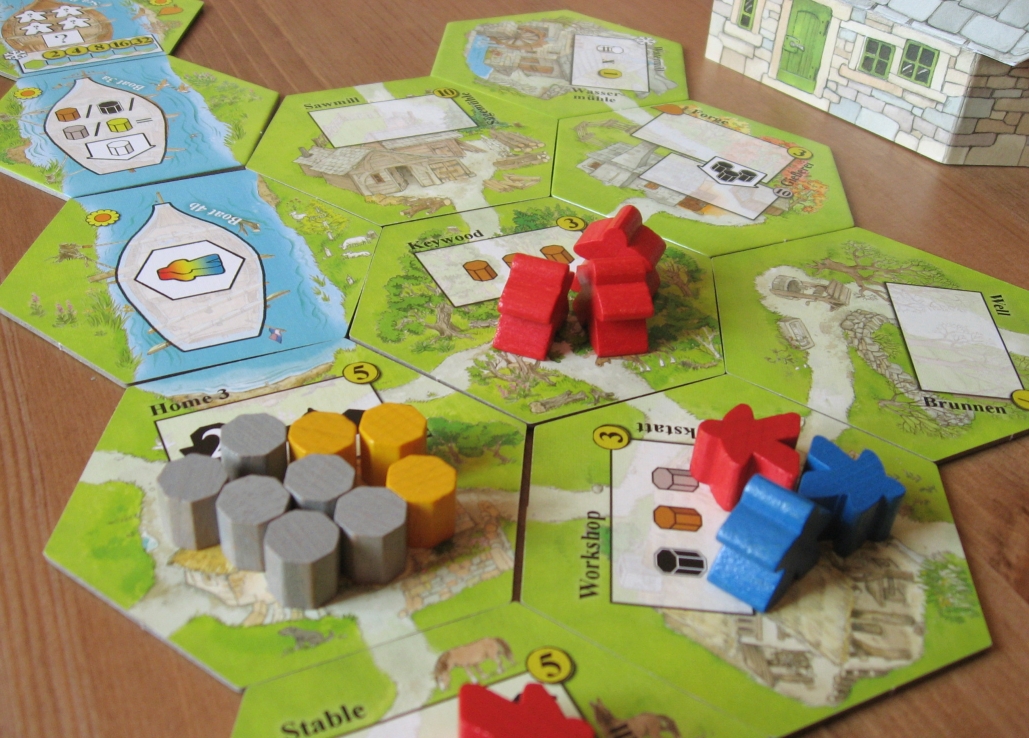
Keyflower is a worker-placement and auction game that is played over four seasons.  Each player begins the game with a home tile and eight worker meeples (or Keyples as they are known in this game).  At the beginning of each round there is a new stack of tiles that players can use and bid for.  The really unusual part of the game is the interplay between workers and bidding:  workers can operate on any tile, in a players own village, in another players village, or one that is still being auctioned.  At the end of the round, the workers go to the owner of the tile, thus, if you have a commodity that other players want, it can be a source of Keyples. On the other hand, if you chose to bid for a tile, presumably you wanted to use it, which means that you have competition for the resource, and so it proved.

Keyflower
– Image by boardGOATS

One player had been present at the drubbing we had received last time we played and tried the same strategy, i.e. to collect skill tiles.  Those of us that were aware of this approach started out with no real strategy except to prevent a second run-away victory by the same means.  Meanwhile the new player quietly got on with collecting gold and marshalling her Keyples.  Mixed based strategies gradually evolved for otherwise indecisive players with resources, the river and transport all featuring and it wasn’t long before we got to the final round, Winter.  Surprisingly, there wasn’t much competition for tiles to begin with as everyone concentrated on getting the resources and skill tiles they wanted to the place they needed them.  By this time, Keyples were in short supply, so there was only a token amount of scrapping for final tiles in what ended as a very, very closely fought game with first and second just one point apart, a tie for third and fourth, and everyone separated by only six points.

Keyflower
– Image by boardGOATS

The third game of the night was, the race game, Salmon Run.    We’ve played this a couple of times before, but still managed to have a couple of new players, so after a quick run through of the rules, off we went with board S1, 5E, 6E, 3M, 2M & F1.  White took an early lead, while Red and Black got in each others’ way and battled with bears.  Red and White both got sore heads bashing the bank, while Black got a bit stuck with mid-stream and trapped everyone else in the current.White made a dash for the finish, but got caught needing a right and straight to get across the last lot of rapids giving Red and Black a chance to catch up.  Red got closest, but White managed to make it across the line first and Red failed to quite make it to the Spawning pool on his last turn.  Even if Red and Black had made it home, Red’s nine fatigue cards and Black’s six dwarfed White’s two (thanks to the enforced wait before the last rapids where she had been able to ditch a lot of hers).

Salmon Run
– Image by BGG contributor kilroy_locke

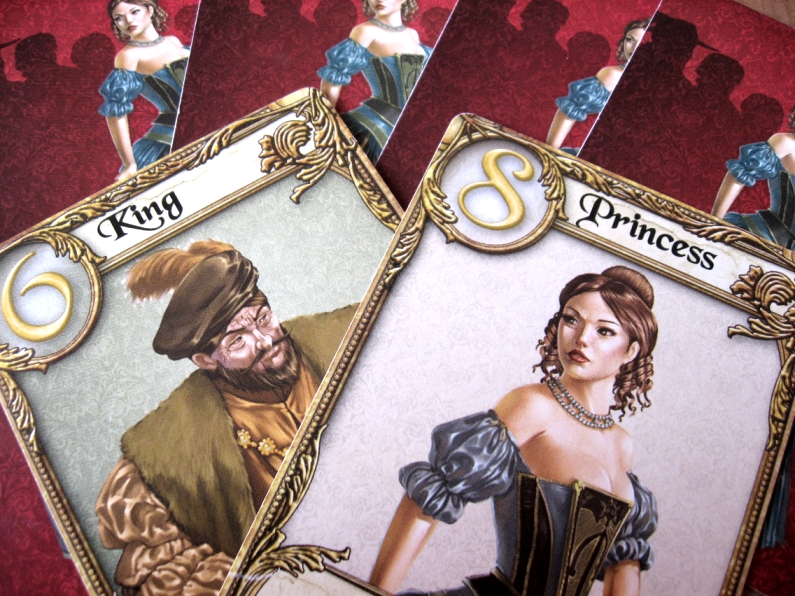
The last game of the night was an old favourite, Love Letter.  This is a really simple little duelling game played with just sixteen cards.  Each round only takes a couple of minutes and each player takes it in turns to draw a card and then play one of the two cards in their hand.  Cards allow players to look at another’s hand, force them to discard, give them the opportunity to try to assassinate other players etc. and the last player in, or (in the unusual case that all sixteen cards are drawn), the player with the highest card, wins the round.  Remarkably, one player managed a run of three rounds undefeated, and despite a desperate rear-guard action, this proved an unassailable lead.

Love Letter
– Image by boardGOATS

Learning Outcome:  A winning strategy doesn’t  always work…

25th June 2013

This week, we started off playing a slightly neglected old favourite, No Thanks!.  It seemed like ages since we played it last, but it turned out that it was less than two months ago that it last got an outing.  Since it is a quick card game where rounds take just a few minutes, it was ideal to play until everyone had arrived.  Next we, we played the “Feature Game”, Incan Gold, which is another game we’ve played previously.  In this game players are going down a mine and trying to get out with as many gems as possible before it collapses.  One player made a bit of a killing in the opening round, but she failed to hang onto the lead and was pipped by just two gems at the very end.

– Image by BGG contributor joshie

It was a bit of an evening for games we’ve played previously, as next we played Alhambra (which was a “Feature Game” at the end of last year).  This is a tile laying game where players have to collect sets and score points for having the most in any one set.  Scoring takes place twice during the game and once at the end, and each time the number of points increases.  This time, Blue (who won last time), got a terrible run of the cards and Red who had missed it last time, had an amazing game winning by a very large margin.

– Image by BGG contributor EndersGame

Racing fish may not seem like an obvious choice for a game theme, but it turns out that it actually works really well.  We played Salmon Run just two weeks ago and although we enjoyed it, we were all a bit tired, so we decided to give it another go this week.  For variety, however, we changed almost all the boards, using  S2, 3M, 4E, 5E & F2.  This time, Black got going much quicker than everyone else and headed left followed by Red while White went right.  Black decided not to worry about fatigue cards and just run for it, while Red and White were more cautious.  Black’s tactics seemed to pay off, however, as he made it to the spawning pool first and nobody else could quite make it in time.

– Image by BGG contributor kilroy_locke

Our final game game was Forbidden Desert which we also played last week, however it is a new release this year and it was a very close game last time, so we felt it deserved another outing.  This time we didn’t have a Water Carrier, but we managed to make good use of the tunnels and the Navigator’s ability to move other players three spaces for the cost of only one action.  These with the Archeologist’s ability to clear extra sand meant we ran out comfortable winners.  We’ll have to ramp up the difficulty next time!

– Image by BGG contributor henk.rolleman

Learning Outcome:  Doing well the first time you play a game doesn’t mean you’ll do well the second time…

11th June 2013

A couple of us arrived very early and managed to squeeze in a couple of games and dinner before anyone else arrived.  First up was Forbidden Desert.  This is a very new, cooperative game, where players work together to try to escape from the desert before the get swamped by the sand storm or die of thirst.  Although they have a lot in common, it is quite different to its older brother, Forbidden Island, and we felt, quite a bit more advanced.  Since it was only the second time out of the box, we played on the Novice Level.  Essentially, the game consists of a grid of tiles with a storm in the middle.  As the game progresses, the storm moves about, shifting the other tiles creating sand dunes as it goes.  The explorers also have to combat the lack of water in the desert, all the while trying to find clues to the location of parts of an ancient burried flying machine, and eventually, the parts themselves.  In the end we did it with a little breathing space, but there is no way we would have escaped without the Water Carrier’s special ability to get more water from the well.

– Image by BGG contributor duchamp

Next we managed a quick game of Morels.  This is a really pretty set collecting game with a mushroom theme and added “woodsiness” in the form of forage sticks which act as a sort of currency.  The idea is that you can collect the easily accessible mushrooms “at your feet” for free, or you can choose a less accessible fungi for the cost of one or more forage sticks.  Once you have a set of three or more mushrooms you can cook them, with added cider or butter flavouring to add points at the end of the game.

– Image by BGG contributor philsstein

It is the Stanford-in-the-Vale Summer Festival this weekend and we are planning to have a stall to raise our profile (weather permitting).  Since it is quite robust, we are planning to make Army of Frogs available to people to play, so we thought we should try to get to grips with it first. Basically the idea is that you jump one of your hexagonal frog tiles (if you can) and then place a frog from your hand, finally drawing another frog from the bag to make your hand back up to two frogs.  Somehow, we managed to play this apparently simple little game wrongly not once, but twice!  Something to work on before Sunday…

– Image by BGG contributor Moviebuffs

Then, we played this weeks “Feature Game”, Mission: Red Planet, which is about colonizing Mars.  In this game, each player is a colonial power which sends astronauts, in space shuttles, to occupy the most promising zones on the planet.  It is an interesting game with a curious mixture of luck and judgement.  The luck comes from the rockets that are available at the start of each round, the value of each region of Mars (which is hidden in the early part of the game) and the destiny cards drawn.  The judgement comes from the character cards which enable players to place a number of astronauts into rockets and often do something else, like launch a rocket early or move astronauts around on Mars or even sabotage someone elses plans.  The character played also dictates when the player gets their turn which leads to a lot of trying to “out think” everyone else, and with only ten rounds, once a card has been played you may not get the chance to play it again.  This sort of game can either go very well or very badly and this is exactly what happened:  Red came in four points ahead of Blue with fifty-five points, while Green finished with less than half that.

– Image by BGG contributor kilroy_locke

The last game of the night was Salmon Run.  This is a new little race game, where players are fish dodging bears, eagles and rapids, jumping waterfalls and trying to be the first to get to the spawning pool without being too tired.  The game has a modular board and, as it was new to most of us, we used a fairly easy set up:  S1, 4E, 3E, 2M and F1.  Red started quickly up the right side of the course with Black and Grey giving chase.  Unfortunately Red banged her head against the bank which gave Grey and Black the chance to overtake.  Black set the bear on Grey a couple of times and managed to sneak ahead, but Grey made a run for the last water fall and managed to sneak into the spawning pool, and as the last player in the round, ended the game and the evening.

– Image by BGG contributor kilroy_locke

Learning Outcome:  For teaching at the Summer Festival, it is probably a good idea to have some laminated crib-sheets available!