Once everyone had finished eating, we moved on to the usual difficult decision of who was going to play what. The “Feature Game“, Wyrmspan which is a very new stand-alone game, based on the mechanisms of one of the group’s favourite games, Wingspan, with dragons instead of birds. It was not as popular as expected, though that was at least partly because it was a relatively quiet night and many of those who would have enjoyed it were away. In the end, Blue, Black and Pink settled down to play leaving two other groups of three to sort themselves out.
 |
| – Image by boardGOATS |
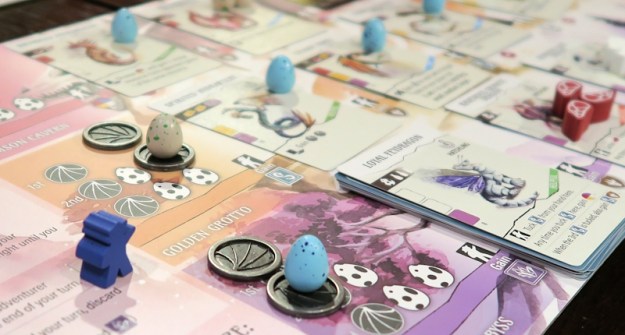
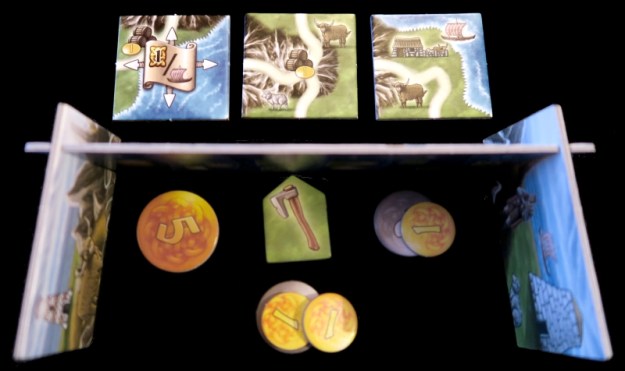
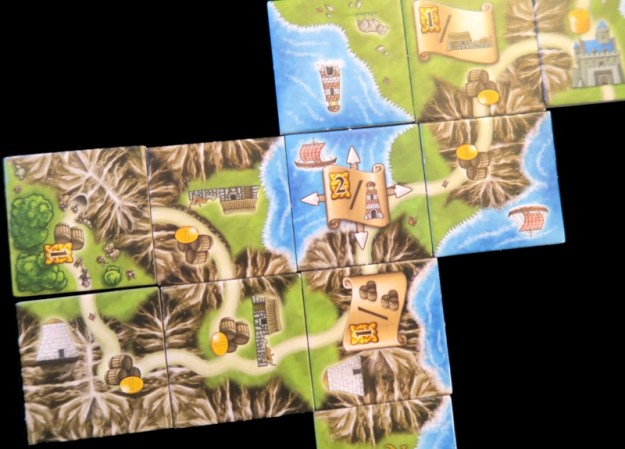
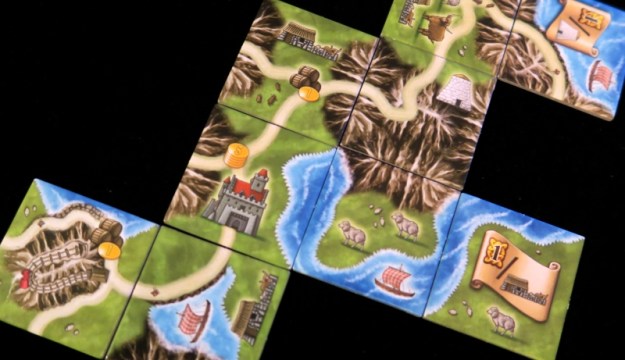
Wyrmspan is very closely related to Wingspan, though it is less forgiving, that is to say, the consequences of mistakes can be much more severe. Like Wingspan, players are playing cards from their hand onto a player board, and activating the habitats in turn. In Wingspan, the cards are Bird cards played in three different habitats, Woodland, Grassland and Wetland, whereas, in Wyrmspan, the cards feature Dragons and they are placed in three different cave networks, the Crimson Cavern, the Golden Grotto, and the Amethyst Abyss. The differences are more than simply cosmetic, however. Firstly, before a Dragon card can be played, it is necessary to explore the cave which involves playing a card (and claiming a Bonus).
 |
| – Image by boardGOATS |
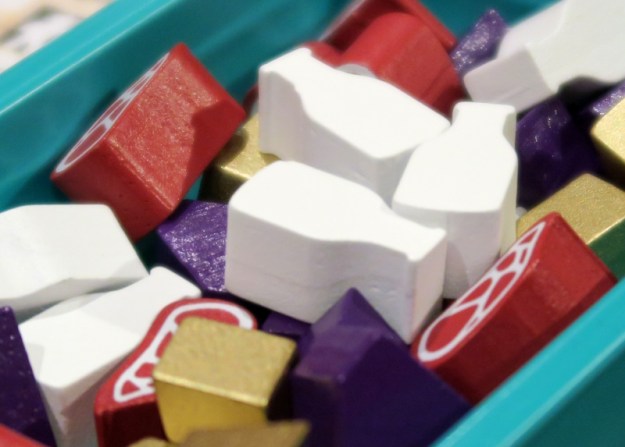
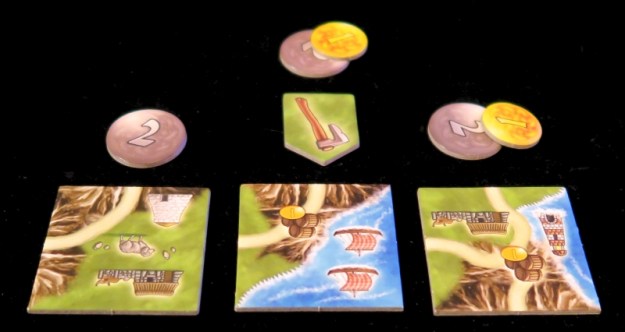
This is one way of getting Resources, there are others (playing dragon cards for example as well as activating the Crimson Cavern). One of the key differences is that these typically provide only one Resource at a time. So, whereas in Wingspan, if a player needs a resource, they activate their Woodland habitat and visit the Birdfeeder, claiming the resource they want and a couple of extras, in Wyrmspan, they don’t have extras so every move as to be made to count. And this is all the more critical as “Planting Dragons” requires a lot of Resources and can be difficult to do, so it is important that the Dragon planted is then exploited as much as possible.
 |
| – Image by boardGOATS |
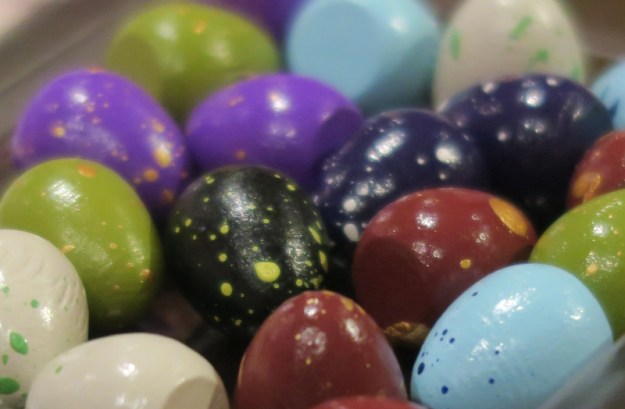
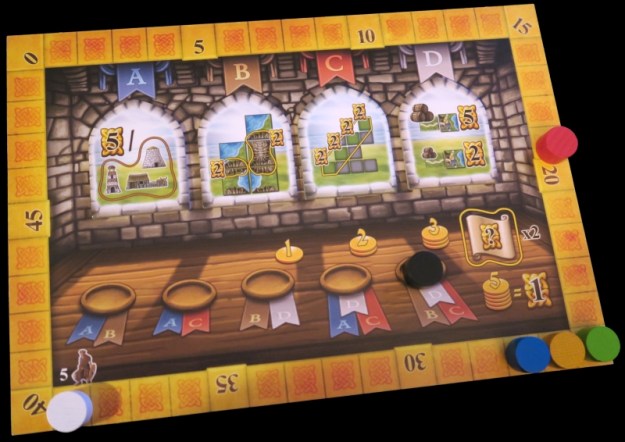
Further, one of the Bonuses is movement on a new, separate board, the Dragon Guild. A step around this Rondel typically gives a Resource as a reward, and when players reach half-way round and all the way round, they get a more valuable bonus which depends on the Guild in play. The distribution of cards is very different too, in Wingspan, the majority of the cards have an effect when the terrain is activate, but in Wyrmspan, these are in the minority with most card effect happening when played or at the end of the round/game. That is not to say they are not important—their very presence enables players to do more when the cave network is activated.
 |
| – Image by boardGOATS |
Further, in Wingspan, players have a fixed number of actions per round (with fewer in the later rounds), whereas, in Wyrmspan, players get a set number of coins at the start of each round and an action typically costs one coin. Some do cost more though, and occasionally players can pickup extra coins, which leads to variable length rounds. Thus, although Wyrmspan is very definitely Wingspan at its core (players pay Resources to play cards and then activate habitats) there are lots of differences which give the game a very different feel, and make it a tighter, slightly more challenging game to play. All that said, there has been a lot of discussion online saying it is much more difficult, but that is not how we found.
 |
| – Image by boardGOATS |
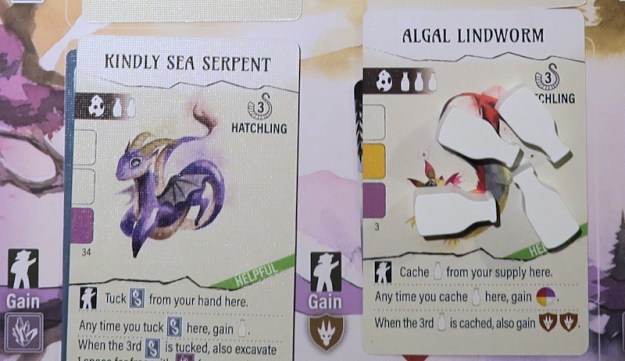
Blue went first and playing a Spirited Hydraptere Dragon in the first round which gave her two extra coins and then she proceed to plan her strategy from there. Black prioritised progress around the Dragon Guild (Seafarers), which, as that was also high on Blue’s priority list, set them in competition. Meanwhile, Pink had started with two Hatchlings (Kindly Sea Serpent and Algal Lindworm) which looked like they would synergise well, so he worked towards playing them. Unfortunately, he came to the conclusion that this was a mistake as it slowed the start of his game and that he would have done better if he had ditched one of them.
 |
| – Image by boardGOATS |
It is interesting to note, that many of the online comments have suggested that Hatchlings come at too heavy a price. However, discussion after the game suggested that all three players felt they were essential to the “engine” and were worth the effort albeit needing some care to choose the right dragon. As the game progressed, Black powered round the Dragon Guild with Blue snapping at his heels. Black took the straight six points from under Blue’s nose, so she took a free excavation instead. Then, towards the end of the game when Blue and Black were heading for their third Dragon Guild bonus Pink grabbed the three point for each completed column and then Black took the straight three point bonus.
 |
| – Image by boardGOATS |
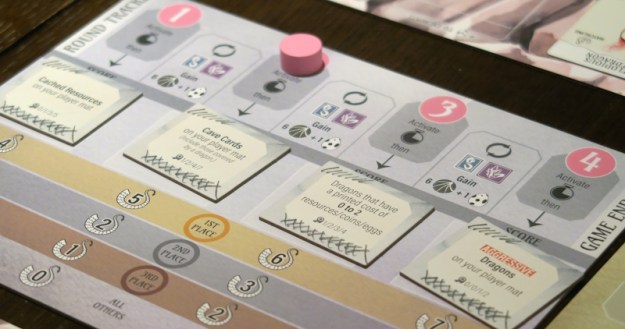
Blue was most unimpressed as between them they had cost her eight points by leaving her with a solitary straight single point, though she picked up a few more from her Tawney Northern Drake (which gave her two points for each marker in the Guild at the end of the game). Pink did well with his Guild points (despite only placing two tokens), but unfortunately it wasn’t enough. As well as his points from the Guild, Black had also prioritised the end of round Public Objectives. In a game with small margins, it looked like this might be enough for victory, however, Blue had a few more eggs, some more valuable Dragons, more tucked Cards and cached Resources. As a result, she just edged it with eighty-eight points to his eighty.
 |
| – Image by boardGOATS |
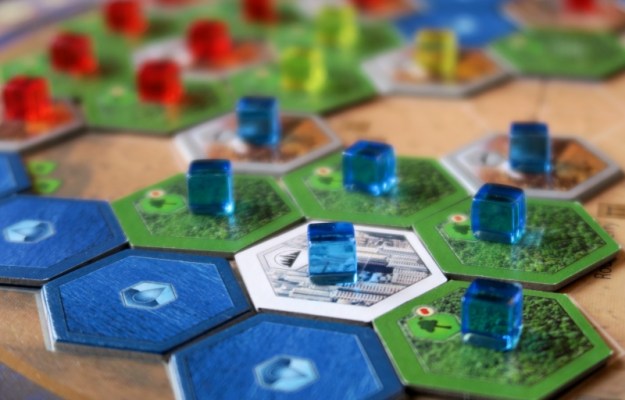
Meanwhile, Green who had considered joining the Wyrmspan game, eventually joined Cobalt and Ivory in a three-player game of Terraforming Mars. This game is quite popular within the group, though it doesn’t get an outing very often. The game is set in the 2400s, when mankind begins to Terraform the planet Mars. Players take the role of corporations sponsored by the World Government on Earth to initiate huge projects to raise the Temperature, raise the Oxygen level, and increase the Ocean coverage until the environment is habitable. Victory points that are awarded for contributions to the terraforming, but also for advancing human infrastructure throughout the solar system, and doing other commendable things.
 |
| – Image by boardGOATS |
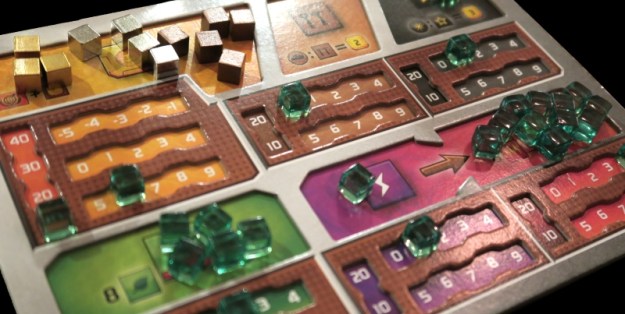
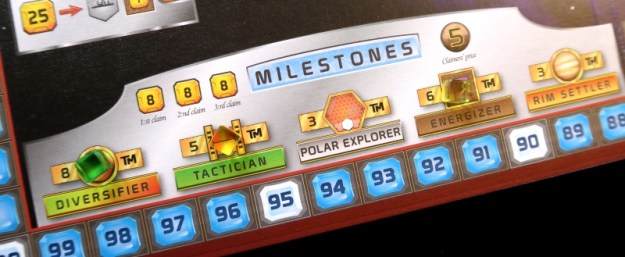
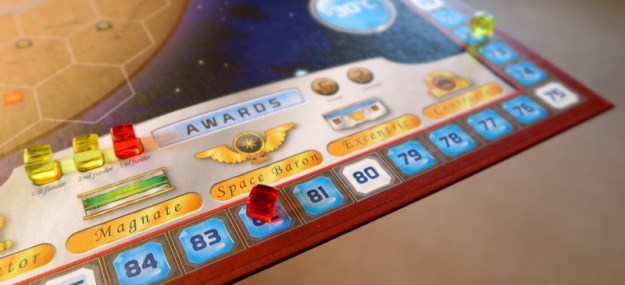
The players purchase Project Cards which can give immediate bonuses, as well as increasing production of different resources. Some of the Cards only become playable when the Temperature, Oxygen, or Ocean coverage increases enough. Buying Cards is costly, so there is a balance between buying Cards and actually playing them. There are six different Resources: MegaCredits (money), Steel, Titanium, Plants, Energy, and Heat and players keep track of these on their personal player board. Players compete for the best places to build Cities, place Ocean tiles, and develop Greenery. They also compete for different Milestones and Awards worth many points.
 |
| – Image by boardGOATS |
At the start of each round (or Generation) players purchase cards from four drawn privately. Then players take it in turns to carry out one or two actions: playing a card, claiming a Milestone, funding an Award, using a Standard Project, converting Plants into Greenery tiles, converting Heat into a Temperature increase, or using the action of a Card already in play. Once all players have passed, players get Resources according to their Terraform rating and production parameters. When the three global parameters (Temperature, Oxygen, Ocean) have all reached their goal, Terraforming is complete, and the game ends—the winner is the player with the most points.
 |
| – Image by boardGOATS |
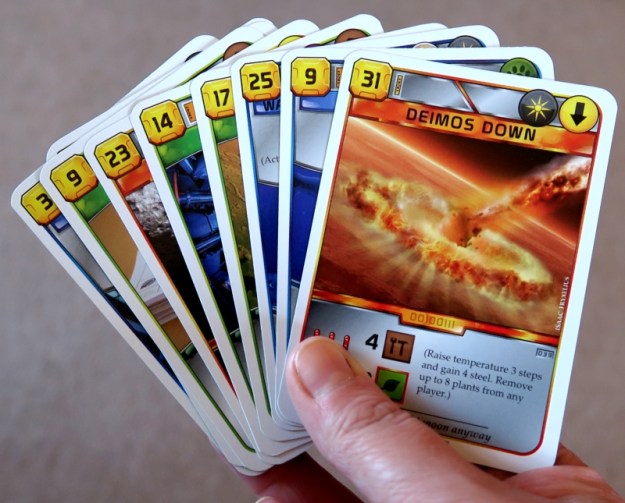
This time, the group played the Elysium map (from the Hellas & Elysium map pack), with the “quick-start” Prelude expansion (but without the Incorporation Cards) and with Card Drafting (after the initial starting hand). Ivory had the Valley Trust Corporation giving him increased money production which was further increased by his Research Network Prelude Card, ensuring that finance was not going to be a problem for him. Green had Tharsis Republic, giving him an injection of cash when any city was planned on Mars. Cobalt had Cheung Shing which gave him a two MegaCredit discount on Building Cards.
 |
| – Image by boardGOATS |
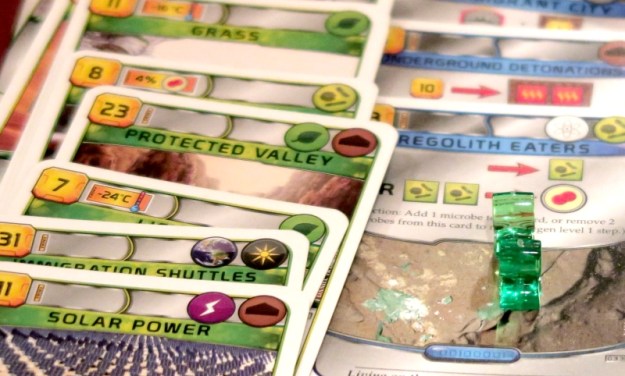
Green and Ivory both placed early Cities; Ivory got built the Research Station giving him a discount on all future Cards. From there, Cobalt and Green then began focusing on Terraforming. Green used his initial Titanium (from Prelude Cards) to play several powerful Event Cards early on. Cobalt then played several action cards including Regolith Eaters, Aquifer Pumping, Extreme Cold Fungus and CHG Producing Bacteria which he was able to combine together well to climb the Terraforming Track, although Green’s Event Cards meant he was never far behind.
 |
| – Image by boardGOATS |
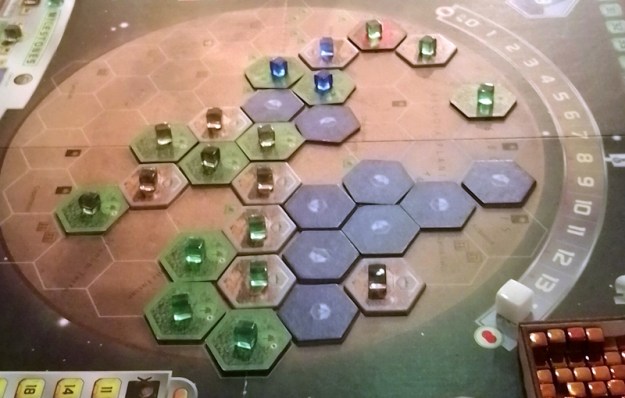
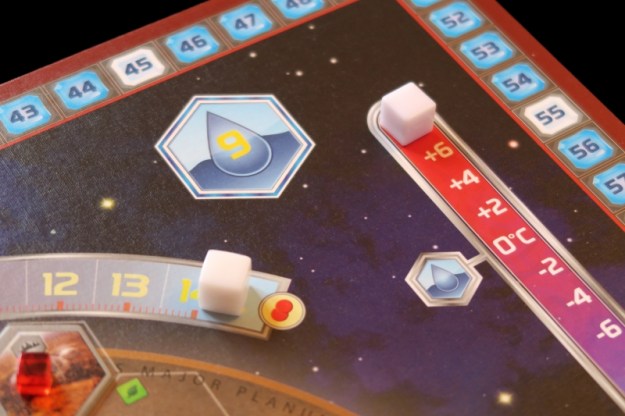
While Green and Cobalt were busy Terraforming, Ivory focused on getting his Plant production up and running as well as further increasing his money production (partly through building another city on Olympus Mons, refilling his hand). Although the other two had sped ahead on Terraforming, during income everyone was getting similar income thanks to Ivory’s increased money production. However, the other were generating lots of Energy/Heat and getting a lot of other resources. As a result, Green took the first Temperature Bonus and Cobalt the second. Turn order meant Cobalt wasn’t able to grab the Oxygen Bonus, which went to Ivory. The Oceans were complete very early in the game, so there was no third Temperature Bonus.
 |
| – Image by boardGOATS |
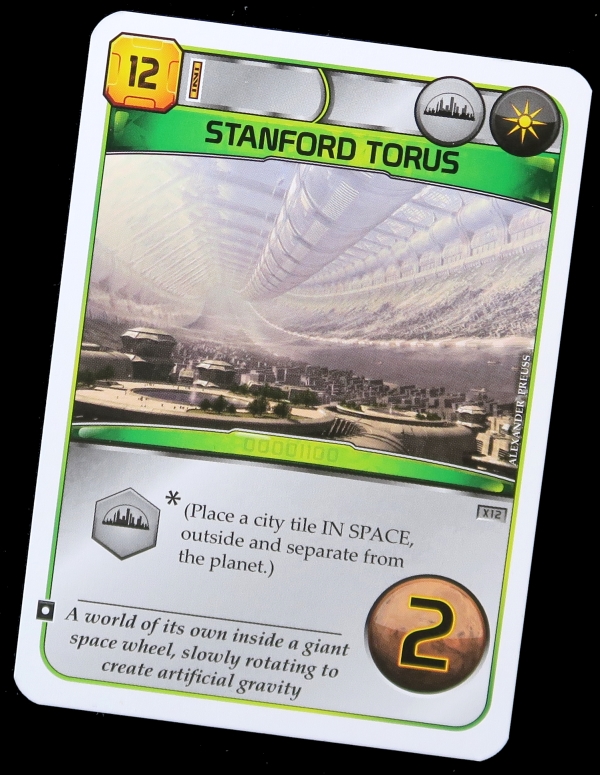
Ivory’s focus on money production as well as Plant and Micro-cards, allowed him to grab the Specialist and Ecologist awards in one turn. This forced Green’s hand to take the final milestone, Legend (for playing at least five events). Green then quickly grabbed the Legend award after. From there, Cobalt continued to focus on Terraforming (particularly Temperature), placing only one City and a handful of Forests, whereas Green and Ivory started placing Greenery tiles. Ivory managed to get to his plant production up to eight, giving him a Greenery tile each round. Ivory and, to a less of extent, Green also started building more Cities.
 |
| – Image by boardGOATS |
Although this was going to score Ivory a lot of points at the end of the game, each City built was feeding Green’s engine, increasing his money production, quickly getting well into the teens. From there, the Awards were the focus. Ivory jumped first for Desert Settler, Green shortly after for Celebrity. Noting he had very little end-game scoring, Cobalt had to spend 20 MegaCredits to grab the last award, the Industrialist. All three players scored the maximum five points for each of the Awards they funded. It then became apparent that the end of the game was approaching: Ivory’s Greenery tiles were rapidly pushing the Oxygen to its maximum, the Oceans had been completed early by Green and Cobalt and Cobalt had focused on Temperature.
 |
| – Image by boardGOATS |
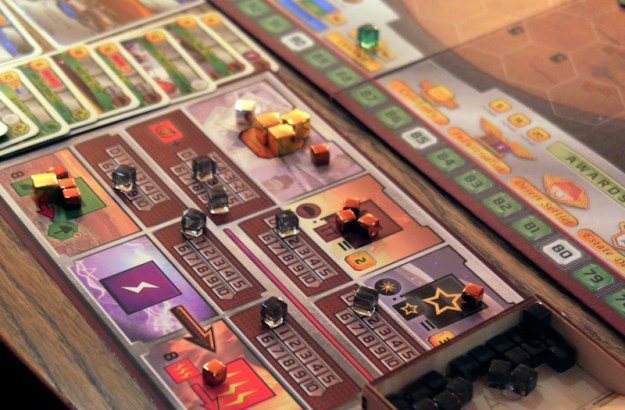
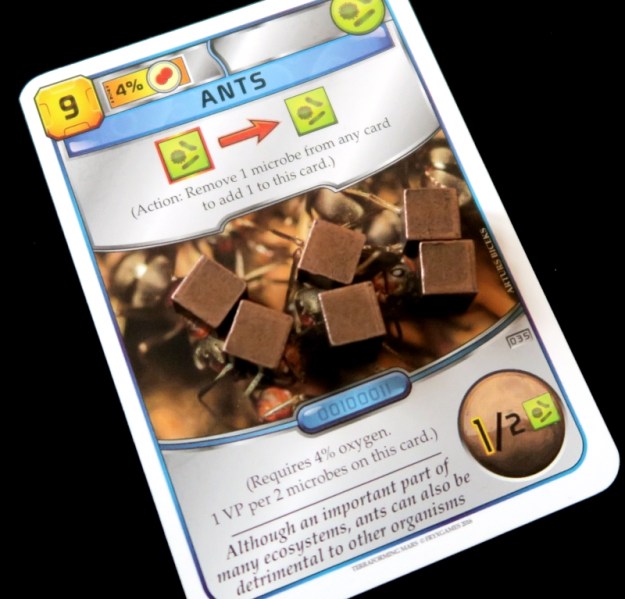
Ivory picked up a number of Animal Cards (Livestock and Fish) and focused on getting animals on them while Green’s huge money production allowed him to play a large number of Cards. It looked like the game was about to end after Generation Seven, but taking that final Award prevented Cobalt from raising the Temperature the final step, forcing one last Generation. That allowed Ivory to get more Animals and Greenery tiles and Green more cards with points before Cobalt finally triggered the end of the game. Both Green and Cobalt were way ahead on Terraforming and everyone scored similarly for Milestones and Awards, but Ivory’s Greenery tiles, Cities and Animals got him victory just ahead of Green.
 |
| – Image by boardGOATS |
This demonstrated how important it is to develop a really robust engine, which together with some other scoring Resources will generally allow the funding of awards. It is also key to keep an eye on the milestones and awards, since they can disappear almost instantly before you get the opportunity. Cobalt had only really played Terraforming Mars solo before this. In the solo game it is a race to Terraform the planet alone before the clock runs out (fourteen generations with the Prelude expansion). This requires a very different strategy to multiplayer Terraforming Mars, however, where it is much better to concentrate on a strong plant engine with some cities to add to the score, as demonstrated by Ivory.
 |
| – Image by boardGOATS |
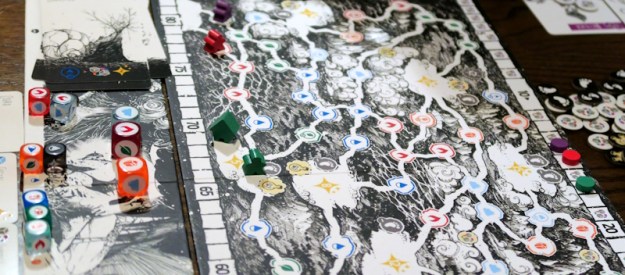
While Mars was being Terraformed and Wyrms were being “Spanned”, Teal, Purple and Pine were playing Glow, a strange little game which visually inhabits the domain of the graphic novel, the roman graphique, much beloved in France. Ben Basso and Vincent Dutrait’s appealing black and white line art is unique and stylised and sets the tone of gentle strangeness, which contrasts well with the brightly coloured dice and other game elements. In Cedrik Chaboussit’s Glow, players take the role of animal leaders recruiting a band of up to eight companions to make a journey to bring shards of light back to a dark world. The game ends after eight days and the winner is the player with the most Light Shards.
:strip_icc()/pic7266231.png) |
| – Image by BGG Contributor Propi |
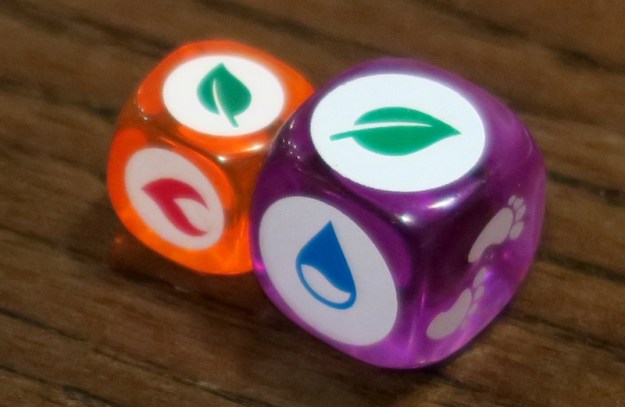
Players start by selecting one Leader Card from a choice of seven and take the accompanying big dice noted on the Card. Dice in the game have elemental symbols on them, Cloud, Water, Leaf, Flame and Gem. The colour of the die gives an extra face of that coloured symbols, for example, the green die has two Leaf symbols on it. On day one and every subsequent day players select a Companion Card from the “Meeting Track” (Marketplace) which is refreshed every day with new Cards. Players take the selected Card into their tableau next to their Leader group to form their growing band. Players also take any small temporary dice that have been placed on the Marketplace card.
:strip_icc()/pic6446690.jpg) |
| – Image by BGG Contributor a2b2c517 |
Once the recruitment phase is over, players simultaneously roll all their dice. Players can re-roll one or two of their dice if they either play a re-roll token (acquired through in-game actions) or move their scoring track token back to the next re-roll space, effectively losing points for this benefit. The dice results are then used to purchase actions at the base of each character card. For example two Flame symbols provides three Sparks, or a Gem and a Water symbol provides a re-roll token. Each die can only be used once on each card, but each card can be triggered multiple times if dice are available, and each die can be used on each card if legal.
:strip_icc()/pic7266230.png) |
| – Image by BGG Contributor Propi |
In addition to scoring point Sparks, players can earn re-roll Tokens, Footprints and Glow-Worms. Unused Feet score one Spark at the end, but have another use in the Journeying phase. If a player has glow-worms equal to or more than their Companions, they receive a ten Spark bonus at the end. The scoring track surrounds a map of the game world with multiple branching paths. Players start in one corner and in the Journeying phase, attempt to move their band meeple to point-scoring campsites of progressively higher value secured by pitching their tent on scoring spaces. To move along the paths players pay the indicated cost, such as a Leaf symbol, from the revealed symbols in their dice pool. Footprint tokens can be used as jokers to by-pass costs.
 |
| – Image by boardGOATS |
At the round end, five new Companion Cards are dealt to the Meeting Track and players give back their temporary small dice by placing them on the matching symbols in the Meeting Track above the Cards. These dice are then taken when the Card is selected in the following round, thus increasing the value of certain Cards. Although the game phases are played simultaneously after the recruitment phase, this time, Teal, Pine and Purple opted to play sequentially to assist with learning the game.
:strip_icc()/pic7266224.png) |
| – Image by BGG Contributor Propi |
The complexity of the game comes from selecting Cards from the Meeting Track and weighing up potential Card actions against increasing a player’s dice pool. Choices include denying opponents Cards, weighing up the cost of re-rolls, planning for action combinations or focusing more on the Journey board for points. Pine selected the starting card of Braccio, giving two big green dice, and the action of two leaves providing a Footprint and three Sparks at the game end. During the game Pine got an extra big green dice with a Sketal follower early on to assist with maximising the Braccio special action focussing on Leaf generation for points.
:strip_icc()/pic6677938.jpg) |
| – Image by BGG Contributor rascozion |
Purple selected starting card Noctiluca with two big purple dice—the sixth face gives two Footprints and the action of three wild symbols scoring five Sparks. Purple went for a corvid strategy, selecting three crow-like birds. One of these, Kaar, effectively curses other players dice by locking away from use one symbol per turn if the black die is chosen along with the other dice. Teal selected Tocana, with three big red dice and four Sparks at game end. As the game developed Teal went for a wild symbol strategy and acquired two Torke cards to generate guaranteed points each round, or so he mistakenly thought at the time…
 |
| – Image by boardGOATS |
Progress was made on the journey board by all, with Purple and Pine getting to the better quality campsite netting fifteen points each, inspiring reminiscences about woeful tales of camping experiences. At game end Teal scored a hundred and six, some fifteen ahead of Purple in second place. Unfortunately, when playing Glow later on BoardGameArena, Teal realised that while the “wild” multi-coloured cost symbols powering actions could represent any symbol, they ALL had to match each other to trigger the benefits.
:strip_icc()/pic7266227.png) |
| – Image by BGG Contributor Propi |
Because Teal had more of this type of card than other players and acquired them early on, Teal had been unfairly gaining a point advantage by triggering Spark acquisition using mixed symbols. This explained Teal’s high score and he insisted on being relegated, recording his score as null and void—that left Purple to take the golden crown and Pine the silver medal. It had been a good game which has lovely presentation with immersive art. There’s lots of risk-reward decision-making, and another game would be great now that the rules are better understood, especially as simultaneous play should reduce playing time to the advertised forty-five minutes.
 |
| – Image by boardGOATS |
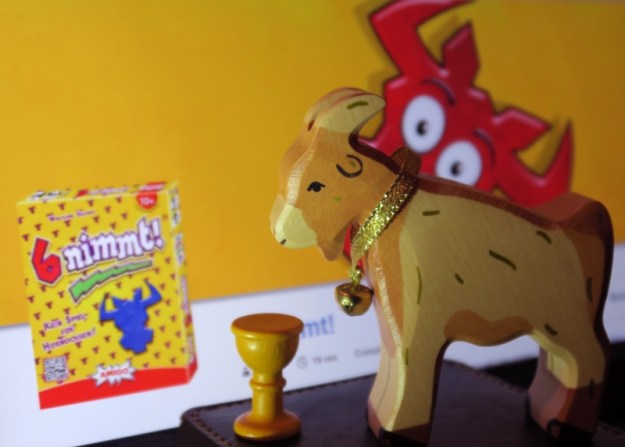
With both Glow and Wyrmspan finished, there was just time for something quick before home time. There was some discussion about what to play, but eventually, the player count of six and the short time available fixed the decision as the old favourite, No Thanks!. This is a very simple “push-your-luck” game where players take it in turns to choose whether to take the face-up Card, or pay a Chip to pass the problem on to the next player. At the end of the game, players add up the face value of their cards and subtract the number of Chips to give them a total—the player with the smallest total is the winner.
 |
| – Image by boardGOATS |
There are two additional rules that make the game work: firstly, if a player has a run of Cards with consecutive numbers, they only count the lowest number. This is tensioned by the second rule, which is that roughly one third of the Cards are removed from the deck at random before the start. This means players have to gamble on whether a card in a run is still available and it can make things go very wrong for people. This time, it went very wrong for Blue who finished with forty-eight and for Black who top scored with a massive one hundred and twelve! The winner, with a very reasonable twelve, however, was Pink, two ahead of Pine who finished with fourteen.
 |
| – Image by boardGOATS |
Learning Outcome: Wyrms are more challenging to handle than Birds.








/pic3782664.jpg)
 boardGOATS