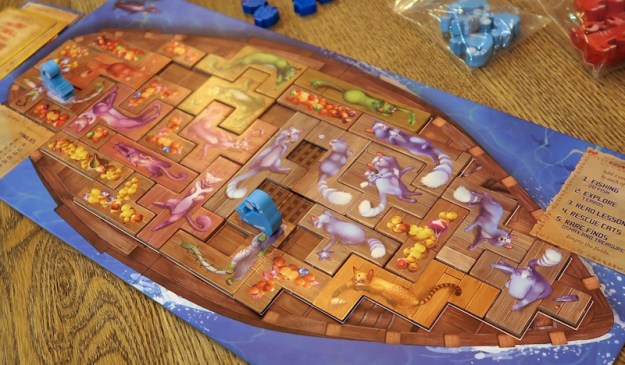
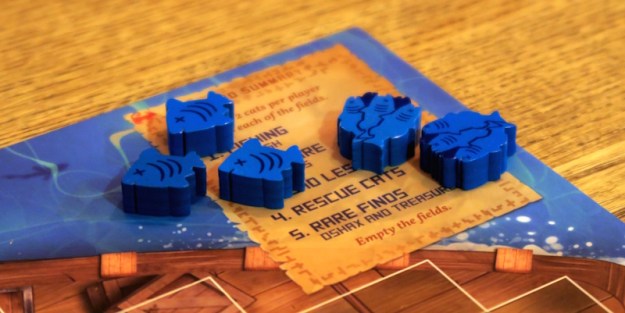
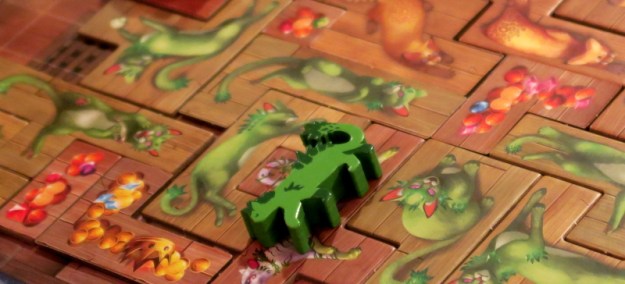
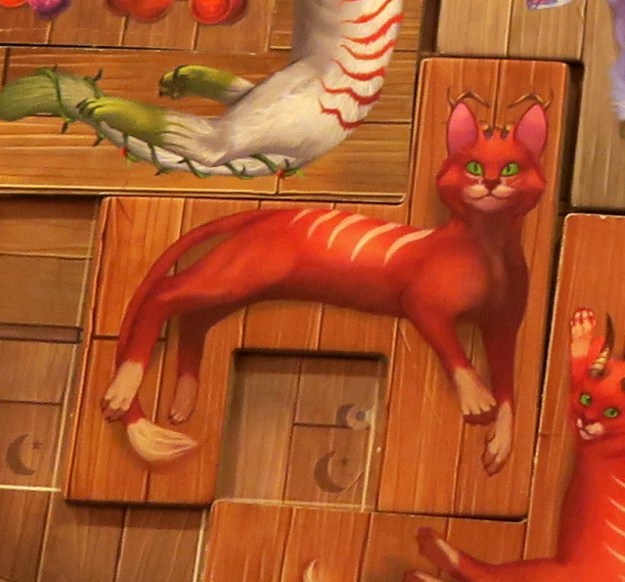
Tag Archives: The Isle of Cats

8th July 2025 (Report)

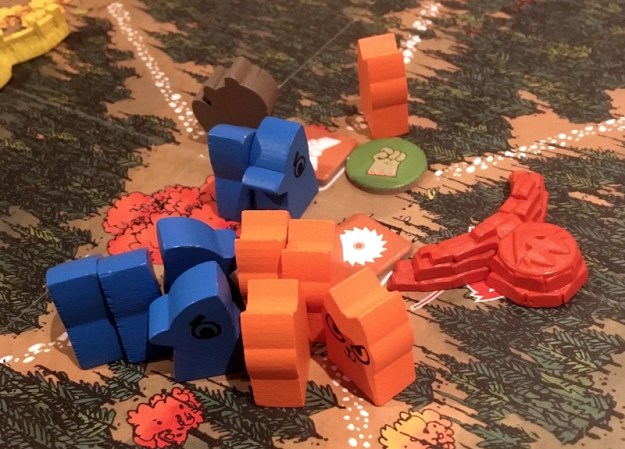
Things were late starting, largely due to the delayed arrival of Blue and Pink with their copy of the “Feature Game“, the the shiny new Emberleaf.  It was Plum’s Special Birthday—there have already been two in the last few weeks (Jade and Pine, with Black a few months ago) and more to come in the not too distant future—so there was a bit of chat, card signing and some amazing chocolate cakes provided by Sapphire.  Eventually, as time was marching on, games were assigned and Blue and Jade started to explain the rules of Emberleaf to Ivory.  This is a “card dancing” and tile placement game from the same stable as The Isle of Cats, where players are trying to re-home their kin in clearings on the central Forest board.

Emberleaf
– Image by boardGOATS

The core mechanic of the game is card placement and movement on the players’ individual Fellowship player boards.  The idea is that on their turn, players carry out one of two possible mandatory actions and as many optional actions as they like.  The two possible mandatory actions are Card Placement and Card Movement (or “Dancing”).  There are five different types of power on the Cards and one of these is the “On Play” action.  This takes effect when they are placed—players start with a two by six space to place cards and can place each card in any empty space.  The other possible mandatory, Card Movement involves starting with the card in the top left corner and progressing down each column, each card is moved left one space and any “Slide” actions are carried out.

Emberleaf
– Image by boardGOATS

When cards reach the left-most column, Sliding moves them off the player’s board (activating any “Drop Off” actions) and back into their hand (not via a discard pile like deck-building games, so there is no probability element; Cards as always available in hand or on the player’s Fellowship board).  The remaining two powers include “Ongoing” and “Charge”.  Ongoing powers are always active as long as the card is on the board, while Charge powers are optional actions that can only be taken a set number of times before they must be refreshed by the Card Sliding off the board.  All these actions broadly come under the categories of Gathering Resources (Wood, Stone, Turnips or Honey), Walking between clearings, Attacking monsters to make dangerous areas in the forest safe, and Building in clearings.
Emberleaf
– Image by boardGOATS

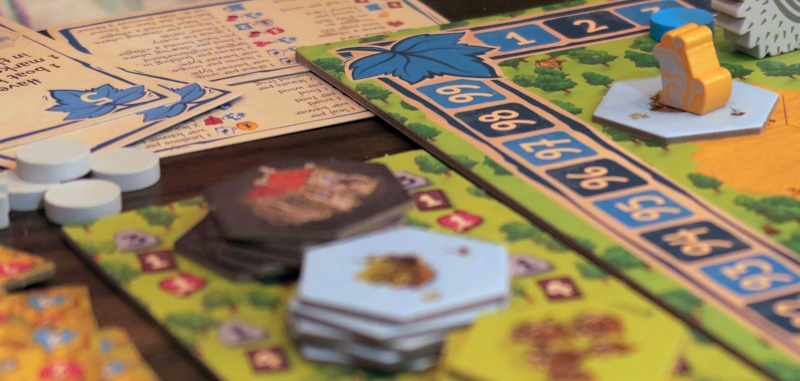
Each player has a space on their Fellowship board to place Resources, which means players have a limited number they can store.  So, for example, Building requires a card to give the action (either placed or moved) and the necessary Resources to be spent, as well their Hero figure at the clearing they are building in.  Each player starts with a super-cute Hero Figure representing their clan chief, located in Hawker’s Crossing—the most westerly clearing, on the edge of the Forest.  From there, players can move their Hero around the board by Walking along paths which go through dangerous areas.  If a player wants to travel through a dangerous area, they need to walk further or, alternatively, they can spend a turn Attacking the monsters in the Dangerous area and make it Safe (which also requires an action either by placing a Card or as part of a Card Movement).
Emberleaf
– Image by boardGOATS

As always, Ivory was on the case, and asked the key question:  Where do the points come from?  In truth, Emberleaf is a bit of a “point salad” with points coming from all sorts of places.  For example, players get points for Building with the number of points equal to the number of different types of building in a neighbourhood.  Players also get points for making Dangerous areas Safe, as well as for collecting Trophies.  There are six Trophies available during the game, and getting these is all about timing with the player who reaches the bottom of the cooperative War Banner Track taking one.  Everyone gets some benefit from this, but the player who takes the Trophy gets an extra bonus.  The game ends at the end of the round when the sixth is taken.

Emberleaf
– Image by boardGOATS

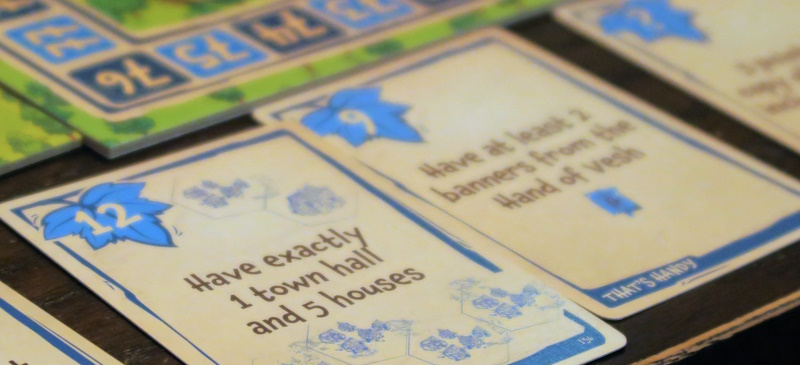
Additionally, in a similar way to the tiny buildings in Tapestry, when players take one of their twenty Emberlings from their Fellowship board and re-home them, they reveal a little bonus and some of these are points (others include Resources etc.).  There is another, more significant way of gaining points, however, and that is through Favour Cards.  These are personal objective cards which can be very lucrative and are scored at the end of the game.  Favour Cards can be acquired as part of rehoming Emberlings, but also by Promising a Favour, one of the optional actions that can be carried out as part of a player’s turn.  Each clearing starts with a Favour token in each player’s colour and if their Hero is currently located in a clearing containing one the player may spend it to take a Favour card.

Emberleaf
– Image by boardGOATS

On the surface, the game is not that complex, though building an engine requires an understanding of what the cards do and how to get the best of them.  Additional Hero cards can be taken from a Card market when a Campfire icon is revealed (likely on re-homing an Emberling).  There are a few little rules niggles as well.  For example, the Card markets (there are two:  Favour and Heros) are refreshed at the end of a player’s turn, but as well as replacing the used cards, the oldest card is also discarded meaning the order cards are drawn in has to be observed.  Similarly, whenever a the bottom of the War Banner Track is reached, the Dangerous Area tiles are refreshed.
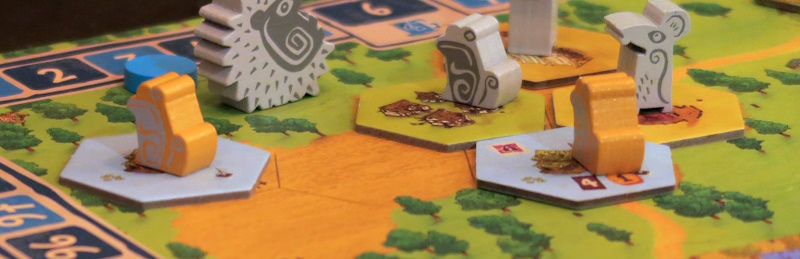
Emberleaf
– Image by boardGOATS

Ivory, got a handle on the rules really quickly and was out of the blocks on the “B” of bang.  Jade wasn’t far behind, while Blue was much, much slower as she spent much of her time with her nose in the rules checking queries rather than focusing on her game.  When she finally got round to looking up, the others were distant figures on the horizon and she had a lot of catching up to do.  Ivory had moved quicklywith an initial strategy of building buildings on the areas that gave honey (particularly markets occupied by a mouse for his end game scoring).  This gave him additional spaces on his board and he then picked up a couple of additional Hero Cards and several Favour Cards to further drive his strategy.
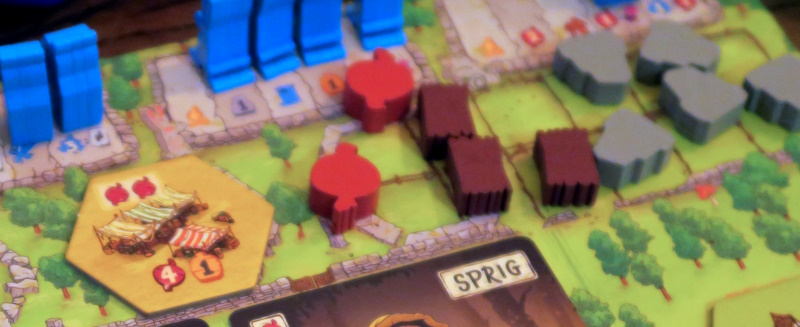
Emberleaf
– Image by boardGOATS

The Koala allowed Ivory to battle anywhere whenever he “Danced”, and that gave him a steady stream of points and resources.  Jade and Blue were slow to clear the additional board actions, but Ivory found that opening up the Build Action meant he always had that available and could place a card with only “Dance Actions” at the end, giving me max benefit for that card.  Everyone tried to get end game objective cards early as they give something to aim for.  Ivory was by far the most effective at this however getting cards that gave points for having his mice on markets, mice in at least three different areas and building in exactly four areas, whereas Blue who was slower, found she was trying to take objectives that matched her achievements.
Emberleaf
– Image by boardGOATS

Inevitably, Ivory was the victory by a veritable country mile finshing with one-hundred and thirty-eight, though Blue who had been practically stationary for most of the game, came through strongly in the late stages to take second.  It had been a tough learning game, but everyone had liked it and it definitely deserves anothe outing.  Meanwhile, Plum, the Birthday Girl, was playing one of her favourite games, Viticulture.  This is also one of Pink’s favourites and is also very popular with both Byzantium and Mint who completed the foursome.  There is nothing really innovative about the game—it is “just a standard worker placement game”, but it does the job really, really well, which elvates it above so many other worker placement games, and as a result, it rates highly on ranks very highly on so many lists.

Viticulture
– Image by boardGOATS

The game played over several rounds, which are split into seasons—Players take it in turns to place workers on the Summer part of the board in the first half allowing them to plant grapes and prepare for Winter when players can harvest their grapes, make wine and fulfill contracts for points.  In general, each action has a small number of active spaces, but players also have a Grande worker who can always be used to carry out an action, even when all the usual spaces have been filled.  Winter and Summer are setup phases when turn-order is addressed and Visitors arrive.  Visitors are cards which allow players to bend the rules slightly and/or gain points.
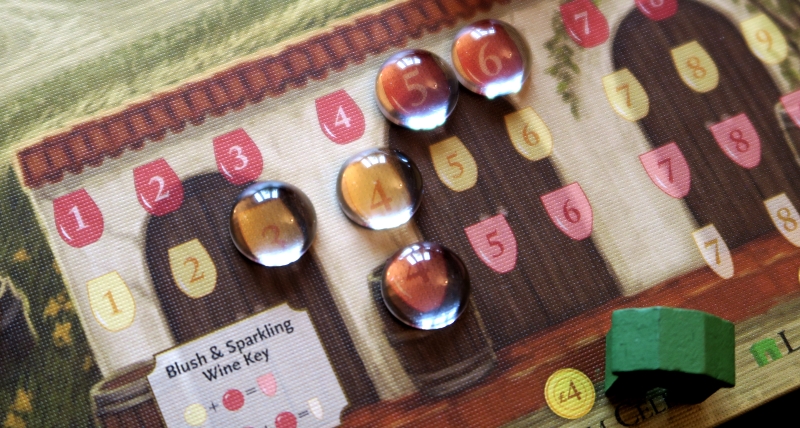
Viticulture
– Image by boardGOATS

This time, however, the group decided play with the Tuscany expansion and the Moor Visitors card deck.  Tuscany replaces the main board with a larger board, but also re-structures the phases so that there are now four seasons to place workers.  It additionally adds a small map where players can place star-eeples to gain a bonus and points at the end of the game for the player with the most influence in this area.  Tuscany also brings in structures, which players can build to enhance their vinyard and use to gain more points.  It also lenghtens the game slightly, ending when a player passes twenty-five points rather than twenty in the base-game.

Tuscany
– Image by boardGOATS

Everyone knew the game well, so after just a few rules clarifications the game was underway with everyone opting for the the now standard trategy of selling a field for an early influx of cash.  Mint started with some really nice building cards including one which enabled her to harvest multiple fields at the same time.  Plum was less enthused by hers and recycled them—as she had begun the game with the Cottage she was picking up extra Visitor cards every Autumn.  She made a concious decision not to choose to “wake up” first, which meant she never went first or last in the turn order and when she chose the start bonus of “age grapes” she forgot to take advantage of it.  This was clearly catching as Byzantium did something similar when he chose the same starting position.
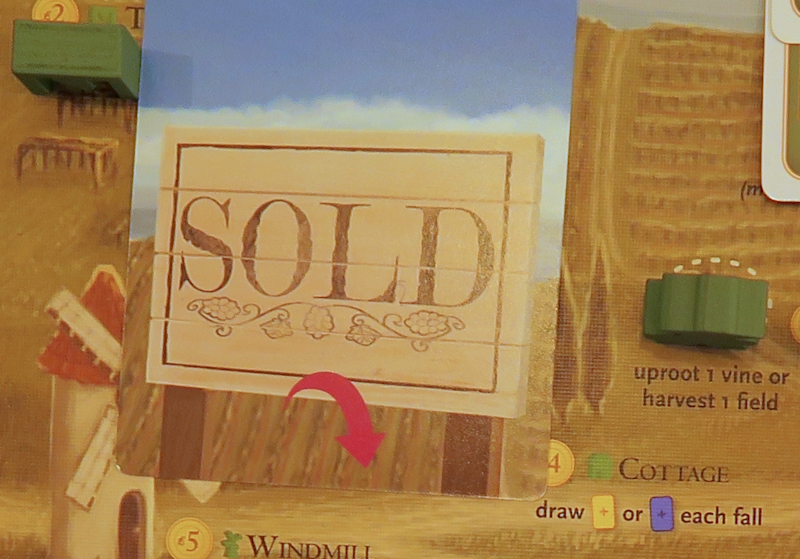
Viticulture
– Image by boardGOATS

The Tuscany expansion also adds Special Workers which have their own special abilities and players can train one of their workers to have each of these.  This time they were the Farmer and the Builder, with the latter from the Special Workers promo.  Respecively, workers with these powers, allow the player to choose a bonus (even if they are not on a bonus space) and save two lira when building.  A priority is always to get more workers early in the game, but whether to upgrade them is a difficult decision as it costs an extra lira and cash is always so tight in this game.  These proved quite popular though as going second in a location with a Farmer still gave a bonus.
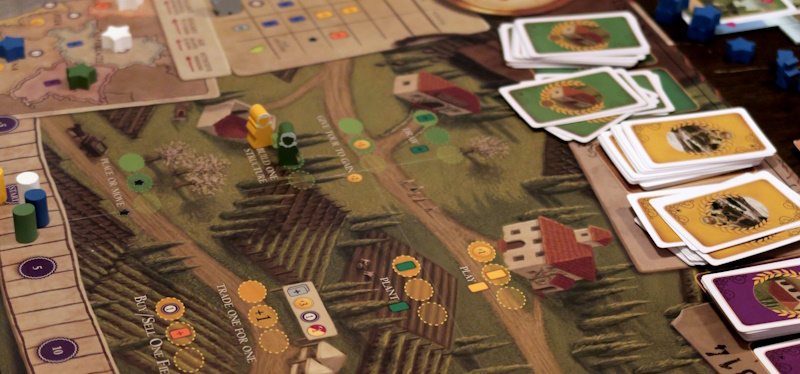
Tuscany
– Image by boardGOATS

Pink got his head down making wine early as he picked up two really nice, achievable and valuable contracts early in the game, which gave him a solid start.  However, it was a very long time before anyone actually really started scoring points as everyone concentrated on building their vinyards before putting them into action.  For example, Plum, needed a Trellis for her first grapes, although having a Builder reduced its cost.  Eventually she also built a Penthouse which gave an extra point when making high quality wine over a value of seven and with those in place was in a position to start growing, harvesting and turning grapes into wine.
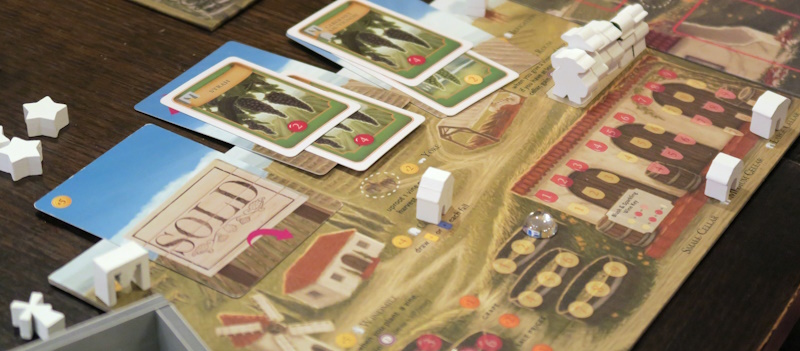
Tuscany
– Image by boardGOATS

At one point, Plum played a two Visitor card combo that gaver her a grape which she was immediately able to sell at tripple the normal price.  Otherwise, everyone mostly focussed on turning grapes into wine and completing contracts for points, although Pink did turn cash into points as well.  As is always the way with Viticulture, there was a sudden cascade of points, and with four experienced players it was a tight game with all four finishing over the twenty-five point finishing line.  The winner was Pink, however, who finished with thirty one points, three more than Plum who took second (no, Pink wasn’t going to let her win, even on her birthday!), and Byzantium and Mint tied and shared the last spot on the podium.
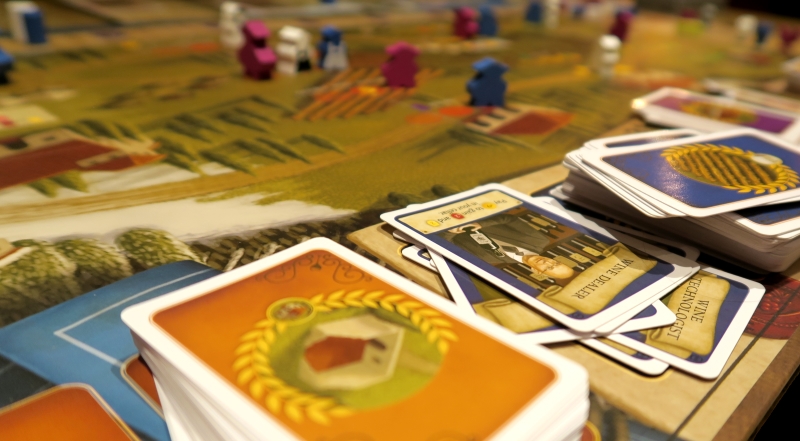
Tuscany
– Image by boardGOATS

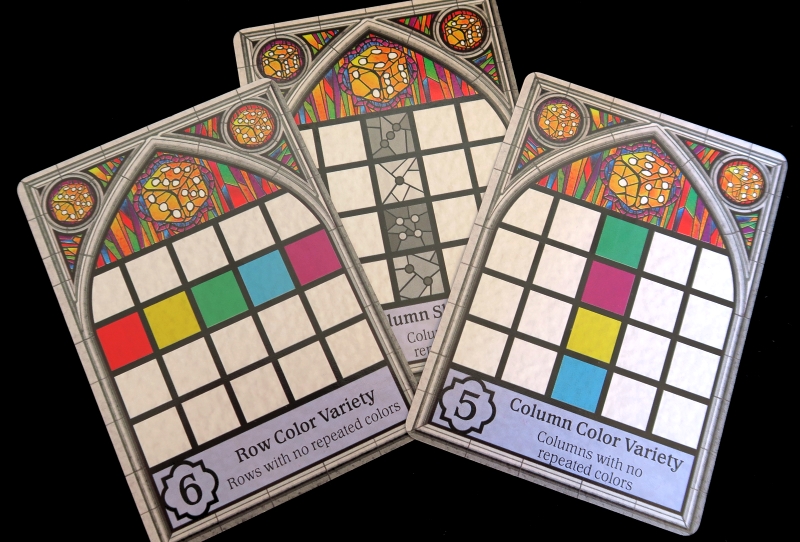
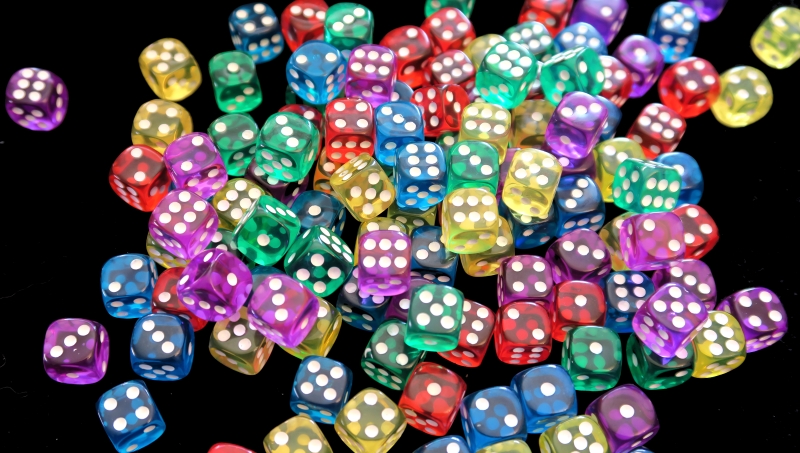
The third table, comprising Black, Purple, Pine, Sapphire and Lime, started with a game of Sagrada (with the 5-6 player expansion).  This is a fairly simple game of dice-drafting, where players are placing dice to create stained glass windows.  Dealt at random, each player begins with a private objective card and two double-sided Window pattern cards, choosing one side to play with and taking the number of Favor tokens marked on the chosen pattern.  Three Tool cards and three public objective cards are placed in the communal central area and the first player rolls all the dice.

Sagrada
– Image by boardGOATS

In “serpentine order” (i.e everyone taking a turn in order then taking a turn in reverse player order), players can use any Tool card (paying one Favour token for the first use, two thereafter) and then choose one die from the pool and place it on an open space in their Window.  The first die must be placed on an edge or corner space and every other must touch another die diagonally or orthogonally.  Dies must match the colour or value depicted on the space if there is one and may never be orthogonally adjacent to a die of same color or value.  Players may choose not to take a die on their turn, but that will leave an empty space and each one costs a point at the end of the game.
Sagrada
– Image by boardGOATS

The game ends after each player has had twenty turns after which players score points for each public and private objective achieved adding one point for each remaining Favour token and and deducting a penalty point for each empty space.  Even though there were five, the group played by these standard rules rather than adding the optional private dice pools from the expansion.  The communal goal cards gave points for placing pairs of dice with a value of three and four; sets of dice with a value of one to six and rows with no repeated numbers.  As is always the case with dice games, this game is all about riding the luck of the roll, but it can play havoc with people’s plans.

Sagrada
– Image by boardGOATS

For example, on Pine’s first turn a roller six of the dice had a value of two, but nobody wanted them.  Later in the game he rolled again, this time rolling no twos when at least two people desperately wanted them!  When the game came to an end, there was just the scoring.  Honours were pretty much even for the first two communal objectives.  Purple managed to score once for the lucrative, one row without repeated numbers objective, while Sapphire and Black scored it twice and Pine three times.  Scores for the private objectives were almost identical for Sapphire, Lime and Pine.  In total that gave Pine victory, nine points ahead of Sapphire in second and sixteen ahead of Black in third.
Sagrada
– Image by boardGOATS

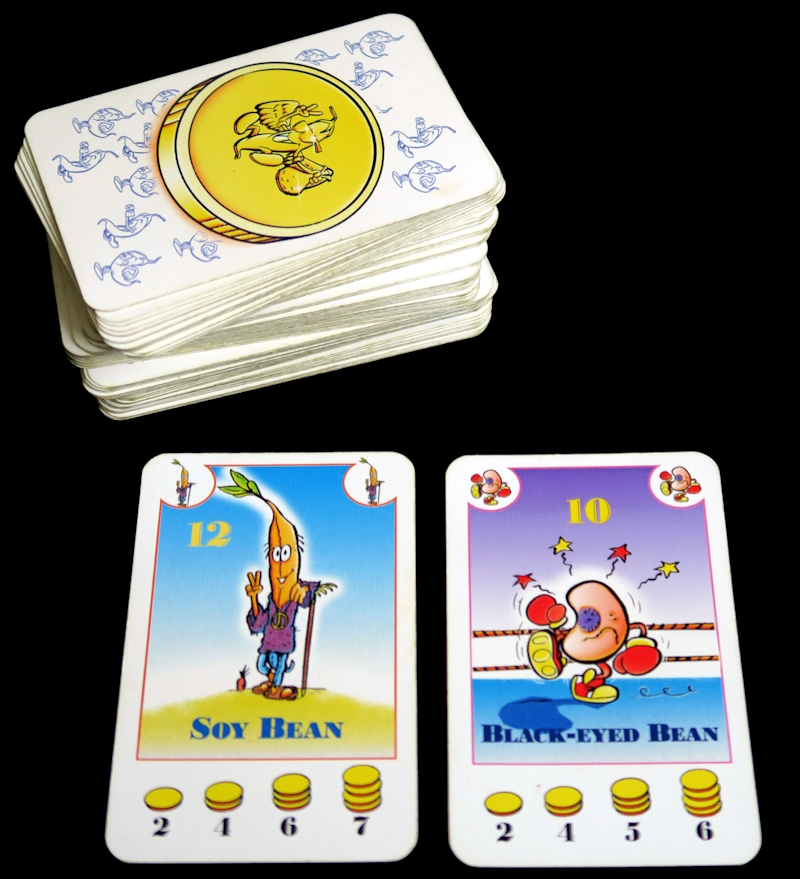
The other games were still going and looking like they were giong to take the rest of the evening, so the group looked around for another game that played five.  From the other side of the room Blue suggested Bohnanza, and as Sapphire thought he’d never played it, the group decided that wasn’t a state of affairs that could continue.  This is a popular game within the group as it is a lot of fun, even though a game about bean farming and trading sounds very unpromising.  Played with cards, the key mechanism is that the order of players’ hands cannot be changed—they can only be manipulated by in-game play.  So, on their turn, players must play the first card in their hand into one of their two “Bean Fields”, and may play a second if they can.

Bohnanza
– Image by boardGOATS

Beans can only be added to empty fields or to fields of the same type.  A field can be harvested at any point, but the aim it to maximise the yield.  Once the active player has played from their hand, there is the flop: two cards are played from the deck onto the table.  These must be planted before the next phase, but can be planted in the active player or by any player with their agreement.  Sometimes these are gifted, sometimes they are traded, and this is how players can manipulate the cards in their hand, by trading away undesirable cards.  Once the cards on the table have been disposed of, then the active player can trade any card in hand before replenishing from the deck to end their turn.
Bohnanza
– Image by boardGOATS

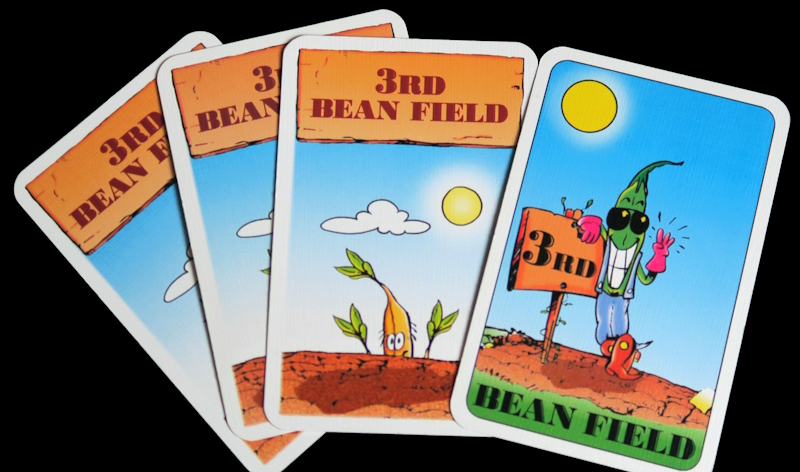
The game ends after three passes threough the deck, but while the first pass seems to take forever, the last always goes like lightening because many of the cards are now in players’ score piles.  Further the balance of the cards changes as the game progresses, with rare cards disappearing as they are turned into “Thaler” and get stuck in players’ stash.  Players can spend some of their riches on a Third Bean Field, but this is only really productive if carried out early in the game.  This was a strategy adopted by Pine this time—unusually for him.
Bohnanza
– Image by boardGOATS

It paid off almost imediately as Pine collected two of the super-rare cocoa beans, and soon added a third.  Black commented that he’d get the fourth, and Pine couldn’t hide his delighted laugh when he immediatly picked it up!  The winner was Lime though who finished three points clear with twenty, leaving Pine to take second and Black to make up the podium.  The question was, however, had Sapphire enjoyed it?  Sadly, the answer was a resounding “no”.  Worse, it turned out that he had played it before, and had disliked it so much that he’d blocked out the experience.  Such a shame, but some games are not for everyone…

Bohnanza
– Image by boardGOATS

Learning outcome:  You don’t have to know how you win, you just have to score more points.
Next Meeting, 8th July 2025

Our next meeting will be on Tuesday 8th July 2025.  As usual, we will start playing shorter games from 7.30pm as people arrive, until 8pm when we will start something a little longer.  Due to a recent change of hands, the pub is NOT doing food at the moment.

This week, the “Feature Game” will be the the shiny new game, Emberleaf (rules, rules summary, short review, three minute overview video, longer how-to-play video).  This is a “card dancing” (explanation video) and tile placement game from the same stable as The Isle of Cats.

Emberleaf
– Image from kickstarter.com, adapted by boardGOATS

And speaking of dancing…

Jeff and Joe were at the village festival watching the dog show.  Unusually, as well as the usual categories of “waggiest tail” and “cutest puppy”, there was also “best dancer”.  Thinking he might be in with a chance, Jeff entered his three-legged spaniel puppy, Elvis.

Joe was was a bit puzzled as Elvis was really a very happy dog and really quite cute.  So he asked, “Jeff, why did you choose to enter Elvis in the “best dancer” category, when he’s such a waggy dog and really very cute.  With his, um, “impairment”, surely he’d be in with a better chance in one of the other categories?”

“Nah,” replied Jeff, “He’s gonna win the dancing category, because all the other dogs have two left feet…”

26th Movember 2024

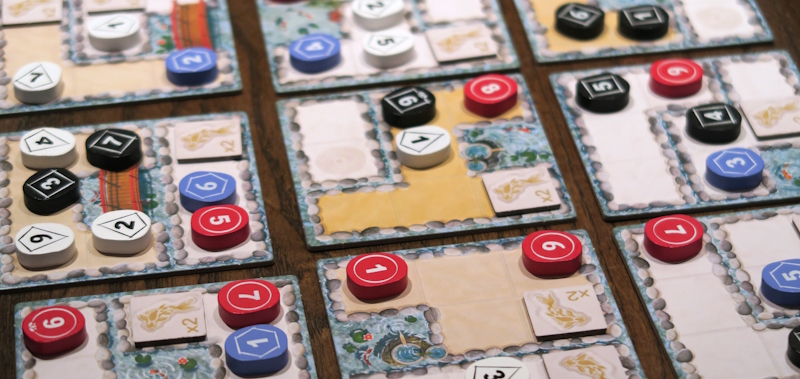
Plum, Jade, Sapphire and Mint were first arrive, and while they were waiting for food, settled down to a game of Hiroba, a sort of board game “Sudoku” where players place their numbered pebbles to take control of the most gardens.  As in Sudoku, players must never have two pebbles of identical value in the same garden, row or column.  After a couple of false starts the group eventually figured out the rules.  This time, Sapphire got in early with the lowest stone number between two Koi carp ponds, ensuring he got both. Plum only got two ponds, so although she got a reasonable number of areas, others overtook her by using the Koi pond multipliers.

Hiroba
– Image by boardGOATS

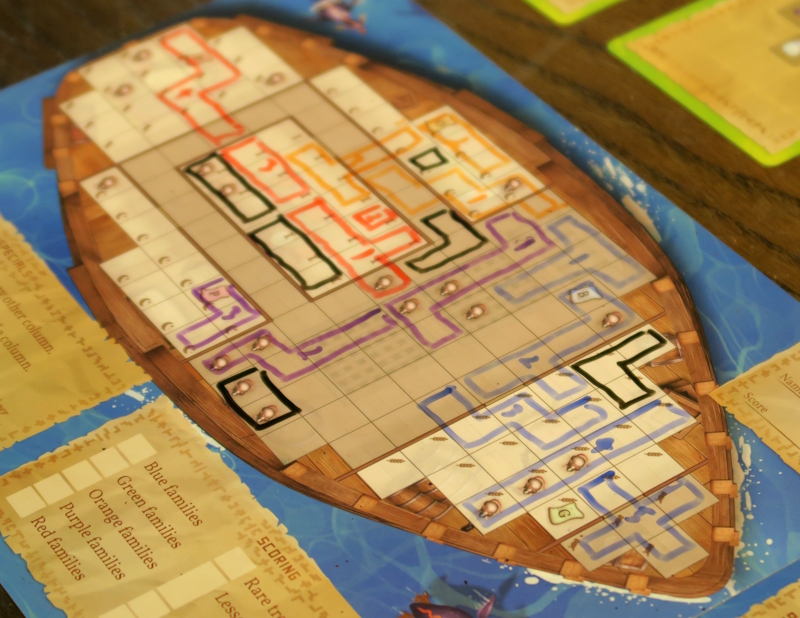
Food arrived during the game, and some were still eating when the final count (and recounts) took place.  Despite Sapphire’s great start, Mint’s total of thirty-five gave her victory by a single point pushing Sapphire into second and leaving Plum in third.  Meanwhile, since Hiroba was underway when Cobalt arrived, he settled down to a solo game of Explore & Draw, the Roll & Write version of Isle of Cats.  The game play is similar with players now drawing polyomino shapes on their ship board, but choosing a set of cards each round instead of drafting them.  In the solo game, the player is competing against his “sister” and this time won by forty points to her thirty-six.

Isle of Cats: Explore & Draw
– Image by boardGOATS

Once everyone had arrived (except Teal who had given up battling the crazy flood-water and gone home) and had finished eating, it was time for the “Feature Game” which was to be Rolling Realms/Rolling Realms Redux. This was advertised as a light roll and write game, but turned out to be rather more involved than everyone expected.  It was developed during the global pandemic as a print-and-play game, but has since been released as two professionally produced games.  Each game consisting of a number of small games based loosely on other games, with more are available to be purchased separately.

Rolling Realms
– Image by boardGOATS

The idea is that players choose three “mini-games”, or “Realms” for each of three rounds.  Then, two dice are rolled and allocated separately to two of the three games.  After nine rolls, players add up the number of starts they’ve achieved in the round.  The winner is the player with the most points after three rounds.  With three copies of the game and several people familiar with it, it should have been a relatively straight-forward game, but with so many different mini-games, players effectively had to learn the rules each round.  As the games play six and there were three copies, the group decided to play one large game. and started with the same three mini-games, based on three of our favourite games, Tapestry, Meadow and Flamecraft.

Rolling Realms
– Image by boardGOATS

And this was where the first problem arose.  The Tapestry mini-game was quite straight-forward, with players trying to fill their grid using polyomino shapes.  However, Meadow and especially Flamecraft, both from the Redux version of the game were more difficult to understand.  The Meadow mini-game was based on the card market with players choosing “cards” and using them to score points and collect resources.  The Flamecraft mini-game caused a lot of confusion with different “Enchant” and “Gather” actions, which are loosely based on the actual game, but it took a while to work out what they did and how to use them.

Rolling Realms
– Image by boardGOATS

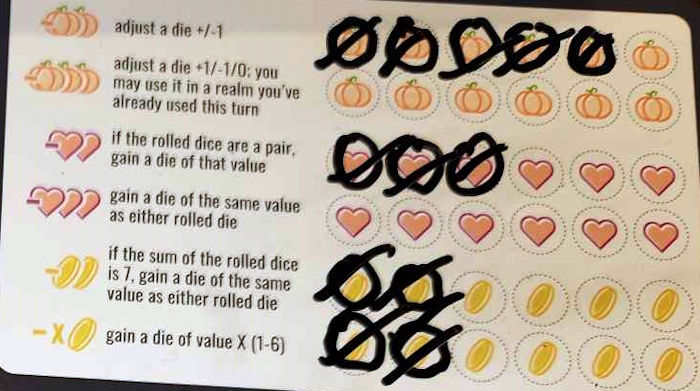
All three games involved players doing things to collect Stars, but the real aim of the game is to collect resources (Pumpkins, Hearts and Coins).  These allow players to modify dice, use them both on the same Realm, and most importantly, gain extra dice to give extra actions—these are essential as without them, players don’t get enough turns to get the more challenging Stars.  With so many people playing and the difficulties in getting heads round rules, the group ended up splitting into three tables.  Plum, Jade, Sapphire and Mint were first to get going and were first to finish the first round.  Plum was the victor, and the group went on to play Dinosaur Island, Stamp Swap and Ark Nova for their second round.

Rolling Realms
– Image by boardGOATS

The second group consisting of Blue, Pink, Ivory, Lime and Pine, were a bit slower as they struggled a bit more with the rules, particularly Pine.  As a result, they were a bit slower to get to the end of the first round, with Blue and Ivory leading the way.  This group decided to reduce the rules overhead by keeping one of the Realms from the first round, the easiest to understand, Tapestry.  To this, they added Between Two Castles and My Little Scythe, both from the original Rolling Realms game, as they thought these might be easier to grok, which they generally were.  In their second round, Ivory and Blue were still fighting it out, but this time they were joined by Pink, with Pine not far behind.

Rolling Realms
– Image by boardGOATS

The comparative success of the second round and keeping one Realm and choosing two from the original game, meant they repeated the strategy for the last round.  This time they kept the Between Two Castles Realm and added Between Two Cities and Scythe.  By the final round, everyone seemed to have got the hang of things as the scores were much closer.  In terms of totals though, Blue just had the edge over Ivory, with Pink in third.  The other table had finished first though, with Tidal Blades, Between Two Cities and Euphoria as the Realms in their final round.  Plum had continued her success in the first round winning both the second and third rounds and therefore, taking overall victory.

Rolling Realms
– Image by boardGOATS

Second place was less clear, however, with Sapphire just beating Mint for second place.  The third table consisted of Cobalt, Black and Purple.  Cobalt had played before, but online while Purple and Black were new to it.  They also struggled a bit and took a more leisurely approach to the game, playing just two rounds.  Their second round Realms consisted of Scythe, Potion Explosion and A Feast for Odin, the last two both add-on packs, and therefore possibly more challenging than those from the base game.  Cobalt won the first round by a bit of a land-slide, but the second round was very close between all three players, with Purple just beating Cobalt (who took overall victory).

Rolling Realms
– Image by boardGOATS

Learning Outcome:  Sometimes, one person’s simple game can be another’s nemesis.

3rd September 2024

By the time Blue, Purple and Pine arrived, Cobalt was already half-way through a solo game of Isle of Cats: Explore & Draw, a “roll and write” version of the card-drafting, polyomino cat-tile-placing game, Isle of Cats.  In Explore & Draw, instead of drafting cards before choosing tiles, players choose a set of cards each turn and then draw their “discoveries” on their boats.  In this version of the game, players simultaneously choose a column from the Island (the central market) and action all three cards in it in order.  These could be three cards from the Cat deck, two Cat cards and one Lesson card, or two Lesson cards and card from the Cat deck.

Isle of Cats: Explore & Draw
– Image by boardGOATS

Cat cards are polyomino cards, Lesson cards are scoring cards and special Oshax and Treasure cards can be found in both decks.  Cats, Oshax and Treasures are all drawn directly on the boat on the worksheet, while lessons are ticked off and scored at the end of the game.  In the solo game, Cobalt was playing against his “Sister” who reveals a Cat Colour and a Lesson, every round and at the end of the game scores for the different Colours in that order and then the Lessons in turn.  This time cobalt made mincemeat of the Automa beating it by seventy-one points to forty-three.

Isle of Cats: Explore & Draw
– Image by boardGOATS

With everyone arrived by this time, it was just the “simple” matter of deciding who was going to play what.  Blue started off leading the “Feature Game“, which was Kavango.  This is a card drafting game where players are building an animal reserve by collecting tags and adding animals to their tableau.  As such, it takes familiar elements from games like Sushi Go!, 7 Wonders, Wingspan, Meadow, Ark Nova and Terraforming Mars, but has a different feel to all of them.  In each round players draft and play ten cards (from an initial hand of twelve), that is to say they choose a card and pass the rest of the cards on to the next player.

Kavango
– Image by boardGOATS

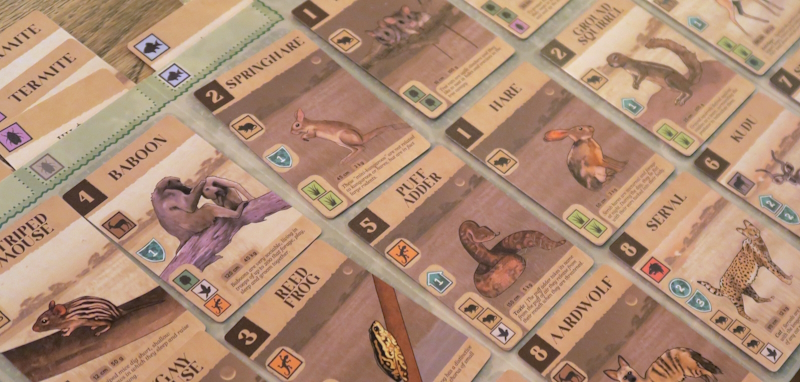
After each card has been chosen, it is added to the player’s tableau.  Then players have the option of claiming money for achieving Research Goals and/or spending money on Poaching, Habitat and Climate protections.  These are required for some of the animals especially the more interesting and lucrative ones.  The clever part about the game is the way the decks progress.  In the first round, the deck is mostly made up of Producers (Grassland, Trees, Invertebrates and Fish) and small animals while the second has mostly medium, but some small and some larger sized animals.  The third and final deck contains almost exclusively larger animals like Zebras, Lions, and Elephants.

Kavango
– Image by boardGOATS

This makes it harder to get Producers in the final round (though it is still possible by paying for Rewilding), but players can often just play cards directly as they already have prerequisites that they acquired earlier in the game.  Throughout, the rules and mechanisms are rooted in reality.  For example, players are responsible for their own Poaching and Habitat protections, but Climate protection is everyone’s concern and players have to work on that together.  Similarly, before a player can have a Puff Adder, for example, they have to have enough small mammals and birds to feed it.  Likewise, if a player wants a White Rhino or an Elephant, they need sufficient Grassland and/or Trees to support them.

Kavango
– Image by boardGOATS

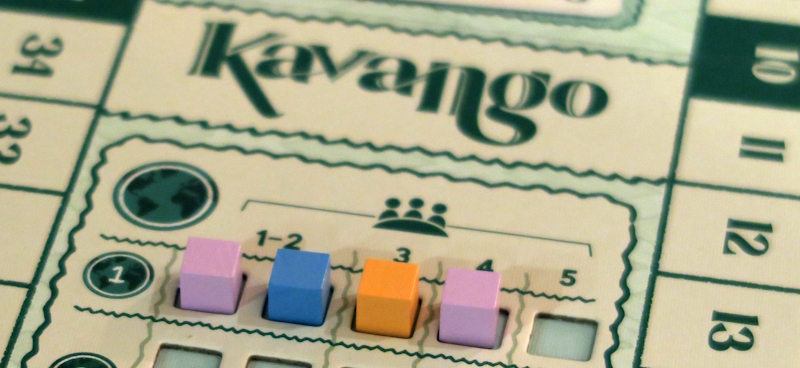
Each round, there are four Research Goals, each with several levels.  The Goals can each only be claimed once, so players generally have the choice of claiming Goals early to get money they can spend straight away, or waiting and getting more money, which may delay progress.  These Research Goals also progress during the game, so early on, they tend to reward players with lots of Producers and Small Mammals etc., while later in the game they reward players with lots of Protections and bigger animals.  At the end of the game, players add bonus points for Biodiversity, Climate Protection and Habitat and Poaching Protection, to the points they got for each animal in their Reserve and the points they acquired during the game for achieving their Research Goals; the player with the most points is the winner.

Kavango
– Image by boardGOATS

Nobody had played the game before, but Indigo had done her homework and had watched the “how-to-play” video, and Blue had done a decent job of reading the rules for a change.  The fact that the rules all made sense helped too, and for the most part everyone had a reasonable handle on what they were trying to do. The first challenge was to try to get all four of the player boards on the table with the score-track/Research board and Climate in the middle.  The boards were so huge that it wasn’t actually possible, so the side of Indigo’s and Navy’s boards were hanging off the edge of the table, and Pines and Blue’s corners were all overlapping or had a flying free-hold.  Still, everyone could just about see what they needed to and could place the cards they had to, and it was all stable so long as nobody moved…

Kavango
– Image by boardGOATS

Pine (the Ecologist), started off really well adding a lot of Small Mammals to his Reserve and achieved early Research Goals as a result.  Early in the game, Indigo (the Investor) started contributing to Climate protection.  Navy (the Botanist) and then Blue (the Researcher) helped her out later in the game, though Pine never had enough money to contribute enough to gain the Climate Protection bonus.  Blue took an early lead in Research Goal points, but Navy soon caught up and by the end of the third round, he had an eight point lead with Indigo holding a three point lead from Pine.  That is only a very small proportion of the points available in the game.

Kavango
– Image by boardGOATS

The Lion’s share of the points come from the animals, including Lions, of course (which Navy had one of).  Pine really struggled in the latter part of the game since he had loads of Small Mammals, but not a lot else. His problems had begun in the second round when he struggled to generate any money as none of the Research Goals fitted after his highly effective first round.  Even so, he still got a over a hundred points for his menagerie and was one measly bird of prey short of getting the Biodiversity Award.  Indigo had a slightly more valuable Reserve, while Blue and Navy tied for the most animal points.

Kavango
– Image by boardGOATS

Indigo, Blue and Navy all picked up the bonus points for Climate Protection, Poacher/Habitat Protection and Biodiversity, which meant that Navy took victory by virtue of his eight point lead from the Research Goal points.  It had been a very enjoyable game though and there was much discussion as the group carefully dismantled the precariously balanced player boards.  Pine took an interest in the other animals in the deck, and there was much hilarity when he found the Sausage Tree—Google convinced him that it was not related to the infamous Spaghetti Tree, and was in fact real.  Nobody could convince him that the fruit wasn’t ideally suited to coaxing Trouser Snakes out of their lair’s though.

Kavango
– Image by boardGOATS

On the next table, Black and Pink were leading a rather ill-fated game of Wyrmspan.  This is a variant of Wingspan with Dragons instead of Birds.  So, like the original, players are playing cards from their hand onto a player board, and activating the habitats in turn. The differences are more than simply cosmetic, however. Firstly, before a Dragon card can be played, it is necessary to explore the cave it will be played in, which involves playing a card (and claiming a Bonus).  In Wingspan, if a player needs a resource, they activate their Woodland habitat and visit the Birdfeeder, claiming the resource they want and a couple of extras, whereas in Wyrmspan, players only get resources one at a time so they don’t have any extras.

Wyrmspan
– Image by boardGOATS

This is critical as “Planting Dragons” requires a lot of Resources and can be difficult to do, so it is important that the Dragon planted is then exploited as much as possible.  Players also need to make the most of the new Dragon Guild.  A step around this Rondel typically gives a Resource as a reward, with a more valuable bonus half-way round and after a full circle.  The distribution of cards is different too:  in Wingspan, the majority of the cards have an effect when the terrain is activate, but in Wyrmspan, these are in the minority with most card effects happening when played or at the end of the round/game.  In Wyrmspan, the rounds are also different.

Wyrmspan
– Image by boardGOATS

Players get a set number of coins at the start of each and an action typically costs one coin.  Some cost more however, and occasionally players can pickup extra coins, which can lead to variable length rounds.  Thus, although Wyrmspan is very definitely Wingspan at its core there are lots of differences.  Blue suggested the group played it, as she had played it with Black and Pink a few months back and they had found it played easily given that they all knew how to play Wingspan.  Thinking Purple, Teal and Lime were also very familiar with Wingspan, Blue rashly assumed it would work, but she underestimated how different it was, how long it was since that last game, and how much longer the game would take with five.

Wyrmspan
– Image by boardGOATS

So, Black patiently explained the rules, while Pink tried to help others muddle through.  Teal focused on simply achieving the end of round goals and “planted” his Dragons accordingly while working on the top row of caves to generate resources—the equivalent of the “woodland”, which works for both Wingspan and for Wyrmspan.  After fighting through one round though, the group agreed to curtail the game after the second round.  In such a short game, the scoring was always going to be skewed, but ultimately the player with the most valuable Dragons, Pink, was the victor, with Teal taking second thanks to him taking the points for winning both the end of round goals.

Wyrmspan
– Image by boardGOATS

Across the other side of the room, the final game was Tapestry, with the Plans and Ploys expansion.  On the surface, Tapestry has simple mechanisms, but they combine to make a complex game.  On their turn, players move one step along one of the four Civilisation tracks around the board: Science, Exploration, Military, Technology and carry out the action (or actions) associated with it.  Each space requires payment of resources, and the further along the track, the more expensive the spaces become.  If a player cannot afford to pay (or chooses not to), then they instead take income, which gives them more resources.  They also gain points and play a tapestry card, which usually provides a power for the next round.

Tapestry
– Image by boardGOATS

So, at its heart, Tapestry is an engine building and resource management game:  players carry out actions and get resources so they can get more resources and ultimately, points.  The Plans and Ploys expansion mostly just adds more of the same with new Civilisations, Tapestry Cards and space tiles.  The biggest difference is the addition of Landmark Cards which are designed to give each player a personal short-term goal in the first part of the game, in the form of buildings that only they can claim. Everyone was familiar with the game, so the rules explanation was minimal.  Byzantium started (Spies/Grassland) and there was an initial general rush towards the Technology track,

Tapestry
– Image by boardGOATS

Ivory (Islanders/Forest), always one for doing something different, instead went in for Exploration as this linked in with his Civilization.  As the first round went on, Byzantium and Cobalt (Aliens/Tropical) stuck to Technology, whereas Plum (Riverfolk/Wetland) diversified slightly into Science and Exploration. Her primary plan was to exploit her Civilisation and then try to get to six island hexes to trigger her personal bonus Landmark.  Byzantium was first to move to the Income phase, closely followed by Plum and then Cobalt. Ominously, Ivory did what he usually did and managed to stretch my first era out, putting himself in a good position to grab the first Exploration Landmark and also making progress on Military.

Tapestry
– Image by boardGOATS

Byzantium went for Technocracy as his first Tapestry card, sticking with his technology theme. He also managed to grab the first Technology Landmark and completed his Architecture card (appropriately the Game Shop). Plum also went for a Tapestry card, Terraforming, that linked her with her strategy, giving her five points for building on impassable plots, something her Riverfolk Civilization wanted her to do and gave her additional resources of.  Although her alternative Civilisation had looked more interesting, it involved knowing what other people’s options were so she had chosen the simpler Riverfolk and made good use of it.  She was also still fairly diverse in her track focus. Cobalt went for Socialism, to keep pace with Byzantium on the Technology track.

Tapestry: Plans and Ploys
– Image by boardGOATS

Cobalt also gained Landmarks from his Technology cards, helping him build his Skyscraper Architecture card. Having only taken his Income whilst everyone else was half way through their second Era, Ivory could see Cobalt was focusing on Technology, so he used the State Marriage Tapestry card to gain befits on this track whenever Cobalt did.  Having the Military track to himself and a good head start on Exploration, Ivory managed to grab a couple of Landmarks quite quickly. Everyone was also getting Income from buildings on their mats too.  Again, Byzantium Plum and Cobalt all moved into their third Era in quick succession, leaving Ivory half way through his second Era.

Tapestry
– Image by boardGOATS

Cobalt managed to grab the third Era Technology Landmark, but he struggled to fit it on his Capital board and it had to overhang.  At this point, Plum used the Dictator Tapestry Card (with associated comments from Byzantium) to move up the Technology track while restricting everyone else’s progress on the same track for one turn.  Byzantium had been  plotting a move as he was next in line for a Landmark, but Plum’s Dictatorial behaviour only slightly delayed him getting it. This, plus the State Marriage benefited Ivory and competition with Byzantium meant Cobalt used the Militarism Tapestry card to switch his focus to Exploration and Military.

Tapestry: Plans and Ploys
– Image by boardGOATS

Although Cobalt had changed tack to avoid competition with Byzantium, Ivory had a health head-start on both of these tracks, grabbing the Landmarks as he went and also conquering the centre island just before Cobalt could.  To add insult to injury, when Cobalt tried to conquer the island and topple Ivory, he was ready with a Trap card, foiling his plan. Cobalt quickly got revenge paying Ivory back in kind when he tried to do the same thing to one of his territories. However, that wasn’t going to discourage Ivory, and with the Military track encouraging him to conquer, he got the final word in, conquering one of Cobalt’s territories and gaining a double topple bonus.

Tapestry: Plans and Ploys
– Image by boardGOATS

Moving into the final era, again, Ivory was characteristically some way behind everyone else. Byzantium picked up extra resources from the “Age of Wonder” and used these to good effect being the first to reach the end of a track.  Plum, hosted the Olympic Games with her final Tapestry card (and presumably moved to Paris to do so).  This gave her ten points in exchange for a Worker Resource, and additionally a bonus building if any other player took up the offer of doing the same.  Byzantium was the only one who did, as Cobalt wasn’t able to and Ivory had other plans.

Tapestry: Plans and Ploys
– Image by boardGOATS

Cobalt and Plum were both still fairly diverse in their track focus, although Plum had made good progress on the Science track, which was mostly ignored by everyone else.  Byzantium also switched focus to some of the other tracks now he had completed the Technology track. Ivory stuck to Military and Exploration, completing the former (although there was not enough time to gain the second Civilization).  He was sorely tempted by one of his favourite strategies, sending his Meeples into Space by completing the Exploration track, but instead, Ivory switched focus to the other tracks to get as many income buildings in his Capital as possible to maximize the final scoring.

Tapestry: Plans and Ploys
– Image by boardGOATS

Again, everyone finished in quick succession except Ivory, who, as usual, had about five or six turns to go after everyone else had finished.  Plum started with an additional thirty-five points at the beginning of the game thanks to her Riverfolk which gave her points for each territory in her City that had at least two unpassable spaces, but everyone caught up throughout the game. In the end, in Ivory’s final Income round scored him well over fifty points, overtaking everyone and winning and giving him victory.  It had been a good game, enjoyed by all, and although he’d won Ivory hadn’t given everyone as much of a trouncing as he had in the past.  Cobalt felt that the advantages of going first were not mitigated for those going last, so maybe next time that could be used as a slight handicap for Ivory.

Tapestry
– Image by boardGOATS

Learning Outcome:  Animal games are a lot of fun—And that’s not Lion!

23rd January 2024

Despite missing a few people, we were still well into double figures, and more than enough for two groups to play the “Feature Game“, the Kittens module from the Kittens + Beasts expansion to The Isle of Cats.  The Isle of Cats is a tile laying game where players are trying to rescue Cats and place them on their Ship while scoring points for completing Lessons (aka end of game goals). The game is played over five rounds, with each round starting with players getting twenty Fish and a hand of seven Cards.  These Cards are drafted two at a time, that is to say, players keep two Cards and pass the rest to their neighbour and repeat until they have none left.  Players then choose which Cards they want to use, paying their cost in Fish and discarding the rest.

The Isle of Cats
– Image by boardGOATS

There are five different types of Card:  blue bordered Lessons; green bordered Rescue Cards; yellow bordered Treasure Cards, brown bordered Oshax Cards and purple edged “Anytime” Cards (which can be played at anytime).  Lesson Cards are objective cards and come in two types, Private and Public, with Private Lessons being secret, personal objectives and Public Lessons being revealed and available for everyone.  These are revealed before anything else happens.  Next players decide which Rescue Cards they are going to play—unlike the Lesson Cards, these can be held over for later rounds.  Rescue Cards feature either “Boots”, or “Baskets” or a combination of both.

The Isle of Cats
– Image by boardGOATS

Boots dictate player order, whereas Baskets allow players to rescue more Cats; players start the game with one permanent Basket which can be used once per round to rescue one Cat, but these can be augmented by temporary Baskets from the Rescue Cards.  Once the Rescue Cards have been played, then, starting with the player at the top of the mountain (the one who played the most Boots), players start to rescue Cats.  The Cat Tiles are drawn at random from a bag before the start of the round, placing Cats on both the left and right sides of the island.  Players then take it in turns to use Fish to lure Cats into their Baskets and relocate them on their Ship.

The Isle of Cats
– Image by boardGOATS

The first Cat can be placed anywhere on the player’s Ship, but thereafter, new Cats must be placed next to another Cat.  At the end of the game, players score points for groups of adjacent Cats of the same breed (colour), with negative points for each room on their Ship which hasn’t been filled and any Rats on the deck which haven’t been covered.  Finally, once everyone has rescued all the cats they can, players then take it in turns to play any Rare Finds Cards they choose from their hand—these are brown edged Oshax Cards and yellow bordered Treasure Cards.  Oshax are friendly Cat-like creatures that are added to the player’s Ship and adopt the colour of a breed of the player’s choice.

The Isle of Cats: Kittens + Beasts
– Image by boardGOATS

The Kittens module from the Kittens + Beasts expansion adds cute little Kitties that the fastest player (the one who played the most Boots), can rescue instead of fully grown cats. Being smaller they are are more flexible when it comes to placing them on the player’s boat and two can be rescued at a time, using only one basket.  At the end of the game, they behave just like full-sized Cats for scoring and therefore can be highly lucrative, while adding little complexity to the game.  Players also score for their completed Lessons and the player with the most points after the five rounds of the game is the winner.

The Isle of Cats: Kittens + Beasts
– Image by boardGOATS

The first thing everyone had to do was decide who was going to play what and where. In an effort to separate couples who usually play together, Blue led one game with Sapphire, Ivory, Pine and Yellow (on his first visit), while Pink was persuaded to join Jade on the other side of the room along with Purple, Plum and Lime.  That left Black, Byzantium, Cobalt and Teal who took themselves off to a third table.  The first game (led by Blue) got going quite quickly, while the second (led by Jade) quickly realised that discretion is sometimes the better part of valour, and decided to skip the Kittens expansion and stick to playing the base game.

The Isle of Cats: Kittens + Beasts
– Image by boardGOATS

Blue began by eschewing Boots and sitting repeatedly at the bottom of the hill, hoping to save them all for one large push later in the game.  This was a plan reinforced by one of her Lessons which would give her extra points if she finished the game as the first player.  Pine, Yellow and Ivory all had a shot at collecting Kittens, while Yellow and Ivory got lucky getting several Oshax cards in the deal which they prioritised buying and playing.  It is always difficult to get a feel for who is winning in this game, but going into the final stages, it all felt quite tight.  Blue played all her Boots and a load of baskets in the final round, but was trampled by Sapphire who played a massive fourteen Boots to take the lead and much to his delight, costing Blue a massive Cat Carrier full of points.

The Isle of Cats: Kittens + Beasts
– Image by boardGOATS

Her problems were made worse by the fact she didn’t realise her Lesson giving her a two points for each visible rat at the end of the game was in addition to rather than instead of the negative point they usually accrue.  In a close game, such loses are costly, and this was quite close with only twenty points between between first and last place and only three points separating third and fifth.  There was more of a gap to Pine with seventy-five points in second, but the winner on his first game with the group was Yellow, thanks to a large clowder of blue Cats and only one room on his boat unfilled.  The game on the next table was considerably less close, however.

The Isle of Cats
– Image by boardGOATS

Teaching had taken quite a bit longer and the group also played more slowly, so as a result, as round three came to a close with no end in sight, the group chose to finish the game after four rounds instead of five.  For some, this was not a huge problem as they were able to modify their game plan so they could complete their Lessons.  For example, Plum wouldn’t have fulfilled more of her Lessons with more time, but successfully completed her five-by-five grid of purely green Cats (though she had one too many touching the central one for her “five Cats touching one” Lesson to score.  In the final scoring, the difference between first and last was a massive sixty-five points, probably not helped by shortening the game, though that wasn’t the only cause.

The Isle of Cats
– Image by boardGOATS

Jade had concentrated on teaching and trying to keep the game on track while Purple had struggled reading the cards without her glasses.  Plum who singularly failed in her duty of of providing residents for the box lids took third some way behind Pink in second.  The runniest of runaway winners, despite never having played before, was Lime thanks to a huge number of successfully completed Private Lessons.  These considerably more than offset his negative points from Rats and unfilled rooms on his Ship.  It was a slow game that led to some to comment that there was a lot to be said for the lighter, more streamlined, roll and write version of the game, Isle of Cats: Explore & Draw.

The Isle of Cats
– Image by boardGOATS

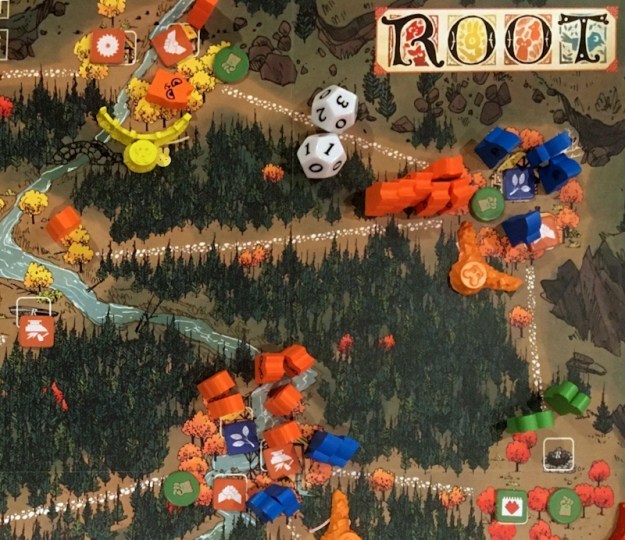
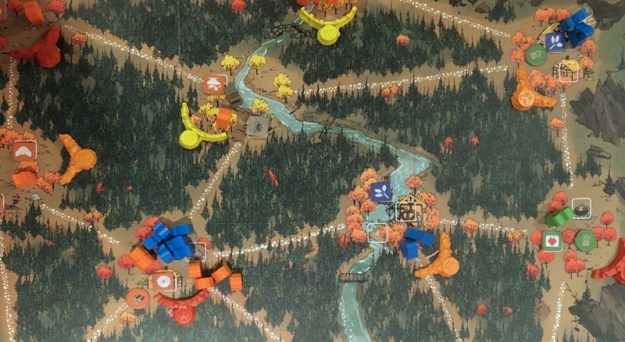
Meanwhile, Teal had found three people who were prepared to give the epic game, Root, a go—something he’d been keen to play with the group for a long time, but had not happened due to its reputation as a long game.  With Cobalt being familiar with the game too and Byzantium and Black keep to play as well, the group decided to give it a try.  Root is a board game of competitive area control in a fictional woodland setting. Players adopt the role of one of four asymmetric factions (increased to ten in expansions) – roughly split between area control and insurgency play-styles. In our game we used the four factions from the base set.

Root
– Image by boardGOATS

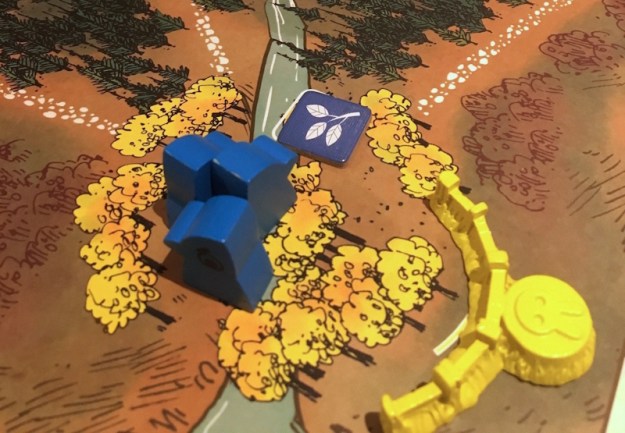
The Eyrie Dynasties are aristocratic Birds of the old regime (think Greece in decline following Roman expansion), the faction of the Marquise de Cat control the whole board with an empire of Cats at the start but are thinly spread (like the height of the Roman Empire on the brink of collapse). The Woodland Alliance are like a Peasant’s revolt faction, reacting to mistreatment by their rulers with outrage and sometimes acts of extreme violence. The Vagabond is a solo actor represented by a single piece, out for themselves—a mix of Robin Hood, folk hero, mercenary for hire and outlaw just doing their own thing.

Root
– Image by boardGOATS

The basic rules of movement, combat (and gaining points for destroying opponent tokens and buildings), use of cards for crafting items for points and bonuses and ruling the twelve settlements connected by paths are common to all. The game immediately ends when one player achieves thirty victory points. Each faction has a unique play-style, breaks the standard rules in their own way and has their unique process of gaining victory points. One of the challenges of playing asymmetric games is that players need to not only learn their own unique rules, but also have to understand their opponents’ strategies and abilities to effectively counter them.  Cobalt and Teal jointly taught the game to Black and Byzantium, which was helped by the clear player boards which take a step-by-step approach to what a player can do on their turn.

Root
– Image by boardGOATS

The Marquise de Cat gains points each time they construct a building even if these are re-builds after they have been destroyed. In the early stages of the game, Byzantium with the Cats shored up his defenses by retreating to a front-line which he could hold against bird incursion. The Cats then focused on a steady building programme, starting with Sawmills to generate timber tokens to enable even more building. Each time a Workshop, Recruiting Post and Sawmill is built on the map board and removed from the player board it reveals a point value of increasing value.  With the production engine in place Byzantium steadily increased the Cats’ building construction rate and the points flowed in.

Root
– Image by boardGOATS

The Eyrie gain their points by the number or Nests which they have on the board at the end of each round. The Birds of the Eyrie, under guidance of Black steamrollered around the board with a massed horde, dominating clearings and building Nests.  At one point this ended up in a massive ongoing siege with the Cats into which both players poured Warriors. The Eyrie have to add cards to it’s decree each turn locking it into committing to a certain number of moves, battles, recruitments and builds in the allocated clearings.  Failure to complete any of these orders each turn immediately results in the Eyrie government going into Turmoil and concomitant loss of points and a new flavour of Leader (with unique abilities) being selected.

Root
– Image by boardGOATS

The Eyrie eventually suffered one great Turmoil, like a playing card pyramid toppling after becoming too unstable. But Black quickly managed to use the refresh of the decree cards to their advantage by choosing cards which provided greater flexibility of actions and was nearly able to catch the Cat’s tail.  The Woodland Alliance gain points by uprisings of popular support across the board expressed by placing of Sympathy tokens. The Alliance under the control of Cobalt steadily built up support in a corner of the board gradually establishing rebel bases for more control—these grant wipe-out of all other pieces in a clearing when established and unlock new abilities for the faction including recruiting Warriors, battling and converting Warriors into Sympathy tokens.

Root
– Image by boardGOATS

The more Sympathy tokens placed in clearings, the more points they generate. The Woodland Alliance eventually managed to build all three bases and also to place eight Sympathy tokens (the eighth now generating four victory points). To move into areas with Sympathy tokens the Cats and Eyrie had to pay a card tax (Outrage) to Cobalt, who could then use these cards as “Followers” to produce more Sympathy for points. This snowballing engine of points was just getting into gear promising to pay dividends when the Cats building rate pushed into the lead.

Root
– Image by boardGOATS

The Vagabond earns points by exploring ruins for items, fulfilling mini-missions (by exhausting items tokens in their Satchel) and trading with other players. Teal as The Vagabond, spent the early game exploring ruins to locate useful items and trading cards for crafted items from other players—being a friend to all and posing no threat. Vagabond trading gradually upped their status with the Eyrie so that they had become an ally meaning that each time a card trade resulted in two points. All was set to for a strategy of fulfilling missions to generate cards, to gift to the Eyre and gain points, when the Cats won!

Root
– Image by boardGOATS

Byzantium, The Marquis de Cat achieved the thirty points he needed to win with Black as the Eryie taking second with twenty-seven and Cobalt and the Woodland Alliance pipping The Vagabond, Teal to third by one point.   In spite of the game being new to two people, the turns passed fairly quickly and momentum gathered with point-scoring as the game progressed. When the game concluded all were happy to have completed the game with time to spare before the pub closing bell.  It had been a successful teach and timely play of a game which has a reputation for being difficult to introduce to new players for a one-off session without prior preparation.  Hats off to the quick learners and to the group as a whole for resisting analysis paralysis in the interests of game-play.

Root
– Image by boardGOATS

Learning Outcome:  Every game should come with “Cat Setup” instructions.

Next Meeting, 23rd January 2024

Our next meeting will be on Tuesday 23rd January 2024.  As usual, we will start playing shorter games from 7.30pm as people arrive, until 8pm when we will start something a little longer.  The pub is doing food, and the table is booked from 6.30pm for those that would like to eat first.

This week, the “Feature Game” will be the Kittens module from the Kittens + Beasts expansion to The Isle of Cats (rules, review and How to Play video).  The Isle of Cats is a tile laying game where players are trying to rescue cats and place them on their ship while scoring points for completing Lessons.  The Kittens module (expansion overview and How to Play video) adds cute little kitties that the fastest player can rescue instead of fully grown cats, but being smaller are more flexible and two can be rescued at a time.

The Isle of Cats
– Image by boardGOATS

And speaking of Cats…

Jeff was at the cinema watching the new release of Jane Austin’s “Emma”, when he noticed what looked like a cat sitting next to him.

“Are you a cat?” asked Jeff, surprised.

“Yes,” the cat replied.

“What are you doing at the cinema?” asked Jeff.

“Well,” replied the cat, “I liked the book…”

28th Movember 2023

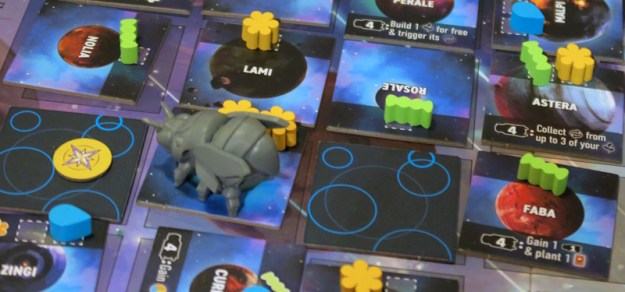
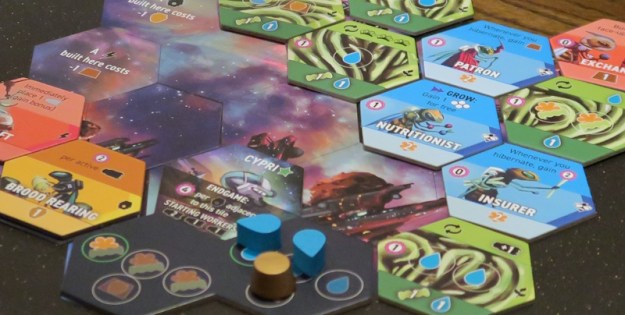
What started out threatening to be a quiet night with the absence of Green, Lilac, Purple and Black, turned out to be quite lively in the end.  As Blue and Pink finished their supper, Pine, then Jade, Sapphire, Plum and Byzantium arrived, soon followed by Teal, Ivory and Lime.  Ivory was armed with his new, shiny copy of Apiary, which was to be the “Feature Game“.  This is a worker-placement, hive-building game where players explore planets, gather resources, develop technologies, and create carvings to demonstrate their faction’s strengths before the end of the year when it is time to hibernate.

Apiary
– Image by boardGOATS

At first glance, Apiary seems to be a fairly simple Worker Placement game, where players have the Tzolk’in choice: place a Worker or retrieve Workers.  Unlike in Tzolk’in where Workers carry out their action when they are retrieved, in Apiary, players take the action and gain the associated benefits when placing a Worker, while retrieving Workers enables players to run any engine they have that relies on those recalled workers.   Unlike many other worker placement games, there is no blocking and players can add workers to any space as long as they have the power and required resources.  If a space is already occupied the existing occupant is “bumped” either to the next space (for certain areas) or sent back to the owner (with a choice to increase strength and make available straight away, or hold on to make use of income abilities).

Apiary
– Image by boardGOATS

Players start with asymmetric factions and basic resources (Pollen, Water, and Fiber) according to their faction.  The Action spaces are mostly about getting or trading Resources and Cards, or adding Tiles to improve their base.  There are five available to players at the start of the game: Explore, Advance, Grow, Research and Convert.  Explore allows players to visit planets, gaining bonuses for being the first to visit a planet, and also resources from the planets they discover while Advance allows players access tiles they can build if they have the resources to do so.  Grow enables players to gain their fourth worker (or gain a worker back from the pool once it hibernates) and allows players to build ship frames while Research gives players access to the Seed Card deck, some of which are incredibly powerful.

Apiary
– Image by boardGOATS

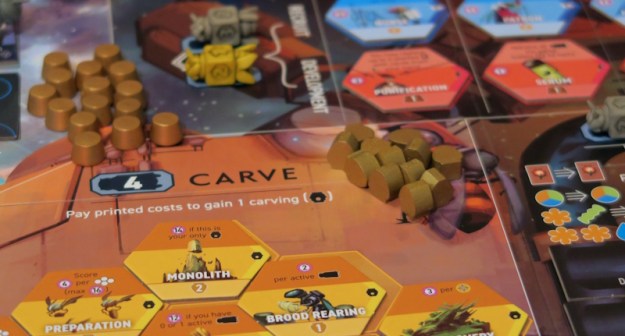
Wax and Honey are more advanced resources that can be created during the game using the Convert Action.  Honey, in particular, is required for the final Action, Carve (which also needs a Level Four worker).   When Workers return to the Active Pool (either by being bumped or because they have been recalled), their value increases by one. Level Four Workers trigger special bonuses when played, but instead of returning to the Active Pool when bumped or retrieved, they hibernate. In this way, the player loses that worker, but gains a bonus.   The game ends when all the hibernate spots are taken or when a player uses all seven of their hibernate tokens.

Apiary
– Image by boardGOATS

The game is beautifully produced with great art and lovely wooden resource pieces.  The QueenShip is arguably the best, looking a bit like Starbug from Red Dwarf.  With that and the theme (which had those traveling from Swindon crying, “Bees… In… Space!” à la The Muppets “Pigs in Space!” at intervals), the game was off to a good start.  The not-blocked worker space mechanism is similar to that in Euphoria: Build a Better Dystopia, which Plum, Byzantium and Jade had played at HandyCon.  Everyone starts off with a unique player “Hive Mat” and starting Faction Tile. Ivory began with “The Log” and “The Sini” which gave points for filing the Hive Mat and for each Development Tiles surrounding the Faction Tile (respectively), so he prioritised getting Development Tiles.

Apiary
– Image by boardGOATS

Cobalt’s Faction, “The Cypri”, gave him four points for each Carving adjacent to his Faction Tile, but found that hard to achieve needing a lot of Honey, so concentrated elsewhere instead.  Plum’s focus was on her Hive Mat, “The Warre”, which had spaces that progressed her along the Queen’s Favour track when she covered them, so she decided early to try and focus on that. She had some Farm Tiles that also would have helped her gain more Favour when she triggered the income for taking workers back, but she didn’t use that until later as, although her workers were bumped a lot, she kept choosing to increase their strength and have them available straight away instead.

Apiary
– Image by boardGOATS

Byzantium started with “The Lama” for his faction that gave him a point for each tile he added to his Hive which grew quite rapidly.  He also nabbed a Farm Tile from under Plum’s nose which gave him the Edge on the Queen’s Favour Track.  As the game came to a close, everyone scrabbled to try to finish things off—like filling their Hive Mat (Plum’s last space was filled for free when she covered the adjacent hex).  The lead at the end of the game was held by Plum, but that isn’t really where the points are in Apiary.  In contrast to everyone else, Ivory almost completely eschewed the Queen’s Favour, focusing on Planted Cards and Honey Pots, which gave him over thirty points alone, and as a result he charged from the back of the pack to take victory.

Apiary
– Image by boardGOATS

Meanwhile on the other side of the room, Pink, who had been fondly remembering his visit to the see the pandas “Down Under”, sucked Pine and Blue into a game of Zoo Break.  This is a cooperative game where players are zoo keepers trying to prevent the marauding animals escaping the zoo.  This has had a couple of outings this year the first was a disaster ended when a cobra got out, but the second was a hard-fought victory.  This time, with just three keepers, turns would come round more frequently, so to make things a little more interesting, Pink (Lucky Duck), Pine (Gardener) and Blue (Angler) decided to play with the Faulty Lock Variant, personally recommended by the designer.

Zoo Break
– Image by boardGOATS

The idea of the game is that players take it in turns to roll the Action Die to found out how many actions they get, then after carrying out the actions, players first draw an Escape card and then a Move card, to see what animals escape and move.  In the original game, once animals are locked up, however, they can’t escape, which means the game gets progressively easier.  Further, some players potentially end up lurking about with nothing much to do waiting for someone else to deal with the last couple of mischievous meerkats.  In the Faulty Lock Variant, however, when an Escape card is drawn for an enclosure that has already been locked, a die is rolled to see if the lock is faulty and whether the animal escapes or not.

Zoo Break
– Image by boardGOATS

The problem with the Faulty Lock Variant is that it can extend the game quite a bit.  That said, it didn’t look like that was going to be a problem as Pink chucked first Pine and then Blue under the Charging Rhinoceros.  Then Pink got trampled too, before Pine paid a couple more visits thanks to a mad Elephant and a venomous snake.  Eventually, the team got their act together and locked up the Rhino, and then the Capuchins, Pandas, and Elephants.  Every now and then, a lock failed and an Elephant got out, but gradually, the animals were being locked up, and eventually the last of the Meerkats was evicted from the part in the fountain locked up (aside from the two that escaped).

Zoo Break
– Image by boardGOATS

It had been a lot of fun, even though Pink was sad that he’d not been hugged by a lonely Panda, and jealous of Pine who had.  It had taken all evening though, and on the next table, Jade, Sapphire, Lime and Teal had managed two leisurely games and a bit of chit-chat.  The first game was Isle of Cats: Explore & Draw, a role and write version of the much more substantial card-drafting, polyomino cat-tile-placing game, Isle of Cats.  In Explore & Draw, instead of drafting cards before choosing tiles, players choose a set of cards each turn and then draw their “discoveries” on their boats.

Isle of Cats: Explore & Draw
– Image by boardGOATS

This time it was relatively close for second place, but Sapphire won by something of a landslide, his seventy-nine points was some twenty-five points ahead of Lime who took second with his neatly coloured in boat.  Once the wipe-clean boards had all been cleaned, Teal took an early night before the remaining trio played moved on to the card drafting and path building game, Trailblazers.  In this game, players start with eight Trail cards and draft two cards three times, adding them to their tableau.  The cards must either be placed adjacent to or overlapping other cards as players try to construct long and elaborate trails in three different colours.

Trailblazers
– Image by boardGOATS

Only closed loops in a single colour, that start and end at a matching campsite will score points and players also compete to fulfill “First To” and “End Game” goals.  The game ends after four rounds, when the player with the most points from closed loops and goals achieved is the winner.  This was much closer than the previous game, though the outcome was, ultimately, much the same.  The goal cards in play were “Hikers’ Quartet”, “Trail Hugs”, “Forever Float” and ” Wanderlust”, though the players only scored for the last two (giving points for the longest single blue “Kayak” route and the longest total brown “Hiking” routes.

Trailblazers
– Image by
boardGOATS

Lime and Jade tried to build trails of all three types, Hiking, Kayaking and Biking evenly, making the best of the cards they had.  However, Sapphire focused exclusively on the two that featured in the “Forever Float” and ” Wanderlust” goals, finishing with twenty-eight points for his Kayaking routes alone.  While it was very close when the trail lengths were taken into account, Sapphire took first place for both end game bonuses and Lime came second in both, which also reflected the final placing.  There was some chatter, while “Bees… In… Space!” finished and then it was time for everyone to go home to hibernate until next time.

Trailblazers
– Image by boardGOATS

Learning Outcome: Golden Honey is valuable.

Deutscher Spiele Preis 2020 – Time to Vote

Although the convention season has been severely disrupted this year, the awards are carrying on as usual.  The best known of these is probably the Spiel des Jahres: this year’s nominations were announced earlier this week.  The Deutscher Spiele Preis, or German Game Prize, is slightly less well known, but arguably better reflects the slightly more advanced, “Gamers Games”, with the results usually more in line with Kennerspiel des Jahres category rather than the family Spiel des Jahres award, or “Red Pöppel”.  Recent winners of the Deutscher Spiele Preis include Wingspan, Azul, Terraforming Mars, Mombasa, and The Voyages of Marco Polo.

Wingspan
– Image by boardGOATS

The Deutscher Spiele Preis (which is awarded at the Internationale Spieltage, in Essen), is selected by a general vote which is open to anyone, players, journalists and dealers alike.  The incoming votes are evaluated by an independent institute and only votes with details of the full name and address are valid (any duplicates are removed).   All votes are treated the same with games placed first receiving five points, those placed second receiving four, and so on.

Azul: Summer Pavilion
– Image by boardGOATS

Only new games from the previous year are included in the ranking, so this year that’s games released since May 2019.  Thus anything new at Essen last year or the Spielwarenmesse (Nürnberg) this year, is eligible.  This includes:  Alubari, Maracaibo, Point Salad, Tiny Towns, Isle of Cats, Wavelength, Jaws, In the Hall of the Mountain King, Azul: Summer Pavilion, Fast Sloths, or any of the games nominees or recommended for the Spiel/Kennerspiel des Jahres awards.

Deutscher Spiele Pries 2020
– Image from spiel-messe.com

Voting is open until 31st July; it’s not necessary to submit a full list, so why not take the opportunity to vote for your favourite release of the year?

18th February 2020

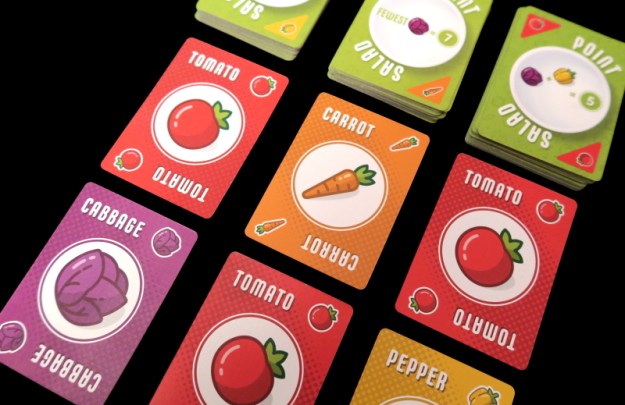
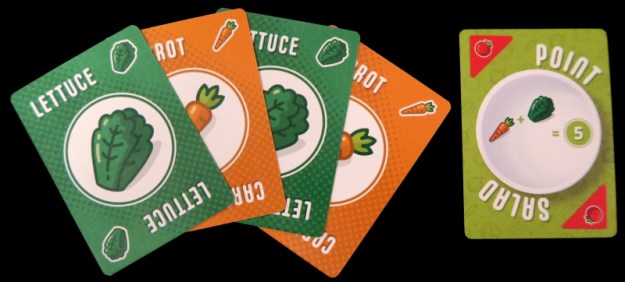
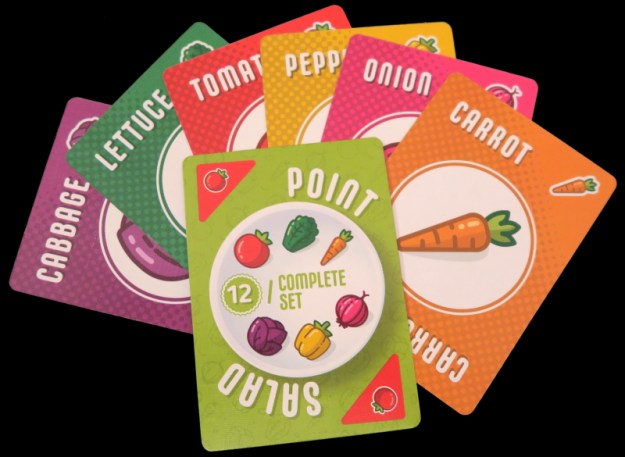
Food was a little delayed, so we decided to start playing something.  Food was clearly on our collective minds though, because we opted for a starter of Point Salad.  This is a very simple set collecting game where players take cards from the market.  The cards are double sided with brightly coloured vegetables on one side and scoring conditions on the other.  The market consists of three piles of cards showing the scoring condition sides, and six cards showing the reverse, the vegetable side.  The number of cards a player can take depends on where they take it from:  one scoring card or two vegetable cards.

Point Salad
– Image by boardGOATS

Each pile of cards feeds one pair of vegetables.  So, when a vegetable is taken, a scoring condition card is turned over to reveal its vegetable side, and that scoring condition is no longer available.  Players can also, once per turn, turn over one of their scoring cards so it becomes a vegetable, but they may never turn over a vegetable to make it a scoring card.  The game is over when all the cards have been distributed, and the scores have been totaled.  One of the more unusual things about this game is that both vegetable and scoring cards can be used more than once.  So, a player with a card giving points for sets of onion, cabbage and carrot (i.e. coleslaw), can score it as many times as they have sets.  Furthermore, if they also have a card that scores for pairs of carrots and lettuces (i.e. rabbit food), they can reuse the carrot cards and count them a second time.

Point Salad
– Image by boardGOATS

Pine began collecting lettuces, an obsession with green things that ended up lasting the whole evening.  Burgundy was more obsessed with red things, specifically tomatoes, so Mulberry, Black and Purple took great delight in snaffling them first, even when they didn’t help.  Blue only needed mayonnaise for her coleslaw as she collected onions, cabbages and carrots and generally made a nuisance of herself with Mulberry, sat to her left.  Food arrived before the game finished, and with people getting distracted by pizza and chips (always more appealing than salad) it is possible there were some missed opportunities.  It was tight finish at the front with only six points between the winner and third place.  Sadly, despite everyone else’s best efforts, Burgundy top-scored with fifty-six, ahead of Mulberry and then Blue.

Point Salad
– Image by boardGOATS

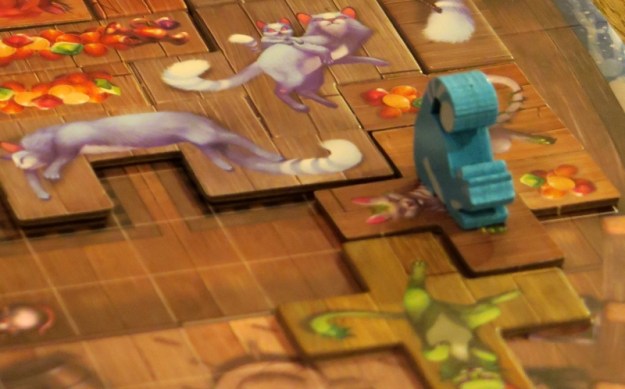
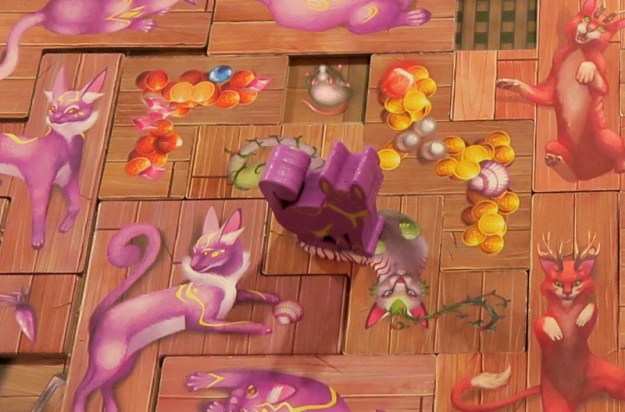
Once everyone had finished eating, it was time to decide who would play what.  The “Feature Game” was The Isle of Cats, a tile-laying game where players are rescuing cats and packing them onto their ship.  There were a lot of takers, none of which were keen to back down (even though Mulberry misunderstood and thought it was called “Pile of Cats” which, on reflection, does sound very exciting).  The game is not terribly complicated though we did make a bit of a meal of it. It is played over five rounds, each of which starts with card drafting.  Players are dealt seven cards and keep two passing the rest to their neighbour; this is repeated until they receive only one single card.

The Isle of Cats
– Image by boardGOATS

The cards come in five different colours: blue, green, yellow, brown and purple.  Blue cards are Lesson cards which are really just Objective cards, but these come in two types, personal and public.  Yellow cards depict some combination of “Boots”, “Cat Baskets” and “Broken Baskets”.  Boots are useful because they dictate where you come in the turn order, while Baskets are needed to used to “pay” to rescue Cats.  Yellow cards are treasure cards, brown cards are special “Oshax” cat cards and purple cards are instant effect cards that can be played at any time.

The Isle of Cats
– Image by boardGOATS

At the start of every round, each player receives twenty Fish which are used to pay for both cards and Cats.  So, once the cards have been drafted, players choose which ones they want to buy. with prices varying from free to five Fish.  The rest are discarded.  It is imprudent to over-spend, as Fish are also needed later in the round to lure cats off the island and onto the players’ ships; some cats are easier to lure than others, with cats on one side of the island costing three Fish and others costing five Fish.

The Isle of Cats
– Image by boardGOATS

Once everyone has paid for their cards, they must play any blue Lesson cards they kept in the round.  Any Public Lessons are revealed while Private Lessons are kept to one side face down.  Players then play their green cards—this is the guts of the game.  Players do not have to play all their green cards straight away, some can be kept for later rounds.  The number of Boots played are counted up, and the turn order is adjusted according to the number of Boots played so that the player with the most goes first and so on.  Player then take it in turns to spend one of their baskets and the appropriate amount of Fish to take one of their Cats and place it on their ship.

The Isle of Cats
– Image by boardGOATS

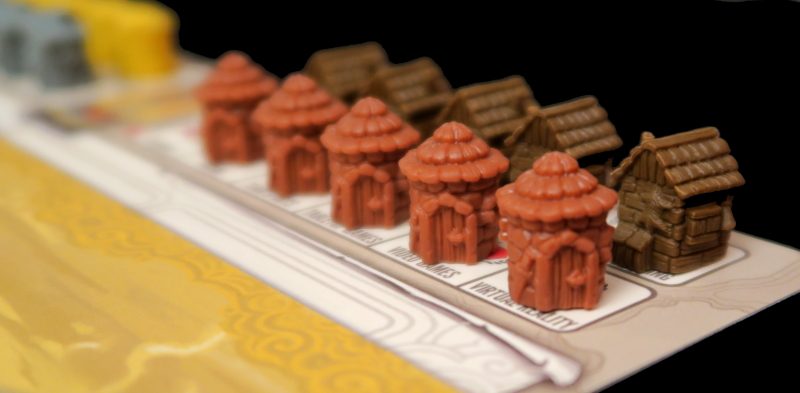
Each player starts the game with one “Permanent Basket” which they can use once per round, aside from this, the other Baskets usually come from the cards played or other Permanent Baskets acquired later in the game.  The Cats come in five different colours and are depicted on polyomino tiles which are placed on the players’ Ship-player boards.  At the end of the game players score points for grouping Cats of the same colour together in Families:  the larger the Family the more points.  So, a group of three Cats of the same colour will score eight points, while a Family of ten Cats scores a massive forty points.  In addition, players lose one point for each rat they have failed to cover with a cat, and lose five points for each room they fail to fill.
The Isle of Cats
– Image by boardGOATS

Thus, perfectly tessellating Cats is the aim of the game, but additional points are also available from the Lesson-objective cards.  It would be quite a challenge to perfectly tessellate tiles while keeping cats of the same colour together and conforming to the arbitrary objectives given in the Lessons, however, there are a couple of things to help grease the wheels.  Players who cover Scrolls on their Ships with a Cat of the same colour can add a Treasure tile to their ship for free—these are small tiles that are very useful for filling in holes.  There are only five scrolls though, one of each colour.

The Isle of Cats
– Image by boardGOATS

Additionally, however, once everyone has run out of Baskets, they can also play their Rare Treasure, yellow and brown cards.  The yellow cards enable players to place more Treasure tiles while brown cards allow players to place the very rare Oshax Cats (or “Oh, shucks!” Cats as we mostly called them).  These are very friendly Cats and will join any Cat Family of the player’s choice, though they have to pick the colour when they place it.  The cards are quite rare and very expensive, but a couple of these can be a really good way to boost the size of a Family.

The Isle of Cats
– Image by boardGOATS

In addition to Baskets on cards, each player starts with one Permanent Basket which they can use once per round.  Blue started the game quickly, by playing two lesson cards followed by a special card which enabled her to swap them for a second Permanent Basket.  Everyone looked on agog, envious of the advantage that would give, however, it had cost a  lot of Fish, and she spent the rest of the game trying to recover. Mulberry struggled to get some useful cards, but eventually managed to get a Permanent Basket of her own while Burgundy managed to get a couple of his own and he concentrated on trying to make sure there were no gaps round the edge of his boat to fulfill Lesson 113 to give him twelve points.

The Isle of Cats
– Image by boardGOATS

Pine meanwhile, continued his obsession with green and hogged all the green cats.  Since cards are drafted most of the cards are seen by some of the other players, so when he said he wasn’t sure how one of his Lesson cards worked, Blue and Burgundy knew exactly what his problem was.  The Lesson in question was Card 222 which gave ten points for each row of twelve containing at least twelve cats of the same colour.  Green’s queries concerned whether the row had to be continuous or whether they could be broken up by treasure, and whether Oshax cats counted.  We said they didn’t have to be continuous and Oshax cats counted so long as they were the right colour.  As a result, Pine’s green car family continued to grow, now forming long rows, lots of them.

The Isle of Cats
– Image by boardGOATS

It was in the final round that Mulberry turned nasty playing Public Lesson Card 235 which meant anyone  who didn’t have seven treasures would lose five  points, which inconvenienced Blue quite a bit.  When it came to scoring, it turned out that we weren’t quite right with the rule for Card 222—the rows should have been continuous.  That might have cost Pine ten or even twenty points, though of course had he known that, he would likely have been able to offset that a little.  It wouldn’t have mattered anyhow as finished with ninety points and a huge lead.  Over thirty points behind, it was close for second, but Burgundy, who just managed to ensure there were no gaps at the edge of his boat, pipped Blue, by two points.
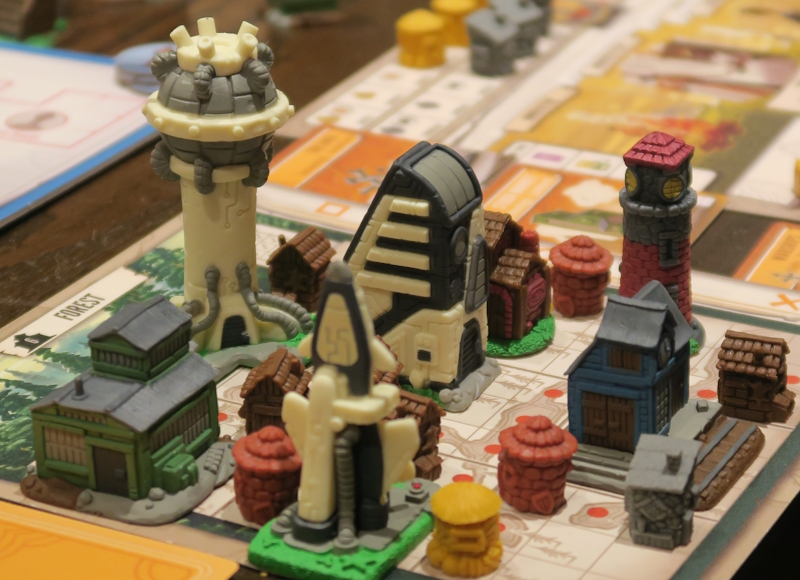
The Isle of Cats
– Image by boardGOATS

There are a number of really nice things about The Isle of Cats.  Firstly the production quality is stellar and there are some really, really nice touches.  The cat artwork is fantastic and the fancy screen-printed cat-eeples from the deluxe upgraded version are quite special.  Unquestionably, we made a mistake playing with five the first time round—we were slow, with a lot of people spending a lot of time checking whether tiles would fit and that made the game even slower.  Mulberry commented that she disliked variable turn order as a mechanism:  it is common in lots of games, but tends to encourage a lot of pauses followed by queries about whose turn it is.  The are other little things like the fact the purple and brown cards could have been more distinct.  Overall, it definitely deserves another chance, but it might be hard to get some of the players from the first time to give it a second try.

The Isle of Cats
– Image by boardGOATS

Meanwhile, on the next table, Ivory, Black and Lime, started off with Key Flow.  This was particularly sad for Blue to see, because Key Flow is a sort of card game of Keyflower, one of her favourites.  That said, Key Flow had been played at our sister group, the Didcot Games Club, just a few days previously, so she consoled herself with the memory of that and concentrated on The Isle of Cats.  Although Key Flow has a lot in common with Keyflower, it has a very different feel.  Where Keyflower is really an auction game (using meeples as currency), Key Flow is a card drafting game.  So, in Key Flow, players start with a handful of cards, simultaneously choose one and place it face down, passing the rest on.

Key Flow
– Image by boardGOATS

Players then simultaneously reveal their card and add it to their village before picking up the hand they’ve just been given, selecting another card and so on.  Like Keyflower, the game is played over four seasons, and like Keyflower players receive some of the Winter offerings  at the start of the game which they can then use to drive their strategies.  The iconography is very similar too, so a player who is familiar with Keyflower generally feels at home with Key Flow.  The cards come in three flavours:  village buildings, riverside buildings and meeples.  Village cards are placed in a player’s village, in a row extending either side of their starting home card.  Riverside tiles are placed in a row below, slightly off-set.

Key Flow
– Image by boardGOATS

Meeple cards are used to activate Village cards by placing them above the relevant building.  As in Keyflower, buildings provide resources, skill tiles, transport and upgrades.  They also provide meeple tokens which can be used to increase the power of meeple cards or activate a player’s own buildings at the end of the round.  Arguably the clever part is how the meeple cards work.  At the centre of each card there are a number of meeples which dictate the power of the card.  A single meeple card can be played on any empty building; a double meeple card can be played on an empty building or one where one other card has already been played.

Key Flow
– Image by boardGOATS

If two cards have already been played, a triple meeple card is required to activate it a third and final time.  Alternatively, a lower power meeple card can be played with one of the meeple tokens, which upgrade a single meeple card to a triple meeple card.  Double meeple cards can also be upgraded, but each building can only be activated a maximum of three times per round.  The really clever part is that the meeple cards have arrows on them indicating where they can be played:  in the player’s own village, in the neighbouring village to the right, the village to the left, or some combination.

Key Flow
– Image by boardGOATS

Black began the game by adding the Key Mine to his village which provided him with iron (wooden, black octagonal prisms).  In summer he added the Smelter which added more iron producing capacity (converting skill tiles), but he quickly upgraded this to give gold instead as it is more versatile and can be used instead of any other resource and any left overs are worth a point each at the end of the game.  Ivory also had resource providers in the shape of the Workshop which provided him with a wood, an iron and a stone every time it was activated.  He then added an Apprentice Hall which generated skill tiles.

Key Flow
– Image by boardGOATS

Meanwhile, Lime built a village strong in gold production, with the Gold Mine and Brewer and potentially the Carpenter too if he could upgrade it.  To his village, Black added a flock of sheep on his river bank while Ivory added a heard of pigs; Lime was more of a mixed farmer though with a bit of everything.  As the game progressed into the scoring rounds, Ivory added a Truffle Orchard which gave him four points for each pig and skill tile pair, allowing him to put all his pigs to good use netting twenty-four points.

Key Flow
– Image by boardGOATS

Lime and Black pulled in similar points tallies with their Emporium (four points for each green meeple and gold pair) and Traveller’s Lodge (points for transport and boats) respectively.   With similar points for their upgraded buildings as well, it was close and the smaller contributors became really important.  Ivory’s Trader which scored him fifteen points for stone and axe skill tiles, while both Black and Lime scored ten points for their Autumn stores (Stone and Timber Yards respectively).

Key Flow
– Image by boardGOATS

Perhaps it was the points he got from the meeples (Winter Fair and Craftsmen’s Guild), but there was only two points between first and second in the end. Black finished with a total of seventy-one points, just enough for victory—a couple of points more than Ivory, with Lime not far behind.  It had been a hard fought game, and Ivory was impressed how the Scribe, which in Keyflower he felt was always a winner, had little effect.  For him, this made the game more interesting, though he had really enjoyed the last time the group played Keyflower with the Farmers expansion, as that had also mixed things up.

Key Flow
– Image by boardGOATS

Given the recent game with the Didcot group it was inevitable that a comparison was going to be made.  This time Black won, but he scored fewer points than he had the previous week when he had come second.  Perhaps the most marked difference was how much quicker the three player game of Key Flow had been than the six player game a few days earlier.  Where the six player game had taken all evening, there was still time for something small, and with Lime taking an early bath, Ivory and Black chose to play a head-to-head of Ticket to Ride: London.

Ticket to Ride: London
– Image by boardGOATS

Ticket to Ride is a train game with an inexplicable alure, which everyone in the group loves and we’ve found that the small versions of the game, New York and London make excellent fillers.  The rules and game play are very similar to the full versions, but the take half the time, and with just two players, that makes it a very short game indeed.  On their turn, players take coloured cards or spend them to place their pieces on the map.  Points are awarded for completing tickets, but critically, failing to connect two locations marked on a ticket will score negative points.  The player with the most points at the end of the game wins.
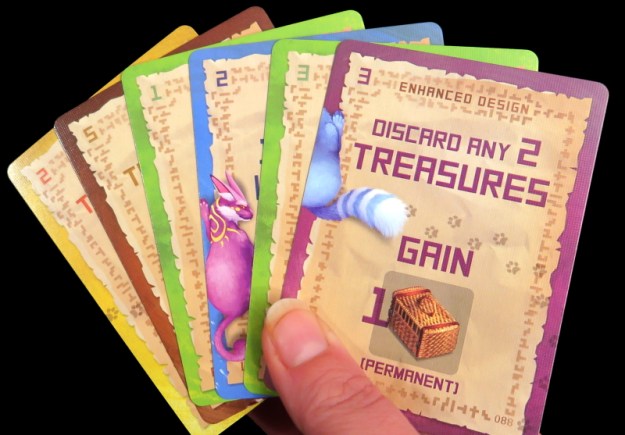
Ticket to Ride: London
– Image by boardGOATS

This time, Ivory built a network connecting Brick Land and the Tower of London in the East with Hyde Park in the West, while Black joined Regent’s Park in the North with Waterloo and Elephant & Castle in the South.  The crunch point came in the area around Covent Garden, but despite this, both players managed to complete all four of their tickets.  This meant it was down to the length of the tickets and the number of pieces placed—Ivory had the edge on both of these.  His revenge for the result in Key Flow was completed by a four point bonus for connecting all four in the St. Paul’s district resulting in a ten point victory.  With that, Ivory headed home, leaving Back to watch the end of The Isle of Cats.
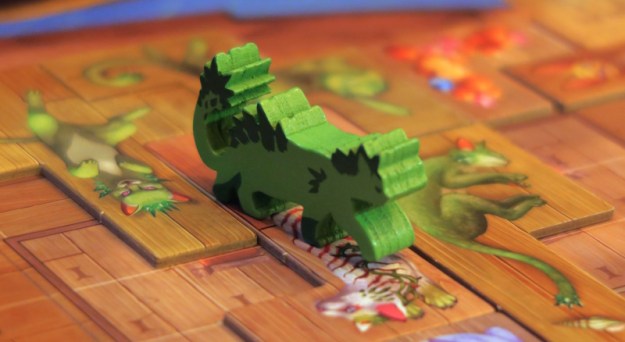
Ticket to Ride: London
– Image by boardGOATS

Learning Outcome:  Games take longer with more players.

Next Meeting – 18th February 2020

Our next meeting will be on Tuesday 18th February, at the Horse and Jockey pub in Stanford-in-the-Vale. As usual, we will be playing shorter games from 7.30pm as people arrive, until 8pm when we will start something a little longer.

This week, the “Feature Game” will be The Isle of Cats, a tile-laying game where players are rescuing cats and packing them onto their ship.

Isle of Cats
– Image by BGG contributor kalchio

And speaking of Cats…

Jeff was at the cinema watching the new release of Jane Austin’s “Emma”, when he noticed what looked like a cat sitting next to him.

“Are you a cat?” asked Jeff, surprised.

“Yes,” the cat replied.

“What are you doing at the cinema?” asked Jeff.

“Well,” replied the cat, “I liked the book…”