Tag Archives: The Settlers of Catan

Boardgames in the News: 20 Years of Catan and El Grande

It seems to be the year for anniversaries: arguably 2015 celebrates significant anniversaries for two of the greatest games in boardgaming history.  We are not talking about Monopoly here (though there has been a lot written about the 80th anniversary of the brand).  The games in question were both released in Germany in 1995:  The Settlers of Catan and El Grande.   The first of these, Klaus Teuber’s The Settlers of Catan, is widely known amongst gamers and many non-gamers, and is often cited as being responsible for the “gaming revolution”.  The base game of “Settlers” (or “Die Siedler”) and its expansions have appeared in thirty languages and sold more than twenty-two million copies worldwide.  At Spielwarenmesse, The International Toy Fair at, Nürnberg, Kosmos and Mayfair unveiled a new look for the entire line of Catan games.

The Settlers of Catan
– Image used with permission of BGG contributor kilroy_locke

The press release explains, “The new look will strengthen the Catan brand both domestically and internationally.  The new cover art utilized by all partners will provide a visual continuity throughout the world.  This new look is more vibrant and alluring with overall improved presentation and splendidly clean branding. The new packaging cries out… CATAN!”  It goes on to say, “As part of the growing expansion of the Catan® family of products, the base game will simply be called CATAN® in all countries and languages, along with a unification of the game’s graphic design in all territories and languages.”

The Settlers of Catan
– Image by BGG contributor herman_the_german

There are a couple of curious things about this, firstly, when Kosmos released the game twenty years ago, it was just going to be called “The Settlers” (or rather “Die Siedler” since it was released in German first).  That was until Blue Byte published a computer game by the same name, so Kosmos decided they wanted something more unique and identifiable and made up “Catan”.  Secondly, aside from the the editions released in English by Mayfair Games (who went its own way with original art and component design), the brand has already been “unified” in its look!

The Settlers of Catan
– Image by BGG contributor degamer

The second of the games mentioned above is El Grande, which was first published in Germany by Hans im Glück.   Like “Settlers” the year before (or “Catan” as we must now call it), in 1996, Wolfgang Kramer and Richard Ulrich’s El Grande was awarded both the Spiel des Jahres and the Deutscher Spiele Preis.  Although it is less widely known than its predecessor, El Grande is hugely respected by gamers often cited as “still the best area control game”.  It is so highly thought of that it continues to be higher on the BoardGameGeek ranking than The Settlers of Catan and many other well known and hugely popular games including Carcassonne, Ticket to Ride, Pandemic and Dominion.  These games are all continuously reprinted, but sadly, the nature of boardgames means that many good titles go out of print.  Unfortunately, El Grande is one such game; it had fallen out of favour with its publishers and has not been reprinted in English or German since the Decennial Edition, ten years ago.

El Grande
– Image used with permission of BGG contributor garyjames

There are a number of reasons why games like this go out of print.  Firstly, much as we hate to admit it, boardgaming is a niche market:  Hasbro recently proudly announced that Monopoly has sold 275 million copies over the eighty years, but compare this with the estimated 450 million Harry Potter books sold in a fraction of the time.  In turn, these make Catan’s 22 million copies look positively paltry by comparison and for games that fail to make the jump to the wider market, the first print run is often only a few thousand.  Whether or not one of these games gets a second print run depends on demand and sale-speed of the first impression, and ultimately, whether or not the publisher thinks it can secure a good return.  Factors that affect this, obviously include the mark-up and the Recommended Retail Price (or RRP, sometimes known as Manufacturer’s Recommended Sale Price or MRSP).  Games that have language dependent components usually suffer here.

El Grande
– Image used with permission of BGG contributor DrGrayrock

There are two main markets:  Germany and USA.  We in the UK benefit from the fact that the USA nominally speak the same language as us, but otherwise, the UK boardgame market is relatively small-fry.  Anyhow, for this reason, games are commonly released primarily in English and German, however, the margins are clearly much larger if the same game can be released to both markets with minimal reworking, and companies like Z-Man Games have made a name for themselves translating the best European games for the English market.  Other companies (e.g. Zoch, Queen and R&D Games) release games as “international” editions which include language independent components and rule booklets in multiple languages.

El Grande
– Image by BGG contributor Domostie

Obviously, it is much more difficult to release a multi-lingual edition if key components include significant text.  It is also much easier to translate a game if the only change needed is the box and the rules; El Grande clearly fell foul of this.  However, so did The Settlers of Catan, and that didn’t do so badly.  So there are obviously other factors, including game play, accessibility, approachability, appearance and marketing.  There is no question that the trading dynamic and controlled randomness in Catan are key parts of its success as they keep everyone involved between turns, but timeliness is probably the real key:  it was perhaps just the right time for a family game that felt a bit different.  So, by the time El Grande came along, well, everyone was playing Settlers, and as a result, El Grande didn’t make quite the same impact.

El Grande
– Image by BGG contributor Bernaar

That doesn’t mean it is less of a game though, so it is great news that Hans im Glück has recently announced the long-awaited return of El Grande, this time in the form of a Big Box with upgraded components.  The Big Box is a collection that, like the Decennial Edition ten years ago, will contain all the expansions that have been officially released over the years.  Z-Man Games has also confirmed that it will release a parallel Big Box in English; Dutch publisher 999 Games will be doing the same in Dutch and have also mentioned a “Jubileumuitbreiding”, or “anniversary extension”.  Clearly anniversaries are to be celebrated, especially if it means older, well-loved games become available once more.

Boardgames in the News: The Hobby Grows and Grows

In the UK in the 1960s and 1970s, boardgames were only available from toy shops, and the range was limited to a relatively small number of “traditional” games, like Chess, Monopoly, Game of Life or Cluedo.  With the appearance of bigger, supermarket-like stores like Toys “R” Us in the 1980s and 1990s, a wider range became available and, occasionally, games like the early Spiel des Jahres winner, Rummikub, made their way onto our shelves.  As children grew up, they might graduate into playing Risk and eventually move onto longer, more complex games like those produced by Avalon Hill.  However, if you liked playing games, but war themes were not for you, it was quite difficult to find good alternative games to play.  They were there though:  games like Acquire and the 18xx railway games had been about for a long time, but these were the exception rather than the rule and were still an acquired taste.

Rummikub
– Image by BGG contributor OldestManOnMySpace

In contrast, in Germany, games like Scotland Yard were starting to become readily available and genuinely very popular.  The success of the Spiel des Jahres, which rewarded good games like Ra, El Grande, Tikal, and the 1995 winner, The Settlers of Catan, meant that boardgames were receiving a lot of publicity in Continental Europe.  The characteristics of these “German Games” (or “Euro Games”) typically include balance, with only a small amount of luck, and lack of player elimination.  As the market developed, beautiful boards and lots of wooden pieces also became an essential component.  Unlike war games, “Euro Games” tend to be less confrontational and much more suitable for family gaming.

The Settlers of Catan
– Image used with permission of BGG contributor kilroy_locke

In the 1990s, UK designers like Alan R. Moon and Richard Breese started publishing small numbers of “designer games”.  These were often largely assembled by hand and generally had a limited print run.  For example, only 1,200 copies of Elfenroads (precursor to the later, Spiel des Jahres winner Elfenland) were ever made and Keywood, the first of the highly acclaimed “Key Series“, was hand-made and had a print-run of just 200.  Given the exclusive nature of these games, it was not surprising then, that many teenagers either gave up on boardgames or moved on to collectable card games, like Magic: The Gathering or Role-Playing Games.

Elfenroads
– Image by BGG contributor dougadamsau

So it was with the growth of the internet that “Euro Games”, or designer boardgames became available to people in the UK.  Firstly, this was because it enabled people to find out about the games that were available, with sites like UseNet and eventually BoardGameGeek in 2000, providing a valuable source of information.  Secondly, internet shopping made “German Games” much more accessible.  The growth of the hobby meant an increase in boardgame publishers, and the appearance of designers like Reiner Knizia who were sufficiently prolific and successful to make a living from designing games.  Over the last fifteen years or so, the hobby has grown and grown and games like Carcassonne and The Settlers of Catan are now available in Waterstones and WHSmith, there are regular comments in The Guardian, there are repeatedly TV appearances, and boardgame cafés are sprouting up all over the place.  The question is, will it continue to grow, or have we reached a high water line?

Ernie
– Image from boardgamegeek.com

25th March 2014

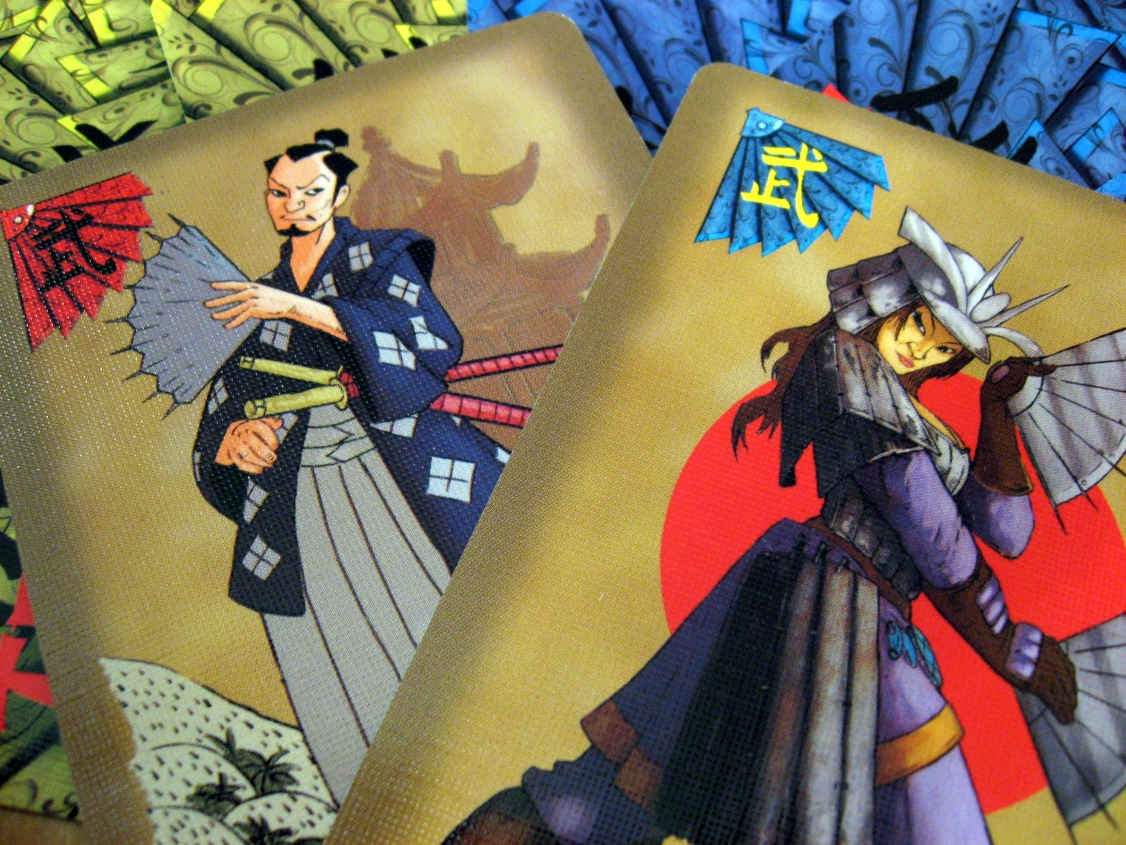
While we waited for people to arrive we started out with a quick duelling card game set in feudal Japan, called Tessen.  The tale goes like this:

“Many years ago, in feudal Japan, disagreements and feuds were common among the clans. Fantastic battles were fought for control of resources, land, and supremacy.  Tiring of all the bloodshed, the Shogun declared a plan to minimize the violence…  All disputes would be decided by a Tessen challenge – a competitive hunt for eight types of elusive mystical animals that roamed the land. Whichever clan’s samurai were able to capture and bring back the most animals would be declared the victor, and the dispute would be ruled in that clan’s favour.  The samurai warriors from each clan would certainly attempt to sabotage the opposition’s efforts and capture their animals.  The only weapon the Shogun would allow was the Tessen, a war fan used for both attack and defence.  While the Tessen could still be deadly, there would be far less bloodshed than if the samurai were allowed to use swords.”

Tessen

So, players each have their own deck containing animal and samurai cards.  Players can draw cards, place them in one of five “cages” in their play area, or attack with a samurai card, but although actions are performed simultaneously, they must be discrete actions.  If attacked, the victim must stop immediately to either concede defeat so that the attacker can move the animals to one of their cages, or repel the attack countering with a samurai card of their own.  Each cage can only contain one type of animal and when it has three or more, the animals can be “banked” and moved into storage freeing up the cage for more animals.  The round ends when one player runs out of cards, so they are frenetic affairs which take only a couple of minutes each.  The first round was a bit of a landslide in favour of the Atika Clan, but the Nambu improved significantly on the second round to level the game.  The third round was close with the Nambu starting very aggressively, but the Atika caught up and ran out of cards first preventing the Nambu from banking her final four deer and winning the game. By this time the others had arrived, so exhausted, we left it as a best of three…

Tessen

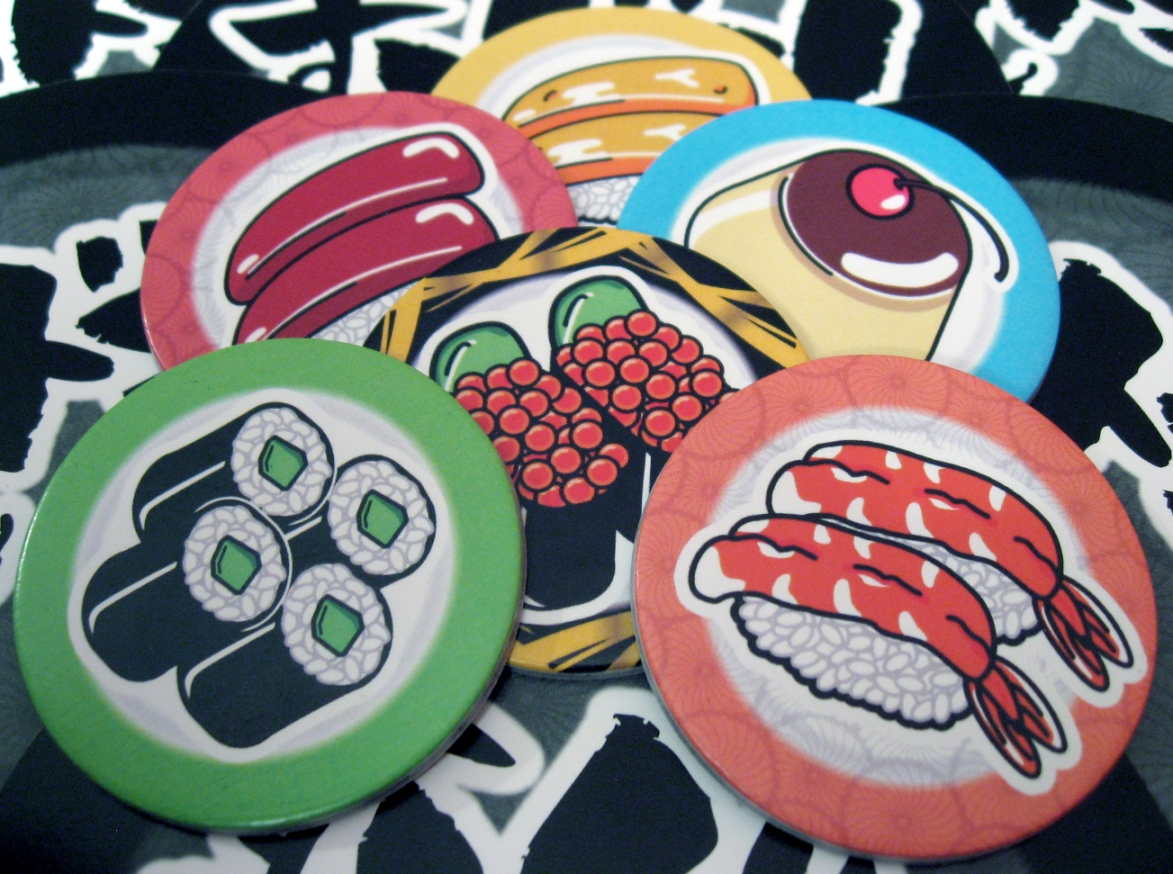
Next we played our “Feature Game” which was Sushi Draft!.  This game is similar to 7 Wonders in that it is based on “card drafting”, however, the aim is far less complex.  The story goes that the children are having a competition to see who can eat the most of one type of sushi at a Japanese family feast.  Mother, however, wants the children to eat a balanced diet, and will give pudding to the one who eats the most varied meal.  Therefore, the aim of the game is to try to do both.  Players start with a hand of six cards and then simultaneously play one before passing all but one of the remaining cards on to the next player.  Play continues until everyone has played five cards at which point the scores are evaluated and players with the most of each type get a corresponding token and the player with the most different types gets a token.  If there is a draw, then the next highest player gets the token.  About half-way through we realised that some sushi were more valuable than others which changed the game somewhat, but the damage was already done and the winner had already collected the highest value tokens.

Sushi Draft

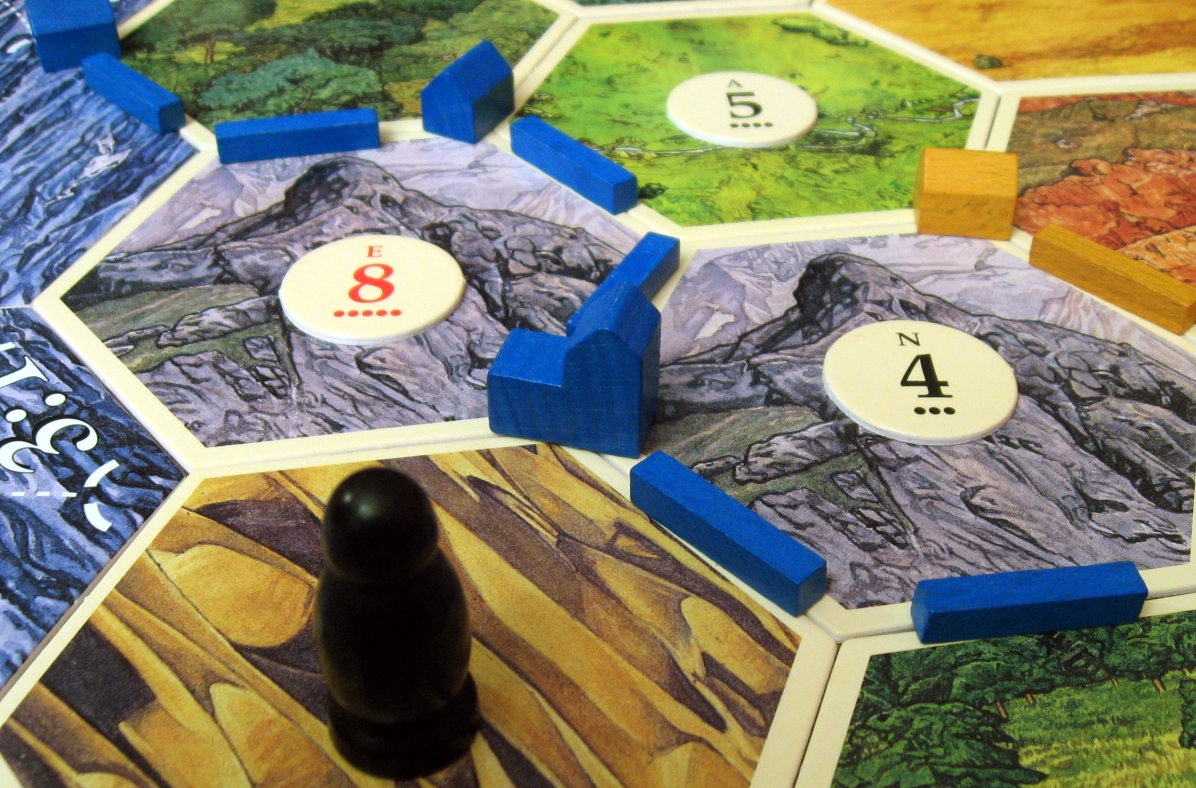
After some considerable debate, next we decided to play Settlers of Catan.  Nearly twenty years old, this is often credited with being one of the first modern boardgames.  As such, it has largely been usurped by more recent and fashionable games.  However, although we were all quite familiar with it, it was a while since most of us had played it, so we decided to blow off the dust.  The game is played on a modular board made up of hexagonal tiles corresponding to resources (wood, clay/brick, sheep, wheat/grain and ore), each of which gets a number.  Turns come in two parts.  First the player rolls two dice, adds the numbers together and anyone with a settlement on the edge of the corresponding hexagon, gets that resource.  However, if a seven is rolled, then the active player moves the robber onto one hexagon (preventing allocation resources from that hex) and then takes a card from an owner of one of the settlements surrounding it.

The Settlers of Catan

The second part of a turn is trading and building, where the active player can trade resources with other players at any rate they can negotiate, or with the Bank at a predefined rate.  Settlements (which score points at the end of the game) must be connected to at least one of the players other settlements by roads, and players start by placing two settlements on the board (in the player order 1, 2, 3, 4, 4, 3, 2 , 1).  Unquestionably the game has its faults, one of them being that the starting positions are really very critical.  While this is unquestionably true, it is not always obvious which positions are the best, and with the random nature of dice, sometimes double six will come up far more frequently than the statistically more likely combined totals of six or eight.

The Settlers of Catan

Since we started out with a random tile lay out we had a very, very distorted map with a lowland region containing all the sheep pasture and wheat fields in big regions with a more mountainous area of with forests and hills.  Even worse, all the clay (used to make bricks) was located on the low probability numbers (two, eleven and twelve), meaning that in theory, these would be difficult to come by.  Initial settlements were predominantly round the sixes and eights with players trying to maximise the variety of resources they had access to.  Blue settled in the highland area while Green, Orange and White tried to get a bit of everything, especially the rare clay.

The Settlers of Catan

It seemed Green had the best placement as he was the first to build a third settlement and followed it quickly with a fourth, meanwhile Blue was getting plenty of ore (which is useless at the start) but struggling to obtain bricks and ended up building a lot of road just to get something built, joined her two settlements and picked up the Longest Road in the process.  Two and eleven seemed to be rolled with peculiar regularity and Green was the main beneficiary as he had multiple settlements that qualified, while Orange and White also picked up the occasional hod-full.  Blue’s long road partitioned off an one corner of the board blocking both Orange and White in the process and when Green beat them to a couple of settlements, that left both Orange and White very tight for space to build and it was a race to the finish.

The Settlers of Catan

Orange judiciously used a monopoly card to steal sheep from everyone and then slaughtered the whole flock to build a city and a lot of road.  Meanwhile White used her impressive skills breading and exporting sheep to great effect to extend in the only direction available to her.  Blue’s productive ore and wood supplies in the mountains, together with the “ore harbour” and “wood harbour” finally started to pay dividends making up for her complete lack of any source of wheat or brick.  Green meanwhile, used his vast grain empire to build cities and collect development cards in an effort to build the Largest Army.  With Blue one point from winning with the cards she needed to build one last city in hand, Green needed just one more Soldier to get the Largest Army and bought a development card.  Although it turned out that three of the next four cards were Soldiers, Green was unlucky and Blue took the win.

The Settlers of Catan

Learning Outcome:  Some of the old classic games are classics for a reason and should not be neglected.

We Play “Second Generation Games”

The BBC really seems to have picked up on boardgaming recently:  in January, BBC Breakfast reported a rise in game sales over the Christmas period and now You and Yours on BBC Radio 4 are getting in on the act.  The report interviewed Joe Jaques (from Jaques of London) and Steve Buckmaster (from Esdevium Games).  It is a nice article that explains the rise of “Second Generation Games” including Carcassonne, Settlers of Catan and Ticket to Ride and discusses their origin and how many of these games have iOS versions that have led to increased interest in the real thing.  The 5 minute article starts 22 minutes and 45 seconds into the program and is available from the BBC website.  There is also an online write up in the business section of the BBC Website.

BBC Radio 4

Cat in Monopoly Box

Monopoly is always being updated and new versions released.  For example, last year Winning Moves/Bletchley Park announced that a special edition to commemorate the life of Alan Turing was to be released. In this edition, the board’s London landmarks, and its Community and Chance cards, have been swapped for places and events important in Turing’s life and players can move their pieces from his birthplace in Maida Vale to Hut 8 at Bletchley Park.  Alan Turing is undoubtedly one of technology’s heroes — a mathematician and codebreaker who laid the foundation for today’s computing age, and 2012 was the 100th anniversary of his birth, but what is the connection with Monopoly? 

Turing Monopoly
– Image of unknown origin

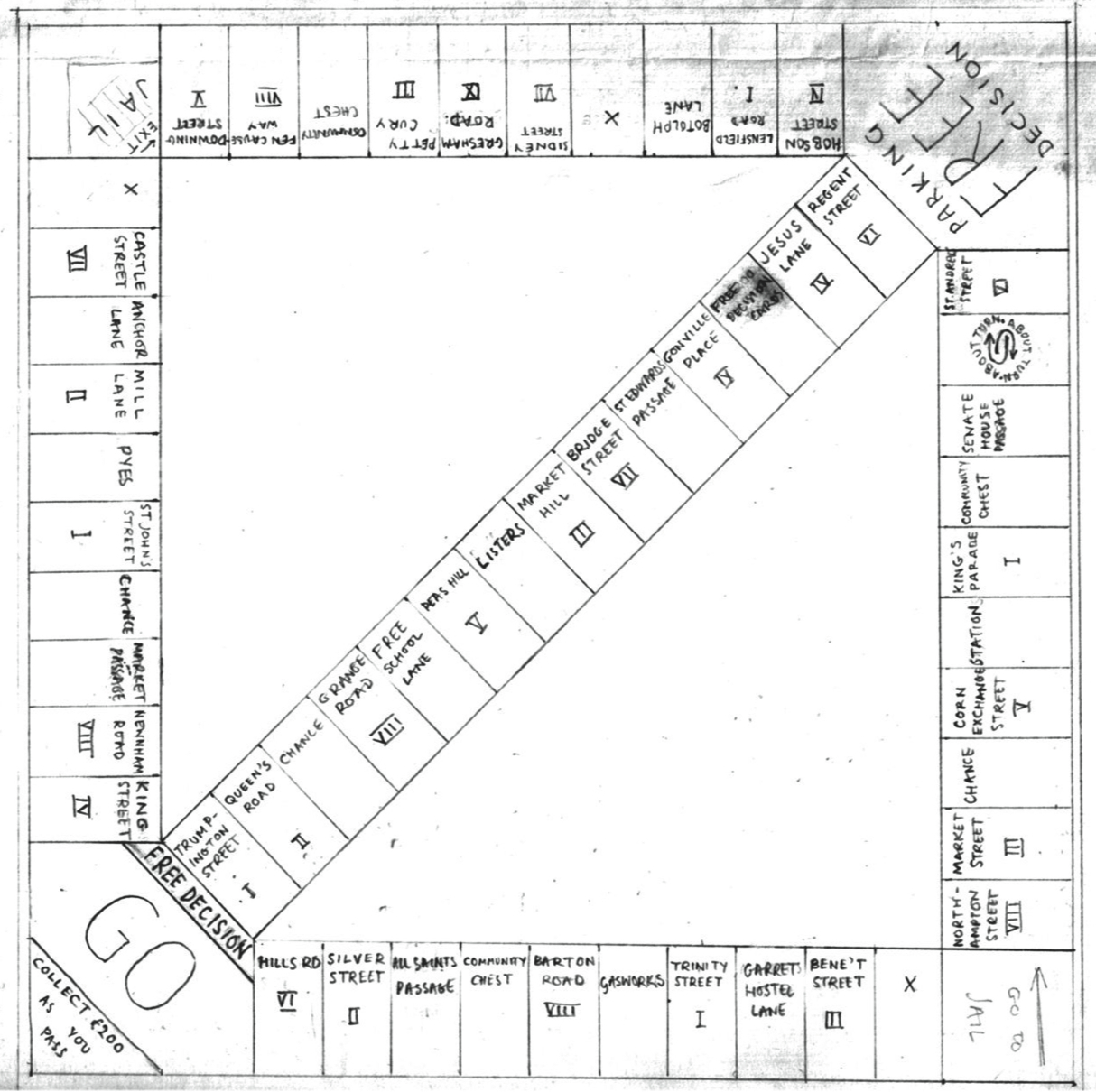
Well, it turns out that he once played a hand made copy made by William Newman (the son of his mentor Max Newman).  According to the booklet that comes with the set, “One afternoon the Newman household phone rang, with Turing on the other end, asking to speak with William. ‘Did he have a Monopoly board?’ Alan asked, and on hearing that he did, raced round. Turing’s mind was fascinated with codes, and there have long been suggestions he thought there were code-based tactics to playing Monopoly to ensure success. Alas, the hand drawn nature of William’s board (not to mention the unique diagonal straight and ‘turn around’ square) proved otherwise, and the great mathematician was beaten.

CAT-an!
– Image by boardGOATS

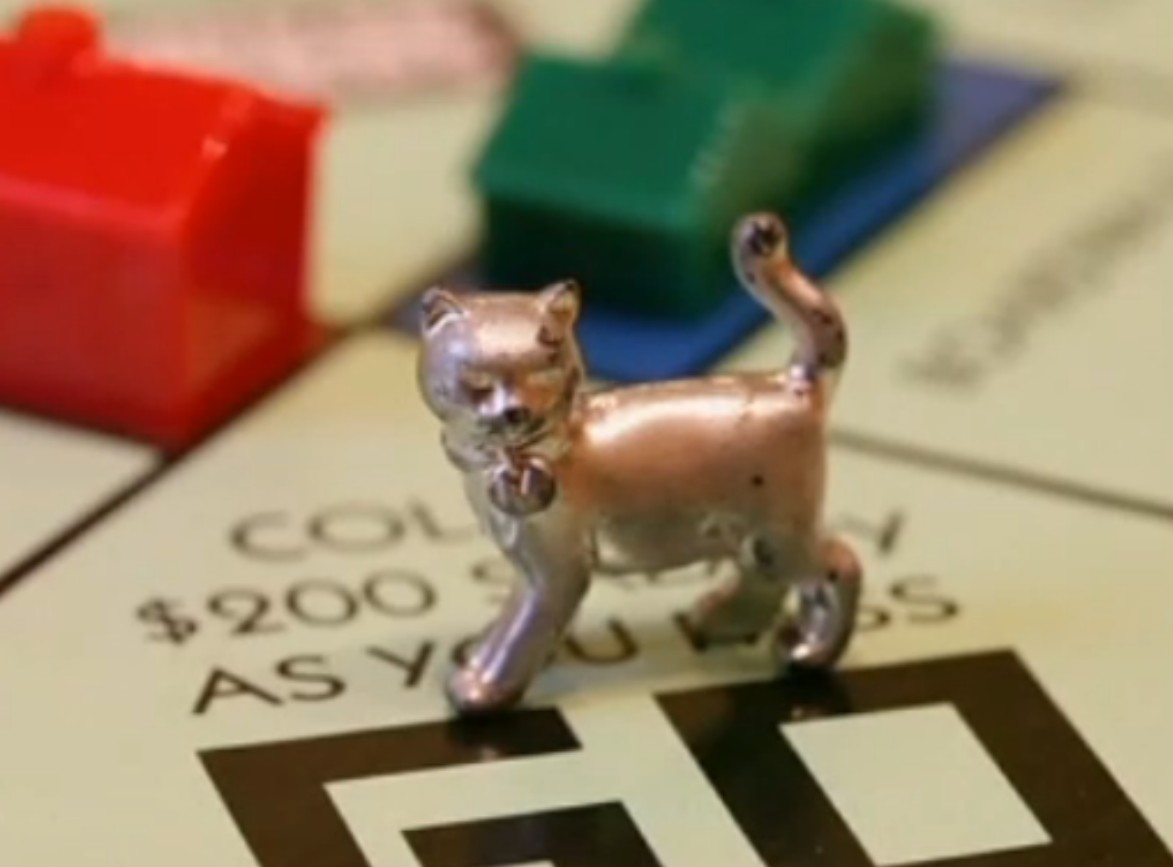
The connection between Alan Turing and Monopoly may seem tenuous, but in contrast, the way cats have a penchant for sitting in game boxes is well known to all gamer-cat-owners – there is even a game called “The Settlers of CATan”!  Thus, it should come as no surprise that, following a month long poll by Hasbro, the cat has beaten off competition from a robot, a helicopter, a diamond ring and a guitar.  The new cat design received 31% of the total vote and will replace the iron in the next edition which will be released later this year.

So now every Monopoly box will come with its own cat!

Monopoly Cat Token
– Image of unknown origin

OxCon and Big DoG

This weekend is OxCon.  OxCon is a weekend of gaming held every January in The Mitre pub in Oxford.  It has almost mythical status within since publicity is almost entirely by word of mouth and often quite last minute.

This year, in addition to the usual thread on BoardGameGeek, there is also a mention in the latest Queen’s Lane Advertiser (QLA-42, page 8) and a FaceBook page.  Not sure how many of the GOATS will make it, that will depend on weather (currently snow-chance) and family commitments, but it should be a good event with Puerto Rico and Settlers of Catan tournaments for the more competitive.

The Mitre, Oxford

In a couple of weekends time (2nd February to be exact – check out the calendar), is the Big DoG – a Day of Games hosted by the Oxford Meeples at Wolvercote Village Hall.  Just to the north of Oxford situated close to the A40 and A34, this looks to be a well cited event, and the list of proposed games looks enticing.  However, whether or not (m)any GOATS are there, will again depend on other commitments.

A Big Dog