Tag Archives: Ticket to Ride: London

31st October 2023

With it being Halloween, there were lots of treats and some very fine spooky-themed attire to go along with the “Feature Game“, Betrayal at Mystery Mansion.  This is a Scooby-Doo themed re-implementation of Betrayal at House on the Hill, a semi-cooperative game, where players work together until there is a haunting and one player takes on the role of the bad guy.  So, the first task for the evening was to decide who was going to take on the roles of Mystery Inc., which precipitated lots of discussion about which was the best character.  Scrappy got short-shift from Pink, though others were less dismissive.  In any case, Scrappy was not an option, and before long, Sapphire, Pink and Pine joined Jade to solve the mystery.
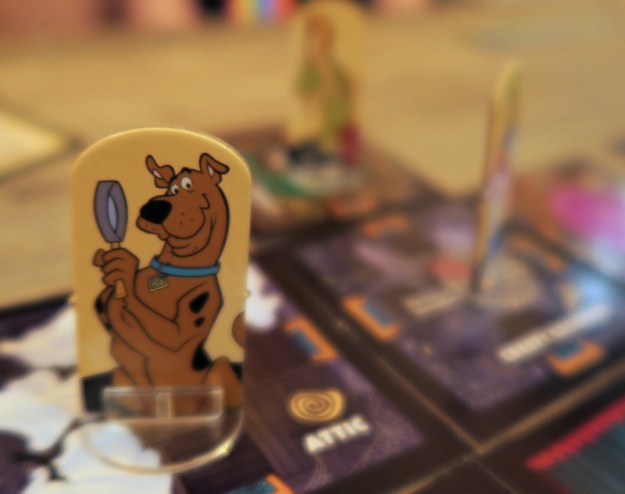
Betrayal at Mystery Mansion
– Image by boardGOATS

Jade, as the group leader, took the role of Fred, while Pink and Pine enthusiastically engaged in the game as Scooby Doo and Shaggy.  That left Sapphire to choose from Velma or Daphne and he went for brains over bimbette.  The group spent quite a bit of time exploring the mansion collecting clues and the like, before the haunt finally started.  As Sapphire was the one to trigger the haunt, Velma was “temporarily lost in the woods” as he took on the roles of the bad guys, a Spectre and a female character called Sharon who was being possessed and controlled by the Spectre.  As the game progressed, it became apparent that the Spectre was her great uncle who was trying to control her to gain access to documents that would enable him to take control of the family fortune.
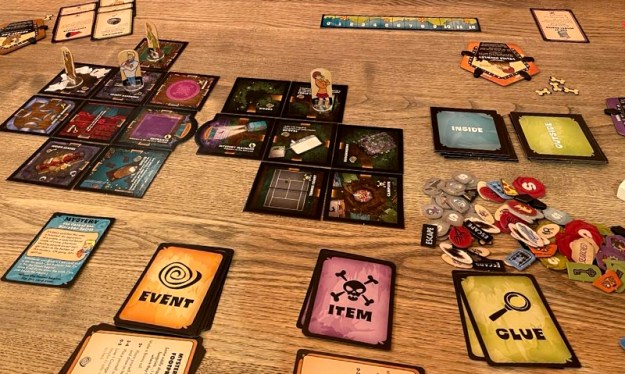
Betrayal at Mystery Mansion
– Image by boardGOATS

The Scooby Gang (minus Scrappy Doo, Daphne and the now lost Velma) had to track down and battle the Spectre and try break the spell controlling Sharon.  As the villain, Sapphire rolled very well and it was very hard for the Gang to pin him down.  Fred ended up stunned at one point, but thankfully revived after missing a turn.  Shaggy scoffed piles of Scooby Snacks in order to re-roll, but the dice weren’t with him.  Scooby himself, however, did very well and survived his battle with the Spectre then was able to recharge in one of the special rooms of the mansion.  In the end the Mystery Inc. won the day and the great uncle was unmasked and announced that he “would’ve gotten away with it if it weren’t for you pesky kids”!
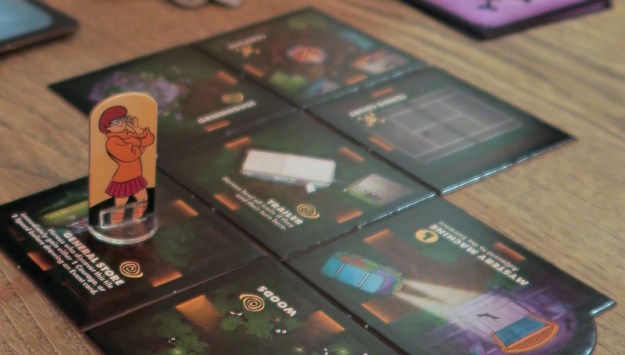
Betrayal at Mystery Mansion
– Image by boardGOATS

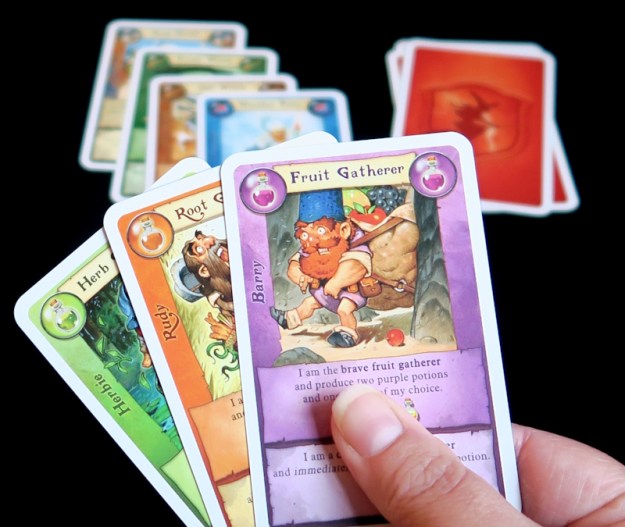
Meanwhile, there were two other games underway on the neighbouring tables.  Blue, Plum and Byzantium eschewed Witch’s Brew (which plays better with more people) and opted for the slightly bigger, beefier, boardgame version of the same game, Broom Service.  Both games rely on the players having a personal deck of Character cards and a lead and follow mechanism.  Each player starts by choosing a set number of Characters from their deck, each with different actions.  The first player then chooses one to lead with and announces that they are either “Brave” or “Cowardly”.  If they choose Cowardly, they can take the action straight away, whereas, if they choose Brave, they must wait until everyone has played to see if they can take the more powerful action.
Broom Service
– Image by boardGOATS

The next player must follow if they have the card in hand, and has the same decision to make—be a Coward and take the weaker action, or be Brave, and risk being gazumped by a later player, as there can only be one Brave player taking the powerful action.  The Brave player (or the most recent Brave player) then leads with another card.  In the card game, Witch’s Brew, players are collecting tokens to give them points, however, in Broom Service, there is an additional “Travelling Salesman” pick-up and deliver type of mechanism.  Players have two Witch-meeples which travel the land collecting potions and delivering them locations to get points.  This time, it was a really, really close game, despite everyone doing different things.

Broom Service
– Image by boardGOATS

Byzantium prioritised collecting Lightening Bolts and Blue concentrated on collecting potions and delivering them.  While they both headed south and contrived to get in each-other’s way, Plum headed north and fell foul of one of the events which left her stuck with no good move in the final round.  Blue kept forgetting about the “Bewitched Roles” which can be used but with a hefty three point penalty and lost six points as a result.  Byzantium assumed he would be the only one to consciously choose to take the hit and thus guarantee he could be Brave, but happened to do that exactly when Blue picked them as well and lost the advantage when he led with those roles.

Broom Service
– Image by boardGOATS

As the game came to a close, it was clear it was going to be close with Blue ahead by a single point with sixty points scored during the game.  She lots of resources left while Byzantium had none but lots of Lightening Bolts, and Plum had some of both.  Initially, Blue and Byzantium tied with seventy-three, just two points ahead of Plum.  That gave Blue victory with the tie break (the most left over resources), but that was only until the miss-count was spotted and Blue lost one point and with it her Winning Witch Medal, instead taking second place by a single point.

Broom Service
– Image by boardGOATS

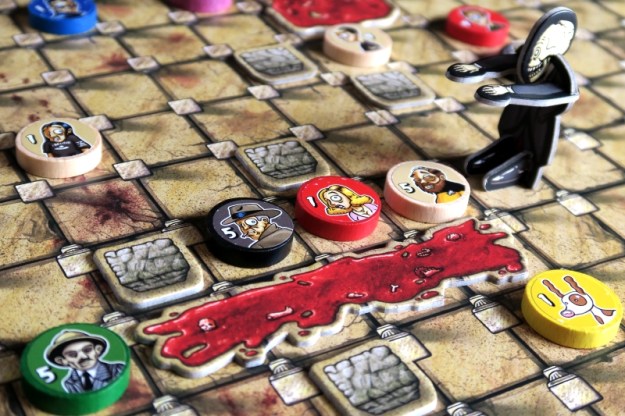
While the first two tables were playing spooky-themed games, Black and Purple led Teal and Cobalt in the monster-mad Finstere Flure (aka Fearsome Floors).  This is a game where players are trying to escape from Fürst Fieso before the castle collapses and without getting eaten.  The idea is very simple: first players move all their pieces the number of spaces shown on their visible side, then the Monster moves.  The Monster moves according to a stack of tiles, either moving a set number or moving until he eats.  The Monster moves one step forwards then looks straight ahead, left and then right. If he sees a player, he turns and moves towards them.

Finstere Flure
– Image by boardGOATS

Thus, the Monster looks, moves, looks, moves until he either runs out of spaces to move, or eats someone.  The game ends after fifteen rounds.  It is simple enough, but there are a few little elements that add to the fun.  Firstly, each player piece moves a total of seven spaces over two turns, but while some alternate three and four space moves, others are more variable, with the most extreme moving six spaces and then one space on the next turn; these different pieces require different tactics.  Players can’t land on another player, if they walk into a rock they push it and if you step in a pool of blood, they slide across it.
Finstere Flure
– Image by boardGOATS

Finally, if the Monster walks into a wall he appears elsewhere on the board adding a further layer of unpredictability.  The game opened with a bang when the first Monster tile revealed was a “Two Kill”, that is to say, the monster keeps moving until he’s eaten twice.  From there, it was carnage.  Everyone had someone eaten, with some multiple times.  There were people who managed to escape from Fürst Fieso, though it wasn’t easy of course.  Everyone managed to get at least one piece out of the castle, with Purple and Cobalt managing to get two pieces out.  The winner, however, was Black who liberated three of his people.

Finstere Flure
– Image by boardGOATS

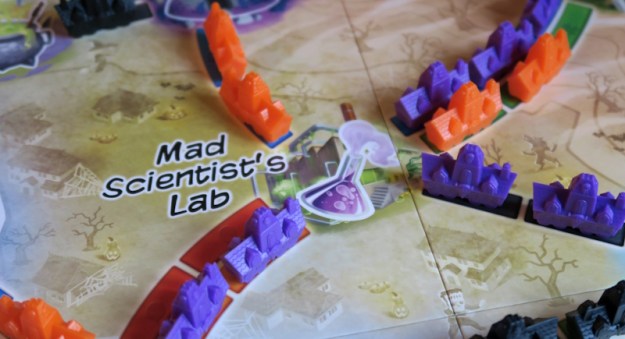
They were the first to finish, so moved on to play the recent release, Ticket to Ride: Ghost Train.  This is really just a variant of First Journey, a simpler version of the group favourite, Ticket to Ride, aimed at children and non-gamers with super-sized pieces.  Like the original game, players take it in turns to either take “two parade float” cards (in this case blind), or pay cards to place trains on the map.  However, instead of scoring points for placing trains, the game is essentially a race game.  Players start with three Tickets and every time they complete one, they draw a replacement.  The winner is the player who completes the most Tickets.
Ticket to Ride: Ghost Train
– Image by boardGOATS

This time, Teal took an early night, but Black, Purple and Cobalt went at it with spooky enthusiasm.  As a different take on the original, they found this a very enjoyable alternative.  As well as Tickets, players can also win “Trick or Treat” bonuses for connecting the Dark Forest region to the Seashore region.  Black and Purple both took a “Trick or Treat” bonus, but the winner was Cobalt who finished with six Tickets, one more than Purple who would have taken another if she’d had just a little more time.  That wasn’t the only Ticket to Ride game of the night however, as the Scooby Gang played a quick game of Ticket to Ride: Berlin once they had solved their mystery.

Ticket to Ride: Ghost Train
– Image by boardGOATS

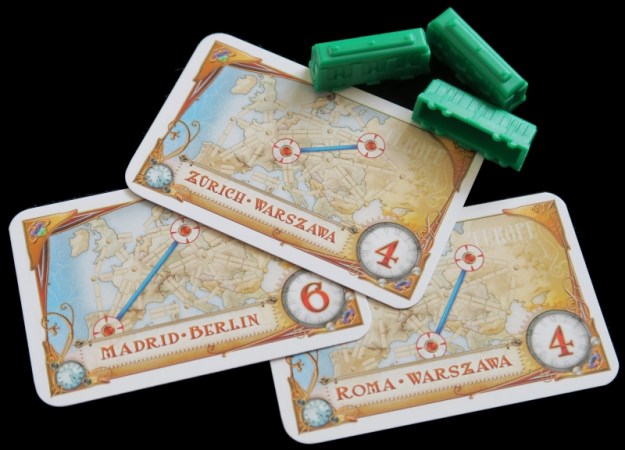
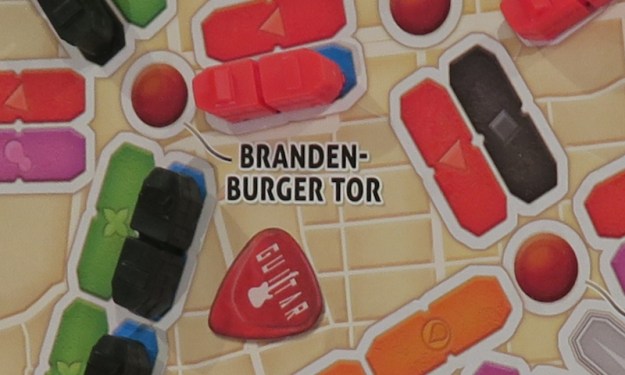
Ticket to Ride: Berlin is one of the mini versions, and there was a little chat about these and which ones people had played.  The first mini version was a “demo” game the publisher used to introduce people to the game at conventions.  Since then, there have been a series of City versions, with New York, London, Amsterdam and San Francisco all featuring and Berlin being the most recent (with Paris to come next year).  These all feature the same basic mechanism as the original game (including the scoring of points for placing trains unlike the First Journey type games), but they have fewer train pieces and a smaller map.  The Berlin map, is long and thin, but the big difference is that players have mixture of Trams and U-Bahn pieces.
Ticket to Ride: Berlin
– Image by boardGOATS

Tram and U-Bahn routes are paid for in similar ways, though only one U-Bahn piece is needed to mark them and they score slightly more points.  Once the differences had been highlighted by Pine and Pink (who played this together a few weeks back), everyone got down to business.  Jade and Sapphire dominated the West while Pink and Pine concentrated on the East, though the geography of the map meant everyone had to include East-West connections in their network.  It was a hard-faught close game with both Jade and Sapphire taking negative points due to incomplete Tickets.  Pine completed five Tickets and Pink finished six.
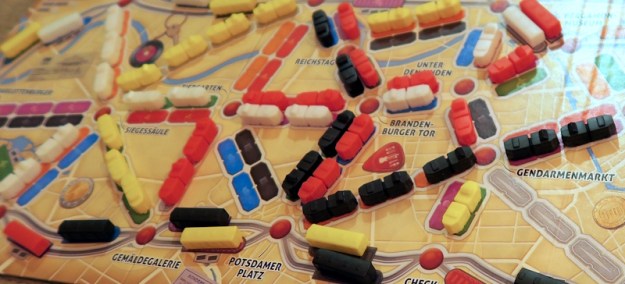
Ticket to Ride: Berlin
– Image by boardGOATS

Pine’s Tickets were more lucrative, however, and he took victory with sixty-one points, while Jade with forty-nine just pipped Pink by two points in the struggle for second place.  Everyone had enjoyed the game, and Jade commented that it was one of his favourite renditions of Ticket to Ride so far—indeed, the addition of a second set of transport seems to have been much more successful in this mini version than it was in the full-sized Rail & Sails where it made it longer and more fiddly without making it significantly better.  While everyone else was playing and then discussing the merits of different versions of Ticket to Ride, the Crafty Trio, Plum, Blue and Byzantium had finished Broom Service and squeezed in a quick game of Dinosaur Drafting with Draftosaurus.
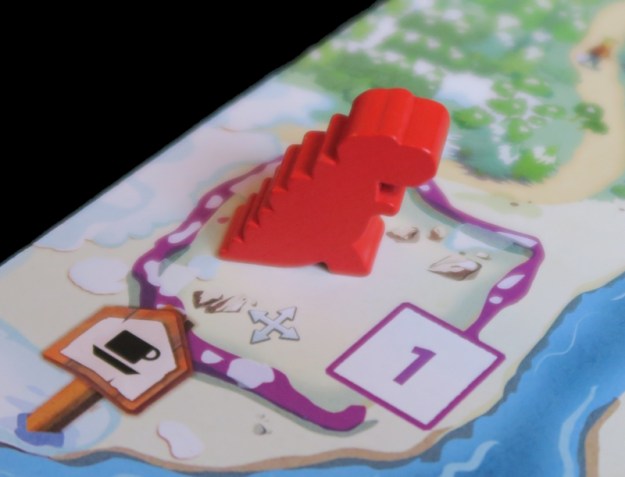
Draftosaurus
– Image by boardGOATS

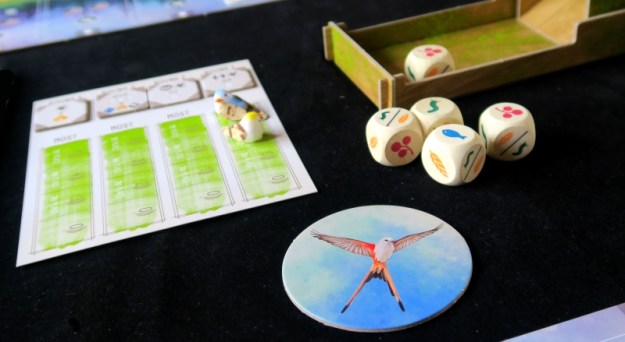
This is a fun little game that we play quite a bit, where players choose one Dinosaur from a handful, add it to their Park and then pass the rest on.  Dino-placement is slightly restricted by the roll of a die, with everyone getting points for how they occupy their pens.  Usually, the group plays with the Summer board, but with the cold weather, the group decided to play with the alternate, Winter board which introduces new and different pens.  These include the Well-Ordered Wood (Dinosaur types must alternate); Lovers’ Bridge (giving six points for each pair of Dinosaurs separated by the bridge); the Lookout (contains one Dinosaur and scores two points for each one of that type in their right neighbour’s pen).
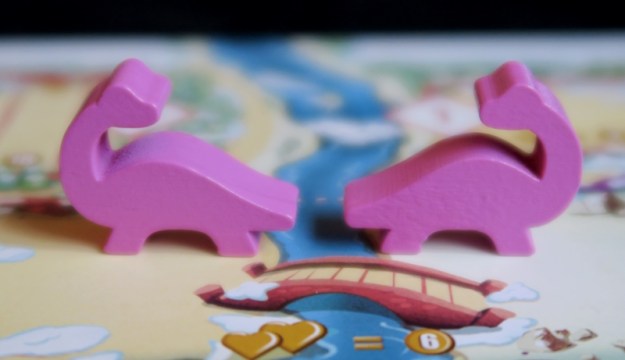
Draftosaurus
– Image by boardGOATS

The most challenging, however is the Pyramid, which holds up to six Dinosaurs in a layered structure, but dinosaurs of the same species may not be placed adjacent to each other (horizontally or vertically).  Blue got into a mess with this, and was stuck with a Dinosaur she could not place at the end as a result.  Plum and Byzantium did slightly better and were able to capitalise more on the Quarantine Zone, which allows players to move the single occupant at the end of the game.  In the end, it was a tight game (though not as tight as Broom Service), in which Plum ran out the victor, three points ahead of Byzantium.
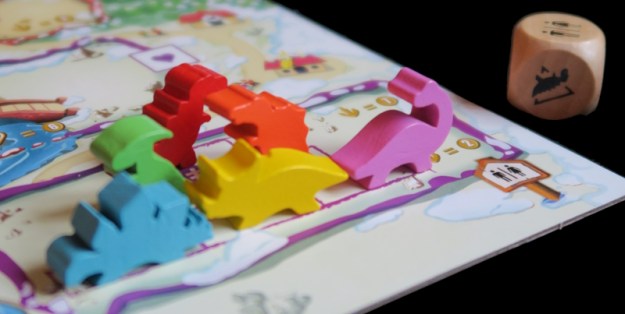
Draftosaurus
– Image by boardGOATS

Learning outcome: They’d have got away with it if it weren’t for those pesky kids!

25th July 2023

After Blue and Pink had sampled the new pizza menu at The Jockey, people started to roll up and join them for the usual chatter.  There were a total of nine, which was one more than  required for the “Feature Game“, the recently announced Kennerspiel des Jahres winner, Challengers!.  This is a deck-building, dueling “capture the flag” game where players battle head-to-head to find the winner.  It is a very light game, with a largely random element, at least on the face of it, so it was always going to be a bit of a “Marmite” game.  Green commented that he wasn’t very interested in it, but as everyone else was quite keen to give something novel a go, he sportingly joined in.

Challengers!
– Image by boardGOATS

The game is very simple, and seems, at first glance to be quite random.  Players start with a hand of cards, and then draw five more and choose a set number to add to their hand.  The clever part is that (with eight players) the game is played over seven rounds, and each round the decks players draw from and/or the number of cards they can keep changes.  There are three decks, A, B and C, and the cards become increasingly powerful as the game progresses.  Once players have fettled their deck, they duel against their designated opponent by drawing the cards from their deck.  In this, one player starts by playing a card and taking the Flag, then the other plays cards until their total equals or exceeds that of their opponent.

Challengers!
– Image by boardGOATS

This initially seems quite random in that players have no agency in this element of the game.  There is a suggested variant that can change this by allowing players to draw two cards and choose one to play—this was an option for later in the game, but in the end, the group stuck to the rules as written.  The game focuses on this duel aspect, but really it is more about building card combinations during the first part of the game and deciding what cards to shed and how many.  Shedding cards is just as important as acquiring cards as, as the winner of a duel is the last player with the flag, so running out of cards can lose a match.

Challengers!
– Image by boardGOATS

Having too many cards can be a problem as well though—when they take the Flag, players move all their cards except the last played to the “Bench”.  The Bench has six seats, and when a card needs a seat and there isn’t one, that player loses.  The winner of the match, the last player with the Flag, then takes a winner’s token which is worth points at the end of the game.  The game is all about the cards which make it less random than it seems at first; some cards have special powers, while others give points.  Additionally, identical cards can share a seat on the Bench, so effectively allow players to have more cards, however, those tend to be weaker cards from the A deck.

Challengers!
– Image by boardGOATS

As such, Challengers! should perhaps be thought of more as a programming game, more in the mold of games like Colt Express, rather than a dueling “capture the flag” game.  After each match, players play musical chairs and after seven rounds (with eight players), the players with the most points duel for overall honours.  Although the idea is very simple, it took a little while for people to get to grips with the procedure.  Blue, who was suffering with the after-effects of a bad cold, acted as much needed umpire and guide, explained the rules and demonstrated how the duel worked using Pink’s hand of cards.

Challengers!
– Image by boardGOATS

Possibly thanks to her fuzzy head, but Pink despite the fact that he was sat in front of her, was onto the second round before Blue realised that something wasn’t right.  Instead of taking his starting hand back after the demo, he had just drawn five blind cards from the A deck, making his hand immensely over-powered.  There were the usual tongue-in-cheek cries of “Cheat!”, but it was a genuine error, albeit one that wasn’t easy to fix by this time.  As a result, the quickest and easiest solution was for him to forfeit the first round and fix his hand before re-starting the second round.

Challengers!
– Image by boardGOATS

One of the nicest aspects of the game was the way everyone played against everyone else.  The GOATS are a nice, friendly group, and although some people end up playing together more often, the group always makes a point of trying to avoid cliques caused by the same people playing together all the time.  The Musical Chairs element of the game meant everyone played against everyone else which gave it a fun, party feel that we usually only experience in October (when we play Crappy Birthday).  It was clear that some people enjoyed it more than others though.  Ivory, Teal and Black, really got to grips with the deck-building element and found the game exceeded their expectations, Ivory in particular really enjoyed it.

Challengers!
– Image by boardGOATS

Lime, Pink, Pine and Purple were a little less enthusiastic, while Green felt it was a clever little game enjoyable for a short while, but that it out-stayed it’s welcome—too long for the game-play within it, he couldn’t wait for it to finish.  It wasn’t much of a surprise, therefore, that Ivory, Teal and Black were the winners of the “Round Robin” tournament phase, finishing with thirty-five, thirty-three and thirty-one points respectively (some way ahead of Lime in fourth with twenty-three).  The play off between Ivory and Teal, therefore, was quite close and tense, but Ivory ran out the eventual winner, largely thanks to his handful of yellow Vendor cards.

Challengers!
– Image by boardGOATS

From there, everyone was keen to play something they were familiar with, but it had to be something quite quick.  Teal suggested SCOUT, which Blue was keen to give another try (having played appallingly last time) and Ivory and Purple were very happy to join them.  This is a very simple, but clever hand management game that was nominated for the Spiel des Jahres award last year.  The theme is almost non-existant (something to do with circus performers), and isn’t even reflected in the card art, which is not unpleasant, but very functional (and therefore useful).  The idea is that players have a hand of cards which, like in Bohnanza, they cannot rearrange.

SCOUT
– Image by boardGOATS

Unlike Bohnanza, on their turn players may play any set of adjacent cards from their hand as long as they beat the current winning set, taking any cards they beat into their scoring pile.  Cards can be a a run of cards with consecutive numbers, or a meld of the same number.  Sets are ranked by size and value and a meld always beats a run of the same size.  Players take it in turns to play, and if they can’t or choose not to “Show” a set of cards that beats the current winning set, they instead “Scout”, taking one of the two cards from either end of the set on the table, adding it to their hand (paying the former owner a point from the supply).

SCOUT
– Image by boardGOATS

And this is where the game gets clever:  all the cards have two values, one for each end, so players can add any cards to their hand anywhere they like and either way up (i.e. making either value active).  In this way, players can manipulate their hand making larger melds or longer runs.  The round ends when either every body “Scouted” in succession, or where one player has run out of cards.  Players then score points for each card in their scoring pile and for each chip for cards taken by “Scouting” with negative points for any cards left in hand.  The first time we played this with the group, it had all been a bit of a voyage of discovery, and last time, Ivory gave everyone a bit of a spanking, so Teal and Blue were keen to prevent that from happening again.

SCOUT
– Image by boardGOATS

Things started off well, with Blue beating Ivory in the first round, though Teal and Purple did less well ending up with a hand of cards.  The second and third rounds went better with everyone taking positive points and it was very close going into the final round leaving it all to play for.  Sadly for everyone else, Ivory brought his A-game to the last round ending the round swiftly leaving Purple and Teal with a hand that more or less off-set their takings and Blue with a positive score, though one with fewer points than Ivory.  The end result wasn’t really very close, though it felt less of a stomping than last time:  Ivory finished with fifty-five points and Blue took second with forty-one, ahead of Purple and Teal who tied for third.

SCOUT
– Image by boardGOATS

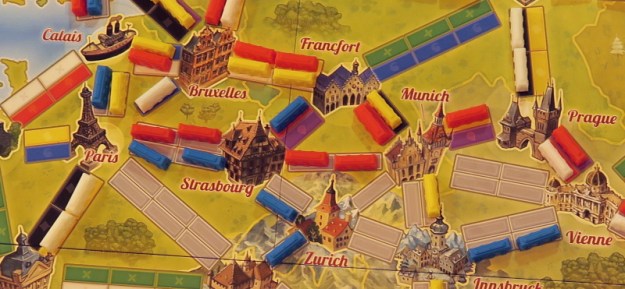
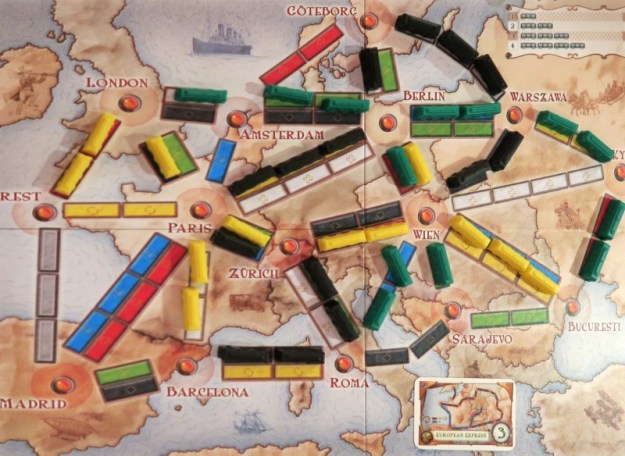
On the next table, Green, Pink, Pine and Black played a close fought enjoyable game of Les Aventuriers du Rail Express, a variant of the Spiel des Jahres winning Ticket to Ride series, but one that is a sort of half-way house between the original full versions of the game and the mini “city” games (like Ticket to Ride: London).  The game only plays four and takes less time, but is quite a nice variant and has a couple of differences to the original, being shorter without losing too much of the main game’s challenge.  As in the original, players can either take two cards from the market (face up cards, or the draw deck), or pay cards to place trains on the board.  Unusually, however, the Locomotive “wild” cards are kept in a single pile and therefore are always available.  This is quite a nice variation, as it means that players never feel forced to take blind cards because what they need isn’t available.

Les Aventuriers du Rail Express
– Image by boardGOATS

This effectively means players are guaranteed to get at least one train card they want.  The other major difference is the presence of the long route ticket.  This is one route that everyone can claim, however the highest scores go to the first to claim it.  It additionally means that failing to complete it does not lead to negative points, so players can ignore it and concentrate on normal short route tickets if they prefer.  There was a moment when the group had three identical coloured cards in the face up market which made them whether they should be scrubbed (as with three Locomotive cards in the base game).  It couldn’t be found in the rules and it was pointed out that in the original games it is possible to have five cards of the same colour, so they stayed and someone eventually found a use for them.

Les Aventuriers du Rail Express
– Image by boardGOATS

Pine took an early point lead which he maintained for quite a while until Green and Pink caught up, and not long after, Black too.  However, as the game neared its conclusion Pine pulled ahead again. Pink had completed the long route already and, at the cost of not being able lay his last two trains, Green decided to get the game finished before anyone else managed it. That long route helped Pink finish in front with sixty-four points, while Black’s slow start demonstrated that getting trains down early is no guarantee of success.  That said, he managed to pull into the station in second place with sixty-one points. Green and Pine fought to not be last and ended up tied just a couple points behind with fifty-nine points.

Ticket to Ride: Europe
– Image by boardGOATS

Learning Outcome:  Winning the Spiel des Jahres award means a game is good, but doesn’t mean it will suit everyone.

24th January 2023

Blue and Pink were first to put in an appearance and availed themselves of the burger offerings at the Jockey before everyone else began to arrive.  Ivory turned up cradling his enormous copy of the Collectors’ Edition of Everdell, complete with its Bellfaire expansion (as well as pretty much everything else available).  And from then on, it was a matter of deciding who was going to play what.  As Ivory began building the Evertree, Green commented that he’d really enjoyed playing it last time and would like to play it again, but wanted to give everyone else the opportunity.  Everyone else similarly followed this gentlemanly gesture, but in the end Ivory took first Teal, then Green and finally Purple to the end of the table and started the mammoth task of unpacking.

Everdell
– Image by boardGOATS

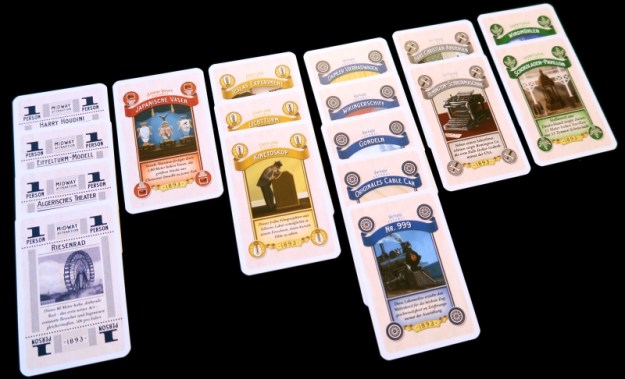
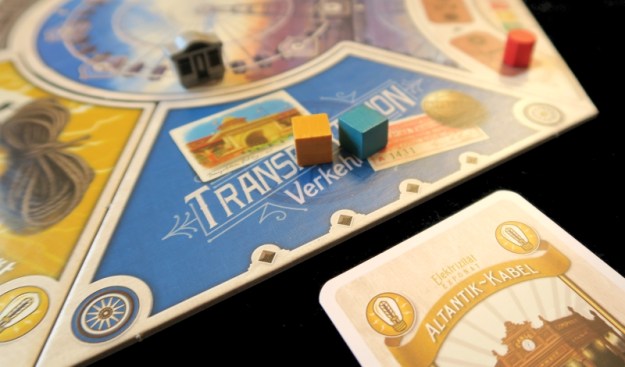
As they began setting up, the other four began deciding what to play.  After suggestions that largely fell on deaf ears, Blue eventually began unpacking World’s Fair 1893.  This is a clever little game that integrates area majority and set collecting mechanics.  The idea is that players choose a segment of the board and place a population marker in it before taking all the cards in that section.  Three cards are then added to the board, with the first added to the section cards have just been taken from and one each added to the next two segments.  Cards come in three types:  Character Cards, Midway Tickets and Exhibit Cards.

World's Fair 1893
– Image by boardGOATS

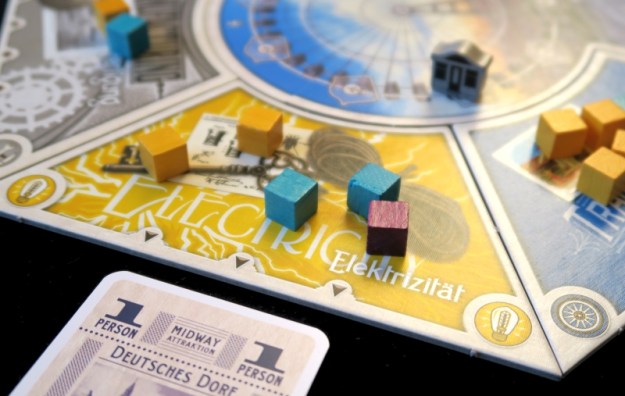
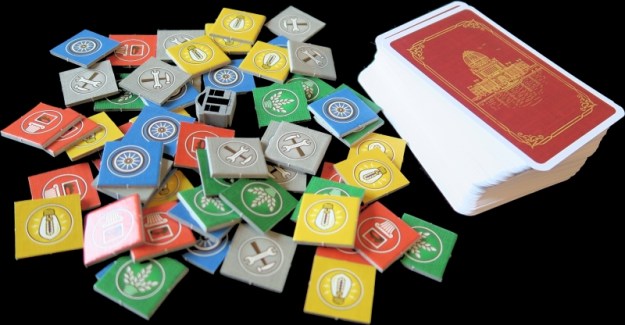
Character cards can be used to move cubes about or add extra cubes and are played by the active player between placing their token and taking the cards from that section.  When the Ferris wheel car has travelled all the way round there is an interim scoring stage.  Midway tickets are exchanged for one point, with the player who has the most earning bonus points.  Exhibit Cards are exchanged for tokens:  each of the five segments of the board are evaluated and the player with the most population tokens gains a couple of bonus points and the opportunity to trade up to three exhibit cards for matching coloured tokens. The player who comes second also gets points and can exchange fewer Exhibit Cards for tokens.

World's Fair 1893
– Image by boardGOATS

The tokens are combined into sets at the end of the game with the larger sets worth more points; sets containing all five different coloured tokens are worth fifteen points, with sets of four worth ten, and three, two and one worth six, three and one point respectively.  Played over the three rounds, the winner is the player with the most points at the end of the game.  Blue didn’t do a great job of explaining the point of tokens, so in the first round, Lime focused on collecting Midway Tickets, lots and lots of Midway Tickets taking lots of points and the bonus too.

World's Fair 1893
– Image by boardGOATS

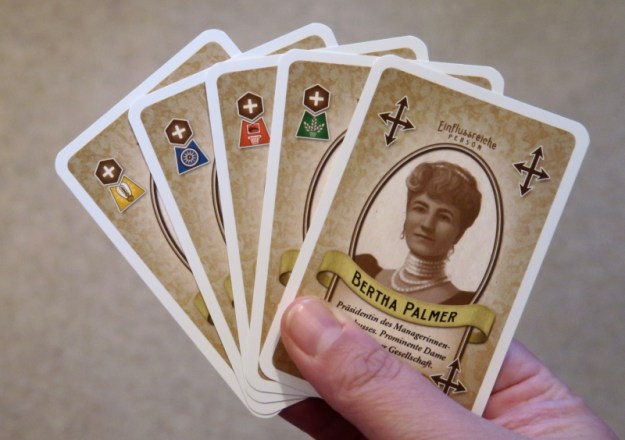
Pink, on the other hand, had played it before and better understood the relationship between Exhibit Cards, Tokens and points at the end of the game.  That said, he seemed to have a bit of a mental block on how to use the his character cards (after placing a population token, but before taking cards).  Bertha Palmer seemed to cause a particular problem and her function had to be explained at least three times before the message got through.  Through the second and third round, Lime continued to collect Midway Tickets while Blue, Pink and Pine tried to manipulate the majorities in the areas for which they wanted tokens for.

World's Fair 1893
– Image by boardGOATS

Lime kept doing well in the green Agricultural region, but was unable to get the cards to match.  This is the catch with the game:  in order to obtain tokens in a specific colour, players need the majority of population markers in that region, but also need to gain Exhibit cards to match, which quite likely are only available from other segments.  Pine commented that he thought this game should be played with ties cancelling each other out like in Las Vegas—funny, that that would have left him in pole position in several key areas that he needed…

World's Fair 1893
– Image by boardGOATS

As the game came to an end, the question was whether anyone would have enough sets of tokens to catch Lime with his huge pile of coins from his Midway Tickets.  It looked like Pink might make it with his two sets of five giving him thirty points, but he fell two points short.  Blue however did slightly better with sets of five, four, three and two and finished with sixty-two points, five more than Lime.  When Pine asked how Pink collected so many tokens, Pink’s response was, “Never underestimate the value of coming second…”

World's Fair 1893
– Image by boardGOATS

Everdell was very much still underway and although time was marching on, there was still time to play something else.  So a decision was made very quickly as Blue got out Les Aventuriers du Rail Express.  “Les Aventuriers du Rail” is the french name for Ticket to Ride, and this “Express” version originally released only in French and Italian, was a “light” version of the game, positioned somewhere between the “City” editions (like New York, London, Amsterdam etc.) and the full sized games.  Thus it plays quicker than the full sized game, but is longer than the City editions, and has a maximum of four players like the smaller games

Ticket to Ride: Switzerland
– Image by boardGOATS

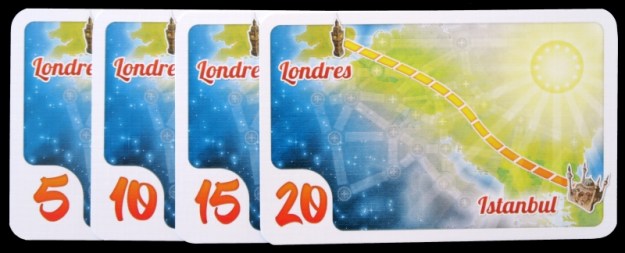
The basic principle of all the games is the same however:  on their turn players either take two coloured carriage cards from the market, pay sets of cards to claim a route and place plastic pieces on the map, or draw tickets giving cities that players need to connect to score points.  Each edition has its own special rules and this one has a shared ticket:  London to Istanbul.  The first player to connect these cities gains twenty points with the second getting fifteen and so on.

Les Aventuriers du Rail Express
– Image by boardGOATS

Additionally, instead of Locomotive (Wild) Cards being included in the Carriage Card market, they are always available from a separate face up deck with players taking one card on their turn instead of two).  It didn’t take long before the group had checked they had the right number of trains and had identified the special rules for this version of the game.  Blue went first, but Pine was the first to place trains on the map, at which point everyone else realised they were going to have to go hard and fast to compete.

Ticket to Ride: Europe
– Image by boardGOATS

Blue also placed an early train, but Pink opted for the “expert strategy” espoused by Black, to pick up tickets early.  The idea is that knowing the destinations you need to connect early is an advantage, but this is offset of course, by the fact that it gives everyone else an extra turn to claim some of the routes you might need.  This time, unbeknownst to the others, Pink got lucky with long overlapping routes and, as a result picked up another batch of tickets.  Pine tried to follow the ticket strategy, but got less lucky.

Les Aventuriers du Rail Express
– Image by boardGOATS

Blue thought the London to Istanbul ticket was quite a good option as it was almost zero risk since it wouldn’t cost her if she failed to complete it, it was also relatively complementary to her starting tickets.  This strategy meant she had to go through the middle of Europe and, as a result, got caught up in the three-way punch-up with Lime and Pine centred on Strasbourg.  Pine came off worst, but unquestionably, Pink came off best as he eschewed central Europe, instead focusing on taking the route to Warsaw via Berlin which also included two slightly more lucrative five car connections.

Les Aventuriers du Rail Express
– Image by boardGOATS

Blue claimed the London to Istanbul route first and with it twenty points, followed by Lime who had completely forgotten about it in his tussle to make his other tickets.  Blue was then left with a choice:  pick up tickets or try to end the game quickly.  Knowing Pink and Pine in particular had a lot of tickets to complete and with plastic trains beginning to run low, she opted for the latter.  Unfortunately for her, Pink had already nearly finished his tickets and was able to complete his last one on his final turn.  That just left the scoring, and it wasn’t really close with Pink finishing with eighty-two and Blue the best of the rest some fifteen points behind.

Les Aventuriers du Rail Express
– Image by boardGOATS

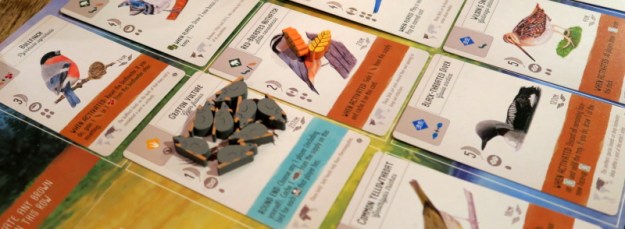
On the next table, Ivory, Green, Teal and Purple played the “Feature Game“, the Bellfaire expansion to Everdell, the winner of the Golden GOAT just before Christmas.  Everdell is a fairly simple game in principle, with players either placing a worker to collect resources or then using the resources to pay to play cards from their hand into their tableau.  The game is very smooth to play, well balanced and has beautiful artwork.  One of the things that makes it different to many other games is that when a player runs out of actions (or earlier if they choose), they can end their season and reclaim all workers and start again.  This is important because some of the action spaces can only be occupied by one critter at any one time.

Everdell
– Image by boardGOATS

The cards come in different types, but one of the key aspects is that critter cards can be played by paying their cost or as a bonus for playing the associated construction card.  For example, if a player builds a Courthouse, they can play the Judge at the same time if they have it in their hand.  Cards give players special powers, extra resources, actions and points at the end of the game.  Each player’s tableau can only hold a maximum of fifteen cards; when a player cannot perform any more actions (or does not wish to) they pass and their tableau is completed.  Everyone else carries on playing and the game continues until everyone has passed with the winner being the player with the most points.

Everdell
– Image by boardGOATS

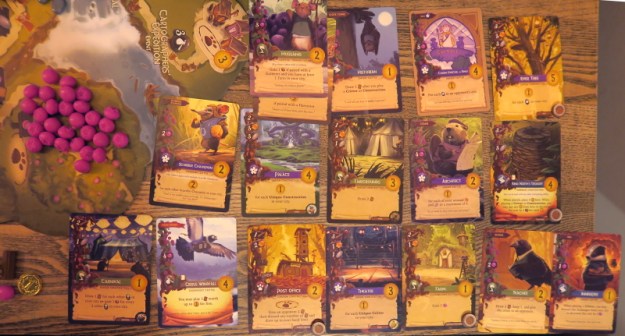
The Bellfaire expansion adds a little bit of variety to the game, in particular the Market, a Bonus for one of each card category, and a randomly selected Beauty Bonus for the most purple flower cards.  The group also included the Extra! Extra! and Legends cards with the Corrin Evertail cards (from the Mistwood expansion).  One of the joys of Everdell is selecting playing pieces. With sixteen different creature meeples to choose from there is something for everyone.  Ivory  was quick to nab the purple coloured Platypus, Teal selected grey Hedgehogs, Purple chose red Squirrels and Green wanted the green Lizards.

Everdell
– Image by boardGOATS

On pulling out all the Lizards from the Box, Green declared that one of his meeples was disabled. It was missing the bottom half, its legs and its tail, poor thing!  To give this one an easy ride green selected it for later use as part of the Autumn cache.  As expected Ivory got off to a flying start.  While Purple was the first to leave winter and head into spring, Green and Teal were not far behind. Ivory, however, seemed to be able to keep going in Winter for many turns after everyone else had left.  He had been quite lucky with the card draw and was able to pair critters with his buildings to a much greater extent than everyone else.

Everdell
– Image by boardGOATS

Teal noticed that Ivory had completed all the card categories and could claim the bonus tile, but he kept quiet and instead was the first to claim a bonus tile: for having three forest tags.  A short while later Green also noticed that Ivory could claim the bonus, but he, perhaps due to silliness or perhaps innate honesty, did not keep quiet.  Ivory had not noticed, so promptly claimed it on his next turn.  No-one else was able to fulfill that requirement for quite some turns.

Everdell: Bellfaire
– Image by boardGOATS

The Bellfaire Market allows players to choose to either gain resources, or to trade them.  When gaining resources, players choose one token, gain the resources and cards, then move that token to the “trade” side of the market.  When trading, players pay resources and discard cards to gain three points and any two resources, before moving the token back to the “gain” side.  This time, players used the market to collect initial resources, but once they had all been used, no-one seemed to show much interest in trading to bring them back into play.  Trading did happen a couple of times later in the game, but no-one could really see the benefit of the trading versus collecting resources outright, especially since two of the randomly drawn extra forest spaces included the ability to trade cards or wood for “any” resource.

Everdell
– Image by boardGOATS

The pattern of Purple going into the next season first and Ivory going last remained all the way through Spring and Summer.  Ivory did slow down somewhat though, and did not enter Autumn much later than Teal and Green.  By this time, most the group had managed to play at least one of their Legends cards and were beginning to use them to good effect.  Green’s Ranger Strey Softpaw which enabled him to use two already used forest action spaces for one worker was generally remarked as a very useful legend card.  Maybe that was how he was able to catch up a little, but one of the key challenges he struggled with was being able to get the Critter and Construction pairs.

Everdell
– Image by boardGOATS

Once Autumn came round, it was time for the poor disabled lizard to play a part on Green’s behalf.  That part was, to cries of being cruel, to go straight to the Cemetery so he could select a card to play for free—unfortunate critter!  Although Ivory kept going longer than anyone, he already had all fifteen cards played, and found himself unable to do much else, even though he still had workers left.  Purple finished early with a similar problem, although she was unable to afford any more cards even with gathering from her last worker.

Everdell
– Image by boardGOATS

Eventually, everyone finished their final season and in the final scoring, Ivory scored big on the card totals.  Green did quite well and finished a few points ahead of Teal, though Purple suffered as she had not been able to play as many cards.  Ivory also scored well on other bonuses and Teal and Green were similarly matched with several bonuses, except that Teal managed to accrue more coins and score Journey points.  As a result, Teal took second, though Ivory was way ahead of everyone else.

Everdell
– Image by boardGOATS

Learning outcome:  We’ll have to brush up the Everdell skills if we ever want a chance of beating Ivory in future.

10th January 2023

One of the first to arrive was Yellow, and it was delightful to see him after such a long time.  He was especially welcome as he was bringing a copy of Paris that he’d been looking after since UK Games Expo in August 2021.  Before long though, there were eight all ready and lined up to play the “Feature Game“, Long Shot: The Dice Game, when two more arrived and a debate began to work out who would play what and where.  As Long Shot was supposed to be quite short, eventually, Plum, Pine, Purple and Lime took themselves off to play Ticket to Ride: London, with Blue, Green, Yellow, Black, Ivory and Teal sticking around to play Long Shot:  The Dice Game.

Long Shot: The Dice Game
– Image by boardGOATS

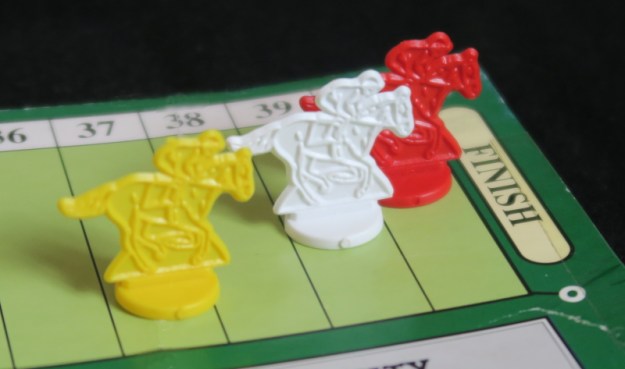
Based on the party game Long Shot, Long Shot: The Dice Game is a light horse racing and betting game in a similar mould to that of Turf Horse Racing, that featured on several people’s lists of top games from 2022.  As it is relatively quick to play, the idea was that it would leave plenty of time to play some of our other old favourites and Ticket to Ride: London was thought to be a good match in terms of length.  Inevitably, that was not quite how things turned out, however.  Long Shot (Dice) is quite simple, and Blue, assisted by Green, was explaining the necessary to the runners and riders.  Ticket to Ride is well known within the group though and was therefore quicker to get started.

Long Shot: The Dice Game
– Image by boardGOATS

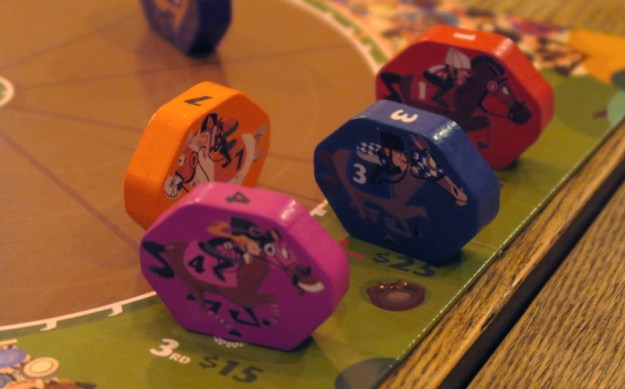
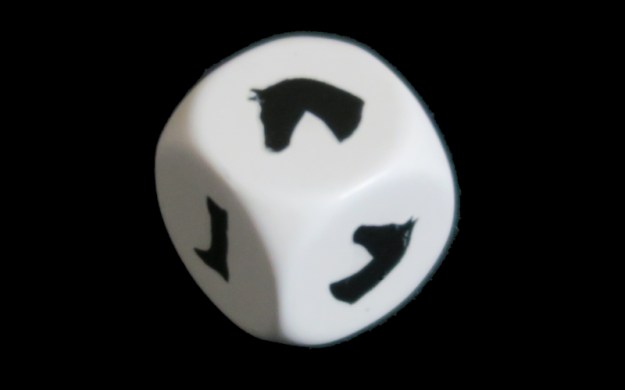
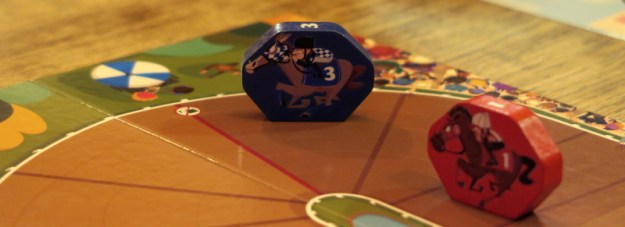
The idea of Long Shot (Dice) is that the active player rolls two dice which dictate which horse moves and how far (one to three spaces).  Everyone (including the active player) then chooses an action from their card, carries it out and crosses it off.  The actions include:  placing bets, buying a horse, buying a riding cap, buying a riding jersey, crossing a horse off the concession chart to get a bonus action once a row or column has been completed.  In general, the action depends on the horse that has been rolled, i.e. if horse number two is rolled, players can bet on that horse, buy that horse, get a cap or jersey for that horse’s rider or cross that horse off the concession grid.  However, each player has three “wilds” which are opportunities to choose any horse.

Long Shot: The Dice Game
– Image by boardGOATS

At the end of the game, players score if they own or bet on a horse that is placed and for any cap/jersey combo for the same horse.  This time, Green started and rolled the blue horse number three which moved three spaces.  As did Teal.  By the time it had moved on three out of four opportunities (and a total of nine spaces), it was starting to look like the dice were loaded and this did not appeal to everyone’s sense of fair play.  The group more or less divided into those that wanted the blue horse wearing number three to win (because they had invested in it) and those who didn’t and preferred the red number one horse.

Long Shot: The Dice Game
– Image by boardGOATS

As Ticket to Ride progressed, the route planners asked how the race was going, and the gamblers, felt it would not be long, given the progress the blue number three horse had made and the lead it had built up.  After its early spurt, a few other horses managed to start to make a bit of ground and, with players starting fill out their bonus grid, players began to take bonus actions which leveled the course somewhat.  The bonuses included taking a free $7 (quite a lot of money in this game); a free $3 bet; free riding cap/jersey, but by far the most interesting were the options to move horses.

Long Shot: The Dice Game
– Image by boardGOATS

Each player has the following four bonuses:  they can move one horse three spaces (once forwards and once back) and they can move two horses two spaces (also both forwards once and both backwards once).  It was as the blue number three horse approached the three-quarters mark (after which players could no longer bet on it) that players showed their allegiance, moving it forwards, or backwards.  And with six players, everyone had potentially several bites of the cherry.  Just as it seemed that one horse had an unassailable lead, one or two players would upset the apple cart and push the leader back and something else forward.  Even the the three-legged purple number eight horse looked like it might be in with a chance of placing at one point (albeit not for long).

Long Shot: The Dice Game
– Image by boardGOATS

Ticket to Ride made more rapid progress.  Although Purple succeeded in completing one of her tickets (for three points), she failed to finish her other two.  That cost her ten points (effectively twenty, which is what she’d have got if she’d completed them), and she blamed Lime.  Lime had troubles of his own though as he was in a very tight battle with Pine.  Perhaps it was his comeuppance for the trouble he’d caused Purple (real or only perceived), but Pine pipped him to victory by a single point, gained when he completed one of the single carriage routes in the centre of the board in the dying moments of the game.

Ticket to Ride: London
– Image by boardGOATS

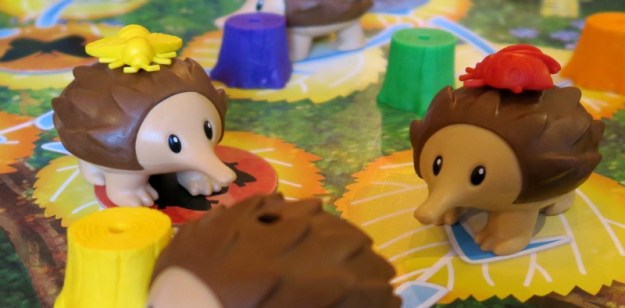
It became a bit of a running joke that the Purple/Plum/Pine/Lime group playing with their train-set asked how things were doing when they finished, and again as they packed away, and again after they’d been to the bar, and again after they’d consumed their drinks and been to the bar again, and each time were told that it was nearly done.  Eventually, Purple, Lime and Pine resorted to playing Love Letter to kill time, winning one round each.  Although Long Shot (Dice) was great fun and everyone was quite amused by the shuffling of horses backwards and forwards, Pine had a point when he commented that when gamers play a light silly game they can play it to destruction—a bit like Echidna Shuffle, which we all adored though it outstayed its welcome when one game lasted two hours!

Echidna Shuffle
– Image by boardGOATS

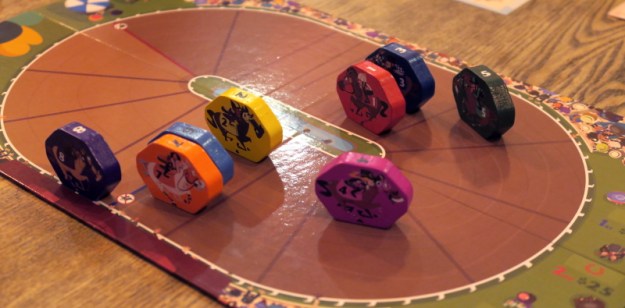
As players ran out of bonuses, the Long Shot horses ran out of track, and eventually, the red horse number one crossed the line, followed by the blue horse number three and finally, the pink horse number four.  Unlike in Downforce for example, however, although winning the race is useful, the betting has much, much more of an influence on the final result.  For example, the two horses Ivory had bet on, numbers five and six, didn’t come in making a severe dent in his score.  In spite of this, it was quite close—Green and Yellow tied for third  with $109 while Teal took second place with $114.  Blue claimed victory though, finishing with $122.

Long Shot: The Dice Game
– Image by boardGOATS

It was only when Green and Pine pointed out that Teal hadn’t scored his horse which gave him $2 per horse he had a bet on, and in his case, an extra $12.  Recalculating his final score, much to her chagrin, Teal just pipped Blue to victory.  From there it was simply a case of tidying up and working out what people wanted to play next.  Ivory had suggested Roll for the Galaxy at the start of the evening and there were lots of takers now, so he went off to set up with Teal, Green and Plum.  Although Teal had played Race for the Galaxy online, Roll for the Galaxy was new to him so the group started with a quick rundown of the rules.

Roll for the Galaxy
– Image by boardGOATS

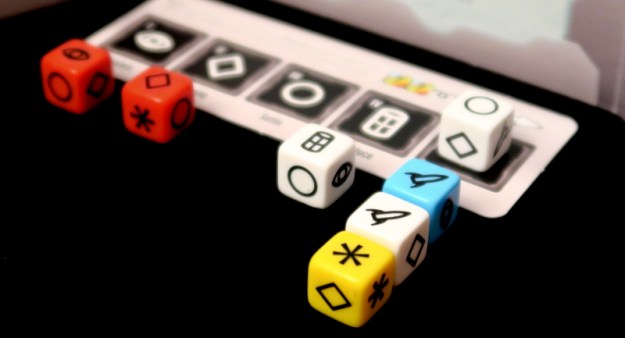
The idea is that everyone starts with a couple of “Worlds” and some dice representing their population.  Players roll their dice with the faces dictating different actions.  In secret, players allocate their dice to the five different phases: Explore, Develop, Settle, Produce and Ship.  Players choose one phase that they want to happen then everyone simultaneously reveals their choices.  All the phases selected will happen, with dice that players have allocated to other phases returned to their cup and recycled.  The game is a combination of “engine builder” and “population builder” (similar to games like Orléans), with players needing the right combination of Worlds to provide their engine, and then building the right combination of dice to make them work effectively.

Roll for the Galaxy
– Image by boardGOATS

With the lighting being less than perfect, some of the dice colours were a little difficult to distinguish, particularly purple and brown.  Plum came to the rescue though, with her new Christmas present:  a portable folding lamp.  The magic of the LED gave a good strong light, enough for everyone without taking up too much room on the table.  Everyone was very impressed and many rapidly came round to the idea that it was a must have gamers’ accessory!  After a faltering start for a couple of turns, Teal soon got the hang of how to select actions and where the dice should go.

Roll for the Galaxy
– Image by boardGOATS

The first clarification needed was that players can only choose one action (though everyone’s choice will be activated), and the second was that the die used to select that action does not need to show a face that matches it. The rest of Teal’s game was one of learning:  with his mining industry, he was able to ship goods for victory points while still gaining some credits, and gained a couple of useful purple die. Unfortunately being new to the game meant he was unable to mount a serious challenge for victory points.  Plum, on the other hand, started out with a couple of red military dice and managed to obtain one more during the game along with the New Galactic Order tile which gave her a couple of extra points for those red dice.

Roll for the Galaxy
– Image by boardGOATS

Plum also made good use of her Terraforming Robots which gave her an extra credit for each World she built and two extra if it was a brown world. She managed to get three brown Worlds.  Ivory also managed to obtain the useful purple die, but his real bonus was from the Alien research ship which gave him a white and a yellow explore action whenever it was chosen.  This meant he was able to keep his credits topped up and have plenty of new tiles on the go without the expenditure of a die. As a result he was able to concentrate on building worlds and shipping/trading.

Roll for the Galaxy
– Image by boardGOATS

Green, meanwhile, quietly built his tableaux concentrating on blue worlds due to his Consumer Market which gave him an extra credit if at the end of the produce round he had  goods on a blue world. He also obtained a green and a yellow world. His Galactic Recycler meant he gained a credit every time he managed to complete a tile. He was the first and only player to build all twelve tiles which gave him the largest score for Worlds. Combined with his Free Trade Association he scored extra points for his three blue worlds and with the victory points he’d collected along the way he finished with forty-four points and a healthy lead, ahead of Ivory’s thirty-eight, just ahead of Plum thanks to his two yellow and two green worlds.

Roll for the Galaxy
– Image by boardGOATS

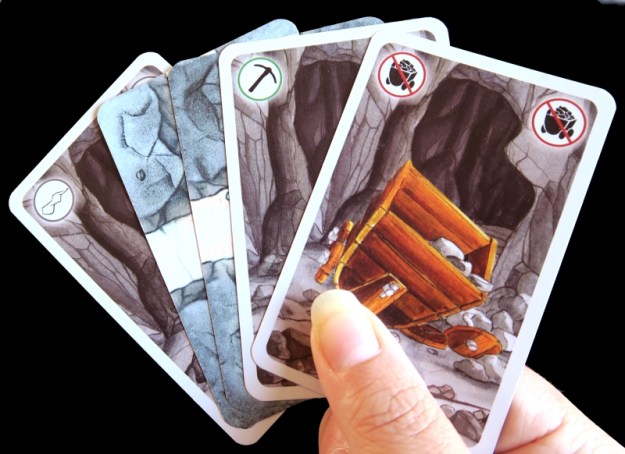
Meanwhile, at Purple’s request, everyone else was playing Saboteur.  This is a hidden traitor game where players take it in turns to either place tunnel cards or to play action cards.  The Good Dwarves are trying to find gold, while the Evil Saboteurs are trying to obstruct them.  In the rules as written, the game is played over several rounds with gold handed out at the end of each round.  The way the gold is distributed doesn’t really necessarily reflect the player who made the biggest contribution, so we play with the “House Rule” that each round is treated as an individual game, then we can play as many “games” as we like and/or time allows.

Saboteur
– Image by boardGOATS

This time, the group played three games.  The first one began with lots of people suspiciously checking and double-checking where the treasure was buried by playing map cards.  Purple was accused of being an Evil Saboteur, quickly followed by Black, Lime and Blue, all of which made no sense as there could only be a maximum of two.  In the end apologies were required when Pine found the gold and Blue and Purple were revealed as the Actual Saboteurs.  The second round followed a similar pattern, only this time pretty much everyone was accused of “Saboteury behaviour”.

Saboteur
– Image by boardGOATS

This time there was a Solitary Saboteur, which meant poor black had a really uphill battle and had really lost before he’d begun.  Once again, Pine was the Dwarf that found the gold, with Lime setting him up.  In the final round, things went a little differently though, particularly when Pine’s dubious behaviour signaled that he might not be trying to find the gold this time.  When Blue distracted the Dwarves by causing a massive rock-fall, it was up to Lime to try and patch the tunnel.  Things had just settled when Blue played another rock-fall and Lime patched that too.  When Blue brought down a third and fourth tunnel collapse, Lime was able to patch them too.

Saboteur
– Image by boardGOATS

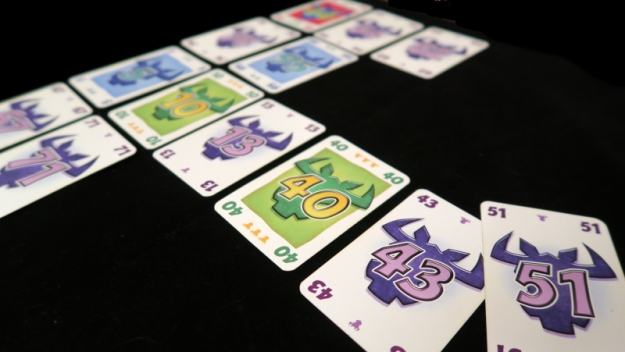
It took so much effort though, that when Pine pushed the tunnel past the gold card, although it only needed a couple of extra tunnel segments, the Dwarves couldn’t make it giving a rare victory for the Saboteurs.  As Roll for the Galaxy was still going and there was a little time left till last orders, there was just time for a quick game of 6 Nimmt!, an old favourite. Blue commented that the name was one of the infamous German joke game titles, and Yellow added that “Nimmt” was the imperative of the German verb, nehmen, to take, thus when the sixth card is played on a row, that player takes the other cards.  The player with the fewest bulls heads wins.  We’ve played it quite a bit recently with the professional variant where cards can be added to the low or high end of the rows.

6 Nimmt!
– Image by boardGOATS

This time, however, as time was pressing the group decided to stick with the simple maths.  We play over two rounds with half the deck in each.  Lime had a complete nightmare in the first round, with twenty-seven “nimmts” in the first round; Pine in contrast managed a clean sheet and Black only picked up two points, so it was all to play for, for some at least.  Lime did much better in his second round giving him a total of thirty-three, only slightly more than Yellow, while Blue managed nearly that in the second round alone, top-scoring with a nice round fifty.  Black picked up just five, but there wasn’t much anyone could do to compete with Pine, who picked up just one solitary point in the second round, his only one in the whole game.

6 Nimmt!
– Image by boardGOATS

Learning Outcome:  Betting can be a mugs game.

20th September 2022

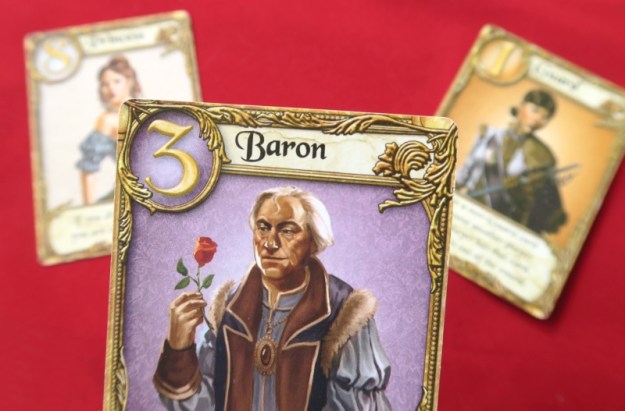
Blue and Pink were the first to arrive to the news that The Jockey was under new management.  Pine soon followed and after a bit of chatter, the three of them settled down to the first “Royal Themed” game, Love Letter.  This is a very quick little game played with a deck of just sixteen cards.  The idea is that players have a hand of one card and, on their turn draw a second and choose which one to play.  The cards each have a special action and a number—the actions allow players to eliminate each other and the player with the highest number at the end is the winner.

Love Letter
– Image by boardGOATS

Powerful cards can lead to early gains, but are risky as they make players targets, however, relying on weaker cards for too long will give a guaranteed loss.  This time, Pink was taken out twice in consecutive rounds by Guard cards with Pine and Blue sharing the spoils.  In the third round, it was down to Blue and Pine again and Pine ran out the winner.  Although with three players the winner is usually the first to win five rounds, as Green and Lilac arrived with Orange and Lemon, the trio called it a halt there.

Love Letter
– Image by boardGOATS

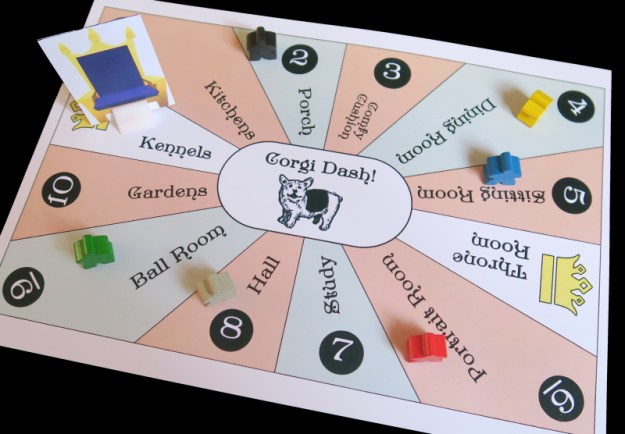
Ivory, Black and Purple turned up as well and as they arrived, everyone remarked on the new smart table decor.  We were only waiting for Lime, but when Pine suggested he might not be coming, his text enquiry was met with the response, “OMG, it’s Tuesday not Monday, will be there in twenty minutes!”  So, while the group were waiting, they decided to start with the “Feature Game“.  To mark the passing of Her Majesty Queen Elizabeth II, this was Corgi Dash, a re-theme of the 1986 Spiel des Jahres winner Heimlich & Co..  Corgi Dash was published as a “Jubilee Souvenir” earlier this year, by Tony Boydell; although we had a copy picked up at the UK Games Expo, as it was a special occasion we had enlarged the board to make it easier to play in a large group.

Corgi Dash
– Image by boardGOATS

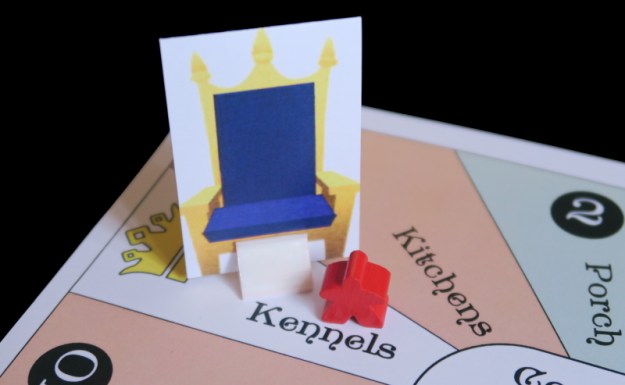
The game is very simple:  on their turn, players roll a die and distribute the pips amongst the “corgis” to move them round the board.  When one of the corgis reaches the throne (either in the Throne Room or the Kennels), each dog scores with the one that triggered the scoring getting nothing.  The Throne then moves to the next location, and the corgis continue to dash towards the Throne.  Each player secretly “owns” one of the dogs and after one dog reaches a score of thirty, everyone secretly guesses which dog belongs to which player.  The game ends when one dog reaches forty points.  Players then score for their dog and receive five additional points for each identity they guessed correctly.

Corgi Dash
– Image by boardGOATS

Blue, Pink, Ivory, Purple and Pine got going first.  In their game, the blue dog (well, meeple actually) got picked on early which marked it out as the dog with no owner.  Unfortunately, the blue dog turned out to belong to Pine and it was the grey dog who had no owner, which became more apparent towards the end when everyone concentrated on their own hounds.  The black dog was the first to get to thirty and then the only one to get to forty too.  Ivory was the only one to guess more than one owner correctly, but it didn’t make any difference as the black dog’s score was twenty more than any other, making it’s owner, Pink, the clear winner.

Corgi Dash
– Image by boardGOATS

On the neighbouring table, Green (who had played Heimlich & Co. a very long time ago, explained the rules to Lilac, Orange, Lemon and Purple. They finished their game early, guessing after two scoring rounds and scoring after the third.  Green’s dog did by far the best picking up thirty-two points, twelve more than any other hound.  Orange did exceptionally well at guessing who had each dog, getting three right, but it wasn’t quite enough to take the lead and he finished two points behind Green, both some way clear of the field with Lemon a distant third.

Corgi Dash
– Image by boardGOATS

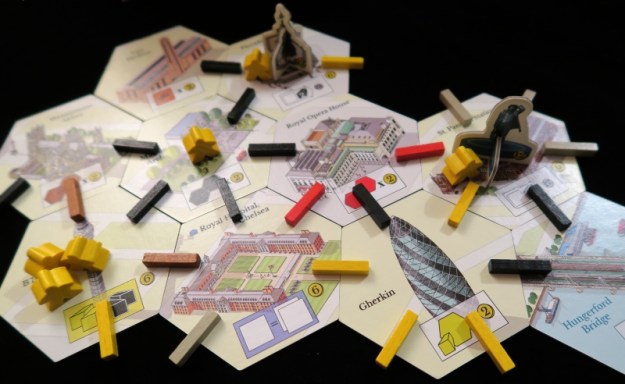
Corgi Dash was very quick to play leaving plenty of time for other games.  With all the happenings around Buckingham Palace and Westminster over the last week, “London themed” games seemed appropriate, so while everyone else played Ticket to Ride: London, Ivory, Blue and Lime took themselves off to the other side of the room to squeeze in a game of Key to the City: London.  This is a reimplementation of one of Blue’s favourite games, Keyflower.  Lime, however, had not played either game, so Blue and Ivory had to explain the rules first.

Key to the City - London
– Image by boardGOATS

Like Keyflower, Key to the City: London is based on an a series of tile auctions where players bid with meeples.  The rules for bidding are simple:  players can bid on any tile, but if there is already a bid, they must follow with the same colour and increase the value.  In addition to bidding for tiles, players can also activate a tile in their Borough, a tile in someone else’s Borough or even a tile that is currently up for auction.  Again though, players must follow colour if the tile has already been activated or has an active bid, further, every time it is activated it costs one additional meeple.

Key to the City - London
– Image by boardGOATS

At the end of each round, all meeples in winning bids return to the bank and players take any tiles they’ve won and add them to their Borough.  All meeples on tiles in a player’s Borough go back to that player, and any meeples used to activate tiles up for auction go to the winner of the tile.  Tiles are worth points at the end of the game.  Some are just worth points out-right while others are dependent on tiles they are connected to and all are worth more if they are upgraded.  Connections are acquired by activating specific tiles; tiles are also upgraded by activating them and paying any associated cost.

Key to the City - London
– Image by boardGOATS

The winner is the player with the most points at the end of the game.  While the mechanics of the game are fairly straight forward, like Keyflower the art of the game is combining them to score well.  The Connections are the main difference between Key to the City and Keyflower, but there are several other smaller differences like the round endings, for example.  In Keyflower, players bid for boat tiles which dictate how many meeples they get at the end of each round, but in Key to the City, when players choose to end their round place their boat in a position on the river.  The earlier a player “checks out”, the earlier they can place their boat and the more meeples they can get—and meeples are scarce, very scarce, in both games.

Key to the City - London
– Image by boardGOATS

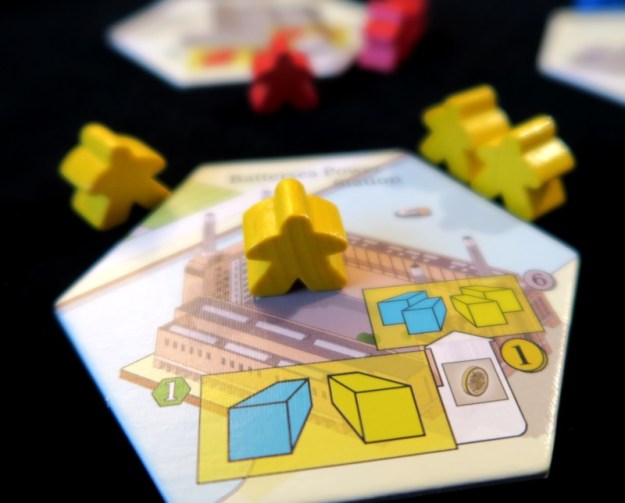
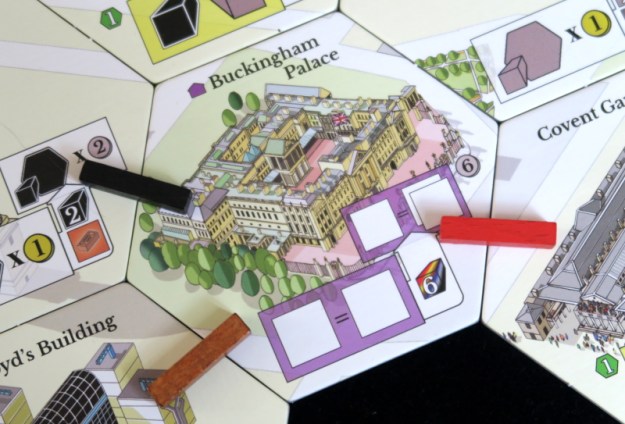
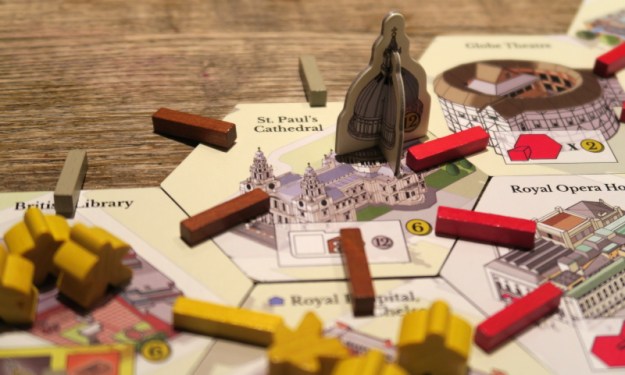
This time, Ivory with the Buckingham Palace player screen and start tile, went first.  He began by winning Paddington Station which gave him telecoms (black) and electricity (grey) cable connections.  He went on to couple this with St. Pancras, Kings Cross and the Royal Academy which gave points when connected with electricity cables and Marble Arch and Monument which gave points for telecoms cable connections.  Lime understood the fundamentals, but was struggling with how to fit them into the game, so when he picked up Battersea Power Station which provided water (blue) and gas (yellow) pipe connections, he was encouraged to pick up the London Eye and Canary Wharf to go with it which ultimately proved good choices.

Key to the City - London
– Image by boardGOATS

Blue lost out in a couple of early bidding wars, so ended up with the Barbican instead, giving her underground tunnels (red) and waste pipe (brown) connectors and later Charing Cross (more underground tunnels and grey electricity cables).  Maybe she’s spent too long with Pink, but she mostly chose to eschew sewage pipes and electricity pylons, instead focusing on trains, using them to make connections with the Royal Opera and the Globe Theatre.  Unfortunately, there was a little “rules malfunction” in the early part of the game with a misunderstanding of one of the scoring icons.  Instead of players scoring for connectors of the colour indicated connected directly or indirectly to a tile, players should only score for each tile connected to the scoring tile.

Key to the City - London
– Image by boardGOATS

The “rules malfunction” was spotted quite early, so although it added a little to Lime’s confusion, everyone had enough time to correct things before scoring took effect.  In the final round, Ivory bid for the Natural History Museum which gave him points for monuments, and London Zoo giving him two points for each blue meeple he was left with at the end of the game.  He then activated a few last tiles and set sail.  Lime engaged in making lots of utilities connections, and bid for the British Museum and the Royal Festival Hall (giving two points for each tile won in the final round and three points for each tile connected by all six utilities respectively).

Key to the City - London
– Image by boardGOATS

Blue took the V & A Museum (giving points for sets of skills tiles) and the Science Museum (giving points for tiles with six connections).  Then she made a mistake:  with Ivory out and Lime running low on meeples, she had the opportunity to either out bid Ivory for London Zoo, or compete with Lime for the British Museum and in a fit of stupidity went for the latter.  Blue’s error might have proved critical though as winning the zoo would not only have given her twelve points, but also taken twelve from Ivory.  As it was, in the final count, Ivory took victory with a hundred and seventeen to Blue’s ninety-six and Lime’s seventy-eight.

Key to the City - London
– Image by boardGOATS

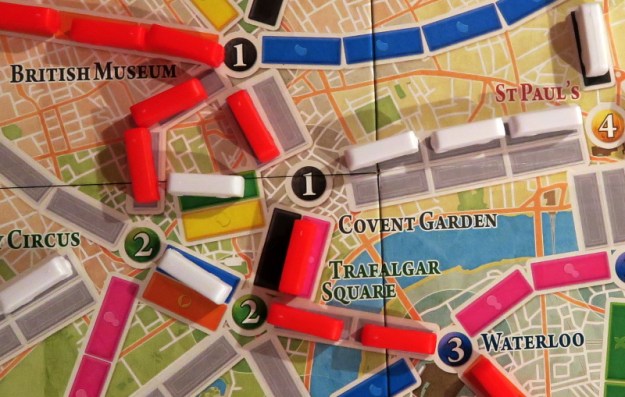
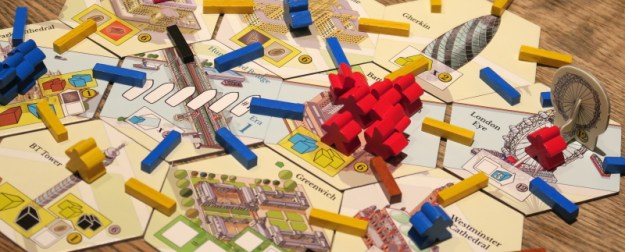
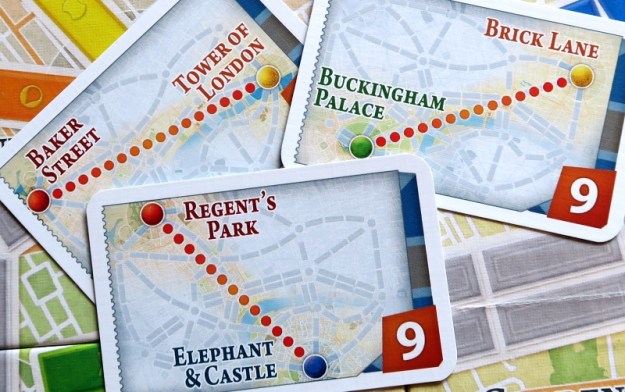
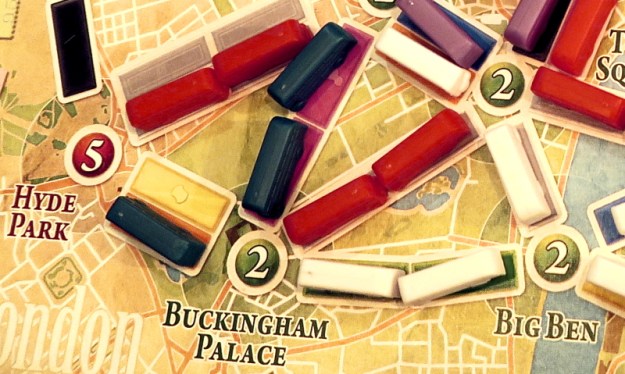
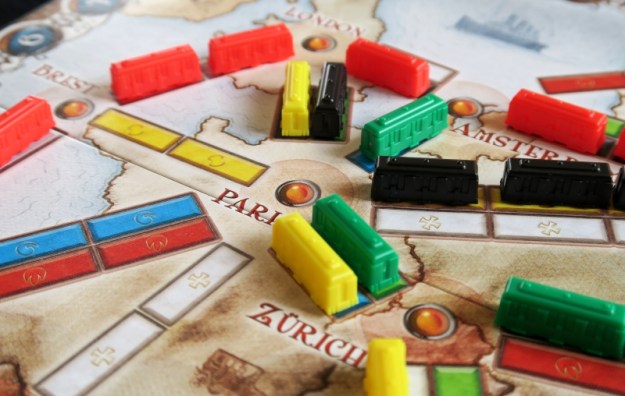
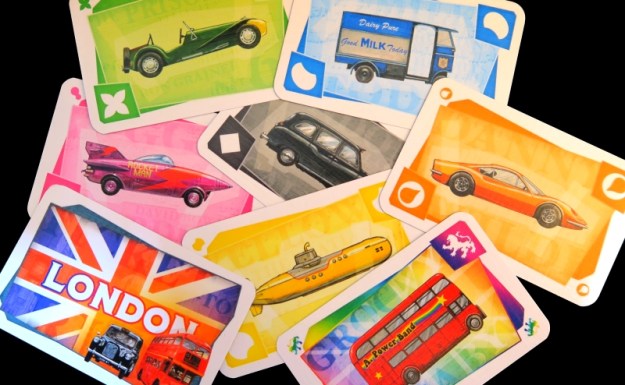
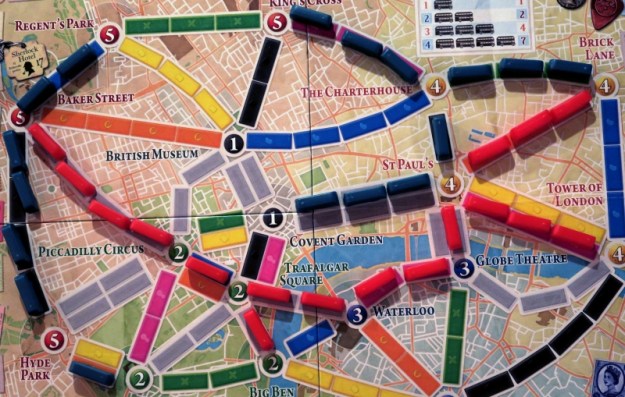
Meanwhile, on the other side of the room two games of Ticket to Ride: London were underway.  Ticket to Ride is one of our current favourite games and the London variant, being one of our “local” editions is particularly popular.  The game plays in the usual way with players taking cards from the market, using them to pay to place trains on the map and claim routes, or taking Tickets which give points at the end of the game if the two destinations are connected.  Each map has an extra rules “tweak” and in case of the London edition players get bonus points if they visit all the places in a borough.

Ticket to Ride: London
– Image by boardGOATS

When Pink asked Pine who the people were on the box there was a general aura of shock when he claimed not to recognise Emma Peel (though he did correctly identify Her Majesty Queen Elizabeth II).  Their game with Purple and Black started off very confrontationally in the centre of the board and carried on in much the same vein as the game developed from there.  Pink took Pine’s dubious advice to take more tickets, but failed to score them.  Pine got his comeuppance though when Black just pipped him to the line beating him into second place by a single point, while Purple took third.

Ticket to Ride: London
– Image by boardGOATS

The other group managed to rattle through the game really quickly too as everyone knew what they were doing.  Orange completed all his Tickets and triggered the end of the game.  For everyone else it was a more frustrating game. Lilac was convinced she was going to lose as she had failed to complete one of her tickets finding herself blocked, but in the end finished second, significantly ahead of Green and Lemon.  Green had tried the “gamers tactic” (espoused by Black on previous occasions) said all the best Ticket to Ride players do, namely  collecting more tickets at the start of the game.

Ticket to Ride: London
– Image by boardGOATS

This went OK until about half way through when he got blocked on his best route, then while trying to re-route got blocked again, forcing him to try a third option. This was blocked too and he was locked out of his key station, finishing with three incomplete Tickets.  Lemon had tried the same strategy (collecting tickets first), but also ended up with a couple not completed.  As a result, Orange wiped the floor with everyone else finishing with a score nearly three times that of his nearest competitor: a convincing victory.

Ticket to Ride: London
– Image by boardGOATS

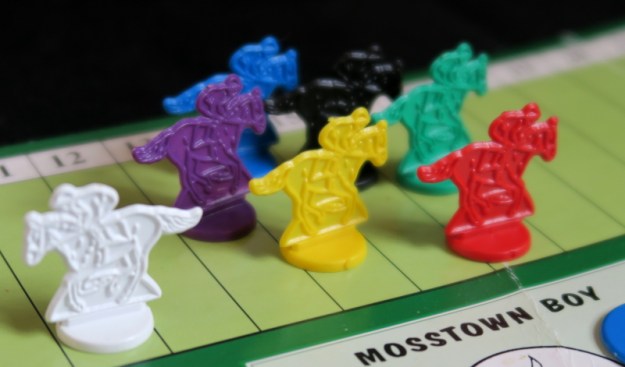
Key to the City: London was still underway, so, given Her late Majesty’s well known love of the gee-gees, the two groups got together to play Turf Horse Racing.  It was a while since anyone in the group played it, so Green reminded everyone of the rules.  The idea is very simple, players have three counters to use for betting, two small and one large, double weight one.  In the first stage, players take it in turns to use these counters to bet on horses.  In the second stage, players take it in turns to roll the die and move a horse to determine the outcome of the race.

Turf Horse Racing
– Image by boardGOATS

The game works because the die has three horses heads with one of each of the other icons, and each horse moves a different amount depending on what is rolled.  Since each horse has to move before a horse can be moved again, players can choose to make a positive move for one of their own horses, or nobble someone else’s.  Although the rules as written give the maximum number of players for Turf Horse Racing as six, the group thought it would stretch to more due to the way it is played.  And given the hilarity that ensued, that seemed a really good decision.

Turf Horse Racing
– Image by boardGOATS

It was decided that due to there being so many players, perhaps three bets per player would create too many horses with multiple bets, so it was house-ruled to two bets only each: one big and one small.  The extra bet tokens needed were taken from Ticket to Ride: a scoring disc and a bus.  Pine was the sole “investor” in Roamin’ Emperor’s fortunes.  Pink, trying to get his revenge for being misled in Ticket to Ride, cajoled everyone to choose this purple horse to move only one space, much to Pine’s annoyance.  Pink got his way, but then got his comeuppance when someone made his chosen horse, Lagoon Lady, also move only one.

Turf Horse Racing
– Image by boardGOATS

After the first round it was Silver Blaze blazing a trail up front, closely followed by Mostown Boy and Raven Beauty.  This theme kept repeating with Lagoon Lady and Roamin’ Emperor moving only one space a turn, until finally Pine struck gold and was able to shoot his horse forward by a massive fifteen spaces and get it into the leading group.  It was a close race, and eventually Silver Blaze was overhauled and brought back into the pack.  As the race entered it’s final furlongs Lagoon Lady was still languishing behind.  Although it had made up some ground, Roamin’ Emperor was making better progress but also starting to fall back.  One more “mega surge” would have been enough to put it within spitting distance of a win, however, that was not to be.

Turf Horse Racing
– Image by boardGOATS

In the end it was The Red Baron who crossed the line first, with Silver Blaze second and Desert Prince third. Adding up the betting totals, Lemon took home the biggest winnings with eight, with Lilac just one behind in second and Black a comparatively distant third.  The conclusion was that Turf Horse Racing can definitely be played with eight, but maybe a little more tinkering is needed. Perhaps keeping the three bets, but with seven horses, the start player moved around the table very slowly—something to think on and investigate further perhaps.

Turf Horse Racing
– Image by boardGOATS

Learning Outcome:  Her Majesty had a point—dogs and horses can be a lot of fun.

28th June 2022

When Blue, Pink, Orange and Lemon rolled in (late thanks to the delights of the Oxford traffic and garden watering), Plum was already there.  A gamer with Gweeples in Didcot, Plum was a friend of Burgundy’s that members of the group first met at his funeral about six months ago.  While she finished her tagliatelle, Blue and Pink waited for their supper to arrive, and everyone admired Pink’s Pornstar Martini, the group revisited Tsuro, which Orange and Lemon had enjoyed so much on their first visit, last time.

Tsuro
– Image by boardGOATS

While setting up, Pine arrived and needed a quick reminder of the rules, but that only took a moment:  players have a hand of three tiles and, on their turn place one of them in front of their stone and extend it’s path, moving their stone (and any others) to the end of its path.  Players are eliminated when their stone goes off the board or collides with another stone—the last player on the board is the winner.  First blood went to Blue, who took out Lemon and Pine, but that was collateral damage as she had no choice and went off the board herself at the same time.

Tsuro
– Image by boardGOATS

Pink was next, being trapped and left with no option, and then just Plum and Orange remained to duel it out.  There was very little space left on the board and the writing was already on the wall when Plum went off.  That left Orange a worthy winner, especially as he had a tile to spare too.  Teal arrived and while Blue and Pink fed, he led everyone else in a game of No Thanks!.  This is a game we’ve played a lot in the group and is a very clever design but like all the cleverest games, has very simple rules.  Played with a numbered deck of thirty-two cards, the idea is that on their turn, the active player can take the card in the middle or pay a chip to pass the problem on to the next person.

No Thanks!
– Image by boardGOATS

The next person has the same decision:  they can take the card and the chip, or pay a chip, and so on.  At the end of the game, a player’s total score is the sum of the face value of the cards they took and the player with the lowest number wins.  There are two key points that make the game, however.  Firstly, if a player has consecutively numbered cards, only the lowest card in the run contributes to their total, which means cards have different values to different players.  Secondly, nine cards are removed from the deck, which adds jeopardy on top.  The game can play out in several different ways.

No Thanks!
– Image by boardGOATS

The player or players with the most chips are always in control, until one player is left with so few chips or runs out completely, that they are forced to take cards even when they don’t want them.  This can prevent players, even those with lots of chips, from getting the cards they need to close runs causing the strategy to back-fire, and leaving those with the most chips with the most points as well.  This time, Orange and Teal amassed a huge pile of chips each, but both managed to avoid ending up with multiple high scoring runs.  Then someone dropped a chip on the floor giving Pine the opportunity to recount the tale of how he dropped a chip between the floor boards and how it is still there despite everyone’s best efforts.

No Thanks!
– Image by boardGOATS

This time, the dropped chip was recovered successfully and the game ended without further mishap.  Orange and Teal took first and second respectively, giving Orange two in two games to match Lemon’s achievement at the start of last time.  By this time, the feeders had finished feeding and everyone else had arrived, so it was time for the “Feature Game“.  To mark the start of the Tour de France later in the week, this was to be the Peloton expansion for the cycling game, Flamme Rouge.  Flamme Rouge is a fast-paced, tactical bike-racing game where each player controls a team of two riders: a Rouleur and a Sprinteur.  The aim is to manage the first rider to cross the finish line.

Flamme Rouge
– Image by boardGOATS

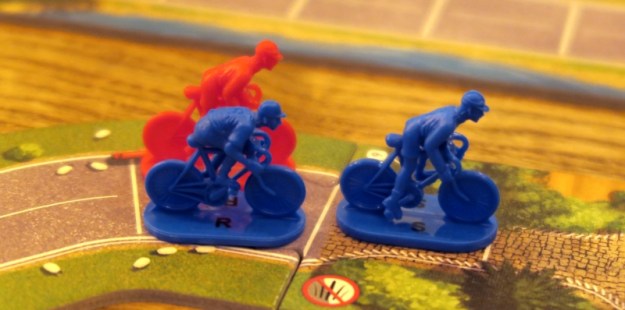
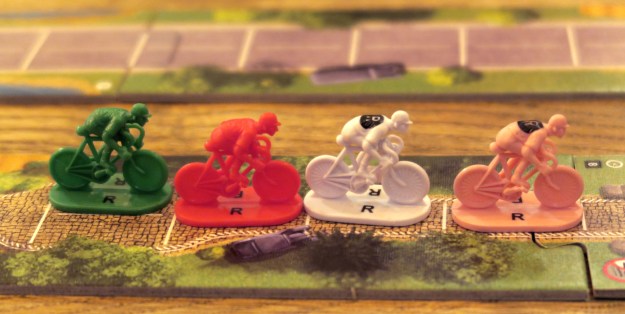
Each rider has a deck of cards, and Players move their riders one at a time, by drawing four cards from the rider’s deck, choosing one to play, and recycling the rest.  Once every player has picked cards for both their riders, players simultaneously reveal their cards and, starting with the cyclist at the front, each rider is moved in turn.  After all the riders have moved, slip-streaming takes effect, with groups that have exactly one space between them and the group in front moving forward to remove the gap.  Finally, every rider that still has an empty space in front of them is deemed to be riding into the wind and takes an exhaustion card which goes into their deck—these are bad because they are slow cards and block up plays’ hands.

Flamme Rouge
– Image by boardGOATS

At the start of the race, everyone’s Rouleurs have the same cards, and everyone’s Sprinteurs have the same cards.  The Rouleurs have lots of cards with a similar face value, where the Sprinteurs have some cards that are faster and have a higher value, which are offset by others that are slower and have a lower value.  Players have to balance how they manage their riders and make the most of the slip-streaming opportunities.  The game is modular with the option to add hills to the base game.  The Peloton expansion adds extra riders (so that the game plays up to six players), cobbled sections (aka “Pavé”), Feed Zones, and rules to set up a break-away.

Flamme Rouge
– Image by boardGOATS

Unusually with so many people, rather than splitting in to three groups playing three different games, we split into just two with both playing the same game.  Since the Grand Départ was due to take place in the essentially flat Denmark this year, both groups largely played without hills, but included cobbled sections (à la Stage 5, from Lille to Arenberg, a week later).  Cobbled sections change width frequently and are generally narrower than normal road, but perhaps more importantly, riders can no-longer benefit from slipstreaming but still get exhaustion cards.  The slightly larger group, led by Ivory and Teal also decided to start with a break-away.

Flamme Rouge
– Image by boardGOATS

Their chosen route was Stage 11 of the stage race and took in three sections of Pavé.  The first of these was shortly after the start, the second after the first hairpin and a short slight up-hill ramp, and the third was after a second hairpin and a little chicane.  Teal and Lime made it into the breakaway and they stayed away for most of the game.  Being at the front “pushing air out of the way” all the time is tiring though, and inevitably, they picked up a lot of exhaustion cards.  That meant that as the Peloton was bearing down on them, just as the finish line was in sight, they didn’t have the energy fend them off.

Flamme Rouge
– Image by boardGOATS

As a result, Black and Pink, who had been sheltering in the middle of the group slid across the line just ahead of the gallant breakaway, who were definitely candidates for the day’s combativity award.  Black took first place, having spent most of the race doing as little as possible and saving it all for the final sprint.  While saving energy is a good tactic, Purple took it to a different level picking up no exhaustion cards at all, though she wasn’t able to turn on the burners in time to take advantage of it.

Flamme Rouge
– Image by boardGOATS

The smaller group, led by Blue and Plum rode a simpler route based on the Avenue Corso Paseo ride, with a cobbled section in the middle between the two hairpin bends.  With most people in this group new to the game, they decided to keep things simple and eschewed the complexities of hills completely, sticking to a pan-flat course, and kept to the standard roll-out used in the base game.  First Orange and then Lemon rode off the front while Pine and especially Blue were repeatedly under threat of being spat out of the back of the peloton.  Most rounds seemed to end with Blue breathing a sigh of relief as she managed to hang on and Lemon laughing as she picked up yet another exhaustion card.

Flamme Rouge
– Image by boardGOATS

Once the riders had passed the Pavé the speed picked up and Blue and Pine started to try to move forward in the field.  Lemon who had led most of the way “bonked” and “hit the wall”, and as a result, was unceremoniously dropped.  It was tight, but Pine’s Rouleur was first over the line just holding off Plum’s first rider who took second followed by Pine’s Sprinteur who took third.  It had been a close and quite attritional race, but despite the fact there were fewer riders with a shorter parkour, the race finished at much the same time as the other one.  So races were compared and there was a bit of chatter about other options as people packed away.

Flamme Rouge
– Image by boardGOATS

Ivory took himself off for an early night, as did Teal, but those that were left were keen to play on, albeit not for long in some cases.  Inevitably there was a lot of discussion about what to play, but when Ticket to Ride got a mention, Pine and Lime were keen to give the London version a run out, and were quickly joined by Pink and Purple.  Ticket to Ride is one of our favourite games and we play a lot of different versions, short and long.  They all have the same basic structure, but different layouts on different maps, and often with a little rules change.  In summary, in the original game, players are connecting cities across the USA.

Ticket to Ride (USA)
– Image by boardGOATS

They do this by collecting coloured cards and then spending those cards to place trains.  Players score points for placing trains and also for completing “Tickets” by connecting two cities together by any chosen route—the further apart the cities, the more points they are worth.  The game end is triggered when one player has only two train pieces left and at the end of the game, the player with the most points is the winner.  The original game takes around an hour to play with the full compliment, but more recently, there have been a number of smaller, lighter versions available.  They have the same rules, but players have fewer pieces and the maps are more congested, based on cities like New York, Amsterdam and later this year, San Francisco.

Ticket to Ride: London
– Image by boardGOATS

This time, however, the version chosen was London.  In this edition, players are placing buses to mark routes, and in addition to scoring points for claiming routes and Tickets, players also score points for connecting all the places in the same district. Pine won the “name the people on the front of the box” competition and went first.  Lime crossed the city travelling from Baker Street to The Tower of London while both Purple and Pink did the same but from Buckingham Palace to Brick Lane, and via different routes. Pine had a northern route and a south route that looked like they would join up in the middle, but didn’t quite make it.  He did manage to claim a district though, the only player to do so for a district of any significant size.

Ticket to Ride: London
– Image by boardGOATS

It was very close between first and second, though there was a bit more distance to Pink in third.  In the end, Lime just pipped Pine to victory by two points.  Meanwhile, there had been some debate between the other five as to what they would play.  Blue suggested introducing Orange and Lemon to one of our old stalwarts, 6 Nimmt!, but it wasn’t one of Plum’s favourite games.  So instead, Blue and Black introduced everyone else to …Aber Bitte mit Sahne, a clever but simple little “I divide, you choose” game.  The idea is that one player is The Baker who divides the cake into pieces and then everyone else takes it in turns to take a one of them.

…Aber Bitte Mit Sahne
– Image by boardGOATS

Each slice of cake has a type, a number on it and a some cream.  When a player takes cake, they can choose to eat it or store it.  For all eaten cake, players a point for each blob of cream.  For stored cake, however, the player with the most of each type will score the number of points associated with that type.  The clever part is that the number of points is equivalent to the number of slices of that type in the game, so the more common types which are harder to get a majority in are worth more, but they also have the most cream, tempting players to eat them straight away.

…Aber Bitte Mit Sahne
– Image by boardGOATS

It is always difficult for the first couple of players to take the role of Baker, but this is exacerbated with five players.  Blue went first, then Black.  It was only a couple of rounds in, that the twinkle appeared in Plum’s eye as she realised how clever the game was and expressed her approval.  It was quite tight in the early stages with players staking their claims to different sorts of cake.  There was competition for kiwi and redcurrent, but others went largely un-stored (and therefore eaten).  After everyone had been the Baker it was time to see who had the most of each and add up the scores.  Black got lucky with the chocolate as everyone else was greedy and ate theirs.

…Aber Bitte Mit Sahne
– Image by boardGOATS

Unfortunately, there was a rules misunderstanding and Orange thought he would get points for every slice he kept if he had the most of that type, so we’ll have to play it again soon so he can try again.  This time though, Black who had been very abstemious and eaten none of his cake, ran out the clear winner with thirty-five points to Blue’s twenty-nine and Plum’s twenty-seven for second and third place respectively.  Ticket to Ride: London was still underway on the next table, so as Orange and Lemon had not played it before, Blue got out Dobble.  We’ve not played this in the group for years, but it is a fantastic little Snap-based filler.

Dobble
– Image by boardGOATS

The idea is that every card has several pictures and each card shares exactly one match with every other card in the deck and using this principle, there are five possible Snap-based games.  Black decided discretion was the better part of valor and opted to spectate while Plum had a significant drive so headed off, leaving just Blue, Orange and Lemon.  They started with a pile of cards each and the winner the first to shed their pile onto the central one.  The game was all very well, but there was a vocabulary check as, although Blue said they could play in Ukrainian, Orange and Lemon were game to give English a go.  Once the items had been identified, the mania started.

Dobble
– Image by boardGOATS

As it was a trial game, the piles weren’t carefully measured, but Orange quickly got the hang of it and in spite of the language differences, managed to shed his pile first for yet another victory.  From there, the group did the reverse and started with one card and grabbed progressively matching cards from the middle.  This can be quite savage, which is why Blue opted for the gentler game first.  Still, everyone was well-behaved and nobody got scratched.  The tension and concentration was palpable though and Ticket to Ride finished and Lime and Pine left with only a a cursory grunt from those playing Dobble, before Blue just edged it to win the final game of the night.

Dobble
– Image by boardGOATS

Learning Outcome:  Tour de France coverage is available on ITV4.

10th February 2022

It was just Blue and Pink for food, so while they waited, they killed time with a very quick game of Ticket to Ride: London.  The little, city versions of Ticket to Ride make great appetisers, and this one is no exception.  The game play is essentially the same as in the full-sized versions (collect coloured cards and play them to buy routes), except they have fewer pieces, a much smaller map and take a lot less time to play.  In terms of strategy, there usually isn’t really time to do much, so it’s typically a case of doing one thing and doing it well.

Ticket to Ride: London
– Image by boardGOATS

This time, Blue decided to really challenge herself.  The London game gives bonus points for connect for players that collect certain locations together.  Blue worked out that if she managed to complete her longer ticket (Buckingham Palace to Brick Lane), going via the “ring road”, she could also complete her shorter ticket (Hyde Park to St Paul’s), and pick up lots of bonus points too, with just one bus left over.  Unfortunately for her, Pink managed to end the game just one turn too soon, leaving her with a gap between Regent’s Park and King’s Cross, no bonuses, no tickets and almost no points.  When it came to sparing her blushes, food couldn’t arrive too soon.

Ticket to Ride: London
– Image by boardGOATS

With Green bringing his parents (Saffron & Sapphire), the “Feature Game” was a light, hand-management, double-think fox and chickens game that we’ve played a few times before, called Pick Picknic.  It looked like three games were going to be needed, so Pink suggested Altiplano (in lieu of Orléans which didn’t quite make it last time), and took it to the other side of the room along with Ivory, Sage and Teal.  Pick Picknic plays six, but with eight foxes to fight over the chickens, two games of four seemed the best way to set things up.  Green suggested breaking up his family unit, so Blue instigated a trade and swapped Lilac and Sapphire for Lime and Purple.

Pick Picknic
– Image by boardGOATS

So, after a quick game of Musical Chairs, Green, Saffron, Lime and Purple settled down to play Pick Picknic.  At the start of each round, the six coloured farm yards are seeded with a random corn (worth one, two or three points).  Players then simultaneously choose a card from their hand and play it.  If their card is the only card of that colour and is a chicken, it gets all the corn.  If there is more than one chicken of that colour, they can either come to an agreement to share the corn, or fight for it.  If there is a fox amongst the chickens, the fox has a good feed and the corn remains till the next round.  If someone plays a fox card and there are no chickens, the fox goes hungry.

Pick Picknic
– Image by boardGOATS

The game started in an amicable manner sharing out the corn instead of fighting for it when the need arose, until half way through when Lime decided he no longer wanted to share. He won, but the scene was now set and squabbles broke out over corn more often.  In the meantime, Lime’s foxes were getting fat from eating everyone else’s birds and corn was building up, uneaten.  The others’ foxes were usually not so lucky, and Purple’s foxes were hungriest of all.  Towards the end of the game peace finally broke out once again and sharing was order of the day once more.  In the final tally, Lime proved the wiliest of us finishing first with fifty points and Saffron and Green close behind with forty-four and forty-five respectively.

Pick Picknic
– Image by boardGOATS

On the neighbouring table, Blue, Lilac, Black and Sapphire were a little slower to get going as they had to choose a game, but eventually decided on Coloretto.  While we’ve played it a lot, it was new to both Lilac and Sapphire so there was a recap of the rules first.  Blue explained that on their turn players have a simple decision:  turn over the top card in the deck and choose a “cart” to add it to, or take the cards from one of the carts.  Lilac commented that it was similar to Zooloretto, which of course it is, as Coloretto was it’s predecessor and they share the same basic mechanism.

Coloretto
– Image by boardGOATS

Players are trying to collect sets of the coloured chameleon cards, but there are two clever features.  Firstly, the largest three sets score positively and scores for the others are subtracted from a player’s total.  Secondly, for each set, the first card is worth a single point, but the second is worth two, the third is worth three and so on (up to a maximum of six cards).  Thus, it is better to get six cards of one colour, rather three in each of two suits.  Sapphire, took this to heart, focusing solely on red and green, and often taking nearly empty trucks as a result.

Coloretto
– Image by boardGOATS

Lilac was more adventurous and pushed her luck a bit, ending up with a bit of a rainbow, but with a couple of strong suits and a few bonus point cards.  Blue commented that, although players need to avoid negative points, players who don’t take cards generally don’t do well, and promptly took lots of cards and ended up with lots of negative points as a result.  Black, very experienced at this game, played smart and took an early lead which he held right until the last round when Blue got lucky and drew cards in her longest suit and with it, took victory, pushing Black into second.  Lilac and Sapphire were not far behind and separated by a single point.

Coloretto
– Image by boardGOATS

Pick Picknic and Coloretto finished at much the same time.  Purple then requested a game of Azul, so we preceded it with another quick game of Musical Chairs as Blue swapped places with Green.  Then, after a little discussion, Green, Lilac, Black and Sapphire chose to play Draftosaurus.  This is a fun little drafting game like Sushi Go!, but instead of drafting cards, players are drafting little wooden dinosaurs.  The dinomeeples are placed on the player’s board with different areas on the board scoring points in different ways.  For example, the “Meadow of Differences” can only hold one of each type of dinosaur, but will score twenty-one points if it contains all six (using the same scoring scheme as Coloretto).

Draftosaurus
– Image by boardGOATS

The game is played over two rounds (drafting clockwise and then anti-clocwise), before all the parks are scored.  Players also score an extra point for each Tyrannosaurus rex they have in their park, as well as extra points if they have if they have the most dinosaurs of the type they put in their “King of the Jungle” pen.  Everyone knows there is only one King of Jurassic Park and Black was looking like the winner with his T-rex strategy. He not only got several bonus points for pens with T-rex’s he also got seven points for having the most T-rexes too.  However it was Green’s more general approach to his dinosaur park that pipped Black to the post.

Draftosaurus
– Image by boardGOATS

All the scores were close though: Green finished with thirty-seven with Black in second with thirty four, and Lilac and Sapphire were just behind.  As everyone else was still playing, the group carried on together and moved on to the fun little push-your-luck game, Port Royal.  This (like its little cousin “Unterwegs“) is a very simple game: on their turn, the active player chooses to “twist” and turn over the top card of the deck, or “stick” and keep the current card set.  The deck of cards consist of coloured ship cards and character cards.  The first decision is to decide whether to risk a “twist” because if second ship card of a colour is drawn the player goes bust and their turn ends.

Port Royal
– Image by boardGOATS

If a player “sticks” they can take a ship and add its treasure to their stash, or they can use their gold to buy the support of characters.  These give players victory points and special powers, but also can be used to claim contracts and give more points.  The cards are double-sided like those in San Juan or Bohnanza, so in the same way, keeping an eye on the discard pile and the money in players’ hoard is key.  Once the active player has taken a card, players round the table can take a card too, but they must pay the active player for the privilege.  The game ends when one player has twelve points or more, that triggers the end of the game and the winner is the player with the most points.

Port Royal
– Image by boardGOATS

Black, once again, got off to a fighting start, collecting arms to help him ward off the pirates while Lilac had her eye on the contract symbols. Sapphire went for the Admiral, which gave him a bonus for drawing at least five cards and would give others an increased chance to buy and pay him even more.  Green started out with Green Trader bonus, but then got consistently hit by the black pirates before he could barely draw any cards, so his game was hampered from the very start.  With his fighting force at strength, Black was able to haul the cards out and start raking in the points.  Lilac managed to convert high value contracts before anyone else, gaining her more coins to buy more cards.

Port Royal Unterwegs
– Image by boardGOATS

Sapphire built up a “Jack of all Trades” hand, but it only steadily gained him points.  Green managed to finally rid himself of the scourge of the black pirates by stopping draws early, and started collecting symbols, but it was too late as Black reached the twelve points before anyone else. Everyone had one more turn, and Lilac was able to convert her final contract to also reach twelve. Both Lilac and Black managed one more purchase to finish on thirteen points each, but Lilac won took the tie break by virtue of having one more coin left than Black.  Sapphire and Green were also tied on points (on nine-points), but Sapphire completed the podium places with four coins more.

Port Royal
– Image by boardGOATS

Meanwhile, Blue, Saffron, Purple and Lime were playing Azul.  We’ve enjoyed the recent versions of these (Stained Glass of Sintra and Summer Pavillion), but this time the original was the game of choice.  All three use the same market mechanism where players either take tiles of one colour from one of the small markets and put the rest in the central pool, or take all the tiles of one colour from the central pool.  In this original version of Azul, players add these tiles to the channels on the left of player board, and at the end of the round if any of these are full, they move one tile to their mosaic and recycle the rest.

Azul
– Image by boardGOATS

Players score points for placing tiles such that they are part of a row and/or a column in the mosaic and at the end of the game, players score bonus points for completed rows and columns and also for placing all five tiles of any one colour.  There is a catch, however.  When a player takes tiles, all the tiles must go into a single tile channel, and must be of the same colour as any that are already there.  Any left overs score negative points and, as the more left over tiles a player has, the more negative points each one will score.  This has the potential to leave one player picking up lots of tiles and scoring lots of negative points.

Azul
– Image by boardGOATS

This time, that player was Lime.  Having scored a few points during the first round, he was unimpressed when all his negative points at the end of that round pushed him straight back to zero.  This wasn’t the only time that happened though, to the point that it became a bit of a running joke, especially as he made it a point every round to take the first player token (which counts as another negative tile).  One of the key tactics of the game is to try to complete tile channels at the end of the round because these are then emptied leaving the maximum amount of flexibility for the next round.

Azul
– Image by boardGOATS

And this is exactly what Saffron did.  Despite never having played the game before, by focusing on completing her tile channels she was always able to dig herself out of any difficulties.  Although the game was longer than Draftosaurus, it didn’t seem like very long before Purple triggered the end of the game by completing a row, the only one to do so.  It was quite close, but Blue just edged it from Saffron who took an excellent second.  With that, Lime headed off (before the drawbridge was raised) and Blue left Purple and Saffron chatting while she went to watch the last few rounds of Altiplano on the other side of the room.

Azul
– Image by boardGOATS

Altiplano is a much longer game and one that we are very fond of in the group.  Indeed, it was the first winner of the Golden GOAT award (in 2018), though we haven’t really been able to get it to the table since then.  For a while, it had been in the plan to play The Traveler expansion, however, we wanted to play the base game again first and with both Teal and Sage new to the game only the Sunny Days mini expansion was included.  The basic mechanism of the game is quite simple:  on their turn, players carry out the action based in the location their meeple is in, and optionally, moves their meeple either before or after, if they can.

Altiplano
– Image by boardGOATS

The game is a “bag building” game, so a bit like its predecessor, Orléans, or even deck builders like Dominion, players need the correct resources to be available when they carry out the actions.  So, at the start of each round, players draw resource disks out of their bag and place them on their player board to be used in the locations they plan to visit.  Mostly the game trots along quite merrily as this stage of the game is carried out simultaneously and everyone does their planning at the same time so the action phase is quite rapid.  Pink explained what all the different locations did and that there were two main sources of points:  Contracts and Resources.

Altiplano
– Image by boardGOATS

At the end of the game, the resources give points with the amount depending on what it is: primary resources score one point (wood, stone, fish etc.) while advanced processed materials (like cloth and glass) can score up to three or four points.  These will score even more points if they are stored in the Warehouse.  When a resource is used it is places into the players recycling box and goes back into their bag when their bag is empty.  In this way, instead of relying on probability/luck as in Orléans where used resources are returned straight to the bag, all resources are used before they are recycled.

Altiplano
– Image by boardGOATS

Players can leave unwanted resources on their player board, but this can obstruct their plans, so another option is to move them to the Warehouse.  Once in the Warehouse, they cannot be removed, but each full shelf (which can only store one type of resource), gives more points at the end of the game.  Only completely full shelves score in this way, which cost Pink some valuable points when he realised Ivory had pinched the last available fish just before he got there.

Altiplano
– Image by boardGOATS

The other main route to scoring points is through completing Contracts.  Players can only have one on the go at any one time, but when complete, they are worth points and also provide the player with a corn which goes straight in the warehouse and can act as a space-filler too.  As well as getting resources from the Wood, Mines, Seafront etc., players can also buy Contracts, build Carts (to provide them with additional travel options), build Boats or Huts (which provide resources and increase their resource scoring), or buy Board Extensions which give them enhanced abilities.  These Extensions also act as a timer triggering the game end.

Altiplano
– Image by boardGOATS

The game was really tight and despite the fact that all four protagonists employed different strategies, a postage stamp would have covered the final scores.  Pink, despite having carefully explained the importance of Contracts as a means to get points, decided to see how he could do by avoiding them completely—the only one to do so.  He concentrated instead on getting resources, especially high value ones, and storing them in his Warehouse.  Teal’s strategy was driven by the fact he started with the Woodcutter which allowed him to turn food into wood, so he concentrated on building Canoes, lots of Canoes.  This was not a strategy anyone had seen before, but it provided him with a lot of resources.

Altiplano
– Image by boardGOATS

Ivory went for Contracts in a big way, taking a massive fifty-five points for them alone.  Since resources on Contracts don’t score in and of themselves, however, this meant he scored fewer points elsewhere.  Sage went for a more “all round” strategy, picking up a lot of points for his contracts too, but also building a lot of Huts to enhance his resource score.  As the game came to a close there was the inevitable checking what the final Extension tiles and then everyone took their shoes and socks off for the complex final scoring.  The winner, on his first time out was Teal, his unconventional Canoe strategy netting him eighty-six points.  Pink finished second with eighty-three and Ivory was just one point behind that, in what had been a very tight game.

Altiplano
– Image by boardGOATS

Learning outcome: Teach a man to fish, and he’ll swap them for a pile of stones.

23rd September 2021

Burgundy and Blue were just finishing their supper when Teal introduced himself.  The three were chatting when Lime, who hadn’t been able to come for over a month, also joined the group.  It was expected to be a quiet night with Green and Lilac away on holiday, Pine working late, and Pink stuck somewhere on the Warwick bypass.  So, there was a lot of chat, but eventually, the group decided to play something and settled on Love Letter.

Love Letter
– Image by boardGOATS

This is a very simple little game that we’ve played a lot, but somehow Lime had missed out.  So, there was a very quick rules explanation:  players start with a hand of one card, draw a second and choose one to play and do the action on the card.  The cards are numbered and the aim of the game is to finish the round with the highest card, or more commonly, avoid being knocked out.  There are only sixteen cards in the deck (and one of those is removed at the start of the round), so it doesn’t take long.

Love Letter
– Image by boardGOATS

The group were only three rounds in when everyone else turned up (including Pink who had escaped the roadworks), so Lime was declared the winner with two tokens and everyone else was introduced to Teal and started to discuss what to play.  In the end, Burgundy took matters into his own hands and started a game of Wingspan, so while Pink waited for his pizza to arrive, Blue explained the “Feature Game“, Mini Rails.

Mini Rails
– Image by boardGOATS

Mini Rails is a very simple little stock-buying and track-laying train game that compresses a lot of the game play of long and complicated games like the 18xx series into under an hour.  Players have two turns in each round, on one they buy shares in one of the companies and on the other they extend the “track” of one of the networks.  If it is built on a white space, players with holdings in that colour increase their value by the marked amount.  If the network is built on a red space, the stocks in that company are decreased in value.

Mini Rails
– Image by boardGOATS

The game is very simple, but there are a couple of clever little tweaks.  Firstly, there are two “tracks”, one is the turn-order track, while the other holds train disks drawn at random from a bag.  On their turn, players choose one of tokens and decide which action to use it for, “build track”or “buy shares”.  The position of the token that is taken dictates where they will be in the turn order in the next round.  Manipulating this turn order is one key aspect of the game, as is deciding whether to buy and then build, or build and then buy.

Mini Rails
– Image by boardGOATS

Perhaps the most complicated aspect of the game is the end-game scoring.  At the start of each round train discs are drawn from a bag; one more than there are turns.  This means everyone always has a choice, but the token the last player does not use is put to one side indicating they have paid “taxes”.  For the companies that have “paid taxes” any negative dividends are erased and positive dividends are counted.  For those companies that have avoided paying their taxes the reverse is true and negative points will be scored while positive points are lost.

Mini Rails
– Image by boardGOATS

This means it is in the interest of players with both large positive or significant negative scores to forgo building track or buying shares and leave a potentially valuable token as taxes.  Similarly, if a player is left with a choice of two tokens, it may be in their interest to buy/build a relatively unfavourable track to deprive other players of points.  With three players, the game doesn’t take too long to play, and with more it would likely become quite random.

Mini Rails
– Image by boardGOATS

Lime took an early lead, though of course lots of early points are… pointless, if the company doesn’t pay taxes.  In the end it was extremely tight, but in the end, Blue just pipped Lime by a single point.  With just three there isn’t much downtime and the game rocks along nicely with plenty of interaction, though as Pink said, “That’s one hell of an abstraction for a train game.”  Blue pointed out that this was what a lot of gamers thought of when someone said “Train Game”.  Pink felt disappointed at the lack of actual trains and tracks so to make it up to him, the group moved on to play Ticket to Ride Demo.

Ticket to Ride Demo
– Image by boardGOATS

Ticket to Ride Demo is one of the small games based on the Spiel des Jahres winner, Ticket to Ride Europe.  The Demo game has an interesting history—it was designed as a sales tool and had only a small print run.  It was so popular though, that it ultimately spawned a new range of small “City” games, New York, London and Amsterdam.  These games are essentially played the same way as the full-sized versions, but with fewer pieces on a smaller map which means they typically take less than half the time.

Ticket to Ride Demo
– Image by boardGOATS

On their turn players can do one of three things:  take cards from the market, spend cards to place trains or take tickets.  Players score points for placing trains, but also for connecting the places on their tickets.  The catch is that any tickets that are not completed score negative points.  The small versions of the game are much tighter with less room for error.  Unlike the others, Ticket to Ride Demo has a double sided map, one USA and one Europe.  This time the group played the Europe map.

Ticket to Ride Demo
– Image by boardGOATS

Compared to the full-sized equivalents, all the little games are like a knife-fight in a phone-box, and this game was no exception.  Lime only completed three of his four tickets as Blue brought the game to a quick and sudden end.  Pink completed all four of his tickets and they were high-scoring too.  Blue’s tickets were less lucrative, but she managed to place all her trains and took the European Express bonus points for the longest continuous route, and with it victory, by just two points.

Ticket to Ride Demo
– Image by boardGOATS

Meanwhile, on the next table an epic, five-player game of Wingspan was underway.  We’ve played Wingspan quite a bit since it came out and always found it very enjoyable.  We’ve played it enough that we’ve also explored the European expansion, but thanks to the restrictions over the last year or so, this was the first opportunity to play the new Oceania expansion.  The base game is a reasonably light, card-driven, combination building game.  On their turn, players can place a bird card from their hand in one of the three habitats, or activate all their cards in one of the habitats and carry out the associated action.

Wingspan: Oceania Expansion
– Image by boardGOATS

The habitats are Woodland, Grassland and Wetland and the actions associated with them are collecting food, laying eggs or collecting cards (respectively).  Once the action has been carried out, the active player activates each card in the habitat in turn.  The game is played over four rounds, with a decreasing number of actions per round as the game progresses.  At the end of each round there are goals and each player also starts with a personal bonus card which is evaluated at the end of the game.

Wingspan
– Image by boardGOATS

The European expansion really only adds extra cards, though this includes a number of birds with abilities that are activated at the end of rounds, and others that increase player interaction.  The new Oceania expansion also adds more cards, but additionally mixes things up a little more with the addition of a new food type, nectar.  Nectar can be used as wild food type, although some of the new bird cards have nectar specified in the cost.  Whenever players spend nectar though, they don’t put it back in the supply, instead they store it in the habitat they spent it on.

Wingspan
– Image by boardGOATS

At the end of the game, the player with the most nectar stored in each habitat scores five points at the end of the game with the player coming second scoring two points.  Nectar is therefore a very important resource giving a potential fifteen points at the end of the game, although it requires some skill to use it effectively as it can’t be carried over between rounds.  Burgundy and Black really invested in nectar and managed to make good use of it during the game as well as take the lion’s share of the nectar points at the end of the game.

Wingspan: European Expansion
– Image by boardGOATS

Burgundy and Black also prioritised valuable birds and tried to ensure they stayed in the running for the end of round bonuses.  Three out of the four of these involved eggs, which fitted with Ivory and Teal’s strategies which focused on an end-of-game egg rush.  Ivory also picked up a lot of points from his Common Starling which enabled him to discard up to five bits of food and tuck a card for each one.  With a maximum of twenty points, Ivory did well to take eighteen during the game, but it was only enough for third place this time though.

Wingspan
– Image by boardGOATS

It was very close at the top between Black and Burgundy.  Burgundy had four bonus cards one of which proved quite lucrative.  The big difference was in the value of the bird cards, however, while Black edged it in many departments Burgundy had a ten point head start.  This wasn’t simply because he had high value birds, more that he had lots of them.  In the end, Burgundy finished five points ahead of Black with ninety-five, in a good game that had been enjoyed by everyone round the table.

– Image by boardGOATS

Wingspan was still only on its third round when Ticket to Ride Demo came to an end.  At around the same time, Pine pitched up, so the, now foursome settled down for something else which ended up being a game of Reiner Knitzia’s Botswana (aka Wildlife Safari).  This is an unusual auction-like game made all the better by the inclusion of plastic animals.  Played over several rounds, players are dealt a hand of cards and on their turn play a card and take an animal of their choice.  The cards are numbered zero to five and come in five different animal suits.

Botswana
– Image by boardGOATS

The cards are played in the centre of the table in suits and the game ends when all six cards of one suit have been played.  The top card in any suit is the current value of that animal.  Thus, if the top zebra card is a five, a player that has three zebras will earn fifteen points for them if the game ends.  However, if the zero just before the game ends, the zebras will become worthless.  It is a deceptively simple, yet fun little game.  Blue thought she’d won until a recount docked her ten points and she finished just two points behind a delighted Pink.

Botswana
– Image by boardGOATS

As Botswana came to an end, so did Wingspan, and although time was marching on, and Lime and Ivory took an early night, there was still time for everyone else to play one last game.  After a little discussion, we settled on 6 Nimmt!, a game we all know and love.  Players simultaneously choose a card and these are sequentially added to the end of four rows of cards, specifically the row with the highest number that is lower than the card itself.  If the card is the sixth card in the row, instead, the player takes other five and adds them to their scoring pile.  The player with the lowest score at the end of the game is the winner.

6 Nimmt!
– Image by boardGOATS

We’ve all played this a lot online over the last year, but doing the maths ourselves was a little daunting, so we decided to go back to playing the non-professional version.  We play over two rounds using half the deck in first and the other half in the second.  This time Teal top-scored in the first round with nineteen, while Burgundy kept a clean sheet with Pink just behind.  Blue’s killer thirty-three in the second round gave her a total of forty-eight, but the winner for the second time in the evening was Pink with just four points.  And with that, it was bedtime.

6 Nimmt!
– Image by boardGOATS

Learning Outcome:  Today’s railway industry is no longer about trains and tracks. ☹

Boardgames in the News: Fake Games from a High Street Name

As reported previously, fake and counterfeit goods are not uncommon online, especially with purchases from certain auction sites.  Even companies like Amazon are not immune though, thanks to co-mingling of stock with that from other third-party sellers and returned items.  More recently, however, there have been lots of reports of issues with copies of Pandemic, Dead of Winter, Carcassonne, Catan, and Harry Potter: Hogwarts Battle bought from Zavvi.  This is of note, not because of the games (which have been targeted before), but because Zavvi is a reputable high street name.

Pandemic
– Image by BGG contributor kilroy_locke

Zavvi is owned by The Hut Group (aka THG), along with a range of other companies that sell everything from lipstick to language services.  The Hut Group also own I Want One of Those (aka IWOOT) who have recently been selling quite a lot of games at a good price including Sagrada, Horrified, and Ticket to Ride: London.  There doesn’t appear to be any question of the authenticity of these games, but IWOOT have been selling copies of Dead of Winter, Pandemic, Carcassonne and Hogwarts Battle too and these also seem to be fakes, presumably from the same, communal supply as the Zavvi games.

Harry Potter: Hogwarts Battle
– Image by BGG contributor zgabor

Both Zavvi and IWOOT have been reluctant to acknowledge that the games are fake insisting to customers that they “do not handle fake goods”, they “source all stock direct from the brand suppliers”, and “items sold by ourselves are not counterfeit”.    Neither Zavvi nor IWOOT are known for selling counterfeits.  So, assuming it is against company policy, how their supply chain became contaminated is an interesting question and it is possible that they themselves have been the subject of a deception.  It seems unlikely that these fakes were supplied through the usual UK distribution channels, but it is possible they were bought in good faith from another supplier.

Dead of Winter: A Crossroads Game
– Image by BGG contributor mikehulsebus

Perhaps the biggest issue here is the poor Customer Service people have reportedly received, including standard unhelpful replies or an offer of only a partial refund.  It seems persistence is the only answer, though reporting the company to the Trading Standards and/or the finance handling service (credit card company or PayPal), can help.  For those struggling with IWOOT, suggesting to Customer Services that they look at “ISM ticket 1195382” can also help (ISM is the Ivanti Service Manager ticketing system).

Boardgames in the News: Gaming at a Distance

With so many people tucked up at home there has been some debate as to whether this will encourage people to play games more.  Among gamers, there has been a lot of discussion about solo games where players compete against the game, but this loses the social aspect.  Online gaming is also an option; this can enable playing with real people, but loses the tactile element of gaming that so many people love.  In most cases though, people are not “home alone”, they are with family, so perhaps this is an opportunity to play games with them?

Cities of Splendor
– Image by boardGOATS

The occasional board game column in The Guardian has published a list of twenty family games including some modern family classics like, Ticket to Ride: London, Splendor, Kingdomino, Dobble and (inevitably) Pandemic.  It also includes a few, more recent games, like Wingspan, and Just One, as well as some less well known games like Patchwork Express, Legacy of Dragonholt and Blue Lagoon.

Wingspan
– Image by boardGOATS

There has some suggestion that there has been a flurry of buying games to play with their families, but is there any real evidence of this?  Anecdotally, there have been comments that prices of games have increased on Amazon.co.uk which could indicate an increase in sales.  The website camelcamelcamel.co.uk tracks prices on Amazon, and it seems to indicate that prices for many popular light games have increased in the last week.

Ticket to Ride: Europe on camelcamelcamel.co.uk (23/03/20)
– Image by boardGOATS from camelcamelcamel.co.uk

There is another possible reason though: Amazon has suspended warehouse services (storage and shipping) of non-medical supplies and “high-demand” products for third party sellers.  This would have the effect of pushing prices up.  A lot of Friendly Local Games Shops sell online though, and many of these have sales on at the moment, so why not support one of the small businesses that are struggling at the moment, and leave Amazon to deal with toilet rolls and hand sanitiser?