Tag Archives: Ticket To Ride: Paris

22nd July 2025 (Report)

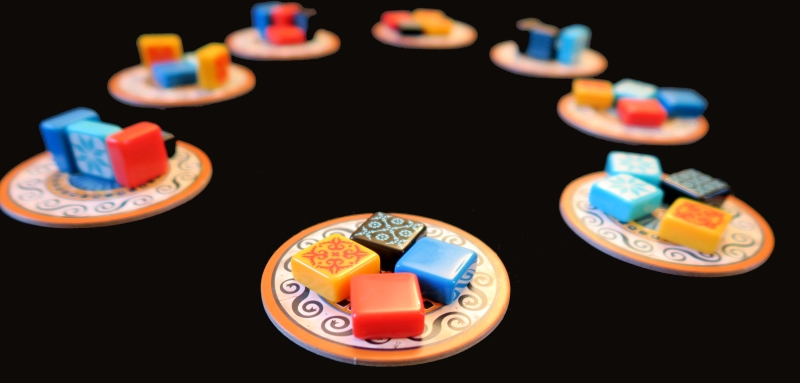
This being the summer, Lime brought LIttle Lime to join in the evening, but as there is a curfew for under-eighteens (due to licencing restrictions), the first game had to get off the mark quickly.  Together with Pink and Plum, they quickly got going with the well known favourite and Spiel des Jahres winning game, Azul.  This is known to everyone, so needed little clarification, though they group decided to use one of the alternate boards from the Crystal Mosaic expansion (the one with the cross pattern).  The game is very simple with players taking tiles of one colour from a factory and putting the remains in the centre, or taking all the tiles of one colour from the central pool.
Azul
– Image by boardGOATS

In either case, players have to add them to their conveyor and if, at the end of the round the conveyor is full, one tile is slid across to be added to the mosaic and the rest disposed of. If the added tile is isolated it scores a single point, but if placed next to other tiles, then more points are scored with larger groups scoring more points.  In this way, tiles grouped together keep scoring points.  Thus, a player who starts well can build a lot of points, which both Little Lime and Plum managed to do.  In the end, Big Lime ended the game, leaving Plum with a single point advantage—The moral of the story:  Don’t end the game too early (as Big Lime commented regretfully).

Azul
– Image by boardGOATS

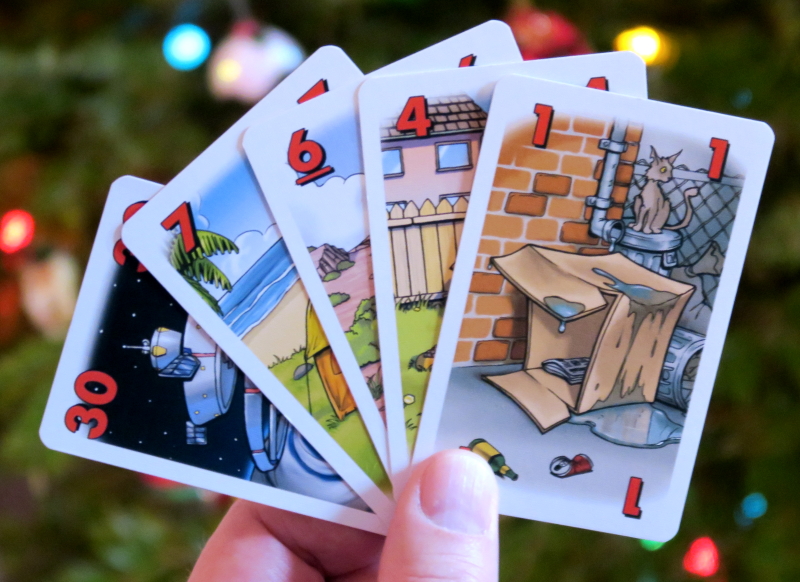
On something of a roll, the group moved on to one of Pink’s favourite quick fillers, For Sale.  Dating from the end of the last century, this game is now nearly thirty years old, but isn’t really showing its age, despite that.  The game comes in two halves:  Buying Properties at Auction, then Selling Properties by Blind Bid.  This game was really really close with a single point between Plum and Little Lime, but they were a a few points behind Big LIme who, as an accountant might be expected to perform well in a financial game.  The winner, however, was Pink, who, despite it being one of his favourite games had never won, until now.  And with that, it was time for Family Lime to head off.
For Sale
– Image by boardGOATS

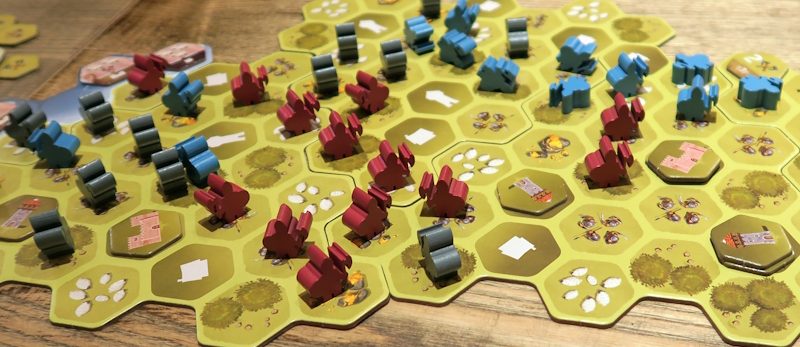
Meanwhile, the rest of the group were engaged in the two tables of the “Feature Game“.  To mark the recent announcement of the Spiel des Jahres winners, this was  Looot.  Although Loot was not actually one of the winners, it, along with Faraway, had recieved a nomination for the Kennerspiel des Jahres and, as it had proved popular within the group (also like Faraway) we decided to make it the Feature.  Although its nomination was in the Expert or Connoisseur category, the game is not overly complex.  The game is played over a series of rounds where each player places one of their Viking workers—the game ends when everyone has run out of Vikings.

Looot
– Image by boardGOATS

On their turn each player places one of their Vikings on the central playerboard.  This is is made up of hexagons: the Viking must be placed on an empty space next to another Viking (of any colour).  Each hexagon gives a resource which can be used to purchase Longships, and if the Viking fulfills certain conditions, it’s owner can capture a house, Watchtower or Castle.  The player with the most points at the end of the game is the winner.  This time there were two tables playing the same game, with Black leading the first table comprising Purple, Byzantium, and Cobalt.

Looot
– Image by boardGOATS

This game turned into a a bit of a battle for Castles between Byzantium and Cobalt.  Cobalt did rather better in the end though thanks to his Long-ship bonuses.  This was because Byzantium kept revealing them and everyone else eschewed them until it came to Cobalt who snapped them up.  Byzantium’s frustration was increased somewhat because Cobalt was just before him in turn order so it looked like they miight make it round to him until they didn’t…  quite…  In the end, Cobalt’s were worth forty-two while Byzantium’s gave him just twenty-eight, despite the fact he actually had more.

Looot
– Image by boardGOATS

It was still close between them, but fairly inevitably, Cobalt had the edge finishing with one-hundred and twenty-eight, ten more than Byzantium in second place.  This was a much higher scoring game than the second table, although that was much closer.  Jade led this game with Mint, Sapphire, and Blue making up the group.  The strategies were very varied, with Jade going for Castles, Mint for Watchtowers, Sapphire for Gold, and Blue who was new to the game, going for a balanced strategy so she could change her tactics as required.

Looot
– Image by boardGOATS

In the end, Blue’s “points from everything” approach just had the edge giving her victory with eighty-eight points, two more than Mint who had one more than Jade with Sapphire close behind. With the games of Looot coming to an end at the same time as For Sale and with Family Lime heading off, the rest of the group split into two.  The first, larger group, consisted of Jade, Sapphire, Blue, Pink, Mint, Plum and Byzantium who decided to give a simple and supposedly quick little game called Tacta an outing.  This is a sort of “card placing” game where players have a hand of cards and place them on the table to cover up spots on other players’ cards.  At the end of the game, the player with the most spots visibleis the winner.
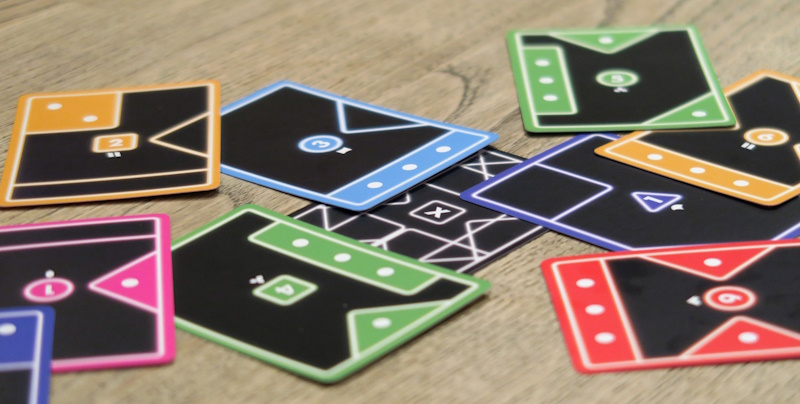
Tacta
– Image by boardGOATS

Unfortunately, game time is proportional to the number of players, so with the six players (Plum and Byzantium shared a hand and worked together), the game was always going to take twice as long as it would with three.  Worse, this was one of those games where gamers take even longer as they want to make sure the find the best placement option and push the rules boundaries.  It is a very clever little game though and a lot of fun, though perhaps playing with fewer cards or fewer players would avoid it outstaying its welcome.
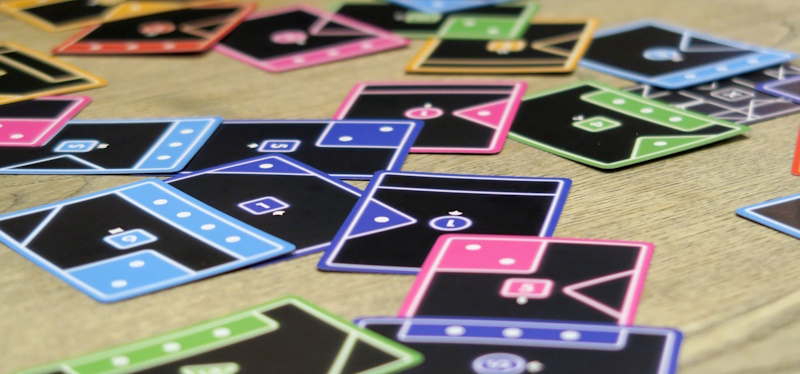
Tacta
– Image by boardGOATS

It was made worse by the fact that everyone helped everyone else and therefore, the victor was quite obvious from fairly early in the game  Although Blue made a dash to come from zero to finish in a more respectable last place, nobody looked like they were seriously going to challenge the Byzantium-Plum team.  Mint took second one point ahead of Pink who was one point ahead of Jade who was one point ahead of Sapphire.  Definitely one to try again, but with fewer people next time.  The supposed quick card game ended up finishing some time after the supposed longer game, Ticket to Ride: Paris that Black, Purple and Cobalt chose.
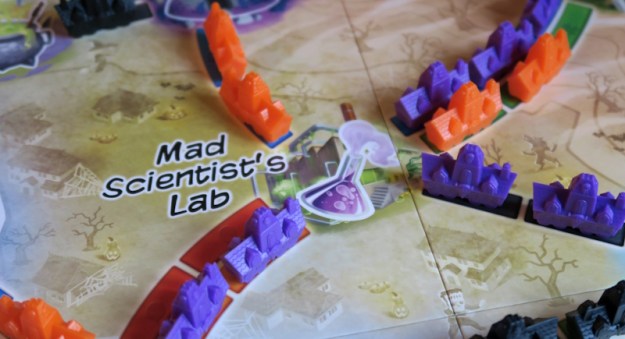
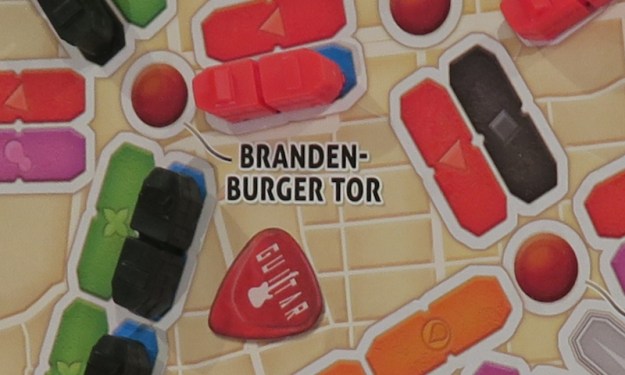
Ticket To Ride: Paris
– Image by boardGOATS

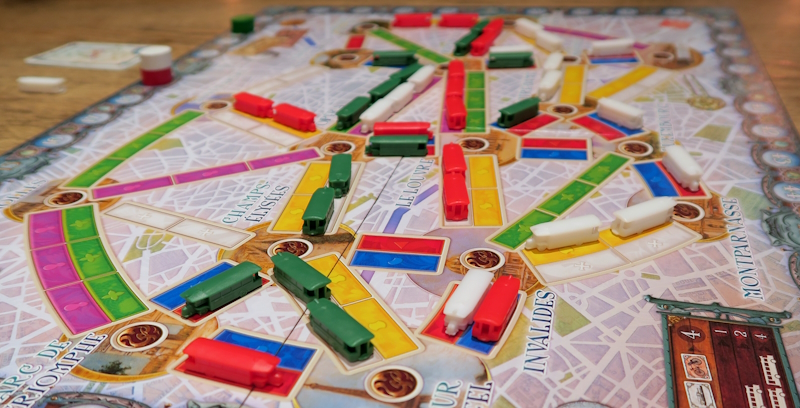
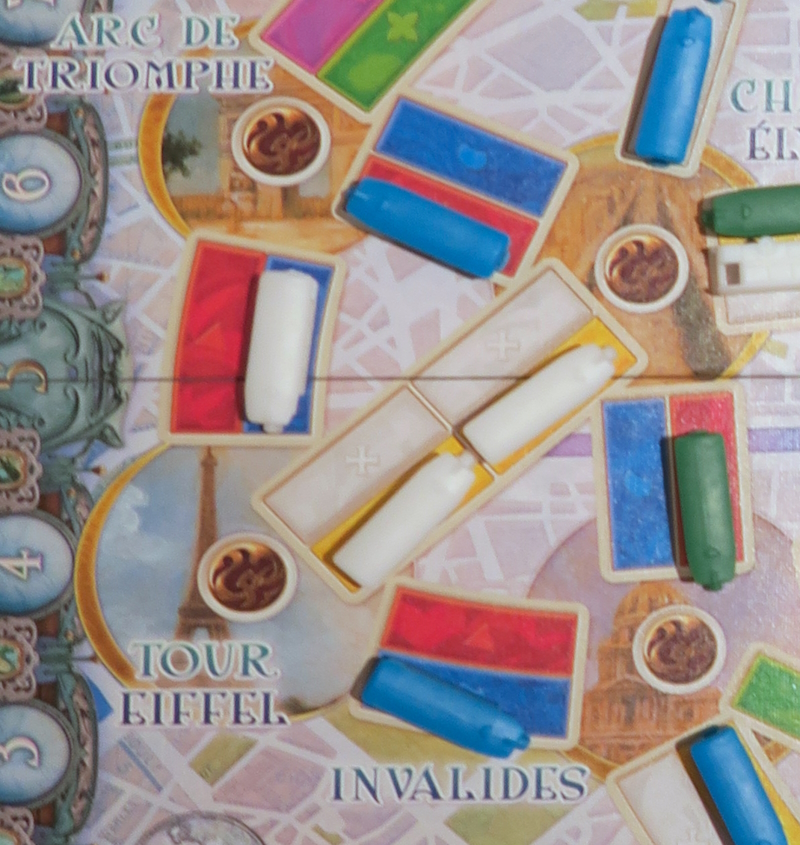
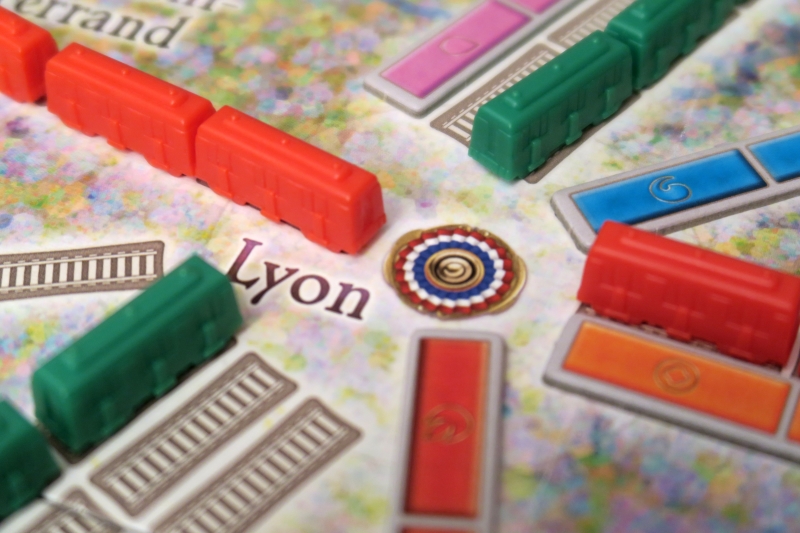
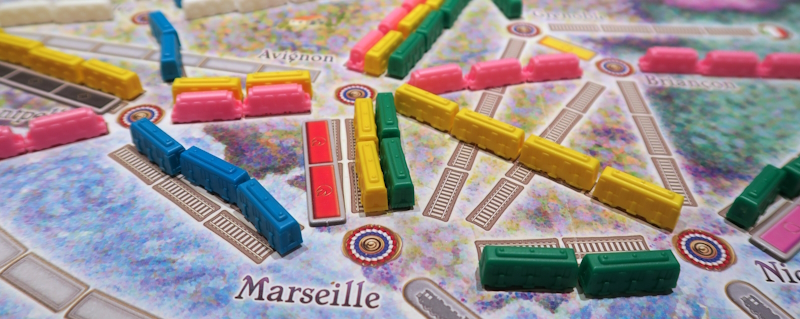
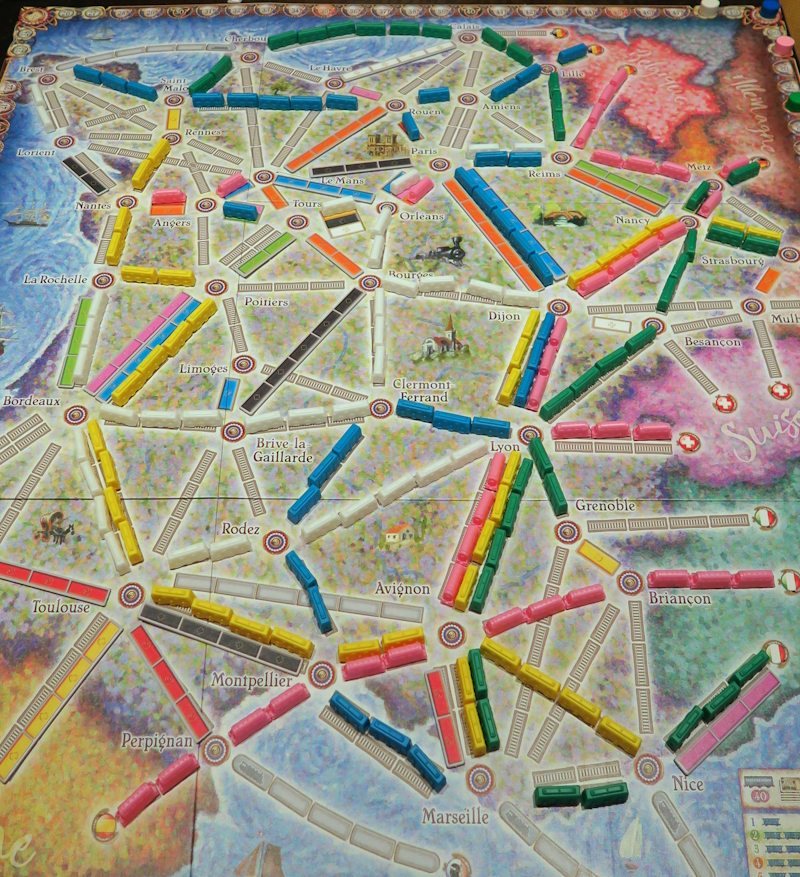
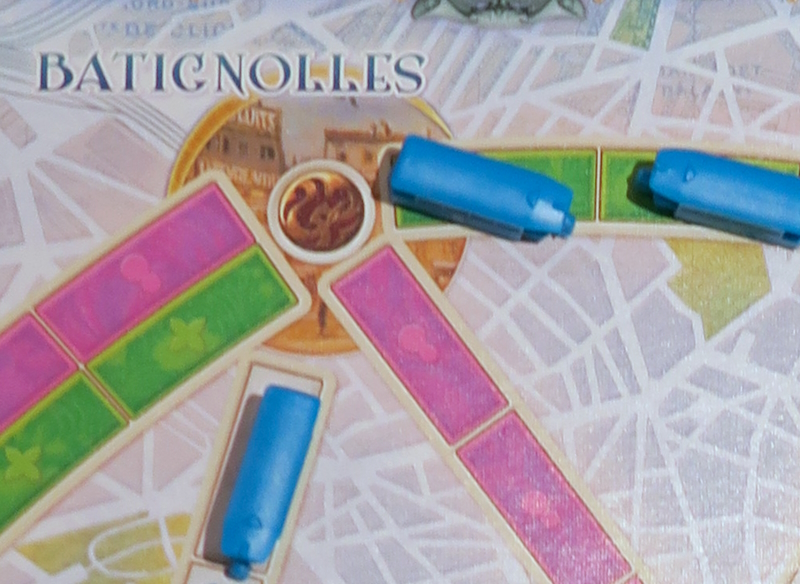
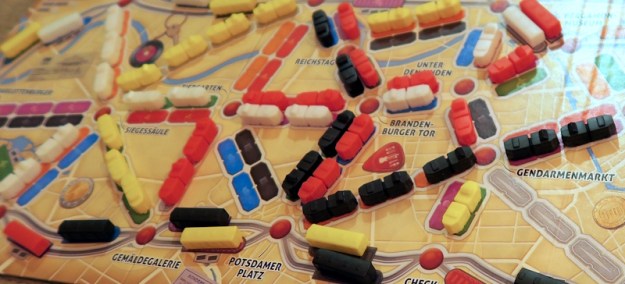
One of the small, “City Editions” of the popular, Spiel des Jahres winning Ticket to Ride games, we’ve played Paris quite a bit since it was released last year.  Following the same pattern as all its brethren, the game involves collecting coloured carriage cards and spending them to place metro carriage pieces on the board to connect regions of the city, while trying to also complete tickets.  Each edition has its own extra little rule, and in the Paris edition, this is centred on the colours of the tricolor.  When players build a red, white or blue route, they keep one of the cards, when they complete a set of three they discard the cards and claim bonus points.
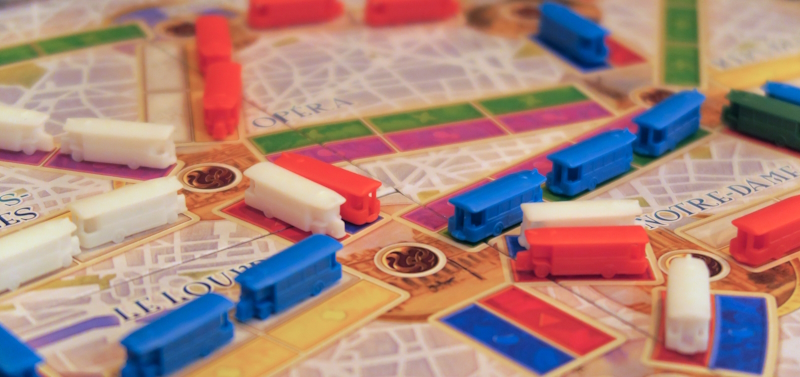
Ticket To Ride: Paris
– Image by boardGOATS

Purple started and game play was rapid.  Before long, players were running out of pieces, with Blake miles ahead of the other two.  But that was without the addition of scores for Tickets. Purple took got nine points for her three completed Tickets thanks to her misplaced bravery in picking up tickets at the end and not being able to complete her last one.  Cobalt took sixteen points for completing all four of his Tickets, though that was with a bit of jiggery pokery (i.e. retaking his last turn) in order to complete one ticket when he realised he had actually failed to complete it. It was therefore perhaps fair that Black who only scored ten points for completing his pair of tickets just managed to keep his nose in front, taking victory by a single point.
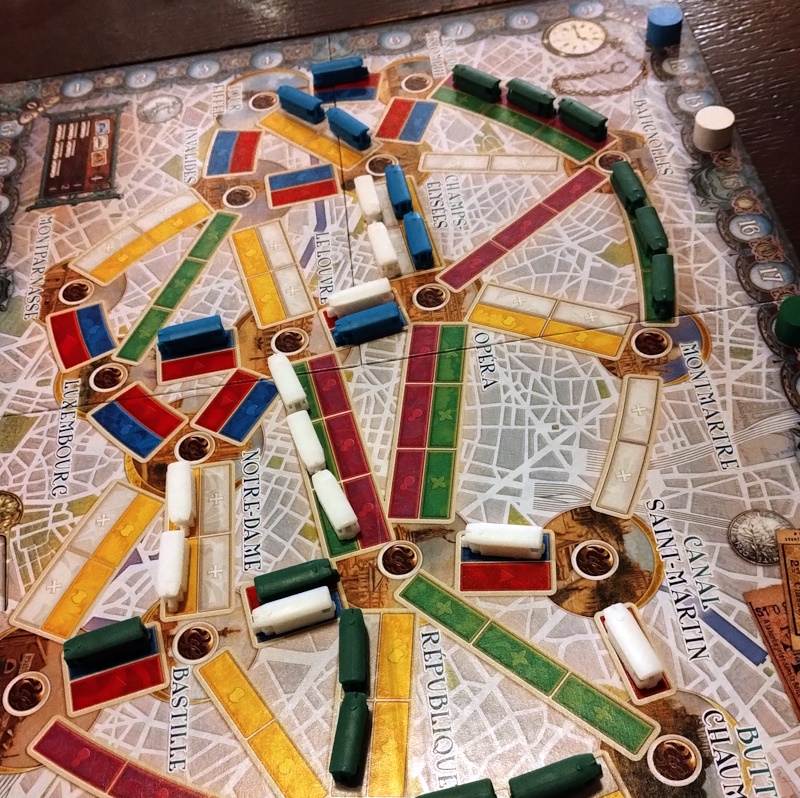
Ticket To Ride: Paris
– Image by boardGOATS

Learning Outcome:  There is something for almost everyone in the Spiel des Jahres lists.

27th May 2025 (Report)

This week, Jade was proactive and quickly got a group together to play the “Feature Game“, which was to be Flip 7.  This is a quick, push-your-luck card game along the lines of Blackjack and recently won a Golden Geek award and received a nomination for the Spiel des Jahres.  The group have already played it a couple of times on a Tuesday, but we wanted to raise its profile and share it more widely amongst our people by making it the Feature Game.  The idea is really simple:  players turn over cards and gamble on not revealing the same number twice.  Unlike Blackjack, the game is played turn-wise, so the the dealer starts by dealing one card to each player.  Then players take it in turns to decide whether they want to “flip” or ” stick”.

Flip 7
– Image by boardGOATS

This mode of play is critical to the game’s popularity because it keeps everyone involved and the turns short. If players stick, they score the total of the face value of their cards.  There are a couple of other things that make the game tick, in particular the fact that each numbered card appears in the deck that number of times (i.e there is one one, two twos and so on).  Thus, the highest scoring cards are also the most risky.  Further driving push to gample, flipping over seven cards in a row gives fifteen bonus points.  There are also some action cards in the deck, “Flip Three”, “Freeze”, “Second Chance” and modifier cards which give extra points, all of which break the rhythm and add interest without adding significantly to the downtime.
Flip 7
– Image by boardGOATS

The game ends when players have reached the pre-agreed total (two hundred, according to the rules, though games can easily be made longer or shorter as desired).  This time, the group played the game as written, to a total of two hundred, which took seven rounds.  Sapphire  and Flint managed to go bust five and six and seven rounds respectively, though Flint did manage to push his luck to get seventy—the most in a single round.   Jade achieved a new low, however, failing to score at all.  The front runner was Teal, but going bust in the sixth round left the door open to Ruby who had been matching him step for step, scoring in every round and triggering the end of the game with her unsurpassed two-hundred and thirteen.

Flip 7
– Image by boardGOATS

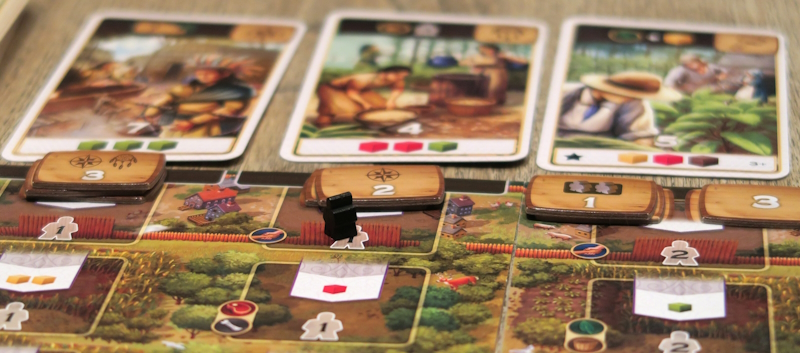
Everyone else was playing a longer game, so with six, that left the choice of another six player game or splitting into two groups of three.  The party feel of Flip 7 had got everyone in the mood for playing in a larger group, leaving a fairly limited choice, though there are a couple of really good options.  Bohnanza is one, but instead, the group chose Faraway—another game that received a Spiel des Jahres nomination this year, that we first played in the group over a year ago and has proved very popular since.  This is another relatively simple game, this time  with a market and a trick-taking type element, but with a really clever twist, and one that really messes with the head.

Faraway
– Image by boardGOATS

The story is that players are exploring the mysterious land of Alula in search of its secrets, meeting its inhabitants and listing its wonders in order to gain more fame than everyone else.  Players simultaneously chose one of the numbered cards from their hand to add to their tableau then, starting with the the player that played the lowest card (similar to 6 Nimmt! or Kingdomino), everyone takes it in turns to choose one from the market to add to their hand.  Players then simultaneously choose another card to play, and again, choose one to add to their hand.  The game ends after everyone has played a total of eight cards, and then everyone scores.

Faraway
– Image by boardGOATS

The scoring is the really clever part, because although the cards are played into tableaux from left to right, the scoring is from right to left.  At first glance, this looks like it makes things easy, because early in the game players find out what they need to get points and can then focus on getting the resources they need as the game progresses.  However, the desire to play scoring cards early is tensioned against card choice (the player who placed the lowest numbered card goes first) and the ability to get Sanctuary bonus cards.  Scoring cards are generally higher number and Sanctuary cards are gained when the card played has a higher value than the previous one in their tableau.

Faraway
– Image by boardGOATS

It is always hard to see how players are doing with this game, because if a player has played a high value scoring card early it can be worth a lot, but if the player fails to gain the necessary resources it can be worthless.  In the event, it was quite close with four of the six players scoring over sixty.  The winner, however, was Pink who got lucky early when he played card number fifty-nine first to start a map strategy and finished with five of them.  Sapphire was only two points behind in second though, and Teal two points behind that.

Faraway
– Image by boardGOATS

Meanwhile, on the other side of the room, Black and Purple were introducing Pine to Looot, another game that received a nomination, this time for Kennerspiel des Jahres, the “Expert” or “Connoisseur’s” game.  This is a game where players gather resources and capture buildings to develop their fjord, fill their Long Ships and complete buildings to rack up victory points. The player with the most riches is crowned Jarl of the Vikings.  The game is played over several rounds until each player has played all their Vikings, giving a maximum of thirteen turns.  In each, a player first places their Viking on a Resource tile on the central board adjacent to another Viking of any colour and takes the Resource and place it on their personal board.

Looot
– Image by boardGOATS

If possible, they then capture a Building and place that on their board, take a Long Ship and also place it on their board, use a Shield, complete a Construction Site and finally grab a Trophy.  At the end of the game, scoring is a bit of a point salad with points awarded for Castles, Watchtowers, Houses, Gold, Sheep, Trees, Construction Sites, any Trophies the player may have claimed and a five-point penalty for any unfilled Long Ships.  Purple raked in points for her Houses, Construction Sites and Trophies, while Black did better for his Watchtowers and Gold, and Pine top-scored for Trees.  The winner, however, was Purple whose total of ninety-one was five ahead of Black in second.

Looot
– Image by boardGOATS

The trio followed this with a shorter game, the Paris version of the 2004 Spiel des Jahres winner, Ticket to Ride (aka Zug um Zug).  Like the original, game-play is very quick and simple:  players take it in turns to take Cards from the market, or spend them to place Trains on the map with the aim of completing Tickets.  Players score points for placing Trains and completing Tickets with penalties for any incomplete Tickets.  Each game variant has its own special rules.  In the case of Paris, when players score bonus points each time they complete a Tricolor: a set of blue, white, and red routes.  This time it was a very close game.  Pine had the most points collected during play (including Tricolors), but Black picked up more for his Tickets and edged it by a single point.

Ticket To Ride: Paris
– Image by boardGOATS

The final game of the night took all evening and was the only one that that has not had a nomination for the Spiel des Jahres, Century: A New World.  This is the final game in the Century Trilogy (preceded by Spice Road, Eastern Wonders), but as they all use some of the same components, Plum and Byzantium had managed to squeeze all three games into one box (with an extra set of cubes so two could be played at once).  In A New World, players are exploring the Americas at the dawn of the 16th century trading with local inhabitants, recording their findings, and hunting and gathering to survive.

Century: A New World
– Image by boardGOATS

The game uses the resource trading mechanisms (Collect, Upgrade and Exchange) found in the rest of the Century series, but instead of using cards as in Spice Road, this is combined with with a worker placement mechanism.  On their turn, players can either Work (place Workers) or Rest (retrieve Workers).  Workers can work at Locations that have neither an Exploration tile nor Workers of their own colour.  If a Location is vacant, they can activate it by placing the number or workers depicted on the space; if it is occupied, the current occupants must be evicted and returned home by placing one extra Worker.

Century: A New World
– Image by boardGOATS

There are four locations types, thee allow players to Collect, Upgrade and Exchange Resource cubes, while the fourth (Forts) allows them to use Resources to claim Points Cards and Bonus Tiles.  Players can only have a limited total number of Bonus Tiles, and can only claim the Points Card associated with the particular Fort.  These Cards are supposed to slide along a conveyor belt so that they move from one Location to another, but thanks to a rules malfunction, this time the didn’t until more than halfway through the game.  The game finishes when one player has their eighth Points Card, so it can end quite suddenly, as players can pick up cards quit quickly due to special powers.

Century: A New World
– Image by boardGOATS

These games are basically race games, and it felt like Byzantium had a good start with points from his Exploration tiles, the only one to have any.  However, as Plum built her engine, she galloped up on the rail, ultimately taking the most points from her Cards. She also took the most points from Bonus Tiles.  In such a tight game, left over resources were critical and they enabled Cobalt to leap-frog Byzantium into second.  Plum was the winner, though by just two points.  It had been fun, though Plum’s comment that she actually preferred the second of the trilogy meant Blue who had not played it would take the opportunity to grab a copy at the UK Games Expo Bring and Buy a couple of days later.

Century: A New World
– Image by boardGOATS

Learning Outcome:  The Spiel des Jahres Jury can spot a good game.

10th December 2024

Everyone had already arrived and was waiting in anticipation when Blue and Pink arrived with piles of gamers crackers, Christmas tree decorations, party poppers, paper parcels, mince pies, festive cakes (with carrot meeples on top) and GOAT Award voting forms.  Food quickly followed along with a volley of noise as people tried to pull their crackers and party poppers first so the contents didn’t land in their supper.  As people munched, there was some discussion about the games played and voting forms were filled in.  In the absence of Green, Pine kindly offered to act as returning officer and collate the statistics.

"Un-Christmas Party" 2024
– Image by boardGOATS

While cake and mince meat parcels were shared round, toasts were offered by Lime to the organisers, and in the memory of Burgundy.  He is much missed and will never be forgotten, but we always make a special point of remembering at this time of year, especially as the Un-Christmas Dinner was his last games night with us.  The GOAT Awards were then announced.  Moment of the Year was when Pine got the end game rule wrong for Tonga Bonga, so that Pink thought he’d won, but then didn’t.  The GOAT Poo Prize for the least popular game of the year went to Ca$h ‘n Guns—not a game the group plays often and its only outing over the last year was at the New Year Party.

"Un-Christmas Party" 2024
– Image by boardGOATS

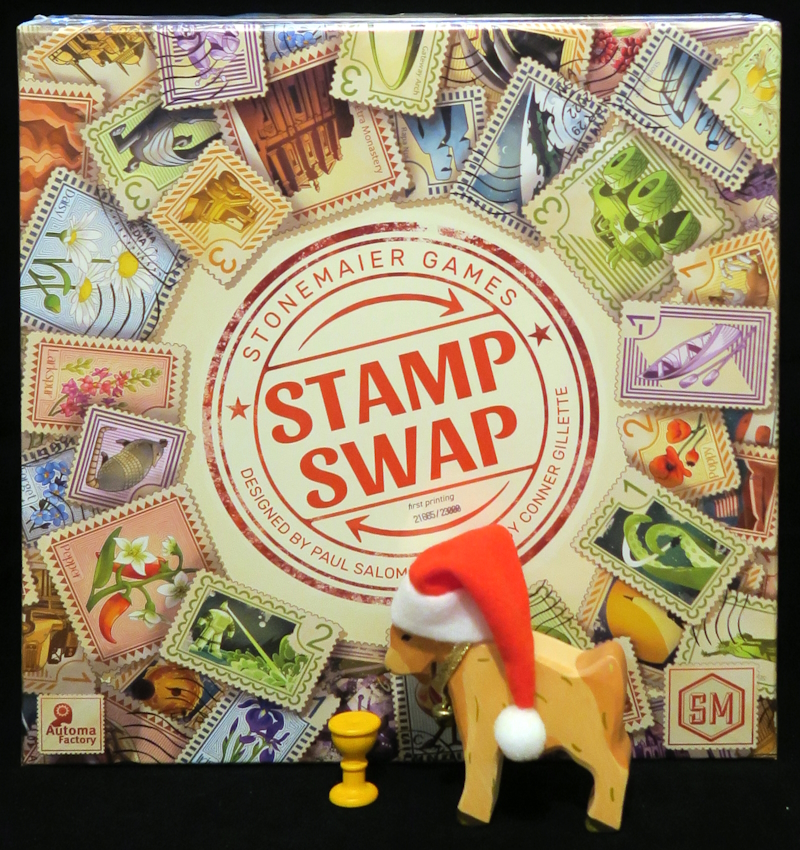
Then it was time for the Golden GOAT.  Previous winners were ruled out, but other contenders included Akropolis, Kavango, Flamme Rouge and Ticket to Ride: Rails & Sails.  The clear winner of the 2024 Golden GOAT Award, however, was Stamp Swap.  There was much discussion about how this was the third winner from Stonemaier Games (after Tapestry last year and Wingspan in 2019) and how we should invite Jamey Stegmaier, to collect the award in person.  Email correspondence over the following few days suggested that while it was unlikely he would be able to come to GOATS, he will be in the UK next year and just might make it as far as Oxford.  In the meantime, he has highlighted the award on his website.

Golden GOAT - 2024
– Image by boardGOATS

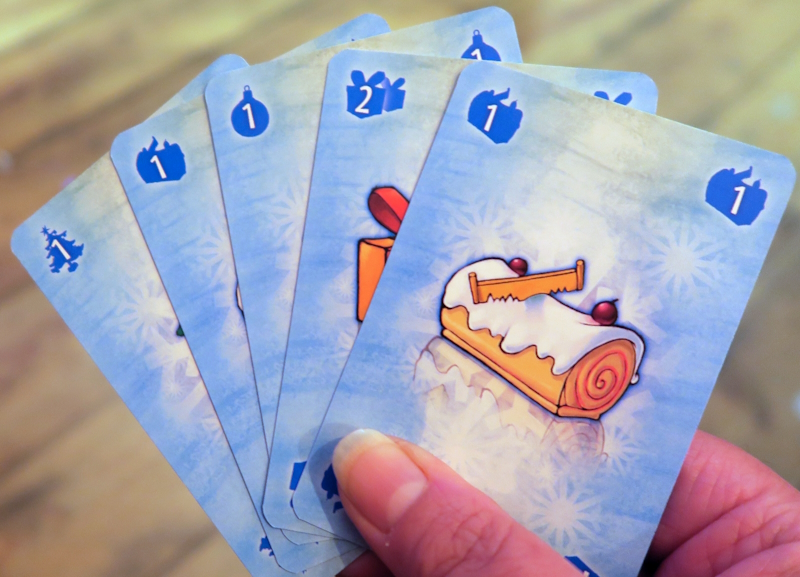
With the festive business over, the group broke into three to play some games.  Pink, Blue, Black and Jade began with the “Feature Game“, Courses De Rennes (aka Reindeer Races), a fun little game where players control a team of four reindeer, racing along four different tracks to try to get the highest-scoring tiles.  On their turn, each player can either draw two cards (with a hand limit of seven) or play as many cards of the same type as they can to move one reindeer along one of the tracks.  The cards are numbered and have suit that corresponds to one of the tracks (or are Elfy, and “wild”).  If two and a three of Gifts is played, the player may move one of its reindeer along the Gift track.

Course des Rennes
– Image by boardGOATS

If a reindeer lands on the same space as another reindeer, it slides forward a space.  If that is occupied too, it continues to slide.  If, however, the owner cries “Thump!” as it lands, the reindeer slithers an extra space forward.  The first reindeer to arrive at the end of a track claims the highest value token.  The game ends when two of the tracks have run out of tokens.  Pink too the first points, and with it a strong early lead.  A few rounds later, Jade took the last token from one of the tracks and with it ended the game.  He got very unimpressed looks from Black and Blue as he gifted victory to Pink, so once this was pointed out, Jade revised his move and play carried on.

Course des Rennes
– Image by boardGOATS

Ultimately, however, it didn’t really change things as Pink still took victory with twenty-two points.  He was long way clear of Jade who won the tight fight for second with fifteen just one point ahead of Black who, in turn, took third by a single point.  Everyone else was still playing, so the group looked for something else to play.  Black had won a copy of Ticket to Ride: Paris in the raffle and, although it wasn’t very festive, it seemed appropriate to give it an outing.  Some of the GOATS had played this mini-city variant of the popular train game earlier in the year when we marked the Olympics with sport and France themed games.  However, none of the current quartet had been part of that group.

Ticket To Ride: Paris
– Image by boardGOATS

The rules are much the same as all the others (take two cards from the market; play cards to place pieces on the map; collect Ticket cards to score points at the end), but like all the variants, Paris has a special rule.  When players claim a red, white, or blue track, they get a card, when they get all three colours they get four “Tricolore” bonus points.  When the game first came out, there had been comments about how this felt very bolted on, but in practice, it was much more interesting than it sounded.  This time, the in game scoring was quite tight, though Blue, with her trains across the city centre got her nose in front and led by six points.  Tickets can make a huge difference to scores though, as they can give a lot of points, both positive and negative.

Ticket To Ride: Paris
– Image by boardGOATS

Black, Pink and Jade all picked up similar points for their completed Tickets (ten, eleven and eight respectively), though Jade was unlucky and unable to complete his last one.  Blue, however, made good use of concurrent routes and scored a massive twenty-four points for hers giving her something of a landslide victory with a total of forty-six.  It was much closer for second which went to Pink who finished with twenty-nine, two points ahead of Black.  Meanwhile, on the other side of the room, Purple was leading Ivory, Plum and Byzantium in one of her favourite Christmas themed games, Christmas Tree.

Christmas Tree
– Image by boardGOATS

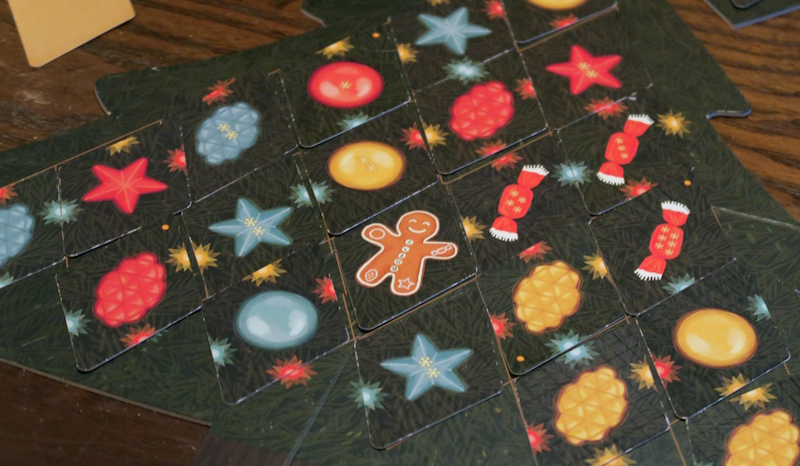
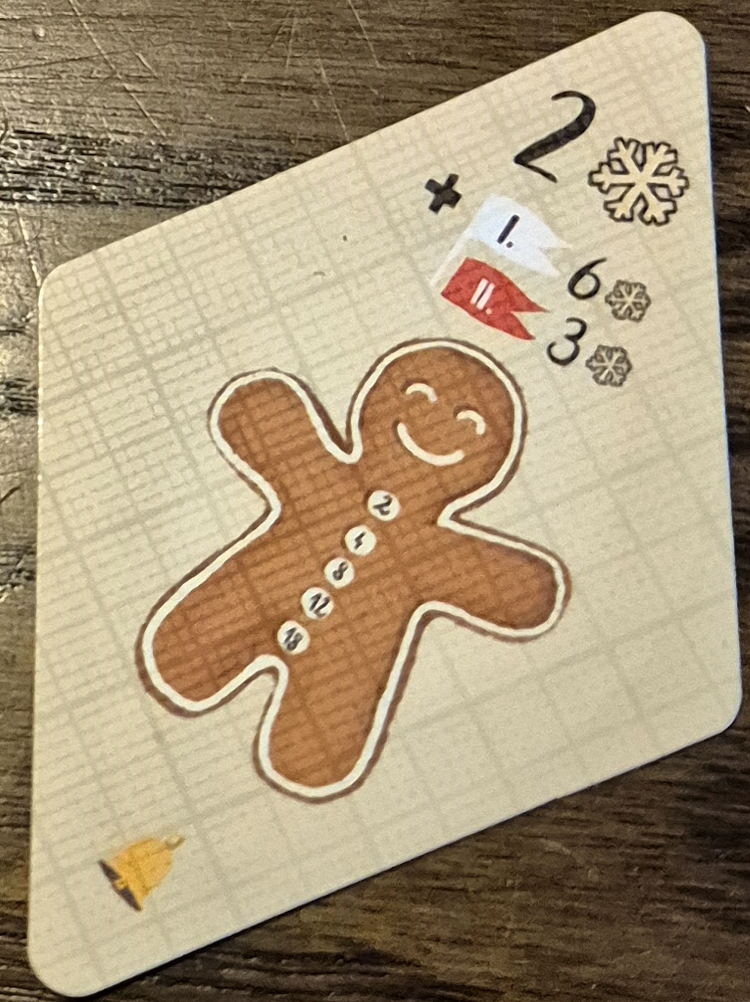
This is a fairly simple little card-drafting game played over thee rounds, where players are “decorating their Christmas Tree” with diamond-shaped cards, where players score points for the Objective cards everyone contributed to a central pool at the start of the round.  This time, the group played from the advanced set of Objective cards (including all three levels) although the first round, the cards were all levels one and two.  These gave one point for each blue or “nobbly” ornament, four points for each pair of ornaments of the same colour and shape arranged in a vertical pair and six points for three specific shapes in a given arrangement.

Christmas Tree
– Image by boardGOATS

The first round started off slowly with everyone looking to fulfill some of the Objectives—everyone was successful, but Plum and Byzantium got off to a better start.  Plum placed her first Gingerbread man and then concentrated on placing vertical pairs although she only managed that once.  In the second round the Objectives were from the more complicated sets, including six points for three specific colours in a given arrangement, six points for the same three shapes or colours in a set pattern, or eight points for four ornaments with the same point value arranged in two set formations.  This time, Byzantium significantly out scored everyone with multiple objectives scored multiple times and, as a result, built a big lead.

Christmas Tree
– Image by boardGOATS

Plum used one of her Biscuits to move baubles around to make a row of four contain the three colours of glass bauble.and thus scored well, whereas Ivory was focusing on picking up high value Sweets and surrounding his Gingerbread men.  The final set of Objectives included six points for a set arrangement of certain point values, eight points for four ornaments with the same point value arranged in a particular arrangement and five points for each row in which the total points of the glass were above the given amount. Finally, there were two points for each Gingerbread man, with bonuses of six and three points for the player with the most/second most Gingerbread men.

Christmas Tree
– Image by boardGOATS

In the third and final round, Byzantium again out scored everyone, scoring multiple times for the set arrangement of certain point values.  At this point, Ivory was full committed to Sweets and Gingerbread men, especially knowing he was putting in the Gingerbread man Objective, which he scored well for.  Plum and Purple also scored well in the final round, with Plum following a strategy similar to Byzantium, whereas was Purple was collecting sweets like Ivory.  It looked like Byzantium was going to win by a large amount, as he was fifty points ahead of everyone else and was scoring more than anyone else for Lights and Baubles too.

Christmas Tree
– Image by boardGOATS

Ivory’s focus on surrounding his Gingerbread men gave him over fifty points and with more than thirty for his sweets he finished with one hundred and seventy one points, pipping Byzantium to victory by just two, with Plume in third some twenty points adrift.  The puzzly nature of the the game had gone down well and with the Christmas theme everyone had enjoyed playing Christmas Tree.  On the next table, the festive link was much more tenuous, however.  Teal, Pine, Sapphire and Indigo had chosen 6 Nimmt!, because there was a twelve in it, representing the Twelve Days of Christmas (or perhaps they had just wanted to play the game and if you can’t play a daft party game at Christmas, when can you?).

6 Nimmt!
– Image by boardGOATS

6 Nimmt! is a popular game with the group at any time of year, though it is usually played with more than four people.  Either way, the game is very simple to play, though tough to play well.  Some say this is because there is a lot of chance in the game, but they are usually the people who do badly…  The idea is that players simultaneously choose a card to play and these are then added, in order, to the rows of cards on the table.  The player adding the sixth card, instead, takes the first five cards into their scoring pile.  Usually, we deal out half the cards for the first round and the rest for the second and the winner is the player with the fewest “nimmts” (or points), at the end of the two rounds.

6 Nimmt!
– Image by boardGOATS

This time, however, the group decided to play the multiple-hand variant where each hand has ten cards, and the game ends when someone’s score passes sixty-six.  And that was Sapphire, who finished with an exceptional total of ninety-five.  The winner was Teal with forty-four, however, who was just two points better off than Pine.  The other games were still ongoing, but there was still time for one last game for this group (who were joined by Navy) before everyone went home warmed by the Christmas Gaming Spirit—and their choice of game was Coloretto (apparently this is a  festive game because it includes red, green and gold Chameleons).

Coloretto
– Image by boardGOATS

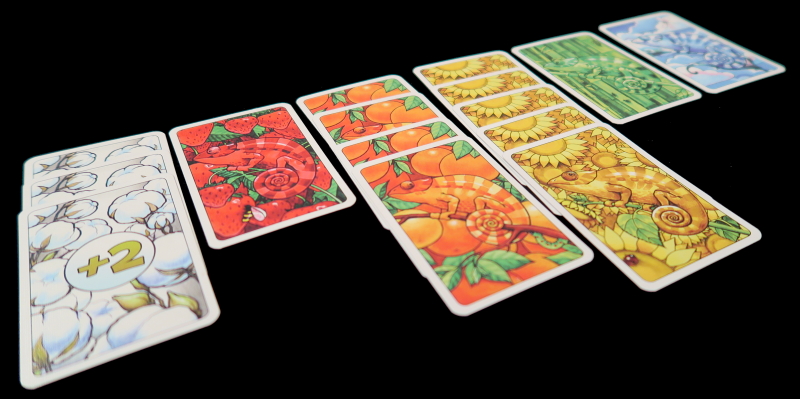
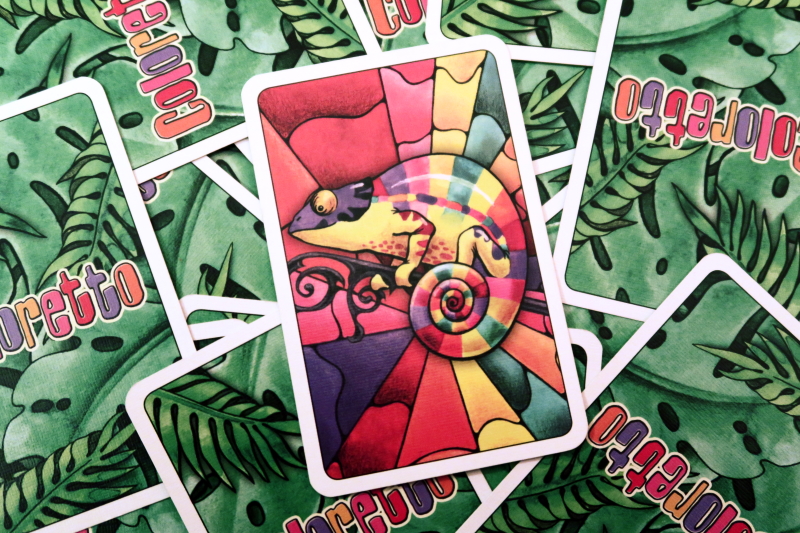
This is another simple filler game, where players either take a card and add it to a truck, or take a truck.  Each truck can take a maximum of three Chameleons, with players collecting coloured sets.  The largest three sets score positive points (according to the Triangular Number Series), while all the others score negative points.  In this way, the bigger the series the more additional cards will score, so the aim is to collect three large sets and ensure the others are as small as possible.  This game was really tight, with Sapphire claiming victory with twenty-seven and Teal and Indigo tying for second on twenty-four.  And with that, people began to drift off, many not to be seen until 2025.

Coloretto
– Image by boardGOATS

Learning outcome:  GOATS love a Cracker!

6th August 2024

Blue and Pink were just finishing their supper when Pine arrived, soon followed by the rest of the posse.  Despite missing Ivory, Teal and Cobalt, we still made it into double figures and everyone was particularly pleased to welcome back Green who has been missing in action for most of the year.  Jade had declared an interest in giving the France map for Ticket to Ride a go.  Ticket to Ride is always popular, so he quickly gathered Sapphire, Pine, Lime and Pink to make an enthusiastic group of five.  He explained the rules differences, to comments of, “Lizen very carefully, I shall say zis only once!”

Ticket to Ride Map Collection: Volume 6 – France & Old West
– Image by boardGOATS

Ticket to Ride is well known in the group and the basic rules needed no explanation (take cards from the market, or use them to claim routes while trying to complete Tickets).  All the maps have their own little unique tweak to the rules.  In the case of the France map, most of the tracks on the board start “uncoloured”.   Whenever anyone draws cards, they take a colored tile that’s two to five train cars long, and place it onto an uncoloured track bed.  After that, any player can claim that route in the usual way (by paying the appropriately coloured cards from their hand).

Ticket to Ride Map Collection: Volume 6 – France & Old West
– Image by boardGOATS

Although anyone can claim a route “coloured” by another player, this time, in practice, most people didn’t build on tracks placed by others.  This was partly because messing with someone else’s plans is usually at the expense of your own, but also because of the “mutually assured destruction” effect—that is to say, interfering with someone else is likely to encourage them to do the same in return.  So on the one occasion when Pine DID “steal” a route that Sapphire had set up, everyone (especially Sapphire) was really shocked! Pine and Sapphire both picked up tickets in the very closing stages of the game and both got very lucky with the tickets matching the routes they had already built.

Ticket to Ride Map Collection: Volume 6 – France & Old West
– Image by boardGOATS

The game was quite close and relatively high scoring, with all five finishing in a twenty point range, but that was before bonuses.  With the France map, there are two bonuses:  ten points for the longest continuous route and fifteen points for the player with the most completed tickets.  With seven, Pine had the most tickets and leap-frogged Jade and Pink (who was playing with his pink “Cancer Awareness” train set), into third place.  That left Lime and Sapphire, but with Sapphire taking the longest route bonus, he finished with a hundred and twenty-nine points, extending his lead over Lime to fifteen points to give him a comfortable victory.  It had been a really enjoyable game, however, so much so that Jade and Sapphire added it the France map to their wish list.

Ticket to Ride Map Collection: Volume 6 – France & Old West
– Image by boardGOATS

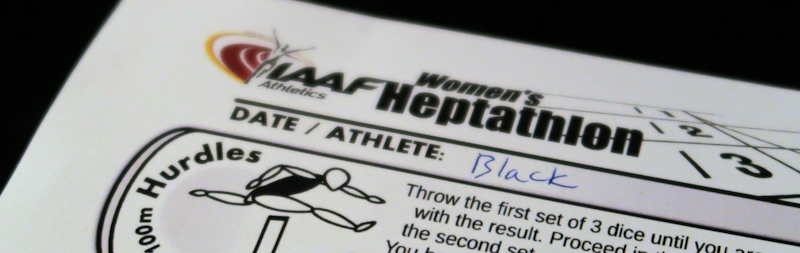
At the other end of the table, that left Blue, Plum, Green, Byzantium, Purple and Black.  Nobody seemed keen to play the “Feature Game” (which was to be Montmartre), partly because that would have required splitting into two groups.  Instead, inspired by the Olympics, the group opted for the Heptathlon variant of Reiner Knizia’s Decathlon.  Decathlon is a print-and-play game consisting of a series of ten different, mostly push-your-luck, dice games loosely themed around the ten sports featuring in the Olympic event.  The Heptathlon Variant is slightly shorter and is based on the women’s equivalent.

Reiner Knizia's Decathlon (Heptathlon Variant)
– Image by boardGOATS

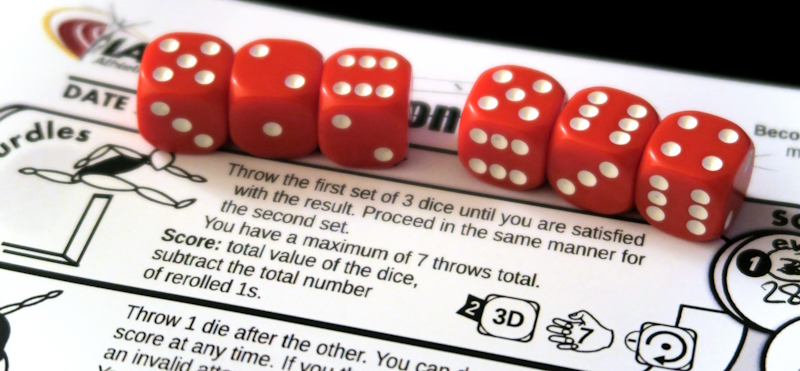
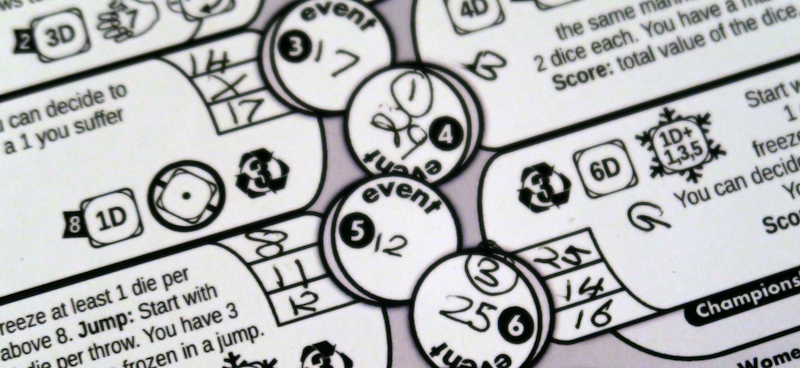
Normally both variations are played with a maximum of four, but this time, the group played the “Championship Variant” where players play together and the winner of an event scores three points, the runner up gets two points and the person placing third gets one point.  The rules say that tied players get the better rank, but the group used count-back to break ties in the first instance.  Blue had brought an enormous pile of printouts and Las Vegas, from which the group got the dice, and started, slightly tentatively with the 100 m Hurdles.  In this game, players have two sets of three dice and throw one until they are happy then throw the other with a total of seven tries.  The catch is that each “one” that is re-rolled scores minus one.

Reiner Knizia's Decathlon (Heptathlon Variant)
– Image by boardGOATS

Green went first and achieved a total of twenty-three.  By the time he had finished though, everyone had got bored watching someone else roll dice and had got on with their own.  It was then that the group realised that, as the 100 m Hurdles was a race, rolling simultaneously was more in keeping with the theme.  Blue crossed the line first (with twenty eight) followed by Byzantium and then Green.  And it was on to the High Jump, a much simpler game where players rolled five dice together to achieve an ever increasing total (with three attempts at each height).  Purple was the first out, failing to achieve eighteen, followed by Blue at the next height.

Reiner Knizia's Decathlon (Heptathlon Variant)
– Image by boardGOATS

The “springiest” was Plum, who sailed over twenty-two, but failed at twenty-four.  She actually tied with Green, but beat him on count-back, with Byzantium taking third.  Next was the Shot Put, where players roll eight dice, one at a time, with a one being a fault.  Players can stick whenever the like, but because of a rules malfunction, the group only played with a maximum of six dice.  The best score after three attempts was again Plum with Black in second and Blue in third.  From here the games got a bit more complex, starting with the 200 m Sprint, which was played with eight dice rolled in a group of four dice, followed by two rolls of two.  Players have a total of eight throws and sixes count negatively.

Reiner Knizia's Decathlon (Heptathlon Variant)
– Image by boardGOATS

Plum tripped over her own feet (or maybe Byzantium tied her laces together), but Green demonstrated a remarkable turn of speed to cross the line first, followed by Blue and then Purple.  More than half-way through, it was a three-way tie between Blue, Green and Plum and others not far behind.  So, the second day started with the Long Jump, a five dice game played in two parts.  First there was the run-up, which dictates how many dice the player gets to use for the actual jump.  For the run-up, players roll all five, freeze at least one and roll the rest, but if the total exceeds eight, it is a foot-fault.  Then, for the jump itself, players use the frozen dice and roll all of them, again freezing at least one per throw.

Reiner Knizia's Decathlon (Heptathlon Variant)
– Image by boardGOATS

The best total after three attempted jumps was Byzantium’s twenty-seven.  Green’s turn of speed obviously helped him as he came second while Blue and Plum tied for third, but Plum took the honours thanks to her second longest jump.  Staying in the field, the next and penultimate event was the Javelin.  This six dice game involved players freezing at least one die per turn, but this time only odd dice could be kept.  Green’s first throw threatened to skewer one of the stewards, and things didn’t get much better from there.  Black faulted on his first throw, but was consistent with his second and third taking third with twenty-two.

Reiner Knizia's Decathlon (Heptathlon Variant)
– Image by boardGOATS

First and second went to Purple and Byzantium (respectively), with both failing to improve on an excellent first attempt.  So, going into the final event, the 800 m Race, most people were going for Gold, while everyone was in with a chance of a medal.  This race was an eight dice game with players rolling two dice, then two dice and then the four remaining dice one at a time.  Players have a total of eleven rolls (i.e. just five re-rolls) and the player with the highest total wins, but with the catch that sixes count negatively.  It was a tight race, but Blue crossed the line first which put her in gold medal position, just until Green crossed the line in second and overtook her.  Purple took third, but for her it was too little, too late.

Reiner Knizia's Decathlon (Heptathlon Variant)
– Image by boardGOATS

So, stood on top of the final podium with his gold medal round his neck, Blue with silver and Byzantium who took bronze just ahead of Plum and then Purple, stood either side.  It had been a lot of fun though, and as people often say, it is the journey that counts.  The games have a bit of a feel of Ganz Schön Clever/Doppelt So Clever/Clever Hoch Drei, but sort of stripped back to their raw essence.  The individual events were quite simple and with a sheet each, players could keep their own score and recheck the rules as required.  The questions, “Do I stick or keep going, what have other people done, and do I need to gamble to win?” in a large group add interest, and everyone enjoyed it so much that there was no difficulty getting people to take home the left-over sheets.

Reiner Knizia's Decathlon (Heptathlon Variant)
– Image by boardGOATS

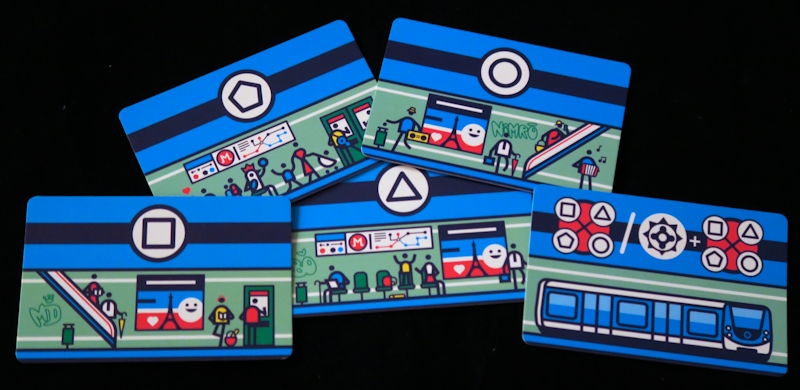
From there, the group of six split into two groups of three and everyone moved from athletics themed games to Paris themed games.  With the best will in the world, there wasn’t time to play Paris, so Blue promised to bring it again another time, and they opted instead to stick with “Roll and Write” type games in the form of Next Station: Paris.  This is the latest variant on Next Station: London, a simple little route planning game with a really clever twist.  The idea is that each station has one of five symbols; a card is turned over depicting one of these symbols and players must extend their route by connecting one end to a station with this symbol without crossing an existing track and following the grid shown on the map.

Next Station: Paris
– Image by boardGOATS

At the end of each round, players score for the number of Districts visited multiplied by the number of Stations in the most visited District.  At the end of the round players get bonus points for Interchange Stations (where two or more lines meet).  However, like the Ticket to Ride maps, each each city comes with a slight variation to the rules as well as a different arrangement of stations.  In London, players score points for crossing the Thames and for the total number of Visitor Attractions visited during the game.  In Paris, these are replaced with scores for visiting Parisian Monuments at the end of each round and using the level crossings marked on the map.

Next Station: Paris
– Image by boardGOATS

The clever part of the game is the fact it is played over four rounds, but each round is played with a different coloured pencil with players swapping pencils between rounds.  This means that while everyone gets the same cards in the same order, they start in different places so are forced to do different things (unlike for example, NMBR 9, where players often play the first few rounds the same).  The Paris version is supposed to be easier than the London variant, but as nobody had played it before, everyone struggled at the start.  The trick though, is, for each line, players need to try to get the same number of Districts as Stations in the most visited District.

Next Station: Paris
– Image by boardGOATS

This is similar to the mechanism in Orléans, where players receive victory points equal to their position on the Development Track multiplied by the number of Trading Stations they have on the map plus the number of Citizen Tiles they have collected.  In both cases, players want these numbers to be as large as possible to give the biggest total.  It is more important that both are significant, however, rather than having one large and one small.  For example, a two times three gives more than one times four, thus it is important to concentrate on both parts equally and not neglect either one of them.

Next Station: Paris
– Image by boardGOATS

Although nobody had played a “Next Station” game before, Blue explained the rules and had got her head round this element of the scoring, where it took the others a little time to get to grips with it. The game suited Plum’s puzzle brain and she liked trying to see where she might get to the level crossings and so on. By the third line, both she and Byzantium were beginning to get the hang of thing (or perhaps the cards just came out better) and then for the final round everyone found their space was more restricted.  It was very close, but Blue’s consistency throughout just gave her the edge and victory by a mere five points.

Next Station: Paris
– Image by boardGOATS

Meanwhile, Green, Black and Purple opted for a quick game of the Paris version of Ticket to Ride.  This is the newest of the smaller, city versions of the game, and one that had not been played within the group hitherto.  In general, these play exactly the same way as the bigger ones, but have fewer pieces and shorter tracks (so play a lot quicker) and have a little rules tweak to keep people interested.  There had been a little bit of chat about it as people arrived and Blue, who had only read the rules was quite scathing about the new rule which felt very bolted on, and as there are now several of these little games, there were comments about the sound of barrels being scraped.

Ticket To Ride: Paris
– Image by boardGOATS

The new rule is that when players claim a red, white, or blue track, they get a card, when they get all three colours they get four “Tricolore” bonus points—this didn’t feel terribly imaginative.  After the game, however, Green commented that it was much better than it sounded.  After he had completed his starting Tickets, he realised they only gave low points, so rather than taking more, he opted to go for Tricolore bonus points instead as the red, white and blue Routes are all short making them easy to get (one, two and one carriage long respectively).  Simpler to achieve than extra Tickets they give an extra four points, though Green only got a total of two Tricolores.

Ticket To Ride: Paris
– Image by boardGOATS

Black and Purple only took one Tricolore each as they were using it as a bonus rather than a target, so missed out on a few opportunities by laying trains on a colour they already had a card for.  In the dying moments of the game, Purple took Tickets—of course she had no way of knowing that Green was about to trigger the final round, but even Black commented that it was a brave move.  And Green ended the game on his very next turn, leaving poor Purple with a couple of uncompleted Tickets.  That extra four point Tricolore bonus Green had taken made all the difference in the final scoring as that was the margin of his victory over Black.

Ticket To Ride: Paris
– Image by boardGOATS

As Green went home (along with Jade, Sapphire, Byzantium and Plum), they passed the copy of Ticket to Ride: Paris along the table to Lime, Pine and Pink who also fancied giving it a go.  They concurred that the Tricolore Bonus was much better in practice than it sounded.  This game was also quite tight with six points between the first and last.  Lime was particularly peeved however, as Pink edged him out by a single point.  With that, and some residual chatter, it was time for home and everyone slowly drifted off.

Ticket To Ride: Paris
– Image by boardGOATS

Learning Outcome:  When you take away the sport, you still have France.

31st October 2023

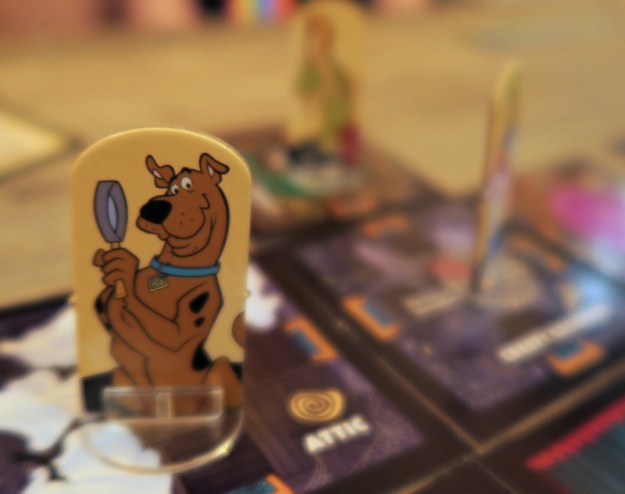
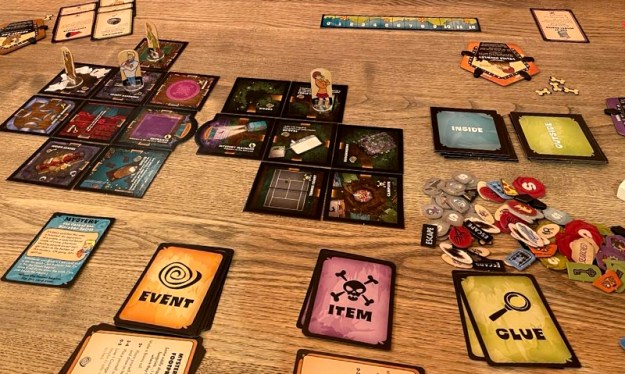
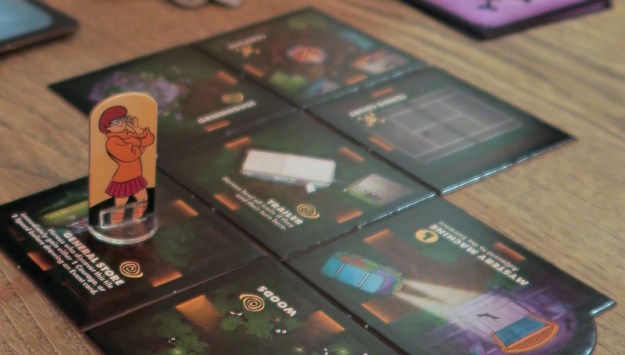
With it being Halloween, there were lots of treats and some very fine spooky-themed attire to go along with the “Feature Game“, Betrayal at Mystery Mansion.  This is a Scooby-Doo themed re-implementation of Betrayal at House on the Hill, a semi-cooperative game, where players work together until there is a haunting and one player takes on the role of the bad guy.  So, the first task for the evening was to decide who was going to take on the roles of Mystery Inc., which precipitated lots of discussion about which was the best character.  Scrappy got short-shift from Pink, though others were less dismissive.  In any case, Scrappy was not an option, and before long, Sapphire, Pink and Pine joined Jade to solve the mystery.

Betrayal at Mystery Mansion
– Image by boardGOATS

Jade, as the group leader, took the role of Fred, while Pink and Pine enthusiastically engaged in the game as Scooby Doo and Shaggy.  That left Sapphire to choose from Velma or Daphne and he went for brains over bimbette.  The group spent quite a bit of time exploring the mansion collecting clues and the like, before the haunt finally started.  As Sapphire was the one to trigger the haunt, Velma was “temporarily lost in the woods” as he took on the roles of the bad guys, a Spectre and a female character called Sharon who was being possessed and controlled by the Spectre.  As the game progressed, it became apparent that the Spectre was her great uncle who was trying to control her to gain access to documents that would enable him to take control of the family fortune.

Betrayal at Mystery Mansion
– Image by boardGOATS

The Scooby Gang (minus Scrappy Doo, Daphne and the now lost Velma) had to track down and battle the Spectre and try break the spell controlling Sharon.  As the villain, Sapphire rolled very well and it was very hard for the Gang to pin him down.  Fred ended up stunned at one point, but thankfully revived after missing a turn.  Shaggy scoffed piles of Scooby Snacks in order to re-roll, but the dice weren’t with him.  Scooby himself, however, did very well and survived his battle with the Spectre then was able to recharge in one of the special rooms of the mansion.  In the end the Mystery Inc. won the day and the great uncle was unmasked and announced that he “would’ve gotten away with it if it weren’t for you pesky kids”!

Betrayal at Mystery Mansion
– Image by boardGOATS

Meanwhile, there were two other games underway on the neighbouring tables.  Blue, Plum and Byzantium eschewed Witch’s Brew (which plays better with more people) and opted for the slightly bigger, beefier, boardgame version of the same game, Broom Service.  Both games rely on the players having a personal deck of Character cards and a lead and follow mechanism.  Each player starts by choosing a set number of Characters from their deck, each with different actions.  The first player then chooses one to lead with and announces that they are either “Brave” or “Cowardly”.  If they choose Cowardly, they can take the action straight away, whereas, if they choose Brave, they must wait until everyone has played to see if they can take the more powerful action.

Broom Service
– Image by boardGOATS

The next player must follow if they have the card in hand, and has the same decision to make—be a Coward and take the weaker action, or be Brave, and risk being gazumped by a later player, as there can only be one Brave player taking the powerful action.  The Brave player (or the most recent Brave player) then leads with another card.  In the card game, Witch’s Brew, players are collecting tokens to give them points, however, in Broom Service, there is an additional “Travelling Salesman” pick-up and deliver type of mechanism.  Players have two Witch-meeples which travel the land collecting potions and delivering them locations to get points.  This time, it was a really, really close game, despite everyone doing different things.

Broom Service
– Image by boardGOATS

Byzantium prioritised collecting Lightening Bolts and Blue concentrated on collecting potions and delivering them.  While they both headed south and contrived to get in each-other’s way, Plum headed north and fell foul of one of the events which left her stuck with no good move in the final round.  Blue kept forgetting about the “Bewitched Roles” which can be used but with a hefty three point penalty and lost six points as a result.  Byzantium assumed he would be the only one to consciously choose to take the hit and thus guarantee he could be Brave, but happened to do that exactly when Blue picked them as well and lost the advantage when he led with those roles.

Broom Service
– Image by boardGOATS

As the game came to a close, it was clear it was going to be close with Blue ahead by a single point with sixty points scored during the game.  She lots of resources left while Byzantium had none but lots of Lightening Bolts, and Plum had some of both.  Initially, Blue and Byzantium tied with seventy-three, just two points ahead of Plum.  That gave Blue victory with the tie break (the most left over resources), but that was only until the miss-count was spotted and Blue lost one point and with it her Winning Witch Medal, instead taking second place by a single point.

Broom Service
– Image by boardGOATS

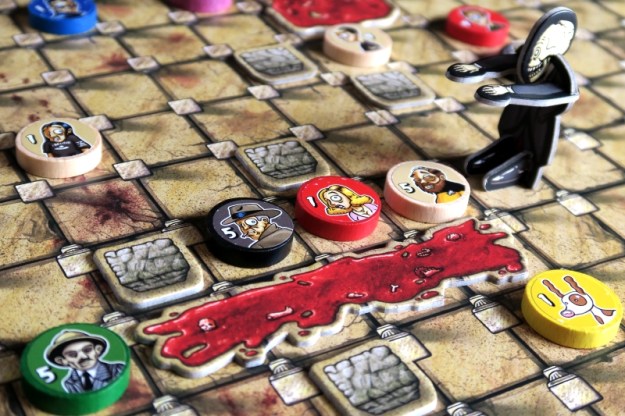
While the first two tables were playing spooky-themed games, Black and Purple led Teal and Cobalt in the monster-mad Finstere Flure (aka Fearsome Floors).  This is a game where players are trying to escape from Fürst Fieso before the castle collapses and without getting eaten.  The idea is very simple: first players move all their pieces the number of spaces shown on their visible side, then the Monster moves.  The Monster moves according to a stack of tiles, either moving a set number or moving until he eats.  The Monster moves one step forwards then looks straight ahead, left and then right. If he sees a player, he turns and moves towards them.

Finstere Flure
– Image by boardGOATS

Thus, the Monster looks, moves, looks, moves until he either runs out of spaces to move, or eats someone.  The game ends after fifteen rounds.  It is simple enough, but there are a few little elements that add to the fun.  Firstly, each player piece moves a total of seven spaces over two turns, but while some alternate three and four space moves, others are more variable, with the most extreme moving six spaces and then one space on the next turn; these different pieces require different tactics.  Players can’t land on another player, if they walk into a rock they push it and if you step in a pool of blood, they slide across it.

Finstere Flure
– Image by boardGOATS

Finally, if the Monster walks into a wall he appears elsewhere on the board adding a further layer of unpredictability.  The game opened with a bang when the first Monster tile revealed was a “Two Kill”, that is to say, the monster keeps moving until he’s eaten twice.  From there, it was carnage.  Everyone had someone eaten, with some multiple times.  There were people who managed to escape from Fürst Fieso, though it wasn’t easy of course.  Everyone managed to get at least one piece out of the castle, with Purple and Cobalt managing to get two pieces out.  The winner, however, was Black who liberated three of his people.

Finstere Flure
– Image by boardGOATS

They were the first to finish, so moved on to play the recent release, Ticket to Ride: Ghost Train.  This is really just a variant of First Journey, a simpler version of the group favourite, Ticket to Ride, aimed at children and non-gamers with super-sized pieces.  Like the original game, players take it in turns to either take “two parade float” cards (in this case blind), or pay cards to place trains on the map.  However, instead of scoring points for placing trains, the game is essentially a race game.  Players start with three Tickets and every time they complete one, they draw a replacement.  The winner is the player who completes the most Tickets.

Ticket to Ride: Ghost Train
– Image by boardGOATS

This time, Teal took an early night, but Black, Purple and Cobalt went at it with spooky enthusiasm.  As a different take on the original, they found this a very enjoyable alternative.  As well as Tickets, players can also win “Trick or Treat” bonuses for connecting the Dark Forest region to the Seashore region.  Black and Purple both took a “Trick or Treat” bonus, but the winner was Cobalt who finished with six Tickets, one more than Purple who would have taken another if she’d had just a little more time.  That wasn’t the only Ticket to Ride game of the night however, as the Scooby Gang played a quick game of Ticket to Ride: Berlin once they had solved their mystery.

Ticket to Ride: Ghost Train
– Image by boardGOATS

Ticket to Ride: Berlin is one of the mini versions, and there was a little chat about these and which ones people had played.  The first mini version was a “demo” game the publisher used to introduce people to the game at conventions.  Since then, there have been a series of City versions, with New York, London, Amsterdam and San Francisco all featuring and Berlin being the most recent (with Paris to come next year).  These all feature the same basic mechanism as the original game (including the scoring of points for placing trains unlike the First Journey type games), but they have fewer train pieces and a smaller map.  The Berlin map, is long and thin, but the big difference is that players have mixture of Trams and U-Bahn pieces.

Ticket to Ride: Berlin
– Image by boardGOATS

Tram and U-Bahn routes are paid for in similar ways, though only one U-Bahn piece is needed to mark them and they score slightly more points.  Once the differences had been highlighted by Pine and Pink (who played this together a few weeks back), everyone got down to business.  Jade and Sapphire dominated the West while Pink and Pine concentrated on the East, though the geography of the map meant everyone had to include East-West connections in their network.  It was a hard-faught close game with both Jade and Sapphire taking negative points due to incomplete Tickets.  Pine completed five Tickets and Pink finished six.

Ticket to Ride: Berlin
– Image by boardGOATS

Pine’s Tickets were more lucrative, however, and he took victory with sixty-one points, while Jade with forty-nine just pipped Pink by two points in the struggle for second place.  Everyone had enjoyed the game, and Jade commented that it was one of his favourite renditions of Ticket to Ride so far—indeed, the addition of a second set of transport seems to have been much more successful in this mini version than it was in the full-sized Rail & Sails where it made it longer and more fiddly without making it significantly better.  While everyone else was playing and then discussing the merits of different versions of Ticket to Ride, the Crafty Trio, Plum, Blue and Byzantium had finished Broom Service and squeezed in a quick game of Dinosaur Drafting with Draftosaurus.

Draftosaurus
– Image by boardGOATS

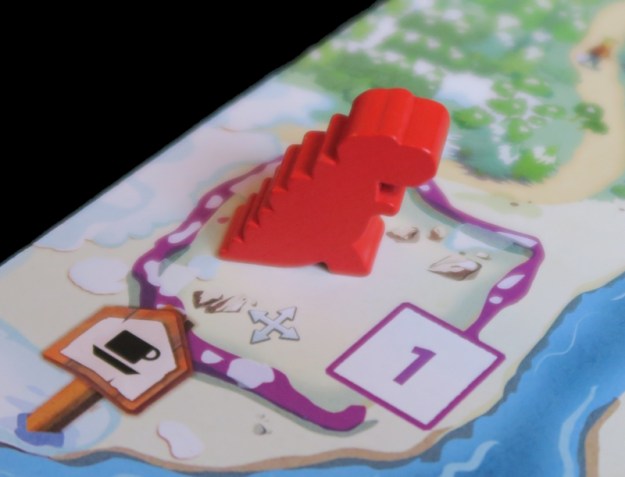
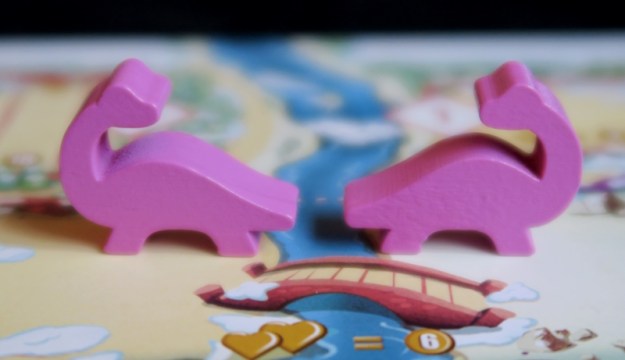
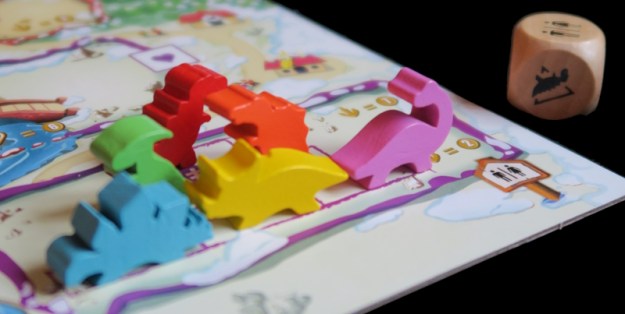
This is a fun little game that we play quite a bit, where players choose one Dinosaur from a handful, add it to their Park and then pass the rest on.  Dino-placement is slightly restricted by the roll of a die, with everyone getting points for how they occupy their pens.  Usually, the group plays with the Summer board, but with the cold weather, the group decided to play with the alternate, Winter board which introduces new and different pens.  These include the Well-Ordered Wood (Dinosaur types must alternate); Lovers’ Bridge (giving six points for each pair of Dinosaurs separated by the bridge); the Lookout (contains one Dinosaur and scores two points for each one of that type in their right neighbour’s pen).

Draftosaurus
– Image by boardGOATS

The most challenging, however is the Pyramid, which holds up to six Dinosaurs in a layered structure, but dinosaurs of the same species may not be placed adjacent to each other (horizontally or vertically).  Blue got into a mess with this, and was stuck with a Dinosaur she could not place at the end as a result.  Plum and Byzantium did slightly better and were able to capitalise more on the Quarantine Zone, which allows players to move the single occupant at the end of the game.  In the end, it was a tight game (though not as tight as Broom Service), in which Plum ran out the victor, three points ahead of Byzantium.

Draftosaurus
– Image by boardGOATS

Learning outcome: They’d have got away with it if it weren’t for those pesky kids!