Tag Archives: Ticket to Ride: Rails & Sails

22nd April 2025

The evening began with the sad news that Kath and Ian and their daughters were leaving for a new pub in Shipton Abbot (or was that  Newton Abbot?).  They have been good to the group and worked hard to give us an environment that conducive to gaming, so it is sad to see them moving on, though Devon is quite a nice place.  Everdell is also reputed to be a nice place, and one that some of the group were to travel to perhaps using its new railway station, as the Newleaf expansion to Everdell was the to be the week’s “Feature Game“.  The game got going after about fifteen minutes of general faffing about and reminding everyone of the rules to the base game and explaining the additional features of the expansion.
Everdell: Newleaf
– Image by boardGOATS

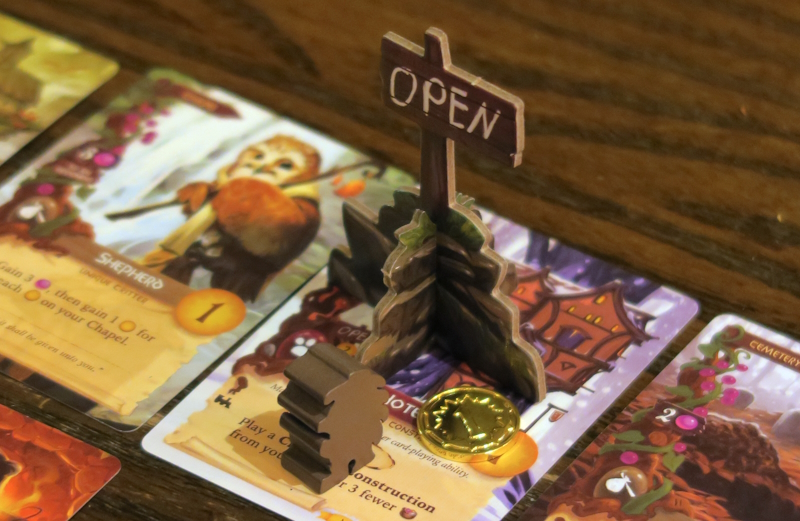
The base game is a fairly simple one of worker placement to collect Resources and spend them to place Cards.  Players keep playing until they run out of workers when they get them all back (vacating the associated Action spaces), and then start again.  The game is played over four rounds (or Seasons), with players with the most points from Construction and Critter Cards as well as Event (end-game scoring) Cards.  The Newleaf expansion adds new Critter, Construction and Event Cards, but more obviously, it a new railway station.  This and associated Visitor Cards, Freight Trucks (which provide an alternative way to get Resources), Travel Tickets, and Reservation Tokens.

Everdell: Newleaf
– Image by boardGOATS

Plum (who obviously chose to play with Cat-eeple Workers) went first, grabbing some Resources, followed by Purple (Butterfly-eeples), Cobalt (Hedgehog-eeples) and then Ivory (Duck-bill Platypus-eeples).  Everyone started setting up their town, particularly focusing on green Constructions and Critters that could give income in spring. Plum built up a large pile of Resources and grabbed a Freight Truck with Resources loaded on it and her choice of discount when producing (paid in part using the Reserve Token to gave her a discount) . Purple didn’t go for green Cards, but red Cards with additional worker spots (in particular the Hotel and Chapel), whereas Cobalt and Ivory both got a Mine and Miner Mole, giving them access to valuable pebbles.
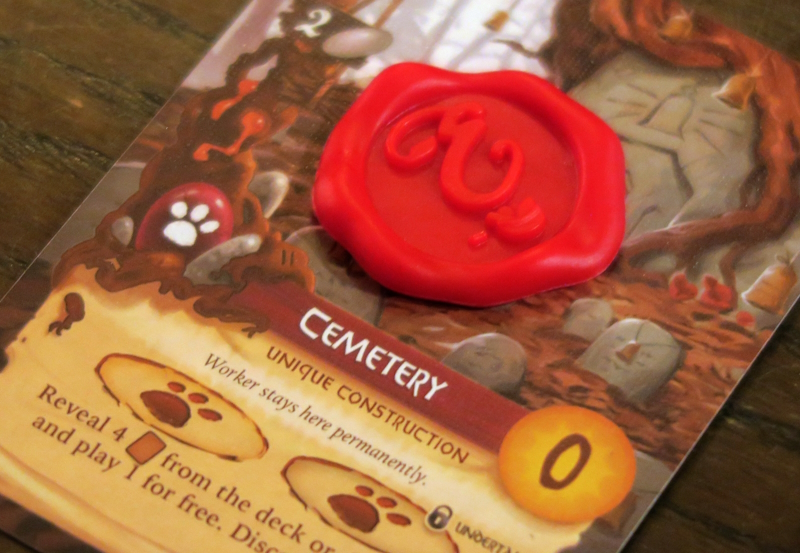
Everdell: Newleaf
– Image by boardGOATS

The length of Seasons in this game is variable, with some players doing more than others before they are forced to reclaim their Workers.  Purple passed on to Spring first, followed by Plum and then, sometime later, Cobalt and Ivory.  Cobalt gained a few blue Cards which had given him Resources (and in particular Cards) when playing Constructions and Critters, whereas Ivory had built quite a collect of green Cards, giving him a significant pile of Resources going into Spring. Spring was very similar to Winter, with everyone focusing on engine building, although Purple was beginning to struggle, due to a shortage of green Cards. Ivory made an early grab for Harvest Festival Event which gives a points bonus for having four green Cards in his city—he was already building quite a big tableau including a Castle.

Everdell: Newleaf
– Image by boardGOATS

Cobalt was taking things slightly more slowly, still focusing on blue Cards, which was enabling him to draw three cards every time he played a Card, so he was always at the hand limit.  Moving into Summer, Cobalt significantly stepped up his building, as did Plum.  She grabbed the Ever Wall Tower card which rewarded her for having nine Constructions. Having already taken Grand Tour event for having three red Constructions, Ivory was eyeing up the Royal Tea special event for having three green and two purple Cards in his town.  However, whilst focusing on collecting resources for buildings to complement his already built Castle and the Palace Card he had in his hand, he failed to notice Cobalt had already played three purple Critters/Constructions.

Everdell: Newleaf
– Image by boardGOATS

As a result, Cobalt beat Ivory to both the Royal Tea and the Scenic Flight awards. Much to Ivory’s disgust, Cobalt was then also able to claim the Sunflower Parade achievement award for having three Events too.  So, Ivory went into damage limitation mode, and began focusing on the passengers at Newleaf station as an alternative way to score points.  Purple was first to move into Autumn and as everyone else followed the focus was firmly on points.  Cobalt was able to collect the Juniper Jig Dance Contest Event card for having nine Critters (in part due to Ivory giving him the Fool!).  Ivory was collecting more passengers using his special ticket to enable him to take a worker back, something everyone had from the from the expansion while Plum was building as many building as possible.
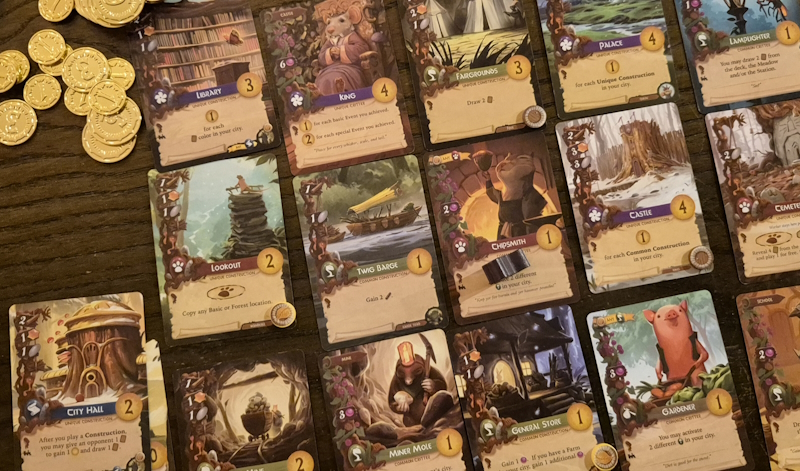
Everdell: Newleaf
– Image by boardGOATS

It was all a bit of a rush at the end as it was nearly midnight when the game finally finished.  Largely due to the scores for his huge number of Events, the winner was Cobalt with ninety-three points.  Ivory took second some ten points behind, closely followed by Plum who got over half her points for Critters and Constructions.  The game had taken all evening, but during this time, Pink, Pine and Lime had managed to get through no less than five games.  The first was one of Pink’s favourites, Zoo Break.  In this game, players work cooperatively to try to prevent the escape of animals from their zoo.  It is one of Pink’s favourite games, but this time it was very, very short-lived.

Zoo Break
– Image by boardGOATS

Things started well as the group locked up the Capuchins, Snakes and the Rhino.  But then the Meerkats, who were partying in the fountain, decided to make a bid for freedom.  Three tigers and four elephants were already on the loose and rampaging round the zoo and while Pink put two Pandas back in their cage, five of the Meerkats made it to the exit and headed out.  And thus a handful of mischievous Meerkats led to the sad demise of Bedlam Zoo (which really had been Bedlam this time).  To help get over the disappointment of the epic failure, the group decided to go on a a train ride around France with Les Aventuriers du Rail Express, a light version of one of the group’s favourite games, Ticket to Ride.
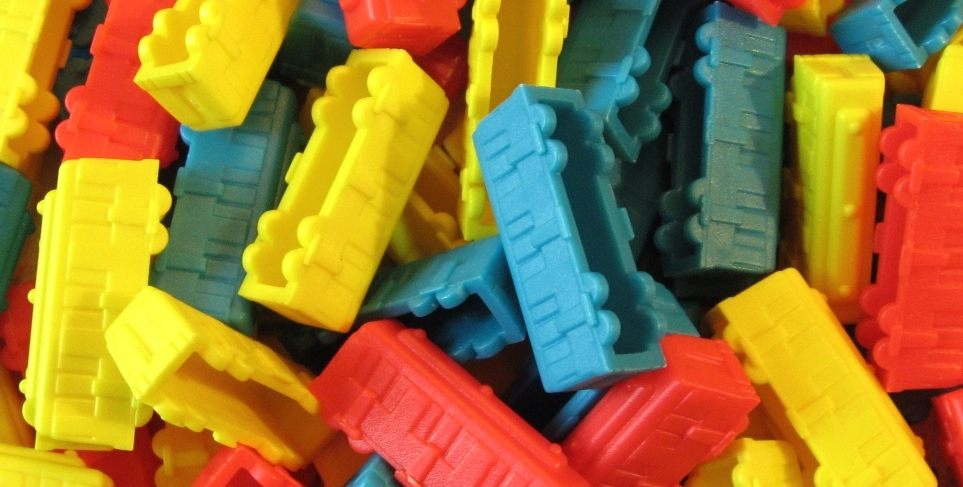
Ticket to Ride: Europe
– Image by boardGOATS

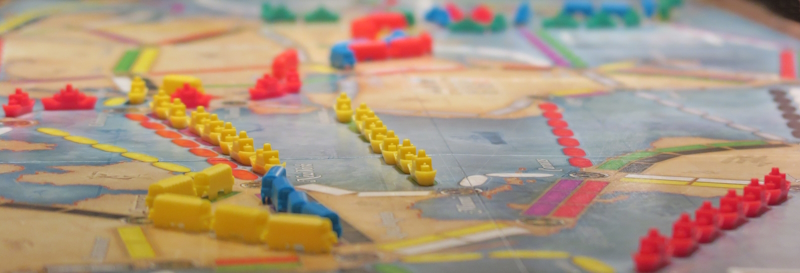
There are lots of versions of Ticket to Ride, from the teeny-tiny city editions through to the rather epic Rails & Sails and Legacy versions.  Les Aventuriers du Rail Express is a French map that is a step up from the city editions and fits between the standard games (Like Europe) and First Journey, making it slightly quicker than the full games, as it is played on a slightly smaller map with slightly fewer trains.  Aside from that, it is essentially very similar in game play to all the others:  on their turn players either take cards from the market, or spend them to place plastic train pieces on the map.
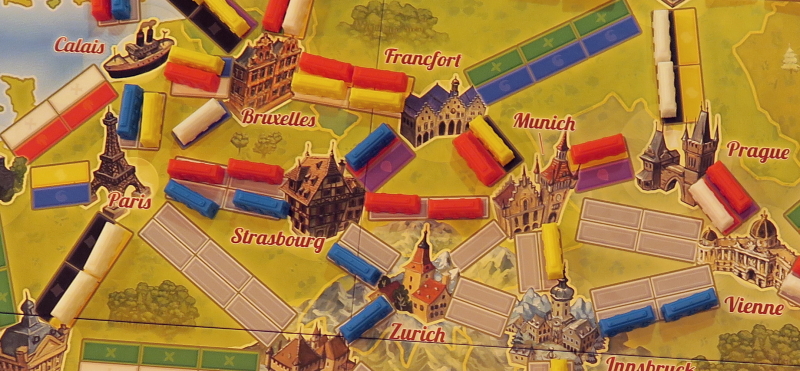
Les Aventuriers du Rail Express
– Image by boardGOATS

As in the larger version players can also take tickets, but this has to be balanced with the bonus for completing a route from London to Istanbul, the most distant pair of cities.  The first player do so gets twenty points, the second gets fifteen and the third gets ten.  Additionally, the wild Locomotive cards also work slightly differently in this game in that, instead of being mixed in with the market, they are always available from a separate stack, but as usual, players can only take one per turn.  Being a quick game, and with everyone feeling they knew the game and was in with a chance of winning, the group ended up playing it twice.
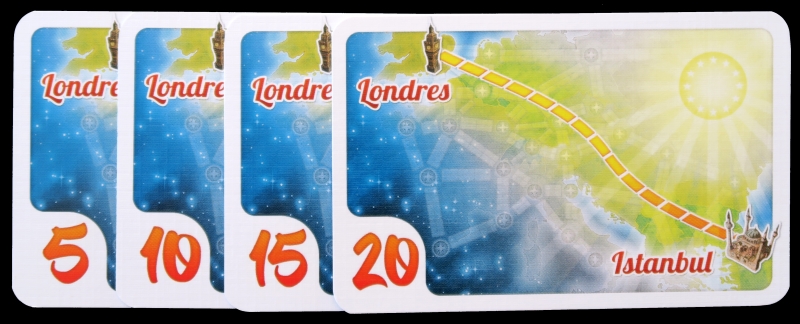
Les Aventuriers du Rail Express
– Image by boardGOATS

The first time, Lime finished with the most points from placing Trains, but both he and Pine carried negative points from incomplete Tickets.  Incomplete tickets are a real drag as they effectively, carry a swing double their face-value.  As a result, Pine just pipped Lime to second place.  The winner was Pink, however, despite the fact that he had the lowest points for his tickets; he did finish the London to Istanbul connection first though.  In the second game, the roles were somewhat reversed with Pink taking the most points for placing trains, but failing to complete the London to Istanbul route at all.  The winner was Pine who, like Pink in the first game, also claimed the maximum of twenty bonus points, while Lime was the runner up.

Les Aventuriers du Rail Express
– Image by boardGOATS

Everyone else was still playing, so the trio managed a quick couple of games of the card-drafting game, Sushi Go!.  This is a very simple game, where players start with a hand of cards and choose one to add to their tableau before passing the rest on.  Played over three rounds, players collect points for collecting Maki Rolls, Sashimi and Nagiri (which is all the better when combined with Wasabi).  At the end of the game, players with the most Pudding cards score an extra six points, while those with the least lose six points.  The player with the highest total is the winner.  The points throughout both games were fairly even with nobody crashing out or having a golden round.
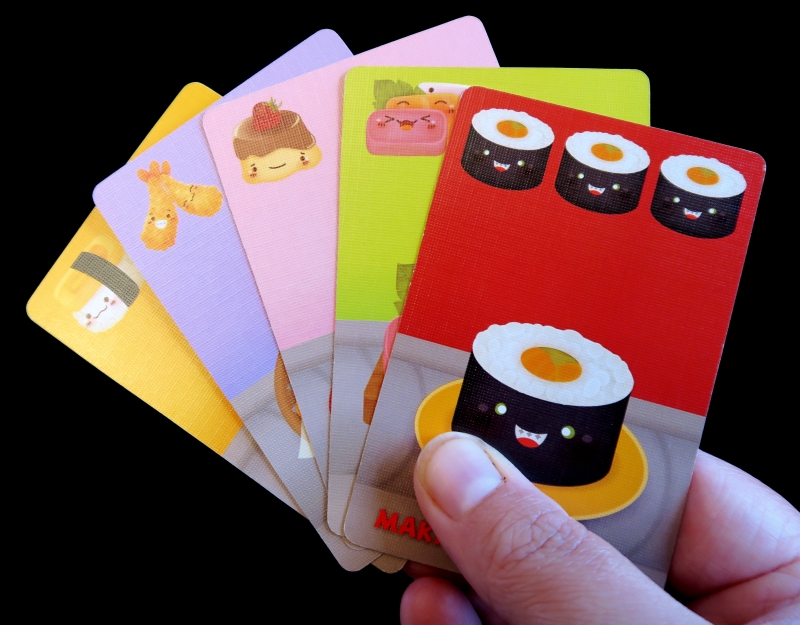
Sushi Go!
– Image by boardGOATS

Despite this, the winner of the first game took it by a bit of a land-slide.  It’s true that Lime top-scored in two of the three rounds, but they were all really close.  The real difference, therefore, was made by the Puddings which he had the most of and left him with a total of forty-five, a dozen more than Pink, the runner-up.  It was fairly inevitable then that in the second game, there was quite a battle for the Pudding cards.  The scores were close again, and again Lime won two out of the three rounds.  The overall winner was arguably Pink, who despite losing all three rounds had the most Puddings and therefore took victory from Lime on a tie-break.
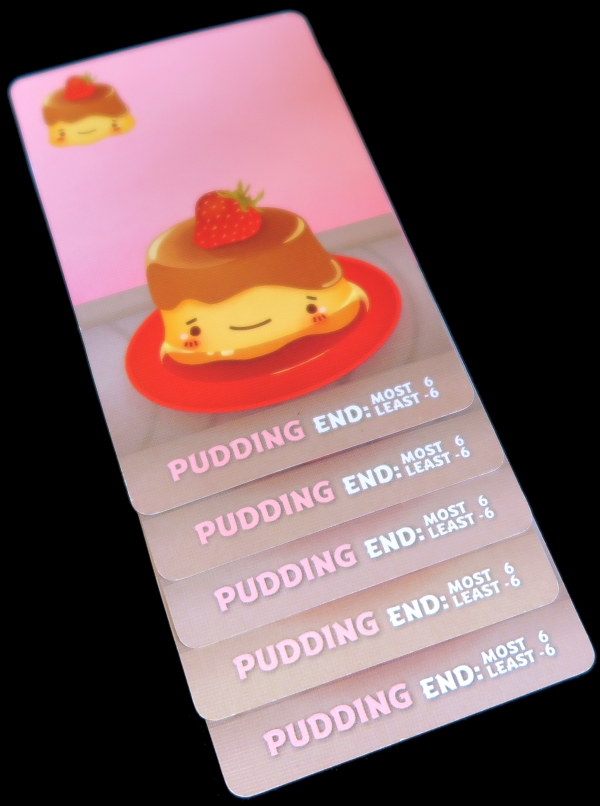
Sushi Go!
– Image by boardGOATS

The final table for the evening, consisted of Jade, Sapphire, Black and Blue playing Meadow with the Adventure Book expansion.  Meadow is a clever little card game where players collect cards to add to their tableau from a central market.  On their turn players place one of their tokens next to the grid with the type of token and the location combining to dictate which card they take.  Players can then add a card from their hand (which may or may not be the one they picked up) to their tableau.  In the base game, there is an additional campfire board, but the Adventure Book replaces this.  Each “page” from the book changes the mechanics to a greater or lesser extent.
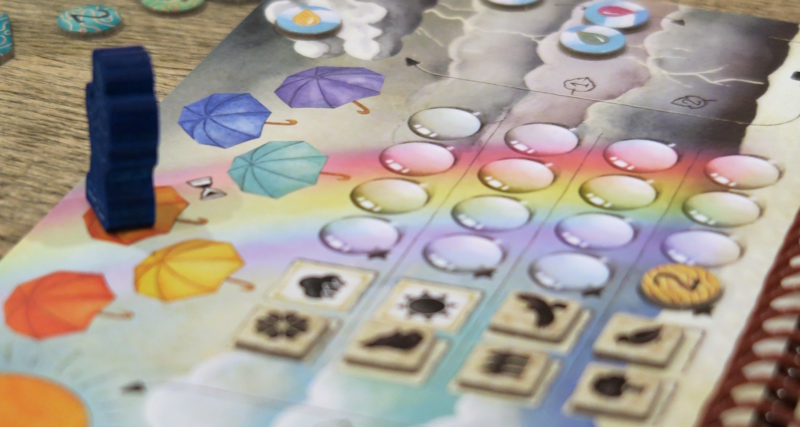
Meadow: Adventure Book
– Image by boardGOATS

The group played with the first scenario, which introduces Weather.  There are two token that indicate a row and a column in the market, and every time a card is taken from these, players can move along the appropriate Weather track.  Reaching the end of these gives players extra cards.  Additionally, placing a token in a space in the Book allows players to claim rewards if they have fulfilled the criteria and have the two symbols shown visible in their tableau.  These give extra points at the end of the game.  There was a lot of faffing about and getting to grips with the rules changes, especially as initially, the wording in the rules for the expansion was a little unclear.  Added to which, Black hadn’t played the base game at all before.

Meadow: Adventure Book
– Image by boardGOATS

Once the rules had been fathomed out and explained, the group got the game underway.  Different players targeted different card types with some going for the harder to place higher up the food-chain cards, while others tried to diversify.  Blue tried to get as many of the bonus points for collecting pairs of symbols as she could and as a result finished at the back of the pack.  The game is not a high scoring one though and those bonus points made a big difference.  It was not quite enough to give her the victory, however, and she finished one point behind Jade who topped the rankings with forty-six points, with Black in third.  It had been a very enjoyable evening all round though, regardless of the number or type of game played.

Meadow: Adventure Book
– Image by boardGOATS

Learning Outcome:  Cards are a critical part of most modern games.
10th December 2024

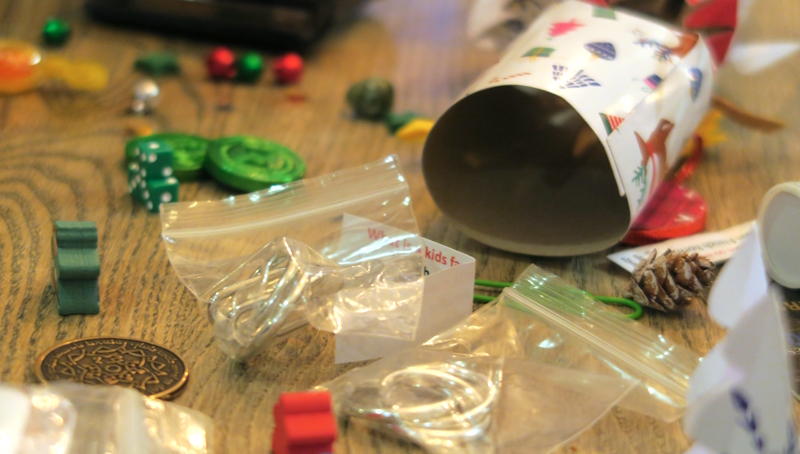
Everyone had already arrived and was waiting in anticipation when Blue and Pink arrived with piles of gamers crackers, Christmas tree decorations, party poppers, paper parcels, mince pies, festive cakes (with carrot meeples on top) and GOAT Award voting forms.  Food quickly followed along with a volley of noise as people tried to pull their crackers and party poppers first so the contents didn’t land in their supper.  As people munched, there was some discussion about the games played and voting forms were filled in.  In the absence of Green, Pine kindly offered to act as returning officer and collate the statistics.

"Un-Christmas Party" 2024
– Image by boardGOATS

While cake and mince meat parcels were shared round, toasts were offered by Lime to the organisers, and in the memory of Burgundy.  He is much missed and will never be forgotten, but we always make a special point of remembering at this time of year, especially as the Un-Christmas Dinner was his last games night with us.  The GOAT Awards were then announced.  Moment of the Year was when Pine got the end game rule wrong for Tonga Bonga, so that Pink thought he’d won, but then didn’t.  The GOAT Poo Prize for the least popular game of the year went to Ca$h ‘n Guns—not a game the group plays often and its only outing over the last year was at the New Year Party.

"Un-Christmas Party" 2024
– Image by boardGOATS

Then it was time for the Golden GOAT.  Previous winners were ruled out, but other contenders included Akropolis, Kavango, Flamme Rouge and Ticket to Ride: Rails & Sails.  The clear winner of the 2024 Golden GOAT Award, however, was Stamp Swap.  There was much discussion about how this was the third winner from Stonemaier Games (after Tapestry last year and Wingspan in 2019) and how we should invite Jamey Stegmaier, to collect the award in person.  Email correspondence over the following few days suggested that while it was unlikely he would be able to come to GOATS, he will be in the UK next year and just might make it as far as Oxford.  In the meantime, he has highlighted the award on his website.

Golden GOAT - 2024
– Image by boardGOATS

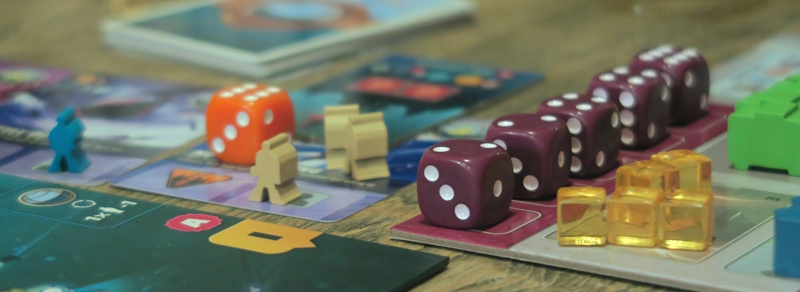
With the festive business over, the group broke into three to play some games.  Pink, Blue, Black and Jade began with the “Feature Game“, Courses De Rennes (aka Reindeer Races), a fun little game where players control a team of four reindeer, racing along four different tracks to try to get the highest-scoring tiles.  On their turn, each player can either draw two cards (with a hand limit of seven) or play as many cards of the same type as they can to move one reindeer along one of the tracks.  The cards are numbered and have suit that corresponds to one of the tracks (or are Elfy, and “wild”).  If two and a three of Gifts is played, the player may move one of its reindeer along the Gift track.
Course des Rennes
– Image by boardGOATS

If a reindeer lands on the same space as another reindeer, it slides forward a space.  If that is occupied too, it continues to slide.  If, however, the owner cries “Thump!” as it lands, the reindeer slithers an extra space forward.  The first reindeer to arrive at the end of a track claims the highest value token.  The game ends when two of the tracks have run out of tokens.  Pink too the first points, and with it a strong early lead.  A few rounds later, Jade took the last token from one of the tracks and with it ended the game.  He got very unimpressed looks from Black and Blue as he gifted victory to Pink, so once this was pointed out, Jade revised his move and play carried on.

Course des Rennes
– Image by boardGOATS

Ultimately, however, it didn’t really change things as Pink still took victory with twenty-two points.  He was long way clear of Jade who won the tight fight for second with fifteen just one point ahead of Black who, in turn, took third by a single point.  Everyone else was still playing, so the group looked for something else to play.  Black had won a copy of Ticket to Ride: Paris in the raffle and, although it wasn’t very festive, it seemed appropriate to give it an outing.  Some of the GOATS had played this mini-city variant of the popular train game earlier in the year when we marked the Olympics with sport and France themed games.  However, none of the current quartet had been part of that group.

Ticket To Ride: Paris
– Image by boardGOATS

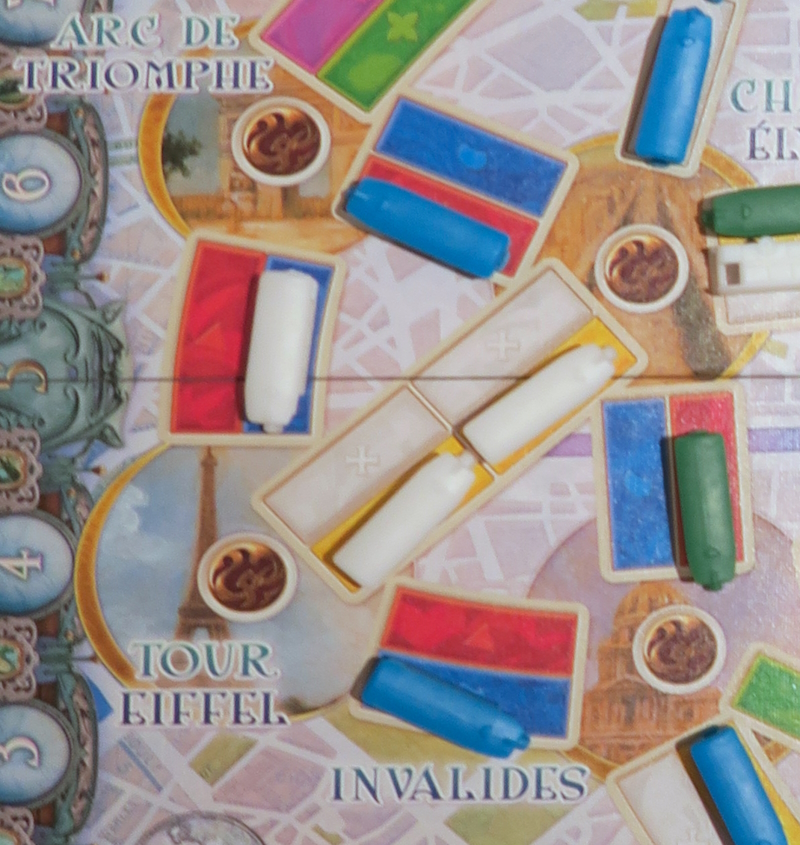
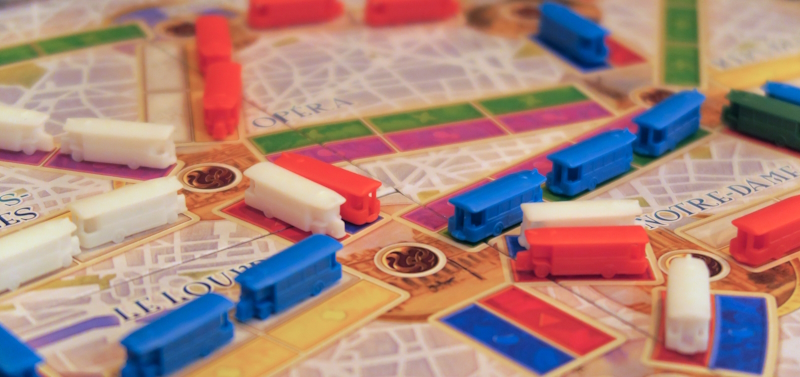
The rules are much the same as all the others (take two cards from the market; play cards to place pieces on the map; collect Ticket cards to score points at the end), but like all the variants, Paris has a special rule.  When players claim a red, white, or blue track, they get a card, when they get all three colours they get four “Tricolore” bonus points.  When the game first came out, there had been comments about how this felt very bolted on, but in practice, it was much more interesting than it sounded.  This time, the in game scoring was quite tight, though Blue, with her trains across the city centre got her nose in front and led by six points.  Tickets can make a huge difference to scores though, as they can give a lot of points, both positive and negative.

Ticket To Ride: Paris
– Image by boardGOATS

Black, Pink and Jade all picked up similar points for their completed Tickets (ten, eleven and eight respectively), though Jade was unlucky and unable to complete his last one.  Blue, however, made good use of concurrent routes and scored a massive twenty-four points for hers giving her something of a landslide victory with a total of forty-six.  It was much closer for second which went to Pink who finished with twenty-nine, two points ahead of Black.  Meanwhile, on the other side of the room, Purple was leading Ivory, Plum and Byzantium in one of her favourite Christmas themed games, Christmas Tree.

Christmas Tree
– Image by boardGOATS

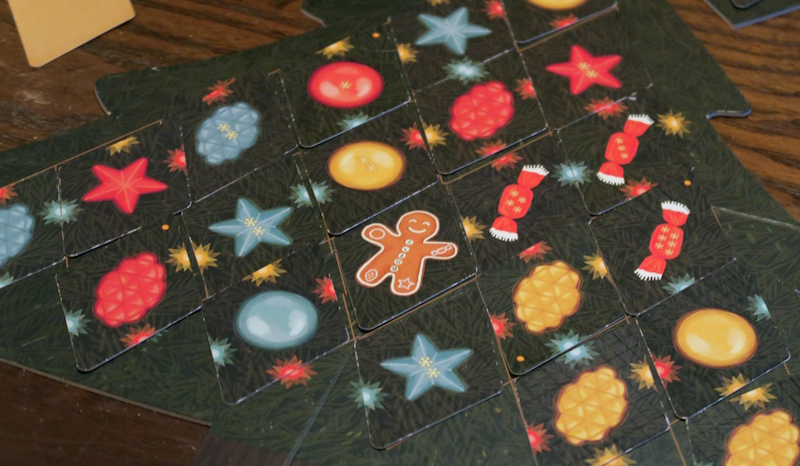
This is a fairly simple little card-drafting game played over thee rounds, where players are “decorating their Christmas Tree” with diamond-shaped cards, where players score points for the Objective cards everyone contributed to a central pool at the start of the round.  This time, the group played from the advanced set of Objective cards (including all three levels) although the first round, the cards were all levels one and two.  These gave one point for each blue or “nobbly” ornament, four points for each pair of ornaments of the same colour and shape arranged in a vertical pair and six points for three specific shapes in a given arrangement.

Christmas Tree
– Image by boardGOATS

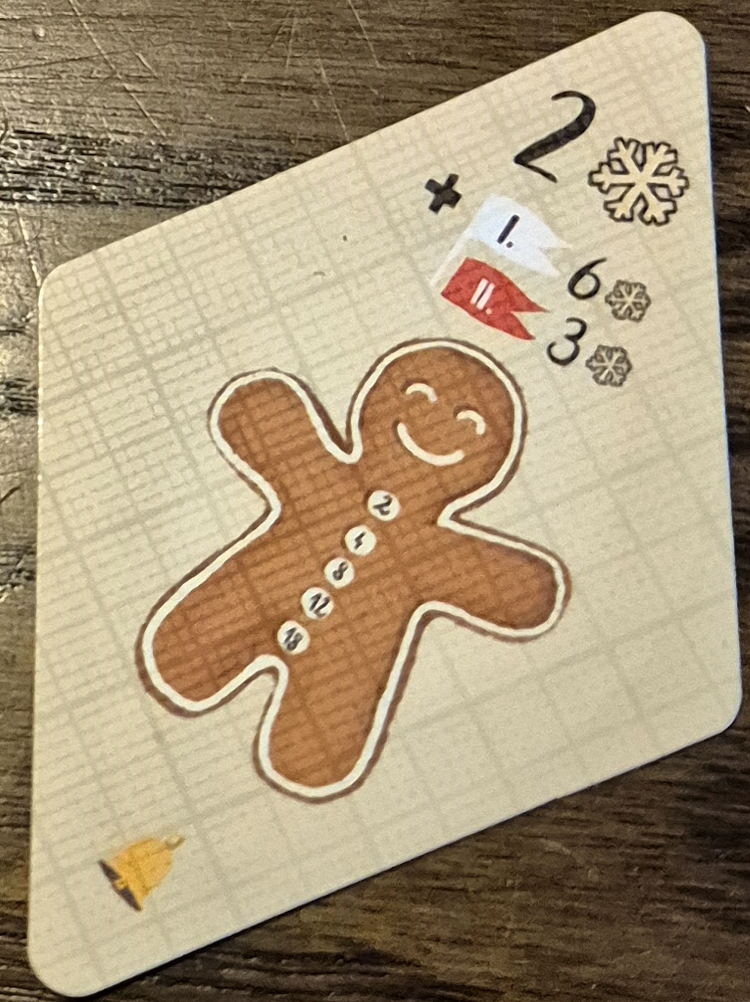
The first round started off slowly with everyone looking to fulfill some of the Objectives—everyone was successful, but Plum and Byzantium got off to a better start.  Plum placed her first Gingerbread man and then concentrated on placing vertical pairs although she only managed that once.  In the second round the Objectives were from the more complicated sets, including six points for three specific colours in a given arrangement, six points for the same three shapes or colours in a set pattern, or eight points for four ornaments with the same point value arranged in two set formations.  This time, Byzantium significantly out scored everyone with multiple objectives scored multiple times and, as a result, built a big lead.

Christmas Tree
– Image by boardGOATS

Plum used one of her Biscuits to move baubles around to make a row of four contain the three colours of glass bauble.and thus scored well, whereas Ivory was focusing on picking up high value Sweets and surrounding his Gingerbread men.  The final set of Objectives included six points for a set arrangement of certain point values, eight points for four ornaments with the same point value arranged in a particular arrangement and five points for each row in which the total points of the glass were above the given amount. Finally, there were two points for each Gingerbread man, with bonuses of six and three points for the player with the most/second most Gingerbread men.

Christmas Tree
– Image by boardGOATS

In the third and final round, Byzantium again out scored everyone, scoring multiple times for the set arrangement of certain point values.  At this point, Ivory was full committed to Sweets and Gingerbread men, especially knowing he was putting in the Gingerbread man Objective, which he scored well for.  Plum and Purple also scored well in the final round, with Plum following a strategy similar to Byzantium, whereas was Purple was collecting sweets like Ivory.  It looked like Byzantium was going to win by a large amount, as he was fifty points ahead of everyone else and was scoring more than anyone else for Lights and Baubles too.

Christmas Tree
– Image by boardGOATS

Ivory’s focus on surrounding his Gingerbread men gave him over fifty points and with more than thirty for his sweets he finished with one hundred and seventy one points, pipping Byzantium to victory by just two, with Plume in third some twenty points adrift.  The puzzly nature of the the game had gone down well and with the Christmas theme everyone had enjoyed playing Christmas Tree.  On the next table, the festive link was much more tenuous, however.  Teal, Pine, Sapphire and Indigo had chosen 6 Nimmt!, because there was a twelve in it, representing the Twelve Days of Christmas (or perhaps they had just wanted to play the game and if you can’t play a daft party game at Christmas, when can you?).

6 Nimmt!
– Image by boardGOATS

6 Nimmt! is a popular game with the group at any time of year, though it is usually played with more than four people.  Either way, the game is very simple to play, though tough to play well.  Some say this is because there is a lot of chance in the game, but they are usually the people who do badly…  The idea is that players simultaneously choose a card to play and these are then added, in order, to the rows of cards on the table.  The player adding the sixth card, instead, takes the first five cards into their scoring pile.  Usually, we deal out half the cards for the first round and the rest for the second and the winner is the player with the fewest “nimmts” (or points), at the end of the two rounds.

6 Nimmt!
– Image by boardGOATS

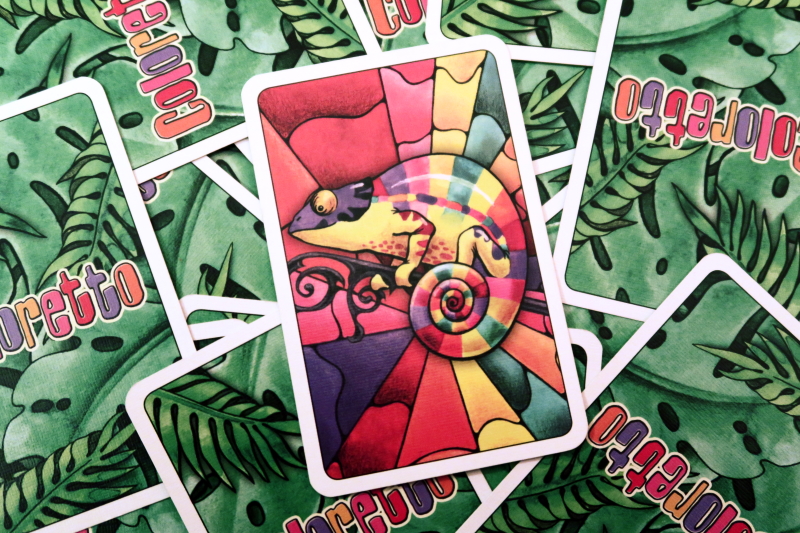
This time, however, the group decided to play the multiple-hand variant where each hand has ten cards, and the game ends when someone’s score passes sixty-six.  And that was Sapphire, who finished with an exceptional total of ninety-five.  The winner was Teal with forty-four, however, who was just two points better off than Pine.  The other games were still ongoing, but there was still time for one last game for this group (who were joined by Navy) before everyone went home warmed by the Christmas Gaming Spirit—and their choice of game was Coloretto (apparently this is a  festive game because it includes red, green and gold Chameleons).

Coloretto
– Image by boardGOATS

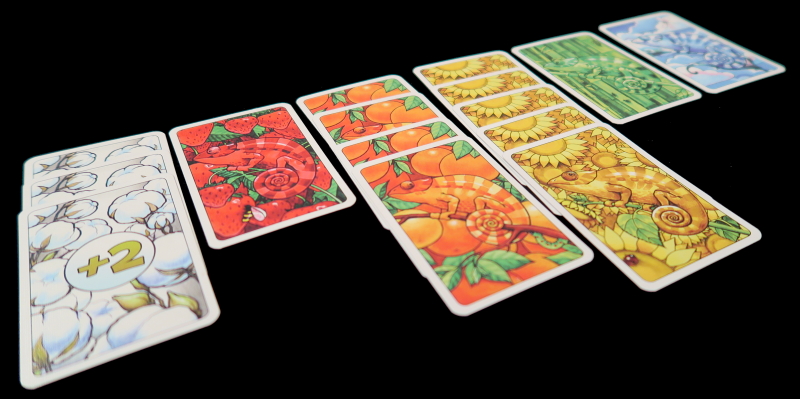
This is another simple filler game, where players either take a card and add it to a truck, or take a truck.  Each truck can take a maximum of three Chameleons, with players collecting coloured sets.  The largest three sets score positive points (according to the Triangular Number Series), while all the others score negative points.  In this way, the bigger the series the more additional cards will score, so the aim is to collect three large sets and ensure the others are as small as possible.  This game was really tight, with Sapphire claiming victory with twenty-seven and Teal and Indigo tying for second on twenty-four.  And with that, people began to drift off, many not to be seen until 2025.

Coloretto
– Image by boardGOATS

Learning outcome:  GOATS love a Cracker!

Golden GOAT Award Winners – 2024

This week was the annual boardGOATS Un-Christmas Dinner including the voting to decide the winners of the GOAT Awards.  There are two main awards:  the Golden GOAT for our favourite game played during the year and the GOAT Poo Prize for our least favourite.  Everyone had the usual three points to hand out for the Golden GOAT Award (plus a bonus if wearing Festive Attire), though a maximum of two points could be given to any individual game.  Everyone could also nominate up to two individual games for the GOAT Poo Prize.

Tonga Bonga
– Image by boardGOATS

This year, the unofficial “Marmite Award” went to Viticulture—something many people seemed to find quite a surprise as it is generally not a divisive game and one that few would usually take offense at.  There had been a lot of fun throughout the year, but one of the more memorable moments was Pine getting the end game rule wrong for Tonga Bonga, so that Pink thought he’d won, but then didn’t.  There were several nominations for the GOAT Poo Prize, including King of Tokyo, Rolling Realms and Ark Nova, but the winner was another surprise: Ca$h ‘n Guns—not a game the group plays often, indeed it doesn’t get played at all at the pub (for obvious reasons), so its only outing over the last year was at the New Year Party.  It can be a lot of fun, but it is also easy to see how some might not like the game.

Ca$h 'n Guns
– Image by boardGOATS

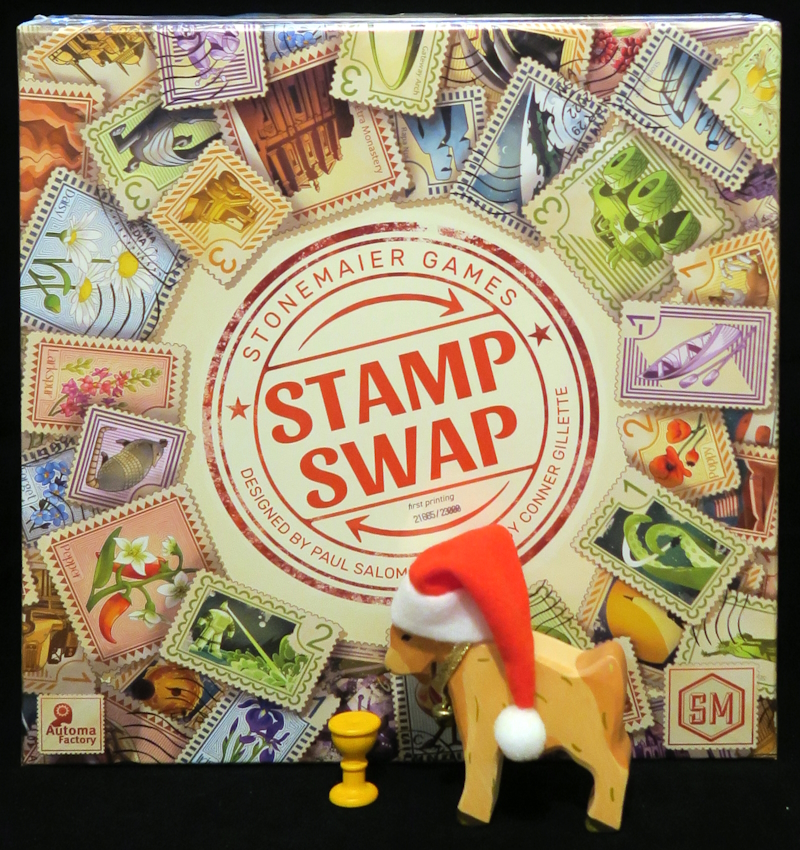
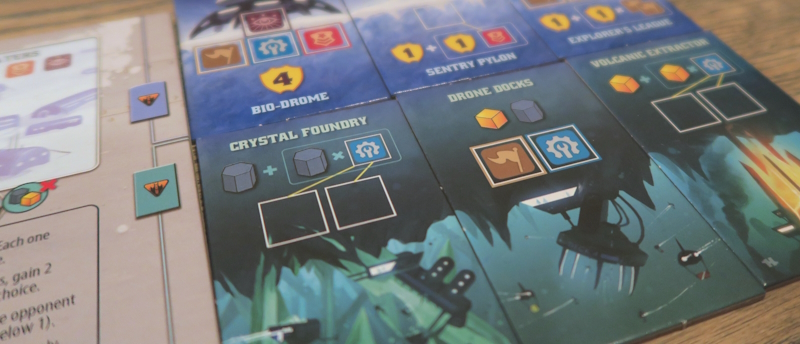
Then finally, there was the Golden GOAT Award for the best game played in the year.  Previous winners were ruled out, but there were plenty of other great games to choose from.  The most popular of these were Akropolis, Kavango, Flamme Rouge and Ticket to Ride: Rails & Sails.  However, the clear winner was Stamp Swap.  This is a new game, only released in September, but was an immediate hit, largely thanks to its silky-smooth game play.  As one person commented, “I wouldn’t have thought a game about stamp collecting would be up my street, and yet…”

Stamp Swap
– Image by boardGOATS

Perhaps more remarkably, this is the third winner from Stonemaier Games after Tapestry last year and Wingspan in 2019—three very different games.  This led to the perhaps slightly tongue-in-cheek suggestion that the group should invite Jamey Stegmaier to visit so we could present him with the actual Golden GOAT in the manner of the Jules Rimet Trophy
Golden GOAT - 2024
– Image by boardGOATS

20th August 2024

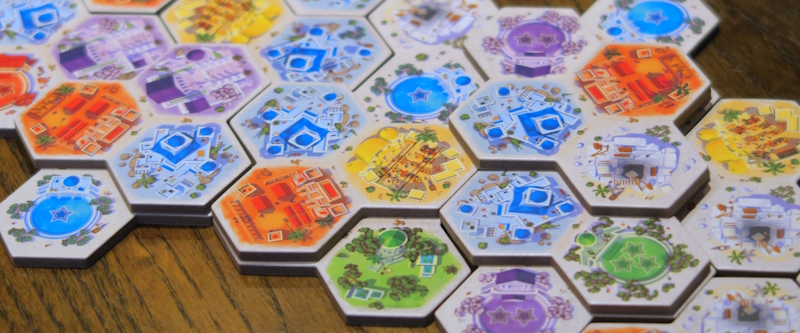
Cobalt was first to arrive.  Pink and Blue weren’t far behind though, and had just ordered their supper when Indigo and her son Navy arrived followed by Jade and Sapphire, then Ivory, Purple, Black, Pine and Teal.  While the others chatted and got drinks, Cobalt began teaching Indigo and Navy Akropolis.  This is a quick little game where each player is building their own acropolis. On their turn, players first take a tile the market. The first tile in the market display is always free, the one after costs one stone (the only resource in the game) the next one two stone and so on.  The tiles comprise three conjoined hexes each either a Quarry (which provide Stone when built over), a Plaza, or a District tile.

Akropolis
– Image by boardGOATS

Plazas and District tiles are in different colours, representing Houses, Markets, Barracks, Temples and Gardens.  Tiles are freely added to the player’s display, either on the base layer or on top of other tiles, so long as any Districts meet the their conditions and as long as there is a matching Plaza present.  At the end of the game, players score for the largest District of each type—each visible hex scores a point for the level it is on (one point for the base layer, two for the first floor etc) multiplied by the number stars shown on the Plazas they have visible.  The game is a sort of cross between Taluva and Cascadia, taking the conjoined triple-hex tiles and layered stacking from Taluva and the tile-placement and individual tableau from Cascadia.

Akropolis
– Image by boardGOATS

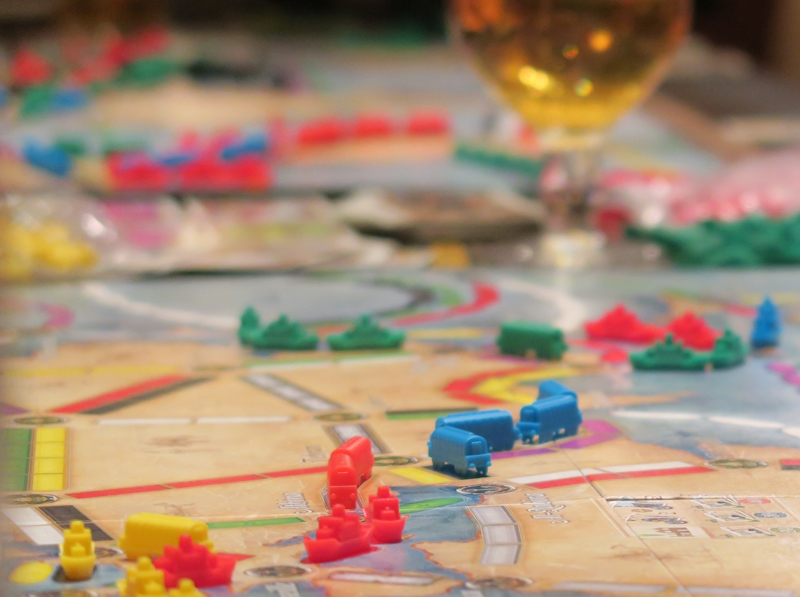
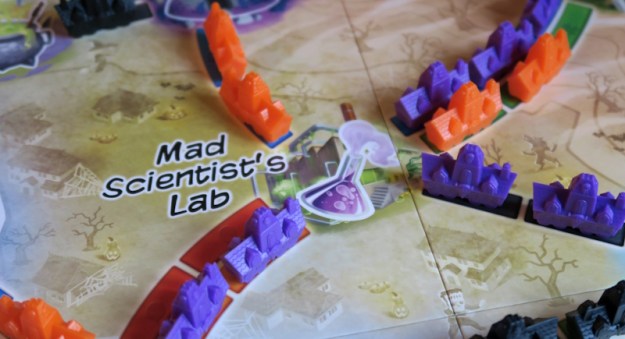
The game was quite tight between Cobalt and Navy, but Navy had the edge, winning his first game in the group with a hundred and eighteen points to Cobalt’s hundred and five.  As the game came to an end, the rest of the group began trying to work out who was going to play what.  In the end, there were two groups setting up to play the “Feature Game” which was Ticket to Ride: Rails & Sails.  This is a variant of the popular train game, Ticket to Ride, but with a considerable step up in complexity. In the original game, players take it in turns to carry out one of three actions:  take train cards, pay train cards to claim Routes on the map by placing train pieces, or take Tickets.  Points are scored for claiming Routes and for successfully connecting the two places shown on their Tickets with negative points scored for failing to complete Tickets.

Ticket to Ride: Rails & Sails
– Image by boardGOATS

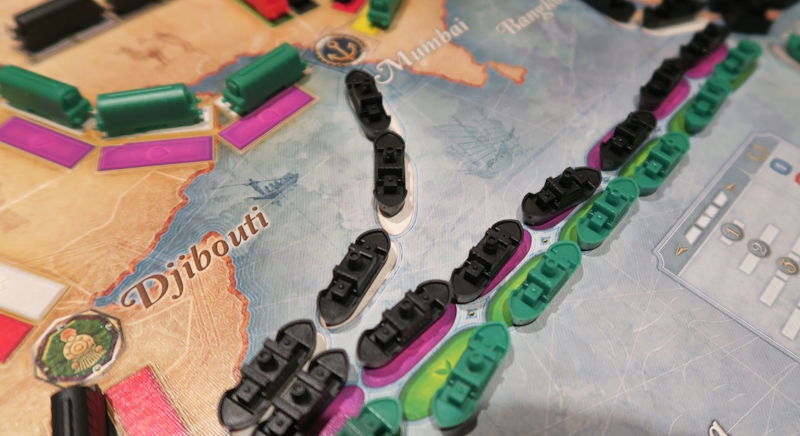
In Rails & Sails, however, players build two connected networks, one on land and one on sea covering the whole globe.  Players build these with two separate sets of train cards, giving them two hands to manage, making it a more complex version of the game.  In addition to the usual four possible actions, on their turn, players can also build a Harbour into a city that they have already claimed a route into. To do this, players spend two Train cards and two Ship cards that are all the same color and all have Harbour symbols on them.  At the end of the game, players gain points for each Ticket that lists their Harbour, with players scoring for each Harbour when more than one features on their Ticket.

Ticket to Ride: Rails & Sails
– Image by boardGOATS

Another thing that adds to the complexity is the tension between Ships and Trains:  at the start of the game, players have a set total number of Ship and Train pieces, and choose choose how many of each they will have.  During the game, instead of a normal turn, they can exchange Ship pieces for Trains or vice versa, but at a cost of one point per piece swapped.  There are two different maps in the game, one covering the Great Lakes, and the other covering the whole World—the total number of Ships/Trains players have depends on which of these is used.  This time, both groups used the World map.  In addition to these major rules changes, there are also a couple of minor tweaks.

Ticket to Ride: Rails & Sails
– Image by boardGOATS

For example, there are Double cards in the Ship deck, which allow players to place up to two Ships per card.  There are also Tour Tickets, which feature more than two destinations—these will score a higher number of points if the locations are connected in the right order (and of course, will score negatively if one of the destinations in not connected at all).  On the World map, there are Pair Routes too.  These require the player to place two train cards of the same colour per space, but the whole Route doesn’t have to be the same colour.  There are the usual Double Routes as well, which come into play with four or five players, and multi-colour “Wild” cards which can be used as either Ship or Train cards of any colour.

Ticket to Ride: Rails & Sails
– Image by boardGOATS

Jade, Ivory, Sapphire and Pine made up the first group.  In their game, Jade and Ivory started by focusing on Trains while Pine and Sapphire began with Ships giving them both taking an early lead with Ships generally giving more points. Sapphire went to the front and stayed there for the majority of the game.  There was an initial scrabble in Asia/south east Asia as well as along the east coast of north and central America, and apart from some early commitments from Pine and Sapphire in the latter, in general there was no major “blocking” and everyone at least tried to play nicely.  That said, by the end of the game the board was very congested, perhaps due to the wrap around nature where Routes could fall off one side and come back on on the other.

Ticket to Ride: Rails & Sails
– Image by boardGOATS

Ivory was the first to take more Tickets and it was some time before Jade joined him.  Ivory went for Tickets considerably more times than anyone else and by the end of the game, he had significantly more completed Tickets than anyone else, though his were of lower value.  Pine in particular started with much more ambitious Tickets and happily declared that he had finished his first ticket about half through the game.  That was until Jade pointed out a potential gap in his track which Pine then hurried to fill.  Sapphire was following a similar strategy to Pine with bigger, higher risk Tickets and also focused on long Routes (hence his throughout the game).  It looked like he was going to trigger the end the game, but in the end, that was Pine.

Ticket to Ride: Rails & Sails
– Image by boardGOATS

Jade and Ivory both had shorter scoring Routes, but with more Tickets, predominantly located in Asia, whereas Sapphire and Pine were mapping the rest of the World.  Everyone except Ivory had to take advantage of the Ships/Trains swap and although this cost points and a turn it didn’t feel like it had a large impact on the game.  Both Jade and Ivory had cards at the end allowing for a late grab of high scoring Shipping lanes, but the game ended a little early for Sapphire.  That said, everyone completed all their tickets, including a very complex and high scoring Tour Ticket.  Pine and Sapphire eschewed Harbours, while Jade built just one.  Ivory, on the other hand, went built all three in the south east, despite the fact they were challenging to place.

Ticket to Ride: Rails & Sails
– Image by boardGOATS

After placing the Ships/Trains and scoring the Tickets, the scores were fairly even, but those extra Harbours really made a difference.  Sapphire and Pine took a twelve point penalty for not having any while Jade picked up twelve (an eight point penalty for not using two and twenty points for having one Ticket ending in his Harbour.  Ivory, however, scored a massive ninety points from his, with each of his three Harbours having two of his Tickets finishing in them.  This ultimately give him a total of two hundred and seventy-five eighty-five more than Pine who took second place. On reflection, there was a minor rules malfunction—when the group recounted the Route scoring, they failed to take account of the penalties for swapping Ships for Trains, but this was only a handful of points and wouldn’t have affected the final standings.

Ticket to Ride: Rails & Sails
– Image by boardGOATS

The game on the next table was not as highly scoring, but there was still quite a large spread in the scores.  While Black reacquainted himself with the rules, the others chatted and counted pieces, eventually they got going though.  Pink started in Australia because he liked it there when he visited almost exactly a year ago.  Then, he traveled north to east Asia, visiting exotic places like Bancock, Jakarta, Hong Kong and Tokyo, before crossing the Pacific to Winnipeg.  As the game came to a close, he also traversed the south Pacific to Valparaiso and took the southern coastal route to Rio de Janeiro.  Black also more or less circumnavigated the globe traveling from the UK, east across Europe to Tehran then on to Mumbai.

Ticket to Ride: Rails & Sails
– Image by boardGOATS

From there, he crossed the Pacific to Lima from where he traveled north, around the top of South America also making it to Rio before crossing the  Atlantic to Cape Town.  Part of the reason for Black and Pink choice of Routed (aside from their Tickets of course) was the fact that Teal was monopolising the Atlantic crossings, making it no fewer than five times!  From his Atlantic ports, he spread into North America and across Africa to Dar es Salaam.  Purple in contrast, focused her efforts on a single extended trip across the USA, found one of the few Routes across the north Atlantic not taken by Teal, journeyed across Europe following Black through Iran to the far East.

Ticket to Ride: Rails & Sails
– Image by boardGOATS

There was an unfortunate “Rules malfunction” when it came to scoring Harbours, which would have had quite a large impact on the game, but as everyone played by the same rules, it was at least fair.  Instead of scoring for each Ticket into each Harbour, they simply scored ten points for their first Harbour, twenty for the second and so on.  With this scoring, Pink, with his eight completed Tickets was the victor with two hundred and five points, fifteen points ahead of Teal in second and Black in third.  Both groups had really enjoyed the longer and bigger challenge of Rails & Sails.  The mix of boat and train cards did cause more grumbling than usual about the wrong colours being available, especially when there was an imbalance in favour of trains over boats or vice versa, but that’s just Ticket to Ride.

Ticket to Ride: Rails & Sails
– Image by boardGOATS

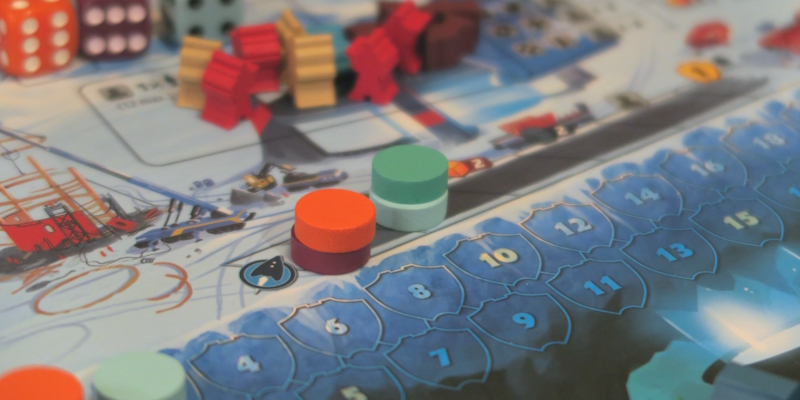
Meanwhile, the remaining group of four, Cobalt, Indigo, Navy and Blue, should really have been playing Azul (!), but after some dithering, Cobalt encouraged them to try The Artemis Project.  This is a game where players are trying to develop colonies on Europa.  The idea is that players roll dice and place them on action spaces to carry out actions.  There are seven Regions and players take it in turns to place their dice in them.  They are: Basecamp, Vents, Quarry, Gantry, Doorstep and Outfitter. At Basecamp, players go on Expedition to earn Expedition Badges and other Rewards. These are a bit like the Quests in the game Lancaster, and like the Squires in that game, dice can be augmented by Colonists.

The Artemis Project
– Image by boardGOATS

Also similarly, Expeditions are unsuccessful if a certain number of pips isn’t reached, which leaves players without their desired Rewards. In such cases, players don’t come away with nothing, instead they move their Token along the Relief Track and pick up a lesser reward.  However, there is a fixed number of spaces available along the Relief Track for each person, so when they are gone, they are gone.  The Vents and the Quarry provide players with Energy and Minerals respectively.  The level of the action depends on the value of the dice, however, the dice are activated from the lowest to the highest.  So, for example, placing a high value die like a six, will yield six Minerals, but if there are only ten available and two other players place fives, these will be activated first leaving nothing.

The Artemis Project
– Image by boardGOATS

The Gantry provides Buildings, which provide players with long term benefits during the game and points towards the end of the game.  Players bid for these and if they win, they must pay the bid amount in Minerals (the value of dice placed), to build them.  Both the Doorstep and the Academy deal with Colonists.  The Doorstep provides players with Colonists, but like the Vents and the Quarry, players who bid high, go last and may not get what they want (or even anything) while the Academy allows players to upgrade their Colonists if required.  Finally, the Outfitter allows players to gain Toolkits which grease the wheels a little by allowing players to alter the values of their dice.  Once all the dice have been placed, these different Regions are activated in order.

The Artemis Project
– Image by boardGOATS

Thus, for example, Minerals collected can be used later in the same round to build Buildings, however, it is wise not to rely on that as another player can play a lower value die, easily scuppering plans.  In this way, the game can be quite aggressive with intentional and unintentional conflict when players get in each other’s way.  It is played over six rounds marked by Event cards associated with the Regions which are resolved before the relevant Region is activated.  At the end of the game, it is a bit of a “point salad” in that players score for left-over Energy and Minerals, for Fully Staffed Buildings, for the number of Buildings, for each complete set of four different Colonists, for any Colonists not part of a set, for Expedition Badges and for having the most unused Toolkits.

The Artemis Project
– Image by boardGOATS

Indigo clearly found the number of Regions a little bit bewildering and was keen to learn by playing, but The Artemis Project is not really a game that lends itself to that.  Indeed, in spite of understanding what each Region does, there is still an element of learning by playing in order to see how things fit together.  As the only one who had played it before, Cobalt stole a march by targeting the Basecamp early and grabbing one of the Expeditions, and because nobody joined him, taking both Rewards.  Navy opted for the sensible choice and went for Buildings in order to get an engine going.  Blue and Indigo weren’t so quick off the mark and took a little longer to work out how to put a strategy together.

The Artemis Project
– Image by boardGOATS

As the game progressed, Indigo became the Queen of the Resources gathering piles and pales, making god use of the multiplier tokens.  Blue made her way up the Relief Track after rolling some higher numbers and not using them well.  This was a problem made worse by Cobalt trying to muscle in on one of her Expeditions leaving her to walk away with nothing, leaving him with nothing too.  As the game came to a close, Navy had more buildings than anyone else and, as Blue and Cobalt both made a bit of a mess of things, he sailed gracefully into the lead finishing with sixty-eight points, while Blue just pipped Cobalt to second place.

The Artemis Project
– Image by boardGOATS

Learning Outcome:  Who needs Planes when you have Ships and Trains?

31st October 2023

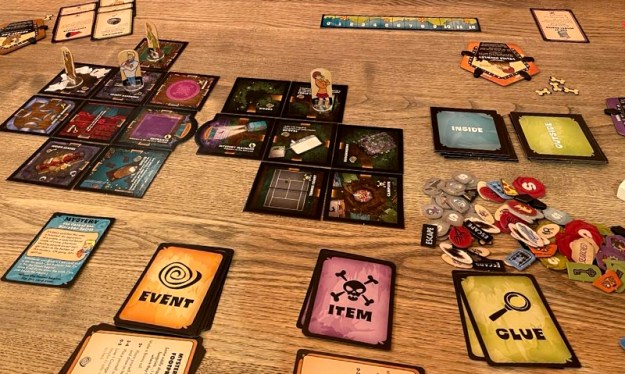
With it being Halloween, there were lots of treats and some very fine spooky-themed attire to go along with the “Feature Game“, Betrayal at Mystery Mansion.  This is a Scooby-Doo themed re-implementation of Betrayal at House on the Hill, a semi-cooperative game, where players work together until there is a haunting and one player takes on the role of the bad guy.  So, the first task for the evening was to decide who was going to take on the roles of Mystery Inc., which precipitated lots of discussion about which was the best character.  Scrappy got short-shift from Pink, though others were less dismissive.  In any case, Scrappy was not an option, and before long, Sapphire, Pink and Pine joined Jade to solve the mystery.

Betrayal at Mystery Mansion
– Image by boardGOATS

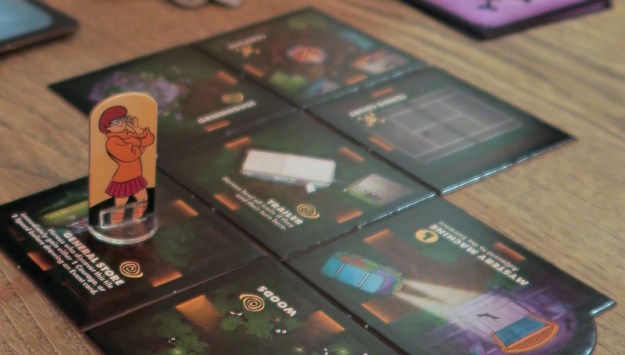
Jade, as the group leader, took the role of Fred, while Pink and Pine enthusiastically engaged in the game as Scooby Doo and Shaggy.  That left Sapphire to choose from Velma or Daphne and he went for brains over bimbette.  The group spent quite a bit of time exploring the mansion collecting clues and the like, before the haunt finally started.  As Sapphire was the one to trigger the haunt, Velma was “temporarily lost in the woods” as he took on the roles of the bad guys, a Spectre and a female character called Sharon who was being possessed and controlled by the Spectre.  As the game progressed, it became apparent that the Spectre was her great uncle who was trying to control her to gain access to documents that would enable him to take control of the family fortune.

Betrayal at Mystery Mansion
– Image by boardGOATS

The Scooby Gang (minus Scrappy Doo, Daphne and the now lost Velma) had to track down and battle the Spectre and try break the spell controlling Sharon.  As the villain, Sapphire rolled very well and it was very hard for the Gang to pin him down.  Fred ended up stunned at one point, but thankfully revived after missing a turn.  Shaggy scoffed piles of Scooby Snacks in order to re-roll, but the dice weren’t with him.  Scooby himself, however, did very well and survived his battle with the Spectre then was able to recharge in one of the special rooms of the mansion.  In the end the Mystery Inc. won the day and the great uncle was unmasked and announced that he “would’ve gotten away with it if it weren’t for you pesky kids”!

Betrayal at Mystery Mansion
– Image by boardGOATS

Meanwhile, there were two other games underway on the neighbouring tables.  Blue, Plum and Byzantium eschewed Witch’s Brew (which plays better with more people) and opted for the slightly bigger, beefier, boardgame version of the same game, Broom Service.  Both games rely on the players having a personal deck of Character cards and a lead and follow mechanism.  Each player starts by choosing a set number of Characters from their deck, each with different actions.  The first player then chooses one to lead with and announces that they are either “Brave” or “Cowardly”.  If they choose Cowardly, they can take the action straight away, whereas, if they choose Brave, they must wait until everyone has played to see if they can take the more powerful action.

Broom Service
– Image by boardGOATS

The next player must follow if they have the card in hand, and has the same decision to make—be a Coward and take the weaker action, or be Brave, and risk being gazumped by a later player, as there can only be one Brave player taking the powerful action.  The Brave player (or the most recent Brave player) then leads with another card.  In the card game, Witch’s Brew, players are collecting tokens to give them points, however, in Broom Service, there is an additional “Travelling Salesman” pick-up and deliver type of mechanism.  Players have two Witch-meeples which travel the land collecting potions and delivering them locations to get points.  This time, it was a really, really close game, despite everyone doing different things.

Broom Service
– Image by boardGOATS

Byzantium prioritised collecting Lightening Bolts and Blue concentrated on collecting potions and delivering them.  While they both headed south and contrived to get in each-other’s way, Plum headed north and fell foul of one of the events which left her stuck with no good move in the final round.  Blue kept forgetting about the “Bewitched Roles” which can be used but with a hefty three point penalty and lost six points as a result.  Byzantium assumed he would be the only one to consciously choose to take the hit and thus guarantee he could be Brave, but happened to do that exactly when Blue picked them as well and lost the advantage when he led with those roles.

Broom Service
– Image by boardGOATS

As the game came to a close, it was clear it was going to be close with Blue ahead by a single point with sixty points scored during the game.  She lots of resources left while Byzantium had none but lots of Lightening Bolts, and Plum had some of both.  Initially, Blue and Byzantium tied with seventy-three, just two points ahead of Plum.  That gave Blue victory with the tie break (the most left over resources), but that was only until the miss-count was spotted and Blue lost one point and with it her Winning Witch Medal, instead taking second place by a single point.

Broom Service
– Image by boardGOATS

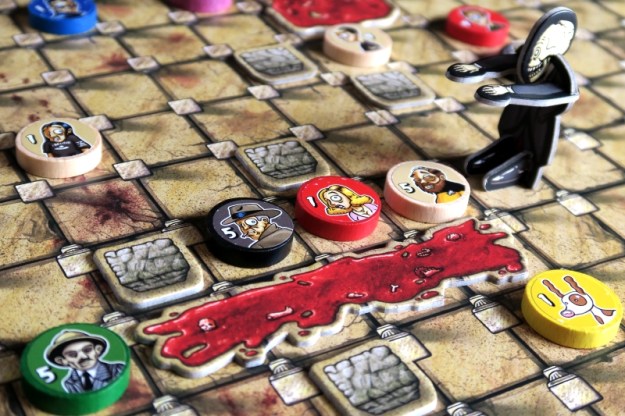
While the first two tables were playing spooky-themed games, Black and Purple led Teal and Cobalt in the monster-mad Finstere Flure (aka Fearsome Floors).  This is a game where players are trying to escape from Fürst Fieso before the castle collapses and without getting eaten.  The idea is very simple: first players move all their pieces the number of spaces shown on their visible side, then the Monster moves.  The Monster moves according to a stack of tiles, either moving a set number or moving until he eats.  The Monster moves one step forwards then looks straight ahead, left and then right. If he sees a player, he turns and moves towards them.

Finstere Flure
– Image by boardGOATS

Thus, the Monster looks, moves, looks, moves until he either runs out of spaces to move, or eats someone.  The game ends after fifteen rounds.  It is simple enough, but there are a few little elements that add to the fun.  Firstly, each player piece moves a total of seven spaces over two turns, but while some alternate three and four space moves, others are more variable, with the most extreme moving six spaces and then one space on the next turn; these different pieces require different tactics.  Players can’t land on another player, if they walk into a rock they push it and if you step in a pool of blood, they slide across it.

Finstere Flure
– Image by boardGOATS

Finally, if the Monster walks into a wall he appears elsewhere on the board adding a further layer of unpredictability.  The game opened with a bang when the first Monster tile revealed was a “Two Kill”, that is to say, the monster keeps moving until he’s eaten twice.  From there, it was carnage.  Everyone had someone eaten, with some multiple times.  There were people who managed to escape from Fürst Fieso, though it wasn’t easy of course.  Everyone managed to get at least one piece out of the castle, with Purple and Cobalt managing to get two pieces out.  The winner, however, was Black who liberated three of his people.
Finstere Flure
– Image by boardGOATS

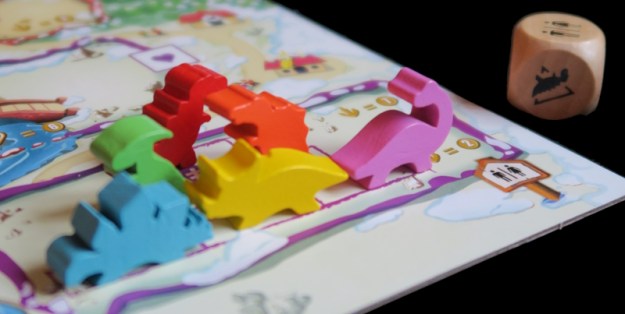
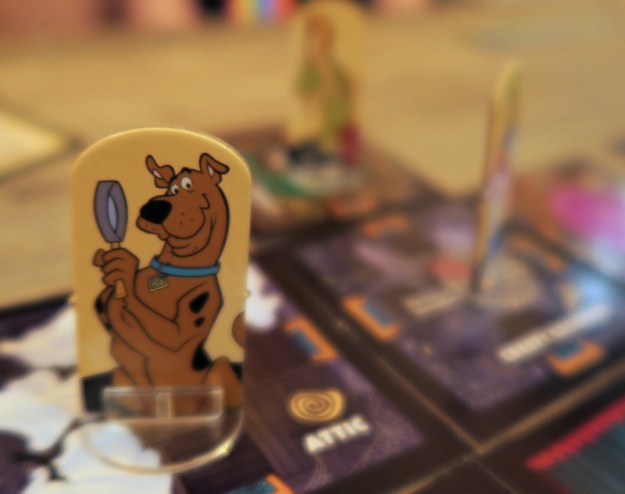
They were the first to finish, so moved on to play the recent release, Ticket to Ride: Ghost Train.  This is really just a variant of First Journey, a simpler version of the group favourite, Ticket to Ride, aimed at children and non-gamers with super-sized pieces.  Like the original game, players take it in turns to either take “two parade float” cards (in this case blind), or pay cards to place trains on the map.  However, instead of scoring points for placing trains, the game is essentially a race game.  Players start with three Tickets and every time they complete one, they draw a replacement.  The winner is the player who completes the most Tickets.
Ticket to Ride: Ghost Train
– Image by boardGOATS

This time, Teal took an early night, but Black, Purple and Cobalt went at it with spooky enthusiasm.  As a different take on the original, they found this a very enjoyable alternative.  As well as Tickets, players can also win “Trick or Treat” bonuses for connecting the Dark Forest region to the Seashore region.  Black and Purple both took a “Trick or Treat” bonus, but the winner was Cobalt who finished with six Tickets, one more than Purple who would have taken another if she’d had just a little more time.  That wasn’t the only Ticket to Ride game of the night however, as the Scooby Gang played a quick game of Ticket to Ride: Berlin once they had solved their mystery.
Ticket to Ride: Ghost Train
– Image by boardGOATS

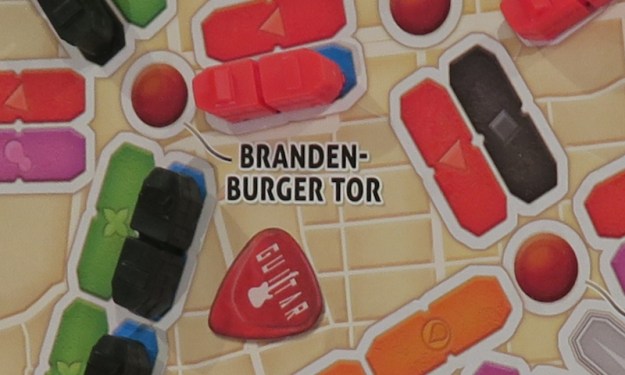
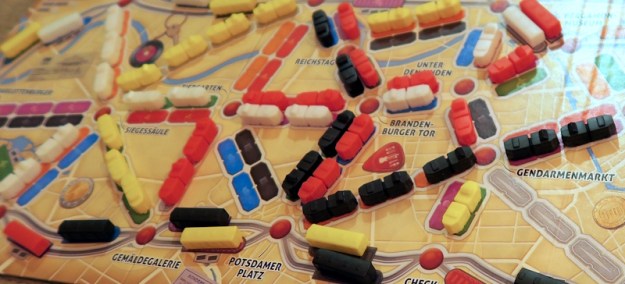
Ticket to Ride: Berlin is one of the mini versions, and there was a little chat about these and which ones people had played.  The first mini version was a “demo” game the publisher used to introduce people to the game at conventions.  Since then, there have been a series of City versions, with New York, London, Amsterdam and San Francisco all featuring and Berlin being the most recent (with Paris to come next year).  These all feature the same basic mechanism as the original game (including the scoring of points for placing trains unlike the First Journey type games), but they have fewer train pieces and a smaller map.  The Berlin map, is long and thin, but the big difference is that players have mixture of Trams and U-Bahn pieces.

Ticket to Ride: Berlin
– Image by boardGOATS

Tram and U-Bahn routes are paid for in similar ways, though only one U-Bahn piece is needed to mark them and they score slightly more points.  Once the differences had been highlighted by Pine and Pink (who played this together a few weeks back), everyone got down to business.  Jade and Sapphire dominated the West while Pink and Pine concentrated on the East, though the geography of the map meant everyone had to include East-West connections in their network.  It was a hard-faught close game with both Jade and Sapphire taking negative points due to incomplete Tickets.  Pine completed five Tickets and Pink finished six.

Ticket to Ride: Berlin
– Image by boardGOATS

Pine’s Tickets were more lucrative, however, and he took victory with sixty-one points, while Jade with forty-nine just pipped Pink by two points in the struggle for second place.  Everyone had enjoyed the game, and Jade commented that it was one of his favourite renditions of Ticket to Ride so far—indeed, the addition of a second set of transport seems to have been much more successful in this mini version than it was in the full-sized Rail & Sails where it made it longer and more fiddly without making it significantly better.  While everyone else was playing and then discussing the merits of different versions of Ticket to Ride, the Crafty Trio, Plum, Blue and Byzantium had finished Broom Service and squeezed in a quick game of Dinosaur Drafting with Draftosaurus.

Draftosaurus
– Image by boardGOATS

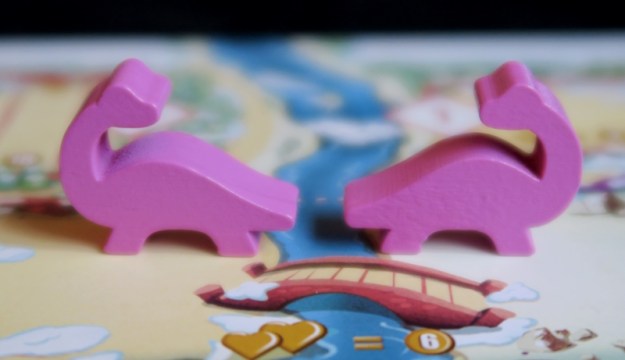
This is a fun little game that we play quite a bit, where players choose one Dinosaur from a handful, add it to their Park and then pass the rest on.  Dino-placement is slightly restricted by the roll of a die, with everyone getting points for how they occupy their pens.  Usually, the group plays with the Summer board, but with the cold weather, the group decided to play with the alternate, Winter board which introduces new and different pens.  These include the Well-Ordered Wood (Dinosaur types must alternate); Lovers’ Bridge (giving six points for each pair of Dinosaurs separated by the bridge); the Lookout (contains one Dinosaur and scores two points for each one of that type in their right neighbour’s pen).

Draftosaurus
– Image by boardGOATS

The most challenging, however is the Pyramid, which holds up to six Dinosaurs in a layered structure, but dinosaurs of the same species may not be placed adjacent to each other (horizontally or vertically).  Blue got into a mess with this, and was stuck with a Dinosaur she could not place at the end as a result.  Plum and Byzantium did slightly better and were able to capitalise more on the Quarantine Zone, which allows players to move the single occupant at the end of the game.  In the end, it was a tight game (though not as tight as Broom Service), in which Plum ran out the victor, three points ahead of Byzantium.

Draftosaurus
– Image by boardGOATS

Learning outcome: They’d have got away with it if it weren’t for those pesky kids!

Essen 2017

It is that time of year again when the gamers’ minds turn to Essen and – The Internationale Spieltage.  To Gamers worldwide, Essen is synonymous with the largest games fair in Europe and, arguably, the world.  The fair runs Thursday to Sunday in mid/late-October every year and is the one of the biggest and most significant of all the boardgame conventions with many new releases and timed to coincide with the end of October.  This year the first day will be this Thursday, 26th October and games, publishers and their wares are all making their way to Germany for four days of fun and games.

Essen
– Image from merz-verlag-en.com

Last year several of the group went, and they came back with a lot of expansions for well-loved games like Istanbul, Colt Express, and Orléans and picked up some new games like Key to the City – London, Ticket to Ride: Rails & Sails and Cottage Garden.  This year, new games include Queendomino, Indian Summer, Altiplano and Keyper, with expansions to old favourites like Isle of Skye, Imhotep, Ticket to Ride, Terraforming Mars and Splendor as well.  Once again, several locals are going and they are sure to bring back some interesting toys to play with over the coming months.

– Image used with permission of designer Richard Breese

Essen 2016

It is that time of year when, the leaves fall from the trees and gamers visit Germany.  No, Oktoberfest isn’t the draw (that happens in September anyhow), this is an altogether different annual German “festival” – The Internationale Spieltage, which is held in Essen.  To Gamers worldwide, Essen is synonymous with the largest games fair in Europe and, arguably, the world.  The fair runs Thursday to Sunday in mid-October every year and is the one of the largest and most significant of all the boardgame conventions.   As such, many of the manufacturers plan their biggest releases for October with their debut at the Fair.

Essen
– Image from merz-verlag.com

Last year there was a bit of a paucity of new games and it seemed to be all about expansions.  This year, while there are still plenty of expansions for well-loved games like Istanbul, Colt Express, Orléans and Ca$h ‘n Guns etc., there are also a lot of new games based on old favourites.  For example, there is Key to the City – London (which has a lot of elements of one of our favourite games, Keyflower), Jórvík (an update and re-theme of Die Speicherstadt), X Nimmt! (a variant on the popular but chaotic 6 Nimmt!), and the latest incarnation of the Ticket to Ride series, Ticket to Ride: Rails & Sails.  There will be plenty of other interesting original games too though, including The Oracle of DelphiA Feast for Odin, Cottage Garden and The Colonists.  Several members of the group are going this year, and they’ll no doubt bring back lots of exciting new toys to share with everyone.

Essen
– Image used with permission of BGG contributor Gonzaga

Boardgames in the News: The Monthly Game Guardian

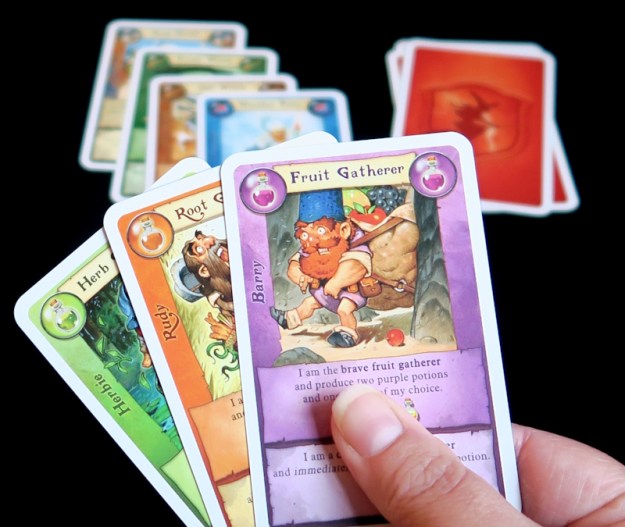
In recent years it has become increasingly acceptable to play boardgames, so much so that there are now regular articles in the national press – in particular The Guardian who have had a dedicated boardgames area in their “Lifestyle” section for some time.  They now also have a regular monthly guide designed to help people “find the best games” and “steer clear of disappointing duds”.  This is written by Owen Duffy who writes for the Guardian on a range of subjects and until recently ran the tabletop gaming blog Cardboard SandwichThe first article showcases four games that even some dedicated gamers might not be aware of:  Ice Cool, Ticket to Ride: Rails & Sails, Mystic Vale and Sneaky Cards.  Owen has a real love of playing boardgames and is genuinely knowledgable about them, so the “Boarders Hoard” is definitely worth keeping an eye out for.

Ice Cool
– Image used with permission of BGG contributor punkin312