Tag Archives: Tuscany

8th July 2025 (Report)

Things were late starting, largely due to the delayed arrival of Blue and Pink with their copy of the “Feature Game“, the the shiny new Emberleaf.  It was Plum’s Special Birthday—there have already been two in the last few weeks (Jade and Pine, with Black a few months ago) and more to come in the not too distant future—so there was a bit of chat, card signing and some amazing chocolate cakes provided by Sapphire.  Eventually, as time was marching on, games were assigned and Blue and Jade started to explain the rules of Emberleaf to Ivory.  This is a “card dancing” and tile placement game from the same stable as The Isle of Cats, where players are trying to re-home their kin in clearings on the central Forest board.

Emberleaf
– Image by boardGOATS

The core mechanic of the game is card placement and movement on the players’ individual Fellowship player boards.  The idea is that on their turn, players carry out one of two possible mandatory actions and as many optional actions as they like.  The two possible mandatory actions are Card Placement and Card Movement (or “Dancing”).  There are five different types of power on the Cards and one of these is the “On Play” action.  This takes effect when they are placed—players start with a two by six space to place cards and can place each card in any empty space.  The other possible mandatory, Card Movement involves starting with the card in the top left corner and progressing down each column, each card is moved left one space and any “Slide” actions are carried out.

Emberleaf
– Image by boardGOATS

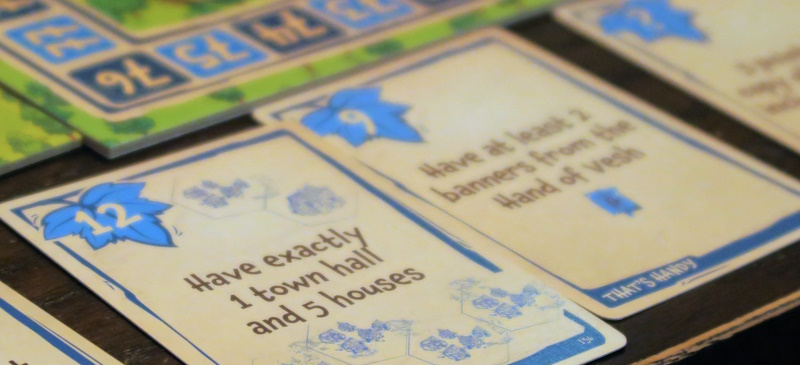
When cards reach the left-most column, Sliding moves them off the player’s board (activating any “Drop Off” actions) and back into their hand (not via a discard pile like deck-building games, so there is no probability element; Cards as always available in hand or on the player’s Fellowship board).  The remaining two powers include “Ongoing” and “Charge”.  Ongoing powers are always active as long as the card is on the board, while Charge powers are optional actions that can only be taken a set number of times before they must be refreshed by the Card Sliding off the board.  All these actions broadly come under the categories of Gathering Resources (Wood, Stone, Turnips or Honey), Walking between clearings, Attacking monsters to make dangerous areas in the forest safe, and Building in clearings.
Emberleaf
– Image by boardGOATS

Each player has a space on their Fellowship board to place Resources, which means players have a limited number they can store.  So, for example, Building requires a card to give the action (either placed or moved) and the necessary Resources to be spent, as well their Hero figure at the clearing they are building in.  Each player starts with a super-cute Hero Figure representing their clan chief, located in Hawker’s Crossing—the most westerly clearing, on the edge of the Forest.  From there, players can move their Hero around the board by Walking along paths which go through dangerous areas.  If a player wants to travel through a dangerous area, they need to walk further or, alternatively, they can spend a turn Attacking the monsters in the Dangerous area and make it Safe (which also requires an action either by placing a Card or as part of a Card Movement).
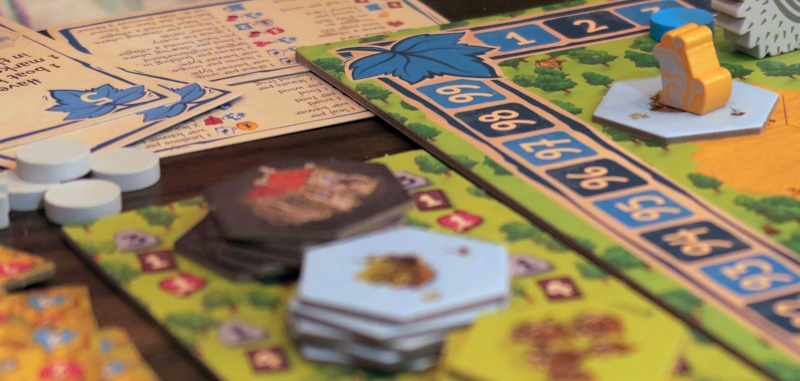
Emberleaf
– Image by boardGOATS

As always, Ivory was on the case, and asked the key question:  Where do the points come from?  In truth, Emberleaf is a bit of a “point salad” with points coming from all sorts of places.  For example, players get points for Building with the number of points equal to the number of different types of building in a neighbourhood.  Players also get points for making Dangerous areas Safe, as well as for collecting Trophies.  There are six Trophies available during the game, and getting these is all about timing with the player who reaches the bottom of the cooperative War Banner Track taking one.  Everyone gets some benefit from this, but the player who takes the Trophy gets an extra bonus.  The game ends at the end of the round when the sixth is taken.

Emberleaf
– Image by boardGOATS

Additionally, in a similar way to the tiny buildings in Tapestry, when players take one of their twenty Emberlings from their Fellowship board and re-home them, they reveal a little bonus and some of these are points (others include Resources etc.).  There is another, more significant way of gaining points, however, and that is through Favour Cards.  These are personal objective cards which can be very lucrative and are scored at the end of the game.  Favour Cards can be acquired as part of rehoming Emberlings, but also by Promising a Favour, one of the optional actions that can be carried out as part of a player’s turn.  Each clearing starts with a Favour token in each player’s colour and if their Hero is currently located in a clearing containing one the player may spend it to take a Favour card.

Emberleaf
– Image by boardGOATS

On the surface, the game is not that complex, though building an engine requires an understanding of what the cards do and how to get the best of them.  Additional Hero cards can be taken from a Card market when a Campfire icon is revealed (likely on re-homing an Emberling).  There are a few little rules niggles as well.  For example, the Card markets (there are two:  Favour and Heros) are refreshed at the end of a player’s turn, but as well as replacing the used cards, the oldest card is also discarded meaning the order cards are drawn in has to be observed.  Similarly, whenever a the bottom of the War Banner Track is reached, the Dangerous Area tiles are refreshed.
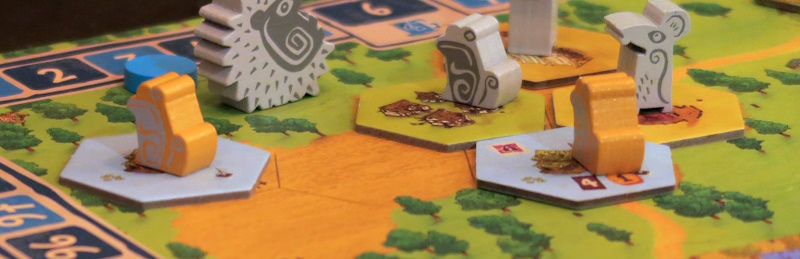
Emberleaf
– Image by boardGOATS

Ivory, got a handle on the rules really quickly and was out of the blocks on the “B” of bang.  Jade wasn’t far behind, while Blue was much, much slower as she spent much of her time with her nose in the rules checking queries rather than focusing on her game.  When she finally got round to looking up, the others were distant figures on the horizon and she had a lot of catching up to do.  Ivory had moved quicklywith an initial strategy of building buildings on the areas that gave honey (particularly markets occupied by a mouse for his end game scoring).  This gave him additional spaces on his board and he then picked up a couple of additional Hero Cards and several Favour Cards to further drive his strategy.
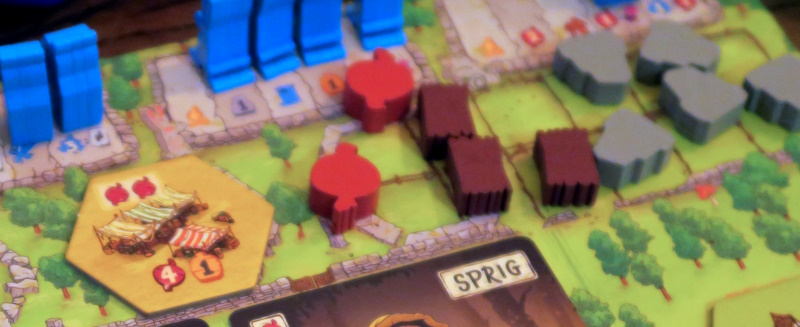
Emberleaf
– Image by boardGOATS

The Koala allowed Ivory to battle anywhere whenever he “Danced”, and that gave him a steady stream of points and resources.  Jade and Blue were slow to clear the additional board actions, but Ivory found that opening up the Build Action meant he always had that available and could place a card with only “Dance Actions” at the end, giving me max benefit for that card.  Everyone tried to get end game objective cards early as they give something to aim for.  Ivory was by far the most effective at this however getting cards that gave points for having his mice on markets, mice in at least three different areas and building in exactly four areas, whereas Blue who was slower, found she was trying to take objectives that matched her achievements.
Emberleaf
– Image by boardGOATS

Inevitably, Ivory was the victory by a veritable country mile finshing with one-hundred and thirty-eight, though Blue who had been practically stationary for most of the game, came through strongly in the late stages to take second.  It had been a tough learning game, but everyone had liked it and it definitely deserves anothe outing.  Meanwhile, Plum, the Birthday Girl, was playing one of her favourite games, Viticulture.  This is also one of Pink’s favourites and is also very popular with both Byzantium and Mint who completed the foursome.  There is nothing really innovative about the game—it is “just a standard worker placement game”, but it does the job really, really well, which elvates it above so many other worker placement games, and as a result, it rates highly on ranks very highly on so many lists.

Viticulture
– Image by boardGOATS

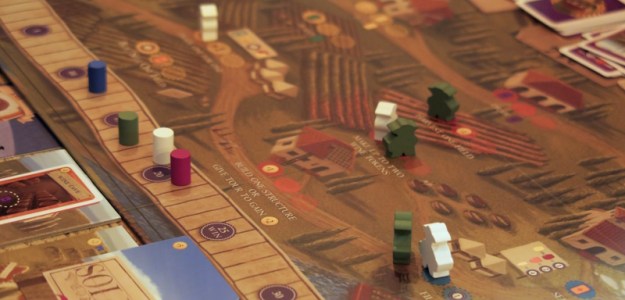
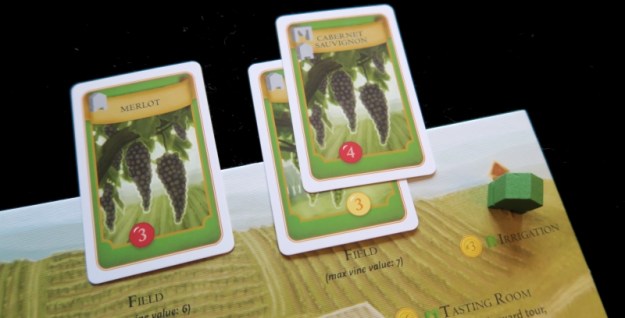
The game played over several rounds, which are split into seasons—Players take it in turns to place workers on the Summer part of the board in the first half allowing them to plant grapes and prepare for Winter when players can harvest their grapes, make wine and fulfill contracts for points.  In general, each action has a small number of active spaces, but players also have a Grande worker who can always be used to carry out an action, even when all the usual spaces have been filled.  Winter and Summer are setup phases when turn-order is addressed and Visitors arrive.  Visitors are cards which allow players to bend the rules slightly and/or gain points.
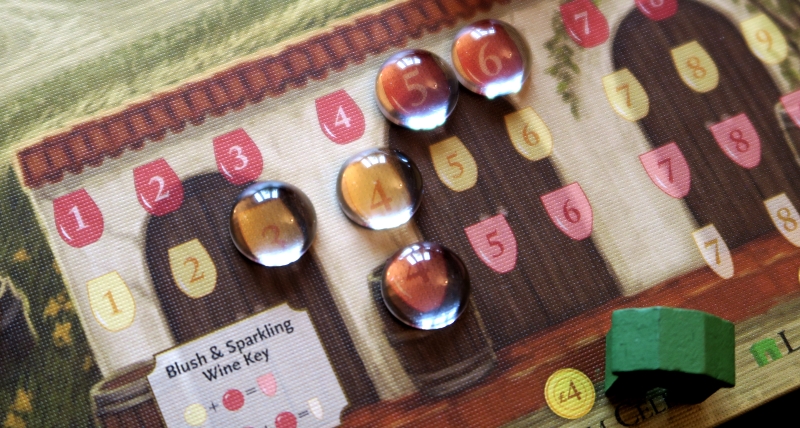
Viticulture
– Image by boardGOATS

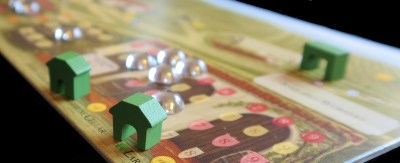
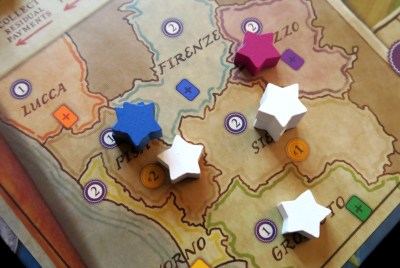
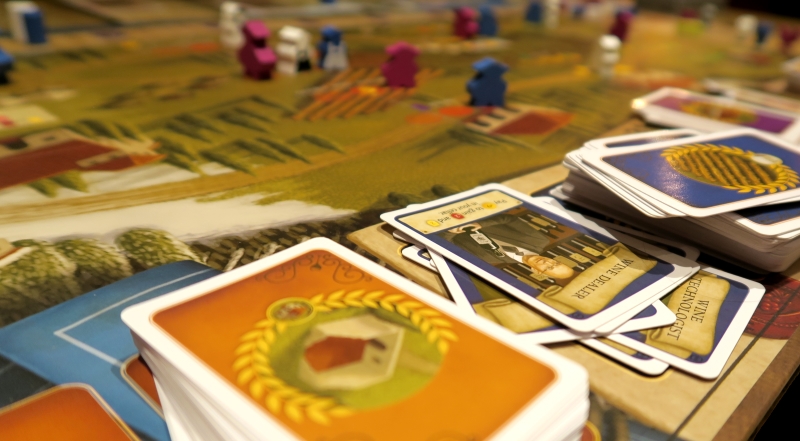
This time, however, the group decided play with the Tuscany expansion and the Moor Visitors card deck.  Tuscany replaces the main board with a larger board, but also re-structures the phases so that there are now four seasons to place workers.  It additionally adds a small map where players can place star-eeples to gain a bonus and points at the end of the game for the player with the most influence in this area.  Tuscany also brings in structures, which players can build to enhance their vinyard and use to gain more points.  It also lenghtens the game slightly, ending when a player passes twenty-five points rather than twenty in the base-game.

Tuscany
– Image by boardGOATS

Everyone knew the game well, so after just a few rules clarifications the game was underway with everyone opting for the the now standard trategy of selling a field for an early influx of cash.  Mint started with some really nice building cards including one which enabled her to harvest multiple fields at the same time.  Plum was less enthused by hers and recycled them—as she had begun the game with the Cottage she was picking up extra Visitor cards every Autumn.  She made a concious decision not to choose to “wake up” first, which meant she never went first or last in the turn order and when she chose the start bonus of “age grapes” she forgot to take advantage of it.  This was clearly catching as Byzantium did something similar when he chose the same starting position.
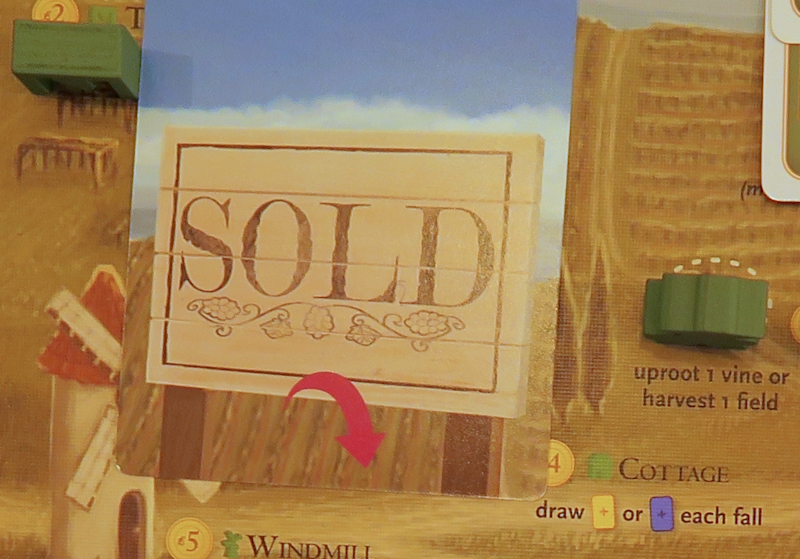
Viticulture
– Image by boardGOATS

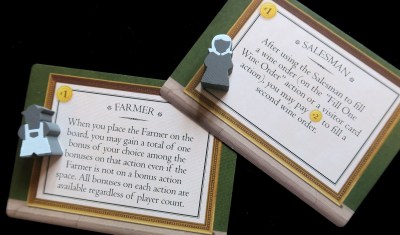
The Tuscany expansion also adds Special Workers which have their own special abilities and players can train one of their workers to have each of these.  This time they were the Farmer and the Builder, with the latter from the Special Workers promo.  Respecively, workers with these powers, allow the player to choose a bonus (even if they are not on a bonus space) and save two lira when building.  A priority is always to get more workers early in the game, but whether to upgrade them is a difficult decision as it costs an extra lira and cash is always so tight in this game.  These proved quite popular though as going second in a location with a Farmer still gave a bonus.
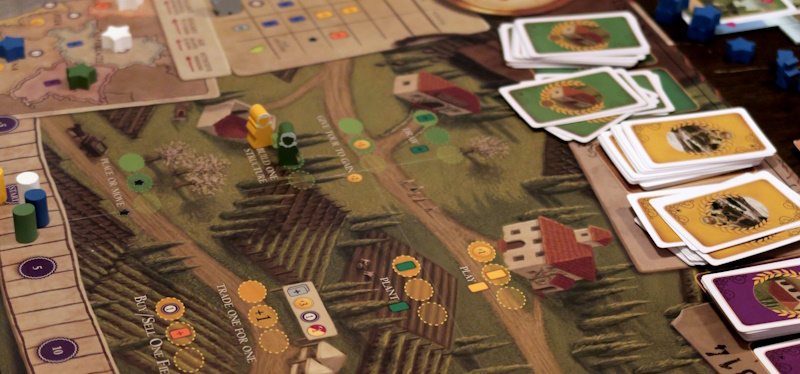
Tuscany
– Image by boardGOATS

Pink got his head down making wine early as he picked up two really nice, achievable and valuable contracts early in the game, which gave him a solid start.  However, it was a very long time before anyone actually really started scoring points as everyone concentrated on building their vinyards before putting them into action.  For example, Plum, needed a Trellis for her first grapes, although having a Builder reduced its cost.  Eventually she also built a Penthouse which gave an extra point when making high quality wine over a value of seven and with those in place was in a position to start growing, harvesting and turning grapes into wine.
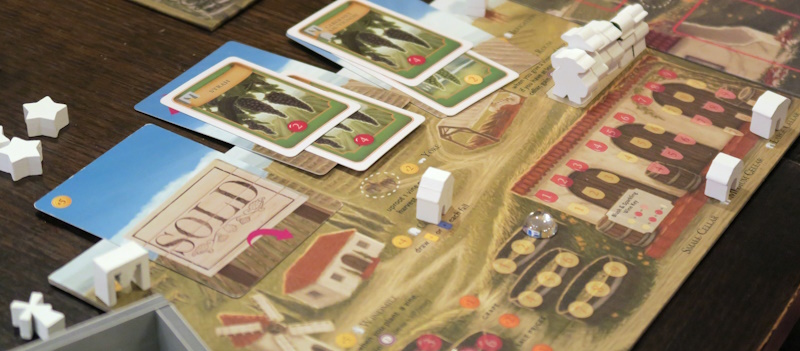
Tuscany
– Image by boardGOATS

At one point, Plum played a two Visitor card combo that gaver her a grape which she was immediately able to sell at tripple the normal price.  Otherwise, everyone mostly focussed on turning grapes into wine and completing contracts for points, although Pink did turn cash into points as well.  As is always the way with Viticulture, there was a sudden cascade of points, and with four experienced players it was a tight game with all four finishing over the twenty-five point finishing line.  The winner was Pink, however, who finished with thirty one points, three more than Plum who took second (no, Pink wasn’t going to let her win, even on her birthday!), and Byzantium and Mint tied and shared the last spot on the podium.
Tuscany
– Image by boardGOATS

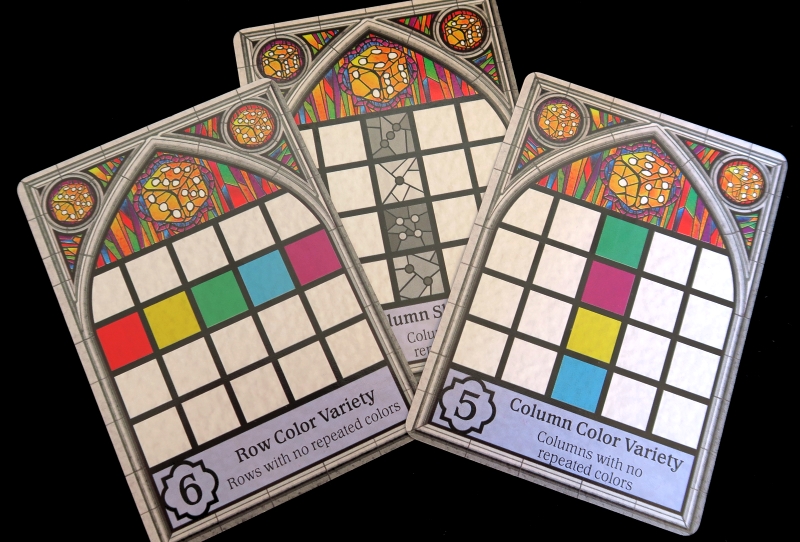
The third table, comprising Black, Purple, Pine, Sapphire and Lime, started with a game of Sagrada (with the 5-6 player expansion).  This is a fairly simple game of dice-drafting, where players are placing dice to create stained glass windows.  Dealt at random, each player begins with a private objective card and two double-sided Window pattern cards, choosing one side to play with and taking the number of Favor tokens marked on the chosen pattern.  Three Tool cards and three public objective cards are placed in the communal central area and the first player rolls all the dice.

Sagrada
– Image by boardGOATS

In “serpentine order” (i.e everyone taking a turn in order then taking a turn in reverse player order), players can use any Tool card (paying one Favour token for the first use, two thereafter) and then choose one die from the pool and place it on an open space in their Window.  The first die must be placed on an edge or corner space and every other must touch another die diagonally or orthogonally.  Dies must match the colour or value depicted on the space if there is one and may never be orthogonally adjacent to a die of same color or value.  Players may choose not to take a die on their turn, but that will leave an empty space and each one costs a point at the end of the game.
Sagrada
– Image by boardGOATS

The game ends after each player has had twenty turns after which players score points for each public and private objective achieved adding one point for each remaining Favour token and and deducting a penalty point for each empty space.  Even though there were five, the group played by these standard rules rather than adding the optional private dice pools from the expansion.  The communal goal cards gave points for placing pairs of dice with a value of three and four; sets of dice with a value of one to six and rows with no repeated numbers.  As is always the case with dice games, this game is all about riding the luck of the roll, but it can play havoc with people’s plans.

Sagrada
– Image by boardGOATS

For example, on Pine’s first turn a roller six of the dice had a value of two, but nobody wanted them.  Later in the game he rolled again, this time rolling no twos when at least two people desperately wanted them!  When the game came to an end, there was just the scoring.  Honours were pretty much even for the first two communal objectives.  Purple managed to score once for the lucrative, one row without repeated numbers objective, while Sapphire and Black scored it twice and Pine three times.  Scores for the private objectives were almost identical for Sapphire, Lime and Pine.  In total that gave Pine victory, nine points ahead of Sapphire in second and sixteen ahead of Black in third.

Sagrada
– Image by boardGOATS

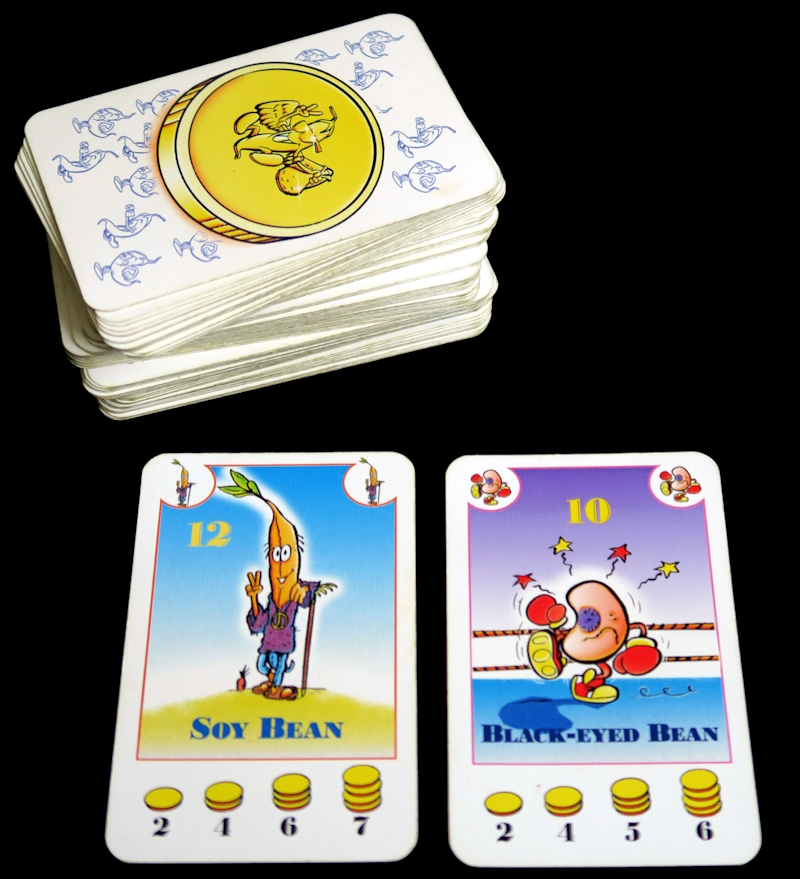
The other games were still going and looking like they were giong to take the rest of the evening, so the group looked around for another game that played five.  From the other side of the room Blue suggested Bohnanza, and as Sapphire thought he’d never played it, the group decided that wasn’t a state of affairs that could continue.  This is a popular game within the group as it is a lot of fun, even though a game about bean farming and trading sounds very unpromising.  Played with cards, the key mechanism is that the order of players’ hands cannot be changed—they can only be manipulated by in-game play.  So, on their turn, players must play the first card in their hand into one of their two “Bean Fields”, and may play a second if they can.

Bohnanza
– Image by boardGOATS

Beans can only be added to empty fields or to fields of the same type.  A field can be harvested at any point, but the aim it to maximise the yield.  Once the active player has played from their hand, there is the flop: two cards are played from the deck onto the table.  These must be planted before the next phase, but can be planted in the active player or by any player with their agreement.  Sometimes these are gifted, sometimes they are traded, and this is how players can manipulate the cards in their hand, by trading away undesirable cards.  Once the cards on the table have been disposed of, then the active player can trade any card in hand before replenishing from the deck to end their turn.
Bohnanza
– Image by boardGOATS

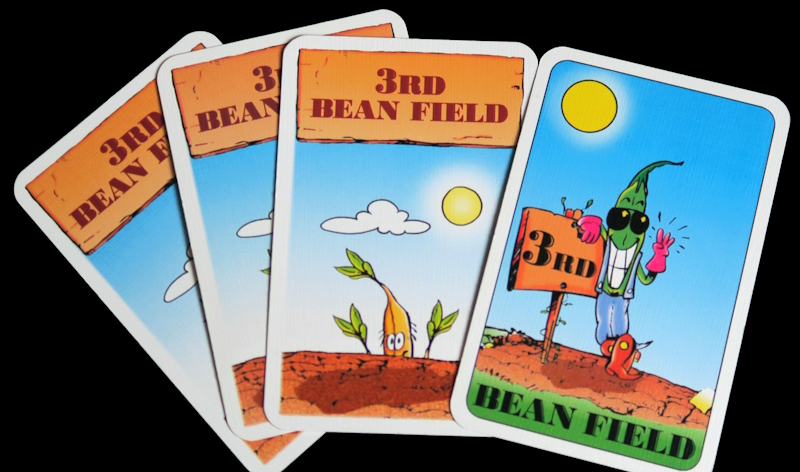
The game ends after three passes threough the deck, but while the first pass seems to take forever, the last always goes like lightening because many of the cards are now in players’ score piles.  Further the balance of the cards changes as the game progresses, with rare cards disappearing as they are turned into “Thaler” and get stuck in players’ stash.  Players can spend some of their riches on a Third Bean Field, but this is only really productive if carried out early in the game.  This was a strategy adopted by Pine this time—unusually for him.
Bohnanza
– Image by boardGOATS

It paid off almost imediately as Pine collected two of the super-rare cocoa beans, and soon added a third.  Black commented that he’d get the fourth, and Pine couldn’t hide his delighted laugh when he immediatly picked it up!  The winner was Lime though who finished three points clear with twenty, leaving Pine to take second and Black to make up the podium.  The question was, however, had Sapphire enjoyed it?  Sadly, the answer was a resounding “no”.  Worse, it turned out that he had played it before, and had disliked it so much that he’d blocked out the experience.  Such a shame, but some games are not for everyone…

Bohnanza
– Image by boardGOATS

Learning outcome:  You don’t have to know how you win, you just have to score more points.
5th March 2024

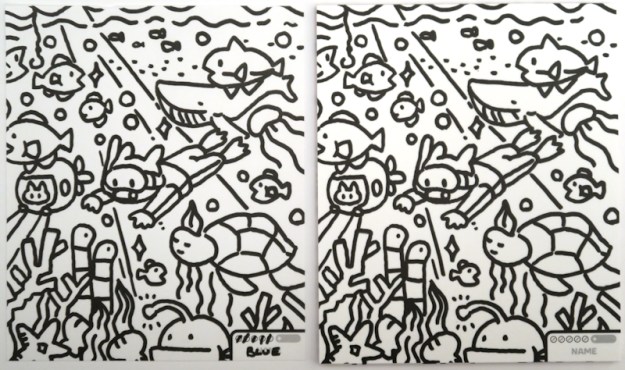
The evening started with everyone unsure who was coming, so the nine players present split into three groups of three, with Blue, Pine and Lime starting with the “Feature Game“. This was the very short, light, Make the Difference, a game that is basically “spot-the-difference” in board game form.  The idea is that each player gets a pre-printed picture and simultaneously add five extra “features” to their pictures.  Once everyone has added their “extras”, players take it in turns to place their pictures in the centre of the table (covered with a sheet of acetate to make it a little more difficult to spot the difference between printing and drawing), together with an unadulterated copy.

Make the Difference
– Image by boardGOATS

Players have one minute (timed with a slightly grumpy egg-timer), during which a player spotting an addition gets a point, then a second minute, during which both the spotter and the modifier get a point.  After the two minutes, any un-spotted additions are assessed for size, and if they are large enough, the modifier gets two or three points.  The additions have to be a single line, may extend an existing feature, and can’t just increase the width of an existing line.  This time, Pine went first with his picture, and the slightly mardy timer gave Lime and Blue a few extra seconds to spot his additions as Pine encouraged it to behave.  Most of his additions were spotted, partly as a result.

Make the Difference
– Image by boardGOATS

Lime went next, and players were slower to spot his additions giving him extra points.  Blue was the last, but this time Pine and Lime really struggled.  For some reason, Blue seemed to be better hiding hiding her additions, taking six points for lines that weren’t spotted during the two minutes of play.  In contrast, her poor spotting let her down, giving her a total of eight points, and just enough for second place.  The winner was Lime, however, with ten points.  There was a little chatter while they packed away, but as there were no new arrivals, the trio moved on to play something else, and quickly chose to give the recent Northern Lights edition of Ticket to Ride another outing.

Ticket to Ride: Northern Lights
– Image by boardGOATS

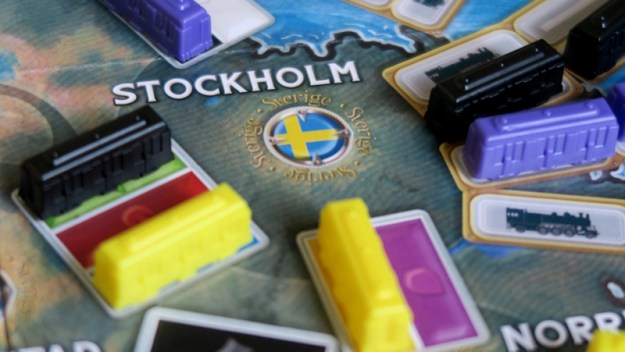
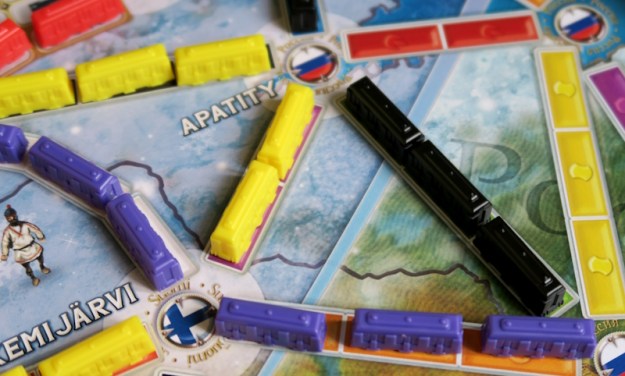
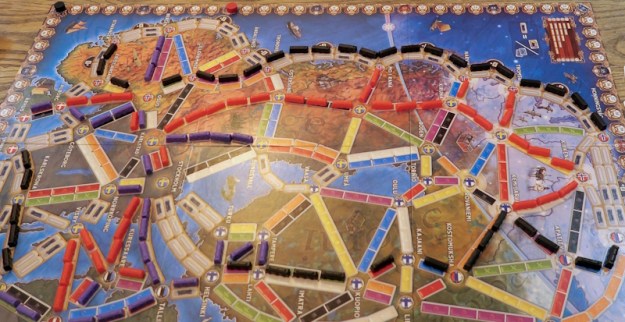
Ticket to Ride: Northern Lights has had a couple of outings since it’s group debut last summer, and has been quite popular in the group.  The game is a fairly standard edition of Ticket to Ride (take cards from the market, or play cards to place trains), but the map is set around the Scandinavian countries of Denmark, Norway, Sweden and Finland.  Like all the variant games, this one has a couple of minor rules tweaks, principally, the addition of bonus cards which give points at the end of the game and bonuses for completing some of the longer Ferry routes.  Locomotives are also handled slightly differently as the market is not refreshed when saturated by them, and for Ferry routes only, they can be replaced by any two cards of the same colour.

Ticket to Ride: Northern Lights
– Image by boardGOATS

This time, the bonus cards drawn at random were the Locomotive Collector (A), International Tycoon (G), Polar Express (H) and the Ferry Master (J).  Pine went first and started placing trains much to Lime and Blue’s horror.  A few turns later, Lime headed up the Norwegian cost, while Blue started building an extended route from Bergen in the west through Stockholm to Tallin in the east.  It was then that Pine, with his north-south route got in her way and began costing her points thanks to the fact that with only three players the double routes weren’t in play.

Ticket to Ride: Northern Lights
– Image by boardGOATS

As he had done last time the group played, Lime churned through his trains remarkably quickly catching Pine and Blue on the hop slightly. After the last few turns had been played, the bonus points were allocated with each player winning one (Lime for the most Ferry routes; Pine for the most tickets ending in the Arctic Circle and Blue connecting the most countries while nobody had any Locomotive cards at the end of the game).  Pine claimed a completed Ticket for eighteen points which he had almost completed when he drew it (AGAIN!).  Also like time, Lime finished with a nice round hundred points, and once again was pipped pipped to victory by Pine, albeit by a larger margin (ten points rather than three).

Ticket to Ride: Northern Lights
– Image by boardGOATS

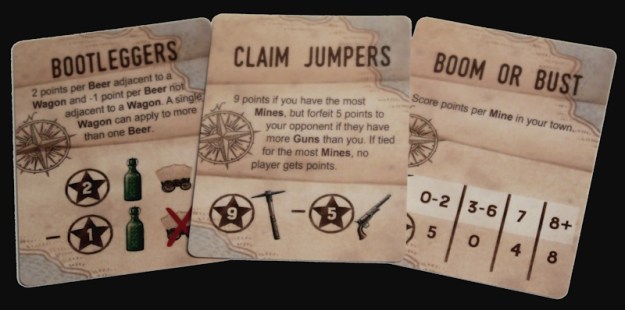
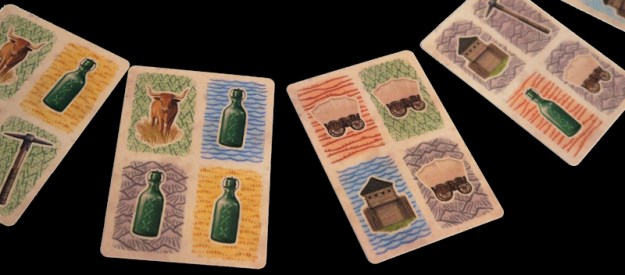
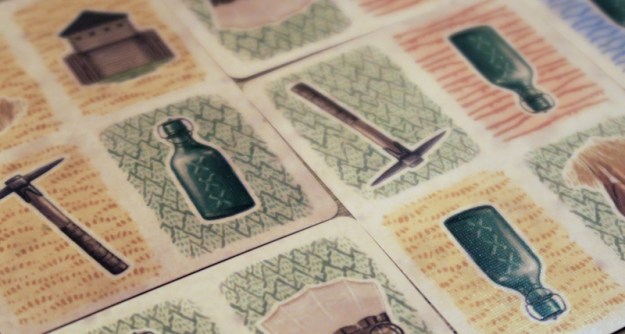
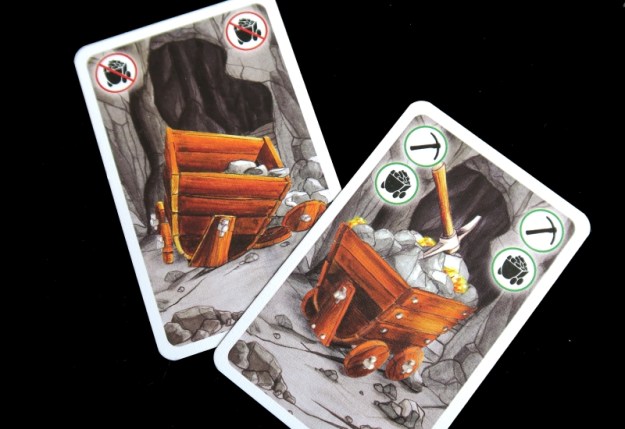
With that over, Lime headed home, leaving Blue and Pine to kill time while waiting for one of the other games to finish.  In this, they played a little “wallet game” called Circle the Wagons.  This is a simple, quick game where players take cards from a market and add them to their player area, building a map, scoring points according to the largest areas of each terrain type and three addition scoring criteria selected at random.  These scoring criteria are printed on the reverse of the cards and are drawn at random at the start of the game.  The first bonus card drawn was “Boom or Bust which gives points for two or fewer Mines/Pickaxes, none for three to six and four or five points for seven or eight (or more).

Circle the Wagons
– Image by boardGOATS

The other bonus cards were Claim Jumpers which gives the player with the most Mines/Pickaxes nine points (though they lose five if their opponent as more Guns), and Bootleggers which give two points for each Beer Bottles next to a Wagon (and minus one for any not next to a Wagon).  Once the bonus cards had been picked, the remaining fifteen cards were shuffled and arranged in a circle.  The first player, in this case Pine, could then choose to either take the first card, or take another, later card, leaving any that had been skipped for his opponent, Blue, who then had the same choice.  Play continues until all the cards had been taken.

Circle the Wagons
– Image by boardGOATS

This time, Pine started prioritising Pickaxes, given the fact that two of the bonus points scored for them.  Blue was slow to get started with these and ultimately scored nothing for Boom and Bust and for Claim Jumpers.  She collected Beer Bottles instead and prioritised scoring for her terrain.  Blue’s thirteen points for Beer Bottles exactly matched Pine’s for his Pickaxes, though he picked up half a dozen points for his Beer as well.  Blue took six points for her Forest and four for her Plains, while Pine got five points for each of his Desert and Water terrain.  It was closer than it seemed during the game, however, with Pine finishing with thirty-five points, just three more than Blue.

Circle the Wagons
– Image by boardGOATS

By this time, Pink, Teal and Ivory were bringing Viticulture to a close.  This is one of the group’s most popular worker-placement games and a particular favourite amongst Pink and Teal who have been promising each other a game for months.  The game is quite simple and doesn’t really do anything fancy, it just does what it does very well.  The idea is that players are making wine, which they do by placing their workers on spaces on the central board.  Each space has a limit to how many workers can occupy it, with each player having a “Grande” worker who can muscle in anywhere.  This time, the group played with the Tuscany expansion, which adds a few little extras.

Tuscany
– Image by boardGOATS

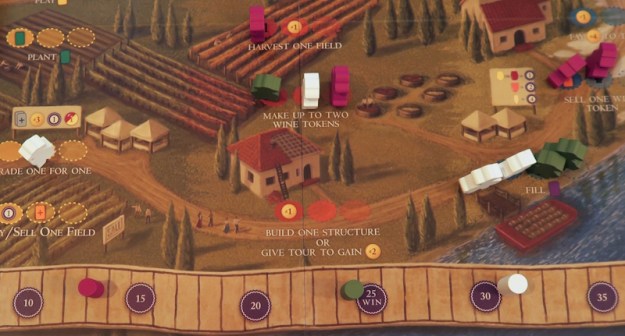
Firstly, whereas the base game has essentially two seasons spring and autumn (with visitors in summer and winter), the Tuscany expansion has actions for all four seasons.  Players can also build special buildings (which give additional powers and special options for those that make the effort to build them), and claim regions to gain influence (and bonuses) which scores points at the end of the game.  The player order works slightly differently to the base game and the end of the game is triggered when someone passes twenty-five points (rather than twenty in the original game).  This time, however, nobody took advantage of the opportunity that Tuscany provides to build buildings, instead focusing on the basics of planting grapes and harvesting them.

Viticulture
– Image by boardGOATS

There is a now a well-known and frequently used tactic of selling a field at the start of the game to provide equity in the early part of the game.  Teal and Ivory both went down this route while Pink decided to try something else, but that didn’t go well for him.  His problems were exacerbated by his inability to get access to fulfilling orders later in the game.  Ivory started acquiring points early taking an early lead.  Teal wasn’t far behind, but never quite managed to overhaul Ivory who triggered the end of the game and finished with thirty-one points, seven more than Teal in second place.

Tuscany
– Image by boardGOATS

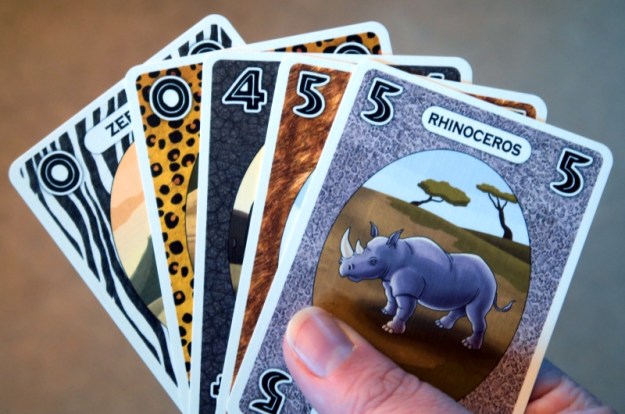
When Viticulture finished, Ivory and Teal headed home, leaving Pink to join Blue and and Pine in a couple of quick games of Botswana.  This is a sort of simple stock-holding game where players are collecting animals.  The idea is that there are five suits of animal cards, each numbered from zero to five—these are shuffled and dealt out to the players with a small number left out for ambiguity.  Matching the suits, there are five sets of five plastic animals.  Players take it in turns to play a card (any card) and then take an animal (any animal) until someone plays the sixth card in any suit.

Botswana
– Image by boardGOATS

When the last card is played in any suit, the game ends immediately and players score points for their animals with each animal being worth the face value of the last card played in that suit.  Thus, Zebras might have been worth five points each, right up until the last card was played which could be a zero, rendering them totally, point-less.  Somehow, it is a hard game to understand—far from random, a bit like 6 Nimmt!, it is very hard to control and manipulate the scoring in a particular direction.  This was quite evident in the two rounds played this time.

Botswana
– Image by boardGOATS

In the first round, Blue held a few key Elephant cards and was able to manipulate the game end to ensure they scored well.  With a couple of high scoring Lions added to her menagerie, she ended the game, ensuring she finished with thirty-five points.  It was very tight between Pink and Pine, but Pink just edged second place with twenty-two.  The second round was also close with just two points between Pink and Pine, but this time they were vying for victory.  In the end it was Pink again, this time triggering the end of the game allowing him to ensure his Leopards scored well.

Botswana
– Image by boardGOATS

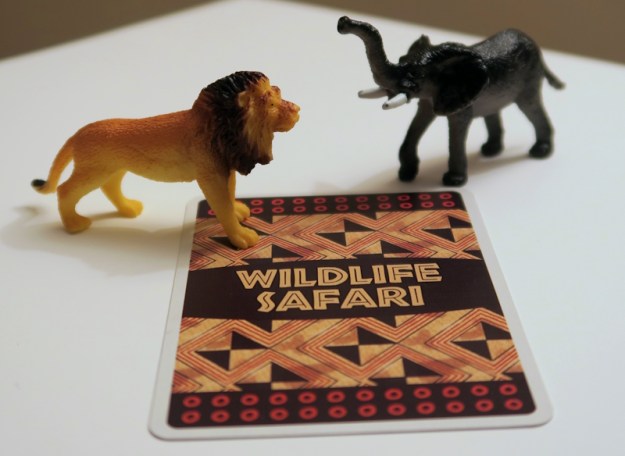
Botswana is a lot of fun and as they packed up, there was quite a bit of chatter.  Pine pointed out that the backs of the cards said “Wildlife Safari” and wondered why.  Blue commented that there were lots of different versions, but couldn’t remember the differences.  A little bit of research shows that the game was originally released as “Flinke Pinke” and then “Quandary” and eventually “Loco!”, all with simple colour suits.  Then, in 2010, the boring colour suits were changed for animals by Eagle-Gryphon Games, who initially republished the game as “Botswana”, before increasing the size of the box and calling it “Wildlife Safari”.  Presumably this particular copy was released when small boxes were still available, but the company had run out of matching cards…

Botswana
– Image by boardGOATS

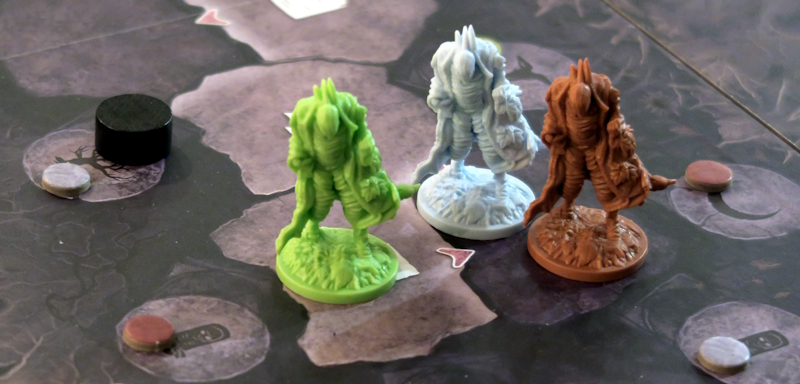
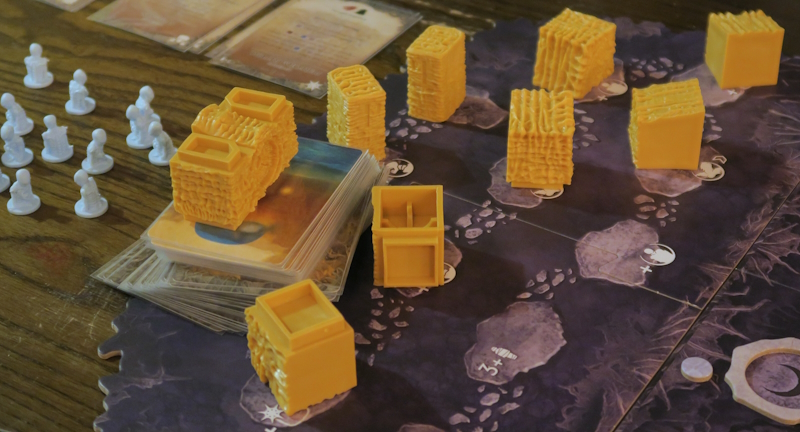
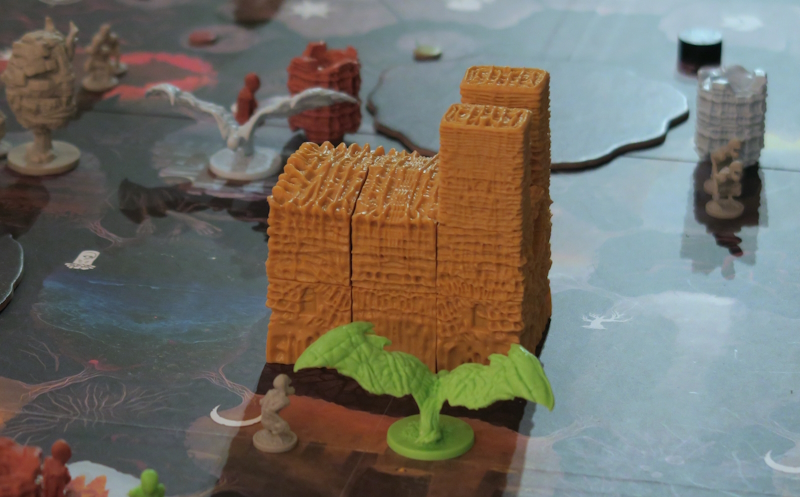
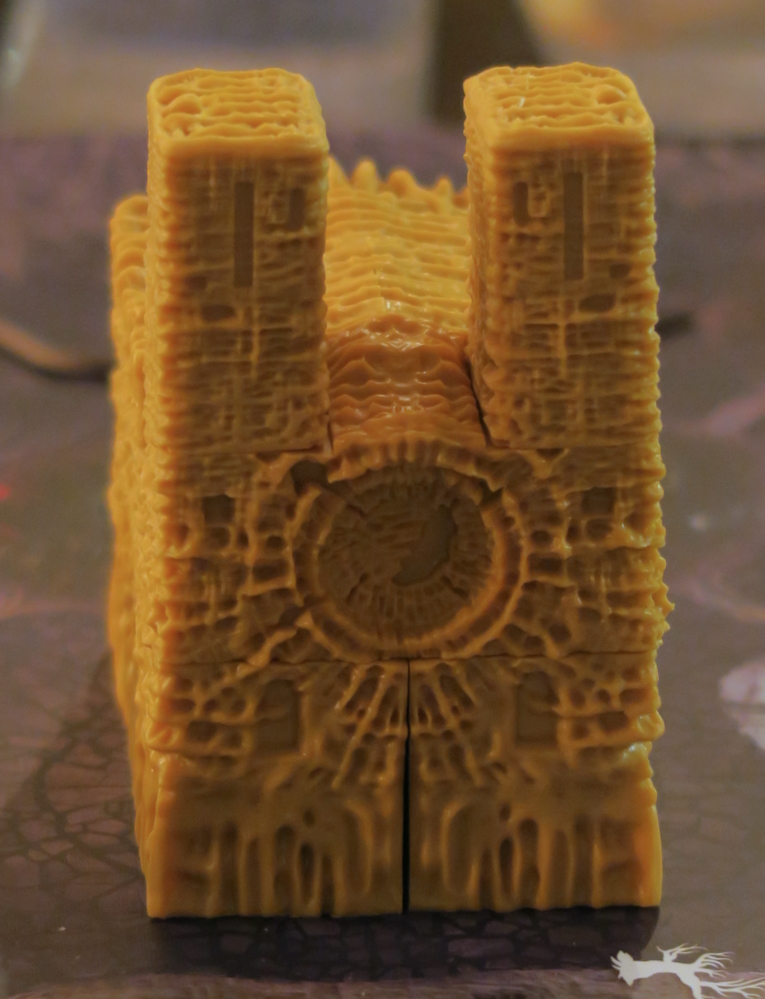
Meanwhile, on the next table, Cobalt had persuaded Plum and Byzantium to join him playing the rather epic-looking Nightmare Cathedral. This is a card-driven action-selection area-control game set in the fantasy world of late Polish surrealist painter and sculptor Zdzisław Beksiński. The game is adorned with his artwork and beautifully sculpted miniatures. Players control Units, which act as a resource, whilst an imposing Cathedral is built in the centre of the board. Once the Cathedral is completed, two Nightmares (out of a selection of eight) appear next to the Cathedral and can be controlled by a player on their turn if a certain condition is met. Each Nightmare, represented by a unique sculpt, has varying abilities such as converting or devouring units as they move around the map.

Nightmare Cathedral
– Image by boardGOATS

The game ends when a certain number of Units have been devoured, or, less likely, after completing three rounds. The winner is determined by points, which can be obtained from climbing the Ritual track, building Forts, Devouring the most Units, or completing objectives on Dream cards (the latter being the largest source of points). On a their turn, the active player selects an action with their Dreamer from one of five on the day/night action track, although they cannot select an action adjacent to their dreamer’s current space. After performing the action, other players get to follow, either Conforming or Dissenting depending on whether their dreamer is adjacent to the current action space.

Nightmare Cathedral
– Image by boardGOATS

The active player then moves their Dreamer to the adjacent Night space, a section of the Cathedral is built, the turn marker moves to the subsequent space and the next player takes their turn.  Each player starts with a tableau of five cards, one for each action type, that details how each action can be performed, as well as the Conform/Dissent actions. The players also have a hand of cards, which come in two forms: action Upgrades or one-time Effects; each card also contains combat symbols.  The five basic actions are: Ritual (spending/removing followers to move up the Ritual track); Summon (producing Followers); Fortify (spending Followers to Build/Upgrade Forts); Manoeuvre (moving Units and/or Shaper, performing a conversion and then initial Conflicts); Develop (playing Development cards from hand, either to Upgrade actions or gain one-time benefits).

Nightmare Cathedral
– Image by boardGOATS

A player controls an area if they have a Fort present, or if there is no Fort and they have the most Units in the area. The board is also populated with a “neutral” player, called The Shadows, that can participate in conflicts and be Devoured for benefits. Each area is associated with one of four symbols, with the active symbol being determined by the turn marker (which changes every turn, cycling through each symbol). Certain actions refer to these symbols, for example when moving up the Ritual track, players must spend Units from areas matching the symbol on the next level of the track, or areas marked active by the turn marker produce if that action is selected. When producing Units by marked areas, the unit is produced by the player who controls the area, not by the active player.

Nightmare Cathedral
– Image by boardGOATS

A player may forgo the action on the card to draw two Development cards to hand. Each player may have up to two Dream (objective) cards at any time, and may complete them on their or another player’s turn provided they match the criteria at the appropriate time as specified on the objective card.  However, they may only draw new cards at a specific point in their turn from a display. Once the Cathedral is nearly complete, the Level II Development and Dream cards are mixed in with the initial Level I cards to provide enhanced benefits and more points. When a player initiates Conflicts, they get to choose which of the valid areas the Conflict(s) occur, and they do not need to participate in the conflict themselves.

Nightmare Cathedral
– Image by boardGOATS

To resolve a Conflict, the two players involved reveal a number of Development cards from hand—the number determined by the number of units present in the Conflict area (plus one if they also have a Fort). Each card depicts claws and shields: a Unit is removed for each claw that was not deflected by a shield. The winner of the Conflict is the player who has a Fort remaining, or, failing that, the most Units in the area; the looser must retreat all remaining Units to adjacent areas.  Each player starts with one action upgraded, drawn at random—each player drew an upgraded summons card.

Nightmare Cathedral
– Image by boardGOATS

Cobalt played first, and was able to complete one of his Dream cards immediately. In the first few turns, Byzantium managed to pin Cobalt in one corner of the board, which severely limited his ability to expand and produce Units, whereas Plum was able to grow relatively peacefully on the opposite side of the board. Byzantium, and to some extent Plum, were able to make use of their expansion to move up the Ritual track. Plum was also able to expand her Forts to several areas. Cobalt was able to upgrade his forts in the limited areas he controlled, as well as draw up to the hand limit of eight development cards over the first half of the game.

Nightmare Cathedral
– Image by boardGOATS

During the second half of the game, after the Cathedral was built and the Nightmares came out, Cobalt was able to make use of his Development cards (especially due to a very well timed fortunate draw) to control both Nightmares in a single turn to Convert and then Devour a sufficient number of his own Units to claim a high-scoring Dream card as well as ensure he had the most Devoured units for end-game scoring.  Unfortunately, this time, the group ran out of time so had to end the game early, stopping after everyone had completed an equal number of turns (time which Byzantium used to move up the Ritual track and Plum used to built a few more Forts).

Nightmare Cathedral
– Image by boardGOATS

Long before the game finished, it was clear that Cobalt was miles ahead and nobody was going to catch him.  Plum held on to he Dreams for too long, while Cobalt and Byzantium were better at completing theirs.  She did manage to get a Fort in the fourth corner of the map fairly early on which gave her somewhere to spawn her Units from, though.  Ending the game early meant players didn’t get to make as much of their Upgraded Action Cards as they might have done and there were cards left in hand which could have come into play with another few more rounds. As a taster game, it proved quite different, however, and deserving of another try sometime, as long as there is time to complete it.

Nightmare Cathedral
– Image by boardGOATS

Learning Outcome:  You are never too old to play “Spot-the-Difference”, but that doesn’t make you good at it.

21st March 2023

Blue and Pink were just setting up Circle the Wagons when Lemon walked in.  As Circle the Wagons is a two player filler game, they quickly packed it away and got out No Thanks! instead.  Lemon hadn’t played it before (or perhaps had forgotten), so Blue gave her a quick rules explanation.  It is a very simple (if clever) game, so it didn’t take long:  the first player reveals the top card of the deck, then makes the choice, either to take it or pay a chip to pass the problem on to the next player.  At the end of the game, the player adds up the face value of all their cards and the player with the lowest total is the winner.

No Thanks!
– Image by boardGOATS

There are two catches, however.  Firstly, if a player has a run of consecutive cards, only the lowest counts to a player’s final score, which encourages players to gamble a little.  However, the second catch is that nine cards are removed from the deck at random before each game, which means the card a player is gambling on getting may not even be present in the deck.  Blue and Pink were half way through their burgers and the trio were halfway through the game when Indigo and then Pine arrived.  Indigo was also new to the game so as they finished the first game Blue explained the rules to her too.

No Thanks!
– Image by boardGOATS

The first game was really close, but Lemon, got lucky and, although everyone scored relatively highly, she had three less than Pink to take victory.  The game plays five well though, so Pine and Indigo joined the other three for a second round.  This time, the top scorer was Indigo who finished just shy of fifty points.  Everyone else was closer, but this time Blue was the winner with seventeen points, some five less then Pine.  By this time, almost everyone else had arrived and the burgers had been dispatched, so it was time to decide who was going to play what.  The “Feature Game” was to be the Visit from the Rhine Valley expansion for one of the group’s most popular games, Viticulture, and the questions were, who wanted to play that, and what would the rest play?

Viticulture
– Image by boardGOATS

Viticulture is one of Pink’s favourite games and Teal was very keen to play it too.  Somewhat surprisingly, Ivory was open to other options, so eventually Indigo and and Green joined them to set that up.  With five people left, Lemon loving Ticket to Ride, and Pine having just acquired Burgundy‘s copy of the Europe edition, it wasn’t really a great surprise when the group decided to give that an outing in his memory.  The game is a very straight forward game of set collecting and network building with players either taking two cards on their turn, or paying sets of cards to place trains on the central map.  Players score points for placing trains on the map (with longer routes giving more points).

Ticket to Ride: Europe
– Image by boardGOATS

At the end of the game, players score extra points for any “completed tickets”, i.e. successfully connected the destinations on ticket cards dealt at the start of the game and perhaps collected during the game.  There is a risk associated with tickets, however, as any that are incomplete, score negatively.  Each version of Ticket to Ride has slightly different rules, so while everyone was very familiar with the basic game, the group had to remind themselves of the specifics of the Europe edition.  The main difference between this version and others is the inclusion of Stations—players can add one of these to a city to enable them to use one line connected to it that someone else has built to help them to complete tickets.

Ticket to Ride: Europe
– Image by boardGOATS

Ivory started and began the game and started on his first move by placing a single train from Bruxelles to Amsterdam.  That caused panic amongst everyone else, and turned out to be completely justified as everyone except Pine got involved in a scrap for the space in central Europe.  Largely as a result of that congestion Purple ended up forced to take tunnel routes.  These are routes where players don’t know the actual cost before they build them, since three cards are turned over from the draw deck and if any match the colour of the track being constructed, these must be matched by the player building the track (or they fail to build it).

Ticket to Ride: Europe
– Image by boardGOATS

This turned out to be costly for Purple who had a couple of attempts knocked back and some that costed considerably more than expected.  Lemon did what she often does and seemly prioritised building tracks she liked the look of, connecting them together later if possible.  Everyone else crossed their fingers and fought for the routes they wanted with most people interfering with somebody else’s plans somewhere along the way.  Ivory claimed the long tunnel route from Stockholm to Petrograd, and much to Purple’s disgust, managed it first time.  Lemon, who was after Pine in turn order kept trying to jump in front of him leading him to wonder whether he was invisible.

Ticket to Ride: Europe
– Image by boardGOATS

Blue seemed to have lots of tickets that didn’t go where her trains were and life got worse and worse as the space became increasingly crowded.  As the number of trains everyone had dwindled, everyone panicked about whether they were going to complete all their tickets.  Then, as everyone else was struggling to complete their tickets, Purple surprised everyone by taking more, and got lucky and finished it the very next turn—just as well, because Ivory had ended the game.  After the obligatory points recount (and a couple of very minor adjustments) the group started evaluating tickets.

Ticket to Ride: Europe
– Image by boardGOATS

Ivory, Pine and Blue had a lot, but Ivory had got lucky with his ticket draws which all fitted together quite nicely.  Blue had been less fortunate and only discovered that she was missing a connection for one of hers when it came to the final count.  Pine and Blue both succeeded in completing eight tickets, but Ivory had the longest continuous connected line, with all but two of his trains conga-ing neatly across the map.  Ivory, who had just been ahead throughout was the victor with a hundred and forty-seven points, twenty ahead of Blue in second and forty ahead of Pine in third.  It had been a good game though, with lots of cut and thrust and everyone (especially Blue) had engaged their inner Burgundy at some point.

Ticket to Ride: Europe
– Image by boardGOATS

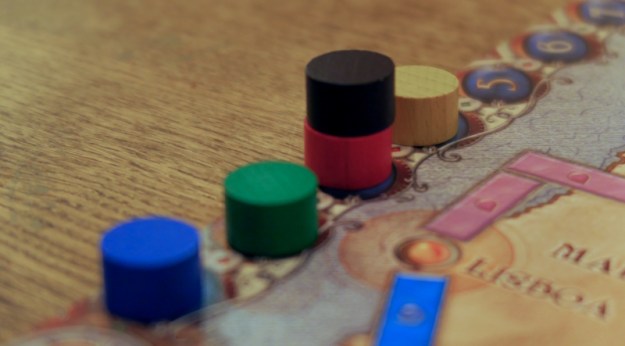
Both Ivory and Pine wanted an early night, but there was still time for something else, so long as it wasn’t too long.  Pine rejected Blue’s optimistic suggestion of Bohnanza as always taking too long, so in the end, the group settled on Coloretto.  Lemon was new to this, but it’s a quick game to teach and an easy game to learn as you play too.  Another set collection game, the idea is that players score points for collecting large sets of coloured chameleons.  So, on their turn, players either turn over the top card of the deck and place the card in one of the trucks (each of which can contain a maximum of three cards), or take a truck.

Coloretto
– Image by boardGOATS

The reason this is clever is because while players score positively for the largest three colour groups, the others all give negative points.  The triangular series gives many more points for the later cards, thus, the trick is to have one large set of cards rather than two or three smaller ones.  The game plays well with five and there were lots of difficult tactical decisions with players trying to work out what everyone else would do and then force them to take cards they really didn’t want.  In the end, it was an easy victory for Ivory though, with thirty-four, four points ahead of Blue in second.  It was much tighter with a three way fight for bronze, that Purple just won.
Coloretto
– Image by boardGOATS

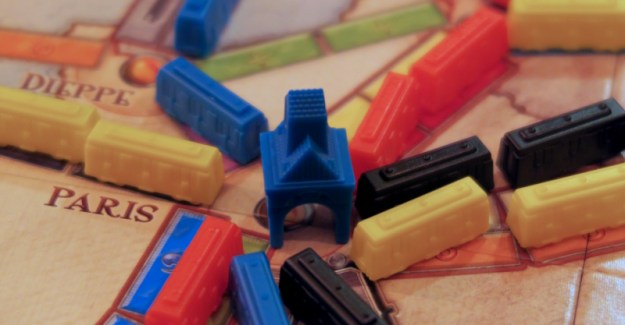
Meanwhile, on the next table, Teal, Pink, Ivory and Green were playing the “Feature Game“, the Visit from the Rhine Valley expansion for Viticulture.  Although Viticulture is much more complex than the other games being played in the room, it is a relatively straight forward worker placement game where players are developing their vineyards by building buildings, planting vines, harvesting grapes, making wine and getting help from visitors.  The game is typically a race with the winner being the player with the most points at the end of the round where a player exceeds a set number of points.  The Rhine Valley expansion is very small, just a replacement deck of Visitor cards, but it has a reputation for changing the game quite significantly, making it more about wine making than just getting points.
Viticulture
– Image by boardGOATS

Viticulture is one of Pink’s favourite games and was quite well known to Green and Teal too thanks to them playing regularly on Board Game Arena.  The Tuscany expansion was a new new variation to Green and Teal though and nobody had played with the new Rhine Valley Visitor cards.  Indigo had never Viticulture at all, but Pink and Teal explained the rules, during which Indigo received some well meant general advice on best plays from the others. When Green suggested that five workers was probably optimum, both Teal and Pink were quick to disagree suggesting that more (maximum of six) was always better.  Viticulture is always a slow burner for the first part of the game, and Pine kept looking across from the other table and remarking how the game had been going for ages, but there had only been a single point scored.

Tuscany
– Image by boardGOATS

As Pink, Teal and Indigo inched forward by a point or three, Green remained resolutely on zero for a long time, and then he sacrificed a point to go negative!  As the game progressed the points started to come eventually.  After drawing fulfillment card after fulfillment card, Pink realised he should have planted some higher value grapes rather than just the first ones that came along, which meant it took lots of turns to make them “ready for sale”.  He was the first to complete a wine order though, with Teal just behind.  Green eventually started to move forward and caught Indigo who was struggling a little to get her head around the game a little and with only three workers was really finding it difficult to get much done.

Viticulture: Visit from the Rhine Valley
– Image by boardGOATS

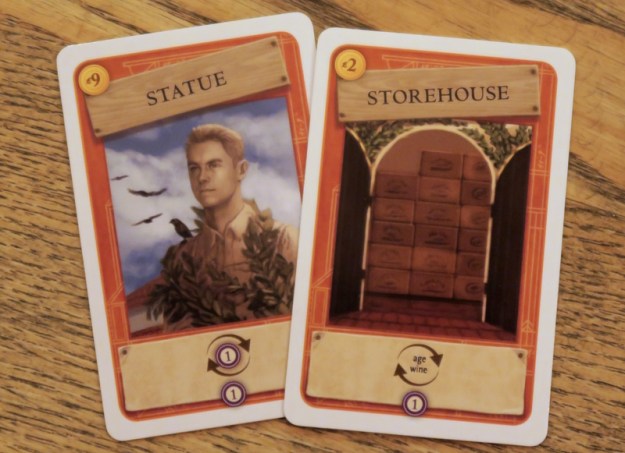
One of the interesting features of Tuscany is the additional buildings that can be constructed.  Green found a Statue which was very expensive, but not only gave him an immediate point, but also an extra point each round.  This, together with his other building, a Storehouse, he had an extra ageing step each round as well—his engine was beginning to build after a slow start.  Green then played a winter Visitor combo, which allowed him to make some wines and fulfill a big six point order with an additional two points.  With the end-game trigger at twenty-five, that was quite a haul in one go, indeed, Green, Teal and Pink were all quite close now.

Viticulture
– Image by boardGOATS

In spite of the sudden flood of points, with time running out, the group soon realised they would not be able to finish in time.  Pink’s more traditional approach of planting, harvesting, making wine and fulfilling orders had kept him at the front of the points track, and would likely have got him over the twenty-five point line in the next round.  However, the group decided that they really needed to finish, just when everyone’s engine was getting into their stride. Nobody will ever know whose would have been be the most successful and by the end of that round it was all very close on the score track.  Pink had his nose in front though, followed by Green and then Teal, but there were still the “Stars” regions to score.

Tuscany
– Image by boardGOATS

This was an area which Teal had really gone for early on in the game. Green had placed a few few early on and then mostly ignored it.  Pink came to the stars late in the game, but as was his usual strategy, made big plays when he did.  In the end Teal narrowly scored most just edging Pink although he still had enough to retain his lead with twenty-one, two ahead of Teal and four ahead of Green.  None of the group quite knew how the end of the evening had snuck up on them so suddenly, they had been so engrossed and it had seemed hardly any time at all—quite a recommendation for a game!

Tuscany
– Image by boardGOATS

Learning Outcome:  If you go into the Wine Business, make sure you know what people want to buy before planting any grapes.

14th June 2022

Pink and Blue were the first to arrive, bringing guests from eastern Europe, Orange and Lemon.  Orange and Lemon were new to our sort of board gaming.  After an explanation of what mushy peas are, food and some chit chat, others started arriving.  The “Feature Game” was the Moor Visitors expansion to Viticulture.  Teal had been keen to play the Tuscany board and the plan was to play both together. So when he and Ivory had arrived, they took themselves off to the other side of the room with Pink and started setting up.

Viticulture
– Image by boardGOATS

Viticulture is a worker placement game about planting vines, harvesting grapes and making wine.  The idea is that the game is broken into seasons and years, and players take it in turns to place their workers in the various locations on the board to carry out the associated actions  Although it is not in and of itself an especially innovative game, it is very polished and smooth, and a joy to play.  There are a couple of little elements within the game of note.  Firstly, each location can take a limited number of workers dependent on the number of players.  To grease the wheels a little though, each player also has a “Grande” worker that they can place anywhere, even in a “full” space.

Viticulture
– Image by boardGOATS

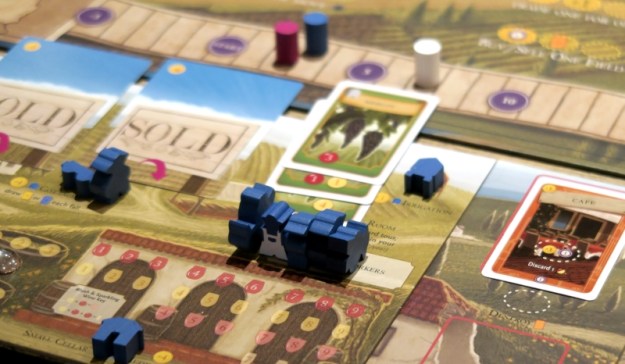
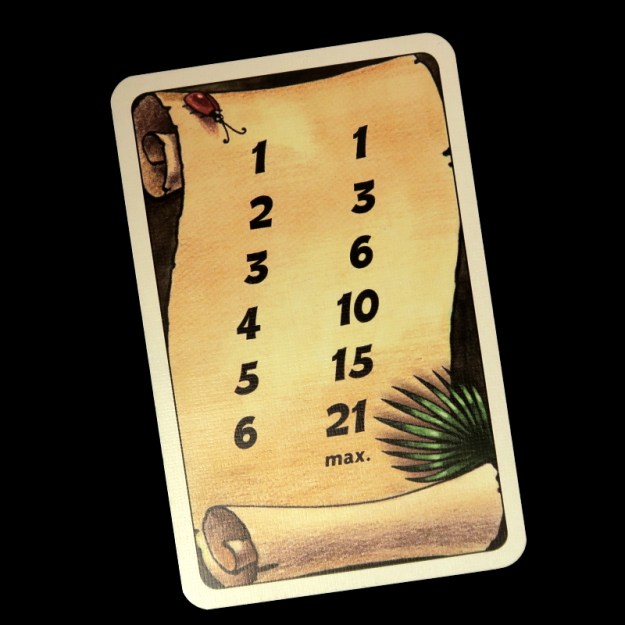
Players start the game with four cards from which they choose two, a mama and a papa and these dictate players’ starting conditions:  money, number of workers, buildings and cards.  There are four different types of card, Vines, Contracts, and summer and winter Visitors.  Players can only plant vines in the summer, and then only if they have sufficient land and any necessary buildings.  From there, grapes can be harvested in the autumn and placed in players’ crush pads and thence combined to form wine and stored and aged in their cellar.  Wine can then be used to fulfill contracts in exchange for points.  Although this is the main source of points, it is not the only one.
Tuscany
– Image by boardGOATS

Some of the Visitor cards give special actions that can be used to generate points, as can buildings like the Windmill and the Tasting Room and some of the Visitor cards.  At the end of each year, players get their workers back and age their grapes and wines as well as collecting residual payments (income).  The Moor Visitors expansion adds extra visitor cards which are just mixed into the deck providing more variety.   The Tuscany expansion mixes things up more, by changing the seasons in which the actions occur, particularly adding actions to spring and autumn.  It also provides a couple of extra mechanisms, including the “Influence” action, special buildings and specialist workers.

Tuscany
– Image by boardGOATS

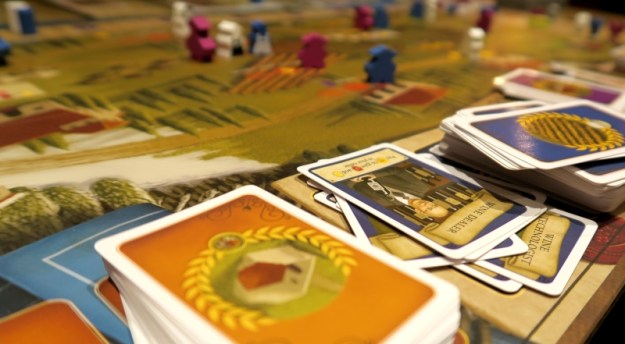
This time, there was the initial random draw of the start tokens to “see who’s cock comes out first”, and then the game got under way.  Ivory and Teal both trained one of their workers to be “Special Workers”. These act as normal workers, but have a special ability when used in a particular way.   Each game, two of these are drawn at random from a deck, and when players train workers, they can make that worker a specialist for an additional fee.  The specialisms are open to all players, though each player can only have a maximum of one worker with each skill set.

Tuscany
– Image by boardGOATS

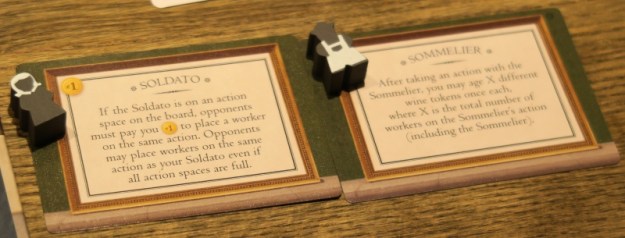
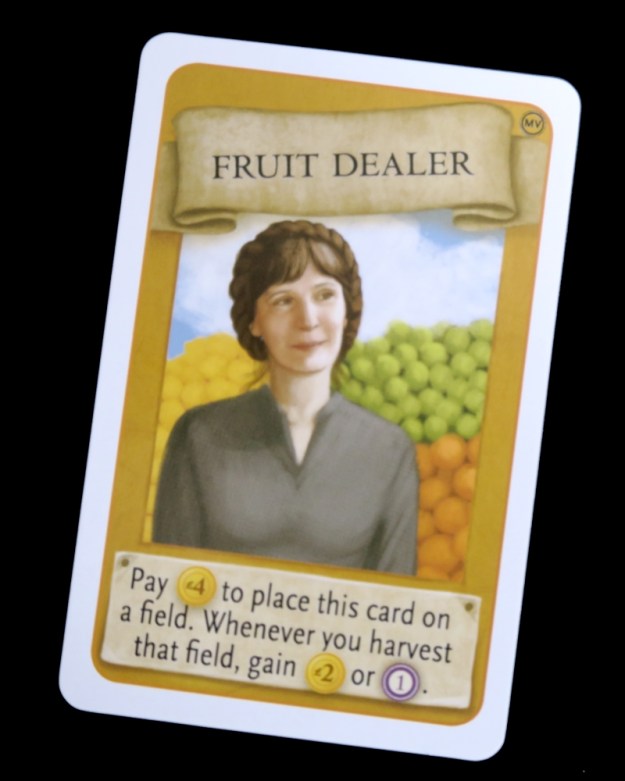
The Special Workers this time were the Soldato who bullies other players into paying to use the same action space, and the Sommelier which gives an additional opportunity to age grapes.  Ivory went for the military option while Teal selected one of his workers to learn about serving wine.  Elsewhere, Pink’s strategy was centered around the use of his Fruit Dealer card from the Moor Visitors expansion.  This gave him a point (or money) every time he harvested a specific field.  Teal built a Café which allowed him to turn grapes into money or points.  Everyone also began with what seems like the accepted strategy of selling off land to gain funds in the early part of the game, buying it back later as required.
Viticulture: Moor Visitors Expansion
– Image by boardGOATS

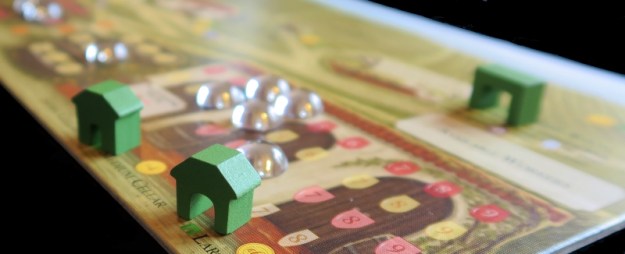
Ivory made an early move to stake his claim on the influence map, using the Influence action to place his Stars.  When placing Star tokens, players get a bonus reward for doing so.  In this way, it effectively provides an alternative way to access some “actions” when they are not available on the main board.  At the end of the game, the player with the most Stars in each region gets one or two bonus points.  After placing all six of their Star tokens, players can still use the Influence action by moving them to swing control of regions (but without gaining the instant reward).  As the game progressed, everyone else muscled in on the Influence action too, and by the end of the game, Pink had the edge.
Tuscany
– Image by boardGOATS

It was an extremely tight game.  With the Tuscany expansion, the end is triggered when someone passes twenty-five points. This time, everyone was very watchful, determined not to get caught out like last time when an early break by Teal unexpectedly ended the game leaving Ivory and Pink unable to play their big final plays.  As a result, everyone finished the game with exactly the same number of points—twenty-six.  That meant the advantage Pink had on the Influence map made the difference, leaving him three points ahead of Ivory and Teal who shared second place both finishing with twenty-eight points, in what had been an epic game between three experienced players.
Tuscany
– Image by boardGOATS

While Pink, Ivory and Teal took themselves off to set up Viticulture, everyone else introduced themselves to Orange and Lemon, and gaming was forgotten for the moment.  Eventually, this non-Viticulture group separated into two halves, one playing Imhotep while the other (including Orange and Lemon), beginning more slowly, with lighter introductory games.  Imhotep is a fun family game that won a nomination for the Spiel des Jahres award in 2016.  We’ve played it a few times since then, but like so many games, it had a two year hiatus thanks to the global pandemic.

Imhotep
– Image by boardGOATS

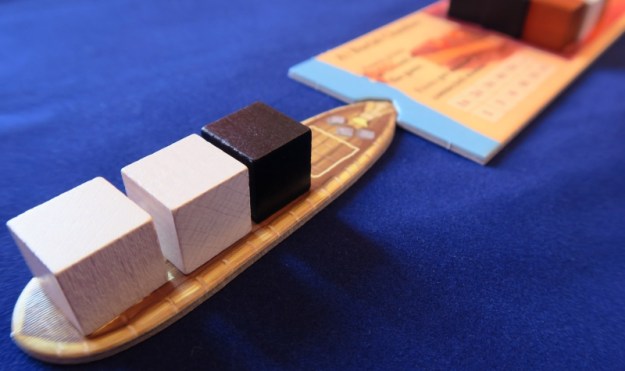
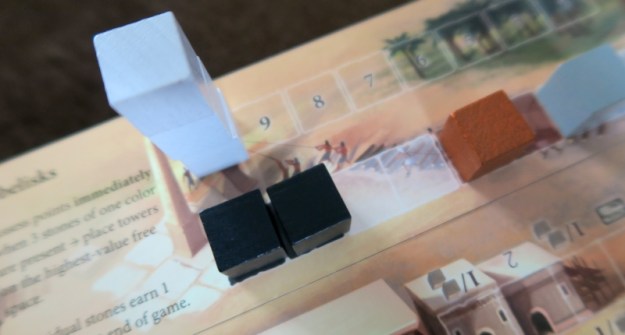
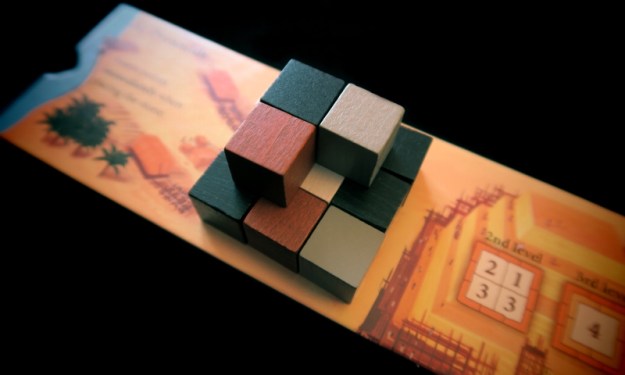
In Imhotep, players move large wooden “stone” blocks by boat to build five monuments.  The game is quite simple to play:  on their turn, the active player can acquire blocks from the quarry, load blocks onto a boat, sail a boat to a monument and add blocks to it, or play an action card.  Each monument scores points in different ways, and the player with the most points after six rounds is the winner.  The game was new to Lilac and Lime, but they quickly got the hang of it—it is quite easy to learn the functions, but deciding the best way to play is where the challenge comes in.

Imhotep
– Image by boardGOATS

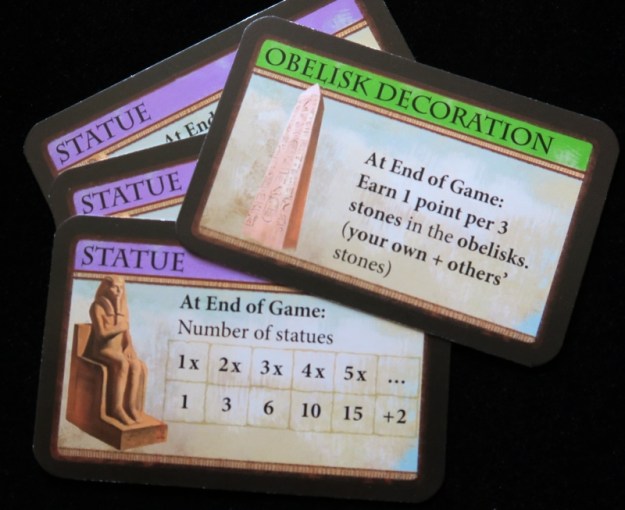
Lilac started out making a play for the Obelisks and quickly took a commanding lead there with four stones by the end of the second round, with one each to Black and Lime.  Lime decided to go for Statues in the market place, which everyone else ignored and so he too managed to get an early lead in them with three by the end of the second round. Black wanted to get his group of five stones into the Burial Chamber, which Green (who had previously announced that he was thirty-fifth world-wide in the Board Game Arena rankings) had spotted and tried hard, but ultimately unsuccessfully to block.  Green managed to get a few larger regions himself in the process though.

Imhotep
– Image by boardGOATS

The Pyramids got steadily built, but unusually for Imhotep the Temple was ignored for most of the game. It wasn’t until the sixth round that any stones were placed there.  The scores for the Pyramid (and towards the end, the Temple as well), kept everyone close together—there was usually only three or four points from first to last place, with the order changing frequently as the game progressed.  Coming to the last couple of rounds, Lilac was challenged by Lime and Black in the Obelisk, but Lime and Lilac (both new to the game), missed the stones in one of the last boats, which Black watched closely.

Imhotep
– Image by boardGOATS

On Black’s turn he moved a two stone boat with only his and Green’s stone to take the lead and give Green a bump from last place to equal third with Lime.  Lilac may have lost out in the Obelisk, but she managed to gain a full five stone region in the Burial chamber, plus a couple of other odd stones. Black got his five but no more. Everyone got a final points bonus from a green card, although Black and Lime’s were for the Temple and only scored a single point. Lilac took a big score of seven for the Burial chamber card.

Imhotep
– Image by boardGOATS

Green also scored well for the Obelisk (five point) and for the Pyramids (six points), as earlier in the game Lime had shifted a three stone boat to the already filled Pyramid preventing the other players scoring more than a single point each.  In the final tally it was very close between Lime and Green, but Green pipped him by a single point, finishing with fifty points to Lime’s forty-nine.  The game finished at exactly the same time as the other group finished their second game.

Imhotep
– Image by boardGOATS

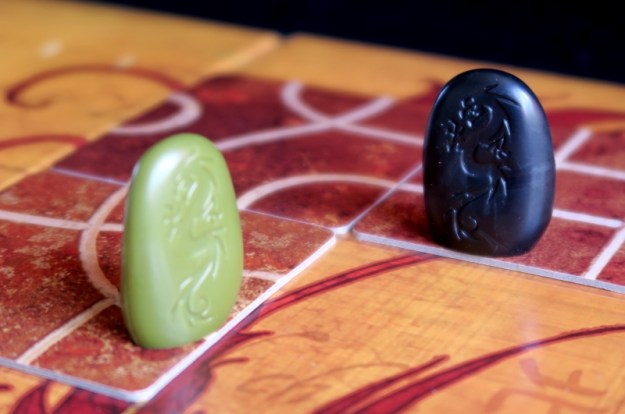
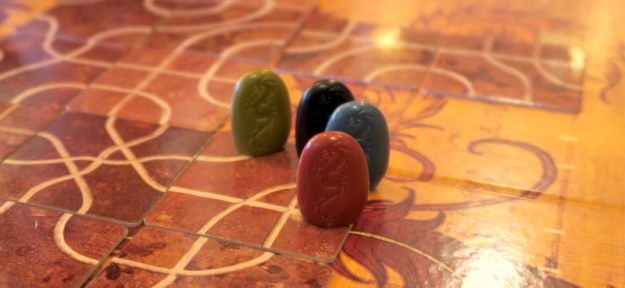
Purple and Blue had been introducing Orange and Lemon to some of the group’s favourite filler games.  They started out gently with Tsuro, aka “The game of the Path”.  This is super quick and simple, with players choosing to play one of the three cards in their hand on their turn, and placing it to extend the path their stone is on.  The winner is the last player still on the board, with players eliminated when their stone is unavoidably moved off the board or collides with someone else’s.

Tsuro
– Image by boardGOATS

There was a certain amount of people “feeling their way” at the start, but with only four players there’s a lot of space on the board at the start.  Players can exploit this and set themselves up with a nice little corner to work in, curating their tiles and avoiding getting themselves into difficulty.  That didn’t last long though, and came to an end when everyone wound up sat on the same tile.  Purple was the first to go, soon followed by Blue.  From there, there was a bit of a head to head, before Lemon “offed” Orange and claimed victory in her first game.

Tsuro
– Image by boardGOATS

Imhotep was still going and Viticulture had only just started, so Blue and Purple decided to introduce Orange and Lemon to the tile laying game, NMBR 9.  The idea is that players take a random tile and place it in their area—tiles must be joined to the others, and if placed on top of other tiles they must additionally be entirely supported and by two or more tiles.  At the end of the game, when two of each tile, numbered zero to nine have been played, the game ends.  Players score points for each tile multiplied by the “floor” it is on.  Thus ground floor tiles score nothing, but any tiles on the second level (the first floor) will score their face value, and so on for higher levels.

NMBR 9
– Image by boardGOATS

Although the rules are quite simple, in practice the game is one that can really make your brain hurt.  In this sense, it was a significant step up from Tsuro, though still quite a short light game.  This time, the tile order did not help players at all with high numbers coming early and at inconvenient times.  Players concentrated on building a sound foundation in the hope of better tiles to follow.  In the event, this worked better for some than others, and, as a result, it was very close between first and second.  Lemon, with seventy-two points ran out the winner once again, just two points ahead of Blue in second place.

NMBR 9
– Image by boardGOATS

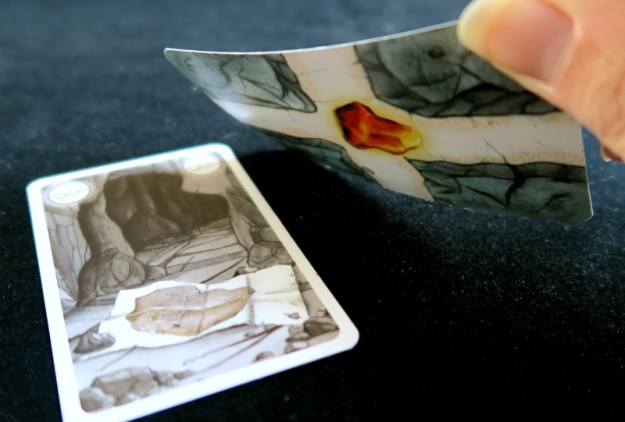
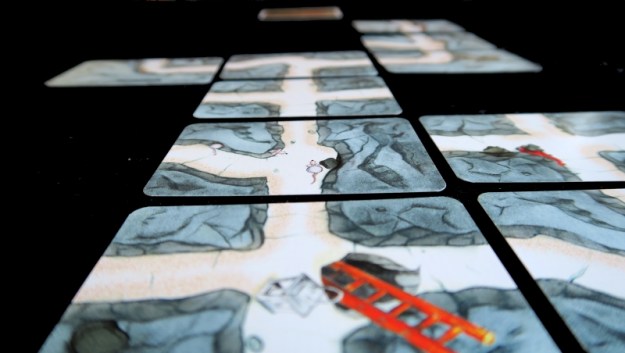
With both groups finished at the same time, there was a lot of chatter, before eventually the groups joined to play something together.  Orange had played Saboteur before, and with such a large group, it seemed an obvious game to play.  There was a quick reminder of the rules for those who had not played it before or who were new to it.  A hidden traitor card game, it is one where there is a lot of banter with players accusing each other left, right and centre.  The group is split into two teams—Lovely Dwarves and Evil Saboteurs.  The aim of the game for the Dwarves is to find the gold, while the clue is in the name for the Nasty, Evil Saboteurs, who are trying to stop them.

Saboteur
– Image by boardGOATS

On their turn, players either play a card, or discard a card.  There are two types:  tunnels and actions.  Tunnels are played in the central area and must extend the existing tunnel network.  Action cards are special cards including map cards (which allow players to take a peak at a target card and report back on whether it is gold or not), rockfall cards (which allow players to remove a troublesome tunnel card), and tool cards.  This last category is where the fun comes.  Players can prevent others from digging tunnels by “breaking” their tools.  Mostly this is because they think someone is on the opposite team, but occasionally it is just “because”.

Saboteur
– Image by boardGOATS

This time, Lime started by picking on Pine for what turned out to be no very good reason.  Pine claimed the gold was in the middle (very early) and five others checked it and concurred.  Pine had a lovely “Saboteury” hand, but emphatically claimed he wasn’t.  And indeed, he wasn’t which meant Lime had to apologise to him at the end as he’d picked on him throughout.  Blue picked on Green—because “He’s always a Saboteur, Right?”—except he wasn’t either.  The guilty parties were Lemon, Lilac and Purple, but it was a fairly easy win for the Dwarves for whom Lime brought victory home.

Saboteur
– Image by boardGOATS

It had been a lot of fun, so everyone was keen to have another go.  After she had been on Team Evil the first time round, Pine perhaps unfairly targetted Lilac who was wholly innocent the second time.  The same could not be said of Purple who was a Saboteur twice in a row.  After picking on him the first time, Blue had to make peace with Green as they were on the same side in the second game (and not the “right” one either).  It is essential for Saboteurs to work well together, and although they did and it was close, it was not quite close enough and Lemon found the gold for the Dwarves.  There was time for one last round, and if the second round was close, the final round was even closer.

Saboteur
– Image by boardGOATS

While the Dwarves were worrying about who might be the three Saboteurs, Lime and Black managed to sow the seed of confusion when with Lime claimed that the gold was in the middle and Black agreeing.  Later it turned out that this was actually coal and although Lime showed his true colours early, it wasn’t until he was joined by Black that the Dwarves realised they’d been duped.  Concerned about the third Saboteur, Blue just managed to find the Gold before they ran out of cards.  Lime and Black had done really well as Saboteurs though, especially as it turned out there were only two of them.  It had been a lot of fun, but with Viticulture at an end, several people wanting an early night and it now having got quite late, everyone decided to leave it at that.

Saboteur
– Image by boardGOATS

Learning Outcome:  It’s never too early to start making enemies.

3rd May 2022

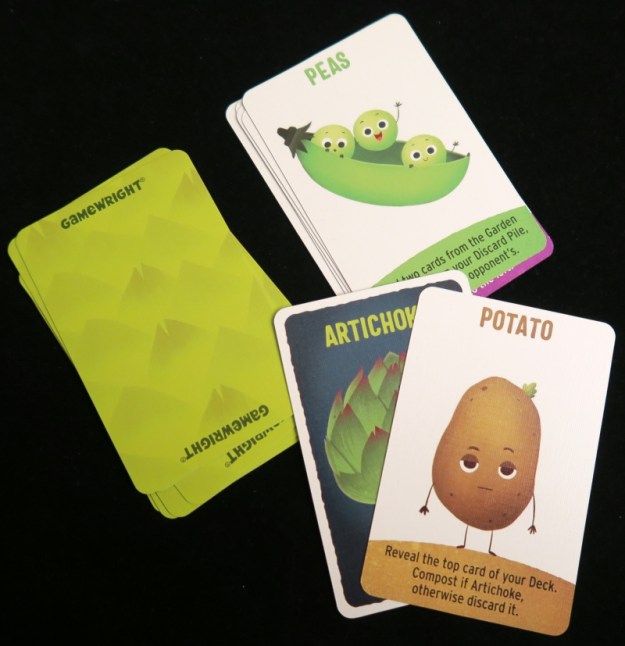
Like the last few games nights, this one started with Pink and Blue playing the deck-shedding game, Abandon All Artichokes.  This is a very simple game where players start with a deck of ten artichoke cards from which they draw a hand of five, then, on their turn, they take one card from the face up market, play as many cards as they can, before discarding their hand to their personal discard pile.  If, on drawing their new hand of five cards they have no artichokes, the game ends and they win.  In the first couple of games a few weeks back, Pink struggled somehow, and Blue won.

Abandon All Artichokes
– Image by boardGOATS

Then Pink got the hang of it, and won several games on the trot, but this time it was Blue’s turn to finally get back on terms, just before supper arrived.  They were just finishing when Black and Purple, and then Teal arrived.  Although it was still very early, it was a perfect opportunity to play the “Feature Game” as it was Moneybags, a quick little social deduction, filler game. The premise is similar to that of Ca$h ‘n Guns, where players are thieves dividing up the spoils from a robbery, stealing from each other and generally trying to deceive everyone so that they come out on top.

Moneybags
– Image by boardGOATS

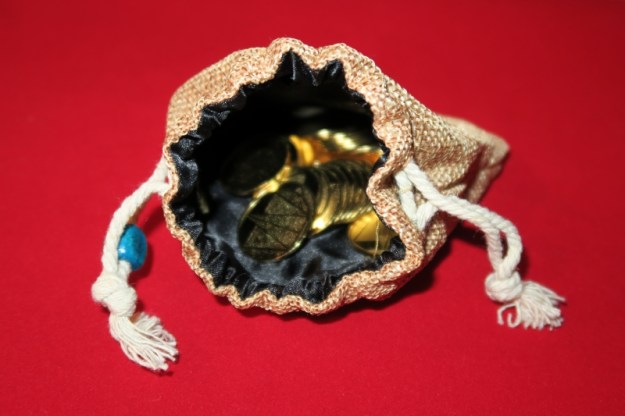
In Moneybags, one player takes the role of the Godfather, divides the loot “evenly” amongst the players’ small hessian sacks.  Holding only the top of their sack, each player takes it in turns to Pass, Stick, or Rob another player.  Pass and Stick are simple actions (pass and remain in the game, pass and stick with the total in their sack so they can neither Rob nor be Robbed), but Rob is the interesting one.  The active player can Rob any other player that is still “in”, taking some or none of the loot from their sack.  The thief mustn’t be too greedy, however, as the victim can challenge—the protagonists compare their loot and the one with the largest stack loses, the winner takes all the loot and the loser is eliminated.

Moneybags
– Image by boardGOATS

After two turns round the table, the game ends with the Godfather (or arguably Godmother), taking their second turn.  The winner is the player with the most loot.  Moneybags can be played over three rounds, though like Saboteur it is probably best when one round is considered “the game” rather than playing in campaign mode.  Pink started as the Godfather and divvied up the money.  In addition to coins, there is also a Diamond in the loot; this is worth roughly ten coins. When comparing spoils, the coins are stacked with the Diamond placed on top so that the tallest stack loses when Robbed or wins at the end of the game.  The Diamond is comparatively light, so it adds a little bit of additional ambiguity to the proceedings.

Moneybags
– Image by boardGOATS

Pink, made a point of taking note of where the Diamond went and then stole it back later in the game giving him the first round, slightly ahead of Teal in second.  Lime arrived during towards the end of the game, so the rules were explained to him.  Then Ivory joined the party so Blue swapped out and gave him a quick summary as well, while Purple, as Godmother, divided up the spoils.  With a slightly better idea of how the game played, the second round went even better with more players Robbing and challenging each other.  As a result, the Diamond went round the table several times.  There was much hilarity as players tried to guess how much cash people had, and Pink showed his age when he commented that someone’s stash “chinked like a bus conductor’s money bag”.

Moneybags
– Image by boardGOATS

Once again, the Godparent finished with the Diamond, but Purple had very little cash to go with it and therefore only made third place.  This time the winner was Ivory, in a very, very tight finish, just ahead of Black.  It had been a lot of fun and although we could easily have played another round or two, we also wanted to play some longer games.  Moneybags fills a similar role to 6 Nimmt! though, so it will get another outing soon.  In the meantime, Viticulture (Essential Edition), Roll for the Galaxy, and Brass: Birmingham were all suggested for the next game, but Pink always loves playing Viticulture and Teal has been keen for a while, so Ivory took them off to play that while the others decided what to play.

Viticulture
– Image by boardGOATS

Viticulture is a worker placement game where players plant and harvest grapes, make them into wine and fulfill contracts to get points.  The first player to reach twenty points triggers the end of the game, and at the winner is the player with the most points at the end of that round.  Although Viticulture is not particularly novel or innovative, it is widely respected as one of the best worker placement games around, succeeding in being both smooth to play and relatively easy to learn, though it takes real skill to be good at it.  This time, everyone sold land to fund worker training; although we haven’t done this when we played previously, it would seem to be an accepted tactic in most games now.

Viticulture
– Image by boardGOATS

At the start of the game, players get choice of a couple of “Mama” and “Papa” cards (taking one of each)—these give people starting resources, workers, money, Visitor cards or a starting building.  Pink took a Trellis from his Mama card which meant he could just plant grapes that needed a Trellis and not worry about building any cultivation infrastructure.  The others prioritised money. Playing two worker cards at the same time (using the on-board bonus) was a popular.  Though it required care not to overrate the feature and wind up playing some slightly naff workers, when perhaps it might have been better to wait until the next round.

Viticulture
– Image by boardGOATS

The grey, extra-worker meeple was also popular, with players seemingly happy to be last in the turn order if that meant they got an extra “turn”.  Although everyone had played the game before (though Teal only online), there were some rules that needed “ironing out” as years of playing with the Tuscany expansion meant that Pink had forgotten many of the differences between that and the base game (Tuscany will get an outing as the “Feature Game” in a few weeks). The game was brought to an unexpected (and obviously skillful) conclusion by Teal, who finished the game just before Ivory and Pink had the chance to deploy their big scores.

Viticulture
– Image by boardGOATS

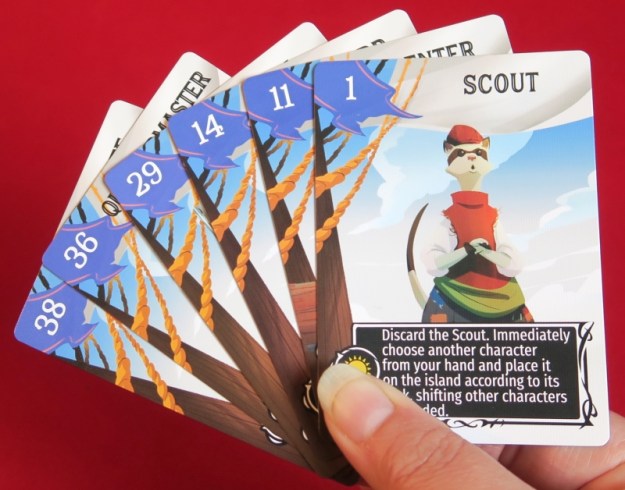
On the next table, Libertalia: Winds of Galecrest got a second outing, largely as Black and Lime had missed out last time, but also as Purple and Blue had enjoyed it.  This is also a fairly simple game to play, with a lot of depth.  Players start with the same hand of Character cards chosen from a larger deck.  This provides a lot of variability, while also ensuring that nobody has an advantage caused by random card draw.  The cards are numbered from one to forty, each with different actions—some daytime, some dusk, and some nighttime.  The idea is that everyone simultaneously chooses a card to play, then the cards are activated in ascending order during the day, descending order at dusk and simultaneously at night.

Libertalia: Winds of Galecrest
– Image by boardGOATS

Some of the cards can have a huge impact on other players’ games.  For example, the Brute causes the highest value card in play to be discarded, which means the player that played that card doesn’t get actions on that round.  In addition to night time actions, any players whose characters survive the day, also get to take some loot, if there is enough available of course.  Some of the loot is extremely valuable, some of it can be used to assassinate other Characters and and some can be more of a curse than an advantage.  As a result, rounds can go well or badly.

Libertalia: Winds of Galecrest
– Image by boardGOATS

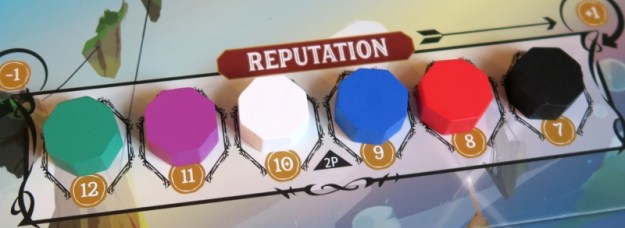
The game is played over three voyages, lasting four, five and six days respectively.  At the end of each voyage, players bank their takings and are paid a small amount based on their reputation at the start of the next round, which then acts as their kitty.  This time, Blue had an appalling first round.  This meant she was some twenty to thirty doubloons behind the others from the start, but also meant that when when others threatened, she was able to point to her lack of funds and how she was “not the threat”.  In contrast, Lime took an early lead and therefore attracted a lot of hostility, missing a lot of turns as a result.

Libertalia: Winds of Galecrest
– Image by boardGOATS

By the start of the final voyage, Blue was still some way behind, but hadn’t given up, Purple was fighting to get to the front, Lime was getting a bit fed up of being picked on and Black knew he was likely to be next in line.  It was all to play for, especially as the final voyage is the longest so players have time to plan and work card combinations.  Blue managed an amazing final round and nearly made it in what was a very tight finish—she ended just two doubloons behind Lime and Black who tied with eighty-six.  Lime could have won outright if he had played his Captain in the final round, but as it was, Black’s Aristocrat left him third on the Reputation track, one place ahead of Lime, giving him victory on the tie-breaker.

Libertalia: Winds of Galecrest
– Image by boardGOATS

Remarkably, Viticulture had finished first, so after discussing and admiring Roll for the Galaxy and comparing it with Race for the Galaxy (which Teal was more familiar with), the trio squeezed in a quick game of Love Letter.  This is a super-quick micro card game played with just sixteen cards that celebrates its tenth anniversary this year.  When it was first released it was very innovative, but since has inspired a lot of similar games, it is still great in its own right, as a simple, quick filler though.  The idea is players are trying to finish with the highest ranking card, so on their turn, they take a card from the deck adding it to their hand, then play one of their two cards.

Love Letter
– Image by boardGOATS

Each card has a rank, but also an action that takes effect when played.  For example, these allow players to look at others’ cards, force others to discard their card, or make them compare cards with the lowest being eliminated.  The last player standing wins the round, the first to three is the winner of the game.  This time, Pink and Ivory got their revenge on Teal for ending Viticulture too soon.  Between them, they shared the five rounds, with Pink just taking the balance and with it, victory as Libertalia and the evening as a whole, came to an end.

Love Letter
– Image by boardGOATS

Learning Outcome:  There’s no such thing as honour amongst thieving gamers.

28th May 2019

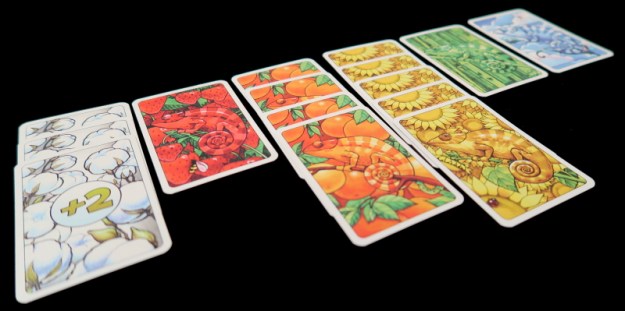
While Pink, Blue and Khaki finished their pizzas, the other early arrivals played a quick game of Coloretto.  This is a relatively short game of set collecting which is very popular with the group; it was new to Lime though so needed a quick rules explanation.  The idea of the game is that on their turn, players can either pick up a chameleon card from the face down deck and add it to a “truck”, or take a truck (passing for the rest of the round).  The innovative part of the game is the scoring which uses the triangular number sequence (one point for the first card, three points for two cards, six points for three cards etc.), with positive points for three sets and negative for the rest.  Thus, players need large sets in three different colours and small sets in all the rest.

Coloretto
– Image used with permission of BGG contributor punkin312

With five players, it was relatively hard to make trucks particularly unappealing to everyone, so the negative scores were kept to a minimum.  It was quite close at the top as a result, with Black, Lime and Mulberry all in the running.  Lime finished with the highest score for his sets totalling thirty, with Mulberry a handful of points behind, but Black had four bonus points and no negatives.  In the end, Lime pipped Black by a single point with Mulberry just a couple of points behind that.

Coloretto
– Image by BGG contributor SergioMR

With Coloretto over, everyone finished with their supper and the stragglers all arrived, there was the usual discussion over who would play what.  The “Feature Game”, Viticulture with the Tuscany expansion, was always likely to take most of the night, so the question was really who was going to play that and what else was on offer.  One of the options suggested was Ticket to Ride with the India map, which was described by Pine as an game where you “just pile people on top of the trains and pack the inside with goats!”  Clearly none of our GOATS fancied the inside of a hot carriage and the discussion continued as Ivory, Pink and Blue started setting out Viticulture and Mulberry (having spent some time as a oenologist) dragged Khaki along for the ride.

Viticulture
– Image by boardGOATS

Viticulture is a worker placement game where players plant and harvest grapes then make and trade wine.  Although there is nothing especially innovative about the game itself, it is an exceptionally good example of its type and is considered bit of a modern classic as a result.  There are two editions, the original Viticulture, and the “Essential Edition“.  We usually play with Essential Edition which includes some of the smaller expansions from the original Tuscany (like the Mama and Papa set up cards), and, as the revised edition, is considered to be the definitive version.  In this base game, the actions are split into two seasons, Summer and Winter, with visitor cards arriving in the Autumn and extra cards arriving in the Spring.  Visitor cards come in two varieties, yellow Summer and blue Winter cards which are played in the different seasons as a special action.

Tuscany
– Image by boardGOATS

The Tuscany expansion messes about with this arrangement with actions in all four seasons, so players have to eke out their meagre supply of workers to last the whole year.  In addition to the larger, “expanded” and restructured board, the Tuscany expansion also adds an extra deck of building cards that players can use to create a personal action space or increase the effectiveness of other actions.  These can be very powerful if used effectively.  Additionally, there is a “influence” board that depicts the regions which players can place “Star-eeples” on to get an instant bonus.  If they have the majority in a given region at the end of the game, they also get a small number of bonus points. Finally, Tuscany also adds workers with a special ability, these cost a little more to train, but if used efficiently can more than pay for that over the course of the game.

Tuscany
– Image by boardGOATS

The other major difference between Viticulture and Tuscany is that the game tends to start slower, with players building their vineyard getting all the pieces of their engine together.  The game is not terribly complicated in terms of taking actions, but planning is tough and as people new to the game, Mulberry and Khaki struggled a bit to get going.  Blue, on the other hand, was out of the traps like a rabbit and got vines planted and harvested with remarkable speed, but then promptly stalled as she desperately needed money, more contracts, and more space in her wine cellar.  In contrast, Ivory and Pink were slower to get going because they were carefully planning their strategies.

Viticulture
– Image by boardGOATS

In the early part of the game, nothing much seemed to happen.  Blue’s simple, but fast start, got her well in front, while Khaki began by actually going backwards, sacrificing victory points to try to build up his team of workers.  Everything else was pretty quiet though, as Ivory was collecting cards and Mulberry concentrated on building.  Pink started with the intention of building an irrigation tower and no trellis (to save money), but that was quickly scuppered when every vine he draw after the first required a visit from “Mrs. Trellis of North Wales“.  There were plenty of sarcastic comments from the next table as they felt they were well on the way to finishing, while it looked like nobody had made any positive progress except Blue, despite playing for well over an hour.

Tuscany
– Image by boardGOATS

Then suddenly, things began to happen.  Pink had sorted out the vine situation, and had purchased a large cellar (to go with the medium cellar he’d started with) which meant he could fulfil some valuable contracts, increasing his residual payments at the end of the round giving him a substantial income in a game where money is always very tight.  Then Ivory began his charge for the finish, setting his Wine Press and Guest House to work.  He was particularly adept at leveraging his Guest House for points, finding ways to take Visitor cards from other players and turn them into points, and then playing other Visitor cards that enabled him to repeat the action.  Mulberry built an Academy that would give her money whenever another player trained a worker, but it was too late in the game as most people had finished training by that point.  Khaki’s Fountain was more effective though giving him money every time someone else gave a tour.

Tuscany
– Image by boardGOATS

As the game approached the end, the question was whether Blue was going to get over the line before Pink and Ivory, really started raking in the points.  With her trained Salesman who enabled her to full-fill two contracts as part of one action, but had proved fairly useless for most of the game, it looked like she might just make it.  Pink was coming up fast and screwed up Blue’s plans on the influence board just for good measure.  Khaki and Mulberry suddenly started to make real progress as well, with Khaki making a rapid shift from negative points to lots of points over just a couple of turns.  It was Ivory though, who stormed ahead, full-filling several orders in the final round as well picking up an extra five bonus points from the influence board.  He finished with a grand total of forty points, ten more than Blue in second place who, in turn, was a single point ahead of Pink.

Viticulture
– Image by boardGOATS

Meanwhile, the second group were playing Maya, an older game where players are taking part in the construction of pyramids in places like Chichen Itza and Palenque.  The game is a combination of semi-blind bidding mechanics, special actions, and building up “influence” by building pyramids in the ancient Mayan civilization.  The greater the influence, the more gold players get from the Mayan leaders and the aim of the game is to have the greatest pile of gold.  Each player starts with an identical hand of cards, ranging from three to eight, representing workers.  Players start by using their worker cards to bid for actions.  These actions come with a pile of stones, and this is one of the clever parts of the game – players must have enough workers left to move the stones they win or forfeit some of their prize.

Maya
– Image by boardGOATS

Players then take turns placing them on the different pyramid locations, placing one stone at a time and starting on the lowest levels.  In general, players can only place a single stone per turn, though they can place a second stone if they discard a third stone back into the supply (quarry).  When a player completes a level of a pyramid and has the majority of stones on that level, they get a free stone from their supply to place on the next level of that pyramid, thus, clever players can discard a stone to play two, and then receive that discarded stone back immediately to place it higher.

Maya
– Image by boardGOATS

Once all the stones have been placed, the pyramids are evaluated. Each level of a pyramid is scored separately, and only those in first and second place receive gold. Where there is a tie, all players get the gold as if they had placed first.  At the end of the round, the pyramids decay, and all players who scored gold on any level of has to return one block from that level back to the supply. If this leaves a player with no blocks on a level, all of that player’s stones on higher levels also go back to the supply. The game ends after three rounds.

Maya
– Image by boardGOATS

Everyone started off building in Tikal, while Pine and Lime developed Copan and Black and Purple struggled in Uxmal.  Palenque was all but ignored by everyone except Purple until the last round when everyone joined her because they were unable to build in the other areas.  It was a very tight game and the nature of it meant nobody knew who was wining until the totals had been calculated.  There was just six points between first and last, but it was Pine who came out on top this time, one point ahead of Lime who took second place.

Maya
– Image by boardGOATS

Viticulture was still going on, so after enjoying a bit of heckling about how the scoreboard hadn’t changed, the group decided to re-visit Bohnanza, this time with an English deck, to reduce Lime’s confusion.  This is one of our most played games, with almost everyone very familiar with it.  The key part of the game is that players must plant their bean cards in the order they receive them.  The only way this fundamental rule can be violated is by trading bean cards with other players.  As everyone knows the game so well, it is often very tight with frequent multi-player ties.  This time it was also very close, but there was more spread than there often is.  On this occasion, the tie was for first place, and it was Black and Pine who finished top with a total of twenty.

Bohnanza
– Image by boardGOATS

Learning Outcome:  Sometimes slow and steady wins the race.