Tag Archives: Village

17th October 2023

Being the first meeting after SPIEL, there was a lot of chatter about Essen and how things had changed since the last time anyone from the group went, some four or five years ago.  Lots of people from the group have been over the years, and others have been to other conventions like UKGE or HandyCon, so have something to compare it to.  Eventually, the group settled down to play games and five very quickly volunteered to play the “Feature Game“, which was Forest Shuffle, a new Essen release.  This is a card game where players are trying to build combinations of animals around trees to score points.
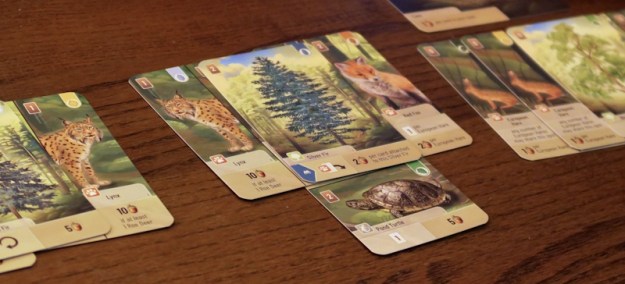
Forest Shuffle
– Image by boardGOATS

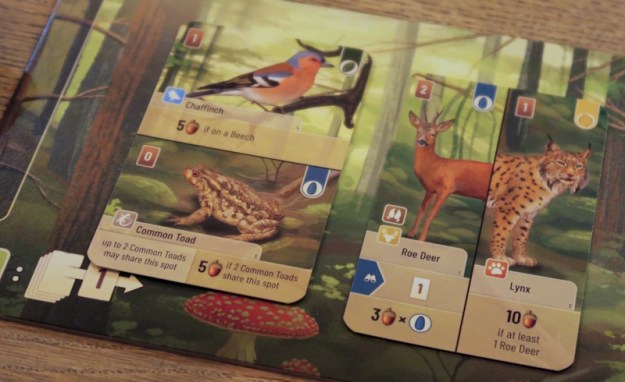
Game play is quite simple:  players start with a hand of cards and, on their turn draw two cards from the market (or “Clearing”) or play one to their tableau.  There are two sorts of card, Trees and “Critters”.  Before playing a Critter, players must have played a Tree, which then has spaces on all four sides.  Birds and Butterflies are played to the canopy, Fungi and Amphibians are played at the bottom of the tree and Mammals are played either side.  The clever part is that Critter cards are split so they show two critters (either left and right or top and bottom), so players choose which they would like to play, and therefore where, tucking the other side under the tree, making the unplayed half invisible.
Forest Shuffle
– Image by boardGOATS

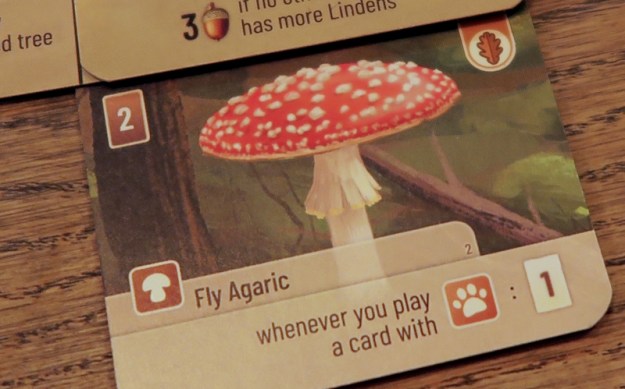
Players have to pay the cost of playing a card into the fact up Clearing, making those cards available to other players (and even sometimes themselves).  Most cards have an effect associated with them, usually this is a one-off special action, but in the case of Fungi, they are special powers that last for the rest of the game.  If the card played matches the colour of the cards used to pay for it, sometimes there is an additional bonus (e.g. take an extra turn, or extra cards, play a card for free etc.).  These can be extremely powerful as they allow players to, for example, pay with cards they can then pick back up, or play a sequence of cards together.
Forest Shuffle
– Image by boardGOATS

The game ends abruptly when the third “Winter is Coming” card is drawn from the deck and the player with the most points is the winner.  Players score points for Trees and for Critters, but it is how players get their cards combining together that really makes the difference.  Thus it is a game of strategy and tactics, but also of timing, which relies on very simple rules.  Blue outlined the rules and explained how some of the cards work together, then ??? started by choosing a card from the market.  There was a little confusion when the Dürer-Fledermaus/Feldhase card came out with the text all in German, but otherwise, everyone got the hang of the basics quite quickly, though playing well can take a little longer.
Forest Shuffle
– Image by boardGOATS

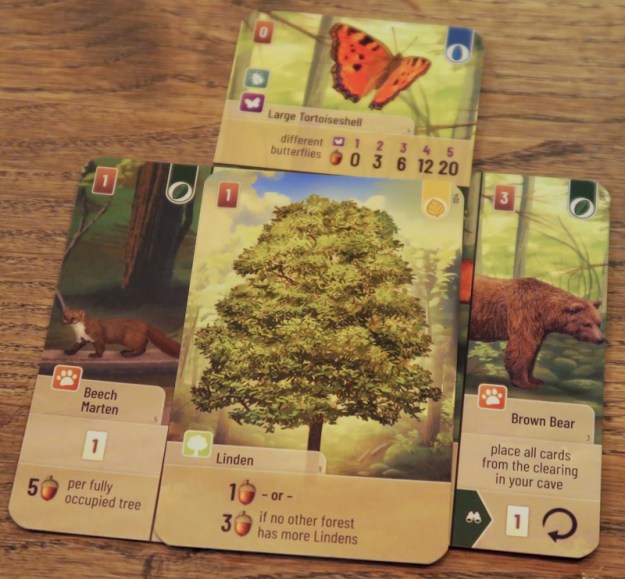
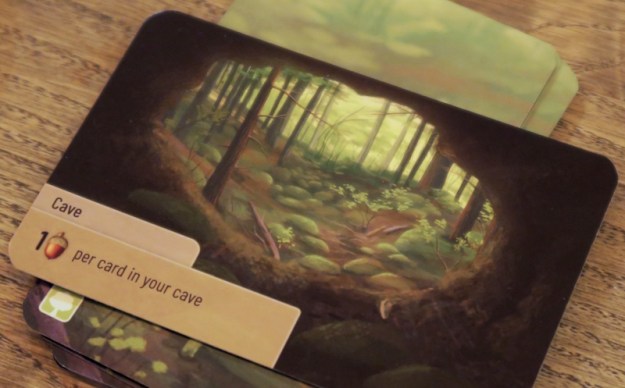
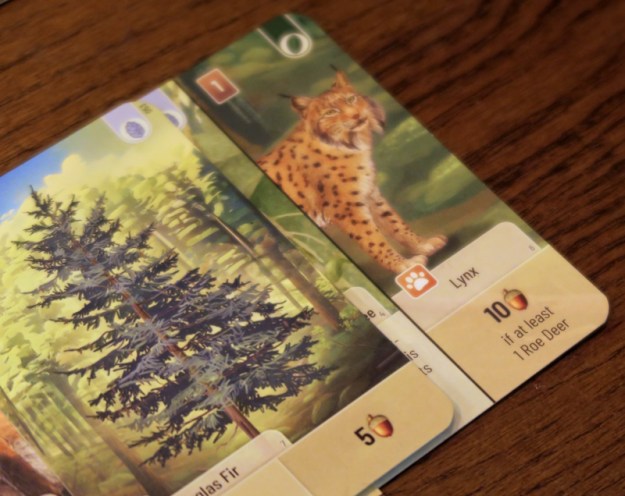
Pine got into a bit of a tussle with Blue and Black for Linden Trees, while Blue spent a long time setting up a “super-move” to play a Brown Bear and place lots of cards from the Clearing into her cave.  Ivory started collecting bats, more bats and even more bats, which coupled with a few gnats gave him lots of points.  His Fungi also gave him a extra cards as he built his forest, making him look like the player to beat.  Meanwhile, Teal was collecting hares (including the Dürer-Feldhase) and before long had down of them.  Then he switched his tactics somewhat after picking up a Roe deer.  This was a critical moment, because from there her started adding lynxes, which give ten points each if there is a Roe deer in the forest.
Forest Shuffle
– Image by boardGOATS

With five, Forest Shuffle drags a little, particularly when everyone is new to the game as they have to read all the cards and try to work out which combinations work well together.  It was an enjoyable game in spite of that, though most people played it in a very multi-player solitaire way, concentrating on their own game rather then keeping an eye on what others want and avoiding gifting people points.  That said, everyone became more aware of what was going on in their neighbour’s forest as the game progressed.  Nobody really had a feel for how well everyone was doing though because of the way the cards combined.  So it was a little bit of a surprise how disparate the scores were.
Forest Shuffle
– Image by boardGOATS

In the end, it was “The Lynx Effect” that made the difference, with Teal taking victory with a hundred and nine points, nearly twenty ahead of Ivory and his bats, with Pine a distant third.  Teal had an early start the next day, so flushed with success, he headed off leaving Ivory to consider leaving as well.  However, when presented with the possibility of playing Draftosaurus, he was tempted into staying—despite it being one of the most popular games in the group, Ivory had only played once before.  He felt he hadn’t really got to grips with it that time, so was keen to give it a quick try now.

Draftosaurus
– Image by boardGOATS

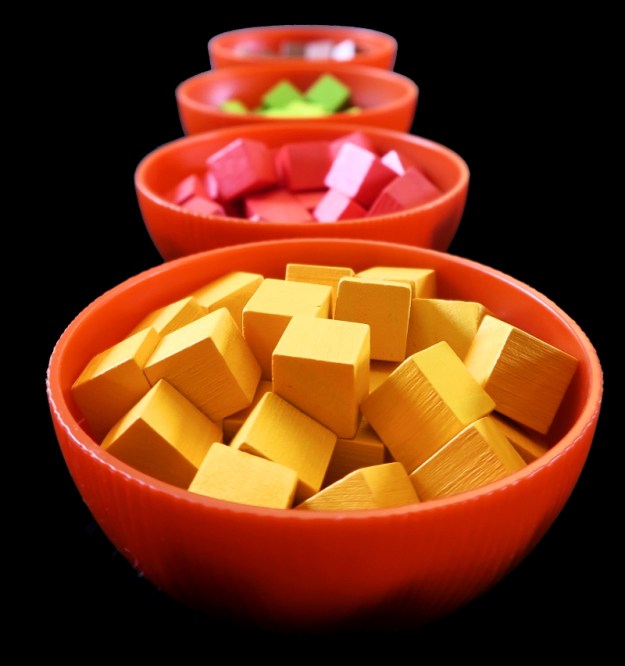
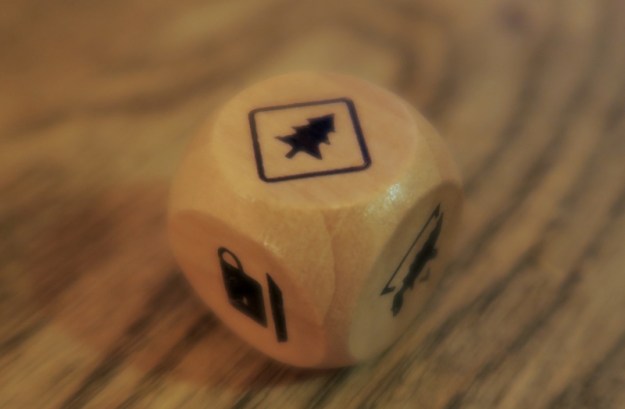
Pine was interested in playing with the Marina Expansion again, but given Ivory had only played it once before, the group decided to save that for anther time.  Without that, Draftosaurus is a simple enough game of drafting wooden dino-meeples with players starting with a hand of six, choosing one and passing the rest on.  Players also take it in turns to roll a die and that dictates where players can place their chosen dino-meeple in their Dinosaur Park.  The parks have pens that score points under certain conditions (e.g. the “Woody Trio” scores seven point if if contains exactly three dino-meeples) and the player with the most points after two rounds of drafting is the winner.
Draftosaurus
– Image by boardGOATS

In contrast to Forest Shuffle, Draftosaurus was an extremely close game—everyone picked up seven points for the “King of the Jungle” and fifteen points for their “Meadow of Differences”.  Everywhere else, where one player had an advantage, others picked up points elsewhere.  Purple and Blue picked up points for their “Woody Trio”, Pine for his “Solitary Island” and Ivory had an extra loved up couple.  In the end, Purple and Pine tied for third with thirty-five points, and Blue just pipped them to second place by a single point.  It was Ivory who was the victor, just two points ahead, perhaps thanks to his extra tyrannosaurs giving him an extra point each; it is safe to say, that he’s definitely got to grips with the game now…
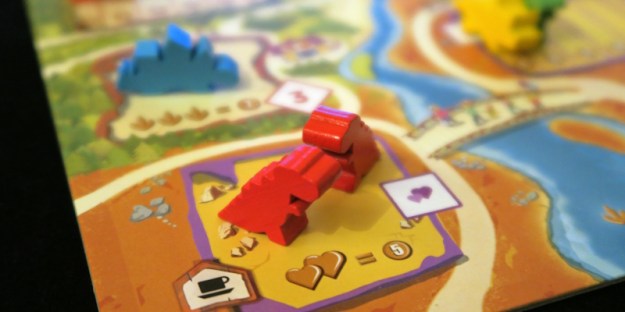
Draftosaurus
– Image by boardGOATS

Meanwhile, on the next table, Green’s suggestion of Terraforming Mars (with the Prelude Expansion) was turned down since the group didn’t want to play a complex and potentially longer game. For the same reason, the group eschewed Village although it has been a long time since the group played it (Green commented on how the original artwork is very pretty, but the new version is horrible!).  In the end, since last time Green had agreed to play one of Cobalt’s games, the group ended up playing Barcelona, a game that is both complex and quite long.  With hindsight, perhaps looking for something else entirely might have been sensible as everyone except Cobalt needed to learn it, and even with experienced players it can take a while.

Barcelona
– Image by boardGOATS

Barcelona is a game where players take on the role of builders in nineteenth century Barcelona who are working on the new expansion to the city following the destruction of old city walls.  Each round, each player takes a single turn consisting of two or more actions, a building phase, and then preparation for their next turn.  Players start with two random Citizen tokens which are placed in a stack onto a chosen unoccupied intersection. Unusually, players can place anywhere they want (no adjacency restrictions as seen in other games).

Barcelona
– Image by boardGOATS

Choosing an intersection is the guts of the game that has significant consequences, initially the type of actions the player can carry out in that round, which are indicated by the streets selected.  At the end of their turn, players must construct a single building if they can which depends on the Citizens adjacent to the building spot selected.  There are four types of buildings: corners and normal shaped Level One buildings require any two adjacent citizens while Level Two building require at least one of them to belong to the middle class and Level Three buildings require three adjacent citizens, one of which must be a member of the upper class.
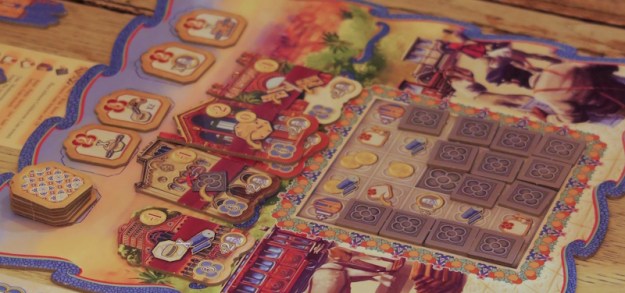
Barcelona
– Image by boardGOATS

As well as moving players along the Cerdà track, Level Two buildings also allow them to progress on their own Sagrada track giving Sagrada bonus tiles with rewards increasing the more they progress.  Level Three buildings move players two steps on their Sagrada track and give them seven pooints, but will also move players down two steps on the Cerdà track.  All the citizens required for buildings have to come from intersections adjacent to the building spots and are removed from the board and placed on their respective progress tracks according to their colour. Once the first citizen is placed on the end segment of a track, that segment’s Cerdà scoring is triggered and players gain points based on the criteria shown on the tile.

Barcelona
– Image by boardGOATS

This value is then multiplied by players’ positions on the Cerdà track, which represents whether or not players build according to the original intentions of Ildefons Cerdà (now considered the inventor of urbanism).  The game is then played over a variable number of rounds interrupted by three scoring phases before a final scoring phase, after which, the player with the most points wins.  Cobalt started first and went straight in, knowing exactly what the best thing to do was, but being first he couldn’t buy a building with only one stack of citizens. Everyone else was much more uncertain of what to do.

Barcelona
– Image by boardGOATS

At the outset Black chose to follow a policy of not buying buildings if he could get away with it (the rules are you must buy after your turn if you can), while Green had decided to work to getting the best result for each stage scoring, and Lime for a while was really confused and did not really know what he was doing at all.  Lime managed to trigger the first stage scoring, meaning that while he, Cobalt and Black had two turns before scoring, Green had only one turn—so much for his game plan and he soon found himself falling behind the others. Going last seemed to be a significant disadvantage, something Cobalt said has been mentioned before in forums, especially for four player game.
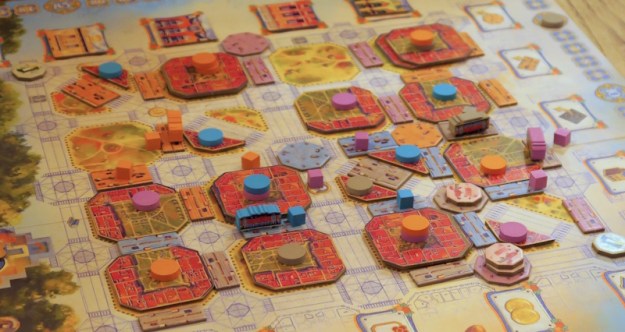
Barcelona
– Image by boardGOATS

And so the game continued. Cobalt knew what he was doing, while Black was trying not to buy buildings, but to get as many points along the way from other means as he could—as he put it, the game was a bit of a “points salad”. Green fared a little better at the second round scoring, but he was still a turn behind the rest (as was Lime for the second stage).  By this time he had decided to get his tram moving as much as possible as well, which was helping him to catch up on the score board.  Lime was still struggling, and gaining a lot of help and advice from Cobalt. It seemed to be working though as he was scoring nearly as well as Cobalt himself.
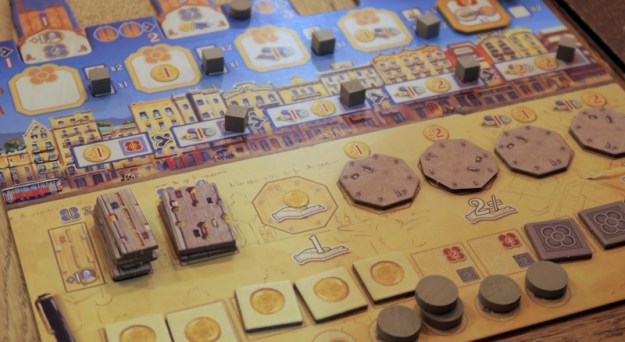
Barcelona
– Image by boardGOATS

The final stage of the game took a bit longer to complete, but was mostly just more of the same. By the final scoring, Lime took the lead to win the game while Cobalt’s experience had helped him compete and take second place, just three points behind. Green had caught up a bit and took third, while Black’s strategy of not buying really hampered him as he dropped further and further behind. He admitted that it probably wasn’t a good strategy as the later building buys really brought home a lot of points due to the points that also came with each purchase.  It had been an interesting game though, not so much about building a points engine, but looking for a good haul of points on each turn.  Having played once though, next time it might feel more like players are scoring from the game rather than the game scoring for them.

Barcelona
– Image by boardGOATS

Learning Outcome:  Nobody can resist the Lynx Effect.

Spiel des Jahres Winners – 2023

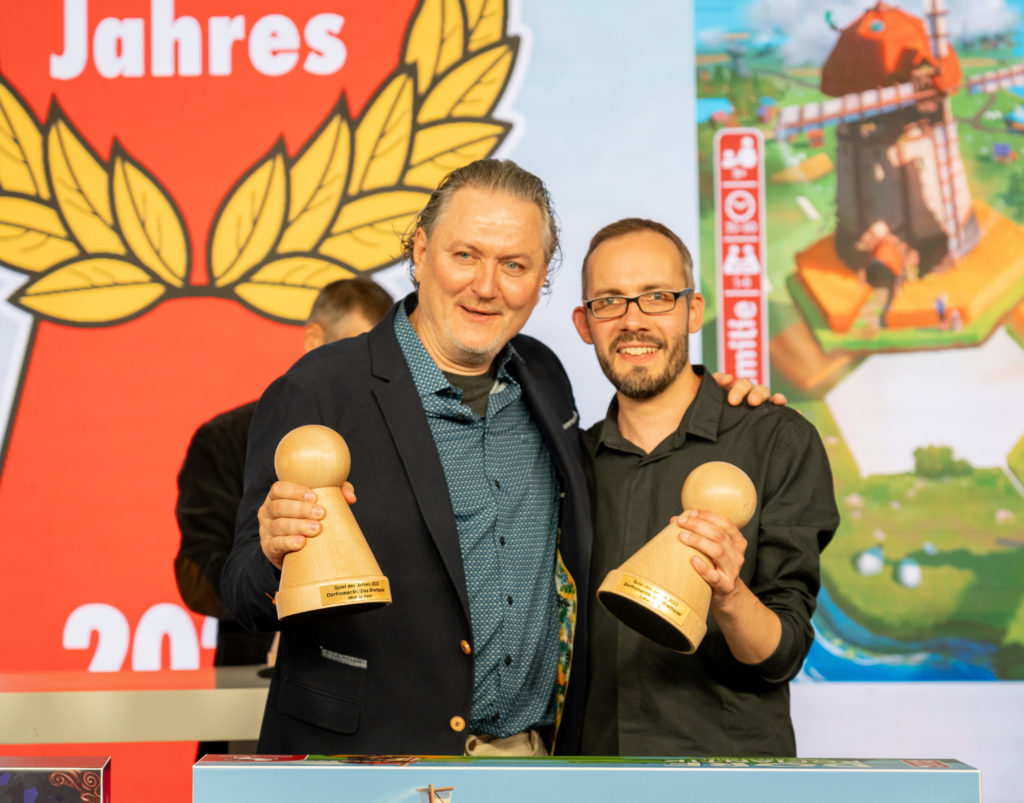
The 2023 Spiel des Jahres (German Game of the Year) winner has been been announced as the cooperative campaign game, Dorfromantik: The Board Game which is based on the video game of the same name.  Players work together to together to lay hexagonal tiles to create a beautiful landscape trying to make the train track and river as long as possible while also fulfilling the orders of the population.  There is a legacy element where points earned can be used to access new tiles that are hidden in locked boxes, which give new, additional tasks and make higher and higher scores possible.  The game is very simple (as draw a tile, place a tile, fulfill tasks), but the hook is the changing strategy that comes with the expanding pool of tiles.

Dorfromantik: The Board Game
– Adapted by boardGOATS from image
by BGG contributor Rugerfred

The winner of the Kennerspiel des Jahres, the “Expert” or “Connoisseur’s” game was announced at the same time and was Challengers!.  This is a sort of “capture the flag” tournament game where players first draw cards and build a deck, then shuffle and duel against another player.  The winner of the match takes the trophy and points, and at the end, the players with the most points duel in the final to decide the overall winner.  Although this is supposed to be a more advanced, it is not in the same league as previous winners of the Kennerspiel award like Village or Wingspan, or even previous Spiel des Jahres winners like El Grande and Settlers of Catan.

Challengers!
– Image by boardGOATS

The thing to remember though is that these games are intended to be family games and the awards are intended to cater for three different ages of families, those with very small children (Kinderspiel—this year won by Mysterium Kids); those with young children (Spiel des Jahres, or “Red Pöppel”), and those with slightly older children (Kennerspiel des Jahres, sometimes known as the “Grey Pöppel”).  This doesn’t mean these games are not suitable for more dedicated gamers, just that they not the target audience, so they should not be surprised if they are not a great fit.  This situation is not going to change in the near future, as the ultimate purpose of these awards is to sell games and advertise them to the general (German) public.

Dorfromantik: The Board Game
– Image from spiel-des-jahres.de

That said, with the right mindset, anyone can enjoy all these games, and they are some of the best of their type available.  So, as usual, congratulations to all the winners and nominees.

Boardgames in the News: TMG on the Brink

One of the leading designer games companies, Tasty Minstrel Games (aka TMG) is reportedly on the brink of demise. Working closely with the Reiner Stockhausen’s dlp Games, they have been responsible for the US editions of Orléans, Yokohama, Citrus and Bohemian Villages.  Well known for their “Deluxified” editions of games, they’ve also collaborated extensively with many other European companies leading to US editions of Village, Belfort , Gùgōng, Gentes, Guilds of London, Eminent Domain and The Oracle of Delphi, and re-releases of popular games like Luna, Colosseum and At the Gates of Loyang. They have not been simply “partners” reproducing other games, developing Scoville, Captains of Industry, and Crusaders: Thy Will Be Done.

Orléans
– Image by boardGOATS

A few years ago, TMG controversially raised over $150,000 selling shares online, but it seems these funds have now run out.  According to an email sent out by TMG to stock holders discussed on a recent Dice Tower News, their “book value is in the negative” which they describe as “virtual bankruptcy”.  As a result, in an attempt to save the company they are laying off staff and have called a halt to game development for the next “two to three years”.  The most recent KickStarter campaign is also being abandoned with backers receiving a refunds.  In the immediate future, the company will be focusing on selling its existing stock hoping that they will “eventually being able to start up again”.

-Video by the Dice Tower

Indications that TMG have been struggling have been there for a while, with allegations they delayed payment to some of their designers and most recently when they failed to renew the publishing rights to their highest rated game, Orléans.  The question is, why has this happened?  Of course, the global pandemic will have played its part, as will the recent sudden increase in shipping costs.  However, these are probably only another nail in the coffin.  The underlying cause is almost certainly the increased pressure caused by a market saturated with high quality games and a lot of noise generated by a conveyor-belt of crowd-funded products.  Sadly, it looks like TMG simply ran out of road, and money.

– Image from playtmg.com

Boardgames in the News: Asmodee’s Plan B

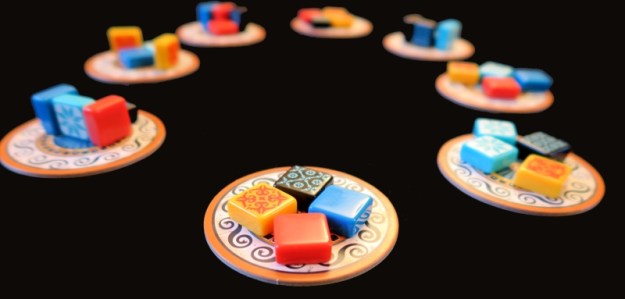
When Asmodee acquired F2Z/Filosofia/Z-Man Games etc. in 2016, the then owner of F2Z, Sophie Gravel, activated her “Plan B” and set up a new company, Plan B Games.  This company was successful almost straight away, winning the Spiel de Jahres Award & Deutscher Spiele Preis just two years later, with Azul.  Since then, Plan B has released the follow-up games Stained Glass of Sintra and Summer Pavilion which, although not as popular as the original, were still very successful in their own right.

Azul
– Image by boardGOATS

Plan B were also responsibly for the three Century Games (Spice Road, Eastern Wonders and A New World) which were all variously successful, and the more recently released games, Beez and Alma Mater.  In 2017, Plan B Games acquired German publisher Eggertspiele, the publisher responsible for many well received heavier, strategy games including Great Western Trail, Mombasa (Deutscher Spiele Preis winner), and Village (Kennerspiel des Jahres & Deutscher Spiele Preis winner), as well as the lighter Spiel des Jahres winner, Camel Up.

Century: Spice Road
– Image by boardGOATS

Given the quality of all these games, almost inevitably, just five years after they acquired F2Z, this week Asmodee announced they have now acquired Plan B and their subsidiary brands (Eggertspiel, Next Move Games and Pretzel Games).  This time Asmodee are absorbing the whole team including Sophie Gavel, perhaps avoiding the necessity of acquiring her Plan C in five years time…

Camel Up
– Image by boardGOATS

9th June 2020 (Online)

It’s been over three months since we were last officially at the Horse and Jockey, and it is clear everyone is really missing it.  When people joined the meeting from 7.30pm and everyone asked how people were doing, most people had nothing much to say.  Pine is still furloughed, Blue is back at work from time to time, as is Green; Ivory never left, while Pink and Black are still working from home.  Otherwise though, everyone is just getting used to the way things are now.  This week, the “Feature Game” was to be Noch Mal!.  This is a “roll and write” game by Inka and Markus Brand, designers of Village, Rajas of the Ganges and the award-winning EXIT: The Game series.  Although Noch Mal! was first released in 2016, it has only recently been released in English (as Encore!), although the game itself is language independent.

Noch Mal!
– Image by boardGOATS

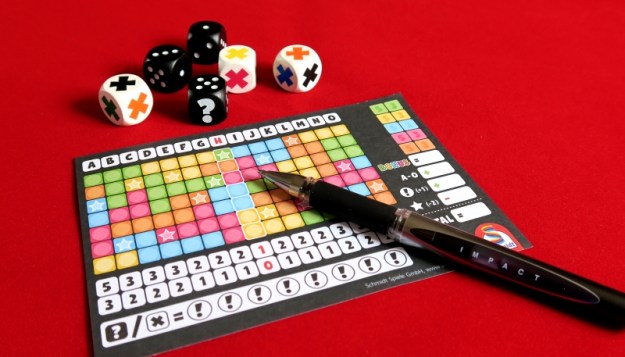
Noch Mal! is quite similar to the 2018 Kennerspiel des Jahres nominee Ganz Schön Clever (aka That’s Very Clever), where one player rolls the dice and then chooses some to use to cross off boxes on their player card, leaving the left over dice for the other player(s) to use.  The player sheet for Noch Mal! is simpler than the one in Ganz Schön Clever though, and there is less structure to the dice rolling making it more suitable for more players.  Indeed, although it is only supposed to play six, we felt it could easily play more, and this is important to us at the moment because the social aspect is the main reason for these online meetings.

Ganz Schön Clever
– Image by boardGOATS

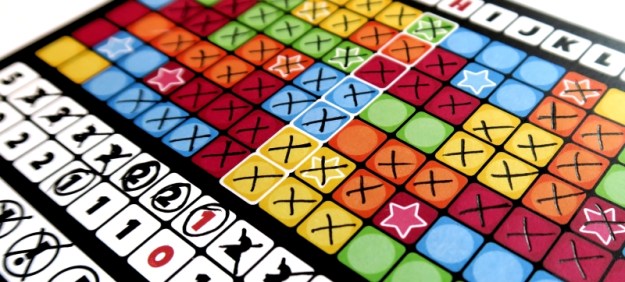
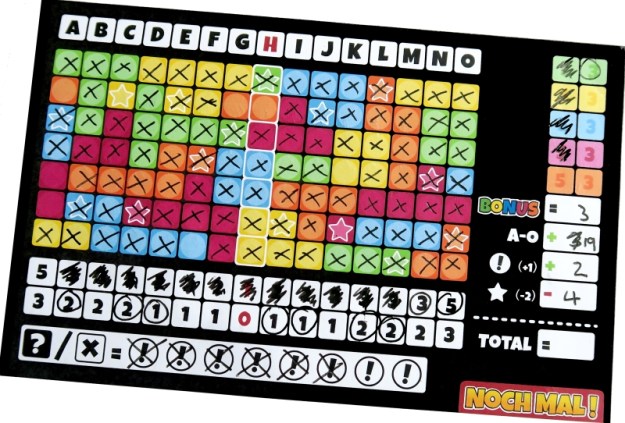
The idea of Noch Mal! is that the active person rolls the dice and then chooses two of the six dice to use.  Three of the dice are relatively normal d6 dice (numbered one to five with a “question mark” replacing the six), while the other three dice are “colour dice” with coloured crosses instead of numbers (red, green, blue, orange, yellow and black).  The player cards depict a rectangular array of square boxes, in groups of different colours.  Players choose two dice, a colour and a number and “spend” them to cross squares off on their sheet.  Thus, if they choose green and five, they must cross off exactly five green squares.  The catch is that these must be in a clump together and must include a square in the starting row (H) or one that is orthogonally adjacent to a square already crossed off.

Noch Mal!
– Image by boardGOATS

Players get points for completing columns, or crossing off all the squares of one colour, with the first player to do so scoring a bonus.  The “question mark” and “black” faces are “wild” and can be used as any number or colour (respectively), but each player can only use a total of eight wilds during the game.  Points are scored for completed columns (those furthest from the central starting column score more), crossing off all of one colour, and any unused wilds.  Some of the squares also feature a star—each one of these that is not crossed off earns a two point penalty.  The game ends when one player crosses off all the squares of two colours and the player with the most points is the winner.

Noch Mal!
– Image by boardGOATS

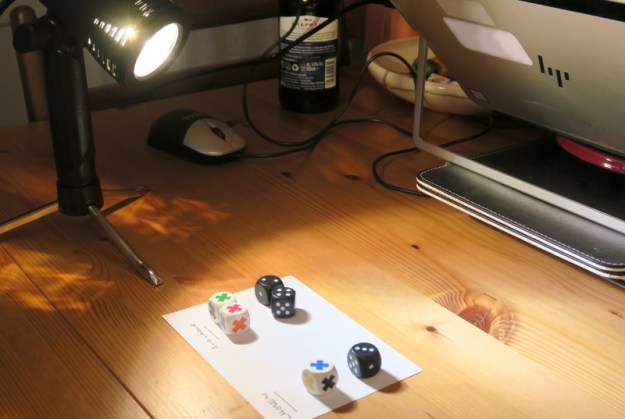
Everyone had three dice and we began by rolling to see who would go first.  Ivory won, but there were lots of roll-offs to settle tie breaks, so determining the order was in danger of taking longer than the game itself!  To keep people involved and give them a feeling of agency everyone rolled their own number dice, while Blue and Pink rolled the colours and displayed everything on one of their cameras.  For the first three rounds the active players (Ivory, Burgundy and Pink) don’t choose dice and everyone else can choose from the full six, so Pine was the first to play a “proper turn”.

Noch Mal!
– Image by boardGOATS

Pink was quick out of the traps and was first to score a column, and then taking points for a second too.  This meant he was three points up before anyone else had scored.  Worse, nobody else could score anything for the starting column (H), and only one point was available now for column G too.  Ivory had other plans though and had expanded to the right of the table and was soon picking up some of the higher scoring columns further away from the centre.  Others tried the same strategy, some with success, others less so.

Noch Mal!
– Image by boardGOATS

The general feeling was a little bit like Bingo with dice with players calling out when they completed a column.  This feeling was accentuated when lots of people called “House” for a load of columns on the right, all at the same time.  Eventually players started claiming colours; inevitably, Ivory was first, and also the first to discover what a curate’s egg it was as he was then forced to pass.  It wasn’t long before someone completed their second colour and everyone then had to work out their scores.

Noch Mal!
– Image by boardGOATS

It was no real surprise that Ivory top scored with what seemed like an enormous ten points, though Black ran him very close with eight.  Pink, Lime Blue and Green felt they had done well to avoid finishing with negative points and Purple would have done a lot better if she hadn’t lost sixteen points for her eight remaining stars.  It had been interesting though and now everyone felt they had a better understanding of how the game worked, it seemed a good idea to give it another try.

Noch Mal!
– Image by boardGOATS

This time, Lime was the first to score points, claiming column H so fast that it seemed impossible.  Having finished with zero last time though, he was keen to get points on the board straight away.  It was then that the IT gremlins began their attack.  First Lime had problems with the camera freezing, then Ivory as well.  It seemed that the problem was somehow specific to Lime and Ivory and when one left, that seemed to sort out the problem for the other one.  When Green looked at the text chat channel, he commented that it was a very long stream of “Lime has left”, “Lime has joined”, “Ivory has left”, “Ivory has joined”, “Lime has left”…

Noch Mal!
– Image by boardGOATS

Inevitably, we decided it was the French (again) trying to get their revenge for our invasion of their game of 6 Nimmt! a few weeks back—they have very long memories do the French!  Obviously, we weren’t going to let them win, so Lime and Ivory took it in turns to duck out when necessary and Blue and Pink took it in turns to let them back in, and the game carried on.  This time, everyone had a better idea of what strategies were available and players made a better job of completing columns.

Noch Mal!
– Image by boardGOATS

More players completed one colour and almost everyone had a near full grid by the end.  This meant it was down to rolling low numbers and those who hadn’t used up all their “wild” tokens.  This turned out to be really quite important with Burgundy and Pink among others, running out and therefore unable to make use of turns that others could.  It was slow at the end, but eventually Black completed his second colour and everyone tallied up the scores.

Noch Mal!
– Image by boardGOATS

Everyone except Ivory had improved their score, and this time everyone finished in the black.  Purple took the award for the most improved player, improving her score by twenty-three points having made an effort to clear up her stars.  As the scores came in, Pink really thought he had it with eighteen, but he’d failed to look across the table to see Blue had twenty, and with it victory.  Noch Mal! had worked really well which shows how our tastes have changed:  in the pub, we would never had played a game like this with so many, however, as Pine pointed out, playing a real game through a camera felt more like game night than playing an virtual game, so we’ll keep that in mind for future events.

6 Nimmt!
– Image by boardGOATS

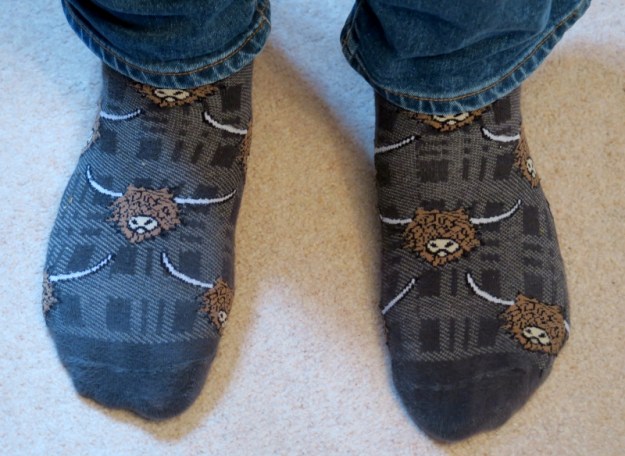
With that, Pine and Lime finally gave in to the French Gremlins and left for an early night, and eventually, Green joined them.  The others were up for something else though, and as Pink was wearing his new 6 Nimmt! socks, that seemed like a good idea.  So everyone logged into Board Game Arena for one of our favourite games.  The game needs little real introduction: players simultaneously choose a card from their hand and everyone reveals them.  Starting with the lowest, the cards are added in turn to one of the four rows—when a sixth card is added the owner instead takes the five cards and starts a new row with their card, scoring the number of bulls’ head points (or “Nimmts”) depicted on the card.

6 Nimmt!
– Image by boardGOATS

On Board Game Arena, the player with the most points when one player’s score falls below zero is the winner.  There was the usual moaning about how bad everyone’s hand was and how badly everyone always did, but Burgundy pretty much nailed it when he said nobody is going to do well, the aim is just to do less badly than anybody else.  In that sense, the game is a bit like escaping a bear, you don’t need to run fast, just faster than everyone else.  This time, Pine started off as the slowest runner being the first to pick up, but was soon followed but Black, Purple and then Burgundy.

6 Nimmt! on Board Game Arena
– Image by boardGOATS from boardgamearena.com

For a long time, it looked like it was going to be a “two bull race” between Blue and Pink, but six is a critical number in 6 Nimmt!, so with six players strange things can happen with players becoming synchronised and picking up lots of points on multiple turns.  It looked like it was going that way for Blue, but she managed to stem the flow and was tied for second with Pine for quite a while before he started picking up cards again.  It looked like Pink’s Lucky 6 Nimmt! Socks were working their magic, but when Black (who had been looking like bear-fodder for the whole game) ended the game, Pink had just picked up, leaving Blue one point ahead.

6 Nimmt! on Board Game Arena
– Image by boardGOATS from boardgamearena.com

There was still time for one more quick game, and with six, the perfect quick game (and one that is available on Board Game Arena), is For Sale.  This is an old game that we dug out about six months ago, before all the current strife, and it got a couple of outings.  Since all games have been online, it is one of the games we can still play, and, as a result, it’s had several outings recently.  It is a game of two halves, first players buy property cards, then they sell them, and the player who makes the most money is the winner.

For Sale
– Image by boardGOATS

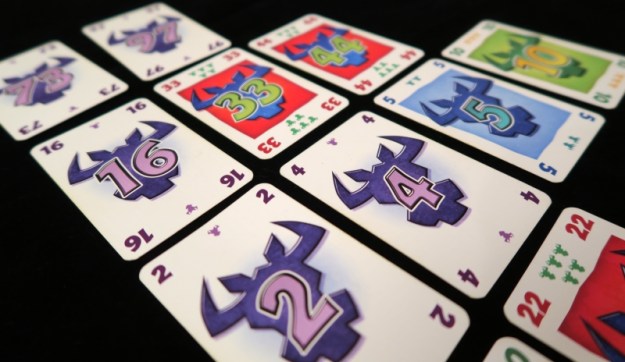
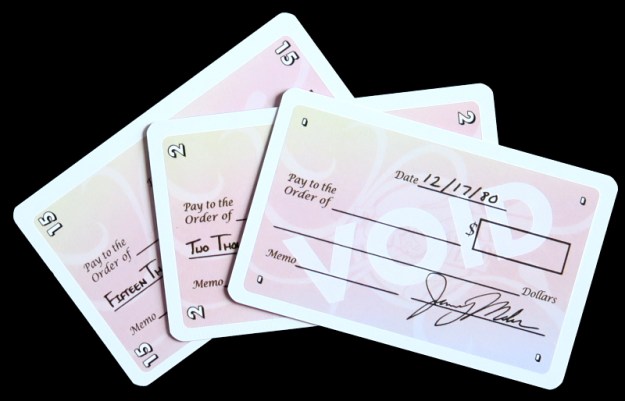
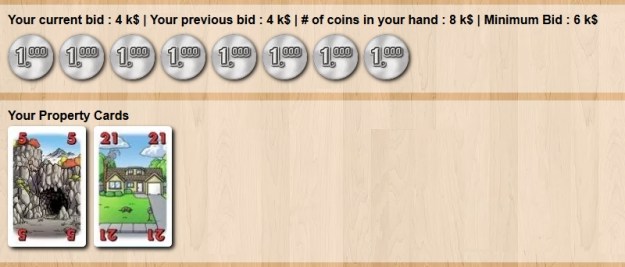
The properties are numbered one to thirty, with the number indicating the relative value.  Buying properties is through auction, with players increasing the bid or passing and taking the lowest value property available and paying half of their bid for the privilege.  The last player then takes the highest value property, but pays their full bid.  In the second part of the game, cheques are revealed and players choose a card to play, with the cheques assigned according to the value of the property played.

For Sale
– Image by boardGOATS

Thus the game consists of two auctions: a variant of an all-pay auction and a sealed bid auction.  In the first auction, a key tactic is predicting what other players will bid so passing can be timed in such a way as to get the best value for money.  Whereas previously, most players increased the bid by the minimum increment, this time it was clear that people were playing a little more tactically, with higher starting bids and increments of $2,000 that pushed other players into paying more.

For Sale on Board Game Arena
– Image by boardGOATS from boardgamearena.com

Black’s and Purple’s strategies were different however:  Black spent a total of just $2,000 on properties, mostly just passing and taking the property offered, and Purple spent only $3,000.  In contrast, Blue spent $13,000 and Pine spent $12,000, i.e. nearly all of their starting $14,000.  There is strategy in the second part of the game too though, and getting the timing right for selling each property is key.  For example, although Blue’s profits of $37,000 were larger than Black’s, his rate of return of $21,000 for just $2,000 outlay was better, matched only by Purple’s return of $32,000 for her $3,000 investment.

For Sale on Board Game Arena
– Image by boardGOATS from boardgamearena.com

That superb return was enough to give Purple third place.  It is not all about rate of return though:  it is the player who makes best use of all their funds that wins.  In this case, this meant we had a tie for first place between Pine and Burgundy, both finishing with a massive $59,000.  The tie break is the player with the most cash at the end, which just gave it to Burgundy who had achieved his $55,000 from properties bought for $10,000.  And with that, it was time for bed.

For Sale
– Image by boardGOATS

Learning Outcome:  A lot of fun can be had with a handful of dice and a few sheets of paper.

24th February 2015

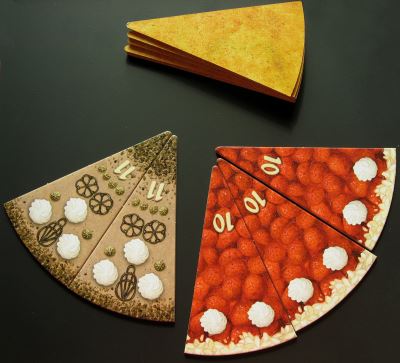
We started out with a game that was new to the group, …Aber Bitte Mit Sahne (which means “…But Please, With Cream”, although the game is also known as “Piece o’ Cake” in English).  This is a quick little set collecting game we’ve not played before with very simple rules.  The game uses an “I divide, you choose” mechanism with points awarded to players with the most slices of the each different types of cake.

…Aber Bitte Mit Sahne
– Image by boardGOATS

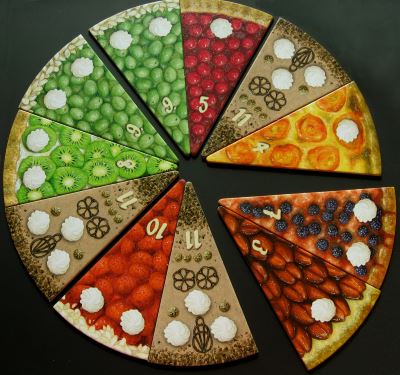
The first player (the Baker) bakes a cake with the types determined at random.  Each slice has a number of blobs of cream on it and a numeral demonstrating how many of that type there are in the game.  The Baker then divides the cake up (usually so that there are sufficient pieces for everyone to have one), with each piece containing any number of slices of any type.  Next, the player to the left of the Baker selects a piece of cake and chooses what to eat and what to keep.  They can eat or keep as many slices they want.  Any cake they choose to eat is turned face down and the total number of blobs of cream in the pile contributes that number of points to the the final score.  Thus, each player takes a piece of cake and chooses what to eat and what to keep, finishing with the Baker.  Then the next player takes a turn as the Baker and so on.  The game continues for five rounds.

…Aber Bitte Mit Sahne
– Image by boardGOATS

At the end of the game, each type of cake is assessed and the player who has collected the most slices of a variety receives points.  The number of points obtained is the same as the number of slices in the game and is written on each slice of that type of cake.  For example, there are eleven pieces of chocolate cake in the game and the player with the most slices will win eleven points at the end.  Crucially, in case of a tie, all tied players score the points.  In general, players can only eat fresh cake (i.e. cake just served), the exception is that they can forfeit the opportunity to take fresh cake and instead eat all the stale cake of one type in front of them.  This might be a good idea if a player can see that they cannot win a category and the number of blobs of cream will give them more points than they would get from the fresh cake.

…Aber Bitte Mit Sahne
– Image by boardGOATS

Burgundy started off as the Baker.  Blue began modestly keeping a slice of apricot cake and eating her chocolate cake (having given up chocolate and cake for Lent, this was very appealing).  Meanwhile, Cerise began collecting strawberry and chocolate, Grey went for gooseberry leaving Red and Burgundy to fight it our for cherry, blackberry and plum.  In the second round, Burgundy set the tone by pinching the a slice of apricot cake from under Blue’s nose handing her a load of relatively worthless slices in the process.  From then on, it was more about stopping other people from getting what they wanted than about collecting something useful, which meant that those who had picked up the start of a set in the first round were in the best position.  The game ended with players sharing the top spot for a lot of the categories, but the strawberry and chocolate that Cerise had picked up early on gave her a massive number of unshared points.  The title of Master Baker went to Burgundy, however, winning by a single point.

Niagara
– Image used with permission of BGG contributor GeoMan

By this time, Green, Black and Purple had arrived, so we split into two groups with the first starting off with the “Feature Game”, Niagara.  This is one of the first games we played in the group back in October 2012, and it was certainly long overdue another outing.  The idea of the game is that players are travelling up and down the Niagara River in canoes collecting gems.  The river is the feature of this game as it is made up of plastic discs that actually move during the game carrying the players boats towards the falls.  Each player has a set of “paddle cards” with numbers 1-6 and a cloud on them and each card must be played one can be reused.

Niagara
– Image used with permission of BGG contributor Marsh

Simultaneously, all players choose a paddle card, then they take it in turns to resolve their card.  Each player has two canoes which can either be on the bank or on the river.  Any boat on the river must be moved and a boat on the bank can be moved if the player wants to (though if they are both on the bank, only one can be moved).  Movement is exactly the number shown on the chosen paddle card, no more and no less (except when bring a boat home with a gem on board) and the boats cannot change direction during the turn.  In addition to moving, players can also load or unload a canoe, which costs two movement points and must be done at the start or end of a move.  An empty boat that is travelling up-stream and lands on a space occupied by another boat laden with a gem may also steal it for no charge.

Niagara
– Image used with permission of BGG contributor erfalucho

At the end of the round, after everyone has taken their turn moving their boats, then the river moves.  It’s movement is dictated by the smallest canoe movement, modified by the weather.  Each player has a weather paddle card and as one of their options, they can alter the weather setting from sunny (-1) to very rainy (+2).  Thus if the lowest paddle card played was a three and the weather was very, very wet, the river would move five spaces.  The winner is the player who has either four gems of the same colour, five of different colours or seven of any colour at the end of the game.

Niagara
– Image used with permission of BGG contributor William Hunt

The game started well, and “just to demonstrate to everyone how it was done”, Blue nicked one of Burgundy’s gems and then increased flow rate of the river.  She got her comeuppance since she promptly ended up with two yellow gems.  Meanwhile, Cerise had collected two clear gems and Red followed Blue’s example and increased the weather flow to it’s maximum.   By the time everyone had been through their paddle cards once, everyone had moved on to trying to get the difficult pink and blue gems that are perilously close to the cataract.  The inevitable happened then, when everyone played a “6” and one of Cerise’s precious canoes went sailing over the waterfall.  Despite turning one of her boats into match-wood, she was still the first to get a complete set of five different coloured gems, giving her the win.

Niagara
– Image used with permission of BGG contributor cmessenger

Meanwhile, the other group were showing no signs of finishing, so since Cerise had never played it, the group moved on to one of Red’s favourite games, Bohnanza.   Cerise was very generous which meant everyone else followed suit and the game wasn’t as tough as it has been when we’ve played it recently.  Burgundy went for the “high value” market, but suffered and Red and Blue’s mixed bean strategy and Blue finished just two coins ahead of Red.

Bohnanza
– Image used with permission of BGG contributor spearjr

The other group were still what seemed like hours from finishing, so the first group tried decided to move onto their third game.  Burgundy expressed an interest in playing Blueprints, a cute little dice stacking game.  However, just as Blue was getting it out, Black suddenly commented that their game was coming to an end.  Blueprints can be a little lengthy, so it was quickly replaced with Tsuro, which turned out to be just the right length.

Tsuro
– Image used with permission of BGG contributor aleacarv

Tsuro is a very simple tile laying, path making game, that has the advantages of playing a range of numbers reasonably well, as well as being very quick to play and extremely easy to teach.  The idea is that players have a stone which is located on the board and a hand of three tiles.  On their turn, they have to place one of the tiles on the board next to their stone such that it extends it’s path and remains on the board, then they replenish their hand.  Players continue until their stone collides with another player’s stone or it is forced off the board (by another player or because they have no choice because of the tiles they have), in which case they are out.  The game started slowly, but Red was the first to go, when she lost a tussle with Burgundy.  Burgundy didn’t last much longer, leaving just Cerise and Blue to tough it out.  Blue was forced to place a tile that left her at the mercy of Cerise, but Cerise had no choice and collided with Blue, ending the game.

Village
– Image used with permission of BGG contributor henk.rolleman

By this time, the other group were just adding up their scores, but what was it that they had been playing that took so long?  Well, they had been playing Village with The Port expansion.  In Village, each player takes the reins of a family striving for fame and glory.  The game is full of difficult decisions, however, it feels like it moves quite quickly.  What is particularly unique though, is the way the game uses the delicate subject of death as a natural and perpetual part of life in the village and a mechanism for dictating the flow and duration of the game.

Village
– Image used with permission of BGG reviewer EndersGame

Each player starts the game with a personal farmyard board and the four members of the first generation of their family.  There is also a central village game board which depicts the different locations players can go to carry out different actions.  At the start of the game/round influence cubes are drawn at random from a bag and placed on these locations.  During the round, players take it in turns choosing a location and taking one of the cubes and then (optionally) carrying out the action. There are a range of actions, from “building a family”, to “crafting goods” or “going to market”.  Some of these (like visiting the “well”) give resources of some kind, while others (like going “travelling” or “entering the church”) are primarily a means to obtain points.

Village
– Image used with permission of BGG reviewer EndersGame

While the action is optional, taking a cube is mandatory.  If there isn’t a cube available at the location, then the action cannot be taken.  Cubes are then used to pay for some of the actions.  In addition to the cube cost, some actions also have a “time” cost:  around the edge of the players farmyard, there is a time track and once a player’s token has been round the board one of their meeples dies.

Village
– Image used with permission of BGG reviewer EndersGame

When one of their meeples dies, the player has to choose one of their oldest generation family members (i.e. those numbered “1”, or in the event that they are all deceased, one numbered “2”) kill them off.  These meeples are then either laid to rest in the Village Chronicle or in one of the anonymous graves behind the church.  Family members placed in the Chronicle will score victory points at the end of the game, however, if there is no room in the relevant section of the Chronicle, the family member is placed anonymously in the unmarked graves behind the church where they do not score.  The game will end when either the last empty space in the Village Chronicle is filled, or the last anonymous grave is filled.  The winner is the player with the most points at the end.

Village
– Image by BGG contributor jardeon

It took a little while to set up and revise the rules and to work out how the new Port expansion fitted in.  Basically this replaces the original travelling option with the ability to board ship and travel the seven seas. Players hire a captain, and then use the ship to sell domestic goods and pick up foreign commodities. Family members can be sent as missionaries to far away islands and dig up treasure chests.

Village Port
– Image by BGG contributor Grovast

Eventually the game began.  Black started out collecting green cubes, aiming for a market based strategy.  Grey was attracted by the large number of points provided by the expansion and decided to pop down to the port and start sailing almost immediately.  Meanwhile, Purple and Green were a little less certain of their initial direction and just built up a small stock of tiles (namely ox and plough to maximise wheat production).  By the end of the first round, both Purple and Green had sent family members into the church bag, and, by pure chance, both Green’s came out.  In the second round Purple joined yellow at sea, Green fumbled over getting his first meeple to work a second time in the craft halls without dying while Black (a hard task master) worked his first meeple into an early grave without shedding a tear!

Village
– Image used with permission of BGG contributor Club Amatent

Blue was also heading deeper into the town hall, piling up extra bonus green cubes and tiles to enhance his market buying opportunities.  Grey continued a balancing act at home while slowly filling his boat.  Green joined Grey and Purple and took to the seas with the highest level captain and rapidly made his way round to collect the various goodies. Purple decided that she did not like the apparent slight by the God(s) and placed even more into the church, and paying for them to be taken out and so gaining the end of round church bonus.

Village
– Image used with permission of BGG reviewer EndersGame

Everything was looking rosy for Black, producing quite a pile of market chips, until the sailors began to return, and were able to swap their bounty for lots of points, saoring into the lead on the victory point track. Black was still confident, if a little nervous now, especially since Green had managed to plant one of his meeples in the far corner of the sea for a huge haul of points at the end.  The books of remembrance were slowly filling, as was the grave yard.  Black then took a late plunge into the waters, while Green started sending family members to join the local council in the Town Hall.  Purple collected cubes a plenty (enabling her to make some free actions of her own choice to her advantage) and Grey was really getting to grips with the game and was making good use of his second trip to sea and happily killing meeples left, right and centre, like mad despots!

Village
– Image used with permission of BGG contributor henk.rolleman

There was a close finish in the final round.   Initially everyone thought it was going to be the last round, but then it started to look like the grave spaces would not be filled after all and another round would ensue.  Then, out of the blue, Green used three cubes to visit the market place, which had otherwise been empty of action cubes.  Buying twice killed off another meeple, which filled the last space in the graveyard and the game was suddenly over (leading the other group to change from Blueprints to Tsuro).  With one last turn each, only Black was able to do anything to increase his score at this point.  Before the final scoring it was very unclear who had won:  Green and Grey were far in front on the victory point track, but Black had a lot of market chips.  It turned out, Black had just done enough, pipping Green by a couple of points with Grey and Purple not far behind in what had been a very close and enjoyable game.

Village
– Image used with permission of BGG reviewer EndersGame

Learning Outcome:  Killing meeples is great fun, if a little time consuming!

16th April 2013

This week we started out with another new game called Love Letter.  This is a really cute little game that packs in a huge amount of deduction, risk, assassination, luck and bluffing, especially considering it comprises only sixteen cards and a handful of cubes.  Basically, each player has a hand of just one card and on a turn, players draw one card, and play one card, trying to expose others and knock them out of the game.  The winner of the round is the player with the highest value card or the last man standing.  We played four rounds, after which it was clear that beginners luck was ruling the day with the players who had played before all failing to win a round.

Love Letter

Due to work commitments and a stroppy horse our less experienced players were unable to attend, so we had a bit of a change of plan and decided to leave the “Feature Game” (Ticket to Ride) for another day.  Since we had another new (though experienced) gamer, we decided to play a new, deeper game called Village.  In this game, each player takes the reins of a family striving for fame and glory.  Village is full of difficult decisions, yet moves quite quickly.  However, what is particularly unique is the way the game uses the delicate subject of death as a natural and perpetual part of life in the village and a mechanism for dictating the flow and duration of the game.

The strategies players employed varied hugely, from exploring the outside world and going into the church, to remaining a penniless farmer, or even trying a bit of everything.  From the start it seemed that White was running away with victory as he left the Village and explored the shire.  Meanwhile Red decided that piety was the best option and sent his sons into the church, leaving Blue and Yellow splashing about in the mud on the farm.  However, towards the end it became apparent that Yellow was hatching a cunning plan in the council chamber and suddenly made a fortune trading in the market.  The final result hinged on Blue’s decision to sell a cow which started a market day giving White the opportunity he needed to effectively have an extra turn and win by two points, with Yellow, Blue and Red surprisingly close behind.

 Village

Learning Outcome:  When it comes to Village life, a single-minded strategy is often more effective than dabbling in everything.