Author Archives: nannyGOAT

19th February 2013

Most people had arrived by about 8pm, so we started off with the “Feature Game”, For Sale. This is a quick, fun game consisting of two rounds: in the first players buy properties by auction; in the second they sell them again for the greatest profit possible.  There were the usual mix of bad calls and lucky gambles, but the win was well deserved.

For Sale
– Image by BGG contributor 4100xpb

Since one of the players had to leave early, we decided to have a quick game of Incan Gold before she left. This is one of the first games we played back in October last year and is a light, “push your luck” game.  The idea is that players are exploring a mine collecting treasures as they go, but if the mine collapses before they get out, they loose everything.  Another run-away victory and, since she had won both games, the winner decided it was definitely time to leave and give the rest of us a chance…

Incan Gold
– Image used with permission of BGG contributor mikehulsebus

So we all moved on to another bidding game, called The Speicherstadt.  This is an interesting game set in post-Hanseatic League Hamburg.  At its heart, it has a curious auction mechanic where players take it in turns placing markers to indicate which contract, ship or firefighter cards they would like.  The first person to declare an interest in a card then has first refusal, but the cost is proportional to the total number of people interested in the card.  If the first player decides it is too expensive, then the card offered at a discount to the other players in the order they declare their interest; the later the player, the larger the discount.  Although it wasn’t obvious a the time, this was won by a massive margin based on collecting the Counting Offices, fulfilling a couple of lucrative contracts and an unhealthy interest in fire-fighters…

The Speicherstadt
– Image used with permission of BGG contributor henk.rolleman

The final game of the evening was Fleet.  This is another game that we hadn’t played before and also had financial management at its heart albeit with a fishy flavour.  Each round starts with players bidding for fishing licenses.  As well as allowing players to launch boats corresponding to the license type, they also provide their owners with a handy bonus.  Cards are multipurpose, as they can be played as boats, captains or used as currency. This game was also won by a large margin, appropriately by the fisherman with by far the largest fleet of boats.

Fleet
– Image by BGG contributor mattmill

Learning Outcome:  Sometimes an interest in men in uniforms helps, although girls always love a sailor.
Cat in Monopoly Box

Monopoly is always being updated and new versions released.  For example, last year Winning Moves/Bletchley Park announced that a special edition to commemorate the life of Alan Turing was to be released. In this edition, the board’s London landmarks, and its Community and Chance cards, have been swapped for places and events important in Turing’s life and players can move their pieces from his birthplace in Maida Vale to Hut 8 at Bletchley Park.  Alan Turing is undoubtedly one of technology’s heroes — a mathematician and codebreaker who laid the foundation for today’s computing age, and 2012 was the 100th anniversary of his birth, but what is the connection with Monopoly? 

Turing Monopoly
– Image of unknown origin

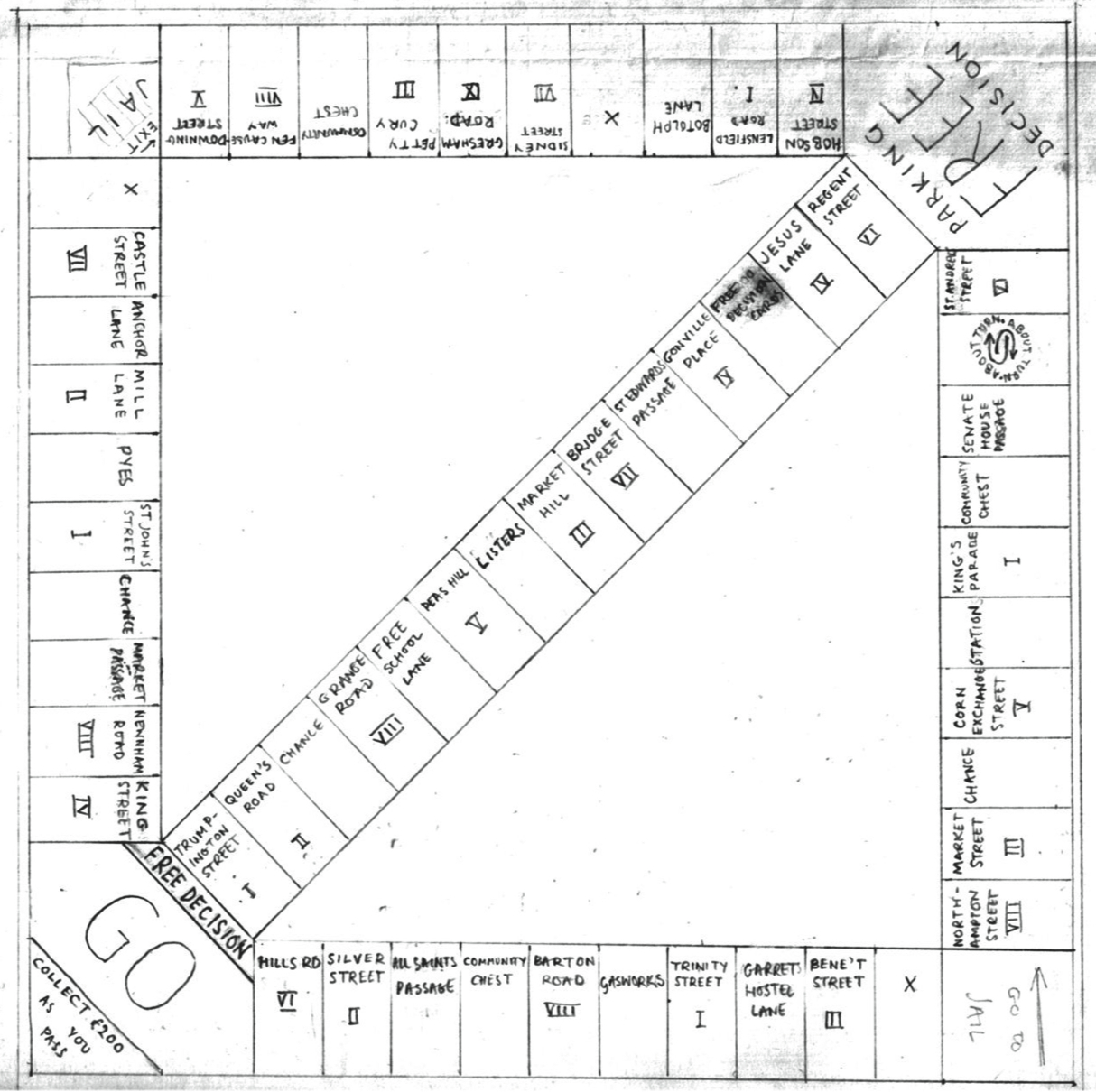
Well, it turns out that he once played a hand made copy made by William Newman (the son of his mentor Max Newman).  According to the booklet that comes with the set, “One afternoon the Newman household phone rang, with Turing on the other end, asking to speak with William. ‘Did he have a Monopoly board?’ Alan asked, and on hearing that he did, raced round. Turing’s mind was fascinated with codes, and there have long been suggestions he thought there were code-based tactics to playing Monopoly to ensure success. Alas, the hand drawn nature of William’s board (not to mention the unique diagonal straight and ‘turn around’ square) proved otherwise, and the great mathematician was beaten.

CAT-an!
– Image by boardGOATS

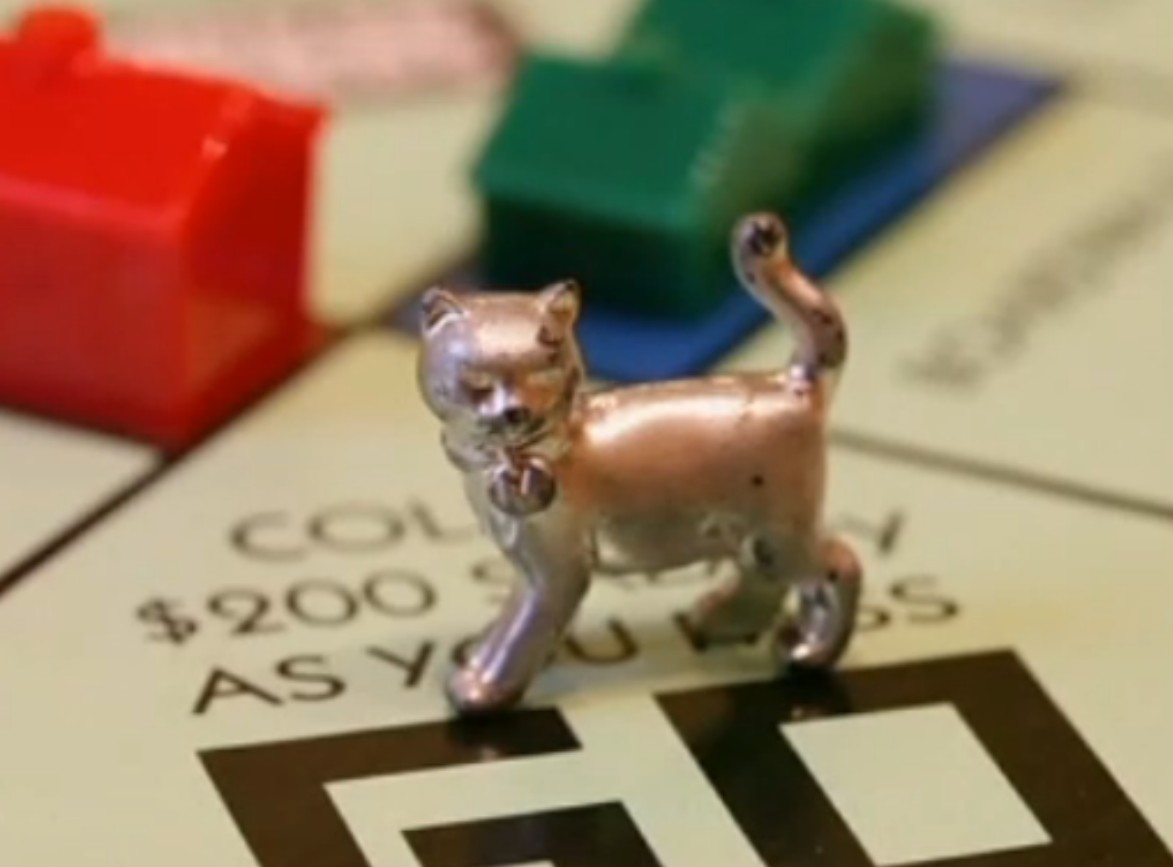
The connection between Alan Turing and Monopoly may seem tenuous, but in contrast, the way cats have a penchant for sitting in game boxes is well known to all gamer-cat-owners – there is even a game called “The Settlers of CATan”!  Thus, it should come as no surprise that, following a month long poll by Hasbro, the cat has beaten off competition from a robot, a helicopter, a diamond ring and a guitar.  The new cat design received 31% of the total vote and will replace the iron in the next edition which will be released later this year.

So now every Monopoly box will come with its own cat!

Monopoly Cat Token
– Image of unknown origin

Next Meeting – 19th February 2013

The next meeting is on Tuesday 19th February playing shorter games from 7.30pm as people arrive, until 8pm when we will start something a little longer.

Since we didn’t play it last time, the “Feature Game” will be For Sale, which is a quick, fun game about buying and selling real estate, where players first bid for several buildings then, after all buildings have been bought, sell the buildings for the greatest profit possible.  We chose this game as we would like to play something a little more substantial that would depend heavily on who comes along (possible games include, Village, Niagara, Mystery of the Abbey, Vasco da Gama, Keyflower and Snowdonia).

For Sale

And talking about selling things…

A door-to-door vacuum cleaner salesman manages to bully his way into a woman’s home in a rural area.

“This machine is the best ever,” he exclaims, whilst pouring a bag of dirt over the lounge floor.

The woman says she’s really worried it may not all come off, so the salesman responds, “If this machine doesn’t remove all the dust completely, I’ll lick it off myself.”

“Do you want ketchup on it?” she says, “We’re not connected for electricity yet…”

5th February 2013

It was another quiet night this week, but the landlady of the pub commented that February is the worst month for them, so maybe it’s catching.

The first game up was Race for the Galaxy.  This is a card game where players build galactic civilizations by playing cards that represent worlds or technical and social developments. Some worlds allow players to produce goods, which can be consumed later to gain either cards or victory points and other worlds or developments have bonuses that help players manage their hand or build more efficiently.  At the beginning of each round, players secretly and simultaneously choose roles, then each player has the opportunity to the action associated with the roles.  The iconography on the cards takes a little getting used to, and some of the players were unfamiliar with the game so we used pre-set hands.  The game was tight with only five points between first and last place and the Produce/Consume strategy giving the win.

Race for the Galaxy

We decided to save the “Feature Game” for next time, so instead, we played Queen’s Necklace.  This is another card game  (maybe we should be renamed “CardboardGOATS”?!?!)  where players buy gem-stones and then try to win the right to sell them.  There are two key things about this game:  firstly, if a card is not bought by the first player, it’s value decreases for the next player, so the longer they hang about the cheaper they are to purchase.  Secondly, when it comes to selling, each gem has an intrinsic value, but the amount the seller gets will also depend on availability, so if everyone tries to sell a valuable gem, the seller may not get as much as the person who won the right to sell a less valuable gem.  In addition to gems, players can also buy character cards which allow players to inspect another’s hand, steal a card, sell an extra gem etc.  This game was not as close as Race for the Galaxy though the eventual winner was the same.

Queen's Necklace

Learning Outcome: It’s always just when you have managed to build a really efficient victory point engine that someone ends the game.

Next Meeting – 5th February 2013

The next meeting is on Tuesday 5th February playing shorter games from 7.30pm as people arrive, until 8pm when we will start something a little longer.

The “Feature Game” will be For Sale, which is a quick, fun game about buying and selling real estate, players first bid for several buildings then, after all buildings have been bought, sell the buildings for the greatest profit possible.  We chose this game as we would like to play something a little more substantial that would depend heavily on who comes along (possible games include, Village, Niagara, Mystery of the Abbey, Vasco da Gama, Keyflower and Snowdonia).

For Sale

And talking about selling property…

Jeff was selling his house, and went to the estate agent left the matter in his hands.

Over the next two days the agent took photographs of the house and wrote a description that made wonderful reading.

After Jeff had read it, he turned to the agent and asked, “Is that everything there?”

The agent responded, “Well, I think so, what do you think I’ve missed?”

Jeff replied, “Why nothing, but you can cancel the sale… the house is much too good to part with!”

22nd January 2013

This week was an all time low in terms of numbers with illness, snow and work all conspiring to reduce attendance.  We knew we were going to be low on numbers, so we started out with a game of Tutto, to give anyone who might have been delayed by the weather time to arrive.  Tutto is a very short game with people drawing cards and rolling dice to score points.  If all six dice score, that’s “tutto” and you get a bonus as detailed on the card; if only some dice score, you can re-roll non-scoring dice, or stick and forfeit the bonus; if none of the dice rolled score, you lose everything from that round.  The game was amazingly tight, with the all players within a few hundred points of the 6000 target at the end.

Tutto

With so few of us, we took the opportunity to play something very new and quite complex:  Vasco da Gama. This is a resource management game with an element of risk where players have to buy projects, recruit sailors, build, captain and launch ships and finally use them to open new commercial routes.  Points were slow coming in the early rounds and players’ scores remained close.  However, as time went on, it became clear that the position of ships in the navigation area was key and the player with the best positioned ships romped away to a clear victory.

Vasco da Gama

Learning Outcome: Sailing is all about positioning your ship to make the best of the prevailing conditions.

OxCon and Big DoG

This weekend is OxCon.  OxCon is a weekend of gaming held every January in The Mitre pub in Oxford.  It has almost mythical status within since publicity is almost entirely by word of mouth and often quite last minute.

This year, in addition to the usual thread on BoardGameGeek, there is also a mention in the latest Queen’s Lane Advertiser (QLA-42, page 8) and a FaceBook page.  Not sure how many of the GOATS will make it, that will depend on weather (currently snow-chance) and family commitments, but it should be a good event with Puerto Rico and Settlers of Catan tournaments for the more competitive.

The Mitre, Oxford

In a couple of weekends time (2nd February to be exact – check out the calendar), is the Big DoG – a Day of Games hosted by the Oxford Meeples at Wolvercote Village Hall.  Just to the north of Oxford situated close to the A40 and A34, this looks to be a well cited event, and the list of proposed games looks enticing.  However, whether or not (m)any GOATS are there, will again depend on other commitments.

A Big Dog

Next Meeting – 22nd January 2013

The next meeting is on Tuesday 22nd January playing shorter games from 7.30pm as people arrive, until 8pm when we will start something a little longer.

The “Feature Game” will be Tutto, which is a quick press your luck game with dice rolling and cards.  We chose this as we would like to play something a little more substantial that would depend heavily on the number of players that come along (possible games include, Vasco da Gama, Village, Niagara, Mystery of the Abbey and Snowdonia).

Tutto

And talking of dice…

An A-Level student called Joe was sitting his General Studies multiple choice paper.

The invigilator told the students they could start and Joe opened the paper and started throwing the dice to select his answers. The invigilator gave Joe a long look, but he could see nothing in the rules to forbid it:  it is not uncommon for students to try their luck and, he supposed, this was an extreme example.

Very soon Joe had finished his paper and put his head on his arms on the desk and fell asleep.

About half an hour before the end of the exam, Joe sat up suddenly, and started throwing his dice again. This time the invigilator was unable suppress his curiosity, and approached the Joe.

“Why are you rolling  the dice again – you finished the questions in the first few minutes!” he said.

Joe replied, “Well sir, you always say we have to double check our answers…”

8th January 2013

Normally, we are very reliant on support from people coming from outside Stanford – Stanford is a village and we are very grateful to the people who travel from the surrounding villages and towns.  However, this week we had a visitor who set a new record coming over 8,000 miles – although it is possible she might not have come just to play games…!

Since the early arrivals were eating, we didn’t start playing until 8pm by which time we had six people, so the first game was Pick Picknic. This is a fun little game where players play chicken cards to claim corn in one of six coloured fields.  If two or more chickens claim the same field, then they can choose to share or they can roll to see who gets it.  But watch out for the foxes:  They are not interested the large tempting pile of corn, and eat chickens instead.  Initially, it seemed that a handful of fox cards was an advantage (well, wouldn’t you prefer to be a fox?), but the winner was the person with the most corn…

Pick Picknic

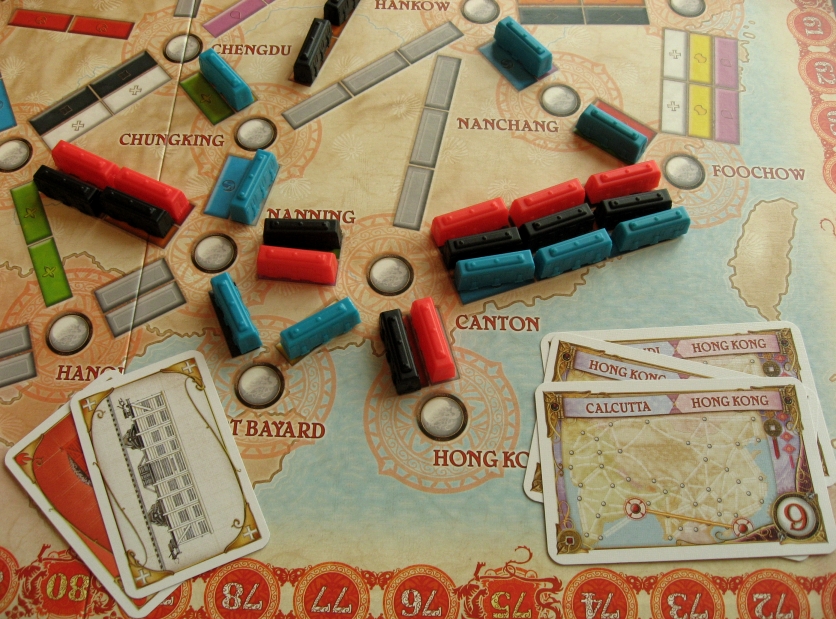
The next game was the “Feature Game” which was Ticket to Ride, a train game where players compete to make routes connecting cities.  Since there were six of us we decided to play the “Team Asia” map which adds the twist that players play in teams of two and have shared information and hidden information.  The first thing we discovered was that it plays a lot better if you include the white, blue and yellow cards, but once we had got that sussed, the game progressed in the usual way with players picking up cards and mispronouncing place names as they laid trains to fulfil their routes.  After a short tussle for Hong Kong, Blue took an early lead with Red and Black squabbling over second place.  However, in the final scoring Black had many more tickets (and higher scoring ones too), and shot ahead running out easy winners.

Ticket to Ride - Team Asia

There had been a lot of discussion and the game took much longer than expected, so we finished up with three rounds of an old favourite, No Thanks!, with the added luxury of real poker chips.  All the winning scores were less than ten, but the final was -1.  We thought that was a good place to end the evening.

Poker Chips

Learning Outcome: Sometimes it is better to be a chicken than a fox!

Boardgames in the News

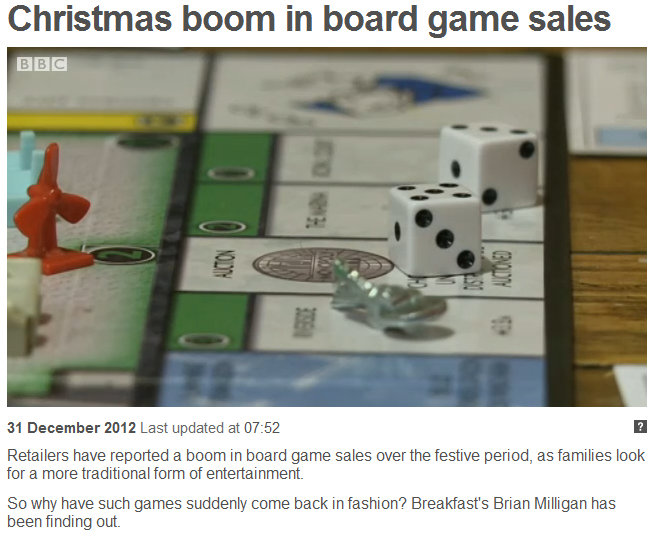
According to BBC Breakfast, retailers have reported a rise in game sales over the Christmas period with John Lewis quoted as reporting a 12% increase. Jaques of London, who claim to be the oldest games manufacturer in the world (they were established in 1795), say sales are rising much faster than that with traditional and boardgame sales rising by 32% for November this year compared with the same period in 2011.

BBC Report 31/12/12