Author Archives: nannyGOAT

Next Meeting – 28th May 2013

The next meeting is on Tuesday 28th May playing shorter games from 7.30pm as people arrive, until 8pm when we will start something a little longer.

This week the “Feature Game” will be Agricola, which is a a highly regarded game about medieval farming   This is heavier game than a lot of our previous Feature Games, but supports many levels of complexity from the “family” version to more advanced versions, so we can play a level that is appropriate to the people that turn up.

Agricola

And talking of farming…

A farm boy accidentally overturned his wagon-load of wheat.

The farmer who lived nearby heard the noise and yelled over to the boy, “Hey Jeff, forget your troubles. Come in and have tea, I’ll help you sort out that wagon later.”

“That’s very nice of you,” Jeff answered, “But I don’t think Dad would like me to.”

“Aw come on Jeff, a bite to eat will give us the strength we need,” the farmer insisted.

“Well OK,” Jeff finally agreed, and added, “But Dad won’t like it.”

After a hearty dinner, Jeff thanked his host. “I feel a lot better now, but I know Dad is going to be very upset.”

“Don’t be silly!” the neighbour said with a smile. “By the way, where is he?”

“Under the wagon.”

14th May 2013

The first game we played this week was our “Feature Game”, the card game, Saboteur which is a little like a cross between two games we’ve played before:  Avalon and Incan Gold. In this game players are dwarves working together mining for gold, with the catch that there could be a saboteur in their midst…  Since nobody had ever played it before, the first round was a bit of an experiment for all of us and we all started out “honest” playing path cards and maps.  However, suspicion arose a when one player claimed to have run out of useful paths and had to play a broken pick-axe, with inevitable reprisals.  Unfortunately, he HAD been honest and there were no saboteurs, but as we just managed to get to the gold, it didn’t really matter.

Since we felt we were starting to get the hang of it, we went went for a second round and this time correctly identified the saboteur and pinned him down with a pile of broken picks, lanterns and wagons while we dug up the gold.  When we picked on the same player for the third time, however, he was understandably distressed and protested his innocence.  Nevertheless, since he had very obviously shut off one of optional tunnels we had been carefully building, the pleading fell on deaf ears and failed to prevent the hail-storm of broken tools, only for it to become apparent that, once again, he was innocent.  When we asked why he had behaved in such a treacherous way, he forlornly explained that he was trying to stop us going the wrong way as he knew where the gold was.  Next time I suppose we might listen to him…

Saboteur

Next, we played the Scandinavian Ticket to Ride, a game we were all reasonably familiar with.  This is a really beautiful edition of “the train game”, but with slight twists to the usual rules.  White and Purple took the first few points, but Black joined in quickly and play continued pretty much evenly.  Black ran out of trains first which stymied Purple’s attempt to get the long track into Murmansk, however, we were all within ten points or so when we went into the final scoring.  Unfortunately, it turned out that Black and Purple had accidentally conspired to block White making her take a sizeable detour.  This had consequences for the number tickets she could complete.  Black and Purple jointly took the Globetrotter bonus with five completed tickets each, but it was the magnitude of the completed tickets that made the difference and Black ran out the winner by some fifty points.

Ticket to Ride:  Nordic Countries

Next we returned to semi-cooperativity with a quick game of The Great Balloon Race.  This is a great little race game (albeit with a ridiculously large box), where players have three different coloured balloons and the first to get them all home wins.  The snag is that nobody knows who owns which colour and it is highly likely that players will share at least one balloon with other players.  We last played this back in October and Blue and Orange got a bit victimised.  This time it was Blue and Pink…

The Great Balloon Race

Finally, we squeezed in a game of Ice Flow.  This is a really pretty strategy game where players direct teams of three explorers that are trying to get from Alaska to Siberia, climbing pack-ice, dodging polar bears, catching fish and occasionally jumping in for a quick swim.  Although this is a new game to boardGOATS, we were all familiar with it, so with a quick reminder of the rules we were off, jumping from ice floe to ice floe.  The game has a bit of a tendency for players to get stuck unable to get fish or rope, but we were wise to this and managed to control the resources quite successfully.  Black got an explorer home first, followed by a couple of Red meeples, however, while Black’s last piece dodged a hungry polar bear, Red managed to get his final one home for the win.

Ice Flow

Learning Outcome:  A clever move can sometimes be mistaken for a guilty one, however much you protest.

Next Meeting – 14th May 2013

The next meeting is on Tuesday 14th May playing shorter games from 7.30pm as people arrive, until 8pm when we will start something a little longer.

This week the “Feature Game” will be a card game that we haven’t played before called Saboteur.  This is a quick game where players are dwarves working together mining for gold, but the catch is that there is a saboteur in their midst…  We’ve chosen this game so that we can play something longer that is appropriate to the people who come.

Saboteur

And talking of dwarves…

It was Snow White’s birthday, so the the Seven Dwarves clubbed together to get her a camera as a present.  When she opened it she was thrilled with such a generous gift and happily took lots of pictures of the Dwarfs and their surroundings.  The next day she took the film to be developed.

A week later she eagerly went to get the developed photos, but the shop assistant said the photos were not back from the processor yet.  Needless to say, she was very disappointed and started to cry.

The clerk, trying to console her, said, “Don’t worry, someday your prints will come.”

Next Meeting – 14th May 2013

The next meeting is on Tuesday 14th May playing shorter games from 7.30pm as people arrive, until 8pm when we will start something a little longer.

This week the “Feature Game” will be a card game that we haven’t played before called Saboteur.  This is a quick game where players are dwarves working together mining for gold, but the catch is that there is a saboteur in their midst…  We’ve chosen this game so that we can play something longer that is appropriate to the people who come.

Saboteur

And talking of dwarves…

It was Snow White’s birthday, so the the Seven Dwarves clubbed together to get her a camera as a present.  When she opened it she was thrilled with such a generous gift and happily took lots of pictures of the Dwarfs and their surroundings and the next day she took the film to be developed.

A week later she eagerly went to get the developed photos, but the shop assistant said the photos were not back from the processor yet.  Needless to say, she was very disappointed and started to cry.

The clerk, trying to console her, said, “Don’t worry, someday your prints will come.”

30th April 2013

Like last time, we again started out with a quick game of Love Letter while we waited for late arrivals.  This time we found that players were winning rounds without getting very deep into the deck, which is strange.  However, one thing that didn’t change was that beginners luck again carried the day…

Love Letter

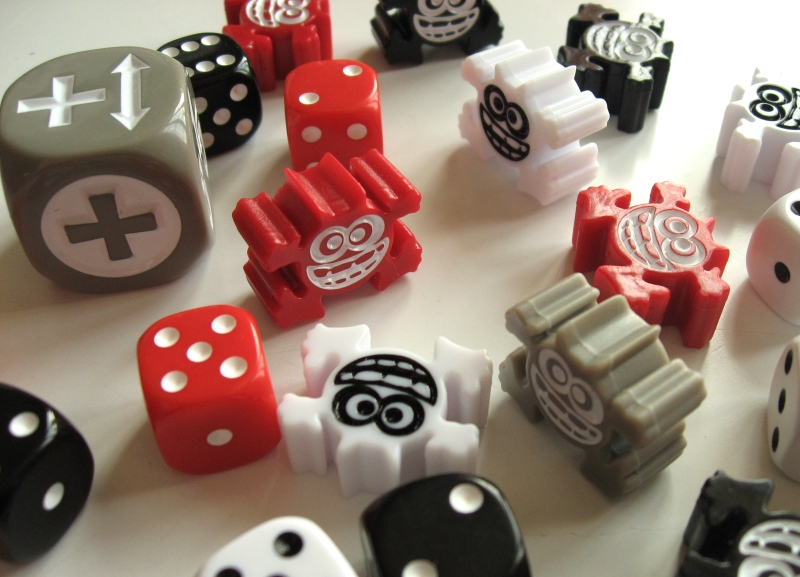
Next we quickly played a new game, Diavolo. This is a dice rolling game where players take it in turns to roll dice and depending on the outcome of the “Order” die, dive for a cute little imp.  If they fail to grab one (or get the wrong one), the player loses a gem and the last person to lose all their gems is the winner.  We all found this game very stressful so we had one quick round of an old favourite, No Thanks! as the last player arrived and went to the bar.

Diavolo

Once again, our less experienced players were otherwise engaged, so we decided to forego Ticket to Ride and play something we enjoyed a couple of months ago, namely The Speicherstadt.  This is a clever little auction game that is relatively quick to play and easy to teach, but has a lot of strategy.  In short, cards are turned over and players take it in turns to place one of their “Village People” next to the card they would like to buy:  contracts, ships (use to fulfil the contracts), firemen (to protect against inferno) etc..  The first player to bid for a card has first refusal for that card, but the price they must pay is equal to the total number of “Village People” next to the card.  If they decline, then the next player has the choice, and the cost has reduced by one.  Despite the fact that the different players seemed to employ quite different strategies it ended a very close game.  For example, Blue eschewed firemen and ended up taking nearly all the negative points due to fires.  Thus, Blue was some twenty points adrift at the back before the final accounting although they had a couple of valuable contracts and the warehouse.  In contrast, White invested heavily in firemen, and was way out in front, but had less to add in the final reckoning.  White and Blue ended level on points in last place, but only two points behind the winner who had engaged in more trading.

The Speicherstadt

Finally, we just managed to squeeze in a game of Keyflower.  This is a really beautiful resource management and bidding game where players use meeples (or “Keyples” as they are known here) both as currency for bidding and as workers to generate resources.  Played over four Seasons, with new tiles available at the start of each one, players take it in turns to bid for the different tiles.  However, the catch is that once a bid has been made, any subsequent bids for that tile must be both larger and made with the same colour.  In addition to the colour management, there are lots of other really elegant aspects to this game.  For example, players can place workers on tiles and use the products during that same Season, thus, if a player needs red for bidding, they may be able to use a worker to obtain the necessary Keyples.  This means you rarely find you can’t do anything, but you often can’t do exactly what you want. Although it was a new release at the end of last year, we had all played it before, so we just had a quick reminder of the rules as we set up and then launched into it.  In contrast to the last game, this was a bit of a white wash with the leader wining by some thirty points.  What was particularly interesting, however, was that this was based on a skill tile strategy which netted some sixty points at the end of the game.  None of us had ever found them all that useful before, presumably at least partly because the right tiles had never come up.

Keyflower

Learning Outcome:  In some games, you can be quite convinced you are losing and be very, very wrong.

Next Meeting – 30th April 2013

The next meeting is on Tuesday 30th April playing shorter games from 7.30pm as people arrive, until 8pm when we will start something a little longer.

Since we didn’t play it last time, the “Feature Game” will again be Ticket to Ride, which is a train game where players compete to make routes connecting cities.  We have chosen this as we are uncertain who will be coming, but we have a couple of new gamers showing an interest.  There are lots of different variations of this game, so it is very flexible and we can choose what variation to play depending on who comes.

Ticket to Ride

And talking of trains…

Two brothers, Jeff and Joe were taking their first trip on a train.  After a couple of hours, a vendor came down the corridor with a trolley selling food.  Now Jeff and Joe had led a sheltered life and the man was selling bananas which they’d never seen before, so they bought one each.

Jeff eagerly peeled his banana and bit into it just as the train went into a tunnel.  When the train emerged from the tunnel, he looked across at Joe and said, “I wouldn’t eat that if I were you.”

“Why not?” asked his brother.

Jeff replied, “I took one bite of mine and went blind for half a minute.”

16th April 2013

This week we started out with another new game called Love Letter.  This is a really cute little game that packs in a huge amount of deduction, risk, assassination, luck and bluffing, especially considering it comprises only sixteen cards and a handful of cubes.  Basically, each player has a hand of just one card and on a turn, players draw one card, and play one card, trying to expose others and knock them out of the game.  The winner of the round is the player with the highest value card or the last man standing.  We played four rounds, after which it was clear that beginners luck was ruling the day with the players who had played before all failing to win a round.

Love Letter

Due to work commitments and a stroppy horse our less experienced players were unable to attend, so we had a bit of a change of plan and decided to leave the “Feature Game” (Ticket to Ride) for another day.  Since we had another new (though experienced) gamer, we decided to play a new, deeper game called Village.  In this game, each player takes the reins of a family striving for fame and glory.  Village is full of difficult decisions, yet moves quite quickly.  However, what is particularly unique is the way the game uses the delicate subject of death as a natural and perpetual part of life in the village and a mechanism for dictating the flow and duration of the game.

The strategies players employed varied hugely, from exploring the outside world and going into the church, to remaining a penniless farmer, or even trying a bit of everything.  From the start it seemed that White was running away with victory as he left the Village and explored the shire.  Meanwhile Red decided that piety was the best option and sent his sons into the church, leaving Blue and Yellow splashing about in the mud on the farm.  However, towards the end it became apparent that Yellow was hatching a cunning plan in the council chamber and suddenly made a fortune trading in the market.  The final result hinged on Blue’s decision to sell a cow which started a market day giving White the opportunity he needed to effectively have an extra turn and win by two points, with Yellow, Blue and Red surprisingly close behind.

 Village

Learning Outcome:  When it comes to Village life, a single-minded strategy is often more effective than dabbling in everything.

Next Meeting – 16th April 2013

The next meeting is on Tuesday 16th April playing shorter games from 7.30pm as people arrive, until 8pm when we will start something a little longer.

The “Feature Game” will again be Ticket to Ride, which is a train game where players compete to make routes connecting cities.  We have chosen this as we are uncertain who will be coming, but as we have a couple of new gamers showing an interest.  There are lots of different variations of this game, so it is very flexible and we can choose what variation to play depending on who comes.

Ticket to Ride

And talking of trains…

A man was on the northbound Caledonian night sleeper train.  Jeff, one of the attendants came and the man asked him for wake-up call, “I have to be off at Perth, I’m a heavy sleeper (no pun intended), but I must get off there. I want you to put me off, whatever I say.”

The next morning the man woke up at Inverness.  Extremely annoyed he found Jeff and gave him a piece of his mind.

After the man had left, somebody asked Jeff, “How could you stand there and take that kind of talk?”

“That’s nothing!” replied Jeff, “You should have heard the guy I put off at Perth!”

2nd April 2013

This week we had two new gamers, so we started out gently with the “Feature Game” which was Coloretto. This is a simple card game where players have to collect sets of coloured chameleons.  However, while the three largest sets contribute positively to the final score, any others are subtracted.  The game was really quite tight with only three points between first and second place.

Coloretto

Next up was Carcassonne which had its second outing in as many games nights.  In contrast to the last game, this was played very “nicely”.  We started out with a selection of tiles from the two river sets and then played with just the base game, without farmers.  The youngest player managed to draw city after city tile and built a massive, uncontested city.  Meanwhile, the other new player got meeples stuck in a city and on a road that required two tiles to infill a hole, one of which was quite specific.  In a masterpiece of courage, she waited it out and drew the last required tile in the penultimate round.  Despite these heroics, however, his seemingly never-ending stream of cloisters meant nobody was quite able to catch red, who ran out eventual winner.

Carcassonne

Given that the new players have an interest in horses, we then moved on to Turf Horse Racing.  This time, the new players ganged up, backing Roamin’ Emperor who had a one in six chance of moving 20 lengths. It started really well too, launching into the lead, only for Silver Blaze, Red Baron, and Desert Prince to eventually move ahead.  Mosstown Boy and Lagoon Lady hung on to the back of the pack while the old nag Raven Beauty seemed to be going backwards.  Lagoon Lady started to loose contact when, with a sudden burst of pace Roamin’ Emperor made a dash for the line winning by 15-20 lengths from Silver Blaze and Red Baron.

Turf Horse Racing

Finally, we finished with a few quick rounds of one of our old favourites, Dobble.  We managed three different riotous variations and honours were pretty much even.

Dobble

Learning Outcome:  When it comes to boardgames, playing on a tablecloth is a BAD idea as it moves and causes “earthquakes”.

2nd April 2013

This week we had two new gamers, so we started out gently with the “Feature Game” which was Coloretto. This is a simple card game where players have to collect sets of coloured chameleons.  However, while the three largest sets contribute positively to the final score, any others are subtracted.  The game was really quite tight with only three points between first and second place.

Coloretto

Next up was Carcassonne which had its second outing in as many games nights.  In contrast to the last game, this was played very “nicely”.  We started out with a selection of tiles from the two river sets and then played with just the base game, without farmers.  The youngest player managed to draw city after city tile and built a massive, uncontested city.  Meanwhile, the other new player got meeples stuck in a city and on a road that required two tiles to infill a hole, one of which was quite specific.  In a masterpiece of courage, she waited it out and drew the last required tile in the penultimate round.  Despite these heroics, however, his seemingly never-ending stream of cloisters meant nobody was quite able to catch red, who ran out eventual winner.

Carcassonne

Given that the new players have an interest in horses, we then moved on to Turf Horse Racing.  This time, the new players ganged up, backing Roamin’ Emperor who had a one in six chance of moving 20 lengths and it stared really well, launching into the lead, only for Silver Blaze, Red Baron, and Desert Prince to move ahead.  Mosstown Boy and Lagoon Lady hung on to the back of the pack while the old nag Raven Beauty seemed to be going backwards.  Lagoon Lady started to loose contact when, with a sudden burst of pace Roamin’ Emperor made a dash for the line winning by 15-20 lengths from Silver Blaze and Red Baron.

Turf Horse Racing

Finally, we finished with a few quick rounds of one of our old favourites, Dobble.  We managed three different riotous variations and honours were pretty much even.

Dobble

Learning Outcome:  When it comes to boardgames, playing on a tablecloth is a BAD idea as it moves and causes “earthquakes”.