The nominations have been announced as usual though. There are three categories, the Kinderspiel (children’s game) , the Kennerspiel (“expert’s” game) and the most desirable of all, the family award, the Spiel des Jahres. The nominees for this year’s awards have been announced as:
Spiel des Jahres My City by Reiner Knizia Nova Luna by Uwe Rosenberg and Corné van Moorsel Pictures by Daniela and Christian Stöhr
In previous years the group has picked out the eventual winner well in advance even of the nominations, however, last year the games generally seemed to be light, almost party games. These are not our usual faire, and in recent years, the Kennerpiel des Jahres has been a better fit. The Kennerspiel nominees are not especially complex games, but are typically a step up from the light family games that are now being nominated for the “Red Poppel”.
– Image by from spiel-des-jahres.de
Last year the winner of the Kennerspiel award was Wingspan which also picked up our own “Golden GOAT” Award at our Un-Christmas Dinner. With all that has been going on, however, we are unfamiliar with almost all the nominees this time round and likely won’t get the chance to play any of them until after the winners have been announced (20th July in Berlin for the Kennerpiel and Spiel des Jahres Awards; 15th June in Hamburg for the Kinderspiel des Jahres).
Having spent the last few meetings playing online using Tabletop Simulator shared through Microsoft Teams, this time we decided to do something a little different. One of the group’s most popular games is 6 Nimmt!, which also plays lots of people. It has unavoidable hidden information, but is available through the online platform, Board Game Arena.
– Image by boardGOATS
On our first online game night, a small group had had a difficult time playing Port Royal on Yucata. Some of the group had also played rather challenging games of Snowdonia and San Juan, and, as a result, had moved to Board Game Arena for three more recent, epic games of Keyflower. The graphics and playing environment on Board Game Arena are more up to date than those for Yucata, but like most other platforms, the servers have been struggling at peak times with the load caused by the recent influx of new online gamers. The folks at Board Game Arena have done a lot of work on that in the last couple of weeks though, and the performance has improved significantly as a result. So much so, that we felt reasonably confident it would be stable enough to be the focus of games night.
– Image by boardgamearena
on twitter.com
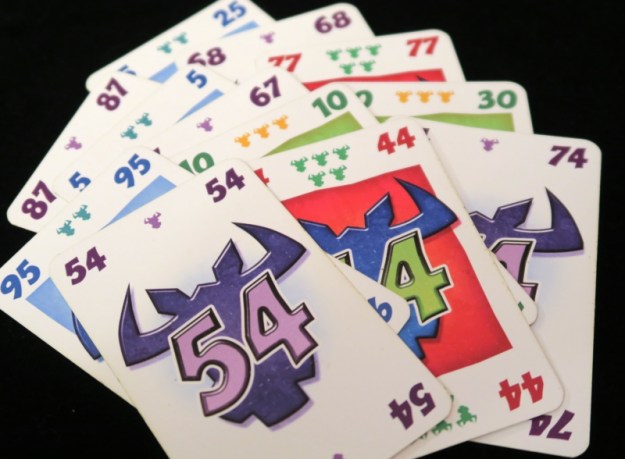
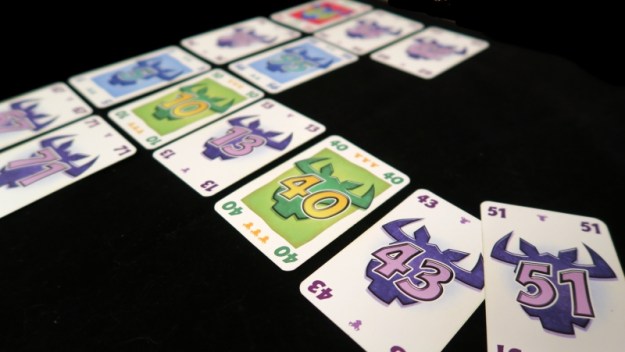
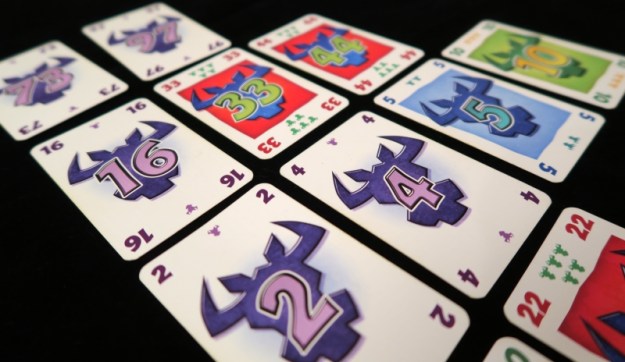
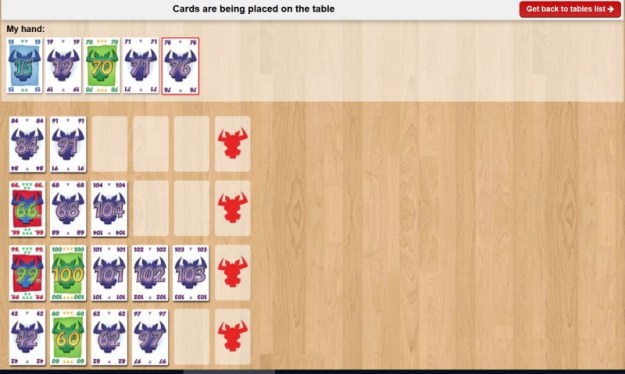
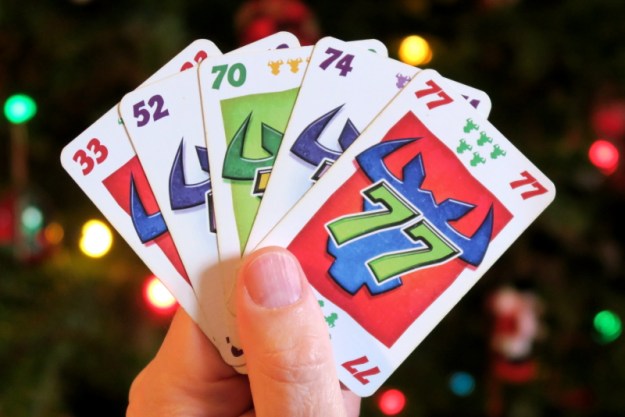
So, this week, the “Feature Game” was to be 6 Nimmt! played on Board Game Arena. This is a game that everyone knows well, though there are a couple of minor tweaks to the rules. The idea is that everyone starts with a hand of cards, ten on Board Game Arena (we usually play with the hand size that is dependent on the number of players). Simultaneously, everyone chooses a card, and then, starting with the lowest numbered card, these are added to the four rows in the display. Each card is added to the row that ends with the card with the highest number that is lower than the card played.
– Image by boardGOATS
Placing the sixth card in the row causes the active player to take all the cards in the row, replacing them with their played card. The clever part is that the score is the not the face value of the cards, but the number of “bull’s heads” shown on the cards. The aim of the game is to finish with the lowest score. When the group usually play, we split the deck into two halves and play just two rounds. On Board Game Arena, however, everyone starts with sixty-six points and the game end is triggered when someone’s score falls to zero.
– Image by boardGOATS
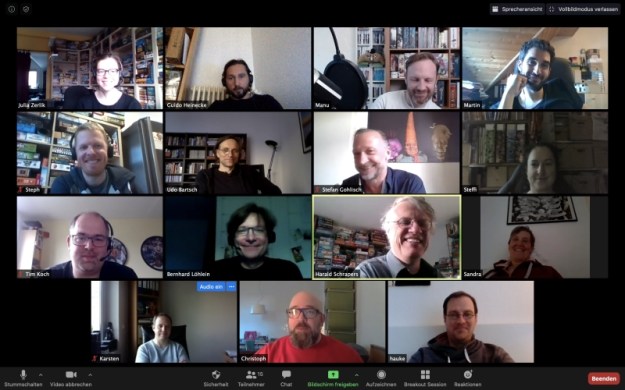
From 7pm, players began logging onto Board Game Arena and joined the MS Teams meeting. Lime was one of the first and his chat with Blue and Pink was interrupted by a phone call from one of Blue’s relatives trying to source a set of drain rods. Blue and Pink were quite convinced they didn’t have any, but that didn’t stop Pink having to spend the next hour hunting for some without success (so Lime kindly offered to lend his if required). While Pink rummaged in the garage, everyone else joined the meeting and chatted. Mulberry unfortunately wasn’t able to join us, but she was replaced by Ivory on his first online meeting. It was great to “see” him again after so long, and good to hear that Mrs. Ivory, Little Ivory and Littler Ivory were all doing well and might be interested in OKIDO.
– Image by boardGOATS
Eventually, Pink finished ferreting and returned to the chair kept warm by his panda and everyone settled down to play. The Board Game Arena implementation worked nicely and everyone was able to chat in the background using MS Teams, but also through the game’s “chat” channel. There was the usual moaning about the quality of cards and comments about how badly things were going: it was almost like playing together in the pub, though not quite.
– Image by boardGOATS from boardgamearena.com
Green and Purple managed to avoid picking up any cards for the first round or two, but it wasn’t long before their natural collecting mania began. The disease spread and soon Pine, Ivory and Black were picking up lots of cards too. It wasn’t long before Lime triggered the end of the game, and Burgundy managed to avoid picking up anything in the final round to win, ten points clear of the rest of the field.
– Image by boardGOATS from boardgamearena.com
There is a lot of luck in the game, especially with so many players, but everyone was happy to play again and it is very easy to engage in a re-match, or so we all thought. It wasn’t until the second game had started that we realised we’d “lost” Lime somewhere along the way. He seemed to be playing a game, but then it dawned on him, that he’d somehow got himself involved in somebody else’s game by mistake. He was very embarrassed and was keen to extricate himself, but Blue worked out where he’d gone and shared the link. So, to the complete mystification of the four French gamers involved, the Brits all joined their game as excitable spectators.
– Image by boardGOATS
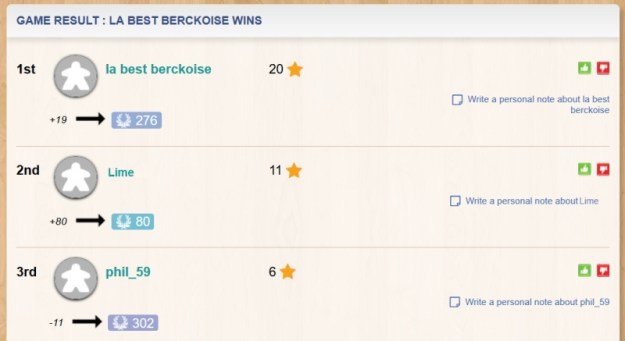
Everyone boisterously cheered on our British Representative, to the blissful ignorance of the French and huge embarrassment of poor Lime. Meanwhile, Black worked out how to abandon the incomplete game and Blue started a new one which everyone joined while still following Lime’s progress against the French. Lime played really well and was in the lead for much of the game, but sadly, one of the French finished strongly and just beat him. Still, we all felt he’d done an excellent job keeping the British end up, and he finished a very creditable second (especially since he was somehow also playing the group’s game and working!).
– Image by boardGOATS from boardgamearena.com
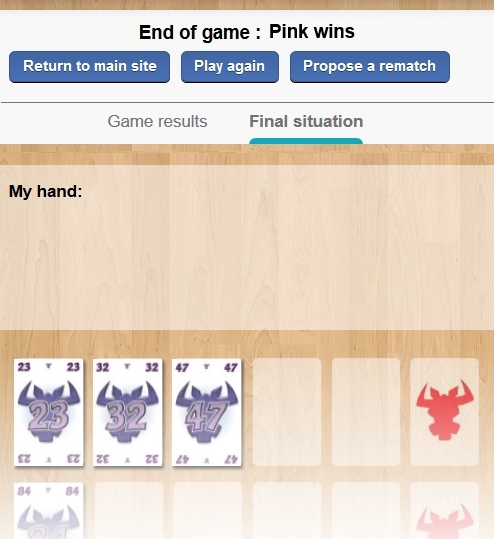
After all that excitement, our game was something of an anticlimax. Nobody was really paying much attention for the first part as they were distracted by Lime’s stellar performance. But when everyone focussed on the game again, Pine, Blue, Ivory and Green were fighting it out to at the top while Pink was doing his best to end the game nice and quickly. There were the usual smutty comments (Green: “Ivory’s got a big one there…!”) and other banter (Pine: “I had the lead for all of two seconds…!”), but eventually, Pink put everyone out of their misery, somehow leaving Blue just ahead of Pine.
– Image by boardGOATS
from boardgamearena.com
Nobody was desperate for an early night, so everyone chose the rematch option again, and this time, everyone ended up in the same game. It started quite close, but Black soon found the cards irresistible and quickly amassed an unassailable pile of brightly coloured cards. At the other end, Pink went from “zero” to “hero”, going from last place to first place, with Pine and Lime tying for second place. Nobody seemed keen to play another round and the evening degenerated into chatter. Pink shared how to customise backgrounds on MS Teams including a selection he had downloaded from the BBC, with one from Blake’s 7 and another from Multi-coloured Swap Shop.
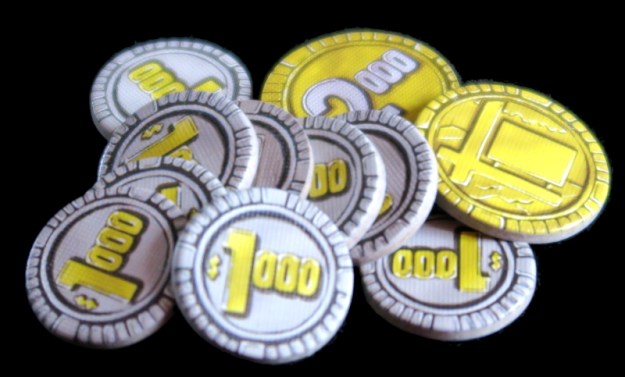
With Lime, Ivory and Green gone, and everyone else clearly not ready for bed yet, but running out of chat, someone suggested another quick game. Once Blue’s maths had been corrected several times (ruling out all the five-player games), the group started a game of For Sale. This is a simple auction game of two halves. First, there is the property sale, where players take it in turn to bid for a building or pass and take the least valuable available. Then, players choose which properties to sell when the “buyers” reveal their offers (cheques).
– Image by boardGOATS
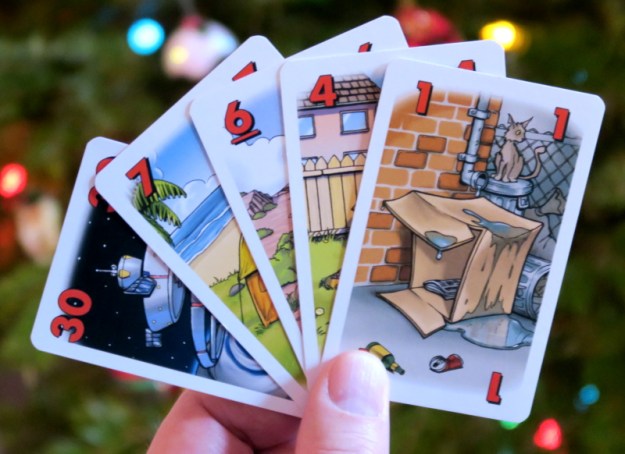
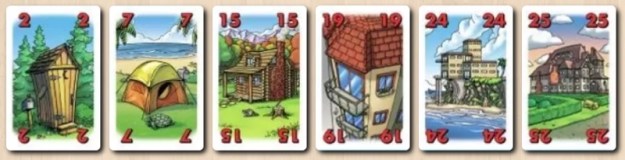
The clever part of this game is that the property cards are numbered (one to thirty), so they have a relative value with those numbered close to thirty more valuable than those around one. Everyone starts with $14,000 and bids are in $1,000 increments, but anyone passing takes the lowest value property available, but takes a rebate equal to half the value of the bid (rounded down). This adds an interesting level of decision making towards the end of each bidding round. In the second phase, cheques are revealed with values between zero (void) and $15,000. The player with the highest value of cheques and any left over money once all properties have been bought and sold, is the winner.
– Image by boardGOATS
Board Game Arena have a very nice implementation of For Sale, faithfully reproducing the original, quirky card art. There were a lot of controversially high bids, not least from Burgundy who paid $9,000 for the space station, the highest value property. It worked though, as Burgundy just pipped Pine to win by a mere $1,000, in what was a very tight game. It is a game where valuing property is key, both for buying and selling, and as it plays quickly, the group decided to give it a second try.
– Image by boardGOATS from boardgamearena.com
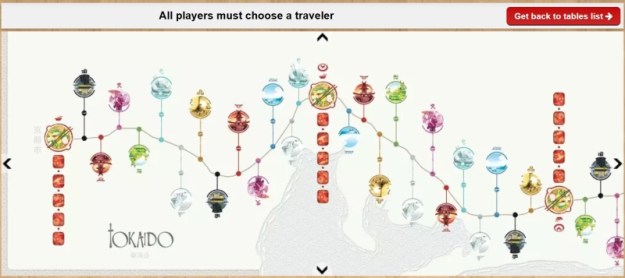
This time, aside from Pink propping up the table again, everyone who had done well, did badly, and everyone who had done badly did well. So, Blue, Black and Pink were at the top this time, with Blue pushing Black into second place by $5,000. With that, Pine left the others to decide what long and drawn-out game they were going to play over the next fortnight, and everyone else eventually settled on Tokaido and set up the table to start the next day.
– Image by boardGOATS from boardgamearena.com
Learning Outcome: 6 Nimmt! est imprévisible dans toutes les langues.
It is at times of stress that people need social contact more than ever, and board games are a great medium for that. Despite the limitations of “remote gaming”, the overwhelming impression is that it is important to stay in touch, so we are persisting with online meetings. Therefore, our next meeting will be on Tuesday 12th May 2020; we will gather from around 7.30pm, and start playing at 8pm.
This week, the “Feature Game” will be one of our favourite games, the game of bulls’ heads, 6 Nimmt!. We have chosen this game because lots of people can play, and this is intended to be a social event so it is important that everyone can be involved and we’ve had an awful lot of fun with the game in the past on games nights. It is a very simple game and everyone knows the rules, so it should be a relatively gentle introduction for those not used to the environment.
– Image by boardGOATS
And speaking of bulls…
Farmer Jeff was inspecting his herd of cattle, when a large, sudden, gust of wind knocked all the cows to the ground. The bulls, on the other hand, just swayed as the wind buffeted them, and continued eating.
Jeff was very surprised by this, so went up to one of the bulls and asked,”How come you bulls are all still standing when all the heifers were blown over?”
The bull looked at him for a moment before replying, “Because we bulls wobble, but we don’t fall down…”
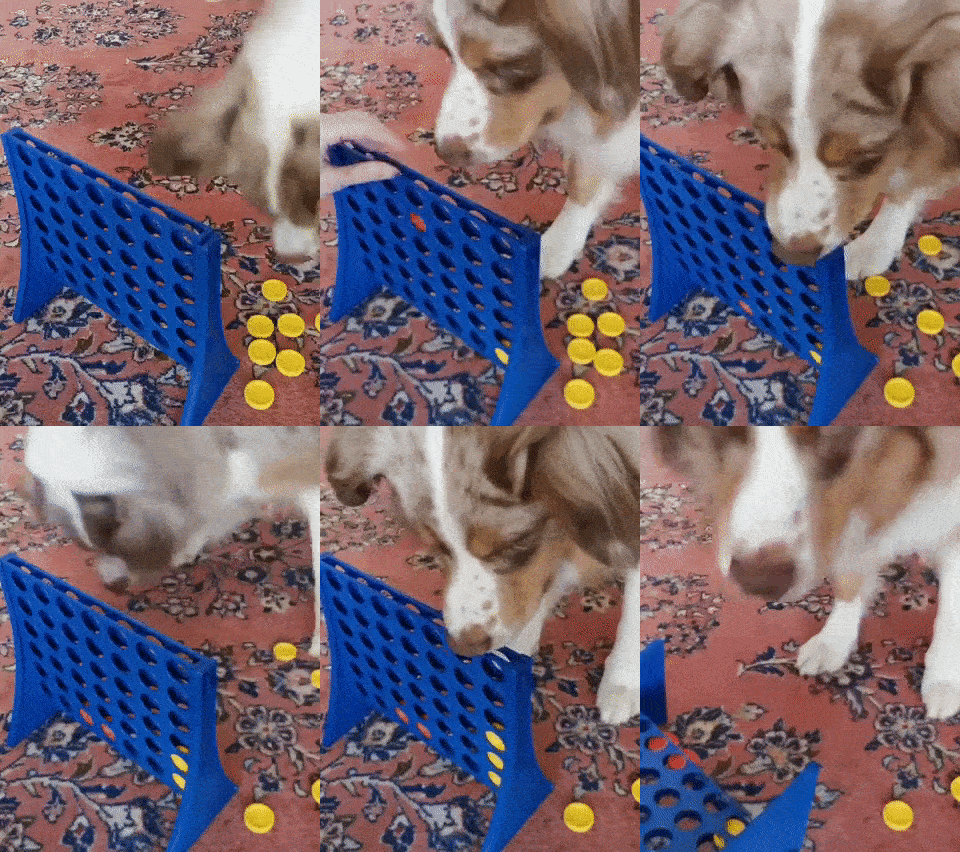
Playing board games has been difficult recently. Some have family they can play with, while others have resorted to playing online. In extremis, however, there are always family pets, but you can’t guarantee they won’t flip the game if you don’t let them win…
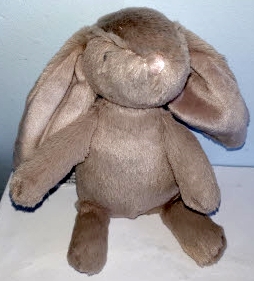
People started to arrive online from about 7pm with Mulberry briefly joining the party to say that she was going to have to work and sadly couldn’t join in the game. It wasn’t long before everyone was once again sharing their stuffed toys, including Burgundy who’s new friend “Bunny” was watching over him from on high. While Blue and Burgundy set up the game, Lime proudly showed off his new haircut that Mrs. Lime had done for him, only for someone to comment that it made him look like a bit like Tin Tin…
– Image by Burgundy
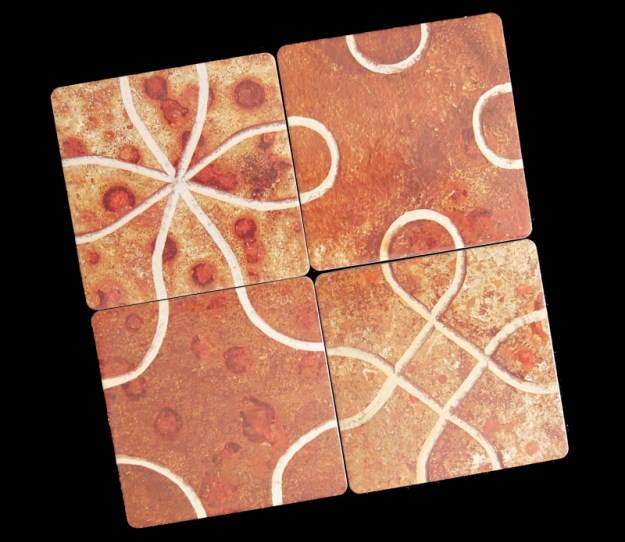
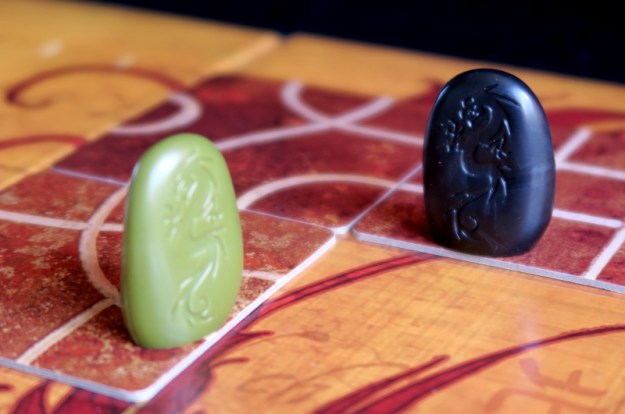
The “Feature Game” was to be Tsuro, a very simple game of tile laying. The idea is that on their turn, the active player placed a tile in the space next to their stone and moves their stone along the path. The last player left on the board is the winner. The game plays lots of people, so was thought to be ideally suited to these online game sessions, but unfortunately, has hidden information in that each player has a secret hand of tiles that they play from. In order to accommodate this playing online (using Tabletop Simulator to visualise, shared through Microsoft Teams), we simply displayed two tiles and on their turn each player picked one.
– Image by boardGOATS
This reduces the amount of planning possible, making the game less strategic, more tactical and, potentially, more random. So to compensate a little and make it fairer, when any tiles with four-fold symmetry were drawn, they were put to one side as an extra option, a third tile, available until someone picked it. As there were a lot of players, we also decided to use the slightly larger board from Tsuro of the Seas, and modify the pieces to suit our purposes. Aside from this, the rules were the same as the original: players can rotate the pieces (or ask someone to do it for them), but they must place them in the space next to their piece.
– Image by boardGOATS
Once a tile has been placed on the board, all stones must be moved along any paths extended, and any that collide or go off the board will be eliminated. Burgundy started in the bottom left corner followed by Black, Purple and Lime, who was joined in the early stages by Little Lime who was keen to help. Pine with his special friend, Beige assisting, followed by Pink, Blue and Green with Lilac and his “pet” sloth in support. Everyone was fairly well spaced out around the edge of the board, so the game began quite slowly. That was OK though as everyone had to get a feel for the graphics and what they were doing.
– Image by boardGOATS from Tabletop Simulator on Steam
As the game progressed, people started to get entangled with each other. The first to come a cropper was Black with Pink not too far behind. Burgundy and Blue got stuck and went off together followed by Green who ran out options and then ran out of road. When Lime was eventually forced off the board by a lack of space, there were just two left. As Purple had to move into the space around Pine (playing on behalf of Beige), giving him the opportunity to push her off the board and claim the first victory for his little Gremlin.
– Image by boardGOATS from Tabletop Simulator on Steam
That had gone quite well and hadn’t taken very long, so as setting up has some overhead, we decided it would be quickest to just play it again. Blue and Burgundy re-stacked all the tiles and everyone chose their start positions. For some reason, this time Green ended up surrounded by lots of empty space while everyone else was bunched together. Green quickly put up a barrier and then went off to play with Lilac to play together alone in the corner, leaving everyone else to fight for space.
– Image by boardGOATS from Tabletop Simulator on Steam
Pine commented that Blue hadn’t moved far, but when she commented that she’d just been round in a circle, Pine objected inciting Pink to call him a “Boardgame Pedant”. Pine took this mantle with pride and said he might add it to his CV as it already said he was a “Bird-watching Pedant”. Blue queried this with “Bird-watching Pheasant?” and Pink upped the ante with “Bird-watching Peasant?” Pine concurred, “Yeah, that too…”
– Image by boardGOATS from Tabletop Simulator on Steam
As the game plodded on, Pink was the first to go off, soon followed by Lime and Black. Then there was a bit of a hiatus though as players got tangled up. Pine was the first who kindly eschewed the opportunity to expel Blue from the game (or maybe he had no choice); and then Blue returned the favour (also with no other option). Somehow, the paths kept getting entwined bring everyone to the same place, while Pine played with himself in the top corner, ominously.
– Image by boardGOATS
It was during this second game that the technology started to struggle a little and Teams kept freezing as the load on the network began to exceed the capacity of the village carrier pigeon. The game just about kept moving though, with Pink, bored having been the first to leave the game, started intimidating Blue with his large Panda. Blue and Pine were next off, thanks to Purple, who had to choose who was going to stay in the game with her. In the end, her choice of Burgundy proved to be unfortunate as he ruthlessly dispatched her on his next turn. It didn’t make much difference though, and Green with lots of space and no competition was the winner. Although his second tile had been crucial to his success, it was really the unintentional assistance from Pine when he played a convenient blocking tile in E5 that clinched it.
– Image by boardGOATS from Tabletop Simulator on Steam
With that over, there was a little bit of chit chat about other game options that would work online: Finstere Flure was an option on the Simulator, but 6 Nimmt! on Board Game Arena was discussed, as was Take it Easy! with pieces delivered by Blue and Pink. That didn’t last long though as the evening degenerated into comparing soft toys again (“Is that Kingston Bagpuss?!?!”) accompanied by renditions of songs by The Eagles. As Green, Lilac and Pine melted away, Blue, Pink, Purple, Black and Burgundy played a few turns to get to the end of Spring in their Keyflower rematch. But that’s another story…
– Image by boardGOATS from boardgamearena.com
Learning Outcome: With all this “working from home”, the Stanford Carrier Pigeon needs a good feed.
Over the last couple of months, the Coronavirus Pandemic has had a huge impact globally, and board gaming has not escaped. For example, the largest distributor in the USA, Alliance Games, has stopped shipping games and the parent company, Geppi Family Enterprises (GFE) have been with-holding payments to vendors. Just over a month ago, we reported that many conventions had been cancelled, and the UK Games Expo, usually held at the end of May/start of June was postponed until August. Since then, Friedhelm Merz Verlag GmbH who run the Essen Spiel in October, have stated that they are monitoring the situation in Germany, where Oktoberfest was recently cancelled.
– Image from ukgamesexpo.co.uk
Yesterday, sadly, the directors of UK Games Expo announced that they have now reluctantly taken the decision to cancel the event this year; the next UKGE is now scheduled for 4th-6th June 2021. The 2020 UK Games Expo Award nominees and winners will still be announced in August, however, and the organisers are currently looking at the possibility of a virtual event. The UK Games Expo does not carry pandemic insurance, so cancellation has serious consequences for their finances, however, in their statement they say have sufficient financial reserves to survive this, although those reserves will be completely depleted. The overwhelming support on Facebook alone, gives some confidence that the event will survive despite this and will come back even stronger next year.
It is at times of stress that people need social contact more than ever, and board games are a great medium for that. Despite the limitations of “remote gaming”, the overwhelming impression is that it is important to stay in touch, so we are persisting with online meetings. Therefore, our next meeting will be on Tuesday 28th April 2020; we will gather from around 7.30pm, and start playing at 8pm.
This week, the “Feature Game” will be Tsuro, “The Game of the Path”. We have chosen this game because lots of people can play, and this is intended to be a social event so it is important that everyone can be involved. The rules as written have hidden information, but we are going to make some modifications to make it work, and play it on the slightly larger, Tsuro of the Seas board.
– Image by boardGOATS
And speaking of paths…
Jeff and his housemate Joe were out for their daily exercise walking down a path near their home, when they spot a deep hole in the ground. As they stood around the hole together looking in, Jeff asked, “How far down do you reckon that hole goes?”
Joe replied, “I don’t know, let’s chuck something in and find out.”
With that, they looked about and spotted an old radiator in the nearby bushes that someone had fly-tipped (since the Council had closed the tip as a non-essential service). Jeff pointed to it and started to drag it towards the hole. Joe gave him a hand and together, the pair half dragged, half carried it and dropped it into the hole.
They started to count and listen for the thud, but before they heard the radiator land, they saw a large goat charging at them from the bushes. Terrified by it’s huge horns they started to run, but as they did so, the goat leapt into the hole. Now some distance from the hole and shocked and confused, Jeff and Joe decided to continue their walk along the footpath.
About ten minutes later, they were confronted by an old farmer who asked, “You haven’t seen a goat lately, have you?”
Jeff answered, “We have actually – about a mile back. It sort of ran at us and then dived into a pit at high speed.”
The farmer gave him a strange look, “But that’s impossible, he was tied to an old radiator…”
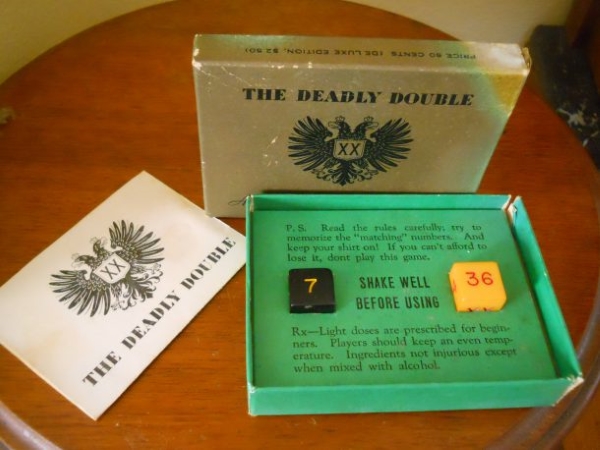
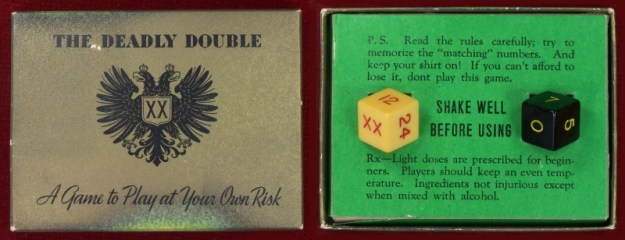
The Deadly Double is an eighty year old, “put-up and take” dice game with a slightly sinister past. The game, designed to be played in cramped conditions in while sheltering from air raids, is almost trivially simple. Each player starts with a pile of chips and contributes a fixed stake or “ante” to the kitty. Then, players take it in turns to roll the two bespoke dice, one black with yellow numerals and one white with red markings. The faces of the black die feature the odd numbers from one to nine while the white die has multiples of twelve up to sixty, giving pairs of one and twelve, three and twenty-four etc. The sixth faces are zero and “double X” (or “XX”) for the black and white dice respectively.
– Image from strangefulthings.com
If a pair is rolled, the active player takes the kitty. In general, players roll once per turn unless they roll a special combination. For example, rolling a zero with a sixty and they contribute to the kitty again; rolling a zero with an even number multiple of twelve, and the player rolls again, and so on. Rolling the “deadly double”, XX, with a zero means the active player must make a large contribution to the kitty defined by a re-roll – a decision must be made before the re-roll, but neither option is good as both are likely to be large: either the face value of the white die, or the number rolled on the black die multiplied by the number of players.
– Image from dicecollector.com
It was perhaps the peculiar numbers featured on the dice that inspired the conspiracy theory that was reported in The New York Times in March 1967. According to an interview with Lasislas Farago, a former United States intelligence expert and military historian, readers of the New Yorker noticed that the newspaper advert for the game showed the numbers seven and twelve, adverts that were published about two weeks before the Japanese attack on Pearl Harbor on 7th December 1941. The Germanic eagle logo and images of a bomb shelter led to the idea that these adverts were in fact warning Japanese agents in the US of the date of the impending attack. It was thought that five and zero shown in the advert might represent the planned time for the attack while the XX, the Roman numeral for twenty, might indicate the latitude for Pearl Harbor in Hawaii.
– Image from dicecollector.com
Even the name, “The Deadly Double” could have alluded to the axis powers, Germany and Japan. According to Lasislas Farago the mystery deepened when the FBI contacted the New Yorker to discover who placed the advertisments, only to find that they didn’t know – the gentleman in question was completely anonymous. The advert had been placed over the counter and paid for in cash and the clerk had no recollection of who placed them. Apparently, neither the game that was offered nor the company whose signature was on the advert ever existed.
– Image from dicecollector.com
However, The New York Times published a follow-up article the following day featuring an interview with a Mrs. E. Shaw Cole of Montclair, New Jersey. She claimed that she had helped her late husband and designer of the game, Roger Paul Craig to design the adverts. Although they were indeed visited by the FBI, she claimed the numbers were all just a coincidence. Despite this, and earlier comments on the subject from Mr. Craig reported in the Los Angeles Times in 1942, the urban myths and conspiracy theories still refuse to die and the game, The Deadly Double, will forever be associated with the surprise attack on Pearl Harbor, that ultimately led to the USA joining World War II.
Social contact is really important for mental health and board games are a great medium for that. Unfortunately, physical proximity isn’t an option at the moment, so we’ve moved our games nights online. Despite the limitations experienced last time, the overwhelming response from the group was that we should persist with online meetings. With this in mind, and the recent special offer for Tabletop Simulator on the Steam platform, we’d had a couple of trial runs to see if that would work for the group. Tabletop Simulator is a “sandbox” environment, which provides an electronic rendering of the game and tools to move things around.
– Image from steampowered.com
The strength of Tabletop Simulator, but also its weakness, is that people have to do everything themselves. Everything. This is good because it means the game can be played according to any rules people want, however, it also means there is a substantial overhead, which is just that bit too much for players not used to computer gaming. Additional hurdles included installing software (a problem on some work laptops) and the intricacies of actually getting it running which required an hour or so tutorial to get going. Unfortunately, these were just too large for us, especially for a group meeting only once a fortnight.
– Image by boardGOATS from Tabletop Simulator on Steam
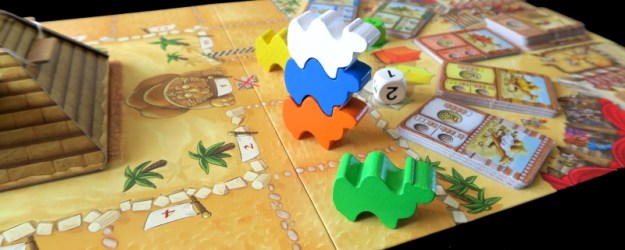
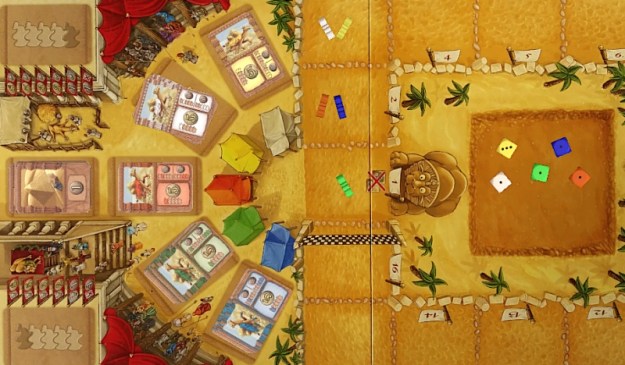
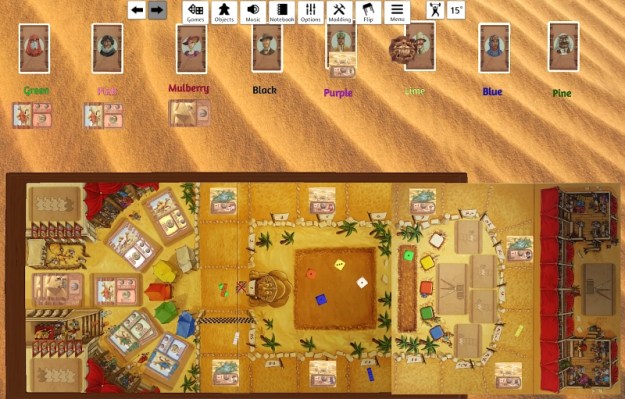
Last time, we had played a simple physical game that we knew well, Las Vegas using cameras. Seeing the “table” had been difficult though, limited by the resolution of the cameras and lighting. So to improve things and get others involved, we decided to go with a compromise: some people would run the game on Tabletop Simulator (providing a better visual experience), but the game would then be “streamed” to the group through Microsoft Teams, using the technology everyone was already familiar with. This time, we were more ambitious: the “Feature Game“, Camel Up has more moving parts and lots of people hadn’t played it before. It still fits the two key requirements, however, lots of people can play (especially with the Supercup expansion), and it has minimal “hidden information”, so it would still work with a couple of minor tweaks.
– Image by boardGOATS
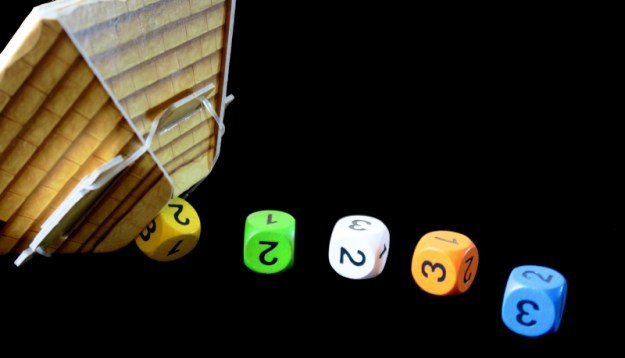
Camel Up is a simple enough family game, so teaching, even online, wasn’t too difficult. It is a race game, where people are betting on racing camels and the player with the most money at the end of the race is the winner. On their turn players have four options. Firstly, they can roll dice to move a camel. In the physical game, this is done with a special pyramid dice shaker that holds a die for each of the five camels and spits them out one at a time. We found using the online rendering of this very difficult, and wanted to involve the players more, so we used the real shaker to deliver dictate the number and players rolled their own dice at home to see how far they moved.
– Image by boardGOATS
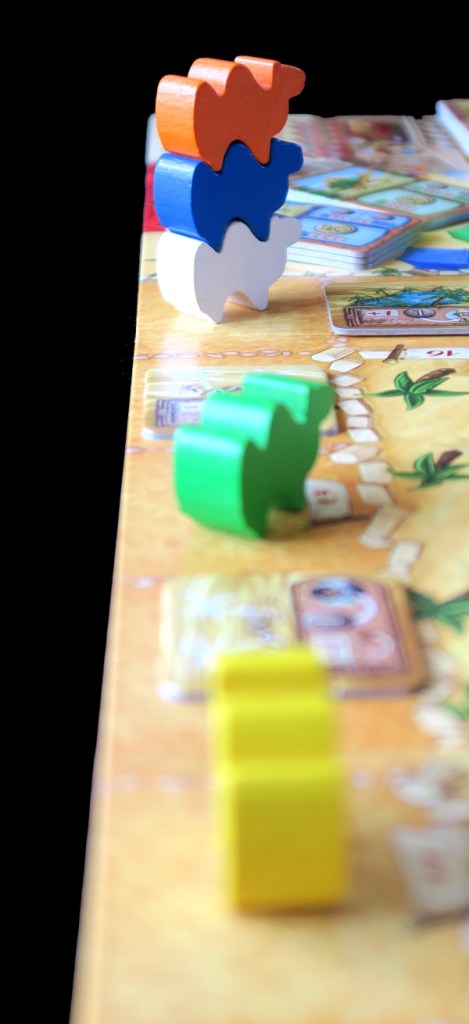
Alternatively, players could place a tile on the track which would earn them money whenever anything landed on it and move those camels forwards or backwards one space (depending which way up the tile had been placed). The other two options involved betting: players could bet on the winner of the leg (i.e. after all the dice had been rolled once) or the eventual winner or loser of the overall race. A simple roll and move would not make betting very interesting, but in Camel Up, when a camel lands on the same space as another camel, it is placed on top of the other piece. Then, if the lower camel moves before the top one does, it gets a free ride.
– Image by boardGOATS
Betting on the winner of a leg was easy to implement—each player had a space on the simulator and betting tiles (and pyramid tiles showing players had rolled dice) were moved to that area. Betting on the eventual winner/loser was more difficult. In the physical game, players have five cards which they play onto the winner or loser pile. At the end of the game, these are evaluated with the first player to bet correctly getting the most money, continuing on a sliding scale, with those who bet incorrectly losing their stake. Obviously, this wasn’t going to work for us, so instead, one person made a note of who placed bets and people kept track of their own choices (as well as their money), and we just tallied up at the end.
– Image by boardGOATS
Blue, Pink, and Mulberry started setting up from around 7pm. We used the expanded board from the expansion to make the race a little longer, but decided that any of the other modules would just make it too complicated this time. This was a very hard decision, because the game can become very random with lots of players and the expansions do a lot to mitigate that. We had already increased the complexity considerably compared with last time, and that would have been a step too far this time.
– Image by boardGOATS
As people joined the “meeting”, people chatted, mostly about nothing, largely because not a lot had happened for most people. Blue commented on the lovely large rainbow image in the window at Lime’s house (drawn by Little Lime), and Pine commented on how nice it was to be home now his caring duties were over. Green was the last to join the party, and he immediately asked when Pine was going to get back which led to much hilarity as the previous conversation was reprised. The procession of soft toys reappeared: Mulberry showed off her Pony, apparently called Macaroni (after Yankee Doodle), and Pine introduced us to his Gremlin, who apparently wants to join us at The Jockey when it re-opens and would like to be known as “Beige”.
– Image by Beige’s “Wrangler”
Having already set the game up for eight, Green and Lilac decided to play as a team, especially as they were still to eat their supper. Blue was about half way through the rules explanation, when, much to everyone’s delight, Burgundy arrived. He didn’t have a microphone, though he could hear everything people said. This created a weird juxtaposition of speaking and reading replies, which occasionally became typing (especially for Blue) when confusion set in. Playing would have been quite difficult as well as needing more set up, but it was lovely to have Burgundy back as we’d all missed him last time, and people couldn’t resist chatting on the text channel in the background. We will definitely sort out a microphone for him for next time though.
– Image by boardGOATS
From there on, it was disorganised chaos mediated by camels. Pine decided to share his packet of Tangy Cheese Doritos with everyone, and the disembodied crunching and rustling was quite something. He blamed it on Beige, but no-one was fooled. This was followed by someone (possibly Black) making a strange bonging noise that to Pink sounded like a bell from a traditional, mechanical signal box. He does have a bit of a thing about trains though. Meanwhile, on the chat, there were discussions about shopping and Pine’s burping camel impersonations. Clearly the Doritos were working their magic.
– From Peter Jordan on youtube.com
The game was something of a side-show to all this “excitement”. In the first round, aside from a couple of people placing oasis/mirage tiles, everyone just moved camels. Having seen how the race worked though, the betting really got going on the second round. The tech, though not perfect, worked well enough, thanks largely to Mulberry’s efficiency. And although the game wasn’t a “meaty”, “manly” game, being together doing something a little different was the most important thing.
– Image by boardGOATS from Tabletop Simulator on Steam
The betting on the end game really told the story of the race. Mulberry was the first to bet on a win, quickly followed by Pine, Black, Purple, Pink and Blue, with everyone gambling on the green or white camel making it over the line first. Pine was the first to have another shot, but still didn’t get it right. Betting on the loser, on the other hand, was started early by Lime and quickly followed by Pink, Black, Blue and Mulberry all of whom bet on the yellow camel to stay at the back of the pack. That camel seemed to have three legs, or maybe a pulling rider, or perhaps it had eaten too many of Green’s sausages. Whatever, it was definitely not a contender, and everyone agreed with Purple who commented that it should retire to a camel sanctuary.
– Image by boardGOATS from Tabletop Simulator on Steam
The front of the race was much tighter, and as the probability field gradually whittled down the likely order of finishers as it became clear that the game was coming to an end. The order of movement was all important and players jumped in with their final bets on who would win the race, but the final leg. Lime was the first to bet on the eventual winner, giving him eight Egyptian pounds, followed by Blue, and Pine with diminishing returns. Green realised that betting on the winner of the leg was more lucrative by this point than betting on the end of the race, and Pink followed suit, leaving Mulberry to finish the race.
– Image by boardGOATS from Tabletop Simulator on Steam
A quick run-down of the final finances showed that Pink was a single pound ahead of Green who who posted an initial, competitive total winnings of twenty Egyptian pounds. Lime, the first to successfully predict both the overall winner and loser finished some way ahead though, with takings of twenty-eight pounds. Pine excused his particularly poor showing by saying he thought camel racing was cruel. From there, the evening mostly descended into verbal and text chatter as people discovered and shared emojis (Pine was the first to find camels, but only in camel colour) and stickers, and then soft toys… again.
– Image by Mulberry
Mulberry suggested that when The Jockey re-opens we should have a “BYOB” party and “Bring Your Own Buddy”. Burgundy apparently misheard and there was more hilarity when the sad message appeared on the chat, “no bunny”. Green saw Mulberry’s Pikachu and said Pokemon Go was a problem in the current climate. That’s not the case for Mulberry apparently, who commented that she has a “Pokey-stop” outside her house. For those who were not familiar with the game Pokemon Go, that just sounded very smutty. Mulberry shared a “Let Me Google That For You” link, but it didn’t seem to help, and things only got worse when she tried to explained what she did with her “Pokey-balls”…
– Image from yucata.de
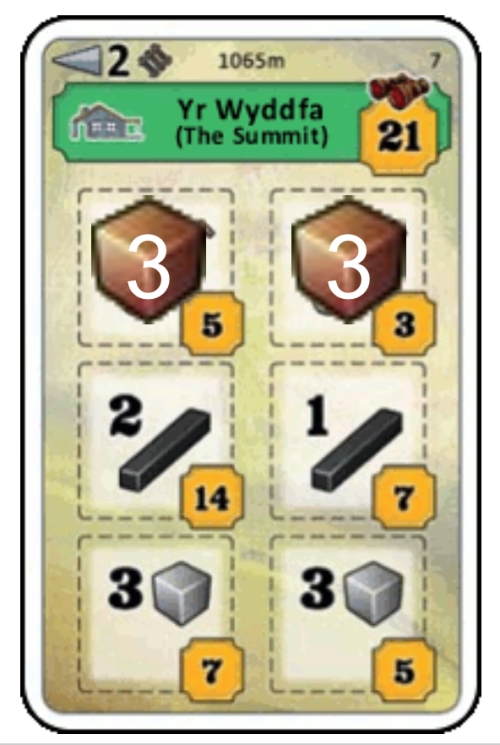
Time was getting on, and meeting on line is surprisingly tiring so eventually, people sadly departed, leaving Pink, Blue, Black and Purple to continue the seemingly eternal game of Snowdonia they had started two weeks earlier, on Yucata.de. Snowdonia is a worker placement game that we’ve played quite a bit as a group, where players are building the rack-railway up the famous mountain. The basic idea is that each player has two workers and they take it in turns to place these on one of the seven options: gather resources; remove rubble; convert resources; lay track; build part of a station; pick up a contract card, and move their surveyor.
– Image by boardGOATS from yucata.de
Each of these actions have a different number of available spaces, so for example, only three workers can lay track in any given round. During the game, the weather changes, increasing and decreasing the work-rate so that players can build that track faster, or slower, or if it is foggy, not at all. Contract cards give players points for successfully completing certain tasks, but can also be used to give an enhanced action instead. The game ends when all the track has been built to the summit, Yr Wyddfa.
– Image by boardGOATS from yucata.de
This game was started after the last games night, so it was only fitting that is should be finished on a games night too. It had started quite slowly – Yucata is quite different to Tabletop Simulator because it is much less flexible, but does ensure players follow the rules and can play turns for them when they have no decision to make. This can help speed things along, but can also be confusing at times when the game state changes more than expected between turns.
– Image by boardGOATS from yucata.de
Playing a strategy game over such a long time period proved difficult for those not used to it. This is mainly because players lost the thread of the “narrative”, and ended up playing tactically for the short term rather than following a long-term plan. Unsurprisingly, Black, who plays quite a lot of games asynchronously on Yucata, struggled least with this. He was also must familiar with the environment and got off to a flying start. Blue prioritised getting a train, but discovered that it didn’t do quite what she had in mind when she tried to use it a day or two later.
– Image by boardGOATS from yucata.de
Pink was the first to move his surveyor, but then completely forgot about it. He only realised it had been passed by everyone else’s about half-way up the mountain in the final round, by which time it was too late to do anything about it and the others were all at the summit. Blue had been horribly inefficient in places due to losing the thread of the game and additionally couldn’t quite build the track she needed to fulfil her most lucrative contract. According to Black, Purple was “playing online like she plays in real life”, but she was definitely doing something right as she put a spurt on at the end laying track.
– Image by boardGOATS from yucata.de
Black started fastest, took the lead and then stayed there, but contracts can be a big game changer in Snowdonia. This time though, Black completed two contracts adding a total of forty-six points to his twenty-one for getting his surveyor to the top of the mountain and forty-five points collected for building during the game. The total made him a run-away winner with a total of a hundred and twenty-one, miles ahead of Purple who sneaked into second place a couple of points in front of Blue. And with that it was time for the long walk to bed.
– Image by boardGOATS from yucata.de
Learning Outcome: A simulator can still be used even when most people don’t have access.
 Hedgehog Roll (a.k.a. Speedy Roll) by Urtis Šulinskas
 Cartographers: A Roll Player Tale by Jordy Adan
 My City by Reiner Knizia



























 boardGOATS