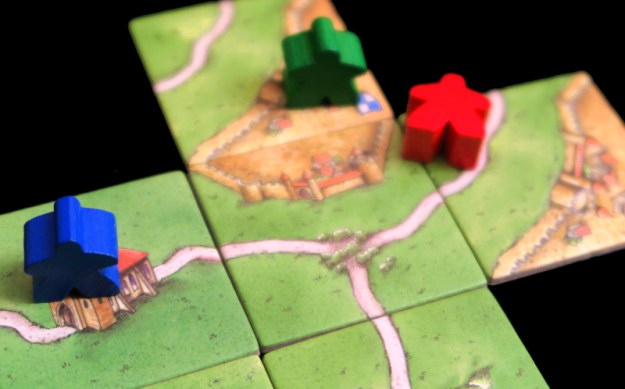
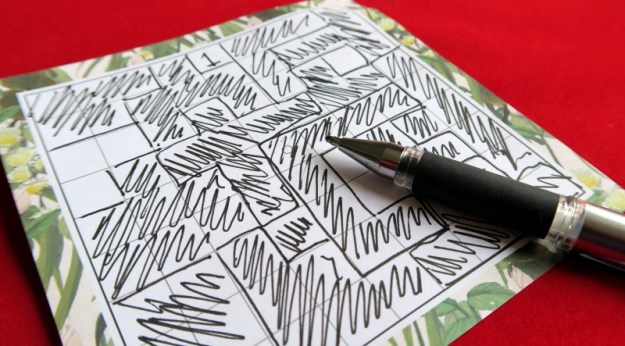
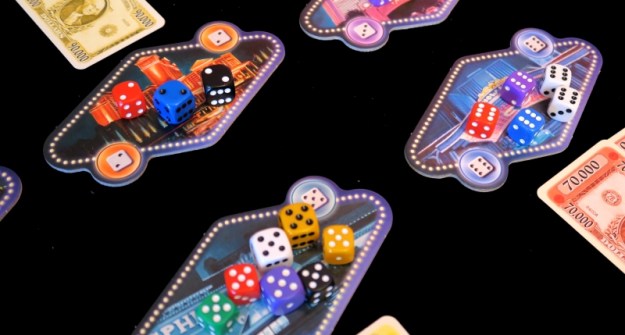
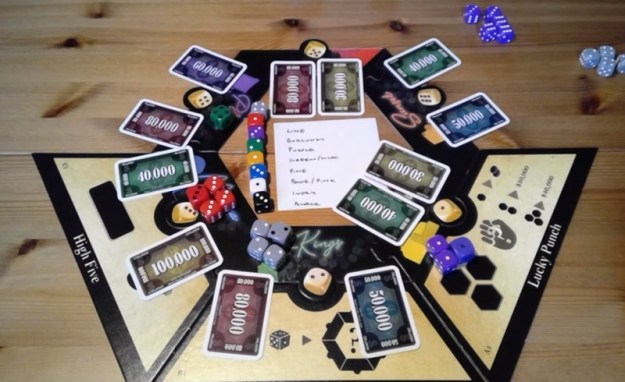
Author Archives: nannyGOAT

Next Meeting, 21st July 2020 – Online!

It is at times of stress that people need social contact more than ever, and board games are a great medium for that.  Despite the limitations of “remote gaming”, the overwhelming impression is that it is important to stay in touch, so we are persisting with online meetings.  Therefore, our next meeting will be on Tuesday 21st July 2020; we will gather from around 7.30pm, and start playing at 8pm.

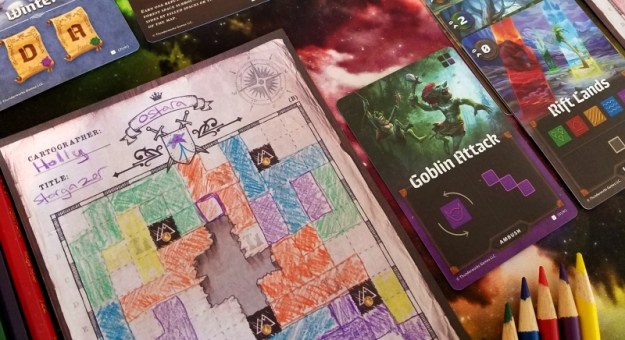
This week, the “Feature Game” will be Cartographers: A Roll Player Tale.  This is a slightly more complicated “Roll and Write” game, that builds on our experience with Noch Mal! and Second Chance which both worked so well.  Cartographers is a little bit more involved than the other two, but also works with many players.  It was nominated for the Kennerspiel des Jahres Award this year and we thought we would play it to celebrate the winners of the Spiel/Kennerspiel des Jahres winners which have just been announced.

Cartographers: A Roll Player Tale
– Adapted from image by BGG Contributor Johnny Dangerously

And talking of cartographers…

Jeff’s cartographer wife, Jill, was worried she’d lost some very important topographical maps.  They spent all morning trying to find them, looking high and low. Eventually, when all hope was lost and Jill thought she was going to have to start again from scratch, Jeff opened a desk draw they had already searched twice, and there they were.

When Jeff showed his wife what he’d found, she said, “Oh, that’s a relief…!”

7th July 2020 (Online)

The evening started with a round of “Swap Shop” as Lime tried to get rid of a couple of aquarium snails that were surplus to requirements (the other occupants of the tank having recently expired), and Purple offering a size ten frock.  Once the snails had been re-homed with Magenta in Wantage, we’d discussed the reopening of the Horse and Jockey, and everyone had compared their colouring tools, Blue explained the rules for the “Feature Game“, the cross between communal colouring and Tetris that is Second Chance.
Second Chance
– Image by boardGOATS

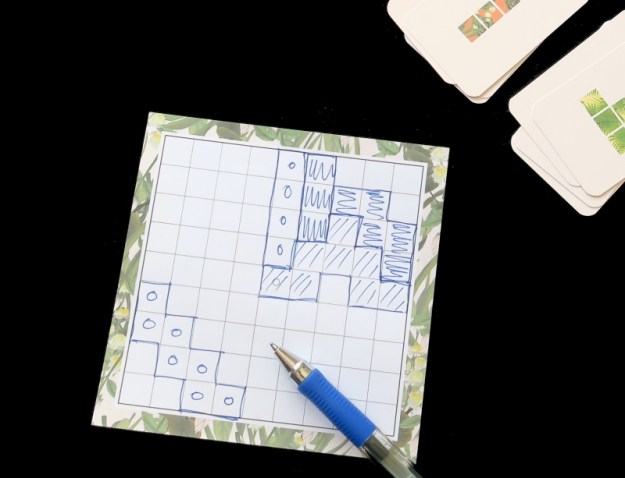
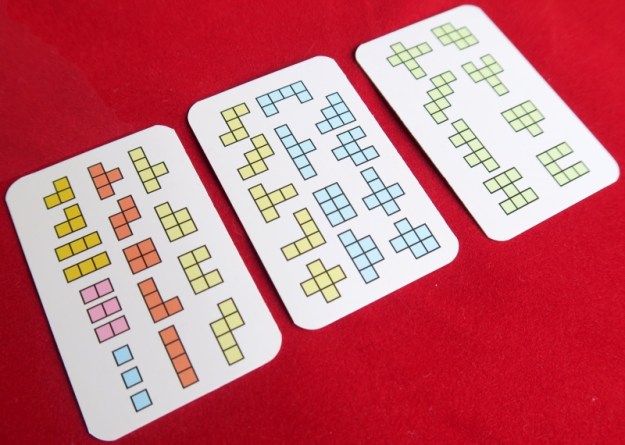
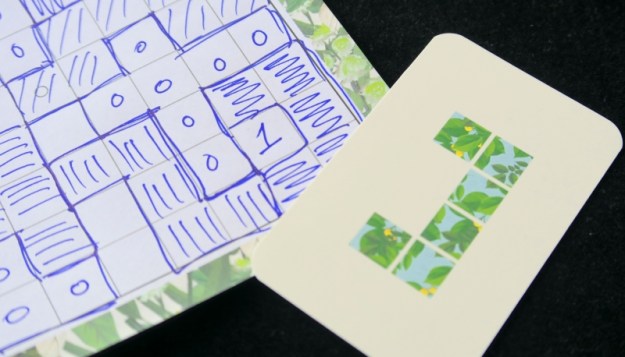
This is a really, really, simple “Roll and Write” type game, similar in style and feel to  Noch Mal! which we played a few weeks back over Microsoft Teams and really enjoyed.  In that game, players were rolling dice, whereas Second Chance is card driven.  Each player starts with piece of paper with a nine-by-nine array of squares which they colour in depending on what is revealed on the cards.  Two cards are turned over at a time, each displaying a shape; players choose one to add to their player area.

Second Chance
– Image by boardGOATS

The shape can go anywhere in the array as long as it doesn’t overlap anything else or extend out of the area.  More than one player can choose each shape and once drawn, its position is final.  If a player is unable to use either shape they get another card specially for them—their second chance.  If they are still unable to go, they are out, otherwise, they live to fight another day.  The game ends when one player fills their grid, everyone is out or the deck of cards is depleted.  The player with the fewest uncovered spaces at the end is the winner.

Second Chance
– Image by boardGOATS

Players start with their own individual first tile which they must place over the central square.  Although the game only officially plays six, fortunately there are enough of these in the box for everyone to have a different start, even though there were ten of us playing.  It wasn’t long before there was a contented silence as everyone got on with their colouring projects.
Second Chance
– Image by boardGOATS

As Pink turned over the cards, there were grunts of disgust and sighs of delight in almost equal measure.  Little Lime seemed greatly entertained by the whole thing and Pine commented that he could just imagine her telling all her chums that “My Daddy does colouring in with his friends online…”  The general consensus was that the game felt a lot like being back at primary school, though Pine commented that it was also like watching landscape architects.  He explained that he worked with some and they spent a lot of time colouring in and have amazing boxes of pencils but only ever use green and brown.
Second Chance
– Image by boardGOATS

As the game continued, people enjoyed their colouring, but variously struggled with artistic impression.  Pine commented that his looked like a work of Jackson Pollock’s, and Green felt would make rhyming slang for his…  Despite Little Lime’s assistance Lime was the first to need a second chance and when he was unlucky in his draw, he was the first out.  Little Lime explained that he could do better next time if he bought an effective rubber.  Purple also needed a second chance, but grabbed hers with both hands and managed to stay in for the rest of the game.

Second Chance
– Image by boardGOATS

More people gradually dropped out, a couple every round, and it wasn’t long before we got to the last two cards.  At the end, Lilac, Green and Purple were all still in, and remarkably, so was Burgundy despite having struggled for the last six or seven rounds.  It’s not lasting the longest that is key in this game though, it is most efficiently packed grid.  Of course, staying in longer usually means more and possibly better opportunities, however.  This time, two of the podium places went to the group of survivors, and Purple finished with nine empty spaces, just pipped by Burgundy with eight.
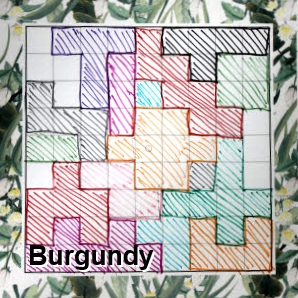
Second Chance
– Image by Burgundy

Second Chance had been a lot of fun, but with remote gaming likely to continue for a while and a lot of “Roll and Write” games on the horizon, after some discussion, we decided to give Saboteur a go.  This is a fun hidden traitor game that we’ve played quite a bit and works really well on Board Game Arena.  The idea is really simple:  players are divided into two teams (Dwarves and Saboteurs), and take it in turns to place tunnel cards with the aim of either tunneling to the gold (Dwarves) or preventing the tunnel reaching the treasure (Saboteurs).  The catch is that nobody knows who else is on their team.
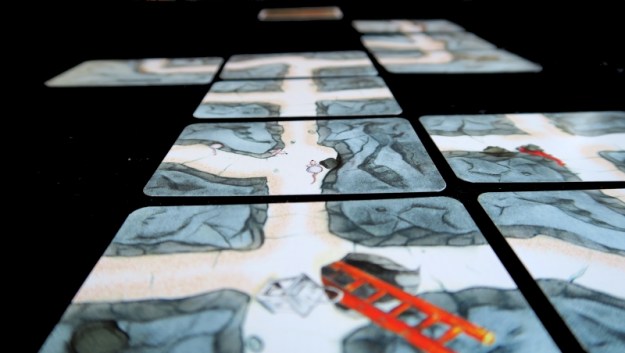
Saboteur
– Image by boardGOATS

In addition to tunnel cards, players can also play action cards, breaking other players’ tools (and thus preventing them from extending the tunnel network), fixing other players’ broken tools, causing a tunnel collapse and using a map to look at one of the three target cards to see whether it is gold or coal.  Players start with four cards in hand, and draw a replacement each time they play, or discard a card.  Since the game ends when the deck is depleted and everyone has played their last card, it is critical that every player gets as much as possible from their cards.
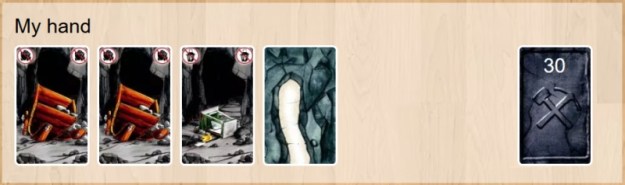
Saboteur on Board Game Arena
– Image by boardGOATS from boardgamearena.com

Blue went first, but claimed she had a hand with three broken tool cards and one tunnel dead-end card , so said she had no option but to discarded a card—A Very Saboteury Move.  Burgundy and Pink played map cards and checked the middle and top target cards respectively, and both said they saw coal.  Pine was suspicious and double checked Pink and concurred.  When Black checked the bottom card and confirmed it was gold, things were looking promising, but very little progress had been made on the tunnel and strangely a lot of cards had been discarded with everyone claiming that they didn’t have useful tunnel cards.
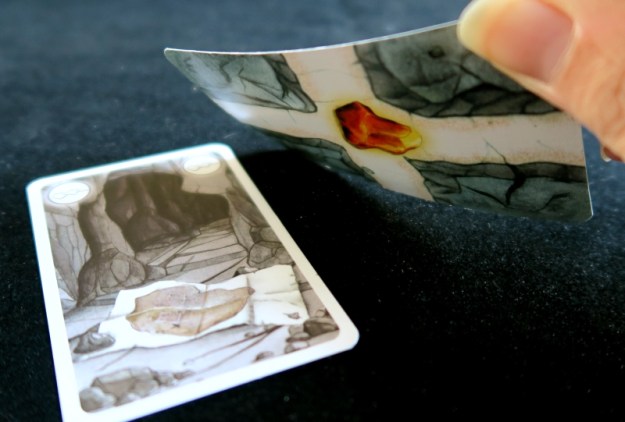
Saboteur
– Image by boardGOATS

Blue said she had a Saboteur’s Hand, which was a shame since she wasn’t one.  Pink asked whether that was a medical condition and wondered whether there was treatment available for it on the NHS.  The bickering stopped abruptly when Purple suddenly “lamped” Team Greeny-Lilac smashing their lantern and leaving them unable to dig.  Blue then got in on the act and pulled the wheels of Ivory’s trolley.  Purple really had it in for Green and smashed his trolly before Pine joined in and broke shaft of Team Greeny-Lilac’s axe—it seemed they really had it in for them.
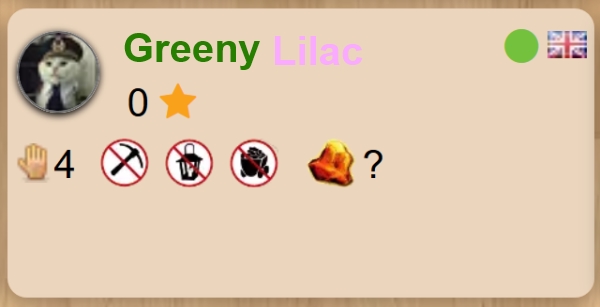
Saboteur on Board Game Arena
– Image by boardGOATS from boardgamearena.com

With everyone apparently having no tunnel cards, people were asking for help in how to spend their actions cards:  whose tools should they break or repair?  When Ivory repeatedly pleaded with Lime to repair his ruin of a trolley, Pink said he’d seen more convincing arguments written on the side of a bus!  At this point, the Dwarves were in complete disarray and in serious trouble.  It is quite unusual for the Saboteurs to win, but half way through the deck, the Dwarves had made very little progress on the tunnel and were still confused about who the Saboteurs were.

Saboteur on Board Game Arena
– Image by boardGOATS from boardgamearena.com

In the end, it turned out to be a win for the Evil Saboteurs, Black, Burgundy and Purple; despite appearances, Pine, Pink and Green were all actually innocent—this time.  It had been a very bruising round though, and everyone took a minute to calm down while the Saboteurs savoured their victory.  Board Game Arena had other ideas, however, and the second round was underway before we could blink.

Saboteur on Board Game Arena
– Image by boardGOATS
from boardgamearena.com

This was much quicker—the tunnel quickly stretched forward towards the middle target even though Greeny-Lilac said it was coal.  Purple double-checked and agreed that it was coal and when Blue peeked at the bottom card and said that was coal, everyone knew where they were going.  That was until Lime said the top card was also coal…
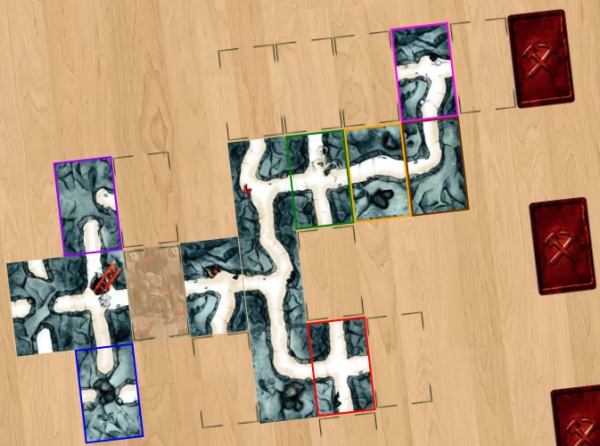
Saboteur on Board Game Arena
– Image by boardGOATS from boardgamearena.com

This gave the Dwarves a dilemma:  logic dictated that either both Greeny-Lilac and Purple were Saboteurs (the second time in a row for Purple), or one of Blue or Lime were telling porkies.  The Valiant Dwarves hedged their bets with two tunnels one headed north and one headed south.  All doubts were abruptly put to bed when Lime revealed his true colours by playing a rock-fall card, earning a broken pick-axe from Pine in return.
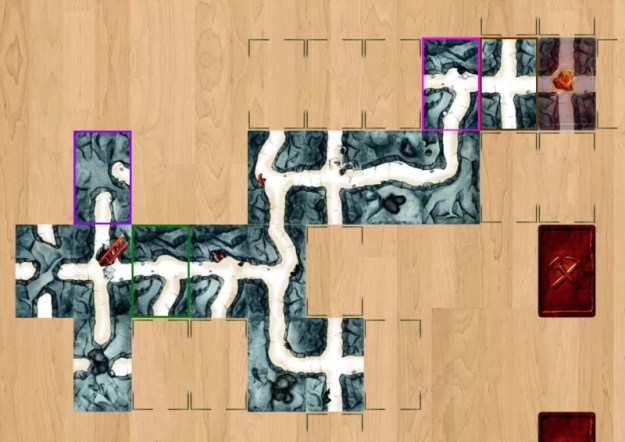
Saboteur on Board Game Arena
– Image by boardGOATS from boardgamearena.com

It was too little too late though, and with just two Saboteurs they were always going to struggle.  It wasn’t long before the Dwarves, in this case Team Greeny-Lilac, found the gold and put the round to bed.  The final round was possibly even shorter, certainly the path was more direct.  Blue once again played a map card and called the bottom card coal while Black played a map on the middle and called that gold.
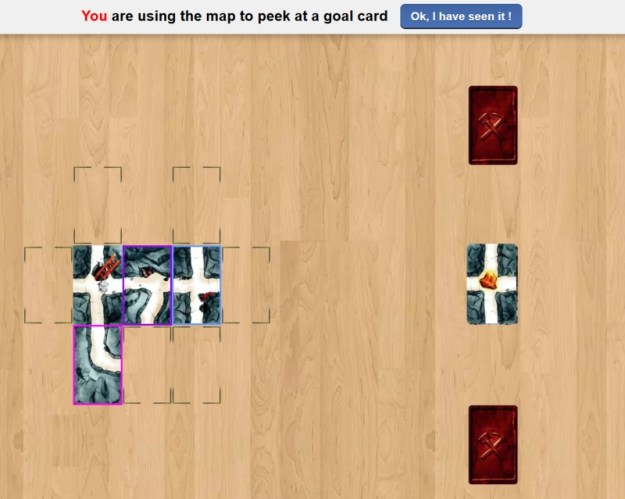
Saboteur on Board Game Arena
– Image by boardGOATS from boardgamearena.com

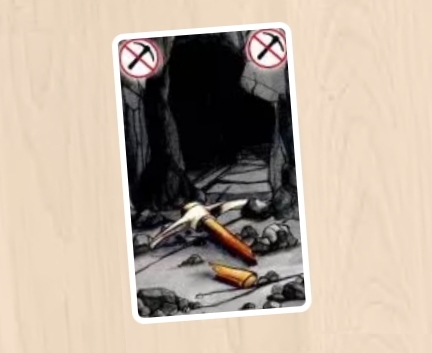
In the absence of any other information, Ivory, Burgundy and Greeny-Lilac headed towards the middle and it was all looking very easy when Purple dropped her bomb-shell, playing a dead-end card leaving the Dwarves with a diversion.  Pink then lent his support to Purple (a Saboteur for the third time!), blocking the alternative route.  Much to her disgust, Pine accused Blue of “Boris Johnson Logic” and then exacerbated his bad behaviour by breaking Blue’s pick-axe.  Blue retaliated by breaking Pink’s pick and Ivory joined in by breaking Purple’s.
Saboteur on Board Game Arena
– Image by boardGOATS from boardgamearena.com

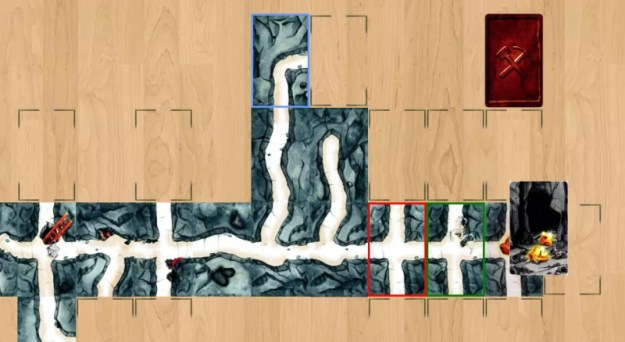
With a maximum of three Saboteurs possible all three were revealed and when Burgundy smashed Pine’s lantern they were all disabled too.  At least they were unable to dig, but they could still cause mischief.  Fortunately for the Dwarves, they didn’t have the cards to cause too much trouble.  Every time someone repaired a tool, a Dwarf stepped in and broke another one, keeping the evil Saboteurs pinned down.
Saboteur on Board Game Arena
– Image by boardGOATS from boardgamearena.com

Greeny-Lilac played a rockfall on the dead-end and Lime, Black and Ivory finished the job off.  That only left the scores.  These are bit strange and depend on treasure cards that are shared out amongst the winners, so luck is a big factor.  This time is was a tie for first place though, with honours shared between Black and Ivory.
Saboteur
– Image by boardGOATS

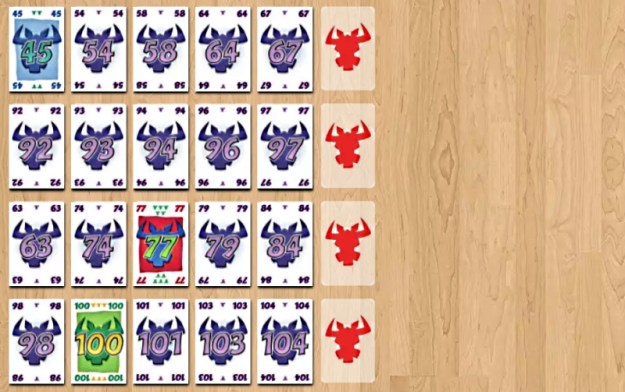
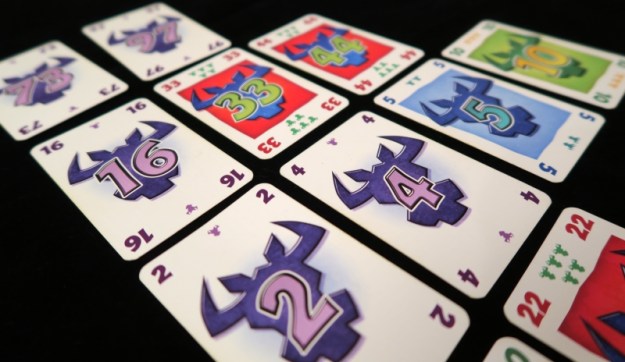
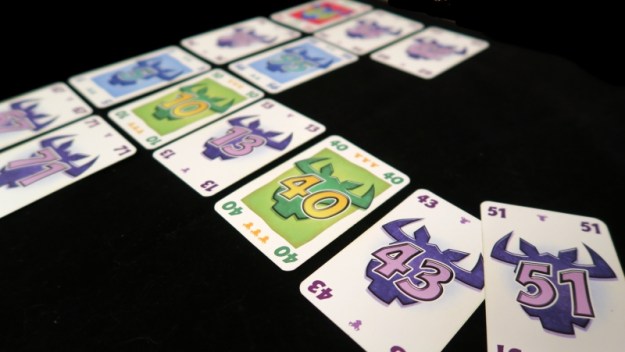
With that, Ivory and Team Greeny-Lilac called it an night and everyone else decided to close the evening with a game of our old favourite, 6 Nimmt!.  There was some discussion about playing with one of the variants.  Normally, players choose a card and then starting with the lowest, they are added one at a time to one of the four rows with the player who places the sixth card picking up.  One of the options is that cards can go at either end, being added to whichever row is closest.
6 Nimmt!
– Image by boardGOATS

Blue was keen to give the variant a go, but Pine had played it before and said he didn’t really understand what it did, but it felt very random.  With such a large number of people it seemed wise to leave it for another day, so we stuck to the usual game.  This time, Blue picked up six Nimmts on her first turn and had a terrible first round.  Purple didn’t do much better either picking up fifteen in one turn, and it all looked like it was going to be over quite quickly.

6 Nimmt! on Board Game Arena
– Image by boardGOATS from boardgamearena.com

With Blue and Purple leading the way to the bottom, the only real question was which of the others would be left behind at the end.  It was very tight, and since Blue and Purple fought a valiant rear-guard action the game went on longer than initially expected; Purple in particular hung on for ages with just one point.  In fact, she managed to hold on to that single point until the end of the game as it was Blue who went into the red and brought it to a stop.

6 Nimmt! on Board Game Arena
– Image by boardGOATS from boardgamearena.com

The game finished with tie for first place between Lime and Pink on forty-four with Burgundy a little way behind in third with thirty-six.  With that, Lime and Pink bade everyone else good night leaving five to carry on.  There were several options, but the group went for one of the easiest and picked Coloretto.  This is a game that everyone is familiar with and has very simple “point decisions” to make:  turn over a coloured card and add it to a truck, or take the cards on one truck and bow out for the rest of the round.
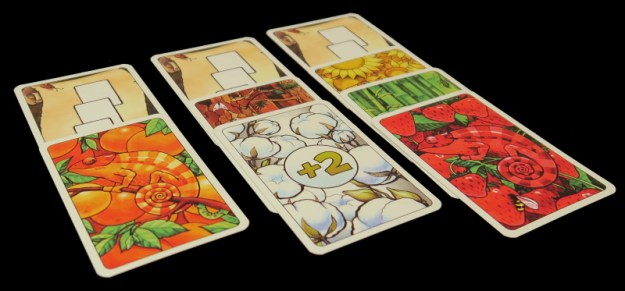
Coloretto
– Image by boardGOATS

Although the decision is very simple, there is a surprising amount of depth, because even though trucks only hold three cards, the colours are critical.  Players are collecting different coloured cards and the more cards the more points they deliver, with points awarded according to the Triangular Number Series.  This means that up to the maximum of six, adding just one more card, increases the number of points by around fifty percent.  The key part is that the largest three sets score positively, while the rest are negative, so players want three large sets and everything else to be as small as possible.
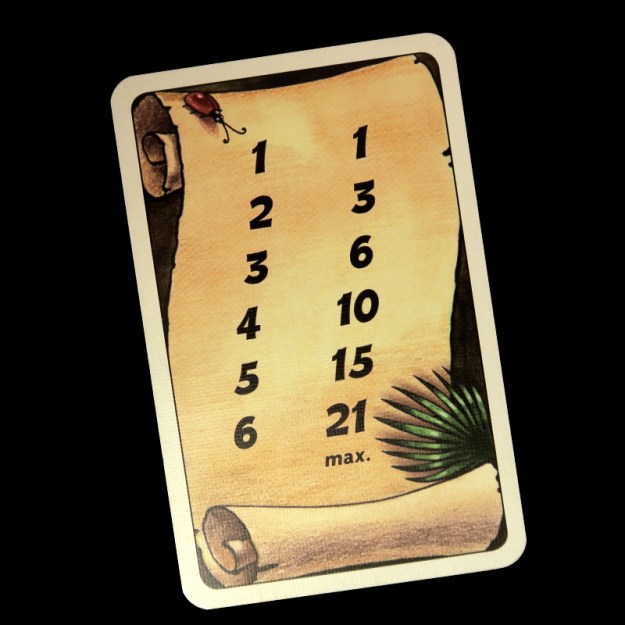
Coloretto
– Image by boardGOATS

The game started with Blue getting lucky with a couple of early yellow chameleons while Purple and picked up a couple of wild cards.  These are really useful because they are added to a set at the end of the game to give the maximum number of points possible.  Black, Burgundy and Pine all started collecting the 1970s sets (orange and brown cards), with the competition making it more difficult for all of them.

Coloretto on Board Game Arena
– Image by boardGOATS from boardgamearena.com

Meanwhile, Blue, finding competition for the yellow cards moved to collecting grey and soon had a full set of six.  With this, a large set of yellows and almost no negative points, it looked like she had an unassailable lead.  And so it proved:  when the end of the game was triggered there was nothing anyone could do.  While it was quite tight for second place with Burgundy’s twenty-four points sneaking ahead of Black, Blue was some way clear with thirty-five points.
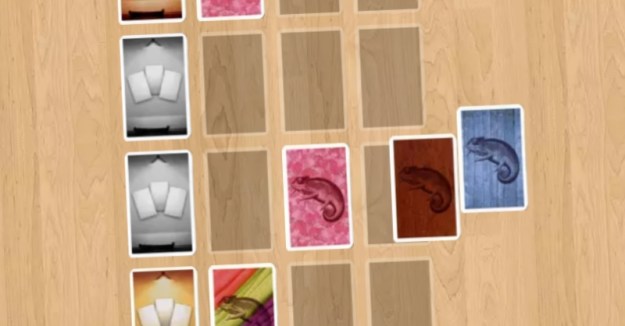
Coloretto on Board Game Arena
– Image by boardGOATS from boardgamearena.com

Clearly that was unsatisfactory, and Black and Burgundy were keen to rectify matters, so they twisted Pine’s arm and persuaded him to join in a re-match.  Things didn’t go quite according to plan, however.  Purple’s starting colour of green proved challenging when five of the first ten cards drawn were green and everyone else contrived to ensure they all went into different carts making sure everyone ended with at least one.
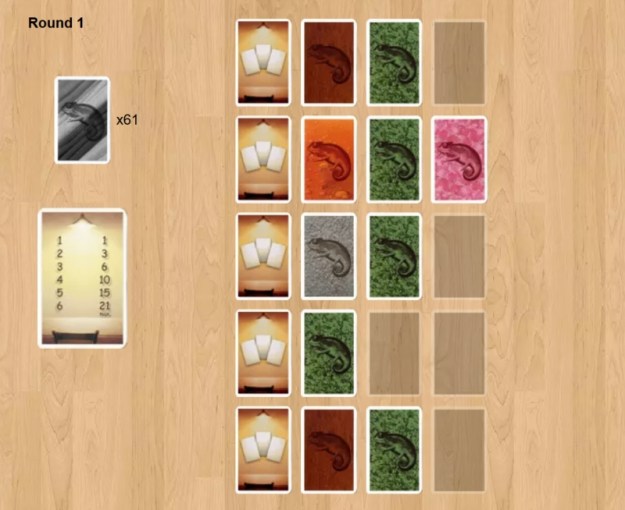
Coloretto on Board Game Arena
– Image by boardGOATS from boardgamearena.com

The next round didn’t look as if it was going to be much better for poor Purple when the first card drawn was also green, but she grabbed it early.  Blue made an early error enabling Burgundy to pick up a nice pair of blue cards.  It was really tight though, with most players matching each other blow for blow and everyone finishing rounds dead level, first with five points then nine points, then fourteen.
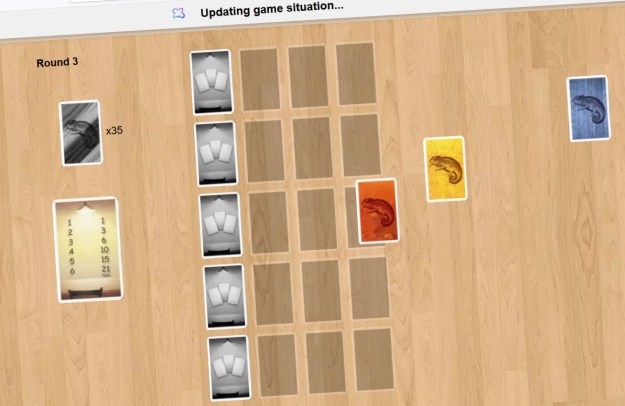
Coloretto on Board Game Arena
– Image by boardGOATS from boardgamearena.com

It was only at the end of the fourth round that the gaps started to show with Burgundy and Purple edging ahead by a couple of points.  Going into the final round it was close, but although it was tight, Burgundy had control of the situation and finished three points clear of the field with twenty seven points.  It was a tie for second between Blue and Purple, who had somehow managed to collect five green cards and a wild with no negative points.

Coloretto
– Image by boardGOATS

The numbers were dwindling, but there was still a hard-core of hardened gamers who were reluctant to retire to bed, though nobody wanted to start something difficult or long.  The options were limited so it wasn’t long before someone suggested the simle tile-laying game Kingdomino and everyone else quickly agreed.
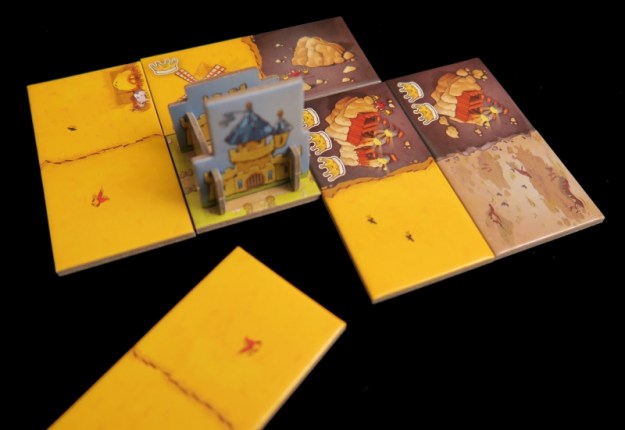
Kingdomino
– Image by boardGOATS

Although the pieces are all the same size and shape (two by one rectangles), Kingdomino has a lot of the Tetris-like aspects of Second Chance, in that the aim is to fit everything together as efficiently as possible.  The really clever aspect of the game is the market.  This consists of two columns of four tiles drawn at random, but placed in ranking order from low to high.  Each player begins with a marker on one tile in the left column and starting with the lowest value tile, the player takes the tile adds it to their Kingdom and then places their marker on the tile of their choice in the second column.  In this way, the player with the least valuable tiles gets to choose first in the next round.

Kingdomino
– Image by boardGOATS

Points are scored for the number of crowns in an area multiplied by the number of tiles in that area.  Thus an area of five squares with three crowns in it would score fifteen points.  In this case though, we also included two scoring bonus:  five points if there were no discarded tiles and ten points for finishing with their castle in the centre of their kingdom.  At the start of the game, four tiles are revealed and players choose which they take in turn without knowing what will turn up in the next round.

Kingdomino on Board Game Arena
– Image by boardGOATS
from boardgamearena.com

Purple went first and took went for two crowns on pasture. Black went next and made the same choice, but ended up with the fourth tile, meaning he would get Hobson’s choice in the next round.  Burgundy went third and took the second tile leaving Blue began with a tile that gave her sea and cornfield with a crown.  As this was the lowest value, Blue went first, so had first choice from the next selection and was able to choose another tile giving her more sea and cornfield.  This was also a low value tiles so also gave her first choice and in turn, this meant she was able to choose more corn and go first then and then more sea.

Kingdomino on Board Game Arena
– Image by boardGOATS from boardgamearena.com

Meanwhile, Black was building his pasture, Burgundy was starting trying to focus on the valuable tiles (with more crowns) and Purple was hedging her bets with a bit of everything.  Blue continued with her ever-growing cornfield adding crowns whenever she had the chance, while Black and Burgundy got into a bit of a tussle for marshland and mountain terrain.
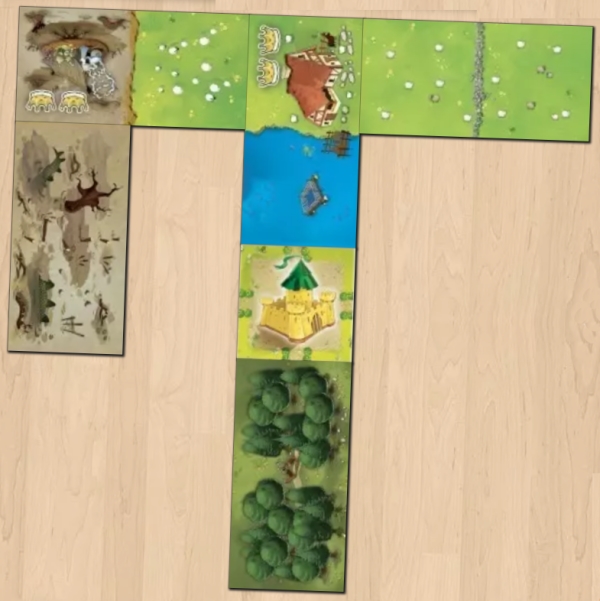
Kingdomino on Board Game Arena
– Image by boardGOATS
from boardgamearena.com

The marshland and mountain tiles being high rated were often last to be played, which meant that these players were often last to play giving them the left-overs from the next selection.  Blue, on the other hand, continued to play a “low rent” game, always taking the cheap tiles, as a result, she ended up with a very large cornfield of eleven spaces and four out of the five available crown giving her forty-four points for that alone.  Purple scored well for her forests and lakes, while Black focussed on grasslands and swamps, but even their two terrains didn’t match the total for Blue’s massive cornfield.
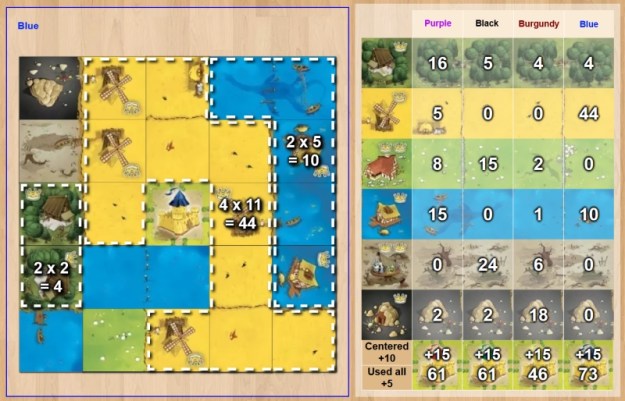
Kingdomino on Board Game Arena
– Image by boardGOATS from boardgamearena.com

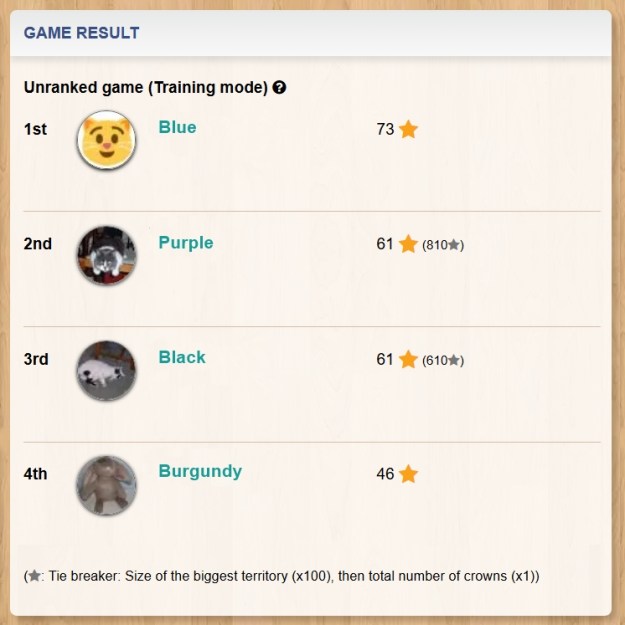
Everyone got their both bonuses and with that and a substantial lake, Blue finished with a winning score over seventy.  It was second place that was more interesting, however, which was a tie between Purple and Black with sixty-one points each.  What nobody hitherto knew, was that there was a tie-breaker:  the size of the biggest territory multiplied by a hundred added to the total number of crowns in the kingdom.  With that, Purple took great delight in second place.  And then it was time for bed for even the most dedicated of board gamers.
Kingdomino on Board Game Arena
– Image by boardGOATS
from boardgamearena.com

Learning Outcome:  Once in a while, everyone really enjoys releasing their inner toddler.
Spiel des Jahres Winners – 2020

The 2020 winner of the coveted German Game of the Year or Spiel des Jahres award has been announced as Pictures.  This is a family game where players have to model the picture on their card using the available components, e.g. shoelaces, coloured cubes, etc.; players get points for correctly guessing other players images and for other players guessing their image.

Pictures
– Image adapted by boardGOATS from the
live stream video on spiel-des-jahres.de

The Kennerspiel des Jahres was awarded at the same time.  This honours more challenging games and this year was awarded to The Crew: The Quest for Planet Nine.  This is a co-operative trick-taking game, where the players are astronauts on an uncertain space adventure.  The Kinderspiel des Jahres award was announced last month and went to Speedy Roll (aka Hedgehog Roll) a game where players which players roll a Velcro ball to pick up goodies that help the move their hedgehogs through the forest, cooperatively or in competition.  Congratulations to all the winners and nominees.

– Image by BGG contributor kalchio

Boardgames in the News: Carcassonne Catches Catan

Board Game Geek (BGG) is arguably the foremost website for information on board games.  It includes a forum for discussion, but also an extensive database currently comprising nearly a hundred and twenty thousand games with associated reviews, photos, publication details and rules clarifications.  There are over two million registered users of the site, many of whom use the BGG to record the games they own, log each time they play, and register their ratings of games in the database.

The Settlers of Catan
– Image by boardGOATS

For many years, the most rated game according to the BGG website was The Settlers of Catan but it has now been overtaken by Carcassonne (95,496 and 95,499 ratings respectively as of 1am BST on Sunday 19th July).  Over the coming weeks the numbers will fluctuate and the tide will ebb and flow, but it looks like Catan, which was released in 1995 (five years before Carcassonne), has been caught.  The race is not over, however, Pandemic is not far behind…

Carcassonne
– Image by boardGOATS

Next Meeting, 7th July 2020 – Online!

It is at times of stress that people need social contact more than ever, and board games are a great medium for that.  Despite the limitations of “remote gaming”, the overwhelming impression is that it is important to stay in touch, so we are persisting with online meetings.  Therefore, our next meeting will be on Tuesday 7th July 2020; we will gather from around 7.30pm, and start playing at 8pm.

This week, the “Feature Game” will be Second Chance.  This is a very simple “Roll and Write” game, similar to Noch Mal! which worked so well a few weeks back, that we played it twice.  Although Roll and Write games have a tendency to feel like multiplayer solitaire, they are very successful when played remotely and can usually play a lot of people (often more than originally designed for).

Second Chance
– Image by boardGOATS

And talking of second chances…

Jeff and Joe we were sitting exams.  On the eve of their final paper, they drove for an hour to a bar, to celebrate.  Unfortunately, they had a couple too many and ended up spending the night in the car.

By the time they reached the examination room the next morning, the exam was over and invigilator had collected all the papers.  Jeff and Joe explained to their supervisor how they’d had a puncture in the middle of the night and had to wait for daylight to get someone to change the tyre for them. They begged and pleaded with the lecturer for a second chance to take the exam.  Much to the lads’ surprise and delight, their examiner was sympathetic towards them and told them to come back to take the paper the next day at 9am.

So, the next day, Jeff and Joe turned up promptly and were ushered into separate rooms.  In each room there was one desk with a pen and the exam paper, face down.

At exactly 9am, Jeff and Joe were both told to turn over the paper which revealed just one question.

“Which tyre?”

23rd June 2020 (Online)

Maybe it was the really hot weather, or perhaps it was the prospect of playing something we all know and love, but people seemed in a slightly brighter mood this week.  Pine commented that every time Purple moved her head he could see the swastika on the box for Escape from Colditz behind her and he was finding it disconcerting.  After she had shuffled her seat, Purple commented that it was hers and Black’s fifteenth wedding anniversary, leading to a chorus of “Happy Anniversary” from everyone.

The Horse and Jockey
– Image by boardGOATS

From there the conversation inevitably moved on to the news that pubs will reopen on 4th July, and specifically the fantastic news that the Horse and Jockey will be one of them.  Clearly there is a long way to go before we can return to playing games there, but it has to be good news for our friends whose livelihoods depend on the place.  There was a lot of concern at the suggestion that people will have to leave their personal details in pubs and what other purposes these may be put to; this was followed by the suggestion that there might be an awful lot of visits to the pub by “Dominic Cummings”…  With that, it was 8pm and everyone had arrived, so we started with an explanation of the differences between Las Vegas Royale and our old favourite, Las Vegas.

Las Vegas
– Image by boardGOATS

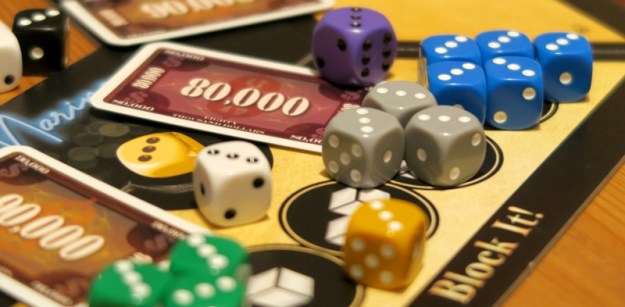
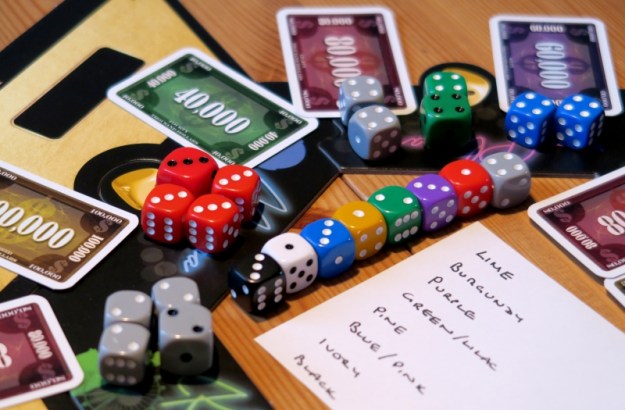
The underlying game is much the same, in that people roll dice and choose which of six, numbered casinos to place them on.  As usual, the active player must place all the dice of one number on the casino of that number and when all dice have been placed, any ties are removed and the winnings are awarded to the owners of the remaining dice, with the largest money card going to the player with the most dice.  In the new Royale version, the casinos are arranged in a circle which is quite nice, but more importantly for us, there is no Slot Machine.  This is a shame, but in the event, we didn’t really miss it.  The new game is played with the “Biggun” from the Boulevard expansion, as standard, which suits us as we always include it when we play.

Las Vegas: The Slot Machine
– Image by boardGOATS

Aside from the new artwork and layout, there is a subtle change to the setup for Las Vegas Royal.  In the original, the money cards, each with a value of $10,000 to $100,000 are distributed so that each casino has a minimum fund (dependant on the number of players).  This means some will have many winners and others only a single jackpot.  In the new version, each casino has just two cards, each with a value between $30,000 and $100,000.  We thought this might have a large impact on game play, and although it changed things, it wasn’t worse, just different.

– Image by BGG contributor kalchio

The biggest differences though, were the inclusion of “jetons” and the additional effects associated with some of the casinos.  The jetons are tokens that players can use to pass during the game, when their dice roll is unhelpful.  The additional actions are added to three of the casinos and usually take effect when a player places dice in that casino.  We chose to start with “Lucky Punch” on Miracle Casino (Casino 1), “Prime Time” on Kings Casino (Casino 2) and “High Five” on Marina Casino (Casino 3).

Las Vegas Royale
– Image by BGG contributor kalchio

It is possible to add extra actions to all six casinos, but for our first play, we decided to stick to the rules and add them to three only.  One area which were we weren’t able to follow the rules in, however, was the player count:  the new version, specifies two to five players and there were ten of us.  This change is likely because the new features lengthen the game, so additionally, the number of rounds is reduced from four to three.  We usually play just three rounds, so we played with two teams of two and decided to make a decision as to how many rounds we would play at the end of the first round.  Blue and Pink had set the game up in advance and, like our first remote game back in March, Las Vegas, everyone else followed using Microsoft Teams.

Las Vegas Royale
– Image by boardGOATS

Lime started, followed by Burgundy, who rolled five threes and placed them on the Marina Casino activating the “High Five”.  This has a token worth “$100,000” on it to be claimed when someone places their fifth die on that casino, and Burgundy duly claimed it.  Purple went for the Miracle Casino (1) and the “Lucky Punch” action at the first opportunity.  With this action, the active player takes one, two or three tokens into their hand and the next player (in this case Team Greeny-Lilac) have to guess how many tokens they have in their hand.  An incorrect guess would give Purple two jetons, $30,000 or $40,000 depending on how many tokens she was holding.

Las Vegas Royale
– Image by boardGOATS

So, Purple turned on her camera and held out her paw in such a way that nobody could see it until Black pointed out that the camera was over the other screen.  Maybe that was just enough information for Team Greeny-Lilac or maybe they were just lucky, but they successfully guessed Purple had two dice in her hand and, as a result, she won nothing.  Burgundy was the next to have a go at the “Lucky Punch”, and it was Purple’s turn to guess.

Las Vegas Royale
– Image by boardGOATS

Purple guessed three and Burgundy’s simple reply of “Bugger” told the whole story—this was especially funny since he didn’t have a camera and we were all trusting him to be honest!  The “Lucky Punch” proved really popular: Pine was next to have a go and Pink (playing as a team with Blue) had to guess.  Although Pine was holding out his hand, Pink couldn’t see the screen from where he was sitting so just guessed three and Pine’s response was just as clear as Burgundy’s.  With three out of three failures, people began to wonder whether if we were all psychic.

Las Vegas Royale
– Image by boardGOATS

Burgundy was the first to be successful at the “Lucky Punch”, adding $30,000 to his $100,000 from the “High Five”.  That wasn’t the opening of the flood-gates though and Ivory’s attempt was blocked by Black and then Black’s was blocked by Lime.  Purple was eventually successful, taking $30,000 and Ivory also managed to sneak a couple of jetons,  though Pine’s attempt at palming a tree-eeple and a duck-eeple (from Christmas crackers at previous unChristmas Dinners) were spotted by Team Bluey-Pink.

Las Vegas Royale
– Image by boardGOATS

Meanwhile, Team Bluey-Pink were the first to use a jeton, followed soon after by Lime.  Egged on by everyone else and much to Ivory’s disgust, Black engaged in a battle for Cleopatra Casino (5), eventually leaving Pine to take the $80,000 with just one die.  Lime won the Kings Casino, but his “Prime Time” bonus meant he could roll two dice and place them if he wished, though unfortunately they had no impact.  The clear winner of the round was Burgundy, however, largely thanks to his $130,000 of bonuses.  Time was marching on, so the group decided that there would only be one more round.

– Image by BGG contributor kalchio

Normally, all the additional actions are swapped, however, there were a lot to choose from and swapping them all would have been a significant task.  The group decided to swap out “High Five” though, and after rejecting “Bad Luck” as “very evil”, the group opted for “Block It!”.  This action enables players to mess with others by placing cubes on casinos where they would be scored in the usual way, but act as an inanimate player.  Pine went first in the second round but was immediately obstructed by Team Bluey-Pink who were the first to try the “Block It!” action.  First, they moved three neutral dice into the Kings Casino (2) pushing Pine into second place.  On their next turn they start moved more neutral dice onto the Sunset Casino, and with Team Greeny-Lilac’s help, made Ivory’s life more difficult and effectively scuppered Burgundy’s plans.

Las Vegas Royale
– Image by boardGOATS

Pine eventually won $40,000 on the “Lucky Punch”, but Black was not so lucky when Lime correctly called him holding two tokens.  Team Greeny-Lilac took $30,000, Black took $40,000, and then Purple did too.  It looked like people had worked out how to escape the jinx until Team Greeny-Lilac tried again and Pine guessed correctly.  The odds were certainly moving towards the expected two out of three though, especially as Purple and Pine picked up $30,000 each towards the end of the game and Team Bluey-Pink picked up a couple of extra jetons.

Las Vegas Royale
– Image by BGG contributor kalchio

Those extra jetons that Blue and Pink had acquired nearly proved very useful when Green and Lilac placed their fifth dice on the Marina Casino (3) leading to a tie for first place.  Unfortunately for both, despite several re-rolls, the tie remained and both pairs missed out on both first and second place ($80,000 and $90,000).  Green got his just desserts when he ended up in another tie for Miracle Casino (1), this time with the unfortunate Pine who got caught in the cross-fire.

Las Vegas Royale
– Image by boardGOATS

In the final tally, the winner was Burgundy, largely thanks to that $100,000 bonus for the “High Five” at the start.  Team Greeny-Lilac weren’t far behind though and neither were Pine and Purple who tied for third place.  Though it could all have been so different, had Burgundy not picked up that obvious windfall so early, everyone else might not have worked so hard to spoil things in the second round and he may well have picked up more money by other means.

– Image by BGG contributor kalchio

As usual, we had a great time with this fantastic game.  The changes to the payout distribution were neither good nor bad, just different.  The group had mixed feelings about the new additional actions, though on balance, they were positive.  We had a load of fun with the “Lucky Punch” and online it was even more fun somehow.  In our game “Prime Time” had little effect and didn’t really influence players, but was very quick to implement and may have more impact at lower player counts.  “Block It!” affected the game more, and certainly influenced the game in the second round.  “High Five” was the huge game-changer though, certainly in this game.

Las Vegas Royale
– Image by boardGOATS

The rules are not completely clear on how this should be used, saying, “When you place your fifth die … in this casino, take the token”.  It is not entirely clear whether the $100,000 is available to everyone who places five dice in the casino, or if the first person is the only one who can claim it.  Before the game, we had decided to go with the latter and Burgundy’s freaky first roll of five threes effectively ended the competition for the Marina Casino (3) in the first turn.  Had the values for the payouts been different and if Burgundy hadn’t rolled all five in one go, this might have played very differently.

Las Vegas Royale
– Image by boardGOATS

On reflection, however, there is another way to play this which might have worked better increasing competition, and may have be the designer’s intention too.  If each subsequent player to reach five dice were to take the token from the current holder it would increase competition and add a nasty edge to the game.  This could also make it a target for using the jetons which otherwise got a bit of mixed reception.

– Image by BGG contributor kalchio

At the end of the game everyone seemed to have too many jetons left and decided to spend them adding a lot of time to the game, mostly for little reward.  Several suggestions about how to improve it were made, including forcing players to exchange them for cash at the end of the round, and/or topping people up to a maximum of two at the start of a new rounds, or maybe giving players one or even none at the start of each round thus making any gained from the “Lucky Fist” that bit more precious.

Las Vegas Royale
– Image by boardGOATS

The combination of the extra actions, the large number of players and the effect of playing online meant the game had taken a long time, so Lime, Ivory, Green and Lilac took their leave.  Although it was late in the UK, it wasn’t in California where Mulberry joined us from her balcony at 38 °C in the mid-afternoon for a game of our old favourite, 6 Nimmt!.

6 Nimmt!
– Image by boardGOATS

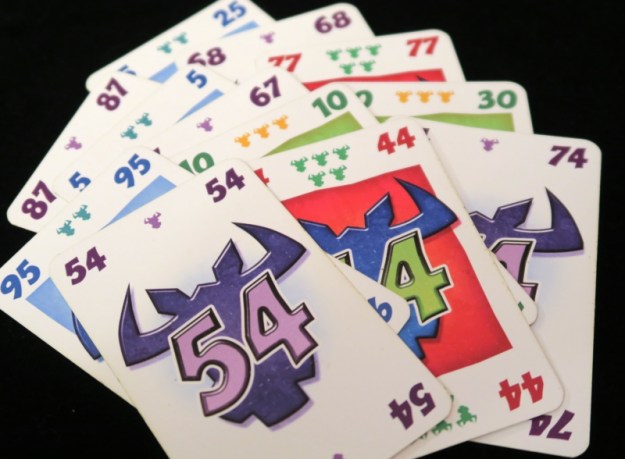
6 Nimmt! is such a simple game which keeps everyone involved throughout and the Board Game Arena implementation is so good, that it is often a fall-back for when nobody can be bothered to think.  Players simply choose one card simultaneously, then, starting with the lowest value card, they add them to one of the four rows.  If the card is the sixth card to be added, the player takes the five cards and the new card becomes the new first card in the row.

6 Nimmt!
– Image by boardGOATS

As always, people complained about the cards they had, though Blue felt she was particularly hard done by this time with one, two and three in consecutive hands and almost nothing above fifty for most of the game.  Given that, she didn’t do too badly in the end.  There was no beating Pine though.  After the game, Pine left and everyone else made it their business to investigate how many games Pine had played on Board Game Arena. There were over a thousand, of which nearly a hundred had been 6 Nimmt!, winning around 30% of games against all comers!  And with that, it was time for bed.

6 Nimmt! on Board Game Arena
– Image by boardGOATS from boardgamearena.com

Learning Outcome:  If voting Donald for US President, many people would prefer the Duck!

Boardgames in the News: Thirsty Meeples Moves and Reopens

As the government lifts its restrictions, pubs and cafés are reopening.  Today our beloved Horse and Jockey reopens:  we know it will be a while before we can play games there again though, not least because all seating is currently outdoors.  Also reopening today, however, is Oxford’s board game café, Thirsty Meeples.  They will be opening in their new larger location, which is about twice the size of the old one—just as well given the current distancing restrictions.  Thirsty Meeples haven’t moved far, they are still on Gloucester Green, just two doors down in what used to be FOPP, part of the music chain owned by HMV.  The shop is opening today for game sales with the café set to open on Wednesday.

Thirsty Meeples
– Image by boardGOATS


Boardgames in the News: New Editions that aren’t an Improvement

Everyone has experienced a disappointing remake of a favourite film; while we always hope for an improvement, only occasionally do we get one.  Board games have a similar problem, but as with films, things are often not clear cut.  For example, the new version of Camel Up arguably has nicer art and a better pyramid dice shaker than the original.  The Crazy Camel mini expansion and the partnership betting (from the original Supercup expansion) also add quite a bit to the game play, especially at higher player counts, but the money isn’t as easy to handle and the dice and camels themselves are plastic and don’t feel as nice.

Camel Up
– Image by boardGOATS

Similarly, the recent editions of Glen More (Glen More II: Chronicles) and Snowdonia (the Deluxe Master set) are beautiful and include lots of extra content.  As previously discussed, this is at the expense of shelf-space though, and portability which means they are less likely to get played.  In other cases, the revision is considered a definite step back.  For example, the revised edition of Colosseum by TMG is widely believed to compare unfavourably with the original Days of Wonder edition.

– Image by boardGOATS

In a recent new edition of Monopoly, female players initially receive $1,900 with a salary of $240, while male players start with $1,500 receiving $200 when they pass “Go”.  On the plus-side, as part of the publicity, three teenage entrepreneurs received a grant of $20,580 each to invest in their own inventions.  Otherwise, Ms Monopoly is widely thought to be hugely patronising to half the population while claiming to celebrate empowering women, something that is apparent in the adverts.

– Video by Hasbro on youtube.com

These days, a lot of gaming is being done online.  One new electronic game that has been seen as a retrograde step is the new Scrabble app, Scrabble Go.  This is a new product that, thanks to changes in licensing, replaces the previous offering from Electronic Arts (EA).  The problem is that the new version seems to have been designed to appeal to the Candy Crush generation with vivid colours, treasure-style rewards and in-app purchases.  Unfortunately, Scrabble is a very traditional game and its players generally don’t appreciate that approach.  To date, nearly eight thousand of these have registered their disgust through an online petition.

Scrabble Go
– Image by boardGOATS from play.google.com

The Carcassonne app has also received a similar licensing-inspired change and although the new Asmodee version is less offensive, many seem to prefer the older, Coding Monkeys version.  So, before deciding to upgrade a game, keep in mind that a new version, often isn’t a better one.

Next Meeting, 23rd June 2020 – Online!

It is at times of stress that people need social contact more than ever, and board games are a great medium for that.  Despite the limitations of “remote gaming”, the overwhelming impression is that it is important to stay in touch, so we are persisting with online meetings.  Therefore, our next meeting will be on Tuesday 23rd June 2020; we will gather from around 7.30pm, and start playing at 8pm.

This week, the “Feature Game” will be Las Vegas Royale.  This is a new version of one of our favourite games, Las Vegas that adds some new features as well as implementing some elements of the Boulevard expansion.  Although the new game only plays five, the original plays more and the social aspect is so important at the moment that we will be playing as a large group again.

Las Vegas Royale
– Image by BGG contributor kalchio

And talking of Las Vegas…

One evening, Jeff was sitting at home watching TV when he heard a voice in his head.  It said, “Sell your house, go to Vegas….”

The following evening, the voice returned, again, exhorting him to sell his home and go to Las Vegas.  After the third night, Jeff found it was praying on his mind and he couldn’t get the thought out of his head.  Over the course of next couple of weeks, the problem got worse and worse, until eventually he could ignore it no longer.  So, he sold his house, his car and all his board games and caught a flight.

On his arrival, the voice became more persistent this time telling him to go to the Cleopatra Cassino.  So Jeff did as he was bid.  As he entered the venue, the voice changed again, this time saying, “Place everything you have on the high roller roulette.”

Obediently, Jeff found a high roller roulette table and the voice changed again, “Bet it all on twenty-four black…”

Without thinking, Jeff put everything he owned on twenty-four black and the voice fell silent as Jeff watched the roulette wheel start to turn.  Then the ball began rolling and bouncing and rolling.  It seemed like an age, but eventually the ball started to slow and eventually stutter and stop.

As the ball landed on double zero, the voice in his head simply said, “Bugger.”

9th June 2020 (Online)

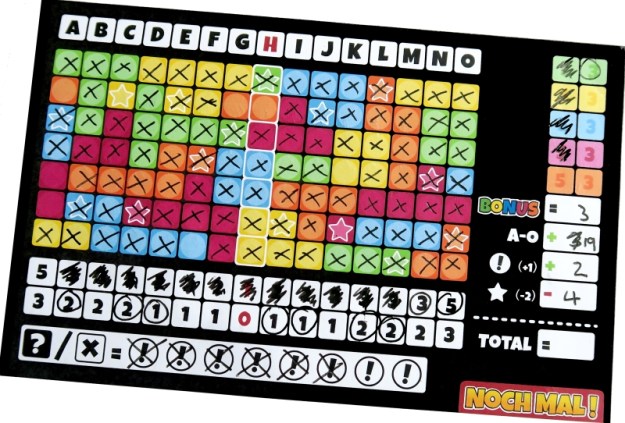
It’s been over three months since we were last officially at the Horse and Jockey, and it is clear everyone is really missing it.  When people joined the meeting from 7.30pm and everyone asked how people were doing, most people had nothing much to say.  Pine is still furloughed, Blue is back at work from time to time, as is Green; Ivory never left, while Pink and Black are still working from home.  Otherwise though, everyone is just getting used to the way things are now.  This week, the “Feature Game” was to be Noch Mal!.  This is a “roll and write” game by Inka and Markus Brand, designers of Village, Rajas of the Ganges and the award-winning EXIT: The Game series.  Although Noch Mal! was first released in 2016, it has only recently been released in English (as Encore!), although the game itself is language independent.

Noch Mal!
– Image by boardGOATS

Noch Mal! is quite similar to the 2018 Kennerspiel des Jahres nominee Ganz Schön Clever (aka That’s Very Clever), where one player rolls the dice and then chooses some to use to cross off boxes on their player card, leaving the left over dice for the other player(s) to use.  The player sheet for Noch Mal! is simpler than the one in Ganz Schön Clever though, and there is less structure to the dice rolling making it more suitable for more players.  Indeed, although it is only supposed to play six, we felt it could easily play more, and this is important to us at the moment because the social aspect is the main reason for these online meetings.

Ganz Schön Clever
– Image by boardGOATS

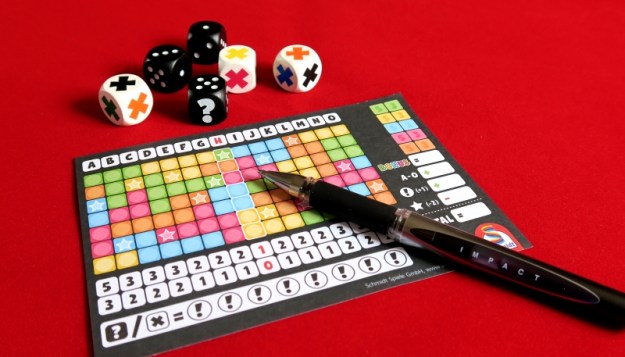
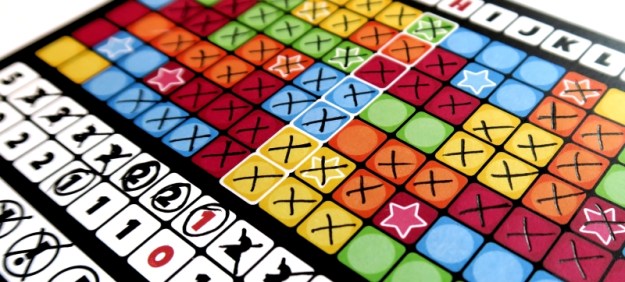
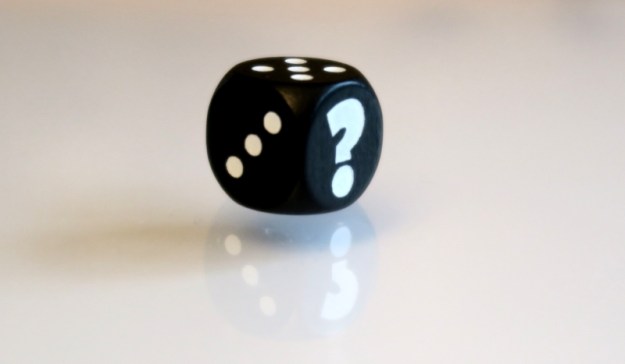
The idea of Noch Mal! is that the active person rolls the dice and then chooses two of the six dice to use.  Three of the dice are relatively normal d6 dice (numbered one to five with a “question mark” replacing the six), while the other three dice are “colour dice” with coloured crosses instead of numbers (red, green, blue, orange, yellow and black).  The player cards depict a rectangular array of square boxes, in groups of different colours.  Players choose two dice, a colour and a number and “spend” them to cross squares off on their sheet.  Thus, if they choose green and five, they must cross off exactly five green squares.  The catch is that these must be in a clump together and must include a square in the starting row (H) or one that is orthogonally adjacent to a square already crossed off.

Noch Mal!
– Image by boardGOATS

Players get points for completing columns, or crossing off all the squares of one colour, with the first player to do so scoring a bonus.  The “question mark” and “black” faces are “wild” and can be used as any number or colour (respectively), but each player can only use a total of eight wilds during the game.  Points are scored for completed columns (those furthest from the central starting column score more), crossing off all of one colour, and any unused wilds.  Some of the squares also feature a star—each one of these that is not crossed off earns a two point penalty.  The game ends when one player crosses off all the squares of two colours and the player with the most points is the winner.

Noch Mal!
– Image by boardGOATS

Everyone had three dice and we began by rolling to see who would go first.  Ivory won, but there were lots of roll-offs to settle tie breaks, so determining the order was in danger of taking longer than the game itself!  To keep people involved and give them a feeling of agency everyone rolled their own number dice, while Blue and Pink rolled the colours and displayed everything on one of their cameras.  For the first three rounds the active players (Ivory, Burgundy and Pink) don’t choose dice and everyone else can choose from the full six, so Pine was the first to play a “proper turn”.

Noch Mal!
– Image by boardGOATS

Pink was quick out of the traps and was first to score a column, and then taking points for a second too.  This meant he was three points up before anyone else had scored.  Worse, nobody else could score anything for the starting column (H), and only one point was available now for column G too.  Ivory had other plans though and had expanded to the right of the table and was soon picking up some of the higher scoring columns further away from the centre.  Others tried the same strategy, some with success, others less so.

Noch Mal!
– Image by boardGOATS

The general feeling was a little bit like Bingo with dice with players calling out when they completed a column.  This feeling was accentuated when lots of people called “House” for a load of columns on the right, all at the same time.  Eventually players started claiming colours; inevitably, Ivory was first, and also the first to discover what a curate’s egg it was as he was then forced to pass.  It wasn’t long before someone completed their second colour and everyone then had to work out their scores.

Noch Mal!
– Image by boardGOATS

It was no real surprise that Ivory top scored with what seemed like an enormous ten points, though Black ran him very close with eight.  Pink, Lime Blue and Green felt they had done well to avoid finishing with negative points and Purple would have done a lot better if she hadn’t lost sixteen points for her eight remaining stars.  It had been interesting though and now everyone felt they had a better understanding of how the game worked, it seemed a good idea to give it another try.

Noch Mal!
– Image by boardGOATS

This time, Lime was the first to score points, claiming column H so fast that it seemed impossible.  Having finished with zero last time though, he was keen to get points on the board straight away.  It was then that the IT gremlins began their attack.  First Lime had problems with the camera freezing, then Ivory as well.  It seemed that the problem was somehow specific to Lime and Ivory and when one left, that seemed to sort out the problem for the other one.  When Green looked at the text chat channel, he commented that it was a very long stream of “Lime has left”, “Lime has joined”, “Ivory has left”, “Ivory has joined”, “Lime has left”…

Noch Mal!
– Image by boardGOATS

Inevitably, we decided it was the French (again) trying to get their revenge for our invasion of their game of 6 Nimmt! a few weeks back—they have very long memories do the French!  Obviously, we weren’t going to let them win, so Lime and Ivory took it in turns to duck out when necessary and Blue and Pink took it in turns to let them back in, and the game carried on.  This time, everyone had a better idea of what strategies were available and players made a better job of completing columns.

Noch Mal!
– Image by boardGOATS

More players completed one colour and almost everyone had a near full grid by the end.  This meant it was down to rolling low numbers and those who hadn’t used up all their “wild” tokens.  This turned out to be really quite important with Burgundy and Pink among others, running out and therefore unable to make use of turns that others could.  It was slow at the end, but eventually Black completed his second colour and everyone tallied up the scores.

Noch Mal!
– Image by boardGOATS

Everyone except Ivory had improved their score, and this time everyone finished in the black.  Purple took the award for the most improved player, improving her score by twenty-three points having made an effort to clear up her stars.  As the scores came in, Pink really thought he had it with eighteen, but he’d failed to look across the table to see Blue had twenty, and with it victory.  Noch Mal! had worked really well which shows how our tastes have changed:  in the pub, we would never had played a game like this with so many, however, as Pine pointed out, playing a real game through a camera felt more like game night than playing an virtual game, so we’ll keep that in mind for future events.

6 Nimmt!
– Image by boardGOATS

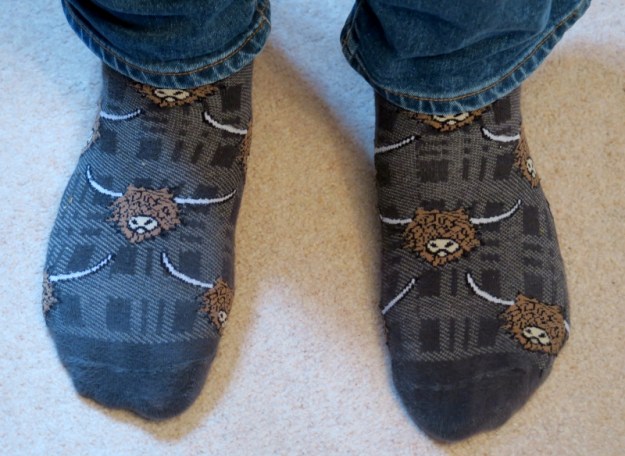
With that, Pine and Lime finally gave in to the French Gremlins and left for an early night, and eventually, Green joined them.  The others were up for something else though, and as Pink was wearing his new 6 Nimmt! socks, that seemed like a good idea.  So everyone logged into Board Game Arena for one of our favourite games.  The game needs little real introduction: players simultaneously choose a card from their hand and everyone reveals them.  Starting with the lowest, the cards are added in turn to one of the four rows—when a sixth card is added the owner instead takes the five cards and starts a new row with their card, scoring the number of bulls’ head points (or “Nimmts”) depicted on the card.

6 Nimmt!
– Image by boardGOATS

On Board Game Arena, the player with the most points when one player’s score falls below zero is the winner.  There was the usual moaning about how bad everyone’s hand was and how badly everyone always did, but Burgundy pretty much nailed it when he said nobody is going to do well, the aim is just to do less badly than anybody else.  In that sense, the game is a bit like escaping a bear, you don’t need to run fast, just faster than everyone else.  This time, Pine started off as the slowest runner being the first to pick up, but was soon followed but Black, Purple and then Burgundy.

6 Nimmt! on Board Game Arena
– Image by boardGOATS from boardgamearena.com

For a long time, it looked like it was going to be a “two bull race” between Blue and Pink, but six is a critical number in 6 Nimmt!, so with six players strange things can happen with players becoming synchronised and picking up lots of points on multiple turns.  It looked like it was going that way for Blue, but she managed to stem the flow and was tied for second with Pine for quite a while before he started picking up cards again.  It looked like Pink’s Lucky 6 Nimmt! Socks were working their magic, but when Black (who had been looking like bear-fodder for the whole game) ended the game, Pink had just picked up, leaving Blue one point ahead.

6 Nimmt! on Board Game Arena
– Image by boardGOATS from boardgamearena.com

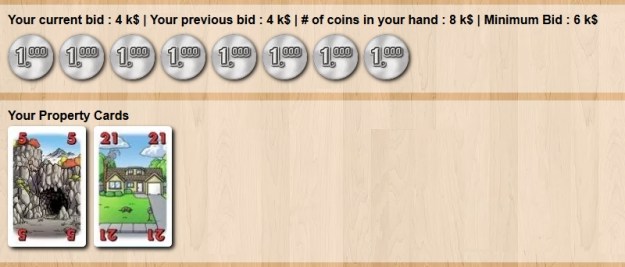
There was still time for one more quick game, and with six, the perfect quick game (and one that is available on Board Game Arena), is For Sale.  This is an old game that we dug out about six months ago, before all the current strife, and it got a couple of outings.  Since all games have been online, it is one of the games we can still play, and, as a result, it’s had several outings recently.  It is a game of two halves, first players buy property cards, then they sell them, and the player who makes the most money is the winner.

For Sale
– Image by boardGOATS

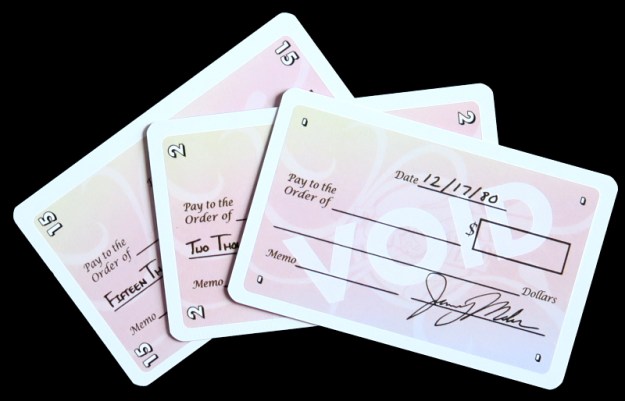
The properties are numbered one to thirty, with the number indicating the relative value.  Buying properties is through auction, with players increasing the bid or passing and taking the lowest value property available and paying half of their bid for the privilege.  The last player then takes the highest value property, but pays their full bid.  In the second part of the game, cheques are revealed and players choose a card to play, with the cheques assigned according to the value of the property played.

For Sale
– Image by boardGOATS

Thus the game consists of two auctions: a variant of an all-pay auction and a sealed bid auction.  In the first auction, a key tactic is predicting what other players will bid so passing can be timed in such a way as to get the best value for money.  Whereas previously, most players increased the bid by the minimum increment, this time it was clear that people were playing a little more tactically, with higher starting bids and increments of $2,000 that pushed other players into paying more.

For Sale on Board Game Arena
– Image by boardGOATS from boardgamearena.com

Black’s and Purple’s strategies were different however:  Black spent a total of just $2,000 on properties, mostly just passing and taking the property offered, and Purple spent only $3,000.  In contrast, Blue spent $13,000 and Pine spent $12,000, i.e. nearly all of their starting $14,000.  There is strategy in the second part of the game too though, and getting the timing right for selling each property is key.  For example, although Blue’s profits of $37,000 were larger than Black’s, his rate of return of $21,000 for just $2,000 outlay was better, matched only by Purple’s return of $32,000 for her $3,000 investment.

For Sale on Board Game Arena
– Image by boardGOATS from boardgamearena.com

That superb return was enough to give Purple third place.  It is not all about rate of return though:  it is the player who makes best use of all their funds that wins.  In this case, this meant we had a tie for first place between Pine and Burgundy, both finishing with a massive $59,000.  The tie break is the player with the most cash at the end, which just gave it to Burgundy who had achieved his $55,000 from properties bought for $10,000.  And with that, it was time for bed.

For Sale
– Image by boardGOATS

Learning Outcome:  A lot of fun can be had with a handful of dice and a few sheets of paper.