Author Archives: nannyGOAT

Spiel des Jahres Winners – 2017

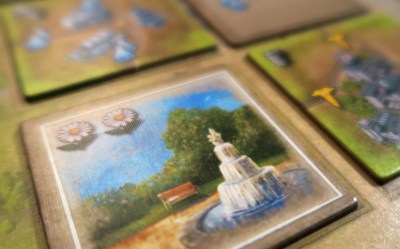
The 2017 winner of the coveted German Game of the Year or Spiel des Jahres award is Kingdomino.  Kingdomino is a simple little tile laying game with elements borrowed from other games, in particular, Carcassonne and Dominoes.  These are combined to make a well presented family game where players taking it in turns to add to their kingdom by placing dominoes that depict different terrains types.  We have played Kingdomino several times on a Tuesday evening and everyone who has played it has enjoyed it.  Discussing it among the group, everyone has felt that it is a fun, light filler that is very accessible and is a worthy winner.  The Kennerspiel des Jahres was awarded at the same time.  This honours more challenging games and was first introduced in 2011 to make up for the fact that the main, Spiel des Jahres award had moved away from the slightly more involved fare (like El Grande and TIkal) towards lighter, more family friendly games (like Dixit and Qwirkle).

Kingdomino
– Image by boardGOATS

Unusually, this year the Kennerspiel des Jahres award went to a series of games:  EXIT: Das Spiel.  These are cooperative games that reproduce the experience of an escape room by providing a series of puzzles inside a game box.  There are currently five of these games, though the award is for the first three, The Abandoned Cabin, The Pharaoh’s Tomb, and The Secret Lab.  Unfortunately, as a group we rarely play cooperative games and are not huge fans of the modern trend for social deduction type games, which  means we are unlikely to play this soon on a Tuesday evening.  The Kinderspiel des Jahres award was announced last month and went to Ice Cool which is a beautiful dexterity race game with cool little “weeble” penguins and wooden fish pegs.

Ice Cool
– Image used with permission of punkin312

Next Meeting – 11th July 2017

Our next meeting will be on Tuesday, 11th July, at the Horse and Jockey pub in Stanford-in-the-Vale.  As usual, we will be playing shorter games from 7.30pm as people arrive, until 8pm when we will start something a little longer.

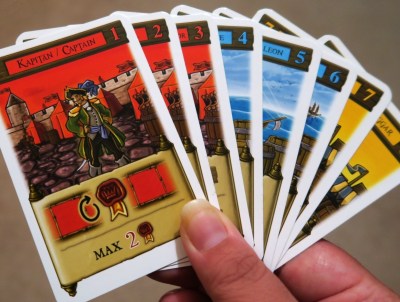
This week the “Feature Game” will be Santo Domingo, a light card game of tactics and bluffing with a pirate theme set in the world of one of our more popular games, Port Royal.  The game is a re-implementation of the slightly older game, Visby, which was only given a limited release.

Santo Domingo
– Image by boardGOATS

And talking of pirates…

Jeff the pirate had finally given up pirating and mended his ways, but his parrot had other ideas. He was constantly swearing and refusing to behave. Eventually, Jeff had had enough, so when the parrot started swearing again, he stuck it in the freezer for five minutes.

When Jeff fished it out again, the bird was very contrite and said, “I promise I’ll be good now, no more swearing. Just one question though: what on Earth did the turkey do?!?!”

Next Meeting – 11th July 2017

Our next meeting will be on Tuesday, 11th July, at the Horse and Jockey pub in Stanford-in-the-Vale.  As usual, we will be playing shorter games from 7.30pm as people arrive, until 8pm when we will start something a little longer.

This week the “Feature Game” will be Santo Domingo, a light card game of tactics and bluffing with a pirate theme set in the world of one of our more popular games, Port Royal.  The game is a re-implementation of the slightly older game, Visby, which was only given a limited release.

Santo Domingo
– Image by boardGOATS

And talking of pirates…

Jeff the pirate had finally given up pirating and mended his ways, but his parrot had other ideas. He was constantly swearing and refusing to behave. Eventually, Jeff had had enough, so when the parrot started swearing again, he stuck it in the freezer for five minutes.

When Jeff fished it out again, the bird was very contrite and said, “I promise I’ll be good now, no more swearing. Just one question though: what on Earth did the turkey do?!?!”

27th June 2017

After our recent large numbers, this was a really quiet night.  It all started off slightly controversially with a new “Tuesday Night is Pizza Night” at the pub and a new menu to go with it.  Despite being very set in our ways, we just about coped and the staff were very understanding and worked round our little foibles.  Inevitably, discussion about pizza re-ignited the pizza topping discussion from last time, with Pine adamant that pineapple is not a suitable topping for a pizza, while Blue commented that she quite liked it and in any case it is much better than sweetcorn, which is added to all sorts of things just for the sake of it.  It was about this point that Ivory pointed out that today was “International Pineapple Day”, much to everyone else’s disbelief.  From there the conversation moved onto the food value of celery and how much you had to chew it before it gave fewer calories than it needed to eat it and GIGO (“Garbage In, Garbage Out”).

Mamma Mia!
– Image by boardGOATS

We then segued neatly onto the subject of Thomas Midgley.  He was the the chap who discovered that adding tetraethyl lead to petrol stopped combustion engines “knocking” and developed the first of the CFCs, “Freon”, thus single-handedly causing more damage to the environment than anyone else, ever.  The world has a strange way of righting itself, though, and Dr. Midgley stopped torturing the planet when he caught polio and was paralysed.  Undeterred, the innovative scientist devised an elaborate pulley system get him out of bed, which ultimately (and perhaps fortunately for the future of planet earth) caused his premature death when he became entangled in the ropes.  Eventually, the conversation came full circle as we moved back to pizza toppings and the unusual “red jalapeños” (or should they be “hala-peenoes”?) on the Jockey’s new “J.B Pizza”.

Scoville
– Image by boardGOATS

By this time it was clear we were only five and we were all going to play the “Feature Game”, 20th Century.  Blue had carefully read the rules over the weekend and fully understood them at the time, however, in the interim, something seemed to have happened to those brain cells making it almost inevitable that we were going to struggle a little.  That said, the game is not that complex, taking place through a series of auctions, however, there are lots of steps to each round.  Part of the problem is that there are only five full rounds and, as the game is quite a long one, it takes at least two or three rounds to get a grip on how they flow, by which time it is too late to do anything about it.

20th Century
– Image by boardGOATS

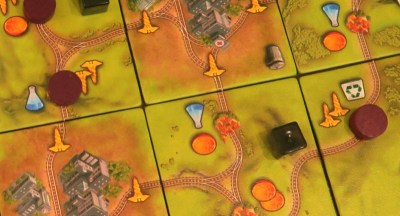
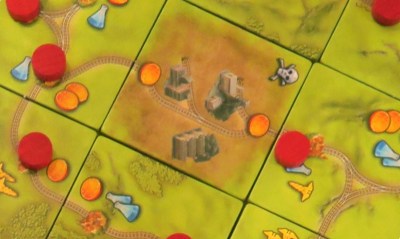
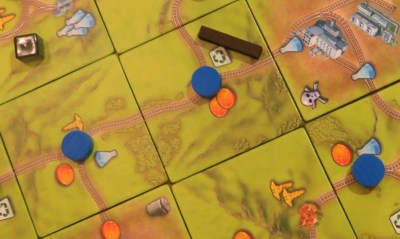
The idea of the game is that players are building their own country (“Pine-istan”, “United States of Burgundy”, “Côte d’Ivory”, “Great Blue-tain”, and “Green-land”) with the winner being the player with the cleanest country.  Each round begins with a land auction.  The “Start Player” begins the auction by choosing a tile and placing the first bid. On their turn, players must increase the bid or they can pass.  The winner then starts the next auction in the same manner.  With five players, there are a total of eight tiles to be auctioned  and players can win as many as they can afford, however, there is a penalty, as each successive tile comes contaminated with additional waste.

20th Century
– Image by boardGOATS

When a player passes, they can either choose to “pass” and bid on the later auctions, or as Pine commented, they can “completely pass out”.  In this case, the player can move onto the next phase and choose whether or not to buy a technology tile.  Choosing when to pass onto the next phase is quite critical as the first player to “pass out” gets the choice of all the available technology tiles, whereas leaving it too late means the good tiles may have already gone.  However, leaving it later can also make them cost less, especially as there are two different “currencies”, “money” and “science points”.  This means that in this game, timing is everything.  Going first allows players to choose to auction the tile(s) of their choice and then move onto choosing from all the technology tiles, but that can be very expensive and money is needed to prevent catastrophes in the next phase.  And some of the catastrophes are very much to be avoided if at all possible.

20th Century
– Image by boardGOATS

As the game progresses, the catastrophes get progressively worse leading to pollution and contamination and can be utterly crippling.  This is effectively another auction, started by the first player to move on to the technology purchasing phase.  These are very different though as there are the same number of catastrophes as players and the are effectively auctioned simultaneously.  The first bidder chooses one of the catastrophes and bids.  The next player can increase the bid on that catastrophe or choose a different one and bid any amount they can afford for it.  When it is a player’s turn, unless they are currently winning, they must increase their bid or place a winning bid on a different catastrophe. Bidding continues in this fashion until everyone has bid for different catastrophes.

20th Century
– Image by boardGOATS

With all the bidding over, players then add any tiles they’ve won to their country along with any rubbish that may have come their way during the round.  Each land tile features one or more cities built on a piece of railway that can be connected to the player’s rail network.  Each city has special production abilities with some producing money, others producing science points or victory points.  Cities are activated with a citizen token, so players have to pick which cities they are going to activate when they place the tiles.   How the tiles are connected is also critical, because some cities have a recycling plant which can be used to remove waste cubes, but only from the same tiles or adjacent tiles connected by rail.  Some technologies also allow players to move rubbish or citizens, which make the rail networks all the more critical.

20th Century
– Image by boardGOATS

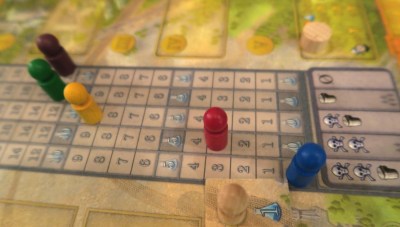
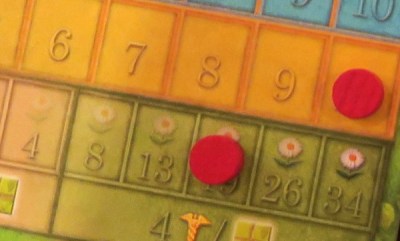
In addition to their “country”, everyone has a player board depicting three production tracks (finance, science and victory points), as well as the pollution level in their country.  The production tracks simply help players keep track the production in all their activated cities.  The pollution track is more interesting, however, as the position on the track gives end-game scoring.  After the fifth round, players can use their technology tiles, productions and recycling plants one last time.  Then, in the final scoring each tile with one rubbish token on it scores nothing and those with more than one score negative points.  Each clean tile scores two, three or four points depending on the state of the player’s pollution track.  Players also score points for the environmental quality or take penalties for any pollution, as well as the players with the most cash-in-hand and science points picking up bonuses.

20th Century
– Image by boardGOATS

We all struggled at the start, but Pine (still in “plaster” after the little incident at the egg-throwing in the village fete) came off worst.  In truth, this sort of game is not really his sort of thing, made worse by the fact that he always wants to understand how games work rather than just doing “stuff” and seeing what happens.  For this reason, in the end he decided he’d “Just pass out” during the first auction.  This wasn’t necessarily a bad tactic as it meant he had a lot of money going into the second round.  Burgundy, meanwhile, began picking up victory points left right and centre and quickly built up a healthy lead, while Ivory and Green were busy trying to build more environmentally friendly countries.  Blue eventually began to catch Burgundy a little until her rail network finally ran out of steam, but the end-game scoring showed how close the game really was.

20th Century
– Image by boardGOATS

Everyone picked up a huge number of points at the end and finished within five points of each other.  Green and Blue both finished on eighty-seven.  It was Ivory though, who had managed to push his pollution track much further into environmental quality than anyone else and took the glory finishing with eighty-eight points.  Almost everyone had enjoyed the game, all the more so since it was a £10 special from The Works clearance sale a few years ago.  There were several aspects that we enjoyed, in particular, the catastrophe bidding is very stressful, as it can ruin plans as well as have significant impact on the amount of money player have for the next round.  Pine was the exception, as he clearly hated it from start to finish, not helped by the fact that Blue wasn’t on the ball when teaching it and he clearly felt that £10 was a ripoff!

20th Century
– Image by boardGOATS

Learning Outcome:  The way the rules are presented can be critical.

Next Meeting – 27th June 2017

Our next meeting will be on Tuesday, 27th June, at the Horse and Jockey pub in Stanford-in-the-Vale.  As usual, we will be playing shorter games from 7.30pm as people arrive, until 8pm when we will start something a little longer.

This week the “Feature Game” will be 20th Century, a tile laying game where players build a land free of garbage and pollution – a land where the environment is as healthy as the economy.  Players accumulate points each round, based on their nation’s quality of life. They also score bonus points for certain aspects of their country’s development and at the end of the game points are awarded based on their country’s income, research, and environmental quality. The player with the most points wins, having built the country with the highest standard of living.

20th Century
– Image by boardGOATS

And talking of modern life…

Jeff arrived at work looking very harassed, so  one of his mates asked him if he was OK.

Jeff replied, “I tell you, women drivers are a hazard to traffic. Driving to work this morning on the motorway, I looked over to my right and there was this woman in a Jaguar doing at least seventy miles per hour with her face up next to her rear view mirror putting on her mascara.”

He went on, “I looked away for a couple seconds and then the next thing I knew was she was careering all over my lane.”

Then Jeff paused a second, before concluding, “It scared me so badly that I dropped my electric razor into my coffee, and it spilled all over my mobile phone.”

13th June 2017

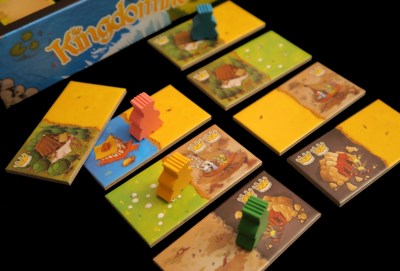
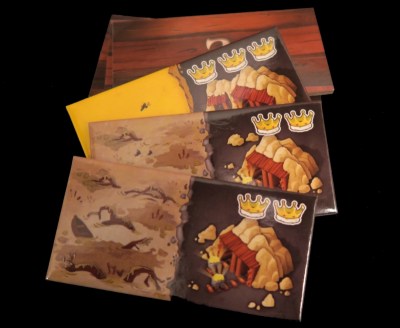
Purple and Black were first to arrive and were finishing off their supper when Burgundy joined them.  While Burgundy waited for for his dinner to arrive, he joined Purple and Black in a quick game of Kingdomino.  This is a fairly light little game that has recently been nominated for this year’s Spiel des Jahres Award.  Kingdomino is a simple little tile laying game with elements borrowed from other games, in particular, Carcassonne and Dominoes.  These are combined to make a well presented family game that is in with a great chance of winning the award.  During the game, players taking it in turns to add to their kingdom by placing dominoes that depict different terrains types.

Kingdomino
– Image by boardGOATS

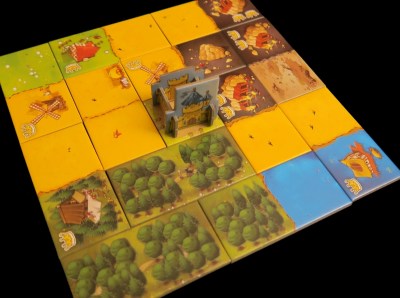
The dominoes comprise two squares each featuring one of six different terrain types: pasture, cornfield, woodland, sea, swamp and mountain.  Some tiles also depict one or more crowns.  When the dominoes are placed, one end must either connect to another domino matching at least one of its terrain types or connect to their starting tile (which can be considered to be “wild”).  All dominoes must fit in a five-by-five space and if one or more of dominoes cannot be placed according to these rules, then they are discarded.  At the end of the game, each player multiplies the number of tiles in each continuous region of terrain with the number of crowns on the tiles in that region and adds them up to give their score – the player with the highest score wins.
Kingdomino
– Image by boardGOATS

There are a couple of interesting little quirks.  Firstly, the dominoes are chosen by players in a very elegant way.  Each domino has a number on the reverse with the higher numbers roughly correlating to the more valuable ones.  At the start of the game four dominoes drawn at random are placed face up in ascending order and each player puts a coloured meeple on one of them.  These dominoes are played in ascending order, so the more valuable ones are played later.  At the beginning of round, another four dominoes are placed face up in number order creating a second row.  When a player carries out their turn, they take the domino under their meeple and add it to their kingdom and moving their meeple to the next row, choosing which domino to place it on.  In this way, players can choose a more valuable tile for the coming round but that is offset by having a later choice of tiles for the following round.
Kingdomino
– Image by boardGOATS

There is also matter of the distribution of the tiles.  Some terrains types, like cornfield, are quite common with few crowns available, however others (like mountain) are very scarce, but have most have more than one crown on them.  This is quite critical because a player could build up a very large area, which fails to score because it has no crowns.  Alternatively, a couple of squares of mountain (or marsh) can score relatively highly.  This effect was critical in this game as both Burgundy and Purple built up large areas of cornfield, but Burgundy managed to add four of the five crowns available to his which gave him substantial score. He had very little else though, and Black had built up areas of sea and woodland and Purple had added several small terrains to her large cornfield.  Largely thanks to his massive cornfield, Burgundy finished with a massive forty-two, almost twice that of Black in second place.  With Kingdomino over and Burgundy and Blue’s pizzas having arrived, the group split into three, with one group playing a new game, “London Meerkats”, one group playing the pizza making card game, Mamma Mia! and the last group eating pizzas (far too serious to be a game).
Kingdomino
– Image by boardGOATS

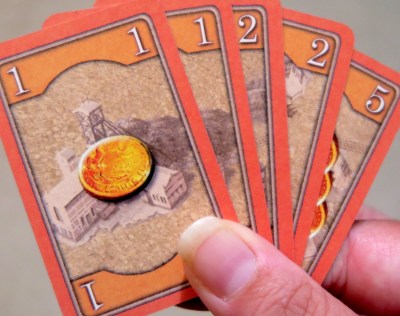
We first played Mamma Mia! about a month ago, and it went down so well, that Red fancied giving it another go this week prior to perhaps making a little purchase herself.  The idea is that players are trying to fulfill pizza orders by first putting topping cards in the “oven” and then sneaking their order cards in on top before another player does the same and claims the toppings for their order. So, each player has a deck of personal order cards and a random hand of toppings. On their turn, each player must place at least one topping card in the oven pile (all the same type) and may follow it with an order card if they choose.  The winner is the player who manages to complete the most orders.

Mamma Mia!
– Image by boardGOATS

Red and Pine had played Mamma Mia! last time (with the Double Ingredients mini expansion) and introduced Magenta and Turquoise to it.  Unfortunately, it is a slightly strange game and some of the rules didn’t quite make it somewhere along the line, not that it mattered though and Burgundy and Blue were thoroughly entertained by some of the snippets that drifted across the room. It seemed Pine in particular had strong opinions on what should go on a pizza, “How can you have four pineapples and one mushroom on a pizza?  That’s disgusting!”  On the other hand he was clearly less revolted by chili and  pineapple commenting, “That’s a nice combination!”  In the final round with Blue and Burgundy now spectating, Pine was clearly getting frustrated at being asked for the third time whether he had a card to add to his order, as he grunted, “No, I still don’t have one; why on earth would I want pepperoni – I’m a vegetarian!”

– Image by boardGOATS

With all the fun and a close game, the winner was almost a incidental, but once again, it was the Red, the “Pizzza Queen” who managed to complete all eight orders, one more than Magenta who finished with a highly creditable seven.  With pizzas cooked and eaten it was time for the “Feature Game”, Between Two Cities with the new Capitals expansion.  We’ve played Between Two Cities quite a bit, and when the expansion was available as a pre-release at the UK Games Expo at the start of the month, it was inevitable that we’d be keen to give it a go.  That said, Pine (clearly still suffering from a surfeit of pineapple and pepperoni), commented, “Here’s where an expansion takes a good game and makes it a worse.”  So it had a lot to live up to.
– Image by boardGOATS

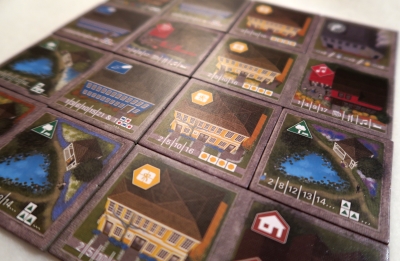
Unfortunately, Turquoise had not played the base game before, however, of all games Between Two Cities is one game where a novice can get a lot of help due to its inherent nature.  The game is very simple as players draft buildings tiles, keeping two tiles each round and passing the rest on.  The novel part of the game is that instead of adding these tiles to one’s own city, the tiles are added to two cites, one on each side, each shared with a neighbour.  The winner is the player with the “best” second city (i.e. the player with whose lowest scoring city is the strongest). This peculiarity of the scoring means players are trying to balance their two cities and ensure the buildings they require a complementary.  The semi-cooperative nature meant that Red and Burgundy could help out Turquoise, and in fact, everyone could help eachother dealing with the complications of the expansion.
Between Two Cities
– Image by boardGOATS

There are three components to the Capitals expansion.  Firstly, each city now starts with a three-by-three starting tile with some pre-filled spaces and others that can  be filled by players.  This adds a tweak to the start of the round that we all agreed we liked, as well as making the game slightly longer as the cities occupied a slightly larger space.  The other two modules were slightly more controversial.  The new tile type, Civic buildings, might have been more popular if the icons hadn’t been so small that they were almost impossible to see in the slightly subdued lighting in the pub (which was worse than normal due to a blown bulb in exactly the wrong place).  Even those who could see them well though, were playing them in a very negative way.  These tiles give three points if placed near one specific type and six if next to two specific types, but one if not adjacent to either or if adjacent to a third specific type.  Unfortunately, the icons were too small to distinguish for anyone over about twenty.  Finally, there were district awards given to the largest districts i.e. contiguous areas of a pair of tile types.  Most people ignored these, largely due to the fact they were concentrating on trying to work out what to do with the Civic buildings.

Between Two Cities: Capitals
– Image by boardGOATS

One of the nicest parts of the Capitals expansion is that it includes a list of all the wooden monument meeples with their names, allowing players to identify better with their two structures.  Burgundy and Turquoise filled their shared city, the “Red Pagoda”, with lots of houses, parks and shops.  Since Burgundy was struggling to see the Civic buildings they completely eschewed them in favour of factories which they mostly managed to avoid placing next to any houses.  On Turquoise’s other side was the “World War Monument”, shared with Magenta.  This city scored less well, partly because it was competing with the “Red Pagoda” for park and factory tiles.  Magenta’s second city didn’t do much better, though at least it wasn’t in competition with her first city.  Sharing with Pine, the “Rialto Bridge” city combined offices with leisure and housing.
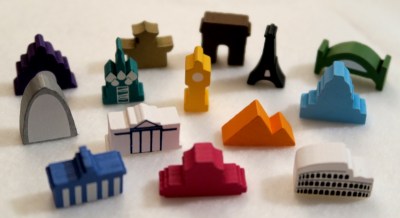
– Image by boardGOATS

Pine’s second city, the “Sydney Harbour Bridge” was shared with Red, and the profile almost exactly mirrored his first city.  It scored much better though partly thanks to the addition of a few Civic buildings and a couple of extra leisure facilities.  Red’s second city, “St. Basil’s Basilica” was shared with Blue and also featured several Civic buildings (as did Blue’s other city, well, someone was going to end up with them).  Despite completely missing out on shops which dented its housing score, “St. Basil’s” still scored quite well due to a lot of houses and parks.  The final city, the “Geekway to the West”, was shared by Blue and Burgundy and featured lots of shops, leisure buildings and houses as well as the Civic buildings, scoring well.
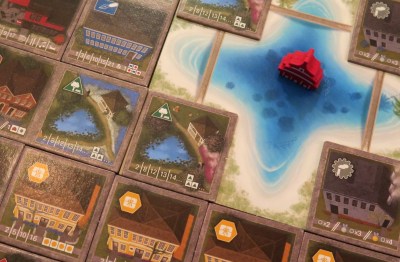
Between Two Cities: Capitals
– Image by boardGOATS

All the scores were a little moot, however, as the District Bonus scores were still to be allocated.  Only Blue had really paid attention to these at the start, and she had infected Burgundy and Red who she had been sharing cities with.  It was perhaps no surprise then that the “Red Pagoda”, the “Sydney Harbour Bridge”, the “Geekway to the West” and “St. Basil’s Basilica” all picked up bonus points which put them in first, second third and fourth place respectively.  That still left the winner to determine.  Blue, Burgundy and Red all had an interest in two of the top four cities.  Burgundy participated in the first and third placed cities giving him first place, and Red and Blue shared “St. Basil’s Basilica” in fourth so Red took second place on the tie-break.

Between Two Cities: Capitals
– Image by boardGOATS

Meanwhile, the next table had been playing London Markets (or “London Meerkats” as we  have taken to calling it).  This game was released at Essen last year following a KickStarter fund-raiser and is a re-themed revision of Dschunke, which was originally nominated for the Spiel des Jahres in 2002.  Green, Black and Purple had tried to play it at Didcot once before, but the set up and rules explanation had taken so long that they had only managed a few opening rounds before running out of time.  This meant they were all keen to try it properly, especially as it seemed to have an interesting and unusual mechanic.  In this, they were joined by Ivory who is always keen to try something new, especially the slightly more complex games.  Although “London Meerkats” is not actually that complicated, being a little different it takes a bit of time to understand how the components fit together.  At its heart, “London Meerkats” is an auction game, where players use goods to make a concealed bid for one of four options with the ultimate aim of having the most money at the end of the game.

London Markets
– Image by boardGOATS

In general, there are four items available in each auction, usually three giving a monetary reward and the fourth providing a special power card.  In a four player game, it is possible that each player bids for a different option and everyone moves onto the next round happy.  More often than not though, more than one person bids for one of the options, in which case at least one person is going to be disappointed and not just because they didn’t win, but also because all bids, even losing bids, go to the bank.  Worse, in the case of a tie, the winnings are split and rounded down, so when this is not possible, again, everyone involved comes out with nothing.  If there are items than nobody bid for, these are auctioned again, but it is even more risky this time as there are the same number of participants, but fewer targets.  They are also the items nobody bid for at the first attempt, so may be less desirable, leaving players with another difficult decision.  The interesting part of the game is how players acquire the goods to use in the bidding in the second part of the round.

London Markets
– Image by boardGOATS

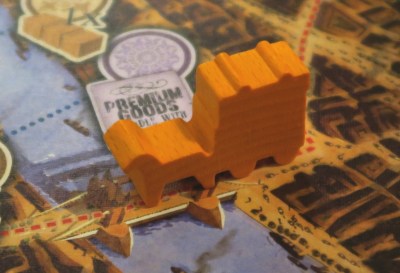
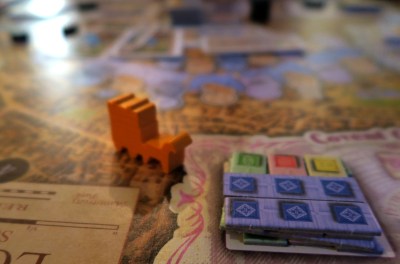
The first part of each round is played on the board featuring London and five of her markets, Brixton, Borough, Portabello, Covent Garden and Petticoat Lane.  Each market exclusively provides textiles, soaps, coffee, porcelain apart from the last one which provides access to one of the others.  There are also three merchants who each start at one of the markets and two assistants who occupy locations on the banks of the river.  Players start by taking it in turns to select a merchant or one of the assistants and activating them, turning the token over so that only one person can carry out each action per round.  The merchants allow players to stack goods crates of their own colour in the market, collect goods cards (which are used for bidding) or collect money from the bank.  The latter number of cards or the amount of money depends on the number of crates visible when the action is used.  Since crates come in bars and are stacked, the number of crates visible changes throughout the game.

London Markets
– Image by boardGOATS

The merchants carry out the activity in the market they are in, whereas players who activate the the assistants can choose which of the two markets to carryout the action in with the action dictated by the assistant’s position on its riverside path.  Once everyone has carried out an action in the London Markets, players get two extra cards of their choice (or more if they have the right power cards) before the auction phase.  With almost everyone having recently played it (or at least a bit of it), the group relied largely on memory, which turned out to be a bit of a mistake, as part way through the game it became apparent that people had mis-remembered the rules in a number of small ways, which did distort the game in very unhelpful manner.
London Markets
– Image by boardGOATS

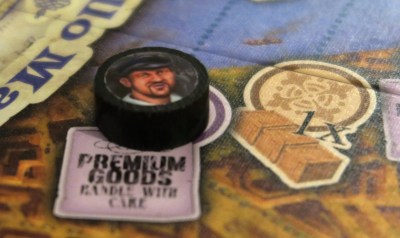
Black began by targeting the auctions for bonus cards, with Ivory going for the high value coffee, Green for low value cloth while Purple cornered the market in cheap lavender soap.  As the first few rounds went on, Ivory continued to pursue coffee and added a bonus card strategy too, claiming several extra pounds for having crates in a multiple markets. Green continued to do well in the auctions, Purple too, but with the lower value goods. Black seemed to miss out several times.  In round three, the first mistake reared its ugly head.  At several intervals during the game, there is an extra mini-action, the first of which is during round three.  We assumed the person who chose the first assistant would also get a bonus card on top of his action which Ivory used to great advantage. It was only after the half way mark that we realised the symbol on the board actually meant that everyone gets a bonus card that round.  Unable to fix this retrospectively with only one bonus card marker left we chose to continue as before. This would mean that Purple got the chance first and only Green didn’t get the bonus.
London Markets
– Image by boardGOATS

After round four, that we realised our second mistake. The two assistant actions are only supposed to be used in the two unoccupied markets, but we had played them as being available in all.  Since the first player marker had made one full rotation, we felt it had been fair and playing that rule properly hereafter would not penalise anyone unduly.  The game continued, Black managed to get the tie-breaker bonus card, meaning he would win any tied auctions and Ivory began to use his bonus cards to good effect.  Green was switching his auction goods quite well, winning several at high and low values, while Purple often found herself taking the short straw, losing a few.  By the half way money check mark, it was all very close with Green narrowly in the lead with £21 just £1 ahead of Ivory had £20 and Black and Purple just behind.

London Markets
– Image by boardGOATS

In the second half of the game, Black was finally able to start making good on his tie breaker, often to the demise of Green and Purple. Ivory was also able to really start building his position as he could now take four cards before each auction and exchange two more, meaning he could acquire a set of six of any type under almost any circumstances. It was about this that the third big mistake became apparent – some of the bonus cards could be held and cashed in later rather than having to be used as an immediate cash injection.  This meant players could work to get crates positioned in the appropriate market before cashing in a card, which would have helped those floundering quite a bit.
London Markets
– Image by boardGOATS

By about three quarters of the way through, it was obvious who the winner would be because he was raking in the cash and everyone else barely got a look-in.  Black had had a better second half, nearly doubling his score, while Green and Purple struggled, although Green fared worse of all as he barely managed a third of what he had taken in the first part of the game.  It was Ivory though that finished with £56, nearly £20 clear of Black in second, a huge margin of victory in what had seemed like a close game at half-time.  It was clear that the incorrect rules had a big impact on the outcome though, and as a result, and as we played it, it really meant that gaining an advantage would result in a increasing circle of benefit so maybe another try is in order, with all the correct rules.

London Markets
– Image by boardGOATS

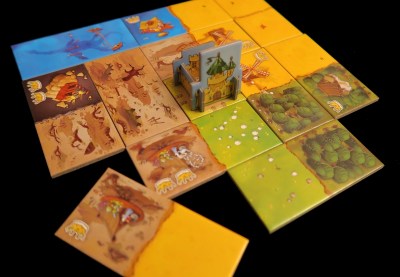
Since “London Meerkats” finished before Between Two Cities, Purple and Black fancied another go at Kingdomino, this time with four players and Ivory and Green instead of Burgundy as the opposition.  There are also a couple of variants, in particular the option of adding a ten point bonus for finishing with the castle in the centre of the five-by-five grid as well as a five point bonus for players who successfully add all twelve dominos to their kingdom, so for a little variety, these were added to the final scoring.  This time Black’s Kingdom started out with a lot of woodland as he struggled to get anything very much, but kept his options open and managed to work in some other regions and get them scoring. He also managed to get his Castle in the middle and complete the whole set for a full fifteen point bonus.

Kingdomino
– Image by boardGOATS

Green started out with cornfields and meadows, soon adding woodland, swamp and water.  Although he kept it tidy with the castle in the middle, he was left with a terrible final double swamp tile that he just couldn’t place.  Purple was trying to play for the high value swamp and mountain tiles, but failed to maintain her five-by-five grid. She had misunderstood the rules and thought that she would score the bonus as long as the castle was surrounded by tiles. In the end her regions were generally small, but with lots of crowns.  Ivory, the “London Meerkats” Meister, went for a wet kingdom and produced a massive scoring lake and a couple of other regions, got his castle in the middle and completed the grid for a full set of bonuses and his second win of the evening.
Kingdomino
– Image by boardGOATS

With time getting on and people beginning to leave, there was just still time for another game and with Burgundy, Blue and Pine left, Splendor was always a likely target.  Burgundy had had an unbeaten Tuesday night run since January 2015 – well over two years and at least eight games, during which time both Pine and Blue had made several attempts to beat him.  The game is a simple one of chip  collecting and engine-building with a very loose gemstone theme.  Basically, on their turn, players can take gemstone poker chips, or use chips to buy a card.  Some cards have points on them and all can be used like the poker chips to buy cards (but without having to return them).  The cards also give players access to “Noble tiles” which also give points.  The winner is the player with the most points after someone reaches fifteen points.

Splendor
– Image used with permission of boardgamephotos

This time the nobles required three each of sapphire, opal and diamond; three each of sapphire, emerald and diamond; three each of sapphire, emerald and ruby; and four each of diamond and opal.  Pine started, but Burgundy was quick out of the traps, collecting diamond cards as there were a lot about at the start and they featured on three of the four Noble cards.  Blue followed quickly and went for sapphire cards as they were also strongly represented on the Noble tiles.  Pine was a little slower, but not far behind picking up opal cards.  Burgundy was first to take a Noble taking the sapphire, emerald and diamond Noble, just beating Blue to it.  He was working on the sapphire, emerald and ruby Noble, but Blue had her eye on that and it with both layers having three sapphire and three emerald cards, it was all down to who would be first to get three ruby cards.

Splendor
– Image used with permission of boardgamephotos

It was neck-a-neck, and it was Blue’s turn.  She only needed the one ruby card and there was one in the display,but unfortunately, although Burgundy could afford it, she couldn’t.  Grudgingly, she reserved the card for herself, hoping that she wouldn’t turn over another ruby card.  Sadly, she did reveal a ruby card, and since Burgundy loads of cards and lots of chips, he could afford it.  It was Pine’s turn first though and he could also afford the ruby card so he decided to add it to his tableau.  It was with bated breath that Pine reveled the replacement card.  Unfortunately for Burgundy it was not a ruby card which left the road open for Blue to take the Noble on her next turn.  It wasn’t all over though, there were two Nobles still available, and Burgundy went for the next one, however, Pine had other ideas and took both in quick succession.

Splendor
– Image used with permission of boardgamephotos

During the game, both Blue and Burgundy had been picking up a few point bearing cards, however, Blue also had two high scoring cards reserved and was looking to play one of these, a four point card requiring seven sapphires.  Knowing Blue’s habit of spotting what other players want and reserving it to obstruct them, Burgundy reserved a four point level three card that he could play next turn.  Unfortunately for him, this revealed a five point card that Blue could afford.  As the last player in the round, taking the card gave her fifteen points which immediately ended the game, and with it, Burgundy’s unbeaten run, finally.

Splendor
– Image used with permission of boardgamephotos

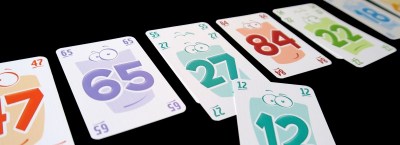
There was still time for a quick game of that “nasty card game”, 3 Sind Eine Zu Viel!.  This game is very simple:  there are three rows of cards (zero to thirty, thirty to sixty and sixty to ninety) and on their turn, the active player chooses a numbered card and adds it to the appropriate row.  If there are five cards in the row the active player must pick up cards: if the card added is the highest card in the row, the active player takes the card with the lowest number, otherwise they take all cards higher than the card added by the active player.  The cards all have a colour as well as a number, and the aim of the game is to get as close as possible to two of each colour, while three is one too many…
3 Sind Eine Zu Viel!
– Image by boardGOATS

About half way through the game, Pine asked whether the card marker was included in the five cards.  This prompted a quick rules check with the inevitable discovery that we had been playing it wrong.  We finished the game with our rules and although nobody managed a full set of seven cards, Blue and Pine both managed very creditable scores, with Blue five points clear.  Since the game is reasonably quick and we all wanted to know what difference the rules change made, we gave the game a second go.  We all felt it was different this time and maybe a little less prone to catastrophic card collections, not that that helped Burgundy.  For the second game on the trot he scored just seven, while Blue and Pine scored more but were even closer this time with Blue taking the second win, by just one point.

3 Sind Eine Zu Viel!
– Image by boardGOATS

Learning Outcome:  Games are generally better when everyone plays by the same rules, ideally the right ones…!

Next Meeting – 13th June 2017

Our next meeting will be on Tuesday, 13th June, at the Horse and Jockey pub in Stanford-in-the-Vale.  As usual, we will be playing shorter games from 7.30pm as people arrive, until 8pm when we will start something a little longer.

This week the “Feature Game” will be the Capitals expansion to Between Two Cities.  Between Two Cities is a semi-cooperative tile laying game that we’ve played quite a lot within the group.  The Capitals expansion hasn’t been properly released yet, though it was available as a pre-release at the UK Games Expo ten days ago.

Between Two Cities
– Image by boardGOATS

And telling a Tale of Two Cities…

There was once a terrible crisis in London, the Thames had a new inhabitant – a horrible sea monster had slunk into the famed London waterway. Citizens who walked too close to the edge of the river were quietly devoured. The city was in an uproar! Who would save them from the horrible creature?

A young man came forward to answer the call. He was a poor man from an inconsequential village, but he had a heart of courage and a love for his countrymen.

He came to the banks of the Thames and called in a loud voice, “Monster! Show yourself if you dare!”

In a flash of scales and slime, the creature broke the surface of the water, his horrible jaws open to devour this arrogant young warrior.  Fortuitously, the hero was quicker, and his sword neatly sliced off the monster’s head. The people poured into the streets of London to celebrate! The crisis was over.

But the story wasn’t quite…

The citizens joyously pulled the carcass out of the Thames river, carved it into sections, and took it to butcher shops all over the city, where it was seasoned and mixed and pressed into the yummiest sausage ever tasted.

Yes, it was the beast of Thames…. it was the wurst of Thames…

30th May 2017

While we were waiting for  food to arrive, we decided to play a quick game of the “nasty card game we finished with last time“, 3 Sind Eine Zu Viel!.  This is a nasty little variant on one of our old favourites, 6 Nimmt!.  It doesn’t have the simultaneous play and there is a little more strategy or at least, there is more of the same “illusion of control”.  The idea is that there are three rows of cards, zero to thirty, thirty to sixty and sixty to ninety.  On their turn, the active player chooses a card and adds it to the appropriate row.  If there are five cards in the row the active player must pick up cards: if the card added is the highest card in the row, the active player takes the card with the lowest number, otherwise they take all cards higher than the card added by the active player.  The cards all have a colour as well as a number, and the aim of the game is to get as close as possible to two of each colour, while three is one too many…

3 Sind Eine Zu Viel!
– Image by boardGOATS

The rules state that each player starts with eight cards and a face down deck of twelve cards.  After six turns, each player has two cards remaining and restores their hand to eight by taking six from the deck, which happens a total of three times.  The game plays a maximum of four, so there are a number of cards left unused.  We started with three players, Pink, Blue, Burgundy, but then Green & Violet turned up, so we fiddled the rules to make the game play five, by reducing the number of cards each player had in their deck, such that each player would draw six, five and four cards, rather than six each time.  This worked quite well, though Pink felt that it made the game much more difficult to play. The game was quite tight in the early stages, with different players trying different strategies, but in the final accounting it turned out that Pink had more pairs than anyone else as well as both ten point bonuses giving him a sizeable winning margin of twelve, pushing Green into second place.

3 Sind Eine Zu Viel!
– Image by boardGOATS

With the food and the “gaming starter” over, it was time for the main course, our “Feature Game”, Terraforming Mars.  Almost everyone was really keen to play, so, since we had two copies available, we decided to split into two groups and play two parallel games.  This began a big debate about who would play in each group. It made sense for Green and Violet to play in the same group, but Blue wanted to play with Pink as she doesn’t see much of him.  There were also gaming considerations as we wanted to make sure there were people who knew what they were doing on both tables but nobody wanted to move about too much. In the end Black swapped seats with Violet and we were ready to start, though since we were nearly all new to it, we had to go through the rules first.

Terraforming Mars
– Image used with permission of BGG contributor henk.rolleman

The idea is that players take the role of giant corporations, sponsored by the World Government on Earth, to initiate huge projects to raise the temperature, the oxygen level, and the ocean coverage until the environment on Mars is habitable. Players then buy project cards into their hand and later, when they have the resources needed, they can play the cards and ultimately place tiles on Mars itself.  There are three different types of cards:  Red cards provide actions that have an instant effect and are then discarded until the end of the game; Green cards have a one-off effect but their “tags” are retained, and Blue cards have an ongoing effect and/or an action that can be activated once per round.  It is building these card combinations that is the interesting part of the game, but also the part that some players struggle most with.

Terraforming Mars
– Image used with permission of BGG contributor punkin312

Each round (or Generation as they are called in the rules) begins with drawing four cards.  In order to keep these cards, players must pay three M€, the currency used in the game.  Next, players take it in turns to carry out one or two actions and continue to do so until every player has passed.  At the end of the round everyone gets resources according to their Terraform Rating and production ability.  Everyone starts with the same Terraform Rating which increase when players raise one of the three global parameters (temperature, oxygen level, and ocean coverage) – this forms the basis of players’ end game scores as well as their income at the end of each Generation.  Each player also has their own production track for the six key resources, M€, Steel, Titanium, Plants, Energy, and Heat.

Terraforming Mars
– Image used with permission of BGG contributor henk.rolleman

Each resource has a primary use in addition to any uses that project cards may make of them.  For example, M€ are generally used to buy cards into players’ hands and then to pay to activate them.  On the other hand, Steel and Titanium can be used to activate specific types of cards in place of M€; although they can be much more efficient than the currency, their use is much more restricted.  Plants can be used to provide greenery on the surface of Mars which in turn gives oxygen.  Energy can be used by in conjunction with projects and all residual energy is turned into heat at the end of the round which in turn can be used to warm the planet.  The guts of the game are the actions. Players take it in turns to carry out one or two actions and continue carrying out actions until every one has passed. In this way, players can ultimately have take as many actions as they like, though they will be limited by the resources they have.

Terraforming Mars
– Image used with permission of BGG contributor punkin312

The actions are:  play a card, paying any costs and carrying out any associated actions if appropriate;  use the action on a Blue card played previously, or carry out a standard action.  The standard actions mostly involve paying for things at a very high rate.  Typically it is much more efficient to do these actions by playing cards, however, sometimes it is worth paying the inflated price because of the way the actions combine.  In the introductory game, every player starts with the same amount of money and project cards, however, despite the lack of experience, both groups decided to play with the Corporation cards. These have delightfully imaginative names like, “Interplanetary Cinematics” (Green), “Inventrix” (Violet) and “Republika Tharsis” (Burgundy). These potentially give players a bit of a steer as to what project cards to buy and later, hopefully, play. With almost everyone new to the game (though several had struggled to read through the rules), it was a steep learning curve that started straight away when we had to choose which cards to pay to keep from our starting hand of ten. This is one of the big challenges of the game as keeping cards costs money and money is scarce.

Terraforming Mars
– Image used with permission of BGG contributor henk.rolleman

Ivory (who had played before, albeit solo) got his table going first, but fairly quickly, they discovered it was generally better to do one action at a time, unless a second relied on a first and there was a chance it might not be possible to play it if someone else got there first.  This was slightly counter to the other table where players started out trying to take both actions, though they also quickly decided that since the last player can keep going at the end, sometimes it is better not to force that second action.  One standard action is to claim a Milestone.  Claiming these costs M€, but can be a good way to add points.  Players can also pay to activate Awards which will give points to the most effective players in certain fields. On Ivory’s table, the Milestone and Award points were fairly evenly spread and it was the Terraform Rating that had the largest influence on the placings, with Ivory finishing three points ahead of Green.  On the other table, the opposite was true with players’ Terraform Ratings very even and Milestones as the key battle-ground.  Burgundy just pipped Blue to almost all of them so she countered funding a couple of awards and winning them.  It was the cards that made the difference though, and Blue picked up a massive fourteen points leaving her seven points clear.  The battle for second was more interesting though, with Burgundy and Pink finishing level.  On reflection both players felt they had missed scoring points on the table with Pink certain he had forgotten to add to his Puppy Farm on at least one occasion.  We let the points stand though and Money-Bags-Burgundy took second on the tie-break.

Terraforming Mars
– Image used with permission of BGG contributor bkunes

We all felt that the game has high potential for “Analysis Paralysis”, particularly at the beginning, in deciding which cards to keep (a problem made worse for on the first play which is why the Beginner Corporations give players ten cards drawn at random). The game could be won or lost on decisions about which cards to keep.  Miscalculations like paying for that extra card that then didn’t leave enough money to play that one really important card that had been saved for can also prove critical.  There were some nasty actions, too.  For example, Green got caught out in his penultimate turn when two of his plant cubes were snatched which left him short of plants to terraform a tile.  Thus he was unable to gain the additional Steel he needed to pay for the next card he was planning which would have given him more plants for another end of game terraforming tile, as well as extra points.  Since this happened to Green just before his turn, he then spent far too long trying to work out whether he could still do it a different way and if not, then what should he do instead!

Terraforming Mars
– Image used with permission of BGG contributor henk.rolleman

The game is full of such enjoyable but difficult decisions, which perhaps explains why it has been the subject of a lot of chatter online, culminating in its recent nomination for this year’s Kennerspiel des Jahres.  It also explains why everyone was concentrating so hard that nobody could really remember what they had been trying to do, what had worked and why.  All that said, the game is a long way from being perfect and bears a lot of the hallmarks of a crowdfunded game, with very difficult rules and variable production values (some over-produced pieces while others could be improved).  In actual fact, the game was originally produced by the Swedish company, FryxGames, a small family run company primarily consisting of four brothers with the rest of their substantial family helping in designing and testing, illustrating and translating.

Terraforming Mars
– Image used with permission of BGG contributor henk.rolleman

Although the rules are very difficult to get to grips with and arguably could be better written, the folks at FryxGames have made some exceptional online teaching material available.  One of the other not insignificant issues is the number of small cubes on the individual player boards.  These mean that it is pretty much guaranteed that at some point the table will take a bump and everyone will have to try to remember where everything was.  Unfortunately, these issues and the difficulty producing the game in sufficient quantities to supply the demand it would lead to, probably mean Terraforming Mars won’t actually win the Kennerspiel des Jahres.  We mostly really enjoyed it though, and almost everyone was keen to give it another go.  In fact only Purple wasn’t keen on playing it at the start with and playing it probably didn’t really change her mind, as it’s just not really her sort of thing.

Terraforming Mars
– Image used with permission of BGG contributor punkin312

Learning Outcome:  Difficult decisions almost inevitably lead to Analysis Paralysis, but sometimes it is worth it.

UK Games Expo 2017

Last weekend, 2nd-4th June, gamers once converged on Birmingham for three days of fun and games for UK Games Expo.  Whereas Essen, is primarily a trade fair so is all about the business surrounding games with lots of buying and selling, Expo focusses on gamers playing games and includes Euro Games as well as lost of role playing games, miniatures games, and war games.  In addition to tournaments there is lots of “open gaming” space and demonstration events for new designs.  There are lots of activities specially designed for kids in the “Family Zone” as well as a trade fair with all the latest games for their parents and seminars presented by industry experts, panels and celebrity guests.

Dice
– Image by boardGOATS

This is the eleventh year of Expo and the event gets ever larger.  Like last year, there were activities in both the NEC and the  NEC Hilton Metropole, though this year it spread into Hall Three at the NEC as well as taking over the whole of Hall One with the food fair outside.  The focus of Expo is on playing games rather than marketing, so there are generally fewer new releases available than at some of the other conventions.  The trade fair is growing though and as a result there were more new games available this year than previously, including The Cousins’ War (a two player game from Surprised Stare Games); Santo Domingo (a new light card game in the style of Port Royal) and Capitals, the new expansion to one of our favourite games, Between Two Cities.  There were also demonstrations and play-testing of of some exciting pre-release games including the new Splendor Expansion and the upcoming stand-alone Snowdonia variant, “A Nice Cup of Tea”.

UK Games Expo
– Image by boardGOATS

A number of GOATS went to play and make purchases with some taking time off work to go on the slightly quieter Friday, while others braved the hoards over the weekend.  A fun time was had by all and it will no-doubt be a topic of conversation next week. when we will surely play some of the new acquisitions.

UK Games Expo
– Image by boardGOATS

Next Meeting – 30th May 2017

Our next meeting will be on Tuesday, 30th May, at the Horse and Jockey pub in Stanford-in-the-Vale.  As usual, we will be playing shorter games from 7.30pm as people arrive, until 8pm when we will start something a little longer.

This week the “Feature Game” will be Terraforming Mars, which is card driven resource management game built round a map of the planet and its moons.  Players take the role of giant corporations, sponsored by the World Government on Earth, to initiate huge projects to raise the temperature, the oxygen level, and the ocean coverage until the environment is habitable.  The game was recently nominated for this year’s Kennerspiel des Jahres.

Terraforming Mars
– Image by boardGOATS

And talking of outer space…

Joe was telling his cousin Jeff about his recent journey – he had just come back from the USA and was very proud of his new-found travel experience.

“Yeah,” replied Jeff, “I love to travel too.  Last year I went to Turkey and next year I’m going to India.”

Not to be out-done, Joe responded, “I’m saving up for a flight on the new Virgin Galactic space flight, I’ve already put my name down for it.  I want to fly to the moon!”

“Cool,” answered Jeff.  Determined to go one better, he added, “I’m waiting for the flights to the sun though.”

“How does that work?” asked his cousin, “Won’t you get all burnt up from the heat and stuff?”

Jeff paused for a moment.  “No,” he said thoughtfully, “We’ll just fly at night…”