Author Archives: nannyGOAT

Christmas GOATS – 2016

For the last few years, on New Year’s Eve, we have had a bit of a party in a private house with a bite to eat followed by games.  These things rapidly become “tradition”, so this year we are once again holding the now “traditional”, New Year’s Eve Games Night.  In the past, because of the way the holidays have fallen, this has replaced a normal Tuesday games night, but this year, we will holding both!  So the next two meetings will be, Wednesday 28th December, at the Horse and Jockey pub and Saturday 31st December, at “Barney’s House”, sorry – wrong link, “Barney’s House”.  The pub is also holding their usual Thursday night Quiz, and some of us will be going along on 30th to make up a GOATS team.  These are in addition to the normal meeting on 13th December and 10th January 2017.  More details will follow nearer the time, but we look forward to seeing everyone at New Year.

Barney's House
– Image from youtube.com

29th Movember 2016

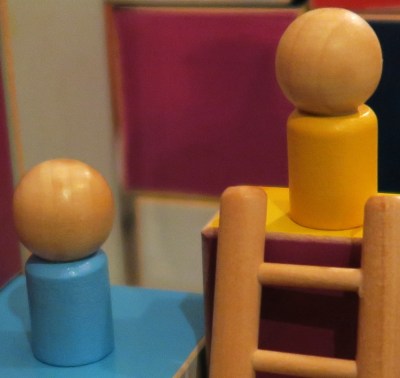
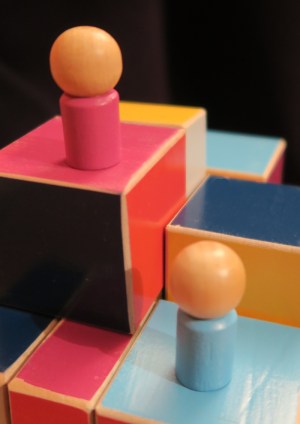
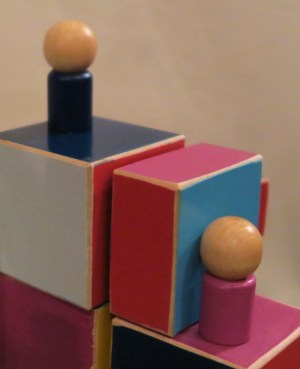
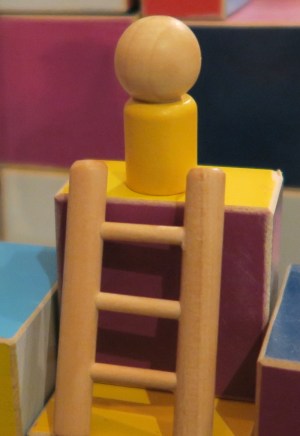
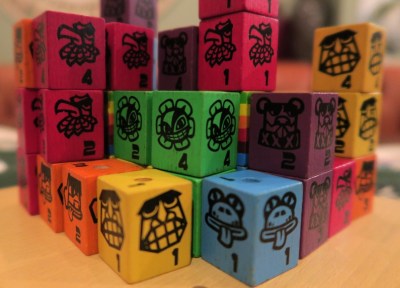
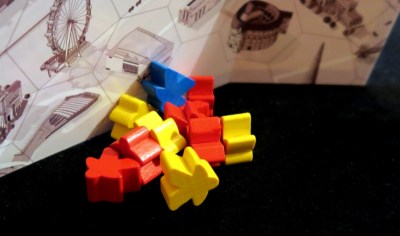
Different week, different people, different sickness, same late start…  After Burgundy had finished worrying the pub staff by changing his supper order (given how fast Blue can polish off a pizza he thought he might be able to eat a Hawaiian quicker than his usual ham, eggs & chips – he was wrong), we split into two groups, with the first playing the “Feature Game”, The Climbers.  This is a great three dimensional strategy game that looks like it is designed round a set of children’s building blocks. It’s appearance belies its true nature however, and, although it looks like a kiddie’s dexterity game, it is really a strategy game with almost no dexterity component at all.  Red and Magenta thought it looked cool and Burgundy had read the rules on line so was also keen to give it a go, so the group was pretty much self-selecting with Blue making up the foursome.

The Climbers
– Image by boardGOATS

We began by placing the two Triple-height blocks in the centre and randomly piling the rest of the bricks round it, covering all the visible surfaces, then Blue started explaining the rules.  It was at about this point that we realised that Burgundy had read a very different set.  The game was originally released in German as Die Aufsteiger.  Since it is very language independent, when they were  translated into English, a few changes were made to the rules and when the second edition was brought out the rules were revised again with some of the additions listed as optional variants.  This means that there are effectively three different sets of rules and to make things worse, lots of people have their own “House Rules” as well.  Since nobody had played it very much we decided to stick to the rules as written in the copy we had, without the addition variants.

The Climbers
– Image by boardGOATS

The game is played in turn order with each turn comprising three steps.  Firstly, the active player can move a block, any block so long as there isn’t anything on it, and they can place it anywhere, in any orientation as long as there is sufficient space.  Next the active player can move their Climber as far as they like within the rules.  Climbers can climb up any step below their head height unaided as long as the face they are climbing onto is grey or their own colour.  They can also use their long and/or short ladders to climb larger distances, but they are fragile and therefore single use (though that’s not very green as Red pointed out).  Finally, the active player may place a blocking stone which prevents a brick being moved or used until that player’s next turn.  Probably the most difficult part of the game is the concept of “space”.  There are three different sized coloured blocks:  Cubes (2a x 2a x 2a), Half-height (2a x 2a x a) and Double-height (2a x 2a x 4a).  These blocks have each face painted a different colour, the five that correspond to the player colours and one side that is grey.  There are also two Triple-height blocks that are plain grey and are the base of the setup.

The Climbers
– Image by boardGOATS

The square faces of the blocks can be considered to consist of four smaller squares – this is the basic unit (a x a).  This basic “a2” unit is sufficient space for one Climber.  Blocks can be placed offset, like bricks in a wall sitting on two or more other bricks, so long as these basic “a2” units are observed and remain whole.  The undersurface of each block must also have full contact with the blocks underneath – there cannot be any holes or overhangs.  If a Climber is sat in an inconvenient place, he can be “nudged” out of the way using a block, provided that he isn’t knocked off or moved onto a different block.  This can make space for placing a block, or for a Climber:  Climbers can only sit on their own colour or grey and need an “a2” unit each.  Thus, several Climbers can sit on a large grey face.  The winner is the player who’s Climber is highest at the end of the game.

The Climbers
– Image by boardGOATS

Red and Magenta started climbing one side, with Blue and Burgundy progressing up the other.  Red stole a bit of a march as everyone else got in each others’ way leaving Magenta to fight a rear-guard action on her side.  Meanwhile, Blue and Burgundy fought for supremacy, until Blue managed to extricate one of the large grey blocks and use it to simultaneously screw up Burgundy and create a second summit at a similar height to the one Red was occupying.  With this second peak to fight over, there were effectively two races competing against each other, but it wasn’t long before first Burgundy, then Blue and Magenta were forced to take a pause in climbing.  It was at this point that we realised the mistake we’d all made.  Players can choose whether to climb or not, but the game ends when all players successively don’t (or can’t) finish their turn on a higher level.  With all three of us failing to climb, that left Red with potentially the final turn.  Although she was highest, Blue and Magenta were blocks at the same height, so we had to invoke the tie-breaker which meant the first player to reach that level would win.  Since Red had got there first, she had no incentive to move and, in was thrilled to finish in first place in what had been a hard-fought game.

The Climbers
– Image by boardGOATS

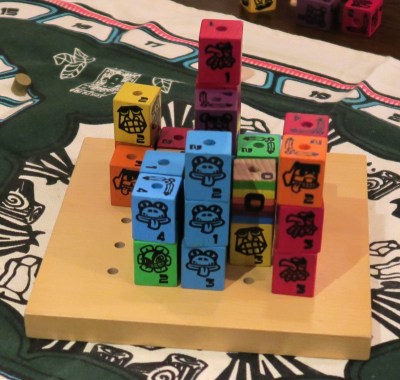
Green, Black and Purple joined the others playing with children’s building blocks, with a game of Totemo, an early Tony Boydell gem (he of Snowdonia and Guilds of London).  This game consists of of colored wooden blocks that have a small dowel attached on one end and a hole in the other. This allows them to be placed in the wooden peg-board.  The game starts with one of the multi-colored wild pieces placed in the center of the board.  Each player starts their turn with three wooden totem pieces.  To place a piece, all totem pieces it touches must abide by the color wheel.  So, for example, a purple block may be placed on its own or adjacent to purple, red or blue blocks; the more blocks it touches, the higher its score.  There are also several blocks with two feathers on top which are totem toppers and cannot be placed on the bottom level. In addition, no other totem piece can be placed on top of them.  Players can only place one totem piece per turn unless they land on a space seeded with a bonus marker.  At the start of the game, several bonus markers are placed round the board – landing on these enables the active player to place another block, up to a maximum of three.

Totemo
– Image by boardGOATS

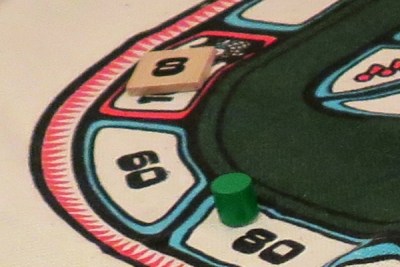
At the end of their turn, the active player replenished their set of totem blocks.  Each round, the start player moves the round marker until it gets closer to the tee-pee indicating the last round. Alternatively, the game can also end if there are no more totem blocks in the bag.  With apologies for not ironing the playing cloth and quick recap of the rules, the game was under way.  The first rounds were, typically, feeler rounds with players just trying to do the best they could.  Black and Purple had played the game many times before while Green, had played it only once and that was a few years ago.  Black and Purple managed to make use of the bonus markers by landing on the correct space on the scoring track and began to pull away from Green who was stuck with red bricks he could only place on their own since there was a predominance of blue bricks on the board.

Totemo
– Image by boardGOATS

This forced Green to change his strategy from simply trying to get the highest score possible to getting the exact score to land on a bonus tile and go again each time.  He started this new approach with a bang, placing all three of his blocks in one go and shot into a healthy lead.  Throughout the game players were each left with one or two blocks they couldn’t easily place, either because they were the wrong colour or were “toppers”.  The game took longer than it should have as everyone was guilty of over analysis at different times, but Black and Purple slowly caught up with Green, and going into the final round were both in the lead once again. Unfortunately neither could quite reach their respective bonus spaces and just added a modest amount to the final score. Green however, placed all three of his blocks and took the lead by more than ten points, with it winning the game.

Totemo
– Image by boardGOATS

With both games finishing together and nobody up for a late night we decided to opt for a large group game, and prompted by Magenta, we quickly settled on Las Vegas.  This is a very simple game where players begin their turn by rolling their dice, then they assign some of them to one of six casinos.  Each casino is numbered one to six and has a jackpot drawn at random from a deck of money.  Players must use all the dice of one number to bet on the casino of that number.  Once everyone has placed all their dice the player who placed the most dice on a casino takes the highest value currency card. The really clever bit is that before any money is handed out, any “draws” are removed, which leads to a lot of barracking.  This time we included the Slot Machine from the 2015 Brettspiel Advent Calendar.  This is like a seventh casino, except that it can hold dice of any number, but each number can only be added once (though a player must add all the dice they have of that number).

Las Vegas
– Image used with permission of BGG contributor punkin312

We also added the extra dice for more players from the Boulevard expansion, as well as “bigguns”, large dice which count as two in the final reckoning.  Green kicked off the first round, which turned out to be very unproductive for both Blue and Burgundy who struggled to get anything of any value.  Burgundy struggled in the second round as well, as did Black and their problems were compounded by the small number of high value notes that were repeatedly drawn.  Meanwhile, Red was struggling to keep her eyes open, so while everyone else was playing the long game, she was played her dice as quickly as she could then dozing while everyone else finished the round without her.  The problem with everyone playing small numbers of dice in the early part of the game and hanging on to dice for as long as possible was that it slowed the game down considerably, not that anyone really minded on this occasion.  It wasn’t until the last round that we began to realise that this strategy didn’t really work, a conclusion that was reinforced by the fact that a slightly embarrassed Red won the game, some $50,000 ahead of Magenta and Blue in second and third.

Las Vegas
– Image by boardGOATS

Learning outcome:  Sometimes sleeping through a game isn’t a disadvantage.

Next Meeting – 29th Movember 2016

Our next meeting will be on Tuesday 29th Movember, at the Horse and Jockey pub in Stanford-in-the-Vale.  As usual, we will be playing shorter games from 7.30pm as people arrive, until 8pm when we will start something a little longer.

This week the “Feature Game” will be The Climbers, which is an interesting and unusual 3D strategy game that looks like it is designed round a set of children’s building blocks.  With a couple of ladders and a blocking stone, it is the player who’s Meeple climbs the highest that wins.

The Climbers
– Image by boardGOATS

And speaking of climbers…

A little old lady, who lived on the third floor of a boardinghouse, broke her leg.  As the doctor put a cast on it, he warned her not to climb any stairs.  Two months later, the doctor took off the cast.

“Can I climb stairs now?” asked the little old lady.

“Yes, of course” he replied, “But don’t overdo it…”.

“Oh thank goodness!” she said. “I’m sick and tired of shinnying up and down that drainpipe!”

15th Movember 2016

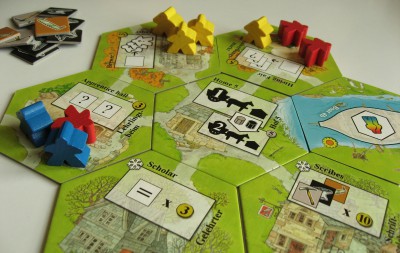
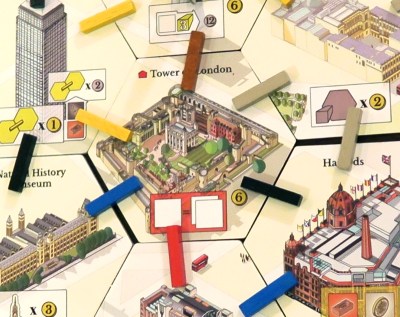
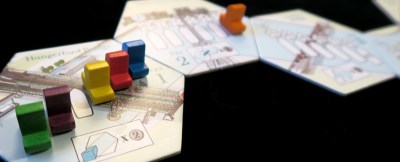
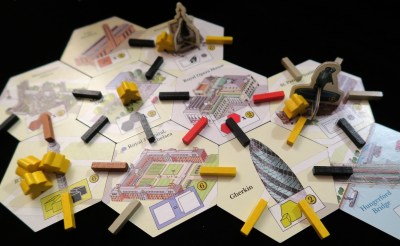
It was another very quiet night thanks to work commitments and illness, so we started late.  Our numbers were bolstered by the return of Yellow, who visited back in July when he was in the area for work.  Clearly we hadn’t frightened him too much last time and he made a return visit, bringing us up to a total of six.  This gave us two possible options: split into two groups of three, or play something with six players.  With six players, Keyflower is usually in the mix as it plays very well with that number, and indeed it had been part of the “possible plan” for the evening.  However, the “Feature Game” was Key to the City – London which also plays six and is a slightly more streamlined re-implementation of Keyflower.  Since everyone was keen to try it so we decided to give it a go with with the full complement.

Keyflower
– Image by boardGOATS

The basic structure of both Keyflower and Key to the City is actually fairly simple, but the strategy behind the games is much more complex.  Both games are played over four rounds with players bidding for tiles to add to their village/borough.  The bidding is particularly unusual as the currency is “Meeples” and, although bidding must increase and “follow suite”, it is free-form, i.e. all the tiles are auctioned simultaneously.  So, players take it in turns to bid, but as the round progresses, players have to decide whether to “spend” Meeples on bidding for other tiles, or whether to keep an emergency supply in case someone tries to out-bid them on a tile they really want.  Tiles are generally worth points at the end of the game, but most also provide some advantage when they are activated during the game.  This could be the provision of a resource, or it could be the opportunity to convert one resource into another.  Any tile in play can be activated by any player placing a Meeple on it.  So players can get a benefit from tiles belonging to other players, or even tiles that are still being auctioned.  Tiles can be activated many times, but each time, the cost goes up and the player must use an extra Meeple.

Key to the City - London
– Image by boardGOATS

When activating tiles, players also have to “follow suit”, so Meeples must be the same colour as any others already there, or, if the tiles is being auctioned, the colour should match any previous bids.  At the end of the round, any Meeples used to activate a tile are returned to the owner of the tile, thus, player’s are effectively paying Meeples to activate other players’ tiles.  And Meeples are valuable, very valuable.  The disadvantage for the tile owner, however, is that once their tile has been activated, they may not have enough Meeples in the correct colour to use the action themselves.  The round is over when every player has passed consecutively, at which point, all losing Meeple-bids are returned to their owner, all winning bids are placed back in the Meeple bag, all tiles are handed to the winner (or removed from the game if there were no bids) and any Meeples used to activate tiles go behind the owners player screen.

Key to the City - London
– Image by boardGOATS

Three of the players were familiar with Keyflower, but only one had played Key to the City before, as it was only released at Essen this year.  Although the basic structure of the game is the same, it is slightly simpler and more streamlined.  For example, in Keyflower, green Meeples are “special” and can only be acquired by activating certain tiles making them much rarer.  Thus, players with green Meeples have a big advantage when bidding and activating as it is much harder for other players to follow suit.  In Key to the City on the other hand, there are no green Meeples at all.  Similarly, in Keyflower, tile placement is very important as resources must be located where they are to be used and can only be transported by road (which needs activation in itself).  This is not a consideration for players of Key to the City, however, there is a different positional aspect to the game.  The octagonal wooden resource cylinders that feature in Keyflower are replaced by wooden utility “connectors”.  These are placed across the edge of a tiles and used to link tiles together.  At the end of the game, tiles that are connected together can score points for players with the correct corresponding scoring tiles.

Key to the City - London
– Image by boardGOATS

Another significant difference between Keyflower and Key to the City is the way the rounds end.  In Keyflower, players can continue taking it in turns to bid or activate tiles until everyone passes.  In addition to the village tiles, players can also bid for boats which determine the turn order as well as the number and colour of Meeples they get in the next round.  These are not present in Key to the City, instead, players have an additional, one-off option of “sailing”.  When a player passes, they can, as in Keyflower, rejoin the bidding in later turns if they wish.  In Key to the City, players can instead choose to sail, which finishes their round.  This is potentially dangerous as it leaves the player without the option to counter-bid if someone else outbids them.  However, there is an incentive to sail earlier as the first players to sail can choose to take the river tile (which give scoring opportunities) or start the next round, with the earliest adopters thereafter getting more Meeples to use in later rounds.

Key to the City - London
– Image by boardGOATS

With three players unfamiliar with both Keyflower and Key to the City we began with a rundown of the rules as well as highlighting the differences between the games for those who had played Keyflower.  Once done, as everyone looked at their final round tiles, Ivory asked what a winning score might be.  Simultaneously Blue and Yellow responded with “fifty” and “a hundred”!  A quick look through the book showed, much to Yellow’s dismay, that the group’s winning scores for Keyflower have generally been above seventy-five.  As everyone digested this and we began the first round rather tentatively as players were uncertain of the value of the different tiles.  Blue and Yellow were keen to avoid over-paying as they had knew how valuable Meeples could be later in the game when they can get scarce, consequently, they refused to couter-bid beyond their comfort zone and finished the first round with almost nothing between them.  Green, on the other hand, led the way and acquired a lot of tiles with Ivory, Magenta and Pine, all new to the game, following his lead.  It was towards the end of the round that the great rules debate happened.

Key to the City - London
– Image by boardGOATS

Yellow and Green had both sailed and the question arose whether sailing counted as passing, because if so, everyone had passed, if not everyone else could continue bidding.  Blue checked the rules which said, “If a player passes they can play again later, unless all the other players who have not already sailed also pass.  If all the remaining players also pass then all players sail in the order that they passed.”  Green was adamant that this could be read either way, and started checking on the BGG rules fora to see if there was discussion on the subject.  By the time he had established that there wasn’t, everyone else had decided that bidding should continue, had done the bidding the wanted and the round was over.  We muddled through the second round in a similar fashion with Yellow and Blue finally taking some tiles and strategies starting to emerge.  Pine and Magenta struggled with the implications and wider objectives of the game, while Ivory (also new to it) purred quietly in the corner as he began to get his head round the game, collected tiles and started to build a strategy.

Key to the City - London
– Image by boardGOATS

Magenta started out enticed by the monument tiles while Yellow, struggling to win bids started collecting river tiles and began connecting them and taking tokens to exchange for upgrades.  Ivory, still purring softly in the corner, managed to pick up tiles that required brown and red connectors as well as the Barbican which provided them.  Blue was trying to connect her tiles, but didn’t have the tiles to provide the connectors as they had mostly come out in the first round when she had failed to pick up any tile at all.  Pine was just starting to get his head round the iconography, but getting hold of connectors was proving challenging.  Meanwhile, Green was ominously winning the bids for the buildings that provide Skill tiles, including the Bank of England and the Senate House and seemed to be trying to re-implement his favourite Keyflower strategy.

Key to the City - London
– Image by boardGOATS

As we went into the last round and the final tiles were revealed, everyone looked round and tried to decide what they might get and how far they could to push their luck to get a few extra points. With everyone trying to upgrade their buildings, the need for Skill tiles was great and, since Green had a most of them, he received a lot of Meeples in return, most of which were red.  This inspired him to go for Lords Cricket ground which would give him two points for each one if he could secure it.  Green commented how much he hated cricket at which point he realised that he was winning both the Oval and Lords.  Blue took the Oval from him before Ivory went “all in” with a huge pile of red Meeples, with it taking about twenty points from her.  With their own projects to complete, nobody obstructed Green in his plans and he finished with a massive thirteen red Meeples (and the scoring tile) as well as a very large pile of Skill tiles.

Key to the City - London
– Image by boardGOATS

With the final round over, players began to add up their points.  Although six-player games can be epic, one of the disadvantages is that it can be very difficult to see what players at the opposite end of the table are doing.  Thus, it was only at the end when we went through the scoring that players could really see what everyone else had been doing and where they were getting their points.  Ivory, with his large pile of yellow Meeples, substantial sewage and underground systems finished with a very creditable sixty-six.  This score was exactly matched by Blue who had a vast telecom’s network and had picked up a couple of monuments which she had managed to upgrade to get the full twelve points. It was Green however who finished with the highest score, nearly twenty points ahead of Yellow and Blue thanks largely to a massive twenty-six points for his pile of red Meeples and much the same again for his Skill tiles.

Key to the City - London
– Image by boardGOATS

As we packed up there was the inevitable postmortem.  Magenta and Pine could both see how clever the game was and were keen to give it another try now they had a better understanding of its flow.  Ivory had really enjoyed it too and was also keen to give it, or (Keyflower) another go.  The others focused on the comparison between Key to the City and Keyflower.  Green said he strongly preferred the artwork for Keyflower, while Blue felt that the axonometric projection and sharper style was better suited to the London theme.  She also commented that if Key to the City had been released first, it would have received all the plaudits and Keyflower would have felt “more fiddly”, consequently, perhaps Key to the City was a better game to learn with.  The overwhelming consensus though, was that a typical game collection didn’t really need both, but we’d happily play either.  As Magenta and Ivory headed off, discussion moved on to the current KickStarter for Keyper, which it turned out, two of us had backed, but we won’t see more of that for another year.

Isis and Osiris
– Image by boardGOATS

There was just time for a quick game to close with, and we settled on Isis & Osiris.  This was a another game picked up at Essen and had got its first outing two weeks ago.  Green was the only player who had been part of that game however, so we all needed a run-through of the rules, which were simple enough.  At the start, players are dealt a pile of tiles, face down, and get a handful of octagonal wooden blocks in their colour.  Game play is very simple: on their turn, the active player can either place a tile face down, first showing it to everyone else, or they can place a block.  At the end of the game, all the tiles are turned face up and players score points for those tiles orthogonally adjacent to their blocks.

Isis and Osiris
– Image by boardGOATS

As players played their wooden blocks, the following players turned over negative tiles and placed them next to them, ensuring lots of negative scores.  As more and more negative tiles put in an appearance, we were all wondering what had happened to the positive ones.  By about half-way through we were were certain they had to appear soon, but with four players, some of the tiles are removed from the game, and we were all coming to the conclusion that those tiles were all the high scoring ones. As it turned out, that wasn’t quite the case, though the balance of the tiles in the box was definitely on the positive side.  Once all the spaces had been filled, we turned over the tiles and it became clear that one wooden block made all the difference.  With three of us finishing with negative totals, it looked a lot like the score line from an episode of QI, but it was Pine that finished with a massive “plus seven QI points” to win the game.

Isis and Osiris
– Image by boardGOATS

Learning Outcome:  Some games need to be played more than once.

Boardgames in the News: A Good Feed

Some people follow blog using Twitter, FaceBook or Tumblr., but for those that don’t use these social media channels, keeping track of posts to the boardGOATS page can be a pain.  There is a fourth alternative though, the RSS feed.  RSS uses a family of standard web feed formats to publish frequently updated information.  Subscribing to a website RSS removes the need for the user to manually check the website for new content. Instead, their browser constantly monitors the site and informs the user of any updates. The browser can also be set up to automatically download the new data for the user.  The boardGOATS feed is boardgoats.org/feed/.  To subscribe, click on the link and follow the instructions at the top of the page.

RSS
– Image from slack-edge.com

Boardgames in the News: Mark Watson’s Inner Child

As has been well documented, as adults playing boardgames has become increasingly acceptable, there have been more frequent articles in the national press.  This includes a regular column in the Guardian as well as television features.  Most recently, a documentary on our “Inner Child” presented by the comedian Mark Watson was broadcast on BBC Radio 4 on Saturday.  The program starts discussing adults sliding down slides and swinging on swings and moves onto a visit to the boardgames café, Draughts, about two minutes before the end.  It is just a short segment in a longer program, but Perudo, Nautilus, Hey, That’s My Fish!, Knit Wit get a mention as well as more well known games Kerplunk, Hungry Hungry Hippos and Articulate!.

Mark Watson
– Image from bbc.co.uk

The whole article will be available on the BBC iPlayer until the middle of December.

Boardgames in the News: International Games Day 2016

Saturday 19th November is International Games Day.  This event is to highlight the fact that modern libraries are about much more than books.  The annual event was started nine years ago by the American Library Association (ALA) in collaboration with the Nordic Libraries “Nordic Game Day”.  Over a thousand libraries world-wide will be showcasing games, so if there is a an event at your local library why not go along?  This year there isn’t an event in Oxfordshire, however, we have contacted Oxfordshire Library Service (part of Oxfordshire County Council) and suggested they organise something for next year.  The more people that ask, the more likely they are do something for 2017, so please join us and let them know if you think Oxfordshire should participate too.

International Games Day
– Image from igd.ala.org


Next Meeting – 15th Movember 2016

Our next meeting will be on Tuesday 15th Movember, at the Horse and Jockey pub in Stanford-in-the-Vale.  As usual, we will be playing shorter games from 7.30pm as people arrive, until 8pm when we will start something a little longer.

This week the “Feature Game” will be Key to the City – London, which is a streamlined version of one of our favourite games, Keyflower.  Released at Essen and themed around the City of London, each tile features an iconic landmark, and players “buy” these tiles and add them to their boroughs.  The game uses many of the same mechanisms as Keyflower, with an additional connection element that simplifies and enhances the spacial component of the game.

Key to the City - London
– Image by boardGOATS

And speaking of London…

Jeff and Joe had gone to London looking for work. were strolling down Bond Street.  After walking for a few minutes, Jeff turned to Joe with a look of amazement on his face.  “Joe!  Look at that shop over there – I thought that London was supposed to be expensive, but that shop is as cheap as chips!”

Joe replied, “Wow – suits £10, shirts £4, trousers £5.  I think that we should buy the lot and take them back with us – we would make a tidy profit selling them in Oxford.”

So the two visitors went into the shop, where Jeff was greeted politely by the owner. Jeff, doing his best to sound local, said, “I’ll ‘ave twenty of yer ‘Whistles’, twenty ‘Uncle Berts’ and twenty pairs o’ ‘Callards’ please.”

Upon hearing this request, the owner smiled, and said, “You’re not from round here, are you?”

Quite bemused, Jeff responded, “No, how can you tell?”

The Owner replied, “This is a Dry Cleaners.”

1st Movember 2016

Blue and Red arrived first, with Red telling the tale of her exciting weekend.  It wasn’t long before Burgundy, Pine and Green had arrived so, at Blue’s behest, Red began telling it all over again.  She had been part of a teem entered into to a twenty-four hour “jigsaw-a-thon” in Belgium.  The Unofficial World Jigsaw Puzzle Championship is held every year in a place called Hannut and includes teams from all over the world.  This year, there were one hundred and twenty four teams, each fielding four active members at any one time (though as many interchanges as required were allowed).  Each team was competitively “jigsawing” in a little pen, Red explained, and when a puzzle was finished the team involved cheered madly and set off a klaxon.  Red’s team came a very creditable fifty-ninth, which was particularly remarkable as they had primarily gone along to have a good time where other teams took it very seriously and were exceptionally well organised.  Everyone was quite taken with the idea though, so much so that Green suggested entering a GOATS team next year.  It remains to be seen whether that actually happens…

Hannut 2016
– Image from 24hpuzzle.be/flickr.com

Green had his own exciting tales to tell about his visit to Millbrook Proving Ground and Burgundy had been to Wembley to see the season’s last American Football match of the NFL International Series which had turned out to be “a great game for neutrals”.  Consequently, it was gone 8pm before we realised that Black and Purple still hadn’t arrived and nobody knew whether they were coming or not.  Texts followed just as Black and Purple walked in commenting how great the NFL match had been.  Needless to say, we were late starting as we chatted on about that again.  Eventually, we split into two groups, with Green, Black and Burgundy settling down to play the “Feature Game”, Batavia.  Batavia was the Dutch colonial name given to the Indonesian city of Jakarta from the seventeenth century.  Batavia was also a ship of the Dutch East India Company (Vereenigde Oost-Indische Compagnie, or VOC) that was built in Amsterdam, and shipwrecked on her maiden voyage in 1629 off the Western Australian coast.  The game, Batavia, on the other hand, is concerned with shipping commodities from the spice islands in the seventeenth century and features both the city Batavia and the ship Batavia.

Batavia
– Image used with permission of
BGG reviewer EndersGame

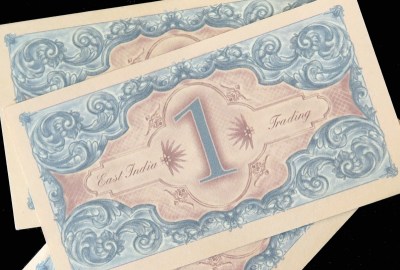
Batavia is played over several rounds on a map of Asia featuring the central islands of the spice trade route.  Players are merchants visiting trading posts of the five East India Companies throughout Asia, gaining “majorities”, which earn the right to different commodities, which in turn translate into money that wins the game.  Each round consists of two phases:  an auction phase and a movement phase.  In the first phase, a die is rolled to determine how many cards will be auctioned.  Then, players bid using their promissory notes increasing the bid until everyone has passed with the highest bidder winning the cards and the right to go first.  The interesting part is that the winning bidder does not pay the bank, instead paying the other players by dealing the promissory notes round the table.  This is a very clever balancing mechanism, because it means the total number of promissory notes in circulation remains unchanged throughout the game.  Players who fail to win an auction also have in increased chance of winning the next time, and promissory notes are worth bonus points at the end of the game, giving them an intrinsic value in their own right.

Batavia
– Image used with permission of BGG reviewer EndersGame

One the auction has been completed the auction winner begins the movement phase.  Each player has a choice, they can take two cards or play ship cards and move their merchant figure to get a new trading post counter.  Ship cards can only be played if the active player has, or can can achieve a majority of cards in one of the five trading companies – cards are played into a tableau and the player with the most cards of a particular shipping company gets the corresponding Company Seal which indicates possession of the majority in that company (and can be taken from another player if necessary).  Thus a player with a Company Seal can play any cards they wish, but if they do not have a Company Seal, they must play enough cards to earn the right to get one, and then can play additional cards as well.  In other words, if a player does not have any of the Company Seals, and can’t play enough cards to get one, then they must draw two cards instead.  Once the active player has played cards and has at least one Company Seal, they may move their Merchant figure along the hex-track to a trading post counter that corresponds to one of the Company Seals they own.  They take this tile which represents gaining the matching commodity from that trading post and is marked by placing a wooden Crate in the appropriate warehouse for that commodity.

Batavia
– Image by boardGOATS

Once a player has played their cards and moved their Merchant, they may, if they wish, turn their hex-tiles into points (or Gold).  The commodities on the tiles are of no significance, but the tiles traded must be from different companies; the more a player trades, the better the return, i.e one tile gives one point, but five tiles (from each of the five different companies) yields a massive fifteen points.  There is a catch though, trading is prohibited if the hex-tile just acquired comes from a company that the player already had a counter for.  Worse, trading post tiles cannot be turned into points at the end of the game, which means decisions can be tense, especially towards the end of the game.  There is another catch though.  Every time a ship card is played, the token that corresponds to that shipping company is moved along the Pirate track, as is the Pirate cannon.  When the cannon reaches a certain point, players forfeit all cards that correspond to the shipping company token that has made it the furthest along the Pirate track.  This fulfills many functions, including ensuring the number of cards in play doesn’t become unwieldy and preventing one player from getting an unassailable majority as well as encouraging players to diversify.  The game end is triggered when one player reaches the end of the trading post track and the round is finished to ensure everyone gets an equal number of turns.

Batavia
– Image by boardGOATS

We had nearly completed the set up when we discovered several pieces missing from the box that had been used elsewhere and not returned.  Rather than abandon the game though, we scavenged bits for the company seals and ‘navigator’ pieces from other games, primarily Vasco da Gama (at least some part of that game is being played).  With that sorted, we were quickly under way.  The early rounds of the game were characterised with high dice rolls, meaning that there were a lot of cards available for each auction that both Burgundy and Green paid handsomely for.  While Burgundy and Black made steady progress, laying claim to a few different commodities, Green raced ahead concentrating on just nuts and vases, the two highest valued commodities available in the game at that point. Black, on the other hand, won so few auctions that he had to miss his turn twice, collecting just two cards instead.

Batavia & Vasco da Gama
– Image by boardGOATS

During the early part of the game we discussed the optimum number of trading post hex-tiles to a swap for points.  The more a player trades, the better the return, i.e one tile gives one point, but five tiles (from each of the five different companies) yields a massive fifteen points, but more is correspondingly more challenging.  Burgundy explained that he felt that three was a good number as four was rife with risks of not being able to get one of the two remaining companies available. He stuck to his guns and exchanged after just three chits, while Green and Black both managed a four relatively easily.  Elsewhere in the  game, Cloth and Coffee were conspicuous by their absence, until about half way when Cloth materialised creating a veritable textile market quarter.  Coffee didn’t become available until the second half of the game and two thirds turned up in the final ten spaces, but by then Green was so far ahead of the other two that neither of them stood much of a chance to even get a foot-hold in that particular racquet.

Batavia
– Image by boardGOATS

In the end, although Burgundy had placed more crates overall, he only had the majority in one commodity, while both Green and Black managed the majority in two each. However with Green snatching the most valuable majorities and the end Target Token he was a clear winner. Black, who had seemed to be on the back foot for most of the game, just snatched the bonus for finishing with the most promissory notes (everyone must have been pretty even handed about their assumptions of card values, to finish with almost exactly the amounts we started with).  When Green snatched that final trading post hex-tile, Burgundy and Black were both a long way behind and plans were scuppered, but it did mean they had a reasonable choice to gather a final useful token.  Ironically, Burgundy placed a final crate in Cotton, which removed Black’s majority there. If he hadn’t done that, Black would have beaten Green by one point. It just goes to show that the player to watch out for isn’t always the most obvious one.
Batavia
– Image by boardGOATS

Meanwhile, on the next table, after a short debate about what to play, Blue, Red, Pine and Purple started on Kerala: der Weg der Elelfanten, “the way of the elephant”.  This was one of the games that came back from Essen and, as a light tile-laying game got its first outing last time.  Pine and Purple had enjoyed it and Red had missed out last time so was keen to give it a go.  The idea is that on their turn, the active player draws the same number of tiles from the bag as there are players and then chooses one to add to their display of tiles.  The everyone else takes it in turns taking a tile and adding them to their own display.  Play is mostly simultaneous as players puzzle over where to add tiles according to the fairly simple rules.  Tiles must be placed next to a tile with an elephant on it and the elephant is then moved onto the new tile.  It can be placed in an empty space, or on top of a previously laid tile.  However, a large part of the game is to finish with exactly one contiguous region of each colour (except the player’s own colour which can have two regions) as any extras must be removed and each tile taken away scores minus two points at the end of the game while any missing colours score minus five.
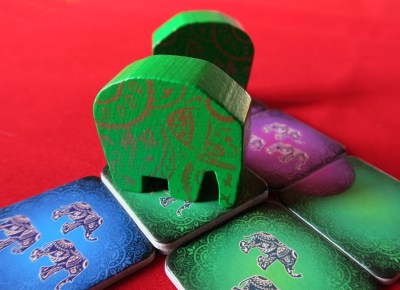
Kerala
– Image by boardGOATS

Blue drew with Black drew last time, thanks to a large number of “apron” tiles which score five points each when placed so that the apron matched the correct colour.  This time, everyone else was wise to how valuable these were and Blue had to fight harder for points.  In this game, positioning elephants and choosing suitable tiles (or leaving everyone else with poor tiles) is everything.  Both Purple and Pine and pine got themselves in a bit of a tangle with multiple regions of the same colour.  For the most part though, by the end of the game they had managed to connect the relevant areas and minimise the number of points lost.  It was Red, playing for the first time who got the best of the tiles.  She was no doubt helped by the fact that Blue (sat to her right), got herself in a terrible tangle and ended up trying to build her way out of trouble by placing tiles on top of others.  The problem was that no sooner had she fixed one problem than another came along, which meant she was more concerned about choosing the best tiles she could for herself than leaving tiles that were difficult for the next players.  Once again, the game finished in a tie, but this time it was Pine and Red who finished in joint first place, nearly ten points clear of the others.

Kerala
– Image by boardGOATS

Batavia was still underway, so the group moved onto a nominally quick little card game, called Fleet Warfside.  Although the game is about the fishing industry and uses the same artwork as the original Fleet card game, the game play is quite different.  The idea is that Wharfside is the sequel, with players buying and selling fish (caught in the original Fleet).  Players begin the game with a handful of fishy goods cards which they can use as currency or trade for points.  In ascending value, the goods cards each represent shrimp, oyster, tuna, swordfish, lobster or king crab.  Thus, two oyster cards are worth more than two shrimp cards and two king crab are worth more than two of anything else.  However, an extra card will always be worth more so three shrimps for example is worth more than two of anything else, even the valuable king crab.  Over-paying is allowed, in fact, it is over-paying that means the game works as, at its core, Fleet Wharfside is a set collecting game, and players need to be able to cover all the bases as prices are constantly changing.

Fleet Wharfside
– Image by boardGOATS

On their turn, players can either carry out a Market action or use the Wharf.  Market action involves buying contract or building card from the face up Market.  The price of each of the four individual cards is set in advance and is given by an indicator card immediately above the contract cards.  When a card is bought, the price of one of the four cards will change as the indicator card is rotated (usually increasing the price).  The Market affected depends on the replacement card drawn.  Instead of carrying out a Market action, players can instead visit the Wharf.  This allows them to do a variety of actions including: use any special abilities that come with the contract cards; assign a maximum of two goods to contracts and store king crab for scoring at the end of the game.  If a contract is completed during this phase, the assigned goods cards are placed on the discard deck and the completed contracts removed from the player’s tableau and placed in their scoring pile.  Bonus points cards are awarded for the first and second contract of each type to be completed.  A Wharf action is finished with a visit to the Wharf where players can take two cards from one of the two pools of face up cards.  There is a hand-limit, but players can choose which cards to discard after they have picked up.

Fleet Wharfside
– Image used with permission of BGG reviewer EndersGame

The game end is triggered when a player completes a set number of contracts and the round completed so everyone gets the same number of turns.  Points are scored for completed contracts/buildings (at face value); stored king crab (at a rate of one per card plus a bonus for the player with the most); contract completion bonuses; the largest set in-hand at the end of the game (one point per card), and the player’s personal Captain Bonus (each player gets a random Captain card at the start of the game which depicts one type of goods and the player scores one point per speciality on their completed contracts).  Blue and Pink played Fleet Warfside on their way to Essen last month, but otherwise it was new to the group.  Although it is a great little card game, it is not really like anything else we’ve played on a Tuesday, and as a result, everyone struggled a bit.   Things were made worse by the fact that nobody really used the ability to over-pay, nor did they use the any two for one, which when judiciously used can speed things a long quite a bit.  When explaining the game, Blue commented that although the goal was to finish contracts, in actual fact it was generally better to try to keep the maximum of three contracts for as long as possible, as each contract has a spacial power and as soon as a contract was fulfilled, its power was lost.  Although this comment was well-meaning, it only succeeded in confusing Pine and Purple further.

Fleet Wharfside
– Image used with permission of BGG reviewer EndersGame

The effect was an endless stream of questions and queries and repeated questions and queries which gave Red a fit of the giggles. The advertised time for Fleet Warfside is twenty to thirty minutes, but although Blue was expecting it to take longer, even she wasn’t expecting it to drag on as long as it did.  The problem was made worse since its sweet-spot is probably three players and with people agonising over what to do and questioning what the options are, the effect was even worse than it was.  Unsurprisingly given that she was the only one to play it before, Blue finished as the winner five points ahead of Red in second place.  Sadly, although it is a clever little game, with this group it was not a great success this time.  Actually, it may be that the more abstract, less visual nature of card games is the problem, since the same people struggled with Port Royal Unterwegs last time and with Oh My Goods! the time before – perhaps something to keep in mind for the future.

Isis and Osiris
– Image by boardGOATS

Since Batavia had finished, Green, Burgundy and Black looked round for something to play that might fill the time while Fleet Wharfside ground on.  Green’s eye fell on Isis & Osiris, a little game that Blue and Pink had brought back for him as a present from Essen.  The pieces  needed removing from their frames and nobody had played it before so there a flurry of rules reading, though in truth it was a simple enough game.  The game comprises elements of strategy and memory.  At the start, players are dealt a pile of tiles, face down, and get a handful of octagonal wooden blocks in their colour.  Game play is very simple: on their turn, the active player can either place a tile face down, first showing it to everyone else, or they can place a block.  At the end of the game, all the tiles are turned face up and players score points for those tiles orthogonally adjacent to their blocks.  The catch is that the tile values range from minus four to plus four (with no zeros), i.e. are both positive and negative.

Isis and Osiris
– Image by boardGOATS

After the inevitable terrorism comments, we started.  The skill in this game is to not only remember where all the best scoring tiles have gone, but also to work out when and where to place your own piece in order to maximise those tile placements: if someone turns up a high negative tile they certain to try to place it next to your piece and away from their own.  While playing we soon realised that a real quandary was when to place the four wooden pieces. Placing them early ensures they are out and gets a large part of the board covered.  Alternatively, waiting until near the end gives a better idea of where the scores are, but leaves less spaces in which to actually get those points. On reflection it seems that it really needs to be a balance, going early or late will probably end up with being boxed out of controlling your own destiny (not that you feel like you have much control normally anyhow).

Isis and Osiris
– Image by boardGOATS

We were unsure what kind of scores we would get. We had the feeling it was one of those game where negative scores would be all too common, and even a single point might be the winning score In the end the scores were a little higher than that at four, five and eight.  Burgundy admitted to forgetting where the scoring tiles were very early, on but still went on to win. It’s not clear what that says about this game, though we would need to play it a couple more times to find out how “random” it really is. With good players with good memories it could be a very challenging game.  Still it did only take the twenty minutes claimed (including set up, explanation and confusion during scoring) which makes it a good filler, which is more than could be said for Fleet Warfside on the next table which was still going.  It was obvious they would be another half hour or so, so with no messing our old favourite Splendor was out of the box and ready to go.

Isis and Osiris
– Image by boardGOATS

In Splendor, players have just three options on their turn:  collect gem tokens, buy a gem card using gem tokens (and/or cards), or reserve a gem card and receive a gold (wild) token at the same time.  Players can have a maximum of ten tokens, though unlimited cards and the cards act as permanent tokens.  Thus, at its heart Splendor is an engine building game built on a set-collection mechanism.  Players score points when they buy some gem cards and for attracting Nobles which are awarded to the first player collect certain combinations of gem cards; the game end is triggered when one player reaches fifteen points and the player with the most at the end wins.  One of the fun things about this game is that, despite its relative simplicity, each game plays differently.  This time it seemed to be a token-heavy game, in other words everyone did a lot of token hoarding, keeping several key colours out of circulation, making progress in a particular colour tricky for everyone.  As a result a number of gold tokens were taken for very lowly cards, several level twos and even a couple of level one cards. Indeed, Black took gold several times for want of anything better to do, since nothing else looked helpful.  The lack of tokens seemed to weigh particularly heavily on Burgundy in the early parts of the game, giving Black and Green a little optimism that maybe this time they might be able to topple him for the first time in four games.

Splendor
– Image used with permission of boardgamephotos

Overall it was a very tight game. Burgundy, in spite of his protestations of having nothing he could do, managed to take the first Noble card. Black quickly got another with a high scoring card, leap frogging him into a strong lead and Green wasn’t far behind in gathering his first Noble.  Burgundy was able to build on his first Noble (one with three cards in each of three colours) by adding just two more cards to give his second Noble and put him within a whisker of ending the game with fourteen points. At this point, Black recognised that this could be his last turn, but he needed two turns to complete his plan. He did the best he could and also reached fourteen points.  Green went next, but his plan worked out just in time, and he placed a reserved card worth three points giving him his second Noble in the same way that Burgundy had and helping him to fifteen points triggering the game end making it the last round.  Unfortunately,  thanks to the turn order, Burgundy got one final turn and it didn’t take a lot of effort to find a way to gather two more points to maintain his Splendor crown, albeit with a warning shot across his bows: next time we’ll get him, maybe.

Splendor
– Image used with permission of BGG contributor henk.rolleman

With Fleet Warfside finally over, Red there was still time one final short filler, and, after a quick discussion, we resorted to our old favourite, 6 Nimmt!.  While Burgundy shuffled, the rest of us engaged in a discussion as to when we last played – after a look through the book, the verdict was July, which only left us to decide whether that was “ages” or not.  We reminded ourselves of the rules:  players simultaneously choose a card, then simultaneously reveal them before playing them in ascending order placing each on the row finishing with the highest card that is lower than the card being played.  When the sixth card is added to a row, the first five are taken and the number of heads contributes to the player’s score, lowest score wins.  We tend to play a variant over two rounds with half the deck in each round and not resetting the table in between which tends to result in a cascade of points in the second round, and this time was no exception.  Black and Burgundy top scored in the first round with zero and one point respectively and nobody else close, setting up a head to head in the second.  Victims of the second round cascade, unfortunately for them, Black and Burgundy both had disastrous second round.  It was Red who redeemed a poor first round to win by one point from Purple and Green who finished in joint second place.

6 Nimmt!
– Image by boardGOATS

Learning Outcome:  Card games are more abstract and sometimes more difficult to understand.
Autumn 2016 Oxford Meeples Big DoG

On Saturday, Movember 12th, Oxford Meeples is again opening the doors of Wolvercote Village Hall to the general public once more and inviting people to join them for another Big Day of Gaming.  As usual, the Oxford Meeples will be bringing a large number of their games, but everyone is welcome to bring their own too.  The hall opens at 10 am with gaming starts from about 10.30 am and continuing ’til late.  Entry is free, although donations towards rent of the hall and refreshments will be appreciated.  Children are welcome when accompanied by an adult.  Several of the GOATS are hoping to attend, but that will depend on weather and other commitments as usual.

Oxford Meeples Autumn DoG '16
– Image from oxfordmeeples.org