Author Archives: nannyGOAT

Golden GOAT Award Winners – 2024

This week was the annual boardGOATS Un-Christmas Dinner including the voting to decide the winners of the GOAT Awards.  There are two main awards:  the Golden GOAT for our favourite game played during the year and the GOAT Poo Prize for our least favourite.  Everyone had the usual three points to hand out for the Golden GOAT Award (plus a bonus if wearing Festive Attire), though a maximum of two points could be given to any individual game.  Everyone could also nominate up to two individual games for the GOAT Poo Prize.

Tonga Bonga
– Image by boardGOATS

This year, the unofficial “Marmite Award” went to Viticulture—something many people seemed to find quite a surprise as it is generally not a divisive game and one that few would usually take offense at.  There had been a lot of fun throughout the year, but one of the more memorable moments was Pine getting the end game rule wrong for Tonga Bonga, so that Pink thought he’d won, but then didn’t.  There were several nominations for the GOAT Poo Prize, including King of Tokyo, Rolling Realms and Ark Nova, but the winner was another surprise: Ca$h ‘n Guns—not a game the group plays often, indeed it doesn’t get played at all at the pub (for obvious reasons), so its only outing over the last year was at the New Year Party.  It can be a lot of fun, but it is also easy to see how some might not like the game.

Ca$h 'n Guns
– Image by boardGOATS

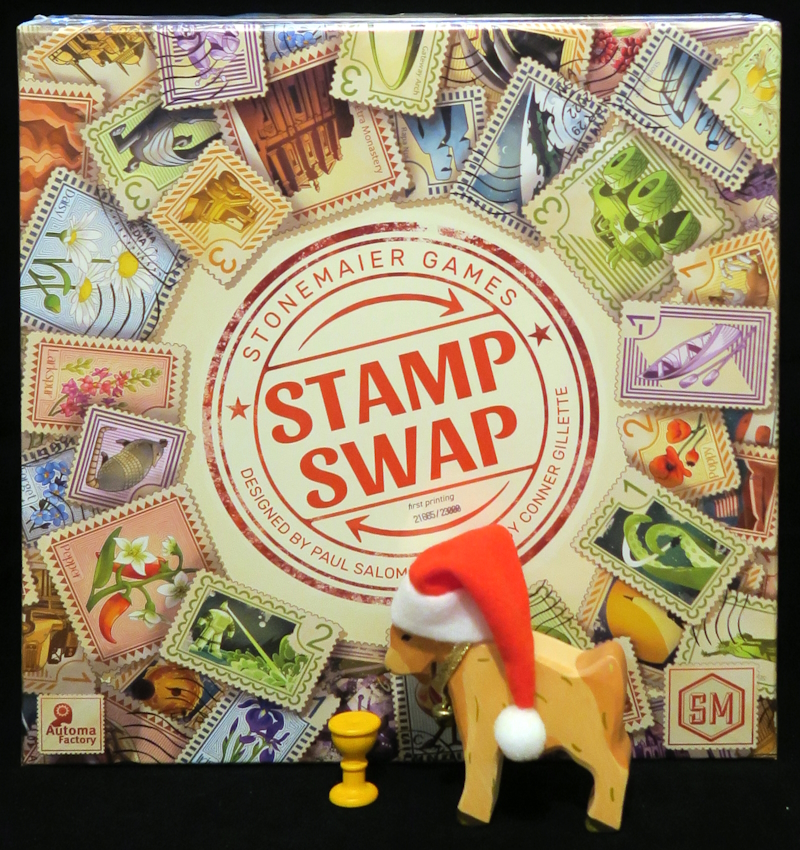
Then finally, there was the Golden GOAT Award for the best game played in the year.  Previous winners were ruled out, but there were plenty of other great games to choose from.  The most popular of these were Akropolis, Kavango, Flamme Rouge and Ticket to Ride: Rails & Sails.  However, the clear winner was Stamp Swap.  This is a new game, only released in September, but was an immediate hit, largely thanks to its silky-smooth game play.  As one person commented, “I wouldn’t have thought a game about stamp collecting would be up my street, and yet…”

Stamp Swap
– Image by boardGOATS

Perhaps more remarkably, this is the third winner from Stonemaier Games after Tapestry last year and Wingspan in 2019—three very different games.  This led to the perhaps slightly tongue-in-cheek suggestion that the group should invite Jamey Stegmaier to visit so we could present him with the actual Golden GOAT in the manner of the Jules Rimet Trophy

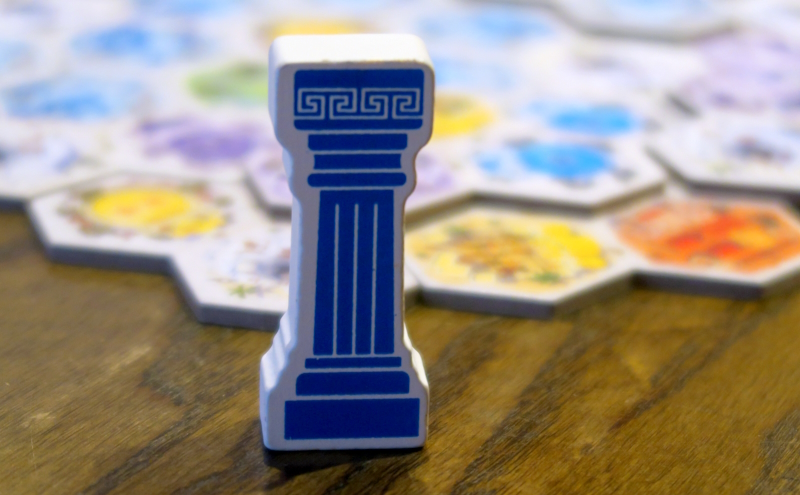
Golden GOAT - 2024
– Image by boardGOATS

Next Meeting, 10th December 2024

Our next meeting will be Tuesday 10th December 2024 at the Horse and Jockey pub in Stanford-in-the-Vale.

As this is our Christmas party we will be meeting early from 6.30pm
with food at around 7pm followed by Christmas festivities.

This week, the “Feature Game” will be Courses De Rennes (aka Reindeer Races; review, “How to Play” video & rules), followed by a range of Christmas and winter themed games like Jokkmokk: The Winter Market, Santa’s Workshop, Christmas TreeSnow Tails, Carcassonne: Winter Edition, Gingerbread House and Ticket to Ride: Nordic Countries.   In Course des Rennes, players control a team of four reindeer, racing to try to get the highest-scoring tiles.

Course des Rennes
– Image by BGG contributor chansen2794

Speaking of reindeer…

Joe and Jeff were admiring the reindeer at Appleton Barn.  He was particularly impressed with the decorations on their antlers.

Jeff asked, “Do you think we could just buy some hornament like that?”

“No,” replied Joe, “I think they’d be too deer…”

26th Movember 2024

Plum, Jade, Sapphire and Mint were first arrive, and while they were waiting for food, settled down to a game of Hiroba, a sort of board game “Sudoku” where players place their numbered pebbles to take control of the most gardens.  As in Sudoku, players must never have two pebbles of identical value in the same garden, row or column.  After a couple of false starts the group eventually figured out the rules.  This time, Sapphire got in early with the lowest stone number between two Koi carp ponds, ensuring he got both. Plum only got two ponds, so although she got a reasonable number of areas, others overtook her by using the Koi pond multipliers.

Hiroba
– Image by boardGOATS

Food arrived during the game, and some were still eating when the final count (and recounts) took place.  Despite Sapphire’s great start, Mint’s total of thirty-five gave her victory by a single point pushing Sapphire into second and leaving Plum in third.  Meanwhile, since Hiroba was underway when Cobalt arrived, he settled down to a solo game of Explore & Draw, the Roll & Write version of Isle of Cats.  The game play is similar with players now drawing polyomino shapes on their ship board, but choosing a set of cards each round instead of drafting them.  In the solo game, the player is competing against his “sister” and this time won by forty points to her thirty-six.

Isle of Cats: Explore & Draw
– Image by boardGOATS

Once everyone had arrived (except Teal who had given up battling the crazy flood-water and gone home) and had finished eating, it was time for the “Feature Game” which was to be Rolling Realms/Rolling Realms Redux. This was advertised as a light roll and write game, but turned out to be rather more involved than everyone expected.  It was developed during the global pandemic as a print-and-play game, but has since been released as two professionally produced games.  Each game consisting of a number of small games based loosely on other games, with more are available to be purchased separately.

Rolling Realms
– Image by boardGOATS

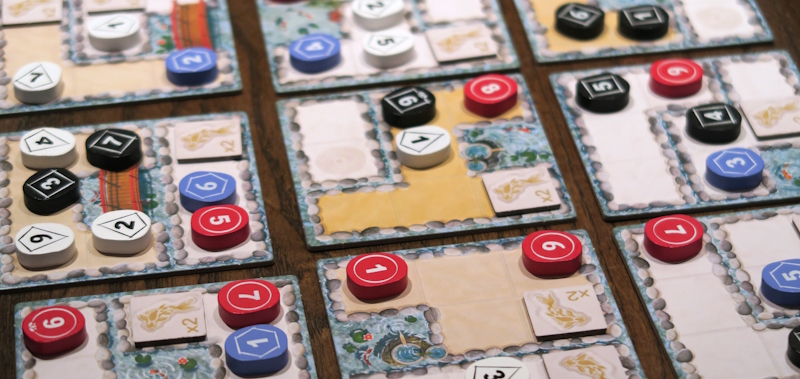
The idea is that players choose three “mini-games”, or “Realms” for each of three rounds.  Then, two dice are rolled and allocated separately to two of the three games.  After nine rolls, players add up the number of starts they’ve achieved in the round.  The winner is the player with the most points after three rounds.  With three copies of the game and several people familiar with it, it should have been a relatively straight-forward game, but with so many different mini-games, players effectively had to learn the rules each round.  As the games play six and there were three copies, the group decided to play one large game. and started with the same three mini-games, based on three of our favourite games, Tapestry, Meadow and Flamecraft.

Rolling Realms
– Image by boardGOATS

And this was where the first problem arose.  The Tapestry mini-game was quite straight-forward, with players trying to fill their grid using polyomino shapes.  However, Meadow and especially Flamecraft, both from the Redux version of the game were more difficult to understand.  The Meadow mini-game was based on the card market with players choosing “cards” and using them to score points and collect resources.  The Flamecraft mini-game caused a lot of confusion with different “Enchant” and “Gather” actions, which are loosely based on the actual game, but it took a while to work out what they did and how to use them.

Rolling Realms
– Image by boardGOATS

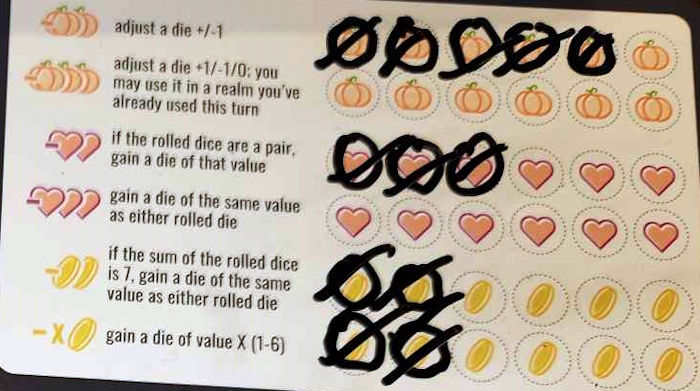
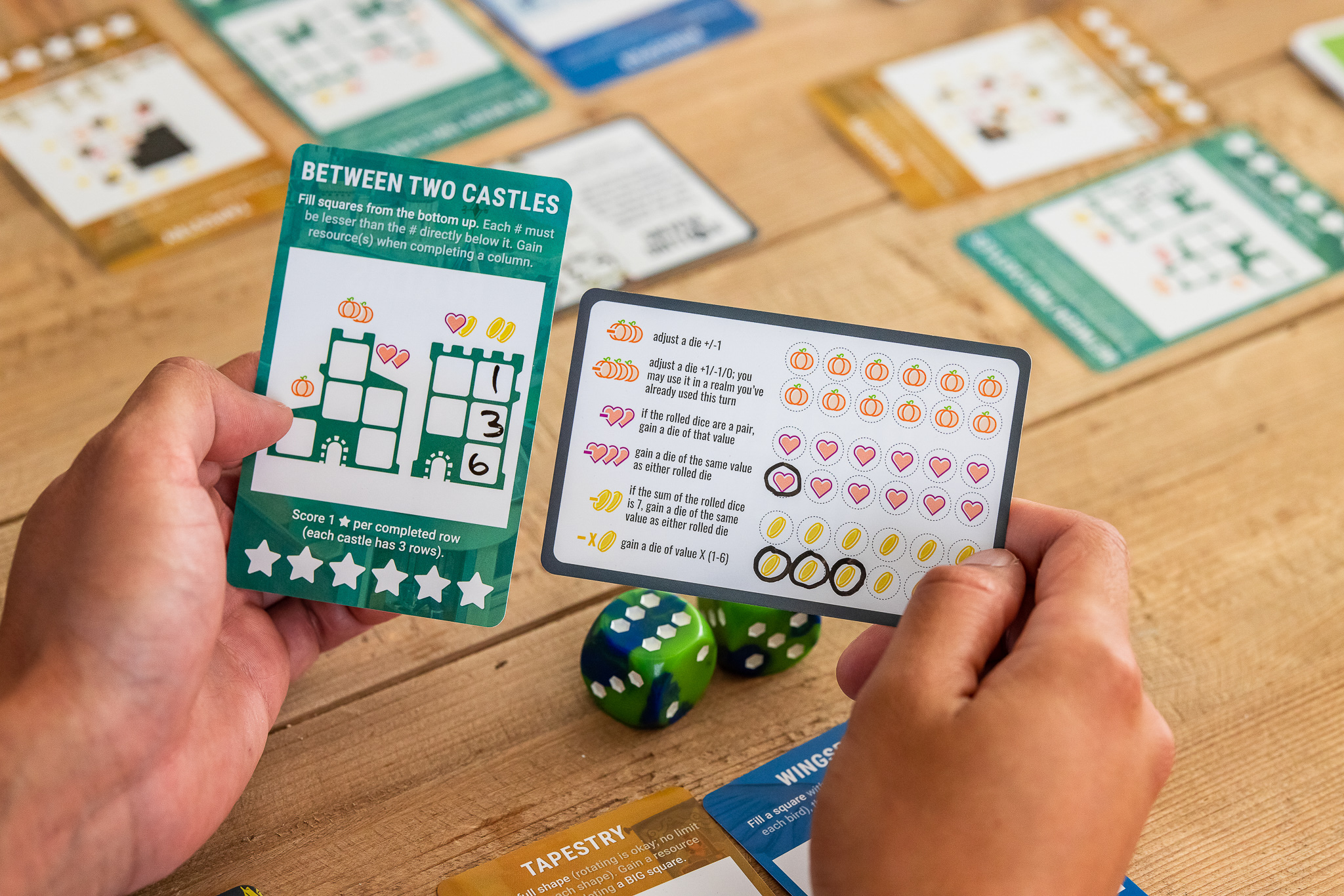
All three games involved players doing things to collect Stars, but the real aim of the game is to collect resources (Pumpkins, Hearts and Coins).  These allow players to modify dice, use them both on the same Realm, and most importantly, gain extra dice to give extra actions—these are essential as without them, players don’t get enough turns to get the more challenging Stars.  With so many people playing and the difficulties in getting heads round rules, the group ended up splitting into three tables.  Plum, Jade, Sapphire and Mint were first to get going and were first to finish the first round.  Plum was the victor, and the group went on to play Dinosaur Island, Stamp Swap and Ark Nova for their second round.

Rolling Realms
– Image by boardGOATS

The second group consisting of Blue, Pink, Ivory, Lime and Pine, were a bit slower as they struggled a bit more with the rules, particularly Pine.  As a result, they were a bit slower to get to the end of the first round, with Blue and Ivory leading the way.  This group decided to reduce the rules overhead by keeping one of the Realms from the first round, the easiest to understand, Tapestry.  To this, they added Between Two Castles and My Little Scythe, both from the original Rolling Realms game, as they thought these might be easier to grok, which they generally were.  In their second round, Ivory and Blue were still fighting it out, but this time they were joined by Pink, with Pine not far behind.

Rolling Realms
– Image by boardGOATS

The comparative success of the second round and keeping one Realm and choosing two from the original game, meant they repeated the strategy for the last round.  This time they kept the Between Two Castles Realm and added Between Two Cities and Scythe.  By the final round, everyone seemed to have got the hang of things as the scores were much closer.  In terms of totals though, Blue just had the edge over Ivory, with Pink in third.  The other table had finished first though, with Tidal Blades, Between Two Cities and Euphoria as the Realms in their final round.  Plum had continued her success in the first round winning both the second and third rounds and therefore, taking overall victory.

Rolling Realms
– Image by boardGOATS

Second place was less clear, however, with Sapphire just beating Mint for second place.  The third table consisted of Cobalt, Black and Purple.  Cobalt had played before, but online while Purple and Black were new to it.  They also struggled a bit and took a more leisurely approach to the game, playing just two rounds.  Their second round Realms consisted of Scythe, Potion Explosion and A Feast for Odin, the last two both add-on packs, and therefore possibly more challenging than those from the base game.  Cobalt won the first round by a bit of a land-slide, but the second round was very close between all three players, with Purple just beating Cobalt (who took overall victory).

Rolling Realms
– Image by boardGOATS

Learning Outcome:  Sometimes, one person’s simple game can be another’s nemesis.

Next Meeting, 26th Movember 2024

Our next meeting will be on Tuesday 26th Movember 2024.  As usual, we will start playing shorter games from 7.30pm as people arrive, until 8pm when we will start something a little longer.  The pub is doing food, and the table is booked from 6.30pm for those that would like to eat first.

This week, the “Feature Game” will be Rolling Realms/Rolling Realms Redux (rules, review, how to play video), which is a light roll and write game that was developed during the global pandemic as a print-and-play game and has since been released as a professionally produced game.

– Image from stonemaiergames.com

And speaking of the pandemic…

During 2020, like many people, Jeff ran out of toilet paper.  Unlike most people, he started using lettuce leaves. As he explained to his mate, Joe, that was just the tip of the iceberg, what happens tomorrow romaines to be seen…

12th Movember 2024

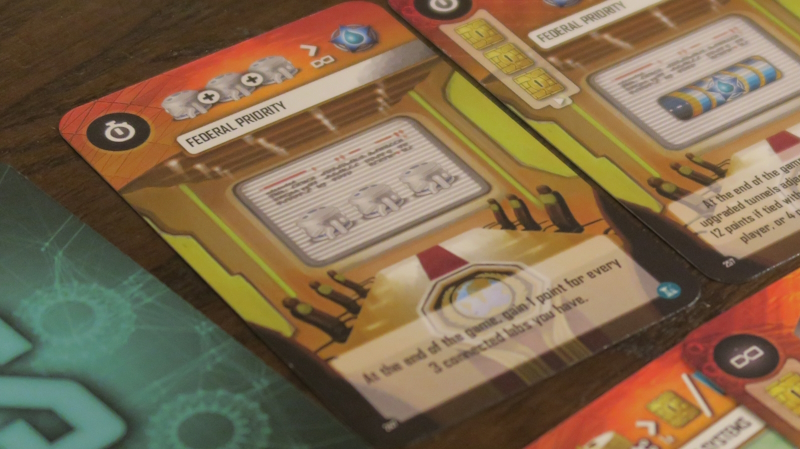
The evening began with Plum explaining the “Feature Game” to Indigo and Navy, despite the fact they had already decided they were unlikely to play it.  Still, there was time to fill as people finished eating and the stragglers, and that was as good a way as any.  The game in question was Underwater Cities, which is a sort of worker-placement and network-building game.  Although the game is quite complex, the underlying mechanism is quite simple:  players start their turn with a hand of three Cards and, on their turn choose an Action space and pay a Card to use it.  The Action spaces and the Cards come in three different colours, green, red and orange.

Underwater Cities
– Image by boardGOATS

If the colour of the Card played matches the colour of the Action space chosen, then the player gets to activate the Card, most of which have an instant effect (though for some, the effect is delayed).  In general, the orange Action spaces are quite powerful and the green Action spaces are weak, whereas the green Cards have powerful effects and the orange cards are weaker, thus the Cards and Actions together are balanced.  Each Action space can only be activated by one person per round and the game takes place over ten rounds (though the group used the Quick Start variant from the New Discoveries expansion which replaces the first round) with each player taking three actions per round and production phases after the fourth, seventh and final rounds.

Underwater Cities
– Image by boardGOATS

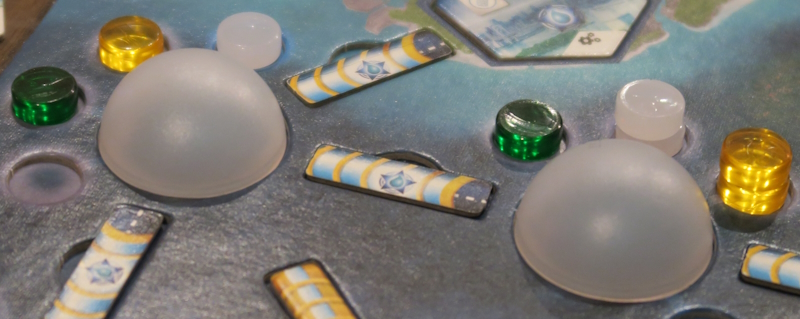
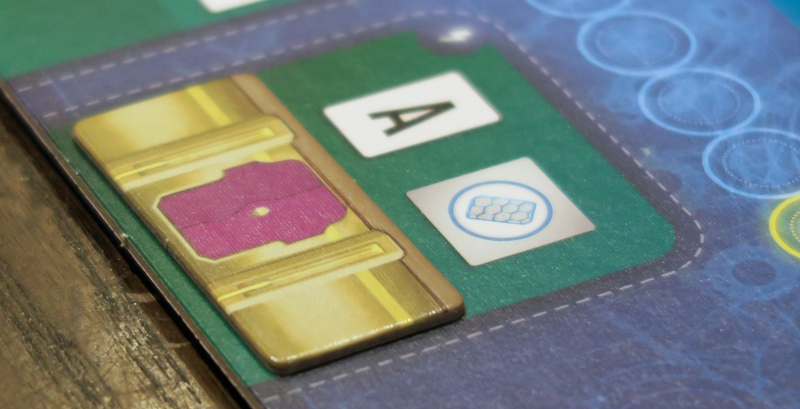
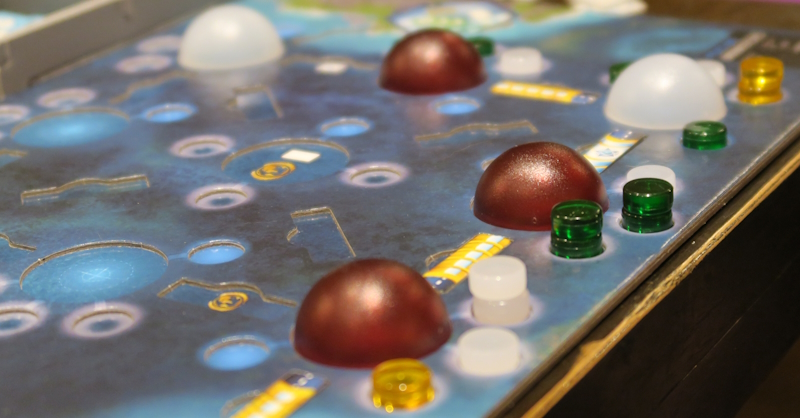
The aim of the game is to build a network on players’ personal player board, connecting Cities together with Tunnels and adding and Upgrading Buildings to provide production capabilities.  There are four Resources, Kelp, Steelplast, Science and Biomatter together with money, or Credits; these are produced by Farms (Kelp), Desalination plants (money) and Laboratories (Steelplast and Science).  Biomatter is essential for building symbiotic cities and can also be a universal building material (can be used instead of Kelp or Steelplast), but is a rare Resource that can only be acquired through Cards, Actions and by connecting some Metropolises to a player’s network.

Underwater Cities
– Image by boardGOATS

Players score points during the game and in the production phases after the fourth and seventh rounds, but most of the points are scored at the end of the game after the final production phase.  At this point, players score for the number of different Buildings next to each connected city in their network, for any end-game scoring cards, for their final scoring Metropolis and for any Resources they have left.  Indigo and Navy showed some appreciation as Plum explained, but ultimately decided it wasn’t for them, and were replaced by Cobalt and Ivory, both of whom had an idea of how the game played from watching run-through videos.

Underwater Cities
– Image by boardGOATS

The Quick Start gave everyone an Enhanced Assistant so Plum started with the ability to get Biomatter on production, so she was able to build purple Symbiotic Cities (which score more points) right from the beginning.  Cobalt’s also helped him when building Cities, giving him one Credit or Steelplast discount, although he didn’t really take advantage of this until the final Era. In contrast, Ivory focused on the end-game scoring from his Metropolis which required him to build seven Cities to get the maximum number of points.  By the first production phase, he had already built three and connected them to his network with Tunnels, but all those people needed a lot of feeding which was costly and slowed him down a lot.

Underwater Cities
– Image by boardGOATS

Plum focused on building a robust food engine with two upgraded green Buildings attached to one City (her end-game Metropolis also gave points for sets of upgraded structures) while Cobalt focused on getting his engine online and started on his objective to connect all his Metropolises and Cities with Tunnels in the second and third Eras.  He was aided by an ongoing ability that triggered whenever he used an Assistant (draw a Card and gain a Point), which he used heavily, getting four Assistants early in the game and activating them all in every Era. The extra Card draw ensured he was always able to play a matching coloured card with every Action which also helped.

Underwater Cities
– Image by boardGOATS

Plum pointed out that a friend who she plays with and often wins says, “Don’t always let me get the Special Cards—they are powerful!”  So after the first production phase, there was a focus on the special cards in middle, all of us grabbing some quite powerful abilities.  Ivory got an additional tile that gave him points every production phase and Plum got a heavily discounted City.  Cobalt’s engine was working very effectively by this time giving him lots of Resources and discounted Actions.  Despite her Special Cards, Plum was struggling as the main upgrade slot which she needed for her end-game Metropolis was denied to me when she had the Resources to use it.  Instead she ended up focusing on Symbiotic Cities and ended up with only the one regular City.

Underwater Cities
– Image by boardGOATS

After the second production phase, there was a big focus on how to maximize points. Ivory took a risk, taking the end game scoring card that gave twelve points for the player with the most upgraded Tunnels.  When he took it, he had the most upgraded Tunnels, but it was clear that Cobalt could challenge this.  Cobalt on the other hand had grabbed a couple of Special Cards giving three points per upgraded Tunnel plus one point per Card in his tableau.  For Ivory to score his Card it was critical that he denied Cobalt the ability to upgrade in the last turn and Ivory was able to make sure he took his first in the final round—this was fairly ironic as the majority of the rounds he had been the last player!

Underwater Cities
– Image by boardGOATS

This scuppered Cobalt’s plans and gave a twenty-four point swing in Ivory’s favour, but since he had increased his hand limit to four and was drawing multiple cards, he was able to pivot and build a City sharing two upgraded Farms and us Cards that provided points when played. This also produced quite a few resources in the final production phase.  Plum was struggling towards the end of the game as she couldn’t get the final Resources she needed to build the last two Tunnels to connect her end-game scoring Metropolis.  Despite it failing to score, it had still been a good focus for her game as the upgraded structures had given her extra production during the game and those Metropolis points would only be critical if the game was close.

Underwater Cities
– Image by boardGOATS

And close it was.  Plum had a slight lead going into the end game scoring and and-game scoring cards gave points fairly evenly too.  Cobalt and Ivory had the same number of Cities with three different Buildings, slightly more than Plum, but she more than made up for it with her Cities with her Cities with two different Buildings.  The Metropolis she failed to connect proved critical in her scoring though and although she just edged Ivory by two points, Cobalt ultimately took victory, also by just two points as he finished with ninety-seven.  It had been a very thinky game, and with three players was reasonably tight with people taking Actions others wanted.  It was very enjoyable when players were so evenly matched which was reflected in the scores despite very different strategies.

Underwater Cities
– Image by boardGOATS

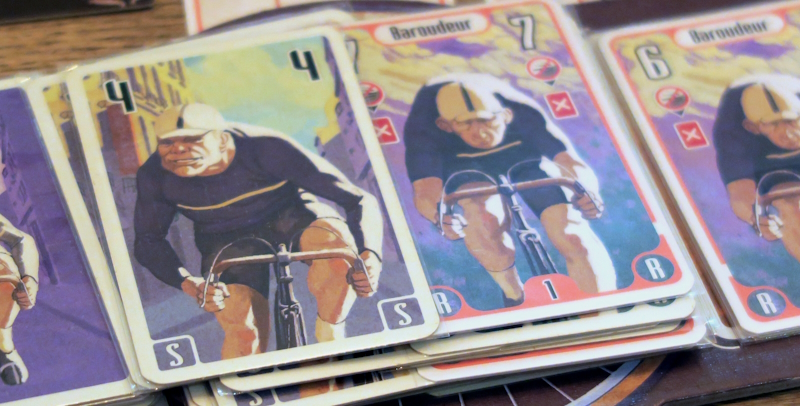
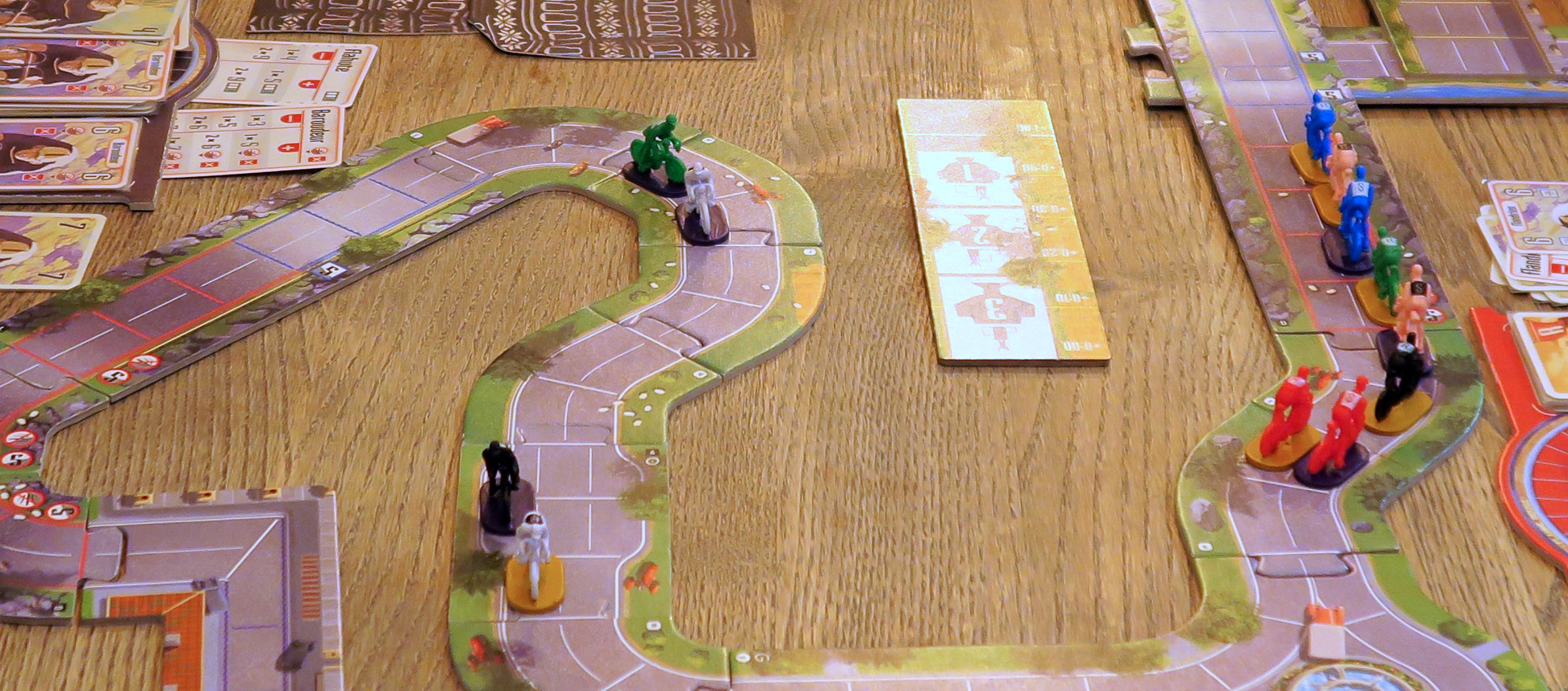
Black and Blue had been interested in joining the game of Underwater Cities, however, as it was, it was the last game to finish by some mile and would have taken a lot longer with a fourth player.  There wasn’t a sixth player interested in making a second game, so in the end, Black joined Pink who was very keen to give Teal’s new acquisition that he’d been toting about since Pink and Blue had brought it back from Essen for him.  This was the Grand Tour expansion to Flamme Rouge. This is a cycle racing game where players move their two riders forward by drawing and playing cards from that riders specific deck, depleting it as they go.

Flamme Rouge: Grand Tour
– Image by boardGOATS

As in real cycle races, players use slipstreaming to avoid exhaustion, in the game, these are cards that block up players’ hands making dealing with obstacles and moving through the peloton more challenging.  A large part of the new expansion is a campaign mode and there was only time for one game, however, there are some additional features, including some new hilly track and a double right-angle hairpin bend.  These added more interesting features to the parcours.  Like all race games, players usually do best if they can start fast and stay at the front of the pack.  In Flamme Rouge, this is mitigated by the fact that once a card is played it is discarded so players have to make their good cards last the duration of the race while avoiding too much exhaustion.

Flamme Rouge: Grand Tour
– Image by boardGOATS

Teal managed to crash both his bikes, while Black and Purple crashed one each.  Indigo and Navy led for most of the game while Pink tried to maintain a position in the front four or five.  Navy faded as the sprinters wound up for a lunge for the line, with Indigo as Marcel Kittel and Pink as Mark Cavendish.  This time, victory went to the German and the Manx Missile with just piped into second with Navy rolling home in third.  The game had been a lot of fun and the general consensus was that the Grand Tour expansion added some nice new features even when multiple games for a campaign weren’t appropriate.  It hadn’t out-stayed its welcome either, and although Teal headed home, there was time for everyone else to play one more quick game.

Flamme Rouge: Grand Tour
– Image by boardGOATS

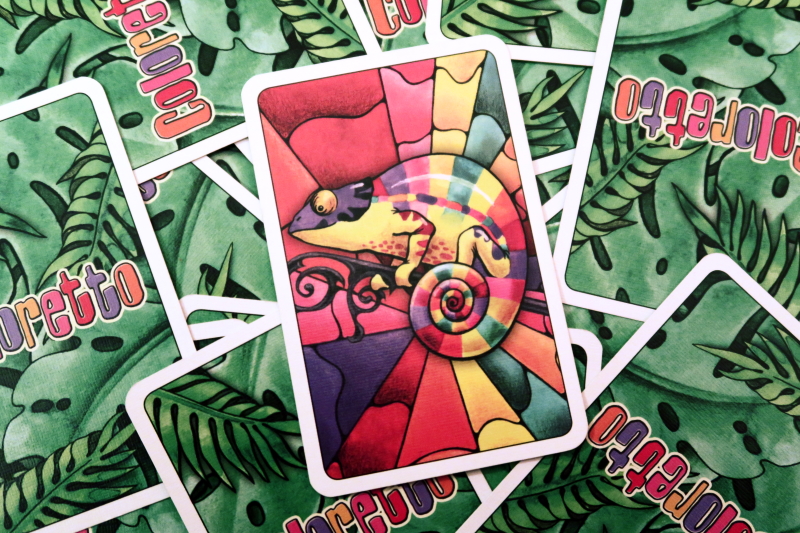
The game of choice was Coloretto—something of an old favourite.  This is a really quick game to teach and start playing, with players taking it in turns to either draw a card and add it to one of the trucks, or taking a truck and adding the Chameleons on it to their collection.  The clever part is that largest three sets score positive points following the Triangular series, while any other sets score negative points.  Purple drew the Golden Joker which was picked up by Pink, while Black took the other Joker.  The game was really tight, well, amongst the top three anyhow.  Navy managed to only score positive points, but his thirty-four points was one less than Indigo who took second and who, in turn, scored one point less than the victor, Black.

Coloretto
– Image by boardGOATS

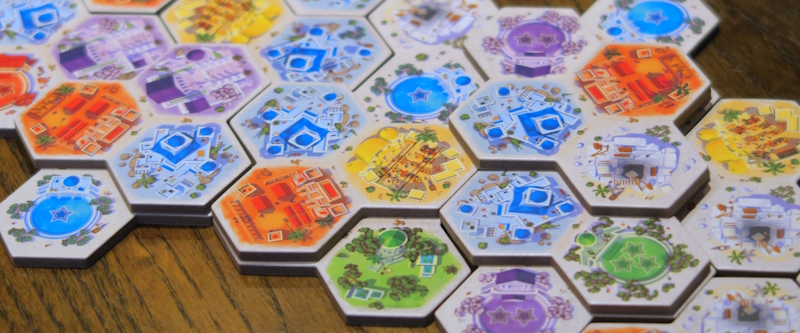
The final table consisted of Pine, Blue, Jade and Sapphire.  After a bit of chit-chat, this group settled on playing Akropolis.  This is a fairly light abstract tile laying game in a similar vein to Taluva or NMBR 9, where tiles placed on higher levels score more points.  In this game, players take a tile from the Market and place it in their City.  The first tile in the market display is always free, the one after costs one stone (the only resource in the game) the next one two stone and so on.  The tiles comprise three conjoined hexes each either a Quarry (which provide Stone when built over), a Plaza, or a District tile.  Tiles can be placed on top of others, but must cover more than one other tile and cannot leave gaps.

Akropolis
– Image by boardGOATS

At the end of the game, tiles that meet the scoring requirements for that colour are multiplied by their height.  As in Kingdomino where the area is multiplied by the number of crowns in it, this District score in Akropolis is multiplied by the number of Plazas in that colour; these totals are added together to give a final total.  This time, Blue scored heavily for her Houses and although Jade almost matched her with his Barracks, he didn’t score much for anything else and Blue had picked up a lot of points for her Markets too.  Together these gave her a bit of a landslide with a total of one hundred and nineteen.  Sapphire and Pine that by the end they had got the hang of things, and fancied giving it another go.

Akropolis
– Image by boardGOATS

The game was punctuated by a discussion about orange juice and lemonade, which is apparently called a “Henry” in these parts though nobody but Jade was aware of it.  Pine commented that where he came from it was more likely to be used to order cocaine.  This time, Blue tried a totally different strategy this time focusing entirely on Houses.  Sapphire’s Markets gave him forty points and Pine’s gave him thirty-four.  These were dwarfed by Jade’s Gardens that gave him sixty points, but they all paled into insignificance compared to Blue’s Houses which gave her one hundred and eight.  Sadly though, with nothing else but a pile of rocks, this left her with exactly the same score as last time—and a tie with Jade, while Sapphire, the most improved player finished in third, just four points behind.

Akropolis
– Image by boardGOATS

Learning Outcome:  The underwater world has a lot of potential.

Next Meeting, 12th Movember 2024

Our next meeting will be on Tuesday 12th Movember 2024.  As usual, we will start playing shorter games from 7.30pm as people arrive, until 8pm when we will start something a little longer.  The pub is doing food, and the table is booked from 6.30pm for those that would like to eat first.

This week, the “Feature Game” will be Underwater Cities (rules, review, how to play video, solo playthrough), which is a card driven, route and engine building game.

– Image by BGG contributor cirdan

And speaking of underwater…

Jeff had taken up scuba diving with his friend Joe. As they were getting ready to go over the side for the first time, Jeff tucked some paper inside his wet suit and tied a pencil to his right wrist. Joe was puzzled and asked him what he was doing.

Jeff replied, “I’m just trying to be prepared in case I want to do some eelustrations…!”

29th October 2024

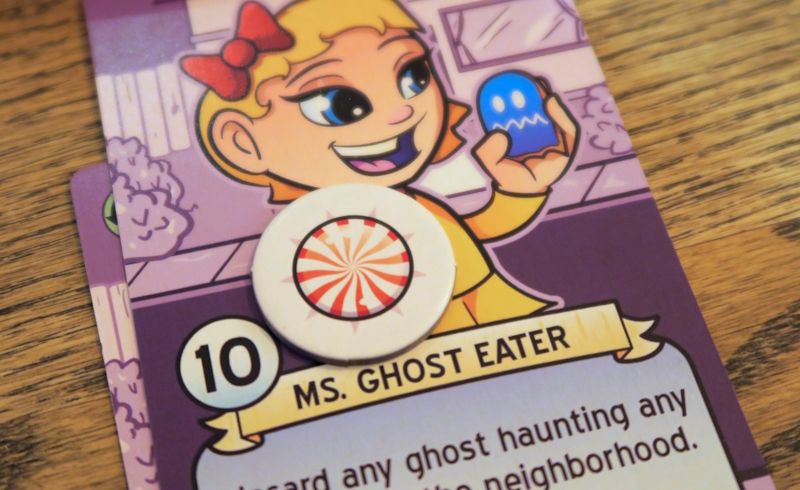
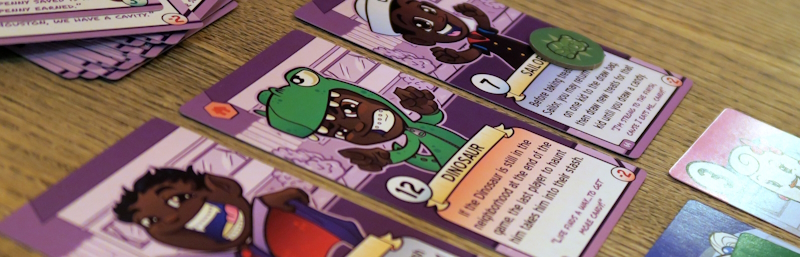
The evening began with everyone admiring Plum’s spooky cardie and wish Black a happy birthday, before people settled down to play spooky games.  To mark Halloween, the “Feature Game” will was Ghosts Love Candy Too (the sequel to Ghosts Love Candy).  This is ostensibly a quick little card game where players haunt kids to steal their sweeties, however, in practice, it took rather longer than expected to get to grips with.  The idea is that players simultaneously choose a card from their hand (of nine) Ghost Cards and then reveal which card people played to decide turn order.  Starting with the player who revealed the highest value card, players then take it in turns to place their card one one of the Kid Cards, to “haunt them”.

Ghost Love Candy Too
– Image by boardGOATS

The player immediately takes any Treat Tokens on the Kid Card and then activates the Kid’s special ability.  Any Kids whose courage has been exceeded are then collected by the active player and the Kid Card is replaced.  Players score points for some of the Kid Cards (some positive, but most are negative), and for Treats they have collected according to their personal, secret, Craving cards which mean that Treats score differently for each person.  Thus, while one player may score five points for, say, Licorice, another another player, Licorice will only be worth one point.  for some reason, there was a bit of sussing out of the rules as, although Blue had done her homework, somehow it didn’t quite fit together in practice.

Ghost Love Candy Too
– Image by boardGOATS

Between them, however, Teal, Pink, Ivory, Cobalt and Blue worked it out in the end. Ivory began, and his favourite was Chocolate, while Cobalt who went second was after peppermints.  From early in the game, it was apparent that Teal was collecting Gummy Bears, and seemed to have little competition, but then, it appeared that Blue was collecting Candy Corn, but that was all she could get her hands on and she really wanted Licorice.  In the end it was a tie between Teal and Pink, who did really well on his Treats, especially his favourites, Lollipops, but picked up ten negative points from his huge pile of terrified Kids.  Victory went to Teal on the tie-break, however, as he had the most of his favourite Treats (that pile of Gummy Bears).

Ghost Love Candy Too
– Image by boardGOATS

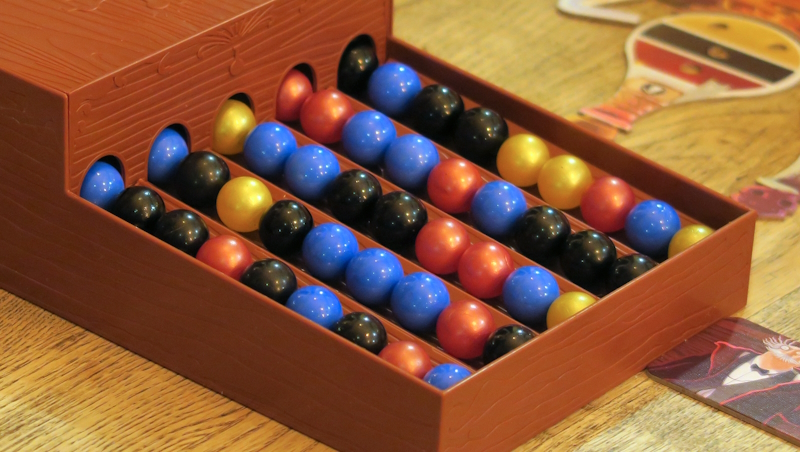
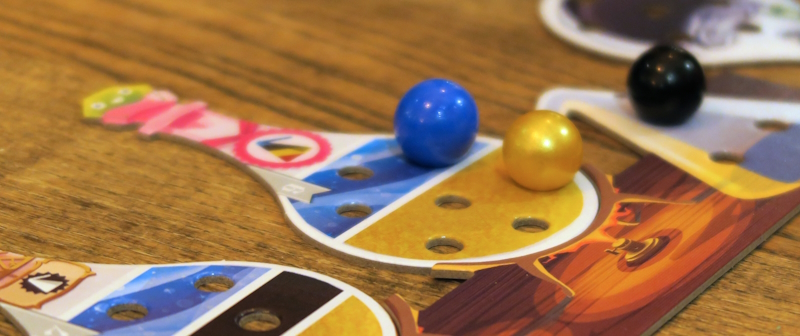
Meanwhile, on the next table, Jade was leading Black, Purple and Green in a game of Potion Explosion, which is sort of “Candy Crush the board game”, played with Marbles.  Players take an Ingredient Marble from the dispenser causing other Marbles to fall.  If that causes Marbles of the same color to connect and form rows or columns, they “explode” and players can take them take as well.  They then use the Ingredients to make  potions and then drink them to give special magical powers.  The winner, however, is the player who brews the most valuable Potions with the least Help and the most Skill.

Potion Explosion
– Image by boardGOATS

This time, Purple took the least assistance and finished with no Help tokens at all, however, a little Help can go a long way if you make the most of it.  Green got a Lot of help which cost him eight points but this was more than offset by the fact he had the most valuable Potions, worth fifty-seven points, and the most Skill giving him another twelve and a total of sixty-one points and substantial victory margin.  Black just pushed Jade into third—although Jade had considerably more valuable Potions, Black had more Skill and had needed a lot less Help, giving him a total of fifty-one points, two more than Jade.

Potion Explosion
– Image by boardGOATS

On the third table, Plum had been keen to give the Ghost Train version of Ticket to Ride a go, however, before they got round to that, they played a couple of games of the rather more tenuously Halloween themed Nova Luna.  This is an abstract tile laying game that uses the mechanism from the slightly older, animal-themed game, Habitats.  On their turn, players choose a tile from the Moon wheel to add to their array.  Each new tile brings a new task to fulfill which are completed by placing colors in a specific arrangement which in turn bring more new tasks. Each time a task is completed, the player may places one of their Markers and the first to place all of their Markers is the winner.

Nova Luna
– Image by boardGOATS

Plum was joined in Nova Luna by Sapphire (as it is one of his favourite games), Byzantium and Mint on her first visit.  The group played two games—the first of which was really close.  Plum and Sapphire tied one seventeen and were beaten by a single point by Mint.  The winner was Byzantium, however, with a two point lead and finished with twenty points.  The game was slightly less tight, though Byzantium, the master of consistency, was also the victor with twenty points.  Second place this time went to Plum with sixteen who was one point ahead of Sapphire who, in turn, was one point ahead of Mint.

Nova Luna
– Image by boardGOATS

Then the group moved on to play the Ghost Train version of Ticket to Ride.  This is really a re-implementation of the introductory version of the game Ticket to Ride: First Journey, but what makes it special is the gorgeous board and large train pieces.  It still uses the same basic mechanism as all the Ticket to Ride games with players collecting parade Float Cards and using them to claim routes on the main board.  Each player starts with a couple of “Ticket” cards showing locations they have to connect.  In this version, when a player completes a Ticket, they reveal it and draw a new one.  If a player can’t complete a ticket, they can take a turn to discard both their cards and redraw.

Ticket to Ride: Ghost Train
– Image by boardGOATS

There are also bonus Tickets available for connecting a location of the Dark Forest region in the top left corner of the board to a location in the Seashore region in the bottom right and bonus Float Cards for connecting Town Hall to the Crypt.  The winner is the first player to claim their sixth Ticket or the player with the most Tickets when someone places their final Train piece on the map.  The game was a bit of a landslide, with Sapphire stealing a march on the others and quickly taking the lead, rapidly collecting his six tickets before anyone else had got anywhere.  Mint took second with two Tickets and and Byzantium and Plum tied for third.

Ticket to Ride: Ghost Train
– Image by boardGOATS

Pink was somewhat surprised when Mint expressed an interest in his bottle of his favourite Blood Orange cider.  Initially he was reluctant to part with it as it wasn’t empty, but once it was pointed out that they needed it for their next game and Pink could just poor the rest into his glass, everyone was happy and Mint began setting up her birthday present—Cards vs Gravity.  This is a silly, but fun party game where players balance cards on a platform attached to the top of a bottle that has the feel of Jenga, but with cards.  The idea is that players have to add cards to the tree without collapsing it.  Byzantium was obviously on a bit of a roll, and followed up his two victories at Nova Luna with two victories against Gravity (and the others of course).

Cards vs Gravity
– Image by boardGOATS

With everyone pretty much finished, some headed home, but the remaining ten managed a couple of rounds of the old favourite, and totally not Halloween themed, 6 Nimmt!.  In this game, players simultaneously choose a numbered card from their hand and then reveal them at the same time.  These cards are added to four rows of cards in the centre of the table, starting with the lowest card, adding each one to the row that ends with the highest number that is lower than the card.  Where the card would have been the sixth card, instead the player takes the five cards as their scoring pile leaving their card as the first in the new row.  The player with the lowest final total is the winner.  The catch is where players play a card that is lower than all the end cards, and as a result takes the row of their choice.

6 Nimmt!
– Image by boardGOATS

This has the potential to completely upset everyone’s plans.  The plans are not the thing here though, it is the tension and anticipation as people wait to see who is going to pick up that brightly coloured, high-scoring set of cards…  This time, Cobalt top-scored in the first round with twenty-seven, slightly more than Jade.  Pink, Ivory and Purple all finished in single digits, but it Pink was the victor with one solitary point.  In the second round, Green took the biggest pile giving him thirty-three points, but Jade managed to take thirteen points from just three cards.  Ivory was the only one to stay in single digits, and was therefore the winner with a total of eight points.

6 Nimmt!
– Image by boardGOATS

Learning Outcome:  Even apparently silly children’s games can be fun when the occasion is right.

Boardgames in the News: Is there a Hidden Cost of Board Gaming?

A recent report about falling fertility rates and increasing childlessness from the BBC has created some discussion online.  The controversy centres on the headline image which shows a young man in front of his games collection.  These include games of some significance including Scythe, Root, Brass and the Suburbia Collector’s Edition, and none of which are cheap.  The implication in the discussion is that he can’t afford to have children because he spends too much on games.  Of course, they may not be his games and nobody has the right to criticise how someone else chooses to spend their money anyhow.  It is often observed, however, that the cost of everything has increased significantly—board games are no exception—and our hobby-spending unquestionably affects our other choices in life.

Kari Aaron Clark
– Image from bbc.co.uk


Next Meeting, 29th October 2024

Our next meeting will be on Tuesday 29th October 2024.  As usual, we will start playing shorter games from 7.30pm as people arrive, until 8pm when we will start something a little longer.  The pub is doing food, and the table is booked from 6.30pm for those that would like to eat first.

This week, to mark Halloween, the “Feature Game” will be Ghosts Love Candy Too (rules, written review, video overview), which is a quick little card game where players haunt kids to steal their sweeties.  It should leave plenty of time to play other Halloween themed games like Broom Service, Witch’s Brew, Ticket to Ride: Ghost Train or Betrayal at Mystery Mansion.

Ghosts Love Candy Too
– Image used with permission of
BGG contributor ratpack

And speaking of ghosts…

Jeff was attending a big seminar about paranormal activities. The auditorium was full of people and a speaker was on the stage.

“Who here has seen a ghost?” The speaker asked. “Please raise your hand.”

Most of the audience raised a hand, then the speaker went on, “OK, so who here has had physical contact with a ghost?”

Maybe twenty people raised their hands. After a pause, the Speaker continued, “Now, who here has had sex with a ghost?” Jeff was the only one to raise his hand.

“YOU, SIR! Please come up on stage!” cried the Speaker and Jeff, walked down the steps to the front and joined the speaker on stage.

“Sir, please can you describe to our audience your experience having sex with a ghost,” the speaker asked Jeff holding the microphone out for him.

“Oh,” said Jeff. “I thought you said goat…”

15th October 2024

There were quite a few people eating this week, but the earliest arrivals were finished when Green turned up for the first time in months toting his copy of Lost Ruins of Arnak.  Jade was already preparing to lead the “Feature Game” which was to be Castle Combo, and he was joined by Sapphire, Pine and Lime.  This is a game that was released to coincide with Essen, but like many of the most popular games was sold out within a couple of hours.  The essence of the game is tableau-building where players draft cards from two markets creating a three-by-three square of people interacting with each other triggering instant effects and end-of-game bonuses.
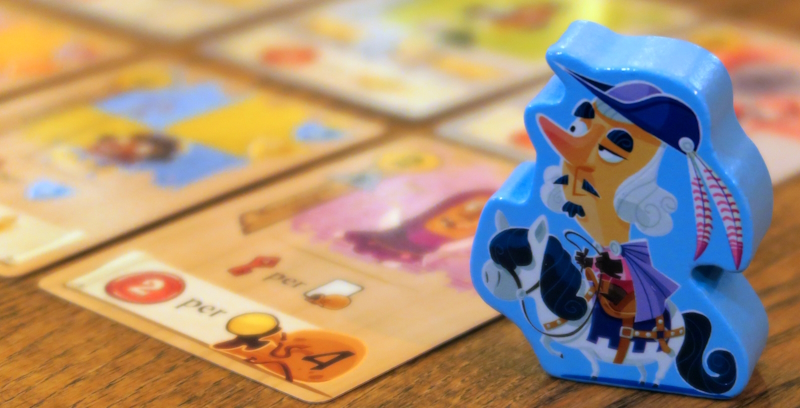
Castle Combo
– Image by boardGOATS

The two markets consist of Castle Cards and Village Cards.  At the start of their turn, players can pay a Key to to carry out a special action, before they buy a Card from whichever market the Messenger token is currently located in and place it in their Tableau. Some card abilities grant a permanent discount when purchasing cards of a specific location (Castle, Village, or both).  If a player can’t afford any of the cards (or choose not to pay for them), they can always take a card without paying its cost, and place it face down in their tableau. In doing so, they ignore its ability, its end game points and any other information printed on it, but immediately gain six Gold and two Keys in compensation.

Castle Combo
– Image by boardGOATS

Each card after the first must be placed orthogonally adjacent to at least one other card in a player’s Tableau and at the end of the game, their Tableau must be a three-by-three grid of Cards. In this way, the final position of the cards in the array is fixed as the game progresses. Once it has been placed, the ability of the Card is applied. Some abilities affect opponents (all other players), while others affect a player’s neighbour (they choose which one). Finally, if the Messenger icon is depicted on the card played, the active player moves the Messenger Token, either to the Castle or to the Village, as appropriate, before refilling the market and ending their turn.
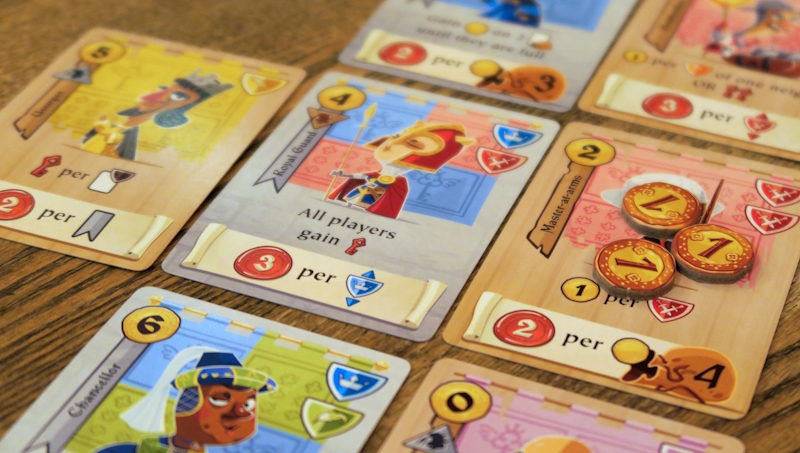
Castle Combo
– Image by boardGOATS

The game ends when everyone has nine Cards in their Tableau and everyone adds up their scores.  This time, Sapphire went first as he’d played before.  The game plays very quickly and smoothly as everyone began building up their displays.  It turned out that playing before wasn’t a great deal of help, however,, as Pine gave everyone else a bit of a trouncing as his final Tableau was worth ninety-six points, seventeen more than Jade who took second place a handful of points ahead of Sapphire in third.  Meanwhile, on the next table, Blue and Byzantium were leading a game of Stamp Swap at the request of Pink who had missed out last time.

Stamp Swap
– Image by boardGOATS

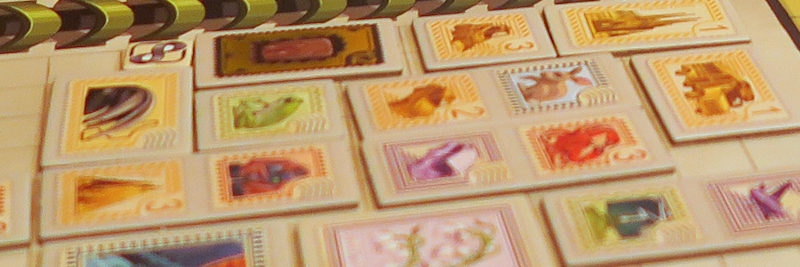
This is another fairly straight forward game, albeit one that takes a bit longer than Castle Combo, though it plays just as smoothly.   There is a lot of simultaneous play, which is nice because it minimises down time.  First, players take it in turns to choose items from the central Pool, then simultaneously divide them into two piles of offerings.  The player with the first player token, chooses and takes one of the piles offered by their opponents.  The opponent keeps their other pile and then chooses a pile from one of their opponents and so on.  Once everyone has two piles, players arrange the Stamps in their Album and then choose which of the four available end of round cards to score this time.
Stamp Swap
– Image by boardGOATS

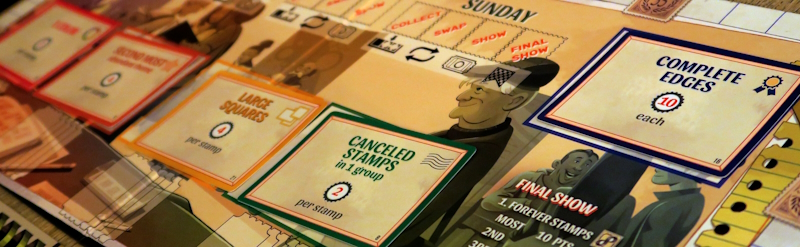
After three rounds, players score the end of game objective card and the player with the most points is the winner.  One of the clever parts about this game is how much difference the objective cards make to the way players arrange their Stamps.  This was very obvious last time when there were two parallel games and one scored Finale Contest gave for points for Stamps completely surrounded by other Stamps, while the other gave points for each empty region.  The former gave lots of Albums where the Stamps were clumped together, while the latter gave spread out Stamps in a lattice-type pattern.  This time, the Finale Contest gave ten points for each completed edge, so players began the game working along the borders of their Album page leaving a hole in the middle that they only filed in later in the game.
Stamp Swap
– Image by boardGOATS

The end of round scores allowed players to score points for the number of stamps they had in one colour, the number of large square Stamps they had, the number of cancelled Stamps and the number of Stamps in their second most abundant theme.  This artificially increased the value of large square Stamps, which was something that Pink failed to take into account early on.  It led to Blue taking what Pink felt was his obviously less valuable pile and giving her a surprise Special Stamp with a sad face from him.  Still, that was replaced with a big grin when he stole one of Blue’s hidden Stamps later in the game and it turned out to be the one with the Giant Panda on it.
Stamp Swap
– Image by boardGOATS

The first event card was Generous Gifts where players choose one of their Stamps to score and then pass on—always a difficult decision, but more-so at the start of the game.  Slim Pickings was the second event giving players fewer items from the Pool at the start of the round, while Hands to Shake was the final event which made more Attendee Cards available, although by this time, it was too late to really take advantage of them.  That said, Byzantium had made collected quite a few Attendee Cards, using them to great effect to gain extra points and Stamps and took one in the final round as well.

Stamp Swap
– Image by boardGOATS

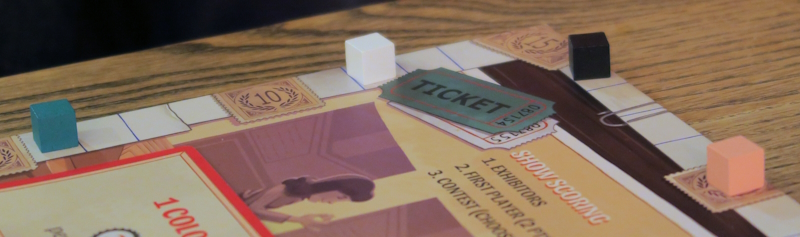
Aside from the Panda, Purple seemed to collect nearly all the Animal Stamps, while Pink did a good job of collecting Flowers.  The game is a bit of a “Point Salad” though, with points coming in little aliquots from lots of different places, and it perhaps pays not concentrate too much on one aspect.  Byzantium got a fast start and took an early lead, which he just managed to maintain to the end, beating Blue into second place by ten points, for the second time, which Pink taking third.  While packing up, everyone agreed that they really enjoyed the game for its smoothness, and the only part that “jarred” was setting out the starting Pool which was a little laborious.  Discussion online later, however, suggested a away to improve this, so that’s something to try next time.
Stamp Swap
– Image by boardGOATS

By the time Stamp Swap finished, Castle Combo had already come to an end and Jade, Sapphire, Pine and Lime had moved on to play Courtisans.  We first played this a few weeks ago, shortly after UK Games Expo.  This is a clever little card game from the same stable as Castle Combo and Faraway, where players are manipulating card values by where they play them.  On their turn, each player receives and plays three coloured Family cards.  One card is played at the Queen’s table to sway a Family’s influence in a positive or negative way depending on whether it is placed above the table or below.  At the end of the game, those Families with more cards below than above will have “Fallen from Grace”.
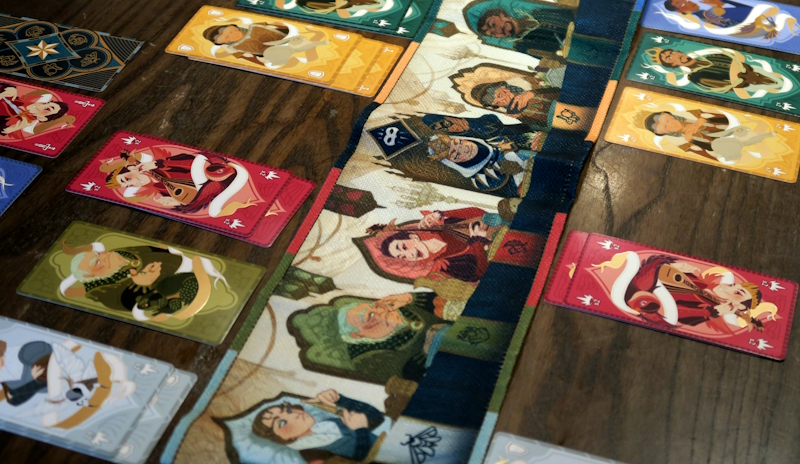
Courtisans
– Image by boardGOATS

One of the other two cards is played in the player’s own Domain and the other in an opponent’s Domain. At the end of the game, each card a player has from an “Esteemed” Family is worth a point, while each card from an Family that has “Fallen from Grace” loses them a point.  Thus, players are trying to increase the value of the cards they have, while decreasing the value of the cards their opponents have. The first game was a game of two parts, Jade and Pine tied for victory with nine points, while Sapphire and Lime also tied with four points.

Courtisans
– Image by boardGOATS

As is often the case with this sort of game, after the first play, once he’d seen how the game works, Lime requested a second game.  This second game was higher scoring with players getting more “Esteem” and fewer Families that had Fallen from Grace.  Both Jade and Lime completed both their objectives as well.  Lime’s massive Esteem scoring of twelve, gave him clear victory with a total of sixteen points, while Jade, who finished with eleven points, just pipped Pine to second by a single point.  There was a bit of chatter with everyone discussing the games, but nobody really had the inclination to play anything else before going home.

Courtisans
– Image by boardGOATS

On the next table, while Blue took a little time out, Pink, Purple and Byzantium played a quick game of the sixteen card filler, Love Letter. This is a sort of multiplayer dueling game where players have a hand of one card, draw a second from the face down deck and then choose one to play, with the aim of being the last player standing, or the player with the highest value card if in the event that the deck runs out first. The trio only played two rounds, but Byzantium managed to get knocked out first turn both times. It was a tie between the other two though, with Purple taking the first round and Pink the second when he knocked out Princess Purple.

Love Letter
– Image by boardGOATS

After two rounds, the trio got bored and moved on to playing Sushi Go!Sushi Go Party! had had a mention earlier in the evening, but as none of them were familiar with the rules changes, they stuck with the smaller, original version.  This is a simple, and one of the purest card drafting games where players start with a hand of cards, keep one and pass the rest on.  The cards are Sushi and players are trying to get sets, or pairs, or as many as possible depending on the Sushi on the card.  The group played the full three rounds, with very mixed outcomes.  At the end of the game, the player with the most Pudding cards gets extra points, but as all three tied so nobody got any.  The winner was Byzantium, with a massive fifty-eight points, seven more than Pink in second in what was a high scoring game.
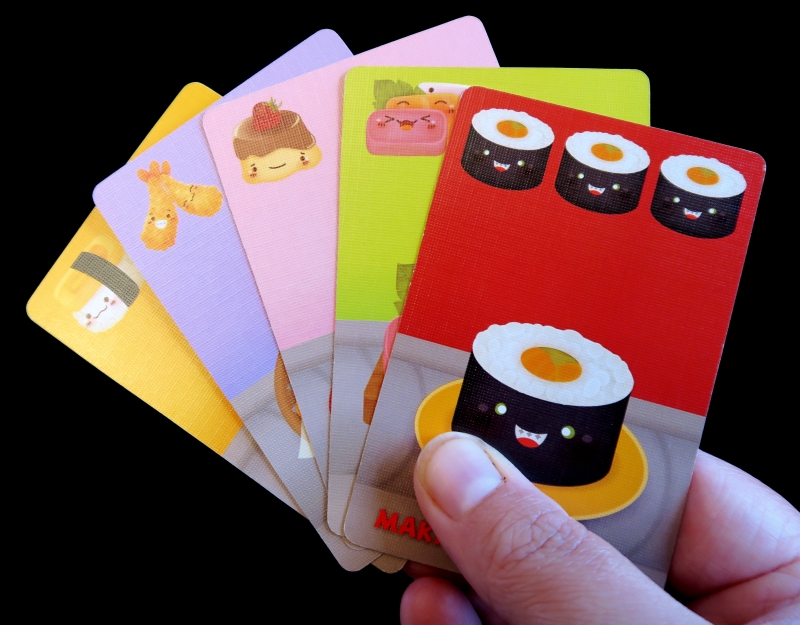
Sushi Go!
– Image by boardGOATS

Byzantium was waiting for Plum to finish on the other side of the room, so Blue rejoined the group for a quick game of something silly—an old game that Blue and Pink acquired at Essen, called Why First?.  The premise of this game is, what’s so important about being first, maybe the winner should be the person who is second.  So in this game, players start with a hand of five number cards and simultaneously, chooses a card to play before, on the count of three giving it to someone.  This player’s piece is then moved that number along the race track.  The round ends after five cards, the last of which must be used to move the payers’ own piece.

Why First?
– Image by boardGOATS

At the end of the round, only the player who is second scores, and that depends on their location on the track.  In the first round, Blue came second (and therefore won the points) and Pink won the second.  Byzantium won the third, but as he finished on the start line, he scored no points, much to his chagrin.  Blue and Purple tied for second in the fourth round so both took a single point, before Purple took the final round.  The winner of the game is, obviously, the player who comes second overall.  Despite a lot of effort by Blue who ultimately finished first and therefore lost, this was Pink who was therefore the winner.

Why First?
– Image by boardGOATS

By this time, the table on the other side of the room had finally finished and were packing up.  Green had clearly arrived wanting to Lost Ruins of Arnak, and Ivory and Plum had kindly joined him.  This had an outing about six months ago, when Green and Plum were also involved.  By this time, however, Green had acquired The Missing Expedition expansion and, having played the game quite a lot solo, wanted to include it to add interest.  The basic game combines deck-building and worker placement with resource management. Players start with six cards in their deck, two Money, two Compasses and two Fear cards (which just clog up players’ hands), and draw five of these to play.
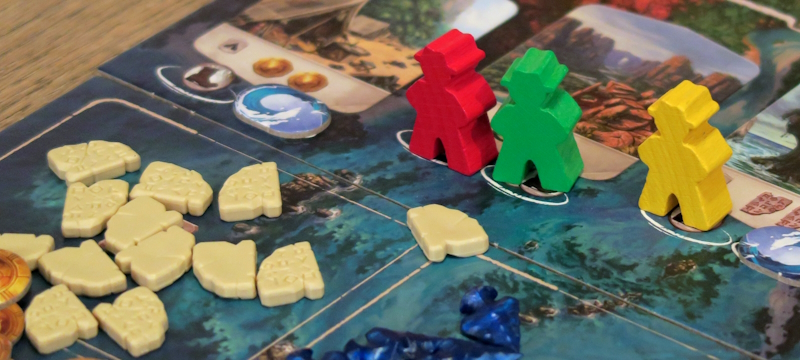
Lost Ruins of Arnak
– Image by boardGOATS

Players then have two meeples each that can be sent to locations on the map, to either discover or use an action Location which generally give Resources plus some extras. Each new site has a Creature guarding it, which, if beaten, will give points and a small one-time bonus.  Players can use resources to move up the Research Track giving different rewards.  Players get one action each per turn, until everyone has passed signalling the end of the round, and the game finishes after five rounds.  The Missing Expedition expansion is modular, but this time the group added the Waterfall Temple and the extra encounter cards. The Waterfall Temple has a couple of steps whose cost changes each time someone Researches past them which can make it a bit unpredictable, though there is a sneaky shortcut to the top of the temple for players prepared to pay the steep cost.
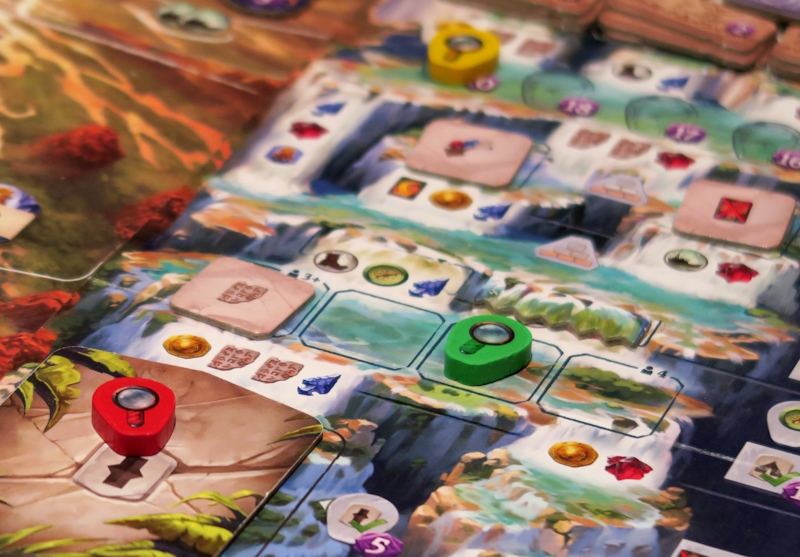
Lost Ruins of Arnak: The Missing Expedition
– Image by boardGOATS

The first round went very quickly with everyone having limited options. Green and Plum began moving up the Research track, looking to gain an Assistant as soon as possible, where Ivory focused on gaining coins and an additional card. Ivory grabbed the Recovered Plane card (from the expansion) that allowed him to recall his explorers and using them again, which felt quite powerful. In the second round, Plum and Green both got their Assistants. They also started getting additional cards with Plum getting the Unreliable Compass card that gave her the benefits from the bottom tile of the exploration track and Green got the Army Knife which gave him flexibility when gaining Resources. Ivory began Exploring, uncovering the first new worked spot, slowly followed by Plum. Ivory managed to use his Plane card to avoid the Guardian, whereas Plum didn’t have that option and gained a Fear card at the end of the round.

Lost Ruins of Arnak: The Missing Expedition
– Image by boardGOATS

In the following rounds, Ivory begin focusing on the research track, catching up with Green and Plum and eventually overtaking them. He reached the part of the track where he could gain the Resources on a set aside exploration tile and got one that gave me an Explore card from the expansion which gave him the choice of something now or something latter. As the third and fourth rounds progressed, the Research track became a core focus Ivory managed to reach the top the first. Everyone continued exploring, and Ivory was also the first to explore a level two tile, gaining additional idols and resources and then subsequently able to recall his explorer to avoid the Guardian and Fear card.
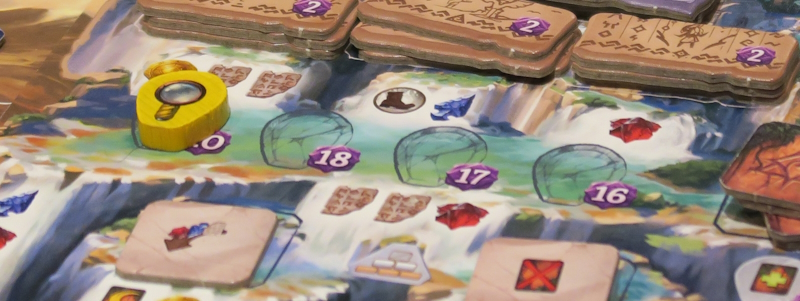
Lost Ruins of Arnak: The Missing Expedition
– Image by boardGOATS

Plum was also Exploring, though at the lower level, but unfortunately the Guardians that she was drawing meant they were very difficult to defeat and she picked up more Fear cards. Green was Exploring less, but was using the engine that he assembled with his Assistants and cards to explore and defeat quite a few Guardians, adding to his engine whilst also gaining points. Towards the end of the game, the question for everyone was how to be most efficient and make the most moves up the Research track. Green joined Ivory at the top, and additionally gained enough Resources to grab an eleven point temple tile. Ivory was looking for an additional Resource to move my notebook up one more step and then remembered he hadn’t gained the bonus tile for reach the top of the Research track, gaining him that valuable Resource.

Lost Ruins of Arnak: The Missing Expedition
– Image by boardGOATS

Plum was also pushing up the Research track, looking to squeeze as much value as possible. Ivory also had accumulated quite a few coins, which allowed him to buy lots of cards during the final round just for their points. With everyone passing in the final round there was just the small matter of the scores. Points for Exploring, Research and Idols were pretty much level. Green’s engine which allowed him to gain the eleven point temple tile and defeat four Guardians (as opposed to Ivory’s and Plum’s one) ultimately gave him victory with seventy-seven points. Ivory’s Artifacts and Item cards gave him second ahead of Plum who had struggled with her Fear (bordering on Terror!) throughout the game.
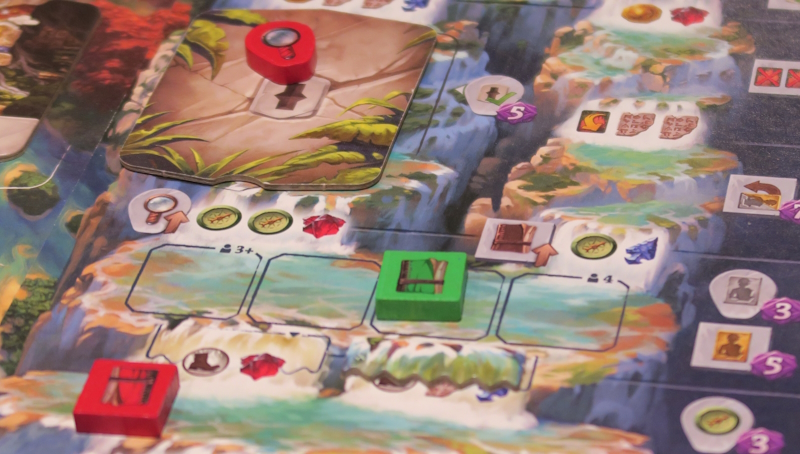
Lost Ruins of Arnak: The Missing Expedition
– Image by boardGOATS

Learning Outcome: Princesses don’t want to live in Ruined Castles.