Author Archives: nannyGOAT

30th June 2015

Continuing the theme from last time, food was a priority, so we didn’t get started until well after eight o’clock.  We split into two groups, the first playing Steam Donkey again as it turned out that we had played it wrong two weeks ago. This card game involves building a seaside resort consisting of a four by three grid of attraction cards.  The idea is that players build the attractions from their cards in their hand, then take passengers from the station who visit their attractions, which they then take from their tableaux to become cards in their hand.  The more popular attractions get more passengers, thus yielding more cards.  Unfortunately, it turns out that on their turn, each player can do only one of these three actions instead of all of them!  It was still a tight game though, with Burgundy and Magenta drawing for first place on fifty-two points.  As, Magenta commented though, “Playing it right is better…”
Steam Donkey
– Image by boardGOATS

Meanwhile, Grey, Green, Cerise and Blue tried an older game, Gheos, which is new to the group.  When Cerise and Grey introduced it, Blue (who had played it a very long time ago) commented that all she could remember was that it was a bit like Carcassonne, but the tiles were triangular and it was a lot nastier.  In this game, players have three tiles in their hand and on their turn place one extending the play area, or replacing one of the existing tiles.  The tiles form land rivers which make islands (land comprising two small sections of land surrounded by water) and continents (larger areas of contiguous land).  Unlike Carcassonne, all the edges are the same so every tile can go anywhere, but some places are better than others of course.

Gheos
– Image by BGG contributor Gonzaga

When a player places a tile, if the continent has not already been settled, they can choose to place a settlement receiving followers equal to the total number of wheat sheaves shown on that continent.  If a player doesn’t start a new settlement, placing a tile allows the active player to recruit a single follower of their own choice.  Followers are important because they dictate how many points players get during scoring.  Everyone scores points when epoch tiles are drawn and each player has three cups tokens which they can play at the end of their turn triggering allowing them to score alone.  Epoch scoring gives players points equal to the number of pyramids on a continent multiplied by the number of followers they have for the tribe settled on that continent.  Cups tokens work in a similar way with points awarded for every follower multiplied by the number of cups on the continent, but only the active player gets to score these.

Gheos
– Image by BGG contributor Outside Lime

Since tiles can be replaced, rivers can be moved creating islands, and merging continents, creating war, causing migration and even leading to extinction (since islands are to small to sustain a tribe and continents can only support one tribe).  This is what makes the game nasty since a players’ followers are immediately lost.  The complexity of the rules associated with migration and war coupled with the different triggers for scoring meant that it took Blue and Green a while to get their heads round it.  Despite Cerise’s protestations, she showed them the way to score taking an early lead.  Grey’s experience showed in the latter stages, however, giving him the first place, eight points ahead of Blue in second.

Gheos
– Image used with permission of BGG contributor KSensei

Green had been desperate to play his new game, Fresco, so had agreed to play Gheos with Grey on the condition that he would play Fresco next.  This is a game where players are master painters working to restore a fresco in a Renaissance church.  Each round begins with players deciding what time they would like to wake up for the day. The earlier they wake up, the earlier they are in turn order, and the better options they get.  However, if they waking up early too often, the apprentices become unhappy and stop working as efficiently. Players then decide their actions for the turn, deploying their apprentice work force to the various tasks:  buying paint, mixing paint, working on the fresco, raising money to buy paint by painting portraits, and even going to to the opera to increase the apprentices’ happiness and inspire them. Points are scored mostly by painting the fresco, which requires specific combinations of paints.  For this reason, players must purchase and mix their paints carefully and beat the other players to the store to buy the pigments and fresco segments they would like to paint.

Fresco
– Image used with permission of BGG contributor Toynan

As a new game, that claimed to take an hour, it was clear it was not going to be quick, so Blue decided to help things along by reducing the number of players and joined the other group to play something shorter before Magenta had to leave.  Although Fresco  was not difficult to explain the other group had nearly finished their first game before play actually started.  With only three market stalls in the three player game and a possible three actions in each section for each player, the game very quickly fell into a routine where the earliest player went to the market to buy paint, with each assistant closing the stall afterwards. This left the other two players painting portraits for money and visiting the theatre to enhance their mood. This rotated around as the paint buying player completed retouching the fresco for tile points and thus pushing into the lead on the score track and moving down the order to choose when to get up.  This did not feel right and the consensus was that maybe the three player game was broken and it needed a fourth player to work. Nevertheless, in a game that nobody had played before, Cerise made it her own, winning by nearly twenty points.

Fresco
– Image used with permission of BGG contributor Toynan

Meanwhile, the other group were playing another new title, confusingly called The Game, which is a cooperative card game nominated for Spiel des Jahres this year.  In this game, players have a hand of five cards from a deck containing cards numbered two to ninety-nine and there are four piles: two starting at 100 and decreasing, two starting at one and increasing.  On their turn, players must play at least two cards and can play more as long as they obey the basic rules.  The cards can be played on any pile so long as it is lower in number than the top card of a decreasing pile or higher than the top card on the increasing pile.  Alternatively, if the card is exactly ten more or less than the the top card on the pile, the “backwards rule” can be invoked and the pile can be pushed back.  The aim of the game is to place all cards on the four piles and it is much more difficult than it seems.  The Game is often compared with Hanabi because it is a cooperative card game, however, the game play and the atmosphere it is played in are very different. In Hanabi, the best games are played in near silence where everyone is trying desperately not to give away any unintended information.  In The Game, players can say anything they like, so long as they don’t give away any specific number information.  This makes it much more chatty, though it took us a while to work out what was useful information and we only got about halfway through the deck before Magenta was unable to play a card.  Clearly one to try again to see if we can do better.

The Game
– Image used with permission of BGG contributor henk.rolleman

Fresco had only just started, so down to four players, Black Fleet came out for another outing.  This is a beautiful over-produced game that we played a few weeks ago, where each player has a merchant ship which they use to collect goods from one port and take to another port earning money.  However, each player also has a pirate ship which they can use to take goods from the merchants.  This also earns players money, but they must beware of the navy vessels which every player can manipulate to sink pirates and use to try to protect their merchants.   On their turn, the active player plays one card which moves both of their ships and one of the navy ships, during which, each ship may perform one action.  The idea of the game is that players can also play fortune cards which modify their actions and also use their money to buy  advancement cards which change the rules of the game, sometimes dramatically.

Black Fleet
– Image used with permission of BGG contributor The_Blue_Meeple

This time, Black got his nose in front buying the first advancement card, but it wasn’t long before Blue and Burgundy caught up.  While Purple was struggling to get anything and kept falling victim to everyone else, Blue moved into the lead with her very effective use of her False Colours and Secret Plans advancement combo (which together allowed her to swap her pirate with one of the navy ships and then earn four doubloons for attacking a merchant).  Burgundy pushed hard with his Delivery Bonus and judicious use of the Pirate Hideout (which allowed him to move his pirate more unpredictably), but could not get enough money to buy his last card leaving Blue to win.  Despite being the first to buy advancement cards, Black finished last as his cards felt relatively under-powered.  So maybe next time, now we all know how to play, we’ll try drafting the cards at the start.  That way there is less chance of one player getting more than their share of the best cards,

Black Fleet
– Image by BGG contributor lacxox

Fresco had finished first, and Green moved over to watch the last moves of Black Fleet, commenting sadly on how the game was broken with three players, which elicited the automatic response of, “Have you checked the rules?”  Whenever anyone online says a game is “broken” that is always the response and it often turns out that they weren’t playing right.  So despite his protestations that they had played correctly, while the last ships were being sunk, Green double checked and found what was wrong. Each player may have three assistants visit the market stalls, but they all visit the same stall and buy one tile, rather than buy one tile from each stall. Thus there will always be a stall open for each player.  This made a lot more sense and will really open the game up for those difficult decisions of timing and tasks. The rules check also brought to light an error in the way the bishop moves:  he was supposed to jump to the retouched or claimed tile each time rather than just staying put.  Although that was a much more minor mistake it was enough to make the choosing of tiles less interesting.  Another game to play again, and correctly this time!

Fresco
– Image used with permission of BGG contributor Toynan

Learning Outcome:  Games are better when played according to the rules…

Spiel des Jahres Winners – 2015

The 2015 winner of the coveted German Game of the Year or Spiel des Jahres award is Colt Express which is a game about bandits robbing an amazing 3D train.  The game plays in two phases:  first everyone plays action cards cards onto a common pile and then the action cards are resolved in the order they were played. There were three games nominated for the Spiel des Jahres this year and we’ve played the other two, Machi Koro and The Game, so we’ll play Colt Express next week to see what all the fuss is about!

Colt Express
– Image used with permission of BGG contributor henk.rolleman

At the same time the Kennerspiel des Jahres was awarded, which honours more challenging games.  It was introduced in 2011 to replace the jury’s habit of intermittent special awards for games too complex for the Spiel des Jahres (notably Agricola which was awarded a special “Complex Game” prize in 2008).  The 2015 award went to Broom Service, which is a reimplementation of the 2008 Spiel des Jahres nominated game, Witch’s Brew.  It is a role selection game where players collect potions, then deliver them across the land to towers that advertise their desires with color-coded roofs.  This year we haven’t played this or either of the other nominees (Orléans and Elysium), but it probably won’t be long before we do.

Broom Service
– Image from asaboardgamer.com

Boardgames in the News: Confusion at The Telegraph!

Anyone who plays modern boardgames knows how our hobby has been growing and growing.  Games like Carcassonne and The Settlers of Catan are now available in Waterstones and WHSmith, there has been a series of regular comments in The Guardian, there are repeatedly TV appearances, and boardgame cafés are sprouting up all over the place.  It seems strange then that last week, Harry Wallop from The Telegraph announced that “Card games and board games are dying out and it’s no great loss”.

Snap
– Image by BGG contributor loopoocat

The basis of this report is a survey carried out by Barclaycard which apparently indicated that games like Old Maid, Happy Families and Snap are in danger of dying out.  Strangely, on the same day, Martin Chilton, the Telegraph online Culture Editor reported that 67 per cent of the children surveyed said that they would like to learn how to play traditional games.  The really annoying thing about all this is that they focus solely on “traditional games”:  Martin Chilton’s article is entitled “The five best board games” and lists them as Chess, Scrabble, Monopoly, Cluedo and Backgammon.

Scrabble
– Image used with permission of BGG contributor Susie_Cat

On closer inspection, however, Harry Wallop’s article does include a link to a more interesting list of fifteen party games, including Pandemic, Camel (C)Up and Biblios.  While their definition of “Party Games” clearly leaves a lot to be desired, it is clear that someone at The Telegraph at least has heard of modern games.  Perhaps the most reassuring aspect of this though, is the response to Martin Chilton’s article in the comments section which includes a nearly eighty passionate responses pointing out better, modern, “classic games” and where to find information about them.

Biblios
– Image by BGG contributor creatsia

Let’s hope Mr Chilton and Mr Wallop read the comments and write a better article soon!

Next Meeting – 30th June 2015

Our next meeting will be on Tuesday 30th June, at the Horse and Jockey pub in Stanford-in-the-Vale.  As usual, we will be playing shorter games from 7.30pm as people arrive, until 8pm when we will start something a little longer.

This week the “Feature Game” will be Batavia, which is a game about merchants visiting the trading posts of the five East India companies all over Asia.

Batavia
– Image by BGG contributor LanaDove

And speaking of traders…

A successful trader parked his brand new Porsche in front of the office ready to show it off to his colleagues.  As he prepared to get out a juggernaut went past, too close and completely tore off the driver’s side.  The trader immediately grabbed his mobile and dialled 999.  It wasn’t more than 5 minutes before a policeman pulled up, but before the policeman had a chance to ask any questions, the trader started screaming how his car, which he just picked up that day, was completely ruined and would never be the same again. After the trader finally finished his rant, the policeman shook his head in disbelief.

“I can’t believe how materialistic you traders are,” he said.  “You’re so focused on your possessions you don’t notice anything else.”

“How can you say that?” asked the trader.

The policeman replied, “Didn’t you realise that your arm is missing from your elbow down? It was looks like it was torn off when the truck hit you.”

The trader looked down in absolute horror.  “$%#*@!” he screamed, “Where’s my Rolex?!?!?!”

Next Meeting – 30th June 2015

Our next meeting will be on Tuesday 30th June, at the Horse and Jockey pub in Stanford-in-the-Vale.  As usual, we will be playing shorter games from 7.30pm as people arrive, until 8pm when we will start something a little longer.

This week the “Feature Game” will be Batavia, which is a game about merchants visiting the trading posts of the five East India companies all over Asia.

Batavia
– Image by BGG contributor LanaDove

And speaking of traders…

A successful trader parked his brand new Porsche in front of the office ready to show it off to his colleagues.  As he prepared to get out a juggernaut went past, too close and completely tore off the driver’s side.  The trader immediately grabbed his mobile and dialled 999.  It wasn’t more than 5 minutes before a policeman pulled up, but before the policeman had a chance to ask any questions, the trader started screaming how his car, which he just picked up that day, was completely ruined and would never be the same again. After the trader finally finished his rant, the policeman shook his head in disbelief.

“I can’t believe how materialistic you traders are,” he said.  “You’re so focused on your possessions you don’t notice anything else.”

“How can you say that?” asked the trader.

The policeman replied, “Didn’t you realise that your arm is missing from your elbow down? It was looks like it was torn off when the truck hit you.”

The trader looked down in absolute horror.  “$%#*@!” he screamed, “Where’s my Rolex?!?!?!”

16th June 2015

Burgundy and Blue were just finishing their supper when they were joined by Cerise, Grey and Red and decided to play a short game until everyone else had arrived.  They chose Sushi Go! which is a card drafting game similar to 7 Wonders, though without the complexity, so, all the players start with a hand of cards, simultaneously play one and pass the rest of the cards to the player on their left.

Sushi Go!
– Image used with permission of BGG contributor henk.rolleman

Since every player is doing the same thing, each player also receives a hand of cards from the player on their right, but each time the cards are passed the hand gets smaller.  In this game players are collecting sets of cards with rewards varying depending on the card and the target.  This time, we played with the Soy Sauce mini expansion which consists of four cards that reward players for getting more different colours encouraging more speculative play.  The game is played over three rounds, with the middle one going in the opposite direction and the winner is the player with the most points.

Sushi Go!
– Image used with permission of BGG contributor kladan

Grey went for the unusual combination of dessert with soy sauce, but Blue topped the round by the judicious application of wasabi to a valuable squid nigiri.  Burgundy won the second hand and Red close behind with a large pile of maki rolls, so, it was all to play for in the final round.  It was a low scoring finale, with Grey the only really successful player, pulling off his best round when it counted.  Unfortunately it wasn’t quite enough:  although Blue’s scores had been steadily diminishing round on round, she just managed to hang on to win, just one point ahead of Grey.  With Black and Purple having arrived, the group split into two, one playing the Feature Game and the other playing another new game, Om Nom Nom.

Om Nom Nom
– Image by BGG contributor jancis

Om Nom Nom was a UK Games Expo special that Purple had been looking for since Essen last year.  The game is quite quick and fairly simple with a lot of “double think”.  The game simulates the hunter and prey relationship.  There are three game boards each depicting a food chain:  cat, mouse & cheese; wolf, rabbit & carrot; hedgehog, frog & fly.  Each player has six cards representing the top two rungs of each ladder; at the start of a round a handful of dice are rolled that represent the lowest two rungs and are then placed on the appropriate section of the board.

Om Nom Nom
– Image used with permission of BGG contributor msaari

Game play is very simple:  simultaneously, all players choose a card to play a predator.  If their is enough prey to feed each hunter, then the player gets their card back with the prey and they score one point for each.  If there is insufficient food available, the animal starves and they lose their card.  Once the first card has been resolved they must play one of the remaining five cards.  So, the clever bit is the middle rung of the food chain where there are both cards and dice, so a card played in the middle will get eaten by any played above.  There are three rounds with everyone playing all six cards in each round, so trying to out-think everyone else is the name of the game.  Purple had played Om Nom Nom before and used her extra experience to win the first round by a sizable margin.  Grey made up for it in the second round as everyone began to get the hang of it, and Red took the final round, making it a close game.  Her consistency made the difference though and Purple finished just two points ahead of Grey.

Om Nom Nom
– Image by BGG contributor Jean_Leviathan

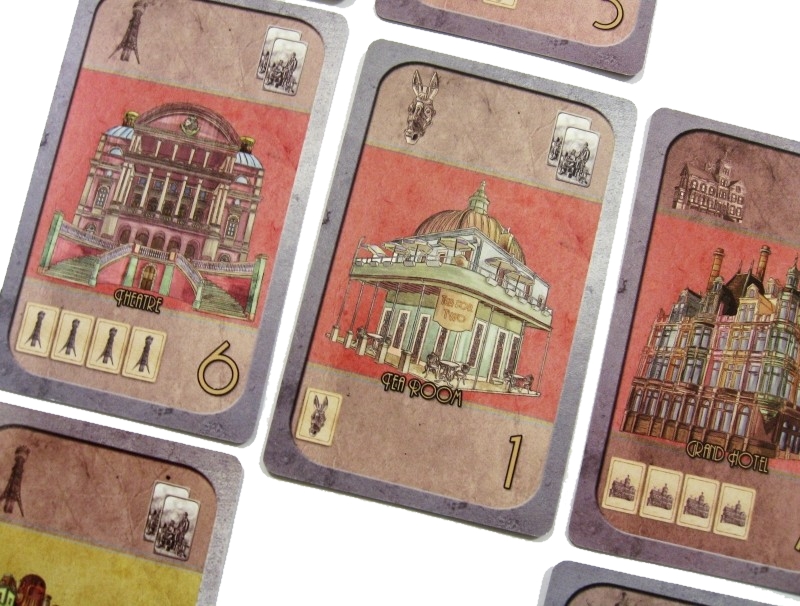
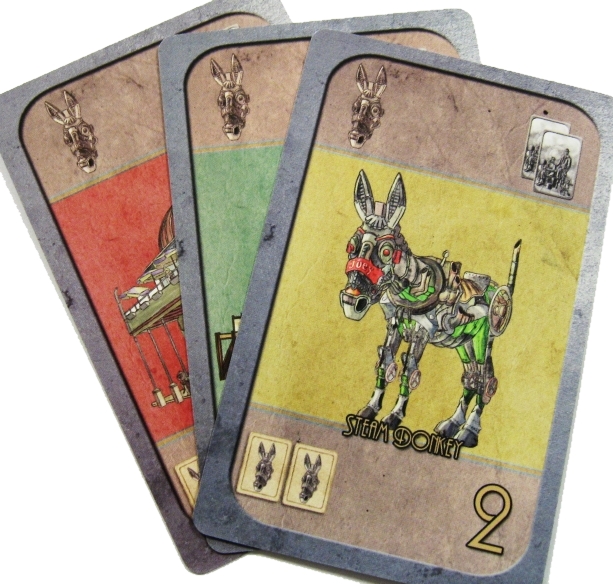
Next the group had a rummage through the bag and opted for another Essen/UK Games Expo acquisition, Steam Donkey; with such a cool name, we wanted to see if the game play matched.  The game is set in 1897, a time when rival seaside resorts are competing to attract a visit from the Queen.  So, players are trying to build a four by three grid of cards representing their seaside resort.  The three rows represent the different parts of the resort:  beach (yellow), town (pink) and park (green).  Similarly, the four columns correspond to the different types of building: amusements, lodgings, monuments and transport.  In order to place a feature, it must go in the correct location and must be paid for using cards of the same type, as such it has similarities with games like Race for the Galaxy and San Juan.

Steam Donkey
– Image by boardGOATS

As players build their resort, visitors arrive at the station and come to see the attractions.   Each attraction can take a certain number of visitors, which are actually a row of face down cards that are used to replenish the cards in players’ hands.  Thus, on their turn players first choose a colour and build as many attractions in that colour as they can/want paying with other cards from their hand.  Next they choose a colour and start taking cards in that colour from the “station”, a row of face down cards.  The colour of the visitor side of cards does not reflect the colour of the attraction on the other side, however, the type of attraction is indicated. Once there are no more visitors of the chosen colour, or there are no more spaces for the visitors to go, the active player adds the visitor cards to their hand and the station platform is refilled with four new visitors.  There is a hand limit of twelve and this can actually be quite a serious impediment for players collecting cards to build the more valuable attractions.

Steam Donkey
– Image by boardGOATS

At the end of the game, points are scored for each unique attraction built as well as for fulfilling individual goals and bonuses depicted on players’ resort posters.  Since this was the first time anyone in the group had played it and there are a couple of unclear points in the rule-book it might not have been played quite correctly, however, everyone seemed to enjoy it what was a very tight game and finished with Purple one point ahead of Red who was just one point ahead of Grey.  Since Purple declared, “It’s a good ‘un!” it almost certainly won’t be long before it gets another outing.

Steam Donkey
– Image by boardGOATS

Meanwhile, the other group were playing the Feature Game, Evolution, yet another game about food and eating!  This is another Essen Special, and is a reimplementation of an earlier game, Evolution: The Origin of Species: the idea is that the game(s) simulate evolution and the “survival of the fittest” concept.  Players start with a herbivore with no special characteristics, and a hand of cards.  Like many games, the cards serve multiple purposes, in this case, they carry a “food supply” number, details of a trait and can also act as a sort of currency,  At the start of the round, players simultaneously choose a card to place face down in the watering-hole, which will dictate how much food will be available later in the round.

Evolution
– Image used with permission of BGG contributor henk.rolleman

Once this is done, players can begin to modify their species.  This can be done in turn, but as it is slow and quite boring if you are relatively unfamiliar with the game, we played this part of the game simultaneously.  There are three things players can do:  they can add a trait to their species; spend a card to increase the body size or population of a species, or spend a card to start a new species.  Cards are a valuable resource and players only get three cards at the start of each round, plus an extra one for each species they have.  This means that traits must be played with care, but also that there is a strong argument for adding new species as early as possible.  However, if there is insufficient food available, animals will starve and if they starve their population will fall, potentially to extinction.

Evolution
– Image used with permission of BGG contributor henk.rolleman

There are a wide range of traits that can be added to a species.  For example if a species is “Fertile”, its population will automatically increase every round saving cards.  Alternatively, if an animal has a “Long Neck” it will feed twice before everything else, allowing it to jump the queue.  It is also possible, however, to make a species a carnivore, which means that instead of feeding from the communal watering-hole, they will only eat meat, feeding off other, smaller species round the table.  Since there are carnivores, there are also traits that can be used to help protect species from being eaten, like the ability to climb, burrow or camouflage.

Evolution
– Image used with permission of BGG contributor henk.rolleman

Traits are most powerful in combination, however. For example, a species which has the ability to cooperate will feed every time the animal to its right feeds.  This means it will jump the queue if that species has a long neck.  Similarly, an animal that can climb and camouflage can only be attacked by a climbing carnivore with good eye-sight.  Since each species has a maximum of three traits, this carnivore would go hungry if the only animals smaller than itself give warning calls as it has no ability to ambush them.  Trait cards are all played face down and revealed in turn order once everyone has finished playing cards and modifying their animals, so players have to try to work out what others might be doing and plan accordingly.

Evolution
– Image used with permission of BGG contributor henk.rolleman

Once everyone has finished playing cards and the traits have been revealed, the amount of food available is revealed and the food numbers on the cards played at the start of the round added up.  Players then each feed one of their hungry species in strict rotation (varied only where traits allow), starting with the start player.  Each player can choose whether to feed one of their herbivores from the watering-hole or use a carnivore to attack another species.  Tactics are important here because each species will need sufficient food for its population.  Once nothing else can feed, any hungry animals will suffer population loss and anything that was completely unfed loses all it population and will become extinct.  On the rare occasion that there is any food left in the watering-hole, it remains there until the next round.  The round ends with each player putting all the food into their food bag which makes the bulk of the points at the end of the game, with extras for each surviving member of the population and any trait they may have.

Evolution
– Image used with permission of BGG contributor henk.rolleman

Unusually there was plenty of food in the first few rounds and everyone quickly built up a pack of animals to try to ensure they got plenty of cards at the start of later rounds.  Unfortunately, food shortages soon set in and one of Black’s animals went carnivorous.  Burgundy suffered badly from the early loss of his alpha species and never really recovered.  Cerise started off well, but was the first to lose a species to Black’s hungry hunter.  Blue was the only player who had tried the game before and was able to use a combination of climbing, cooperation and a long neck to keep her animals fed, but still fell prey to Black and his savage carnivore.  One by one, the animals developed traits to try to out-smart Black, as he added features in a race to avoid starvation.  It was quite tight in the final count, but Blue finished five points clear of Black in second place.

Evolution
– Image used with permission of BGG contributor punkin312

Since the other group were still building their seaside resorts, so the group decided to try Om Nom Nom, and see what all the noise on the other table had been about.  By the end of the first round, it was obvious and there were howls of laughter as everyone tried to second-guess everyone else and everyone’s best laid plans crumbled into dust.  Blue and Burgundy managed to systematically stamp on each-others toes leaving Black and Cerise to fight it out for first place.  Her superb first round turned out to be the deciding factor though and Cerise finished four points ahead of Black.

Om Nom Nom
– Image by BGG contributor jancis

With time creeping on and Cerise and Grey leaving, we looked for a quick game to finish and decided to try another new game, called Skull which is based on an older bluffing game called Skull & Roses.  The idea is that each player has four cards:  three featuring flowers and one with a skull.  Players take it in turns to play a card and declare what the card is.  Alternatively, instead of playing a card, they can start bidding by declaring how many roses they can find around the table.  Once every player has passed the winning challenger must attempt to locate the required number of roses, starting by turning over all the tiles in their own pile.  If they find a skull before they complete their challenge, the lose a card; the winner is the first player to successfully complete two challenges.

Skull
– Image used with permission of BGG contributor nad24

Blue started off showing everyone else how to lose a challenge, by unsuccessfully bluffing to lure others into over bidding.  Black lost two challenges in quick succession, but Burgundy made an end of it by winning two out of two.  Since Skull had finished so quickly, we all felt there was still time for that last game and with barely a mention of 6 Nimmt!, Purple was getting the cards out to play what is rapidly becoming one of our most popular games.  It’s not obvious why we like it, but part of it is probably the fact that nobody really understands it.  This time it was a three way competition for the most points as everyone dived to the bottom, leaving Blue to finish with just eleven, some thirty points better than the person in second place.

6 Nimmt
– Image by boardGOATS

Learning Outcome:  Food is important, both in life and in games, but especially on Alternate Tuesdays

Next Meeting – 16th June 2015

Our next meeting will be on Tuesday 16th June, at the Horse and Jockey pub in Stanford-in-the-Vale.  As usual, we will be playing shorter games from 7.30pm as people arrive, until 8pm when we will start something a little longer.

This week the “Feature Game” will be Evolution, which is a game where players adapt their species in a dynamic ecosystem where food is scarce and predators lurk to ultimately out-evolve other players’ dinosaurs to win the most food… and the game.

Evolution
– Image used with permission of BGG contributor henk.rolleman

And speaking of evolution…

One day, Jeff was discussing evolution with two other engineers, when one of them brought up the question of who designed the human body.  Jim insisted that the human body must have been designed by an electrical engineer because of the perfection of the nerves and synapses.
John disagreed, and exclaimed that it had to have been a mechanical engineer who designed the human body as the system of levers and pulleys is ingenious.

“No,” Jeff said, “You’re both wrong,” and the others waited for Jeff’s usual pearls of wisdom.  “The human body was designed by an architect. Who else but an architect would have put a toxic waste line through a recreation area?”

2nd June 2015

After the bustle of last time with three parallel games, it felt really quiet to be back to a single table.  Unfortunately, the missing people were those that the “Feature Game”, Bania had been aimed at, but we decided to give it a go anyhow as it was supposed to be short.  It had also received an uncharacteristically poor review in the latest edition of the SpielBox magazine, and we were curious as to why.

Bania in SpielBox
– Image by boardGOATS

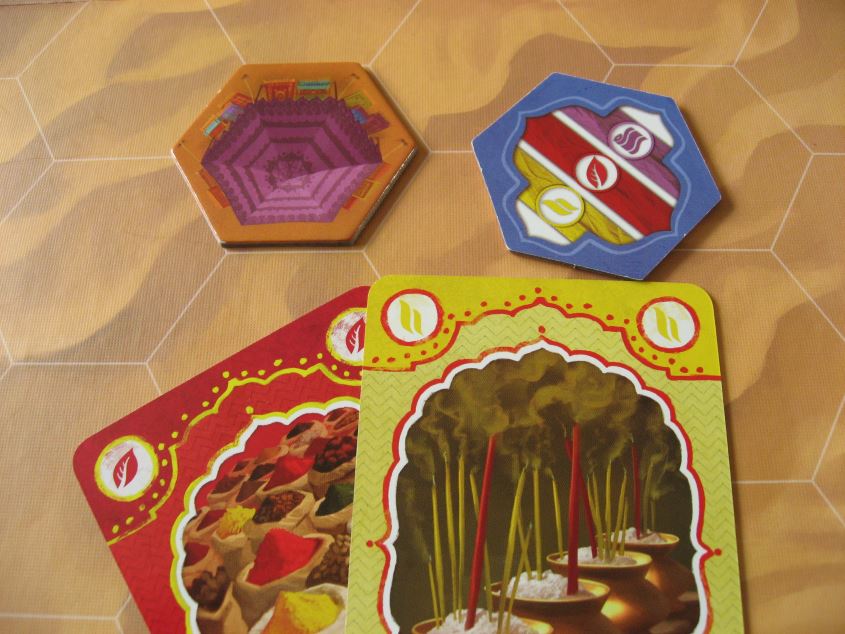
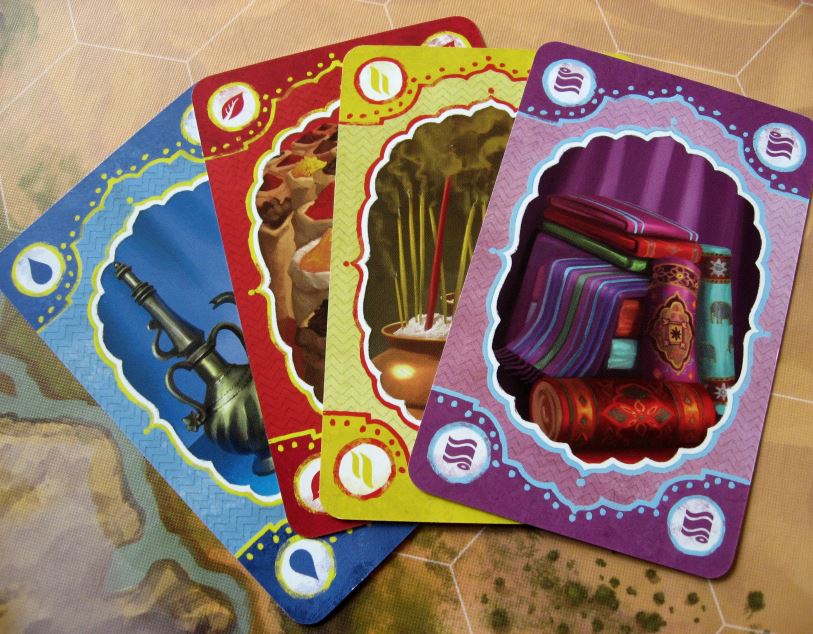
The game is simple enough, comprising the elements of hand-management and tile laying.  The idea of the game is that players are building tents in the desert.  When they build a tent, there is no cost if they can place it next to other tents of the right colour, otherwise they must any additional cost in cards from their hand.  Thus if a tile needs red, purple and yellow but can only be placed next to a red and yellow, a purple card is also required.  On their turn, the active player can place as many tiles as they want to from their hand four and if they place all four, then they can draw another four tiles and keep going as long as they want or are able.  Once they can no longer place tent tiles or otherwise choose to stop, they draw tiles to replenish their hand back to four and play passes to the next player.

Bania
– Image by boardGOATS

Points are scored during the game for building tents which can be placed more or less anywhere.  However, once a settlement consists of seven tiles it is “complete” and it cannot be added to.  Adding to a growing settlement scores one point whereas starting a new one scores three points.  Thus extending a settlement costs less, but also earns fewer points  and the key part of the game is the source of cards.  These come from the elephant:  if it is on the board at the start of the active player’s turn then they can take a card corresponding to each colour present in that settlement.  When a settlement is completed, the elephant is returned to its owner and will yield nothing at the start of their next turn (although they can place it on any tile they as they lay it).  So players want their elephant to stay in a settlement consisting of four different colours, but want to complete it themselves so they can place it again straight away.

Bania
– Image by boardGOATS

In the event that a player needs more cards then they have, instead of laying tiles (and placing their elephant), they can roll the four dice a total of three times, saving as many as they choose from each roll.  There are six options corresponding to the four colours, and additionally an elephant’s head and an “elephant aaarrrse” (as it quickly became known thanks to Grey and his cool accent). A complete elephant gives the player their “elephant cards” again (which is only useful if the elephant is on the board), otherwise they get the resources shown on the dice.  The game ends when no more tiles can be placed and the winner is the player with the most points once the all important bonus points (for the player with the most of each resource) have been added to the tally.

Bania
– Image by boardGOATS

Grey got the game under way but it was Burgundy who showed us how to deal with the elephant.  By completing the settlement his elephant was occupying and then placing a new tile, he was able to pick up cards at the start of consecutive rounds.  Meanwhile, Green picked up on another trick for scoring extra points.  Starting a new settlement and then placing a second tent tile to link it to another settlement could give four points for the cost of three cards if the placement was chosen carefully;  placing the tiles in the same place but reversing the order could still cost three cards, but would only yield two points.  Eventually, we came into the home straight, but as it was all quite tight, bonus points suddenly seemed really, really important so nobody wanted to end it and we spent nearly two full rounds just collecting cards before the last tile was laid.  In the end it was a tight game with just five points between first and last, but Blue finished in front, two points ahead of Burgundy.

Bania
– Image by boardGOATS

We had had very little difficulty with the rules of Bania, but quickly realised that the chief downside of the game was “analysis paralysis”.  Because each player can place as many tiles as they want, there is very little planning a player can do in advance as everything will have changed by the time it is their turn.  The fact players couldn’t plan much in advance slowed everything down a lot (we even managed trips to the bar between turns!), although we felt this might be a bit alleviated a little with fewer players as the rounds wouldn’t seem quite so long.  The analysis was sometimes a bit negative too as it was often a case of, “Can’t do this, or this or this, so, um, well, I’ll have to do something with these then…”  On reflection, we decided that part of the problem was that we all got a bit hung-up on picking up “cheap single points” for adding to settlements rather than trying to get the three points for starting a new one.  The biggest problem we found, however, was simply that the game outstayed its welcome – the box claimed it would take half an hour and it took us well over twice that.  We still weren’t sure it deserved the stand-out negative review that it got from SpielBox though.

Bania
– Image by boardGOATS

Next we had a big discussion as to what to play next.  Green had some new toys he was desperate to play with, but Blue felt that since Grey could stay as long as he wanted this time, it was a good opportunity to play something a bit longer.  Burgundy had played recently been introduced to Castles of Mad King Ludwig and had loved it and was keen to give it another go, so that clinched it.  Grey and Green were new to it, so Blue explained while Burgundy got on with arranging tiles chipping in when Blue missed stuff out.

Castles of Mad King Ludwig
– Image used with permission of BGG contributor punkin312

Castles of Mad King Ludwig is a tile laying game where players are building an amazing, extravagant castle for King Ludwig II of Bavaria, one room at a time.  Rooms selected randomly are sold off in batches with one player, the Master Builder, setting the prices for each room in the batch.  Payment is made to the Master Builder (similar to the auctions in Goa), but as they are the last player to buy, there is a large element of “I divide, you choose” (similar to games like …Aber Bitte Mit Sahne).  Thus, the idea is that the Master Builder wants to arrange the tiles such that rooms desired by the other players are expensive, but generally not too expensive, and similar to Goa, having a lot of money is powerful, but when you spend it, you give that advantage to the active player.

Castles of Mad King Ludwig
– Image used with permission of BGG contributor aleacarv

The other interesting mechanism is controlling the room layout so that rooms that work well together are daisy-chained yielding the most points.  When a room is placed, points are scored for that room, but also the room it is attached to.  Most of the points are dependent on the type of room they are connected to, so, a large purple living room with (say) six doors, will score every time a room is added to it.  If it scores two points for every “blue sleeping room” that is connected to it, it will score two points when it is first placed (next to a sleeping room, but four when the next is added to it, then six and so on.  However, the difficult part is trying to find six blue rooms that also score when they are placed next to a purple living room.  Balancing the synergistic effects are really what make the game interesting.

Castles of Mad King Ludwig
– Image used with permission of BGG contributor punkin312

When a room is completed, there is a bonus, this can be extra points or some other advantage like an extra turn or money etc..  At the end of the game there are also bonus points for the player who best fulfills the requirements for the “King’s Favours” as well as points for personal bonuses.  The game uses a card-deck to determine which rooms are drawn and when it is exhausted it triggers the end-game.  One last round is played before all the bonuses are calculated and the winner is the player who finishes with the most points.

Castles of Mad King Ludwig
– Image used with permission of BGG contributor punkin312

Burgundy started off launching himself into the lead with the aid of several yellow food rooms which gave him an extra turn.  Green and Blue started out fighting over the downstairs rooms before Blue took herself off and started building purple living spaces to try to compete for one of the King’s Favours.  Meanwhile, Grey was struggling a little with the peculiarities of scoring but as he got the hang of it, he started to amass points with several large red activity rooms.  It was when Blue jumped from a distant fourth place to the front of the pack by completing a purple living room surrounded by corridors, which when completed was re-scored giving her some twenty-plus points in one round, that the game was blown apart.  Blue had built up a significant lead, but Burgundy and Grey were catching her, when the game moved into the final round leaving it all down to the bonuses.  Grey took the highly contested points for “square rooms”, and Green took the points for the most downstairs rooms.  Blue took the points for small rooms and purple rooms.  It was really the personal bonus cards that made the difference though, and they left Blue the winner, some ten points clear of Burgundy.

Castles of Mad King Ludwig
– Image used with permission of BGG contributor punkin312

Learning Outcome:  Experience often helps.