Author Archives: nannyGOAT

20th May 2014

This week we started out with our “Feature Game”, Walk the Plank!.  This is a fun, light-hearted little game with a lot of chaos and not a few kamikaze pirates.  The board is set up with a “ship”, three plank segments and “the sea” and each player starts with three pirate meeples on the ship.  At the start of a round, everyone chooses three cards from their hand and places them face down, in front of them.  Each card has an action:  “Shove Anybody”, “Retract the Plank” and “Extend the Plank”, for example, enable a player to push another persons meeple closer to the sea, shorten and extend the plank respectively.  Each round then consists of each player taking it in turns to turn over the top card and do what card says.  Because players choose the cards and the order they will play them in at the start of the round, by the end of the round everyone is just trying to make the best of an increasingly worsening situation, and rounds often end with a lot of pirates perched on the end of the plank waiting for the last card to seal their fate.

Walk the Plank!
– Image by BGG contributor TheBoardGameFamily

Blue and Green’s fate was sealed first in a manic pirate suicide pact, shortly followed by Red.  With a two pirates to one advantage, newcomer Orange always had the advantage over Yellow.  As Yellow shortened the plank, the end became inevitable and, although Yellow took one of Orange’s meeples with him, Orange chalked up her first victory.

Walk the Plank!
– Image by BGG contributor onorc

After a lot of debate about what to play next, Blue suggested Ra, as she’d never played it and it is a classic and is supposed to be one of the best (if not the best) of the auction games available.  Green said he’d played it once, a very, very long time ago and hadn’t liked it, but was happy to give it another go and see if that opinion was justified.

Ra
– Image by BGG contributor Stas

This game is an unusual and very clever auction game.  Basically, players take it in turns to pull tiles from a bag and tiles can be good, bad, or they can be “Ra” tiles which start an auction.  The auctions themselves are curious affairs: each player has three tokens that they use for bidding, each with a unique number.  Thus, the person with the highest value can always win if they choose to, but once the auction is over, the token is placed in the middle and effectively becomes part of the stash for the next auction.  The game comprises three rounds, each with ten to twenty auctions, however, each player can only win a maximum of three  in each round (i.e one with each token).

Ra
– Image by BGG contributor blakstar

Those who had played it before had a better appreciation of the importance of the high value tokens.  Blue didn’t and squandered the higher tokens she started with.  With little or no choice in the auctions, she resorted to “turtling”, which in this context involved trying to minimise the effect of the higher tiles.  Instead of drawing a tile from the bag, the active player can also call “Ra!” and start an auction and this is what Blue did.  A lot.  An awful lot.  As the bidding starts with the next player, this meant blue would bid last, but Blue was committed to bidding if no-one else did.  With some of the lowest tokens, she had little to lose if forced to bid, and set her sights low, going for a “try not to loose points” strategy coupled with a small number of river tiles and trying to stay ahead with green Pharaoh tiles.

Ra
– Image by BGG contributor Stas

Moving into the final round, Red was collecting monuments, Yellow had built up a sizeable river, Green was going for Civilisation tiles and Orange was trying to do a little bit of everything.  Meanwhile, Blue was still calling “Ra!” at almost every opportunity, hoping to win something useful with her “one”.  Thanks to Yellow failing to get a “flood” tile to activate his enormous river (there was one left in the bag at the end), Yellow didn’t accrue the massive score expected and surprisingly, Blue nearly made it.  However, although her strategy had overall not been a bad one, on reflection, the game was probably ruined by Blue’s repeated small auctions.  Although Green was slightly more enamoured by the game than he was the first time he played it, the overwhelming opinion seemed to be in favour of not playing it again soon.

Ra
– Image by BGG contributor usagi-san

We cheered ourselves up by finishing with an old favourite, Bohnanza.  Also universally known as “The Bean Game”, we’ve played this quite a bit, so it was relatively quick to get started.  Only Orange was new to it, and as the rest of us know it so well, it was a very close game.  Blue started off strongly but slowed towards the middle of the game when Orange got the hang of it and Yellow and Red started trading efficiently.  The game finished with only a couple of points between the places and Green ran out the winner, only one point ahead of Red and Orange who tied for second.

Bohnanza
– Image by boardGOATS

Learning Outcome:  Sometimes an otherwise good strategy can ruin a game for everyone.

Spiel des Jahres Nominations – 2014

Every year the a jury of German-speaking board game critics (from Germany, Austria, Switzerland), review games released in Germany in the preceding twelve months and award the best the German Game of the Year, or Spiel des Jahres.  The criteria used include:

  • game concept (originality, playability, game value),
  • design (functionality, workmanship),
  • layout (box, board, rules),
  • rule structure (composition, clearness, comprehensibility).

Last year, the winner was Hanabi, and previous winners include, favourites like Ticket to Ride: Europe, Niagara, Zooloretto, Alhambra, and Carcassonne.  The nominees for this year have just been announced and include (amongst others) Splendor, which we played last time we met.

Spiel des Jahres

Next Meeting – 20th May 2014

Our next meeting will be on Tuesday 20th May, at the Horse and Jockey pub in Stanford-in-the-Vale.  As usual, we will be playing shorter games from 7.30pm as people arrive, until 8pm when we will start something a little longer.

This week the “Feature Game” will be Walk the Plank! which is a quick piratical game of disorganised chaos and fun.  As it is a fairly quick game, it will give us the opportunity to decide what longer games we would like to play once everyone has arrived.

Walk the Plank!

And talking of the pirates…

Long ago, when sailing ships ruled the waves, Captain Jeff and his crew were in danger of being boarded by a pirate ship.  As the crew became frantic, the Captain bellowed to his First Mate, “Bring me my red shirt!”

The First Mate quickly retrieved the captain’s red shirt, which the captain put on and led the crew to battle the pirate boarding party.  Although some casualties occurred among the crew, the pirates were repelled. Later that day, the lookout screamed that there were two pirate vessels sending boarding parties.  The crew cowered in fear, but the Captain, calm as ever, bellowed, “Bring me my red shirt!”

Once again the battle was on.  However, Captain Jeff and his crew repelled both boarding parties, though this time more casualties occurred.  Weary from the battles, the men sat around on deck that night recounting the day’s occurrences when an ensign looked to the Captain and asked, “Sir, why did you call for your red shirt before the battle?”

The Captain, giving the ensign a look that only a captain can give, exhorted, “If I am wounded in battle, the red shirt does not show the wound and thus, you men will continue to fight unafraid.”

The men sat in silence marveling at the courage of such a man. As dawn came the next morning, the lookout screamed that there were pirate ships, 10 of them, all with boarding parties on their way.

The men became silent and looked to the Captain, their leader, for his usual command.  Captain Jeff, calm as ever, bellowed, “Bring me my brown trousers…!”

6th May 2014

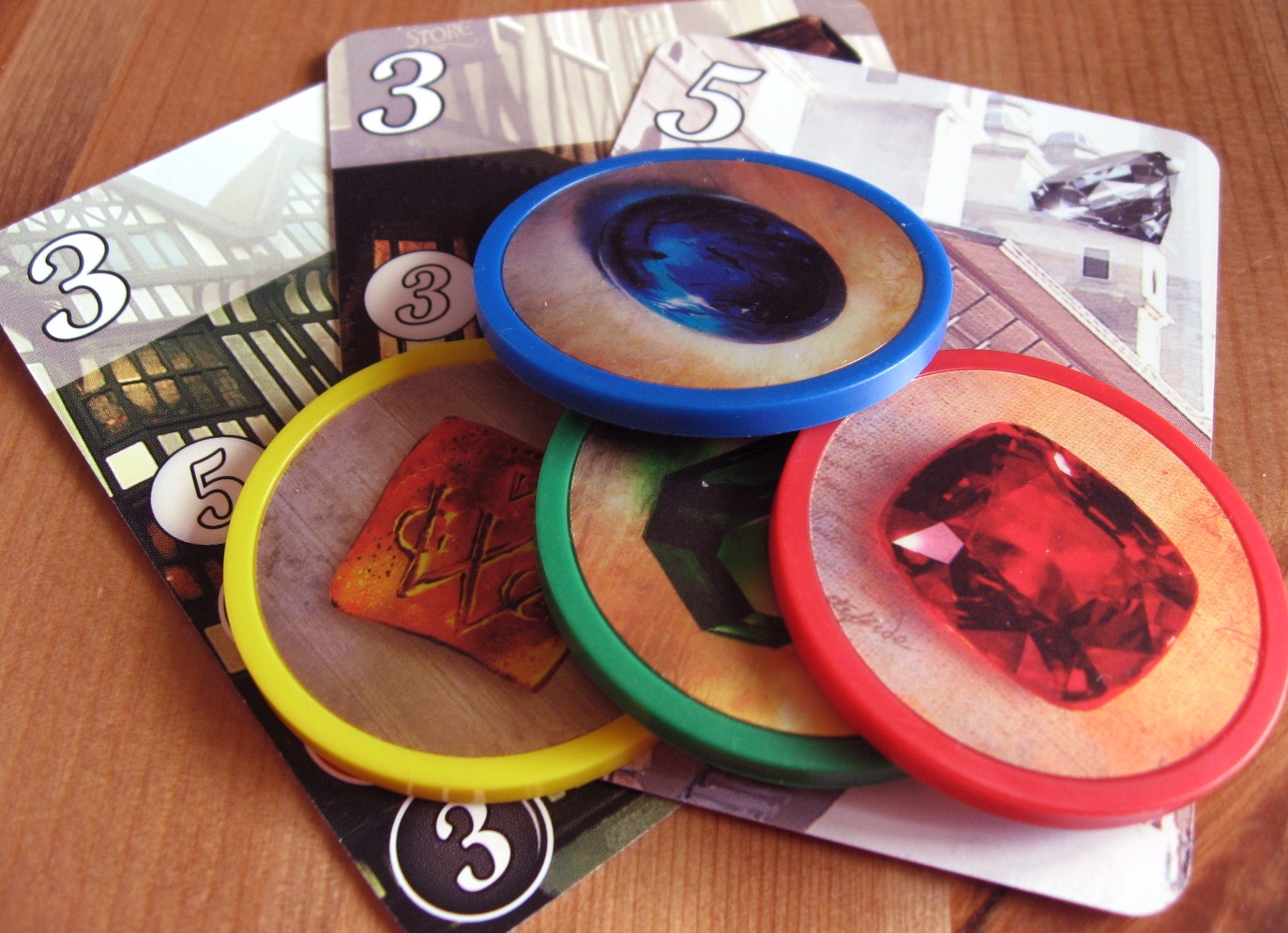
This week, we started out with our “Feature Game”, Splendor.  This is a fairly simple game of gem (chip) collecting and card development.  On a player’s turn, they have a choice of four options:  They can collect three different gems (or chips); they can collect two identical chips (but only if there are four or more left); they can pay chips to buy a card, or they can reserve a card and get a gold chip for their troubles.  Gold chips are “wild” and can be used to replace any other colour when buying cards.  Each card also represents a gem and, once bought, can be used in any purchase thereafter.  At the start of the game a set of “noble” tiles are revealed and these are awarded to players with sets of three types of gem cards and give points at the end of the game.  In addition, some cards also give points at the end of the game and the game ends at the end of the round when one player has fifteen points.  The game was very tight with Green edging it by one point.

Splendor

Our second game was Tzolk’in:  The Mayan Calendar a game we last played back in December last year.  This is a worker-placement game with a difference:  players place their workers on the wheels of a Mayan Calendar that actually turn at the end of each round.  On their turn, players can either place workers on the wheels, or they can remove them from the wheels, but they can never do both.  Players can place as many as they can if they choose, but the more they place, the more it costs.  When workers are removed from the wheels, players perform the associated actions, however, generally, the longer the worker has remained on the wheel, the larger the rewards.

Tzolk'in:  The Mayan Calendar

Each player gets to pick from a small number of starting advantages and Green chose to start with an extra worker.  In contrast, Blue started out with a moderate supply of corn and spent her first few turns getting extra workers and a building to help her feed them.  Green was making excellent progress and also had a building to help feed his workers, and then we realised that he hadn’t made sure he had three corn at the start of each round.  The penalty (as for most things in this game) was angering the Gods, so he regressed down all three temples and we carried on, but unfortunately his rhythm was broken.

Tzolk'in:  The Mayan Calendar

Green really struggled to feed all his workers and have enough corn to do anything.  Blue stopped concentrating on what she was doing and Green stole the monument she had been working towards (which rewarded good positions on the technology tracks).  In her confusion, Blue went a little overboard harvesting corn and ended up buying her way out while Green held back by his lack of corn.  As there was no competition for placing skulls, Blue picked up a hat-full of points there, and with the bonuses provided by her positions higher up the temples, she inflicted brutal revenge for the single point defeat in the previous game.

Tzolk'in:  The Mayan Calendar

Learning Outcome:  Do not anger the Gods:  they will have their revenge.

Museums at Night – Games in Oxford!

Tonight is “Museums at Night” night in Oxford.  Each free event will offer a late night experience showcasing a vast array of objects, animals, instruments, sounds and specimens from across the globe.  All the museums in Oxford are participating, but the part that most interests us is the Games Night in the History of Science Museum.  This event is in association with the games cafe, “Thirsty Meeples” and includes talks as well as activities.  Fun for all the family – some of the GOATS will definitely be there!

Next Meeting – 6th May 2014

Our next meeting will be on Tuesday 6th May, at the Horse and Jockey pub in Stanford-in-the-Vale.  As usual, we will be playing shorter games from 7.30pm as people arrive, until 8pm when we will start something a little longer.

This week the “Feature Game” will be Splendor which is a new game of chip-collecting and card development.  As it is a fairly simple game about gold and gemstones that is quick to teach and play and will give us the opportunity to decide what longer games we would like to play once everyone has arrived.

Splendor

And talking of jewels…

Jeff and his friend, Joe, heard that the streets of Blackpool were paved with gold.  So, one afternoon they set out together to make their fortune.

As they got out of the car Joe saw a golden sovereign lying on the pavement.  Bending down to pick it up he said to Jeff, “Would you look at that!  We’ll be making our fortune in no time at all!!”

Jeff stopped him saying, “Leave it there for now, we can always start work tomorrow morning…”


22nd April 2014

This was our first meeting back at the Jockey after the fire, so some of us met up before the start to try their new menu.  The first to arrive we’re early, so played a quick game of Hive.  This is a game we’ve messed about with before, but not actually played within the group (though the players this evening were quite experienced).  The game is often compared to Chess because the pieces are Black and White and different pieces have different characteristics in the way they move.  Although much of the thinking is similar, the theme is insects and there is no board, so it is perfect for transporting and playing in the pub. The first game was won by Black, so a rematch was called for.  This time the Ladybug expansion was added, but the result was the same – a second win for Black.

Hive

By this time, more people had arrived so orders were placed and food arrived and duly consumed to everyone’s satisfaction.  We were still expecting more people, so after food we had a quick game of Marrakech.  This is a strange little game about carpets, played on a board made of a grid with coloured strips of fabric representing carpet.  Basically, on their turn, players can choose to rotate the wooden character called Assam by 90 degrees, before the roll the die and move Assam the appropriate number of squares. Players then lay a piece of their coloured fabric covering two squares, one of which must be adjacent to Assam. When Assam moves, if he lands on a square covered with carpet, then the active player pays the owner of the carpet; the amount paid is dependent on the contiguous area covered by that colour.  The nature of the game means it swings to and fro, however, it felt quite tight, so much so that when two players finished with the same score, it seemed they must share victory, until Blue reported her score that is…

Marrakech

Next up was Mammut. This is a funny sharing game that (amongst other things) features the incongruity that is the sabre-tooth duck.  The idea is that on their turn players can either take any number of prey tiles from the central pool or take all the tiles from one other player, retuning at least one to the centre.  Thus, you have to be careful what you take because if another player thinks you have been greedy or you have tiles they want, they may get stolen!  The round ends when everyone has tiles and there are no tiles left in pool, and players score points depending on who has the most or least of the different types prey.  Yellow and Blue made a good early showing, but Blue soon struggled and Red, Green and Purple all began to compete strongly.  Coming into the final round Yellow was clearly in a good position with Green and Blue languishing at the back.  With the final round of scoring, Blue surged forwards only to be overtaken by Purple who picked up a lot of points.  Despite her valiant efforts though, Yellow just pipped her to the win by just one point.

Mammut

The last game of the night was our “Feature Game” which was Mascarade.  This is a relatively short game of bluffing that also challenges the memory.  Each player is initially dealt a character card face up. Players study the cards and try to remember who has which card before they are all turned face down and play begins.  Players take it in turns to either swap cards with another player, look at their own card, or declare their character in a bid to perform the associated action.  Since swaps are done in secret under the table, all certainty quickly goes, so when a player declares their character it is not always obvious whether they are right.  If a player is unchallenged, they perform the associated action without revealing their card.  If, on the other hand, another player thinks the declaration is incorrect, they may claim they are that character instead, in which case, the cards belonging to all claimants are revealed and anyone who is wrong pays a fine.

Mascarade

This was a new game to all of us, but once we got going it was a lot of fun with a lot of confusion as cards were swapped (or not).  At one point, Green bought Yellow’s dummied swap for Blue’s “Cheat” card and decided he also fancied the “Cheat” so traded with Yellow.  Blue then traded with Purple, so when Green declared he was the Cheat, Purple challenged – the confusion on Green’s face was a picture!  In the confusion, Blue capitalised and collected the last three coins she needed to win.

Mascarade

Learning Outcome:  Don’t try to cheat a Cheat!

Back at the Jockey – 22nd April 2014

Our next meeting will be on Tuesday 22nd April, back at the Horse and Jockey pub in Stanford-in-the-Vale.

As usual, we will be playing shorter games from 7.30pm as people arrive, until 8pm when we will start something a little longer.  However, to celebrate our return after the fire, some of us will be meeting early and sampling the new menu.  We will be there from 6.45pm; please feel free to join us.

This week the “Feature Game” will be Mascarade.  This is a relatively short game of bluffing that also challenges the memory.  It is a card game that everyone can join in with giving us the opportunity to decide what longer games we would like to play once everyone has arrived.

Mascarade

And talking of the mascarade…

Jeff and his wife were all dressed up and on their way to the mascarade ball, but were having difficulties finding a parking space.  After half an hour hunting, now late, Jeff says, “Lord take pity on us. If you find us a parking place I will go to church every Sunday for the rest of my life and give up drinking and partying.”

Miraculously, a parking place appeared.  Jeff looked up again and said, “Never mind, I’ve just found one.”

25th March 2014

While we waited for people to arrive we started out with a quick duelling card game set in feudal Japan, called Tessen.  The tale goes like this:

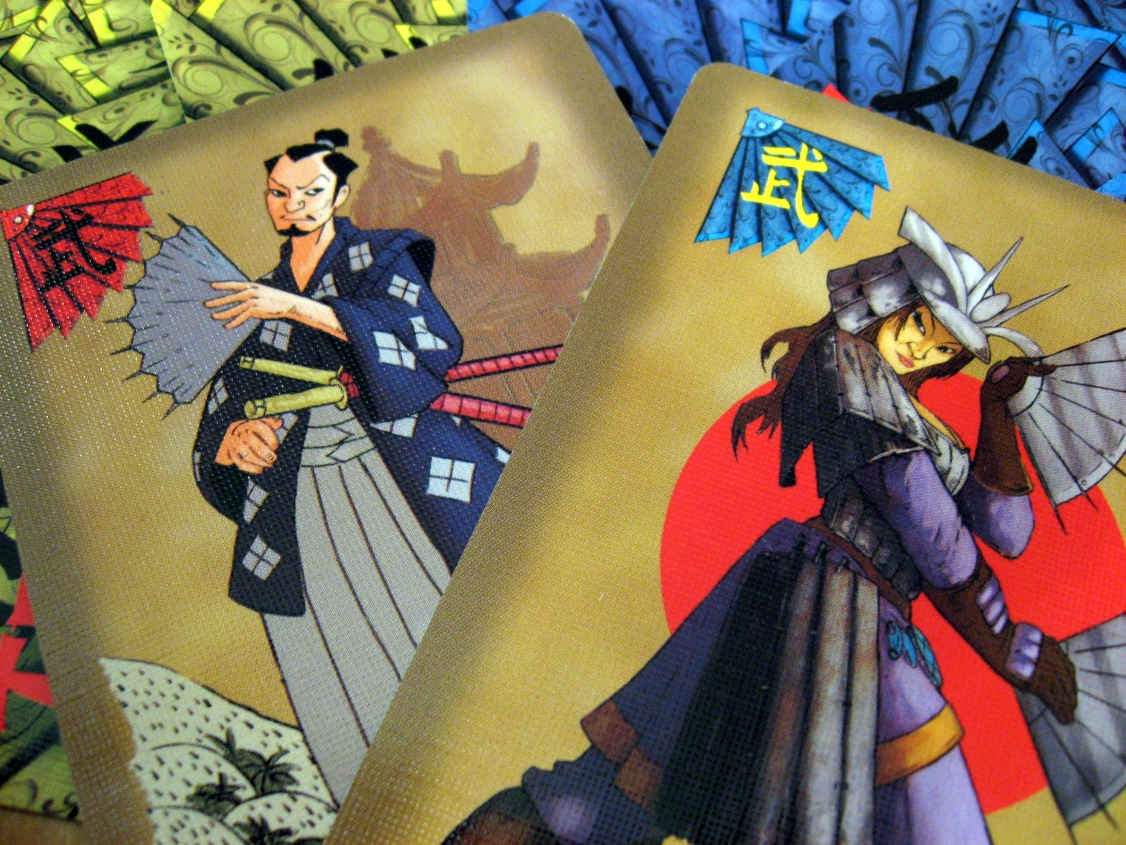
“Many years ago, in feudal Japan, disagreements and feuds were common among the clans. Fantastic battles were fought for control of resources, land, and supremacy.  Tiring of all the bloodshed, the Shogun declared a plan to minimize the violence…  All disputes would be decided by a Tessen challenge – a competitive hunt for eight types of elusive mystical animals that roamed the land. Whichever clan’s samurai were able to capture and bring back the most animals would be declared the victor, and the dispute would be ruled in that clan’s favour.  The samurai warriors from each clan would certainly attempt to sabotage the opposition’s efforts and capture their animals.  The only weapon the Shogun would allow was the Tessen, a war fan used for both attack and defence.  While the Tessen could still be deadly, there would be far less bloodshed than if the samurai were allowed to use swords.”

Tessen

So, players each have their own deck containing animal and samurai cards.  Players can draw cards, place them in one of five “cages” in their play area, or attack with a samurai card, but although actions are performed simultaneously, they must be discrete actions.  If attacked, the victim must stop immediately to either concede defeat so that the attacker can move the animals to one of their cages, or repel the attack countering with a samurai card of their own.  Each cage can only contain one type of animal and when it has three or more, the animals can be “banked” and moved into storage freeing up the cage for more animals.  The round ends when one player runs out of cards, so they are frenetic affairs which take only a couple of minutes each.  The first round was a bit of a landslide in favour of the Atika Clan, but the Nambu improved significantly on the second round to level the game.  The third round was close with the Nambu starting very aggressively, but the Atika caught up and ran out of cards first preventing the Nambu from banking her final four deer and winning the game. By this time the others had arrived, so exhausted, we left it as a best of three…

Tessen

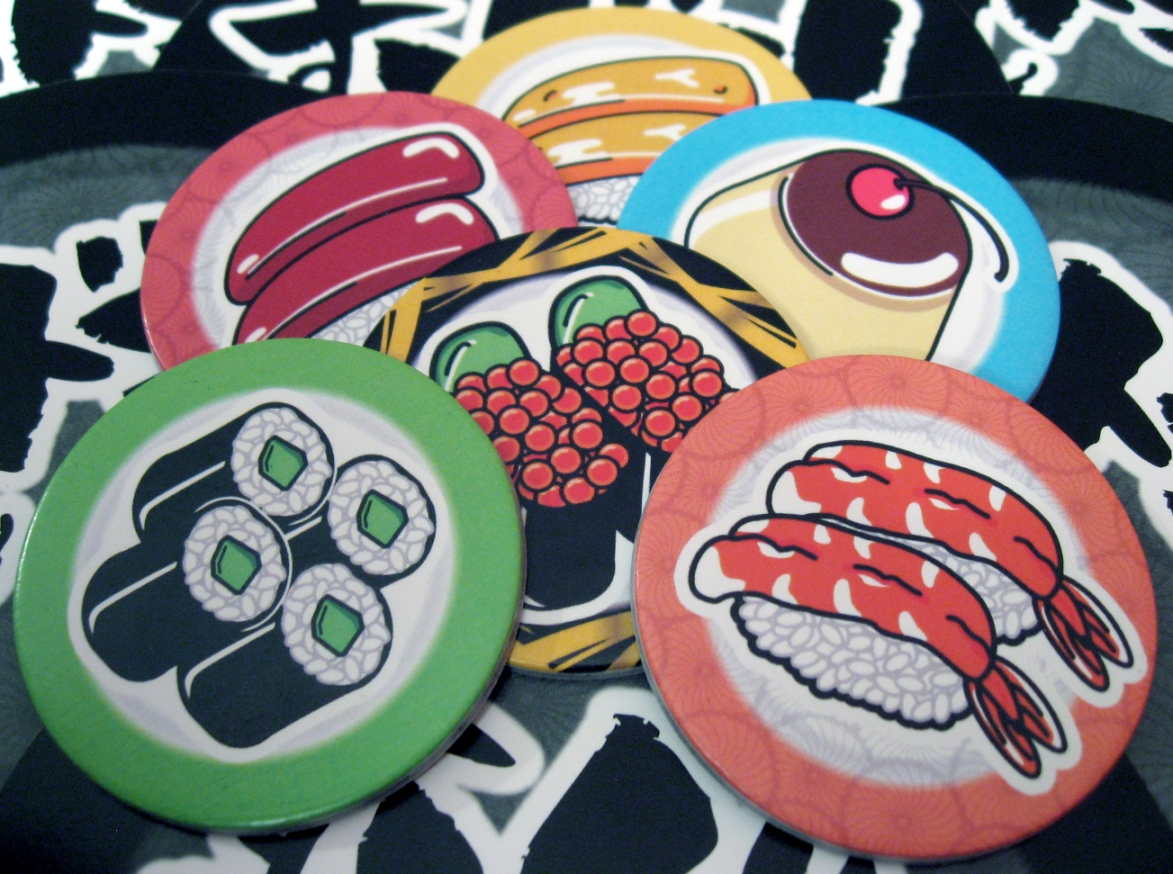
Next we played our “Feature Game” which was Sushi Draft!.  This game is similar to 7 Wonders in that it is based on “card drafting”, however, the aim is far less complex.  The story goes that the children are having a competition to see who can eat the most of one type of sushi at a Japanese family feast.  Mother, however, wants the children to eat a balanced diet, and will give pudding to the one who eats the most varied meal.  Therefore, the aim of the game is to try to do both.  Players start with a hand of six cards and then simultaneously play one before passing all but one of the remaining cards on to the next player.  Play continues until everyone has played five cards at which point the scores are evaluated and players with the most of each type get a corresponding token and the player with the most different types gets a token.  If there is a draw, then the next highest player gets the token.  About half-way through we realised that some sushi were more valuable than others which changed the game somewhat, but the damage was already done and the winner had already collected the highest value tokens.

Sushi Draft

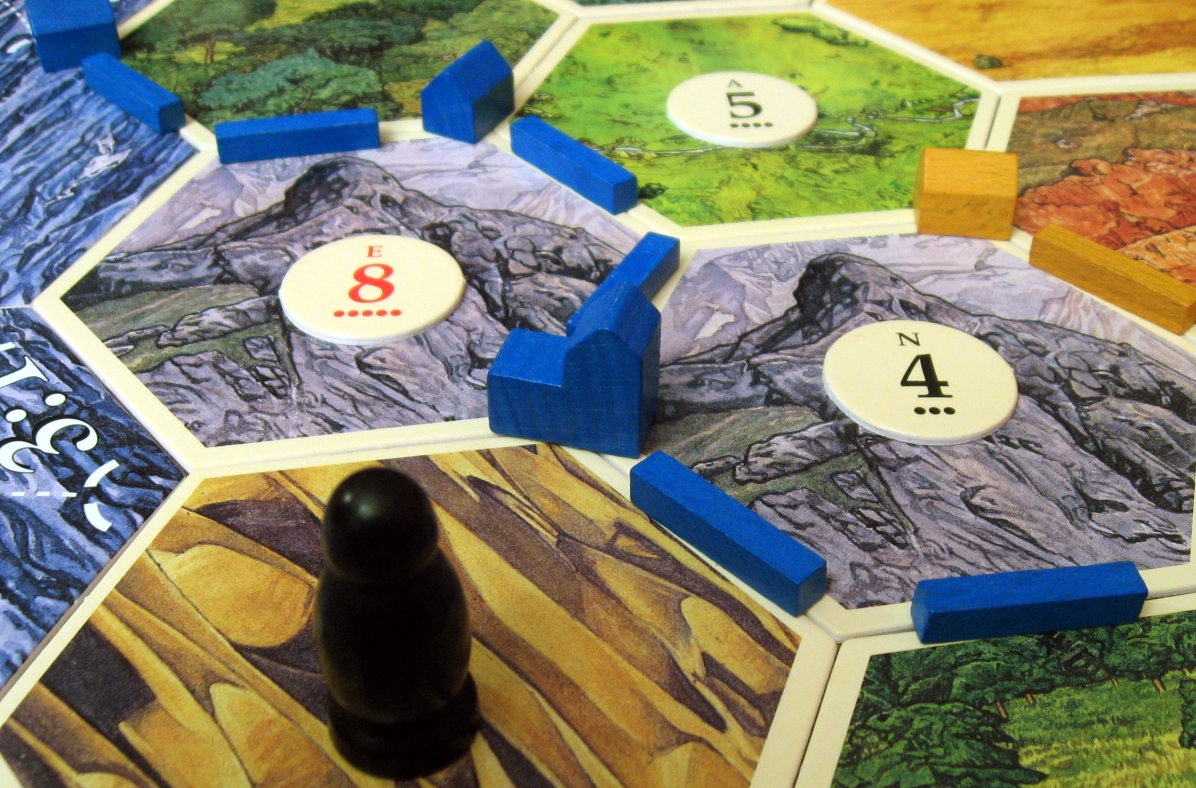
After some considerable debate, next we decided to play Settlers of Catan.  Nearly twenty years old, this is often credited with being one of the first modern boardgames.  As such, it has largely been usurped by more recent and fashionable games.  However, although we were all quite familiar with it, it was a while since most of us had played it, so we decided to blow off the dust.  The game is played on a modular board made up of hexagonal tiles corresponding to resources (wood, clay/brick, sheep, wheat/grain and ore), each of which gets a number.  Turns come in two parts.  First the player rolls two dice, adds the numbers together and anyone with a settlement on the edge of the corresponding hexagon, gets that resource.  However, if a seven is rolled, then the active player moves the robber onto one hexagon (preventing allocation resources from that hex) and then takes a card from an owner of one of the settlements surrounding it.

The Settlers of Catan

The second part of a turn is trading and building, where the active player can trade resources with other players at any rate they can negotiate, or with the Bank at a predefined rate.  Settlements (which score points at the end of the game) must be connected to at least one of the players other settlements by roads, and players start by placing two settlements on the board (in the player order 1, 2, 3, 4, 4, 3, 2 , 1).  Unquestionably the game has its faults, one of them being that the starting positions are really very critical.  While this is unquestionably true, it is not always obvious which positions are the best, and with the random nature of dice, sometimes double six will come up far more frequently than the statistically more likely combined totals of six or eight.

The Settlers of Catan

Since we started out with a random tile lay out we had a very, very distorted map with a lowland region containing all the sheep pasture and wheat fields in big regions with a more mountainous area of with forests and hills.  Even worse, all the clay (used to make bricks) was located on the low probability numbers (two, eleven and twelve), meaning that in theory, these would be difficult to come by.  Initial settlements were predominantly round the sixes and eights with players trying to maximise the variety of resources they had access to.  Blue settled in the highland area while Green, Orange and White tried to get a bit of everything, especially the rare clay.

The Settlers of Catan

It seemed Green had the best placement as he was the first to build a third settlement and followed it quickly with a fourth, meanwhile Blue was getting plenty of ore (which is useless at the start) but struggling to obtain bricks and ended up building a lot of road just to get something built, joined her two settlements and picked up the Longest Road in the process.  Two and eleven seemed to be rolled with peculiar regularity and Green was the main beneficiary as he had multiple settlements that qualified, while Orange and White also picked up the occasional hod-full.  Blue’s long road partitioned off an one corner of the board blocking both Orange and White in the process and when Green beat them to a couple of settlements, that left both Orange and White very tight for space to build and it was a race to the finish.

The Settlers of Catan

Orange judiciously used a monopoly card to steal sheep from everyone and then slaughtered the whole flock to build a city and a lot of road.  Meanwhile White used her impressive skills breading and exporting sheep to great effect to extend in the only direction available to her.  Blue’s productive ore and wood supplies in the mountains, together with the “ore harbour” and “wood harbour” finally started to pay dividends making up for her complete lack of any source of wheat or brick.  Green meanwhile, used his vast grain empire to build cities and collect development cards in an effort to build the Largest Army.  With Blue one point from winning with the cards she needed to build one last city in hand, Green needed just one more Soldier to get the Largest Army and bought a development card.  Although it turned out that three of the next four cards were Soldiers, Green was unlucky and Blue took the win.

The Settlers of Catan

Learning Outcome:  Some of the old classic games are classics for a reason and should not be neglected.