Author Archives: nannyGOAT

Next Meeting – 25th March 2014

Following the fire at the Jockey, our next meeting on Tuesday 25th March will be held in a private house in Stanford.  Please get in touch if you would like to come along and would like directions.  As usual, we will be playing shorter games from 7.30pm as people arrive, until 8pm when we will start something a little longer.

Since we didn’t get to play it last month, the “Feature Game” will again be Sushi Draft!.  This game is similar to 7 Wonders in that it is based on “card drafting”, however, the aim is far less complex.  The story goes that the children are having a competition to see who can eat the most of one type of sushi at a Japanese family feast.  Mother, however, wants the children to eat a balanced diet, and will give pudding to the one who eats the most varied meal.  Therefore, the aim of the game is to try to do both…!

Sushi Draft

And talking of Japanese food…

It was their wedding anniversary, so Jeff and his wife went out for a meal in a posh Japanese restaurant.  When they arrived, the waiter asked whether they had a reservation, but as Jeff had forgotten it was a “special day” he hadn’t had time to make a booking.  “No problem,” said the waiter, “I’ll see if I can find a table for two.”

As they were waiting for a table to be prepared, Jeff’s wife couldn’t help noticing a fish tank full of beautiful tropical fish. She turned to Jeff and said, “I would love some fish like that for our aquarium at home.”

Jeff agreed, keen to make up for his earlier faux pas, agreed that they were beautiful and asked the waiter what the fish were called.

The waiter replied, “Sushi…”

11th March 2014

So you can’t keep keen gamers down, and some of us decided that as it was games night, we were going to play some games anyhow.  First up was a Dixit which was was the first game of the new year, played in the early hours of New Year’s Day.  In this game, the “Story Teller” chooses a card from their hand and uses a word, phrase, noise or even action to describe it.  Everyone else chooses the card from their hand that they feel best matches the “clue”.  These are shuffled together with the Story Teller’s “answer” card and turned over, before players choose which one they think was correct, i.e. the Story Teller’s.  Points are awarded to players for guessing correctly, to players who’s cards were picked by other players, and to the caller if some people (but not all) managed to guess the correct card.

Dixit

Red fell behind initially, but after Blue had taken her place at the back she managed to rejoin the pack, moving into second place.  It didn’t stay that way for long, however, and as the group closed up everyone (except White) took their turn at the rear of the group.  With two rounds to go the rabbits were all lined up one behind the other with only only three points between first and last place.  Red was the first to slip up and failed to score in the penultimate round, followed by Green in the last round, which left White and Blue to move ahead, with Blue taking it by a nose.

Dixit

Red had to leave, and the rest of us played another game of Tobago as two people had missed out last time. This is a very pretty treasure hunting game  where players take it in turns to play clue cards that successively narrow down the location of the treasure.  Players can then try to position their vehicle in such a way that, once the location of the treasure has been uniquely identified, they are the first to get to it.  Treasure is then distributed amongst those who played clue cards and the player who found it, but beware!  There are two “cursed treasures” which as well as damaging the current treasure also cause unprepared players to discard their most valuable treasure.  In this game we had fun finding the “Grey” treasure as all the clues were very non-specific and it required seven clues to locate it.  Despite all that effort, however, the first treasure card revealed was cursed and nobody got anything!  In contrast, the other nasty treasure also required a lot of clues, but it was the last card revealed and nobody had passed so nobody missed out.  As the game was nearing the end, it was Green’s turn and only one treasure had any clues, both of which were his.  With the aid of an amulet, he managed to locate the treasure and travel to it collecting keeping all the treasure for himself.  As before, we ran out of treasures making it necessary to take cards from the discard deck.  This time, the cursed treasure was not drawn though and Green picked up a massive 14 points, giving him a clear win with 46 points in a game that had been very close with only a few points in it until the final turn.

Tobago

Learning Outcome:  Beware of the Cursed Treasure:  A lot of hard work can be wasted!

25th February 2014

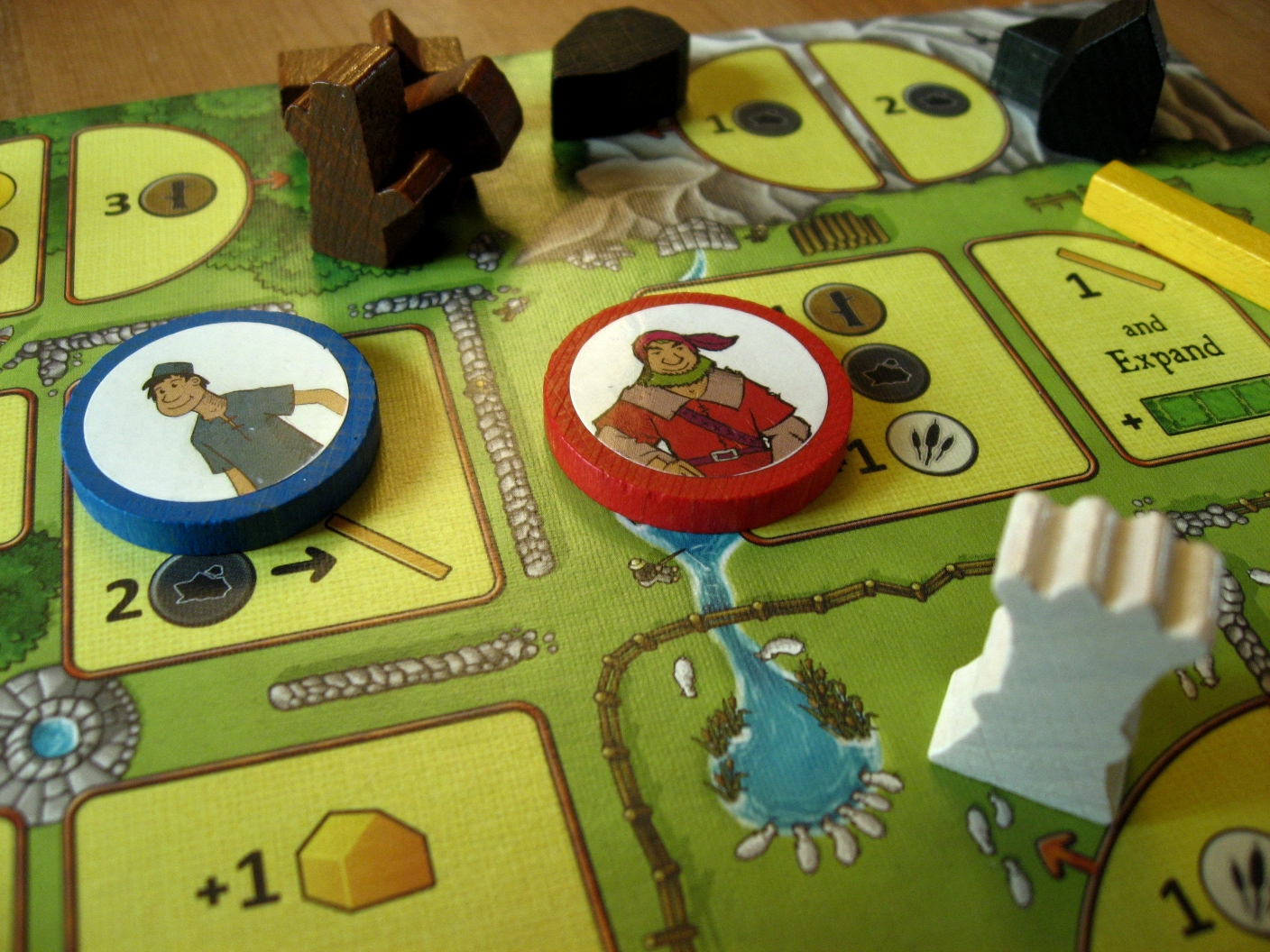
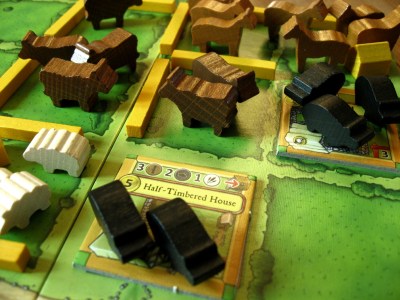
Thanks to people leaving, moving and catching lurgy we were really short of players – what a come down from a few weeks ago when we had two parallel games and were struggling to find chairs for everyone!  For this reason, we abandoned the “Feature Game” (Sushi Draft!), as it plays better with more people and started out with a quick game of Agricola:  All Creatures Big and Small.  This is a smaller version of one of our more popular “worker placement” games, Agricola.  In this game players are medieval farmers and the idea behind it is that players start with a small number of workers and carry out actions to build up their farm by fencing off pasture, buying animals, ploughing fields and growing corn and vegetables, all the time trying to make sure that workers have enough food.  At the end of the game, players score for a range of things including how large their house is, and how big their family is.

Agricola:  All Creatures Big and Small

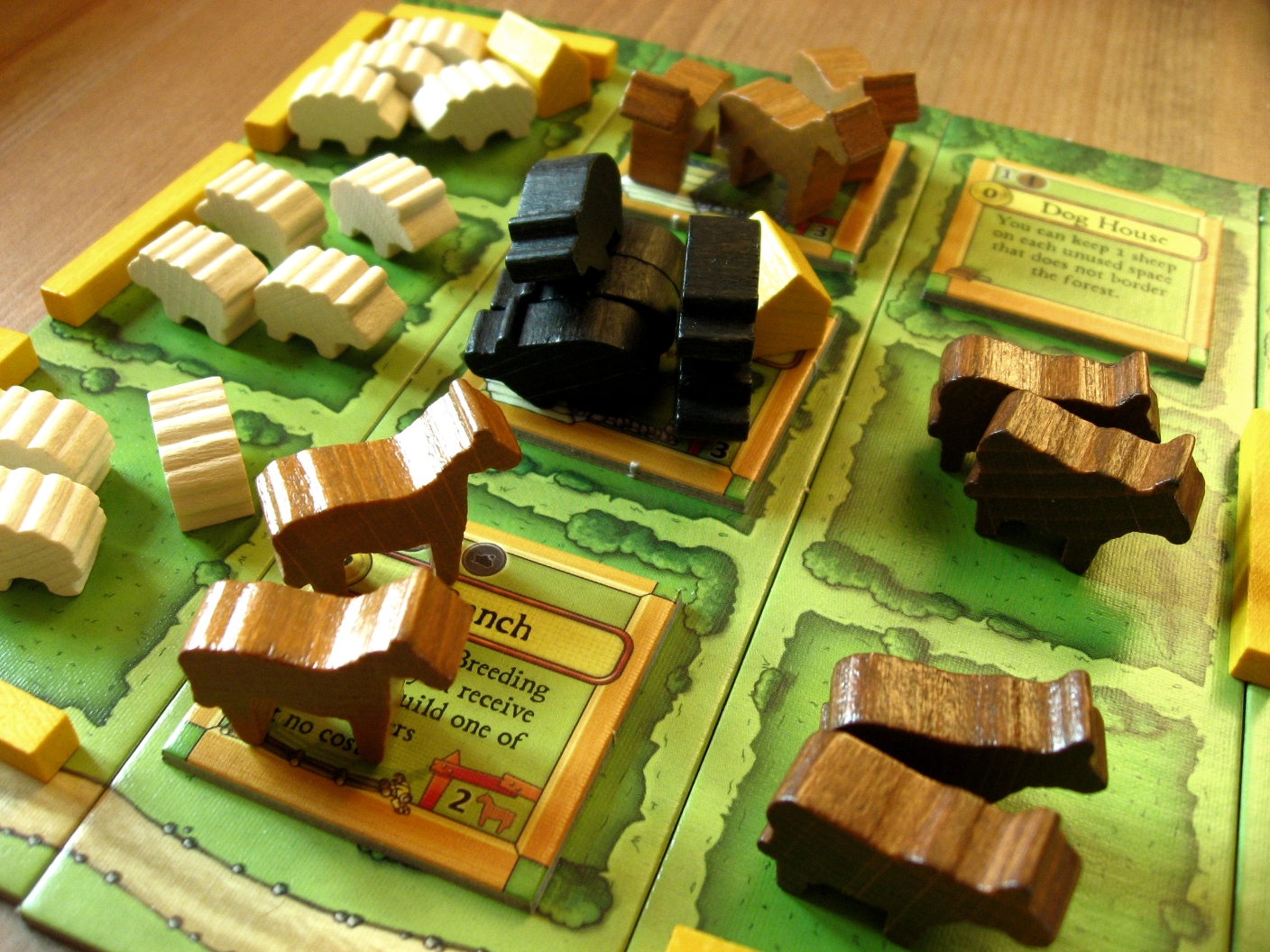
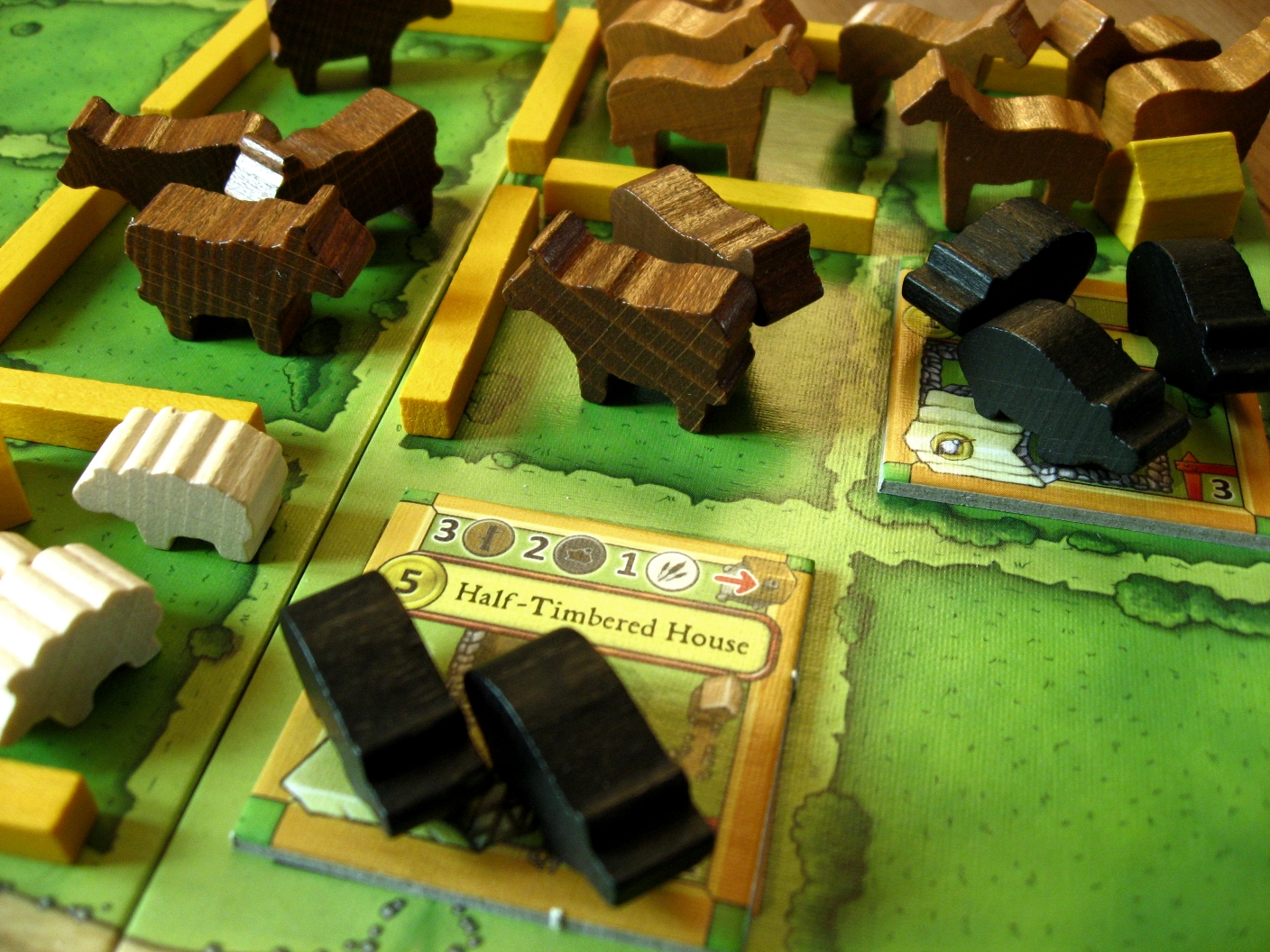
In the smaller version, the focus is concentrated on the animals and players primary aim is to develop their stock with a secondary aim of expanding their property and making good use of the new land.  In general, a lot of the basic rules are the same:  You collect resources to build anything and your animals must be kept in an enclosed space (either a building, tied to a drinking trough or in a fenced pasture); any animals that you have more than two of will breed at the end of the round to give another.  In contrast to its big brother, in this game there is no facility for increasing your family from the three you start with, there is very limited facility to upgrade your cottage, food is provided by some other means outside the game (clearly the workers are not going to starve), and minor/major improvements and occupations are provided by buildings.  We had played this before (though not on a Tuesday), so we included four random buildings from the expansion, More Buildings Big and Small, specifically, the Ranch, Dog House, Rearing Station and Barn Floor Manufacturer.
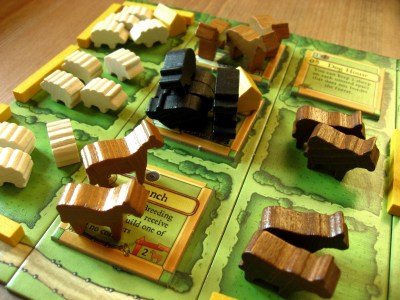
Agricola:  All Creatures Big and Small

Red started and began collecting horses, meanwhile, Blue built a Dog house that allowed her to keep one sheep in each unfenced pasture not adjacent to the forrest.  Red then built a stall and some feeding troughs and started breeding horses and pigs while Blue tried to expand her property and built a Ranch as the flock of sheep carried on growing.  In the dying stages of the game, Red managed to gather together enough sheep to avoid a penalty, but failed to completely cover his second expansion board;  Blue had to allow a couple of animals to escape as she couldn’t find space to house them despite completely covering all three of her expansion boards.  Blue ran out the winner with 51 points to Red’s 43, largely thanks to her large flock of sheep.
Agricola:  All Creatures Big and Small

Next, we played Tobago, which is a Christmas game that we’d played before (though again, not on a Tuesday).  This is a very beautiful game of treasure hunting on the island of Tobago.  The board is divided into segments of different terrain, forest, beach, mountain, river etc.   The idea is that players take it in turns to play cards that successively narrow down the location of the treasure.  Thus, if the first player plays an “in the forest”card, the next might play a not “next to the river” card reducing the number of available spaces that can hold the treasure to those wooded spaces out of earshot of the river.  Each player also has an All Terrain Vehicle (ATV) that they can move instead of playing a card, and use to collect treasures.  When an ATV arrives at the treasure space (or the treasure location is unambiguously revealed as a location where there is a vehicle), treasure cards are revealed to the players, with one per card per clue and an extra for the player who found the treasure.  The cards are then pooled, shuffled and the top one turned over.  The last player to place a clue card gets first choice of and can either choose to take the card, or pass (waiting for the next card), and let the next player choose.  Each treasure card has a different value and as players who placed a lot of clue cards will have seen a lot of them, they are in a better position to decide whether it is a good idea to take a treasure or to pass, the more so since there are two “cursed treasures” which prevent any further treasures being revealed as well as causing players to discard their most valuable treasure card.   Once the treasure has been distributed, amulets are distributed around the island; players who collect these can exchange them for an extra turn or use them to prevent treasure loss when the cursed treasure is revealed.

Tobago

Red placed his ATV in the middle of the island next to a lake, so Blue placed hers on the other side of the water and immediately realised that Red had the optimal position. Red started laying clues, so Blue carefully stalked him matching every clue he placed.  The first treasure was located in such a way that Blue could make it there first giving her the majority of treasure cards.  Placing second meant that Blue had first choice and was able to keep the most lucrative treasures.  This pattern was repeated for the first few treasures and Blue managed to get a nose in front.  Red made tried to collect amulets so he could regain control of the game, but the final damage was done when the cursed treasure cards appeared and in both cases Blue collected more treasures than Red.  As the game came to an end, Red had amassed a fine collection of amulets, but it was too late to make a real impact and Blue won, 73 points to 43.

Tobago

The last game we played was Morels, which we’ve played before, but was new to one of the players.  This is a fairly traditional set collecting game, but is a very nice rendition with lovely art-work and some hand made forage sticks provided by the designer.  The idea is that you can collect the readily available mushrooms “at your feet” for free, or you can choose a less accessible fungi and pay the difference in forage sticks, the game’s currency.  Once you have a set of three or more mushrooms you can cook them, and add cider or butter if appropriate to add extra points at the end of the game.  Red started again as he hadn’t played it before and made a point of collecting some forage sticks by trading a pair of “Hen of the Woods” for six forage sticks early on.  Meanwhile, Blue picked up a couple of basket cards and couple of night cards, but was unable to get a nice set worth cooking.  Red picked up a couple of Porcini cards and Blue collected a couple of Morels and both players waited for the third card to make up the set.  Red cooked a handful of Tree Ears flavoured with some cider and Honey Fungi, while blue cooked some Shitake with butter and some Lawyers’ Wigs.  As the supply of fungi started to dwindle, Blue finally managed to pick up the third Morel and cook it, but Red took the last pan card preventing her from playing the Chanterelles.  Despite this, Blue took the game by 38 Mushroom Varietal Points to 29, giving her a hat-trick of wins for the evening.

Morels

Learning Outcome:  It is nice to come back from a loosing streak with a bit of a bang.
Next Meeting – 25th February 2014

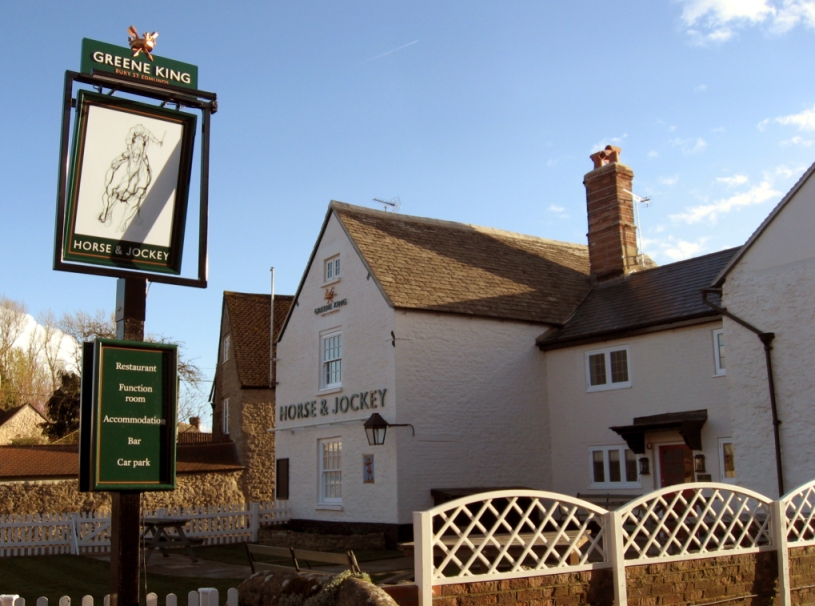
Following the fire at the Jockey, our next meeting on Tuesday 25th February will be held in a private house in Stanford.  Please get in touch if you would like to come along and would like directions.  As usual, we will be playing shorter games from 7.30pm as people arrive, until 8pm when we will start something a little longer.

This week the “Feature Game” will be Sushi Draft!, which is a fast little card game picked up at Essen last year that is still waiting for an outing.  The game is similar to 7 Wonders in that it is based on “card drafting”, however, the aim is far less complex.  The story goes that the children are having a competition to see who can eat the most of one type of sushi at the family sushi feast.  Mother, however, wants the children to eat a balanced diet, and will give pudding to the one who eats the most varied meal.  Therefore, the aim of the game is to try to do both…!

Sushi Draft

And talking of sushi…

Jeff and and his business partner were opening a new sushi bar in The Strand.  Since The Inns of Court, Lincoln’s Inn, Gray’s Inn and the Temple occupy much of the surrounding area they decided to make it exclusive to lawyers.

They called it “Sosumi”.

11th February 2014

One of our regulars is moving pastures new, so as this was probably her last week, we played games she said she liked.  We started off with Parade, which is a little card game with an Alice in Wonderland theme where you add cards to a row, but the cards that you place dictate what cards you pick up.  In general, cards score their face value and the object of the game is to have the lowest score, however, for the person who has the most of a colour, that colour scores only one for each card. So, the game starts with everyone trying to minimise what they pick up and then, once the writing is on the wall, everyone scrabbles to pick up as more cards than everyone else.  We first played it a few weeks ago and our leaver came second by just one point, so this had an element of a re-match.  The winner from last time was quickly forced out of the running and ended up with twenty-eight points, and the battle was between our leaver and the player who came last in the previous game.  Sadly, our leaver once again finished in second place with twenty points after being forced to pick up a couple of tens, but, with fourteen points, the win went to someone who claims he always looses “little games”.

Parade

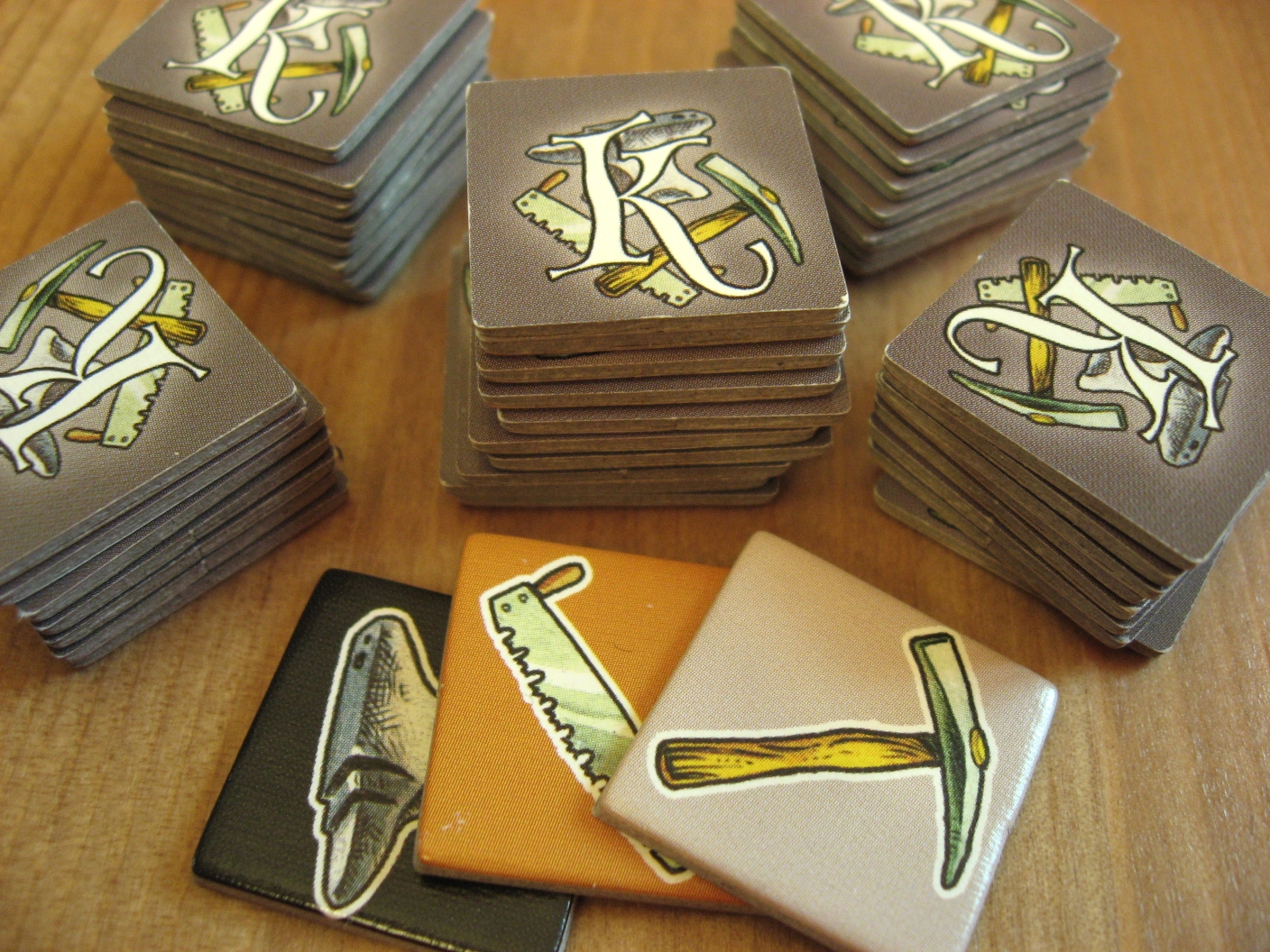
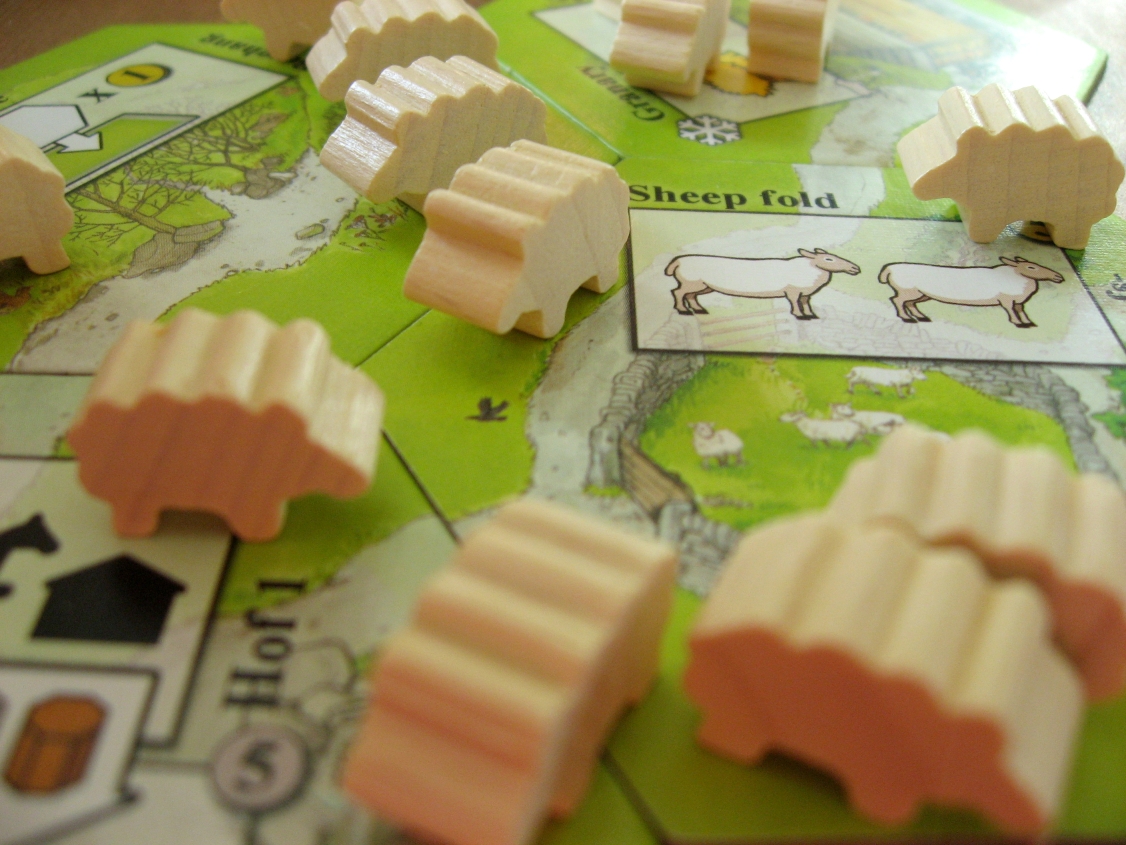
Next we started setting up the “Feature Game” which was Keyflower with the Farmers expansion and then a couple more people arrived.  Keyflower is one of our most played games, but there is one player who usually wins, so the rest of us made a point of ensuring that Green didn’t have it all his own way this time.   Like the last time we played with the expansion, we used all the farming tiles.  Winter tiles were doled out and the rules were passed round as people checked and double checked what they had.  Spring tiles were then revealed and Red and Blue went for the sheep tiles.  Red and White won them, but Blue had placed a couple of workers on the tiles before the end of the round giving her a breeding pair.  By the end of the summer both Red and Blue had a large flock of sheep and it was only then that Blue dissolved into fits of giggles as she realised that sheep weren’t pink and she had been collecting the wrong animal…

Keyflower

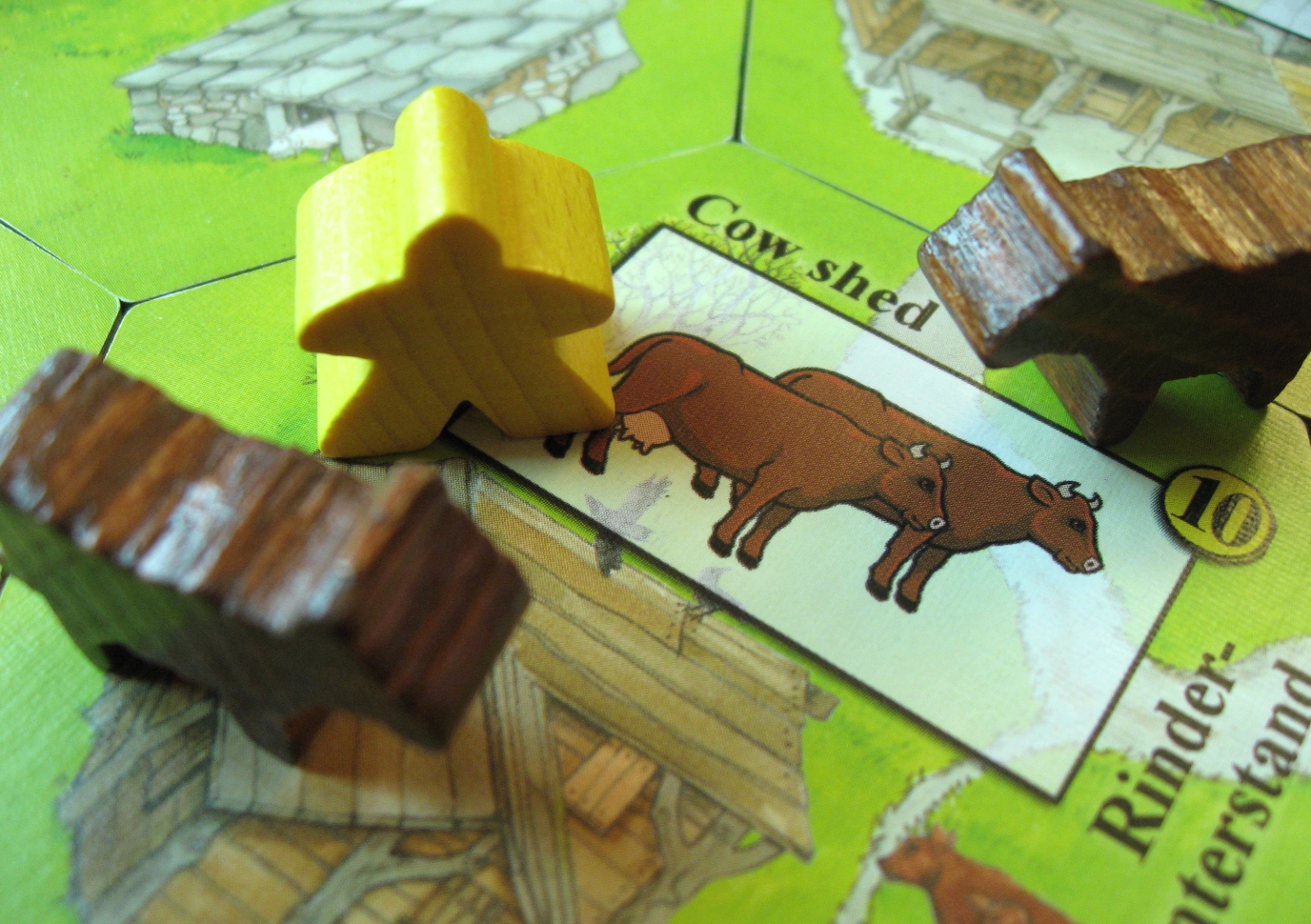
Meanwhile, Green had been acquiring resources, Yellow had been trading tiles getting two for one on each occasion, and White had been busy building up a healthy stock of green meeples and pigs.  In the last round, the winter tiles were revealed.  The Hillside tile came out and it suddenly became apparent why Green had such a strange shaped village, so Yellow took it off him.  The only other animal tile that came out was the cow tile which Blue made a play for to try to redeem her earlier spell of colour blindness.  Red pointed out a couple of turns in that it was worth a lot and promptly started to bid for it too.  In revenge for “stealing” his Hillside, Green took the Scribe which rewards players for collections of skill tiles, so Yellow took the Windmill which rewards players for collecting resources…

Keyflower

Despite Red’s efforts, Blue managed to sneak under the radar and nabbed the Keythedral (which is worth twelve points).  The collective efforts of Yellow, White and Red had succeeded in preventing Green from winning.  However, despite having a chronic shortage of meeples throughout (due to squandering them on sheep in the first two seasons) and therefore a very small village, and almost no points from anything else, the combination of a heard of cows, the Keythedral and the damage the other players had done to each other, meant Blue finished with seventy-one points, seven ahead of Yellow in second and twelve ahead of Red in her last, quite epic game with us.

Keyflower

Learning Outcome:  Beef is very nourishing!

Next Meeting – 11th February 2014

Following the fire at the Jockey, our next meeting on Tuesday 11th February will be held in a private house in Stanford.  Please get in touch if you would like to come along and would like directions.  As usual, we will be playing shorter games from 7.30pm as people arrive, until 8pm when we will start something a little longer.

One of our regulars is moving to pastures new and this will probably be her last week.  So, we have decided to make “Feature Game” one of her favourites, Keyflower.  We have played it quite a bit, but she missed out on the Farmers expansion which was an interesting addition, so we may include that too, however, if she can’t make it, we may play something completely different…

Keyflower

And talking of farmers…

Jeff was a small-town country farmer with a watermelon patch.  Unfortunately, he found that some of the local kids had been helping themselves to his prized watermelons.  After some thought, Jeff came up with a way to discourage this profit-eating situation and he put up a sign that said, “WARNING! ONE OF THESE WATERMELONS CONTAINS CYANIDE!”

Jeff smiled smugly to himself the next evening as he watched the kids run off without eating any of his melons.  A couple of days later, Jeff returned to the watermelon patch to find that the sign was still having its desired effect and discover that none of the watermelons had been eaten.  However, there was now a new sign that said, “NOW THERE ARE TWO!”

28th January 2014

This week was memorable for a number of reasons.  Firstly, the non-playing member of the group, had been to the vet for the first time in about fifteen years and she didn’t like what they did to her (in fairness, she started it by taking a chunk out of the vet, but it is certain both she and the vet won’t forget the day quickly).  Secondly, nearly every current member turned up, the first time this had happened since the fire at the Jockey, and with the added bonus of a new member, we were just a bit pushed for space.  It is a very nice problem to have though, especially since this time last year we were really struggling.

Zooloretto: The Dice Game

People arrived gradually, so we started with our “Feature Game”, the filler Zooloretto:  The Dice Game.  This is closely related to the tile laying game, Zooloretto, which we’ve played before.  Both use the “Coloretto mechanism” which is a variant of the “I divide, you choose” mechanism that children sometimes use when sharing a cake.  Basically, the idea is that players take it in turns to roll dice (or draw tiles or cards depending on the game) and choose which “truck” to place them in.  When they see a truck they like, they can choose to take the contents instead of rolling (then they sit out of the rest of the round).  In the case of the dice version, players are collecting custom animal dice;  the idea is to have as many as possible up to a given limit and exceeding the maximum incurs a penalty.  The first two people to arrive were about half way through when two more turned up and joined in for a second game.

Zooloretto:  The Dice Game

After the second game we had a quick game of “extend the table, rearrange the furniture and hunt for extra chairs” and were just finishing as the last group arrived.  After some discussion, we decided to split the group into two and the first group played Montego Bay.  This is a game that we played last year and all felt that it was quite enjoyable, so we decided to give it another outing.  In summary, players control two figures, a large docker and a small docker who are travelling round the warehouses collecting barrels of rum to place on ships before they sail.  There are two aspects to the game, the first is the priority given to filling boats because, when a boat sails, the player with the largest number of barrels on board scores the most points.  Secondly, everyone chooses how far to move their dockers simultaneously at the start of the round, however, players take their turns in a prearranged order which leads to an interesting juxtaposition of chaos and “double-think”.  In this game, Orange came back from the dead with optimal use of “Lazy Jack” to win by four points.

Montego Bay

Meanwhile, the second group played 7 Wonders, which we played at New Year.  Played in three rounds, this is a card drafting game where players take one card from their hand and then pass the rest on, then repeatedly do the same with the cards they receive until there are none left.  The idea of the game is to build an civilisation and complete their “wonder”.  For the last game there were seven of us and it was over-long and completely disorganised chaos.  This time there was a much more manageable number and it worked much, much better.  One player had played it many times before and it showed in the score with him winning with fifty-two points, five ahead of second place.  The other group were only about halfway through their game though, so that gave an opportunity for a rematch.  Revenge was duly served as the game finished with the winner of the second game fifteen points clear of a tight pack which included the winner of the first game.

7 Wonders

For the last game we got back together as a large group and finished with a game of SaboteurWe played this nearly a year ago, but again didn’t have an optimal number of players.  This time, with more than twice as many, the game played much, much better.  The idea is that players are digging for gold by laying cards to form tunnels.  Everyone is either a “Dwarf” or a “Saboteur” and at the end of the game, points are given to the Dwarves if they extend the tunnel to find the gold, and Saboteurs if they succeed in stalling the Dwarves so much that they fail.  In addition to extending tunnel network, players can also play cards that inhibit the digging ability of others, or alternatively remove an impediment someone else has played.  The first game everyone was watching our “Habitual Saboteur” and waiting for him to do something suspicious, meanwhile, another player moaned about the nature of his hand, and kept discarding cards and everyone else seemed to get on with digging.  The Dwarves were about halfway there when one player declared she was a Saboteur and played a very obstructive card and immediately received a hail-storm of broken tool cards.  It was only after the Dwarves had run out of cards that the “discarder” showed his true colours as a Saboteur and the Habitual Saboteur wasn’t (this time).

Saboteur

In the second round, our Habitual Saboteur made up for his good behaviour in the first round and teamed up with the Saboteur Queen.  It looked like the dwarves might just make it when another Saboteur jumped out of the shadows throwing broken tools at all the Dwarves and putting the gold definitively beyond their reach.  Going into the final round, the Saboteur Queen (who ended up obstructing in all three rounds) had what was thought to be an unassailable lead with six points to a maximum of three elsewhere and a third failure for the Dwarves would have given her a landslide victory.  However, this time she only had the one team-mate which made it much more difficult for her to obstruct the tunnellers and, in due course, it was the Habitual Saboteur (who once again, surprisingly, wasn’t) who laid the final card and found the gold.  He managed to take a total of four points from the last round and just pipped the Saboteur Queen to the win.

Saboteur

Learning Outcome:  Don’t believe anyone when you know there is a Saboteur in your midst!

Next Meeting – 28th January 2014

Following the fire at the Jockey, our next meeting on Tuesday 28th January will be held in a private house in Stanford.  Please get in touch if you would like to come along and would like directions.  As usual, we will be playing shorter games from 7.30pm as people arrive, until 8pm when we will start something a little longer.

This week the “Feature Game” will be Zooloretto:  The Dice Game, which is a quicker, dice version of the tile laying game, Zooloretto, which we’ve played before.  In both games players are zoo owners and the aim is to collect large sets of animals and make their zoo profitable, but too many animals become difficult to store…

Zooloretto: The Dice Game

And talking of zoos…

Jeff and his small son were standing in front of the tiger’s cage at the zoo.  Jeff was explaining to the little boy how
ferocious and strong tigers are and junior was taking it all in with a serious expression.

“Dad,” the boy said finally, “If the tiger got out of his cage and ate you up …”

“Yes, son?” Jeff said expectantly.

“…What bus should I take home?” the boy finished.