Author Archives: nannyGOAT

14th January 2014

As we weren’t too sure about who was coming it took a while to get going, but first up, we decided to play our “Feature Game”, Parade.  This is a set collecting card game with an Alice in Wonderland theme.  Basically, there is a “parade” of characters in the form of a row of cards.  Players take it in turns to add a card from their hand to the parade and depending on the number and colour of the card they play, they then remove cards from the parade and place them in suits in front of them.  So, if a player places a red five, the five most recently played cards are “protected” and the player takes all the red cards and any cards numbered five or lower and places them in their area.  The aim of the game is to finish with the lowest accumulated total.  The clever part is the scoring:  if a player has the most cards of a given colour, all the cards score one regardless of the face value; all the remaining cards score their full value.  So, a set of high scoring cards can suddenly score a lot less because that player has the largest number of cards in that suit.  The other key part is that at the end of the game, each player adds two cards from their hand to their sets on the table.  Thus, the last two cards can have a dramatic effect on the game as they can change who has the majority in the colour suits and if you get it wrong  it can have a catastrophic effect on your end score.  Two players started off well, picking up only zeros and ones, while another was forced to pick up a few high cards straight away so decided to try to collect the most cards in these suits.  He was doing a good job when the everyone else was forced into taking a couple of high scoring cards each and started competing.  Despite initial appearances, the game was very tight, with the winner just one ahead of second with sixteen points, and slightly different card choices at the end could have completely changed the placings.

Parade

Next, we decided to play Agricola.  This is one of our more popular games and we had just finished setting up when one of the players was called away with boiler trouble.  We decided to leave it for another day and play Flash Point:  Fire Rescue instead.  This is a cooperative game where players take on the roles of fire-fighters trying to rescue people from a burning building.  Players take it in turns to carry out actions and then dice are rolled to spread the fire.  The addition of dice makes the game less predicatable than in some of the other cooperative games we’ve played where cards are used to simulate impending doom.  The use of dice also means that there isn’t the same “ticking clock” that there is with cards:  if you can stay on top of the fire, you can take as long as you like to get people out, on the other hand, if the fire gets out of control, it spreads faster and faster increasing the risk to the casualties and increasing the chance of explosions which cause damage to the building and suddenly the building collapses and everyone dies.

Flash Point:  Fire Rescue

Since we had a player who was new to the game, we played Veteran level (three explosions, three hotspots and four hazardous materials) and used the reverse side of the base game board.  We divided our labour so we had half the team fighting the fire and the other half rescuing people.  There was a lot of fire in the centre of the board down the corridor, so Red went in first as the CAFS fire-fighter.  Meanwhile, Blue entered via the side door as the Rescue Specialist and quickly saved the first casualty before riding the ambulance round to the other side and following Red in to rescue a couple more.  Red dealt with the recurrent smoke in the shower cubicle while Blue enlarged the hole in a damaged wall and rescued a couple more.  One of the new Points of Interest was placed rather unfortunately next to fire and we didn’thave time to deal with them before an explosion meant we had our first victim of the flames.  Despite the loss, however, we had soon rescued the required seven people.  Somehow, leaving casualties in a burning house seems wrong, so we continued to try to rescue everyone else.  All the Points of Interest were now on the far side of the board, so the Rescue Specialist rode round the building in the ambulance and made a new more convenient entrance.  Red helped reveal which of the Points of Interest were real people and then together Blue and Red carried the last two people out leaving only one Point of Interest behind, which was known to be a false alarm.

Flash Point:  Fire Rescue

Learning Outcome:  Where there’s smoke, fire will surely follow…

Next Meeting – 14th January 2014

Following the fire at the Jockey, our next meeting on Tuesday 14th January will be held in a private house in Stanford.  Please get in touch if you would like to come along and would like directions.  As usual, we will be playing shorter games from 7.30pm as people arrive, until 8pm when we will start something a little longer.

This week the “Feature Game” will be Parade, which is a set collecting card game with an Alice in Wonderland theme.

Parade

And talking of Wonderland…

The White Rabbit was running happily through the Wonderland woods when he came across the Dodo smoking a cigarette.  He ran up the Dodo and said, “Hey, Dodo, you shouldn’t do that. Think of your health. You should come running in the woods instead!” The Dodo looked at the White Rabbit, looked at his fag, caughed, shrugged his shoulders, tossed the cigarette over his shoulder and ran off through the wood with the White Rabbit.

After a while the Dodo and the White Rabbit came across a the Cheshire Cat rolling a joint.  The White Rabbit ran up the Cheshire Cat and said, “Hey, Cheshire Cat, you shouldn’t do that.  Think of your health. You should come running in the woods instead!”  The Cheshire Cat looked at the White Rabbit and the Dodo, looked at the spliff, shrugged his shoulders, tossed the joint over his shoulder and ran off through the wood with the White Rabbit and the Dodo.

After a while they came across a the Mad Hatter setting up a line of Coke.  The White Rabbit said, “Oh, Mad Hatter, you really shouldn’t do that. You should come running with us in the wood. It is much better for you.”  The Mad Hatter looked at the White Rabbit looked at the line of Charlie, shrugged his shoulders, then ran off through the wood with the White Rabbit, Dodo, and Cheshire Cat.

After a while they came across a the Alice filling a syringe with heroin.  The White Rabbit said, “Oh, Alice, you really shouldn’t do that. You should come running with us in the wood. It is much better for you.”  Alice looked at the White Rabbit then at the syringe, shrugged her shoulders, then ran off through the wood with the White Rabbit, Dodo, Cheshire Cat and Mad Hatter.

After a while they came across the Queen of Hearts drinking her way through a magnum of Champagne.  The White Rabbit ran up to the Queen and said, “Your Majesty, you really shouldn’t do that.”  The Queen immediately jumped up and starts beating the White Rabbit mercilessly with her mace shrieking “Off with his head!”.  Alice grabed the Queen and pulled her off the White Rabbit and said, “Your Majesty!  What are you doing?!?!” The Queen gets one more blow in and says, “That Rabbit!  He always makes me run around the damn woods when he’s on Ecstasy!”

31st December 2013

The evening started with a quick two player game of “extend the table and try to find space for it”.  Just as we were finishing, one of our regulars arrived with his family, including his dinosaur-pyjama-clad four year old – unquestionably the youngest GOAT to date!

PitchCar

As planned, we started off with our “Feature Game”, the gorgeous, dexterity car-race, PitchCar.  The idea of this game is that, starting with the player at the front of the field in each round, players take it in turns to flick their small wooden car round the custom-made circuit.  Since the game was new to so many of the players, we started out with a simple track with just one jump (from the first expansion) and smooth corners (from the second expansion).  Despite their tender years, Black and Yellow demonstrated a remarkable aptitude, and Black ran in the easy winner.

PitchCar Track 1 - 31/12/13

The first game was such a hit that when three more people arrived, we built a second, slightly more complex track while pizzas were “prepped”.  In this game, Blue (played by one of the new arrivals), quickly got half a lap ahead and managed to maintain his lead until the end.  This was followed by a game of “hunt for enough chairs” by which time, the first of the pizzas were ready.  By this time, despite it being two hours past his bedtime, “dinoGOAT” was still keen to play on, however, we managed to persuade him (with the aid of a mince pie) that it was bedtime and we’d play Dinosaur Race another time.

PitchCar Track 2 - 31/12/13

That left us with just enough people to give the first of our “Christmas Games” an outing.  Waldschattenspiel is not, as you might think, a game about what bears do in the woods.  It is actually a really unusual game, played in the dark, where one player (the designated adult!) operates a candle and the others are little dwarf meeples with felt hats.  The idea is that that wooden trees cast shadows, and the dwarves, who start the game hiding in the woods, have to meet up together behind the same tree. The snag is that when they move, they must do so without being illuminated by the candle. Any photophobic dwarves caught in the light become “frozen” and are unable to move until they are rescued by other dwarves.  The dwarves started out badly when Green got trapped, and then frozen, very early on.  The rest of the dwarves managed to meet up, but in a failure of strategy, tried to rescue Green as a group.  When they all got trapped and only Red was able to escape, the writing was on the wall and the Candle scored a win on the next move.

Waldschattenspiel

Next up was the second of our Christmas Games, 7 Wonders.  This is a card drafting game, where each person picks one card from their hand to play, then passes their remaining cards on to the next player.  The aim of the game is to build your civilisation by developing your science and technology and building one of the seven wonders of the ancient world.  We played the ‘A’ side and with seven players, most of whom had never played it before, there was a lot of chaos, and the game was a bit of a mystery to a lot of us. However, the game was won by one of the new players, who, as well as successfully building the Hanging Gardens of Babylon, also had a strong army and had a well developed civilisation.

7 Wonders

A couple more players left and the rest of us played with the tower from Amerigo while we decided what the next game should be.  Enticing though it was, it only played four, so, after much deliberation, we decided to play Dixit.

Amerigo

This is a clever, light card game, where the “active player” secretly chooses a card and uses a sound, word, phrase or sentence to describe it.  The other players all choose the best card from their hand to match the sentence and secretly hand them to the active player who shuffles the cards and displays them to everyone. The players then try to guess which card was played by the active player with points being awarded for choosing correctly, having your card chosen by another player, and, as the active player, for being ambiguous enough to ensure that some players, but not all, chose their card.  The artwork by Marie Cardouat is wonderfully surreal and the game produced some equally peculiar clues in what ended up as a close game. Blue took an early lead, but it couldn’t last and, everyone else closed, pausing for just a brief interlude to sing Auld Lang Syne and watch fireworks (it was raining, so we “wimped out” of setting off our own and just admired everyone else’s from the warm; one group were especially obliging and set off some very nice ones just outside the window!). White snuck ahead of Blue with the last point of the game, and took the first win of 2014 adding it to her last win of 2013. This was in contrast to Red who lost both the last game of 2013 and the first game of 2014!

Dixit

Learning Outcome:  Cold pizza isn’t that bad after all!

Next Meeting – 31st December 2013

Our next meeting will be on Tuesday 31st December and, as it is New Year’s Eve will be a bit of a party with pizza and nibbles.  Following the fire at the Jockey, the party will be held in a private house in Stanford.  Please get in touch if you would like to come along so we know how much pizza to make.

The plan is to start off early with the “Feature Game”, which, like last year, will be the gorgeous, dexterity car-racing game, PitchCar.  Then we will have something to eat, rearrange the tables and play something a little longer and maybe set off some fireworks at midnight.

PitchCar

And talking of New Year…

The New Year’s Eve party had turned into a regular marathon with numerous guests coming and going.

At one point, a man knocked on the door, was greeted heartily although no one knew who he was, and was led to the bar in the basement.  He sat there happily for a couple of hours before a strange light dawned on his face.

“You know,” he confided to his host, “I wasn’t even invited to this party. I just came over to tell you that some of your guests’ cars are blocking my driveway.”

The guest paused a moment and then continued, “My wife’s been sitting out in the car waiting for me to get them moved…”

17th December 2013

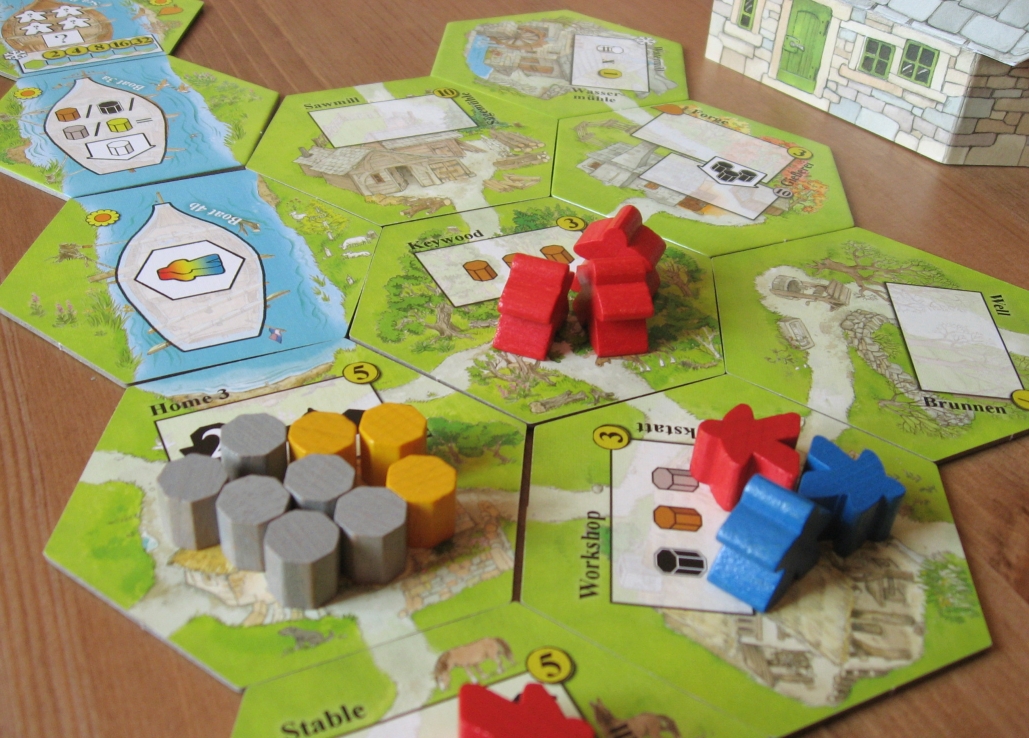
We planned to start early and get in a quick game of the “Feature Game”, Morels, however, we had just finished going through the rules and were just about to start when the late arrivals arrived early.  So, we left the mushrooms for another day and moved on to one of our favourites, Keyflower.  The reason why we were all especially keen to play this, is that the expansion, Keyflower:  The Farmers was released at Essen and we had been waiting since October for a good opportunity to give it an outing.  There are two documented ways to integrate the expansion with the main game:  you can choose tiles randomly from those available in the base game and the expansion, or you can use all the farming tiles and just use random base game tiles to “top up” the numbers.  Since it was the first time any of us had played the expansion, we chose to use this latter, “Farmers Variant”.

Keyflower

The idea behind the expansion is so simple that it is really very clever, and it is hard to believe that it wasn’t designed at the same time as the base game (though according to the designer, it was not).  In summary, the structure of the game remains the exactly same, but the new tiles give you access to animals which you place in the fields defined by the roads and the edge of the village.  There are a handful of rules associated with the animals (they breed at the end of spring, summer and autumn, but not winter because its too cold; they don’t breed if they are sharing with other animals because they are too shy), and the expansion also introduces wheat (which can be used to entice animals from one field to another or to encourage the horse pulling the cart enabling it to move more resources), but otherwise the game is essentially the same.  Or not…

Keyflower

As usual, we handed out our winter tiles and a handful of meeples (or Keyples as they are called in this game), before the spring tiles were laid out for everyone to look at.  With the farmers expansion, sheep are introduced in spring, pigs in summer, and cows in autumn.  So sheep came out first and Blue and Green got the key sheep producing tiles, and everyone with sheep tried to make sure they had at least two so that they could profit from the end of season breeding.  Unusually, almost no resource production tiles came out as these were of course displaced by the animal tiles, and this was the way it stayed for the rest of the game.  On the other hand, all the “green Keyple” tiles came out making them more abundant than usual.

Keyflower

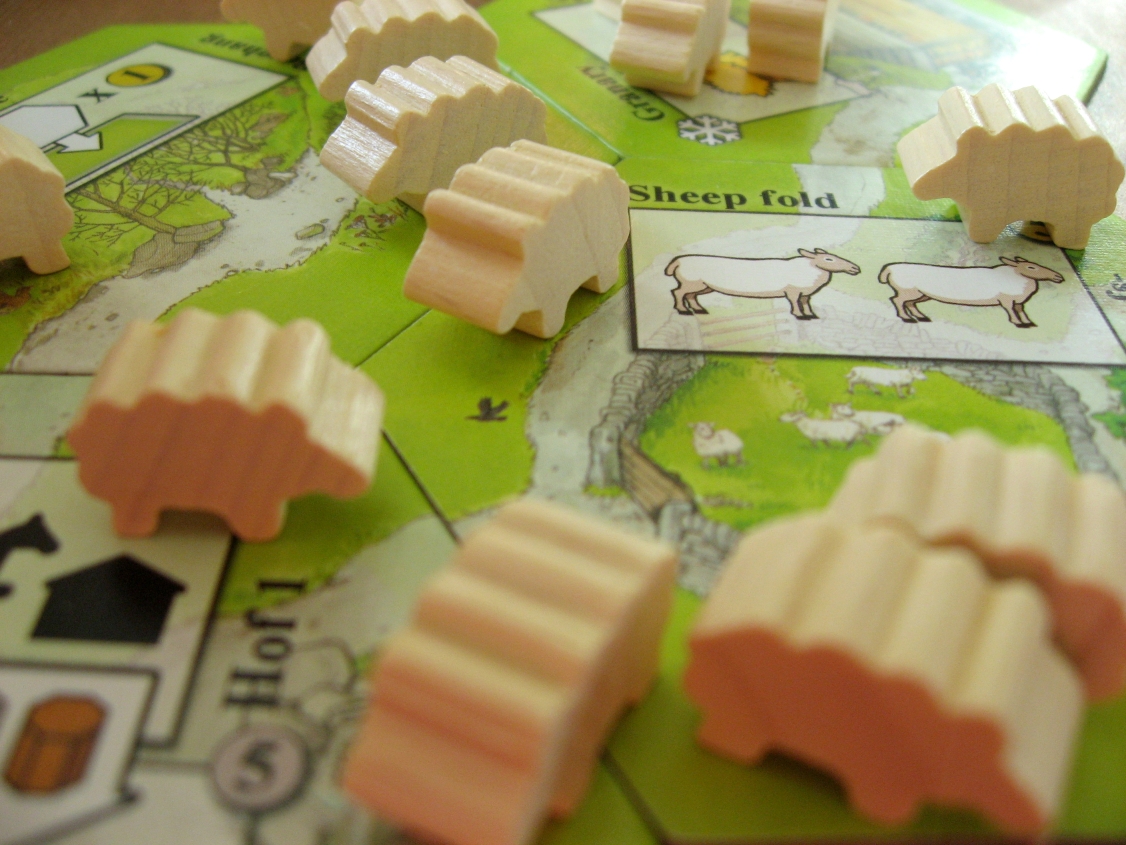
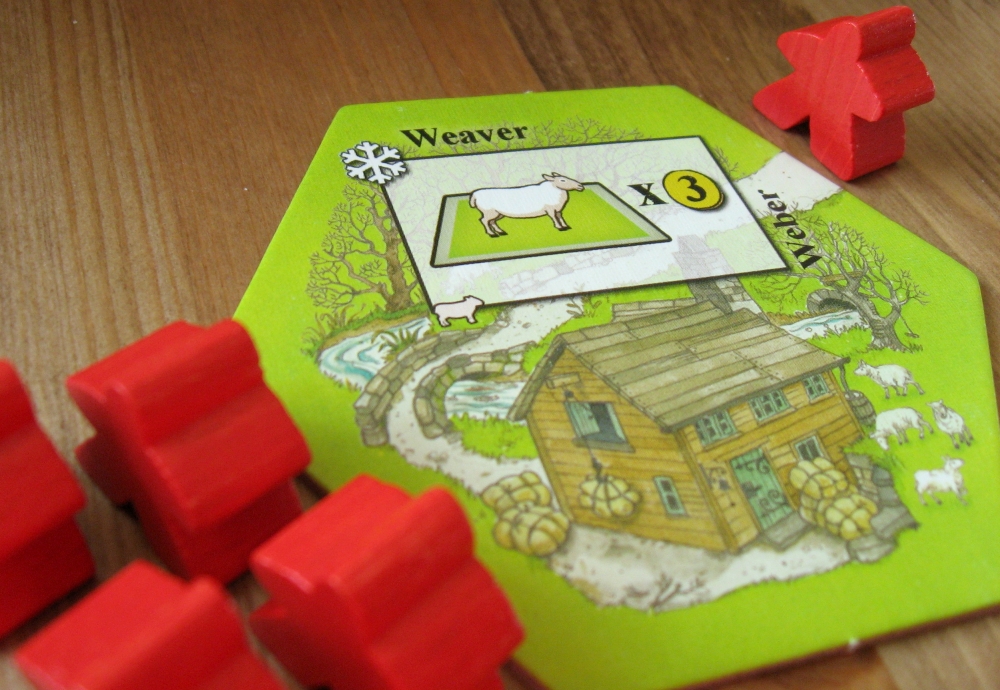
In summer and autumn, Yellow tried to get into the animal husbandry business breeding pink cows and got into a tussle for it with Blue, who largely lost out and played most of the game with a village of just four tiles.  Meanwhile, the other sheep-farmer, Green, eschewed pigs and cows and concentrated on expanding his flock to nearly epic proportions.  By winter, Blue, with her hamlet and miniscule fields, was stacking pigs and cows in a way that would not have won favour from the RSCPA and Green (the shepherd) was trying to obtain the services of a weaver to increase the value of his flock.  Meanwhile, Yellow was trying to expanded his cattle business and Red, the only player who had managed to get resource production tiles was mining for gold, employing a jeweller to maximise her the outcome from her gold and moving iron from one side of her village to the other.  In the dying moves of the game, the Yellow outbid Blue for the dairy who in turn placed a large bid for the weaver which Green was unable to match.  This cost Green somewhere in the region of twenty points and forced him to take the hillside tile and try to make the best use of it he could.  Despite the inconvenience, Green still romped away with the win some twenty points ahead of Blue and Yellow who came joint second.  Even so, somehow this didn’t seem quite as much of a white-wash as last time

Keyflower

Learning Outcome:  Trying to breed pink cows does not make you a better farmer!

Next Meeting – 17th December 2013

Following the fire at the Jockey, our next meeting on Tuesday 17th December will be held in a private house in Stanford.  Please get in touch if you would like to come along and would like directions.  As usual, we will be playing shorter games from 7.30pm as people arrive, until 8pm when we will start something a little longer.

This week the “Feature Game” will be Morels.  This is a quick little card game based on mushroom picking.  We’ve chosen this because we know some people will probably be late arriving and it’s a cute little game that the early birds can play while they are waiting to hear who will come.

Morels

And talking of mushrooms…

Jeff was out Christmas shopping and while he was waiting at the checkout, he got talking to the man in the queue behind him.  The conversation got around to wives, and he said he had been widowed three times. Jeff was appalled, “Three wives, all dead and buried?” he asked.

“Yes,” replied the man.

“What happened if you don’t mind me asking?” said Jeff.

“Not at all,” the man answered, “The first one ate poison mushrooms.”

“What happened to the second one?” asked Jeff, all agog.

“Poison Mushrooms,” replied the man.

“And the third?” asked Jeff, thinking he might have spotted a pattern.

“Fractured skull,” said the man.

“Oh,” said Jeff, “How did that happen?”

The man paused, then replied, “She wouldn’t eat the poison mushrooms…”

3rd December 2013

Since we knew people were arriving late, we started nice and early to get a quick two-player game in first.  The game we settled on was a cute little game picked up from Essen a couple of months ago, called 1911 Amundsen vs Scott.  This is an asymmetric card game where players are engaged on a polar expedition, and as in 1911, the players take different routes and use different tools (Roald Amundsen famously used dog sleds and beat Robert Falcon Scott’s team who used horses by just a few weeks).  On their turn, players collect cards or play cards.  The cards played can be used to get closer to the pole, or can be special cards to either assist the mission or obstruct the opposition.  Scott had played the game a few times before, whereas Amundsen was new to it.  The Scott’s starting hand included the “equipment loss” card which is quite powerful as it reduces the opponents hand limit from seven to five.  Since Amundsen hadn’t played it before, Scott decided to let Amundsen find his feet before playing it.  This turned out to be a tactical error as the game mirrored 1911 and Amundsen arrived just ahead of Scott who reached the South Pole only to find Amundsen’s Norwegian flag already planted in the frozen ground.

1911 Amundsen vs Scott

Next up was the “Feature Game”, Tzolk’in:  The Mayan Calendar.  This is a complex, but beautiful worker placement game where players represent different tribes during two Mayan “ages”.  On their turn, players must either place workers or pick up workers. When placing workers, players can place as many workers as they like (as long as they can afford it), and must put them onto the gears in the lowest available spaces on any of the five outer gears.  At the end of the round, the central gear rotates, turning each of the outer wheels moving the workers up the next level.  On the next turn, players may chose to place more workers, or might take some or all of the current workers off the gears – the catch is that a “null move” is not allowed, so timing is everything and it is very easy to get things slightly wrong.  This is made worse by the fact that everyone must have three corn at the start of the round and half way through and at the end of each age, there is a “food day”.  The currency of the game is corn and if you don’t have enough to support your workers you Anger the Gods and the penalties for that can be quite dire.

Tzolk'in:  The Mayan Calendar

Since we had one person who had not played it before and it was a while since the rest of us had played it, we spend a fair amount of time going through the rules.  Then we dealt out the starting tiles for players to chose their starting conditions.  Green chose the crystal skull, Blue decided to start with some technology, Yellow began with some corn and Red started with a small farm providing enough to keep one of her people fed for the rest of the game.  Green started out placing his skull on the Chichen Itza wheel (or chicken pizza as we call it) as he felt it would give him a guaranteed thirteen points.  Blue went first and started out by getting an extra worker and then very slowly began to build her corn harvesting ability, angering the Gods when she didn’t have enough corn at the start of a round.  Meanwhile, Red ensured that her people would be fed by building lots of farms, and Yellow quietly collected resources.

Tzolk'in:  The Mayan Calendar

Green confused everyone by placing only the one crystal skull and then going all out to climb the temple steps.  However, it wasn’t until late in the game that everyone else realised this and although Blue capitalised by catching a lot of the remaining spaces, by this time the damage had already been done.  Yellow made a surge as the only player to successfully build a monument, but it was not enough to catch Blue, or indeed Green who made it two wins out of two for the evening.

Tzolk'in:  The Mayan Calendar

Learning Outcome:  Sometimes its necessary to keep a close eye on the beginner to stop them from winning!

Next Meeting – 3rd December 2013

Following the fire at the Jockey, our next meeting on Tuesday 3rd December will be held in a private house in Stanford.  Please get in touch if you would like to come along and would like directions.  As usual, we will be playing shorter games from 7.30pm as people arrive, until 8pm when we will start something a little longer.

This week the “Feature Game” will be Tzolk’in:  The Mayan Calendar, which is complex strategy game where workers are placed on a series of gears that move as the game progresses.

Tzolk'in:  The Mayan Calendar

And talking of Mayans…

Jeff’s best friend was Burmese and as it was approaching Christmas and he wondered what to get him.  He searched high and low, but could not come up with anything suitable so he did what everyone does and tried the internet.  As he was searching about, he I read somewhere that the Mayan calendar ended on the 21st, and decided a new calendar would be a great Christmas gift for his friend from Myanmar…

Gaming in the Seventh Century

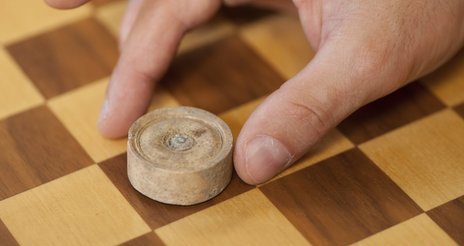
Archaeologists from the University of Reading have found a seventh century board game piece in the remains of an Anglo-Saxon royal hall in Kent.  The hollow bone cylinder with a central bronze rivet found at the Lyminge dig is thought to belong to an early Backgammon or Draughts-type games set.  Board games were really popular in Anglo-Saxon times, especially Latrunculi and Tabula, which had a lot in common with Chess and Draughts with the aim being to capture the opponent’s pieces.

Ancient Game Piece

Finds like this are very rare and the last time a piece like this was found it was in an aristocratic grave excavated in Taplow in Buckinghamshire in the 1880s.  On that occasion, ten pieces were found and these are now in the British Museum.  The game piece recently found in Kent is an isolated discovery and is unique in that it was found where the game was being played, so is presumably a piece that was lost during the game or as it was put away.  Maybe in a thousand years archaeologists will be finding lost trains from Ticket to Ride!

19th November 2013

Since we arrived in “dribs and drabs” and one player had to leave early, we started out playing a couple of quick little games.  First up was Pick Picknic.  This is a cute little game where players simultaneously play coloured chicken cards.  If someone plays the only chicken card of a given colour, they get all the grain at that coloured farm.  If multiple players go for the same coloured farm, then players can either agree to share the corn in any way that is mutually agreeable or roll for all of it.  They must beware the foxes though – foxes don’t eat corn, they only eat chickens; if someone plays a fox card, they will eat any chicken cards of that colour.  The first game was a bit of a white-wash, in contrast, however, the second game was a draw.

Pick Picknic

Next up was a game with a similar box and name, but other wise completely different: Pickomino.  This is a strange little dice rolling game with appealing “worm tiles”.  On a their turn, players roll eight dice.  They must keep all the dice of one “type”, i.e. all those with a one, or all those with a two etc., however, they must not have any of that number or type already.  Then they can, if they choose, re-roll the remaining dice and do the same again.  When they decide to “stick”, they can take any “worm tile” available in the pool with a value equal to or less than the total shown on their dice, and place it on the top of their pile.  When the number rolled exactly matches the topmost tile on someone elses pile, then the player may steal that tile if they choose.  The person with the most worms at the end wins.

Pickomino

Unfortunately, since the rules were in French and the English translation was not entirely clear, we didn’t play this quite right, so we’ll have to give it another go sometime. Since new players had arrived and one had to leave, we moved on to something a little deeper in Montego Bay.  This is an unusual little game about loading barrels into boats.

Montego Bay

To do this, each player has two workers, a large one and a smaller one, and a set of 5 cards for each worker which are used to move them.  Simultaneously, all players secretly choose one of the numbered cards from each of their card sets, then the workers are moved one at a time along the path around the outside of the warehouse, according to a prearranged (otherwise random) order.  Thus, when it is a workers turn to to move, the appropriate card is revealed and the worker moved accordingly.  The clever part is what happens if the space is already occupied, as the original worker is pushed to the opposite side of the warehouse.  In some cases, the position opposite side of the warehouse is also already occupied in which case both spaces are blocked and the active worker simply moves as far as he can.  When all workers have moved, the warehouses are checked if there is a worker next to a chamber. If a worker is next to a chamber with barrels, players receive drums in their colour equal to the number of barrels in the room. These drums are placed in one or more of the ships in the harbour; players may decide freely, but when a ship is full, it sails away immediately and players score points depending on who has the most barrels on the ship.  In contrast, if the chamber has broken barrels in it, drums must be removed from ships.  Thus, players are trying to make sure their workers are optimally placed, but since their pieces can be influenced by other players, everyone is trying to anticipate what each other will do.  Because of all the “double think”, the game is very prone to “analysis paralysis”, however, it wasn’t too bad and only really became noticeable in the last rounds of the game when it was all quite tight and moves were critical to the final score.  Green took the honours in the end, a couple of points clear of Blue, but everyone expressed an interest in playing it again sometime.


Montego Bay

Lastly, was the “Feature Game”, Coup.  This is a very quick little card game of bluffing and back-stabbing.  The idea is that each player starts with two cards representing the people they influence.  On their turn they can take a small amount of money or declare who one of their people is and do a more exciting action associated with that character.  The catch is that since the cards are hidden, players only know who they have influence over themselves – everyone else is secret.  Other players then have a choice, one of them can challenge the active player, or one of them can declare they are a character that can block the action (this declaration can also be challenged), or they can do nothing.  When a player is challenged, they must display one card:  if it demonstrates that they were telling the truth then they draw a replacement card, if it indicates they were lying then they lose a card.  The aim is to be the last player with influence (i.e. a hidden card).  The key to the game is to play as a team against the leader to prevent them from building up enough money to carry out a coup (which there is no real protection from), but to play independently when it is your own turn.  Unfortunately, we didn’t really get the team aspect of the game and, because we didn’t play very many hands, players didn’t really have time to work out that if a player tells the truth, that is a powerful tool to be used against them.  For this reason, it seemed more a game of chance (because if you tell the truth you are safe from challenges), than a game of skill.

Coup

Learning Outcome:  Sometimes short games are best played repeatedly so that they take as long as “big” games which gives time to play the meta-game.