Category Archives: Games Night

9th July 2013

This was our first meeting after the fire at the Jockey, so was the first meeting in someone’s home and therefore had a slightly different feel.

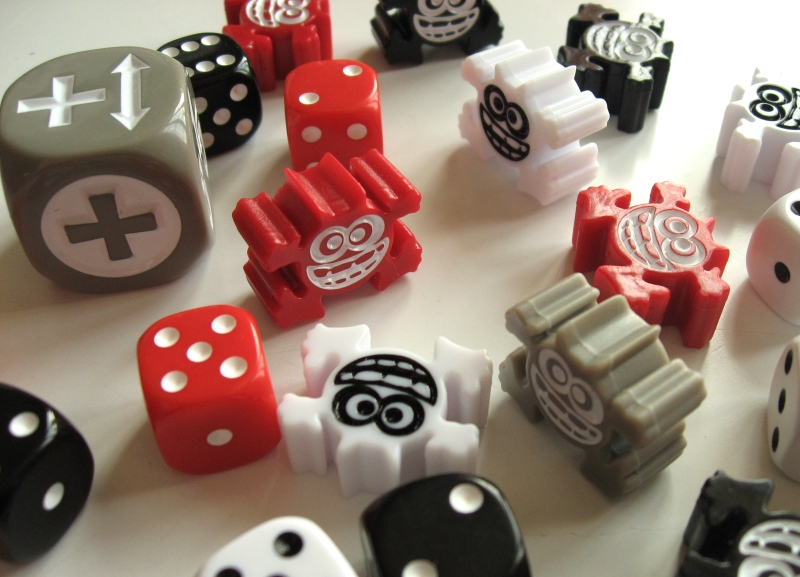
While we waited for people to arrive, we had a mess about with Hive.  This is a little two player game that some have compared to Chess.  This similarity comes from the fact that the pieces are Black and White and different pieces have different characteristics in the way they move.  Although much of the thinking is similar, the theme is insects and there is no board.  We had hardly started when everyone else arrived, so we left the teaching game for another occasion and decided to start something bigger.

Hive

In honour of the Jockey, we considered playing Flash Point:  Fire Rescue, however, we thought this could be considered bad taste so we decided to stick with our original plan to play our “Feature Game”, Agricola.  This is a game we played a few weeks ago, about farming in the middle ages.  Each player starts with a two room wooden hut and farmer and his wife.  In each round, players take it in turns to send the members of their family out to work.  The problem is that each action can only be taken once, by one player in each round.  In addition, there are only fourteen rounds and at intervals there are Harvests when all members of the family must be fed or the family has to go begging.  Last time we played the “basic game”, but as everyone had played it before (though some had only experience of the “basic game”), this time we decided to add a layer of complexity by playing with the “E-Deck” of “Minor Improvement” and “Occupation” cards.

We had a bit of a debate about whether we should just deal out the cards or whether we should “draft”.  Drafting is where everyone chooses to keep a card from their hand and passes the rest of their cards to the player on their left;  they then choose a second card from the hand they receive from the player to their right, before passing the rest on, and so on until all the cards have been shared out.  This has several purposes.  Firstly it means everyone knows what cards are in play, which allows for a deeper level of strategy where players can deliberately play to obstruct other people’s game.  Secondly, in theory, it means that nobody ends up with a really good hand while someone else ends up with all the rubbish cards.  Finally, it also means that players can choose cards that work well together, however, this can result in a bit of an “all or nothing” game depending on whether the plan works or not.  We decided against drafting as two players had never played with the cards and felt that they wouldn’t know what a good card or a good combination of cards was.  Although this was undoubtedly the right decision in the circumstances, unlike many games, the cards are not carefully balanced and there are definitely some cards that are better than others, so it would certainly be something to try another time.

Agricola

After carefully tiling the boards to make them fit on the table, we dealt out the cards and Red won the start player lottery.  Everyone made a dash for occupations before the players began to develop their different strategies.  Red had a occupation cards that made upgrading his wooden hovel into a stone palace cheaper, so decided to prioritise that, while Green decided to expand his family and went in for agriculture and fishing.  Meanwhile, Blue enclosed a massive pasture and Turquoise engaged in vegetable farming.  Each strategy appeared to have its good points and bad points, for example, Blue covered a lot of the space available, however, she spent the early part of the game flirting with starvation; in contrast, Green had plenty of food available, but struggled to make use of all the land.

In the last few rounds, everyone made the obligatory dash for points.  Red finally managed to upgrade his five bedroom mansion to stone, but at the expense of everything else except one solitary field; Blue added a stable to her pasture and invested in the next generation; Turquoise built three large pastures and crammed three children into his three bedroom brick house, and Green optimised his final harvests and enclosed a pasture for a couple of cows.  Turquoise ran out an easy winner with over forty points having managed to participate in a little bit of everything except sheep.  Blue and Green came in joint second with twenty-nine points apiece.

Agricola

Learning Outcome:  Living in a stone mansion does not make you a good farmer.

25th June 2013

This week, we started off playing a slightly neglected old favourite, No Thanks!.  It seemed like ages since we played it last, but it turned out that it was less than two months ago that it last got an outing.  Since it is a quick card game where rounds take just a few minutes, it was ideal to play until everyone had arrived.  Next we, we played the “Feature Game”, Incan Gold, which is another game we’ve played previously.  In this game players are going down a mine and trying to get out with as many gems as possible before it collapses.  One player made a bit of a killing in the opening round, but she failed to hang onto the lead and was pipped by just two gems at the very end.

– Image by BGG contributor joshie

It was a bit of an evening for games we’ve played previously, as next we played Alhambra (which was a “Feature Game” at the end of last year).  This is a tile laying game where players have to collect sets and score points for having the most in any one set.  Scoring takes place twice during the game and once at the end, and each time the number of points increases.  This time, Blue (who won last time), got a terrible run of the cards and Red who had missed it last time, had an amazing game winning by a very large margin.

– Image by BGG contributor EndersGame

Racing fish may not seem like an obvious choice for a game theme, but it turns out that it actually works really well.  We played Salmon Run just two weeks ago and although we enjoyed it, we were all a bit tired, so we decided to give it another go this week.  For variety, however, we changed almost all the boards, using  S2, 3M, 4E, 5E & F2.  This time, Black got going much quicker than everyone else and headed left followed by Red while White went right.  Black decided not to worry about fatigue cards and just run for it, while Red and White were more cautious.  Black’s tactics seemed to pay off, however, as he made it to the spawning pool first and nobody else could quite make it in time.

– Image by BGG contributor kilroy_locke

Our final game game was Forbidden Desert which we also played last week, however it is a new release this year and it was a very close game last time, so we felt it deserved another outing.  This time we didn’t have a Water Carrier, but we managed to make good use of the tunnels and the Navigator’s ability to move other players three spaces for the cost of only one action.  These with the Archeologist’s ability to clear extra sand meant we ran out comfortable winners.  We’ll have to ramp up the difficulty next time!

– Image by BGG contributor henk.rolleman

Learning Outcome:  Doing well the first time you play a game doesn’t mean you’ll do well the second time…

11th June 2013

A couple of us arrived very early and managed to squeeze in a couple of games and dinner before anyone else arrived.  First up was Forbidden Desert.  This is a very new, cooperative game, where players work together to try to escape from the desert before the get swamped by the sand storm or die of thirst.  Although they have a lot in common, it is quite different to its older brother, Forbidden Island, and we felt, quite a bit more advanced.  Since it was only the second time out of the box, we played on the Novice Level.  Essentially, the game consists of a grid of tiles with a storm in the middle.  As the game progresses, the storm moves about, shifting the other tiles creating sand dunes as it goes.  The explorers also have to combat the lack of water in the desert, all the while trying to find clues to the location of parts of an ancient burried flying machine, and eventually, the parts themselves.  In the end we did it with a little breathing space, but there is no way we would have escaped without the Water Carrier’s special ability to get more water from the well.

– Image by BGG contributor duchamp

Next we managed a quick game of Morels.  This is a really pretty set collecting game with a mushroom theme and added “woodsiness” in the form of forage sticks which act as a sort of currency.  The idea is that you can collect the easily accessible mushrooms “at your feet” for free, or you can choose a less accessible fungi for the cost of one or more forage sticks.  Once you have a set of three or more mushrooms you can cook them, with added cider or butter flavouring to add points at the end of the game.

– Image by BGG contributor philsstein

It is the Stanford-in-the-Vale Summer Festival this weekend and we are planning to have a stall to raise our profile (weather permitting).  Since it is quite robust, we are planning to make Army of Frogs available to people to play, so we thought we should try to get to grips with it first. Basically the idea is that you jump one of your hexagonal frog tiles (if you can) and then place a frog from your hand, finally drawing another frog from the bag to make your hand back up to two frogs.  Somehow, we managed to play this apparently simple little game wrongly not once, but twice!  Something to work on before Sunday…

– Image by BGG contributor Moviebuffs

Then, we played this weeks “Feature Game”, Mission: Red Planet, which is about colonizing Mars.  In this game, each player is a colonial power which sends astronauts, in space shuttles, to occupy the most promising zones on the planet.  It is an interesting game with a curious mixture of luck and judgement.  The luck comes from the rockets that are available at the start of each round, the value of each region of Mars (which is hidden in the early part of the game) and the destiny cards drawn.  The judgement comes from the character cards which enable players to place a number of astronauts into rockets and often do something else, like launch a rocket early or move astronauts around on Mars or even sabotage someone elses plans.  The character played also dictates when the player gets their turn which leads to a lot of trying to “out think” everyone else, and with only ten rounds, once a card has been played you may not get the chance to play it again.  This sort of game can either go very well or very badly and this is exactly what happened:  Red came in four points ahead of Blue with fifty-five points, while Green finished with less than half that.

– Image by BGG contributor kilroy_locke

The last game of the night was Salmon Run.  This is a new little race game, where players are fish dodging bears, eagles and rapids, jumping waterfalls and trying to be the first to get to the spawning pool without being too tired.  The game has a modular board and, as it was new to most of us, we used a fairly easy set up:  S1, 4E, 3E, 2M and F1.  Red started quickly up the right side of the course with Black and Grey giving chase.  Unfortunately Red banged her head against the bank which gave Grey and Black the chance to overtake.  Black set the bear on Grey a couple of times and managed to sneak ahead, but Grey made a run for the last water fall and managed to sneak into the spawning pool, and as the last player in the round, ended the game and the evening.

– Image by BGG contributor kilroy_locke

Learning Outcome:  For teaching at the Summer Festival, it is probably a good idea to have some laminated crib-sheets available!

28th May 2013

The first game of the evening was Ice Flow, the cute strategy game where players have to cross the Bering Straight from Alasaka to Siberia by jumping from ice floe to ice floe.  We had played a quick game last time just before we finished, and this game started the same way as that one with Black making all the running and Red following on behind.  The first explorer home was Black  with a Yellow explorer was hot on her heels.  Black’s  remaining two explorers were very close to home though and ready to pounce.  This meant that Yellow was forced to try a bit of blocking to prevent Black and Red getting home, but unfortunately it needed a couple of moves too many and it was an easy win for the Black as the youngest player, with Red a close second.

Ice Flow

The other game we played was the “Feature Game”, Agricola, which is a highly regarded game about farming in the middle ages and since half the players hadn’t played it before, it was very much a learning game.  The idea is that players are medieval farmers living in a two room wooden hut with their spouse.  Life is hard, and success is measured by the quality and size of your home, the number of animals you keep, and your ability to put your land to good use.  However, your priority is simply to get enough food to survive and survival is difficult without resorting to begging.  Each round, the family go out to work to try to obtain materials to improve their homestead or to work on the land to avoid starvation, but there are always lots of things players want to do, and never enough turns.  To make matters worse, at intervals during the game, there is a harvest when the animals breed and the grain is brought in, but everyone has to be fed.

It was quite difficult for the players who had not played it before to grasp how to start, but Cyan and White started out collecting all the wood, while Green hoarded all the clay.  In the absence of anything better, Blue scraped together enough wood to extend her hut and decided engaged in a little procreation which meant she could send the children out to work on the land and an early age.  Meanwhile Cyan moved into animal husbandry building lots of fences and breeding sheep while Green got all house proud building a clay oven and extending and renovating his hut from a wooden shack to a brick cottage.    Unfortunately Green failed to use his shiny new oven before harvest so famine arrived and his burgeoning family had to beg to survive.  Although Cyan had a very impressive flock of sheep, without an oven, her family were forced to live on fish and it showed in the final score.  Green’s large family and building a huge paddock in the last round offset some of his five begging cards and he came home a close third, however, Blue ran out clear winner 11 points ahead of  White in second place.

Agricola

Learning Outcome:  You needed to do a little bit of everything to be a successful farmer in the middle ages.

14th May 2013

The first game we played this week was our “Feature Game”, the card game, Saboteur which is a little like a cross between two games we’ve played before:  Avalon and Incan Gold. In this game players are dwarves working together mining for gold, with the catch that there could be a saboteur in their midst…  Since nobody had ever played it before, the first round was a bit of an experiment for all of us and we all started out “honest” playing path cards and maps.  However, suspicion arose a when one player claimed to have run out of useful paths and had to play a broken pick-axe, with inevitable reprisals.  Unfortunately, he HAD been honest and there were no saboteurs, but as we just managed to get to the gold, it didn’t really matter.

Since we felt we were starting to get the hang of it, we went went for a second round and this time correctly identified the saboteur and pinned him down with a pile of broken picks, lanterns and wagons while we dug up the gold.  When we picked on the same player for the third time, however, he was understandably distressed and protested his innocence.  Nevertheless, since he had very obviously shut off one of optional tunnels we had been carefully building, the pleading fell on deaf ears and failed to prevent the hail-storm of broken tools, only for it to become apparent that, once again, he was innocent.  When we asked why he had behaved in such a treacherous way, he forlornly explained that he was trying to stop us going the wrong way as he knew where the gold was.  Next time I suppose we might listen to him…

Saboteur

Next, we played the Scandinavian Ticket to Ride, a game we were all reasonably familiar with.  This is a really beautiful edition of “the train game”, but with slight twists to the usual rules.  White and Purple took the first few points, but Black joined in quickly and play continued pretty much evenly.  Black ran out of trains first which stymied Purple’s attempt to get the long track into Murmansk, however, we were all within ten points or so when we went into the final scoring.  Unfortunately, it turned out that Black and Purple had accidentally conspired to block White making her take a sizeable detour.  This had consequences for the number tickets she could complete.  Black and Purple jointly took the Globetrotter bonus with five completed tickets each, but it was the magnitude of the completed tickets that made the difference and Black ran out the winner by some fifty points.

Ticket to Ride:  Nordic Countries

Next we returned to semi-cooperativity with a quick game of The Great Balloon Race.  This is a great little race game (albeit with a ridiculously large box), where players have three different coloured balloons and the first to get them all home wins.  The snag is that nobody knows who owns which colour and it is highly likely that players will share at least one balloon with other players.  We last played this back in October and Blue and Orange got a bit victimised.  This time it was Blue and Pink…

The Great Balloon Race

Finally, we squeezed in a game of Ice Flow.  This is a really pretty strategy game where players direct teams of three explorers that are trying to get from Alaska to Siberia, climbing pack-ice, dodging polar bears, catching fish and occasionally jumping in for a quick swim.  Although this is a new game to boardGOATS, we were all familiar with it, so with a quick reminder of the rules we were off, jumping from ice floe to ice floe.  The game has a bit of a tendency for players to get stuck unable to get fish or rope, but we were wise to this and managed to control the resources quite successfully.  Black got an explorer home first, followed by a couple of Red meeples, however, while Black’s last piece dodged a hungry polar bear, Red managed to get his final one home for the win.

Ice Flow

Learning Outcome:  A clever move can sometimes be mistaken for a guilty one, however much you protest.

30th April 2013

Like last time, we again started out with a quick game of Love Letter while we waited for late arrivals.  This time we found that players were winning rounds without getting very deep into the deck, which is strange.  However, one thing that didn’t change was that beginners luck again carried the day…

Love Letter

Next we quickly played a new game, Diavolo. This is a dice rolling game where players take it in turns to roll dice and depending on the outcome of the “Order” die, dive for a cute little imp.  If they fail to grab one (or get the wrong one), the player loses a gem and the last person to lose all their gems is the winner.  We all found this game very stressful so we had one quick round of an old favourite, No Thanks! as the last player arrived and went to the bar.

Diavolo

Once again, our less experienced players were otherwise engaged, so we decided to forego Ticket to Ride and play something we enjoyed a couple of months ago, namely The Speicherstadt.  This is a clever little auction game that is relatively quick to play and easy to teach, but has a lot of strategy.  In short, cards are turned over and players take it in turns to place one of their “Village People” next to the card they would like to buy:  contracts, ships (use to fulfil the contracts), firemen (to protect against inferno) etc..  The first player to bid for a card has first refusal for that card, but the price they must pay is equal to the total number of “Village People” next to the card.  If they decline, then the next player has the choice, and the cost has reduced by one.  Despite the fact that the different players seemed to employ quite different strategies it ended a very close game.  For example, Blue eschewed firemen and ended up taking nearly all the negative points due to fires.  Thus, Blue was some twenty points adrift at the back before the final accounting although they had a couple of valuable contracts and the warehouse.  In contrast, White invested heavily in firemen, and was way out in front, but had less to add in the final reckoning.  White and Blue ended level on points in last place, but only two points behind the winner who had engaged in more trading.

The Speicherstadt

Finally, we just managed to squeeze in a game of Keyflower.  This is a really beautiful resource management and bidding game where players use meeples (or “Keyples” as they are known here) both as currency for bidding and as workers to generate resources.  Played over four Seasons, with new tiles available at the start of each one, players take it in turns to bid for the different tiles.  However, the catch is that once a bid has been made, any subsequent bids for that tile must be both larger and made with the same colour.  In addition to the colour management, there are lots of other really elegant aspects to this game.  For example, players can place workers on tiles and use the products during that same Season, thus, if a player needs red for bidding, they may be able to use a worker to obtain the necessary Keyples.  This means you rarely find you can’t do anything, but you often can’t do exactly what you want. Although it was a new release at the end of last year, we had all played it before, so we just had a quick reminder of the rules as we set up and then launched into it.  In contrast to the last game, this was a bit of a white wash with the leader wining by some thirty points.  What was particularly interesting, however, was that this was based on a skill tile strategy which netted some sixty points at the end of the game.  None of us had ever found them all that useful before, presumably at least partly because the right tiles had never come up.

Keyflower

Learning Outcome:  In some games, you can be quite convinced you are losing and be very, very wrong.

16th April 2013

This week we started out with another new game called Love Letter.  This is a really cute little game that packs in a huge amount of deduction, risk, assassination, luck and bluffing, especially considering it comprises only sixteen cards and a handful of cubes.  Basically, each player has a hand of just one card and on a turn, players draw one card, and play one card, trying to expose others and knock them out of the game.  The winner of the round is the player with the highest value card or the last man standing.  We played four rounds, after which it was clear that beginners luck was ruling the day with the players who had played before all failing to win a round.

Love Letter

Due to work commitments and a stroppy horse our less experienced players were unable to attend, so we had a bit of a change of plan and decided to leave the “Feature Game” (Ticket to Ride) for another day.  Since we had another new (though experienced) gamer, we decided to play a new, deeper game called Village.  In this game, each player takes the reins of a family striving for fame and glory.  Village is full of difficult decisions, yet moves quite quickly.  However, what is particularly unique is the way the game uses the delicate subject of death as a natural and perpetual part of life in the village and a mechanism for dictating the flow and duration of the game.

The strategies players employed varied hugely, from exploring the outside world and going into the church, to remaining a penniless farmer, or even trying a bit of everything.  From the start it seemed that White was running away with victory as he left the Village and explored the shire.  Meanwhile Red decided that piety was the best option and sent his sons into the church, leaving Blue and Yellow splashing about in the mud on the farm.  However, towards the end it became apparent that Yellow was hatching a cunning plan in the council chamber and suddenly made a fortune trading in the market.  The final result hinged on Blue’s decision to sell a cow which started a market day giving White the opportunity he needed to effectively have an extra turn and win by two points, with Yellow, Blue and Red surprisingly close behind.

 Village

Learning Outcome:  When it comes to Village life, a single-minded strategy is often more effective than dabbling in everything.

2nd April 2013

This week we had two new gamers, so we started out gently with the “Feature Game” which was Coloretto. This is a simple card game where players have to collect sets of coloured chameleons.  However, while the three largest sets contribute positively to the final score, any others are subtracted.  The game was really quite tight with only three points between first and second place.

Coloretto

Next up was Carcassonne which had its second outing in as many games nights.  In contrast to the last game, this was played very “nicely”.  We started out with a selection of tiles from the two river sets and then played with just the base game, without farmers.  The youngest player managed to draw city after city tile and built a massive, uncontested city.  Meanwhile, the other new player got meeples stuck in a city and on a road that required two tiles to infill a hole, one of which was quite specific.  In a masterpiece of courage, she waited it out and drew the last required tile in the penultimate round.  Despite these heroics, however, his seemingly never-ending stream of cloisters meant nobody was quite able to catch red, who ran out eventual winner.

Carcassonne

Given that the new players have an interest in horses, we then moved on to Turf Horse Racing.  This time, the new players ganged up, backing Roamin’ Emperor who had a one in six chance of moving 20 lengths. It started really well too, launching into the lead, only for Silver Blaze, Red Baron, and Desert Prince to eventually move ahead.  Mosstown Boy and Lagoon Lady hung on to the back of the pack while the old nag Raven Beauty seemed to be going backwards.  Lagoon Lady started to loose contact when, with a sudden burst of pace Roamin’ Emperor made a dash for the line winning by 15-20 lengths from Silver Blaze and Red Baron.

Turf Horse Racing

Finally, we finished with a few quick rounds of one of our old favourites, Dobble.  We managed three different riotous variations and honours were pretty much even.

Dobble

Learning Outcome:  When it comes to boardgames, playing on a tablecloth is a BAD idea as it moves and causes “earthquakes”.

2nd April 2013

This week we had two new gamers, so we started out gently with the “Feature Game” which was Coloretto. This is a simple card game where players have to collect sets of coloured chameleons.  However, while the three largest sets contribute positively to the final score, any others are subtracted.  The game was really quite tight with only three points between first and second place.

Coloretto

Next up was Carcassonne which had its second outing in as many games nights.  In contrast to the last game, this was played very “nicely”.  We started out with a selection of tiles from the two river sets and then played with just the base game, without farmers.  The youngest player managed to draw city after city tile and built a massive, uncontested city.  Meanwhile, the other new player got meeples stuck in a city and on a road that required two tiles to infill a hole, one of which was quite specific.  In a masterpiece of courage, she waited it out and drew the last required tile in the penultimate round.  Despite these heroics, however, his seemingly never-ending stream of cloisters meant nobody was quite able to catch red, who ran out eventual winner.

Carcassonne

Given that the new players have an interest in horses, we then moved on to Turf Horse Racing.  This time, the new players ganged up, backing Roamin’ Emperor who had a one in six chance of moving 20 lengths and it stared really well, launching into the lead, only for Silver Blaze, Red Baron, and Desert Prince to move ahead.  Mosstown Boy and Lagoon Lady hung on to the back of the pack while the old nag Raven Beauty seemed to be going backwards.  Lagoon Lady started to loose contact when, with a sudden burst of pace Roamin’ Emperor made a dash for the line winning by 15-20 lengths from Silver Blaze and Red Baron.

Turf Horse Racing

Finally, we finished with a few quick rounds of one of our old favourites, Dobble.  We managed three different riotous variations and honours were pretty much even.

Dobble

Learning Outcome:  When it comes to boardgames, playing on a tablecloth is a BAD idea as it moves and causes “earthquakes”.

19th March 2013

It was another quiet night as work intervened for many of us.  So first up was the “Feature Game”, Carcassonne.  This is one of the classic “modern” games where players lay tiles and play “Meeples” to score points.  Since the new gamers were unable to come, we played “nasty” rather “friendly”, with one player who kept getting road junctions and another who got all the got city ends!  It was a very close game that went twice round the scoring track and ended with only five points between first and last place.

Carcassone

The second game we decided to go with was Hamburgum which is a game set in Hamburg during the seventeenth century where players produce beer, sugar and cloth and sell them overseas. They compete for the best sites for their buildings and the best berths for their ships in the harbour, but ultimately they vie to make the most prestigious church donations, because only prestige decides the game. The game is almost completely luck free as it has no cards or dice and the actions are selected by your position on a carousel or roundel.

The game started quite slowly, until we realised we could build more than one building at a time, so, it took a while for the first church to be completed with all five donations.  The second was slightly quicker, but once we completed the third, the rest followed very quickly and the race round the roundel was on to get goods turned into money and then into resources to make the final donations to the prestigious last church. The margin of victory was much larger for this game than Carcassonne, but with about twenty-four points on that last church, the result could have been much closer.

Hamburgum

Learning Outcome:  When it comes to resources, “few but often” sometimes goes further than “lots but rarely”.