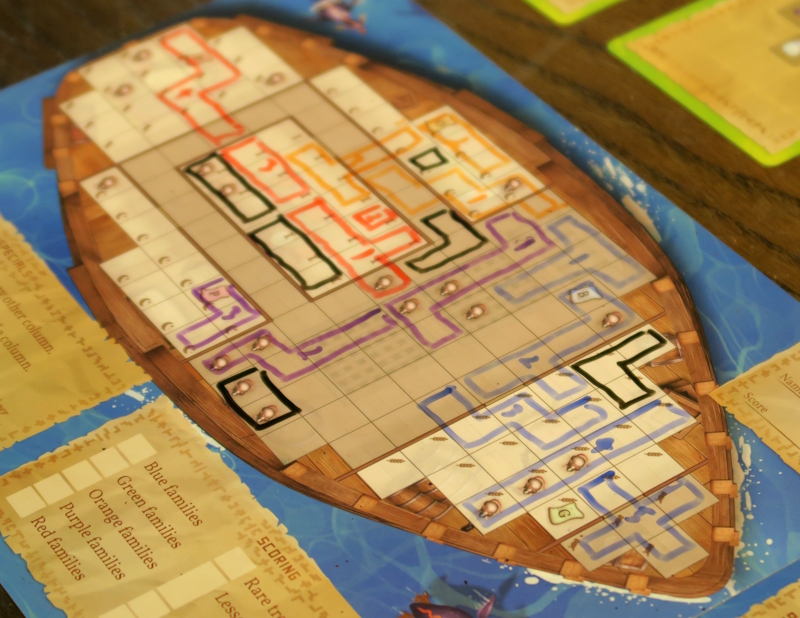
By the time Blue, Purple and Pine arrived, Cobalt was already half-way through a solo game of Isle of Cats: Explore & Draw, a “roll and write” version of the card-drafting, polyomino cat-tile-placing game, Isle of Cats. In Explore & Draw, instead of drafting cards before choosing tiles, players choose a set of cards each turn and then draw their “discoveries” on their boats. In this version of the game, players simultaneously choose a column from the Island (the central market) and action all three cards in it in order. These could be three cards from the Cat deck, two Cat cards and one Lesson card, or two Lesson cards and card from the Cat deck.
 |
| – Image by boardGOATS |
Cat cards are polyomino cards, Lesson cards are scoring cards and special Oshax and Treasure cards can be found in both decks. Cats, Oshax and Treasures are all drawn directly on the boat on the worksheet, while lessons are ticked off and scored at the end of the game. In the solo game, Cobalt was playing against his “Sister” who reveals a Cat Colour and a Lesson, every round and at the end of the game scores for the different Colours in that order and then the Lessons in turn. This time cobalt made mincemeat of the Automa beating it by seventy-one points to forty-three.
 |
| – Image by boardGOATS |
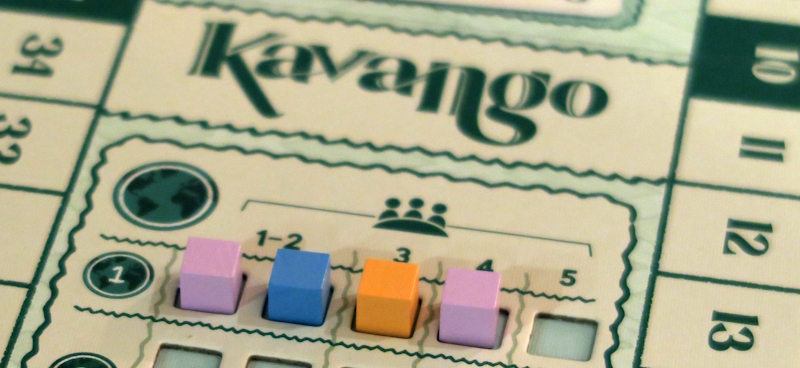
With everyone arrived by this time, it was just the “simple” matter of deciding who was going to play what. Blue started off leading the “Feature Game“, which was Kavango. This is a card drafting game where players are building an animal reserve by collecting tags and adding animals to their tableau. As such, it takes familiar elements from games like Sushi Go!, 7 Wonders, Wingspan, Meadow, Ark Nova and Terraforming Mars, but has a different feel to all of them. In each round players draft and play ten cards (from an initial hand of twelve), that is to say they choose a card and pass the rest of the cards on to the next player.
 |
| – Image by boardGOATS |
After each card has been chosen, it is added to the player’s tableau. Then players have the option of claiming money for achieving Research Goals and/or spending money on Poaching, Habitat and Climate protections. These are required for some of the animals especially the more interesting and lucrative ones. The clever part about the game is the way the decks progress. In the first round, the deck is mostly made up of Producers (Grassland, Trees, Invertebrates and Fish) and small animals while the second has mostly medium, but some small and some larger sized animals. The third and final deck contains almost exclusively larger animals like Zebras, Lions, and Elephants.
 |
| – Image by boardGOATS |
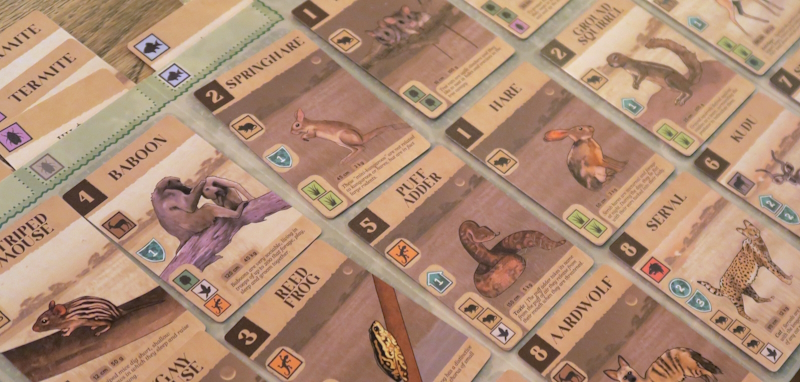
This makes it harder to get Producers in the final round (though it is still possible by paying for Rewilding), but players can often just play cards directly as they already have prerequisites that they acquired earlier in the game. Throughout, the rules and mechanisms are rooted in reality. For example, players are responsible for their own Poaching and Habitat protections, but Climate protection is everyone’s concern and players have to work on that together. Similarly, before a player can have a Puff Adder, for example, they have to have enough small mammals and birds to feed it. Likewise, if a player wants a White Rhino or an Elephant, they need sufficient Grassland and/or Trees to support them.
 |
| – Image by boardGOATS |
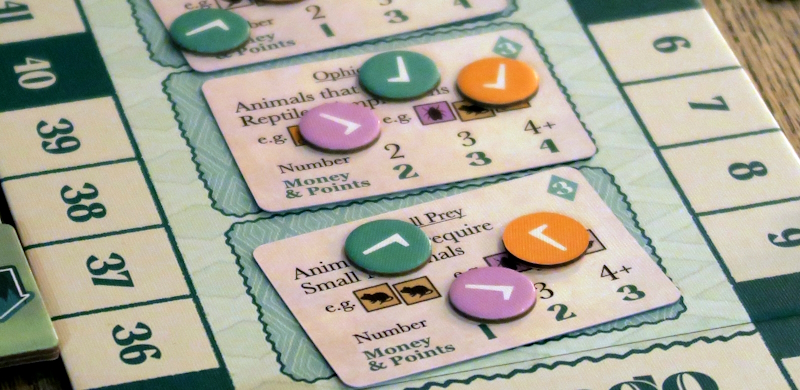
Each round, there are four Research Goals, each with several levels. The Goals can each only be claimed once, so players generally have the choice of claiming Goals early to get money they can spend straight away, or waiting and getting more money, which may delay progress. These Research Goals also progress during the game, so early on, they tend to reward players with lots of Producers and Small Mammals etc., while later in the game they reward players with lots of Protections and bigger animals. At the end of the game, players add bonus points for Biodiversity, Climate Protection and Habitat and Poaching Protection, to the points they got for each animal in their Reserve and the points they acquired during the game for achieving their Research Goals; the player with the most points is the winner.
 |
| – Image by boardGOATS |
Nobody had played the game before, but Indigo had done her homework and had watched the “how-to-play” video, and Blue had done a decent job of reading the rules for a change. The fact that the rules all made sense helped too, and for the most part everyone had a reasonable handle on what they were trying to do. The first challenge was to try to get all four of the player boards on the table with the score-track/Research board and Climate in the middle. The boards were so huge that it wasn’t actually possible, so the side of Indigo’s and Navy’s boards were hanging off the edge of the table, and Pines and Blue’s corners were all overlapping or had a flying free-hold. Still, everyone could just about see what they needed to and could place the cards they had to, and it was all stable so long as nobody moved…
 |
| – Image by boardGOATS |
Pine (the Ecologist), started off really well adding a lot of Small Mammals to his Reserve and achieved early Research Goals as a result. Early in the game, Indigo (the Investor) started contributing to Climate protection. Navy (the Botanist) and then Blue (the Researcher) helped her out later in the game, though Pine never had enough money to contribute enough to gain the Climate Protection bonus. Blue took an early lead in Research Goal points, but Navy soon caught up and by the end of the third round, he had an eight point lead with Indigo holding a three point lead from Pine. That is only a very small proportion of the points available in the game.
 |
| – Image by boardGOATS |
The Lion’s share of the points come from the animals, including Lions, of course (which Navy had one of). Pine really struggled in the latter part of the game since he had loads of Small Mammals, but not a lot else. His problems had begun in the second round when he struggled to generate any money as none of the Research Goals fitted after his highly effective first round. Even so, he still got a over a hundred points for his menagerie and was one measly bird of prey short of getting the Biodiversity Award. Indigo had a slightly more valuable Reserve, while Blue and Navy tied for the most animal points.
 |
| – Image by boardGOATS |
Indigo, Blue and Navy all picked up the bonus points for Climate Protection, Poacher/Habitat Protection and Biodiversity, which meant that Navy took victory by virtue of his eight point lead from the Research Goal points. It had been a very enjoyable game though and there was much discussion as the group carefully dismantled the precariously balanced player boards. Pine took an interest in the other animals in the deck, and there was much hilarity when he found the Sausage Tree—Google convinced him that it was not related to the infamous Spaghetti Tree, and was in fact real. Nobody could convince him that the fruit wasn’t ideally suited to coaxing Trouser Snakes out of their lair’s though.
 |
| – Image by boardGOATS |
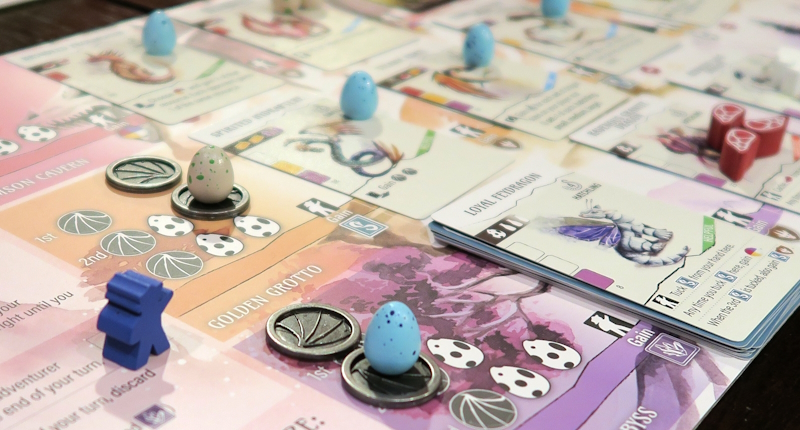
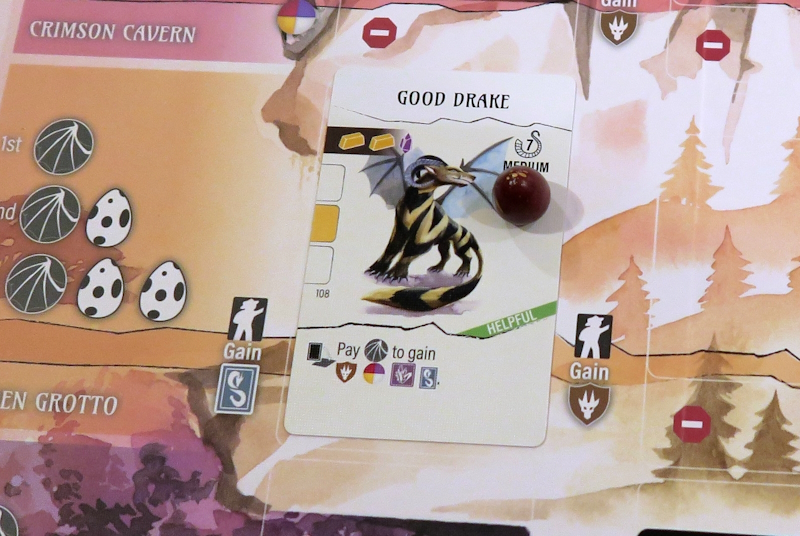
On the next table, Black and Pink were leading a rather ill-fated game of Wyrmspan. This is a variant of Wingspan with Dragons instead of Birds. So, like the original, players are playing cards from their hand onto a player board, and activating the habitats in turn. The differences are more than simply cosmetic, however. Firstly, before a Dragon card can be played, it is necessary to explore the cave it will be played in, which involves playing a card (and claiming a Bonus). In Wingspan, if a player needs a resource, they activate their Woodland habitat and visit the Birdfeeder, claiming the resource they want and a couple of extras, whereas in Wyrmspan, players only get resources one at a time so they don’t have any extras.
 |
| – Image by boardGOATS |
This is critical as “Planting Dragons” requires a lot of Resources and can be difficult to do, so it is important that the Dragon planted is then exploited as much as possible. Players also need to make the most of the new Dragon Guild. A step around this Rondel typically gives a Resource as a reward, with a more valuable bonus half-way round and after a full circle. The distribution of cards is different too: in Wingspan, the majority of the cards have an effect when the terrain is activate, but in Wyrmspan, these are in the minority with most card effects happening when played or at the end of the round/game. In Wyrmspan, the rounds are also different.
 |
| – Image by boardGOATS |
Players get a set number of coins at the start of each and an action typically costs one coin. Some cost more however, and occasionally players can pickup extra coins, which can lead to variable length rounds. Thus, although Wyrmspan is very definitely Wingspan at its core there are lots of differences. Blue suggested the group played it, as she had played it with Black and Pink a few months back and they had found it played easily given that they all knew how to play Wingspan. Thinking Purple, Teal and Lime were also very familiar with Wingspan, Blue rashly assumed it would work, but she underestimated how different it was, how long it was since that last game, and how much longer the game would take with five.
 |
| – Image by boardGOATS |
So, Black patiently explained the rules, while Pink tried to help others muddle through. Teal focused on simply achieving the end of round goals and “planted” his Dragons accordingly while working on the top row of caves to generate resources—the equivalent of the “woodland”, which works for both Wingspan and for Wyrmspan. After fighting through one round though, the group agreed to curtail the game after the second round. In such a short game, the scoring was always going to be skewed, but ultimately the player with the most valuable Dragons, Pink, was the victor, with Teal taking second thanks to him taking the points for winning both the end of round goals.
 |
| – Image by boardGOATS |
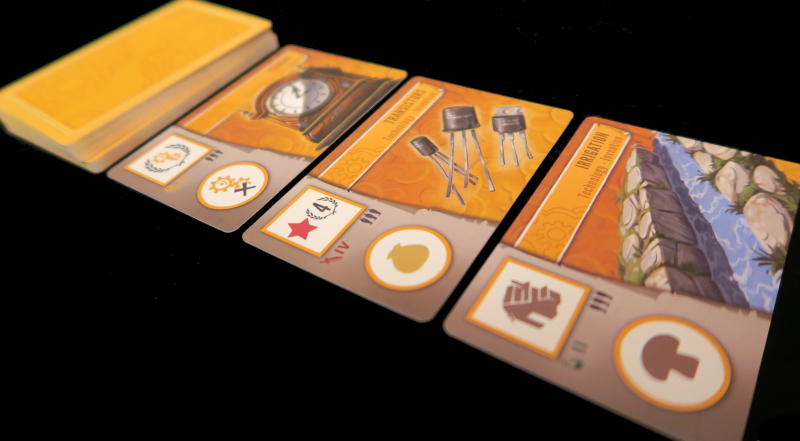
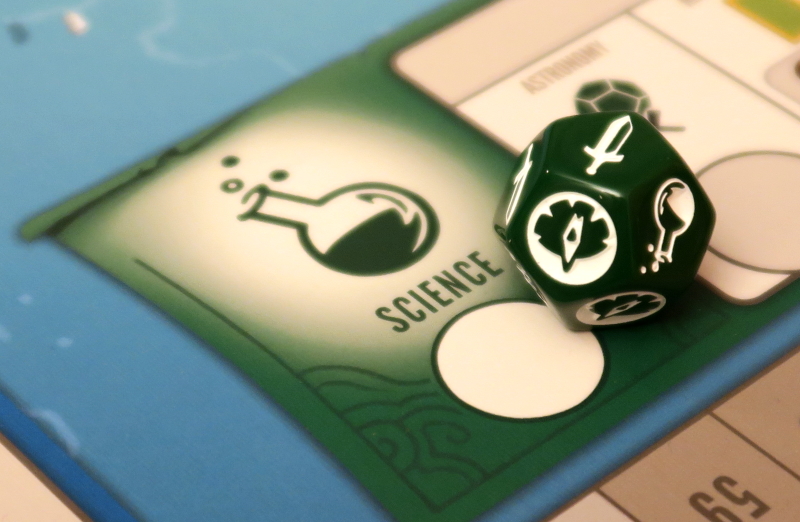
Across the other side of the room, the final game was Tapestry, with the Plans and Ploys expansion. On the surface, Tapestry has simple mechanisms, but they combine to make a complex game. On their turn, players move one step along one of the four Civilisation tracks around the board: Science, Exploration, Military, Technology and carry out the action (or actions) associated with it. Each space requires payment of resources, and the further along the track, the more expensive the spaces become. If a player cannot afford to pay (or chooses not to), then they instead take income, which gives them more resources. They also gain points and play a tapestry card, which usually provides a power for the next round.
 |
| – Image by boardGOATS |
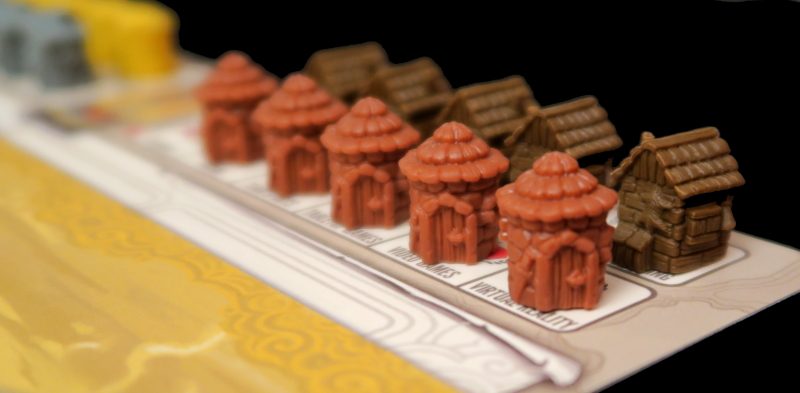
So, at its heart, Tapestry is an engine building and resource management game: players carry out actions and get resources so they can get more resources and ultimately, points. The Plans and Ploys expansion mostly just adds more of the same with new Civilisations, Tapestry Cards and space tiles. The biggest difference is the addition of Landmark Cards which are designed to give each player a personal short-term goal in the first part of the game, in the form of buildings that only they can claim. Everyone was familiar with the game, so the rules explanation was minimal. Byzantium started (Spies/Grassland) and there was an initial general rush towards the Technology track,
 |
| – Image by boardGOATS |
Ivory (Islanders/Forest), always one for doing something different, instead went in for Exploration as this linked in with his Civilization. As the first round went on, Byzantium and Cobalt (Aliens/Tropical) stuck to Technology, whereas Plum (Riverfolk/Wetland) diversified slightly into Science and Exploration. Her primary plan was to exploit her Civilisation and then try to get to six island hexes to trigger her personal bonus Landmark. Byzantium was first to move to the Income phase, closely followed by Plum and then Cobalt. Ominously, Ivory did what he usually did and managed to stretch my first era out, putting himself in a good position to grab the first Exploration Landmark and also making progress on Military.
 |
| – Image by boardGOATS |
Byzantium went for Technocracy as his first Tapestry card, sticking with his technology theme. He also managed to grab the first Technology Landmark and completed his Architecture card (appropriately the Game Shop). Plum also went for a Tapestry card, Terraforming, that linked her with her strategy, giving her five points for building on impassable plots, something her Riverfolk Civilization wanted her to do and gave her additional resources of. Although her alternative Civilisation had looked more interesting, it involved knowing what other people’s options were so she had chosen the simpler Riverfolk and made good use of it. She was also still fairly diverse in her track focus. Cobalt went for Socialism, to keep pace with Byzantium on the Technology track.
 |
| – Image by boardGOATS |
Cobalt also gained Landmarks from his Technology cards, helping him build his Skyscraper Architecture card. Having only taken his Income whilst everyone else was half way through their second Era, Ivory could see Cobalt was focusing on Technology, so he used the State Marriage Tapestry card to gain befits on this track whenever Cobalt did. Having the Military track to himself and a good head start on Exploration, Ivory managed to grab a couple of Landmarks quite quickly. Everyone was also getting Income from buildings on their mats too. Again, Byzantium Plum and Cobalt all moved into their third Era in quick succession, leaving Ivory half way through his second Era.
 |
| – Image by boardGOATS |
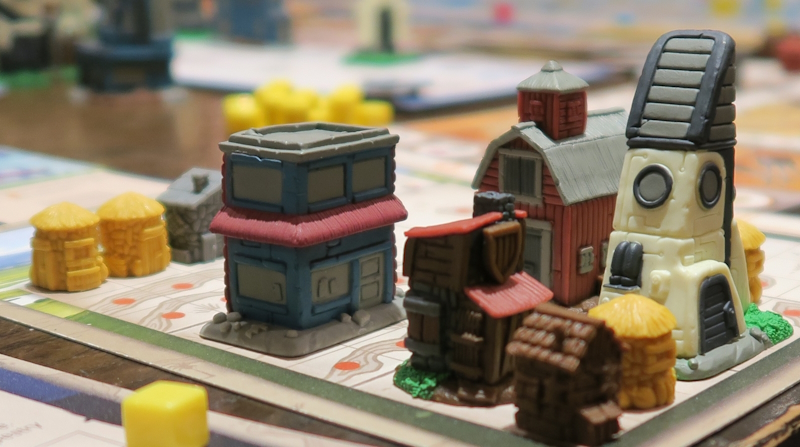
Cobalt managed to grab the third Era Technology Landmark, but he struggled to fit it on his Capital board and it had to overhang. At this point, Plum used the Dictator Tapestry Card (with associated comments from Byzantium) to move up the Technology track while restricting everyone else’s progress on the same track for one turn. Byzantium had been plotting a move as he was next in line for a Landmark, but Plum’s Dictatorial behaviour only slightly delayed him getting it. This, plus the State Marriage benefited Ivory and competition with Byzantium meant Cobalt used the Militarism Tapestry card to switch his focus to Exploration and Military.
 |
| – Image by boardGOATS |
Although Cobalt had changed tack to avoid competition with Byzantium, Ivory had a health head-start on both of these tracks, grabbing the Landmarks as he went and also conquering the centre island just before Cobalt could. To add insult to injury, when Cobalt tried to conquer the island and topple Ivory, he was ready with a Trap card, foiling his plan. Cobalt quickly got revenge paying Ivory back in kind when he tried to do the same thing to one of his territories. However, that wasn’t going to discourage Ivory, and with the Military track encouraging him to conquer, he got the final word in, conquering one of Cobalt’s territories and gaining a double topple bonus.
 |
| – Image by boardGOATS |
Moving into the final era, again, Ivory was characteristically some way behind everyone else. Byzantium picked up extra resources from the “Age of Wonder” and used these to good effect being the first to reach the end of a track. Plum, hosted the Olympic Games with her final Tapestry card (and presumably moved to Paris to do so). This gave her ten points in exchange for a Worker Resource, and additionally a bonus building if any other player took up the offer of doing the same. Byzantium was the only one who did, as Cobalt wasn’t able to and Ivory had other plans.
 |
| – Image by boardGOATS |
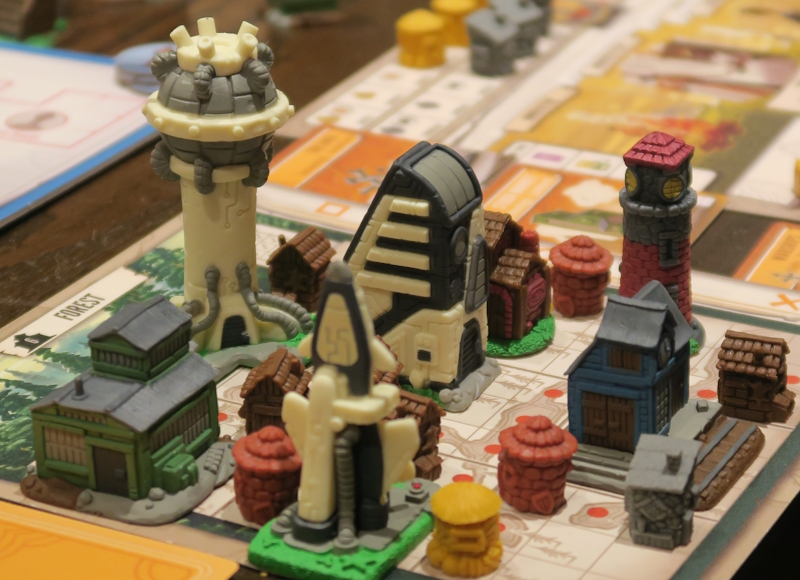
Cobalt and Plum were both still fairly diverse in their track focus, although Plum had made good progress on the Science track, which was mostly ignored by everyone else. Byzantium also switched focus to some of the other tracks now he had completed the Technology track. Ivory stuck to Military and Exploration, completing the former (although there was not enough time to gain the second Civilization). He was sorely tempted by one of his favourite strategies, sending his Meeples into Space by completing the Exploration track, but instead, Ivory switched focus to the other tracks to get as many income buildings in his Capital as possible to maximize the final scoring.
 |
| – Image by boardGOATS |
Again, everyone finished in quick succession except Ivory, who, as usual, had about five or six turns to go after everyone else had finished. Plum started with an additional thirty-five points at the beginning of the game thanks to her Riverfolk which gave her points for each territory in her City that had at least two unpassable spaces, but everyone caught up throughout the game. In the end, in Ivory’s final Income round scored him well over fifty points, overtaking everyone and winning and giving him victory. It had been a good game, enjoyed by all, and although he’d won Ivory hadn’t given everyone as much of a trouncing as he had in the past. Cobalt felt that the advantages of going first were not mitigated for those going last, so maybe next time that could be used as a slight handicap for Ivory.
 |
| – Image by boardGOATS |
Learning Outcome: Animal games are a lot of fun—And that’s not Lion!











 boardGOATS