Next Meeting, 3rd October 2023

Happy Birthday to Us!

Our next meeting will be Tuesday 3rd October 2022, when we will be celebrating our eleventh birthday.  As usual, we will start playing shorter games from 7.30pm as people arrive, until 8pm when we will start something a little longer.  The pub is doing food, and the table is booked from 6.30pm for those that would like to eat first and there will be cake afterwards.

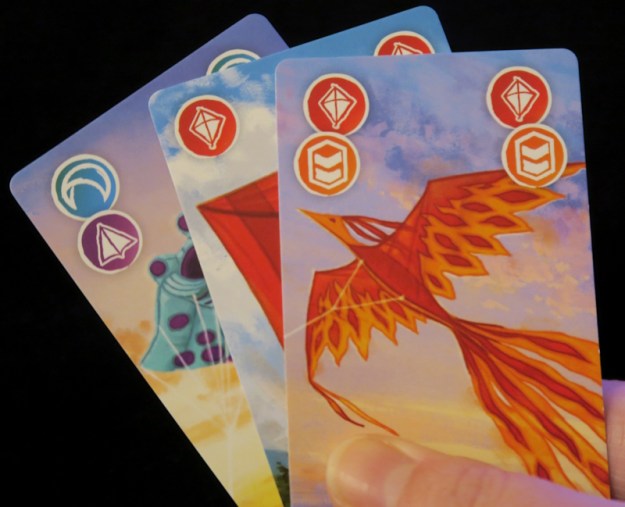
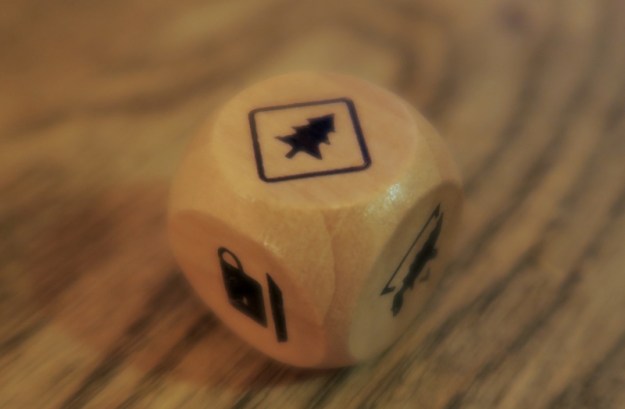
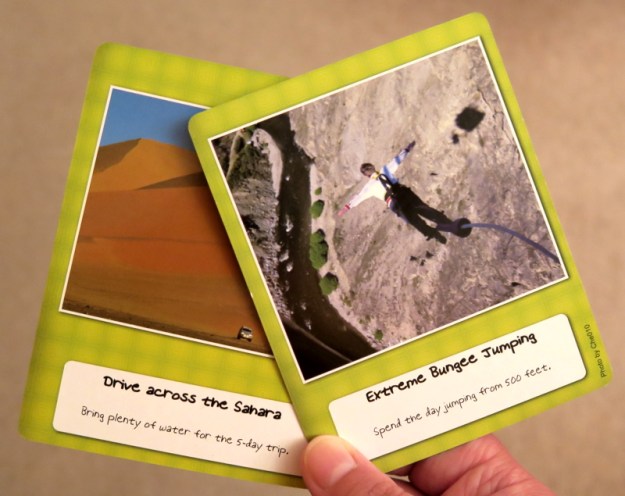
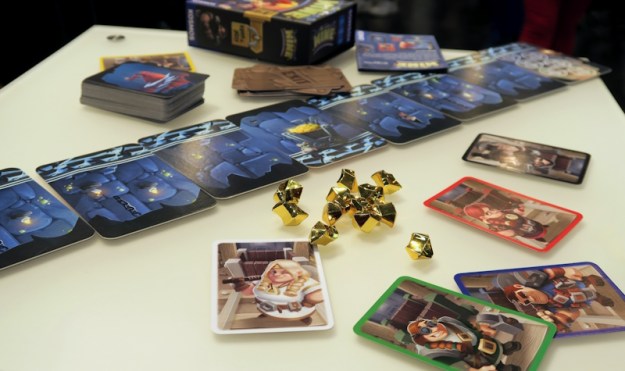
As is now traditional on our birthday, the “Feature Game” will be Crappy Birthday. This is a party game where players give each other comedy birthday presents and the recipient has to decide who gave the best and worst gifts.

Crappy Birthday
– Image by boardGOATS

And speaking of birthdays…

It was Jeff’s birthday and, as it was a special birthday, his brother had bought him a special present.  Before opening the gift, Jeff shook it slightly, and noticed that it was wet in the corner.  Touching his finger to the wet spot and tasting it, he asked, “Is it a bottle of wine?”

His brother shook his head, “No…” So, again, Jeff touched his finger to the box and tasted the liquid.

“A bottle of Scotch then?” he asked, beginning to get all excited – this was way better than he’d expected.  Again his brother shook his head though, “No, not a bottle of Scotch…”

Eventually, Jeff said, “OK, I give in, what is it?”

His brother paused for effect, before answering, “A puppy!”

19th September 2023

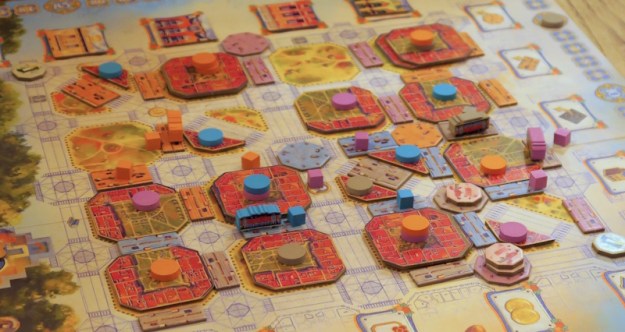
Blue and Pink were the first to arrive, making up for their recent absence on the other side of the world.  They had finished their supper and were just discussing the upcoming Essen, when Purple and Black arrived, quickly followed by Pine, to be regaled of tales of koalas, pandas and roos.  Green, Teal, Cobalt and Lime weren’t that far behind and then the group split into two to play.  The “Feature Game” was Alea Iacta Est, a fairly simple dice chucking game with a Roman theme.  Although it has a lot of similarity to one of our old favourites, Las Vegas, it is more of a “gamers’ game” as it has a bit more planning and slightly more complex scoring.

Alea Iacta Est
– Image by boardGOATS

Like Las Vegas, players have a handful of dice, which they roll on their turn and then place a some or all in one of the locations.  In Las Vegas, the locations are different gambling joints and the dice placed are all the same number.  However, in Alea Iacta Est, the dice placed depend on the location, there are five, and the all behave differently.  For example, in the Templum, the first player adds one die and takes a face down Fortunum token.  The next player to place dice in the Templum adds one more die than the first player making sure the total number of pips is larger, and also takes a token.  If a player is returning to the Templum, they can reuse the dice they placed previously, making sure their number of dice is one more than the previous person to play there.

Alea Iacta Est
– Image by boardGOATS

The Fortunum tokens are points, ranging at random from one to three.  At the end of the round (triggered by one player running out of dice), the player with the most Fortunum tokens keeps two of their tokens, while everyone else keeps one of their choice.  In the Senatus, players have to place “runs”, that is sequences of dice with consecutive values.  Players who place dice later must add one more die than the previous player and the run must be different to any that already exist.  Players can only have one run in the Senatus, but as for the Templum, players can ad dice to their previous entry.

Alea Iacta Est
– Image by boardGOATS

At the end of the round, the player with the longest sequence of dice takes three Senate cards, keeps one and passes the rest on to the player with the second longest sequence of dice.  The Senate cards provide players with end game scoring opportunities.  The Castrum is similar to the Slot Machine from the Las Vegas Boulevard expansion, in that players add sets of dice of the same value.  Like the Slot Machine, players can have more than one group, but unlike Las Vegas, there may be any number of groups in the Castrum, but never two groups with the same pips and same number of dice.

Alea Iacta Est
– Image by boardGOATS

The player with the largest group in the Castrum at the end of the round takes their choice from the face up selection of Province tiles.  These score points at the end of the game, as long as they have at least one assigned Patrician.  Players get Patricians from the Forum Romanum.  The Forum Romanum is perhaps the most complex to control. Player can place either a single die with any number of pips or exactly two dice, which show together the total five pips (i.e. a one and a four, or a two and a three).  The dice are placed at the base of pillars in value order with the lowest value added to the left displacing everything to the right by one space.

Alea Iacta Est
– Image by boardGOATS

The clever part is the order the dice are placed when there is the inevitable tie:  the most newly added, also goes in the space to the left the group with the same number (again shifting everything to the right by one space).  At the base of each pillar there is also Patrician tile and these go to the owner of the die next to the pillar at the end of the round.  The fifth and final space is the Latrina, which is where players place dice if they can’t place them anywhere else, getting a re-roll token in return.  These can be cashed in during the game, or are worth a point for each pair at the end of the game.  The Patrician tiles and the Provinces are coloured.  Patricians are worth their face value, but only if allocated to a Province with a matching colour.

Alea Iacta Est
– Image by boardGOATS

Each Province can support two Patricians, one male and one female.  Each Province also scores its face value, though there is a point deduction if it has no Patricians.  These are the main source of points, though Senate tiles can provide a lot as well, with additional points from the re-roll chips and Fortuna tiles (taken from the Templum).  The game is played over five rounds with players taking it in turns to allocate dice until one player runs out (play continues until everyone has had the same number of turns).  As expected, it took a couple of rounds for everyone to get the hang of the locations, and in particular how the Forum Romanum worked and the implications for the scoring.

Alea Iacta Est
– Image by boardGOATS

Initially, everyone, but Pine in particular collected some Senate cards, to try to give them a steer on what to aim for.  They were a bit more complicated than people realised, so while they helped to an extent, in some cases, things became more opaque rather than less.  Pink, Pine and Blue made a real effort to get what they wanted from the Forum Romanum, which became increasingly difficult as the game progress—in the final round, the only dice left there had the value of one.  Teal focused on the getting lots of Provinces, realising that they still scored most of the points even when they were unoccupied.

Alea Iacta Est
– Image by boardGOATS

Given how people struggled to get to grips with the scoring, it was a really close game.  Pink just pipped Blue by a single point and Teal was only a couple of points behind in third.  Ultimately, despite the similarities with Las Vegas, it was very definitely a “learning game”.  Indeed, the similarities are quite superficial as the guts of the game are in the way the different locations interact.  This takes the game from being a light betting game to a much more complex game, though one that is still a lot of fun, with special moments when someone shifts someone else’s carefully positioned dice right out of the Forum.

Alea Iacta Est
– Image by boardGOATS

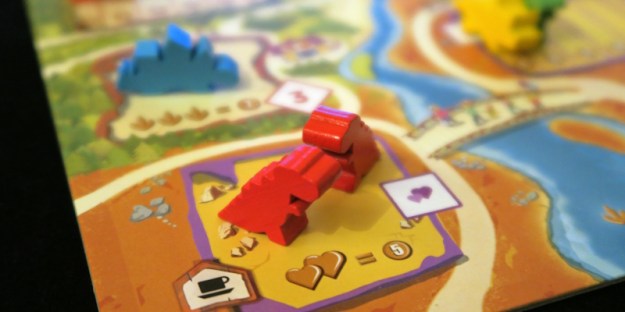
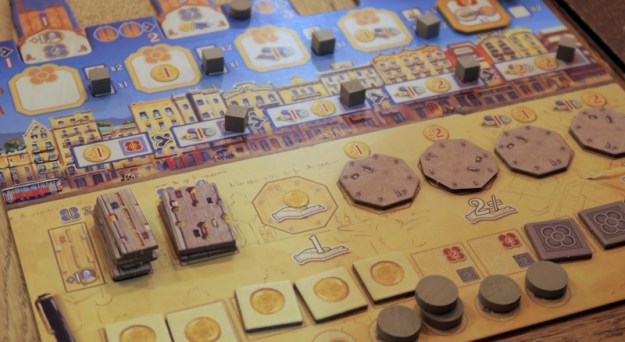
Meanwhile, on the next table, Green led Black, Purple and Cobalt in a game of Endeavor: Age of Sail.  This is a game that is very popular with the group, and although it seems quite complex, really comprises of point-by-point decisions, so although strategy is very important, tactics are critical too. The game is played over eight rounds, each consisting of four basic phases: Build, Populate, Payment and Action.  There are four technology tracks roughly corresponding to each phase, which dictate what a player can do during that phase.  For example, how far along the building track a player is dictates what they can build: the further along they are, the more buildings they have to choose from.

Endeavor: Age of Sail
– Image by boardGOATS

Thus it is one of those games where small decisions made early can have a big impact later in the game.  The first phase consists of passing round the tray of buildings rather like a box of chocolates, but after that, the second and third phases are more or less carried out simultaneously.  The guts of the game, however, is the Action phase.  In this round, players can place population markers on their buildings to activate them and carry out one of the five actions:  Colonise, Ship, Attack, Plunder Assets, and Pay Workers, actions that are generally focused on the central map.

Endeavor: Age of Sail
– Image by boardGOATS

Cobalt had not played Endeavor before so the group opted for the standard buildings and played using the standard, four/five player side of the board.  They did add three exploits from the Age of Expansion, however, the last three that had not yet been played with this copy of the game. They would not come into play until later and by then everyone should have a good idea of how to play.  While Cobalt and Black went with the Occupy action for their first building followed by the Workshop for extra bricks for their second building, Green and Purple both chose Shipping as their first building.  Green then took a Shipyard for a second shipping action and Purple went for a Market (gaining cards), “just to to be different”.

Endeavor: Age of Sail
– Image by boardGOATS

In that first round, Black and Cobalt only took a single occupy action with a plan to get better actions for their third building. Purple could only manage a single shipping, while Green also only managed one ship, but combined it with gaining a Culture to push him into the next category to get more citizens in the second round.  In that next round, Purple and Cobalt continued their similar strategy, gaining slaves for their bricks, while Green was forced into a workshop to stop himself getting hamstrung on buildings later and Purple was struggling to get enough citizens to use all the actions she had available to her.

Endeavor: Age of Sail
– Image by boardGOATS

That was pretty much how the game continued. Black and Cobalt placing people into Europe and building up their cards; Green was shipping around the world (although mostly in the Caribbean and South America) and Purple was taking the shipping routes in Europe, but always without enough citizens.  As the game progressed, regions started to open. Green inevitably gained the first Governor card. Cobalt and Puple fought for who had the most cards in total.

Endeavor: Age of Sail
– Image by boardGOATS

Once three and then four regions became open, only Green and Cobalt had people in both regions of the two opened exploits, so only they were able to make use of them.  They did use the South Sea Company exploit and Green took the extra brick as a ongoing benefit. This was not a normal brick, but a whole extra brick level, which allowed him to gain a level five building in the final round (the only one to do so). Cobald had tried to get a level five building, but then realised he had failed to reduce his brick level after he’d lost a couple of cards, and so was restricted to another level four building.  Although the Letters of Marque was the other opened exploit, no one actually made use of it.

Endeavor: Age of Sail
– Image by boardGOATS

About three rounds in, Green suddenly realised he had forgotten to explain the “Abolition of Slavery” rule to Cobalt. It didn’t look likely to happen as no-one had yet taken any European cards, however, Cobalt made his mind up then that this was what he was going to aim for—even though he had his own slaves, it felt morally right to him to make it happen!  Which he duly did, however, the only players to lose out as a result were himself and Black.  Both of them needed to reduce their card count anyhow, and the slaves were the ones likely to  be for the chop, so it didn’t cause too much damage.  The minus points they both received were only a small price to pay for their freedom.

Endeavor: Age of Sail
– Image by boardGOATS

Balancing everything is critical in this game and unfortunately Purple had always been on the back foot without enough citizens to do the actions she had available.  In the end Green ran out the winner as he had managed to get most of his attribute tracks up and gained a fair presence on the board.  The Letters of Marque, although unused, did provide for extra scoring on the shipping tracks, where Green had rather a lot of due to his early double shipping strategy. He and Cobalt also gained some points for using the South Sea Company Exploit.  This pushed Cobalt into second, marginally ahead of Black (who had managed a fair few points on cards and buildings).

Endeavor: Age of Sail
– Image by boardGOATS

It was still early and Endeavor was on-going, so when Teal left, the group looked for something little and light to play, and quickly settled on No Thanks!.  This is a favourite with the group because it is super-quick to set up and play:  players start with eleven red chips, and on their turn either take the card shown or pay a chip to pass the problem on to the next player.  At the end of the game, when the deck has been depleted, players score for the lowest value card in each continuous “run”, offset by any remaining chips and the winner is the player with the lowest total.  This is made more difficult by the fact that around thirty percent of the cards have been removed.

No Thanks!
– Image by boardGOATS

This time, the group played a total of three games.  In the first one, Pink took all the chips leaving everyone else with nowhere to go but pick up cards, which Blue did in spectacular fashion, finishing with one hundred and forty points.  The other three were very close together, with Pink just edging it by a single point from Lime.  The second game was much better balanced.  Although Pine won, there were clues as to Lime’s strategy for the next game as he picked up lots of cards and would have won by a large margin if two of the cards he wanted hadn’t been removed from the deck, but that’s the point of the game of course.

No Thanks!
– Image by boardGOATS

The third and final game was very unusual.  Lime rode his luck like a bucking bronco and kept taking cards.  Blue picked up a couple, but that was all he let her have, and Pine and Pink who just kept passing, eventually ran out of chips.  As they were playing open handed, Lime saw this and just collected the rest of the cards leaving him with forty chips and fifty-two points from his cards—a very good final score of twelve. Unfortunately for him, as both Pine and Pink had no cards or chips, they both finished with a round, fat zero, and therefore shared victory in one of the strangest No Thanks! games anyone had ever played.

No Thanks!
– Image by boardGOATS

With Endeavor coming to a close, there was just time to squeeze in something quick.  The fancied a change though and, as it had been a while since it’s last outing, Love letter was picked.  Everyone knew the game well , so the rules didn’t really need to be explained: start with a hand of one card, draw a second and choose one to play, effectively dueling to have the highest value card once the deck was exhausted.  Blue and Pine won the first two rounds, and as the others were finishing packing up, rather than play more, the group decided Blue and Pink should have a play-off.  Blue quickly acquired the Princess, which can be risky, but it was soon over when Pine played the Baron and compared hands, do his detriment.  With that, it was time to go home.

Love Letter
– Image by boardGOATS

Learning Outcome:  Although two games may seem similar, they may not suit people equally well.

Eleven is Heaven – Happy Birthday to Us!

Eleven Today

BoardGOATS is Eleven Years Old Today!

Yes, after eleven years boardGOATS is still meeting at the Horse and Jockey in Stanford-in-the-Vale. Four of those who were there at the first meeting still come regularly and we now typically have around ten, lovely people every time.  While we have two or three people from the village, we have a lot of people who travel some miles to join us—without you, boardGOATS wouldn’t be the success it is, so we really appreciate it.  Here’s to another year of games!

Next Meeting, 19th September 2023

Our next meeting will be Tuesday 19th September 2023.  As usual, we will start playing shorter games from 7.30pm as people arrive, until 8pm when we will start something a little longer.  The pub is doing food, and the table is booked from 6.30pm for those that would like to eat first.

This week, the “Feature Game” will be Alea Iacta Est (rules, review and how to play video).  This is a fairly simple dice chucking game, with a lot of similarity to one of our old favourites, Las Vegas, but with a bit more planning and a roman theme.

Alea Iacta Est
– Image used with permission of
BGG contributor MeepleMaven

Speaking of Romans…

Jeff was working at a cinema when a Roman centurion walked in. After the showing, the Roman came back to the desk and asked for a refund.

“No one told me that the movie was going to be a pornographic one,” the centurion explained to Jeff.

Jeff politely replied, “Sir, look at the sign, it clearly says right here what kind of films we show.”

Looking back at the sign, the centurion responded, “You lie! There are most certainly not thirty movies!”

5th September 2023

The evening began with Green and Purple arriving to find Plum and Cobalt sitting outside the pub chatting.  This was partly because the weather was warm, but also because someone else was sitting at our usual table and we had been relegated to another long table on the other side of the room.  Pine arrived soon after and once introductions between Cobalt and those who had not been about last time were concluded, the group decided to play a short intro game while they waited for everyone else to arrive.  The game settled on was Coloretto, which had only just begun when Ivory arrived, but he was happy to watch.

Coloretto
– Image by boardGOATS

Coloretto is a quick and simple game that is very popular with the group.  Players either turn over the top card and add it to a “Truck”, or take a Truck and add it’s contents to their collection, sitting out until everyone else has taken a Truck.  Players are collecting coloured sets of Chameleon cards, but the key is that only three sets score positive points, with the others scoring negatively.  Thus players are trying to get as many cards in three colour suits, and as few as possible in each of the rest.  This time, everyone started with a different colour, so there were no obvious clashes.  As is usual for this game, it took a few turns for each players position to become clearer.

Coloretto
– Image by boardGOATS

By this time Plum was keeping the number of colour sets she had low with only two, but also had a couple of +2 bonus point cards and a Rainbow Chameleon (a wild) . Purple’s set was similar but with three colours.  Green was making steady progress and Cobalt was low on any particular colour, but only had four sets and a Rainbow Chameleon, so was poised for a good score if the cards fell in his favour. Pine meanwhile seemed to be in the process of collecting at least one of each colour!  By the end of the game, Plum had managed to collect Chameleons in just three colours and so scored no negatives, while Pine just seemed to have sets of everything. Purple had three extra colours, but with only one of each; her Rainbow Chameleon and +2 cards helped to give her a good score.

Coloretto
– Image by boardGOATS

Green managed only one negative point, but had no bonuses, while Cobalt had his cards fall right and ended with a couple of good colour sets and with it, victory.  By the conclusion of Coloretto, Jade and Sapphire had arrived bringing with them the feature game, Vaalbara.  In this game, each player is a clan leader trying to take over some territories with game-play which is vaguely reminiscent of Libertalia/Winds of Galecrest.  Players all have the same deck of twelve cards representing the members of their tribe.  Each turn, players choose secretly one card, then in the order of initiative of the revealed Characters, players activate their powers and take over one of the available Territories. Each type of Territory has its own way of scoring points (Collection, Pair, Diversity, Risk etc.).

Vaalbara
– Image by boardGOATS

Thus the game is about timing and playing the best powers and the high initiatives at the most opportune moments. After nine rounds, the player with the most points wins.  Jade and Sapphire had played Vaalbara about a dozen times together, and Green had played a similar number of games on Board Game Arena with reasonable success. Pine was entirely new to it the game and joined the other three.  Jade and Pine took the Mountains in the first round, and then Jade managed to snatch the only one on offer in the second round.  Green ended up with the final card in the first round—the All Rounder, so scored poorly with it.

Vaalbara
– Image by boardGOATS

By the middle of the game Sapphire was going all out for Fields, Jade was on to his third Mountain and Pine was beginning to get the hang of things.  Green was struggling with his all rounder strategy:  all he could get was a River and several Forests and even after he’d swapped one of those for something else (he’d mixed up the cards and instead of swapping a card between first and second row, it was any card with the top card of the deck) it didn’t work out.  Pine managed to complete his second Mountain, but Jade amazingly managed all four which catapulted his score. It was only then that Pine and Green realised that the fourth Mountain was twenty points on top of the ten for the first three (i.e. a very thirty in total from four cards).

Vaalbara
– Image by boardGOATS

By the end of the game the Poppy Fields were coming out in profusion and started to really score a lot of points.  Unfortunately for Green, Jade managed to nab the Field card ahead of him for a five type bonus and Green was still only on four terrain types.  Once the dust had settled and the final scores were compiled, it was quite close with Jade and Pine were tied for first on seventy points, and Green only three points behind and just ahead of Sapphire. Pine joked that maybe the tie-break would be the player position on the last card back, thinking that would about as arbitrary as some of the other tie breaks had been recently. A quick check of the rules confirmed it and ultimately gave victory to Jade.

Vaalbara
– Image by boardGOATS

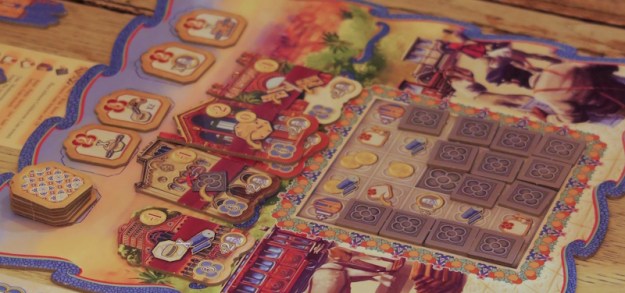
From there, the quartet moved on to play an old favorite, Azul.  In this game, players are tile-laying artists challenged to embellish the walls of the Royal Palace of Evora.  On their turn, players draft colored tiles from the marketplace onto their player board.  At the end of the round, players score points based on how they’ve placed their tiles to decorate the palace with wasted tiles scoring negative points.  Bonuses are awarded at the end of the game for completing rows and columns and sets of the same colour, and then player with the most points is the winner.  A pretty game, the group started with a short discussion about what colour one of the tiles really was.

Azul
– Image by boardGOATS

People wanted to call it blue, but there is already a fully blue tile, and this one was a little more turquoise with a white pattern—they did not come up with answer to the problem.  The game played much as it always does with complaints about the tiles that were not coming out of the bag when needed and at one point there was one Marketplace with four tiles all the same colour (that colour that we could not quite pin a name on).  Mid-way through the game no-one seemed to want the orange tiles, and it ended up with about eight of them in the middle of the table. It finally fell to Pine to take them, but he could not place any of them and they all had to go on his negative score line!

Azul
– Image by boardGOATS

The game was reluctantly brought to a conclusion by Sapphire, at the urging of everyone else.  He did not want to complete his row, wanting to hold out and complete a different colour later, but if he hadn’t taken the tile he would have ended up with a larger negative score and it had already not been possible to fully populate market. After final scoring, Jade and Sapphire shared the lead with ninety-five points with Green, who’d had a much better game than he usually has in third.  Tie break time again, but this time Sapphire won it because he was the only player to have completed a full row (the tile he hadn’t wanted to take).

Azul
– Image by boardGOATS

There was still time for something else, and the group settled on Nimalia, a new, interesting card-laying game where players are designing the best Animal Sanctuary.  Each card has four “Biome” squares on it of potentially different terrain, and different animals.  Players start each round with three cards and draft them, placing the chosen card partly (or wholly) on top the already laid cards in a simlar way to Sprawlopolis or Honshū.  The Sanctuary must remain within a six by six grid made of the squares (not the cards).  The game is played over a series of five rounds, where two or three different conditions are scored at the end of each drafting round.  This time, the first round would score for the largest area of Savannah and for connected Polar Bears and in the second round the scoring switched to Polar Bears and Gorillas next to Water.

Nimalia
– Image by boardGOATS

In the third round it returned to the largest Savannah, but with the complication of scoring maximum for no Giraffes down to scoring nothing with three or more giraffes—of course giraffes live in the Savannah!  Rounds four and five used both the Giraffes and the Gorillas to score while adding in the Savannahs in the fourth round and polar bears in the fifth.  The nature of the scoring meant that any cards with Giraffes were quickly passed on leaving some players with a double giraffe card to lay as the last card on a giraffe scoring round.  Since it wasn’t possible to lay a new card underneath an old one, those giraffes caused scores to tumble!

Nimalia
– Image by boardGOATS

In the first round Pine roared into the lead while everyone else stayed within a point or two of each other.  After the second round, Sapphire was the one who lost out, with Pine retaining his significant advantage. During the third and fourth rounds Jade and Green managed to catch Pine, with Jade pulling into the lead.  Sapphire managed a good score in the fourth round, but he had a lot of ground to make up and he’d left his charge to the finish a little too late.  In the final scoring, Jade and Green pulled ahead in a tight battle, which Jade won by just two points with his total of eighty. Pine was third after flailing around in the final round and having been left with a double giraffe.

Nimalia
– Image by boardGOATS

While all that was on-going, the rest of the group, Plum, Ivory, Purple and Cobalt, opted for a club favourite, Wingspan, enhanced by the European Expansion.  This is a card-driven engine-building game where players choose one of four possible actions (activating their Woodland, Grassland or Wetland areas or placing a bird card in one of those locations).  Points come from each individual card end of round goals, and eggs left at the end.  The game is all about building combinations of cards that work together efficiently, so the it took all night as everyone wanted to do their absolute best.

Wingspan
– Image by boardGOATS

Ivory as always was very good at this, but was also quite generous giving everyone food each time he activated his Woodland area.  Cobalt was the first to get three bird cards in his Reserve, though Ivory  ended up with the most valuable birds on his board, with Plum’s next highest.  One of Plums birds moved at the end of each round though, which was very useful for saving costs and improving yields.  It was Ivory and Cobalt who tended to come out best with the end of round goals.  As is often the case Ivory continued to score well with a good haul of bonus card points too.

Wingspan: European Expansion
– Image by boardGOATS

Purple failed to complete any of her bonus cards, but did make sure all her birds laid purple eggs.  Cobalt finished the game with the most eggs, however, inevitably followed by Ivory.  As for cached food and cards, Plum got the most food, but Purple had the most Tucked cards.  With all the scores added up, Ivory was the almost inevitable winner on ninety-three with Cobalt not far behind with eighty-three and Plum taking the battle for third by just three points in what was a hard-fought game.

Wingspan
– Image by boardGOATS

Learning outcome:  Goats love playing with colours.

Next Meeting, 5th September 2023

Our next meeting will be Tuesday 5th September 2023.  As usual, we will start playing shorter games from 7.30pm as people arrive, until 8pm when we will start something a little longer.  The pub is doing food, and the table is booked from 6.30pm for those that would like to eat first.

This week, the “Feature Game” will be Vaalbara (rules, review, how to play video).  This is a light card game, with elements of hand management and set collection where players are neolithic clan leaders trying to take over territory.  It is very quick to play, so should leave plenty of time for other games.

Vaalbara
– Image by BGG contributor The Innocent

Speaking of the Neolithic…

Joe hadn’t been feeling well and he was down the pub sharing his woes with his mate Jeff.

“You see,” he explained.  “The doctor said I’ve got kidney stones, gall stones and even bladder stones.  It’s really painful and they don’t know what’s causing it.”

Jeff answered, “It’s because you are so old fashioned—you are living in the stone age…”

22nd August 2023

It was an unusually quiet night—indeed we haven’t been this low on numbers since the dark days of 2020.  On a bleak night in mid March of that year, there were also just four, and that presaged eighteen months of playing games online.  On that occasion, everyone knew something bad was coming and it was a very sombre evening as a result.  This time was much more positive though, as almost all the absentees were away because they were having a good time.  That left just Black, Purple and Plum to meet Cobalt on his first meeting.

Ticket to Ride: Northern Lights
– Image by boardGOATS

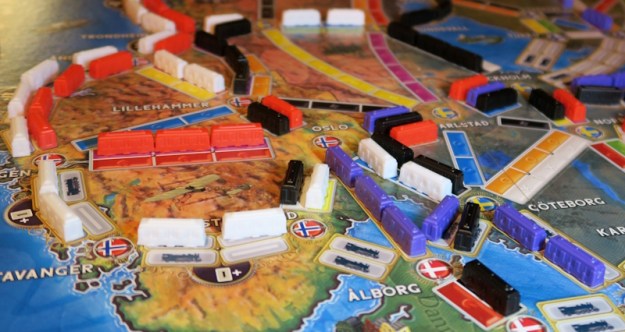
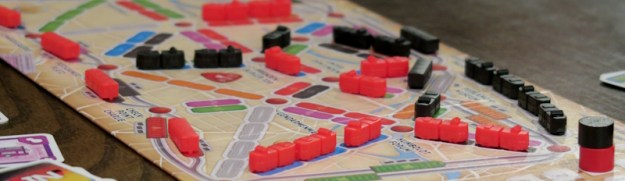
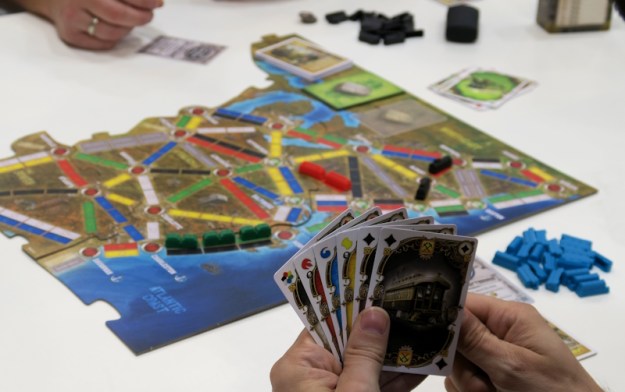
The group started with the “Feature Game” which was Ticket to Ride: Northern Lights.  This is the latest version of one of the group’s most popular games, Ticket to Ride, and one that is currently only available in Scandinavia.  Like all the other versions, the rules are quite simple:  on their turn, players either take train cards from the face-up market (or the blind draw deck), or spend cards to place trains on the map for points.  Once or twice during the game, players may instead choose to draw Tickets, which give players points at the end of the game if they are completed, that is to say, the owner has connected the two locations with their trains.  Woe betide any player with incomplete tickets however, as they score negatively.

Ticket to Ride: Northern Lights
– Image by boardGOATS

Northern Lights is similar to the Nordic Countries stand-alone game that we often play at Christmas, except that more people can play and the artwork is a little less festive (though still very, very beautiful).  There are the usual “rule tweaks” that come with a new version of the game and which are in Finish, Danish, Swedish and Norwegian only.  In this case, a translation says that the biggest differences are the addition of bonus cards, four of which are drawn at random at the start of the game and give extra points at the end, (for example to the person with the most left over trains, longest continuous route, most completed ferries etc.).  Additionally, there are some triple routes (which only take effect with five players) and some routes have a “+X” next to them and when trains are laid on these the player takes X train cards from the face down pile.

Ticket to Ride: Northern Lights
– Image by boardGOATS

The rules surrounding Locomotive (wild) cards are slightly different too:  for all routes they can replace any other card and for ferry routes Locomotive cards can be replaced with a pair of the same colour (that doesn’t have to be the same as the rest of the cards used).  As a result, unlike most of the other versions, if there are three or more face-up Locomotive cards in the market, the market is not refreshed (a point of discussion some weeks back).  With just four players, the triple routes were not used and the bonus cards drawn were the Small Step Strategist (D), the Nordic Express (E), the International Tycoon (G) and the Snowplough Reward (I).

Ticket to Ride: Northern Lights
– Image by boardGOATS

These rewarded players for the most single space tracks claimed, the longest continuous route, connecting the most countries and the most routes connecting pairs of cities in the arctic.  The group also forgot to remove the spare trains, making the game slightly longer than it would have been with the rules as written.  Black built a long route all the way down the west coast of Norway, which he shared with Plum in the north and Cobalt further south.  Purple kept to the East side of the map, with a significant amount of her tracks above the arctic circle.

Ticket to Ride: Northern Lights
– Image by Black

When it came to the bonuses, Plum took the Snowplough award and Black was the International Tycoon.  Plum and Black tied for the Longest Route (Nordic express) and Cobalt missed out on joining them by just two two trains.  Instead, he just pipped Purple to the reward for having the most single track sections.  Aside from this, it was a hard-fought game as usual.  Black and Cobalt both completed three Tickets, while Plum finished four and Purple managed a massive seven.  Size matters though, and Purple’s Tickets were all short routes, so didn’t score as highly as the others’.  The bonuses were critical though in such a close fought game, and there were just three points in it, with Black just taking victory ahead of Plum with Cobalt in third.

– Image by Black

It had been quite a long game and time was marching on, so the group opted for another old favourite, Splendor.  This had been a favourite game of Burgundy‘s who’s birthday it would have been at the end of the month.  This year it has not been possible to plan something to mark the occasion (as we did last year), but we will try to do something in September.  In the meantime, as always, everyone will continue to remember him in the games we play.  And Splendor was definitely one of those games—at one point Burgundy had a fourteen game winning streak.  Although Burgundy liked complex games, he also really appreciated simple elegance, and this is definitely one of those games.

Splendor
– Image by boardGOATS

The game is a simple engine builder:  players take chips from the market (three different ones or two the same if there are four or more available), or spend chips to buy cards.  The cards are permanent gems and those that cost more additionally give points.  At the end of the game, the player with the most points is the winner.  Cards aren’t the only way of scoring points though, players can also get points for enticing a Noble to support their cause by collecting the correct gems.  The rules say the game end is triggered when one player reaches fifteen points, however, this time, due the group played to just ten.

Splendor
– Image by boardGOATS

There are several consequences of playing a shorter version of the game, including changing the effect of the more expensive cards, but it also changes the importance of the Nobles.  It also makes reserved cards more difficult to fulfill.  This time, Cobalt had one card that he reserved, but failed to complete.  Everyone had lots of cards and the game was just getting going when Black swooped to secure the support of Elisabeth of Austria with his three Onyx, Sapphires and Diamonds and triggered the end of the game.  Plum had looked like she might just take her revenge for Black pipping her in Ticket to Ride, but it was to be a second runner up place for her behind Black’s unsurpassed twelve points.

Splendor
– Image by Black

Learning Outcome: Board games are in my mind, they guide me back to you…

Next Meeting, 22nd August 2023

Our next meeting will be Tuesday 22nd August 2023.  As usual, we will start playing shorter games from 7.30pm as people arrive, until 8pm when we will start something a little longer.  The pub is doing food, and the table is booked from 6.30pm for those that would like to eat first.

This week, the “Feature Game” will be Ticket to Ride: Northern Lights (rules, review).  This is the latest version of one of our favourite games, Ticket to Ride, and is similar to the Nordic Countries stand-alone game that we often play at Christmas, except that more people can play, there are a few rules tweaks, and the artwork is less festive (though still very, very beautiful).

Ticket to Ride: Northern Lights
– Image by boardGOATS

Speaking of the Northern Lights…

Jeff’s mate Joe was telling him about the recent trip he’d made to Norway with his girlfriend, Alice. He explained how seeing the Northern Lights was one of the things he’d always wanted to do. He’d found a romantic log cabin and they stayed there together for a few nights. Joe explained that he’d loved his time there and seeing the Northern lights, but his girlfriend Alice, had admitted that she hadn’t found the trip at all interesting.

Jeff replied, “I guess it must have been really hard watching the Aurora boring Alice…”

8th August 2023

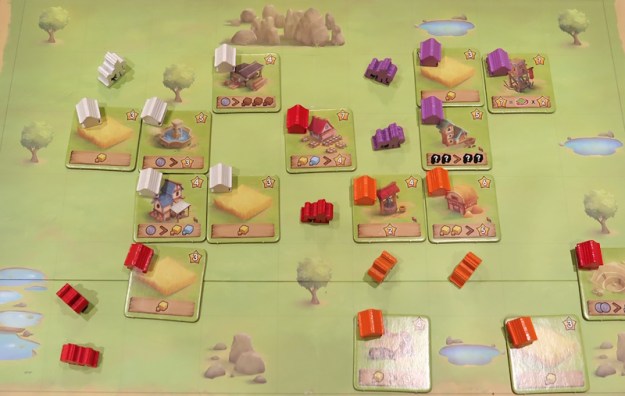
Blue and Pink were first to arrive, and, as they finished their pizza, others began to turn up too.  It was a slow start on a relatively quiet night, but eventually Blue Ivory, Black and Jade were settling down to play the “Feature Game“, Ginkopolis.  This is a medium weight tile-laying game with an area control element.  Blue explained that it was one of those games that had been through a phase of being very out of print and therefore inevitably in high demand, though now was much more available.  The game is set in 2212 where players are urban planners trying to building the eco-city, Ginkgopolis, though the theme is quite loose and in reality, it is much more more abstract that that.

Ginkgopolis
– Image by boardGOATS

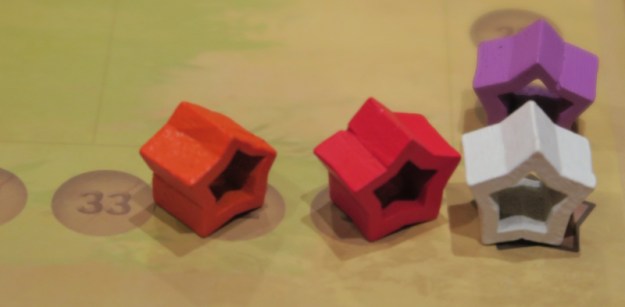
The game is card-driven, with players simultaneously choosing a card and any tiles they are going to play with it, and then, starting with the first player, taking it in turns to carry out one of three possible actions: Urbanise, Construct or Exploit.  There are two different sorts of cards in the game, Urbanisation cards which feature a letter, and Construction cards which come in three different colour suits, red, blue and orange, and are numbered one to twenty. When choosing either an Urbanise action or a Construct action, players additionally choose a Tile to play from their personal stash.  Urbanising involves placing a tile in the space matching the letter on their Urbanise card, adding a wooden Resource block in their colour to claim it.

Ginkgopolis
– Image by boardGOATS

There is a little upkeep, in that they move the Urbanisation letter marker to a space orthogonally adjacent to the Tile they placed and mark it with a grey cylinder.  As a reward for urbanising, players get to Activate all orthogonally adjacent buildings.  This is claiming a number of  Tiles, Resources or Ginkgo Points (a sort of currency used in the game), with the item dependent on the colour and the number received equal to the height of the Building activated.  Constructing is similar, except the Tile chosen is placed on top of another Tile, returning any Resources on the tile to their owner and claiming Ginkgo Points from the bank for each one.

Ginkgopolis
– Image by boardGOATS

In addition to this immediate reward, there are also costs:  if the Constructed Tile has a lower number than the tile it is built on, they must pay the difference in Ginkgo Points and if the colour is different, they must also pay one Resource to the general supply.  In addition to these potential costs, the active player must also place Resources from their stash on top of the newly expanded building to claim it (with the number equal to the height).  This can make Constructing expensive, though as the game progresses, they get Resources back as other players build on buildings they have Urbanised or Constructed.  Still, particularly early in the game, players can find themselves running out of supplies, in which case, they can Exploit.

Ginkgopolis
– Image by boardGOATS

Exploiting involves playing cards (without a tile) to gain Tiles, Resources, or Ginkgo Points.  How they Exploit depends on whether the card they are Exploiting is an Urbanisation card or a Construction card.  For Urbanisation cards, players just take either a Resource or a Tile from the supply, whereas for Construction cards, players Activate the building on the card to receive Tiles, Resources or Ginkgo Points equal to the height of the building. This is not the only way to get resources, however.  Once a player has carried out their chosen action, they either recycle the card (if they Urbanised or Exploited) or, if they Constructed, they keep it in front of them.  Each Construction card has an action as well as a number and a colour, and these are activated during the game, most after carrying out actions, with some providing end-game Points.

Ginkgopolis
– Image by boardGOATS

And scoring is where the game gets tricky.  The winner is the player with the most Ginkgo Points at the end of the game, but in addition to chips acquired during the game and end-game points from Construction cards, the majority of the points come from the area control element of the game.  The city is divided into districts with districts defined as areas containing at least two buildings of the same colour.  The player with the most Resources in the district wins control and takes Ginkgo Points equal to the total number of Resources in the district.  The player to take second gets Ginkgo Points equal to the number of their Resources in the district.  Ties are broken in favour of the player with the highest building.

Ginkgopolis
– Image by boardGOATS

There is quite a lot of critical upkeep in the game, but the most important it to remember to put a grey construction cylinder on buildings during Urbanisation and Construction.  This is because at the end of each turn, players top their hand back up to four cards drawn at random—when the draw deck is empty, however, the discard deck is recycled and topped up with cards that correspond to the newly constructed buildings.  Since cards that correspond to buildings are kept when the building is over-built, and everything else is recycled, the draw deck (and the cards in hand) comprise all the buildings currently visible, together with all the Urbanisation cards, and nothing else.

Ginkgopolis
– Image by boardGOATS

Getting this wrong, breaks the game spectacularly, as Blue and Ivory had found out on the one other occasion they played it (with Pink, during one of the sporadic meetings in the pub late in the Summer of 2020).  This time, they were aware of the importance of placing the grey markers and mostly managed to stay on top of that so everything went a bit smoother, allowing players to concentrate on the nuances of the game.  And there are lots of nuances.  For example, over-building can help a player to take control of a district, or, if they change its colour, break one up, but it also gives Resources to the previous owner.  Similarly, Urbanising expands the city, but provides a cheap way for other players to expand districts and perhaps muscle in.

Ginkgopolis
– Image by boardGOATS

The game started with everyone feeling their way, trying to make the most of the Character cards they were dealt at the start of the game.  These give bonuses to players to get them going in the early stages of the game.  It is possible to draft these character cards, but the group began with the preconstructed sets:  Ivory got set one, Black got set six, Jade got set two and Blue got set five.  These give players a strategy steer in the early part of the game, for example, Blue and Black’s cards gave them two bonuses for Exploiting while Jade and Ivory both benefited twice for Constructing.  Quite early in the game, it became clear that there was one building towards the middle that was going to be quite critical in the area control battle and Blue, Black and then Ivory all over-built and tried to claim it for their own.

Ginkgopolis
– Image by boardGOATS

The game has the ability to feel very swingy, and lacking in control, and yet it is actually an extremely smart, tactical game—one clever tile placement can completely change the game by breaking up a district or joining two districts together and totally change the balance of power.  This game was no different in that regard, though it took a little time for everyone to really start to see its potential.  There were other elements of the game that players gradually came to appreciate.  For example, Black ran into the unexpected difficulty of running out of Resource markers, because he had a lot in the city.  This gave the others a problem—building over his buildings relieved that pressure, but because he had so many on the board, it was hard to avoid doing it.

Ginkgopolis
– Image by boardGOATS

Jade also had difficulties getting the tiles he wanted to match his cards, while Ivory had difficulties getting the cards he wanted (and was the only one to spend one of his refresh hand tokens, which cost him two points in the end-game scoring).  The game ebbed and flowed, and although it vastly exceeded its advertised forty-five minutes, it wasn’t long before the stack of tiles dwindled and triggered the end of the game.  At this point, players could choose whether to add tiles from their hand back into the game.  Jade was aghast at the idea having struggled to get tiles throughout, but Ivory had an enormous stack and put a few back into the supply to keep things going for another couple of rounds.

Ginkgopolis
– Image by boardGOATS

As the game drew to a close, the question was whether anyone would be able to make a move on the largest districts.  The highest building that had been long fought over now belonged to Ivory, but had been cut off, leaving it pointless, which left two large red and one large blue district as well as some smaller efforts.  Key was the number of Ginkgo points picked up during the game—everyone thought Ivory had a lot, but it turned out Black was the king of the Ginkgo tokens with a massive thirty-six. Blue was a little way behind him, but made up for this with her city scoring, which ultimately gave her victory with sixty-six points, nine more than Black in second who was well clear of Jade and Ivory who tied for third.

Ginkgopolis
– Image by boardGOATS

Meanwhile, on the next table, Purple, Green and Pink were deciding what to play while they waited for Pine who was running late.  Green commented that he didn’t want to play something new, so in the end the group settled on Splendor.  This is an old favourite, though one with poignant memories for most in the group as it was a favourite of Burgundy who sadly passed away eighteen months ago—it would have been his sixty-fifth birthday at the end of the month.  As always, with Burgundy in mind, the trio set the game up.  It is a very simple, tactical engine builder, where players take it in turns to either take chips from the supply, use chips to buy a face up card from the market or, occasionally, reserve a card.

Splendor
– Image by boardGOATS

Players win points for the higher value cards, or for collecting enough cards of specified colours to claim a Noble.  This time, Pink tried a strategy that concentrated on going for cheap cards with the primary aim of scoring for Nobles.  This had the benefit of giving him lots of cards which builds the engine quickly making other cards cheaper.  The strategy worked well, but not as well as Pink needed it to for him to beat Green who ended the game, with a lead of three points.  As Splendor came to a close, Pine rocked up, so the newly expanded, now quartet looked for something fairly light to play, and Pink suggested one of his favourites, For Sale.

For Sale
– Image by boardGOATS

As Pink described it, like football, For Sale is a game of two halves.  In the first half, players bid for properties which they then sell in the second half of the game.  This time, Purple became a bit of a tent specialist (with tents of various quality), which turned out not to work so well for her.  Pine ended up with the outside netty (one of the lowest value cards), but one that you are almost guaranteed not to loose money on.  Once again, however, the winner was Green with Pink taking his second second place.  So the question was, could anything upset that pattern?

For Sale
– Image by boardGOATS

The group moved on to Botswana, a sort of set collection stock-holding card game that it is really hard to get your head round despite actually being very simple.  The five animal suites each have six cards, which are shuffled together and dealt out.  Players then play a card from their hand, and take any one of the animals on the table.  The round is over when any one of the five animals has the sixth card played, at which point players score points for each animal they have, equal to the final card played.  After three rounds, the player with the most points is the winner.

Botswana
– Image by boardGOATS

This time, all three rounds were remarkably even.  Purple was just one point behind green going into the final round, though Pink had some ground to make up if he was going to continue his run of second places.  In the end, Green made it three from three, and relatively poor final rounds from both Pink and Purple left Pine to take second with Purple just behind.  Green decided three was enough, and didn’t fancy tarnishing his winning streak, so headed off while Purple and Pink waited for their other halves to finish Ginkopolis, and looked round for a suitable filler.

Coloretto
– Image by boardGOATS

Coloretto is another old favourite, and one that plays really well with three.  A really simple set collecting game, on their turn, players either turn over a coloured chameleon card and place it on a truck, or take a truck.  At the end of the game (when the draw deck has been mostly depleted), players score points for each coloured set of cards.  In general, the larger sets score more, but only the largest three score positively, everything else gives negative scores.  For a bit of variety, the group used the scoring card from the Limit Cards/Extra Cards mini expansion (but without any of the other rules and cards).  This gives low scores for the small groups, but very high scores for the large sets.

Coloretto: The Extra Cards
– Image by
boardGOATS

Aside from a query about the Golden Joker (which like the normal multi-coloured Joker can be added to any set at the end of the game, but additionally gives an extra card drawn at random from the deck), there was no real need to revise the rules.  It was a good game, though Pink blotted his copy book with quite a lot of negative points and wasn’t able to improve on his two second places as a result.  The run-away winner was Purple though, who finished with forty-eight points, eight more than Pine in second place.  And with Ginkopolis coming to an end too, that was it for another week.

Coloretto
– Image by boardGOATS

Learning Outcome:  In some games, you have to start building right from the gink-go…