Essen 2025

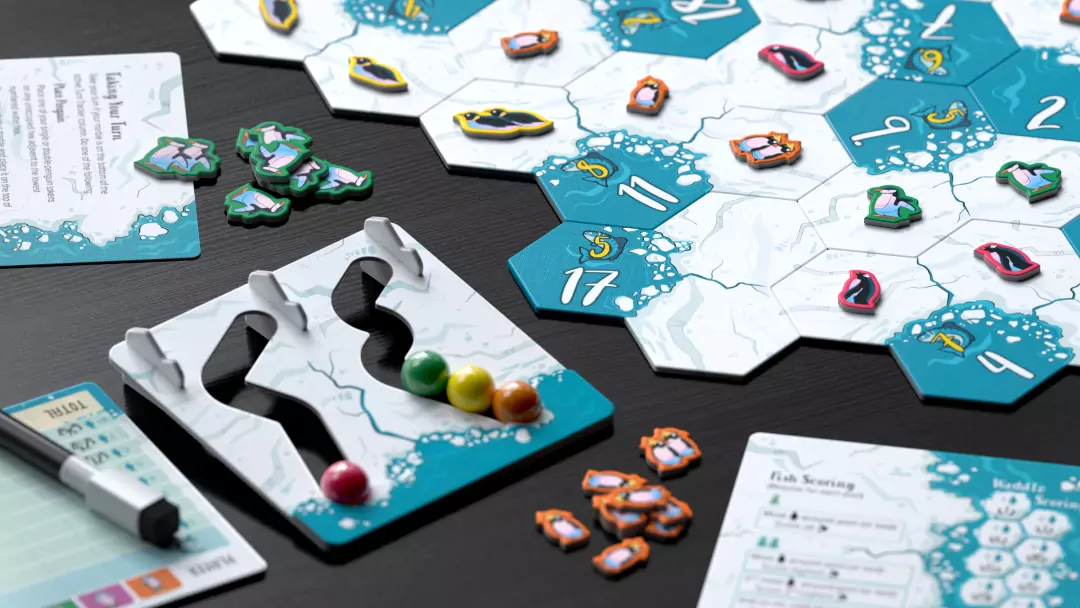
Today is the conclusion of the largest annual gathering of gamers in Europe.  The Internationale Spieltage is known to gamers worldwide simply as “SPIEL” or “Essen” and is a four day fair with lots of new releases scheduled to coincide with the event, just in time for Christmas sales.  This year, there have been lots of exciting new games available to be seen including Galactic Cruise, Brick Like This!, Forest Shuffle: Dartmoor, Waddle, Orloj: The Prague Astronomical Clock (which was sold out before the end of the first day) and Origin Story (which was sold out by Friday).

.Orloj: The Prague Astronomical Clock
– Image by boardGOATS

In addition to new games, the rise of crowd funding has had a large impact, and increasingly there are stands presenting current live projects in the hope of seccuring additional backers.  Examples of this included, Eldertide: A Thousand Lights, the Lodges expansion to Kavango, Cascadia: Alpine Lakes, AstroNavigators, and the re-release of Nippon to name just a few.  There have been a lot of really good deals to be had too, and there will be even more on the final day today.  It was with sadness though that the Snowdonia spin-off, Alubari was found at a discounter for €15, as this was a great game released with much fanfare a few years ago.

Cascadia: Alpine Lakes
– Image by boardGOATS

Old favourites typically often get a new lease of life with the release of expansions.  This year, relatively recent releases like SETI (which was confirmed as the winner of the Deutscher Spiele Preis), Faraway, Castle Combo and Windmill Valley recieved new additions, but older games like Underwater Cities and Wingspan also got some love (with the new Data Era expansion and the fan-designed promo packs).  As well as new games and expansions, there were also a number of re-releases of old favourites including Ra, Bohnanza (with Dahlia artwork) and Botswana, and even Ticket to Ride which has had a bit of a face-lift with new artwork.

Botswana
– Image by boardGOATS

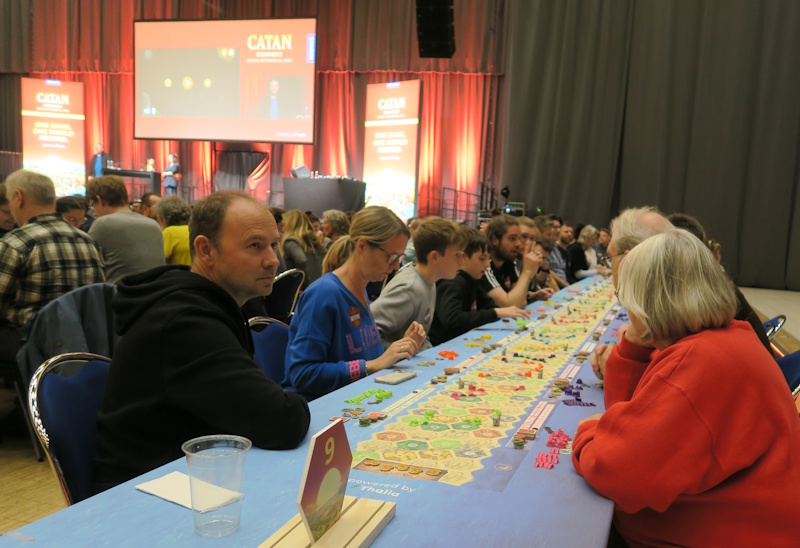
For those that were prepared to stay late on Friday, there was a world record attempt for the most people playing The Settlers of Catan together.  This was achieved with CATAN-Connect, which is a new version of the game designed for large parties that has large groups playing around single islands with elements of simultaneous play and everyone working to one electronic dice roll and a timer.  The record had been set at Essen in 2015 with one thousand and forty, only for Rotterdam to set a new record two years later with one thousand and ninety-six.  At SPIEL, one thousand, one hundred and seventy players joined in the game (watched by a few more who were just curous), successfully bringing the world record back to Germany where it arguably belongs.

CATAN-Connect
– Image by boardGOATS

Next Meeting, 14th October 2025

Happy Birthday to Us!

Our next meeting will be Tuesday 14th October 2025, when we will be celebrating our thirteenth birthday.  We will be eating together to celebrate at 7pm, with cake and games afterwards.

As is now traditional on our birthday, the “Feature Game” will be Crappy Birthday.  This is a party game where players give each other comedy birthday presents and the recipient has to decide who gave the best and worst gifts.

Crappy Birthday
– Image by boardGOATS

And speaking of birthdays…

Jeff was at the surgery.  “Doctor, I get heartburn every time I eat birthday cake,” he explained.

The doctor asked him to open his mouth and say “Ahhh.”

After a few moments’ examination, the doctor said, “Next time, take the candles off.”

boardGOATS is Now a Troublesome Teen!

Thirteen Today

BoardGOATS is has reached its Troublesome Teens!

It is over thirteen years since our first boardGOATS meeting at the Horse and Jockey in Stanford-in-the-Vale. We now typically have over ten, lovely people every time many of whom make a special effort to travel some distance to join us—without you, boardGOATS wouldn’t exist, so we really appreciate it all the effort you folks make.  Here’s to another year of great games!

Next Meeting, 30th September 2025

Our next meeting will be on Tuesday 30th September 2025.  As usual, we will start playing shorter games from 7.30pm as people arrive, until 8pm when we will start something a little longer.  The pub is now doing food again, so those that will be eating will be arriving from around 6.30pm.

This week, the “Feature Game” will be The Traveler expansion to Altiplano (base game rules, base game review, base game instructional video, expansion rules, expansion review, expansion overview and instructional video).  Altiplano is a “bag building” game where players develop their alpaca farms in the highlands of Peru and was the first game to receive the coveted Golden GOAT Award in 2018.

Altiplano
– Image by boardGOATS

And speaking of alpacas…

Jeff was at Millets Farm with his wife and, after visiting the Falconry, they were admiring the animals.  They were looking at the alpacas, when Jeff commented, “They look a bit scary, do you think they might bite?”

His wife replied, “Oh no, they are quite friendly, there’s no cause for a llama…!”

Next Meeting, 9th December 2025

Our next meeting will be Tuesday 9th December 2025 at the Horse and Jockey pub in Stanford-in-the-Vale.

As this is our Christmas party, we will be meeting early from 6.30pm
with food at around 7pm followed by Christmas festivities.

After eating, we will be playing a range of Christmas and winter themed games like Jokkmokk: The Winter Market, Santa’s Workshop, Christmas TreeSnow Tails, Carcassonne: Winter Edition, Gingerbread House and Ticket to Ride: Nordic Countries, or any party games we have time for after eating and voting on the annual GOAT Awards.

"Un-Christmas Party" 2023
– Image by boardGOATS

Speaking of Christmas…

Jeff had just bought himself a Christmas jumper (so he could get an extra vote for the Golden GOAT), but it kept picking up static electricity.  In the end, he took it back and exchanged it for another one – free of charge…

Goats in the News: The Velkopopovický Kozel Brewery

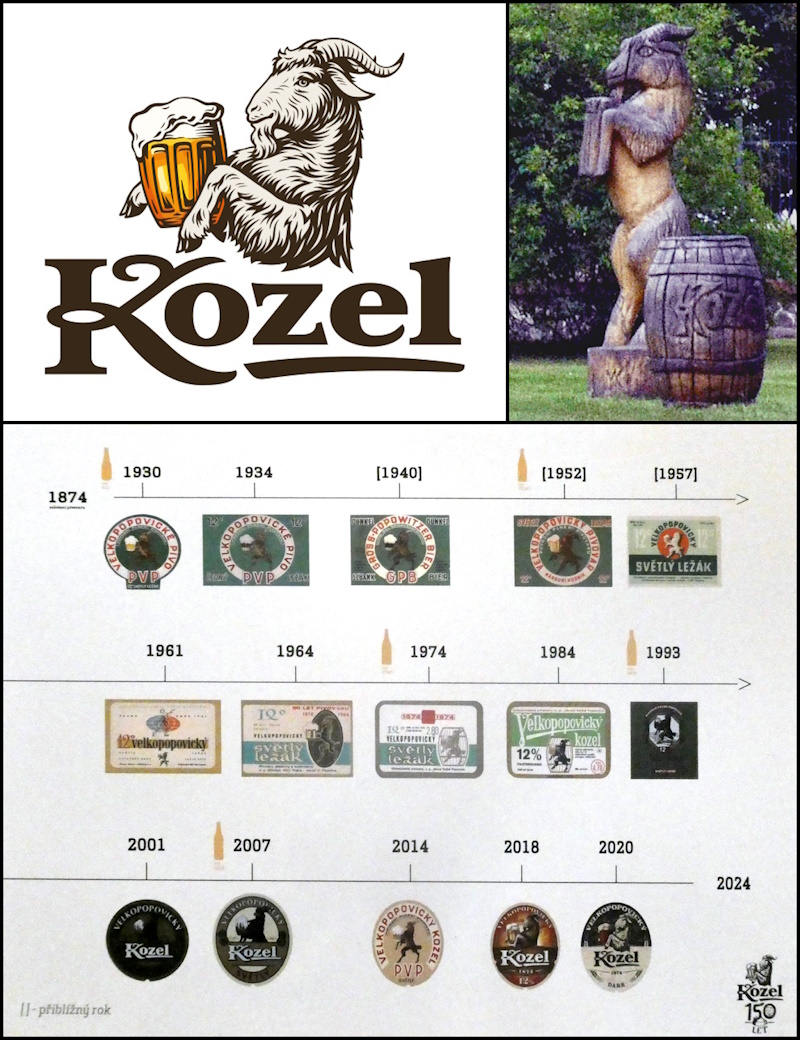
A few weeks ago, while many of us were playing games, two members of the group were visiting the village of Velké Popovice in Czechia.  Part of the reason for their visit was to go on the Kozel Brewery tour.  The first references to the Popovice Brewery come from the mid-sixteenth century, but the first batch of the dark Velkopopovický Kozel beer was brewed on 15th December 1847.  Internationally, Kozel is probably the best known Czech beer, although the brand has been owned by Asahi since 2016.

Velkopopovický Kozel Brewery
– Image by boardGOATS

The interest here, is in the name—Kozel means “goat” in Czech and this is reflected in the brand logo.  The origin apparently comes from the fact that a dark beer used to be called “bock”, which also means “goat” in German.  Hence, the brewery’s strong, dark beer became known locally as kozel.  So, when in 1919, a lost French painter passed through the fillage, he gave the village a painted billy goat as a thank you for giving him food and shelter. Since then, the brewery have had a sucession of goat mascots, most of which have been called Olda, and the current incumbent can be visited by people touring the facility.

Velkopopovický Kozel Brewery
– Image by boardGOATS

Next Meeting, 16th September 2025

Our next meeting will be on Tuesday 16th September 2025.  As usual, we will start playing shorter games from 7.30pm as people arrive, until 8pm when we will start something a little longer.  The pub is now doing food again, so those that will be eating will be arriving from around 6.30pm.

This week, the “Feature Game” will be First Empires (rules, review and instructional video).  This is a dice-driven, area movement and control game that we played a few weeks ago and found we really enjoyed.

First Empires
– Image by boardGOATS

And speaking of empires…

Jeff was visiting the bar at the top of the Empire State Building. He was standing at the bar when a guy in a suit approached him and said, “Did you know that one of the reasons this building has such interesting design is that they made it so that when people jump out of the window, the wind stops them from falling too fast, and they just float to the ground, unhurt?”

Jeff was astonished, “No way,” he said, “Prove it!”

So, the man in the suit climbed onto the window sill and jumped out the window. A few minutes later the lift arrived and out he walked.

“See! It works!” the man in the suit said. Jeff was really impressed and before anyone could stop him, he jumped onto the window sill and lept out of the window and, after what seemed like an age to him as he accelerated rapidly, landed with a jolt in an anti-suicide net.

Back in the bar, the bartender sighed, “Superman, you really can be an idiot when you’ve been drinking!”

5th August 2025 (Report)

Following on from Little Lime’s visit last time, this week we had special visits from Mister Mint (aka Vermillion), Little Mint (aka Sable), and Little Ivory (aka Tangerine).  While everyone else got their collective acts together, Family Mint ordered their supper and got down to a quick couple of rounds of Panda Panda, a set collecting game with cute panda artwork.  In this game, players take it in turns to discard a card onto their personal discard pile or take a card from the draw pile from someone elses discard pile; when a player discards an “A” card, everyone passes a card to the left.  The winner is the first player to start their turn with a set.  Sable tried to win without discarding cards, but the victor of both rounds was Mint.

Panda Panda
– Image by boardGOATS

One of Family Mint’s current favourites is Wombat Rescue, where players are taking the role of mummy wombat trying to find their lost babies.  Enticed by the animals in the game, Pine joined Vermillion, Sable, Ivory and Tangerine, to play a game that seemed to be based almost entirely on the fact that the most fundamental Euro-game piece is the wooden cube and wombats are the only known animals who’s poo is cube-shaped (due to a slow digestive tract and intestines that contract in a specific way to shape their feces over time).  The theory is that because wombats have extremely poor vision but an excellent sense of smell, they use their poop cubes as “smell markers” and cube-shaped poop it is less likely to roll away or be moved.

Wombat Rescue
– Image by boardGOATS

The premise of the game is that a dingo has stormed the burrow and chased away four of each player’s baby wombats or joeys.  As mummy wombat, players have to eat and digest food in order to produce poop cubes, that they can use to build smell areas to navigate the board.  With a network of poop cubes, they can then find their baby wombats, and bring them home.  Thus, the player who best plans their smell areas and moves most efficiently will be the first to find all their joeys, and win the game.  Unfortunately, with five, the game took rather longer than the suggested sixty minutes, but they had a great time, so that didn’t really matter.

Wombat Rescue
– Image by boardGOATS

There was much amusement as cries of, “Stop sniffing my poo!”, “Are you going to use your smell corridor now?” and “There’s poo EVERYWHERE!” carried to the neighbouring tables along with odd words and phrases like “smell radius”, and the slightly odd request, “Can I sniff your baby please?”.  The eventual winner was Vermillion and there was quite a bit of chat as players packed up.  Although it had out-stayed its welcome a little, it wasn’t in the same league as that other Austrlian game, Echidna Shuffle, which on one notable occasion took hours because nobdy wanted to be the person who gifted someone the game, even though, everyone desperately wanted it to end!

Wombat Rescue
– Image by boardGOATS

The main beneficiaries of the poop-laden comments were Mint, Blue and Lime on the next table.  They were playing the “Feature Game“, which was Cubed.  This is a very simple, sort of 3D, hexagonal/trioominoes domino game.  Players started with a hand of twenty of the delightfully tactile hexagonal pieces and then take it in turns to play a piece, adding it to the central grouping.  Pieces must join two edges, matching colour and slope direction:  each piece has a dip in the middle and the vertices alternate high and low.  Although this is simple, it is more difficult than it looks at first glance.  Additionally, some of the pieces have black edges, which are blocking pieces and nothing can be added to these sides.

Cubed
– Image by boardGOATS

If a player can’t place a piece, instead they draw a random tile from the face-down pool.  The winner is the first player to get rid of all their pieces and they score zero.  Everyone else scores for the pieces they have left, with one point for those with three different colours, two for any with two colours, three for monochrome pieces and five for any blocking pieces.  Blue started, which turned out not to be the advantage initially thought as later players have more options.  That wasn’t the reason Blue did horrifically badly though, that was partly due to inneptitude and partly due to luck of the tile draw.  It was quickly clear that she was trying to limit losses and the battle was between Lime and Mint.

Cubed
– Image by boardGOATS

Lime finished first, but Mint only had one piece left and if everyone got the same number of turns she could have placed it thus ending in a tie.  The rules weren’t entirely clear on the point although arguably, the advantage of potentially getting an extra turn offsets the advantage of more play space (especially early in the game).  Either way, the group decided to call it a tie and settle the matter over another game, this time adding the variant rules.  These introduce the concept of “gaps”, single space “holes” in the array.  Players who “bridge the gap” and create one get to place an extra piece, and players who “fill the gap” get to “gift” one tile to another player.  Inevitably, however, this meant everyone saw making gaps as a challenge.

Cubed
– Image by boardGOATS

Mint did, eventually manage to make a gap, but it really wasn’t easy and probably partially led to her conceding victory to Blue, who made a much better fist of the second try.  That left how to score—consider it to be two separate games, or combine the scores as a campaign?  Well, Lime won the first “game”, Blue won the second, but Mint had the lowest overall score (with or without the extra turn), so it was decided that it was a three way tie and everyone was a winner!  That wasn’t the nly tie of the evening though.  There were two more tables of games, the first playing Vivarium.

Vivarium
– Image by boardGOATS

This is a card collection game with fantastic art, based round a market similar to that in Meadow.  In Vivarum, however, players use dominoes to create the coordinates that dictate the card they take.  After seven rounds, the player that has successfully completed their objectives and collected the greatest creatures wins the game.  Jade led the game with Cobalt and Sapphire joining him.  Players start with two dominoes and, on their turn swap one with central pile and then either use the new pair to take a card or take two gems—these are worth a point each at the end of the game, but can also be used to alter the values of dominoes during the game.

Vivarium
– Image by boardGOATS

Once everyone has taken two turns, the market is restocked and a new (two turn) round starts.  There are three different types of cards: Creatures, Equipment and Contracts.  Each Creature is one of four types, one of four colours and is worth points; Equipment are in four different types, earns Gems and give a special power; Conracts provide objectives that reward for different types of Equipment or Creatures.  At the end of the game, players score for Creatures, unused Gems, Priority Tokens (earnt for taking certain cards each round) and Contracts.  This time, it was close, though not actually a tie (that came later).

Vivarium
– Image by boardGOATS

Creature scores and Gems were all smilar, but the most significant differnce was in Priority Tokens.  Cobalt took ten more points from these than anyone else, which more than offset his slight deficit in other departments and gaving him seventy-seven points with Jade taking second place a few points behind.  After a short break, the group moved on to place Diced Veggies, a really clever little resource management game.  Players take it in turns with the Cleaver, using it to slice up the central array of dice.  Each die represents an ingredient and these are then assigned to  the recipes players are working on.

Diced Veggies
– Image by boardGOATS

Players can’t just grab loads of veg though—they can only take a limited number of pips with each chop, and the right dice values can unlock bonus cards to boost a recipe’s score.  Once a player has carefully sliced their veg from the main block (with a total value of ten or fewer) the can assign dice to Cook one of their recipes before drawing one more card (either a Hype/bonus card or a recipe).  Players can carry eight veggies, two Hype cards and two Recipe cards on to their next turn, but when one player has completed six recipes, everyone gets one more turn before the scores are added up.  And this was the game that ended in a tie—despite lots of variation in recipes and bonuses, Jade and Cobalt both finished with fifty points, with Sapphire just behind.

Diced Veggies
– Image by boardGOATS

The final table, led by Plum, were playing First Empires, a game where each player takes control of an ancient nation and determines its fate.  On their turn, players roll dice according to how they’ve developed their empire board. The six sides of the dice correspond to the five abilities on their board. To expand to new territories or invade opponents, players unlock movement ability; to annex a territory, they have to outnumber the current occupant or have a “sword” result on the dice and chase the inhabitants elsewhere. Dice also allow players to develop their player board, using the die face that corresponds to improvement and controlling an associated territory.

First Empires
– Image by boardGOATS

As the game progresses, players can also gain more dice and additional re-rolls, while also unlocking achievement cards.  The game ends after a set number of rounds (dependent on player number) when players earn points based on played achievement cards, points unlocked on their personal board, and for cities under their control.  After Plum had explained the rules, everyone began.  With only four players, the far East wasn’t available, so Plum started in Morocco (K), Ruby in the the Far East (H), Flint began in Europe (E) and Pink in South Africa (M).  Flint quickly achieved one of his early goal cards and occupied two islands

First Empires
– Image by boardGOATS

Pink pressed north early on, which meant it was more difficult for Plum to invade new lands. Pink, Ruby and Plum all drew the “occupy another player’s home region” card in the first half of the game, so there was a lot of shifting about as people targeted each other’s regions picking up Cities in the process.  There was a little bit of a rules interpretation error as most people restricted themselves to only re-rolling one die rather than picking a number of dice, but that was soon rectified.  Flint got to the top of the dice track, but it was towards the end of the game so he wasn’t able to capitalise on it by rolling five dice.

First Empires
– Image by boardGOATS

Flint picked up lots of points for his dice track, but failed to score on his re-roll track, whereas everyone else was the other way round.  In fact, Plum and Pink both got their highest score from the re-roll track. Ruby top scored on explorers, but the winner was Pink who also did well on his explorers track, but picked up a lot of points for his cards and cities too.  He finished with sixty-five points, nine points clear of Ruby with Plum completing the podium.

First Empires
– Image by boardGOATS

Learning outcome:  The shape of your poo is important.

Deutscher Spiele Preis – 2025

The Deutscher Spiele Preis is awarded anually based on an open vote from German games clubs, gamers in German-speaking countries and people in the gaming industry.  It recognises the “Best Children’s Game” and a top ten list of the “Best Family and Adult Games”.  Although the order of the top three in each category won’t be announced until the Internationale Spieltage in Essen at the end of October, the list of winning games has been released.

Endeavor: Deep Sea
– Image by BGG contributor tobsn,
adapted by boardGOATS

The top three in the general category in alphabetical order are:

The remaining list of games in the top ten are:

  1. Castle Combo
  2. Faraway
  3. Civolution
  4. Blood on the Clocktower
  5. Slay the Spire: Das Brettspiel (aka Slay the Spire: The Board Game)
  6. Astrobienen (aka Apiary)
  7. Dune: Imperium — Uprising

The games named in the Deutscher Spiele Preis lists often intersect with the winners and nominees of the annual Spiel des Jahres Award. This time is no exception, indeed the only game in the top five Deutscher Spiele Preis list not to have recieved a Spiel des Jahres award or a nomination likely missed out because it was considered too complex.  And therein lies much of the difference between the two:  the Spiel des Jahres nominees/winners are chosen by a committee with a list of strict criteria, whereas the Deutscher Spiele Preis is more like a list of the most popular games of the preceding year, with the gaming public having a strong say.  As a result, the Deutscher Spiele Preis often includes heavier games.

Bomb Busters
– Image by BGG contributor spiritraw,
adapted by boardGOATS

The top three children’s games (again in alphabetical order) are, Cascadia Junior, Die kleinen Alchemisten (aka Little Alchemists), and Die Sandburgen von Burgund (aka The Sandcastles of Burgundy).  The order of the top three in both categories will be announced at the press conference on Wednesday 22nd October; congratulations to everyone on the list.

Deutscher Spielepries 2025 Logo
– Image from
spiel-essen.com


Next Meeting, 2nd September 2025

Our next meeting will be on Tuesday 2nd September 2025.  As usual, we will start playing shorter games from 7.30pm as people arrive, until 8pm when we will start something a little longer.  Following a recent change of hands, the pub is now doing food again, so those that will be eating will be arriving from around 6.30pm.

This week, the “Feature Game” will be Parachute Panda (one review and another review).  This is a light, fun little filler game with a bit of take that, cute artwork and, of course, lots of pandas…

Parachute Panda
– Image by BGG Contributor W. Eric Martin, adapted by boardGOATS

And speaking of pandas…

Jeff walked into a bar with his pet panda. It was about 5pm, but they were ready for a good night of drinking. They started slowly, watching the Magpies play on the TV, drinking beer and eating peanuts. As the night went on, they moved to mixed drinks, and then shots, necking one after another. Finally, the barman called, “Last orders,” so, Jeff went to the bar one last time.

“One more for me… and one more for my panda,” he asked. The barman set them up and Jeff and the Panda knocked them back. Suddenly, after one drink too many, the panda collapsed in a heap on the floor. Jeff left some cash on the bar, put his coat on and headed for the door.

The barman called after him, “Hey you can’t just leave that lyin’ there…”

To which Jeff replied, “Don’t be daft—that’s not a lion, it’s a panda…!”