12th July 2022

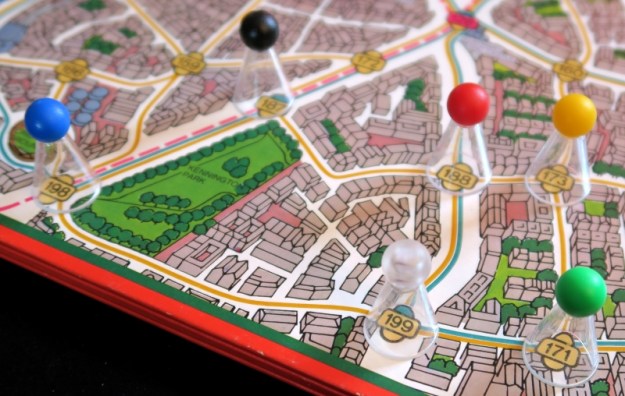
Blue, Pink, Orange, Lemon and Plum all started with food, and Pink’s was accompanied with cocktails (again).  There was a lot of chatter about playing something, but when Pine arrived, that ruled out …aber bitte mit Sahne (which we played last time).  While the discussion about what to play and how to split the group was on-going Purple and Black arrived, so the discussion moved on to who would play what and who else was expected.  In the end, Pink and Plum took themselves off to the other side of the pub to start setting up Altiplano while everyone else admired the 1980s box for the “Feature Game“, the bike racing game, 6-Tage Rennen (aka 6 Day Race).

6-Tage Rennen
– Image by boardGOATS

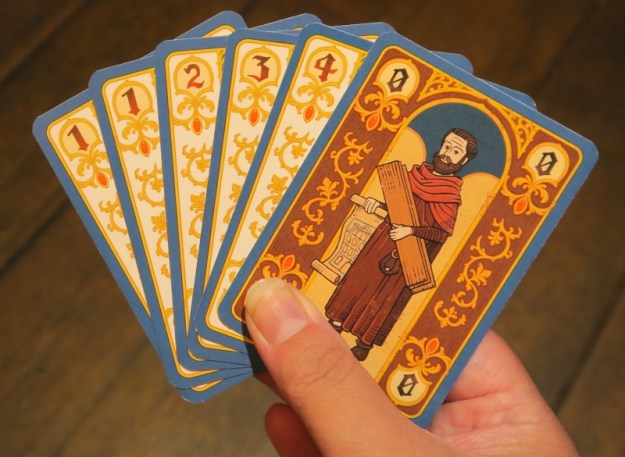
When Lime, Ivory and then Teal rolled up a few minutes later, Ivory joined the Altiplano game, but Teal, after a tough day, eschewed its complexity and decided to go for a gentle cycle ride with the other group instead.  In contrast to Flamme Rouge which we all played last time and emulates road racing, 6-Tage Rennen is set in a velodrome and mimics a six day race meeting.  It is quite simple, much simpler than Flamme Rouge actually, but in spite of this the group still managed a “rules malfunction”.  Similar to Flamme Rouge, the game is card driven, but rather than choosing simultaneously and then playing in race order, in 6-Tage Rennen players choose their card and play in turn order.

6-Tage Rennen
– Image by boardGOATS

There are a couple of other key differences.  Firstly, slip-streaming works differently:  if a player lands on an occupied space, they move again. If that space is occupied by two riders, the active rider moves twice more and if it is occupied by three or more riders, then they can really make a killing.  Also, 6-Tage Rennen is a points race, which means it is the player with the most points at the end who wins, not necessarily the first player to cross the line.  Points are available for the first riders to finish with ten points for first place, but also at the intermediate sprints of which there are two, earning five points for the first riders to cross each line and in both cases there are points for the minor placings.

6-Tage Rennen
– Image by boardGOATS

Teal went first and moved a single space, followed by Blue who used Teal to bounce on an extra space.  Pine, Purple, Black and Orange, further demonstrated how to use the slip-stream mechanism, but it was Lemon, who like last time in Flamme Rouge, took an early lead, though this time without the penalty of Exhaustion cards.  Not only did Lemon take an early lead, but she held it to the first sprint line taking the maximum five points, leaving Teal, Blue and Pine to take the three, two and one respectively.  It was then that the rules malfunction really took effect.

6-Tage Rennen
– Image by boardGOATS

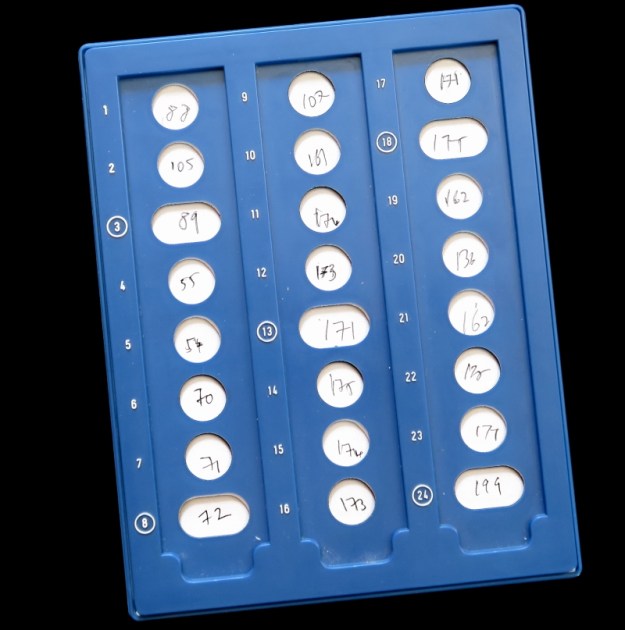
The game is over thirty-five years old and imported from Germany, so the rules were originally in German, but this copy had two English translations. Unfortunately, these were both a bit unclear and, as a result, both Blue and Pine misunderstood how many green cards players started with.  This meant everyone ran out of cards very quickly and Blue, on the fly decided players would refresh their hand from the grey cards.  As Pine pointed out, this was likely to leave a shortage, so the number of cards was reduced slightly.  This meant some players ran out more than once and replaced their cards several times as a result which changed the game massively.

6-Tage Rennen
– Image by boardGOATS

Still, as everyone was playing with the same rules and nobody wanted to just start again, the group played on.  Lemon led the pack over the second sprint line too, and then over the finish line to a landslide victory with the maximum twenty points, twice her nearest rival, Teal.  The game hadn’t taken very long, and Black had long said he thought 6-Tage Rennen was better than Flamme Rouge and he along with some others were keen to play again with correct rules.  So, Pine dealt out the correct number of green cards and Lemon, as the winner of the first race went first in the second.

6-Tage Rennen
– Image by boardGOATS

The first thing noticed was the lack of a six in the starting hand.  As Black pointed out, this was key to the strategy of the game—staying six spaces ahead of other riders helps stop players from “getting a bounce” and moving ahead, and that’s where the grey cards come in.  Half-way round the track, there is a “special space” and players who land on this space discard their cards and replace them with grey ones.  The starting green hand has a seven, two fives, several fours along with some lower value cards and should just last the duration of the race.  Landing on the special space gives cards taken from two piles drawn at random—six slow cards (value one to three) and four fast cards (value four to six).

6-Tage Rennen
– Image by boardGOATS

This time, Orange started fast taking the first sprint and continuing on to the special space where he traded in his cards for new grey ones.  Lemon wasn’t far behind though, followed by Lime and Teal.  Purple demonstrated how to play the game by getting a “double bounce” on her seven, moving twenty-one spaces from the back to near the front on a single turn.  That left Blue and Pine who, reminiscent of last time, were “gapped” and struggled to keep up with the pack.  Before long, Pine was dropped and resignedly, rolled slowly round the track; he would have stopped at the pub if he hadn’t been in a velodrome!

6-Tage Rennen
– Image by boardGOATS

As the game unfolded, Teal commented on how clever it was and added, “It’s almost like it’s been play-tested…”  Meanwhile, Black joined Blue and they worked together briefly until their teamwork broke down just before they were able to catch up with the lead riders.  Lemon stalled on the “miss a turn” special space, allowing Teal to sneak past and pip her to the line.  As everyone else made their final lunge for the finish tape, Lime and Purple positioned themselves for the minor places before Lemon accelerated past and crossed the line to take second.  It being a points race, it was the total, not the finishing positions that count.  It was much closer this time than in the first race, but the placings were still the same with Lemon just beating Teal, and Lime taking the bronze medal.

6-Tage Rennen
– Image by boardGOATS

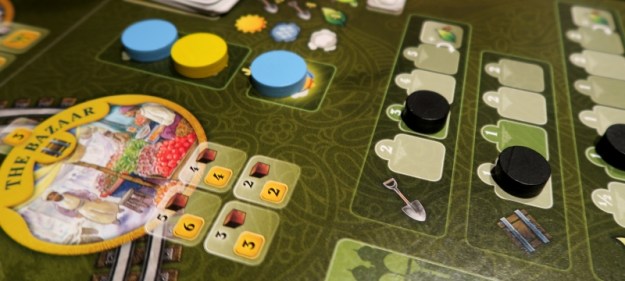
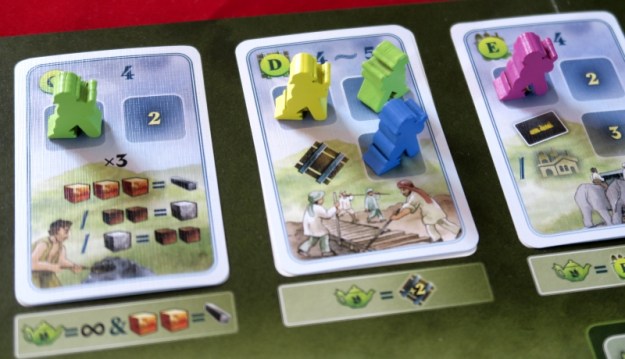
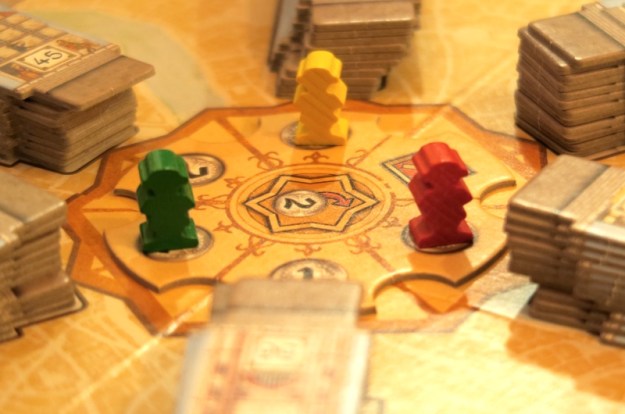
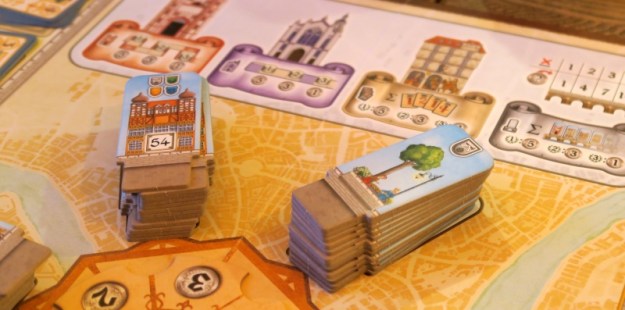
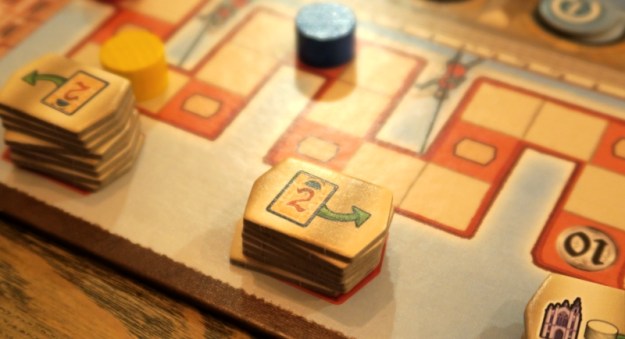
All this time, on the other side of the room, Pink, Plum and Ivory were playing Altiplano (with the Sunny Days mini-expansion).  Altiplano is a worker-placement bag building game that is a re-implementation of the bag-building mechanic used in Orléans.  The idea is that players draw resources out of their bag and place them on their personal action boards.  Then, players take it in turns to move their “worker” round the rondel to different locations where they can carry out corresponding actions assuming they have the right resources in the right place.  In essence, the game can be boiled down to one of resource improvement, for example, players can use an Alpaca to get Wool which they can later turn into Cloth.

Altiplano
– Image by boardGOATS

Points are scored for the resources at the end of the game, with more valuable resources worth more points.  Picking up Hut cards also increases the value of resources.  When a player no-longer needs a resource, they can move it into their warehouse with completed “shelf-fulls” scoring points at the end of the game.  Players have to be careful with this however, as once a resource is in the warehouse it cannot be used anymore.  Additionally, players can also score points by completing contracts.  It is the player that best interweaves these different aspects of the game that wins.

Altiplano
– Image by boardGOATS

All three players felt they were making a poor fist of things and agreed they were “playing sub-optimally”.  Ivory concentrated on collecting and completing contracts.  In contrast, Pink completely eschewed contracts and instead focused on getting Glass tokens—the most valuable of the resources.  To do this, he had to get cocoa first, which he did by taking the Cocoa Canoe and with it one Cocoa resource.  He then increased the value of his Glass by taking the matching Hut.

Altiplano
– Image by boardGOATS

As a bit of a chocoholic, Plum also wanted Cocoa but as Pink had nabbed the Cocoa Canoe, the only way she could get it was to buy an Extension board.  Unfortunately, the first one was too early for her and she couldn’t afford it.  The next Extension had the “Navigation” anchor icon on it associating it with the Harbour Location, but players are only allowed one Extension board at each Location and, as Plum started with the Fisherman, she was not able to get that one either.  The next Cocoa opportunity didn’t come up until much later in the game, by which time it was too late really.  She did take an Extension eventually, one for the Mountains, which enabled her to exchange Food to give Ore which she was then able to convert into Silver.

Altiplano
– Image by boardGOATS

Last time the group played Altiplano, we discovered a “rules malfunction” associated with the purchase and use of carts.  Unfortunately, although many other aspects of the rules were checked, this was overlooked, so instead of always being able to move one space for one food token, or more with a cart, the group played that they could only move if they owned a cart and then only move one space.  That meant movement was much more difficult and made life more challenging.  Once again, everyone was playing by the same rules, so it wasn’t hugely important though it may have shifted the balance of the game a little.

Altiplano
– Image by boardGOATS

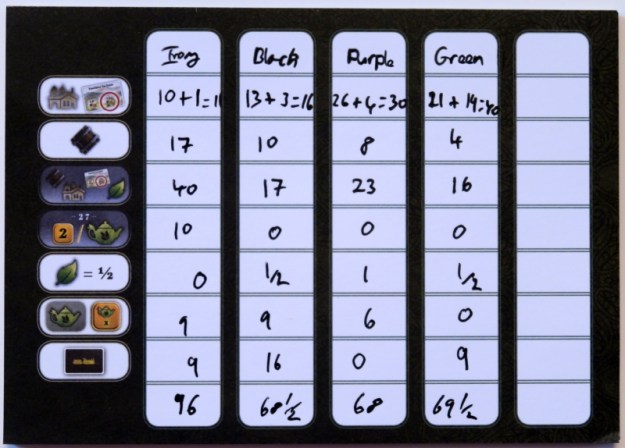
There was a nice atmosphere during the game though.  In a Star Wars reference, Pink advised Plum, “Not to go trading with The Huts” and politely waited until the ladies were no-longer present before indulging in comments about his Woodcutter “getting some wood”.  When he started getting wood, however, he couldn’t stop and finished with a particularly large pile.  Ivory started with the Farmer and used his Alpaca to produce wool and wove that into some very high quality scarves.  There was something remarkably “Fishy” about Plum’s strategy but especially when she carefully stashed too many of her fish in her warehouse and then ran out of resources.  She had far more money than anyone else, but ultimately though, there was nothing anyone could do about Pink, who’s Glass factory gave him clear victory.

Altiplano
– Image by boardGOATS

The cycle race finished long before the activities on the high plain.  Lime decided to head off to make sure he got home before the infamous Oxfordshire road closures cut him off, and Teal having enjoyed his evening on the bike also took an early night.  After some more chatter, the remaining six began “a quick game” of Bohnanza.  This is one of our all-time favourite games, and it was time to introduce it to Orange and Lemon.  Although it is not difficult, it is very different to the games we’ve played in the last few weeks, and is considerably more challenging if English is not your first language.

Bohnanza
– Image by boardGOATS

Bean farming might not seem an exciting theme, but the game is great fun and relies on the simple premise that players must not change the order of the cards in their hand.  On their turn, the active player must plant the first card, the card at the front of their hand, and may plant the second card if they choose.  Players have just two Bean Fields to work with, and each one can only hold one type of bean at any one time.  Once the active player has planted their bean or beans from their hand, they turn over the top two cards in the central deck—these must also be planted before the game can progress, though the active player can trade them with another player or even give them away.

Bohnanza
– Image by boardGOATS

Once the two cards on the table have been planted, the active player may trade cards from their hand before drawing replacement cards.  At any point a player may harvest beans, but the more cards they harvest, the more they are worth.  However, if a player has a field with only one bean in it, they must harvest their larger field first.  At the end of the game, the player with the most coins is the winner.  Normally, the game ends after the third turn through the deck, but this time, because time was running short, the group finished after the first pass.  This meant the group missed out on way the balance of the deck changes and the rare cards get rarer and the deck gets progressively shorter.

Bohnanza
– Image by boardGOATS

Purple started, and talked through her turn, followed by Blue.  Pine knew what he was going to do and got on with it as did Black, before it was Orange and then Lemon’s turn.  Purple started collecting Green and Soy Beans, with Pine planting Wax and Black-Eyed Beans.  Orange competed with Blue for Red and Coffee Beans and with Black for Chili Beans.  Lemon started with Blue Beans and later moved onto Green Beans.  There were lots of “generous trades” and gifts too—the group generally play together nicely, but tonight, the heat and the tiredness all round, meant everyone was especially kind to each other.

Bohnanza
– Image by boardGOATS

With time marching on, the group agreed to call a halt when the deck ran out the first time, even though that meant Pine missed out on two turns that he had set up beautifully.  It was a really close game, but it was Blue who just won the chocolates that Pink offered up for first prize.  As she was only one point clear, she shared her winnings with Lemon who generously passed her’s on to Purple.  It was hot and late, and as everyone left, the pub locked up behind them.

Chocolate Prizes
– Image by boardGOATS

Learning Outcome:  Games usually play better with the rules as written.

Deutscher Spiele Preis 2022 – Time to Vote

The best known award is probably the Spiel des Jahres: this year’s winners were announced yesterday.  The Deutscher Spiele Preis, or German Game Prize, is slightly less well known, but arguably better reflects the slightly more advanced, “Gamers Games”, with the results usually more in line with Kennerspiel des Jahres category rather than the family Spiel des Jahres award, or “Red Pöppel”.  Whereas the Spiel des Jahres awards are selected by a jury, the Deutscher Spiele Preis is selected by a general vote which is open to anyone, players, journalists and dealers alike.

Deutscher Spiele Pries 2022
– Image from
spiel-messe.com

Voters must include their name and address, so after removing any duplicates, all votes are treated the same with games placed first receiving five points, those placed second receiving four, and so on.  The top ten games from the previous year are included in the ranking, so this year that’s games released in German since the end of July 2021.  Thus anything new at Essen last year or the Spielwarenmesse (Nürnberg) this year, is eligible.  So that includes games like Ark Nova, Cascadia, Libertalia: Winds of Galecrest, Terraforming Mars: Ares Expedition, Red Rising and Creature Comforts.
Libertalia: Winds of Galecrest
– Image by boardGOATS

Voting is open until 31st July; it’s not necessary to submit a full list, so why not take the opportunity to vote for your favourite release of the year?

Spiel des Jahres Winners – 2022

The 2022 Spiel des Jahres (German Game of the Year) winner has just been been announced as Cascadia.   Cascadia is a token-drafting and tile laying game featuring the habitats and wildlife of the Pacific Northwest.  Players take turns expanding their terrain area and populating it with wildlife by taking a terrain and wildlife pair of tiles and adding them to their territory.  Players are trying to create large areas of matching terrain to create wildlife corridors, while also placing wildlife tokens to achieve the goal associated with that animal type (e.g. separating hawks from other hawks, surrounding foxes with different animals and keeping bears in pairs).
– Image by BGG contributor singlemeeple

In recent years, there has been a marked change in the sort of games winning the award with a noticeable shift to lighter games with a general drift away from “traditional board games” like past winners, El Grande, Tikal, The Settlers of Catan, Carcassonne, Ticket to Ride: Europe.  This was epitomised by last year’s winner MicroMacro: Crime City, which is arguably more of an activity than a game.  Although this may make games more relevant to a wider cross-section of the public, it also means the Spiel des Jahres awards are increasingly less applicable to more traditional gamers.  This year’s winner, Cascadia is something of a throwback in this regard, being a more conventional modern board game and not as light as some of the recent winners.

– Image by Ludonaute

That said, the introduction of the Kennerspiel des Jahres or “connoisseur” award eleven years ago, was aimed at filling the gap left by the drift of the Spiel des Jahres Award, with a move towards lighter games.  As such, it is usually a better fit for the experienced gamer, though not necessarily those who enjoy classic Euro board games.  This year, all three nominees were more traditional Euro-type games, guaranteeing that the winner would be too.  The Kennerspiel des Jahres winner is announced at the same time as the winner of the “Red Poppel”, and this year it was another nature game, Living Forest, a game where players are a nature spirit trying to save the forest and its sacred tree from the flames of Onibi.

Cascadia
– Image adapted by boardGOATS from the
live stream video on spiel-des-jahres.de

The Kinderspiel des Jahres award winner was announced last month and went to Zauberberg (aka Magic Mountain), a game where players move sorcerers’ apprentices down a mountain, and ride the influence of the will-o’-the-wisp.  As usual, congratulations to all the winners and nominees.

Next Meeting, 12th July 2022

Our next meeting will be Tuesday 12th July 2022.  As usual, we will start playing shorter games from 7.30pm as people arrive, until 8pm when we will start something a little longer (table is booked from 6.30pm for those who would like to eat first).

Following last week when we played Flamme Rouge to mark the start of the Tour de France, this week the “Feature Game” will be the older bike racing game, 6-Tage Rennen (aka 6 Day Race).  As for Flamme Rouge, players move their riders by playing cards and use slipstreams to gain an advantage, but it is more turn based than the newer game.  This should be quick to play giving everyone a chance to play something different.

6-Tage Rennen
– Image by boardGOATS

And speaking of bicycles…

Jeff was riding his bicycle up and down the street when he saw his mum in the front garden. He let go of the handlebars, waved his hands in the air and yelled to his mum “Look mom, no hands!”

His mum replied, “Be careful darling…”

Jeff was enjoying showing off however, so he lifted his feet off the pedals and shouted, “Look mum, no feet!”

His mum replied more sternly, “Be careful, darling…”

Then suddenly, there was a loud crash as Jeff and his bike hit the tarmac. His mother ran over and, as Jeff slowly got back up, he said, “Look mum, no teeth!”

28th June 2022

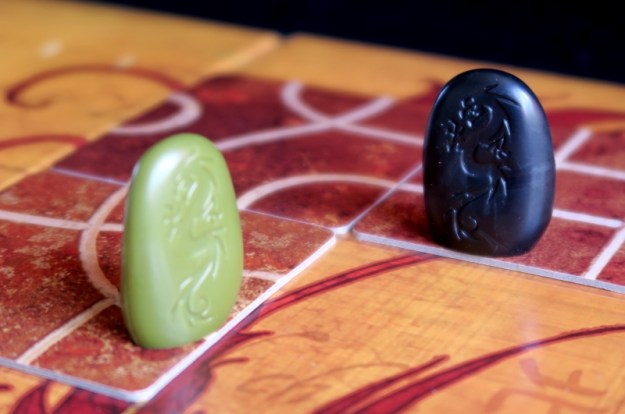
When Blue, Pink, Orange and Lemon rolled in (late thanks to the delights of the Oxford traffic and garden watering), Plum was already there.  A gamer with Gweeples in Didcot, Plum was a friend of Burgundy’s that members of the group first met at his funeral about six months ago.  While she finished her tagliatelle, Blue and Pink waited for their supper to arrive, and everyone admired Pink’s Pornstar Martini, the group revisited Tsuro, which Orange and Lemon had enjoyed so much on their first visit, last time.

Tsuro
– Image by boardGOATS

While setting up, Pine arrived and needed a quick reminder of the rules, but that only took a moment:  players have a hand of three tiles and, on their turn place one of them in front of their stone and extend it’s path, moving their stone (and any others) to the end of its path.  Players are eliminated when their stone goes off the board or collides with another stone—the last player on the board is the winner.  First blood went to Blue, who took out Lemon and Pine, but that was collateral damage as she had no choice and went off the board herself at the same time.

Tsuro
– Image by boardGOATS

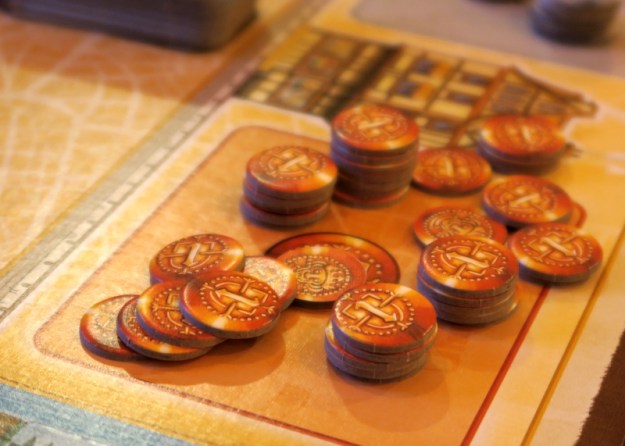
Pink was next, being trapped and left with no option, and then just Plum and Orange remained to duel it out.  There was very little space left on the board and the writing was already on the wall when Plum went off.  That left Orange a worthy winner, especially as he had a tile to spare too.  Teal arrived and while Blue and Pink fed, he led everyone else in a game of No Thanks!.  This is a game we’ve played a lot in the group and is a very clever design but like all the cleverest games, has very simple rules.  Played with a numbered deck of thirty-two cards, the idea is that on their turn, the active player can take the card in the middle or pay a chip to pass the problem on to the next person.

No Thanks!
– Image by boardGOATS

The next person has the same decision:  they can take the card and the chip, or pay a chip, and so on.  At the end of the game, a player’s total score is the sum of the face value of the cards they took and the player with the lowest number wins.  There are two key points that make the game, however.  Firstly, if a player has consecutively numbered cards, only the lowest card in the run contributes to their total, which means cards have different values to different players.  Secondly, nine cards are removed from the deck, which adds jeopardy on top.  The game can play out in several different ways.

No Thanks!
– Image by boardGOATS

The player or players with the most chips are always in control, until one player is left with so few chips or runs out completely, that they are forced to take cards even when they don’t want them.  This can prevent players, even those with lots of chips, from getting the cards they need to close runs causing the strategy to back-fire, and leaving those with the most chips with the most points as well.  This time, Orange and Teal amassed a huge pile of chips each, but both managed to avoid ending up with multiple high scoring runs.  Then someone dropped a chip on the floor giving Pine the opportunity to recount the tale of how he dropped a chip between the floor boards and how it is still there despite everyone’s best efforts.

No Thanks!
– Image by boardGOATS

This time, the dropped chip was recovered successfully and the game ended without further mishap.  Orange and Teal took first and second respectively, giving Orange two in two games to match Lemon’s achievement at the start of last time.  By this time, the feeders had finished feeding and everyone else had arrived, so it was time for the “Feature Game“.  To mark the start of the Tour de France later in the week, this was to be the Peloton expansion for the cycling game, Flamme Rouge.  Flamme Rouge is a fast-paced, tactical bike-racing game where each player controls a team of two riders: a Rouleur and a Sprinteur.  The aim is to manage the first rider to cross the finish line.

Flamme Rouge
– Image by boardGOATS

Each rider has a deck of cards, and Players move their riders one at a time, by drawing four cards from the rider’s deck, choosing one to play, and recycling the rest.  Once every player has picked cards for both their riders, players simultaneously reveal their cards and, starting with the cyclist at the front, each rider is moved in turn.  After all the riders have moved, slip-streaming takes effect, with groups that have exactly one space between them and the group in front moving forward to remove the gap.  Finally, every rider that still has an empty space in front of them is deemed to be riding into the wind and takes an exhaustion card which goes into their deck—these are bad because they are slow cards and block up plays’ hands.

Flamme Rouge
– Image by boardGOATS

At the start of the race, everyone’s Rouleurs have the same cards, and everyone’s Sprinteurs have the same cards.  The Rouleurs have lots of cards with a similar face value, where the Sprinteurs have some cards that are faster and have a higher value, which are offset by others that are slower and have a lower value.  Players have to balance how they manage their riders and make the most of the slip-streaming opportunities.  The game is modular with the option to add hills to the base game.  The Peloton expansion adds extra riders (so that the game plays up to six players), cobbled sections (aka “Pavé”), Feed Zones, and rules to set up a break-away.

Flamme Rouge
– Image by boardGOATS

Unusually with so many people, rather than splitting in to three groups playing three different games, we split into just two with both playing the same game.  Since the Grand Départ was due to take place in the essentially flat Denmark this year, both groups largely played without hills, but included cobbled sections (à la Stage 5, from Lille to Arenberg, a week later).  Cobbled sections change width frequently and are generally narrower than normal road, but perhaps more importantly, riders can no-longer benefit from slipstreaming but still get exhaustion cards.  The slightly larger group, led by Ivory and Teal also decided to start with a break-away.

Flamme Rouge
– Image by boardGOATS

Their chosen route was Stage 11 of the stage race and took in three sections of Pavé.  The first of these was shortly after the start, the second after the first hairpin and a short slight up-hill ramp, and the third was after a second hairpin and a little chicane.  Teal and Lime made it into the breakaway and they stayed away for most of the game.  Being at the front “pushing air out of the way” all the time is tiring though, and inevitably, they picked up a lot of exhaustion cards.  That meant that as the Peloton was bearing down on them, just as the finish line was in sight, they didn’t have the energy fend them off.

Flamme Rouge
– Image by boardGOATS

As a result, Black and Pink, who had been sheltering in the middle of the group slid across the line just ahead of the gallant breakaway, who were definitely candidates for the day’s combativity award.  Black took first place, having spent most of the race doing as little as possible and saving it all for the final sprint.  While saving energy is a good tactic, Purple took it to a different level picking up no exhaustion cards at all, though she wasn’t able to turn on the burners in time to take advantage of it.

Flamme Rouge
– Image by boardGOATS

The smaller group, led by Blue and Plum rode a simpler route based on the Avenue Corso Paseo ride, with a cobbled section in the middle between the two hairpin bends.  With most people in this group new to the game, they decided to keep things simple and eschewed the complexities of hills completely, sticking to a pan-flat course, and kept to the standard roll-out used in the base game.  First Orange and then Lemon rode off the front while Pine and especially Blue were repeatedly under threat of being spat out of the back of the peloton.  Most rounds seemed to end with Blue breathing a sigh of relief as she managed to hang on and Lemon laughing as she picked up yet another exhaustion card.

Flamme Rouge
– Image by boardGOATS

Once the riders had passed the Pavé the speed picked up and Blue and Pine started to try to move forward in the field.  Lemon who had led most of the way “bonked” and “hit the wall”, and as a result, was unceremoniously dropped.  It was tight, but Pine’s Rouleur was first over the line just holding off Plum’s first rider who took second followed by Pine’s Sprinteur who took third.  It had been a close and quite attritional race, but despite the fact there were fewer riders with a shorter parkour, the race finished at much the same time as the other one.  So races were compared and there was a bit of chatter about other options as people packed away.

Flamme Rouge
– Image by boardGOATS

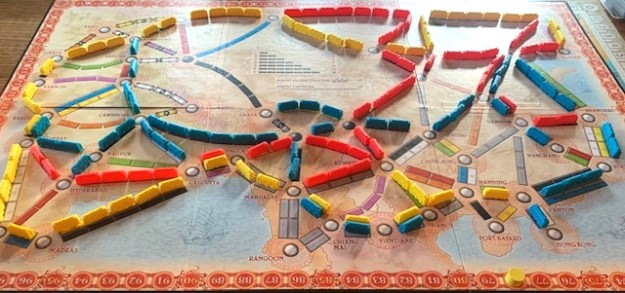
Ivory took himself off for an early night, as did Teal, but those that were left were keen to play on, albeit not for long in some cases.  Inevitably there was a lot of discussion about what to play, but when Ticket to Ride got a mention, Pine and Lime were keen to give the London version a run out, and were quickly joined by Pink and Purple.  Ticket to Ride is one of our favourite games and we play a lot of different versions, short and long.  They all have the same basic structure, but different layouts on different maps, and often with a little rules change.  In summary, in the original game, players are connecting cities across the USA.

Ticket to Ride (USA)
– Image by boardGOATS

They do this by collecting coloured cards and then spending those cards to place trains.  Players score points for placing trains and also for completing “Tickets” by connecting two cities together by any chosen route—the further apart the cities, the more points they are worth.  The game end is triggered when one player has only two train pieces left and at the end of the game, the player with the most points is the winner.  The original game takes around an hour to play with the full compliment, but more recently, there have been a number of smaller, lighter versions available.  They have the same rules, but players have fewer pieces and the maps are more congested, based on cities like New York, Amsterdam and later this year, San Francisco.

Ticket to Ride: London
– Image by boardGOATS

This time, however, the version chosen was London.  In this edition, players are placing buses to mark routes, and in addition to scoring points for claiming routes and Tickets, players also score points for connecting all the places in the same district. Pine won the “name the people on the front of the box” competition and went first.  Lime crossed the city travelling from Baker Street to The Tower of London while both Purple and Pink did the same but from Buckingham Palace to Brick Lane, and via different routes. Pine had a northern route and a south route that looked like they would join up in the middle, but didn’t quite make it.  He did manage to claim a district though, the only player to do so for a district of any significant size.

Ticket to Ride: London
– Image by boardGOATS

It was very close between first and second, though there was a bit more distance to Pink in third.  In the end, Lime just pipped Pine to victory by two points.  Meanwhile, there had been some debate between the other five as to what they would play.  Blue suggested introducing Orange and Lemon to one of our old stalwarts, 6 Nimmt!, but it wasn’t one of Plum’s favourite games.  So instead, Blue and Black introduced everyone else to …Aber Bitte mit Sahne, a clever but simple little “I divide, you choose” game.  The idea is that one player is The Baker who divides the cake into pieces and then everyone else takes it in turns to take a one of them.

…Aber Bitte Mit Sahne
– Image by boardGOATS

Each slice of cake has a type, a number on it and a some cream.  When a player takes cake, they can choose to eat it or store it.  For all eaten cake, players a point for each blob of cream.  For stored cake, however, the player with the most of each type will score the number of points associated with that type.  The clever part is that the number of points is equivalent to the number of slices of that type in the game, so the more common types which are harder to get a majority in are worth more, but they also have the most cream, tempting players to eat them straight away.

…Aber Bitte Mit Sahne
– Image by boardGOATS

It is always difficult for the first couple of players to take the role of Baker, but this is exacerbated with five players.  Blue went first, then Black.  It was only a couple of rounds in, that the twinkle appeared in Plum’s eye as she realised how clever the game was and expressed her approval.  It was quite tight in the early stages with players staking their claims to different sorts of cake.  There was competition for kiwi and redcurrent, but others went largely un-stored (and therefore eaten).  After everyone had been the Baker it was time to see who had the most of each and add up the scores.  Black got lucky with the chocolate as everyone else was greedy and ate theirs.

…Aber Bitte Mit Sahne
– Image by boardGOATS

Unfortunately, there was a rules misunderstanding and Orange thought he would get points for every slice he kept if he had the most of that type, so we’ll have to play it again soon so he can try again.  This time though, Black who had been very abstemious and eaten none of his cake, ran out the clear winner with thirty-five points to Blue’s twenty-nine and Plum’s twenty-seven for second and third place respectively.  Ticket to Ride: London was still underway on the next table, so as Orange and Lemon had not played it before, Blue got out Dobble.  We’ve not played this in the group for years, but it is a fantastic little Snap-based filler.

Dobble
– Image by boardGOATS

The idea is that every card has several pictures and each card shares exactly one match with every other card in the deck and using this principle, there are five possible Snap-based games.  Black decided discretion was the better part of valor and opted to spectate while Plum had a significant drive so headed off, leaving just Blue, Orange and Lemon.  They started with a pile of cards each and the winner the first to shed their pile onto the central one.  The game was all very well, but there was a vocabulary check as, although Blue said they could play in Ukrainian, Orange and Lemon were game to give English a go.  Once the items had been identified, the mania started.

Dobble
– Image by boardGOATS

As it was a trial game, the piles weren’t carefully measured, but Orange quickly got the hang of it and in spite of the language differences, managed to shed his pile first for yet another victory.  From there, the group did the reverse and started with one card and grabbed progressively matching cards from the middle.  This can be quite savage, which is why Blue opted for the gentler game first.  Still, everyone was well-behaved and nobody got scratched.  The tension and concentration was palpable though and Ticket to Ride finished and Lime and Pine left with only a a cursory grunt from those playing Dobble, before Blue just edged it to win the final game of the night.

Dobble
– Image by boardGOATS

Learning Outcome:  Tour de France coverage is available on ITV4.

Boardgames in the News: Kazuki Takahashi Creator of Yu-Gi-Oh! Plays his Last Card

Kazuki Takahashi, writer, illustrator and designer of Yu-Gi-Oh!, was found dead yesterday having died aged sixty while snorkeling off the coast of Japan a couple of days ago.  Yu-Gi-Oh! (which translates as “King of Games”) is a Japanese manga series that spawned an anime series, video games and a very popular collectable card game.  The plot centres around Yugi Mutou, a bullied boy who solves the ancient Millennium Puzzle and as a result awakens his gambling alter-ego.  Thereafter, whenever threatened the alter-ego challenges them to dangerous Shadow Games which reveals their true nature.

Yu-Gi-Oh!
– Image from dicebreaker.com

In Yu-Gi-Oh! Trading Card Game, players start with 8,000 Life Points and summon monsters (by playing cards), sacrificing weaker monsters in favour of stronger ones.  Players lose if they run out of Life Points or cards, or if their opponent plays a combination of cards which trigger automatic victory.  In 2011, Yu-Gi-Oh! took the Guinness World Record as the highest selling trading card game with over twenty-five billion cards sold.  This had increased to thirty-five billion as of January last year, with total sales worth nearly ten billion dollars.

Kazuki Takahashi
– Image from yugioh.fandom.com

Boardgames in the News: Playing Diamond Light Source

Diamond Light Source is a particle accelerator near Harwell, Didcot.  The synchrotron accelerates electrons to near light speeds so that they give off light ten billion times brighter than the sun.  It is used by over six thousand visiting scientists per year from both from academia and industry who study everything from fragments of ancient paintings to fossils, from jet engines to unknown virus structures.  As part of their ongoing education and out-reach program, Diamond staff, Mark Basham and Claire Murray engaged with board game designer and now former research scientist, Matthew Dunstan to produce Diamond: The Game.

Diamond: The Game
– Image from diamond.ac.uk

Matthew Dunstan is probably best known for Elysium (nominated for the Kennerspiel des Jahres in 2015), but also designed/co-designed Chocolate Factory, Pioneer Days, Monumental and Relic Runners.  As a graduate student at Cambridge, he was also interested in structural chemistry and was familiar with Diamond Light Source.  The value of gaming and play in general and as tools for learning and social development are well known, and there are many games with a science education element, including Periodic, Compounded, Inhabit the Earth, ION, and Evolution (the last of which was the subject of a publication in Nature).

Diamond: The Game
– Image from twitter.com

Diamond: The Game1 is a bit different to these, however, as it was specifically aimed at secondary school students (aged 11–18).  The game was intended to enable them to explore the broad variety of science carried out at Diamond, scientific careers and the experiences of being a scientist.  To increase student engagement and attainment, there was a specific emphasis on linking curriculum and classroom learning to scientific applications and the real-life careers available in science, technology, engineering and mathematics (STEM) careers.  The initial release was delayed thanks to the global pandemic, so a “print and play” version was released in 2020 with a lighter variant aimed at primary school children.  Schools that would like a hard copy can apply online.

– Video by Paul Grogan

1 Murray, C. et al., Res. for All, (2022), 6(1); doi:10.14324/RFA.06.1.14.

Boardgames in the News: The Increased Commercialisation of BoardGameGeek

While everyone else was still breathing a sigh of relief that the Millennium Bug had been vanquished, to very little fanfare, a small hobby-website went live.  In the first weeks of the new millennium then, Scott Alden and Derk Solko started BoardGameGeek (aka BGG).  It was to be a board game platform based on a 1990s computer gaming news website that Scott Alden had worked on called 3DGameGeek.com.  Using this underlying framework, BGG was built round a database that now contains of over fifty thousand games including reviews, photos, rules addenda, and lots of other information.

BoardGameGeek - August 2000
– Image from archive.org

The vast majority of these data were User contributed, though in the early days, there were no User accounts and Scott Alden took submissions by email and would copy and paste the information into the website hard-coding the User names.  More content meant more traffic though and very quickly, the infrastructure began to creak under the weight of the content that the enthusiastic supporters provided and the visitors it encouraged.  In the early days, the website looked very different to its modern rendition.  In 2003, the website began taking advertising revenue to help support the site financially, and the following year BGG formally started their Patron program so supporters could contribute financially too.

BoardGameGeek - March 2006
– Image from archive.org

As well as being very generous with their time, supporters were also generous with their cash, so much so, that by 2006 Scott Alden was able to work on BGG full time, an event that was accompanied by the first of several a major site redesigns.  Advertising and Patron support weren’t the only sources of revenue, however.  From the very early days, the site had supported a market place, sales from which generated a small income to the site.  Additionally, in November 2005, BGG held its first convention, BGG.CON.  And all the while, functionality was increasing to include, logging game plays, subscription services, forums, video hosting, collection curation utilities etc..

BGG.CON Logo
– Image from twitter.com

At this time, BGG felt like a community and many people made BGG feel like a second home—a group of friends getting together to talk about games.  Since then, BGG has gradually changed.  Perhaps the first occasion when The Powers That Be fell out with a considerable portion of the community was in 2009 when they tried to rebrand BGG as “Geekdo”.  The idea behind the name was quite a good one, with its origin in the Japanese, Dō or 道, meaning “way”, implying a body of knowledge and tradition, as in TaeKwonDo, Judo and other Asian martial arts.  Thus, Geekdo was often subtitled, “The Way of the Geek”.  The purpose was to bring BGG and the new RolePlayerGameGeek and VideoGameGeek together under the same banner.

RPGGeek Logo
– Image from rpggeek.com

Unfortunately, a fondness for the BGG brand coupled with the fact people did not understand the need for change or indeed how to pronounce it (Geek-doo, Geek-dow or Geek-doe?), did not endear the Geekdo concept to many of the site Users.  Underlying the objections was perhaps a more insidious concern though—the feeling that maybe this change meant the preparation of the site for sale.  This was reflected in the way the new brand name was commonly referred to online as “Geek dough”, implying that the change was all about money.  Commercialisation of BGG has always been a problem for a large proportion of the User-base, who have invested their time and money in the site; they see it as a community, their community, when in reality it belongs to Scott Alden and it is his to do what he wants with.

Geekdo.Logo
– Image from
boardgamegeek.com

Since the Geekdo fiasco (which has since been quietly dropped in public, though it still exists behind the scenes), there have been a number of other controversies.  The increase and changes to forum moderation have put the noses of a small, but significant and vocal minority of the User-base out of joint.  Additionally, changes to the layout of the website designed to make it more modern and User-friendly have alienated some of the high-level Users.  These people had no problem with the high density of the material, indeed many, being Geeks comfortable with programming and complex games, positively liked it.  People fear change, but to a large extent, whether these changes are for the better is a matter of perspective.

BGG Ernie
– Image from boardgamegeek.com

For example, abandoning the popular mascot, Ernie, in favour of an “orange blob” was controversial at the time though it arguably made BGG more inclusive and less “white” and “male”.  Changes to the main page and hiding the old customisable front page (now called the “dashboard”) may have made the site more User-friendly to new people, but did the opposite for some who were already very familiar with it.  There has been an undoubted increase in the commercialisation too.  The BGG store (distinct from the Marketplace mentioned above) was started ten years ago as an outlet for hard to acquire promotional games items.  The prices of these items have increased considerably over time though and more recently the Store has stocked high-end accessories too.  BGG has also moved further into the world of retail, opening the GeekGameShop, which sells games, competing directly in the US games market.

BGGStore LogoGeekGameShop Logo
– Image from boardgamegeek.com

More recently, there have been controversial changes to the old GeekMarket.  This was a very primitive way of selling games, but with the ability to subscribe to games through the database, it was cheap, flexible and very effective.  With changes to the market places required by the US Internal Revenue Service, there has recently been an upgrade to the GeekMarket.  At the moment this is only available in the US, but with a 6% sale commission fee (up from 3%) plus an additional 2.9% + $0.30 for payment processing via Stripe, it is considerably more expensive to the User than the old facility.  Additionally, at least in the early stages, the postage options have been more restricted, removing “cash on delivery” making low value and no-ship sales (e.g. at conventions) non-viable.

Gamegenic Logo
– Image from gamegenic.com

This and various other changes to the site seem less User-friendly and more driven by financial considerations.  In the last week, there has been a further development—BGG has signed a partnership agreement with Gamegenic, “to show the community suitable sleeve sizes and optimal gaming accessories for games played on the popular YouTube video series “GameNight!“, i.e. essentially product placement.  This is another way that BGG has changed over the years—initially all the content was User-created, but now BGG hires people to create the most visible reviews and other content.  GameNight! is a weekly video show published on the BGG YouTube Channel.

Asmodee Logo
– Image from asmodee.com

Like Days of Wonder, Fantasy Flight Games, and Catan Studios, Gamegenic is an Asmodee studio.  They were set up three years ago, prior to the spate of acquisitions in 2020 and 2021 and the subsequent purchase of Asmodee by Sweden’s Embracer Group AB.  The concern many people have is that this partnership between Gamegenic and BGG is a preliminary to Asmodee taking over BGG.  This fear is not totally baseless as Asmodee have form with this approach having acquired other companies after first signing a partnership agreement with them (Esdevium and Heidelberger among others).  Further, Asmodee showed their interest in board game media and online resources when they acquired the French-language boardgame site, Tric Trac and the online gaming platform Board Game Arena.

Embracer Group AB
– Image from embracer.com

While the long term is unclear, the short-term is more transparent.  The partnership agreement between BGG and Gamegenic will likely lead to the most visible content becoming increasingly laden with product placement.  There will be increased promotion of Gamegenic products to the exclusion of all others with potentially skewed opinions, rather than an unbiased presentation of the best products available. Whether this is a slippery slope or not only time will tell.  On 20th January 2020 though, BGG celebrated its twentieth anniversary, and over that that time it has grown to the point where it has around five million visitors to the site per month.  It would be a great shame if its independence has gone by the time it reaches its twenty-fifth anniversary in three years time.

BGG Corner Logo 2022
– Image from boardgamegeek.com

Next Meeting, 28th June 2022

Our next meeting will be Tuesday 28st June 2022.  As usual, we will start playing shorter games from 7.30pm as people arrive, until 8pm when we will start something a little longer (table is booked from 6.30pm for those who would like to eat first).

This week, to mark the start of the Tour de France on Friday, the “Feature Game” will be the Peloton expansion for Flamme Rouge (review, rules & explanation video).  Flamme Rouge is a fast-paced, tactical bicycle racing game where each player controls a team of two riders: a Rouleur and a Sprinteur with the aim being to cross the finish line first with one of their riders. Players move their riders by playing cards and use slipstreams to avoid exhaustion and position their riders to sprint for the win.

Flamme Rouge
– Image by BGG contributor aldoojeda

And speaking of bicycles…

Jeff was sitting in the pub beer garden with his mate Joe chatting about life.

“I’ve really had it with my dog,” said Jeff, “He’ll chase anyone on a bicycle.”

Joe answered, “Ahh, that’s annoying is that.” He took a long pull at his pint before he continued, “So what are you going to do—leave him at the dog’s home? Give him away? Sell him?”

“Oh no, nothing that drastic,” replied Jeff. “I think I’ll just confiscate his bike.”

14th June 2022

Pink and Blue were the first to arrive, bringing guests from eastern Europe, Orange and Lemon.  Orange and Lemon were new to our sort of board gaming.  After an explanation of what mushy peas are, food and some chit chat, others started arriving.  The “Feature Game” was the Moor Visitors expansion to Viticulture.  Teal had been keen to play the Tuscany board and the plan was to play both together. So when he and Ivory had arrived, they took themselves off to the other side of the room with Pink and started setting up.

Viticulture
– Image by boardGOATS

Viticulture is a worker placement game about planting vines, harvesting grapes and making wine.  The idea is that the game is broken into seasons and years, and players take it in turns to place their workers in the various locations on the board to carry out the associated actions  Although it is not in and of itself an especially innovative game, it is very polished and smooth, and a joy to play.  There are a couple of little elements within the game of note.  Firstly, each location can take a limited number of workers dependent on the number of players.  To grease the wheels a little though, each player also has a “Grande” worker that they can place anywhere, even in a “full” space.

Viticulture
– Image by boardGOATS

Players start the game with four cards from which they choose two, a mama and a papa and these dictate players’ starting conditions:  money, number of workers, buildings and cards.  There are four different types of card, Vines, Contracts, and summer and winter Visitors.  Players can only plant vines in the summer, and then only if they have sufficient land and any necessary buildings.  From there, grapes can be harvested in the autumn and placed in players’ crush pads and thence combined to form wine and stored and aged in their cellar.  Wine can then be used to fulfill contracts in exchange for points.  Although this is the main source of points, it is not the only one.

Tuscany
– Image by boardGOATS

Some of the Visitor cards give special actions that can be used to generate points, as can buildings like the Windmill and the Tasting Room and some of the Visitor cards.  At the end of each year, players get their workers back and age their grapes and wines as well as collecting residual payments (income).  The Moor Visitors expansion adds extra visitor cards which are just mixed into the deck providing more variety.   The Tuscany expansion mixes things up more, by changing the seasons in which the actions occur, particularly adding actions to spring and autumn.  It also provides a couple of extra mechanisms, including the “Influence” action, special buildings and specialist workers.

Tuscany
– Image by boardGOATS

This time, there was the initial random draw of the start tokens to “see who’s cock comes out first”, and then the game got under way.  Ivory and Teal both trained one of their workers to be “Special Workers”. These act as normal workers, but have a special ability when used in a particular way.   Each game, two of these are drawn at random from a deck, and when players train workers, they can make that worker a specialist for an additional fee.  The specialisms are open to all players, though each player can only have a maximum of one worker with each skill set.

Tuscany
– Image by boardGOATS

The Special Workers this time were the Soldato who bullies other players into paying to use the same action space, and the Sommelier which gives an additional opportunity to age grapes.  Ivory went for the military option while Teal selected one of his workers to learn about serving wine.  Elsewhere, Pink’s strategy was centered around the use of his Fruit Dealer card from the Moor Visitors expansion.  This gave him a point (or money) every time he harvested a specific field.  Teal built a Café which allowed him to turn grapes into money or points.  Everyone also began with what seems like the accepted strategy of selling off land to gain funds in the early part of the game, buying it back later as required.

Viticulture: Moor Visitors Expansion
– Image by boardGOATS

Ivory made an early move to stake his claim on the influence map, using the Influence action to place his Stars.  When placing Star tokens, players get a bonus reward for doing so.  In this way, it effectively provides an alternative way to access some “actions” when they are not available on the main board.  At the end of the game, the player with the most Stars in each region gets one or two bonus points.  After placing all six of their Star tokens, players can still use the Influence action by moving them to swing control of regions (but without gaining the instant reward).  As the game progressed, everyone else muscled in on the Influence action too, and by the end of the game, Pink had the edge.

Tuscany
– Image by boardGOATS

It was an extremely tight game.  With the Tuscany expansion, the end is triggered when someone passes twenty-five points. This time, everyone was very watchful, determined not to get caught out like last time when an early break by Teal unexpectedly ended the game leaving Ivory and Pink unable to play their big final plays.  As a result, everyone finished the game with exactly the same number of points—twenty-six.  That meant the advantage Pink had on the Influence map made the difference, leaving him three points ahead of Ivory and Teal who shared second place both finishing with twenty-eight points, in what had been an epic game between three experienced players.

Tuscany
– Image by boardGOATS

While Pink, Ivory and Teal took themselves off to set up Viticulture, everyone else introduced themselves to Orange and Lemon, and gaming was forgotten for the moment.  Eventually, this non-Viticulture group separated into two halves, one playing Imhotep while the other (including Orange and Lemon), beginning more slowly, with lighter introductory games.  Imhotep is a fun family game that won a nomination for the Spiel des Jahres award in 2016.  We’ve played it a few times since then, but like so many games, it had a two year hiatus thanks to the global pandemic.

Imhotep
– Image by boardGOATS

In Imhotep, players move large wooden “stone” blocks by boat to build five monuments.  The game is quite simple to play:  on their turn, the active player can acquire blocks from the quarry, load blocks onto a boat, sail a boat to a monument and add blocks to it, or play an action card.  Each monument scores points in different ways, and the player with the most points after six rounds is the winner.  The game was new to Lilac and Lime, but they quickly got the hang of it—it is quite easy to learn the functions, but deciding the best way to play is where the challenge comes in.

Imhotep
– Image by boardGOATS

Lilac started out making a play for the Obelisks and quickly took a commanding lead there with four stones by the end of the second round, with one each to Black and Lime.  Lime decided to go for Statues in the market place, which everyone else ignored and so he too managed to get an early lead in them with three by the end of the second round. Black wanted to get his group of five stones into the Burial Chamber, which Green (who had previously announced that he was thirty-fifth world-wide in the Board Game Arena rankings) had spotted and tried hard, but ultimately unsuccessfully to block.  Green managed to get a few larger regions himself in the process though.

Imhotep
– Image by boardGOATS

The Pyramids got steadily built, but unusually for Imhotep the Temple was ignored for most of the game. It wasn’t until the sixth round that any stones were placed there.  The scores for the Pyramid (and towards the end, the Temple as well), kept everyone close together—there was usually only three or four points from first to last place, with the order changing frequently as the game progressed.  Coming to the last couple of rounds, Lilac was challenged by Lime and Black in the Obelisk, but Lime and Lilac (both new to the game), missed the stones in one of the last boats, which Black watched closely.

Imhotep
– Image by boardGOATS

On Black’s turn he moved a two stone boat with only his and Green’s stone to take the lead and give Green a bump from last place to equal third with Lime.  Lilac may have lost out in the Obelisk, but she managed to gain a full five stone region in the Burial chamber, plus a couple of other odd stones. Black got his five but no more. Everyone got a final points bonus from a green card, although Black and Lime’s were for the Temple and only scored a single point. Lilac took a big score of seven for the Burial chamber card.

Imhotep
– Image by boardGOATS

Green also scored well for the Obelisk (five point) and for the Pyramids (six points), as earlier in the game Lime had shifted a three stone boat to the already filled Pyramid preventing the other players scoring more than a single point each.  In the final tally it was very close between Lime and Green, but Green pipped him by a single point, finishing with fifty points to Lime’s forty-nine.  The game finished at exactly the same time as the other group finished their second game.

Imhotep
– Image by boardGOATS

Purple and Blue had been introducing Orange and Lemon to some of the group’s favourite filler games.  They started out gently with Tsuro, aka “The game of the Path”.  This is super quick and simple, with players choosing to play one of the three cards in their hand on their turn, and placing it to extend the path their stone is on.  The winner is the last player still on the board, with players eliminated when their stone is unavoidably moved off the board or collides with someone else’s.

Tsuro
– Image by boardGOATS

There was a certain amount of people “feeling their way” at the start, but with only four players there’s a lot of space on the board at the start.  Players can exploit this and set themselves up with a nice little corner to work in, curating their tiles and avoiding getting themselves into difficulty.  That didn’t last long though, and came to an end when everyone wound up sat on the same tile.  Purple was the first to go, soon followed by Blue.  From there, there was a bit of a head to head, before Lemon “offed” Orange and claimed victory in her first game.

Tsuro
– Image by boardGOATS

Imhotep was still going and Viticulture had only just started, so Blue and Purple decided to introduce Orange and Lemon to the tile laying game, NMBR 9.  The idea is that players take a random tile and place it in their area—tiles must be joined to the others, and if placed on top of other tiles they must additionally be entirely supported and by two or more tiles.  At the end of the game, when two of each tile, numbered zero to nine have been played, the game ends.  Players score points for each tile multiplied by the “floor” it is on.  Thus ground floor tiles score nothing, but any tiles on the second level (the first floor) will score their face value, and so on for higher levels.

NMBR 9
– Image by boardGOATS

Although the rules are quite simple, in practice the game is one that can really make your brain hurt.  In this sense, it was a significant step up from Tsuro, though still quite a short light game.  This time, the tile order did not help players at all with high numbers coming early and at inconvenient times.  Players concentrated on building a sound foundation in the hope of better tiles to follow.  In the event, this worked better for some than others, and, as a result, it was very close between first and second.  Lemon, with seventy-two points ran out the winner once again, just two points ahead of Blue in second place.

NMBR 9
– Image by boardGOATS

With both groups finished at the same time, there was a lot of chatter, before eventually the groups joined to play something together.  Orange had played Saboteur before, and with such a large group, it seemed an obvious game to play.  There was a quick reminder of the rules for those who had not played it before or who were new to it.  A hidden traitor card game, it is one where there is a lot of banter with players accusing each other left, right and centre.  The group is split into two teams—Lovely Dwarves and Evil Saboteurs.  The aim of the game for the Dwarves is to find the gold, while the clue is in the name for the Nasty, Evil Saboteurs, who are trying to stop them.

Saboteur
– Image by boardGOATS

On their turn, players either play a card, or discard a card.  There are two types:  tunnels and actions.  Tunnels are played in the central area and must extend the existing tunnel network.  Action cards are special cards including map cards (which allow players to take a peak at a target card and report back on whether it is gold or not), rockfall cards (which allow players to remove a troublesome tunnel card), and tool cards.  This last category is where the fun comes.  Players can prevent others from digging tunnels by “breaking” their tools.  Mostly this is because they think someone is on the opposite team, but occasionally it is just “because”.

Saboteur
– Image by boardGOATS

This time, Lime started by picking on Pine for what turned out to be no very good reason.  Pine claimed the gold was in the middle (very early) and five others checked it and concurred.  Pine had a lovely “Saboteury” hand, but emphatically claimed he wasn’t.  And indeed, he wasn’t which meant Lime had to apologise to him at the end as he’d picked on him throughout.  Blue picked on Green—because “He’s always a Saboteur, Right?”—except he wasn’t either.  The guilty parties were Lemon, Lilac and Purple, but it was a fairly easy win for the Dwarves for whom Lime brought victory home.

Saboteur
– Image by boardGOATS

It had been a lot of fun, so everyone was keen to have another go.  After she had been on Team Evil the first time round, Pine perhaps unfairly targetted Lilac who was wholly innocent the second time.  The same could not be said of Purple who was a Saboteur twice in a row.  After picking on him the first time, Blue had to make peace with Green as they were on the same side in the second game (and not the “right” one either).  It is essential for Saboteurs to work well together, and although they did and it was close, it was not quite close enough and Lemon found the gold for the Dwarves.  There was time for one last round, and if the second round was close, the final round was even closer.

Saboteur
– Image by boardGOATS

While the Dwarves were worrying about who might be the three Saboteurs, Lime and Black managed to sow the seed of confusion when with Lime claimed that the gold was in the middle and Black agreeing.  Later it turned out that this was actually coal and although Lime showed his true colours early, it wasn’t until he was joined by Black that the Dwarves realised they’d been duped.  Concerned about the third Saboteur, Blue just managed to find the Gold before they ran out of cards.  Lime and Black had done really well as Saboteurs though, especially as it turned out there were only two of them.  It had been a lot of fun, but with Viticulture at an end, several people wanting an early night and it now having got quite late, everyone decided to leave it at that.

Saboteur
– Image by boardGOATS

Learning Outcome:  It’s never too early to start making enemies.