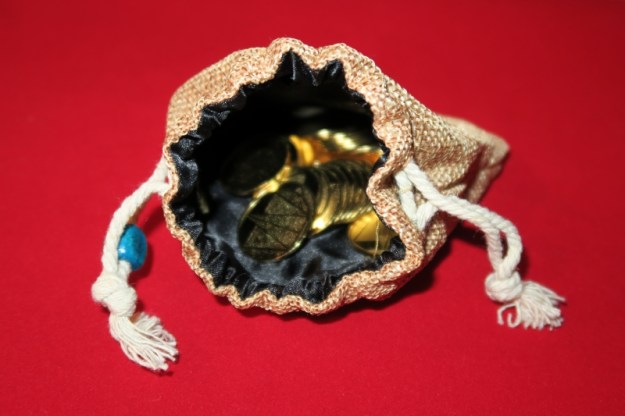
Pink, Blue, Orange and Lemon were the first to arrive, very soon followed by Plum and Jade. While they were waiting for food, the group decided to play a couple of quick games. First up was Moneybags, a game we played for the first time a few months ago. This is a very quick social deduction game with a similar premise to Ca$h ‘n Guns: players are a gang of thieves distributing their loot. In Moneybags, the “Godfather” first distributes the loot and players then take it in turns to either steal from another player, pass, or close their money bag and recuse themselves from the rest of the game.
 |
| – Image by boardGOATS |
If a player is robbed, the victim can challenge if they think the thief was too greedy. If the victim has less than the robber, they win their challenge and take all the money for themselves, otherwise the thief wins and they take all the loot. After two rounds, the players that have not been eliminated compare the height of their piles of cash, and the one with the tallest stack is the winner. Pink started sharing out the cash while Blue explained the game. Blue then started, robbing Pink to demonstrate how it is done. It wasn’t long before the first player, Plum was eliminated, and everyone really understood how things worked.
 |
| – Image by boardGOATS |
When she was robbed, Lemon was unlucky to lose her challenge to Orange on a tie leaving only Blue, Pink and Orange left at the end of the round. It was then a matter of comparing the three stacks to find that Orange was once again involved in a tie, but this time he lost to Pink on the tie-breaker (the winner being the player earliest in the turn-order). Pink relinquished his right to being the Godfather though and gave it to Orange who filled the money bags for a second round. Unfortunately, Orange failed to put any coins at all in Plum’s bag and put most of it in Lemon’s and Pink’s. This made Lemon the first target and Pink the second.
 |
| – Image by boardGOATS |
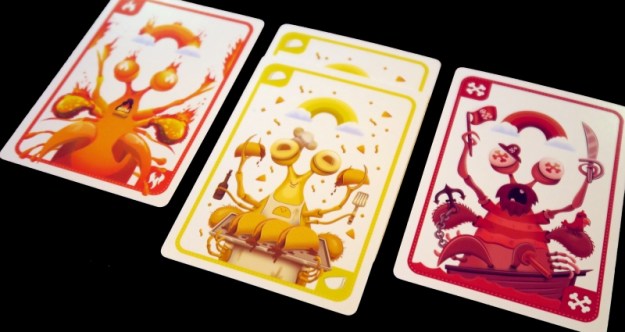
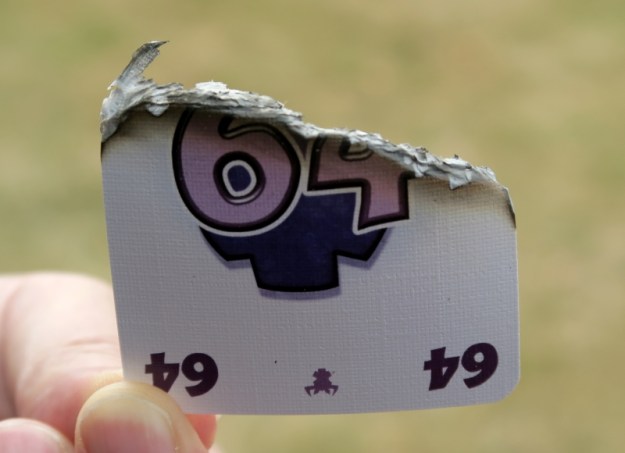
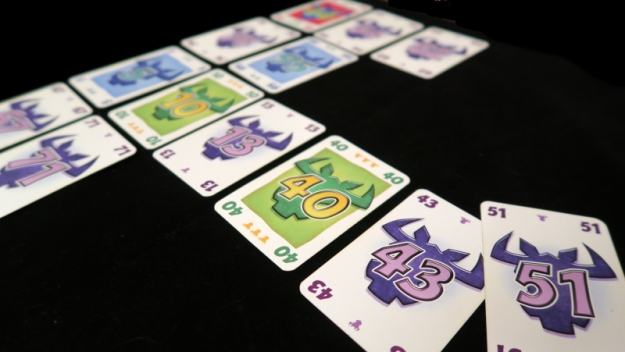
Ill-advised challenges left both Lemon and Blue eliminated in the first round and Orange by the end of the second. Another three way comparison quickly pushed Pink into third leaving a close finish between Plum and Jade with Jade just sneaking in front. Two games were enough, and Jade suggested the group move on to something new: MANTIS, a game from the same people as Exploding Kittens. This is a simple set collecting game where, on their turn, players can choose to “Steal” or “Score”. Players declare their plan (and their victim if they are stealing) before they turn over the top card of the deck. When Stealing, if the colour matches cards belonging to their victim, then they take the cards and add them, face up to their array.
 |
| – Image by boardGOATS |
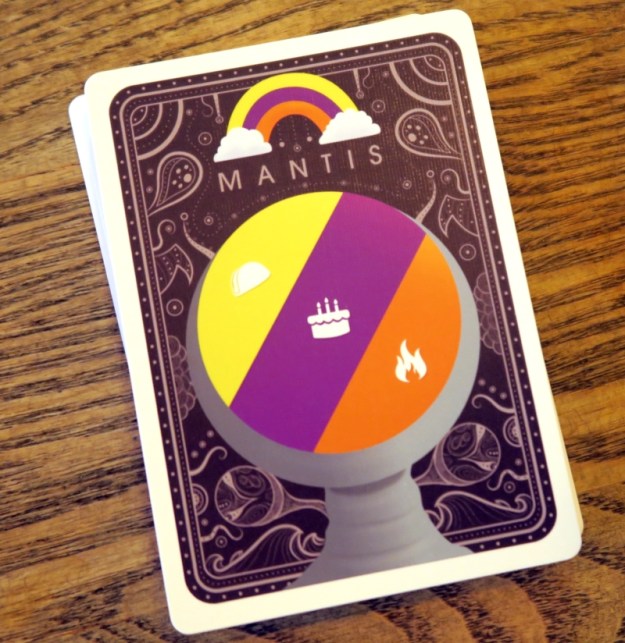
When Scoring, if the colour matches any of their own cards, they turn over the cards and these become points—the first player to ten points is the winner. While this sounds like pure chance, there is one thing that makes the game less random: the backs of the cards show three colours, one of which is the card colour while the others are red herrings (or herrings of another colour). So whilst the game isn’t challenging, it rocks along nice and quickly. Blue took points on her first turn to take an early lead, but everyone else soon caught up and overtook her.
 |
| – Image by boardGOATS |
Food started to arrive, and everyone tried (and failed) to finish before eating; it took a couple more rounds before Pink scored his tenth point. It was very close for second with almost everyone else on six or seven, but Orange just nicked it with eight. While everyone tucked in to their food, the rest of the group arrived. There was some debate as to who would play the “Feature Game” which was to be Alubari: A Nice Cup of Tea, but in the end, Green and Ivory took themselves and the game to the other side of the room to set up a four player game where they were eventually joined by Black and Purple.
 |
| – Image by boardGOATS |
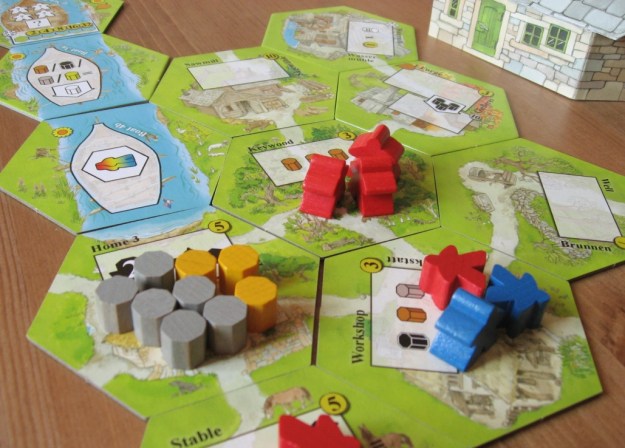
Alubari is a re-implementation of the popular worker-placement game, Snowdonia. It had been a while since any of the group had played Snowdonia, so they needed a quick refresher of the rules and to learn the new aspects of Alubari. The underlying mechanisms are essentially the same, but it has a slightly smoother feel, and of course, the setting is Darjeeling (in the Indian state of West Bengal). In this version of the game, players harvest Tea Estates and assist in the building of the Darjeeling and Himalayan Railway, from Siliguri Town to the summit at Ghum. In addition, players use Chai (made from from harvested tea leaves) which increases the power of their actions. Like the original game, players take it in turns to place their two workers on the action spaces available on the board.
 |
| – Image by boardGOATS |
Once the workers have been placed, players carry out the actions in action order, that is to say, anyone who has a worker in Action A goes first, with the spaces within each Action numbered and activated in order. The Actions are: take Resources from the Stockyard; dig Rubble from the Tea Plantations; convert resources (Iron Ore into Iron Bars, Rubble into Stone or Stone into Rubble); lay Track; build Stations or buy Equipment; take Contract Cards, and finally, harvest Tea leaves or make Chai. Chai is very powerful because players can use it to to get an additional worker for the duration of one round.
 |
| – Image by boardGOATS |
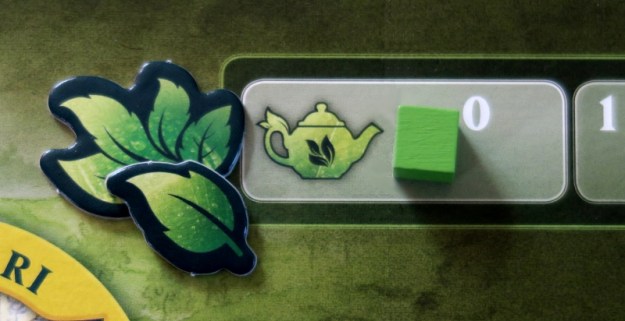
Chai can also be used to enhance actions. For example, players can normally take three Resources from the Stockyard including one Chai; paying a Chai increases the number of Resources they can take to five with a maximum of two Chai. Some of this mirrors Coal in the original Snowdonia game, but initially, there was a little confusion amongst players over the differences between Tea and Chai. There is a distinction here between Tea and Chai, with Tea being the raw leaf product (represented in the art by a leaf) and Chai being the refined product (represented by a teapot). Tea Harvests are shown by a leaf with an arrow which mean players collect Tea leaves equal to the number of tea estates owned by player multiplied by the current value of the Tea Harvest Track.
 |
| – Image by boardGOATS |
The Tea Harvest Track works the same way as the Excavation Work (aka Dig) Rate and the Track Work Rate: they depend on the Weather. The back of the contract cards show the weather; at the start of each round the current Weather disk is removed, the other Weather disks shuffled forwards and the empty space filled with a disk that matches the back of the top card in the Contract deck. Thus, players can see what the weather will do for the next few rounds and use that to plan when to take actions. In general, the Excavation and Track Work Rates are increased by sun, decreased by rain and Work stops altogether when it is foggy; in contrast, the Tea Harvest Rate increases with rain, decreases with fog and is unaffected by sun.
 |
| – Image by boardGOATS |
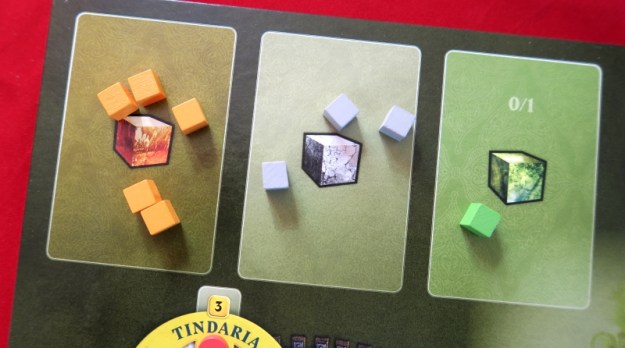
At the start of each round, the Stockyard is refilled with Resources which are drawn blind from a bag. As well as Iron Ore and Stone, the bag also contains a small amount of Chai and five Event Cubes. When one of these is drawn, from the bag, the game plays itself according to a Rondel. This design feature is intended to prevent players from hoarding Resources and thus slowing the game—the fewer Resources there are in the bag, the more likely it is that a white Event Cube will be drawn out. The Events include Excavate, produce Tea, build Stations and lay Track. This last is particularly important because the game ends at the end of the round when the final Track space, on the approach to Darjeeling is completed—this could be by a player or an Event.
 |
| – Image by boardGOATS |
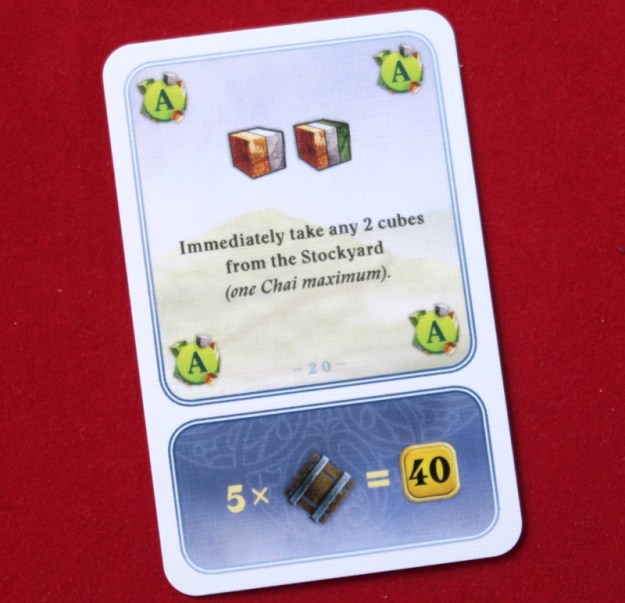
Once the rules had been run through, the game got underway. Right from the outset Black pointed out that it was through Contracts that the big scores were really made. The Contract Cards come in two parts: a Special Action part and an end game bonus. The Action can be used in any round, but its use must be declared before any Actions are resolved. Whether the Action is used or not, players can claim the bonus at the end of the game, and it was these to which Black was referring. Ivory took note of Black’s advice and very early on went for a hefty contract which would give him forty points if he could get five rail tracks.
 |
| – Image by boardGOATS |
Considering that there are only fifteen tracks in the game, with four players and the game itself sometimes building track through the Events, the Contract for five rail segments looked like a tall order. However, as nobody was really paying attention to Ivory’s plans, with the help of a Chai super-boost, it proved easier than it should have been. Aside from that, Ivory, along with Black and Purple began with a fairly typical Snowdonia game approach, collecting building supplies. Green on the other hand, decided to experiment with the new Tea/Chai mechanisms and started clearing the Tea Estates. Although Green did get the first Tea Estate, everyone else also got one soon after.
 |
| – Image by boardGOATS |
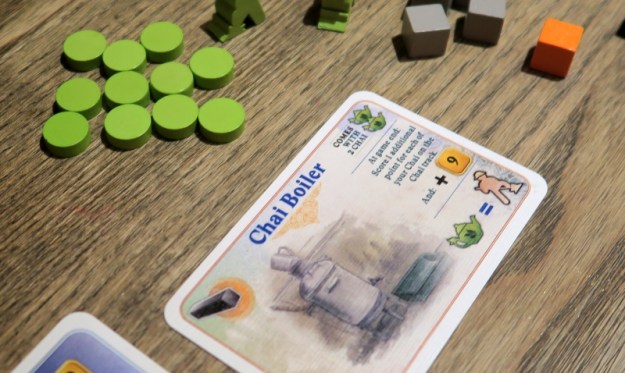
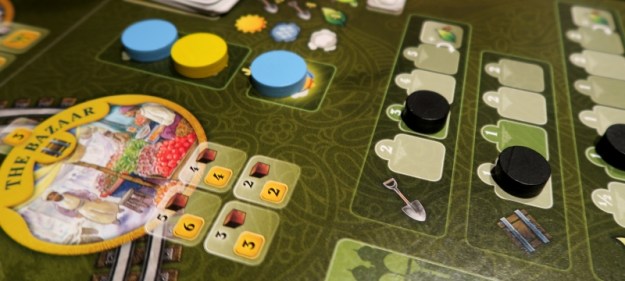
Green was able to continue this approach though, and by the first Tea Harvest, he had more estates than any one else. Green was also the first to gain Equipment, going for a simple one, the Chai Boiler, from the Promo Pack, and gained two Chai with it. He was able to use those Chai to boost his later actions. By halfway through the game he had built up quite a pile of Rubble, and only then realised that he could use this to build Stations. This wasn’t the only game blunder made with Stations. It was only towards the end of the game that Black suddenly remembered the first town on the map, where players could use Tea leaves to pay to build the Station. The first space only cost three leaves, but gave a whopping twelve points and Purple make use of that as soon as it was pointed out.
 |
| – Image by boardGOATS |
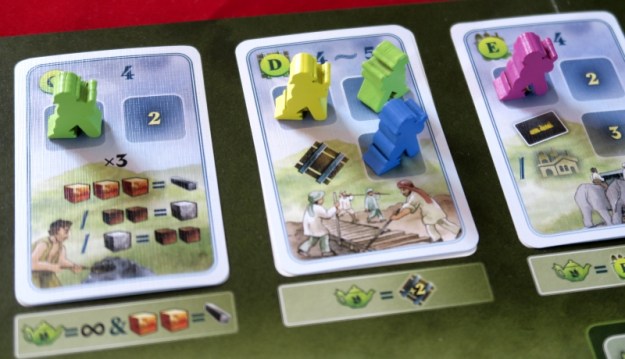
Green took advantage of the Tea/Chai conversion after a very good Harvest, pushing himself to the top of the Chai track. He was then able to get a third worker and boost many of his actions the following round. Through most of the game Ivory held the start player token, with Green and Black only taking it a couple of times with Ivory taking it back straight away. The game was building nicely when suddenly, almost out of nowhere, it was over. There were eight Tracks built when everyone except Purple chose to lay Tracks in the next round. Green went first. He needed to build two Tracks for his contract—he had the Steel but the Track Work Rate was one and he had run out of Chai so couldn’t increase it.
 |
| – Image by boardGOATS |
Next was Ivory who did have Chai, which allowed him to build two extra Track sections and he had the Steel to do it enabling him to build three in one go. Black also had Chai, but only two steel. Seeing that he may not get another chance, he used the Chai, but still needed to lay one more track for his Contract. So the game had gone from eight Track sections to fourteen in a single turn. Green was primed to get his second Track section to complete his Contract, but unfortunately for him, the game had other ideas. With three white Event Cubes, the second event was Lay Track triggering the end of the game, but no Track left to be built. From there, it was just the usual calculations with players maximising points with the last workers and Chai.
 |
| – Image by boardGOATS |
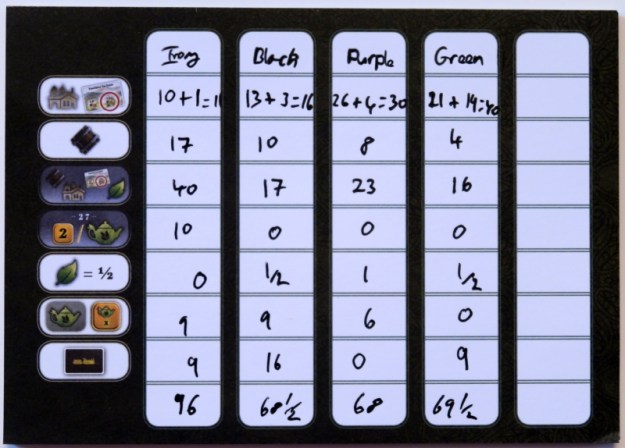
Adding up the points, it turned out to be an incredibly close game. Purple and Green were within a whisker of Black who was the runner-up with sixty-nine and a half points (yes, this game does indeed give half points!). It was Ivory who was the clear winner, however, with his five track Contract that shot his score to the dizzying heights of ninety-six. In the post game discussion, the group agreed that some of the Chai boosts seemed more powerful than others, and the track laying bonus in particular seemed overly powerful. There also did not seem to be as many Tea Harvests as players expected (only three in the whole game including one from a Contract Card). This was only one game though and it is highly likely that others will play out quite differently.
 |
| – Image by boardGOATS |
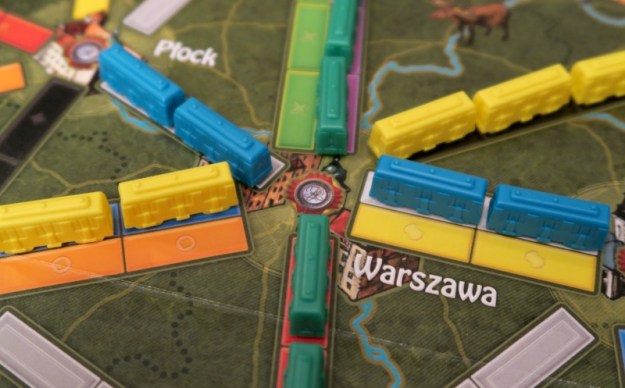
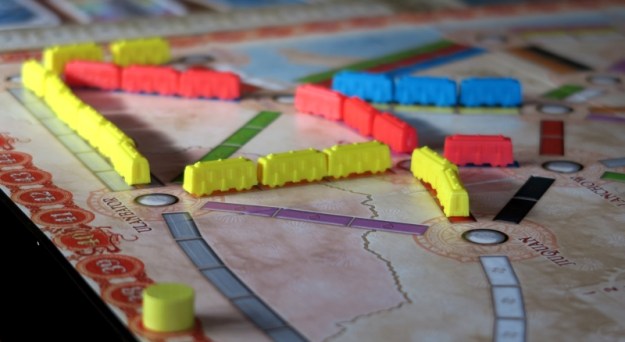
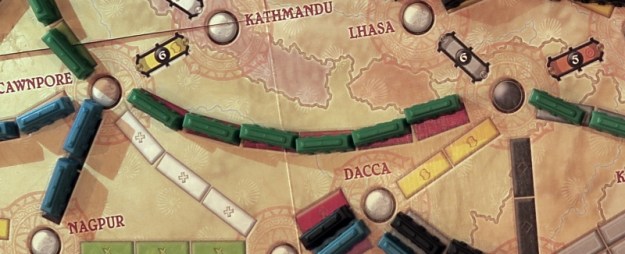
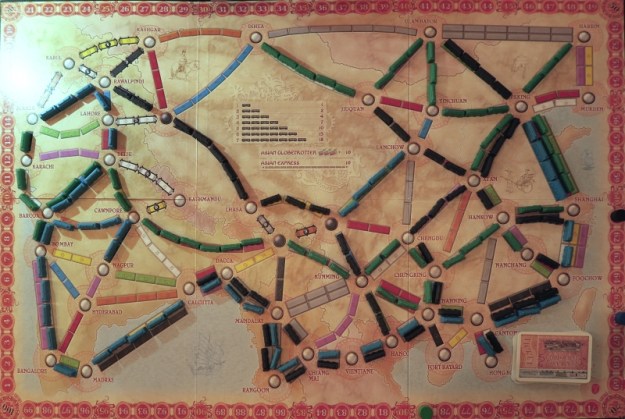
Meanwhile, on the other side of the room, after a bit of discussion, Blue swapped seats with Lime and he and Pink introduced Orange and Lemon to one of our favourite games: Ticket to Ride. We play this quite a bit in lots of different guises, so the plan was to start by playing a short game, the Demo edition, and then play a full sized version. The game is very straight-forward and the basic play is the same across all editions: on their turn, players can take train cards, build track by paying train cards, or take tickets which give end-game points. While the basic mechanisms remain though, the map, the number of train pieces change and some editions add extra little rules.
 |
| – Image by boardGOATS |
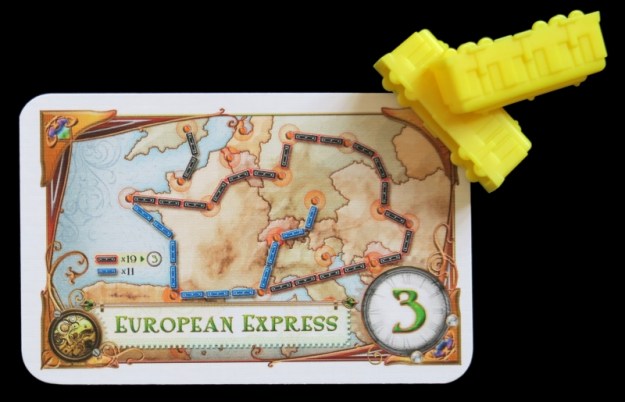
In the first, Demo game (played on the Europe map), Lemon managed to get lots of matching tickets which meant she gave everyone else a bit of a spanking. Not being a native English speaker, Lemon queried the vernacular at which point Pink tried to explain that it was a sporting term, but everyone else including those on the next table insisted that he should explain it properly with all the meanings. Lemon and Orange opted to spare his blushes by looking it up, only to blush themselves when they found it. Much hilarity ensued and was shared with the neighbouring table.
 |
| – Image by boardGOATS |
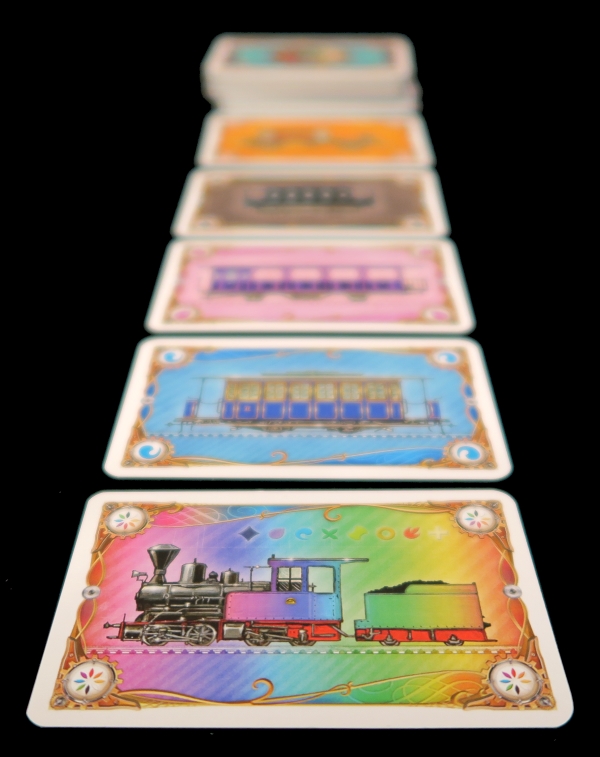
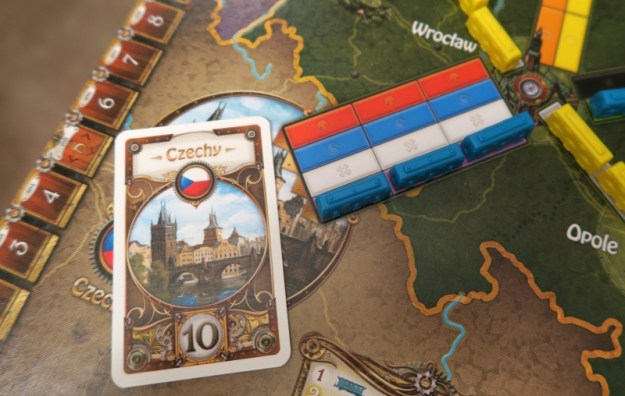
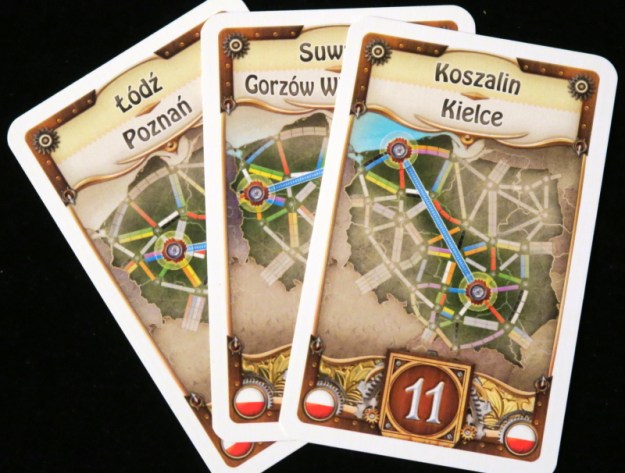
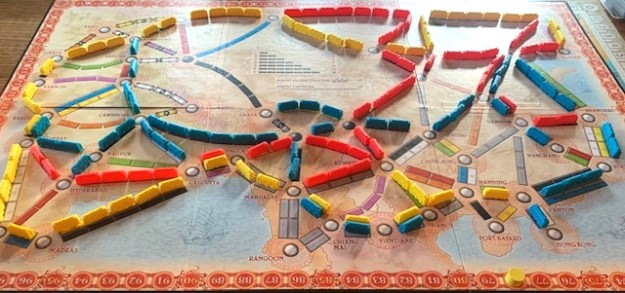
After the introductory game, Pink and “the Citruses” moved onto a “full version”, but in an effort to avoid “special rules” the group played a house ruled version of Ticket to Ride: Germany. This version of the game has its heritage in the Märklin limited edition that was the third game in the series and was published about fifteen years ago. Märklin make model railways, a bit like Hornby, but with German trains. The Märklin version of Ticket to Ride had special art work with a different Märklin train depicted on each individual card in the deck. More importantly, however, it introduced a passenger mechanism which made the game considerably more complex than the original.
 |
| – Image by boardGOATS |
With the Märklin edition sold out, about ten years ago, Days of Wonder (presumably reluctant to renew the license for the Märklin branding) re-released the game for the German and Austrian market as Zug um Zug: Deutschland. This was a simpler version that used the same map, but without the passengers, although the 1902 expansion was released a a couple of years later to reintroduce them with a new, simpler mechanism. A few years after that, about five years ago, the German game was released for the worldwide market including both the Deutschland base game and the 1902 expansion—the only difference was the omission of two tickets.
 |
| – Image by boardGOATS |
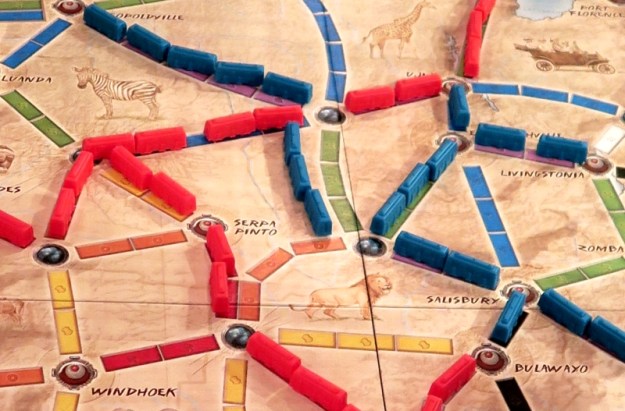
It was this newest Germany version of the game that the group played. However, although the variant includes the passenger mechanism and there is no official variant in the rules “as written” to remove them, in order to keep things simple, the group omitted that part of the game, effectively playing Zug um Zug: Deutschland. The game had just begun, when three rounds in, Pine arrived. The others offered to include him, but he declined and, as a result, he didn’t play anything at all, all evening. He did manage to recount the infamous game when he and Pink gave Blue and Burgundy a spanking over the Heart of Africa map as they got stuck in the middle blocking each other.
 |
| – Image by boardGOATS |
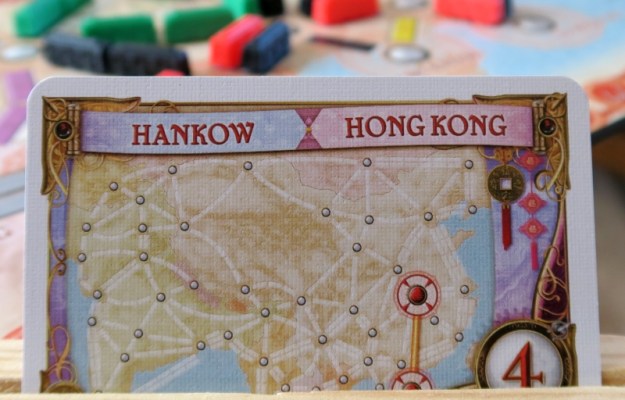
The German version has two types of ticket: long tickets (brown backed) and short tickets (blue backed). At the start of the game, players choose four in any combination of the two types, but must first announce what combination of Tickets they are drawing. Pink went for an almost exclusively long (brown) ticket strategy which he achieved with varied success, while the others went for a mixed ticket approach. There was a little difficulty reading the tickets as the game uses a slightly gothic font which can be a little difficult to read, especially for those who’d forgotten their glasses.
 |
| – Image by boardGOATS |
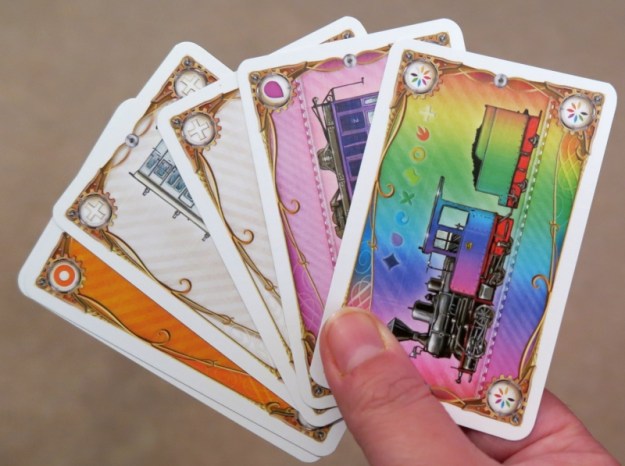
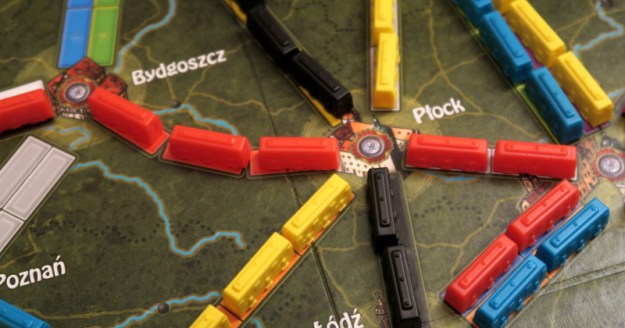
Both Lemon and Lime claimed the long train line from Berlin to Hamburg which give them eighteen points, the equivalent of a long ticket. And tickets were very important this time. Pink began completing routes from Kiel to Switzerland and France (via Bremen and Köln) before taking more tickets. To fulfill these, he extended his network to Hamburg in the north, but failed to get to Karlsruhe in the south which cost him eighteen points in failed tickets. The game can be played in a relatively friendly way, or aggressively with players trying to shut each other out. We play in the more self-focused, less confrontational way, so failed tickets are normally relatively unusual, as such, this game was remarkable in that it was a bit of a tale of missed tickets.
 |
| – Image by boardGOATS |
In addition to Pink, Orange was particularly unfortunate this time, failing to complete any tickets as he was unintentionally badly blocked. The game was ended somewhat unexpectedly by Lime, partly because he picked up the long route (suddenly depleting his supply of trains), but mostly because people weren’t paying attention to the number of trains he had left. He was more fortunate in his ticket draws as well and that contributed to his hundred and fifty-four points and him giving everyone else a serious trouncing (another word for Orange and Lemon to look up). Lemon was the best of the rest finishing with ninety, over sixty points behind Lime.
 |
| – Image by boardGOATS |
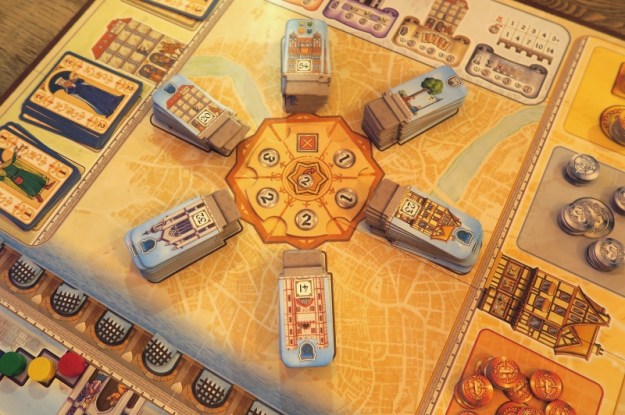
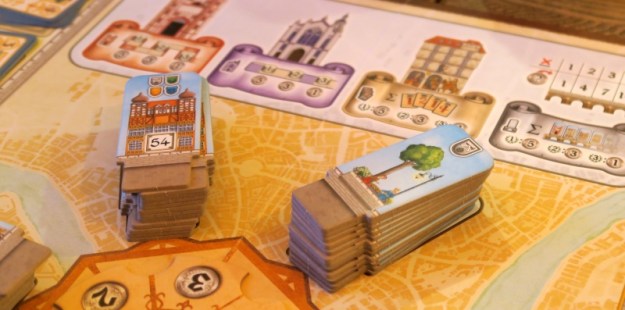
While everyone else was playing with trains, on the next table, Jade introduced Lilac and Blue to his new acquisition that he picked up from UK Games Expo back in June, Old London Bridge. This is a fairly typical Queen Games game, with lots of pieces, but not too challenging—just what everyone wanted on a warm night. The game is set in 1136 after the great wooden bridge across the Thames was been consumed by fire. Players are architects, each responsible for designing and building one section of the new bridge. On their turn, players add one of the available buildings to their bridge section. Each building has three attributes: Location, Colour and Number.
 |
| – Image by boardGOATS |
There are six different types of building, each with a special “power”. Thus, Haberdashers allow players to take money, the Purple Chapel buildings allow players to move along the associated track etc.. The colour is important because if that colour matches other buildings already on their bridge, they get a boost—for example, if a player takes a blue Haberdasher building, and already has two other blue buildings, they get to do that action effectively three times, taking three times as much money. Finally, buildings must be built in descending Number order—to reset, players have to build a park, which has no additional “power”.
 |
| – Image by boardGOATS |
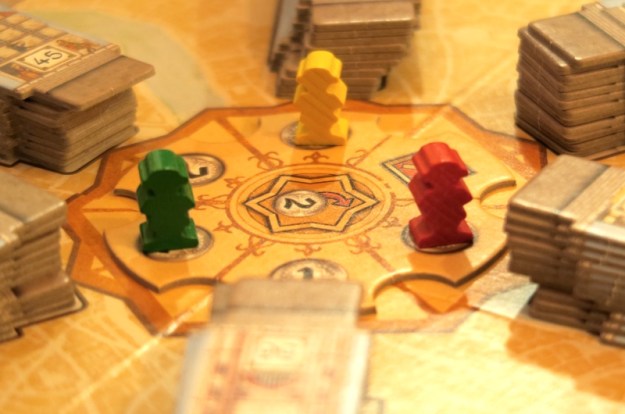
There are six building spaces on a central Rondel, each associated with a different pile of buildings and each with a money bonus that changes as the Rondel rotates at the start of each round. Each Rondel space can only hold one player’s marker, thus each building type can only be built once per round. One space is always deactivated (which one also changes as the Rondel moves), but the seventh space, the centre of the of the Rondel costs money, but allows players to take any building, including one that is currently unavailable (either because it has already been taken or was deactivated at the start of the round).
 |
| – Image by boardGOATS |
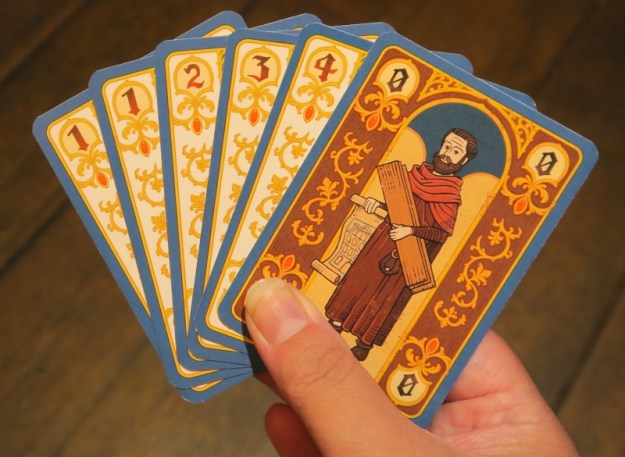
Each round, players bid with Character Cards to see who gets to choose a building first. Character Cards which have a numerical value, zero to four. Where there is a tie, it is broken by players’ respective positions on the Purple Chapel track. Players start with a hand of Character Cards, but can add to these by building a Hostelry building—the higher the power, the more powerful the cards they can take. At the end of the game, the players get bonus points depending on the value of the Characters they have left over. In addition to the Haberdasher, the Hostelry and the Parks there are also two types of buildings in the Bridge Gate: Purple Chapel Buildings and Red Gatehouse Buildings.
 |
| – Image by boardGOATS |
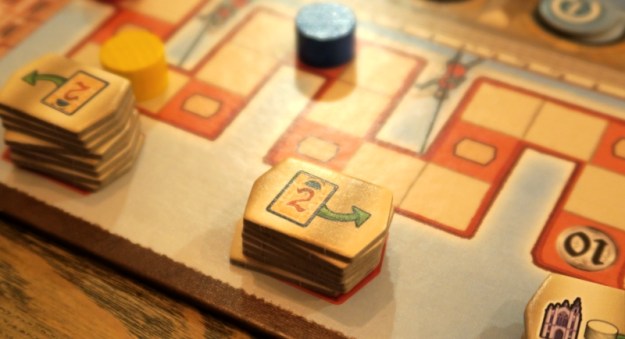
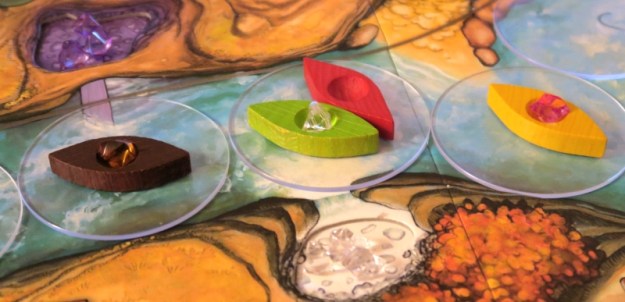
Each of the Bridge Gate buildings have a track associated with them. During the game, passing milestones on these tracks give money and break ties (Chapel Track) or give special tokens that allow players to bend the rules (Gatehouse Track). Additionally, players get bonus points at the end of the game depending on their final position on these tracks. The final building type is the Guild House. These have no action associated with them, but are “Colour wild”, featuring all four colours, and as such, they boost every other building type. At the end of the game, players add their residual money to bonus points for their finishing position on the Bridge Gate tracks, for unused Characters, and for having the fullest bridge (if a player can’t obey the Number rules, they may have been unable to build a building).
 |
| – Image by boardGOATS |
Jade had only just started explaining the rules, when Plum announced that she had a “new religion”—Kittens, and shared photos. From this point forward, every pause in the game became a “Kitty Paws” and was punctuated by more increasing levels of cuteness—definitely an improvement on the stuffed Pandas from last time. Despite the undeniable distractions, everyone was still able to focus on the game and proceedings weren’t slowed at all. Plum seemed to amass a vast amount of money in no time at all and after making a mess of her first turn, Blue got lots of orange buildings and lots of cards but was very slow to make any progress on the Purple Chapel track and lost every tie-breaker she was involved in as a result.
 |
| – Image by Plum |
Lilac was the first to run out of Character Cards and therefore ended up relying on her position on the Chapel track to ensure she didn’t get left with Hobson’s Choice every time. In this she was helped by Jade who also ran out of cards. Although Blue’s forest of Orange buildings meant she could get a lot each turn, her choice was often to do something she wanted but not get much of it, or take yet another orange building and to do something she didn’t really want and rely on probability to even things out in the end. Things didn’t really even out, and as a result, Blue ended up with a lot of Character Cards. Everyone else went for a much more balanced strategy focusing on one or two or maybe three Colours. And Plum’s pile of loot grew ever larger.
 |
| – Image by boardGOATS |
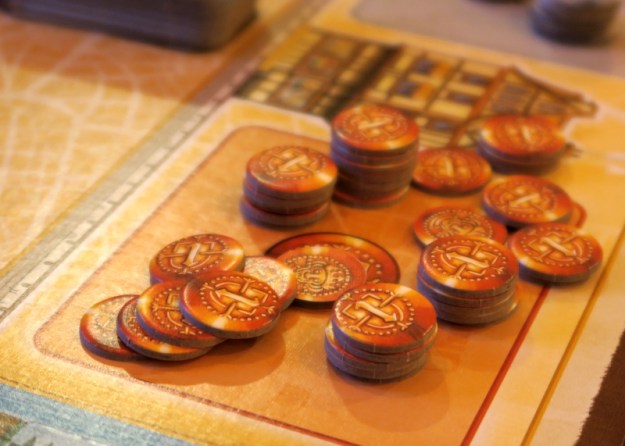
Towards the end of the game, Jade put on a massive spurt along the Red Gatehouse track and collected some Character Cards, while Blue finally made a move along the Purple Chapel track. As a result, Jade who had led the Purple Chapel track for most of the game was pipped by Blue, and Blue who’d held a massive lead on the Red Gatehouse track was edged out by Jade. Plum finished with the most cash with thirty, but in the end was only slightly ahead of Lilac and Jade. Lilac who had just quietly got on with her game was the only player to fill all the spaces on her Bridge, despite running out of cards. In the ranking for players with the most buildings, there was a tie for second place.
 |
| – Image by boardGOATS |
Initially, the tie was resolved as a friendly tie with both Plum and Jade getting three points for their second place and Blue taking one. On reading the rules later, it turned out that end-game ties are also broken by position on the Purple Chapel track, giving Jade three points and Plum one. In general, bonus points are actually much less significant than money. This is because money is absolute and turned directly into points, but the bonuses only reflect placings (not how successful someone is); the bonuses therefore have a maximum of five points in each case whereas players can finish with as much money as they can.
 |
| – Image by boardGOATS |
In this case, however, it was very close for second place and the tie break for that bonus turned out to be critical: Plum beat Jade on the friendly ties, but positions were reversed with the tie breaker from the rules as written. Old London Bridge also includes alternate bonus conditions and had even one of these been in use, then the scores could have been quite different. There was no question about the winner though: throughout, Lilac had just quietly got on with her own game doing everything well. She was the only one to finish with all twelve buildings, finished with almost as much money as Plum, and had made good progress on both the Bridge Gate tracks. With a final score of thirty-eight points, she was four points clear of whoever took second. With time for just a few more “kitty pictures”, people started heading home.
 |
| – Image by Plum |
Learning Outcome: Everyone Likes Train Games, and Kittens.










:strip_icc()/pic4326079.jpg)













:strip_icc()/pic68678.jpg)