UK Games Expo 2019 – Not as Hot as Last Year, but that’s a Good Thing…

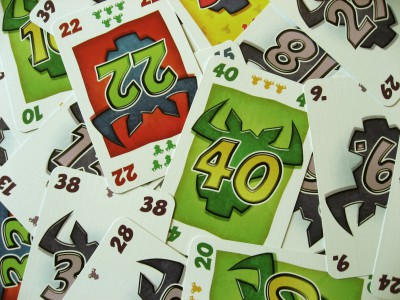
Last weekend was the thirteenth UK Games Expo (sometimes known as UKGE, or simply Expo), the foremost games event.  Every year it grows bigger, and this was no exception. Historically, Expo is focused on gamers playing games rather than publishers selling new games, however, the exhibition aspect has been growing, and this year there were two halls full of vendors selling games and demoing wares.  Last year, there was an issue with the air conditioning on the Friday which, combined with the thousands of “hot water bottles” walking about looking at games, made it unbelievably hot.  This year, working facilities and a little more space made it much, much more pleasant, although Saturday was busier than ever!

UKGE 2019
– Image by boardGOATS

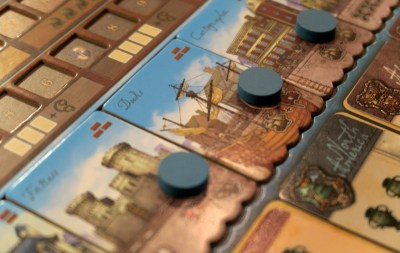
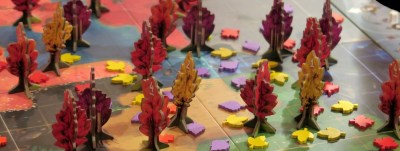
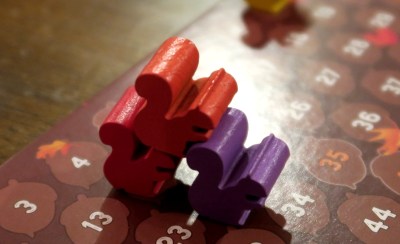
This year the hot games included Wingspan, copies of which were flying off the slightly wobbly shelves following it’s recent Kennerspiel des Jahres nominationFoothills, a two player Snowdonia game by UK designers Ben Bateson and Tony Boydell (designer of the original Snowdonia, Ivor the Engine and Guilds of London) was another extremely popular game.  Foothills is produced by Lookout Spiele, but there were sixty copies available from the designer’s Surprised Stare stand, which sold out in less than forty minutes (though there were a small number of copies to be had elsewhere for those that kept their eyes peeled).

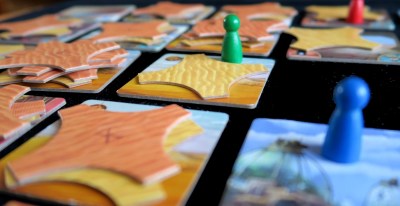
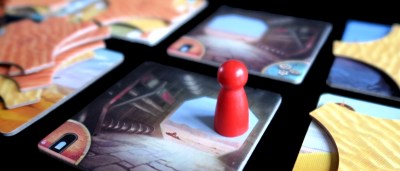
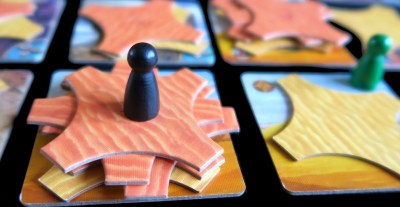
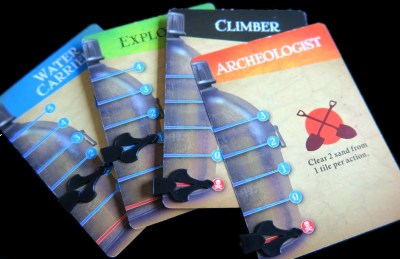
Foothills
– Image by boardGOATS

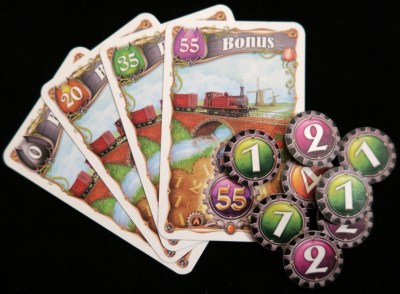
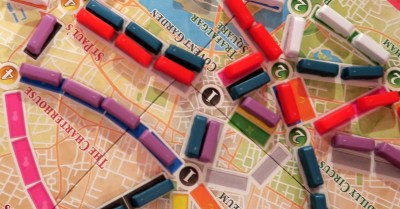
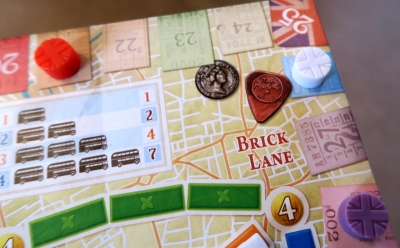
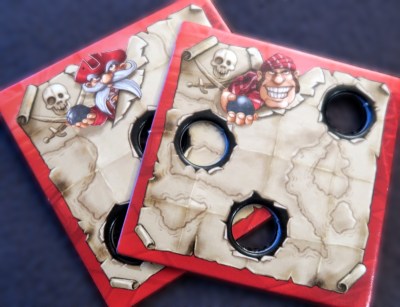
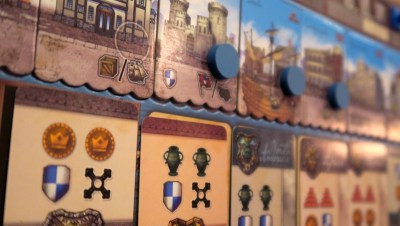
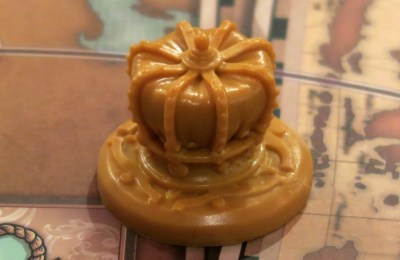
Surprised Stare were also demoing Foothills and another Snowdonia-based game, Alubari, which is due for release later in the year (hopefully).  There was a new Ticket to Ride game available (London) as well as another instalment in the Catan series (Rise of the Inkas); the new expansion for Endeavor: Age of Sail was also available to see (coming to KickStarter later in June) and “old” favourites like Echidna Shuffle were there to be played and bought too.  There were some very good deals to be had from some of the third party sellers as well, including some of the Days of Wonder games for just £15.

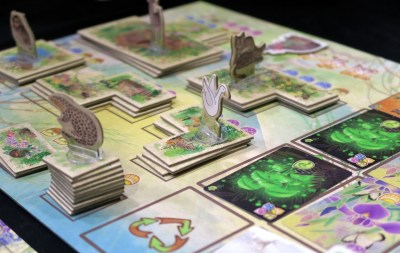
Horticulture Master
– Image by boardGOATS

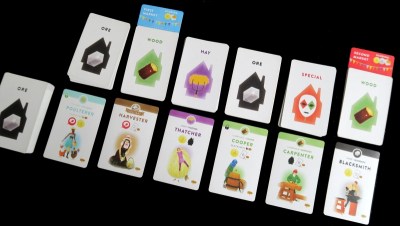
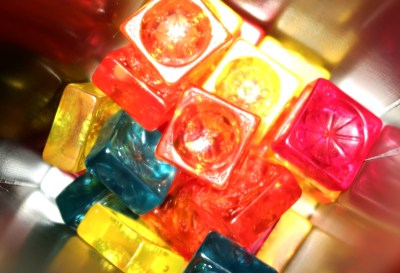
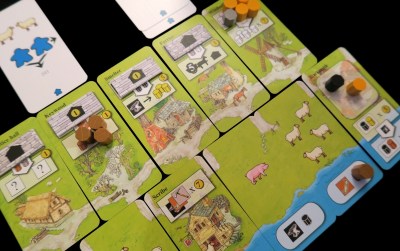
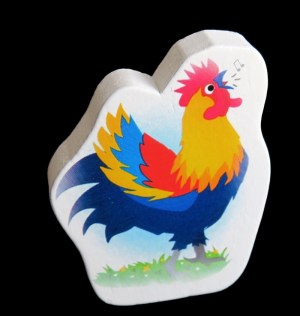
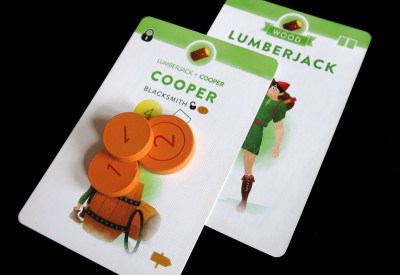
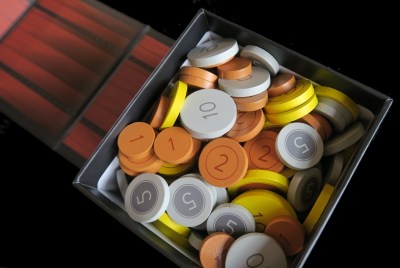
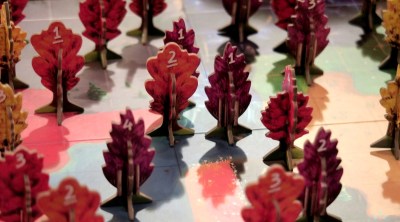
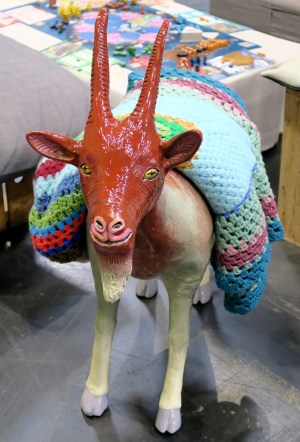
One of the reasons for attending conventions is the opportunity to see and play games that are not available elsewhere.  One example was Horticulture Master, a cute little Taiwanese game with beautiful artwork, which combined card collecting elements from Splendor with Tetris-like tile laying from games like Patchwork and Bärenpark.  Another cute little game was Titans of Quantitas from Gingerbread Games, a clever two player strategy game based round the old fashioned digital rendering of the number eighty-eight.  What really made this game special though was the fact that the stall was guarded by a fiberglass goat!  Not everything was quite as wholesome though, as one Games Master was thrown out and banned for life for including content in a role-playing game that allegedly involved sexual violence and played on the shock factor.  This is definitely the exception rather than the rule, however, and UK Games Expo is a great place for family and friends to spend a weekend.

UKGE 2019
– Image by boardGOATS

Boardgames in the News: The Million Pound Lost Lewis Chess Piece

The iconic Lewis Chess pieces were found nearly two hundred years ago in the Outer Hebrides.  Also known as the Uig Chess pieces, they were made in the twelfth century and were carved from walrus ivory and whale teeth.  The “set” consists of seventy-eight pieces, most of which are exhibited at the British Museum, with the rest housed at the National Museum of Scotland in Edinburgh.  The British Museum suggests the pieces were made in Norway and belonged to a traveling merchant who lost them on his way to Ireland.

Lewis Chess men
– Image from britishmuseum.org

Although the collection is often referred to as a Chess “set”, the pieces show a large variation in size suggesting they may actually comprise several different sets, albeit with several pieces missing.  Six months ago, one of these turned up in a drawer in a family home in Edinburgh.  The walrus tusk “Warder” (the equivalent of a Rook) had been bought in 1964 for £5.  Now that authenticity has been confirmed, it is due to be auctioned at Sotheby’s on 2nd July and is expected to fetch up to a million pounds.  The original hoard contained a total of ninety-three artifacts, the whereabouts of four of which remain unknown. The moral?  Have a clear out – you never know what may be hiding in your sock drawer!

Lewis Chess men
– Image from Sotheby’s

Boardgames in the News: Is Rape a Suitable Subject for a Game?

If asked whether rape is a suitable subject for a game, most people would answer, “No, of course not!”  But not all, it would seem.  Sadly, the UK Games Expo made the national news yesterday when one individual was thrown out and banned for life thanks to the unsuitability of the material he was presenting.  The game in question was Things from the Flood, a role-playing game or “RPG”, where the players take on the roles of young teens in the 1990s where players were trying to balance everyday life with solving mysteries with their friends in an alternate time-line.  Unfortunately, the game master concerned (widely rumoured to be Kevin Rolfe), saw fit to include kidnap and gang rape in the scenario he was leading.  Perhaps worse, he allegedly found the shock-factor entertaining.  The floor manager, John Dodd investigated and the organisers released an official statement saying:

“The content was not set out in the game description. If it had been included in the submission it would have been rejected as unacceptable even for a game with an 18 rating. … We immediately halted the game the GM was currently running and cancelled all of the games he was due to run. …  He has also been banned from submitting any games for the foreseeable future.” 

The unequivocal nature of the response from UK Games Expo clearly demonstrates that sexual assault is not a subject matter that is acceptable for games at the event, nor indeed in the wider hobby.  However, it has undoubtedly done damage, not only to the convention (where there are many children and young people present), but also to the image of board gamers in society where there is already the perception that gaming is full of misfits and weirdos with a personal hygiene problem.  This is very sad given how family-friendly, sociable and open most gamers and game groups are.

UKGE 2018
– Image by boardGOATS

UK Games Expo 2019

Once again, gamers are converging on Birmingham for three days of fun at the thirteenth UK Games Expo (sometimes known as UKGE, or simply Expo).  This event is focused on gamers playing games rather than publishers selling new games, so has a different feel to “Essen” in October. The event used to be held in the NEC Hilton Metropole, but now also occupies a large chunk of the NEC and as the event expands it is becoming increasingly commercial.  In addition to Euro Games, there are a lot of cos players miniatures games, and war games, with tournaments as well as plenty of “open gaming” space, talks and play testing.  Several of the GOATS are planning to go this year, some for just a day, others for several days, and it is certain that it will be a fun weekend.

UKGE 2019
– Image from
ukgamesexpo.co.uk

Next Meeting – 28th May 2019

Our next meeting will be on Tuesday 28th May, at the Horse and Jockey pub in Stanford-in-the-Vale.  As usual, we will be playing shorter games from 7.30pm as people arrive, until 8pm when we will start something a little longer.

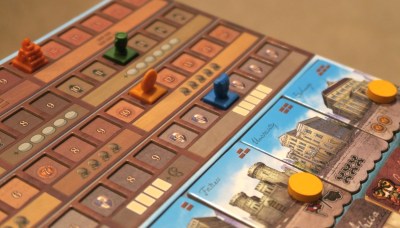
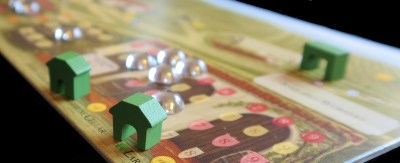
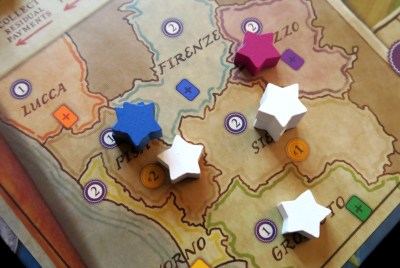
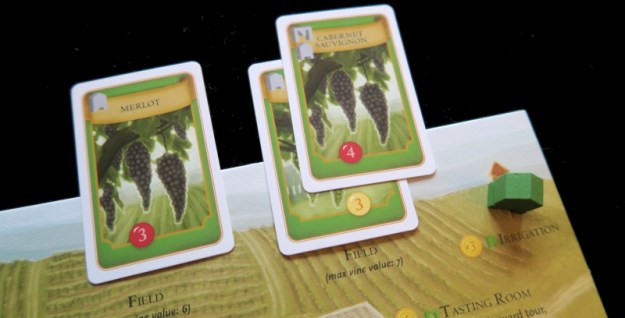
This week the “Feature Game” will be Tuscany, the expansion to the Viticulture, a worker placement game about planting vines, harvesting grapes and making wine.  The Tuscany expansion provides changes to the seasons wherein the actions occur in and provides a couple of extra mechanisms for getting points.

Tuscany
– Image by boardGOATS

And speaking of wine…

Jeff was driving down a country lane when he met a car coming the other way.  Unfortunately both drivers were going a bit quickly and as they came round a blind corner they collided.  Both cars involved were completely wrecked, but amazingly neither Jeff nor the young lady driving the other vehicle were hurt.

After they climbed out of their cars, the young lady said, “Just look at our cars! There’s nothing left, but fortunately we are both unhurt. This must be a sign from God that we should meet and be friends and live together in peace for the rest of our days.”

The lady was very good looking and her car looked very valuable, so Jeff, thinking his luck was in, replied, “I agree with you completely.”

The woman continued, “And look at this, here’s another miracle. My car is completely demolished, but this bottle of wine didn’t break.  Surely God wants us to drink this wine and celebrate our good fortune.”

She handed the bottle to Jeff, who, mentally checking whether it was his birthday, opened it, drank half and then handed it back. The woman took the bottle, screwed the cap back on and handed it back to Jeff.

Jeff looked a little confused and asked, “Aren’t you having any?”

The woman replied, “No. I think I’ll just sit here and wait for the police…”

14th May 2019

A lot of the usual suspects weren’t about, so it looked like it was going to be a really quiet  night.  This was due to be offset by Pink, who was putting in one of his rare appearances from the frozen north, but at 6pm he was stuck at Leicester Services with a “limping” car.  While Pink’s arrival looked in doubt, he also lost the unofficial title of “furthest traveled” with Mulberry bringing along her other-half, newly arrived from California.  He had been awake for some forty hours traveling, so was reluctant to actually play anything, but we really appreciated his company all the same.  We were just starting the “Feature Game” when Pink arrived (thanks to a couple of very nice AA men), so as he scoffed his pizza we went through the rules for Powerships.

Powerships
– Image by boardGOATS

Powerships is not a complex game:  Black described it as “roll and move”, which is a little harsh if arguably accurate.  The game is played on a hexagonal grid representing the solar system and featuring the planets.  On their turn, players may take or return a single die, and then re-roll as many of their dice as they choose.  They may then rotate their space ship sixty degrees left or right and then move it the total number of spaces shown on their dice.

Powerships
– Image by boardGOATS

The movement rules are slightly more complex.  A crash is hitting a planets, a dust cloud or the “Trumpian” wall surrounding the solar system (there is a problem with alien immigrants in 2345 apparently).  Players may only crash if they have no choice, and if they crash, the penalties are severe: they must go in the direction that means they travel the furthest (even if that is unfavourable), they lose all their dice, and they move their damage maker left by a space for every unused movement (leading to a reduction in the maximum number of dice they can have).

Powerships
– Image by boardGOATS

Although ships can pass others, spaces cannot be occupied by more than one ship—they don’t crash though (fortunately), they just pull-up short, just behind. There are a number of special spaces:  yellow chevrons apply drift to a ship as they pass; space currents cause ships to change direction and warp speed and hyperspace enable ships to briefly go twice as fast.  What really makes the game, however, is the course:  players have to travel round three planets in a specific order and in a particular direction as marked by three orange bollards, before arriving at the finishing planet.

Powerships
– Image by boardGOATS

This time, as it was Tuesday, Mercury was the  starting planet. Random chance selected Purple as start player, but as spaceship placement is in reverse player order, Mulberry chose pole position and Blue placed her ship next.  Perhaps it was because he was still focusing on his pizza or maybe he decided to be a gentleman, but Pink placed his ship on the opposite side of the starting planet and just for good measure pointed it away from the first corner on Venus so that he was not forced to crash into Mercury on his first turn.  Green, Lime, Black and Purple placed their ships in turn order, with their start positions increasingly obstructed until Purple was left with no choice but to start on the planet itself surrounded by everyone else, and hope to avoid rolling a one on her first turn.

Powerships
– Image by boardGOATS

Purple was lucky and managed to escape from the ring of ships, parking herself squarely in front of Mulberry.  As everyone else rolled their first die and moved towards the first corner, the unfortunate consequences of Pink’s initial position became apparent.  Rolling a three, forced him to move his ship away from the first bollard and directly towards the walled edge of the solar system, where he stayed for the next few turns, trapped between some space dust, Saturn and a hard place, shuffling about in a strange many-point turn.

Powerships
– Image by boardGOATS

The rest of the fleet made good progress towards the first check-point, Venus, and then Blue foolishly rolled an extra dice and was forced to head off-course.  Green and Mulberry were pulling away a little as the pack headed into the farthest reaches of the solar system and approached the second corner located on Uranus, and that was where the mayhem really began. Purple went the wrong way round the bollard, so had to go back for a second shot; Mulberry hit the planet head on at full speed and was forced to maneuver slowly, and carryout repairs before she could build up speed again; Lime overshot and had to pirouette to get back on course while Black carefully dodged the debris, but struggled to find a clear course.

Powerships
– Image by boardGOATS

Meanwhile, Green sailed on serenely, finding the unobstructed path to the third marker on Pluto, on his first attempt.  It was perhaps just as well, as he was so busy advising Lime and fiddling with his phone that he missed his turn.  He suddenly realised he had missed out, but as everyone else unanimously agreed that turn order had been scrupulously observed and it was all in his imagination, he had no choice to but to acquiesce.  When Pink was about to taking his next move there was much hilarity when Green suddenly noticed he had missed out again! It was much harder for everyone to deny him a second time, and Green paid more attention for the rest of the game.

Powerships
– Image by boardGOATS

Pink had finally escaped from the combined gravitational pull of the starting planet and the  wall and Blue was moving back up the field as everyone else struggled to avoid calamity.  As Green headed towards the finish at Neptune, Black and Blue engaged in fierce struggle for second place (which Blue ultimately won by one turn) and Lime led the rest of the pack round the final corner.  It was coming into the home straight that Lime snatched defeat from the jaws of victory when he failed to decelerate and careered off for what looked like a second lap.  Mulberry was the beneficiary closely followed by Purple, with Pink and Lime bringing up the rear in what had been a mad, chaotic race, but a lot of fun.

Powerships
– Image by boardGOATS

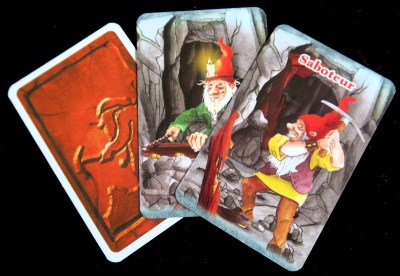
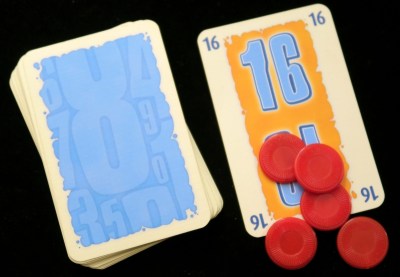
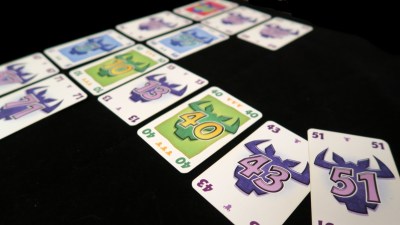
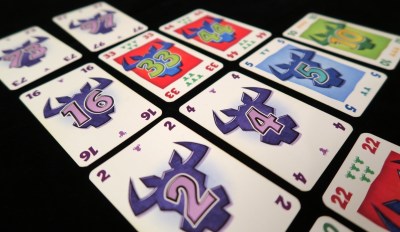
With Powerships taking more than an hour longer than the advertised half-hour, Mulberry signed Pine’s birthday card and then took her jet-lagged husband home leaving six.  Inevitably as Pink was around, someone raised the subject of Bohnanza.  Other games were discussed, including 6 Nimmt! and Saboteur, but someone pulled a face for all of them, and in the end as Lime hadn’t played it, “Beans” won the day. This is one of our all-time favourite games, and everyone else was very familiar with it, especially Pink who claims to dislike the game while owning several copies of it in multiple languages.

Bohnanza
– Image by boardGOATS

Black explained the rules to Lime as everyone else tried to work out the game set up for six.  The game itself is actually very simple: each player starts with two bean fields in front of them.  On their turn, the active player must plant the first card in their hand and may plant a second before turning over the top two cards from the draw deck.  These two bean cards must be planted before play can continue, but they can be planted in the active player’s field or in someone else’s if a trade can be agreed.  Once these cards have been dealt with, the active player can freely trade as many cards as they want from their hand (all of which must be planted) before drawing cards and ending their turn.

Bohnanza
– Image by boardGOATS

At any time, a player can harvest a field of beans, at which point some of the beans are retained with the cards turned face down, becoming “money”.  The player with the most money after three trips through the deck is the winner.  There are two key rules: firstly, players cannot rearrange their hand – it has a front and a back and cards are played from the front and arrive at the back.  Thus the game is all about manipulating the order of the cards in hand by trading the unwanted ones for something more helpful.  Secondly, although players can harvest a field whenever they want, they cannot harvest a field with only one bean card unless all that player’s fields are singletons.  While the rules of the game are not difficult, things were complicated considerably by the fact that the only version available was in Spanish – a special gift from Red to Pink.

Bohnanza
– Image by boardGOATS

Although Blue’s Spanish was up to the job, the fact that everyone else (familiar with the English version) used the English names for the beans instead of those on the cards, confused Lime utterly.  Despite that, Lime got stuck in to what turned out to be a very tight game.  Green, Pink and Purple bought a third bean field; Green was adamant that he gained no advantage from his though Purple and her “Judías Colora” may have done a little better and Pink thought he might have got an extra coin out of it.  In the end, Blue and her seemingly never-ending stream of “Pochas” had the edge and she finished in first place with a total of fifteen coins, some way ahead of a five-way, eleven-point tie for second place.

Bohnanza
– Image by boardGOATS

Learning Outcome:  Pay attention or you might miss a turn (or two).

Spiel des Jahres Nominations 2019

Every year, in May, the nominees are announced for the most prestigious award in board gaming, the Spiel des Jahres.  There are typically three categories, the Kinderspiel (children’s game) , the Kennerspiel (“expert’s” game) and the most desirable of all, the family award, the Spiel des Jahres.  The nominees for this year’s award have been announced as:

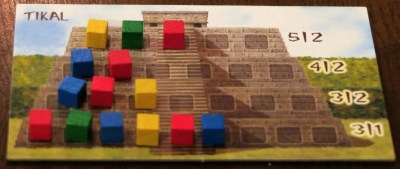
Last year the group picked out the eventual winner, Azul, after playing it at Essen, but this year nobody really had much idea of what would be nominated.  While we enjoyed the sequel to Azul, Stained Glass of Sintra, we felt it was not in the same league as its predecessor.  This year the games generally seem to be light, almost party games.  Our personal favourite for the “Red Poppel” was probably Echidna Shuffle, but we knew that was unlikely to make the cut for other reasons.  Those who had played it felt that Teotihuacan: City of Gods was in with a shout for the Kennerspiel award, but in truth, that it was probably a little too complex.  Wingspan was the only game from this year’s nominees that the group had really picked up on, and is planned as a “Feature Game” for later in the year.

Usually the Kennerspiel Prize winners are a good fit to our group, but this year they are also largely unknown to us, so there is clearly a lot to discover before the winners are announced in Berlin on 22nd July (Kinderspiel des Jahres winners will be announced a month earlier in Hamburg on 24th June).

Spiel des Jahres
– Image from spieldesjahres.de


Next Meeting – 14th May 2019

Our next meeting will be on Tuesday 14th May, at the Horse and Jockey pub in Stanford-in-the-Vale.  As usual, we will be playing shorter games from 7.30pm as people arrive, until 8pm when we will start something a little longer.

This week the “Feature Game” will be Powerships, a mad space-ship racing game where players roll dice and try to navigate their craft traveling great distances around a galactic race course, dodging planets, space dust… and each other.

Powerships
– Image by boardGOATS

And speaking of the vast distances in space…

Jeff and his mate Joe were sitting on a bench one evening talking about where they were going on holiday and watching the moon rise over rural Oxfordshire.  Jeff commented that he’d had been thinking about going to Australia as he’d heard that there were loads of gorgeous girls there.  Joe liked the sound of that, but was concerned about how far away it was.  Jeff shrugged—he knew it was a long way, but wasn’t sure how far.

There was a moment of silence, then Joe asked, “Which do you think is farther away, Australia or the moon?”

Jeff pointed at the sky and said, “Duh! Can you see Australia from here???”

30th April 2019

For a while, it looked a lot like the “Feature Game”, Lewis & Clark , wasn’t going to happen – it’s a longer game and one that requires a specific type of gamer.  Of the usual candidates for this sort of game, Burgundy had given notice that he was feeling under the weather, so wouldn’t be coming; Blue was in attendance but was feeling a bit off-colour too; Black wasn’t in the mood for something heavy; Mulberry was recovering from jet-lag so needed an early night, and Green and Ivory hadn’t arrived by 8pm.  Inevitably though, we were just deciding what else to play when Green and Ivory turned up and looked keen to give Lewis & Clark a go.

Lewis & Clark
– Image by boardGOATS

With Blue joining them, that left Black, Purple, Mulberry and Pine (who was celebrating coming off his antibiotics again), to come up with something to play.  While everyone played musical chairs, suggested games and admired Blue’s shiny new copy of Roll for the Galaxy: Rivalry (freshly muled from the US by Mulberry), the foursome decided to play Azul: Stained Glass of Sintra.  This is the new implementation of last year’s Spiel des Jahres winner, Azul, which features the same market, but with glass pieces instead of ceramic tiles.

Azul: Stained Glass of Sintra
– Image by boardGOATS

The differences are more than cosmetic though – instead of placing their pieces in a row and moving them onto a grid, pieces are placed directly into the player’s window.  This is modular consisting of the double-sided strips laid out at random so everyone has a different starting setup.  There are restrictions on how the pieces can be placed though:  tiles must be placed in the strip immediately below their Glazier meeple, or in a strip to its right.  The Glazier is then placed above the strip the tiles were placed in,, so he gradually moves to the right. Instead of taking tiles, players can choose to reset the Glazier’s position, moving him back to the left most strip.

Azul: Stained Glass of Sintra
– Image by boardGOATS

Players get points when strips are completed scoring the sum of the score depicted below the strip and any strips to the right that have already been completed. There is also a colour bonus—each round has a colour drawn at random at the start of the game, and any tiles that match the colour for the round score extra. Once a strip has been completed, it is flipped over; after it has been filled a second time it is removed. Any left over tiles that cannot be placed are placed into the glass tower and yield a penalty with players moving along a negative score track which has small steps at the start that gets larger. When the market is empty the round ends and the round indicator tile is also dropped into the glass tower which is emptied when the .  There are also end-game bonus points with two variants available, one colour dependent and the other rewarding completing adjacent strips.

Azul: Stained Glass of Sintra
– Image by boardGOATS

Mulberry was new to the game and had not even played the original Azul, despite it having been so popular within the group.  Pine, Purple and Black had, of course, played the original game many times, but were less familiar with the Stained Glass of Sintra variation and Pine at least had played it just once.  It was a tight game and it wasn’t clear who was going to win until the end of the sixth and final round when it became apparent that Black was in a good position to make a killing and probably take an insurmountable lead.  Unfortunately, for him, he snatched defeat from the jaws of victory by putting his red glass pieces in the wrong place.  Pine meanwhile had made  a bit of a mess of things elsewhere which left him a score of minus ten for his unused tiles, but this wasn’t enough to knock him of the top of the podium where he sat two points ahead of Black in second and a few more ahead of Mulberry in third.

Azul: Stained Glass of Sintra
– Image by boardGOATS

Mulberry needed an early night to help with the jet-lag and Lewis & Clark was still underway, so the remaining three decided to play a recently released game, Gingerbread House.  In this game players are witches in the Enchanted Forest, building their gingerbread house and attracting hungry fairy tale characters with colorful gingerbread.  Each player has a player board showing a three-by-three grid of building spaces with a symbol on each space.  They also have a pile of rectangular tiles each featuring two squares showing two symbols, a bit like dominoes, which are placed face-down in a stack with the top three turned face up (a little like the train cards in Ticket to Ride).  On their turn, players draw one of the face up tiles and place it on their player board, then carry-out the effect of the symbols they covered up.  The most likely symbol is one of the four different types of gingerbread, which means they collect a token of that type.

Gingerbread House
– Image by boardGOATS

Sometimes a player wants to cover two squares on different levels, in which case “stair” tiles can be used as a spacer; players can also receive these as an effect of placing tiles, or they receive two stair tiles if they forfeit their turn.  Other effects include the opportunity to swap one type of gingerbread for another or cage a fairy tale character.  If the two symbols covered are the same, the player gets the effect three times instead of twice adding a positioning element to the tile placement.  Once a tile has been placed, the active player can use some of their gingerbread tokens to capture fairy-tale characters, either from the face up character line or from their “cage” trap near the gate of their cottage.  If placing tiles completed a level, the active player may take a bonus card (up to a maximum of three).

Gingerbread House
– Image by boardGOATS

Pine, who had not played the game before went for a very tall house combo, taking a “Chimney” bonus tiles which reward players with eight or more levels (complete or incomplete) and a “Treasure Chest” bonus which would give points if his had at least four complete levels.  Black started off capturing the most valuable fairy tale creatures and then added the “Magic Wand” bonus card which gave him even more points.  Purple meanwhile, also concentrated on the characters she was capturing, taking the “Cauldron” bonus, which rewarded her for catching non-human characters.  Black’s strategy was very effective and, although the characters are hidden once they are taken, so it was no surprise that he was well in front, scoring as many points for his characters alone as Purple and Pine scored in total.  It was really close for second place, however, but Pine just pipped Purple by a single point.

Gingerbread House
– Image by boardGOATS

Meanwhile, on the next table, Ivory, Green and Blue had been playing the “Feature Game”, Lewis & Clark.  This is a resource collecting race game, with a deck building element.  Players are explorers trying to get from St. Louis to Fort Clatsop, traveling up the Missouri River over the Rocky and Bitterroot Mountains through Montana and Idaho, and down the Columbia River to the Oregon coast.  Players do this by playing character cards from their hand which provide actions including gathering resources, traveling or converting primary resources into secondary resources.  There are several very unusual things about the game.  Firstly, each card has a power as well as an action.  Whenever a character card is played it must be empowered either by playing a second card and using it’s power rating, using natives, or a combination of both.  This dictates how many times the action is carried out (up to a maximum of three).

Lewis & Clark
– Image by boardGOATS

Once a card has been played, either as an action or to activate another card, they are placed on the player’s personal discard pile, so there is also an element of deck-building to the game, with more characters available through the “Journal” .  Of course, the most exciting cards are those with the highest rating, so using them to activate other cards may be efficient, but means that action will not be available until the deck is recycled.  This is another interesting and clever aspect of the game:  each player has their “Scout” and their “Camp”, and they move their scout along the rivers and through the mountains and then, when they “make camp”, they move the camp to join the Scout and pick up all their used cards.  This is a similar mechanism to that used in K2 where players have tents to shelter in, however, in Lewis & Clark the key part is that there are “time penalties” that penalise inefficiencies, like any unused character cards.

Lewis & Clark
– Image by boardGOATS

As well as the cost associated with inefficient use of their characters, there are also penalties for hoarding resources.  In order to travel players need buffalo (or bison…?), canoes, and horses, Acquiring canoes and horses require other resources and these must be transported to the new camp by boat—the more resources a player has when their camp moves, the more costly it will be.  Each player’s expedition also has a number of natives, and these also travel by boat.  Players start with five boats three that will hold resources and two for the natives; transporting two resources and one native is free, but the costs increase significantly when more travel.

Lewis & Clark
– Image by boardGOATS

Another interesting mechanism used in the game is way players gather some of the resources.  Each player starts with action cards that generate the four primary resources, wood, equipment, fur and food (depicted by buffalo, or bison—what’s the difference?  You can’t wash your hands in a buffalo…).  These have a brown, grey, pink or yellow icon associated with them and each character card depicts one of these.  When a player plays, for example, a lumberjack card, they get wood equivalent to the number of visible brown icons visible in front of them, but also those displayed by their each of their neighbours.  Thus, if a player has two wood icons in front of them, and their neighbours have another two each, they would get up to six wood (enough to make four canoes), and if they activated that card three times, that would increase to eighteen.  If both neighbours decided to make camp, however, they would pick up all their cards and playing that lumberjack activated once would then only yield two wood.  Thus, timing is critical and one turn can make all the difference.

Lewis & Clark
– Image by boardGOATS

Instead of playing a character card, on their turn, players can take a village action by placing a native on the board.  Some of these locations, like the Hunter space, can only hold one native, so the player can only take the action once and nobody else can visit the Hunter to get food and fur until the space has been vacated.  Other spaces like the Canoe Maker, can be visited many times, so a player who has a lot of wood can turn them into up to three canoes.  Natives can also visit the Shaman, which enables players to repeat another player’s Character card.  This turned out to be really important as spaces are only emptied when a player plays their Interpreter card.  The Interpreter calls all natives on the board to a powwow in the middle of the village and then as many of these natives as desired can be recruited for that player’s expedition.

Lewis & Clark
– Image by boardGOATS

Once per turn, before or after the compulsory action (playing a Character card or deploying a native in the village), players can make camp and recruit new Characters from the face up cards drawn from the Journal deck.  Each character has an intrinsic cost in equipment, as well as a cost in fur dependent on it’s position in the Journal.  There is a potential for hands to become full of unwanted cards, however, it is possible to use one card to pay part of the cost.  Additionally, there is a location in the village, “Farewell” that players can use to discard cards and also refresh the Journal.

Lewis & Clark
– Image by boardGOATS

Although the game seems to take an inordinately long time to play, it is not actually that complicated.  Essentially, players are trying to gather resources and use these to recruit helpful Characters and acquire secondary resources (horses and canoes) and then use these to travel along the rivers and through the mountain.  Although it seems simple, planning and timing is absolutely critical—getting it wrong can easily mean that a Scout finishes his round behind his camp so that the expedition fails to move forward.  The location of the mountains can mean that even a successful forward movement may be inefficient as The Commander (the movement Character card everyone starts with) only allows players to use canoes to move four spaces along the river and horses to move two spaces in the mountains.

Lewis & Clark
– Image by boardGOATS

Ivory went first and began by collecting resources, followed by Blue and then Green.  Blue was the first to move and headed off up the river from St. Louis and then made camp.  Ivory and Green weren’t far behind, but when they came to make camp the time penalties they accrued meant they actually went backwards.  This is not always such a bad move in this game if it is due to building a robust engine for later in the game.  So in the first few rounds it looked like Blue had a massive lead, but that didn’t last as the others began the chase.

Lewis & Clark
– Image by boardGOATS

Blue was first into the mountains and then realised she had mis-read her expedition leader  card and found that horses would only move two spaces each through in the mountains, not four (like canoes).  The mountains are key to the game and particularly changing ovement and avoiding wasting moves.  Green thought he had it sussed with his Cut Nose Character card, but hadn’t checked the rules and just assumed that it would allow him to move one space through the mountains without needing any resources.  That would have made it a very powerful card, as trading for horses to get through the mountains requires three nonequivalent primary resources per horse (which moves two spaces).  He was very disappointed and, like Blue had to completely reconsider his options.

Lewis & Clark
– Image by boardGOATS

Meanwhile, Ivory had a plan to get his expedition through the mountains.  His combination of the Black Cat and Coboway Character Cards meant he could collect any missing resources he needed easily and then use them to move fast through the mountains.  Inevitably, with Blue mired in the mess she had made, Ivory galloped into the lead, but he still had the Colorado river to negotiate before he could get past fort Clatsop and make camp.  For this he needed natives, but so did Blue.  Unfortunately for Blue, the fact that Ivory was ahead of her in the turn order meant he was able recruit more natives and it wasn’t long before his expedition paddled past the finishing line, and, despite a large time penalty, made camp on the Oregon coast, a very worthy winner in what had been a very enjoyable game.  Definitely one to play again.

Lewis & Clark
– Image by boardGOATS

Learning Outcome:  Many native Americans have unpronounceable names.

Next Meeting – 30th April 2019

Our next meeting will be on Tuesday 30th April, at the Horse and Jockey pub in Stanford-in-the-Vale.  As usual, we will be playing shorter games from 7.30pm as people arrive, until 8pm when we will start something a little longer.

This week the “Feature Game” will be Lewis & Clark, a resource collecting race game in which each player manages an expedition intended to cross the North American continent, trying to be the first to reach the Pacific.  It is a longer game, but there will be plenty of shorter games available to play as well.

Dinosaur Island
– Image by BGG contributor styren

And speaking of explorers…

Jeff was the first to person explore the Coast of Labrador. Shortly after he left though, he realized that he had forgotten something really important and had to go back to get it.

This made him the first Labrador Retriever…