2nd April 2019

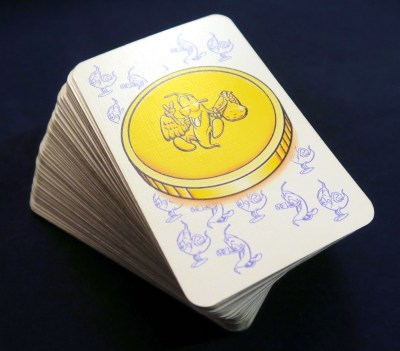
The evening began with a lot of people eating, the return of Mulberry’s daughter, Maroon, and the arrival of someone new, Lime.  So while the usual suspects finished their supper, everyone else played a game of Incan Gold (aka Diamant).  This is a light, “push-your-luck” type game, where players are exploring a mine by turning over cards, sharing any Gems these reveal.  After each card has been revealed, players simultaneously choose whether to leave the mine or stay and see another card revealed.

Incan Gold
– Image by boardGOATS

Unfortunately, as well as gem cards, the deck also includes Hazards like scorpions, snakes, poison gas, explosions and rockfalls.  When a particular Hazard is revealed for a second time, the mine collapses.  Anyone still inside the mine at this point loses all the gems they’ve collected during the round, while those that left early keep their winnings and stash them in their tent.  So, the trick is that as players leave, the share of the gems grows larger, but so does the risk of collapse. Additionally, there are also Artifact cards.  When one of these is revealed nobody gets any gems until they leave, but if they leave alone, they not only get the Artifact, but also any remainders from the division of spoils associated with the Gem cards revealed earlier in the round.

Incan Gold
– Image by boardGOATS

The game is played over five rounds, and like all push-your-like games like this, players who are unlucky in the first round often feel they are out of the game.  This is particularly true where one player does really well in the first round as they have can play safe and can afford to leave the mine early to consolidate their position.  However, this time there were a lot of players and everyone was somehow encouraged to stay in the mind keeping things close.  As the game progressed however, the pack began to split and a small group of leaders began to emerge.  In the end, Mulberry’s wind-ups failed to put Pine off his game and he finished with more than twice her total, winning the game with twenty-five Gems.  Purple was a close second though, with Maroon not far behind in third.

Incan Gold
– Image by boardGOATS

With food and the first game finished, it was time to decide who was going to play the week’s “Feature Game”, Dinosaur Island.  This is a worker placement game set in a dinosaur theme park.  Although it’s not named specifically, the colour, theme, artwork and feel is clearly intended to evoke an impression of the most famous dinosaur theme park, Jurassic Park,  despite having ten people and the Totally Liquid expansion available (which provides the pieces for a fifth player), we decided it was likely to be a long game and that sticking to four or fewer might be wise, and so it proved.  The rest of the group were half-way through their chosen game, Las Vegas, before the dino-group had even finished setting up, never mind the rules run-through.

Dinosaur Island
– Image by boardGOATS

Las Vegas is one of our most popular games, and the idea is very simple, on their turn, the active player rolls their dice and uses them to “bet” in one of the casinos.  “Betting” is done by placing all the dice of one value on the corresponding casino.  On their next turn, the player re-rolls their dice and does the same again.  Each casino has a pot of cash and after the last dice has been placed, the player with the highest “bid” at each casino (i.e. the player who placed the most dice), wins the largest denomination note.  Similarly, the player who placed the second largest bid taking the second highest denomination and so on.  The catch is that before the order is determined, any dice involved in a tie are completely removed, so a bet of a single die can win, even though there could be several higher bets, which makes the game great fun.

Las Vegas
– Image by boardGOATS

We usually play with the extra high denomination notes and the “Big Dice” from the Boulevard expansion, as well as the Slot Machine mini-expansion.  The “Big Dice” add to interest in the decision making when pacing bets, as they are double-weight, and count for two dice.  The Slot Machine, on the other hand, gives another place for players to bet, but instead of having a specific number, players can place all their dice of one number as long as each number is only placed once.  At the end of the round, the player with the most dice in the Slot Machine takes the highest denomination note from the pot, but in the case of a tie, the total number of pips on the dice are taken into account, then the highest value dice.

Las Vegas: The Slot Machine
– Image by boardGOATS

Once again, Pine was caught in a tussle, this time with Purple, which culminated in him placing four sixes to beat her “three-of-a-kind”, just to annoy her.  Green almost always does badly at this sort of game and this was no exception, although the game was reasonably close this time.  Mulberry and Maroon, mother and daughter tied for third place, but it turned out that the squabble between Purple and Pine might actually have had a real impact on the final result as they toughed it out for first place.  In the end, those four dice might have been critical as Pine beat Purple by a measly $30,000 – a substantial amount to most of us, but a relatively small sum in this game where most players win quarter of a million dollars or more.

Las Vegas
– Image by boardGOATS

Dinosaur Island was still going on and was looking like it still had some way to go (though they had finally started).  Mulberry, Maroon and Pine all wanted an early night, but Green and Lime decided to keep Purple company for another game, which eventually turned out to be Walk the Plank!  This is another popular game and Green and Purple felt it was essential to introduce Lime to it.  The game is a programming game with a pirate theme.  The idea is that each player has a hand of cards and at the start of the round “programs” their turn by deciding which cards they are going to play, then they take it in turns to action one card per turn.  The point is, although players have to choose three cards at the start of the round, by the time the final cards are played the game has changed so much that any plans made at the start will have gone completely to wrack and ruin.

Walk the Plank!
– Image by boardGOATS

So, players start with three pirate meeples each and the aim is to push everyone else off the ship, along the plank and off the end thus sending them to visit Davey Jones’ Locker.  Once again, Green was picked on by the others and was the first to lose all three of his pirateeples to the kraken, and therefore took on the role of the Ghost Meeple.  The Ghost is confined to the ship, has a restricted set of actions and only gets to carry out one per round.  Unfortunately, the game doesn’t play so well with two, and as a result when it got down to a couple of meeples each for Purple and Lime they got bogged down in a bit of a stale-mate.  This didn’t make it any less fun though.  In the end it was a Ghostly Green who helped push Purple’s final meeple off the boat and Lime did the rest giving him his first win; hopefully we can look forward to many more in the coming weeks.

Walk the Plank!
– Image by boardGOATS

Meanwhile, on the neighbouring table the other four were playing the week’s “Feature Game”, Dinosaur Island.  Although it took a long time to set up and explain, Dinosaur Island is not actually that complex a game.  The game is played over four phases.  In the first phase, a set of beautiful bespoke dice are rolled and players play their scientist meeples to choose dinosaur “designs” or DNA resources associated with the available dice, or increase their DNA storage.  In the second phase, players can use their funds to buy upgrades to their technologies from the market place, which basically improves the quality of the actions players can take in the next phase.   The third phase is the core, “worker-placement” round.  This is when players can “build” dinosaurs, reinforce their security, convert DNA into other types of DNA etc.

Dinosaur Island
– Image by boardGOATS

In the final, fourth round, players open their park to the public, drawing visitor-meeples blind, out of a bag.  The visitors come in two types, yellow, paying visitors and pink “hoodlums” who don’t pay and are very good at avoiding getting eaten.  The total number of visitors is dependent on the total excitement rating of the dinosaurs each player has in their park; the more dinosaurs a player has and the more exciting they are, the more visitors a player has and therefore the more money they receive in gate receipts.  However, the more exciting dinosaurs also need better security which is expensive.  If a park’s security is insufficient, the dinosaurs get out and start eating the visitors – each surviving visitor scores the park owner a victory point while visitors that are eaten cost victory points.

Dinosaur Island
– Image by boardGOATS

There are a couple of little tweaks that give the game a lot of replay-ability.  For example, there are eleven “plot twist” cards which introduce slight variations to the rules keeping things fresh.  For example, turn order is normally dictated by the number of points each player has, but the group played with a “plot twist” that meant the player order was always the same, with the first player progressing clockwise one place each round.  There are also thirty-nine end-game goal cards of which a small number of cards are selected for each game, when a set number of these have been completed by at least one player, this triggers the end of the game.  Any number of players can complete these objectives and receive the points associated with them, but once one player has completed an objective, it will become unavailable at the end of the round.  Thus all players who achieve an objective will do so in the same round.

Dinosaur Island
– Image by boardGOATS

This time, the group, played with the aquatic dinosaurs from the Totally Liquid expansion, partly because they alleviate the incessant “neon pink-ness” of game, but mostly just because they are cool.  Blue began by getting a bit carried away with the coolness of swimming dinos and started out taking a plan for a very exciting Megalodon largely simply because she had heard of it, and without thinking through the consequences. Having read the rules in advance, Burgundy had a much better handle on the challenges associated with the game and made a beeline for the special Dino Security upgrade which enabled him to increase the security in his park a second time per round at no extra cost.

Dinosaur Island
– Image by boardGOATS

Black also understood the importance of threat and security and decided to try to deal with the problem by keeping his threat level down.  One unfortunate side-effect of this is that most low threat dinosaurs are un-exciting and attract fewer visitors.  It all became a bit academic though as his threat level spiraled out of control.  Blue, realised she had made a bit of bish and needed to do something to enable her to start producing Megalodons without getting all her visitors eaten and hemorrhaging points.  So she decided to concentrate on upgrading her technologies hoping to net the bonus seven points from the end-game objective rewarding players for having four upgraded technologies.  Black quickly realised he couldn’t keep up with Blue’s developments and as it wasn’t going to happen for him focused his efforts elsewhere.

Dinosaur Island
– Image by boardGOATS

Meanwhile, Ivory had bagged the popular T-Rex dinosaur plan and was producing them in large numbers.  He, like Black also got heartily sick of pulling “hoodlums” out of the bag instead of paying visitors.  Black bought himself a technology to deal with the problem, but Ivory chose a different route, employing an expert who arrested any hoodlums in his park with the net effect that they became less prevalent for everyone else as well.  Experts are expensive though and not everyone could afford one, or felt they were worth the money.  Certainly they are more valuable if they are employed early in the game so players get their money’s worth

Dinosaur Island
– Image by boardGOATS

Everyone got points from the end-game objectives, but as the game came to a close it was clear who was in pole position.  Although his security wasn’t quite sufficient the huge number of visitors turning up every round put Ivory in front by some twenty-plus points.  In contrast, it was very close for second place however, with just five points between second place and the wooden spoon.  The nature of the game means keeping tabs on points, security, threat and excitement levels is quite a fiddly business. Since it was possible to throw a very small blanket over the three competing for second place, it is quite possible that the scores weren’t accurate, nevertheless, the Black finished in second place in what had been a very enjoyable game.

Dinosaur Island
– Image by boardGOATS

Learning Outcome:  Security is very important and should not be neglected.

Next Meeting – 2nd April 2019

Our next meeting will be on Tuesday 2nd April, at the Horse and Jockey pub in Stanford-in-the-Vale.  As usual, we will be playing shorter games from 7.30pm as people arrive, until 8pm when we will start something a little longer.

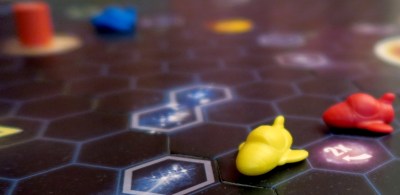
This week the “Feature Game” will be Dinosaur Island, a worker placement game set in a dinosaur theme park.  During the game, players collect DNA, research the DNA sequences of extinct dinosaur species and then combine the ancient DNA in the correct sequence to bring these prehistoric creatures back to life. Players then compete to build the most thrilling theme park and work to attract the most guests and keep them alive.

Dinosaur Island
– Image by boardGOATS

And speaking of Dinosaurs…

Jeff and Joe had just finished watching Jurassic World and as they watched the credits, Joe said commented that he thought it was a fantastic film.  Jeff was less impressed.

Joe enthused, “But just look at what they made those dinosaurs do!”

Jeff replied, “Yeah, it’s great—they were able to train raptors. Still, that’s not as impressive as the Flintstones convincing a bird to be their record player…”

19th March 2019

Yet again, the evening began with a discussion of everyone’s ailments: Pine had spent the last fortnight visiting Swindon for a daily dose of intravenous antibiotics; Green’s absence was explained by his contagious skin condition, and Blue was feeling particularly blue thanks to a nasty cold (a present from Pink).  The general itchiness of the group was increased by the addition of everyone’s favourite nit-nurse stories.  Perhaps it was the general malaise, but there seemed to be a lot of food eaten, including several helpings of ice-cream, but eventually we got down to playing games, beginning with the “Feature Game”, Botswana (aka Wildlife Safari).  Unusually, this was very, very popular, and Mulberry drew the short straw, so she was promised a chance to play it soon.

Botswana
– Image by boardGOATS

Botswana is deceptively simple:  Players have a hand of cards and take it in turns to play one card onto central set piles and then take any one of the plastic animals.  There are five “animal suits” and six cards in each, numbered zero to five.  At the end of the round, players multiply the number of plastic animals they have in each suit by the face value of the last card played in that suit.  Thus, a player with three plastic elephants where the last card played was a four would score twelve for that suit.  The game is played over as many rounds as there are players.

Botswana
– Image by boardGOATS

It took a round for people to get a feel for the game, but it quickly became clear how clever it is.  A bit like 6 Nimmt!, Botswana has a feeling of luck about it, but it is also very tactical.  Players want to make sure they play the high value cards that they have and get as many animals as possible in those suits, but play them early and someone else may subsequently play a zero making them worthless.  On the other hand, waiting to the end to play high cards risks someone else ending the game and failure to maximise the score.  So the game is all about timing and second guessing everyone else.

Botswana
– Image by boardGOATS

Blue and Pine took the first round, and while the second and third were more level, going into the final round, Black commented to Burgundy that it was clearly a two horse race.  Blue’s answer that it was surely a “two zebra race”, was met by Pine’s response that he’d rather ride an elephant as they are generally better tempered and can be trained to carry people.  After a  discussion about whether the plastic, model elephants were African or Asian, the appearance of the leopards and their spots, and the collective noun for rhinoceros, the game continued.  Like a crush of rhino, Pine could barely contain his pride as he trampled over the rest of the herd in his stubbornness.  In a bit of a dazzle, Blue came in second with a late leap.

Botswana
– Image by boardGOATS

Meanwhile, on the next table, Ivory, Mulberry and Purple were playing Splendor. Although we’ve played this very extensively, somehow Mulberry had missed out.  The game is very simple however:  on their turn, players either take three different coloured gem-chips or use gem chips to buy cards.  The cards are effectively permanent gems that can be reused without loss, but some of them give victory points as well.  The other source of points are Nobles: players who collect a given number of cards featuring certain gems get a visit from a noble and a bunch of points as a result.  Despite Burgundy being occupied with the safari on the next table, it was still a bit of a landslide.  Diamonds were scarce, and Purple had a bit of a melt-down.  With Mulberry new to the game, the way was clear for Ivory who took two of the Noble tiles and finished the game with an unassailable sixteen points.

Splendor
– Image by boardGOATS

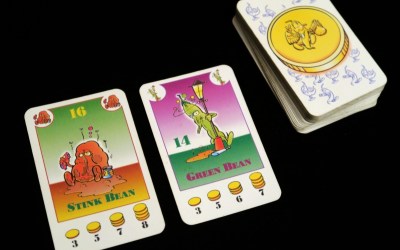
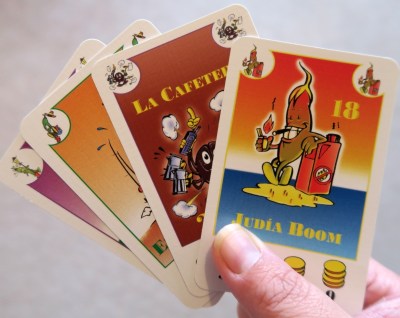
Everyone was feeling a bit washed out, and nobody was particularly enthusiastic about suggesting games to play.  Ivory was the most proactive suggesting Altiplano, Dice Forge, Dinosaur Island and Bohnanza, but nobody looked terribly interested.  After a discussion about which throat sweets people preferred (where Fisherman’s Friends were equated to “Toilet Duck Pastels”, eventually the inevitable happened and the whole group settled down to a  game of Bohnanza.  This is one of our most popular games when everyone’s a bit tired and can’t be bothered with anything more complex, and often gets an outing when everyone wants to play together.

Bohnanza
– Image by boardGOATS

The game is quite simple and everyone in the group knows it well now, but the game always starts with everyone chorusing “Don’t rearrange your cards!” as the habit is so ingrained.  On their turn, the active player must play the first bean card into a field in front of them, playing a second if they wish.  Two cards are turned over from the central deck which can also be planted or traded, but must be planted by someone before the active player can trade cards from their hand with anyone else round the table and finally draw cards into the back of their hand.

Bohnanza
– Image by boardGOATS

As a group, we usually “play nice”, that is to say, players trade positively rather than negatively and gratefully accept freebies if offered (by players keen to get unwanted cards out of their hand).  With a full compliment of players, the game is always tight, often coming down to luck and this was no exception, and no less enjoyable as a result.  With only three points between first and sixth place it looked like it was going to be a three way tie between Pine, Purple and Ivory who all finished with eleven points.  Suffering with a think head though, Blue was slow counting and they were all disappointed when, after a couple of recounts (just to check) she pipped them to first place.

Bohnanza
– Image by boardGOATS

With Ivory and Mulberry wanting an early night, we were looking for something short before they went.  Not many games play seven well, but 6 Nimmt! is always popular and this was no exception.  People often claim 6 Nimmt! is a game of luck, but in reality it is one of walking a tightrope of perfect timing:  get it wrong and everything falls apart, but get it right and with Lady Luck in support a perfect round is possible.  Indeed, Ivory managed just such a perfect round, not once, but TWICE, last time we played, and everyone was determined he wasn’t going to manage the same this time.  Ivory’s “ivory tower” quickly fell, as he picked up nine points; Pine and Blue did well  taking a single point each, but Mulberry managed to keep a clean sheet.  We play over two rounds, so the question is usually not so much who manages to do well in the first round as who manages to sustain it over both rounds.

6 Nimmt!
– Image by boardGOATS

Ivory’s game went completely to pot in the second round when he top scored with twenty-five, leaving him to fight for the dubious honour of the Wooden Spoon.  That was close between Purple, Burgundy and Ivory, but this time, Burgundy won the race for the bottom with forty-three.  Black managed a clear round at the second attempt, but it couldn’t make up for his fourteen in the first round.  It was very tight at the front, with all three of the lowest scorers maintaining their timing for the second round; Mulberry followed her clean sheet with five, but Pine went one better finishing with a total of four.  Normally either of these scores might have been expected to be enough to secure a win, but Blue, despite her lurgy, added a second single point round to her first, ending with the lowest score, with just two.

6 Nimmt!
– Image by boardGOATS

Once Ivory and Mulberry had said their farewells, the rest of the group were looking for something light that would play five.  Coloretto was an option, but …Aber Bitte Mit Sahne (aka Piece o’ Cake) was on top and hadn’t had an outing for a while and with general laziness and lethargy the order of the day it was inevitable that Coloretto was going to lose out this time.  …Aber Bitte Mit Sahne is just about the simplest game to use the “I divide, you choose” mechanic, but simple is sometimes simultaneously very clever and in this case, it is also very well rendered.  The game consists of a pile of fifty-seven pieces of “cake”, each one an eleventh of a complete cake, randomly shuffled to form five stacks (with two left out).  As well as artwork showing the type of cake, each piece also has a number on it (the number in the deck), and some have a blob of cream as well.

…Aber Bitte Mit Sahne
– Image by boardGOATS

On their turn, the “Master Baker” take one of the piles of face down pieces and turns them over one at a time to make a complete cake.  They then divide this into “slices”.  The player to the Master Baker’s left chooses a slice, and for each individual piece they can either keep it, putting it face up in front of them, or eat it, turning it face down and putting it to one side.  At the end of the game, each player scores points if they have kept the most slices of a particular type, and scores points foe each blob of cream they have eaten.  It was quite a cagey game and was very close as a result.  Blue was the only one not to eat any of her cake, not due to any dairy or low fat diet, simply because her head was too fuzzy to deal with the extra option.  Somehow though, she got lucky and nearly everything she kept scored her points.

…Aber Bitte Mit Sahne
– Image by boardGOATS

Learning Outcome:  It’s possible to win, even with a bad cold.

Next Meeting – 19th March 2019

Our next meeting will be on Tuesday 19th March, at the Horse and Jockey pub in Stanford-in-the-Vale.  As usual, we will be playing shorter games from 7.30pm as people arrive, until 8pm when we will start something a little longer.

This week the “Feature Game” will be Botswana (aka Wildlife Safari).  This is a very clever little set collecting card game with an African animal theme and some very cool, plastic, safari animals.

Botswana
– Image by boardGOATS

And speaking of safaris…

Jeff was on safari with his wife and mother-in-law.  One evening, while still deep in the jungle, Jeff’s wife awoke to find her mother gone.  Rushing to her husband, she insisted on them both trying to find her mother.  Jeff picked up his rifle, put on his hat, and started to look for her.  In a clearing not far from the camp, they came upon a chilling sight:  Jeff’s mother-in-law was backed up against a thick, impenetrable bush, and a large male lion stood facing her.

Jeff’s wife cried, “What are we going to do?”

“Nothing,” replied Jeff. “The lion got himself into this mess, let him get himself out of it.”

5th March 2019

The evening started with lots of chit-chat including discussions about the smell of weed (the cheap stuff is called skunk for good reason apparently), a Czech bloke who was eaten by his illegally kept lion and the fact that Pine was feeling very poorly (which ultimately turned out to be a nasty case of cellulitis rather than man-flu). Meanwhile, lots of pancakes were eaten and there was a mix-up between Blue’s and Green’s leading to much hilarity.  The return of Ivory after a a couple of months on “sabbatical” heralded the long awaited Key Flow, as the “Feature Game”.  Key Flow is a card game version of one of our favourite games, Keyflower, and before Ivory left we promised we would save it for his return.

Key Flow
– Image by boardGOATS

Purple and Black quickly excused themselves from playing Key Flow, and with Blue, Burgundy and Green joining Ivory, the group divided into two with unusual alacrity.  Blue and Burgundy explained the rules, which though related to Keyflower (and by extension, Key to the City: London) with familiar iconography and similarly played over four seasons, give the game a very different feel.  Key Flow is a very smooth card drafting game, so players start with a hand of cards and choose to one to play and hand the rest on to the next player.  The cards come in three flavours:  village buildings, riverside buildings and meeples.  Village cards are placed in a player’s village, in a row extending either side of their starting home card.  Riverside tiles are placed in a row below, slightly off-set.  Meeple cards are used to activate Village cards by placing them above the relevant building.

Key Flow
– Image by boardGOATS

As in Keyflower, buildings provide resources, skill tiles, transport and upgrades.  They also provide meeple tokens which can be used to increase the power of meeple cards or activate a player’s own buildings at the end of the round.  Arguably the clever part is how the meeple cards work.  At the centre of each card there are a number of meeples which dictate the power of the card.  A single meeple card can be played on any empty building; a double meeple card can be played on an empty building or one where one other card has already been played.  If two cards have already been played, a triple meeple card is required to activate it a third and final time.  Alternatively, a lower power meeple card can be played with one of the meeple tokens, which upgrade a single meeple card to a triple meeple card.  Double meeple cards can also be upgraded, but each building can only be activated a maximum of three times per round.

Key Flow
– Image by boardGOATS

The really clever part is that the meeple cards have arrows on them indicating where they can be played:  in the player’s own village, in the neighbouring village to the right, the village to the left, or some combination.  In the four player game, this means everyone has access to the buildings in three of the villages, but not the fourth (located opposite).  And in this game that was critical for Blue.  As in Keyflower, players begin the game with a small number of winter scoring tiles (cards in Key Flow), which can be used to drive their strategy.  In Key Flow, each player additionally chooses one at the start of the final round, so they know they are guaranteed to keep one of these and can invest more deeply in one strategy.  As a result, Blue was caught in a difficult situation.  As the game developed, Burgundy and Ivory both collected a lot of skill tiles; Blue was also interested as she had received the Scribe winter card at the start which gives seven points for every set of three different skill tiles.

Key Flow
– Image by boardGOATS

Unfortunately for Blue, she could only get pick-axe skill tiles and Green sat opposite, had the Hiring Fair which would have allowed her to change some of them, but the seating position meant she couldn’t use it.  Ivory had other plans, however, and was busy picking up pigs and sheep.  Burgundy was producing gold and Green was producing wood.  Everyone was hampered by a paucity of coal as the Key Mine and miner cards were among those removed at random at the start of the game.  The game progressed through the seasons, and the game is very smooth, with more restrictions on the decisions and less of the negative, obstructive bidding that often features in Keyflower, making it a bit quicker to boot, though the setup is a little tedious.

Key Flow
– Image by boardGOATS

Blue and Green were not in the running which was notable as they usually both do well with Keyflower, but both had struggled to get the cards or skill tiles they needed for their strategies.  In truth, though the theme is similar and the iconography and some of the mechanisms are the same, the two games are really very different, so perhaps it was not so surprising after all.  It was very, very close between Ivory and Burgundy at the front though, with just two points in it.  Ivory had no points from autumn cards, but a lot of upgrades and lots of points from his winter tiles.  In particular he scored well for his Truffle Orchard, which rewards players for having a lot of pigs and skill tiles, that he coupled with the marvelously named Mansfield Ark which allows pigs to be replaced with sheep.  In contrast, Burgundy had fewer upgraded buildings, but a lot of autumn cards that scored points for him, especially his Stoneyard.  It wasn’t enough though, and despite Green dumping his winter tile to try to limit Ivory’s scoring options, Ivory just beat Burgundy into second place—Welcome back Ivory!

Key Flow
– Image by boardGOATS

While Blue and Burgundy explained the rules to Key Flow and set up the decks of cards, the other debated what to play.  Auf Teufel komm raus came out of the bag and then went back into the bag when Purple decided she didn’t want to play it, only for it come back out again in response to the chorus of protests, and this time make it onto the table.  This is a game we played for the first time a few weeks ago and enjoyed though we struggled with constantly making change due to a shortage of poker chips that make up the currency.  Thanks to the very kind people at Zoch Verlag, now furnished with a second pack of chips, it was time to play again.  The game uses “push your luck” and bidding in combination to make a simple but fun game.

Auf Teufel komm raus
– Image by boardGOATS

Everyone simultaneously places bets on the maximum value of coal that will be drawn out of the fire by one player in the round. Players then take it in turns to draw coals, either stopping when they choose or going bust if they draw a piece.This time, despite her reluctance to play it, Purple started very quickly and held the lead for most of the game.  Like last time, Mulberry skulked at the back, and abused this position to overtake Pine at the end by making a pact with the Devil.  Black stayed hidden in the pack for the majority of the game and then, in the final round pushed the boat out and gambled big.  In this game going large can lead to a spectacular win or equally spectacular loss.  This time, the gamble paid off and Black raked in a massive three-hundred and eighty points taking him just ahead of Purple in the dying stages of the game.

Auf Teufel komm raus
– Image by boardGOATS

With Auf Teufel komm raus over and Key Flow still underway, Purple was able to choose a game she wanted to play, and picked Hare & Tortoise.  This is an old game, the first winner of the Spiel des Jahres award, forty years ago. The game is a very clever racing game where players pay for their move with Carrots, but the further they move the more it costs.  The icing on the cake are the Lettuces though:  each player starts with a bunch of Carrots and three Lettuces—players cannot finish until they have got rid of all their Lettuces and nearly all of their Carrots.  On their turn the active player pays Carrots to move their token along the track; each space has a different effect including enabling them to eat Lettuces, but each will only hold one player’s token at a time.

Hare & Tortoise
– Image by boardGOATS

Competition for these Lettuce spaces is always fierce, but that’s not the only stress, as efficiency is key, players who move too fast consume their Carrots too quickly and have to find a way to get more, which slows them down.  The winner is the first player to cross the finishing line, but that’s only possible if they’ve eaten all their Lettuces and almost all of their Carrot cards.  Last time we played Hare & Tortoise, it was six-player mayhem and a real scrabble as a result.  This time with just four, it was still a scrabble, but not quite as intense.  Black got his nose in front and managed his timing very effectively so was first to cross the line.  Pine and Mulberry were close behind, the latter just two turns from crossing the line herself.

Hare & Tortoise
– Image by boardGOATS

Hare & Tortoise finished at about the same time as Key Flow; Pine had looked like death all night and Mulberry had an important meeting in the morning so both left early.  Ivory, on the other hand, said he would stay for another game so long as it was short, so the rump of the group settled down to an old favourite, 6 Nimmt!.  Everyone knew the how to play: players simultaneously choose a card, then simultaneously reveal them before playing them in ascending order placing each on the row ending with the highest card that is lower than the card being played.  When the sixth card is added to a row, the first five are taken and the number of heads contributes to the player’s score, lowest score wins.  We tend to play a variant over two rounds with half the deck in each round and not resetting the table in between.

6 Nimmt!
– Image by boardGOATS

This time, Blue continued her poor run of form and top-scored in the first round with twenty-six, closely followed by Purple with twenty-two.  With a round to go, Burgundy, Ivory, Green and Black were all still in with a shout though.  Unusually, the second round went very similarly to the first, with Purple top-scoring with thirty-one (giving her a grand-total of fifty-three), Burgundy and Ivory getting exactly the same score as they had in the first round, and Green finishing with a similarly low score.  Only Black and Blue had significantly different scores, and while Black’s second round score destroyed his very competitive position from the first round, nothing was going to put Blue in with a chance of winning.  It was Ivory, again, who was the winner though, with a perfect zero in both rounds—two games out of two on his return (while we are very pleased to see him back again, we’ll have to put a stop to this run!).

6 Nimmt!
– Image by boardGOATS

Ivory decided to quit while he was ahead, leaving five to play Sagrada with the expansion.  Sagrada is a similar game to Azul, using dice instead of tiles and with a stained glass theme (which was slightly controversially also used in the recent Azul sequel, Stained Glass of Sintra). In Sagrada, each player has a grid representing a stained glass window.  At the start of the round, a handful of dice are rolled, and players take it in turns to choose one and place it in their window.  Once everyone has taken one die, everyone takes a second in reverse order (a la the initial building placement in Settlers of Catan).  This leaves one die which is added to the Round Track—the game ends after ten rounds, i.e. when after the tenth die has been placed on the Round Track.

Sagrada
– Image by boardGOATS

When players place dice, they must obey the restrictions on the window pattern card selected at the start of the game.  This time we played as well as two cards from the main decks (Gravitas for Purple and Firmitas for Black), we also used three promos: Vitraux (Blue), International Tabletop Day (Burgundy), and Game Boy Geek (Green; ironic as he’d never had a Game Boy in his life!).  This doesn’t score any points they come from the objectives:  public, which are shared and private which are personal.  This time, the public objectives awarded points for columns with different colours, rows with different colours and columns with different numbers.  The original game only included enough material for four players, but the recent expansion provided the additional pieces for the fifth and sixth, and four of the five private objectives came from there, giving those players the total face value of dice played in specific places.

Sagrada
– Image by boardGOATS

In addition to the private objectives, the group also decided to use the private dice pools.  When these are used, players only take one die from the draft (instead of two), taking the second from a pool rolled at the start of the game.  The final part of the game is the tool cards, three of which are drawn at random.  These can be used by players to help manipulate dice after they’ve been rolled or placed.  This time the tools were the Grinding Stone, Lens Cutter and Tap Wheel which enabled players to rotate dice to the opposite face, swap a drafted die with one from the Round Track and move two dice of the same colour that matches one of the dice on the Round Track.  To use these Tools, players must pay in tokens that are allocated at the start of the game according to the difficulty of their window pattern card.  Any of these left over at the end of the game is worth a point, but otherwise, points can only be scored by completing the objectives, and any dice that cannot be placed score negative points.

Sagrada
– Image by boardGOATS

The problem with this game is that it is extremely easy to get into a pickle and end up placing dice illegally.  Blue, who was a bit all over the place due to a night shift on Monday thought she would be the culprit, but it was Black who fell foul of the rules, and several times too.  Each mistake only cost him one point though, and in some respects it is better to have to remove dice than compromise plans.  Although she didn’t make any mistakes, Purple was concentrating so hard on placing all her dice she completely forgot to work on the objectives.  Misplaced dice tend to be indicative of other problems though and Blue was absolutely determined not break the rules this time, having made a complete pig’s ear of the game just over a year ago at New Year.  As a result she concentrated so hard that she gave herself a headache.

Sagrada
– Image by boardGOATS

In the end, arguably it was worth the sore head as Blue not only avoided any illegal die placements, but also managed to get sets of different colours for all five columns in her window. Green managed four out of his five columns though and did well on some of the other objectives too.  Burgundy hadn’t done so well on that objective, but had done better on others, especially his own private objective.  It was very close for second, with Burgundy just one point behind Green’s sixty six, but Blue, headache and all was well in front with over eighty.  As they packed up, the group discussed the inclusion of the private dice pools and the effect of the extra player.  Blue felt the dice pools gave a better chance to plan, while Black felt they made the decision space more complex and slowed the game down.  Certainly, with five there’s a lot of thinking time and it can be very frustrating to see others ahead in the turn order take all the “best” dice, something that seemed worse with more players.

Sagrada
– Image by boardGOATS

Learning Outcome:  It’s great to welcome people back when they’ve been away!

Boardgames in the News: How to Spot Fake and Counterfeit Games

Over the last few months, there have been increasing numbers of reports of fake or counterfeit games.  The quality of these forgeries is extremely variable and a huge range of games appear to be affected, from popular gateway games like Ticket to Ride: Europe, 7 Wonders or Dominion to more complex games like Terraforming Mars.  Card games like Codenames might be thought of as an obvious target due to how simple they are to reproduce, however, one of the most affected games is Azul, and some reports suggest that it is the cardboard components that are poor quality—the plastic tiles are indistinguishable from the genuine articles.

Codenames
– Image from czechgames.com

So, how does one spot a counterfeit board game?  The answer is basically the same as for anything else.  Firstly, look at the quality.  This is probably the strongest indicator and if the quality of the fake is particularly high the buyer might not mind so much, or even notice.  Things to look out for include:

Splendor
– Image from imgur.com by BGG contributor ceephour

Some counterfeits are very high quality however.  This can be due to the so-called third shift work“, where a game is made in a factory that is nominally closed overnight, but the workers gain access and create bootleg copies with stolen material or off-cuts. Some of these are very good, but in some cases they also use parts that failed the quality control tests.  In such cases, the seller maybe more of an indication.  If buying on ebay or Amazon market place, beware if the seller has a strange name, claims to be located in the UK but isn’t, and has a very long delivery time.  In such cases, the scam is often to get payment a long time in advance, so that by the time the item is delivered (if at all), they are long gone.

Terraforming Mars
– Image from imgur.com

Thirdly, don’t imagine that Amazon is safe either:  there are three types of transaction, “Shipped from and sold by third-party seller”, “Sold by third-party seller and fulfilled by Amazon” and “Shipped and sold by Amazon”.  Amazon only “sells” authentic items, however due to “commingling“, their stock can become contaminated by fakes.  This is because when an item is sold by a third-party seller and fulfilled by Amazon, the third-party seller ships their item to Amazon who add it to their pile in their warehouse before they ship it on.  If the third-party is dodgy, the person buying from them may get lucky and get a copy from Amazon’s stock which means someone else will be unlucky…

Finally, if it sounds too good to be true, it probably is—caveat emptor: Buyer Beware!

Next Meeting – 5th March 2019

Our next meeting will be on Tuesday 5th March, at the Horse and Jockey pub in Stanford-in-the-Vale.  As usual, we will be playing shorter games from 7.30pm as people arrive, until 8pm when we will start something a little longer.

This week the “Feature Game” will be Key Flow, a sort of card game version of one of our favourite games, Keyflower.  In truth, though the theme is similar and the iconography and some of the mechanisms are the same, the two games are really very different.  Key Flow is a card drafting game where players are adding cards to their village, and to the river that flows alongside.

Key Flow
– Image by boardGOATS

And speaking of rivers…

Jeff had just been handed his P45 and was feeling very, very down.  He had loved his job and been proud of what he did and didn’t know how he was going to tell his friends and family.  Walking home, he crossed a bridge high above the Thames.  As he looked over the railing he contemplated his position and suddenly found himself standing on the top rail getting ready to jump.  As he perched precariously, he happened to look down and saw a little man with no arms dancing on the river bank below.

Jeff thought, “My life isn’t so bad after all—at least I have both arms.” And with that he got off the railing.  Filled with a strange feeling of relief, he then walked down to the river bank to thank the little man for saving his life.

“Excuse me…” Jeff said as he approached the little man.  “I Just wanted to say thank-you.  I was about to jump off that bridge and kill myself, but when I saw you dancing even though you have no arms, I changed my mind.”

“Dancing? I’m not dancing,” the armless man replied bitterly.  “I’ve got an itch and I can’t scratch it!”

19th February 2019

Blue, Black, Purple, Burgundy and Mulberry were just trying to squeeze in a quick game of No Thanks! before eating, when Green arrived with his parents.  They were quickly followed by the first round of food, so it wasn’t until they had finished that the carefully counted piles of chips finally got put to use.  The game is very simple:  players take it in turns to either take the card on the table or pay a chip to pass the problem on to the next player.  If they don’t have any chips left they must take the card when it is their turn (and any chips that are on it).  The game ends when the deck has been depleted and everyone scores the sum of the face value of the cards minus any remaining chips—the player with the lowest score is the winner.

No Thanks!
– Image by boardGOATS

Last time we played this, Pine dropped a chip, but a thanks to the kind generosity of the people at  Amigo Spiele, it had not only been very swiftly replaced, but they had kindly sent spares in case the something similar happened again.  And they were almost required straight away, when Black managed to send a couple of chips flying.  Having learnt our lessen from last time, we immediately took a quick intermission to play “Hunt the Game Piece”, finding one quickly, while the other perched precariously over the same large gap that the had been so disastrous last time.  The rogue chip was rescued without further calamity, but for the avoidance of other mishaps, we might have to put tissue paper down the hole for next time…

No Thanks!
– Image by boardGOATS

The game of No Thanks! was a bit incidental around all that excitement.  Burgundy took the first card in an effort to get ahead, but it wasn’t the best card to build from.  Purple and Blue were forced into trying to build runs from the ends, which is always risky, but can yield huge rewards.  This wasn’t going to be one of those times though and Purple’s problems were compounded by the fact that she only discovered the twenty-three in the middle of her long run was missing when it came to scoring.  Mulberry was very tempted by some if scoring cards, but despite the fact she was pushed to her last chip, she managed to avoid getting herself into a mess.  Black played a very canny game building a small medium value run, not tempted to take a chance on gaps.

No Thanks!
– Image by boardGOATS

With everyone finished eating, it was time to decide what to play.  Black had suggested that Dixit might be suitable for Green’s parents.  However, Green was keen to play the “Feature Game”, Celestia (a remake of the older game, Cloud 9), and as Black was the only one who knew the rules, that meant he was up for that too.  Burgundy was less keen, so in the end, as Celestia is better with more players, and to avoid too much shuffling of seats, Blue, Mulberry and Burgundy left everyone else to board the airship.  In this game there is no board, instead there are nine city tiles making a path.  Players then take on the roles of adventurers exploring the cities of Celestia by airship.  At the beginning of each journey a new captain is identified and they begin by rolling the dice to discover the challenges they will face.  Before the Captain faces these challenges, however, however, each player must decide whether to stay on board, or leave the airship.

Celestia
– Image by boardGOATS

At each city there is a pile of treasure cards (mostly just victory points) which get better as the journey progresses.  When a player leaves the ship, they take a treasure card at that city, forfeiting the potential riches to come.  Once everyone has made their decision, the Captain has to deal with the challenges by playing equipment cards.  If the Captain is successful, the airship moves on to the next city where a new captain is identified who rolls the dice and so on.  If the Captain is unable to deal with the challenges they face, the airship crashes, returning to the first city and none of the passengers on board get any treasure.  Those passengers who left the ship then get back on board for the start of the new journey.  When one  player has a total of fifty points the game ends.

Celestia
– Image by boardGOATS

This time, the group added the A Little Help expansion which adds cards that players can use to help out the Captain.  There are a few extra cards like The Bandit and The Mooring Line as well, which players who are not on the ship can use to make life harder for those trying to get to the next city.  The group also added the lifeboat from the A Little Initiative expansion, which enables players to continue on their journey alone.  One of the key parts of Celestia is hand management as cards are scarce.  Players start with a hand of cards, six cards in a four or more player game and only get to draw a card when the journey ends, either due to a crash or arriving at the ninth city.  With the inclusion of the expansion cards, there seemed to be quite a bit to remember when learning the rules, but as ever, once underway the game flowed and the rules became clearer. Even so there was still a lot of double checking of which cards could be used when. Black and Purple had both played the game before and knew how quickly things could get difficult.

Celestia
– Image by boardGOATS

So Black and Purple cashed in their travel tickets early in the first round and hopped off the airship quite early on, leaving everyone else wondering if they were missing something as they sailed onwards. In contrast, Green and his parents (who had not played before) stayed on board and as a result took a lot of points.  This all seemed a little too easy and on rechecking the rules it became apparent that something was wrong. Players had been drawing cards after arriving at each city as the Captain changed rather than after it crashed, which meant everyone was awash with cards.  From then on the group played correctly, but the damage had already been done.  The balance of cards had been destroyed, and Green and his mum had an unassailable lead.  Green came out he victor with some canny play that allowed him to hop on and off the airship, but it was a hollow victory as those first twenty-five points were not fairly won.  The game definitely deserves another try though as it is a clever and fun game when played correctly.

Celestia
– Image by boardGOATS

While the airship was being filled, Blue, Mulberry and Burgundy debated what they were going to play.  Orléans was very tempting, but as Celestia was supposed to be relatively quick, the trio decided to play the shorter Tokaido instead.  This is a simple, but very clever game where players are traveling the East Sea Road from Kyoto to Edo (Tokyo), meeting people, tasting fine food, collecting beautiful items, discovering great panoramas, and visiting temples and wild places.  The winner is the player who discovers the most interesting and varied things and is the most initiated traveler.  The really clever part of the game is the turn order, because the player at the back goes first.  Although this is an unusual mechanism, it is not unique and is also seen in Glen More, an out of print game that is getting a face-lift and reprint this year as Glen More II: Chronicles.

Tokaido
– Image by boardGOATS

The idea is that each location on the road can only be occupied by one player.  Players only ever move forward and the player at the back has a free choice of which empty location they move to.  They can choose to stop at the first empty location which means they will be able to maximise the number of locations they can visit, or they can choose to skip a few locations potentially gifting these to their opponents, but ensuring they stop at the locations they will profit most from.  Thus the game is all about optimising movement, compromising visiting the best locations, visiting the most locations and preventing opponents visiting the locations they want by getting there first.

Tokaido
– Image by boardGOATS

Each player starts with a character card which gives them a different start condition and a special power.  Burgundy was positioned at the front playing Yoshiyasu enabling him to draw a second card whenever he encounters someone, and choose which one to keep Encounter cards give a one-off bonus, so being able to choose instead of relying on random draw is a nice advantage.  Mulberry started in second position on the track and as Kinko, was able to pay one Yen less for her food at mealtime.  There are several stops for food along the way and money is always scarce so anything that saves money is always good.  Blue began at the back (and therefore started), playing Sasayakko who gets the cheapest souvenir for free whenever she buys two or more when visiting the Village.

Tokaido
– Image by boardGOATS

In this game, it is essential that players make the most of their special powers, so Blue visited as many Villages as she could, collecting as many sets of souvenirs as she could.  To do this though, she need lots of money and money is not easy to come by.  Similarly, Burgundy stopped to make as many encounters as he could and coupled this with visiting the Hot Springs.  Hot Springs simply give a two or three point card drawn at random from a deck, with the three point cards depicting monkeys playing in the spring.  Somehow, every time Burgundy drew a Hot Spring card, it featured monkeys, while Blue and Mulberry received no monkey-love; after his fifth card it was something they really began to resent.

Tokaido
– Image by boardGOATS

Mulberry was the first to score points and Burgundy wasn’t far behind.  Blue was slowest off the mark, but eventually caught up and overtook the others, romping into the lead, helped by Burgundy who persisted in moving Blue’s token when he scored points.  That wasn’t the full story, however.  At the end of the game points are awarded to the players with the most Hot Spring cards, the most Encounter cards, the most Souvenirs, for donating money at the Temples, and for the player who spent the most on food.  With Burgundy taking the vast majority of these points, he caught up and, after several recounts, both Blue and Burgundy finished on eighty-one points with Mulberry not far behind.  With more achievement cards, Burgundy was the clear winner, but he’d tried to be generous with his points throughout the game and insisted on sharing victory with Blue (to go with the lack of sleep they shared).

Tokaido
– Image by boardGOATS

Celestia was still going and wasn’t looking like it was going to be finished very soon, so Blue,  Burgundy and Mulberry decided to try something else.  After a bit of discussion, they opted for a new game by the producers of the Spiel des Jahres and Deutscher Spiele Preis winner, Azul, that had been brought back from Essen late last year.  Blue had played Reef with Pink, Black and Purple after The Gallerist during a recent “Monster Games” session, but otherwise it hadn’t made it to the table.  It isn’t a complex game though and is very quick to teach:  on their turn, players can either take a card from the pool of face up cards, or play a card, adding the pieces of coral depicted in the top half to their reef and then scoring the pattern shown in the bottom half of the card.

Reef
– Image by boardGOATS

The reefs are a three by four grid and the pieces of coral can be played anywhere and can stack up to a maximum height of four.  Scoring the patterns is as viewed from above, and each one can be scored several times with different patterns worth different numbers of points.  This means there are two approaches to the game, scoring low but frequently, or building to one large score.  Mulberry opted for the first approach and facilitated this with single colour piles of coral.  Blue tried the alternative strategy, building to a large twenty-plus point score, while Burgundy tried a mixture.  As a result, Mulberry quickly built up a healthy lead, and the question was whether the others would catch her or not.  It was close, very close, with just four points covering all three players.  This time though, little and often was the winner, and Mulberry finished with forty-two points, one more than Burgundy.

Reef
– Image by boardGOATS

Celestia was still going, so Mulberry stayed to play one last game, San Juan.  This is an old game from the Alea Small Box Series that is sometimes referred to as the card game of Puerto Rico.  The idea is that on their turn, the active player chooses a role, Builder, Producer, Trader, Prospector, Councillor and then everyone takes it in turn to carry out the associated action.  The person who chose the action gets to use the privilege of the role (pay one less for building, trade or produce one extra item etc.).  One of the clever things about the game is that cards have multiple purposes, similar to Bohnanza where cards can be money or beans.  In San Juan, each card can be played onto the table as a building, but when in hand they can be used as payment, and during the game they can be used as produce as well.  Each card has a value when built and there are a small number of special buildings whose score depends on the other buildings in play.  The game ends when a player builds their twelfth building.

San Juan
– Image by boardGOATS

Mulberry was tired and really struggled, so Blue and Burgundy tried to help explain what she could do, certain she’d get the hang of it.  They stressed the importance of not getting left behind on the building, a message Mulberry took to heart, building at every opportunity.  Blue made life difficult for everyone though, building a Guardhouse reducing everyone else’s hand limit to six.  Burgundy saw one of the valuable six point plus violet building cards early in the game, but that was it, so he ended up building lots of production facilities.  Blue on the other hand built lots of violet buildings and with it a City Hall giving her one point per violet building.  In the meantime, Mulberry kept building so when Blue failed to spot she had eleven buildings she accidentally triggered the final round.  It was very, very tight, but somehow, Blue just kept her nose in front finishing with twenty-three points, one more than Burgundy and two more than Mulberry.

San Juan
– Image by boardGOATS

In the meantime, Celestia had finally come to an end.  With Green and his parents wanting to leave and Pine finally putting in an appearance after a long day bird watching in the West Country, the group we went for a very short game, one about birds: Pick Picknic.  This game combines simultaneous card selection with bluffing and a slice of luck.  The idea is that there are six farm  yards of different colours, if someone plays the only chicken card of a given colour, they get all the grain at that coloured farm.  If multiple players go for the same coloured yard, then players can either agree to share the corn in any way that is mutually acceptable or roll the die for all of it.  Foxes don’t eat corn, however, they only eat chickens, so if someone plays a fox card, they will eat any chicken cards of that colour.  This time there seemed to be a lot of hungry foxes, and lots of fighting birds.

– Image used with permission of BGG reviewer EndersGame

These were accompanied by the usual exclamations as people realised that their attempt to grab a pile of corn was stymied by someone else’s decision.  It was a close game, with four players within four points of each other.  It was tight at the front too with just a handful of points between first and second place, but it was Purple who just edged Green’s father into second place.  With that over Family Green headed off and, as Burgundy was still occupied playing San Juan, everyone else felt it was a good opportunity to play Splendor as someone else would have a chance to win.  Splendor is a game we’ve played a lot and it is ideal for late in the evening when everyone is tired because it doesn’t need too much thought.

Splendor
– Image by boardGOATS

Splendor is very simple:  players take it in turns to take gems (chips) or use the gems to buy cards from the display.  Cards can be used to buy other cards, but some of the cards also give points, and collecting certain combinations of cards allows players to claim a Noble tile giving more points.  Essentially, it is a race to fifteen points, though as players finish the round (so everyone gets the same number of turns), it is the player with the most points who wins.  This time the game started with everyone evenly matched.  There was a lot of overlap in the colours required to claim Nobles tiles, so they were claimed at much the same time.  Then Black took the lead and although both Purple and Pine were close to adding to their respective totals, Black’s score of nineteen was unassailable.

Splendor
– Image by boardGOATS

Learning Outcome:  Close Games are Good Games.

Boardgames in the News: 20 Years of Alea

Latin for “dice”, Alea is a brand of Euro games that celebrates their twentieth anniversary this year.  Alea is owned by Ravensburger, a company that has been around for nearly a hundred and fifty years producing everything from instruction manuals to children’s books under their familiar Blue Triangle trademark.  Alea is a more recent development intended to develop a range of strategy games distinct from their more family-friendly range.  Dating from 1999, the Alea range is credited with bringing a lot of “modern classics” to our tables, including Puerto Rico, Ra, Taj Mahal, San Juan, The Castles of Burgundy, Broom Service and one of our groups all time favourites, Las Vegas.  There are four series in the range, the “Big”, “Medium”, “Small” and “very Small” box games, each game in the series is numbered with the artwork on the covers designed to have a “book-shelf” look.

Alea Big Box Games
– Portmanteau image created by boardGOATS

It looked like the end was nigh when Asmodee bought Heidelberger Spieleverlag in 2017, and with it the distribution rights to the Alea brand.  However, Ravensburger reclaimed the rights last year, so to celebrate that and Alea’s twentieth anniversary, they are relaunching the line with new graphics.  They are starting with a new version of The Castles of Burgundy, a boxed set including all the current expansions, and Las Vegas Royale, a big-box version of Las Vegas, including selected elements from the Boulevard Expansion and some new action tiles.  It remains to be seen how many of the old familiar titles will also get a face-lift and make an appearance in the new line and how many new exciting titles will be introduced.

The Complete Original Alea Range
No. Big Box Medium Box Small Box
1 Ra (1999) Louis XIV (2005) Wyatt Earp (2001)
2 Chinatown (1999) Palazzo (2005) Royal Turf (2001)
3 Taj Mahal (2000) Augsburg 1520 (2006) Die Sieben Weisen (2002)
4 The Princes of Florence (2000) Witch’s Brew (2008) Edel, Stein & Reich (2003)
5 Hoity Toity (2000) Alea Iacta Est (2009) San Juan (2004)
6 The Traders of Genoa (2001) Glen More (2010)
7 Puerto Rico (2002) Artus (2011)
8 Mammoth Hunters (2003) Las Vegas (2012) &
Las Vegas Boulevard (2014)
9 Fifth Avenue (2004) Saint Malo (2012)
10 Rum & Pirates (2006) La Isla (2014) V. Small Box
11 Notre Dame (2007) San Juan (2014) The Castles of Burgundy:
The Card Game
(2016)
12 In the Year of the Dragon (2007) Broom Service:
The Card Game
(2016)
13 Macao (2009) Las Vegas:
The Card Game
(2016)
14 The Castles of Burgundy (2011) The Castles of Burgundy:
The Dice Game
(2017)
15 Bora Bora (2013) Puerto Rico:
Das Kartenspiel
(2018)
16 Puerto Rico with Expansions (2014)
17 Broom Service (2015)
18 Carpe Diem (2018)