Boardgames in the News: How to attract a Goat

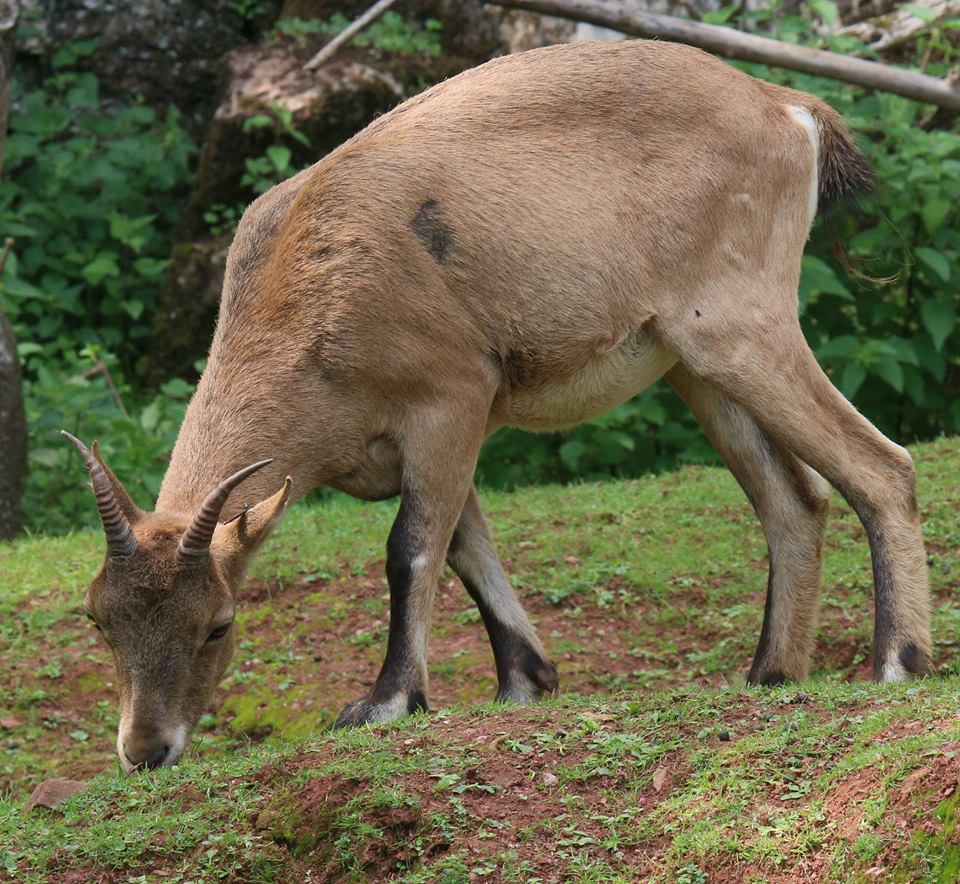
It has been shown previously that dogs and horses have the ability to discriminate human emotional facial expressions.  This is thought to be a by-product of their close working relationships with humans during domestication.  Because dogs and horses are required to work together an understanding of human emotional facial expressions is actively an advantage making the attribute self-selecting.  In contrast, goats have been exclusively domesticated as production animals and as such are less likely to have been selected for reading subtle communicative cues from humans.  A study carried out at the Buttercups Sanctuary for Goats, suggests otherwise however.

A Goat
– Image from pexels.com

A total of twenty goats were tested (eight females and twelve males), receiving a total of four test trials each.  Each trial consisted of a pairs of greyscale still human faces of the same individual showing positive (happy) and negative (angry) facial expressions and over all the trials, the goats’ first interactions were more often with the positive image.  They also tended to spend more time with the positive image compared to the negative one, indicating that goats can distinguish between human faces conveying different emotions.  These results suggest that goats are attracted to “happy faces”, and have been reported by McElligott and co-workers in the Royal Society journal Open Science.1

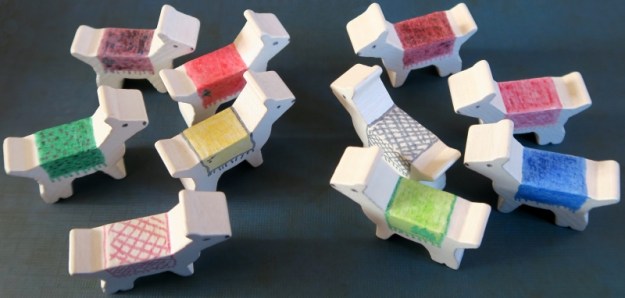
A Flock of boardGOATS
– Image by boardGOATS

1 Nawroth, C., Albuquerque, N., Savalli, C., Single, M-S., McElligott, A. G., R. Soc. Open. Sci. (2018), 5, 180491; doi:10.1098/rsos.180491.

Next Meeting – 21st August 2018

Our next meeting will be on Tuesday, 21st August, at the Horse and Jockey pub in Stanford-in-the-Vale.  As usual, we will be playing shorter games from 7.30pm as people arrive, until 8pm when we will start something a little longer.

This week the “Feature Game” will be Lancaster, a worker placement game set in the time of Henry V.  Players develop their knighthood, deploy individual knights in the counties of England, work on their own castle, and send them off to the wars in France.  We’ve played Lancaster a few times, but it’s a good game and it’s been a little while since it last got an outing.

Lancaster
– Image used with permission of BGG contributor kilroy_locke

And talking of Plantagenets…

Jeff was visiting a friend in Leicester when he came across the Richard III Visitor Centre.  He had never been much good at History at school, so before paying the entry fee, he wanted to know what it was all about.  The volunteer on the gate was very keen to explain, “Richard III was the last of the Plantagenet Kings who died at the Battle of Bosworth Field in 1485, but nobody knew where he was buried.”

Jeff was puzzled, “So how did you know he’d died then?” he asked.

“Oh,” replied the guide, “We’ve found him now, we found him a few years ago, in a carpark, and he’s been reburied in Leicester Cathedral.”

“Oh right,” answered Jeff, “I’d have thought he’d have been flushed down the toilet like all the other Richard III’s…”

7th August 2018

Largely due to holidays and work, for the first time in months, we only had enough players for one game.  Blue and Pink were first to arrive and, while they were waiting for their pizzas, they played a quick game of Honshū.  This is a game that Blue had played with Black and Purple about a year ago when Black and Blue agreed it was a very, very clever game.  Somehow though, it hadn’t got another outing until last week at the Didcot Games Club, when Blue introduced Pink to it.  He really enjoyed it and was keen to give it another go.  It is a trick taking game, so it plays a bit differently with two.  The idea is that players start with a hand of six cards; two cards are drawn at random from the deck to make one pool, and the players play a card each to make the second pool.  Each card features six districts and a number – the player who wins the trick by playing the highest number chooses one pool and then chooses a card from that pool.  The other player does the same with the second pool.

Honshū
– Image used with permission of
BGG contributor  HedgeWizzard

The players then add the cards to their city. Each card is divided into six districts, each of which scores in a different way at the end of the game. For example, every district in their largest city, players score a point. Similarly, all forest districts score two points. More interestingly, a single water district is worth nothing, but water districts connected to it after that are worth three points each. Perhaps the most interesting are the factories which only score if they are supplied with the appropriate resources, wooden cubes that are placed on resource producing districts.  These resources can also be used increase the value of cards when they are played, in the two-player game this is only by the losing player who can guarantee a win by paying a resource.  One of the biggest challenges is choosing the cards though. When the cards are placed, players must take care to make sure that they either partially cover (or are covered by) at least one other card. This, together with the fact that players are trying to expand their largest city and any lakes makes choosing and placing a card really difficult as there are many options to explore.

Honshū
– Image used with permission of BGG contributor msaari

Despite playing it a couple of times, neither Blue nor Pink have really understood how the game plays which is probably what makes it interesting.  After the first three rounds, in the two-player game, players swap their remaining three cards and are supposed to add another three (repeating this after the sixth and ninth rounds).  Unfortunately, Blue misunderstood the rules for some reason, so instead, they swapped hands after three tricks, refreshed their hands to six cards at half-way and swapped hands again after nine.  This simplifies the game a lot, as the obvious strategy is to play high cards early and then hand all the dross over to the other player who is forced to play them.  It also introduces a lot of luck, and while we like luck in the right place, the game would definitely be more interesting with the rules as written.  Blue won, but it is definitely one to play again, and correctly this time.

Honshū
– Image used with permission of BGG contributor bkunes

With Burgundy’s arrival and then Green’s, and food out of the way, we moved onto the “Feature Game”, Altiplano.  This is a bag building game that re-implements some of the mechanisms found in one of our more popular games, Orléans.  Like Orléans, Altiplano has two phases: planning and carrying out.  The idea is that players start off with a handful of resource tokens and, on their turn can draw a number of these out of their bag, placing them on their personal worker board.  Simultaneously, players then place them on the action spaces on their board.  This usually takes a little time as everyone is trying to maximise their return.  And this is where it differs significantly from Orléans where everyone can more or less do whatever they want, whenever they want.  In Altiplano, there is a central circle of locations, and actions can only be carried out when player’s meeple is in the appropriate area.  There are seven locations and players get one movement of a maximum of three spaces for free on each turn.  This means it is possible to get to any location, but only one of them, unless they pay a food token which will allow them another move, but only a single space.  Thus getting the planning right is essential.

Altiplano
– Image used with permission of boardgamephotos

In the action phase, players must take an action, or pass.  Once they’ve passed, they cannot have another turn.  Before or after they take an action, players may move if they are able to.  This effectively means that players can carry out actions in two locations per turn, unless they pay for more.  Once a token has been spent, it it goes into a little cardboard crate where it stays until the player’s bag is empty.  This means that unlike Orléans, every token must come out of the bag and be placed; there is no element of chance except in the timing.  Thus, instead of playing with probability, the game is now all about controlling what’s in the bag and knowing what can come out and when.  Anyone who’s played Orléans and felt that their Monks have entered a closed order in the corner of their bag will really appreciate this.  However, it also means rubbish can be even more costly as it WILL come out and must be used.  Worse, any rubbish will will eventually go back in the bag and have to be dealt with again, and again and again…

Altiplano
– Image used with permission of boardgamephotos

It is possible to get rid of resources:  they can be placed into the player’s personal warehouse. Once they are in the warehouse though, they can’t be taken out again and as all resources are limited, it may not be possible to obtain a replacement.  Placing resources in the warehouse is done by visiting the Village and is a useful thing to do as it is one of the ways to score points.  Most resources are worth points at the end of the game, but in addition to this, full shelves in the warehouse score bonus points.  Each shelf can only hold one type of resource, and the higher shelves score more points.  Getting resources is therefore important, but they have to be the right resources as the warehouse isn’t the only strategy available.  At the Village location, players can also buy Hut cards which depict one resource and give players extra points for that resource at the end of the game (as well as a little bonus).  In the Market, it is possible to “sell” goods (they still go back into circulation though), and buy Contract cards which give points when completed.  Players can only work on one Contract at a time, but once they are finished, they can be worth a lot of points.

Altiplano
– Image used with permission of boardgamephotos

The Market will probably be one of the most visited locations as players can also buy “Extensions” to their player board.  These are really key to playing the game well, as without them there are lots of resources that are difficult to get.  In addition to the Village and Market, there are five other locations to visit:  the Farm, the Forest, the Mines, the Harbour and the Road.  The first four of these are mostly about using one sort of resource to get another (e.g. using an alpaca and some food to get wool, or using two fish to get stone).  All resources acquired in this way go into the recycling crate to be used on a later turn.  The Road is slightly different as it features a track similar to the Knights track in Orléans, and players’ position on the road dictates how many resource tokens they are allowed to place in the planning phase.  Like Orléans, players don’t have to place their full quota of tokens on action spaces, but these will block spaces for their next turn if they don’t (which can be doubly damaging as it prevents more useful things coming out of the bag).  The Road has to be built though, and it costs a wood and a stone to travel along the path.  Some steps give Corn instead, and this has to be placed in the warehouse, but it can be very useful as it is “wild”, so can help fill those difficult rows where resources are scarce.

Altiplano
– Image used with permission of BGG contributor JackyTheRipper

The game is not terribly complicated in itself, but there is a surprising amount of thinking to be done and, like all great games, players always want to do many more things than they are able.  Blue had played Altiplano with Pink a couple of times, and Burgundy had read the rules and watched a video, so the rules explanation was really for the benefit of Green.  Unfortunately, he was too interested in playing with his phone to pay attention, which might explain why he made such a mess of things later on.  To be fair, everyone was interested in the difference between an alpaca and a llama (apparently llamas have long banana-shaped ears and are roughly twice the size of an alpaca, but alpacas have softer fleece and are a bit more skittish).  We all had a good laugh at the jumping alpaca footage too, but even after all that and everyone else focussed on the game, it was clear Green’s attention was elsewhere.

Altiplano
– Image used with permission of BGG contributor Mouseketeer

At the start of the game, everyone gets a character card which dictates their starting resources and gives them a special action.  Green was the Woodcutter, Blue was the Shepherd, Pink was the Miner and Burgundy was the Farmer, giving them access to Wood, Wool, Ore and Alpacas respectively.  Blue and Green started with only three resources (and an extra coin), which didn’t seem to bother Green much.  Blue felt it was a big disadvantage though, especially as it wasn’t clear to her what strategy the Shepherd encouraged.  In the absence of anything better, she started off going to the Market and buying an Extension, and using her Alpaca to make some Wool in the hope that things would become clearer in time.  Green on the other hand, began with the obvious tactic and used his Woodcutter to get some wood.  For Burgundy, the priority was to increase the number of resources he was able to place in each round, so he began by trying to get the stone he needed to start building his road.

Altiplano
– Image used with permission of boardgamephotos

Pink had a two-pronged strategy, planning to go for the three point resources  (especially Silver as he had the Miner which meant he could get plenty of Ore).  This was because they were less difficult to get than Glass, but were still worth a lot, especially if augmented with a Hut bonus.  So that was the second part of his plan: get lots of Hut cards from the Village as they give a small bonus anyhow, and by taking them he was depriving everyone else.  As Burgundy started to build his road, Blue and then Pink decided to join him.  Eventually Green followed suit, but it wasn’t until he was several steps along the road that it became clear that he hadn’t actually been visiting the road to build it.  He explained that he didn’t think it was necessary as the road was different and it had been positioned very slightly out of the line of the circle due to the slightly cramped space.  Everyone else had been visiting properly though, so if he’d been concentrating on the game and watching what others were doing (instead of playing with his phone), it probably wouldn’t have happened.

Altiplano
– Image used with permission of boardgamephotos

Meanwhile, Pink was continuing to collect Huts and Silver, and Blue had another Extension, was buying lots of Cocao and using it to get Glass (or occasionally Food or Cloth).  It was around this time that Green began to join Pink collecting Huts.  Burgundy was just beginning to get his game off the ground when he got into a bit of a tangle.  He had positioned himself to move onto his third step along the Road, but that gives Corn and he really didn’t want to take it yet as it would have to go into his Warehouse.  Since he didn’t have any resources in his Warehouse yet, it would mean he would have to start a shelf with Corn.  The problem with this is that any corn he got later would have to go on that shelf too, rather than padding out any other, scarce resource.  Eventually, Burgundy managed to sort out his problem, but it took a couple of turns and set him back just long enough for Blue to buy the Extension he had his eye on (again).

Altiplano
– Image used with permission of BGG contributor JackyTheRipper

The game was entering its final stages and Blue began filling her Warehouse, trying to keep the size of her bag down.  She was helped by the Extension she’d grabbed from under Burgundy’s nose which allowed her to place an extra item in the Warehouse on each visit.  Everyone else followed, and began worrying about what they needed to maximise their bonus points.  Everyone that is except Green, who was still fiddling with his phone despite the fact that his friend had apparently gone to bed.  The game end is triggered when either there aren’t enough Extensions left to fill the Extension Strip, or one of the locations is completely exhausted.  When Green took the last Glass token, everyone had just one more round to maximise their bonus points.  Blue and Burgundy fought to try to get the last Extension that allows players to draw an extra ten tokens out of their bag and put them straight in the Warehouse at the end of the game.  This time Burgundy won, as Blue discovered that she didn’t need it anyhow because she could use Corn to do the job, and as she didn’t have the right resources in her bag it wouldn’t have helped her in any case.

Altiplano
– Image used with permission of boardgamephotos

Eventually, the game petered out as there was nothing more people could do and players began adding up their scores.  Burgundy had struggled throughout and Pink’s experience and Hut strategy had worked well.  It was very, very close at the front though with just three points in it, and much to everyone’s surprise given how much attention he wasn’t paying, Green finished just ahead of Blue with a hundred and six to her hundred and three.  He was obviously pleased and professed to have liked the game despite not really focusing on it.  It was when Burgundy commented on all the Wood and the Glass that he had, that someone asked where Green had got all the Glass from.  As Green explained that he’d got one from a Hut, it all came out.  Every time he’d taken a Hut card, he’d taken a resource (perhaps confusing them with Boat cards).  He said it wouldn’t really have made much difference, although he wouldn’t have won as he’d have had fewer resources and therefore maybe ten points less, leaving him in second place.  Burgundy pointed out that the advantage he got from all those resources during the game was incalculable, added to which, taking the last Glass ended the game early preventing others from scoring more.  Normally nobody would have minded as everyone makes mistakes from time to time, but as Green had been playing with his phone all evening and not concentrating, we decided there was no cause for a llama, and just disqualified him.

Altiplano
– Image used with permission of boardgamephotos

Learning Outcome:  Playing with your mobile phone means you make mistakes which upset the balance of the game.

Next Meeting – 7th August 2018

Our next meeting will be on Tuesday, 7th August, at the Horse and Jockey pub in Stanford-in-the-Vale.  As usual, we will be playing shorter games from 7.30pm as people arrive, until 8pm when we will start something a little longer.

This week the “Feature Game” will be Altiplano, a bag building game that re-implements some of the mechanisms found in Orléans.  Players must build an effective production engine as well as deliver the right goods at the right time and store goods cleverly enough to fill the most valuable areas of their warehouse, all the while being scrutinised by a large cardboard alpaca…

Altiplano
– Image used with permission of boardgamephotos

And talking of alpacas…

Jeff was visiting his South American cousin, José, who farmed alpacas up on the high planes in the Andes.  Alpacas are quite substantial beasts and very nosy, so were very interested in this newcomer from Europe.  Jeff, on the other hand, was a more than a little intimidated by the large shaggy creatures.  José was very understanding though, and explained that they were really very friendly adding, “There’s really no cause for a llama…”

24th July 2018

It was a quiet night, and the atmosphere was slightly subdued as our thoughts were with Green who had had a very rough day and therefore wasn’t with us.  Burgundy and Blue were still eating, so Pine, Red and Ivory began punching out Pine’s brand-spanking, new copy of the “Feature Game”, AzulThis week, Azul won the Spiel des Jahres Award, but despite the fact that it only came out at Essen last year, and has been difficult to get hold of for much of the time, we’ve still managed to play it a lot.  Even so, Red seemed to have managed to miss out, so an explanation of the rules was in order.  It is quite simple to play, if a little abstract.  The idea is that players are tile laying artists decorating a wall in the Palace of Evora with “azulejos”.  On their turn, the active player can either take all the tiles of one colour from one of the factory displays (putting the rest in the central market) or take all the tiles of one colour from the market in the centre of the table.  They then place the tiles in one of the five rows on their player board.

Azul
– Image used with permission of BGG contributor JackyTheRipper

Each row can only contain one colour, but players may have more than one row with any given colour.  The catch is that each player only has five rows, each with a set number of spaces, one to five.  Players can add tiles to a row later in the round, but once a row is full, any left-overs go into the negative scoring row.  Once all the tiles have been picked up, players evaluate their board, and, starting with the shortest row, one of the tiles from each full row is added to the player’s mosaic and scored. Players score one point for a tile that is not placed adjacent to any other tile, whereas tiles added to rows or columns score the same number of points as there are tiles in the completed row (or column).  The game continues with players choosing tiles from the factory displays and then adding them to rows, the catch is that as the mosaic fills up, it is harder to fill the rows as each row can only take each colour once.

Azul
– Image used with permission of boardgamephotos

End game bonuses, keep everyone guessing right up to the end which adds interest and occasionally it can be really nasty when someone ends up with a pile of tiles they can’t use.  Red, Ivory and Pine got going quickly, and once Burgundy and Blue had finished with their supper, they moved to a table near the door to make the most of the draught and started a second game with Black and Purple.  Having played the game quite a bit, nobody pulled their punches:  It was only the second round when Blue had to pick up ten yellow tiles netting her fourteen negative points.  She was fortunate that she didn’t have fourteen to lose, but when Black picked up seven yellow tiles a couple of rounds later he was less lucky.  On the next table Ivory was being nasty to Pine, leaving him with Hobson’s Choice and minus ten points either way.  Playing “dirty” clearly worked for Ivory as he won the first game, though there was some confusion of the scoring, which Pine blamed on his over-hot head.

Azul
– Image by BGG contributor JackyTheRipper

In the other game, there had been a lot negative points and a lot of bonuses, it was all surprisingly close.  In the last round, Purple took the tiles she needed for a full set of reds and Blue had scotched a ten point bonus for Burgundy.  Despite that, Burgundy still picked up a massive twenty-seven points in end-game bonuses, but much to everyone’s surprise he didn’t quite manage to catch Black who finished with a eighty-five.  It had been quite a stressful game, but as usual, we’d all enjoyed it, and discussion moved on to the new release coming in October: Azul: Stained Glass of Sintra, which we are all looking forward to, as long as it doesn’t “do a Queendomino“.*

Azul
– Image used with permission of BGG contributor Toynan

Red, Pine and Ivory had started their game first, and with only three players compared with four on the other table, it was no surprise that that also finished first.   As they were looking round for something to play, Red spied Yardmaster, one of her favourite games, in Blue’s bag.  Neither Pine nor Ivory had played it before, but it wasn’t difficult for Red to persuade them to give it a go.  Unlike most other train games, in Yardmaster, players are building a locomotive rather than routes.  On their turn players can do two from the three possible actions:  draw a cargo card (either blind or from the face up discard pile); buy a railcar card from the four face up cards in the middle, or swap their “Exchange Token” with any other one around the table.  To buy a railcar, players pay using sets of cargo cards, so a yellow number three railcar will cost three yellow “oil” cards.  The exchange tokens allow players to use other cargo cards at a rate of two-to-one, however, if a player only had two yellow oil cards but also had two blue “coal” cards and the blue exchange token, they would still be able to buy the yellow number three railcar.

Yardmaster
– Image used with permission of BGG contributor joeincolorado

When buying a railcar, if the number or colour match the previous car, then it must be added to the end of their locomotive.  If not, then players can park it in their personal sorting yard and add it later, when another railcar is being bought and added to the locomotive.  This is the clever part of the game as it allows players to “stack” points in their personal train yard enabling them both to take some risks and strategically remove railcars from the grasping hands of their opponents.  Players score is the total of the numbers of the on the railcars making up their locomotive at the end of the game.  Ivory started out with a really clever move, using a discarded “extra move” cargo card to take another “extra move” card and Pine and Red thought it was all over before it had begun.  It wasn’t though, and despite it being a very short game, Ivory quickly got bogged down trying to buy a high value, “Purple Four”, which gave both Red and Pine the chance to get past him.  Although he was new to the game, it was clearly one that made sense to Pine who finished four points ahead of Red.

Yardmaster
– Image used with permission of BGG contributor moonblogger

As both games finished Blue, Burgundy, Black and Purple moved back to the group’s usual table and the options were discussed.  With seven players and Red present, Bohnanza was always a possibility, but with the heat sapping everyone’s strength, nobody fancied playing anything too strenuous and the deal was sealed.  Everyone is very familiar with this, even Ivory who has played it the least, so as Burgundy shuffled the deck and removed the cocoa and garden beans, everyone else reminded each other of the rules:  must plant the first card in hand, may plant the second as well; turn over two cards from the deck which must be planted before any other deals can be finalised; trading can only be with the active player; draw four cards at the end of a turn; two coins for a third bean field; fields with only one card can’t be ploughed in unless they all have only one card, and don’t forget – you can’t rearrange your hand!

Bohnanza
– Image used with permission of BGG contributor spearjr

As usual with a large number of players, it was a tight game and everyone spent most of it telling people not to trade with everyone else as they were winning.  Three times through the deck doesn’t take long and people don’t get many turns, but it was Blue, Black and Purple who stood on the podium at the end with everyone else within a point of each other.  It was Blue who made up for her dire showing in Azul though, beating Black into second place by a massive two points.  There was still time to play something else, but the heat had clearly got to everyone as the conversation degenerated into a discussion about everyone’s favourite childhood cartoons and how many had inspired boardgames.  The late, great Peter Firmin‘s Ivor the Engine and Noggin the Nog both got a mention, but then age and nationality created a bit of a divide, and the evening ended with Pine crowing, “My name’s Pig and I like cream cakes!”  His head was definitely over-hot.

Pipkins
– Image taken from youtube.com

Learning Outcome:  Children’s TV programs were very weird in the 1970s.

* Queendomino is the follow-on to the 2017 Spiel des Jahres winner, KingdominoWhen the group played it, we found the new game replaced the smooth elegance of the original with a more clunky, complex, long-winded game that was no where near as good as the games it was trying to compete with (much like Tsuro of the Seas a couple of years before).

Boardgames in the News: Who are PAI Partners and what do they want with Asmodee?

A couple of months ago, Reuters reported that according to un-named sources, investment bankers had been hired to run the sale of Asmodee.  The claim was that the sale “could value the company at over €1.5 billion”, but there was no credible information as to who the potential buyers were.  This mystery has now been solved with the announcement that PAI Partners have entered into exclusive discussions to acquire Asmodee, a company with an enterprise value of €1.2 billion.  So, who are PAI Partners and what do they want with Asmodee?  Well, PAI is a European private equity company, that grew out of the merger between the French banks, BNP and Paribas in 1993, with a management buyout completed in 2001.  They have invested in a wide range of companies covering everything from yoghurt (Yoplait) to tyres (Kwik Fit) to cargo handling (Swissport).  Obviously PAI are interested in making money from Asmodee, but at this time there is no evidence to suggest that would by by asset stripping.  Price increases would be almost inevitable however, as the Studios would be under pressure to provide a good return on the investment.

PAI Partners
– Image from paipartners.com

Next Meeting – 24th July 2018

Our next meeting will be on Tuesday, 24th July, at the Horse and Jockey pub in Stanford-in-the-Vale.  As usual, we will be playing shorter games from 7.30pm as people arrive, until 8pm when we will start something a little longer.

This week the “Feature Game” will be Azul, an abstract game, with a very, very loose theme where players are tile laying artists decorating a wall in the Palace of Evora with “azulejos”.  We have chosen this game to celebrate the fact that it has just received the coveted Spiel des Jahres award.

Azul
– Image used with permission of boardgamephotos

And talking of Palaces…

Jeff was visiting Buckingham Palace.  After a tour of the house and grounds, the visit finished at the Royal Stables.  As he wandered around he saw an elderly lady in a head-scarf and realised he was in royal company.  He was standing quietly admiring a magnificent stallion when suddenly it passed wind so loudly it couldn’t be ignored.

“Oh dear,” said the Queen, “How embarrassing. I’m frightfully sorry about that.”

“It’s quite understandable,” replied Jeff, and after a moment, added, “As a matter of fact I thought it was the horse…”

Spiel des Jahres Winners – 2018

The 2018 winner of the coveted German Game of the Year or Spiel des Jahres award is Azul.  This has been a very popular game within the group and to us has been the stand-out game this year since Essen.  It is very easy to teach with a surprising amount of depth and is beautifully produced, making it a game we are always happy to play.  The Kennerspiel des Jahres was awarded at the same time.  This honours more challenging games and this year was awarded to Die Quacksalber von Quedlinburg.  So far this has only been released in German, so we have not been able to play it yet.  In addition, there was a special award for for Pandemic Legacy: Season 2, which the jury felt was the benchmark against which all other legacy games should be judged.  The Kinderspiel des Jahres award was announced last month and went to Funkelschatz (aka Dragon’s Breath) which is dexterity gem collecting game.

Azul
– Image used with permission of boardgamephotos

10th July 2018

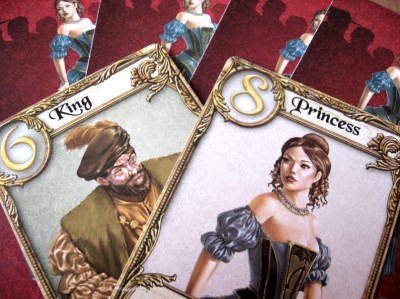
While those eating finished, we welcomed an old friend from the Didcot Games Club on his first visit, and began the evening began with a quick game of an old classic, High Society.  Designed by Reiner Knizia, this is a light bidding game with a catch, in the mold of games like For Sale, No Thanks!, Modern Art, and perhaps our old favourite, Las Vegas.  First released over twenty years ago in the designer’s heyday, a beautiful new edition has recently been published by the Cumnor Hill-based company, Osprey Games.  In High Society, everyone starts with the same set of money cards, each numbering from 1,000 up to 25,000 Francs.  The game is all about correct valuations. Players take it in turns to bid for the luxury objets d’art for sale, however, when they increase their bid, they add money cards to their personal bidding pile, and there is no concept of change.  Thus, as the game progresses, players have fewer and fewer bidding options  as they spend their money cards, and are increasingly forced to big large amounts potentially for relatively low value items.  Some of the objects for sale are not so much art, as artless, and can halve a player’s score, lose them points, or even cause them to discard something they purchased previously and the first person to withdraw, “wins”, while everyone else pays whatever they wagered.

High Society
– Image by boardGOATS

The other twist is at the game end which occurs abruptly when the fourth “end game” card comes out.  At this point, the player with the least money at the end is eliminated regardless of the value of their luxurious objects.  Despite the age of the game, a lot of people were new to it, and as the valuation of the luxuries is the key, some people found knowing how much to bid challenging.  As is the case with this sort of game though though, until the scores were actually calculated nobody knew who was winning, especially as the money was tight at the bottom.  Purple and Black (or “The Dark Destroyer as Ivory called him”) had pots of cash, but Red was just eliminated ahead of Yellow.  That left the final count:  Black was by far the most efficient, with a score of fourteen, two more than ivory – quite remarkable given the amount of cash he had left at the end.  It was Yellow though, who having just escaped elimination, finished some way in front with nineteen points.

High Society
– Image by boardGOATS

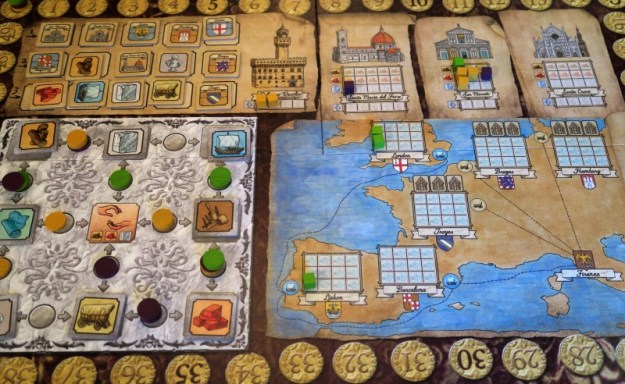
With everyone fed and High Society over, we split into two groups: one to play the “Feature Game” (which was to be Keyflower) and the rest to play something else.  As always, the issue was what the other game was to be and almost everyone was happy to play Keyflower, but for some, the final decision depended what the other game was to be.  The problem was that the choice of the second game depended on who was going to play it.  Eventually, Purple broke the deadlock when she said she would be happy not to play Keyflower.  With Red having requested it in the first place, and it being Blue’s favourite game, it was just a matter of who would fill the remaining seats.  In the end, Pine, Burgundy and Ivory joined Red and Blue, leaving Yellow, Black and Purple to play Calimala, an area-influence driven, worker-placement game set in the Republic of Florence during the Late Middle Ages.

Calimala
– Image by boardGOATS

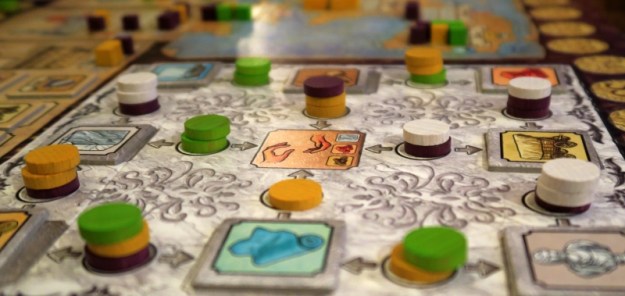
This is an unusual game with variable setup to keep it fresh.  The idea is that on their turn, players place one of their workers on one of the twelve worker spaces.  Each one of these is adjacent to two of the nine action spaces. If there is already a worker disk present on the space, once the active player has carried out their actions, then the other player gets another turn.  This continues until a player places the fourth disk on a stack: actions are carried out for the top three disks and the fourth is placed on the first available scoring tile which is then triggered.  Each player has some worker disks in their own colour and a small number in white.  Coloured disks give players a maximum of two actions on three occasions (i.e. a total of six), while white disks give four actions when played, but none later in the game.  The actions include acquiring resources (brick, wood or marble), building (ships, trading houses or workshops), create artwork, produce cloth, transport cloth, and contribute to the building of the churches.

Calimala
– Image by boardGOATS

The fifteen scoring phases are built on the actions, rewarding players for the amount of cloth they have shipped to a given city or combination of cities for example, or for their contribution to a specific building, or their contribution to the building effort of a given resource.  In each case, the player with the most scores three points, the player in second place scores two and the player in third gets just one point.  In case of a tie there is a complicated series of tie-breakers.  The game ends when either all fifteen tiles have been scored, or everyone has placed all their workers (in which case any remain tiles are scored).  It was another close game:  “The Dark Destroyer” scored heavily for the cloth in the Port Cities (Barcelona, Lisbon and London), while Purple scored for the trading cities (Troyes, Bruges and Hamburg).  Calimala is one of those games that rewards players who score “little and often”, and it was Yellow who managed to score most frequently.  There were a lot of tie-breaks however, particularly between Yellow and Black and it was probably the fact that Yellow did better in these that tipped the balance, as he finished just ahead of Black with a winning score of forty-five points.

Calimala
– Image by boardGOATS

Keyflower was still under way, so the players looked around for something quick to play and picked one of Yellow’s favourite games, Red7.  On the surface, this is a fairly simple game, but underneath it is much more complex.  The game is played with a deck of forty-nine cards, numbered one to seven and in seven different colour suits.  Each player starts with seven cards in hand and one face up on the table.  The player with the highest value card is “winning” because the rule at the start is that the highest card wins.  On their turn, each player can play one card from their hand into their tableau in front of them, or play a card into the centre which changes the rules of the game (a little like Fluxx), or they can do both.  If they cannot play a card or choose not to, they are out of the round.    In the event that there is a tie and the highest face value is displayed by more than one player, the tie is broken by the colours with red higher than orange and so on through the spectrum to violet.

Red7
– Image used with permission of BGG contributor punkin312

The colours also dictate the rules, so any red card played in the centre will change the rules to “the highest” wins.  Similarly, any orange card played in the centre changes the rules so that the winner is the person with the most cards of the same number.  In each case, if more than one player satisfies the rules, the tie is broken by the card that is highest (taking into account both number and colour).  Thus, if the rule is “the most even cards” and there are two players with the same number of even cards in front of them, the player with the highest even card is the winner.  At the end of their turn, the active player must be in a winning position, or they are out of the round. The round continues until there is only one player left.

Red7
– Image used with permission of BGG reviewer EndersGame

We last played this a few years back when we made rather heavy weather of it.  Part of the problem was that there were several of us and we were all new to it.  This meant we struggled without someone to lead the way.  With Yellow very familiar he was able to show everyone else how to play.  Inevitably, this meant he won (giving him a hat-trick).  The game was played over five rounds and at the end of each round the player who was left at the end kept their highest cards.  With Yellow so much more familiar with the game than anyone else, it was inevitable that he would be able to build on this, and he made the most of it.

Red7
– Image used with permission of BGG contributor punkin312

By this time, the next table were just coming to the end of their game of Keyflower, and we had all found it unusually hard going, that is to say we all struggled to find anywhere to score points.  The premise of the game is quite simple:  over four rounds (or seasons) tiles are auctioned using meeples (or Keyples) as currency.  The clever part is that to increase a bid, players must follow with the same colour.  Keyples can also be used to perform the action associated with a tile, any tile, it doesn’t have to be their own, but each tile can only be used three times in each round and, again, players must follow the colour.  The aim of the game is to obtain the maximum number of victory points at the end.  However, the highest scoring tiles aren’t auctioned until the last round (Winter), so players have to keep their options open.  On the other hand, the tiles that are auctioned in Winter are chosen by the players from a hand of tiles dealt out at the start, so players can choose to take a steer from that, or, if things go badly wrong, decide not to include certainly tiles.

Keyflower
– Image by boardGOATS

These games are nearly always memorably epic and this was definitely no exception.  The game started of with Ivory declaring that while he loved it, he thought it was maybe “a bit broken” because in his experience, there was one winter tile that would guarantee a win to the player that got it.  Blue and Burgundy thought they knew he was referring to “The Skill Tile Strategy” and agreed it was powerful, but felt it wasn’t over-powerful.  Blue said she thought it was only a guaranteed win if everyone else allowed it.  Pine suggested that playing the game would give Ivory another opportunity to gather evidence to see if this was the case.  As soon as the winter tiles were dealt out, it was clear that Ivory had one of the tiles that rewarded players with lots of Skill Tiles, and everyone knew what his strategy was going to be.

Keyflower
– Image by boardGOATS

Spring started and it quickly became clear that it was going to be a fight.  Initially, Blue went for the Peddler which converts yellow Keyples into Green ones, but Pine thought that sounded good, and outbid her.  Next she went for the Miner which gives two coal, upgradable to three, but Red outbid her on that.  Somewhat in error she tried to get the Woodcutter which gives two wood (upgrading to a wood and a gold), but Burgundy outbid her.  Ivory also got in on the act, beating her to the Keystone Quarry, which meant Blue finished spring with no Village tiles at all.  At least she didn’t over-pay for anything though, and it meant she had plenty of Keyples to bid with for Summer, at least in theory.  The lack of tiles meant she didn’t have a strategy though, while everyone else was beginning to build theirs.

Keyflower
– Image by boardGOATS

With summer came a whole new set of interesting tiles, for Ivory, that included the Hiring Fair which gives two tiles in exchange for one (upgradable to three tiles for one).  Given that Ivory had telegraphed his plans, and that Burgundy took one for the team during Concordia last time (when he took the Weaver and gave everyone else a chance), Blue felt it was her turn and she made it her business to outbid him, even though this gave her a tile she had very little use for.  As the only one with any meeples to speak of, Blue managed to pick up three boats relatively cheaply too.  She didn’t have it all her own way though, as Pine took the Farrier (extra transport and upgrade ability) and Ivory took the Brewer who turns skill tiles into Keyples.

Keyflower
– Image by boardGOATS

Unusually, there had been a lot of bidding for the end of season tiles and it came to a peak in autumn with everyone jostling for position for the final round.  The other tiles were generally less popular, however, and most people were trying to keep their Keyples to themselves where possible, hoarding them for the final round.  And it was in the final round that it all came to a head.  Everyone had to put in at least one tile, but nobody seemed terribly keen to put any in.  Blue had contrived to win the start Keyple at the end of autumn, and started by bidding for the Key Guild tile which had been put in by Ivory.  Inevitably this descended into a bidding war, which Blue won.  The Key Guild tile gives ten points for any five skill tiles, so Blue was finally able to use her Hiring Fair to get points. Having had his plans scuppered, Ivory moved on to messing with Pine’s plans, while Red engaged Burgundy in a bidding war for the Jeweller tile (which increases the value of gold from one point to two), and lost.

Keyflower
– Image by boardGOATS

It had been a  really tough game with points really hard to get hold of, and that was visible in the scores.  It was very tight with just six points covering Red, Burgundy, Ivory and Pine and all of them in the low to mid forties.  Blue finished with sixty-one however, thanks largely to her twenty points for her skill tiles and sixteen for her boats.  It had been a very stressful game, that led to a considerable amount of discussion.  Ivory felt the fact that Blue had won using skill tiles confirmed that they were over-powered, but Pine and Burgundy were less certain, so the jury is still out.  Blue said that every game was different and the point was that it was up to other players to stop the person who is making a beeline for skill tiles, in fact, that was exactly what she had done to Ivory, as he put that tile out in winter.  The discussion would have continued, however, it was getting late and people began to leave.

Keyflower
– Image by boardGOATS

Pine, Burgundy and Blue felt there was just time for a quick game of NMBR 9.  This little game has been a real success within the group, mostly at the start as a warm-up game, but occasionally as filler too.  Pine took the deck of cards and began turning them over, with everyone else taking the number shaped tiles and adding them to their tableau.  It was another tough, tight game, but Blue managed to squeeze one of her eights on to the fourth level giving her twenty-four points for that tile alone.  Aside from that, the levels and therefore the scores were very similar, so Blue took victory by twenty-one points from Pine in second place.

NMBR 9
– Image by boardGOATS

Learning Outcome:  Sometimes it is better to keep your plans to yourself.

Next Meeting – 10th July 2018

Our next meeting will be on Tuesday, 10th July, at the Horse and Jockey pub in Stanford-in-the-Vale.  As usual, we will be playing shorter games from 7.30pm as people arrive, until 8pm when we will start something a little longer.

This week the “Feature Game” will be Keyflower, which is a tile laying game with an unusual auction mechanic implemented using meeples. We’ve chosen Keyflower because it is one of our favourite games, and one particular member keeps asking to play it and then misses out.

– Image by boardGOATS

And talking of auctions…

Jeff went to an auction and bought a Stradivarius and a Rembrandt.  He was very happy with them since the price he paid was remarkably low, and even he had heard the names.  Although he knew they were valuable, Jeff had no idea how much they were actually worth, so he decided ask a valuer to put a number on his windfall.

In response to his query, the valuer explained, “Well sir, this is indeed a Stradivarius and that is a Rembrandt, but it’s a great pity that Stradivarius couldn’t paint and Rembrandt couldn’t build violins…”