Next Meeting – 10th May 2018

Our next meeting will be on Tuesday, 10th May, at the Horse and Jockey pub in Stanford-in-the-Vale.  As usual, we will be playing shorter games from 7.30pm as people arrive, until 8pm when we will start something a little longer.

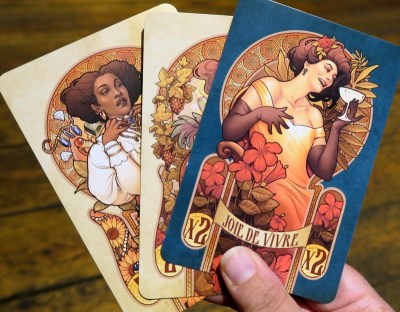
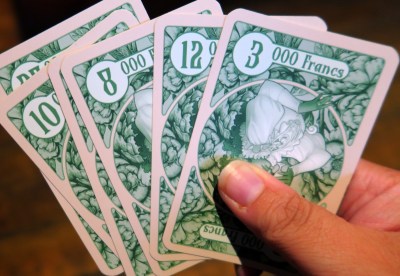
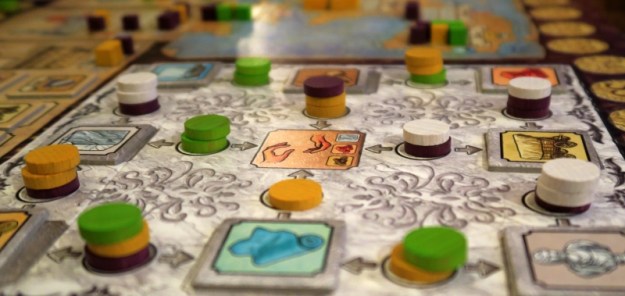
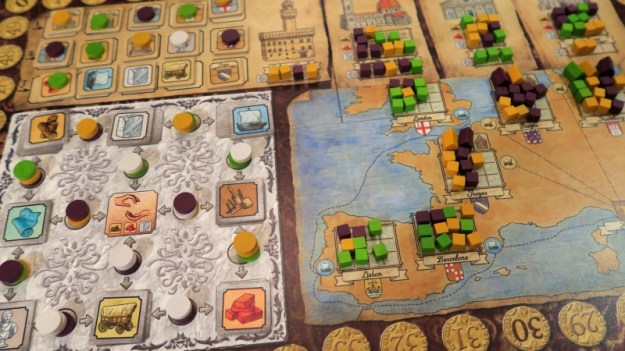
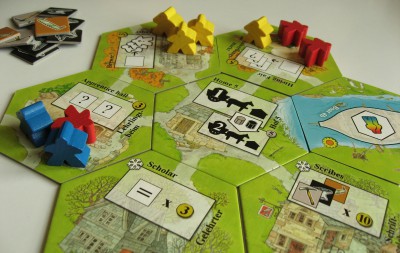
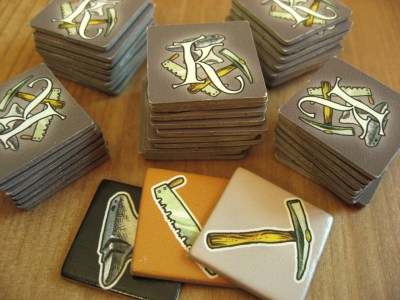
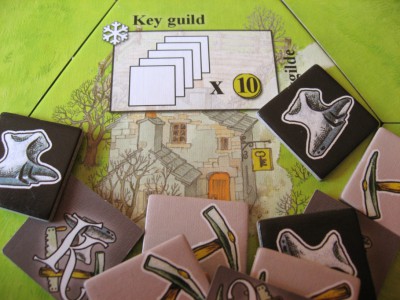
This week the “Feature Game” will be Keyflower, which is a tile laying game with an unusual auction mechanic implemented using meeples. We’ve chosen Keyflower because it is one of our favourite games, and one particular member keeps asking to play it and then misses out.

– Image by boardGOATS

And talking of auctions…

Jeff went to an auction and bought a Stradivarius and a Rembrandt.  He was very happy with them since the price he paid was remarkably low, and even he had heard the names.  Although he knew they were valuable, Jeff had no idea how much they were actually worth, so he decided ask a valuer to put a number on his windfall.

In response to his query, the valuer explained, “Well sir, this is indeed a Stradivarius and that is a Rembrandt, but it’s a great pity that Stradivarius couldn’t paint and Rembrandt couldn’t build violins…”

26th June 2018

It was an remarkable evening from the very start:  Burgundy had a drink at the pub for the first time in known history, Blue eschewed her usual pizza and chips in favour of the ploughman’s special (both consequences of the heat), and to top it all, a new gamer, Viridian, turned up.  Inspired, while food was still being consumed, we quickly sorted out who was going to play what, and the first game got started with another outing for Echidna Shuffle.  This was a game some of us played at the UK Games Expo and was such a success that Purple and Black brought a copy home.  The game is a very simple, pick up and deliver type game with beautiful pieces.  Basically, each player has a set of three coloured insects and three matching tree stumps.  On their turn, the active player rolls a die and moves the fabulously large echidnas around, trying to use them to pick up their insects and drop them off on their stumps.

Echidna Shuffle
– Image by boardGOATS

We played Echidna Shuffle last time as the “Feature Game”, but instead of taking the expected  half an hour, it took nearer two!  Although it dragged a little towards the end, everyone had enjoyed it, but it was felt that it might not take quite so long when played with fewer people and with the alternative board: the “Winter Snowball Fight” side, rather than the pretty “Summer Leaf” side.  The “Snowball Fight” board is considerably more complex, with arrows going in lots of different directions giving players more options and opportunities to mess up other’s plans.  The game was tight, but didn’t go on anywhere near as long as last time and was all the better for it.  Everyone managed to get home their first bug reasonably easily, and Pine (the winner last time) was the first to get his second bug home with Purple just behind.  With the more complex patterns on this board it was much harder to keep people away from their third tree stump and despite everyone else’s best efforts, Purple managed to ease her way to her third stump and win the game.

Echidna Shuffle
– Image by boardGOATS

On the next table the “Feature Game”, Concordia had started, but still had a long way to go, so the group looked for something else to play, and attention fell on Lanterns: The Harvest Festival.  This is a light, pretty, tile-laying game with the tenuous theme of decorating the palace lake with floating lanterns and competing to become the most honoured artisan.  On their turn, players choose a tile from their hand of three and add it to the central palace lake.  Each tile is divided into four quarters, each of which has a colour, red, orange, blue, green, purple, black and white.  Every player then receives a lantern card corresponding to the color on the side of the tile facing them, with the active player receiving bonus cards for any edges where the colours of the new tile match those of the lake.  At the start of their next turn, players can gain honour tiles by dedicating sets of lantern cards, three pairs, four of a kind or seven different colours. Each tile is worth honour points and the player with the most points at the end of the game wins.

Lanterns: The Harvest Festival
– Image used with permission of boardgamephotos

We’ve played this a few times, so in order to spice things up a little, we added the pavillions from the expansion, The Emperor’s Gifts.  This introduces the concept of the emperor’s pavilion;  players can place up to three pavilions during the game, on “unimproved” lantern tiles.  If the players make a colour match on a pavilion, they earn a gift from the emperor.  Two emperor cards are revealed at the start of each game, so at the start of their turn players can redeem two gifts to activate one of the cards and perform the special action associated with it.  Some of these gifts allow players another avenue to earn more honour whereas other gifts allow players to modify the state of the playing area.  Black, Purple and Pine all went after the highest scoring honour tiles requiring seven cards of different colours, while Green tried to maximise the efficiency of his cards taking the lower scoring combinations instead, but getting more of them.  The addition of The Emperor’s Gifts was a little controversial:  Black in particular was of the opinion that they made a nice little game unnecessarily complicated, while Green felt the base game was quite simple and benefited from the additional elements.

Lanterns: The Emperor's Gifts
– Image by boardGOATS

In the end the scoring was close, with a tie between Black and pine on fifty-three, and another tie between Purple and Green on sixty-one.  Even though the others were scornful of Green’s strategy, it nearly worked, but it was Purple, who had managed to get both her temples out and used the extra bonuses to good effect in the last few turns who won the tie-breaker with two favours to Green’s one.  And with it, she took her second victory of the night.  The “Feature Game” was still going on the next table, but Pine was finding it difficult going as he didn’t have his glasses.  Apparently he’d left them on the roof of his car and only realised once he’d got home and discovered them missing (possibly another consequence of the hot weather).  Green also wanted an early night so the group ended up chatting and Black took to spectating the game on the neighbouring table.  This was Concordia, a longer, strategy game of economic development in Roman times,  We’ve played it a few times on Tuesdays and Fridays (at the Didcot Games Club), and enjoyed both the base game and the Salsa expansion.  This time we used the Egypt map from Concordia: Ægyptus / Creta, the latest expansion.

Concordia: Ægyptus / Creta
– Image by boardGOATS

It was Viridian and Ivory’s first game of Concordia, and it was a while since Blue had played it too, so Burgundy explained the rules. Mechanistically, the game is quite simple:  players have a deck of cards and, on their turn, they play one and do what it says.  That’s all there is to it, but how the cards work together is the key.  Each player begins with a hand of Character cards (the same cards), six colonists and a handful of resources. The game is one of resource production and exploration. Notable cities are connected via land and (in the case of the Egypt map) river routes and each produces one resource.  These cards allow players to move colonists and build settlements, trigger production for all settlements in a given region, introduce more colonists etc., however one of the cards enables players to buy extra cards from the market (a face up display). The cards are played into a personal discard pile where they remain until the player plays their “Tribune” card to get all their cards back.

Concordia
– Image used with permission of BGG contributor Space Trucker

Each player also has a warehouse of a fixed size which will hold a maximum of only twelve items, which at the start of the game includes four of their six colonists (two ships and two “Elvis-meeples” – the third ship and third “Elvis-meeple” start the game in Memphis, Uh-huh). So, managing resources and finances is one of the key parts of the game and it is essential that players have the right resources when they need them as there isn’t space to store excess. Another “pinch-point” is the cards; players can only play each card once before picking them all up. They also get income when they play their Tribune card to recover their cards, but as it is dependent on the number of cards they pick up, it is in the player’s interest to play as many cards as possible before collecting them all again – this also needs planning.

Concordia: Ægyptus / Creta
– Image by boardGOATS

One of the characteristics of the Egypt map is how tight it is, making the game a bit of a knife-fight in a telephone box.  For this reason, it is imperative players get a good start and Ivory did just that, quickly commandeering two of the cities that produced fabric.  Before long he had engaged in a cycle of produce and sell, produce and buy and it was clear that everyone else was in danger of a sever trouncing.  Meanwhile, Viridian was building a strong-hold in the Oasis province and was also looking to be very competitive.  Blue had started off well too, heading for the Red Sea.  This is a new feature specific to the Egypt map, which has the ability to generate five Sestertii every time one of the Red Sea ports produce. In a game where money is so tight, this seemed like a really good idea, but Blue was keen to use her ship to build on all the Red Sea harbours first and needed resources to do that which meant she delayed to long to make best use of it and it took Burgundy to show her how to do it.

Concordia: Ægyptus / Creta
– Image by boardGOATS

All the while though, Ivory was getting ever stronger with his vast amount of cloth and then the Weaver card appeared in the card row.  This enables the owner to produce all their cloth at the same time, rather than having to produce them one province at a time.  There was a flurry of people buying cards and suddenly it was quite cheap, though nobody had any use for it except Ivory, as nobody else had any cities producing cloth.  And so, the Weaver sat there, unloved, until Burgundy took one for the team and bought it, much to Ivory’s disgust.  It was expensive though and cost Burgundy dearly.  Ivory couldn’t believe Burgundy had taken the Weaver, and lamented his failure to get it when he had the chance, possibly due to an uncharacteristic misjudgement, or maybe the heat was getting to him too.

Concordia
– Image used with permission of BGG contributor bkunes

The game continued with players building up their production heartlands; Burgundy had a stronghold in the Valley of the Nile, while Viridian took the Farmer and Smith cards enabling him to produce with his wheat and silver cities.  It was about this point that the other game finished, and Black began spectating.  Ivory asked him how he thought he was doing and Black replied he had no idea, “You can never tell with Concordia.”  Ivory pressed some more and Black took a look at his cards and eventually said no.  The most challenging part of the game is the end-game scoring, which is tied up in the Character cards. In addition to a name and an action, each card is dedicated to a Roman God. Each God rewards the card’s owner with victory points at the end of the game.

Concordia: Ægyptus / Creta
– Image by boardGOATS

For example, Mars delivers points for colonists placed on the board. Each Character dedicated to Mars gives two points per colonist, so a player with all six colonists on the board at the end of the game and five Characters devoted to Mars will score thirty points. Thus, since the cards are effectively multipliers, in general, the strategy is to try to excel in one area rather than try to do a little bit of everything, but that is something that is definitely easier said than done.  Black’s intervention sparked a massive spell of card buying.  Burgundy went for “Mercurius” cards that reward players for having different types of production, while Ivory went for “Saturnus” cards which gave points for each populated province or region.  Blue on the other hand, noticed she already had a few “Jupitus” cards and there were lots on the table so made a beeline them and then started building in as many cities as she could.

Concordia: Ægyptus / Creta
– Image by boardGOATS

When Black came back for a second look and Ivory again asked whether he thought he would win, Black was less negative, but still not exactly positive.  And shortly after that, Blue took the last card (and with it the seven point bonus) and everyone tried to eek out what they could from their last turn.  It was tight, and as the scores for each card type were calculated, the lead changed repeatedly.  It turned out that Black’s reticence was well placed.  Although Ivory’s position looked good it was soon clear that his one hundred and twenty-nine wasn’t enough and the loss of the Weaver card had cost him dear.  Burgundy finished with one hundred and forty-five, scoring highly despite not having one really strong area (unusual in this game).  It was Blue who top scored though, with one hundred and fifty-four, thanks largely to her massive seven “Jupitus” cards.

Concordia
– Image by boardGOATS

Learning Outcome:   Hot weather can have some strange effects…

Boardgames in the News: Playing with Your Food

KickStarter is a crowd-finding platform, where people seek financial support for their latest, greatest idea.  All sorts of bizarre and unusual things can be found there, as well as a lot of boardgames.  One of the more curious projects currently seeking financial support is “The Edible Games Cookbook“.  Designed by a professional game designer cum amateur baker, the hard-back book presents a series of “food experiences to play with friends and family”. The campaign page says that players “might be required to crack a secret code that’s baked into cream puffs; keep a straight face while eating something gross; conjure up a delectable morsel from a mishmash of ingredients; perform “sacred”, food-related rituals; test their memory and taste buds … and that’s only half the games”.  There is a sample chapter available, if you want to have your taste buds tickled, and the project runs until Friday 20th July 2018.

The Edible Games Cookbook
– Image from kickstarter.com

Boardgames in the News: But Emily loved him…

Sadly, Peter Firmin, “father” of Bagpuss and Basil Brush, passed away yesterday after a short illness, aged eighty-nine.  In addition to the old, saggy cloth cat (baggy, and a bit loose at the seams) and the anarchic fox (boom BOOM!), together with Oliver Postgate, Peter brought many other childhood favourites into our homes.  These include, The Clangers, Pogle’s Wood, Pingwings and What-a-Mess.  To gamers though, the most interesting are probably Ivor the Engine, Noggin the Nog, both of which have recently inspired boardgames that Peter Firmin personally illustrated in his unique and beautiful style.  He was a lovely man who will be greatly missed by all who knew him and those who were inspired by him.

– Image by boardGOATS

Next Meeting – 26th June 2018

Our next meeting will be on Tuesday, 26th June, at the Horse and Jockey pub in Stanford-in-the-Vale.  As usual, we will be playing shorter games from 7.30pm as people arrive, until 8pm when we will start something a little longer.

This week, the “Feature Game” will be Concordia: Aegyptus / Creta, the latest expansion for Concordia, a strategy game of economic development in Roman times.  We’ve played Concordia a few times on Tuesdays, and Fridays at the Didcot Games Club; we’ve played both the base game and with the Salsa expansion, and it has always been enjoyed.

Concordia
– Image used with permission of boardgamephotos

And speaking of Romans…

Like Jeff, all his descendants fancied their chances at getting rich.  One in particular, Jefficus Stultus, had thought that being a gladiator was a good way of achieving his dreams.  He did alright on his first visit to the arena, but his second bout was less successful.  First his opponent sliced off both of his arms; Jefficus never wanted for courage, however, and fought on, kicking and biting as furiously as he could. When Jefficus’ opponent lopped off both his feet though, the brave gladiator had no choice but to give up.

He was now both unarmed and defeated…

12th June 2018

The evening started with a couple of quick rounds of Love Letter, while Pine and Burgundy finished off their dinner.  This is the a quick “micro game” played from a deck with only sixteen cards.  Each player starts with just one card in hand drawing a second on their turn, choosing one to play.  The aim is to try to eliminate the other players from the game, with the last player the winner.  Red started the first round and immediately knocked out Burgundy by guessing his hand.  When Pine swapped his Countess card for the Princess though, he took the first round.  The second was also won by the Princess, but this time Red was the beneficiary, despite being side-tracked discussing work with Blue.

Love Letter
– Image by boardGOATS

With food essentially dealt with, it was time to discuss who was going to play the “Feature Game”.  This time it was Echidna Shuffle, a very simple pick-up and deliver game with a couple of clever little quirks and fantastic over-produced pieces.  This was a game Black and Purple played with Blue and Pink at UK Games Expo last week; they liked it so much they nearly came to blows over who was going to get a copy, and it sold out on Friday afternoon as well.  Everyone else had heard about it, and despite the fact that it played six, it was hugely over-subscribed, so Blue, Burgundy and Ivory took themselves off to choose something else to play.  For many, Echidna Shuffle looked like a game with hedgehogs—the wonderfully chunky and gorgeously styled models could be either.  As there are more hedgehogs than echidnas in the UK, that’s what everyone associated them with, so every time someone said “Hedgehogs” there was a chorus of “Echidnas!” in response.

Echidna Shuffle
– Image by boardGOATS

The idea of the game is that each player has three tree-stumps on board, and three insects in-hand; players have to get all three of their insects to their tree-stumps by riding them on the backs of echidnas. Each echidna and each stump can carry just one insect, with stumps removed from the game once they are occupied.  The active player first rolls the dice, and then moves the echidnas.  There are a lot of echidnas and not a lot of free spaces, so players have to shuffle the echidnas round the board, first passing their insect pick-up point, then trying to move that echidna to a tree-stump. Someone commented that “Echidna Skiffle” might have been a better name, but Pine pointed out that while they might look like hedgehogs, none of them looked like Lonnie Donegan

Echidna Shuffle
– Image by boardGOATS

The total number of spaces moved is dictated by roll of a die, and this is perhaps one of the cleverest parts of the game: players only roll the die on alternate turns with intermediate turns evaluated from the dice board giving a total over two turns of nine.  Thus, if someone rolls the maximum, a seven, the next turn they get just two.  Similarly, if they roll a small number, say a three, then they get a six on the next turn.  This clever trick means nobody gets screwed over by the dice, but there is still a nice, randomisation effect to the movement.  There are two sides to the board, the normal “Summer Leaf” side, and the manic “Winter Snowball Fight” side.  On this occasion, we played the “simple” board with a full complement of six players.

Echidna Shuffle
– Image by boardGOATS

Red got one of her bugs home first and it remained that way for several turns, before everyone else caught up quickly, leaving only Green bugless.  Red and Magenta then led the way with their second insect before Green finally got one of his home.  There followed a steady levelling-up with each player getting their second insect home, while everyone took care to make sure that Red and Magenta were prevented from getting their third critter to it’s stump.  Meanwhile Green and Pine were really struggling a second bug home, eventually leaving Pine the only one with only a single safe insect.  By this time, the game had turned into a group calculated effort to stop each other from getting their third insect home.  Consequently, Pine was feeling very left out as his echidnas kept falling victim to everyone else’s attempts to stop the others.

Echidna Shuffle
– Image by boardGOATS

Eventually, Pine joined the party, and everyone was struggling to get one final insect home and put everyone out of their pain.  A move by Purple appeared to leave the door open for Black to trundle his final echidna to his last stump in two moves, but for some reason he moved his echidna in the wrong direction on the first move, leaving it to do another loop before he could get it back, and that was the end of his chance.  The game continued for a while longer, like a never-ending six-player game of chess;  everyone circling each other, with their insects stuck in eternal echidna traffic jams until finally Pine broke through to an open leaf road, and an unstoppable position.  At least three other players were unable to get their insect to their own stump without playing “King Maker” for someone else, so Pine emerged the victor having spent so long stuck at the back of the field early on.

Echidna Shuffle
– Image by boardGOATS

Discussing the game afterwards, we realised that with the “simple” board and six experienced gamers who thought perhaps a little too much about the game, it had ended up in an almost “Tic-Tac-Toe” impasse.  This had lengthened the game, making it take much, much longer than it should have done.  As a result, players vowed to use the more complex board “Snowball Fight” board and maybe look for other ways to prevent the stalemate, like using the “extra moves” variant, especially when playing with lots of people.  It would be well worth finding a way to make it play a little quicker as we all had fun with the game which had very nice pieces. A game we can all share with our non-gaming friends and families too, which gave it a big thumbs up from the group, most of whom don’t really care whether they are hedgehogs, echidnas, or even porcupines

Echidna Shuffle
– Image by boardGOATS

On the next table, Blue, Burgundy and Ivory, had eventually chosen to play Dice Forge, a game they had enjoyed once before but felt they had unfinished business with.  The game is a dice building game, with a similar feeling to deck building games like Dominion and bag building games like Orléans, or cup building games like Roll for the Galaxy.  In these games, the aim is to try to mitigate the effects of luck by stacking the deck, bag, cup to improve the odds; in the case of Dice Forge, it is the dice themselves that players are modifying.  Each player starts with two dice, similar to those in some of the Lego games, where the faces can be removed and changed.  Beyond this, the game is actually quite simple.  On the active player’s turn, everyone rolls both their dice and accumulates resources accordingly.  On their turn, the active player can then also spend their resources to either upgrade dice, or to move their pawn from their central “Starting Portals” to one of the “Islands” on the board and take a “Heroic Feat” card.  Dice upgrades and cards all have a cost, with the best having the highest costs.

Dice Forge
– Image by boardGOATS

One of the key strategy elements is where to put dice upgrades, and how to improve the dice.  For example is it best to save up for the most expensive upgrades, or given the fact that the game only lasts ten rounds, is it better to upgrade dice at every possible opportunity?  Similarly, is it best to upgrade one dice preferentially, to try to ensure that something good will come out every time, or is it best to sprinkle good stuff on both dice and hope that the dice Gods will smile…  On the other hand, cards can be more effective, so it can be better to concentrate on getting them, but only if the means to buy them can be accumulated quickly and efficiently.  This time Blue decided to concentrate on building up one die and try to keep her points tally ticking over.  Burgundy tried a different approach and went for cards, but struggled to get the “Sun Shards” he needed to execute his plan.  Meanwhile, Ivory serenely surfed the resource roller-coaster, buying cards and upgrading his dice seemingly at will.

Dice Forge
– Image by boardGOATS

The game came to a close with the tenth round, finishing just as the echidnas were finishing their elegant waltz.  Blue, who had been working up to a twenty-six point card had he plans quashed when Burgundy caused her to roll one of her dice and she ended up loosing six of her valuable Moon Shards.  This was all the more damaging as she had been waiting patiently for her turn with a full quota wasting any dice rolls that gave her more.  That meant that Ivory could take the last card on his turn, leaving Blue to try to find other ways of making points with her final turn.  And then it was just a case of quickly adding up the scores:  Blue had accrued more than twice as many points with her dice than Burgundy, who had in turn amassed a large pile of cards giving him more than twice as many points as Blue via that route.  It was Ivory though who was the clear winner, the same number of points from his dice as Blue, and almost the same number of points from his cards as Burgundy.

Dice Forge
– Image by boardGOATS

It wasn’t late, but with Green, Red and Magenta heading off for an early night, that left six to play something else.  Ivory had enjoyed his first and only game of Las Vegas so much that he was keen to give it another go and everyone else was happy to join him. It is a very simple game with players rolling their dice and assigning some of them to one of the six numbered casinos.  Once everyone has placed all their dice the player who placed the most dice on a casino takes the highest value currency card.  The really clever bit is that before any money is handed out, any “draws” are removed, which leads to a lot of table talk and “helpful suggestions”.  As usual, we added the Slot Machine (which is like a special seventh casino); some elements from the Boulevard expansion, including extra high value money cards and the large, double weight dice, and house ruled the game to three rounds.  Some people did well on the first round, some well on the second, some on the third, but once, again, it was Ivory who finished with $400,000, just a head of Blue and Purple, proving that last time wasn’t just beginner’s luck…

Las Vegas
– Image by boardGOATS

Learning Outcome:  Some dice games aren’t all about luck.

Boardgames in the News: Concentric Eccentric Carcassonne

People playing Carcassonne in and around the walled city of Carcassonne, are a common sight and the locals are very tolerant.  However, the residents have been less impressed by the new art installation adorning the medieval fortress.  Selected by the Centre des Monuments Nationaux to celebrate the 20th anniversary of Carcassonne’s inscription on the UNESCO World Heritage List, the installation is also part of the IN SITU Heritage and Contemporary Art, a summer event in the Occitanie / Pyrenees-Mediterranean region focusing on the relationship between modern art and architectural heritage.

Concentric Eccentric Carcassonne
– Image from france.fr

The work was designed by Felice Varini and comprises thin, painted aluminium sheets laid on the walls and towers of the west side of the medieval city, to form a succession of yellow “concentric eccentric circles” drawing visitors into the city.  The installation was officially inaugurated on 4th May and will be visible until the end of September.

Next Meeting – 12th June 2018

Our next meeting will be on Tuesday, 12th June, at the Horse and Jockey pub in Stanford-in-the-Vale.  As usual, we will be playing shorter games from 7.30pm as people arrive, until 8pm when we will start something a little longer.

This week, the “Feature Game” will be Echidna Shuffle a great little pickup and deliver game with wonderfully tactile, large plastic pieces and a great little dice balancing mechanism.  This game was a surprise hit at UK Games Expo and sold out on the first day.

Echidna Shuffle
– Image from kickstarter.com

And speaking of deliveries…

One Monday morning Jeff the postman was riding through the neighbourhood on his usual route, delivering the post.  As he approached one of the homes he noticed that both cars were still in the driveway.  As he was wondering, a friend of his, the home owner, David, came out with a load of empty beer, wine and spirit bottles for the recycling bin.

“Wow, looks like you guys had one hell of a party last night,” Jeff commented.

David, in obvious pain, replied, “Actually the party was Saturday night. This is the first time I have felt like moving since 4am Sunday morning.  We had about fifteen couples from around the neighbourhood and it got a bit wild. We all got so drunk that around midnight we started playing “Who Am I?”. ”

Jeff thought for a moment and then asked, “How do you play “Who am I?” ?”

“Well,” replied the home owner, “All the guys go in the bedroom and come out one at a time covered with a sheet with only the “family jewels” showing through a hole in the sheet. Then the women try to guess who it is…”

The postman laughed and said, “Sounds like you had a great time, I’m sorry I missed it.”

“Probably a good thing you did,” David responded, “Your name came up seven times…”

29th May 2018

Two of our more sporadic members arrived early and were keen to get as many games played as possible, so the first game was squeezed in between ordering food and its arrival.  As something quick was required and Turquoise hadn’t played it before, NMBR 9 was the perfect choice.  A quick rules explanation was necessary, but there isn’t much to explain so it didn’t take long:  one player turns over the card deck, one at a time and everyone takes the indicated card and adds it to their tableau, ensuring that the edge touches one of the other tiles.  Once a few tiles have been placed to form a base layer, then tiles can be placed on top of other tiles as long as there are no overhanging parts, and the tile sits squarely on more than one other tile; the higher the tiles are placed the more they score.  It was a  tight game, well, tight between three players, but Pink romped away with it, twenty points clear, thanks to building one more level than everyone else.

NMBR 9
– Image used with permission of BGG contributor punkin312

Food was a little delayed, so there was time for another short game, this time an old favourite, 6 Nimmt!.   This is a game that gives players the illusion of control while everything is going well, and then shatters that illusion when it all goes wrong.  It is one of those games that is more difficult to explain than to play, but essentially players simultaneously choose a card from their hand, then simultaneously, everyone reveals their card.  Beginning with the lowest, each card is added in turn to the end of one of the four rows of cards on the table.  If a card is the sixth to be placed in a row, the first five are “won” and the card becomes a new starting card.  The player with the fewest “nimmts” is the winner, though almost as much kudos goes to the person for whom the game goes most wrong  and ends up with the most “nimmts”.  As usual, we played two rounds, and Magenta won the first with a duck, while Purple top-scored with twenty-six.  Purple picked up more “nimmts” than anyone else in the second round too and bravely took the wooden spoon, but the winner is the lowest over two rounds, and when Magenta picked up thirteen in the second round, she left the door open for Turquoise who finished with a very creditable total of six.

– Image by boardGOATS

While Pink, Blue, Magenta and Turquoise munched their pizzas, and Burgundy was attacked his ham, egg and chips, there was just time for those not eating to play a quick game of Love Letter. This game is very, very simple and can be as long or as short as necessary, in fact we hardly ever actually play it to the bitter end (three wins for one person).  Players start with a one card in hand and, on their turn draw a second, then choose which to play.  Each card has a special action and the aim of the game is to be the last player remaining or, in the case of more than one player left standing, to finish with the highest value card.  The first round went to Ivory came out on top, but in the second, Green made a lucky guess and knocked out Ivory in the first turn.  Then Green lost on a comparison, leaving Black and Purple to battle it out to the last card, with Purple the victor.  The third (and as it turned out, final) round ended up in a very unusual situation of being a tie between Green and Purple who both had the same high card.  While checking the rules, Blue shouted across that the winner was the one who had the highest total in front of them, which gave victory to Green.  With one-a-piece (except for Black) it was declared a three-way tie, though Purple was able to claim a moral victory with one win and a lost tie-break.

Love Letter
– Image by boardGOATS

Burgundy was still wading through his ham, egg and chips, but everyone else was finished, so it was time to negotiate who was going to play the “Feature Game”.  This was to be Taluva, a game we’ve played before, but this time it was to include the Extension.  The base game is a fairly simple tile laying game with a surprising amount of depth.  The idea is that on their turn, players place their tile, then place a building then replenish their hand.  This procedure is to that of Carcassonne, but that is where the comparison ends.  The tiles are a strange dodecagon made of three hexagonal regions or fields, one of which is always a volcano.  When placing tiles, they can be adjacent or on top of other tiles so long as the volcano sits on top of another volcano (the tile must also cover more than one tile and there cannot be an overhang).  Buildings can be placed anywhere, provided that they obeys certain rules. Unfortunately, although the game is beautiful, the theme is a bit sparse making these rules appear very arbitrary which has the consequence that they are quite difficult to remember.

Taluva
– Image by boardGOATS

A hut can be built on any unoccupied level one terrain that isn’t a volcano. On the other hand, an existing settlement can be expanded by placing huts on all adjacent terrains of one type, with more huts placed on the higher levels (two on the level two etc.). There are also three temples and two towers to place which can only be added to existing settlements: temples must be added to settlements covering at least three fields, while towers must be placed on a level three field adjacent to a settlement of any size.  The game ends when there are no tiles left and the winner is the player to have placed the most temples at the end of the game. In case of a tie, the number of towers built counts and then the number of huts. However, if a player succeeds in building all buildings from two out of the three different types before the game end, then he immediately wins the game. On the other hand, any player who squanders his building pieces and is unable to build any more is immediately eliminated.

Taluva with Extension
– Image by boardGOATS

Adding the Extension adds four optional modules:  pieces for a fifth player; two ships per player; a small number of double-hex tiles (rather than triple-hex tiles), and a board that provides a boundary for the building area.  We added all four modules, though we used the largest boundary area so it had only a small impact on the game.  The double-hex tiles are laid out face up and each player can only use one during the game, but as all tiles must be used unless a player checks-out early, the decision when to take play one can be quite important as nobody wants to be left with a tile they can’t use effectively.  Perhaps the most interesting module, though, is the ships.  These are played on “lagoons”, but critically, there is  a limit of one ship per lagoon, and the ships do not connect other areas.

Taluva with Extension
– Image by boardGOATS

From the very start, everyone seemed to get carried away with the idea of trying to build lagoons and place their ships.  Everyone that is except Burgundy, who got his first settlement illegally removed by Blue and spent most of the rest of the game trying to catch up.  Meanwhile, Pink stalled as his computer overheated, trying to come up with a strategy to compete with Ivory’s ever-growing empire.  It quickly became apparent that it would require everyone else cooperating to bring it down.  Burgundy and Blue tried to hatch a plan, but Black couldn’t see a way to prevent Ivory placing his last ship, and wasn’t prepared to spend as long thinking about things as Pink.  And with that, Ivory brought the game to an end; definitely far more “thinky” than such a simple little game really had a right to be.

Taluva with Extension
– Image by boardGOATS

Meanwhile, those who did not want to play long or heavy games chose a light game of Best Tree House, an easy game to learn (or so we thought).  This is a fairly simple little card drafting game, but with the rules in German, it was down to Purple to try and remember how to play it and Magenta to attempt some translation.  Players start with a hand of six room cards, and simultaneously choose one to add to their tree, passing the rest of their hand on to their neighbour.  There are some rules about building: firstly, treehouses must be built in such a way that each new level has one more card than the last (giving the tree its shape).  Each card represents a type of room and these are colour-coded to one of six colours. When a player is adding a card of a colour they don’t have in their treehouse yet, it can go anywhere, but if a player is placing a colour that already exists in their treehouse, it must connect to at least one card of matching colour. In this way players have to consider their card placements over the course of the game and try to avoid locking themselves out of options as play develops.  The clever part is the Balance Marker which limits the placement options.  It has three positions and when it is not central, the player cannot build on that side of their treehouse, indeed, they have to build to the other side of center in order to move their Balance Marker back to open up their placement options again.

Best Treehouse Ever
– Image used with permission of
nonsensicalgamers.com

At the end of each round, players score their treehouse based on the trophies on display.  We stumbled through the first game not entirely sure who should chose the scoring alteration cards after each round.  It wasn’t till the end of the game, when Black had found a copy of the English rules online for us that we realised we had made a few mistakes in the way we played. Some of us had also re-used a colour that should not have been used as it had already been blocked by other rooms.  Although the game was a tie between Purple and Turquoise on thirty-four each, we felt we had made such a mess of it that we needed to try again, but properly this time—it was only a short game after all.  The second time round, the game made more sense and everyone made better choices. The choosing of the score alteration cards was certainly trickier this time, but that felt more like a game challenge.  This time the victory went to Magenta, but everyone felt better after the second try and the game seemed a lot fairer too.

Best Treehouse Ever
– Image used with permission of nonsensicalgamers.com

Although time was getting on, it still wasn’t that late, and the “Feature Game” looked like it might be drawing to a close soon, therefore we picked another short one, Dodekka.  This is a simple little push-your-luck card game, with five different suits, Fire, Earth, Air, Water or Ether each with cards numbered 0-4. The game starts with three random cards placed in a line from the draw deck.  On a player’s turn they can either take a card from the deck and add it to the end of the row of cards, or take the card nearest the deck.  If the total of the face values of the cards in the row exceeds twelve, then the player has to take the whole row.  At the end of the game, players choose a scoring suit and add up the face value for that colour, then they subtract the penalty points – one for every card not in their scoring suit.  Purple and Green are old hands at this one, but Turquoise and Magenta had not played it before. Green made a good show of demonstrating how not to play this game as he managed to collect a vast array of cards of all colours.  His positive score was not bad, but he had a shockingly high negative score giving an overall minus one.

Dodekka
– Image by boardGOATS

It was much closer between the other three.  Turquoise got to grips with the idea quite quickly and managed to amass a high positive score of 16, but ended up with a few too many other colours.  In a game that is often won with a score of two or three, her score of nine was excellent and remarkably tied with Purple who scored.  Eclipsing them both, however, was Magenta, who scored positive thirteen like Purple, but amazingly had avoided the traps and ended up with only two other cards to give an unheard-of total score of eleven.  By this time, Taluva had finished, and that group had moved onto another quick game that we’ve not played for a while, The Game.  This was played with the blue cards from The Game: Extreme, but we just ignored the additional extra icons.  In this game, players must try to cooperatively play every card from the deck (numbered two to ninety-nine) onto four piles.  On their turn, the active player must play two cards from their hand on any of the four piles:  for two of the card must be of higher value than the current top card, while for the other two it must must be of lower value.

The Game: Extreme
– Image by boardGOATS

Players can discuss anything they like so long as nobody discloses any specific number information and they can play as many cards as they like on their turn so long as they play at least two (until the deck has been depleted, after which they must play one).  To help eveyone out, there is also the so called “Backwards Rule” which allows players to push a pile back so long as the difference between the card they are playing and the card they are covering is exactly ten.  Once the active player has played their cards, they replenish the missing cards.  The game ends when all cards have been played or the active player is unable to play a card.  This time, a lot of players started with mid-range cards, but once those had been cleared, things progressed quite satisfactorily.  Inevitably, when Burgundy was forced to trash a pile, things began to go wrong, but once he’d played all his cards, with a bit of careful organisation all of a sudden it looked possible, and indeed, as Ivory played his last cards, a four and a three, we beat The Game for the first time in a very long while.

The Game: Extreme
– Image by boardGOATS

While all this excitement was going on, Green had left for an early night and the last three decided to give NMBR 9 another go.  This time, all three players only managed two scoring layers, and, as a result, there was just one point between second and third.  It was Turquoise, however, who had really got a handle on the game this time though, and finished more than ten points ahead of the others with a creditable score of sixty-four.  There was still time left for something shortish, and with six people there wasn’t an awful lot to choose from, so in the end, we went for an old favourite, Bohnanza, also known as “The Bean Game”.  Because most people have played this a lot, in general, it was only a few minor points that really needed clarifying though reminders are always helpful:  hands must NOT be rearranged; active players MUST play the first card from hand and may play the second; the two cards turned over from the deck must be planted before any other trading can be done; fields with only one bean in them cannot be harvested unless all fields only have one bean in them; draw FOUR cards at the end of players turns, and third bean fields cost only TWO coins…

Bohnanza
– Image by boardGOATS

The game was very close.  Purple was clearly doing well with lots of lucrative Soy beans, while Black-eye beans were unusually popular.  Black was stuck with a precession of coffee and wax beans, while Blue kept digging up stuff just before she acquired more of them. Burgundy kept complaining that he had a very small pile, but by the end it looked just as healthy as anyone else’s.  Blue bought herself a third bean field at her first opportunity, and, controversially, Ivory followed about two thirds of the way through the second round.  This drew lots of surprised gasps and sucking of teeth, as the received wisdom is that with large numbers of players, the extra field is rarely worth it.  It was impossible to tell whether Ivory would have done better without it, but it was a game of small margins.  In the end, it was a tie, with Blue and Purple both finishing with thirteen points, largely thanks to a very dodgy trade on the final turn.

Bohnanza
– Image used with permission of BGG contributor spearjr

Learning Outcome:  Great games can come from a simple rule set.

UK Games Expo 2018 – Bigger Every Year!

The first weekend in June was the UK Games Expo (sometimes known as UKGE, or simply Expo), held at the NEC and the NEC Hilton Metropole in Birmingham.  Several of the GOATS went, as well as some of the GOATS’ friends from the Didcot Games Club.  Friday was unbearably hot in the main hall with two people actually passing out with the heat, but by Saturday, the air conditioning was on and and it was less sticky.  That was just as well because Saturday was the busiest day, though it didn’t feel too crowded because there was extra space compared with last year.

UKGE 2018
– Image by boardGOATS

The GOATS went with the specific intention of seeing some of the recent releases like Mini Rails, the Viticulture expansion, Visit from the Rhine Valley, North American Railways, as well as prototypes like Tales of the Northlands: The Sagas of Noggin the Nog which has raised over £45,000 through crowd-funding thanks largely to the beautiful artwork by Peter Firmin.

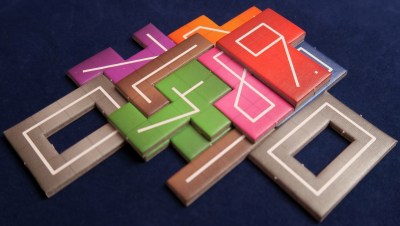
Mijnlieff
– Image by boardGOATS

Plenty of games were played; Blue and Black even managed to squeeze in a quick game of Mijnlieff while they were waiting for lunch to arrive on Friday lunch time.  The surprise of Expo though, was Echidna Shuffle – a light pickup and deliver game with extremely tactile pieces.  In the demo game, Black pipped Purple into second place, with Blue and Pink some way behind, but the only real question was how many copies they were going to buy, and it was no surprise that it sold out on Friday!  It surely won’t be long before it Features on a Tuesday night…

UKGE 2018
– Image by boardGOATS