Next Meeting – 14th November 2017

Our next meeting will be on Tuesday, 14th November, at the Horse and Jockey pub in Stanford-in-the-Vale.  As usual, we will be playing shorter games from 7.30pm as people arrive, until 8pm when we will start something a little longer.

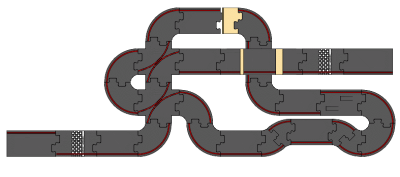
This week, will be the slightly belated “Essen Special” so the “Feature Game” will be Flamme Rouge, a bicycle racing game where players have to balance the demands of their “sprinter” and their “rouleur”; the winner is the player to get one of them over the finish line first.  Although we are celebrating this year’s Spiel Convention at Essen, this game was actually released at Essen in 2016, but now has an expansion that adds a couple of extra players.  There will also be other games brought back from Essen, including AzulQueendomino and Animals on Board.

Flamme Rouge
– Image by BGG contributor Hasematzel

And speaking of bicycles…

Jeff was out riding his bicycle when knocked over a little old lady.  Jeff was horrified and stopped to help the old dear.  She was a bit shaken, but was a tough old bird and, with his help, got up and dusted herself off.  As she got to her feet, she berated Jeff asking, “Don’t you know how to ride a bike?!?!”

“Yes,” he answered, “But I don’t know how to ring the bell yet…”

31st October 2017

The evening began with Blue handing out Essen orders to Red (Sole Mio!, a relative of Mamma Mia!), Green (Thunderbirds and all the expansions), and Burgundy (lots of Concordia and Orléans bits).   Just to make sure Ivory and Pine didn’t feel left out, she had also brought a whole flock of boardGOATS to pass round – all suitably decorated.  There was a lot of discussion of the games at Essen, but Spiel has grown so much over the last few years that it was impossible to see everything as was evident when Green trotted out the fruits of his research and what was “hot”.  Altiplano, Clans of Caledonia, Photosynthesis, Gaia Project, Charterstone, and Noria were all completely missed for various reasons, but Pink and Blue had managed to look at Agra, Meeple Circus, and Kepler-3042 and had picked up copies of Keyper, Queendomino, Mini Park, Montana, Captain Sonar and Azul (Blue’s tip for Spiel des Jahres next year) among other things, all of which will no doubt appear over the coming weeks.

A Flock of boardGOATS
– Image by boardGOATS

With the chit-chat and pizzas over, it was definitely time to play something.  With six of us, it was almost certainly two games which was fortunate as Green wasn’t keen on anything Halloween themed, which ruled out the “Feature Game”, Dead of Winter: A Crossroads Game. That wasn’t a problem though, as Pine was keen to play and everyone else was happy to be a third.  In the end, it was Blue that joined them as she hadn’t played it before.  With two novices, that meant a full explanation of the rules.  Dead of Winter is a semi-cooperative game.  There are a number of things that make it different from other, older cooperative games like Pandemic.  For example, there is a group objective, but each player also has a secret, personal objective:  players must achieve both to win.  There is also the addition of a traitor, who’s objectives are counter to everyone else.  Both Pandemic and Shadows Over Camelot have this mechanism integrated as part of an expansion, and in Dead of Winter, this is also optional, or (like another of our favourites, Saboteur) can be played in such a way that there may, or may not be a traitor present.

Dead of Winter: A Crossroads Game
– Image used with permission of BGG contributor mikehulsebus

Perhaps more significantly than these though, is the nature of the ticking clock.  In Pandemic there is a deck of cards that which dictate what happens and, ultimately, how long the game is going to go on for as the game ends if they run out.  The situation is similar in the other Matt Leacock games like Forbidden Island and its sequel, Forbidden Desert.  In contrast, Dead of Winter, is played over a set number of rounds.  There is still a deck, the “Crisis deck”, but this sets the tone of the round and provides the “team” with a task that must be completed before the end of the round otherwise nasty things happen.  In general, the Crisis sets a tithe of cards that must be forfeit by the “team” during the round.   Of course, as in real life, the “team” consists of people who have different agendas, and one who may be out to sabotage the colony…

Dead of Winter: A Crossroads Game
– Image used with permission of BGG contributor adamfeldner

So, at the start of the round, a card is drawn from the Crisis deck and then everyone rolls their dice and the first player takes their turn.  This begins with another player drawing a card from the Crossroads deck.  This player is supposed to read only the first line, unless the condition is fulfilled in which case they read the rest of the card.  These are quite clever, as they end with two options—the eponymous “Crossroads”. The text on these cards adds a lot of atmosphere as well as adding to the sense of impending doom as sometimes the card might be activated by something the active player does.  Each player starts with two Survivors and the active player has one die per character and an extra one.  The Survivors have special abilities and the dice are “spent” by them carrying out actions.  For example, a player could attack a zombie which costs one die, but the value of the die needed will depend on the character:  James Meyers who is a bit of a wuss, is rubbish at fighting and needs a six, on the other hand Thomas Heart is a violent sort who loves a good brawl and anything at all will do.

Dead of Winter: A Crossroads Game
– Image used with permission of BGG contributor mikehulsebus

As well as attack a zombie, there are a number of other actions that require a die, including search a location, clean the waste, and build a barricade.  Searching is the only way players can get Item cards.  Around the central game board, there are a number of special locations and each one of these has a pile of Item cards.  The distribution of the different types vary and depend on the location, for example, weapons are unlikely to be found a the hospital, but medicine is quite prevalent.  Like attacking zombies, ability to search depends on the different characters and some Survivors have a special ability which means they are good at searching in a particular location.  In contrast, anyone can build a barricade or take out the bins, so these actions can be carried out by anyone with any dice, as long as they are in the right place.  In addition to actions that require a die, players can also play a card, help deal with the crisis, move a Survivor, turn food cards into food tokens, request cards from other players, hand cards to other players or initiate a vote to exile someone.

Dead of Winter: A Crossroads Game
– Image used with permission of BGG contributor mikehulsebus

While there are lots of things players can do, there are also hazards along the way.  For example, moving from one location to another is risky, so the Survivor must roll to see what damage the exposure did.  It may be that they were well wrapped up and nothing happened, but it is also possible that they were wounded in the attempt, or caught frostbite which is nasty because the effect progresses in later rounds.  Worst, of course, is getting bitten because the Survivor dies straight away and the effect spreads to other Survivors at the same location (who also have to roll the exposure dice).  Once every player has taken their turn, the zombies swarm, arriving at each location that where there are Survivors, with extras attracted by noise.  If a location gets overrun by zombies, they start killing Survivors.  Every time a Survivor dies, they Colony’s moral drops.  The game ends moral gets to zero, the requisite number of rounds have been played or if the main objective has been completed.  Our main objective was simply to survive the five rounds we were to play.  Blue began with a serious lack of practical ability in David Garcia (accountant) and James Meyer (psychologist).  Fortunately that was made up for by Ivory and Pine who began with Thomas Heart (soldier), Andrew Evans (farmer), Janet Taylor (Nurse) and Edward White (chemist).

Dead of Winter: A Crossroads Game
– Image by BGG contributor The Innocent

Andrew Evans, Janet Taylor, Edward White and David Garcia all had special abilities when searching and Thomas Heart was excellent fighting off zombies, while James Meyer just had an especially uncool anorak.  We started well and for the first couple of rounds, the zombies were only faintly annoying and the biggest issue was fulfilling the requirements of the Crisis Cards.  Early on, Ivory armed Andrew Evans with a rifle which enabled him to take out any one of the undead, something that proved very handy and made up for the enormous amount of noise Andrew Evans had been making during searching.  During the second round, Blue gained an extra couple of characters (Buddy Davis and Harman Brooks), which gave her extra dice and more special abilities she could use, but the downside was they came with a load of extra helpless survivors (folk that are a bit of a dead-weight and just need a lot of feeding).  It seemed like a gamble, but in the third round, Ivory “found” Sophie Robinson (a pilot) as well.   By the end of the third round, it was clear the message had got out to the zombie hoards and they were coming to get us (possibly due to the racket that Ivory had been making with Andrew).

Dead of Winter: A Crossroads Game
– Image used with permission of BGG contributor kilroy_locke

The fourth round was tight especially as everyone’s attention began to turn to their secondary goals.  The otherwise fairly useless James Meyer suddenly found himself some courage and a baseball bat and set about the un-dead with great gusto.  Pine decided that he really, really wanted that extra character that he’d been persuaded out of earlier in the game and acquired Alexis Grey, a librarian with an ability to search the library efficiently.  Going into the final round, we had to be a little careful in a couple of areas and moral was low, but it was clear that unless one of us turned out to be a traitor, the game was won.  And so it turned out: there was no traitor and it was just a question of who had succeeded in their secondary goal.  At the start of the game, Pine had been highly conflicted, needing medicine for Edward White’s special power, but also having a goal of needing to finish with two at the end of the game.  Since he started his final turn with no medicine, he thought the boat had sailed, but with his very last action, he happened to draw two medicine cards to satisfy his second objective.  Ivory also needed two medicine cards for his goal and had managed to hoard these throughout the game.  Blue’s challenge was more difficult as she needed the colony to have lost three members to the hoards.  Despite her best efforts to kill off some of her own Survivors, Pine and Ivory had generously helped keep them alive, so she failed dismally, the only one not to complete both victory requirements.

Dead of Winter: A Crossroads Game
– Image used with permission of BGG contributor kilroy_locke

Although we had all enjoyed the game, it was unfortunate that there wasn’t a traitor as the lack of an enemy within meant it felt a bit like communal puzzle solving.  It was also unfortunate, that so very few of the Crossroads Cards actually had an effect as they mainly affected characters we weren’t playing with.  This wasn’t helped by our habit of forgetting to draw them and/or reading too much of the card.  We felt the Crossroads Cards would have been more interesting with extra players, but it was already a long game and we felt the down-time would really drag with more.  Certainly, some turns, especially as Blue and Ivory acquired additional Survivors, seemed to take an unbelievably long time already.  Certainly four would probably be the maximum we would want to play with, though we would also increase the likely-hood of a traitor as we felt we’d missed out on half the fun.  In conclusion, Red and Burgundy’s comment at the start now made sense, “It’s a good game, but if there’s something else more interesting about…”

Dead of Winter: A Crossroads Game
– Image used with permission of BGG contributor zombiegod

Meanwhile, on the next table, Green and Burgundy were teaching Red how to play Puerto Rico.  This is a much older game which was the highest rated game for many years and is still well regarded.  Red had never played it and it was a very long time since Burgundy or Green had played it as well, so they were keen to see how it held up against some of the more modern games.  In Puerto Rico, players are plantation owners in seventeenth century Puerto Rico growing up to five different kind of crops: corn, indigo, sugar, tobacco, and coffee. Each plantation owner must try to run their business more efficiently than their competitors. First they must grow their crops then they must store them efficiently. Finally, players must sell their crops at the right time or ship their goods back to Europe for maximum benefit. In order to do this most effectively, the plantation owners must make optimal use of the arriving colonists and develop the capital city, San Juan, building useful amenities.

Puerto Rico
– Image by boardGOATS

The flow of the game is quite straight-forward in that on their turn, the active player chooses a “role” then everyone takes it in turns to carry out the action associated with that role. Each role has a “privilege” which the active player gets which gives them a little bonus (as well as the opportunity to take the action first. Once everyone has chosen a role, the remaining role cards are “improved” by the addition of money, the used role cards are returned to the pool and the start player (The Governor) moves one player to the left before the new Governor starts the next round. The aim of the game is to get victory points which are awarded for buildings and for shipping goods. However, to build, players need money, and before they can ship goods, players need to be able to produce the goods with a plantation (and where necessary process them in the appropriate building).

Puerto Rico
– Image by boardGOATS

Each building/plantation has a special bonus, but for a player to receive this, the building needs to be occupied by a “colonist”. All these activities are carried out through the role cards. For example, the Builder enables players to construct a building, but the player who chooses the role gets the privilege of paying one doubloon less than they would have done otherwise. Similarly, the Craftsman is used to produce, but the privilege allows the player who chose the role to produce one extra item (of those they had already been able to produce). Other roles include the Captain (enables players to ship goods); the Trader (allows players to sell goods for money); the Settler (players can take a plantation tile and add it to their island); the Mayor (the ship of “Colonists” arrives and they are divided among the players), and the Prospector (everyone does nothing except the person with the privilege who takes a doubloon from the bank).  The game ends when either, one player has built their twelfth building or the supply of victory points or colonists has been exhausted.

Puerto Rico
– Image by boardGOATS

The first few rounds were a little tentative. Green started with the Governor (through random selection) and chose the build action first. Burgundy chose Mayor using his extra citizen to occupy both indigo plantation and production building. Red needed a little help to suggest that she place her citizen on her Corn rather than her small market since this would enable her to produce something, whereas in the market she would have nothing to sell. So inevitably Red then chose craftsman. This gave Red a two corn, Burgundy an Indigo and Green nothing as he only had indigo and one citizen.  From there, the game progressed as you might expect, with each player following a different strategy.

Puerto Rico
– Image by boardGOATS

Green relied on his indigo resources and built a Small Market and an Office (so he could sell multiples of the same type of goods), dug a couple of quarries, and clearly went for a money and buildings strategy. When he started losing out in the Captain (shipping) phase he was able to very quickly buy a Wharf and always managed to ship something and thus stay in the running on victory points. He was the first to buy a big building of course and chose the one which gave him extra points for production buildings believing he could fairly easily add to his already reasonable tally. Burgundy went for a diversified portfolio of goods and as able to add a factory building which started to really rake in the money with four different types of goods. He was only missing corn, which he easily added to make an extra five doubloons every time craftsman came up. As a result he was not far behind Green at buying a large building.

Puerto Rico
– Image by boardGOATS

Since he had been shipping regularly and gathering victory points Burgundy took the building that would give him an extra point for every four points he had, however about half way through the game he began to struggle with his shipping. Red had begun to regularly take Captain, which meant that he was last to load and would often miss out being able to load all his goods—without any kind of warehouse was regularly losing all his stock of two or three goods each time.  Eventually, he had enough of this and decided to do something about it.  The choice was between a Wharf and a Harbour:  increasing his victory point income every time he shipped, or gain an extra ship he could always ship to.  It was a tough choice, but in the end he chose Wharf only to then discover he did not have quite as much money as he thought and so had to settle for Harbour after all.  This nearly proved his undoing in the end, as with two or three more captain actions happening he still found himself unable to ship everything, losing several goods in the process—Red and Green made quite sure of that!!

Puerto Rico
– Image by boardGOATS

Red’s game was a little more tentative, as she found her feet, trying to figure out how the game all hung together. She struggled a bit with getting the buildings and plantations all occupied in the right way to produce what she needed. She ended up with a lot of Sugar, but her small warehouse meant that early on she did not have to discard it and was able to make a large shipment later on, locking out Burgundy, the other Sugar producer in the game.  In the end she ended up with more citizens that she had spaces and so for a while had an occupied Indigo Production building but no Indigo Plantation. It seemed it didn’t really matter though, as she had a good thing going on with the Captaincy, shipping large amounts of Sugar regularly giving her a regular supply of points. With everything else that was going on, Red didn’t get round to buying a large building.

Puerto Rico
– Image by boardGOATS

As the game neared conclusion, we thought we would run out of Citizens first, but selection of the Mayor slowed and Captains became a more regular feature so the victory points dwindled fast. Green was worried that he might not get his large building occupied before the victory points ran out, so when he became Governor for the last time, he chose the Mayor in an effort to extend the game, much to Red’s chagrin.  She claimed that it was allowing Burgundy to get his large building occupied and thus gain more points, which is true, but it helped Green too.  In the end it was Red’s Captaincy that ended what proved to be an incredibly close game; Puerto Rico is not a game we usually think of as being so well balanced that the scores are always close. The hidden victory points and various other ways to gain points tend to keep players guessing right til to the end and it is usually possible for one player to quickly build an efficient engine which wipes the floor with everyone else.

Puerto Rico
– Image by boardGOATS

That wasn’t the case this time.  Although the actual game play is quite simple, Puerto Rico can be a challenging the first time as it is hard to really work out the best way to play, and things only become clear after two or three rounds.  So Red did really well, not only to keep pace with two experienced players, but especially to take second place against two players, scoring fifty points.  Green’s lack of resources to ship, even with his wharf, let him down and it was Burgundy, who scraped a win with fifty-three points.  While packing up, there was a lot of discussion about the game:  did Green really hand Burgundy victory by choosing that Mayor? We concluded probably not, as if Burgundy would have chosen it if Green hadn’t.

Puerto Rico
– Image by boardGOATS

Puerto Rico used to be the gamers’ game of games for quite a few years, until Agricola elbowed its way to the top. Since then that top spot has been fiercely fought for and, as in Formula 1, (where everyone now talks about Schumacher, Vettel and Hamilton), everyone seems to have forgotten poor old Juan Manuel Fangio, the unsurpassed master for decades. Once in a while it’s good to bring out the old tapes and watch the old master at work though, and so it is with Puerto Rico.  After so many years it was interesting to see how it stacked up against the newest masters of the gaming world.  We concluded that it still competes very well: it has variety and simplicity at its heart, great interaction and just enough complexity to make it a challenge without needing a PhD just to understand the rules.

Puerto Rico
– Image by boardGOATS

Dead of Winter was still going and it sounded like there was another half an hour play, which meant there time for another, shorter game, and the group settled on Coloretto. Everyone knew it quite well it was a quick start.  On their turn the active player either draws a coloured chameleon card and places it on a “truck” or, they take a truck and its chameleons (which means they’re out for the rest of the round). The idea is that players are collecting sets of cards, but only three will yield positive points, with the rest scoring negatively.  There are some “special” cards as well, including multicoloured joker chameleons and “+2” cards which give an extra two points at the end of the game.  So, everyone was shocked when  a “+3” came out of the pile came.  Clearly there were some expansion cards in the deck and nobody had noticed despite having played with it several times before.

Coloretto
– Image used with permission of BGG contributor punkin312

The first round was also remarkable in that first a yellow card was pulled, then a purple (placed on a different pile), then another yellow, which was placed on the purple pile, then a purple, which was placed on the yellow pile, to make two identical piles. So, what were the colours of the next two cards? Yes, yellow and purple! Burgundy and Red bailed at this point but Green decided to see where if he could get a second yellow or purple and ended up with a red instead giving him three singletons.  From there, the game progressed in the usual way. Green collected more new colours each with only one card, but that meant he had a wide choice to specialise in. Eventually he chose green as his primary colour, which the others found difficult to prevent him from getting. Burgundy was trying to keep his number of colours down, concentrating on just brown and yellow, but Red and Green kept ganging up on him to make sure he had to take something else very time.  To get round this, he ended up taking single cards several times, but that meant he didn’t get as many cards as he might otherwise have collected.  Red was the lucky one who took the rainbow joker and otherwise went for blues and purples.  She was forced to collect too many other colours though.  In the end, it was again Burgundy who managed to eek out the best score, despite Red and Green’s combined best efforts.

Coloretto
– Image used with permission of BGG contributor SergioMR

Learning Outcome:  Sometimes winning is impossible, even with teamwork.

Deutscher Spiele Preis – 2017

In 1990 the German magazine “Die Pöppel-Revue” introduced The Deutscher Spiele Preis, or German Game Prize, which is now awarded annually at the Internationale Spieltage, Essen.  While the Spiel des Jahres rewards family games and is awarded by a panel of judges, the Deutscher Spiele Preis is awarded based on votes from the industry’s stores, magazines, professionals and game clubs.  For this reason the Deutscher Spiele Preis tends to reflect “gamers games” and is usually more in line with the Kennerspiel des Jahres.  This year the award went to Terraforming Mars with the winner of the International Gamers Award, Great Western Trail, as runner up.  The 2017 Spiel des Jahres winner Kingdomino was joint sixth with the Kennerspiel des Jahres nominee Raiders of the North SeaIce Cool, winner of the this years Kinderspiel des Jahres, also won the Deutsche Kinderspielepreis.

Terraforming Mars
– Image used with permission of BGG contributor punkin312

In Terraforming Mars, players take the role of giant corporations, sponsored by the World Government on Earth, to initiate huge projects to raise the temperature, the oxygen level, and the ocean coverage until the environment on Mars is habitable. Players then buy project cards into their hand and later, when they have the resources needed, they can play the cards and ultimately place tiles on Mars itself. There are three different types of cards: Red cards provide actions that have an instant effect and are then discarded until the end of the game; Green cards have a one-off effect but their “tags” are retained, and Blue cards have an ongoing effect and/or an action that can be activated once per round. It is building these card combinations that is at the core of what we have found to be an interesting game.

Terraforming Mars
– Image by boardGOATS

Next Meeting – 31st October 2017

Our next meeting will be on Tuesday, 31st October, at the Horse and Jockey pub in Stanford-in-the-Vale.  As usual, we will be playing shorter games from 7.30pm as people arrive, until 8pm when we will start something a little longer.

Normally, the week after Essen would be the “Essen Special” playing a game someone has brought back from the fair, but this week Tuesday is Halloween, so to mark the occasion, the “Feature Game” will be Dead of Winter: A Crossroads Game.  In this game, players are part of a small, weakened colony of survivors in a world where most of humanity is either dead or diseased, flesh-craving monsters.  Players must therefore work towards a common victory condition, but for each individual player to achieve victory, they must also complete their personal secret objective.

Dead of Winter: A Crossroads Game
– Image used with permission of BGG contributor mikehulsebus

Jeff, Joe and Jim ran into a museum to hide from the hoard of zombies coming down the road.  While looking for something to eat and drink Joe found a golden lamp out of which popped a Genie.

“You can have three wishes.”  The Genie said, “What is your first wish?”

Without missing a beat, Joe answered, “I want to go back to my family before the zombie apocalypse and I want it to never happen!” Jim added, “That sounds great, I wish for that too!”

And with a puff the two men were gone.

There was a sudden splintering, shattering noise as the front door of the museum caved in with the weight of all the zombies pushing on it.  As the museum rapidly filled up with zombies, the Genie asked Jeff, the last of the three friends what he wished for.

Jeff thought about it quickly and answered, “I wish my two friends were back here to help fight off all these zombies…”

17th October 2017

Inevitably, the evening started with Blue and Burgundy eating pizza while discussing Essen and what goodies might be available.  For lots of reasons, it was a very quiet night, but the “Feature Game”, Squirrel Rush, had enough pieces that everyone could join in, so we started off with that.  It was a new game to the group, but not terribly complex, even with the “Smart Squirrel” variant that we used.  That said, there was still a little bit of an “analysis paralysis” problem and at times we were in danger of getting into a “Chariot Racesituation again

Squirrel Rush
– Image by boardGOATS

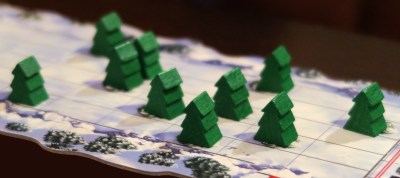
The game takes place over six rounds with each round consisting of players moving their wooden squirrel around the board turning over tiles as they pass them and collecting nuts as they go.  Each tile has a different number of nuts on each side, but the catch is that squirrels can only move orthogonally and as players move their squirrel, each tile must have fewer nuts on it than the last.  Thus, a squirrel could move over a  tile with five nuts on it, then a three nutter and stop on a double nut tile (perhaps because there were no singletons available).  From round two, players can also play a card from their hand that allows them to break the rules slightly, for example by moving diagonally once or jumping a tile, or even leaving the “board and returning somewhere else.

Squirrel Rush
– Image by boardGOATS

It sounds quite simple, but in practice, we were all a little bit prone to over-thinking the problem and trying to spot that perfect move.  With five players there was also a lot of unproductive down-time.  This was because the board was constantly changing as tiles were turned over so meaningful decisions could not be made until the previous player’s turn at the earliest.  There were the inevitable nutty jokes to keep people amused between turns though, and Ivory enjoyed winding up Pine about how enormous his nuts were and how he was sure Pine would be happy to share them with Blue who didn’t have any…  Pine retaliated with a nutty factoid, asking which bird buries more nuts than a squirrel.  Only Burgundy knew the answer is the Jay, funny, yet beautiful birds.

Squirrel Rush
– Image by boardGOATS

Meanwhile the game continued, though everyone was finding it a bit of a struggled thanks to the tile layout which had lots of “fours” along one side.  The nutty comments continued as well with, Pine commenting that he’d found a nice bit of glade to sit in, nibbling his nuts…  In the end, it was a surprisingly close game, despite the fact that everyone knew Ivory was miles in front and had an insurmountable lead.  Insurmountable until the last round in fact, when Burgundy picked up a massive eighteen points thanks to an well placed nut, finishing on seventy-one, beating Ivory by just one point.  Pine nearly managed the same feat, finishing just one behind on sixty-nine.  In fact, it was a tight finish all round as Blue and Black finished in joint fourth with sixty-six.    All in all, it was a beautifully presented, enjoyable little game that would be play differently with a different tile layout; as Pine pointed out, “It’s Nuts!”

Squirrel Rush
– Image by boardGOATS

With so few of us, we needed something that played five.  Although lots of options were put on the table, it was almost inevitable what were going to end up play.  Ivory had been very envious of the fact he’d missed out when he’d been away last time due to a work team-building event, and his eyes lit up when he realised Roll for the Galaxy was a real option.  Problem was, Burgundy was not keen as he (like a lot of people), struggles with the icons and the procedure.  It is not actually as bad as the slightly older card game, Race for the Galaxy, but it’s still quite unlike anything else we play and the iconography adds to the challenge.  Black and Blue were firmly of the opinion that the reason we all struggle with this game is because we don’t play it enough and were therefore quite keen play it in order to become more familiar.  So Burgundy bravely agreed to give it a another go.

Roll for the Galaxy
– Image by BGG contributor haslo

On the face of it, the game is quite straight-forward:  players roll the dice in their cup in secret, behind their screen then separate the dice according to their symbols (Explore, Develop, Settle, Produce and Ship). Players then, still in secret, re-position one of their dice to use it to choose one action they would like to activate.  Players can also put a die to one side for a turn to “Dictate” the symbol on another die, i.e. reassign it to a different phase. When all the dice have been assigned, Once everyone has positioned their dice, they are revealed and players simultaneously carry out the phases that have been chosen in the appropriate order.  The catch is what happens to the dice when they are “spent”.  For example, dice used to Explore are simply placed straight into the “Citizenry” where they wait to be recycled on a later turn when they can be returned to the cup at a cost of $1.

Roll for the Galaxy
– Image used with permission of BGG contributor punkin312

Dice used in the other phases have a slightly more complicated route, so those assigned to Development or Settling are placed on to the appropriate pile of tiles until there are enough to build them, and then they are placed in the Citizenry to await recycling.  Dice used for Producing are themselves turned into produce and placed on the Production World tile, where they stay until someone activated a Shipping phase.  When the goods are Shipped, they are removed from the Production tile and placed in the Citizenry where they can be similarly recycled.  This is complex enough, but it is only really the back-drop to the game, the guts of which are centred on choosing tile combinations to build according to a particular strategy.  The problem is, if players are struggling to get the nuts and bolts of the game to work, then strategy inevitably will suffer.

Roll for the Galaxy
– Image used with permission of BGG contributor punkin312

Unsurprisingly given his enthusiasm for playing it, Ivory made all the early running, settling early and making good use of his Terraforming Robots Development which meant he had pots of cash and was referred to as “Money Bags” for most of the game.  Meanwhile, Burgundy and Pine were struggling to get their heads round the different “Dice Cycles”.  Pine had played it for the first time only a couple of weeks ago, but it is such a unique game in many ways that it is hard to remember what to do.  In fact, although both Black and Blue have played it several times now, they were both quite slow off the mark as they had to remind themselves of what they had to do.

Roll for the Galaxy
– Image used with permission of BGG contributor punkin312

It was about halfway through the game that the Christmas music started; Ivory was thrilled while Pine was disgusted in equal measure.  The bar staff were all feeling very festive and were not impressed when we pointed out that there was still Halloween and Bonfire Night to go before we could even begin to consider Christmas!  When Ivory built his twelfth world and  triggered the end of the game, his mood was improved even further, making him a very happy squirrel indeed.  With nobody else close to twelve worlds, it looked like Ivory was home and dry with some to spare, however, although she only had nine Worlds she had a lot of higher value, Genes Worlds.  This, together with the large pile of Victory Point chips she had acquired towards the end of the game, much to everyone’s surprise, drew her level with Ivory on forty-eight.  This led to a tie-break, which, despite the fact that we’d already started packing up clearly went Ivory’s way as he had many more dice and loads more money than Blue.  Magnanimously though, Ivory offered to share the victory.

Roll for the Galaxy
– Image used with permission of BGG contributor punkin312

Learning Outcome: It’s probably best not to comment on the size of a squirrel’s nuts…

Essen 2017

It is that time of year again when the gamers’ minds turn to Essen and – The Internationale Spieltage.  To Gamers worldwide, Essen is synonymous with the largest games fair in Europe and, arguably, the world.  The fair runs Thursday to Sunday in mid/late-October every year and is the one of the biggest and most significant of all the boardgame conventions with many new releases and timed to coincide with the end of October.  This year the first day will be this Thursday, 26th October and games, publishers and their wares are all making their way to Germany for four days of fun and games.

Essen
– Image from merz-verlag-en.com

Last year several of the group went, and they came back with a lot of expansions for well-loved games like Istanbul, Colt Express, and Orléans and picked up some new games like Key to the City – London, Ticket to Ride: Rails & Sails and Cottage Garden.  This year, new games include Queendomino, Indian Summer, Altiplano and Keyper, with expansions to old favourites like Isle of Skye, Imhotep, Ticket to Ride, Terraforming Mars and Splendor as well.  Once again, several locals are going and they are sure to bring back some interesting toys to play with over the coming months.

– Image used with permission of designer Richard Breese

Boardgames in the News: AlphaGo Goes Again

Last year, Google announced that it’s AlphaGo software (part of their DeepMind project) had beaten the reigning three-time European Go champion Fan Hui winning five consecutive games – the work was published in the scientific journal Nature.1 The original tree search in AlphaGo evaluated positions and selected moves using neural networks. These neural networks were trained by supervised learning from human expert moves, and by reinforcement learning from self-play.  Today the team reported2 a new version of AlphaGo, “AlphaGo Zero“, that was developed without any input human data beyond game rules. Previous versions of AlphaGo were initially trained on thousands of human amateur and professional games to learn how to play Go.  AlphaGo Zero skipped this step and learnt to play simply by playing games against itself, starting from completely random positions.  AlphaGo Zero thus became its own teacher and after three days beat the previously published, champion-defeating version of AlphaGo by one hundred games to nil.  After playing thirty million games over a period of forty days AlphaGo Zero became even stronger, outperforming the version of AlphaGo known as “Master”, which has defeated some of the world’s best players including the current world number one Ke Jie.

Go
– Image from deepmind.com

1 Silver et al., Nat. (2016), 529, 489; doi:10.1038/nature16961.
2 Silver et al., Nat. (2017), 550, 354; doi:10.1038/nature24270.

Next Meeting – 17th October 2017

Our next meeting will be on Tuesday, 17th October, at the Horse and Jockey pub in Stanford-in-the-Vale.  As usual, we will be playing shorter games from 7.30pm as people arrive, until 8pm when we will start something a little longer.

This week the “Feature Game” will be Squirrel Rush, which is a quick-playing little filler game where players are squirrels traveling through the wood collecting nuts.  It is a very simple little game with two variants; we will probably be playing with the slightly less random “Smarty Squirrel” rules.

Squirrel Rush
– Image by boardGOATS

And talking of smart squirrels…

Jeff and his father went hunting together for the first time.

Jeff’s father said, “Stay here and be very quiet. I’ll be just across the field.”

A few minutes later, Jeff let out a blood curdling scream and his father ran back.

“What on earth is wrong?” Jeff’s father asked. “I told you to be quiet.”

Jeff answered, “Look Dad, I was quiet when the spider crawled across my face; I was quiet when the slithered across my feet. But when the two squirrels crawled up my trouser leg and said, “Should we eat them here or take them with us?” Well, then I guess I just panicked…”

3rd October 2017

The evening started with a quick hand of Love Letter between Blue and Burgundy while they waited for their “Fave” pizzas to arrive.  The game only lasted a handful of turns and Blue took it with the Princess when she played a Baron to force a comparison.  As Burgundy said, with that combination of cards lined up against him, his poor Baron didn’t stand a chance.  There wasn’t time for him to get his revenge, however, as food arrived, along with a Happy Birthday text from Pink (who wasn’t able to come).  With the arrival of Red and Magenta, Blue and Red talked about work for a few minutes before Ivory and Pine joined the party and everyone settled down to a quick game of 6 Nimmt!—a quick game that could be played while eating pizza.

Happy 5th Birthday!
– Image by boardGOATS

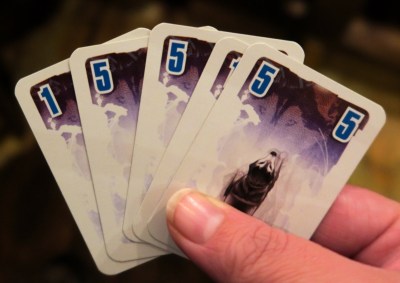
Bizarrely, Ivory had somehow managed to avoid playing 6 Nimmt! despite it being one of our most frequently played games.  So, there was a quick run-down of the rules before we could start.  The game starts with four cards face up on the table, the beginning of four rows.  Each player starts with a hand of cards and players simultaneously choose one and place it face-down before a simultaneous reveal.  Cards are then played in ascending order, with players placing their card on the highest card that is lower than the card being played.  When the sixth card is added to a row, the first five are taken by the active player and the number of heads contribute to that player’s score; lowest score wins.  We tend to play two rounds, each using half of the deck of one-hundred and four cards.  The thing that makes the game so compelling is that players begin to feel they have control over their destiny, but any grip they may have is incredibly tenuous and once things start to go wrong the problems tend to escalate horribly.

– Image by boardGOATS

This time, things started to go wrong early for Red and Blue, but Pine outstripped them by miles and finished the first round with twenty three “nimmts”—as he commented, enough for a whole dairy heard.  Burgundy and Magenta were doing much better with one nimmt and none respectively.  Given his excellent performance in the first round, everyone expected Burgundy to start collecting cards with enthusiasm in the second round, and so it proved.  His efforts paled into insignificance compared with some of the others though, in particular Ivory and especially Blue, who finished with a massive top score of forty-four.  The winner was unambiguously Magenta, however, who added a second clear round to her first and managed to end the game without picking up a single bull’s head, a real achievement.

Happy 5th Birthday!
– Image by boardGOATS

With everyone now arrived and pizzas all consumed it was time for the party to really start, with the “Feature Game”, Crappy Birthday accompanied by a marvellous blue Meeple Cake supplied by Georgie from The Jockey.  Everyone sang Happy Birthday and Blue and Green as the originators of the group blew out the candles then Red took the knife and started to carve while Magenta began dealing cards for the game.  With everyone eating cake (including the people at the pub who couldn’t believe we’d been going for five years), attention turned to Crappy Birthday.  This is funny little party game which we played for the first time last year to celebrate our fourth anniversary.  The premise of the game is that it is one player’s birthday and every one gives them a “present” chosen from the cards in their hand.  The birthday boy or girl then has to choose the best present and worst present and then returns these cards to the person who gave them.  At the end of the game players count up the number of pressies they have had returned and the one with the most (i.e. the one who gave the fewest mediocre presents) is the winner.  The game has a lot in common with Dixit, but is a lot simpler.  In the same way though, the production quality of the cards is really key to making the game work, though the emotions are very different:  in Dixit everyone marvels at the beauty of the art, in Crappy Birthday everyone laughs at the stupidity or brilliance of the gifts.

Crappy Birthday
– Image by boardGOATS

This time we discovered that Black wanted a Viking helmet for his birthday, Red wanted to go on the first trip to Mars, Burgunday fancied a course in Sumo wrestling and a drive across the Sahara was on Ivory’s “Bucket List”.  There were many amusing gifts that didn’t actually score points including the Gnome ABBA Tribute Band (singing, “Gnoming me, Gnoming you” perhaps?) and a dead rat to hang on the front door at New Year.  We also discovered that Pine hates heights and horses (especially those that are trying to throw you off), so the session of rodeo riding was thrown straight back in disgust.  Red returned a Porta-Potty (she’s seen plenty in the last year apparently); Blue threw back comedy lessons (she hates being on stage); Black sent back a chair because it was boring and Red decided she couldn’t cope with a 150lb burger and claimed it would make her sick.  Everyone clearly thought that physical exertion was not Burgundy’s thing, but it was the tight rope walking that he was least keen on while Ivory had a fit of shyness and turned down the kind offer of a session skinny-dipping.  Purple rejected the idea of her very own personal roller-coaster, though it was close between that and snake charming lessons.  Pine commented that he would have combined the snake charming with the five chihuahua puppies as the latter would have provided an excellent food supply for the snakes.  This did not go down well with Purple who had chosen the chihuahua’s as her favourite gift and didn’t want them eaten…

Crappy Birthday
– Image by boardGOATS

It didn’t really matter who was the winner because everyone had fun and everyone got their moment in the spotlight as they had to explain their decisions.  And while they listened everyone else got sticky eating the meeple cake which was soon nibbled away to leave just a bit of head and a foot.  After one round we counted up who had the most returned cards and Ivory who had five cards was the winner by miles with Green and Burgundy in a distant, joint second place.  Party games aren’t really the Group’s “thing”, but everyone enjoyed this one (particularly accompanied by cake) and the consensus seemed to be that once a year was about probably right, especially as it gave everyone time to forget the silly things on the cards.  With the birthday cards collected in and the cake mostly gone it was time to decide what to play.  Nobody was quick to decide and things were complicated by those planning to leave early.  In the end we decided to stick together as a group (it was a party after all) and play a round of Saboteur.

Saboteur
– Image used with permission of BGG contributor mothertruckin

The idea of Saboteur is that each player is either a Dwarf or a Saboteur and players take it in turns to play a card from their hand.  The Dwarves aim is to extend the tunnel to the treasure, while the Saboteurs try to stop them.  There are two types of cards that can be played:  tunnels and special cards.  The cards with tunnel fragments shown must be played in the correct orientation, though the tunnel depicted can include junctions, bends, and even dead-ends. While the Dwarves try to push the path towards the gold, Saboteurs try to play disruptive cards while trying not to look like it.  Meanwhile, special cards include “rockfall” cards which can be played to remove a tunnel card already played, and maps which can be used to see where the gold is hidden.  Most importantly, however are “broken tool” cards which can be played on another player to prevent them building tunnel cards until they (or another kind-hearted soul) plays a matching “fixed tool” card to remove it.  The game is supposed to be played over several round with the winning team sharing out a pile of gold cards, but we tend to play it as a team game and stick to one round at a time.

Saboteur
– Image used with permission of BGG contributor mikehulsebus

The game began quite carefully with everyone doing their best to look like dwarves, that didn’t stop the accusations though and it wasn’t long before someone decided that Black and Green were looking shifty.  Green had almost all the map cards and unsportingly decided to stick to the rules and refused to share them.  Then Pine roused suspicions when his use of a map card led to a disagreement with Green clearly identifying one of them as a Saboteur.  Before long Ivory had joined the fray and nobody knew what was going on, except that the tunnels kept moving forward.  Eventually, Blue left nobody in any doubt when she gleefully diverted the tunnel away from the only possible remaining gold.  With the last card in the draw deck gone, it went down to the wire, but all the sabotage from Blue, Pine and Ivory was to no avail.  Cards continued to be played and it took a whole extra round, but the Dwarves just managed to make it to the treasure.

Saboteur
– Image used with permission of BGG contributor mikehulsebus

With time ticking on, Red and Magenta left for an early night and the residue of the group split into two parts, the first of which played Sheep & Thief.  This game has had a couple of outings recently, in particular on a Tuesday two weeks ago.  Sheep & Thief is a curious little tile/card drafting and laying game with elements of pick up and deliver mechanisms added for good measure.  Each player has a board divided into a four by four grid, and starts with their home card and two sheep in the top left hand corner.  Each round is played in two halves: first players draft cards then they play them, taking it turns to place one card per turn.  Players are trying to connect their home card to the other three corners while trying to keep their sheep safe and trying to catch other players sheep with their fox, meanwhile, they are also attempting to navigate their black sheep to the bottom left right corner of their board.  With points for all sorts of things including sheep captured, sheep retained, long rivers, connecting the home card to the other corners of the board as well as for moving their black sheep as far from home as possible, it is a veritable “point salad”, but one where it is actually very difficult to do well.

Sheep & Thief
– Image by boardGOATS

Pine, with his love of sheep was always going to do do well, despite this being his first try at the game.  Everyone else had played it several times before and therefore knew what they were letting themselves in for.  The strategies were very varied though, for example, Purple prioritised getting her road from her home card to the opposite corner of her board and picked up fifteen points for doing so.  Green prioritised getting his black sheep as far as he could in the hope that he might get points for his road in the process.  Unfortunately, although Green’s sheep netted him fifteen points, he was not able to connect his home card to any other corner and therefore failed to get any extra points as a result.  In contrast, Black tried to do a bit of everything which really isn’t a strategy that works for this game.  As a result he really struggled.  It was a very close game, and on the re-count finished in a tie between Green and Pine who both scored thirty-one points with Purple just behind.  Since the tie-breaker is the number of sheep and and both Green and Pine finished with the same number of sheep the victory was shared.

Sheep & Thief
– Image by boardGOATS

On the next table, Ivory, Burgundy and Blue were being indecisive.  In the end after looking longingly at the “Deluxified” Yokohama, they reluctantly decided that it would probably take too long and decided to give Dice Forge a go instead.  This game was new to everyone except Ivory who gave his assurance that it would not be a long and complicated game.  And he was right – the whole thing took less than an hour and a half including teaching.  The game is a dice building game, with a lot in common with the deck building games like Dominion and bag building games like Orléans, or cup building games like Roll for the Galaxy, where the aim is to try to mitigate the effects of luck by stacking the deck, bag, cup or in this case dice, to improve the odds.  In the case of Dice Forge, it is the dice themselves that players are modifying.  Each player starts with two dice, similar to those in some of the Lego games, where the faces can be removed and changed.

Dice Forge
– Image by boardGOATS

Beyond this, the game is actually quite simple.  On the active player’s turn, everyone rolls both their dice and adds the result to their accounting tracks.  On their turn, the active player can then also spend some of their gains to either upgrade dice, or to move their pawn from their central “Starting Portals” to one of the “Islands” on the board and take a “Heroic Feat” card.  Each upgrade has a cost, with the best upgrades having the highest costs.  The cards also have costs and the most powerful cards are the most expensive.  When upgrading, players can choose which faces to replace and what to replace them with.  In contrast, most of the cards have a single use special action or bonus, but some also have a perpetual action.  With the game restricted to only ten rounds, however, these have to be bought early if they are to prove game winners.  Once everyone had had the full ten rounds, each player adds up their points and the player with the most is the winner.

Dice Forge
– Image by boardGOATS

There are several sources of points:  firstly, some dice faces give points, but this is not a particularly efficient way of scoring unless there are some cards that can be used to increase the acquisition speed. Cards can be more effective, but only if the means to buy them can be accumulated quickly and efficiently.  Blue started off trying to get some nice dice faces to improve the probability of a good roll.  She quickly realised the really clever part of the game:  what is the best way to upgrade the dice and how should the faces be distributed?  For example, is it better to put all the good faces on one die and guarantee one good roll, or is it better to spread them across both and hope to roll more good rolls than bad ones?  She opted for the latter, but wasn’t sure whether that was the right choice or not.

Dice Forge
– Image by boardGOATS

While Blue was faffing about with where to put her dice, Burgundy had a much bigger problem as he was struggling to roll what he wanted in order to upgrade his.  This had the knock-on consequence that by the time he got what he wanted, invariably, Blue or Ivory had pinched what he wanted.  Ivory, having played the game before clearly had a much better idea of what he was trying to do, but although he managed some exceptional rolls, he struggled from time to time too.  In the end, Burgundy more or less gave up on dice and started to collect cards.  Somehow he managed to accrue a seventy-two cards—a massive number compared with compared with the forty-two/forty-six that Ivory and Blue had gathered together.  It almost worked as well, since he netted a fantastic ninety-eight points, remarkable considering his very slow start.  In the end Burgundy finished just two points behind Blue who top-scored with a nice round hundred.  Everyone had enjoyed it though, despite the frustrations, and everyone was quite keen to give it another go, though not straight away as it was definitely home time.

Dice Forge
– Image by boardGOATS

Learning Outcome:  Time flies when you are playing boardgames!

Next Meeting – 3rd October 2017

Our next meeting will be on Tuesday 3rd October, at the Horse and Jockey pub in Stanford-in-the-Vale.  As usual, we will be playing shorter games from 7.30pm as people arrive, until 8pm when we will start something a little longer.

To celebrate our fifth birthday this week, the “Feature Game” will once again be Crappy Birthday.  This is a silly little filler/party game that we can mess about with while people are eating cake, allowing us to play something longer once everyone is done.  Family games like this are not usually our sort of thing, but we played it last year to celebrate our fourth birthday and had a ball, so we thought we’d keep the second deck of cards for this year…

Crappy Birthday
– Image by boardGOATS

And speaking of birthdays…

It was Jeff’s birthday and, as it was a special birthday, his brother had bought him a special present.  Before opening the gift, Jeff shook it slightly, and noticed that it was wet in the corner.  Touching his finger to the wet spot and tasting it, he asked, “Is it a bottle of wine?”

His brother shook his head, “No…” So, again, Jeff touched his finger to the box and tasted the liquid.

“A bottle of scotch then?” he asked, beginning to get all excited – this was way better than he’d expected.  Again his brother shook his head though, “No, not a bottle of scotch…”

Eventually, Jeff said, “OK, I give in, what is it?”

His brother paused for effect, before answering, “A puppy!”