Five Today – Happy Birthday to Us!

Five Today!

BoardGOATS is Five Years Old Today!

We are very lucky: after five years the boardGOATS is still here meeting fortnightly in the Horse and Jockey in Stanford-in-the-Vale.  The group is now bigger than it has ever been, but still has a lovely, friendly, social feeling.  We would like to thank to everyone who has come along in the past and in particular, all those travel from further afield to make it the success it is – we really appreciate it.  We’d also like to thank the folks at the Jockey who have been supportive throughout letting us have so much fun in their back room.

19th September 2017

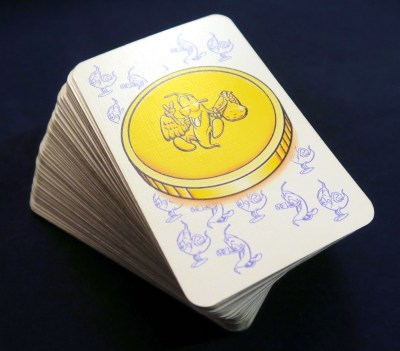
After more discussion that it really warranted, we started the evening with a quick game of Bokken Schieten (aka Ziegen Kriegen).  Given the choice of this, No Thanks! or 6 Nimmt!, Red chose “the Goat Game”, but was disappointed to find it wasn’t what she was expecting.  Bokken Schieten is a very simple trick-taking game based on Blackjack.  Players choose a card from their hand and play it face up in front of them – the person who plays the highest card takes the trick and with it all the cards played in the round.  The player who plays the lowest card draws a Goat Island card and places the goat-meeple on one end, choosing which end will start Goat Island and the value of the number to contribute to the limit.  The game continues with players playing cards and winning tricks, and the player who plays the lowest numbered card adding to Goat Island, choosing whether to add a large or small amount to the total.  At the end of the game players count the number of goat heads on their cards and the winner is the player with the highest total that does not exceed the limit given by the sum of the numbers on Goat Island.
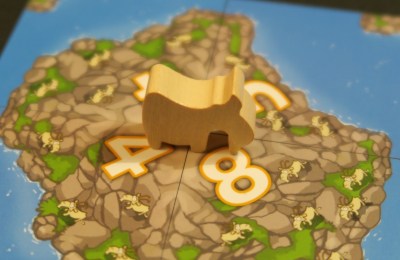
Bokken Schieten
– Image by boardGOATS

Pine was the player who had most recently seen a goat, so he went first.  It quickly became apparent that several players were struggling:  Burgundy had all the low cards, while Magenta had only one card below twenty-four and consequently went bust quite quickly.  Blue also had few low cards, but was so paranoid about going bust she ended up winning no tricks at all.  Goat Island finished with a value of fifteen which immediately put two players out of the running and with Blue taking no tricks it was between Burgundy and Pine.  It turned out that having so many low value cards gave Burgundy the edge as he finished with eleven goat heads, four more than Pine.  It was about this point that Red pointed out that Green, Black and Purple were pariahs because they were the only ones who weren’t wearing blue.  Everyone looked a bit mystified until Red explained that she was celebrating Dublin beating Mayo in the final of the All Ireland Gaelic Football Chamionship, and Dublin played in blue.  Green and Purple quickly demonstrated they did have something blue on (socks and scarf respectively), which just left Black.  He looked shifty and commented that he was also wearing blue, but didn’t think anyone really wanted him to prove it…
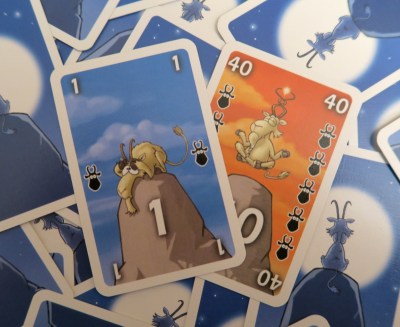
Bokken Schieten
– Image by boardGOATS

The silliness continued as Pine commented that he’d received an email with the subject line, “Show us your knickers”.  Apparently this was something to do with recycling and they wanted new undies or “slightly used bras”.  Pine’s well-endowed colleague had commented that none of her bras were “slightly used” and Pine looked to the girls round the gaming table for opinions precipitating a discussion as to what constituted a “slightly used bra”.  With the nonsense continuing into the discussion of games, there were only two games people were keen to play.  Some of the group had played Roll for the Galaxy a few weeks earlier and felt it needed to be played more so everyone could get to grips with it better.  Green was particularly keen to give it another go, and Black and Purple were happy to join him, leaving place for one more.  Burgundy actively rejected it and Red was keen to play the “Feature Game”, Battle Kittens which left three people to sort themselves out.  In the end, we went with seating positions and Pine, although he was a little skeptical and hadn’t played it before, joined the Roll for the Galaxy group leaving Blue and Magenta play Battle Kittens with Red and Burgundy.

Battle Kittens
– Image by boardGOATS

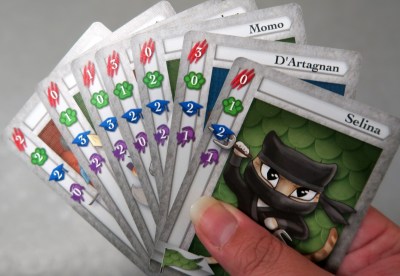
Battle Kittens is a quick-playing card drafting game with a ninja-cat theme.  The idea is that each player is one of the Cat King’s Royal Cat Herders, who starts with seven cat cards, taking one passing the rest on.  As each player receives a new hand, they take another card and keep passing the ever-diminishing hands on until there are no cards left to circulate.  Once this drafting phase has been completed, players divide up their packs of kittens into three groups which will contest the three different battle arenas.  Each arena will be contested on the basis of one of the four traits:  cuteness, strength, wisdom, and agility.  The squads with the three highest point totals in a battlefield are awarded a number of fish tokens in accordance with that particular battlefield’s allotment for first, second and third place.  The key thing is that some kittens have special powers allowing players to pick up “King” cards or add points to other cat cards.  King cards are mostly good, but the King can be fickle sometimes takes out his ill-temper on an unsuspecting squad of kittens.  The game is played over three rounds and the winner is the player with the most fish at the end of the game.
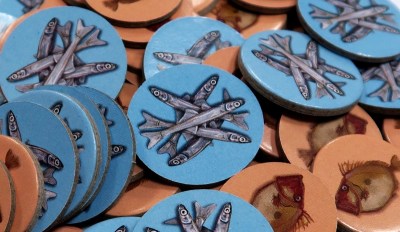
Battle Kittens
– Image by boardGOATS

It took everyone a round to really appreciate what they were trying to do, but by the second round, the gloves were off and the ninja kittens were attacking with everything they had.  It was a hard fought close series of battles as the piles of fish gradually grew and grew.  With the game quickly all done bar the counting, which was very close, but Blue’s Brave Moggies took first place, two fish ahead of Burgundy in second place.  The other table were still underway, so with time for something else, there was another decision to be made.  With time now a factor, there were fewer options and it wasn’t long before a decision was made and players were getting out Sheep & Thief.

Bokken Schieten
– Image by boardGOATS

Sheep & Thief is a strange little “point salad” of a game.  Each player has a board divided into a four by four grid, and starts with their home card and two sheep in the top left hand corner.  Each round is played in two halves: first players draft cards then they play them, taking it turns to place one card per turn.  There are lots of different elements to the game: players are trying to connect their home card to the other three corners while trying to keep their sheep safe and trying to catch other players sheep with their fox, meanwhile, they are also attempting to navigate their black sheep to the bottom right corner of their board.  With points for sheep captured, sheep retained, long rivers, connecting the home card to the other corners of the board as well as for moving their black sheep as far from home as possible, it is hard to see who has the most points and get an idea of who is in the lead.  Blue and Burgundy had both played the game before and both said it was very hard to do everything.

Sheep & Thief
– Image by boardGOATS

Blue didn’t have many sheep and most of them got stolen by Burgundy and particularly Red who really engaged with the thief aspect of the game.  Meanwhile, Magenta didn’t quite follow the rules surrounding the rivers so we had to re-write things a bit to work round it.  Although Blue had almost no sheep and her black sheep got itself sent back to the start right at the end so scored nothing, Blue did manage to pick up lots of points for a long river and and connecting her home to the other corners, giving her a quite respectable score of twenty-eight.  In contrast, Burgundy hadn’t managed to build a route to any of the corners and only had a short river.  With all the sheep he had stolen and his travelling black sheep (who nearly made it all the way to the far corner), he also scored twenty-eight.  It was quite a surprise when Magenta, who had lots of sheep, but was a little low in the other areas, also scored exactly twenty-eight points.  With a three-way tie, it was with bated breath that everyone waited while Blue added up the scores, but sadly, Red had only managed twenty-three.  This seemed a little low to Red, however, and on the recount, it turned out she had, not twenty-eight, but thirty-three, making her the winner and the best sheep thief!
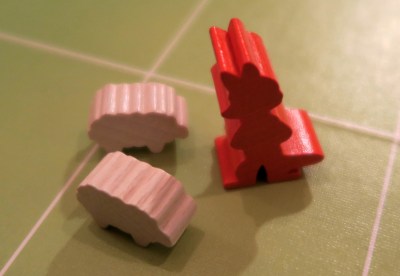
Sheep & Thief
– Image by boardGOATS

With Red and Magenta heading off and the other game still going on, there was just time for Blue and Burgundy to play something short.  It was hard to decide what, as Splendor was the obvious choice, but last time Blue and Burgundy had played, Blue had finally won after two years of trying and was reluctant to start another losing streak.  The game is a simple one of chip collecting and engine-building with a very loose gemstone theme. Basically, on their turn, players can take gemstone poker chips, or use chips to buy a card. Some cards have points on them and all can be used like the poker chips to buy cards (but without having to return them). The cards also give players access to “Noble tiles” which also give points. The winner is the player with the most points after someone reaches fifteen points.  This time, although Blue started well, Burgundy soon wore her down eventually finishing with seventeen points to Blue’s eleven by take two points and a Noble to end the game.

Splendor
– Image used with permission of boardgamephotos

Meanwhile, on the next table a tight fought battle was underway in Roll for the Galaxy.  Black, Purple and Green had all played it before several times and relatively recently too, so it was only Pine who needed a detailed rules explanation.  In summary, players roll the dice in their cup in secret, behind their player screen. They then distribute the dice according to their symbols, matching them up to each of the five phases, Explore, Develop, Settle, Produce and Ship. Players then, still in secret, re-position one of their dice to use it to choose one action they would like to activate. Players can also put a die to one side for a turn to “Dictate” the symbol on another die, i.e. reassign it to a different phase. Once everyone has positioned all their dice, the player screens are removed and players simultaneously carry out the phases that have been chosen in order.  In general, if a phase is chosen by anyone, it will happen for everyone.  Thus, players can look at what others are doing and try to decide whether someone else will activate a particular phase and then they can activate another.

Roll for the Galaxy
– Image used with permission of BGG contributor punkin312

Each die is used to carry out an action once, so if a player has multiple dice assigned to the same phase, the action may be carried out several times. Any dice that were not used because the phase did not happen or because the player chose not to use them are returned to the players’ cups.  Dice that have been “spent” to carry out an action must be placed in the player’s “Citizenry” and must be transferred back into the player’s dice cup at a cost of $1, before they can be used again.  The aim of the game is to get points which come through Trading goods and Settling and Developing Worlds.  These actions have corresponding phases which players must choose during the game.  Worlds broadly come in two different types:  Production and Development.  Production Worlds come with extra dice in different colours and as the different colours have different distributions of symbols, they have different advantages and disadvantages.  The dice can be “spent” in exchange for victory points or money; all dice have the same value when used to get victory points, but different values when acquiring money.  Development Worlds do not provide dice, but instead give special powers and/or extra points at the end of the game.

Roll for the Galaxy
– Image used with permission of BGG contributor punkin312

Players draw World tiles from a bag during the Explore phase and one of the key parts of the game is controlling these piles and manipulating the worlds built in order to steer a particular strategy.  Another important part of the game is controlling which dice that go into the player’s cup.  In this sense, the game could be compared with deck building games like Dominion or bag-building games like Orléans, where players build the contents of their deck/bag in an effort to control luck.  Perhaps the most important part of the game is choosing which Worlds to build and trying to get a synergy between them.  This is quite hard to get to grips with on the first try as it’s not always easy to identify which Worlds are god ones to keep.  That said, players essentially draw one tile from the bag at a time, so the only decision to be made is which side to use.  On the other hand, one of the options is throwing tiles out, in which case, several tiles may be drawn from the bag simultaneously which is more powerful, but makes the decision much harder.  The game end is triggered when one player has built twelve worlds or the pile of victory point chips is consumed.  It is a game that takes a bit of getting used to and everyone usually struggles a bit at the start, which is what Black and Green were so keen to try it again quickly after they last played.  This time everyone seemed to build their strategies round slightly different approaches.

Roll for the Galaxy
– Image by BGG contributor haslo

Green started with a green “Genes” World which is valuable when Trading, however, he was able to he was able to pair it with a Development world that gave him a Production bonus making it very lucrative.  With this and a couple of other Production Worlds he was able to engage in a lot of Shipping.  Black began with a red, Military die which has a distribution that encourages Settling and Developing.  It wasn’t until right at the end of the game though that he was able to Develop some of his most valuable Worlds.  Pine began quite tentatively as it was his first time, but quickly got the hang of Producing and Settling and managed to Develop Worlds that gave him bonuses which eased things along.  Purple, on the other hand,  struggled to get to grips with the game, largely thanks to the worlds she picked up at the start.  In the end, she just built as much as she could and triggered the end of the game when she built her twelfth world.  The others weren’t far behind her though and their better combination of Worlds gave them more points.  It was the victory points from Shipping that really made the difference however, but it was very close at the top with just two points in it.  Had Green ended the game a round earlier (as he’d had the chance to do) he might just have kept his nose in front.  As it was, allowing Black to Develop in the final round was a crucial error and gave him the victory by just two points.

Roll for the Galaxy
– Image used with permission of BGG contributor punkin312

The evening was nearly over, but after a quick update on Richard Branson and Hurricane Irma, there was just time for a little bit more “Trash Talk” – quite literally as it happens, as the conversation moved onto the subject of “drive-through litter-bins” on motorways.  This is now apparently a thing, which led to a discussion with everyone expressing their disgust at the laziness of people who seem incapable of taking their littler home with them and recycling it.  It was in response to one such comment on this subject from Blue that Pine, much to everyone’s astonishment pronounced, “That is because you’re intelligent…”  And on that note, it was definitely time for home!

Roll for the Galaxy
– Image used with permission of BGG contributor punkin312

Learning Outcome:  Black wears blue underwear and Pine thinks Blue is “intelligent” (well, sometimes).

Next Meeting – 19th September 2017

Our next meeting will be on Tuesday, 19th September, at the Horse and Jockey pub in Stanford-in-the-Vale.  As usual, we will be playing shorter games from 7.30pm as people arrive, until 8pm when we will start something a little longer.

This week the “Feature Game” will be Battle Kittens, which is a quick-playing card drafting game with a ninja-cat theme.  The idea is that players draft kitten cards then choose which kittens to put into each of the three different battle arenas.

Battle Kittens
– Image by boardGOATS

And talking of ninja cats…

Jeff was driving through the city when a policeman stopped him and asked him about the Siberian Lynx in the passenger seat.

“What are you doing with that Siberian Lynx?” he exclaimed, “You should take it to the zoo.”

Jeff replied, “Certainly Officer, that’s just where we are going.”

The following week, the same policeman saw Jeff in his car, once more with the cat next to him in the front seat.  This time, of them were wearing sunglasses.  The policeman pulled him over.

“I thought you were going to take that cat to the zoo!”

Jeff replied, “I did. We had such a good time we are going to the beach this weekend!”

5th September 2017

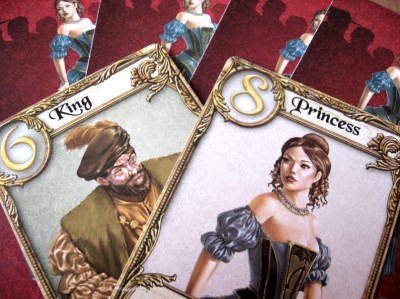
As people arrived slowly, the evening started out with a few rounds of Love Letter.  The archetypal “micro game”, Love Letter is a simple filler game that we’ve played a lot in the past, but less so recently.  The idea is that players have a single card in hand and, on their turn, draw a second and choose which one to play.  There are only sixteen cards in the deck and each has a value and an action.  The action is carried out when the card is played and the player with the highest value card at the end of the game is the winner.  The game is not high on strategy, but is ideally suited to playing while doing other things (like eating pizza), so it is very light hearted and can often generate lots of silly moments with this time being no exception.  When Blue drew the second highest card, the Countess, she got carried away and chose to play the Prince she already held.

Love Letter
– Image by boardGOATS

Unfortunately, the special action for the Countess is that if a player has a Prince or the King as well as the Countess she must discard the Countess (thus revealing information).  Without thinking properly, she played used Prince’s action on Green who was forced to discard the Princess, putting him out of the game.  Too late Blue realised her error and she apologised profusely as Green grabbed his card back and she played her Countess instead.  When the next player, Burgundy, then draw a Guard card giving him the chance to assassinate any card he could name, everyone knew that Green’s days were numbered, though they were reckoning without Burgundy’s bad memory!  Completely unable unable to recall the card Green had been forced in error to reveal, he incorrectly named the King and Green lived on.  In the long run, nobody really benefited from the confusion though, with almost everyone taking one round, we played sudden death and it was Pine who ultimately emerged victorious.

Love Letter
– Image used with permission of BGG contributor thatmadgirl

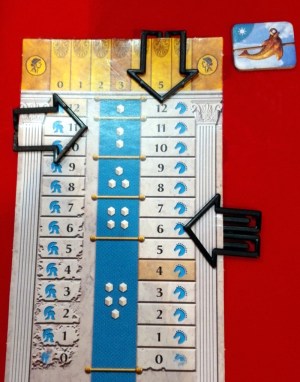
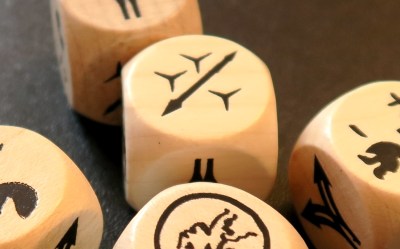
With everyone present it was time for the “Feature Game”, Chariot Race, which is a fairly quick-playing Yahtzee style dice game with a horse racing theme, but actually has more of a feel of King of Tokyo (that we played last time) than anything else.  Players take on the role of charioteers participating in a great race in ancient Rome with the aim being to use dice to complete two laps of the dusty arena and be the first to steer their chariot over the finish line.  On their turn, the active player rolls a number of dice dependent on their speed on the previous turn, with faster chariots rolling fewer dice.  Each face of the six-sided dice allows a different action: Gain new Favors; increase or decrease speed; change lanes, or attack opponents (either directly by hurling javelins or indirectly by dropping caltrops in their path).  If the first roll is not satisfactory, the player can re-roll any or all of the dice.  They can re-roll a second time or turn one die to their chosen face, but to do that they must cash in some of the favour of the goddess Fortuna.  Favours of Fortuna are useful for repairing chariots too, and as there is a large kamikaze element to the game, Favours prove very useful indeed.  Once the dice roll is set, the active player moves their chariot forward according to the final speed they achieved, swerving to avoid rivals, caltrops and potentially devastating piles of rocks and the first player to drag their wreck of a chariot across the line for the second time is the winner.

Chariot Race
– Image modified from original by BGG contributor JackyTheRipper

The game is supposed to be a quick little fun racing game, but it turned out to be everything but quick. This was probably the fault of the players as much as anything else as everyone seemed to get bogged down in analysing all the options.  With seven people present and Chariot Race, playing a maximum of six, Ivory kindly offered to team up with Green who was feeling a little out of sorts, but they were in complete agreement that they should start at the front of the grid.  In contrast, Black decided to start at the back, hoping that others would see him as less of a threat and maybe take each other out leaving him an easy run in.  In practice, it turned out that the back was a particularly bad place to be as Black struggled to avoid everyone in front of him and consequently picked up a lot of damage, soon wrecking his chariot and joining the rows of spectators cheering on their heroes.  Burgundy was quick to follow when the wonky donkey pulling his chariot sped up suddenly and accidentally invented a new Roman form of skittles when he crashed into everyone else in turn.  The problem with that was that although everyone took damage, each collision caused damage to Burgundy’s chariot eventually turning it in to match-wood.

Chariot Race
– Image modified from original by BGG
contributor JackyTheRipper

Starting at the front, the Green/Ivory chariot made a very quick start and took an early lead.  Blue gave chase starting with a recklessly high speed and a “go down in a blaze of glory” attitude.  Pine was a little more circumspect, but made good ground early on.  Purple on the other hand, started towards the back of the grid, made a slow start and was obstructed by the wreckage of Black’s and Burgundy’s chariots at the start of her second lap.  Blue and Green/Ivory tried to impede each other with Blue chucking spears and Green/Ivory dropping caltrops.  As Green/Ivory approached the end of their second lap, Blue was just behind.  So as Green/Ivory crossed the line running on empty they were speared by Blue on the next turn and their wheels fell off their chariot.  Blue crossed the line with a bit to spare and was quickly followed by Pine who couldn’t quite pass Blue so chucked a spear at her to make up for it.

Chariot Race
– Image by boardGOATS

That just left Purple.  With a lot of ground to make up, the odds were always against her and everyone joined helping her to try to cross the line or take out Pine or Blue.  Sadly it was not to be and she decided that if she couldn’t influence the race, she would go out with a bang and smashed her chariot to smithereens on a rock.  So, a game that was listed as taking less than an hour had taken over two and only a third of the chariots playing had made it to the finish line.  It didn’t matter who won though, it had been a lot of fun.

Chariot Race
– Image modified from original by BGG contributor JackyTheRipper

With Chariot Race taking so much time though, we were limited by what else we could play.  Before long there was a debate about the options, including all out old favourites like Saboteur and 6 Nimmt!.  In the end Bohnanza won as a game we could all play without thinking, and Burgundy was reaching for the familiar yellow box from his bag.  The game is one of our old staples, is quick to learn and keeps everyone involved throughout.  Often the simplest of mechanisms are the most effective an that is the case of Bohnanza:  players cannot rearrange the cards in their hand and must play them in the order they arrive.  Thus, on their turn, the active player first plays the first card in their hand with the option of playing the second if they desire.  Once they’ve been planted, two cards are drawn which can be traded, but must be planted by someone.  This can lead to free gifts, but also players being nasty and refusing to take even the apparently most lucrative trades

Bohnanza
– Image used with permission of BGG contributor spearjr

This time, Burgundy started strongly, as did Pine and Ivory.  Black struggled consistently to get the cards he wanted, and with so many people playing, everyone had to be quick or they would miss out.  It was a very tight game with players mostly being nice to each other though everyone was typically reluctant to give Burgundy any easy trades, he got plenty anyhow.  As everyone totaled up the scores, it was clear there wasn’t much in it.  Five of the seven players ended the game with either nine or ten coins, but it was Purple who just sneaked in front finishing with eleven to win by a nose.  And with that, it was time to go home.

– Image by boardGOATS

Learning Outcome: Games sometimes take a lot longer than it says on the box.

Boardgames in the News: Rolling the Dice in the British Virgin Islands

With Hurricane Maria currently devastating the Caribbean, people are once again battening down the hatches and preparing for winds that could reach over 150 mph.  While they are waiting, they could do worse than play a game or two to try to take their mind off it.  That is exactly what the Virgin tycoon, Richard Branson, did when Hurricane Irma struck his home, Necker Island, in the British Virgin Islands.  According to his blog, Richard and his team settled down to an evening playing Perudo (aka Liar’s Dice) before the whole team slept together in two rooms, listening to the parrots chattering away next door, waiting for the arrival of the approaching menace.

Perudo
– Image from virgin.com

This is not the only time Richard Branson has shown an interest in games.  He has expressed a love of chess previously, but he also nearly had a commercial interest in another well known game.  Back in the early 1980s, a friend in Canada, introduced him to a new board game.  It was such a hit that developers invited him to travel to Quebec and seal a deal to distribute the game globally.  Since Richard was incredibly busy with Virgin Records at the time, the trip was postponed so the developers sold the game, Trivial Pursuit, to another company, and the rest is history.

Boardgames in the News: Biscuit Boardgames at Bake Off

This week on The Great British Bake Off, it was biscuit day.  So, Paul Hollywood and Prue Leith set the remaining eleven bakers the challenge to bake a biscuit-based showstopper with a boardgaming theme that could actually be played.  Now on its eighth series, The Great British Bake Off recently moved from BBC to Channel 4, a change that was accompanied by a rejuvenated presenting team including Sandi Toksvig and Noel Fielding.

The Great British Bake Off
– Image from Channel4.com

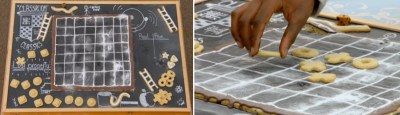
Sadly, the games depicted were all variants on traditional games like Snakes and LaddersCoppit (similar to Ludo), Operation and Chess rather than some of the fantastic modern classic games now available.  Nevertheless, there were some interesting renditions, including from one contestant, Kate, who went for something slightly more modern, basing her creation on Jumanji, the game from the eponymous film.  Stacey was more ambitious deciding to design her own game called “Get to School”, as well as bake it.  There wasn’t time to play test that, but Paul Hollywood did challenge student Liam to a game of Noughts and Crosses played with his compendium of biscuit games.  In the end, the title of Star Baker went to Steven, the Marketer from Hertfordshire, for his “Check Bake Game”, based on Chess.

The Great British Bake Off
– Image from Channel4.com

The episode is available to watch on on demand for another three months.

Boardgames in the News: Meeples vs Tequila Slammers

Last week, a team of boardgamers were pitted against three lovers of Latin cuisine, on the quiz show, Only Connect.  Only Connect is an unusual program that takes pride in being esoteric, challenging teams of contestants make connections between apparently unconnected things.  The team of Meeples included Gail Trimble who led the Corpus Christi College team to the final of University Challenge in 2009.  Although Corpus Christi beat the team from Manchester by eighty-five points, they were later disqualified after an investigation revealed that one of Gail’s teammates finished studying at Corpus Christi while the series was being recorded.  Now back in Oxford, Gail currently holds the position of associate professor in Classical Languages and Literature.  Proving that gaming is a family affair, Gail was joined on Only Connect last week by her husband Tom West and her brother Hugh.  Amongst other things, this episode featured groups of geometric shapes, lucky statues, and micro-genres on Netflix.  The Meeples took an early lead, and despite failing to solve their “Wall”, progressed safely onto the next round. The episode is available to watch on iPlayer until the end of the month.

Meeples on Only Connect
– Image from bbc.co.uk

Boardgames in the News: Arranged!

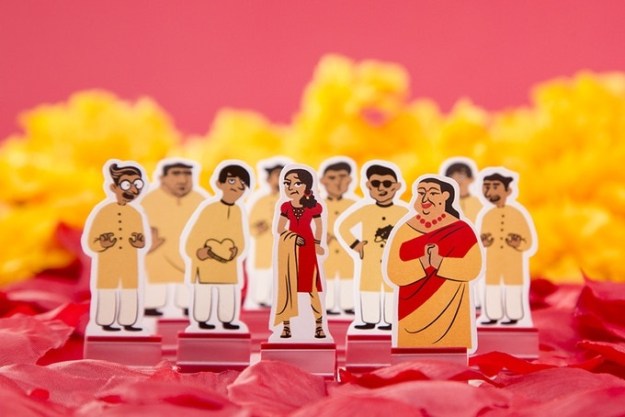
Inspired by the pressure she felt from her own family to submit to an arranged marriage, Arranged! is an unusual game designed by Nashra Balagamwala, a citizen of Pakistan who studied at the Rhode Island School of Design.

Arranged!
– Image from kickstarter.com

The culture of arranged marriages is still very prevalent in South-Asian societies with many girls forced into marrying someone their family chooses for them.  The husband is typically chosen on the basis of his wealth and social status, or sometimes, even as a business deal.   Most of these women cannot fight against the culture because they aren’t educated enough to be able to provide for themselves.  Arranged! masks the darkness of this topic, and provides a light-hearted platform for people discuss these issues surrounding arranged marriages.  The game involves a matchmaker (“Rishta Aunty”) who is trying to get the teenage girls married off to any and every boy she can find.  Meanwhile, the girls spend their time coming up with creative ways to avoid getting hitched for like talking about having a career, gaining weight, being seen in the mall with boys, and many other things that every other society would consider normal, but are seen as disgraceful in South Asian culture.  Eventually, Aunty comes across the Golden Boy, a green-eyed, light skinned, CEO of a business with a foreign passport. This is when the game dynamic switches around and it turns into a rat race to get married to the dreamy Mr. Right with the girls making their way towards Aunty by flaunting their talents.

Arranged!
– Image from kickstarter.com

Arranged! is currently the subject of a crowd-funding project on KickStarter which has already raised over $20,000, considerably more than the $6,000 goal.  Interested parties have a little less than two days left to join the  campaign, which ends on Thursday.

Next Meeting – 5th September 2017

Our next meeting will be on Tuesday, 5th September, at the Horse and Jockey pub in Stanford-in-the-Vale.  As usual, we will be playing shorter games from 7.30pm as people arrive, until 8pm when we will start something a little longer.

This week the “Feature Game” will be Chariot Race, which is a fairly quick-playing Yahtzee style dice game with a horse racing element.  The game is guaranteed to include lots of cut-throat nastiness that would make Judah Ben-Hur wince, but it should be all over in a fraction of the time!

Chariot Race
– Image by boardGOATS

And talking of horses…

A horse was looking over a fence watching a game of cricket.

“Any chance of a game?” he asked Jeff who was the captain.

At first the captain was taken aback by the talking horse, but when it insisted it was keen to play Jeff thought it might be a bit of a laugh if he sent the horse out as the opening bat. The horse shaped up to the first ball and slammed it over the boundary for six. He did the same with the second and third, indeed every ball he hit for six until the over ended.

Jeff had been the horse’s partner, so when the bowler ran in from the other end and he managed his first shot for a meagre single, he called for the horse to run.  The horse had other ideas though and just stood there.  Frantic calls by the captain to run were ignored and in the confusion the skipper was stumped out.

“Why on earth didn’t you run?!?!” yelled Jeff in disgust.

“Listen mate,” replied the horse, “If I could run I would be at the racetrack today, not messing around with this cricket nonsense…”

22nd August 2017

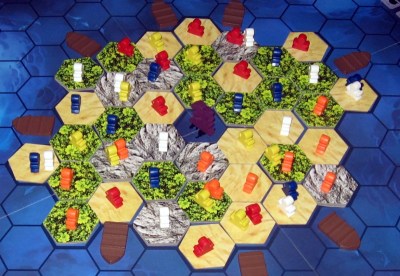
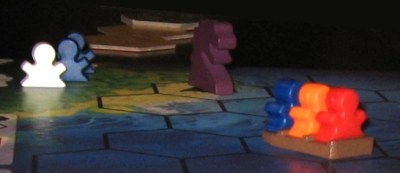
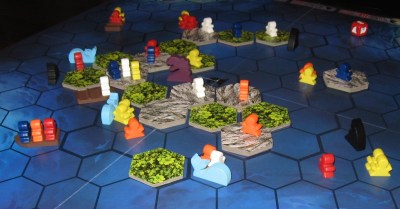
It was a quiet night thanks to work and holidays, and for a long time looked like it might just be a clash of colours between just Magenta and Pink, but gradually others rolled in, just in time for the “Feature Game”, Survive: Escape from Atlantis!.  This is a fairly light game, with a vicious edge that only really works if players engage fully in the “take that” elements.  Basically, each player has set of meeples, each with a number on the base which equates to their value.  With Blue away for work, everyone was keen to take the opportunity to play blue for a change, but Burgundy got in first.  The aim of the game is for players to get their meeples safely to the mainland on the four corners of the board before the volcano erupts and kills them.  To this end, the game begins with players taking it in turns to place their meeples on the hexagonal tiles that make up the central island.   There are actually quite a few things to consider here.  Firstly, the tiles flood in order with the coastal low-lying beach tiles sinking beneath the waves first, then the forest tiles, and finally the grey mountainous tiles.  So, starting on a mountain means there is more time to make arrangements before a vindictive player can sink that hex dumping the unfortunate meeple into the drink.  However, the meeple in question may have to travel some distance across the island to get to the coast, which will take time and actions, both of which are limited.

Survive: Escape from Atlantis!
– Image by boardGOATS

The other major consideration when placing meeples are their value – each player has ten meeples and their values range from one to six.  The winner is the player who gets the highest total value home, so getting a six home is far more important than getting a one to safety.  For this reason, positioning the high value meeples well is critical, on the other hand, placing them first might telegraph that they are the most important meeples, putting them at risk later.  Critically, once they have been placed nobody, not even their owner, can look at the number on the bottom.  So remembering where the high value meeples are also vital to success, as is deciding whether to put the high value meeples together and potentially in the same boat, risking other players attacking it, but ensuring that all efforts can be focussed in one direction.  In general, each hexagon can only hold one meeple, so the available choice steadily decreases during set up.  The base game only plays four, but more can be accommodated with a mini expansion that adds extra pieces in two new colours.  The rules state that everyone should place only eight meeples (returning a one and a three to the box), but we didn’t realise this until people had begun placing so we used the “overpopulated” variant where players place their extra pieces on hexes that are already occupied once the island is at capacity.

Survive: Escape from Atlantis!
– Image by boardGOATS

Once all the meeples had been placed and were jostling for position, the game began in earnest.  On their turn, each player does four things:  play a tile from their hand; move their meeples; remove a tile (carrying out the action if appropriate or adding it face down to their hand), and finally roll the red Creature Die.  Players have three movement points and can use them to move any combination of their meeples and/or boats up to a total of three land or sea spaces.  There are a few rules associated with these, for example,”swimmers” can only move one space per turn because they tire easily, and once they have left the island, they cannot return.  Similarly, it only costs one point to move a “dry meeple” from land to a boat in a neighbouring space, whereas a swimmer must be in the same space as the boat and then it takes a movement point for them to climb over the side.  While anyone can move empty boats, only the player with the largest number of meeples can move an occupied boat.

Survive: Escape from Atlantis!
– Image by boardGOATS

Once the active player has moved his meeples, he then removes one tile from the island, tipping any residents into the sea and then secretly looks at the underside of the tile.  Each tile has different effect with some spontaneously creating whales, sharks or boats out of thin air, while others allow players to hitch a ride on a passing dolphin or cause sharks to magically vanish into the ether.  There are three different types of tile, green bordered to be played immediately; red bordered to be kept for later and played at the start of a later turn; and tiles with a red cross which are also kept but are played on another player’s turn (typically in response to them moving a shark into an attacking position or similar).  Finally, after the tiles have been dealt with, the active player rolls the Creature Die, and then move the creature of that type of their choice.  There are three types of creature.  Whales move fast (up to three spaces) and attack occupied boats, turning them into matchwood, but they leave swimmers alone.  Sharks, on the other hand, move a maximum of two spaces and will happily scoff any swimmers they come across, but can only circle boats looking longingly at their occupants.  Sea monsters are the slowest movers travelling only one hex at a time, but are also the most hazardous, smashing boats and then eating the contents.

Survive: Escape from Atlantis!
– Image used with permission of BGG contributor jsper

For the most part, everyone had distributed their meeples evenly over the island, but Green went for the mountain spaces first so his were a little land-locked in the early part of the game.  Perhaps it was just as well for him though, as everyone started out aggressively and got more so.  There were a lot of whale tiles early on, so boats didn’t last long and no mercy was shown to swimmers at all. Even being nice and trying to make allies didn’t work, so when Pink tried to be nice by moving his boat towards one of Magenta’s swimmers she didn’t repay him in kind.  It’s true that Pink might have had an ulterior motive thinking it was less likely she would attack his boat it if it had one of her own meeples in it, but setting a shark on two of his swimmers was arguably uncalled for.  He got his revenge though when he used a whale to sink one of her boats and parked a shark in the neighbouring hex.  Meanwhile, there was a brief uneasy truce between Green, Burgundy and Ivory as they shared a boat and, with so many people with a vested interest and Pink and Magenta still at war, all three made a rapid crossing.

Survive: Escape from Atlantis!
– Image by boardGOATS

It wasn’t long before all the beach tiles had gone and then all the forest tiles too.  Then everyone was on tenter-hooks waiting for someone to turn over the volcano tile triggering the immediate end of the game.  There are eight mountain hexes, so the probability started out as one in eight, then one in seven, then one in six…  And then Green turned over the fourth mountain tile signalling the end for Pink’s swimmer who had nearly made it to land and Ivory’s boat which disappeared beneath the waves as it filled up with lava.  That just left the scoring.  Burgundy had got three of his meeples home closely followed by Ivory and Magenta who had saved two each.  The number of meeples is largely irrelevant however, as it is the sum of the value of the meeples that is key, and although it looked like a close game, in the end it was much less close than everyone thought.  Almost all of the high value meeples had been eaten or drowned and only Ivory had managed to save any, rescuing both his five and his six point meeples.  That left him with eleven, a clear margin of victory over Burgundy who finished with a creditable seven, taking second place.  It had been fun though, and Pink, who had played it most recently concluded that it was very different with lots of players as it’s a lot easier to end up getting eaten or sunk since it’s a long time between turns delaying the chance to deal with “the impending sea serpent of doom…”.

Survive: Escape from Atlantis!
– Image by boardGOATS

Everyone hadn’t got the aggression out of their systems, so it was out with King of Tokyo for a bit more “take that” style gaming.  This is another “light, but vicious” game where players are mutant monsters, gigantic robots, and strange aliens—all of whom are destroying Tokyo and whacking each other in order to become the one and only, undisputed master of the city.  At the start their turn, the active player rolls six dice, each of which show six symbols each of which has a different effect.  The active player gets three successive throws over which they can choose whether to keep or discard each die.  The dice are used to get points, restore lives, acquire energy and attack other monsters.  Lives and points are tracked using a dial and the aim of the game is to be the first to reach twenty points.

King of Tokyo
– Image used with permission of BGG contributor mikehulsebus

At its core the game uses a three roll, keep or re-roll system similar to that used in Yahtzee, but there is a little more going than that.  In addition to cute standee-monsters and the scoring dials, there is also a small board representing Tokyo.  At the start of the game, Tokyo is empty, but the first player to roll at least one paw (attack) on the dice and choose to use it can move into Tokyo.  Once Tokyo is occupied, it will not be empty again during the game.  Monsters in Tokyo can only damage monsters outside the city and monsters outside Tokyo can only attach monsters inside the city.  This means that a player in Tokyo is a target for all the other monsters.  On the other hand, rolling an attack die while in Tokyo deals damage to everyone else increasing its value.

King of Tokyo
– Image used with permission of BGG contributor msaari

Tokyo is also important because when a Monster enters Tokyo the player earns a point for doing so, furthermore, if a Monster is still in Tokyo at the start of their next turn then the player earns another two points, and will continue to earn points for every round they stay there.  This is perilous, however, as they will be the subject of every attack someone makes from outside Tokyo and monsters in the city are not able to heal themselves.  With five players, there is room for two monsters in Tokyo, which means there is one less outside, but that is only the case until a monster inevitably succumbs to their injuries.  Once a player is in Tokyo, the only way to get them out again is to keep attacking them, until their nerve fails and they decide to leave making way for the attacking monster.  By this time, of course, it may be too late and too much damage has been done for them to be able to heal sufficiently.

King of Tokyo
– Image used with permission of BGG contributor Toynan

In addition to attacking and healing, the dice can also yield energy.  For each lightening bolt rolled and kept, the active player gets a green energy cube, which can be used to buy power cards.  These come in two main types,  “Keepers”, that can be used repeatedly, or “one off” cards that are discarded when used for their benefit.  They are potentially very valuable, especially if bought early in the game and can be used repeatedly.  Finally, it is also possible to score points from the dice by rolling three of the same numbers.  For example, rolling three “twos” will give two points, however, rolling two will score nothing which makes going for these quite a gamble.  The game ends when either one player gets two twenty points or there is only one monster left standing.

King of Tokyo
– Image used with permission of BGG contributor msaari

The game continued the aggressive theme of the evening.  Magenta and Burgundy were first in Tokyo and survived the whole round picking up the bonus points.  Pink then attacked and both Magenta and Burgundy fled with their tails firmly between their monstrous legs.  On his next turn, Burgundy was able to hide and heal, but Magenta was not so lucky being forced to attack and go back into Tokyo.  Sadly, this proved fatal and she was quickly out after accruing just seven points.  At this point Green was looking very strong with a powerful hand, in particular the “Evacuation Orders” which caused everyone else to lose five points.  This meant that when Pink quickly followed Magenta out of the game (finished off by Ivory) he went with no points at all.  Meanwhile, Burgundy was slowly rebuilding his health and was able to keep the other remaining players at a minimum.  Ivory was next, making it a battle to the death between Burgundy and Green, a battle that Burgundy eventually won after much blood was spilt.  Although it was still early, all the savagery had been tiring and everyone opted for an early night.

King of Tokyo
– Image by BGG contributor Schaulustiger

Learning outcome:  Being nasty can be very hard work.