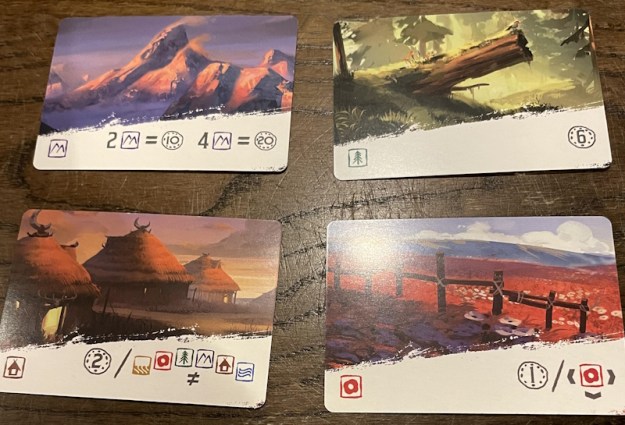
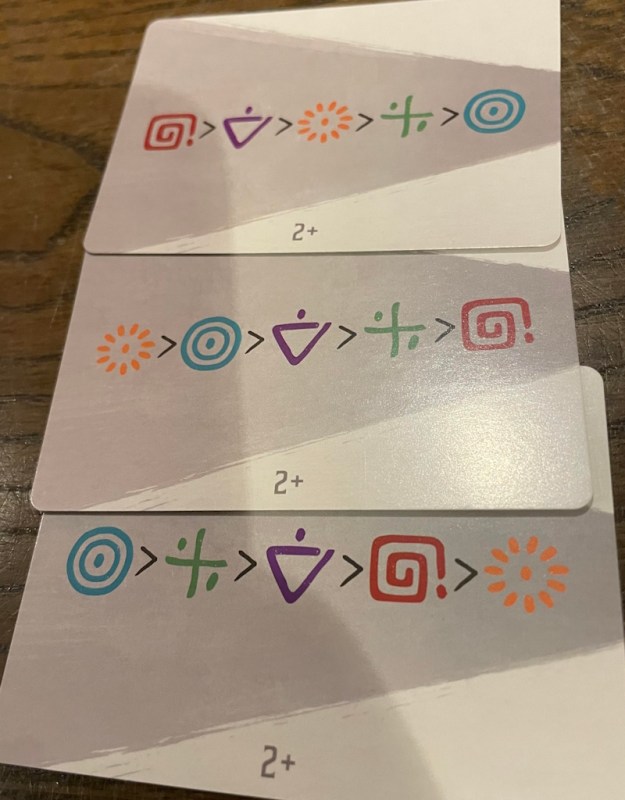
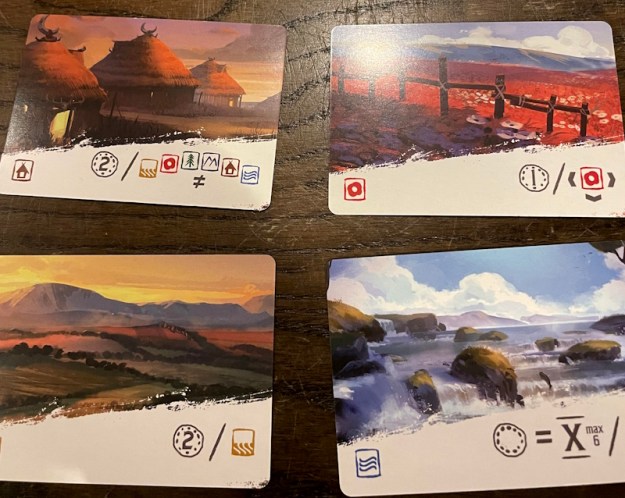
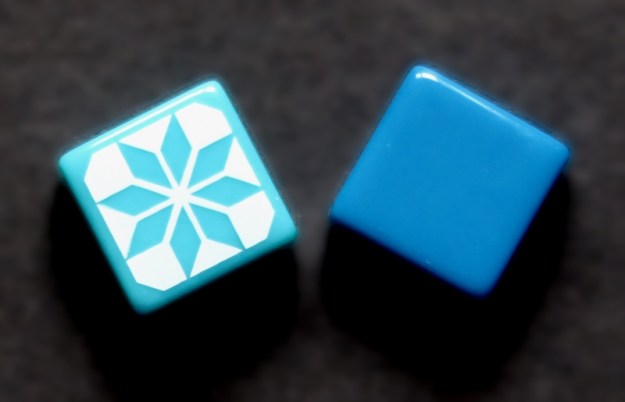
Tag Archives: Azul

22nd July 2025 (Report)

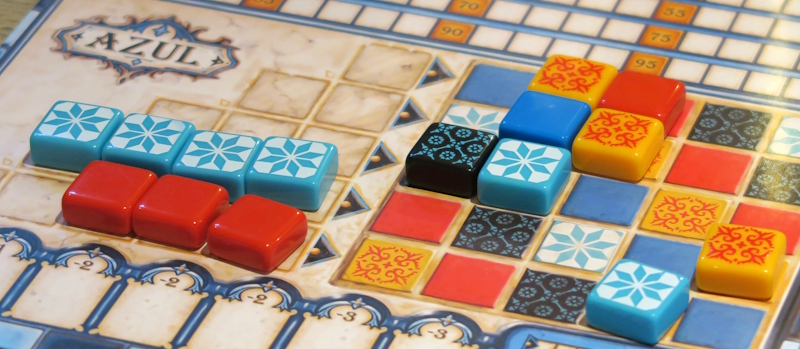
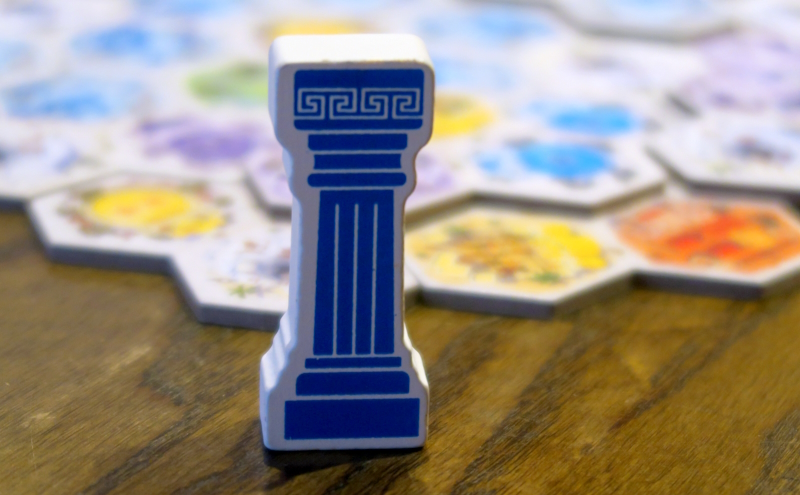
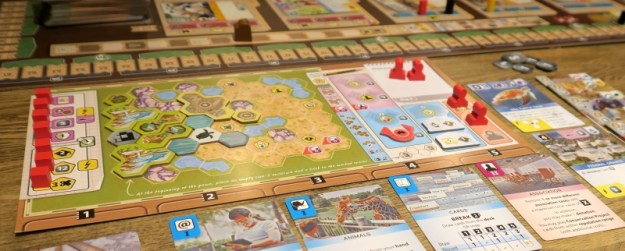
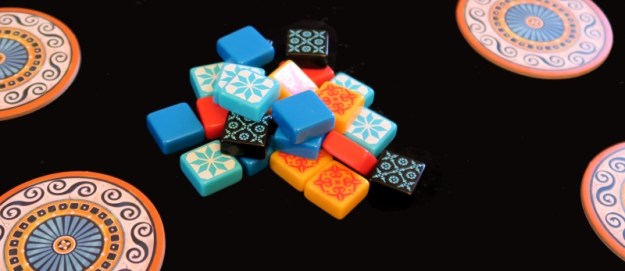
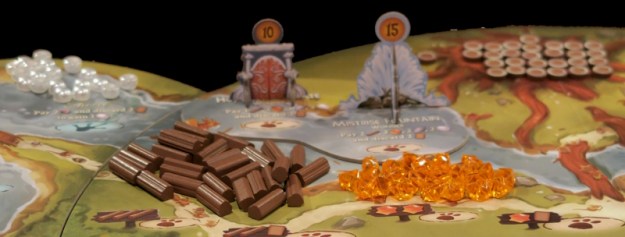
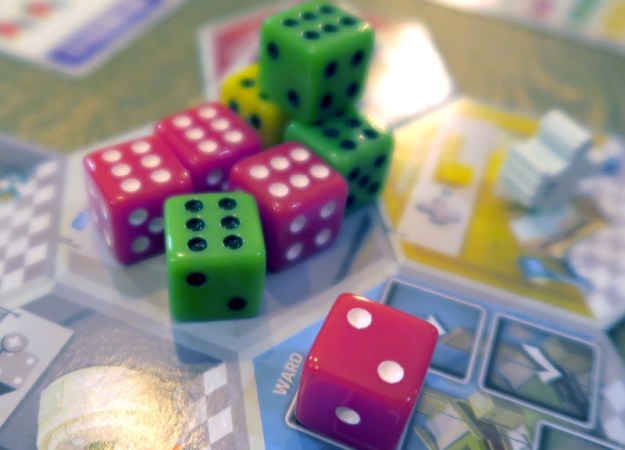
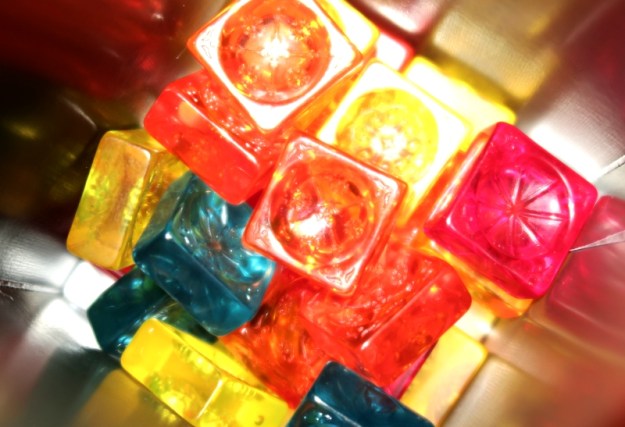
This being the summer, Lime brought LIttle Lime to join in the evening, but as there is a curfew for under-eighteens (due to licencing restrictions), the first game had to get off the mark quickly.  Together with Pink and Plum, they quickly got going with the well known favourite and Spiel des Jahres winning game, Azul.  This is known to everyone, so needed little clarification, though they group decided to use one of the alternate boards from the Crystal Mosaic expansion (the one with the cross pattern).  The game is very simple with players taking tiles of one colour from a factory and putting the remains in the centre, or taking all the tiles of one colour from the central pool.

Azul
– Image by boardGOATS

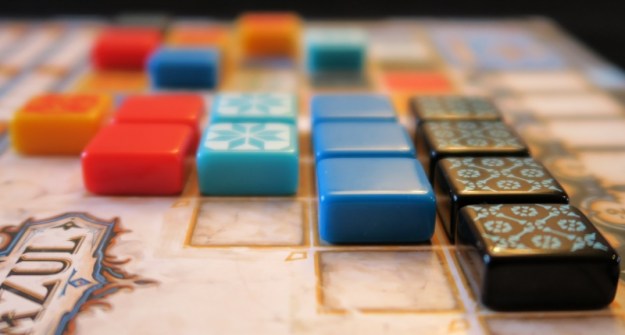
In either case, players have to add them to their conveyor and if, at the end of the round the conveyor is full, one tile is slid across to be added to the mosaic and the rest disposed of. If the added tile is isolated it scores a single point, but if placed next to other tiles, then more points are scored with larger groups scoring more points.  In this way, tiles grouped together keep scoring points.  Thus, a player who starts well can build a lot of points, which both Little Lime and Plum managed to do.  In the end, Big Lime ended the game, leaving Plum with a single point advantage—The moral of the story:  Don’t end the game too early (as Big Lime commented regretfully).

Azul
– Image by boardGOATS

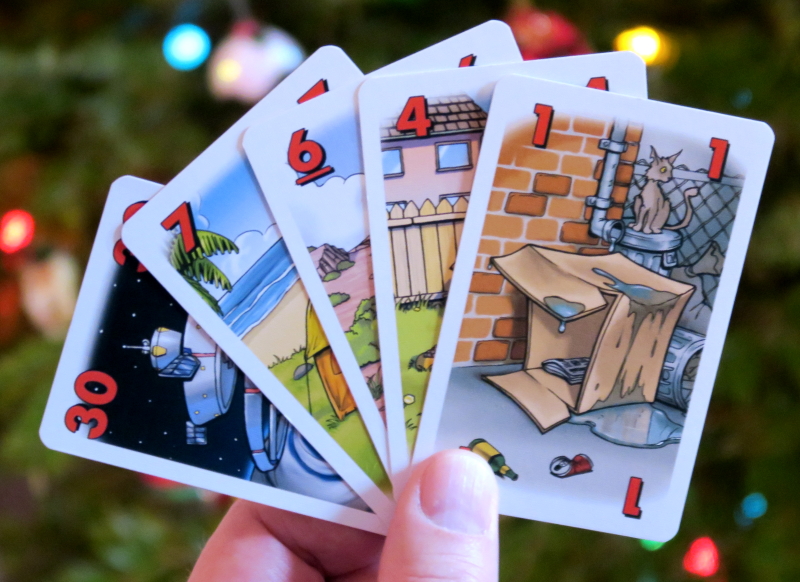
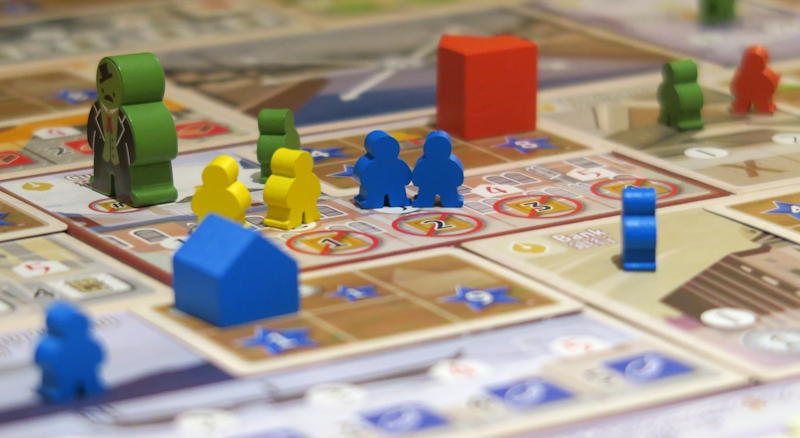
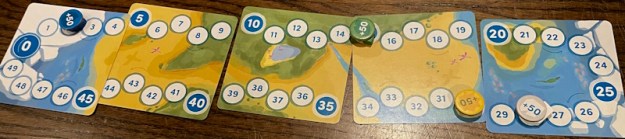
On something of a roll, the group moved on to one of Pink’s favourite quick fillers, For Sale.  Dating from the end of the last century, this game is now nearly thirty years old, but isn’t really showing its age, despite that.  The game comes in two halves:  Buying Properties at Auction, then Selling Properties by Blind Bid.  This game was really really close with a single point between Plum and Little Lime, but they were a a few points behind Big LIme who, as an accountant might be expected to perform well in a financial game.  The winner, however, was Pink, who, despite it being one of his favourite games had never won, until now.  And with that, it was time for Family Lime to head off.

For Sale
– Image by boardGOATS

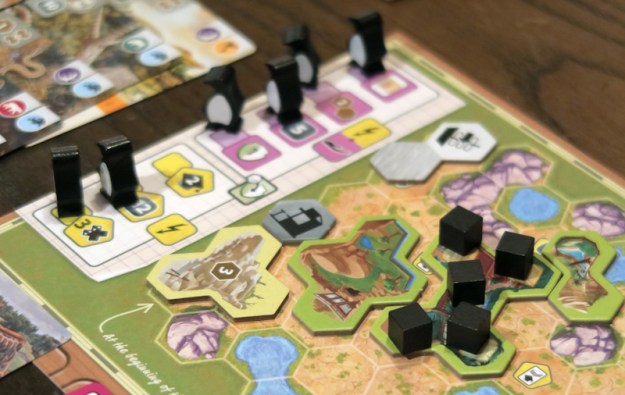
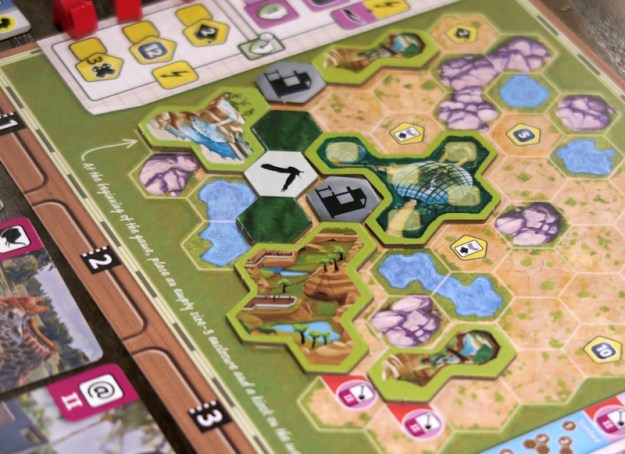
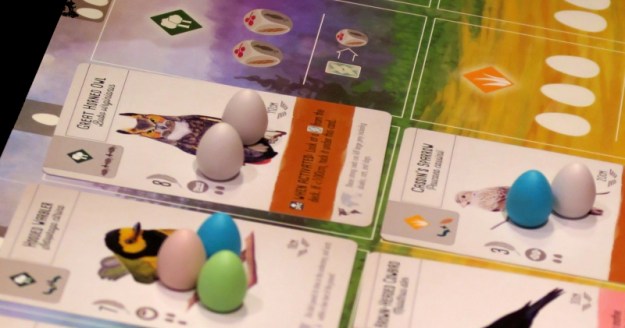
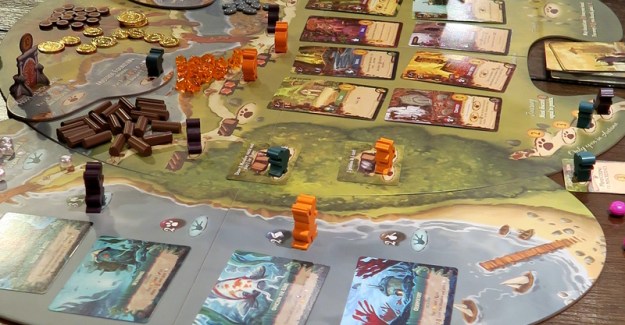
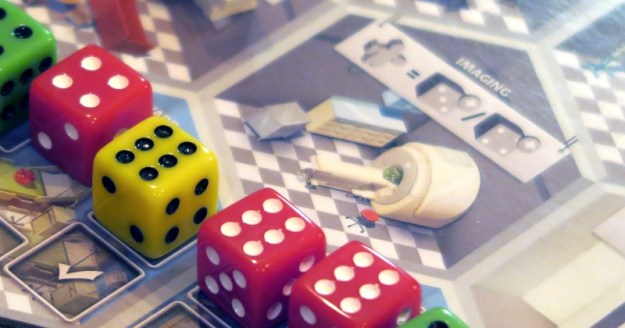
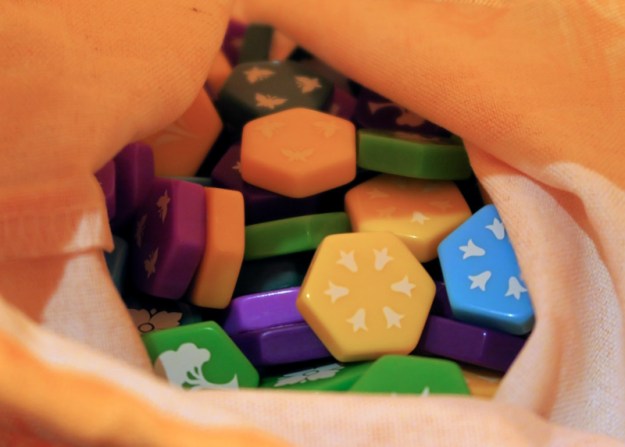
Meanwhile, the rest of the group were engaged in the two tables of the “Feature Game“.  To mark the recent announcement of the Spiel des Jahres winners, this was  Looot.  Although Loot was not actually one of the winners, it, along with Faraway, had recieved a nomination for the Kennerspiel des Jahres and, as it had proved popular within the group (also like Faraway) we decided to make it the Feature.  Although its nomination was in the Expert or Connoisseur category, the game is not overly complex.  The game is played over a series of rounds where each player places one of their Viking workers—the game ends when everyone has run out of Vikings.

Looot
– Image by boardGOATS

On their turn each player places one of their Vikings on the central playerboard.  This is is made up of hexagons: the Viking must be placed on an empty space next to another Viking (of any colour).  Each hexagon gives a resource which can be used to purchase Longships, and if the Viking fulfills certain conditions, it’s owner can capture a house, Watchtower or Castle.  The player with the most points at the end of the game is the winner.  This time there were two tables playing the same game, with Black leading the first table comprising Purple, Byzantium, and Cobalt.

Looot
– Image by boardGOATS

This game turned into a a bit of a battle for Castles between Byzantium and Cobalt.  Cobalt did rather better in the end though thanks to his Long-ship bonuses.  This was because Byzantium kept revealing them and everyone else eschewed them until it came to Cobalt who snapped them up.  Byzantium’s frustration was increased somewhat because Cobalt was just before him in turn order so it looked like they miight make it round to him until they didn’t…  quite…  In the end, Cobalt’s were worth forty-two while Byzantium’s gave him just twenty-eight, despite the fact he actually had more.

Looot
– Image by boardGOATS

It was still close between them, but fairly inevitably, Cobalt had the edge finishing with one-hundred and twenty-eight, ten more than Byzantium in second place.  This was a much higher scoring game than the second table, although that was much closer.  Jade led this game with Mint, Sapphire, and Blue making up the group.  The strategies were very varied, with Jade going for Castles, Mint for Watchtowers, Sapphire for Gold, and Blue who was new to the game, going for a balanced strategy so she could change her tactics as required.

Looot
– Image by boardGOATS

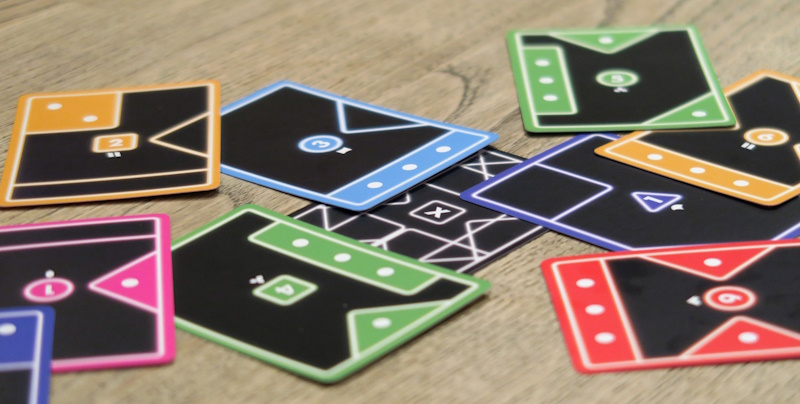
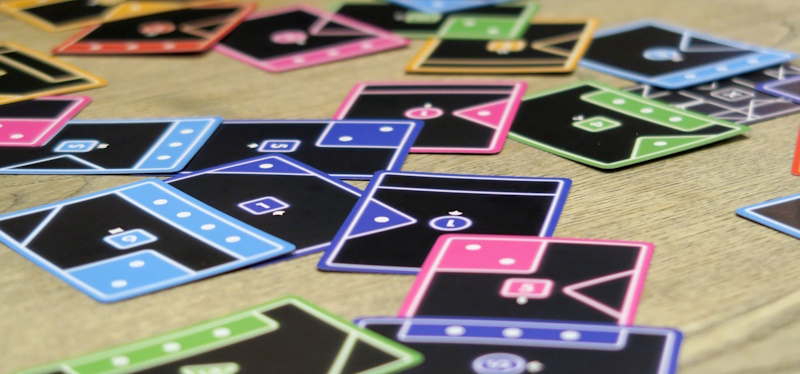
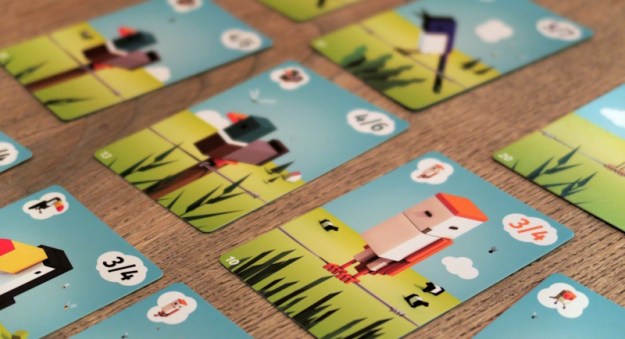
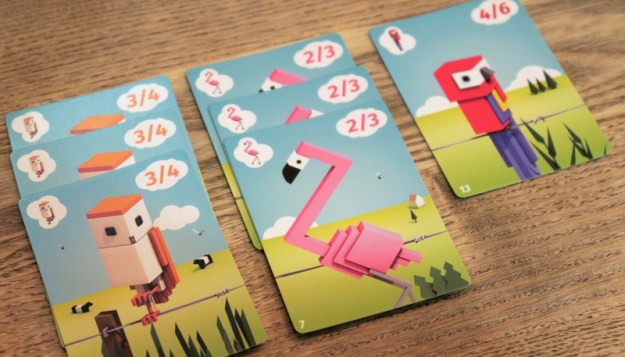
In the end, Blue’s “points from everything” approach just had the edge giving her victory with eighty-eight points, two more than Mint who had one more than Jade with Sapphire close behind. With the games of Looot coming to an end at the same time as For Sale and with Family Lime heading off, the rest of the group split into two.  The first, larger group, consisted of Jade, Sapphire, Blue, Pink, Mint, Plum and Byzantium who decided to give a simple and supposedly quick little game called Tacta an outing.  This is a sort of “card placing” game where players have a hand of cards and place them on the table to cover up spots on other players’ cards.  At the end of the game, the player with the most spots visibleis the winner.

Tacta
– Image by boardGOATS

Unfortunately, game time is proportional to the number of players, so with the six players (Plum and Byzantium shared a hand and worked together), the game was always going to take twice as long as it would with three.  Worse, this was one of those games where gamers take even longer as they want to make sure the find the best placement option and push the rules boundaries.  It is a very clever little game though and a lot of fun, though perhaps playing with fewer cards or fewer players would avoid it outstaying its welcome.

Tacta
– Image by boardGOATS

It was made worse by the fact that everyone helped everyone else and therefore, the victor was quite obvious from fairly early in the game  Although Blue made a dash to come from zero to finish in a more respectable last place, nobody looked like they were seriously going to challenge the Byzantium-Plum team.  Mint took second one point ahead of Pink who was one point ahead of Jade who was one point ahead of Sapphire.  Definitely one to try again, but with fewer people next time.  The supposed quick card game ended up finishing some time after the supposed longer game, Ticket to Ride: Paris that Black, Purple and Cobalt chose.

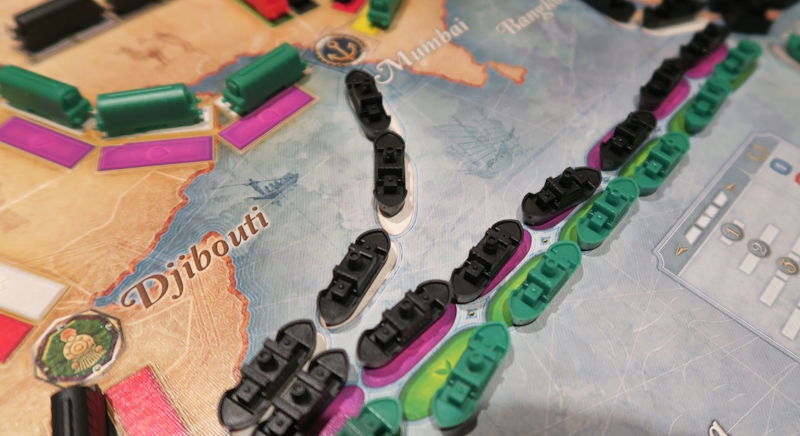
Ticket To Ride: Paris
– Image by boardGOATS

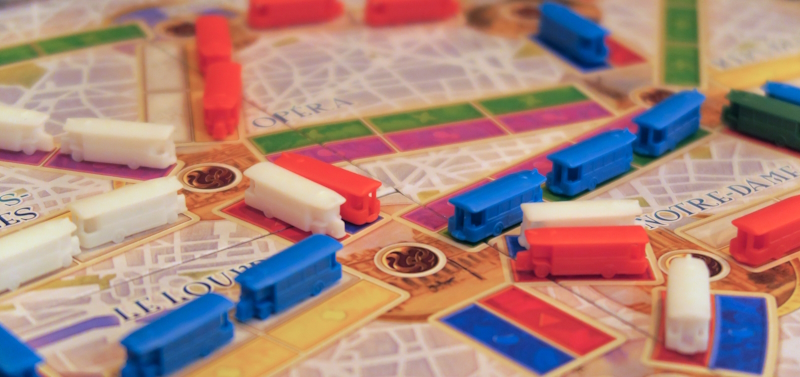
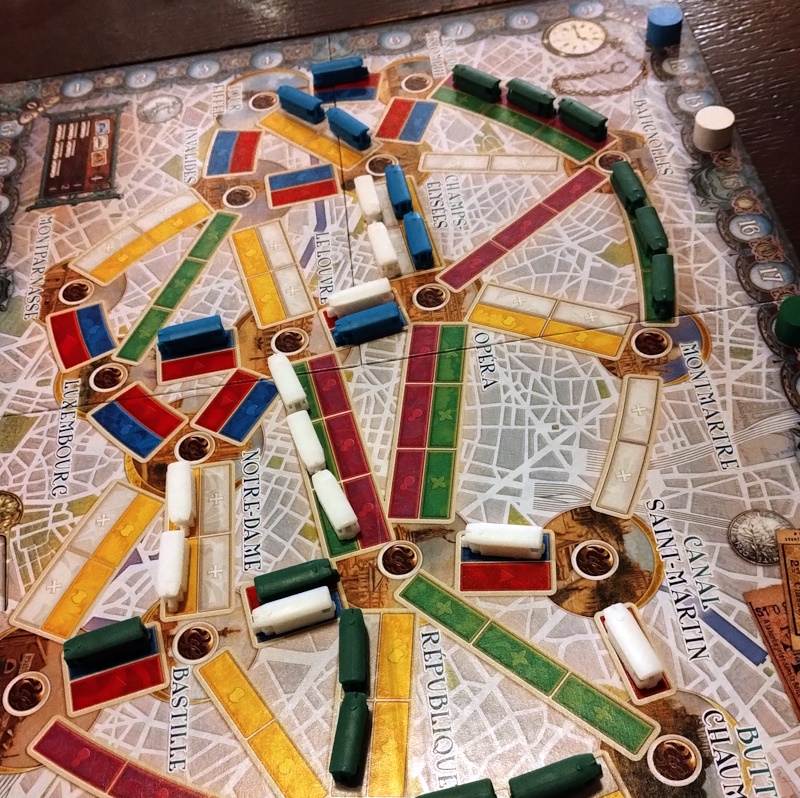
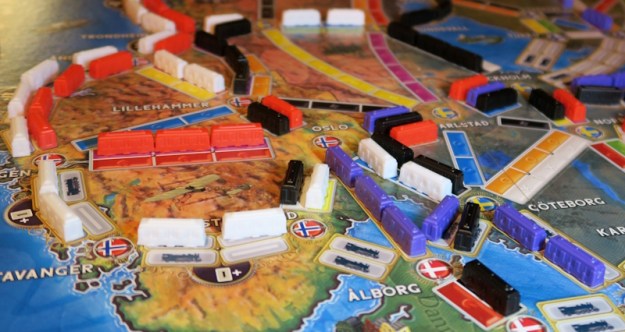
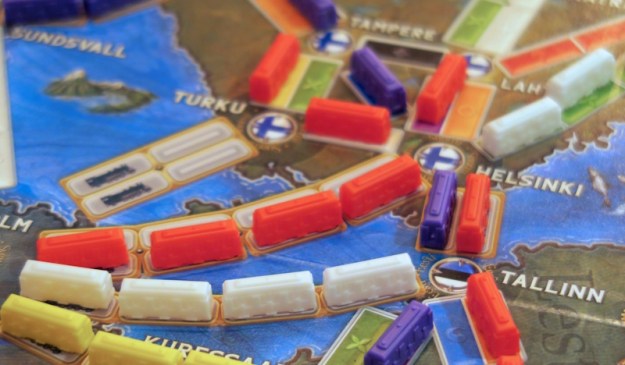
One of the small, “City Editions” of the popular, Spiel des Jahres winning Ticket to Ride games, we’ve played Paris quite a bit since it was released last year.  Following the same pattern as all its brethren, the game involves collecting coloured carriage cards and spending them to place metro carriage pieces on the board to connect regions of the city, while trying to also complete tickets.  Each edition has its own extra little rule, and in the Paris edition, this is centred on the colours of the tricolor.  When players build a red, white or blue route, they keep one of the cards, when they complete a set of three they discard the cards and claim bonus points.

Ticket To Ride: Paris
– Image by boardGOATS

Purple started and game play was rapid.  Before long, players were running out of pieces, with Blake miles ahead of the other two.  But that was without the addition of scores for Tickets. Purple took got nine points for her three completed Tickets thanks to her misplaced bravery in picking up tickets at the end and not being able to complete her last one.  Cobalt took sixteen points for completing all four of his Tickets, though that was with a bit of jiggery pokery (i.e. retaking his last turn) in order to complete one ticket when he realised he had actually failed to complete it. It was therefore perhaps fair that Black who only scored ten points for completing his pair of tickets just managed to keep his nose in front, taking victory by a single point.

Ticket To Ride: Paris
– Image by boardGOATS

Learning Outcome:  There is something for almost everyone in the Spiel des Jahres lists.

13th May 2025 (Report)

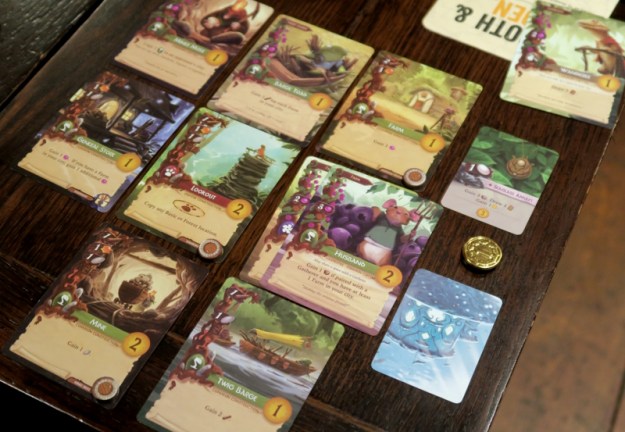
For some, the evening began early with fish and chips in the garden to mark a special visit from Plum’s Aunt Damson.  The evening took an even more special turn as it was the day before Pine’s Big Birthday, so there was cake.  Green also put in one of his special appearances, bringing his mum, Saffron, with him.  Salmon came for the second time, and lastly, Orange, who had acquired a motorbike and was therefore now able to travel, also came for the first time in about eighteen months.  So with all these extras as well as the usual suspects, the room was packed and the group split into four with Jade leading the “Feature Game” which was to be Moon, a card drafting game where players construct bases, vying to build the new lunar capital.

Moon
– Image by boardGOATS

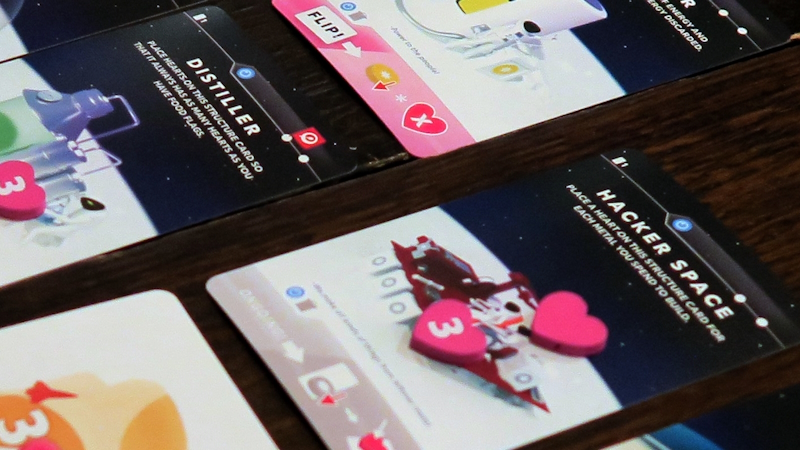
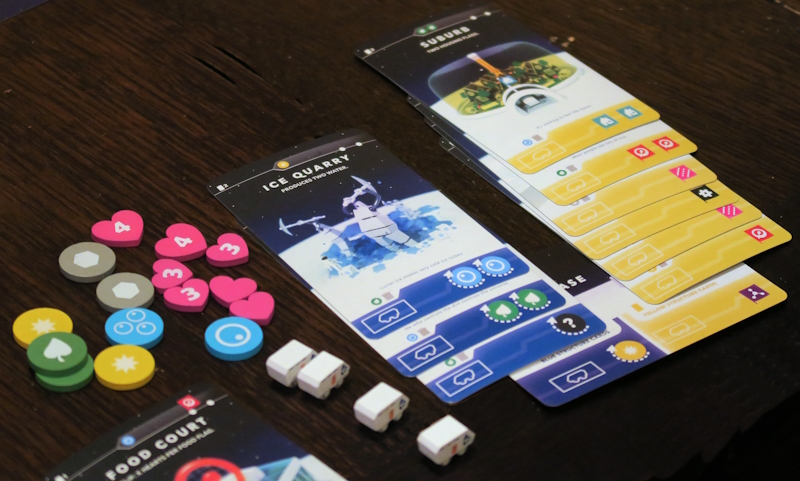
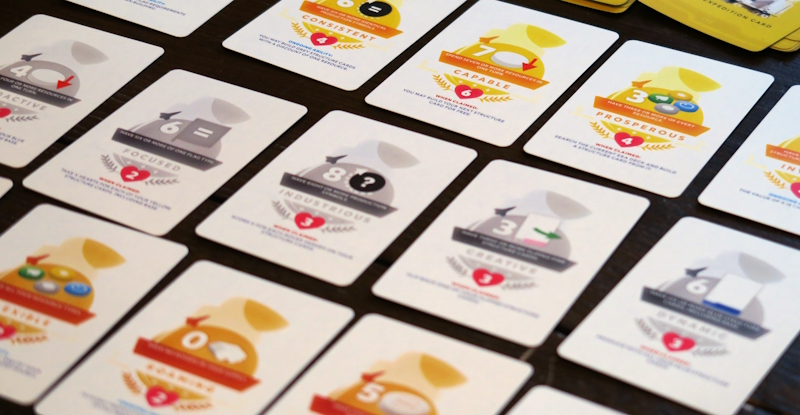
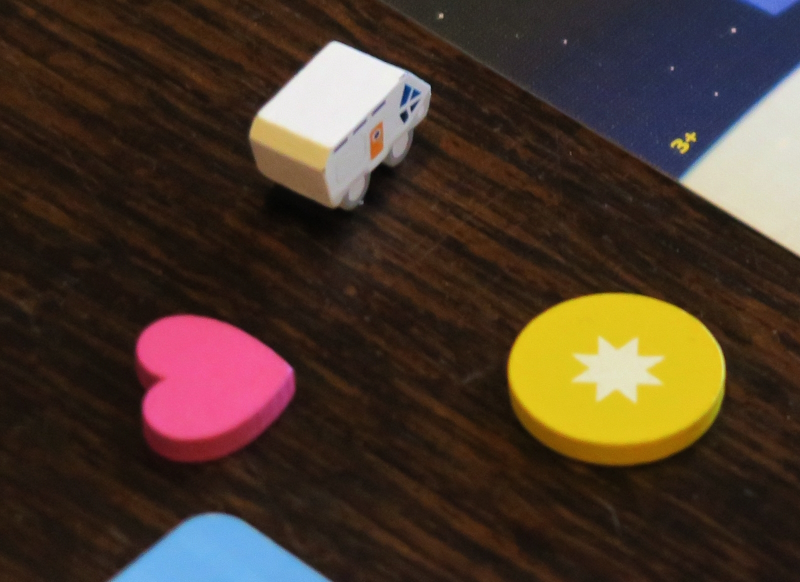
Moon is played over three rounds or Eras, collectively representing the first hundred years of populating the Moon.  Each Era is divided into three parts:  first players produce Resources, Rovers and Hearts from their Settlements.  Then comes the drafting where players choose a card from their hand to Build or discard, then pass their hand to the next player, repeating until there are no cards left.  Finally, players claim the Hearts on the central Flag Reward Board, and score any Hearts placed on their Structures and Reputation Cards.  At the start of the drafting phase, each player has one Expedition cards while the rest of the cards are Structure cards—this hand of cards represents an expedition from Earth that travels between settlements on the Moon.

Moon
– Image by boardGOATS

Unlike most card-drafting games, turns are taken sequentially with, players a Structure card from their hand and placing it in their Settlement paying any Resources and making sure any Flag Requirements are fulfilled.  Alternatively, instead of playing a card, they can discard (or “Assimilate”) a card, taking the Resources, Rovers or Hearts depicted in the discard line.  There are also four optional actions that players can carry out once each in any order before or after their mandatory action (Building or Assimilating)—use the Bonus Action on their Expedition Card; park a Rover; claim a Reputation card, or turn over a pink Action card.

Moon
– Image by boardGOATS

Once all players have taken their turn, all players pass their hands (including the Expedition card) to the player seated to their left and the player who now has the First Expedition Card starts the next round.  There are some similarities with Terraforming Mars, with cards having “Flags” (akin to the “Tags”), with some cards needing some Flags as a prerequisite while others display and therefore provide them.  There are five different Flags, Industry, Science, Food, Housing, and Transportation.  There are also four different types of Resource, Energy, Water, Biomass and Metal which are represented by wooden tokens, or Resource-eeples.

Moon
– Image by boardGOATS

The guts of the game are the cards—there are five different types:  blue Production cards, yellow Flag cards, pink Ability cards, grey Excitement cards and red Special cards.  Blue and yellow Structure cards also display a Rover parking space.  Players begin the game with two Rover-eeples, but can acquire more during the game.  Players can park Rovers on other players’ Structures to either use the card to immediately gain its Resources (blue) or use the Flags on it to fulfill a Flag Requirement when Building (yellow). Pink Ability cards provide an ability players can use once per Era by flipping the card while grey Excitement cards provide Hearts, which are victory points—some of these just give points at the end of the game while others give Hearts during the game.

Moon
– Image by boardGOATS

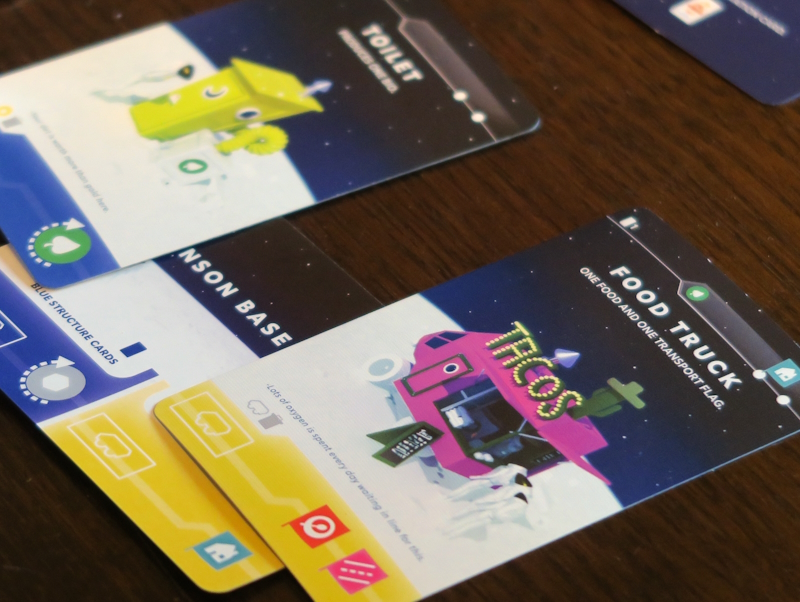
There was some hilarity over the card names, especially when Orange built a Toilet right next to his food van, Just in case!  Jade who was the most familiar with the game, took an early lead in the Hearts and finished with what appeared at first glance to be an unassailable lead with fifty-six of them, fifteen more than anyone else.  There are other scoring opportunities however, with points available for Grey Structures and Reputation Cards, and Jade came off worst for both of these.  Black picked up the most points for his Grey Structures with thirty followed by Pine with twenty-seven.  Scores were much lower for Reputation with Black, Sapphire and Pine with a similar tally.  In the end, it was very close, but the victory was Sapphire with a combined total of seventy-nine, just two more than Black in second, with Jade completing the podium.

Moon
– Image by boardGOATS

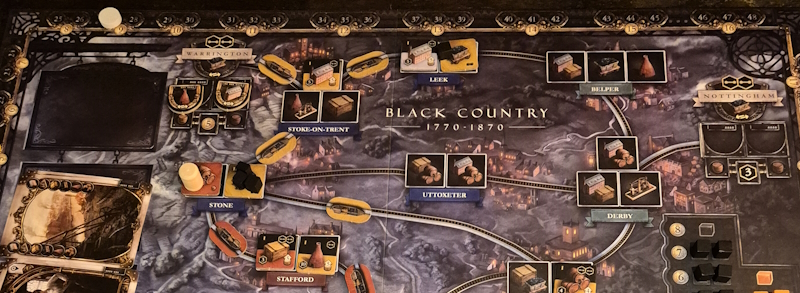
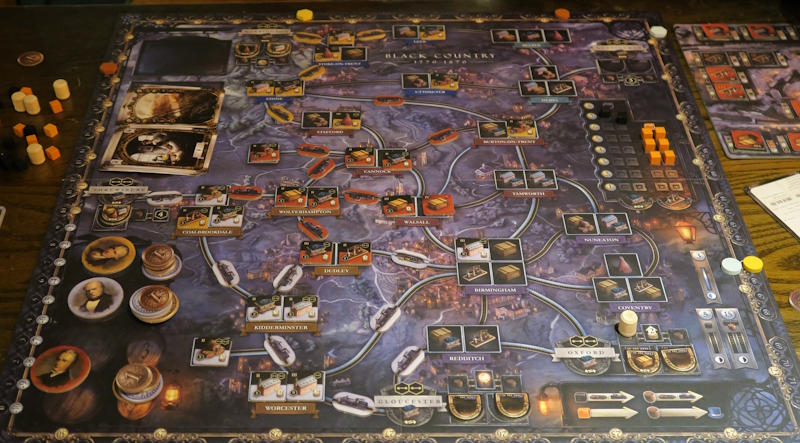
On the next table, Ivory and Byzantium were introducing Salmon to Brass: Birmingham.  There was a concern after last time that they might be a bit pushed to finish it in time (especially after last time), but with only three and with Birmingham being quicker to play than the original Lancashire version, they felt it was worth a go.  Ivory explained the rules while Byzantium set up the board.  In both games, players develop, build and establish their industries and network in an effort to exploit low or high market demands.  Players take turns according to the turn order track, paying two cards (from their hand of eight) to take any two actions from a possible six: Build, Network, Develop, Sell (cotton, manufactured goods or pottery), Borrow, and Scout.

Brass: Birmingham
– Image by boardGOATS

Building involves paying the required resources to place an industry tile while Networking is placing a Rail or Canal Link.  When Developing, players increase the point value of an industry, while Borrowing involves taking a £30 loan and a reduction in income.  The Scout action is new to the Birmingham game and replaces the Double Action Build in original, instead discarding three cards and taking a wild location and wild industry card.  Played in two halves, when the deck runs out players score, remove all the Canal Links then play on but this time building Rails.  The game ends when the deck runs out for the second time.

Brass: Birmingham
– Image by boardGOATS

Ivory went first.  Due to Shrewsbury accepting all goods (this was randomly determined as part of set up) and selling goods being critical to scoring points, initially everyone focused on building near there and building industries that gave resources (i.e. coal and iron) that were going to be need to build further industries.  So Ivory, who went first began by building a Coal Mine in Coalbrookdale, while Byzantium added an Iron Works at the same location and Salmon placed a Coal Mine next door in Wolverhampton. At the start it looked like all three would all be competing in the same area, but once they continued building their networks (via Canals) and more industries, everyone started to spread out.  Ivory headed south, building Cotton Mills in Kidderminster and Worcester and was the first player to Sell, Selling to Shrewsbury and gaining four points for consuming Beer there (Beer being a prerequisite to Selling) and filling the tile to increase his income.

Brass: Birmingham
– Image by boardGOATS

Byzantium went north and sold Cotton to Warrington, gaining £5 as his “Beer Bonus”, and increased his income. Seeing the opportunity Byzantium was building, Ivory took the opportunity using a Leek card he had which allowed him to build outside his network, to build a Cotton Mill in Leek and immediately Selling, using the remaining Beer there to also gain £5. Salmon went more central (Cannok and Walsall), focusing on Coal Mines and Iron Works, but as no one was consuming the resources (both Byzantium and Ivory were slightly self-sufficient), he was unable to flip his industries and increase his income. This became a major issue for him as the game progressed. Everyone ran out of money quite quickly and were forced to take out Loans, decreasing their income making it negative so that they had to pay money to the bank at the end of each round.

Brass: Birmingham
– Image by boardGOATS

Whereas Byzantium and Ivory promptly Sold some Goods, flipped tiles and increased their  income so it was positive again, Salmon got caught in a debt trap, having to take further Loans to take actions and service his debt. When required to take a third Loan (and then pay £9 each in upkeep), it was agreed that he should take the Loan without the drop in income, allowing him to take actions and sell goods and ultimately get back to a positive income. After a late era focus on breweries to get the Beer to Sell further goods, cotton and in Byzantium’s case, Pottery, the Canal Era came to an end. After scoring flipped tiles and Canal Links, Ivory had a slight lead.

Brass: Birmingham
– Image by boardGOATS

At the end of the Canal Era and going into the Rail Era, as well as all the Canals, all Level 1 tiles are removed from the board, representing obsolete technologies.  This wiped out everything Ivory had and most of Byzantium and Salmon’s tiles, so the start of the Rail Era was similar to the beginning of the game.  That said, Byzantium and Salmon were tied to their positions because, without a named card, players always have extend their Network from an existing position if they can.  That meant, Byzantium and Salmon always had something that was going to score twice though, where as Ivory had to build from scratch, but was free to start anywhere.

Brass: Birmingham
– Image by boardGOATS

With Rail connections requiring Coal to build, and because the cards in Ivory’s hand were all close to Shrewsbury (which that accepted all goods), he began the second Era almost exactly the same action way as he started the first, building a Coal Mine in Coalbrookdale. Although he had nothing on the board, Ivory was able to rebuild very quickly, partly because he had a good income, but also because he had taken a Loan as his very last action in the Canal Era.  Salmon and Byzantium also built their Networks in similar areas to the first Era. Byzantium’s core strategy was building and selling pottery to Warrington.

Brass: Birmingham
– Image by boardGOATS

Pottery is a unique resource in Brass: Birmingham, with the first pottery title being worth a large amount of points when flipped, the next being worth very little, the next giving big points etc.. Players are also restricted in developing Pottery, which mean they can’t skip the low point value titles. However, the big scoring tiles are worth a lot and Byzantium was able to get the highest level title out and flipped for a total of twenty points. Ivory again focused on the more standard cotton Mills, and each title being worth more points than the last, he was able to get multiple titles placed and Cotton sold, flipping the tiles to Shrewsbury. He also spent actions building lots of rail links next to his flipped tiles.

Brass: Birmingham
– Image by boardGOATS

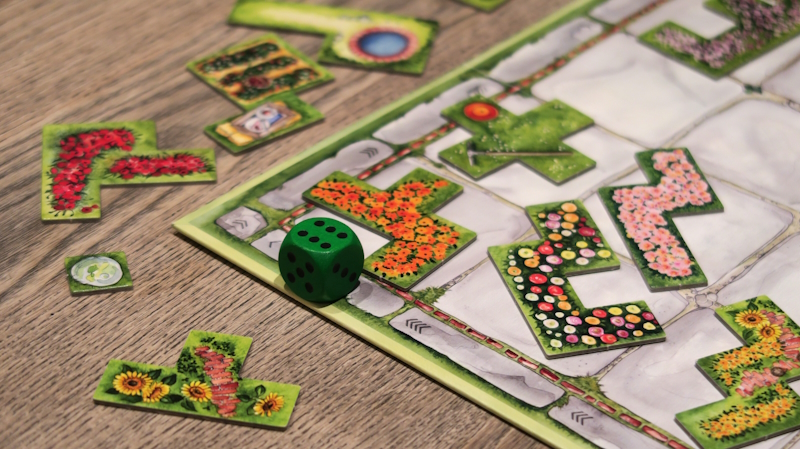
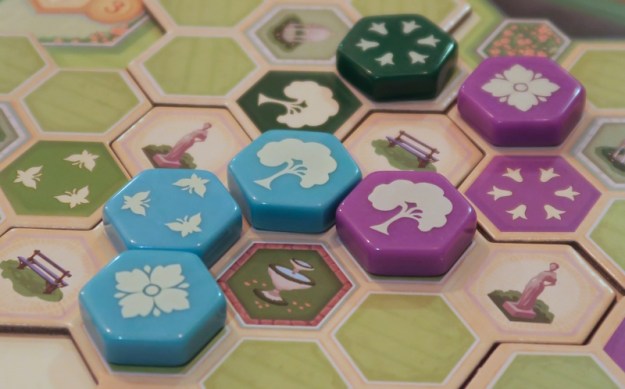
Salmon again took a different approach, focusing on goods, the easiest to build and flip (especially as some don’t need beer), but these are not worth as many points. The game ended after all the cards had been played (for a second time), with Ivory’s focus on rail links and Cotton giving him victory over Byzantium by about twenty points.  Meanwhile, Teal beginning to explain the rules for Cottage Garden to Plum, Plum’s Aunt Damson and Blue, but then Ruby arrived.  Blue had cake to dispense and had a curiosity about Brass, so quickly offered her seat to Ruby and the Teal began again.  Cottage Garden is a fairly straight-forward Tetrissy, puzzle-type, polyomino game with a similar feel to Patchwork, but with more people.

Cottage Garden
– Image by boardGOATS

In Cottage Garden, players are competing in the art of gardening and are working two beds with a variety of flowers.  To do this, players select polyomino tiles of flower beds from a central market grid (restricted by the location of the “Gardener”), then place them on one of their two personal garden boards. Each board has several garden elements that are worth points when not planted over, and these are scored (on two different tracks) as soon as a garden has been completed. There are points “bars” on each track, and when these are passed players receive bonus tokens that can fill in empty spaces or give players a better selection of the flower bed tiles.

Cottage Garden
– Image by boardGOATS

Once a garden is finished, the player receives a new one to complete. After the Gardener completes her fifth lap around the market, the game enters its final round, after which, the player with the most points from their completed gardens is the winner.  The received wisdom is that the problem with the game is that it doesn’t change or intensify, which some people find boring.  However it also means that players have time to “get their eye in” and learn how to play without the game evolving beneath them and catching them out as they spend whole time playing chase.  As such, it was pretty much the perfect game for the occasion.

Cottage Garden
– Image by boardGOATS

Everyone did pretty well—Ruby picked up the scoring quickest, but Aunt Damson got the first beehive.  Teal wasn’t far behind though, getting the second.  In the final round, Plum just scored her current flower bed and discarded the second so that she didn’t get any negative points, something that turned out to be a critical decision in a very tight game.Plum and Teal had the edge in scoring for Pots, but that was off-set by Ruby’s scoring for her Cloches and and Aunt Damson’s Beehives.  Teal, Ruby and Aunt Damson were all within a couple of points, but the victor, was Plum with fifty-six, just three points clear of Ruby who edged second from Teal.

Cottage Garden
– Image by boardGOATS

In addition to Aunt Damson, Green had brought his mother, Saffron who was visiting. the area  Saffron was quite well known to some of the group so there was quite a bit of chatter before she joined Green, Lime and Purple in a game of Azul.  This is a game that is well known within the group and with everyone familiar, the rules explanation could be kept short:  the game uses a very simple, but very clever market mechanic where players take all the tiles of one colour from a market stall and put the rest into a the centre, or take all the tiles of one colour from the centre.

Azul
– Image by boardGOATS

As soon as they have taken the tiles, players add them to one of the rows on their player board.  At the end of the round, one tile in each full row is moved into their mosaic.  The game ends when one player completes one full row of their mosaic.  Players score points when they add tiles to their mosaic (one point for each tile in the row and column it forms), and receive bonuses for completed rows, columns and any completed sets in their mosaic.  The catch is that each feeder row can only contain one colour and and if there are left-overs when they add to it, these score negative points.  Further, each row in a player’s mosaic can only have one tile of each colour.

Azul
– Image by boardGOATS

This time, Lime nearly got caught out, however, after Blue was summoned for a rules adjudication.  The question was, was he able to have more than one feeder row in a colour?  If they all had to be different he would be forced to place a lot of tiles in his overflow space and pick up a pile of negative points.  As the rules are clear and players can have as many feeder rows of the same colour as they like at any point during the game (they can only put each colour in a row of the mosaic once), Lime dodged a bit of a bullet.  As a result, he just edged it taking victory by three points from Green with Saffron a few points behind him.

Azul
– Image by boardGOATS

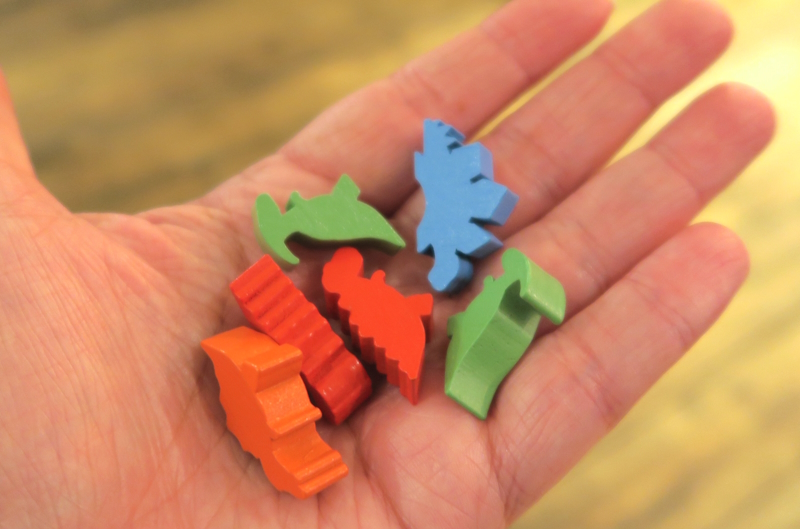
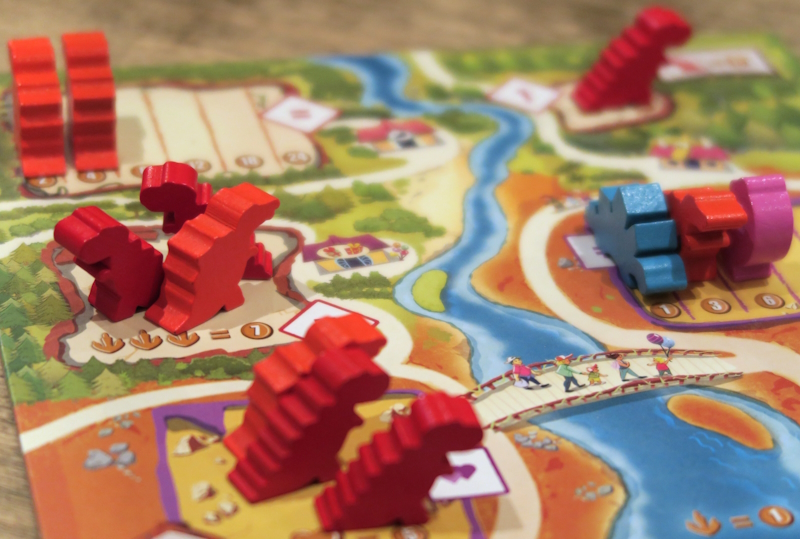
With everything else still going, when Azul finished, Blue joined the table to introduce Saffron to another one of the groups favourite games, Draftosaurus.  This is a very simple drafting game (similar to games like Sushi Go! where players choose from a hand of cards and pass the hand on), but in this case players are drafting cool dino-meeples and adding them to their dinosaur park, with different locations scoring for different combinations of dinosaurs. The game is played over two rounds, each placing six dinosaurs.  The first game was a bit of a land-slide although it ended in a tie between Green and his mum, Saffron, both scoring thirty-seven points.

Draftosaurus
– Image by boardGOATS

It couldn’t be left there of course, so the group “did a Lime” and played again.  This time it wasn’t until the scoring that Green realised why he hadn’t seen a single T. rex—Blue sat to his right had nabbed them all before he got to see them!  T. rex is a special dinosaur in general, but especially in Draftosaurus, giving an extra point for each one, but also having some placement restrictions.  Blue is generally very bad at this game, but even a park full of dinosaur kings (and queens) didn’t help, although it was a very close game with four players within a couple of points.  The clear victory though was Purple with thirty-eight, three points ahead of Lime who led the rest of the pack.

Draftosaurus
– Image by boardGOATS

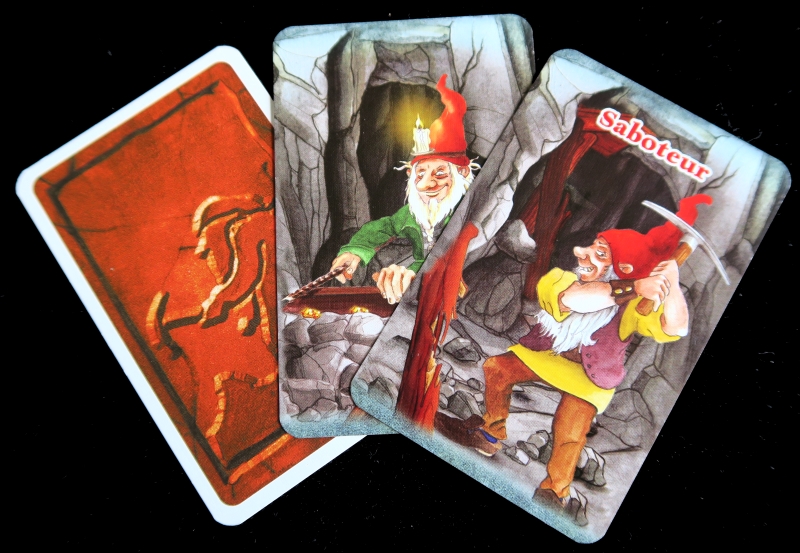
From there, there was a bit of chatter, but by the time Cottage Garden had finished, Teal, Lime, Green and Saffron all decided it was time to head home, leaving Purple to join Ruby, Plum and Aunt Damson.  There was some question about that they would play, but in the end they decided on one of Purple’s favourites, the hidden traitor game, Saboteur.  In truth, this is not at its best with four, but despite that, the group really enjoyed it.  The idea of the game is that players are Dwarves building a network of Tunnels in order to find treasure.  They do this simply by playing a card to extend the Tunnel and drawing a replacement.  The catch is that there is a traitor, an Evil Saboteur, in their midst.

Saboteur
– Image by boardGOATS

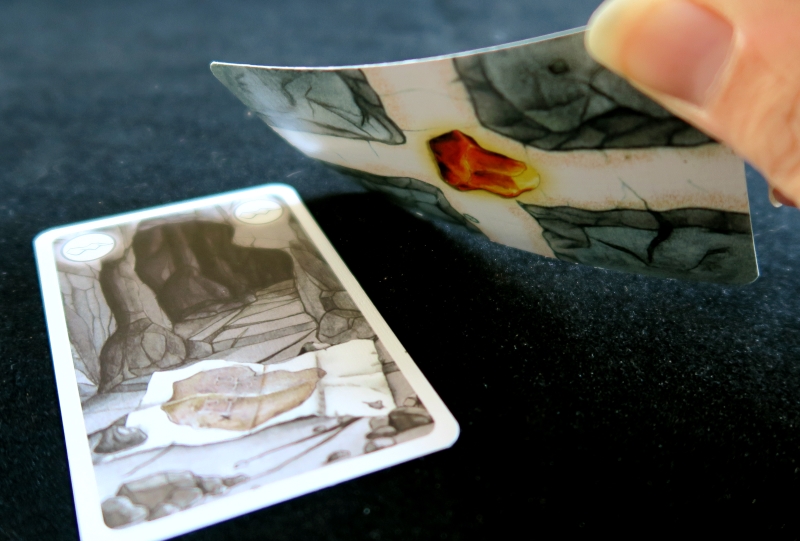
So, if the Dwarves have not found the treasure by the time the deck runs out, then they have lost and victory goes to the Evil Saboteur.  In addition to Tunnel cards, the deck also contains Special Map, Rock Fall, Broken Tool and Fixed Tool Cards which Dwarves and Saboteurs can use as they feel appropriate.  With four players, Ruby put two Saboteur cards in the pile used to assign the roles, but as it happened only one came out—Ruby.  Plum seemed to get the all map cards and checked the target nearest her first: Coal.  She then tried the the middle target card, but finally found gold in the one furthest from her.

Saboteur
– Image by boardGOATS

Ruby chose to strike out at Aunt Damson first, but that left Purple and Plum to continue digging for the gold.  Ruby then played a tunnel card with a dead-end which exposed her as a Saboteur, and as the only one, the writing was on the wall.  The game is formally played over three rounds, but we don’t like the way that plays and treat one round as a game in its own right.  Everyone enjoyed the game, but Aunt Damson in particular—she had watched and enjoyed The Traitors, so the overall concept particularly appealed.  It had been a lovely evening with a slightly different set of people and lots of games played.

Saboteur
– Image by boardGOATS

Learning Outcome:  It’s lovely to host family and old friends.

25th March 2025

With a generally Japanesey theme planned for the evening to mark the official start of the Japanese Cherry Blossom Season, Blue and Pink, the early arrivals considered 5×5 Zoo, Songbirds and Honshū which were all abandoned variously because the rules were in Japanese, the game was too complex, or it didn’t natively play two.  In the end, they settled on Sprawlopolis, which although very definitely not Japanese, did at least have a bit of a Japanese feel to it.  The game is a simple quick cooperative micro-game where players take it in turns to at to their city by placing cards.

Sprawlopolis
– Image by boardGOATS

Each card is quartered with each section showing one of the four different zones, green Parks, brown Residential, grey Industry and blue Offices.  The players score a point for each piece in the largest region of each city zone minus the number of roads, plus scores for each objective.  This time the objectives were “Master Planned”, “The Outskirts” and “Sprawlopolis” giving a points target of twenty-five.  It was close and, as Blue and Pink weren’t quite on the same wavelength with their planning (communication is allowed without describing the cards in hand) it was didn’t look like they were going to make it, but in the end, they topped the target by two points.

Sprawlopolis
– Image by boardGOATS

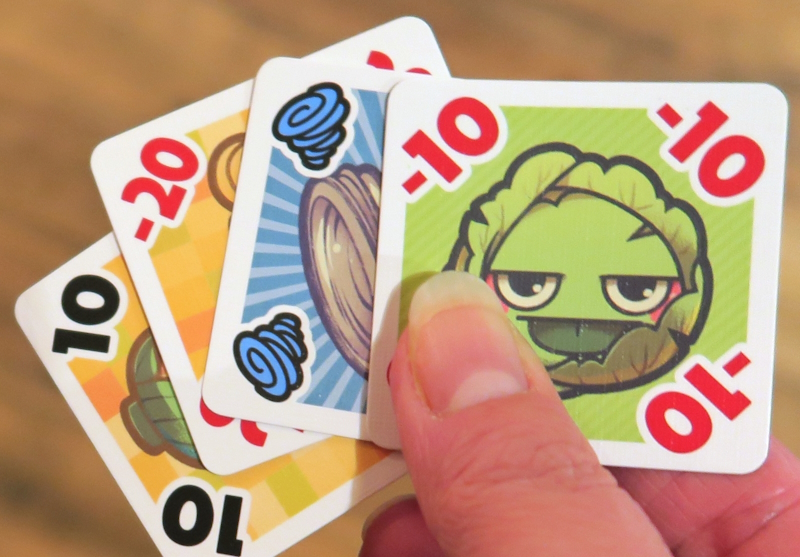
By this time, everyone else had arrived so the group split into three with the first group, a large group of six playing the “Feature Game” which was Habesuto (aka ハーベスト) which translates as “Harvest”.  This is a quick game from Japan about building a farm, growing vegetables and distributing produce. On their turn players play a card onto the central board and then replenish their hand.  Each player owns a field in the central play area; if that field is empty then players must play a card into their own field, thereafter, they can play anywhere.  When a row of three or more cards is created, the cards are scored, with the cards, and therefore points, going to the owner of the field, but points can be positive or negative.

Habesuto (aka ハーベスト or Harvest)
– Image by boardGOATS

There are special cards like the Tornado which removes cards and the wild Harvest card.  There are three vegetable suits of cards (red, yellow and green) each with five denominations, ten, twenty, forty, and minus ten and minus twenty.  At the end of the game, when everyone has run out of cards or is unable to play, players score the value of each card in their score pile.  To this they add fifty points if their field is empty, but subtract fifty points for each special card left in their hand.The game is really quick and nasty.  Initially everyone felt their way through and began playing nicely.  The niceness was reflected in the scores which were very even—Teal was the winner with a hundred points, but it was a three-way tie for second between Sapphire, Ruby and Lime.

Habesuto (aka ハーベスト or Harvest)
– Image by boardGOATS

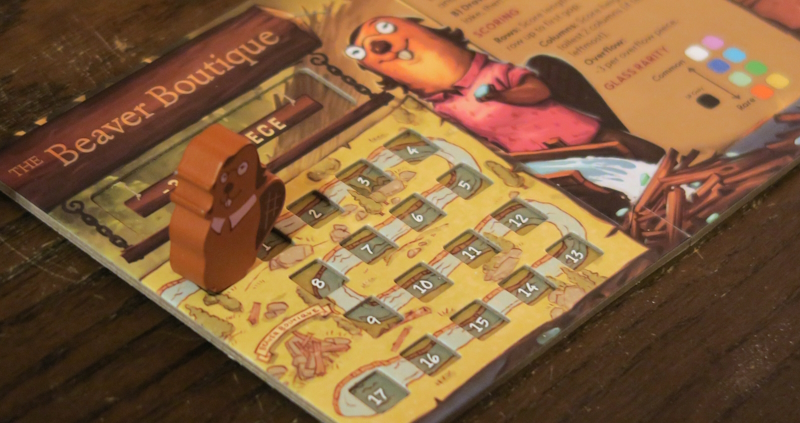
Everyone had got the feel of the game and wanted to play again, but this time, the gloves were off.  Second time round, Ruby was the victor with Teal increasing his score, but dropping down the rankings into second with a hundred and sixty.  Jade came in third, twenty points behind.  The third round was a bit more evenly balanced, with Lime taking first place with a hundred and thirty and Flint the only other player to make it into three figures.  Teal went from hero to zero and finished the final game with minus ten.  From there, the group decided to move away from Japan and into a world inhabited by cute animals with River Valley Glassworks, which got its first outing just a week ago.

River Valley Glassworks
– Image by boardGOATS

As River Valley Glassworks plays a maximum of five, Jade taught and acted as umpire.  In this game, players take it in turns to play a piece from their inventory into the river. Each river tile can take only a specific shape, and players have to play into a space adjacent to where they want to draft from. After claiming their glass, the river shifts forward revealing new pieces.  Glass is stored in players’ shops, and the scores depend on where the glass is placed with completed rows and columns giving bonus points.  However, too many of one type gives negative points.

River Valley Glassworks
– Image by boardGOATS

The game process is simple enough:  either place a piece of glass onto a river tile or draw exactly four pieces from the lake with the aim of collecting a rainbow of glass pieces but the challenge is getting the balance right.  In the end, the group did a “Lime”, that is, played it once and then decided to give it another go.  First time round, the battle was between Ruby, Sapphire and Teal with Ruby holding off Sapphire by four points who in turn, just pipped Teal by one.  By the second time, Teal had got the hang of things and won by a bit of a land-slide, finishing with sixty-six, eighteen more than Lime in second.

River Valley Glassworks
– Image by boardGOATS

Meanwhile, on the other side of the room, Plum, Ivory, Byzantium and Blue settled down to play another Japanese game, which turned out to be something of a secret favourite amongst them: Yokohama.  This is a sort of path building game, almost like a heavier version of the popular game, Istanbul.  Players operate a Merchant who travels around building their business.  They also have Assistants, Shops and Trading Houses.  On their turn, players deploy one Assistant in three different areas or two Assistants in one area, then they move their Merchant.  Merchants can move as far as they like, but can only travel through locations occupied by their Assistants and cannot finish in an area already occupied by another Merchant.

Yokohama
– Image by boardGOATS

Players then perform the action associated with their destination, with the level depending on the Power of that player at that location.  The Power is the player’s presence in that location, i.e. the sum of the President (equal to one), any Assistants and any Buildings.  The more Power, the better the resultant benefit.  A Power of four or more enables the player to build a Shop or Trading house at the location which will earn additional points or other rewards as well as providing more Power on future visits.  Any Assistants at the location are “used” and returned to the player to be placed on a later turn.

Yokohama
– Image by boardGOATS

As in Istanbul, the different locations provide different benefits.  There are locations that provide resources (Tea, Copper, Silk and Fish), some that provide Order cards (Dock or Port) or Technology cards (Laboratory or Research centre) and others that enable players to get more Assistants, Shops or Trading Houses (Employment Agency), Money (Bank) or points (Church and Customs).  Ivory started quickly, grabbing early points for the game focuses (lots of Tea) and getting some buildings placed, while Blue ended up with a pile of initially unwanted Fish and Plum spent some time tripping over everyone else.  Byzantium, didn’t seem to be doing much but Plum rather ominously said that was the way he played the game, just before winning by a huge margin.

Yokohama
– Image by boardGOATS

Ivory made great headway getting the goods to give him twenty-two points from the Customs House, but just as the game came to a conclusion he ran out of steam having spent lots of turns playing only two Assistants as opposed to three.  It was a close run thing in the end with barely ten points between first and last, indeed, Ivory finished a single coin away from getting the ten point Technology that would have given him the game.  As it was, Plum’s prediction proved right and victory was taken by Byzantium who had quietly got on with his game, mostly unnoticed by everyone else.  It wasn’t the landslide foretold though, as his hundred and six points was only three points ahead of Plum in second.

Yokohama
– Image by boardGOATS

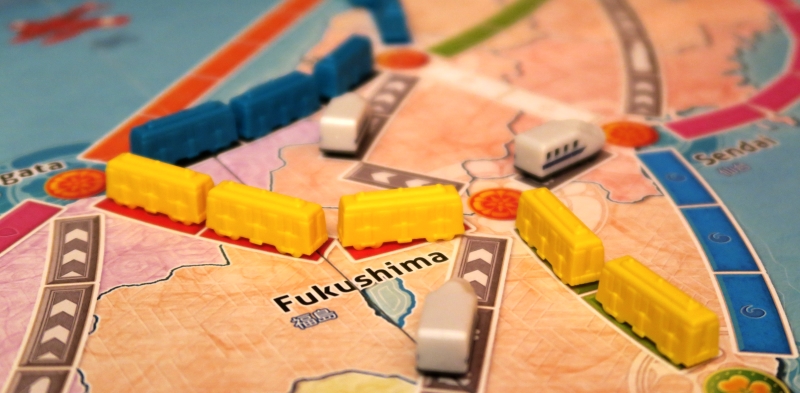
The last group were Blue, Pine, Purple and Black who started off with a game of Ticket to Ride with the Japan expansion.  This is played much like the original base game i.e. players take cards from the market or play cards to place trains; score points for placing trains and completing Tickets.  Like all the expansion maps, the Japan map has its own set of additional features, in this case, these a mostly focused on the Bullet Train which runs through the centre of the long thin board.  Once these routes have been claimed, they can be used by all players to complete destination tickets.  Instead of scoring points for such routes, players progress along the Bullet Train track.  Whoever has contributed most to this shared project at the end of the game receives the largest bonus, with the player who contributes least being penalised.

Ticket to Ride Map Collection: Volume 7 – Japan & Italy
– Image by boardGOATS

Last time we played this game there was a rules malfunction associated with the Bullet Train, but this time, that wasn’t a problem.  Much hilarity ensued when Purple place a single train route from Hiroshima to Okayama and entirely unintentionally prevented Pink from completing his four long Tickets costing him a total of fifty-two points leaving him with a final score of minus twenty-four.  Pine found this so amusing that he went round the room telling everyone else.  Besides this the minor aspect of the winner seemed immaterial, but that was Pine thanks mostly to his completed Tickets, double Black’s total which gave him second place.

Ticket to Ride Map Collection: Volume 7 – Japan & Italy
– Image by boardGOATS

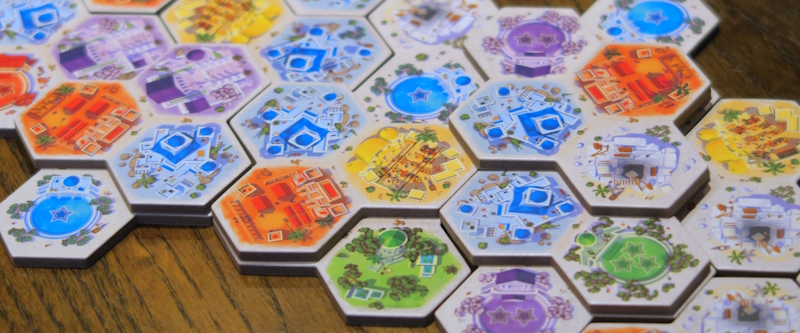
Once the dust had settled, Pine, Pink, Purple and Black rounded off the evening with a game of the Summer Pavilion version of our old favourite, Azul.  This uses the same market mechanism as in the base game, but instead of taking square tiles and placing them straight away, players take lozenge shaped tiles and and put them to one side for the second phase when players place them on their player board.  The pieces a positioned according to colour to form seven coloured “stars”. Each location is numbered according to the cost to play it—thus a space numbered five needs five pieces one of which is placed on the board while the others are discarded.

Azul: Summer Pavilion
– Image by boardGOATS

Placing one gives a single point while placing a second next to the first scores two and so on until the placing the sixth scores six points.  So a priority is placing tiles to expand groups, however, surrounding statues give bonus tiles.  Additionally, played over six rounds, each colour takes its turn as wild, though at least one tile of the required colour has to be played.  At the end of the game, players score a bonus for each of the seven stars that they’ve filled completely and bonuses for completing all seven spaces of value one, two, three or four.

Azul: Summer Pavilion
– Image by boardGOATS

Pink couldn’t remember the rules, so summoned Blue to explain, but her brain wasn’t on the right page so Jade, who, by this time was just adjudicating, explained instead.  The in-game  scoring was quite close with just two points between Pine and Pink, and Purple and Black not far behind.  So it all came down to the bonus points.  Pine picked up points for completing his green star and all the seven spaces with the value one giving him twenty-two additional points.  Pink’s fourteen points for completing his red star together with his twenty-four number bonus points more than off-set Pine’s small advantage, giving a modicum of revenge for the delight everyone got from his earlier misfortune in Ticket to Ride.

Azul: Summer Pavilion
– Image by boardGOATS

Learning outcome: Bad things that happen can make good memories, for some people at least.

20th August 2024

Cobalt was first to arrive.  Pink and Blue weren’t far behind though, and had just ordered their supper when Indigo and her son Navy arrived followed by Jade and Sapphire, then Ivory, Purple, Black, Pine and Teal.  While the others chatted and got drinks, Cobalt began teaching Indigo and Navy Akropolis.  This is a quick little game where each player is building their own acropolis. On their turn, players first take a tile the market. The first tile in the market display is always free, the one after costs one stone (the only resource in the game) the next one two stone and so on.  The tiles comprise three conjoined hexes each either a Quarry (which provide Stone when built over), a Plaza, or a District tile.

Akropolis
– Image by boardGOATS

Plazas and District tiles are in different colours, representing Houses, Markets, Barracks, Temples and Gardens.  Tiles are freely added to the player’s display, either on the base layer or on top of other tiles, so long as any Districts meet the their conditions and as long as there is a matching Plaza present.  At the end of the game, players score for the largest District of each type—each visible hex scores a point for the level it is on (one point for the base layer, two for the first floor etc) multiplied by the number stars shown on the Plazas they have visible.  The game is a sort of cross between Taluva and Cascadia, taking the conjoined triple-hex tiles and layered stacking from Taluva and the tile-placement and individual tableau from Cascadia.

Akropolis
– Image by boardGOATS

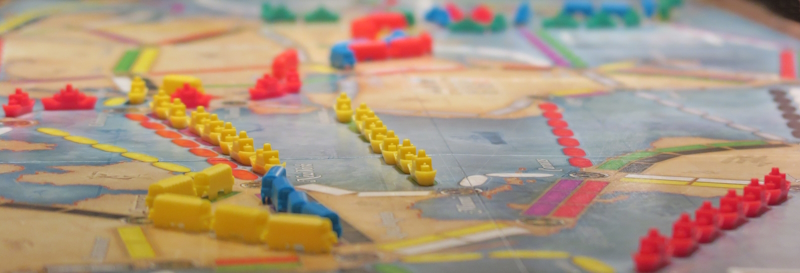
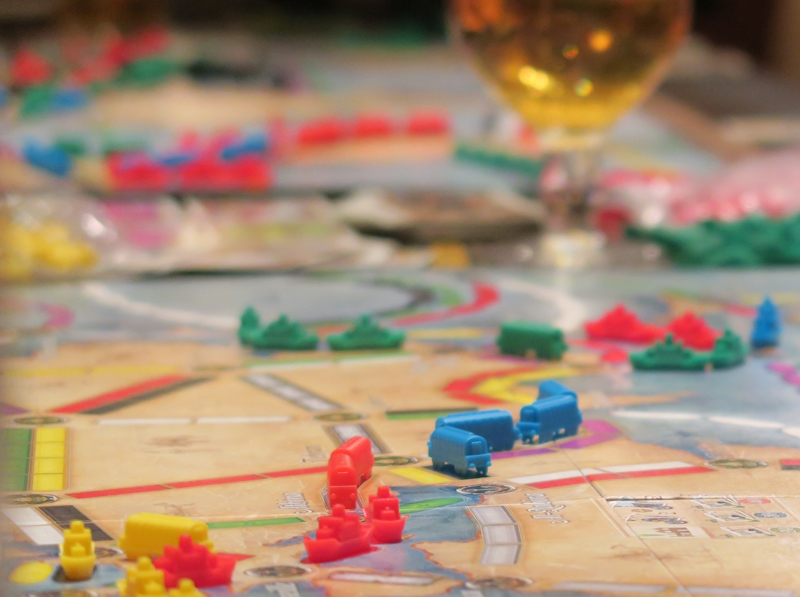
The game was quite tight between Cobalt and Navy, but Navy had the edge, winning his first game in the group with a hundred and eighteen points to Cobalt’s hundred and five.  As the game came to an end, the rest of the group began trying to work out who was going to play what.  In the end, there were two groups setting up to play the “Feature Game” which was Ticket to Ride: Rails & Sails.  This is a variant of the popular train game, Ticket to Ride, but with a considerable step up in complexity. In the original game, players take it in turns to carry out one of three actions:  take train cards, pay train cards to claim Routes on the map by placing train pieces, or take Tickets.  Points are scored for claiming Routes and for successfully connecting the two places shown on their Tickets with negative points scored for failing to complete Tickets.

Ticket to Ride: Rails & Sails
– Image by boardGOATS

In Rails & Sails, however, players build two connected networks, one on land and one on sea covering the whole globe.  Players build these with two separate sets of train cards, giving them two hands to manage, making it a more complex version of the game.  In addition to the usual four possible actions, on their turn, players can also build a Harbour into a city that they have already claimed a route into. To do this, players spend two Train cards and two Ship cards that are all the same color and all have Harbour symbols on them.  At the end of the game, players gain points for each Ticket that lists their Harbour, with players scoring for each Harbour when more than one features on their Ticket.

Ticket to Ride: Rails & Sails
– Image by boardGOATS

Another thing that adds to the complexity is the tension between Ships and Trains:  at the start of the game, players have a set total number of Ship and Train pieces, and choose choose how many of each they will have.  During the game, instead of a normal turn, they can exchange Ship pieces for Trains or vice versa, but at a cost of one point per piece swapped.  There are two different maps in the game, one covering the Great Lakes, and the other covering the whole World—the total number of Ships/Trains players have depends on which of these is used.  This time, both groups used the World map.  In addition to these major rules changes, there are also a couple of minor tweaks.

Ticket to Ride: Rails & Sails
– Image by boardGOATS

For example, there are Double cards in the Ship deck, which allow players to place up to two Ships per card.  There are also Tour Tickets, which feature more than two destinations—these will score a higher number of points if the locations are connected in the right order (and of course, will score negatively if one of the destinations in not connected at all).  On the World map, there are Pair Routes too.  These require the player to place two train cards of the same colour per space, but the whole Route doesn’t have to be the same colour.  There are the usual Double Routes as well, which come into play with four or five players, and multi-colour “Wild” cards which can be used as either Ship or Train cards of any colour.

Ticket to Ride: Rails & Sails
– Image by boardGOATS

Jade, Ivory, Sapphire and Pine made up the first group.  In their game, Jade and Ivory started by focusing on Trains while Pine and Sapphire began with Ships giving them both taking an early lead with Ships generally giving more points. Sapphire went to the front and stayed there for the majority of the game.  There was an initial scrabble in Asia/south east Asia as well as along the east coast of north and central America, and apart from some early commitments from Pine and Sapphire in the latter, in general there was no major “blocking” and everyone at least tried to play nicely.  That said, by the end of the game the board was very congested, perhaps due to the wrap around nature where Routes could fall off one side and come back on on the other.

Ticket to Ride: Rails & Sails
– Image by boardGOATS

Ivory was the first to take more Tickets and it was some time before Jade joined him.  Ivory went for Tickets considerably more times than anyone else and by the end of the game, he had significantly more completed Tickets than anyone else, though his were of lower value.  Pine in particular started with much more ambitious Tickets and happily declared that he had finished his first ticket about half through the game.  That was until Jade pointed out a potential gap in his track which Pine then hurried to fill.  Sapphire was following a similar strategy to Pine with bigger, higher risk Tickets and also focused on long Routes (hence his throughout the game).  It looked like he was going to trigger the end the game, but in the end, that was Pine.

Ticket to Ride: Rails & Sails
– Image by boardGOATS

Jade and Ivory both had shorter scoring Routes, but with more Tickets, predominantly located in Asia, whereas Sapphire and Pine were mapping the rest of the World.  Everyone except Ivory had to take advantage of the Ships/Trains swap and although this cost points and a turn it didn’t feel like it had a large impact on the game.  Both Jade and Ivory had cards at the end allowing for a late grab of high scoring Shipping lanes, but the game ended a little early for Sapphire.  That said, everyone completed all their tickets, including a very complex and high scoring Tour Ticket.  Pine and Sapphire eschewed Harbours, while Jade built just one.  Ivory, on the other hand, went built all three in the south east, despite the fact they were challenging to place.

Ticket to Ride: Rails & Sails
– Image by boardGOATS

After placing the Ships/Trains and scoring the Tickets, the scores were fairly even, but those extra Harbours really made a difference.  Sapphire and Pine took a twelve point penalty for not having any while Jade picked up twelve (an eight point penalty for not using two and twenty points for having one Ticket ending in his Harbour.  Ivory, however, scored a massive ninety points from his, with each of his three Harbours having two of his Tickets finishing in them.  This ultimately give him a total of two hundred and seventy-five eighty-five more than Pine who took second place. On reflection, there was a minor rules malfunction—when the group recounted the Route scoring, they failed to take account of the penalties for swapping Ships for Trains, but this was only a handful of points and wouldn’t have affected the final standings.

Ticket to Ride: Rails & Sails
– Image by boardGOATS

The game on the next table was not as highly scoring, but there was still quite a large spread in the scores.  While Black reacquainted himself with the rules, the others chatted and counted pieces, eventually they got going though.  Pink started in Australia because he liked it there when he visited almost exactly a year ago.  Then, he traveled north to east Asia, visiting exotic places like Bancock, Jakarta, Hong Kong and Tokyo, before crossing the Pacific to Winnipeg.  As the game came to a close, he also traversed the south Pacific to Valparaiso and took the southern coastal route to Rio de Janeiro.  Black also more or less circumnavigated the globe traveling from the UK, east across Europe to Tehran then on to Mumbai.

Ticket to Ride: Rails & Sails
– Image by boardGOATS

From there, he crossed the Pacific to Lima from where he traveled north, around the top of South America also making it to Rio before crossing the  Atlantic to Cape Town.  Part of the reason for Black and Pink choice of Routed (aside from their Tickets of course) was the fact that Teal was monopolising the Atlantic crossings, making it no fewer than five times!  From his Atlantic ports, he spread into North America and across Africa to Dar es Salaam.  Purple in contrast, focused her efforts on a single extended trip across the USA, found one of the few Routes across the north Atlantic not taken by Teal, journeyed across Europe following Black through Iran to the far East.

Ticket to Ride: Rails & Sails
– Image by boardGOATS

There was an unfortunate “Rules malfunction” when it came to scoring Harbours, which would have had quite a large impact on the game, but as everyone played by the same rules, it was at least fair.  Instead of scoring for each Ticket into each Harbour, they simply scored ten points for their first Harbour, twenty for the second and so on.  With this scoring, Pink, with his eight completed Tickets was the victor with two hundred and five points, fifteen points ahead of Teal in second and Black in third.  Both groups had really enjoyed the longer and bigger challenge of Rails & Sails.  The mix of boat and train cards did cause more grumbling than usual about the wrong colours being available, especially when there was an imbalance in favour of trains over boats or vice versa, but that’s just Ticket to Ride.

Ticket to Ride: Rails & Sails
– Image by boardGOATS

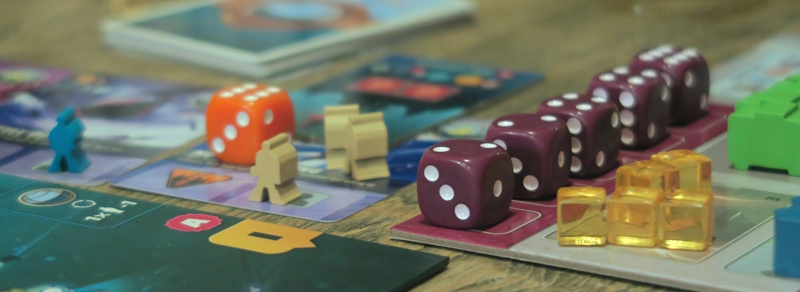
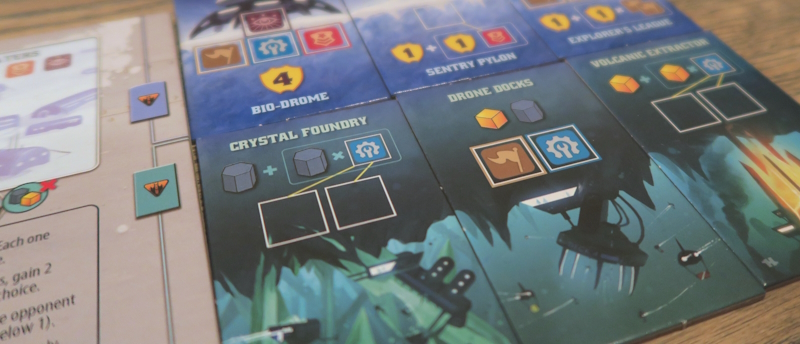
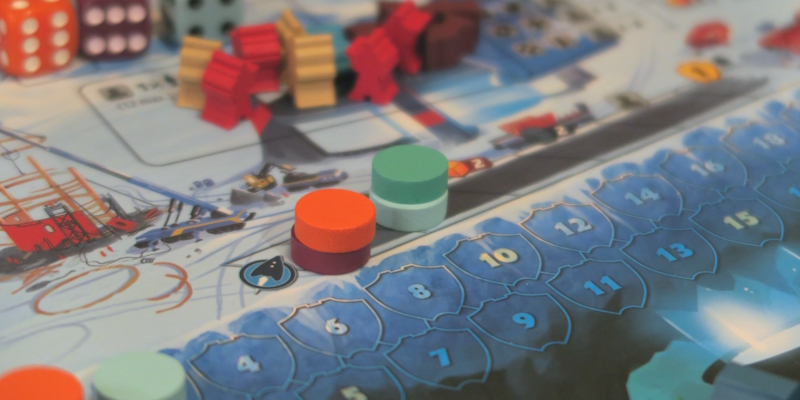
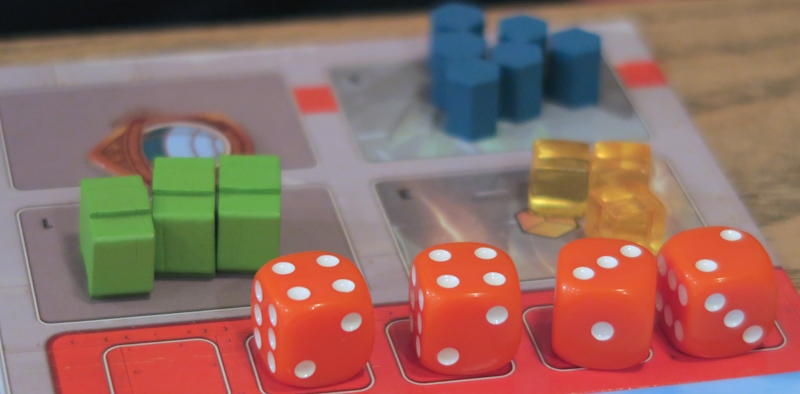
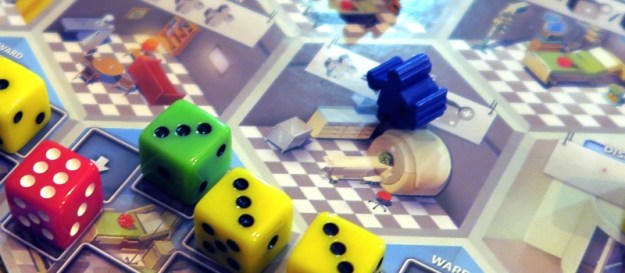
Meanwhile, the remaining group of four, Cobalt, Indigo, Navy and Blue, should really have been playing Azul (!), but after some dithering, Cobalt encouraged them to try The Artemis Project.  This is a game where players are trying to develop colonies on Europa.  The idea is that players roll dice and place them on action spaces to carry out actions.  There are seven Regions and players take it in turns to place their dice in them.  They are: Basecamp, Vents, Quarry, Gantry, Doorstep and Outfitter. At Basecamp, players go on Expedition to earn Expedition Badges and other Rewards. These are a bit like the Quests in the game Lancaster, and like the Squires in that game, dice can be augmented by Colonists.

The Artemis Project
– Image by boardGOATS

Also similarly, Expeditions are unsuccessful if a certain number of pips isn’t reached, which leaves players without their desired Rewards. In such cases, players don’t come away with nothing, instead they move their Token along the Relief Track and pick up a lesser reward.  However, there is a fixed number of spaces available along the Relief Track for each person, so when they are gone, they are gone.  The Vents and the Quarry provide players with Energy and Minerals respectively.  The level of the action depends on the value of the dice, however, the dice are activated from the lowest to the highest.  So, for example, placing a high value die like a six, will yield six Minerals, but if there are only ten available and two other players place fives, these will be activated first leaving nothing.

The Artemis Project
– Image by boardGOATS

The Gantry provides Buildings, which provide players with long term benefits during the game and points towards the end of the game.  Players bid for these and if they win, they must pay the bid amount in Minerals (the value of dice placed), to build them.  Both the Doorstep and the Academy deal with Colonists.  The Doorstep provides players with Colonists, but like the Vents and the Quarry, players who bid high, go last and may not get what they want (or even anything) while the Academy allows players to upgrade their Colonists if required.  Finally, the Outfitter allows players to gain Toolkits which grease the wheels a little by allowing players to alter the values of their dice.  Once all the dice have been placed, these different Regions are activated in order.

The Artemis Project
– Image by boardGOATS

Thus, for example, Minerals collected can be used later in the same round to build Buildings, however, it is wise not to rely on that as another player can play a lower value die, easily scuppering plans.  In this way, the game can be quite aggressive with intentional and unintentional conflict when players get in each other’s way.  It is played over six rounds marked by Event cards associated with the Regions which are resolved before the relevant Region is activated.  At the end of the game, it is a bit of a “point salad” in that players score for left-over Energy and Minerals, for Fully Staffed Buildings, for the number of Buildings, for each complete set of four different Colonists, for any Colonists not part of a set, for Expedition Badges and for having the most unused Toolkits.

The Artemis Project
– Image by boardGOATS

Indigo clearly found the number of Regions a little bit bewildering and was keen to learn by playing, but The Artemis Project is not really a game that lends itself to that.  Indeed, in spite of understanding what each Region does, there is still an element of learning by playing in order to see how things fit together.  As the only one who had played it before, Cobalt stole a march by targeting the Basecamp early and grabbing one of the Expeditions, and because nobody joined him, taking both Rewards.  Navy opted for the sensible choice and went for Buildings in order to get an engine going.  Blue and Indigo weren’t so quick off the mark and took a little longer to work out how to put a strategy together.

The Artemis Project
– Image by boardGOATS

As the game progressed, Indigo became the Queen of the Resources gathering piles and pales, making god use of the multiplier tokens.  Blue made her way up the Relief Track after rolling some higher numbers and not using them well.  This was a problem made worse by Cobalt trying to muscle in on one of her Expeditions leaving her to walk away with nothing, leaving him with nothing too.  As the game came to a close, Navy had more buildings than anyone else and, as Blue and Cobalt both made a bit of a mess of things, he sailed gracefully into the lead finishing with sixty-eight points, while Blue just pipped Cobalt to second place.

The Artemis Project
– Image by boardGOATS

Learning Outcome:  Who needs Planes when you have Ships and Trains?

Boardgames in the News: Games on Radio 4

BBC Radio 4 often has short articles on games and from occasionally has longer programs that are dedicated to games or playing.  Recent examples include the “Why we Play” series and an episode of “Start the Week” discussing Videogames.  There has also been an episode of the magazine program “All Consuming“, dedicated to board games.  This is presented by Charlotte Stavrou and Amit Katwala and discusses everything from the Ancient Egyptian game of Senet to more recent classics like Azul, Monopoly and The Settlers of Catan.

Azul
– Image by boardGOATS

During the program, there are interviews with Dan Jolin, co-founder of the magazine, Senet and the World Monopoly Champion, Nicolo Falcone; there is also a visit to the Orc’s Nest in Covent Garden.  Traditional and historical games like Mancala, Chess, The Game of the Goose, Snakes and Ladders and Backgammon are discussed at length together with their history.  Moving on to more modern games, Articulate!, Splendor, Ticket to Ride, and Pandemic all get a mention.  The presenter, Amit Katwala also visits the hugely prolific designer Reiner Knizia in his office in Munich where he keeps a library of all his games including The Quest for El Dorado, Samurai, Lost Cities, Gold Rush, and Lord of the Rings.  There, they discuss how “critical mass” is important for success—reaching enough people is the key Dr. Knizia explains, and is why games like Go and Chess are so popular.

All Consuming
– Image from bbc.co.uk

Last week there was also an episode of the comedic science program, “The Infinite Monkey Cage” with presenters Brian Cox and Robin Ince featuring Marcus de Sautoy from the Maths Department in Oxford, games designer Dave Neale and comedienne Jessica Fostekew. This begins with an introduction about playing Cluedo, moving on to a discussion about the definition of a game—something the philosopher Ludwig Wittgenstein apparently struggled with.  One possible definition discussed is that playing a game is a voluntary attempt to overcome unnecessary obstacles.  From there, conversation progresses to how people often refuse to play with those who are perceived as being good at playing games; Marcus de Sautoy explaining the maths behind his strategy for winning at Monopoly, and why Snakes and Ladders is so popular.

Senet
– Image by boardGOATS

There is also a game of Rock-Paper-Scissors (which makes interesting radio) with discussion about the World Championships, how to win and the fact that it isn’t as random as one might think.  There is a lot of discussion about modern Euro games as well as more traditional games and historical games, with Senet, The Mind, Cheat, Escape from Colditz, Rummikub, Royal Game of Ur, Scrabble and some of those mentioned above amongst those featuring.  The discussion touches on John Nash and Game Theory, the Prisoner’s Dilemma, The Ultimatum Game and the Golden Ratio.  For those who are interested in board games and gaming, this episode of The Infinite Monkey Cage is well worth a listen and both it and the episode of All Consuming are currently available on BBC Sounds.

The Infinite Monkey Cage
– Image from bbc.co.uk

9th July 2024

When Blue and Pink arrived, Crimson and Cyan were already there on their first visit, finishing their supper and playing a game of Molehill Meadows.  This is a new game by the designer of Zuuli, that they had picked up at the UK Games Expo (meeting the designer Chris Priscott and his delightful family in the process).  In Molehill Meadows, players take on the personality of Mika the Mole, who has an affinity for shiny things, a hunger for juicy worms and an innate desire to dig  A flip-and-write game, players dig tunnels using polyomino shapes to carefully expand their molehill home.

Molehill Meadow
– Image by boardGOATS

Their game was somewhat interrupted as people arrived and were introduced and they were surrounded by the general chatter of arrival and Blue and Pink munching their pizzas.  Crimson and Cyan carried on playing, flipping polyomino cards and then drawing the shapes on their map.  Extending their tunnel to find Worms gave both players four “Worm Powers”, and fining treasure gave them points.  Cyan collected twice as much treasure and picked up more than twice the number of bonus points than Crimson (for collecting all of the two sets of flowers on the Objective Cards) and thus was the eventual victor by something of a landslide (or should it have been a tunnel collapse?).

Molehill Meadow
– Image by boardGOATS

Then, while everyone else generally gossiped and caught up with the events of the last week or so, Jade and Sapphire joined Crimson and Cyan for a quick couple of rounds of the trick-taking, climbing game, SCOUT.  We’ve played this a few times on a Tuesday and everyone has always enjoyed it.  The game is simple in that on their turn, the active player either plays a set of cards to beat and replace the set on the table (a run or a meld), or take one card from either end of the set on the table and add it to their hand.  The round ends if a player plays the last card in their hand, or if it is a player’s turn and they played the current active set of cards on the table.
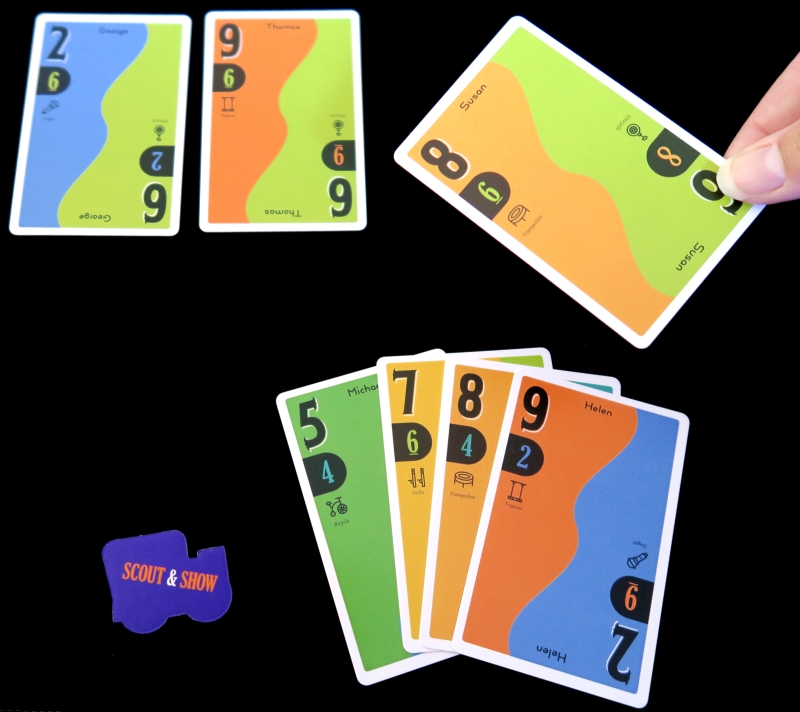
SCOUT
– Image by boardGOATS

At this point, player score for cards in their scoring pile (cards they have beaten during the round), for “chocolate bars” (rewards given when another player takes a card from their active set), and deducts a point for every card left in hand.  The clever part of the game is that, like Bohnanza, cards cannot be rearranged in hand, this with the fact that cards have different values depending which way up they are make this little card game really clever.  In the interests of time, the group only played two rounds, and although the scores can be very disparate, this time it was really tight with only five points between first and last and Sapphire taking the honours one point ahead of Crimson.

SCOUT
– Image by boardGOATS

By this time, Blue and Pink had just about finished eating and everyone else had mostly finished chatting, so with twelve, the group split into three groups of four, starting with Pine, Sapphire and Cyan who joined Jade in the “Feature Game“, Happy Home.  This is another polyomino game, with similarities to games like New York Zoo and Bärenpark, but with a theme of home decorating rather than building an animal park.  Like New York Zoo (or indeed Jokkmokk), the game has a central market, in this case representing a Store, which players move their Meeple round.
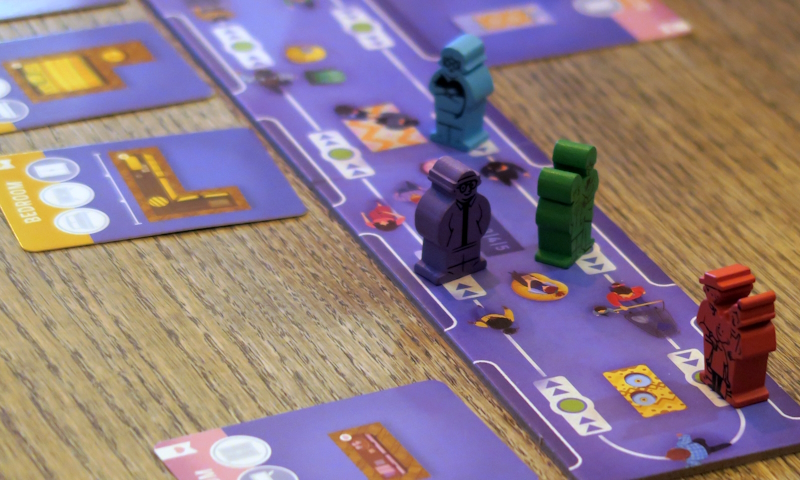
Happy Home
– Image by boardGOATS

On their turn, the active player moves their Meeple (or should that be Muman?) to an available space, takes the card and matching tile and then adds it to their home.  When all the cards are used up, players instead place a “Welcome Mat” on their doorstep to show they are ready to welcome visitors.  When everyone has finished , the game is over and players score their Home for Furniture, Colours, Pot Plants, their Welcome Mat and Design Objectives, losing points for any scratches still visible and not covered up by Furniture.
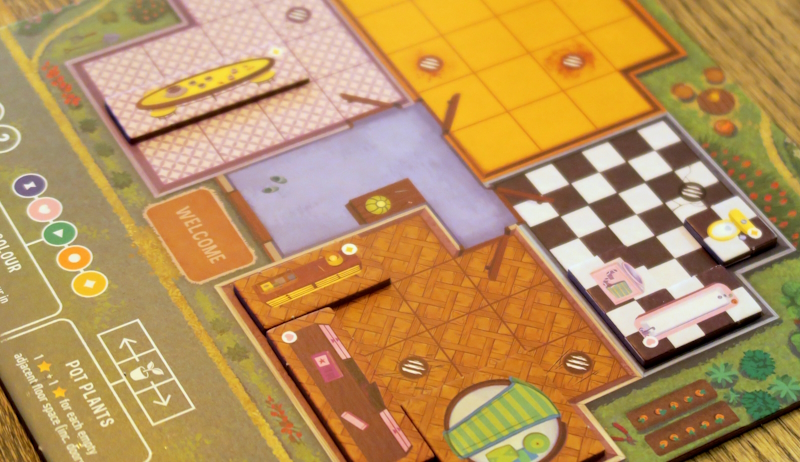
Happy Home
– Image by boardGOATS

There was a wee bit of misunderstanding on how the scoring worked even though Jade had done his best to explain it at the beginning.   Each Room scores one, three or six points if it has one, two or all three different core pieces of Furniture in it, and each Pot Plant is worth a point plus a bonus point for each empty space orthogonal to it.  That wasn’t where the problem was however, that was with the Colour scoring. Essentially players need to have the same Colour across at three different rooms to get two points and across four rooms to get five points, but somehow, this caused more confusion than it should have done.
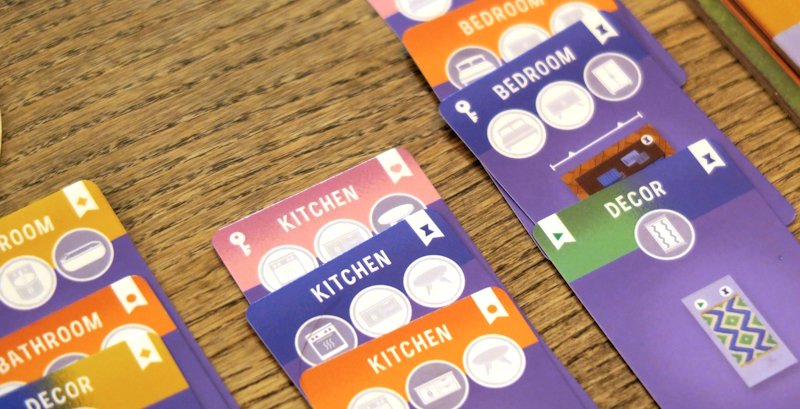
Happy Home
– Image by boardGOATS

The group also made life more difficult for themselves by shuffling the cards and removing twenty-four cards as per the rules for the four-player game, but somehow the bulk of those removed seemed to be Furniture for just one of the rooms, the Bathroom.  It was a good learning game as the value of Rugs, for example, became evident later on—players were a bit confused as they don’t score in their own right, but they add Colour to a Room and thus can score at the end of the game.
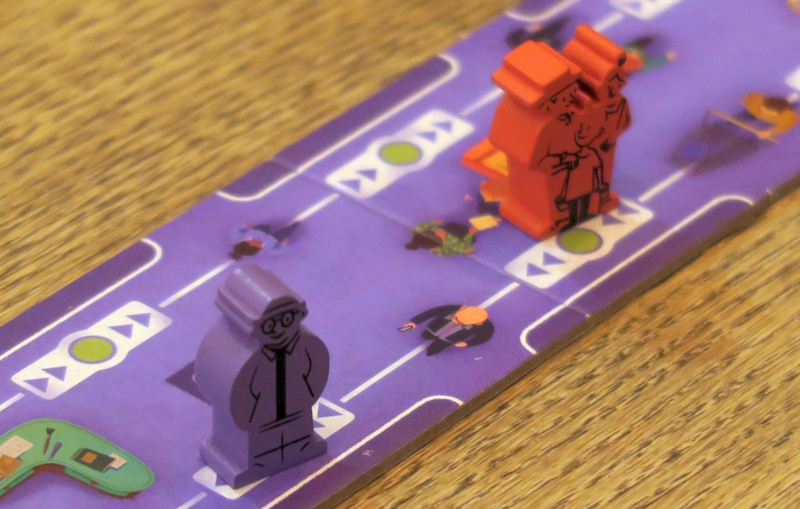
Happy Home
– Image by boardGOATS

This time the Design Objective was “Bigger is Better”, so players lost a point for each empty floor space in their Room with the most empty spaces.  The lack of Bathroom fittings, meant Pine didn’t have a loo in his house and had to resort to “wafflestomping“, but he did have what looked like two pink ironing boards furnishing his Lounge.  Next door, Sapphire filled his Living Room with a pink sofa and an enormous matching pink widescreen TV (that was the same size as the sofa!).  In the end, the victor was a bit of a runaway winner.
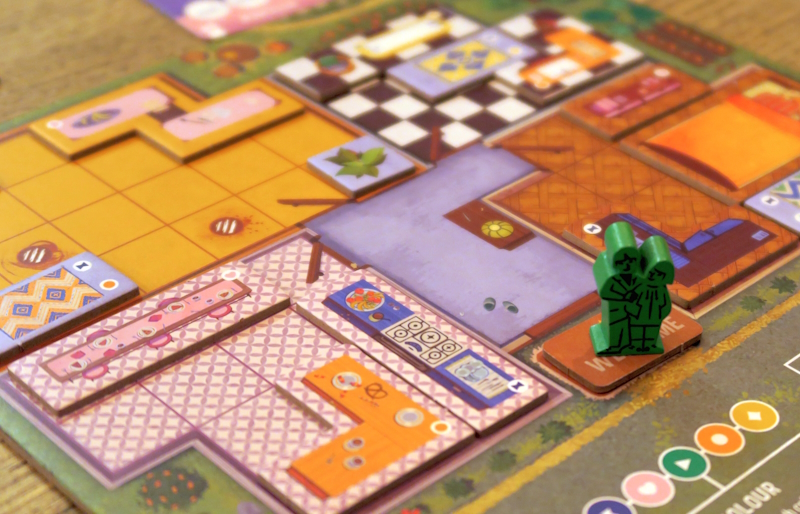
Happy Home
– Image by boardGOATS

In spite of his lack of toilet facilities, Pine finished with twenty-four points, some seven ahead of Sapphire in second, with Jade taking the last place on the podium.  Before the game, Pine had said he wasn’t sure about it from the description, but in the event he really enjoyed it, as indeed did everyone else.  Meanwhile, there were two other games underway.  The first of these was Keyflower—a very popular game with certain members of the group, but one that hasn’t had an outing for a long time, in fact the last time the group played it was online in 2020, and the much-missed Burgundy was involved.
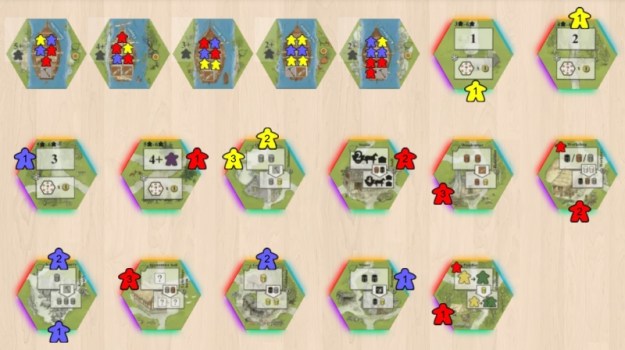
Keyflower on boardgamearena.com
– Image by boardGOATS from boardgamearena.com

This time, the four players were Blue, Pink, Black and Ivory, all of whom had played Keyflower before (albeit a while ago).  The game is fairly simple in terms of concepts, but like many good games, challenging to play well.  Each round, players take it in turns to bid on a tile, or activate a tile.  The clever part of the game is that both bidding and activating is done with red, blue, yellow or occasionally green Keyples (Meeple-shaped workers).  In each of the four rounds (or Seasons), a set number of tiles are put out for players to bid on.  Players take it in turns to bid or activate and when everyone passes in succession, any tiles won are added to the winner’s village, any losing bids and any Keyples used for activating return to their owner.

Keyflower: The Farmers
– Image by boardGOATS

At the end of each round, a boatload of new Keyples arrive in each village (players can bid to get the one of their choice), before the tiles for the next Season are set out.  In general, tiles are drawn at random, and in the first season, Spring, mostly provide Resources with Summer and Autumn tiles providing special powers and Autumn and Winter tiles providing scoring opportunities.  The Winter tiles are different to those for the other Seasons in that instead of being drawn at random at the start of the Season, they are dealt our to each player at the start of the game.  Then, at the start of Winter, players choose from their pile which ones they want to make available—in this way, the Winter tiles act as sort of objective tiles.
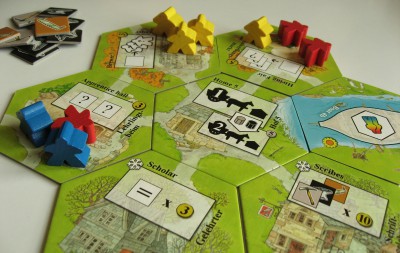
Keyflower
– Image by boardGOATS

The Keyflower box also contained The Farmers expansion and the question arose whether to include it or not.  Blue, Pink and Ivory were on the fence until Black said he’d never played with the Farmers, so of course that was a problem they had to urgently fix.  In the base game, the different tiles are connected by roads which are used for transporting goods to places where they can be used to upgrade tiles or score points.  In The Farmers expansion, these roads now define fields where animals can be left to graze and with each occupied field scoring points at the end of the game.
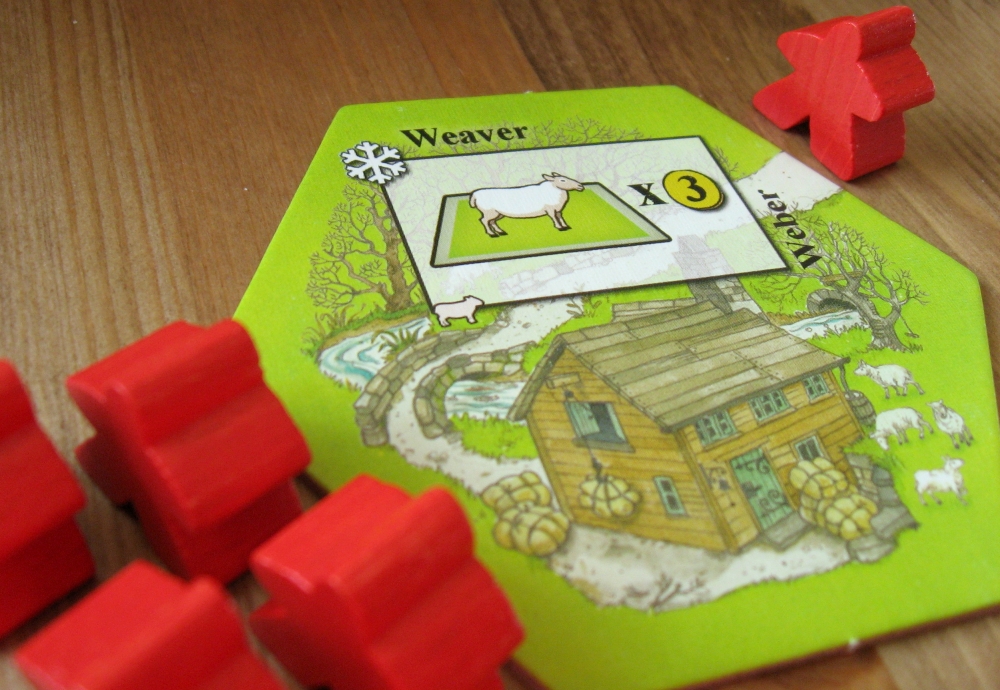
Keyflower: The Farmers
– Image by boardGOATS

Additionally, The Farmers expansion introduces wheat as a new resource, which can be used to add distance/quantity to the movement action, enabling players to move more animals and resources further.  There are several ways to set up the game with The Farmers expansion, but this time the group used The Farmers Variant, where all the tiles from the expansion are used and the number made up with tiles from the base game.  After setting up and explaining the additional rules to Black, Ivory went first, taking the waving purple start-player Keyple, and began the bidding.

Keyflower: The Farmers
– Image by boardGOATS

In Spring, Blue failed to get anything useful at the start of the game (or so she thought) taking just the Key Mine tile which gives Coal and didn’t match any of her Winter tiles.  Pink started off taking the Sheep Fold which gave him a source of sheep and the Paddock which gave him more Movement and upgrade ability together with some Wheat.  Then, he took the Workshop which gave him one resource of his choice from Wood, Coal or Stone, upgradeable to three resources, one of each, which matched his Winter tile, the Mercer’s Guild.  Ivory won the Quarryman, which gave him some very useful gold, and in Summer took the Shepherd’s Hut which gave him Wheat and Sheep and then embarked on a concerted breeding and movement programme.

Keyflower
– Image by boardGOATS

Black picked up a few tiles early in the game, which ultimately led to a lightly sprawling Village by the end of the game.  These included the Wheatfield in Spring and the Tavern, the Smelter and Boat 3a in the Summer.  By this time, Pink had decided that the sheep weren’t doing it for him so moved on to pigs, with the Pigsty.  Blue, having missed out on the Tavern which converts one Keyple into two, instead took the only tile that generated green Keyples, the Store which went well with one of her Winter tiles, the Key Market, but gave the added power of preventing other players from following if she was the first to Bid with Green, as they were highly unlikely to have any.

Keyflower: The Farmers
– Image by boardGOATS

In Autumn, Blue discovered the value of the Key Mine tile she had picked up in the first round, when the Blacksmith tile appeared which gave points for each Coal on the tile at the end of the game.  She added the Ranch to this which gave Cows and Wheat, and then began mining Coal in earnest and hoarding large numbers of sheaves for a super-movement move later in the game to get everything where it was needed as efficiently as possible.  Black got the Goldsmith which went well with his Smelter which gave him the Gold he needed to upgrade it and get ten points, while Ivory and Pink continued their procreation programmes.
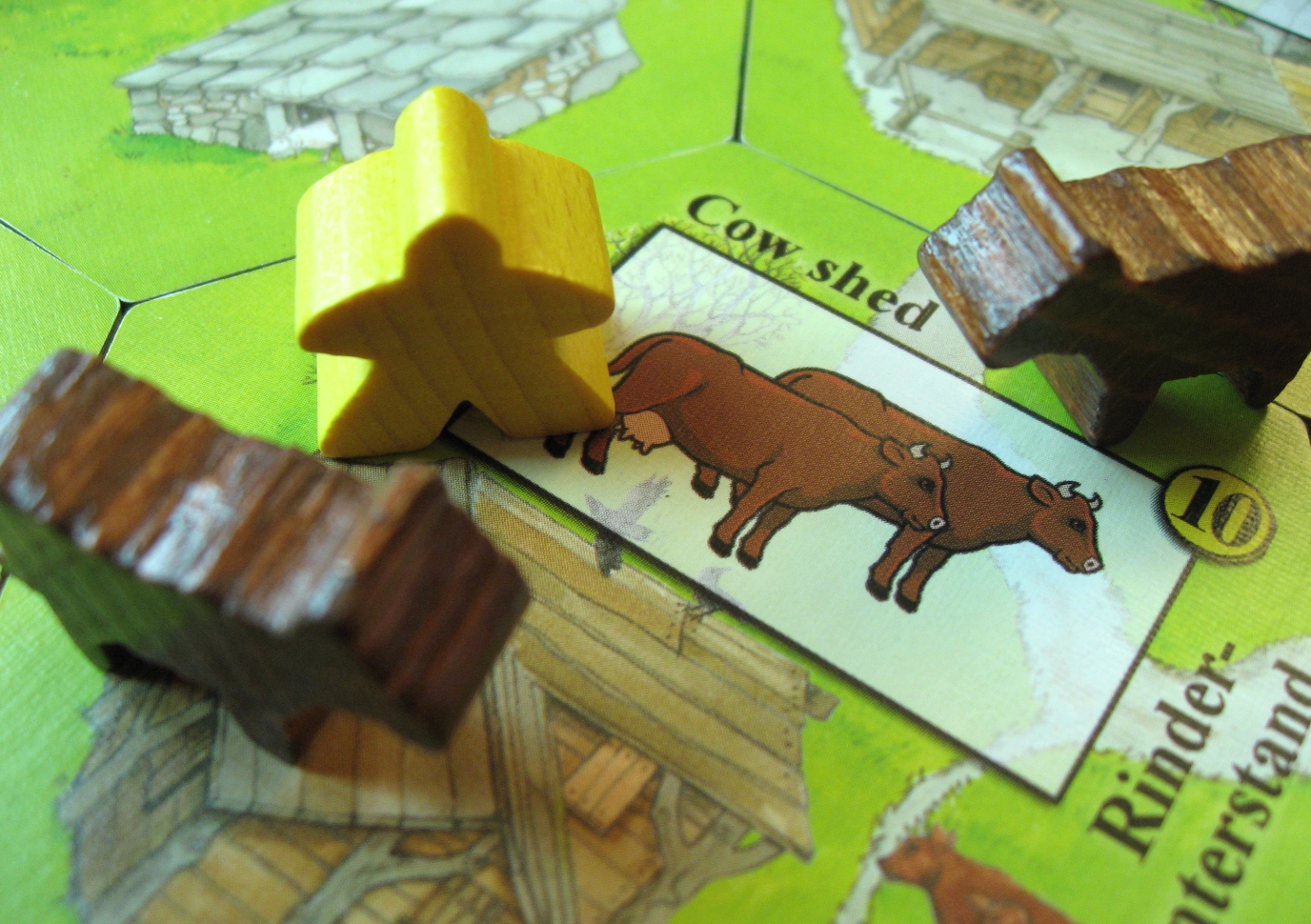
Keyflower: The Farmers
– Image by boardGOATS

As the game progressed there were several visits from the other gamers in the room, many of whom, much to the people who were playing it’s surprise, had not played Keyflower. It is, of course, Blue’s favourite game and was a favourite of Burgundy’s, as well as being generally very popular with almost all of the regulars pre-2020.  So as the game continued into Winter, it was clear it would have to get another outing or two reasonably soon to rectify the situation. There is also The Merchants expansion which has not been played with the group, so that might be the “Feature Game” in the coming months.

Keyflower: The Farmers
– Image by boardGOATS

Only eight out of a possible sixteen Winter tiles were introduced by the players and the Scribes, which Ivory commented usually ensured victory was not there (it turned out nobody had started with it).  Black took the Granary which gave him points for his Wheat and Pink got his Mercer’s Guild that he’d been working towards.  Ivory won the Cathedral giving him a straight twelve points; the Weaver giving two extra points per sheep field, and the Bakery giving four points for each set of a Resource, a Skills tile and a Wheat Sheaf.  Blue had lots of options, so concentrated on building her piles of resources before bidding for her end of game scoring.
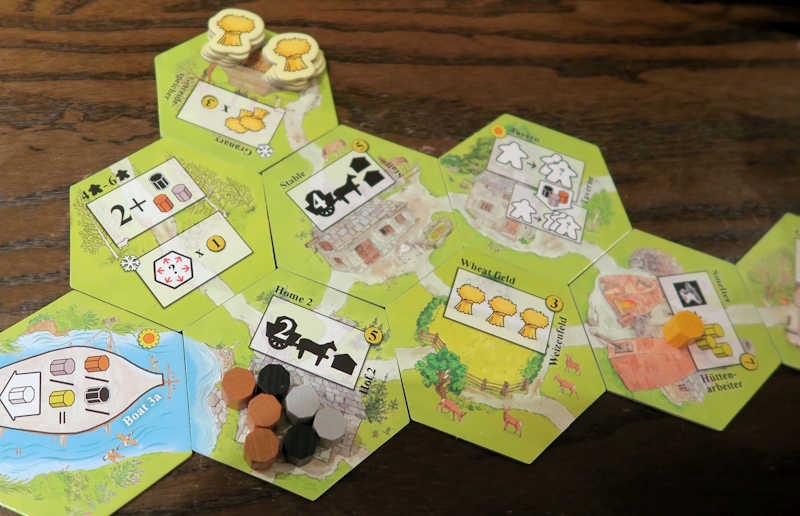
Keyflower: The Farmers
– Image by boardGOATS

This required a lot of nerve as Ivory had there wherewithal to take some of the tiles she obviously wanted.  Ivory hummed and hawed over it and as Black and Pink passed, twice he had the chance to begin a war, but decided not to as “that’s not very nice” and it can also backfire spectacularly.  Instead he generated the odd Gold for a point (“in case it was close”) and waited and watched.  In the end he passed and then Blue passed and that was that bar the counting.  And as it turned out, it was close, very close, but Blue just took victory, by a mere three points, with a total of ninety-five.
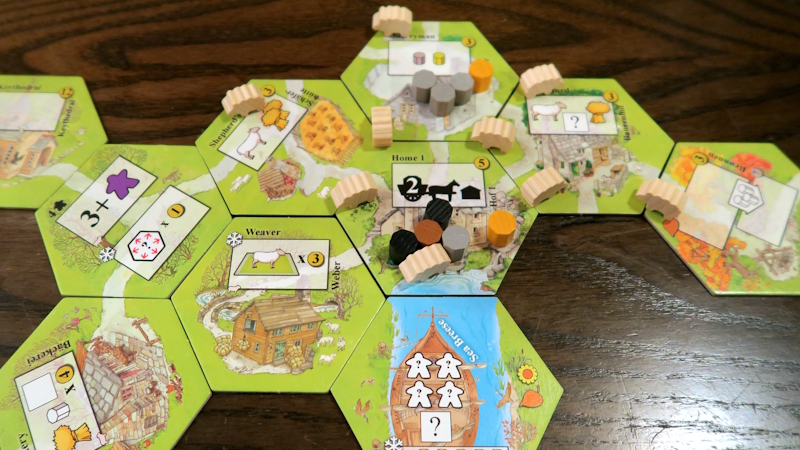
Keyflower: The Farmers
– Image by boardGOATS

The jury is out as to whether it was Ivory’s kindness that cost him the game because Blue did, of course, have contingency plans if someone had tried to take some of the tiles she wanted, and she could have cost him a lot of points.  However, by the end, Blue had no Keyples left and Ivory had a couple that he could have used, so depending on how things had panned out, he might have just nicked it or still lost.  Instead, his kindness and generous good nature won him a lot more respect from his fellow gamers, especially given that everyone knew how fond Blue is of Keyflower successfully destroying her plans might have made her just a little bit sad.
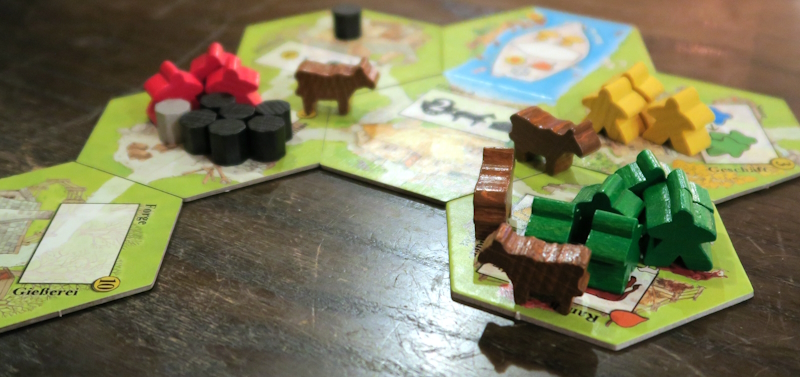
Keyflower: The Farmers
– Image by boardGOATS

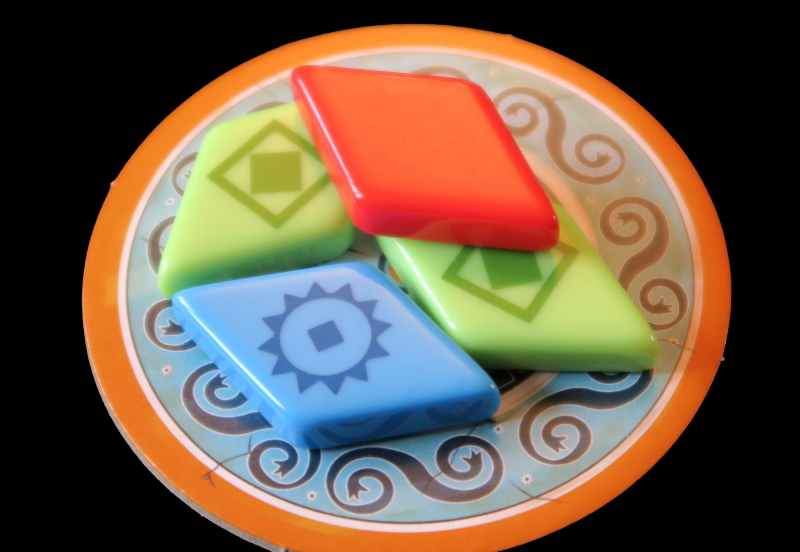
Finally, the third table began their evening with Azul: Summer Pavillion, the third in the series based on the essentially abstract game of tile collecting, Azul.  Crimson kindly obliged in offering to lead the game with Lime, Teal and Purple, none of whom had played this variant before.  This is more similar to the original than the second in the series (Stained Glass of Sintra), but is built on lozenge-shaped pieces that make up hexagons.  Like the original, players take tiles from a central market and add them to their player-boards claiming points as they do so.  In contrast to the original, players store the tiles and add them all to their board at the end of the round (taking it in turns to do so).
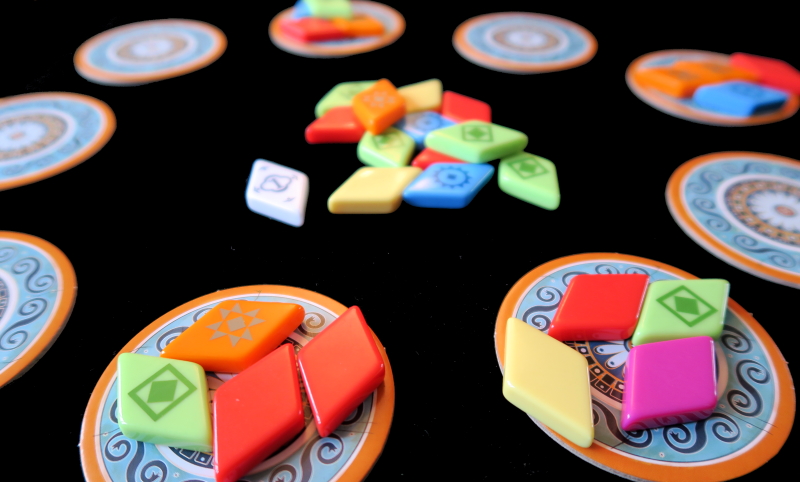
Azul: Summer Pavilion
– Image by boardGOATS

After some initial confusion caused by the additional bag and player boards from the Objective Tiles and Glazed Pavillion expansions, the game got underway.  Unfortunately, there was a bit of a rules malfunction:  initially it was thought that every time a tile was placed it scored one point for itself, two for one next to it and three for a third one in sequence (totalling six).  The group soon realised this wasn’t right though.  So they then thought you scored at the end of the round after playing all the tokens, however, they soon realised there was no way anyone could remember when a new tile that round had been placed.
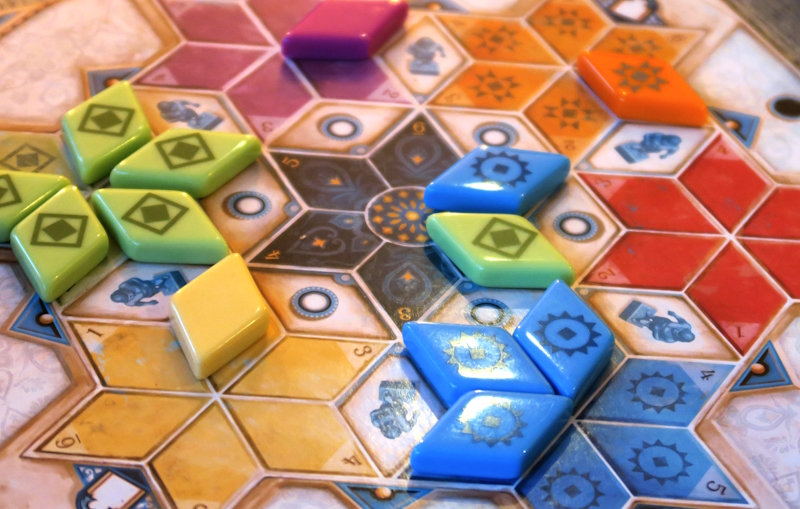
Azul: Summer Pavilion
– Image by boardGOATS

At this point, they then read the rules and from that decided players score one point for the tile and one for each tile it was adjacent to, thus scoring from one to three points per tile as they were placed and this is how they continued to play.  Cyan immediately identified they had come a cropper when he looked at the low end-game scores. He explained that they should have scored one point for the tile placed and one point for each tile connected to that group, so potentially up to six points could be scored for some tiles!
Azul: Summer Pavilion
– Image by boardGOATS

Although it wasn’t played by “the rules as written”, everyone had the same disadvantage, and the group resolved to give it another go again soon, but with the right rules next time.  As it was, it was a very close game with Crimson, beating Lime by a single point and Teal finishing some half a dozen points behind.  It is a very pretty game, and despite the issues, players had enjoyed making patterns and pushing the tactile bright tiles around, which was very therapeutic after a hard day at work.

Azul: Summer Pavilion
– Image by boardGOATS

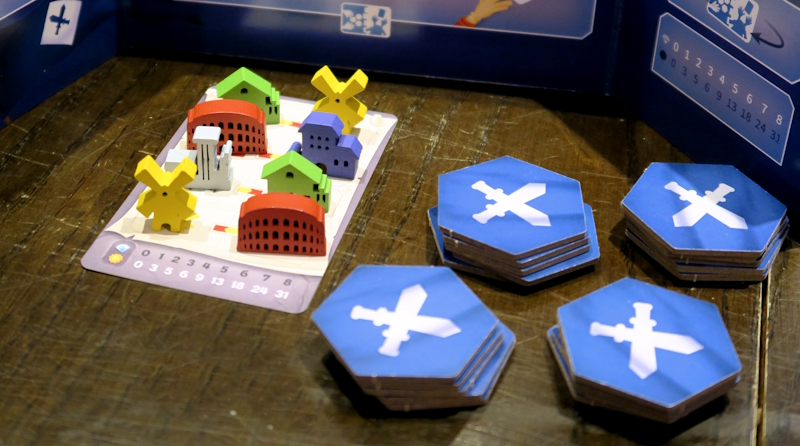
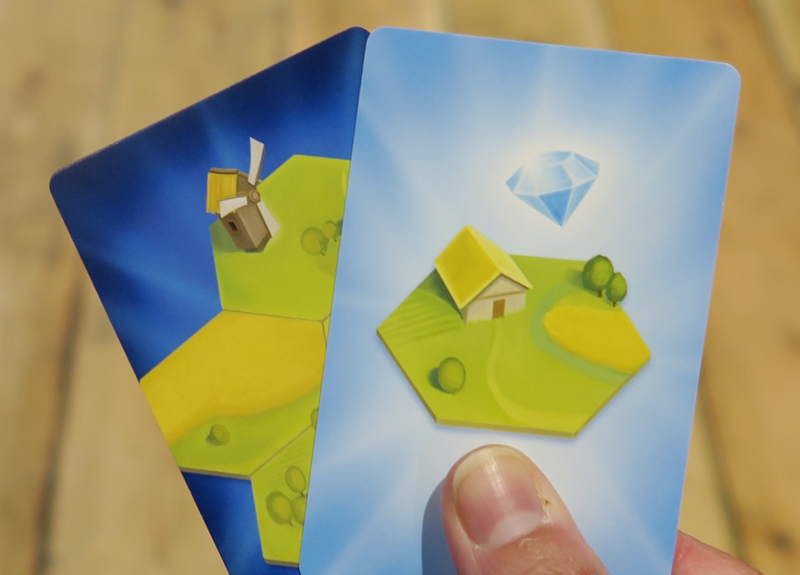
Keyflower was ongoing (and would be for the rest of the evening), but Happy Home had finished so there was a quick game of musical chairs and Purple began by leading Lime, Cyan and Pine in a game of the group’s currently popular filler, Rome in a Day.  This is a little tile laying game built round the “I divide, you choose” mechanism.  The idea is that players draw five land tiles at random and place two buildings on tiles one and two. They then divide the five tiles into two groups—a bigger and a smaller one (in any ratio), and add a Crystal Gem to the smaller land set before offering the choice to their neighbour.
Rome in a Day
– Image by boardGOATS

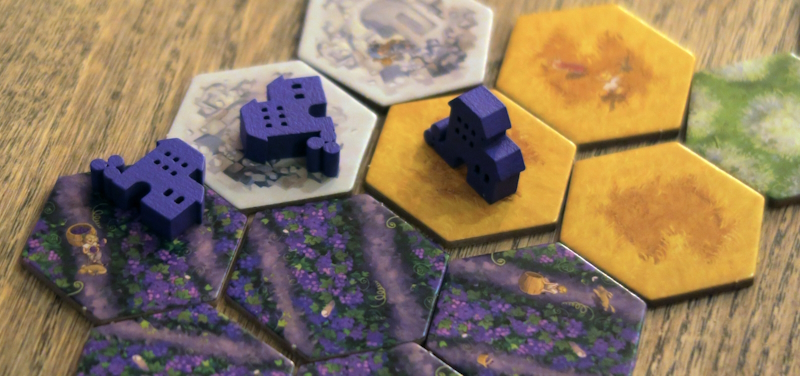
During the four rounds that the game is played over this neighbour alternates, right, left, right, left. So, each round, players choose a set from their neighbour and these and the tiles they were left with are added to their domain.  At the end of the game, any building that stands on or adjacent to land of its own colour will score for each tile in the group and then players score for the diamonds they have collected—the player with the most points is the winner.  The game has had a couple of outings recently after Black and Purple picked it up at UK Games Expo a few weeks back.  Pine, Lime and Cyan had not been part of those games, so Purple explained the rules.
Rome in a Day
– Image by boardGOATS

The game was a bit of a struggle, probably not helped by the fact that on both the previous occasions the rules have not been strictly adhered to.  This is partly because the rules are not the best written and partly because when the game was explained to Black and Purple at UK Games Expo they were different to those published online.  Although it wasn’t entirely clear to everyone during the game, it was actually very close.  In fact, Lime and Cyan finished tied for first place with forty-four points each despite quite different tactics with Cyan prioritising collecting Gems and Lime making hay in his Wheat fields and wine in his Vineyards.
Rome in a Day
– Image by boardGOATS

While the group were fighting their way through Rome in a Day and Keyflower was coming to an end, Jade led Sapphire and Crimson in the 2024 Spiel des Jahres recommended game, Harmonies.  This was described by Jade as a sort of cross between Splendor and Cascadia, with an Azul-type market.  On their turn, the active player takes three wooden Tokens from one of the spaces on the central player board and places them on their player board. These Tokens represent Mountains, Trees, Buildings, Water and Fields.  Some tokens can stack, others cannot: the reasons why are thematic (e.g. tall Mountains and Forests, no tall Rivers etc.), but otherwise Tokens can be placed on any empty space.

Harmonies
– Image by boardGOATS

Players may then take an Animal card from the central display—they can have a maximum of four at any one time and each has a number of Animal cubes on them.  Each time the pattern on an Animal card is fulfilled, one of these Animal cubes is removed and placed on the token indicated on the card.  At the end of the game, players score for the highest achieved Animal on each card and for each Mountain, Tree, Building, Field and River (or Island, depending on  which side of the board players are using).  Mountains are made of stacks of up to three Rock Tokens, while Trees are a green Leaf Token on zero, one or two Wood Tokens.
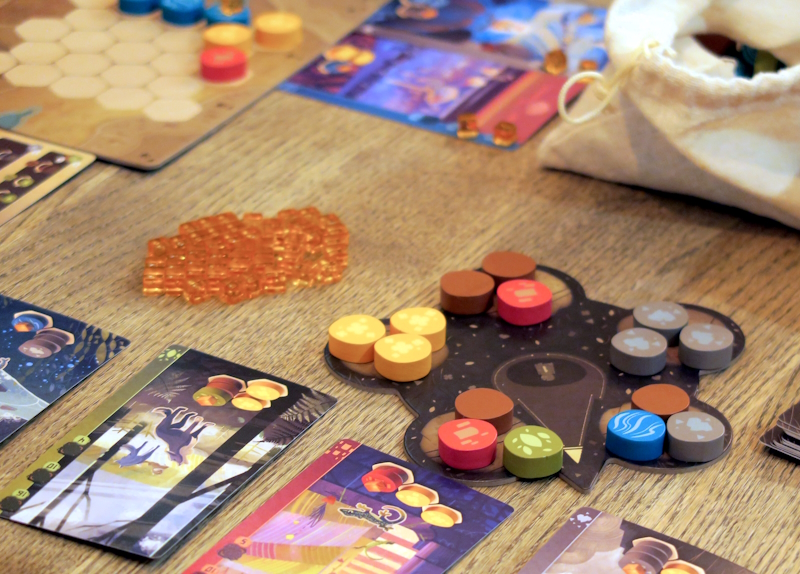
Harmonies
– Image by boardGOATS

Taller Mountains and Trees give more points (one, three or seven points), while Buildings (made of two Tokens, at least one Brick and a Wood, Rock or another Brick), and Fields (two adjacent Wheat Tokens) score five points each.  Finally, depending which side of the board is used, players score points for the length of their River, or five points for each Island they make.  This time, the group played with “Side A” which scores for Rivers.  It was a learning game for Crimson, but was quite close quite between Jade and Sapphire, but Sapphire’s one hundred and eight gave him victory in what is an interesting point-salad tile-placement game that deserves another outing soon.

Harmonies
– Image by boardGOATS

Learning Outcome:  You don’t need a toilet to have a Happy Home.
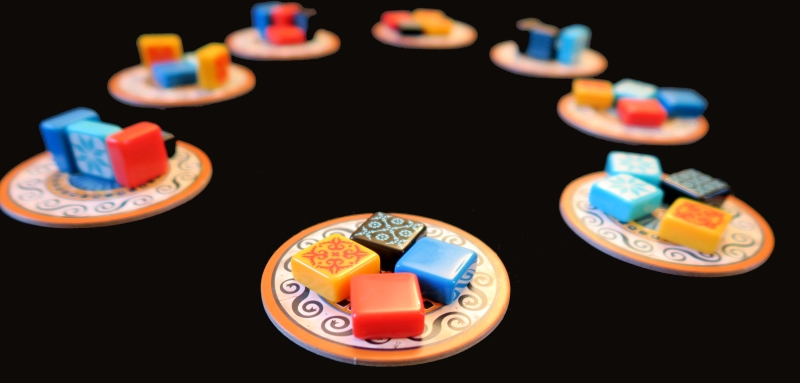
6th February 2024

People were still eating when Ivory rolled up nice and early to start setting up Ark Nova.  Although it was not the “Feature Game“, we are planning to feature the Marine Worlds expansion in the next few weeks and wanted to play the base game before we did.  So, Ivory was soon joined by Cobalt, Plum and Green on the other side of the table, leaving the rest to decide who would play the “Feature Game”, CuBirds, and what everyone else would play while they did.  Before long, Pine, Pink, Lime and Blue were dealing out the bird cards while Purple, Black and Teal moved to the next table and rummaged through the game bags to decide what to get out.

CuBirds
– Image by boardGOATS

CuBirds is a fairly simple set-collecting game built round a central market.  Players start with a hand of seven cards and, on their turn must place cards from their hand.  They have to place all the cards they have of one type, adding them to one of the four rows on the table, at either end.  If there is already a card of this type in that row, then they take all the cards between that card and the newly added cards into their hand.  Optionally, if they have enough cards of a given type in their hand, they can complete a flock of them, that is play the cards, keeping one or two in their display (a bit like harvesting a been field in Bohnanza, where harvesting a field of five beans might leave a player with two Bean Thalers).

CuBirds
– Image by boardGOATS

The game ends immediately when one player’s collection has either three cards of each of two bird types, or seven different bird types (of the eight available) in front of them.  It should play out in about half an hour, though inevitably, the first play through took longer as everyone felt their way through.  When any player places the last card in their hand, everyone has to ditch their whole hand which can be quite brutal with players losing partial sets and having to start collecting again. Pink was the first to upset everyone’s plans, quickly followed by Pine.

CuBirds
– Image by boardGOATS

A lot of fun was had identifying the bird types, and nobody got close to guessing what the tall, thin, “little brown job” was, which turned out to be a reed warbler, but was soon universally known as “WeirdBird”.  When the end of the game was triggered, both Blue and Lime had a magpie apiece with Lime’s paired with four toucans and Blue’s with three robins, while Pink just had two little ducks.  Fittingly, as by far the most dedicated birder in the group, the winner was Pine with three flamingos and three “wols” with a spare parrot.  It had been fun, but rather than play again, as he’d missed out on both the previous plays, Pink had been keen to give the new full-sized, Scandinavian Northern Lights version of Ticket to Ride a go.

Ticket to Ride: Northern Lights
– Image by boardGOATS

Like the other variants, Ticket to Ride: Northern Lights has slight changes to the rules and a new map, which in this case, similar to the older, festive themed Nordic Countries, though it plays up to five instead of just three.  The base rules are quite simple: on their turn, players either take train cards from the face-up market (or the blind draw deck), or spend cards to place trains on the map for points. Once or twice during the game, players may instead choose to draw Tickets, which give players points at the end of the game if they are completed (i.e. the owner has connected the two locations with their trains) and score negative points if they are not.

Ticket to Ride: Northern Lights
– Image by boardGOATS

Northern Lights additionally has some triple routes (which only take effect with five players) and some routes have a “+X” next to them and when trains are laid on these the player takes X train cards from the face down pile.  In general, Locomotive (wild) cards can replace any other card but for ferry routes they can be replaced with a pair of the same colour (that doesn’t have to be the same as the rest of the cards used).  Unlike most of the other versions, however, if there are three or more face-up Locomotive cards in the market, the market is not refreshed.  The biggest differences are the addition of Bonus cards, however, which extra points at the end.

Ticket to Ride: Northern Lights
– Image by boardGOATS

This time the Bonus cards used were Capital Investment (B), Local Area Network (F), International Tycoon (G) & Ferry Master (J).  These gave Bonus points for completing Tickets to the capital cities (Stockholm, Copenhagen, Oslo and Helsinki); completing the most short Tickets; connecting to the most countries; and completing the most Ferry routes.  The map is very tight with a lot of short routes, spread over a fairly long thin map and a wide variety of Ticket lengths.  Everyone complained that their starting Tickets weren’t compatible, though Blue and Lime both kept all three of theirs, even so Pink surprised everyone when he took his first set of Tickets very early.

Ticket to Ride: Northern Lights
– Image by boardGOATS

Pine soon followed and his sniggering as he kept all the new Tickets was ominous, signalling that he’d already completed all three—a fact confirmed when he drew more on his next turn too.  Blue and Lime covered similar spaces,connecting the north-west to the south-east, while Pine’s network dominated the east and Pinks sprawled over the south.  Everyone was getting on with doing their thing when suddenly, Lime brought the game to a rather abrupt end, catching everyone else out.  As a result, Pink and Pine both had an incomplete ticket that costing them fourteen and twelve points respectively, while Blue had two giving her a combined loss of sixteen points (though part of that was her own fault as she’d overstretched her self and would have run out of trains anyhow).

Ticket to Ride: Northern Lights
– Image by boardGOATS

In spite of that, it was a very, very tight finish with just six points between first and third place, meaning the Bonus cards became much more critical than might have been expected earlier in the game.  Lime set the target with a nice round hundred points, but he did not take any of the Bonus points and was just pipped by Pine who took several of them with Blue making up the podium.  It had been an imperious game from Lime, and he was unlucky to have lost to Pine who was the first to admit that he’d got very lucky with his Tickets, especially the draw where he’d already completed the Tickets, quite remarkable given how spread out the network is on this map.
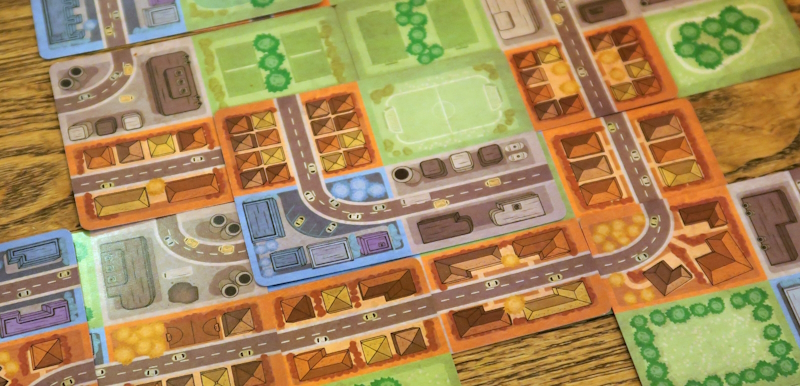
Ticket to Ride: Northern Lights
– Image by boardGOATS

Meanwhile Purple, Black and Teal had been playing Azul.  This is a favourite game within the group, which is unusual as we tend to eschew abstract games. Players are mosaic building, taking tiles from a shared array of factories, adding them to their Storage on their personal player boards.  At the end of the round, any full rows are scrapped with one tile progressing into the player’s mosaic.  Players score when the tiles added form rows or columns, and the longer they are, the more points players get.  The catch is that each Storage space can only hold one tiles of one colour.  If there is nowhere to put tiles taken from the Factories, left over tiles go into the Scraps bin costing players points which can be very costly as Black found out when he lost fourteen in the final round.

Azul
– Image by boardGOATS

For a little variation, the trio added the Joker tiles and the five double score markers from the Special Factories Promo tiles.  The Joker tiles are a set of ten beautiful promotional tiles that can serve as a proxy for any of the other tiles, though their aesthetic comes at a price as players can’t use them for end of game color Bonuses.  The five double score markers allow players to double the points scored for a row or column, by taking the marker of the matching colour.  Everyone took one of these during what was a hard-faught game where Purple and Black tied for with seventy points.  The clear victor was Teal, however, with eighty-eight points.

Azul
– Image by boardGOATS

Teal and Pine took their leave, so after some chatter, Purple and Black joined Lime, Pink and Blue in another game of CuBirds.  This time, Black collected magpies but twice had enough for sets but kept losing them.  Pueple got three WeirdBirds and was busy collecting parrots when the game came to an end.  Both Lime and Blue tried to collect a set of seven different birds, but while Blue got close with five (and a duplicat “wol”), Pink was imperious.  Before his final turn he had a set of three toucans and two sets of two (flamingos, ducks and robins), pretty-much guaranteeing him victory, regardless what he was left with, though he chose to check-out with another flock of flamingos.

CuBirds
– Image by boardGOATS

While all this was going on, on the other side of the room an epic game of Ark Nova was underway between Ivory, Cobalt, Green and Plum.  This is a much longer game than we usually play with an advertised playing time of upwards of two hours and reputedly considerably more with inexperienced players and setup time included.  It is all about planning and designing a modern, scientifically managed zoo, but the game-play is more like Terraforming Mars with animals, than Zoo Break or Zooloretto.  That said, although it is quite complex, functionally it is not difficult to play on a turn by turn basis, though there is quite a lot to manage and keep a track of.

Ark Nova
– Image by boardGOATS

On their turn, players take one of six possible actions:  activating one of the five action cards (Cards, Build, Animals, Association and Sponsor) with a strength equal to the number above the card, or move a card back to the first space and take a cross token instead.  When activating a card players perform the action based on its power level which is dictated by its position in the row.  Once a card has been played, it is moved the first space in the player’s five card row (i.e.to the lowest power position on the left) moving the other cards to the right to replace the card removed, effectively incrementing their power by one.  During the game, players can upgrade and turn over the action cards to a more powerful second side using various Bonuses.
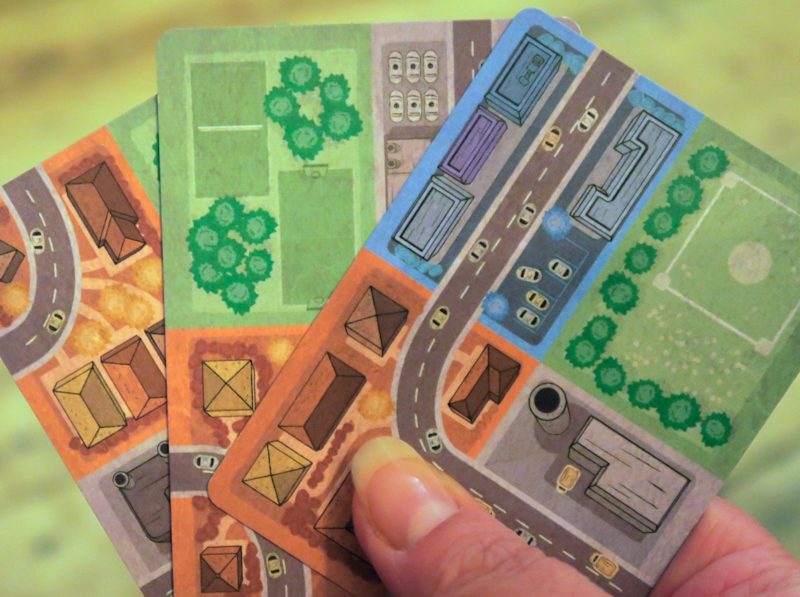
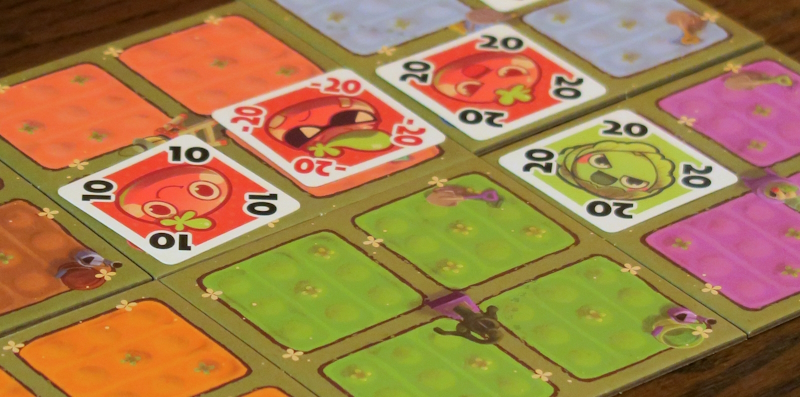
Ark Nova
– Image by boardGOATS

The Cards action is the simplest action, which lets players draw cards from the deck (the number depending on strength) then advance the marker two spaces along the break track which defines when the round ends.  The Build action allows players to pay to construct one building on their zoo map.  Players can build basic enclosures with a size of one to five, but they can also build a petting zoo for animal storage or pavilions and kiosks (which give players Appeal and money respectively based on adjacent filled enclosures).  With the upgraded build action, players can build multiple different buildings and have access to the large bird aviary and reptile house which allow the storage of multiple animals.

Ark Nova
– Image by boardGOATS

The Animals action allows players to add animals into enclosures in their zoo. Some animals have a special requirement and need a symbol in their tableau and/or the upgraded animal card. Adding an animal to an enclosure has a cost, and then the player turns over the empty enclosure of at least the size needed or places the listed cubes into a special enclosure (an aviary or a reptile house).  The player then adds the animal card to their tableau and resolves the abilities on it and receives ticket sales along with possibly Conservation points and Reputation.

Ark Nova
– Image by boardGOATS

The Association action allows players to take one task on the Association board with different tasks available based on their power level.  This allows people to gain Reputation points, acquire a partner zoo they don’t already own, gain a partner university, or support a Conservation.  Finally the Sponsor action allows players to play exactly one Sponsor from their hand which offer ongoing abilities.  They can allow players to place unique tiles in their zoo and offer end game Conservation point opportunities. Some Sponsor cards have conditions on their play similar to the animal cards.

Ark Nova
– Image by boardGOATS

Players take it in turns to take actions, resetting every time a break occurs, until the end game has been triggered.  There are two tracks, Appeal (Tickets) and Conservation that follow the same course, but in opposite directions.  The game end is triggered when one player’s pair of scoring markers cross, after which, everyone gets one more turn and then the end-game cards are scored.  The player with the largest overlap between their Conservation and Appeal values is the winner.  Everyone was familiar with the game and had watched the rules refresher video, so the group could make a fast start, however, Cobalt and Green had played a lot online and Plum had only played once, so there was a difference in experience levels.

Ark Nova
– Image by boardGOATS

Green and Plum took early Association actions taking the two Reputation universities, scuppering Cobalt’s first turn who couldn’t make use of the double science university.  Cobalt therefore took a partner zoo and snapped a Conservation project from the display in the first few turns. Early game sponsors included: “Veterinarian” by Green (grabbing him an additional university and allowing Conservation projects to be performed at Association level four instead of five, although he didn’t make use of this throughout the game); “Quarantine Lab” by Plum (providing her immunity to venom, constriction, hypnosis and pilfering); “Expert in small animals” by Cobalt (reducing the cost of two-sized animals by three); and “Expert in Herbivores” by Ivory (providing three money each time a herbivore is placed into any zoo).

Ark Nova
– Image by boardGOATS

Plum was very pleased with her “Quarantine Lab” as it meant she didn’t really have to bother with the effects of red tokens that say you have been bitten or poisoned because it meant there was one less thing to get in here way and complicate her game.  Cobalt used his expertise in small animals to good effect, especially when combined with partner zoos, with a petting zoo and several small animals, allowing his money to stockpile. Ivory concentrated on reptiles while Green played several negative effect cards early (e.g. boa constrictor), which hit Ivory and Cobalt (the latter multiple times, and grabbing some of that stockpiled cash). Plum appeared to take an early lead possibly due to her Quarantine Lab which kept her out of all the early pilfering and poisoning.
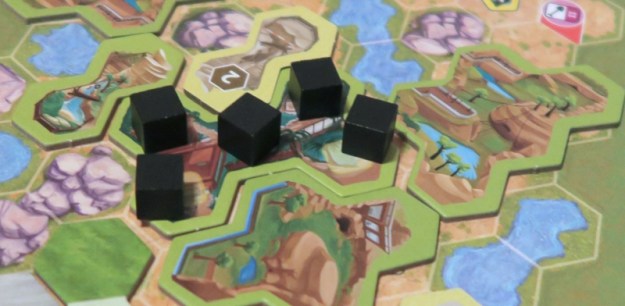
Ark Nova
– Image by boardGOATS

Cobalt was first to complete a Conservation project, using the snapped card to release a herbivore into the wild and gaining the two-enclosure Bonus, immediately followed by Ivory.  In the middle-game, the African Bush elephant and Serengeti National Park appeared side-by-side in the display, so Cobalt took the risky decision to nab these over two consecutive rounds, but was forced to discard five or six cards from an unexpected break. Having kept the elephant and Conservation project, Cobalt played these to grab an extra scoring card and race up the Conservation track and triggered the scoring card discard. Ivory and Plum took to the Appeal track. Green remained languishing on both tracks, particularly the Conservation track where he barely moved all game.

Ark Nova
– Image by boardGOATS

Cobalt was first to upgrade his cards, leaving only the Association action not upgraded, whereas Green concentrated on Sponsors and Association actions. Plum was working through some difficult choices, ultimately deciding to having to flip the Animals card so that she could play the Elephant she had been nursing. She left the Reputation as the non-upgraded card, which unfortunately removed some of the better options that the Elephant gave.  Plum was just a Europe icon away from being able to take the multi-regional goal, but ultimately forgot that having high Appeal is the negative element to the score and didn’t do the things to convert her Appeal to give her points.

Ark Nova
– Image by boardGOATS

Green was slow to get going, but eventually, managed a master move with his first Conservation project and flew up the scoring to overtake Plum, and began chasing down Ivory and Cobalt.  It was very close between Ivory and Cobalt on who would trigger the end game: Cobalt managed to keep his counters from crossing, causing Ivory to trigger the end game and allowing Cobalt one last turn. Although Ivory scored well on the final turn, Cobalt covered his zoo (giving him seven more Appeal) and scored more than twenty points in the final turn.  In end game scoring, it became apparent that Plum had misunderstood her end game scoring card.  She had thought it gave points for empty enclosures in her zoo (rather than empty spaces) and had set about building lots of them towards the end.  Without this, her game would have ended very differently.

Ark Nova
– Image by boardGOATS

Ivory took the third place on the podium having realised Green was closing and decided to end the game perhaps a turn or two earlier than he really wanted which may have inadvertently caused himself more damage as Green needed some three turns to score anymore.  Green did exceptionally well taking a full four Conservation points from his Bonus card and three extra points from Sponsors, and with it, almost taking victory with a total of eighteen points.  However, Cobalt’s final turn plus two scoring cards (one of which was for small animals) meant he won with a convincing score of thirty.

Ark Nova
– Image by boardGOATS

It had been quite stressful getting the game completed in time, especially with some long turns where actions were chained together, for example Plum played one card which enabled another full turn, but with two new cards it was tough to decide which gave the better option.  All that said, it had been very enjoyable and everyone had got on with their game and helped each-other where necessary.  The group clearly demonstrated that the game can be played in around four hours even with four, so long as everyone knows what they are doing and keeps moving.  It will be a few weeks before the Marine Worlds expansion gets an outing, but it will be exciting when it does.

Ark Nova
– Image by boardGOATS

Learning Outcome:  Reed warblers are weird warblers.

5th September 2023

The evening began with Green and Purple arriving to find Plum and Cobalt sitting outside the pub chatting.  This was partly because the weather was warm, but also because someone else was sitting at our usual table and we had been relegated to another long table on the other side of the room.  Pine arrived soon after and once introductions between Cobalt and those who had not been about last time were concluded, the group decided to play a short intro game while they waited for everyone else to arrive.  The game settled on was Coloretto, which had only just begun when Ivory arrived, but he was happy to watch.

Coloretto
– Image by boardGOATS

Coloretto is a quick and simple game that is very popular with the group.  Players either turn over the top card and add it to a “Truck”, or take a Truck and add it’s contents to their collection, sitting out until everyone else has taken a Truck.  Players are collecting coloured sets of Chameleon cards, but the key is that only three sets score positive points, with the others scoring negatively.  Thus players are trying to get as many cards in three colour suits, and as few as possible in each of the rest.  This time, everyone started with a different colour, so there were no obvious clashes.  As is usual for this game, it took a few turns for each players position to become clearer.

Coloretto
– Image by boardGOATS

By this time Plum was keeping the number of colour sets she had low with only two, but also had a couple of +2 bonus point cards and a Rainbow Chameleon (a wild) . Purple’s set was similar but with three colours.  Green was making steady progress and Cobalt was low on any particular colour, but only had four sets and a Rainbow Chameleon, so was poised for a good score if the cards fell in his favour. Pine meanwhile seemed to be in the process of collecting at least one of each colour!  By the end of the game, Plum had managed to collect Chameleons in just three colours and so scored no negatives, while Pine just seemed to have sets of everything. Purple had three extra colours, but with only one of each; her Rainbow Chameleon and +2 cards helped to give her a good score.

Coloretto
– Image by boardGOATS

Green managed only one negative point, but had no bonuses, while Cobalt had his cards fall right and ended with a couple of good colour sets and with it, victory.  By the conclusion of Coloretto, Jade and Sapphire had arrived bringing with them the feature game, Vaalbara.  In this game, each player is a clan leader trying to take over some territories with game-play which is vaguely reminiscent of Libertalia/Winds of Galecrest.  Players all have the same deck of twelve cards representing the members of their tribe.  Each turn, players choose secretly one card, then in the order of initiative of the revealed Characters, players activate their powers and take over one of the available Territories. Each type of Territory has its own way of scoring points (Collection, Pair, Diversity, Risk etc.).

Vaalbara
– Image by boardGOATS

Thus the game is about timing and playing the best powers and the high initiatives at the most opportune moments. After nine rounds, the player with the most points wins.  Jade and Sapphire had played Vaalbara about a dozen times together, and Green had played a similar number of games on Board Game Arena with reasonable success. Pine was entirely new to it the game and joined the other three.  Jade and Pine took the Mountains in the first round, and then Jade managed to snatch the only one on offer in the second round.  Green ended up with the final card in the first round—the All Rounder, so scored poorly with it.

Vaalbara
– Image by boardGOATS

By the middle of the game Sapphire was going all out for Fields, Jade was on to his third Mountain and Pine was beginning to get the hang of things.  Green was struggling with his all rounder strategy:  all he could get was a River and several Forests and even after he’d swapped one of those for something else (he’d mixed up the cards and instead of swapping a card between first and second row, it was any card with the top card of the deck) it didn’t work out.  Pine managed to complete his second Mountain, but Jade amazingly managed all four which catapulted his score. It was only then that Pine and Green realised that the fourth Mountain was twenty points on top of the ten for the first three (i.e. a very thirty in total from four cards).

Vaalbara
– Image by boardGOATS

By the end of the game the Poppy Fields were coming out in profusion and started to really score a lot of points.  Unfortunately for Green, Jade managed to nab the Field card ahead of him for a five type bonus and Green was still only on four terrain types.  Once the dust had settled and the final scores were compiled, it was quite close with Jade and Pine were tied for first on seventy points, and Green only three points behind and just ahead of Sapphire. Pine joked that maybe the tie-break would be the player position on the last card back, thinking that would about as arbitrary as some of the other tie breaks had been recently. A quick check of the rules confirmed it and ultimately gave victory to Jade.

Vaalbara
– Image by boardGOATS

From there, the quartet moved on to play an old favorite, Azul.  In this game, players are tile-laying artists challenged to embellish the walls of the Royal Palace of Evora.  On their turn, players draft colored tiles from the marketplace onto their player board.  At the end of the round, players score points based on how they’ve placed their tiles to decorate the palace with wasted tiles scoring negative points.  Bonuses are awarded at the end of the game for completing rows and columns and sets of the same colour, and then player with the most points is the winner.  A pretty game, the group started with a short discussion about what colour one of the tiles really was.

Azul
– Image by boardGOATS

People wanted to call it blue, but there is already a fully blue tile, and this one was a little more turquoise with a white pattern—they did not come up with answer to the problem.  The game played much as it always does with complaints about the tiles that were not coming out of the bag when needed and at one point there was one Marketplace with four tiles all the same colour (that colour that we could not quite pin a name on).  Mid-way through the game no-one seemed to want the orange tiles, and it ended up with about eight of them in the middle of the table. It finally fell to Pine to take them, but he could not place any of them and they all had to go on his negative score line!

Azul
– Image by boardGOATS

The game was reluctantly brought to a conclusion by Sapphire, at the urging of everyone else.  He did not want to complete his row, wanting to hold out and complete a different colour later, but if he hadn’t taken the tile he would have ended up with a larger negative score and it had already not been possible to fully populate market. After final scoring, Jade and Sapphire shared the lead with ninety-five points with Green, who’d had a much better game than he usually has in third.  Tie break time again, but this time Sapphire won it because he was the only player to have completed a full row (the tile he hadn’t wanted to take).

Azul
– Image by boardGOATS

There was still time for something else, and the group settled on Nimalia, a new, interesting card-laying game where players are designing the best Animal Sanctuary.  Each card has four “Biome” squares on it of potentially different terrain, and different animals.  Players start each round with three cards and draft them, placing the chosen card partly (or wholly) on top the already laid cards in a simlar way to Sprawlopolis or Honshū.  The Sanctuary must remain within a six by six grid made of the squares (not the cards).  The game is played over a series of five rounds, where two or three different conditions are scored at the end of each drafting round.  This time, the first round would score for the largest area of Savannah and for connected Polar Bears and in the second round the scoring switched to Polar Bears and Gorillas next to Water.

Nimalia
– Image by boardGOATS

In the third round it returned to the largest Savannah, but with the complication of scoring maximum for no Giraffes down to scoring nothing with three or more giraffes—of course giraffes live in the Savannah!  Rounds four and five used both the Giraffes and the Gorillas to score while adding in the Savannahs in the fourth round and polar bears in the fifth.  The nature of the scoring meant that any cards with Giraffes were quickly passed on leaving some players with a double giraffe card to lay as the last card on a giraffe scoring round.  Since it wasn’t possible to lay a new card underneath an old one, those giraffes caused scores to tumble!

Nimalia
– Image by boardGOATS

In the first round Pine roared into the lead while everyone else stayed within a point or two of each other.  After the second round, Sapphire was the one who lost out, with Pine retaining his significant advantage. During the third and fourth rounds Jade and Green managed to catch Pine, with Jade pulling into the lead.  Sapphire managed a good score in the fourth round, but he had a lot of ground to make up and he’d left his charge to the finish a little too late.  In the final scoring, Jade and Green pulled ahead in a tight battle, which Jade won by just two points with his total of eighty. Pine was third after flailing around in the final round and having been left with a double giraffe.

Nimalia
– Image by boardGOATS

While all that was on-going, the rest of the group, Plum, Ivory, Purple and Cobalt, opted for a club favourite, Wingspan, enhanced by the European Expansion.  This is a card-driven engine-building game where players choose one of four possible actions (activating their Woodland, Grassland or Wetland areas or placing a bird card in one of those locations).  Points come from each individual card end of round goals, and eggs left at the end.  The game is all about building combinations of cards that work together efficiently, so the it took all night as everyone wanted to do their absolute best.

Wingspan
– Image by boardGOATS

Ivory as always was very good at this, but was also quite generous giving everyone food each time he activated his Woodland area.  Cobalt was the first to get three bird cards in his Reserve, though Ivory  ended up with the most valuable birds on his board, with Plum’s next highest.  One of Plums birds moved at the end of each round though, which was very useful for saving costs and improving yields.  It was Ivory and Cobalt who tended to come out best with the end of round goals.  As is often the case Ivory continued to score well with a good haul of bonus card points too.

Wingspan: European Expansion
– Image by boardGOATS

Purple failed to complete any of her bonus cards, but did make sure all her birds laid purple eggs.  Cobalt finished the game with the most eggs, however, inevitably followed by Ivory.  As for cached food and cards, Plum got the most food, but Purple had the most Tucked cards.  With all the scores added up, Ivory was the almost inevitable winner on ninety-three with Cobalt not far behind with eighty-three and Plum taking the battle for third by just three points in what was a hard-fought game.

Wingspan
– Image by boardGOATS

Learning outcome:  Goats love playing with colours.

18th April 2023

Blue and Pink were joined for food by Jade, Plum, Byzantium and Sapphire.  As they finished, Pine, Green and Purple showed up (leaving Black under the patio, again), followed by Ivory and a team of Sherpas toting his massive Complete Collection of Everdell.  There were quite a few possible takers for the Pearlbrook expansion, the night’s “Feature Game“, but eventually, after a lot of discussion, Ivory was joined by Plum and Jade and they took themselves over to the other side of the pub and started setting up, which was no small task, though Everdell is functionally a fairly simple game.

Everdell: Pearlbrook
– Image by boardGOATS

Everdell is a dynamic tableau building and worker placement.  On their turn players can do one of three things: place a Worker and carry out any associated actions; pay any associated cost to play a card from their hand, or prepare for the next Season.  The game is played from Winter through to the onset of the following Winter, so each player has four Seasons, though because players can prepare for the next Season whenever they want to, players’ Seasons have different lengths and start their Seasons at different times.  This means one player who takes fewer turns could finish their game much sooner than another player.  At the end of the game, when everyone has finished, the player with the most points is the winner.

Everdell: Pearlbrook
– Image by boardGOATS

The Pearlbrook expansion adds an extension to the board, which displays River Destination cards and the new Pearl resource that give the brook (and thus the expansion) its name.  The basic event spaces are covered up as these are not used and are replaced by two new Wonder spaces.  Everyone also gets a couple of adornment cards at the start of the game and on their turn can pay a Pearl to play one of these as an action.  The don’t take up any space in the player’s city, but give an instant bonus action and points at the end of the game.  Players also start with a Frog Ambassador which they use to visit the Pearlbrook either to get Pearls or to activate the River Destinations.

Everdell: Pearlbrook
– Image by boardGOATS

The River Destination spaces have a requirement printed on the board (e.g. three production cards in the City) and a player’s Frog Ambassador can only visit, if the player has achieved it and it is unoccupied.  The River Destination cards start the game face down with a Pearl on top and the first player to visit each one takes the Pearl and turns over the card.  Another player can’t visit the Destination until it has been vacated which typically happens at the end of the occupying player’s Season.  The Shoal space allows players to exchange two resources and two cards for a Pearl, but this space is unlimited.

Everdell: Pearlbrook
– Image by boardGOATS

Ivory charged out of the starting blocks, leaving Plum and Jade for dust.  Jade struggled to get his engine going because his starting hand needed three different types of resources.  Plum and Jade commented that it was nearly impossible to get a Pearl in the first Season, Winter, so Ivory made it his business to prove them wrong.  Once he’d got his Pearl, he used it to play his first adornment card giving him more resources and, as a result he was still in winter when Plum and Jade had moved on and were well into Spring.  That meant Ivory didn’t take his Platypus workers back leaving them blocking spaces the others would have liked to use.

Everdell: Pearlbrook
– Image by boardGOATS

As a result Plum and Jade had progressed their Spring before Ivory played his Frog Ambassador, which they hadn’t been able to use at all during Winter.  It was a long time since Jade had played and he was out of practice optimising his seasons, consequently his Spring achieved less than he would have liked.  As the game progressed, the River Destinations were opened up and everyone started to use them, giving everyone more Pearls.  Plum (obviously playing with Kitty workers) had built up quite a pile, so both Ivory and Jade raided her stash by playing Pirate Ship cards which take up space and don’t score points.  That meant she could use one herself in an attempt to wreak her horrific revenge later, though it wasn’t as fruitful.

Everdell: Pearlbrook
– Image by boardGOATS

Both Jade and Plum then played Pirate cards, gambling with discarding cards and hoping to draw cards with a sum of value of seven cards to get another Pearl, but both failed.  Although Plum and Jade had built up a large pile of Pearls, Ivory took the first, and largest monument, the “Light House”, due to his huge pile of resources.  The others weren’t far behind though, taking the “Sunblaze Bridge” and the “Mistrise Fountain” respectively.  Ivory also put his enormous wood pile to good use claiming the first event (“An Evening of Fireworks”).  That triggered Plum to spot that she had already completed “X Marks the Spot”, so she grabbed that quickly followed by Jade who took “Ministering to Miscreants” shortly after.

Everdell: Pearlbrook
– Image by boardGOATS

There was quite a bit of congestion and Jade in particular found Plum and Ivory grabbed spaces just before he could get there.  Throughout the game, Ivory managed to eek every last ounce out of each Season, but in the end, although Ivory dragged out Winter and Spring, after he’d achieved the event and got his Monument, he ran out of things to do.  As a result, everyone finished very close in both time and scores and it was far from the landslide that might have been predicted earlier in the game.  Plum’s prosperity gave her an edge, but that was offset by Jade’s left over Pearls and higher scoring event.  It was Ivory who was the victor, however, with eighty-two points just six ahead of Plum in second.

Everdell: Pearlbrook
– Image by boardGOATS

With Ivory, Plum and Jade playing Everdell, that left seven people to decide what they were going to play and how they were going to split the group or even if they were going to divide into two.  And then Lime arrived, but while that made splitting into two group more sensible, there still wasn’t any consensus about what to play and nobody seemed to want to commit to a group until they knew what was going to be played.  So, in the end Blue made an executive decision and, much to Green’s delight, decreed that one of the games would be Dice Hospital.  Purple, Byzantium and Pine joined him and they started setting up.

Dice Hospital
– Image by boardGOATS

Byzantium and Green had both played this before, so together, they explained the rules to Pine and Purple.  The idea is that each player is the owner of a hospital and starts with an administrator which gives them a special power, three nurses, and three patients—dice drawn at random from a bag.  The colour of the dice represents their illness and the number,  its severity:  six indicates the patient is healthy, but if the number falls below one, the patient dies.  At the start of each round, players take an ambulance with new patients—if there aren’t enough beds available, another patient must make space by moving to the morgue (where each body-bag is a negative point at the end of the game).

Dice Hospital
– Image by boardGOATS

Players can then improve their hospital by adding specialist medics and wards and finally, their medics can visit each patient and improve their health.  Different specialisms can only “heal” certain colours or numbers.  Any patients not treated are “neglected” and their health deteriorates with any that fall below one moving to the morgue while anyone who exceeded six is discharged.  The more that are discharged at the same time, the more points the player scores.  The game ends after eight rounds and the player with the most points is the winner.   The key to the game is knowing which specialists to get and which ambulance of patients to take.

Dice Hospital
– Image by boardGOATS

There was some confusion about what the symbols on the Specialists and Wards meant. The little help cards seemed to cause more confusion as they did not list all the symbols, so in the end, the rule-book was handed out which fixed the problem.  Green had played the game a few times on line, but less often in real life, so needed to keep checking the rules for the set-up and the order of who chose when and did what, but eventually the game got started.  The first round was a little slow with a few restarts as people took a little time while to work out how the game worked and what they could actually achieve.

Dice Hospital
– Image by boardGOATS

During the second round after everyone had finished their “Healings”, Pine was still working his out, but had ended up with one less discharged patient than he expected.  Unfortunately real life doesn’t have a “reset” button like the game on line and you can’t always remember what the hospital looked like before starting healing people.  So in the third round, everyone else kept an eye out for Pine to help him, before sorting out their own hospitals.  Unfortunately, the suggestions, though intended to be helpful were distracting, and as a result, Pine struggled to work out what he was trying to do. By this time everyone was really finding it difficult to discharge patients.

Dice Hospital
– Image by boardGOATS

Byzantium was struggling because he had gone heavy on green Doctors and Wards while Green had lots of red Dice and Doctors, but had ended up with Patients which didn’t quite match what they needed.  And so, there were the first fatalities—the Hospitals were in crises! Nothing new there, then…  By the end of the game, Pine and Purple were getting the hang of things. Despite his struggles, Pine did well and came second with thirty-eight points, only beaten by Byzantium who score forty-three.  Even though he did quite well for a first game, Pine did not warm to Dice Hospital and the overall conclusion was that it is a game that plays better on-line as it deals with all those complicated set-up and order issues, as well as having that extremely useful “turn reset” function.

Dice Hospital
– Image by boardGOATS

With everyone else finally sorted out, that just left Blue, Pink, Lime and Sapphire to decide what to play.  Pink suggested Azul: Queen’s Garden, but the only problem was that he’d never played it.  Sapphire had though, so the group nominated him to teach them because, how hard could it be since everyone was very familiar with the original Azul?  Well, as it turned out, quite hard, since in terms of difficulty Queen’s Garden is more on a par with the second and third editions (Stained Glass of Sintra and Summer Pavilion), which are both a very marked step up from the original.

Azul: Stained Glass of Sintra
– Image by boardGOATS

In the original Azul, take all the pieces of one colour from a market and add the rest to the central pool or take all the pieces of one colour from the central pool.  In Queen’s Garden, the Tiles come with different colours and different patterns and the Markets come out gradually through each of the four rounds.  So, instead of taking pieces of the same colour from one market, players can take as many different the pieces of the same colour or with the same pattern from anywhere as long as they are are all different (maximum of six).  Additionally, when a Market is empty, it is turned over and becomes a Garden Extension which players can also take on their turn.

Azul: Queen's Garden
– Image by boardGOATS

Garden Extensions are hold seven tiles—the player mat has space for six Tiles printed on it, but once that is full, players need Extensions to place more.  Each Extension has a single tile printed on it, so once a Market has been emptied and turned over, it can be taken by the active player along with any Tiles matching the colour or pattern.  Like Summer Pavilion, the Tiles and Extensions are then stored before they are added to their Garden display.  Unlike Summer Pavilion however, the amount of storage space is limited, so instead of taking Tiles/Extensions from the market, players can place a Tile or Extension in their player area, or Garden.

Azul: Queen's Garden
– Image by boardGOATS

When placing a Tile in their Garden players must pay.  The price is dictated by the pattern:  trees cost one, eagles cost two, butterflies three and so on.  Like Summer Pavilion, the cost is made up of the Tile placed and Tiles that match the colour or the pattern of the Tile placed, which are dropped into a Tower for recycling later in the game.  Also like in in Summer Pavilion, when a player surrounds marked spaces they get a bonus, in this case, “Wild Tiles” which can be used to match any colour or pattern when paying to place other tiles.  These are essential for some of the higher value patterns, which are very expensive to place and it can be hard to get enough tiles that match, however, Wild Tiles also take up space in storage.

Azul: Queen's Garden
– Image by boardGOATS

When tiles are placed, if they are adjacent to a tile, either the colour or the pattern must match.  Alternatively, Tiles can be placed so they aren’t next to another tile.  At the end of each round, players score all the pieces currently in their Garden, with different colours and patterns scoring points at the end of each round as per the rondel (trees, green and blue tiles scoring at the end of the first round for example).  At the end of the game, players score for each Group of three or more tiles where the colour or the pattern match.  Colour Groups score for each pattern present in it (trees score one point, eagles two and so on), but each pattern can only be included in each Group once giving a maximum Group size of six.

Azul: Queen's Garden
– Image by boardGOATS

Pattern Groups also score for the pattern (so a Group of trees will score one point per tiles), but in these groups each colour can only feature once, so again there is a maximum size of six.  If any Group has reached its maximum size of six, the player also gets an extra six bonus points.  However, any left-over tiles that have not been placed give negative scores which can be very, very costly indeed.  The group were just getting underway when Jade came round with some birthday cake—pieces cut from an absolutely amazing “Lego Cake” made by the amazingly talented Jason Smith.  Everyone, on all three tables, was very much distracted by the remarkable, solid chocolate Lego bricks and very fine chocolate cake, but eventually attention returned to the games.

Jade's 2023 Birthday Cake
– Image by Jade

With the group feeling their way somewhat, people started without long term plans.  A few rules got missed, the group forgot to score a point for each Pavilion and nobody paid much attention to the option of drawing face-down Garden Extensions because of the six point penalty.  The biggest rules malfunction, however, was that nobody realised that Lime had a duplicate tile in his large dark purple group of tiles in the centre of his garden, giving him a slightly illegal set of seven.  The group let that slide and everyone concentrated trying to find a way of getting points from their gardens.

Azul: Queen's Garden
– Image by boardGOATS

Everyone seemed to have slightly different strategies, collecting different colours or different patterns and covering different areas of their gardens.  While nobody had thought anyone was going to need their “I’ve been round the track already” token, and obviously, nobody was going to have to touch their two-hundred and forty point token, everyone did make it round once and claimed their sixty point tokens.  It was all very, very tight and there were even slight recounts, but in the end, it Blue claimed victory, by just two points (or maybe even one) from Lime who was just two (or maybe three) points ahead of Pink.

Azul: Queen's Garden
– Image by boardGOATS

There was a lot of chatter as everyone packed away.  Pink commented that he liked Queen’s Garden—not as much as the original Azul, but at least as much as Summer Pavilion (nobody talks about Stained Glass of Sintra, which Sapphire politely described as a bit of a “mis-step”).  And then everyone wandered over to spectate the great count up and pack-away of Everdell.  It was all a bit rushed and Ivory was definitely going to have some homework to do in terms of sorting it all out, but there was still just enough time to share a few pictures of cake, parties and kitties—it seems they are quite fond of Bitoku

Bitoku
– Image by Plum

Learning outcome:  Goats, like cats, love to play games, and eat cake.

Golden GOAT Award Winners – 2022

As usual, the boardGOATS met just before Christmas for a party and to decide the winners of the GOAT Awards.  After pizza and crackers and the usual mayhem, the group voted for two awards:  the Golden GOAT for our favourite game and the “GOAT Poo” award for our least favourite.  Everyone had the usual three points to hand out for the Golden GOAT Award (plus a bonus if wearing Festive Attire), though a maximum of two points could be given to any individual game.  Everyone could also nominate up to two individual games for the GOAT Poo Prize.

Dice Hospital
– Image by boardGOATS

This year, there were a few games that received the unofficial “Marmite Award”, that is to say they received nominations for both the Golden GOAT and the GOAT Poo prizes.  These included Dice Hospital, Azul, Modern Art and Viticulture.  For the GOAT Poo Prize itself, there were several games that received two or three nominations, but the clear winner was Villainous – The Worst takes it All which received six nominations—quite an achievement since only five people played it and one of those wasn’t present for the vote!  Villainous is a beautiful, asymmetric card game, but one that we struggled with for several reasons, not least the fact that players had to work out how to play their own character, and we were playing it with five people which is two or three more than it needs.

Disney Villainous: The Worst Takes it All
– Image by boardGOATS

Nominations for Moment of the Year included two epic games, one of Viticulture and the other of Tapestry.  The latter nomination included the citation:  “I thought I was doing well until Ivory lapped me… twice!”  Pine also recalled Lilac nobbling him in Turf Horse RacingThe most poignant moment however, with hindsight, was last year’s UnChristmas Dinner, which was the last meeting attended by Burgundy, who very sadly, suddenly passed away just a few days later.  We all still miss him, but the fact we were joined by Jade and Plum and their partners this year is his legacy, and one we think he would have been proud of.

Mike Parker
– Image by
Pushpendra Rishi

And that just left the Golden GOAT Award for the best game of the year.  Previous winners including Wingspan, Altiplano and 6 Nimmt! were ruled out, but there were plenty of options remaining.  Lots of games received three nominations including Endeavor, Cascadia, Old London Bridge, Splendor, Tapestry and Die Wandelnden Türme  But this year, the clear winner was Everdell. This card-driven game was only played for the first time a few weeks ago, but it is planned to play it again soon with one of the expansions being the “Feature Game” early in the new year.

Golden GOAT - 2022
– Image by boardGOATS