Tag Archives: Broom Service

31st October 2023

With it being Halloween, there were lots of treats and some very fine spooky-themed attire to go along with the “Feature Game“, Betrayal at Mystery Mansion.  This is a Scooby-Doo themed re-implementation of Betrayal at House on the Hill, a semi-cooperative game, where players work together until there is a haunting and one player takes on the role of the bad guy.  So, the first task for the evening was to decide who was going to take on the roles of Mystery Inc., which precipitated lots of discussion about which was the best character.  Scrappy got short-shift from Pink, though others were less dismissive.  In any case, Scrappy was not an option, and before long, Sapphire, Pink and Pine joined Jade to solve the mystery.
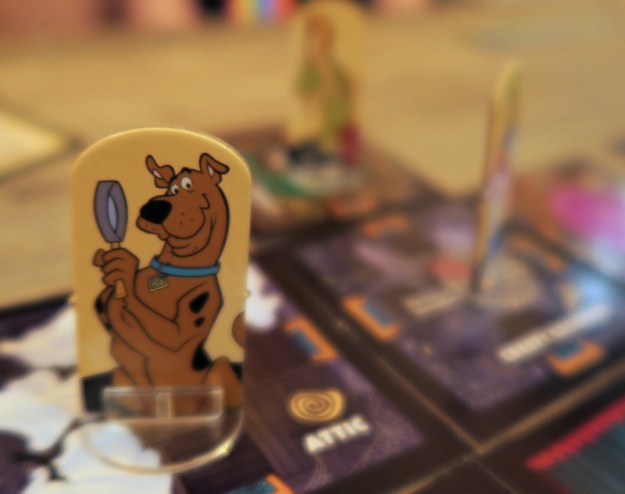
Betrayal at Mystery Mansion
– Image by boardGOATS

Jade, as the group leader, took the role of Fred, while Pink and Pine enthusiastically engaged in the game as Scooby Doo and Shaggy.  That left Sapphire to choose from Velma or Daphne and he went for brains over bimbette.  The group spent quite a bit of time exploring the mansion collecting clues and the like, before the haunt finally started.  As Sapphire was the one to trigger the haunt, Velma was “temporarily lost in the woods” as he took on the roles of the bad guys, a Spectre and a female character called Sharon who was being possessed and controlled by the Spectre.  As the game progressed, it became apparent that the Spectre was her great uncle who was trying to control her to gain access to documents that would enable him to take control of the family fortune.
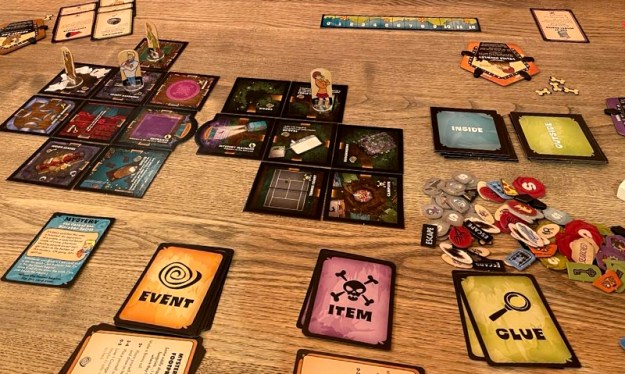
Betrayal at Mystery Mansion
– Image by boardGOATS

The Scooby Gang (minus Scrappy Doo, Daphne and the now lost Velma) had to track down and battle the Spectre and try break the spell controlling Sharon.  As the villain, Sapphire rolled very well and it was very hard for the Gang to pin him down.  Fred ended up stunned at one point, but thankfully revived after missing a turn.  Shaggy scoffed piles of Scooby Snacks in order to re-roll, but the dice weren’t with him.  Scooby himself, however, did very well and survived his battle with the Spectre then was able to recharge in one of the special rooms of the mansion.  In the end the Mystery Inc. won the day and the great uncle was unmasked and announced that he “would’ve gotten away with it if it weren’t for you pesky kids”!
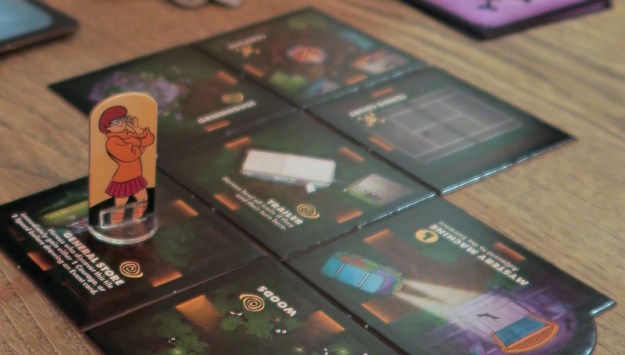
Betrayal at Mystery Mansion
– Image by boardGOATS

Meanwhile, there were two other games underway on the neighbouring tables.  Blue, Plum and Byzantium eschewed Witch’s Brew (which plays better with more people) and opted for the slightly bigger, beefier, boardgame version of the same game, Broom Service.  Both games rely on the players having a personal deck of Character cards and a lead and follow mechanism.  Each player starts by choosing a set number of Characters from their deck, each with different actions.  The first player then chooses one to lead with and announces that they are either “Brave” or “Cowardly”.  If they choose Cowardly, they can take the action straight away, whereas, if they choose Brave, they must wait until everyone has played to see if they can take the more powerful action.
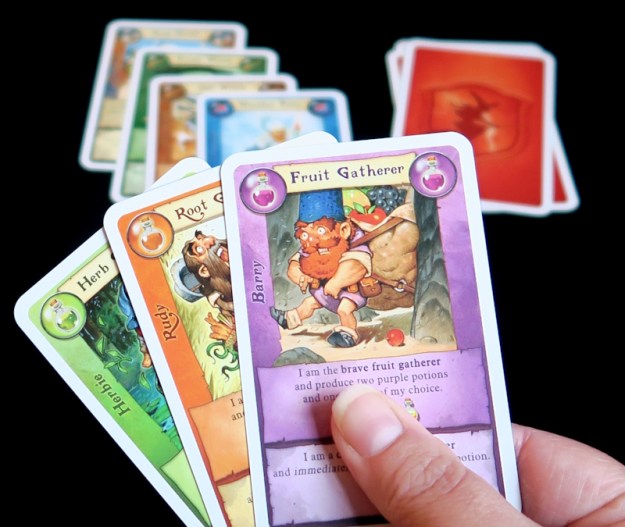
Broom Service
– Image by boardGOATS

The next player must follow if they have the card in hand, and has the same decision to make—be a Coward and take the weaker action, or be Brave, and risk being gazumped by a later player, as there can only be one Brave player taking the powerful action.  The Brave player (or the most recent Brave player) then leads with another card.  In the card game, Witch’s Brew, players are collecting tokens to give them points, however, in Broom Service, there is an additional “Travelling Salesman” pick-up and deliver type of mechanism.  Players have two Witch-meeples which travel the land collecting potions and delivering them locations to get points.  This time, it was a really, really close game, despite everyone doing different things.

Broom Service
– Image by boardGOATS

Byzantium prioritised collecting Lightening Bolts and Blue concentrated on collecting potions and delivering them.  While they both headed south and contrived to get in each-other’s way, Plum headed north and fell foul of one of the events which left her stuck with no good move in the final round.  Blue kept forgetting about the “Bewitched Roles” which can be used but with a hefty three point penalty and lost six points as a result.  Byzantium assumed he would be the only one to consciously choose to take the hit and thus guarantee he could be Brave, but happened to do that exactly when Blue picked them as well and lost the advantage when he led with those roles.

Broom Service
– Image by boardGOATS

As the game came to a close, it was clear it was going to be close with Blue ahead by a single point with sixty points scored during the game.  She lots of resources left while Byzantium had none but lots of Lightening Bolts, and Plum had some of both.  Initially, Blue and Byzantium tied with seventy-three, just two points ahead of Plum.  That gave Blue victory with the tie break (the most left over resources), but that was only until the miss-count was spotted and Blue lost one point and with it her Winning Witch Medal, instead taking second place by a single point.

Broom Service
– Image by boardGOATS

While the first two tables were playing spooky-themed games, Black and Purple led Teal and Cobalt in the monster-mad Finstere Flure (aka Fearsome Floors).  This is a game where players are trying to escape from Fürst Fieso before the castle collapses and without getting eaten.  The idea is very simple: first players move all their pieces the number of spaces shown on their visible side, then the Monster moves.  The Monster moves according to a stack of tiles, either moving a set number or moving until he eats.  The Monster moves one step forwards then looks straight ahead, left and then right. If he sees a player, he turns and moves towards them.

Finstere Flure
– Image by boardGOATS

Thus, the Monster looks, moves, looks, moves until he either runs out of spaces to move, or eats someone.  The game ends after fifteen rounds.  It is simple enough, but there are a few little elements that add to the fun.  Firstly, each player piece moves a total of seven spaces over two turns, but while some alternate three and four space moves, others are more variable, with the most extreme moving six spaces and then one space on the next turn; these different pieces require different tactics.  Players can’t land on another player, if they walk into a rock they push it and if you step in a pool of blood, they slide across it.
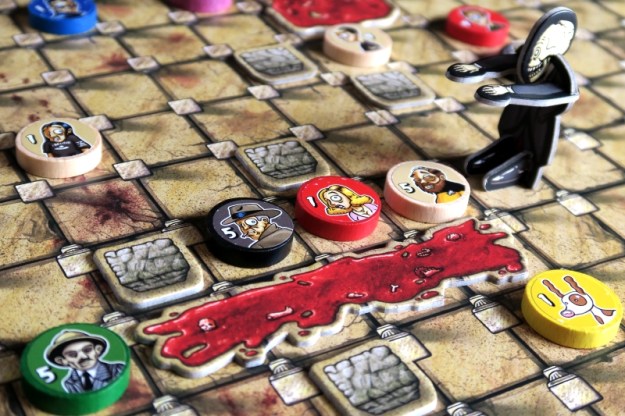
Finstere Flure
– Image by boardGOATS

Finally, if the Monster walks into a wall he appears elsewhere on the board adding a further layer of unpredictability.  The game opened with a bang when the first Monster tile revealed was a “Two Kill”, that is to say, the monster keeps moving until he’s eaten twice.  From there, it was carnage.  Everyone had someone eaten, with some multiple times.  There were people who managed to escape from Fürst Fieso, though it wasn’t easy of course.  Everyone managed to get at least one piece out of the castle, with Purple and Cobalt managing to get two pieces out.  The winner, however, was Black who liberated three of his people.

Finstere Flure
– Image by boardGOATS

They were the first to finish, so moved on to play the recent release, Ticket to Ride: Ghost Train.  This is really just a variant of First Journey, a simpler version of the group favourite, Ticket to Ride, aimed at children and non-gamers with super-sized pieces.  Like the original game, players take it in turns to either take “two parade float” cards (in this case blind), or pay cards to place trains on the map.  However, instead of scoring points for placing trains, the game is essentially a race game.  Players start with three Tickets and every time they complete one, they draw a replacement.  The winner is the player who completes the most Tickets.
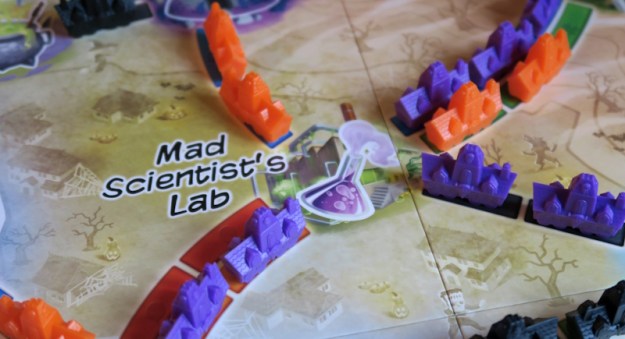
Ticket to Ride: Ghost Train
– Image by boardGOATS

This time, Teal took an early night, but Black, Purple and Cobalt went at it with spooky enthusiasm.  As a different take on the original, they found this a very enjoyable alternative.  As well as Tickets, players can also win “Trick or Treat” bonuses for connecting the Dark Forest region to the Seashore region.  Black and Purple both took a “Trick or Treat” bonus, but the winner was Cobalt who finished with six Tickets, one more than Purple who would have taken another if she’d had just a little more time.  That wasn’t the only Ticket to Ride game of the night however, as the Scooby Gang played a quick game of Ticket to Ride: Berlin once they had solved their mystery.

Ticket to Ride: Ghost Train
– Image by boardGOATS

Ticket to Ride: Berlin is one of the mini versions, and there was a little chat about these and which ones people had played.  The first mini version was a “demo” game the publisher used to introduce people to the game at conventions.  Since then, there have been a series of City versions, with New York, London, Amsterdam and San Francisco all featuring and Berlin being the most recent (with Paris to come next year).  These all feature the same basic mechanism as the original game (including the scoring of points for placing trains unlike the First Journey type games), but they have fewer train pieces and a smaller map.  The Berlin map, is long and thin, but the big difference is that players have mixture of Trams and U-Bahn pieces.
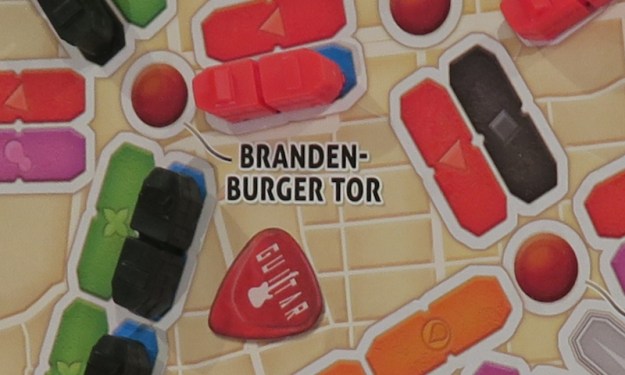
Ticket to Ride: Berlin
– Image by boardGOATS

Tram and U-Bahn routes are paid for in similar ways, though only one U-Bahn piece is needed to mark them and they score slightly more points.  Once the differences had been highlighted by Pine and Pink (who played this together a few weeks back), everyone got down to business.  Jade and Sapphire dominated the West while Pink and Pine concentrated on the East, though the geography of the map meant everyone had to include East-West connections in their network.  It was a hard-faught close game with both Jade and Sapphire taking negative points due to incomplete Tickets.  Pine completed five Tickets and Pink finished six.
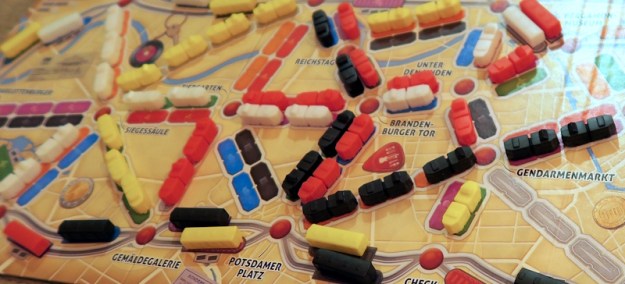
Ticket to Ride: Berlin
– Image by boardGOATS

Pine’s Tickets were more lucrative, however, and he took victory with sixty-one points, while Jade with forty-nine just pipped Pink by two points in the struggle for second place.  Everyone had enjoyed the game, and Jade commented that it was one of his favourite renditions of Ticket to Ride so far—indeed, the addition of a second set of transport seems to have been much more successful in this mini version than it was in the full-sized Rail & Sails where it made it longer and more fiddly without making it significantly better.  While everyone else was playing and then discussing the merits of different versions of Ticket to Ride, the Crafty Trio, Plum, Blue and Byzantium had finished Broom Service and squeezed in a quick game of Dinosaur Drafting with Draftosaurus.
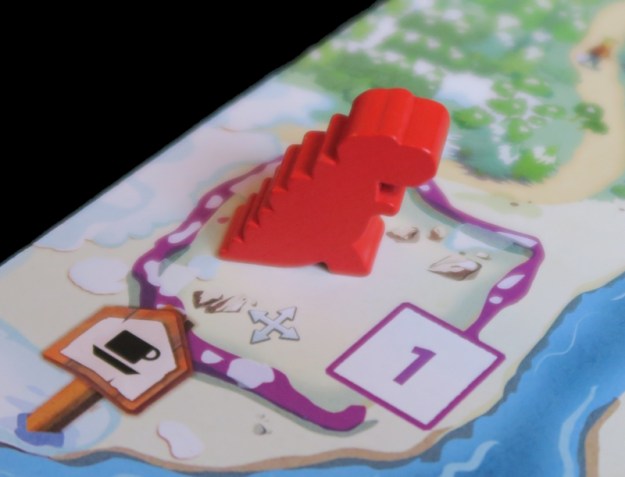
Draftosaurus
– Image by boardGOATS

This is a fun little game that we play quite a bit, where players choose one Dinosaur from a handful, add it to their Park and then pass the rest on.  Dino-placement is slightly restricted by the roll of a die, with everyone getting points for how they occupy their pens.  Usually, the group plays with the Summer board, but with the cold weather, the group decided to play with the alternate, Winter board which introduces new and different pens.  These include the Well-Ordered Wood (Dinosaur types must alternate); Lovers’ Bridge (giving six points for each pair of Dinosaurs separated by the bridge); the Lookout (contains one Dinosaur and scores two points for each one of that type in their right neighbour’s pen).
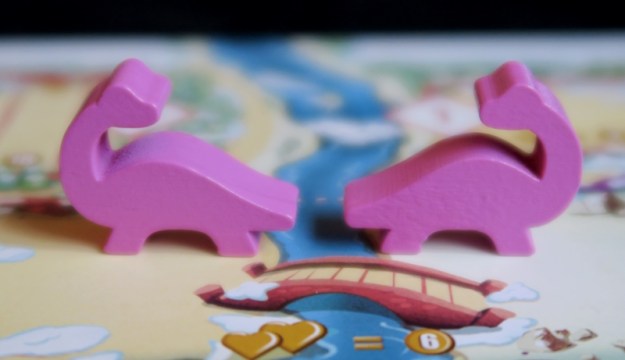
Draftosaurus
– Image by boardGOATS

The most challenging, however is the Pyramid, which holds up to six Dinosaurs in a layered structure, but dinosaurs of the same species may not be placed adjacent to each other (horizontally or vertically).  Blue got into a mess with this, and was stuck with a Dinosaur she could not place at the end as a result.  Plum and Byzantium did slightly better and were able to capitalise more on the Quarantine Zone, which allows players to move the single occupant at the end of the game.  In the end, it was a tight game (though not as tight as Broom Service), in which Plum ran out the victor, three points ahead of Byzantium.
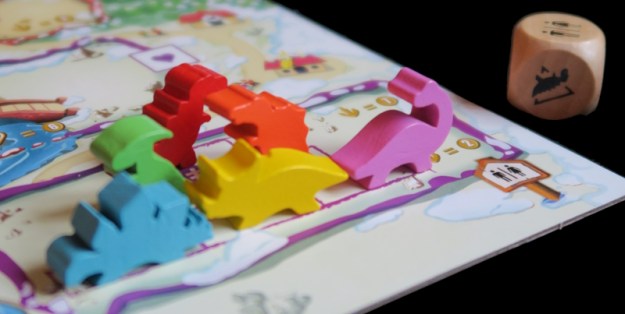
Draftosaurus
– Image by boardGOATS

Learning outcome: They’d have got away with it if it weren’t for those pesky kids!

Boardgames in the News: 20 Years of Alea

Latin for “dice”, Alea is a brand of Euro games that celebrates their twentieth anniversary this year.  Alea is owned by Ravensburger, a company that has been around for nearly a hundred and fifty years producing everything from instruction manuals to children’s books under their familiar Blue Triangle trademark.  Alea is a more recent development intended to develop a range of strategy games distinct from their more family-friendly range.  Dating from 1999, the Alea range is credited with bringing a lot of “modern classics” to our tables, including Puerto Rico, Ra, Taj Mahal, San Juan, The Castles of Burgundy, Broom Service and one of our groups all time favourites, Las Vegas.  There are four series in the range, the “Big”, “Medium”, “Small” and “very Small” box games, each game in the series is numbered with the artwork on the covers designed to have a “book-shelf” look.

Alea Big Box Games
– Portmanteau image created by boardGOATS

It looked like the end was nigh when Asmodee bought Heidelberger Spieleverlag in 2017, and with it the distribution rights to the Alea brand.  However, Ravensburger reclaimed the rights last year, so to celebrate that and Alea’s twentieth anniversary, they are relaunching the line with new graphics.  They are starting with a new version of The Castles of Burgundy, a boxed set including all the current expansions, and Las Vegas Royale, a big-box version of Las Vegas, including selected elements from the Boulevard Expansion and some new action tiles.  It remains to be seen how many of the old familiar titles will also get a face-lift and make an appearance in the new line and how many new exciting titles will be introduced.

The Complete Original Alea Range
No. Big Box Medium Box Small Box
1 Ra (1999) Louis XIV (2005) Wyatt Earp (2001)
2 Chinatown (1999) Palazzo (2005) Royal Turf (2001)
3 Taj Mahal (2000) Augsburg 1520 (2006) Die Sieben Weisen (2002)
4 The Princes of Florence (2000) Witch’s Brew (2008) Edel, Stein & Reich (2003)
5 Hoity Toity (2000) Alea Iacta Est (2009) San Juan (2004)
6 The Traders of Genoa (2001) Glen More (2010)
7 Puerto Rico (2002) Artus (2011)
8 Mammoth Hunters (2003) Las Vegas (2012) &
Las Vegas Boulevard (2014)
9 Fifth Avenue (2004) Saint Malo (2012)
10 Rum & Pirates (2006) La Isla (2014) V. Small Box
11 Notre Dame (2007) San Juan (2014) The Castles of Burgundy:
The Card Game
(2016)
12 In the Year of the Dragon (2007) Broom Service:
The Card Game
(2016)
13 Macao (2009) Las Vegas:
The Card Game
(2016)
14 The Castles of Burgundy (2011) The Castles of Burgundy:
The Dice Game
(2017)
15 Bora Bora (2013) Puerto Rico:
Das Kartenspiel
(2018)
16 Puerto Rico with Expansions (2014)
17 Broom Service (2015)
18 Carpe Diem (2018)


29th December 2015

The pub was very busy, and with one chef down with the lurgy (which had got four of us as well), food was delayed. So, unusually, we started off with a quick game. Expecting more people, we decided to play something short, and opted for Qwixx. This game was designed by Steffen Bendorf who also designed The Game (which has been popular with the group this year) and was nominated for Spiel des Jahres in 2013. So, it has a good pedigree, however, when it was nominated there were a lot of comments about its suitability and eventually, it was beaten by Hanabi, which most people agreed was a better game. We finally got the chance to give it a go in October and generally felt that although the rules made for a promising sounding filler, the resulting game was disappointing. Given how some people continue rave about it though, we’d were keen to give it another try and see if we’d been mistaken.

Qwixx
– Image used with permission of BGG contributor punkin312

Qwixx is a very simple game: each player has a score card displaying the numbers two to twelve in the four different colours, red and yellow ascending and blue and green ascending.  On their turn, the active player rolls six dice, two white, and one of each of the colours, red, blue, green and yellow.  Every player may cross out the number corresponding to the sum of the white dice. The active player may then also cross out a coloured number corresponding to the sum of one white die and one matching coloured die. If the active player cannot or chooses not to cross off a number, then they must tick a penalty box, which costs them five points at the end of the game. The snag is that although numbers can be skipped, they must be crossed off in order, red and yellow ascending, blue and green descending.

Qwixx
– Image by boardGOATS

Points are scored for the number of each colour crossed out and penalties subtracted; the game ends when one player has picked up four penalties, or players have crossed off the last number for two colours locking them for everyone. Scarlet, an experienced local gamer who is usually unavailable on Tuesday evenings, commented that it was a bit like Yahtzee, but with slightly more decisions to make. This didn’t further endear the game to Blue, who has bad memories of playing Yahtzee as a child. Scarlet did manage to demonstrate a modicum of strategy when he chose to cross off a sixth red number rather than his first green number since that would give more points at the end. His discovery clearly gave him a bit of an edge as he took second place, eight behind Burgundy who won with eighty.  We had a bit of discussion about what strategy there was, but it was not really enough to rescue the game in anyone’s eyes and it now faces donation to a worthy cause.

Qwixx
– Image used with permission of BGG contributor punkin312

Meanwhile, Grey and Cerise had arrived and seeing everyone else engaged decided to play a quick game of Hey, That’s My Fish!. This is a cute little abstract with a penguin theme, and, in common with games like Carcassonne, although it plays more, in many ways, it is at its best as a two player game when it is most vicious. The game is played on a grid of hexagonal tiles, with each player starting with four penguin figurines which players take it in turns to move in straight lines across the tiles. When a penguin is moved, the active player gets the tile it was sitting on, leaving a gap that cannot be crossed. Thus, the ice flow progressively melts away trapping the penguins in increasingly smaller spaces.

Hey, That's My Fish!
– Image used with permission of BGG contributor aleacarv

A number of fish is depicted on each tile, and the player with the most fish at the end of the game, i.e. when there are no more valid moves, is the winner. This is just the sort of game that Grey likes, deliciously savage with plenty of opportunity to go for the jugular and for a while he had Cerise under the cosh. Her delight at the end was obvious though when the final reckoning put her four fish clear.  With food imminent for those who hadn’t yet eaten, and Green expected, we decided to split the group and start the “Feature Game”, Broom Service.  This game uses the role selection mechanic from Witch’s Brew (a game we played a few weeks ago), but adds much more with a board and a delivery mechanic.  Witch’s Brew was nominated for the Spiel des Jahres in 2008, but was beaten by Keltis (a boardgame equivalent of the popular two player card game Lost Cities), but its reincarnation, Broom Service, won the Kennerspiel des Jahres this year.

Broom Service
– Image used with permission of BGG contributor punkin312

Like Witch’s Brew, players start with a hand of character cards from which they simultaneously choose a subset in secret. The start player then chooses a card and announces they are that character declaring they are either “brave” or “cowardly”. The other players then must follow suit if they hold that card. If a player is cowardly they take a lesser reward immediately, but if they are brave, they must wait until the end of the round to see if they get a reward. Once everyone has declared their position, the last brave player takes a greater prize and anyone who was brave earlier in the round gets nothing.  The character cards come in three types, Gatherers (who provide ingredients), Witches (who allow players to travel to an adjacent region) and Druids (who deliver potions to the towers). There is also the Weather Fairy who charms away clouds using magic wands.

Broom Service
– Image used with permission of BGG contributor punkin312

The rules are modified by event cards that are revealed at the start of the round, and with less than five players, the game is also made tighter by the inclusion of “bewitched” roles (cue Burgundy and Pink demonstrating how to wiggle-twitch their noses like Tabitha). The game is considerably more complex than the cute theme and artwork imply. Compared with Witch’s Brew, there are also a number of small rules that it is difficult to remember at the start, though they are in keeping with the theme.  The game ends after eight rounds, and, although points are awarded for delivering potions during the game, there are extra points for weather clouds and sets of potions collected.

Broom Service
– Image used with permission of BGG contributor punkin312

Grey quickly got his nose in front delivering potions early, but Scarlet and and Cerise followed suit and kept the points difference down. It didn’t last however, and before long, Grey had moved his witches away from everyone else’s into the south-east corner of the board where he was able to score heavily without competition.  Despite Cerise’s best efforts with the Weather Fairy and Scarlet’s set collecting, Grey had an unassailable lead and finished nearly thirty points clear with ninety-three points. Second place was much closer, however, Scarlet taking it by just two points from Cerise.

Broom Service
– Image used with permission of BGG contributor punkin312

Meanwhile, once the matter of food had been dealt with, Blue, Pink and Burgundy were debating what to play. It had been narrowed down to Snow Tails or Snowdonia (with Pink requesting an expansion to add interest), when Green appeared, newly arrived from visiting relations over Christmas. He was keen to play Snowdonia, so that sealed the deal, with the Jungfraubahn expansion added as a sweetener.

Snowdonia
– Image by BGG contributor duchamp

The base game is not that complex and we’ve played it a few times, however, it is one of those games that somehow everyone struggles to remember how it works. With both Burgundy and Blue suffering with Seasonal Lurgy, adding the expansion was always going to make things more complicated too.  The idea is that players take it in turns to place their workers in the seven possible actions, which are then activated in order. These actions include, visiting the stockyard; converting iron ore into iron bars; digging to remove rubble from the track-bed; laying track; building part of a station; taking contract cards; and surveying the route.

Snowdonia
– Image used with permission of BGG contributor aleacarv

There are two twists: the weather and the game. The stockyard is refilled from a bag, and there are small number of white cubes in the bag which, when drawn cause the game to play itself. This mechanism came about because the designer dislikes players who hoard resources, so in this game, if people don’t keep things moving, the likelihood of white cubes coming out increases and the game moves along on its own. The other interesting mechanism is the weather which increases and decreases the digging and track laying rate making players’ timing key.

Snowdonia
– Image used with permission of BGG contributor winterplum

Green, Pink, Blue and Burgundy were still setting out the game and trying to work out what modifications the Jungfraubahn expansion made, when Broom Service finished, so Grey, Cerise and Scarlet played a quick game of Cosmic Encounter. This is a game they were all familiar with, though we’ve not played it on a Tuesday night before.  The game is reasonably straight forward, with each player leading an alien race trying to establish colonies on other players’ planets with the winner the first player to have five colonies on planets outside their home system.

Cosmic Encounter
– Image by BGG contributor RRunner

On their turn, The active player becomes “The Offense”. The Offense encounters another player on a planet by moving a group of his or her ships through the hyperspace gate to that planet. They draw cards from the destiny deck which contains colors, wilds and specials. The Offense then takes the hyperspace gate and points at one planet in the system indicated by the drawn destiny card. The Offense and The Defense both commit ships to the encounter and both sides are able to invite allies, play an encounter card as well as special cards to try and tip the encounter in their favour.  The game was close with lots of too-ing and fro-ing, but Cerise was the one to finally successfully establish five colonies, with Grey and Scarlet finishing with four and three colonies respectively.

Cosmic Encounter
– Image used with permission of BGG contributor kilroy_locke

By this time, the other group had finally sussed out what they were doing and had got under way with Snowdonia.  The Jungfraubahn expansion changes the game quite considerably replacing fog with snow which adds rubble to the track that must be cleared again before track can be built.  It also introduces dynamite which can be used to remove large amounts of rubble as well as being used to initially clear a route through the mountains before the track-bed is prepared. Added to these, the new contract cards, seemed to introduce even more bad weather than “north-wet” Wales!

Snowdonia
– Image used with permission of BGG contributor winterplum

Blue and Burgundy were both a bit slow off the mark and struggled to really get going. In contrast, Green quickly picked up an engine and Pink got a couple of valuable contract cards. With Grey and Cerise leaving, Scarlet was left as an interested spectator. Eventually, Blue and Burgundy got going, but it was a bit of a rear-guard action.  With the expansion, the game was taking slightly longer than expected, so Green, decided to take the opportunity to play Scarlet as a substitute and went home leaving the rest to finish the game without him. He had set out his plan and Scarlet did an excellent job executing it, however, Pink just had the edge.

Snowdonia
– Image used with permission of BGG contributor ansi

Green/Scarlet took a massive seventy-nine points in bonuses and with twenty-nine points for station building together with the maximum for his surveyor, they finished with one hundred and twenty-two.  The break down for Pink was nearly completely reversed with him taking seventy-eight points for station building and nearly sixty more in bonuses, giving a total of one hundred and thirty-eight, and the game.

Snowdonia
– Image used with permission of BGG contributor winterplum

Learning outcome: Lurgy does not improve gaming ability.

3rd Movember 2015

Like last time, we started out messing about with the dexterity game, Bellz!.  With Blue, Magenta and Burgundy all familiar with it, it was a very tight game.  As the only person who hadn’t played it before, it took Red a couple of turns to get the hang of it before she developed a devastating new technique and came storming from the back to snaffle first place.  Next time there might be a new house rule…

Bellz!
– Image used with permission of BGG contributor W01FVF

Despite the original prognosis of an hour’s wait for food, the pub kindly rushed us through so while we munched we played a quick game of Turf Horse Racing on a very lumpy course.  It was a while since we last played it, so Green reminded us of the rules.  The idea is very simple, players have three counters to use for betting, two small and one large, double weight one.  In the first stage, players take it in turns to use these counters to bet on horses.  In the second stage, players take it in turns to roll the die and move a horse to determine the outcome of the race.  The game works because the die has three horses heads with one of each of the other icons, and each horse moves a different amount depending on what is rolled.  Since each horse has to move before a horse can be moved again, players can choose to make a positive move for one of their own horses, or nobble someone elses.

Turf Horse Racing
– Image used with permission of BGG contributor franchi

Silver Blaze had a fantastic start so for the next few rounds, but from then on, his progress was slowed by everyone who hadn’t bet on him.  Once the rest of the field had caught him up, the pack stayed together for the rest of the race until Roamin’ Emperor finally broke free with the finishing line in sight.  Then suddenly, Magenta played king-maker giving Red Baron a sudden spurt to win bringing the game to an abrupt finish with Roamin’ Emperor coming in second and Mosstown Boy third, bringing home the rest of the field.  Although Magenta had an investment in Mosstown Boy, Burgundy was the real winner as he had his double bet on the green horse and he finishing ahead of Magenta by several lengths.

Turf Horse Racing
– Image used with permission of BGG contributor franchi

With the arrival of a new player during the game, that gave us six, so we decided to play our the  Halloween-inspired “Feature Game”, Witch’s Brew.  This is a role selection card game with aspects of set collecting and bluffing that has recently been reimplemented as this year’s Kennerspiel des Jahres, Broom Service.  Each player begins each round with a deck of twelve character cards from which they choose five.  The start player then selects a card and places it on the table and declares they are that character by saying, for example, “I am the witch”.  The next player examines their hand of five chosen cards, and if they don’t have the same card, they pass.

Witch's Brew
– Image used with permission of BGG reviewer EndersGame

Play continues until there is a player who is holding the current character card, in which case they then have a choice.  They can object and declare that they are the character instead, saying, for example, “No, I am the Witch”.  In this case, they replace the first player as “the Witch” – the player who is the Witch at the end of the round gets the richest pickings and starts the next round, while everyone else gets nothing.  Alternatively, they can take the “cowardly” option and acquiesce, instead saying “so be it”.  In this case, they immediately take a lesser reward.  Although the decision is a simple binary one, the ramifications are potentially complex and far-reaching, added to which it is a lot of fun to watch player after player declaring their character only to be shouted down by their neighbour.

Witch's Brew
– Image used with permission of BGG reviewer EndersGame

The aim of the game is to collect ingredients for potions and then prepare them.  The more complex the potion, the more it is worth at the end of the game.  Thus, players might use the Snake Hunter to collect snake venom and the Herb Collector to provide them with herb juice which can then be used together to brew a potion in a silver cauldron using the Druid.  Players can also pick up points for potion shelves, but the characters used to claim these (the Cut Purse and the Begging Monk), force all the other players to pay a tithe, which will be used to cover the cost.

Witch's Brew
– Image used with permission of BGG contributor Toynan

Nobody had played it before, but Blue, having read the rules, started out well while everyone else was still working out what to do.  Pine was unlucky just failing to get enough gold/ingredients to pick up potion shelves on several occasions.  Burgundy also struggled to make the game work for him, and when he eventually succeeded in brewing his first potion it felt like a real success.  Working steadily, Blue gradually built up an unassailable lead though Green came from nowhere with his last couple of cards, finishing in second, by just a couple of points.

Colt Express
– Image by boardGOATS

The next game up was Colt Express, newly pimped out with fancy gems, purses and a new large start “poppel” from Essen.  The game itself is quite straight forward, but it usually takes at least  round to see how it works.  The idea is that game play is in two phases:  first players take it in turns to chose which cards they are going to play, then players take it in turns to action the cards they chose in the order they chose them.  Although we’ve played Colt Express quite a bit recently, with Pine new to the game, and the chaotic nature of it, it seemed a little unfair to drop him in the deep end and include the expansion as it adds quite a bit more complexity.  So, after admiring the wooden horses and 3D stagecoach, and discussing the DeLorean mini-expansion, we decided to stick with the base game.

Colt Express
– Image used with permission of BGG contributor sdetavern

The game started out with bullets flying every where and, unusually, mostly finding their targets.  As the game progressed, even the marshal joined in the fun making Ghost (played by Magenta) a real spook for Halloween.  Burgundy (playing Belle) and Red (Cheyenne) started out well with some valuable pickings.  Magenta, starting to look like a piece of Swiss cheese, was seriously hampered by the nine bullet holes she had picked up, and Pine (Doc) was not far behind with seven, though he was giving as well as taking.  Somehow Green (playing Django) who we normally take care to make sure can’t get ahead in games like this, had largely managed to avoid being shot.  This gave him a significant advantage added to which, everyone else  foolishly left him to play his own game.  Before long he was getting away with the strong box (now upgraded to a gold bar) worth $1,000.  This, with the Sharp Shooter Bonus gave him the win, $750 ahead of Blue in second (playing Tuco) who also picked up the bonus for emptying her magazine.

Colt Express
– Image used with permission of BGG contributor punkin312

Magenta and Red were determined that Blue should get an early night to nurse her cold, but she managed to persuade them to one last quick game of one of our current favourites, 6 Nimmt!.  The first round all went according to plan with Burgundy once more picking up more Nimmts than anyone else.  As usual, he did much better in the second round, but couldn’t match Blue and Red who finished in joint first place with a total of just eight each.

6 Nimmt
– Image by boardGOATS

Learning outcome:  Organised chaos is a fun part of lots of different games.

Boardgames in the News: Are Games a Good Investment?

It might seem strange for a courier company to comment on the value of boardgames, however, David Jinks, the Head of Publications at ParcelHero (a UK courier comparison site), has been has been reported to have strong opinions on the subject.  He explains how traditional games can be worth many thousands if the edition is right; they even have a page on their website discussing collectible games.  So why are ParcelHero so interested?  Well, it turns out that buying and selling vintage copies of Monopoly is big business, most of which is done on the internet using sites like eBay (who have several buyers’ guide pages on the subject).  Thus, ParcelHero’s involvement is in shipping these items (though in truth it is probably mostly about publicity as there are a lot of other things that they can deliver too).

Container
– Image used with permission of BGG contributor Zoroastro

Now, there will always be a market for vintage copies of traditional family games, but what about the more modern classics?  Sadly, that early copy of The Settlers of Catan is not worth a lot yet, though of course it might be when the game has been around as long as Monopoly of course.  There are modern games that sell for a small fortune however.  These tend to be games where there is some combination of high demand, small print-run, popular designer and unlikely reprint.  There are a number of games that fall into this category and some are not all that old.  Container was released in 2007 by Valley Games Inc., and is an unusual production and shipping game – those who have played it claim there is nothing similar.  The recent law suit that ensnared the reprint of Up Front means a reprint is unlikely, so copies cannot be easily be obtained for less than £100.

Key Market
– Image used with permission of BGG contributor duartec

Another example, is Key Market, which was designed by David Brain and released at Essen in 2010, however, only nine hundred copies were made and it sold out very quickly.  R&D Games are a small company and have moved on to other things (including one of our favourite games, Keyflower), so it looks unlikely that Key Market will be reprinted in the near future.  This is not the only high value game from the Key Series: a set of the earlier titles Keywood, Keydom and Keytown recently went for £1,800!

Keywood, Keydom & Keytown on eBay
– Image by boardGOATS

It’s not just games from small companies that become rare and demand high prices.  Colosseum was a Days of Wonder game with a wide release, but following an alleged dispute between the designer and publisher, it seems unlikely it will be reprinted.  Witch’s Brew is in a similar boat, though it is the implementation of its central mechanism in the Spiel des Jahres winning Broom Service which is likely to prevent a reprint.  The irony is that Witch’s Brew and Broom Service are quite different even though though the publisher and designer have been saying otherwise, so demand is not likely to drop, quite the opposite.

Witch's Brew
– Image used with permission of BGG reviewer EndersGame

So clearly there is money to be made from boardgames, or at least, from some boardgames.  However, for every game that increases in value there are many that end up nearly worthless.  Worse, timing is everything; there is nothing like the announcement of a reprint to have a sudden impact on the market of a desired game.  So, before a reprint is announced the price climbs steadily as the desired item becomes increasingly rare and people continue to pay the inflated prices as “they are only going to go up”.

Mission: Red Planet
– Image used with permission of BGG contributor kilroy_locke

When a new release is announced, everyone has to take a gamble.  Many potential buyers will wait for the new edition hoping that the price will be lower and the quality will have improved in line with modern expectations.  So, demand suddenly drops and sellers are left with a tricky choice:  reduce the price and hope someone who hasn’t heard the news will bite, or sit tight and wait.  Notably, the recent Fantasy Flight Games announcement of a third edition of Fury of Dracula has led to a sudden flood of copies on the secondary market caused by people hoping to get a sale before the price drops.  Similarly, the secondary market price for Mission: Red Planet plummeted when a second edition was announced. On the other hand, waiting can turn out to be a better option in the event that the new edition is deemed inferior to the original.  This is not as uncommon as one might imagine, as artwork often changes and there are frequently also “improvements” to the rules as well and changes to some components.

Fury of Dracula - Secondary Market
– Image used with permission of BGG contributor tumorous

Sometimes changes are for the better, but it is not uncommon for buyers to prefer the original.  For example, for the second edition of one of our favourite games, Snowdonia, the wooden workers were upgraded to plastic figurines, however, our group find the first edition tokens more tactile.  Sometimes, the publicity surrounding a release of a second edition has the additional effect of reviving a market that had become stagnant due to the lack of availability.  In such cases, the reprint can actually increase the price of an already expensive edition when the new version is thought of as inferior.  Mostly, however, a reprint will cause the price to fall as the difference between editions is something only a connoisseur will really appreciate.

Snowdonia
– Image by boardGOATS

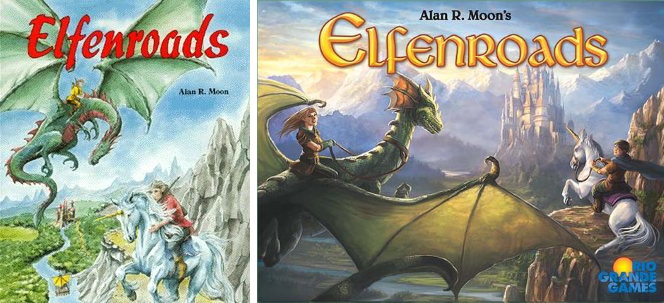
So, where does this leave us?  There are a number of facts that are undoubtedly true.  Firstly, with the exception of the most popular games, almost all modern boardgames are perpetually “between print runs”, with sufficient stock available to supply demand.  For this reason, games can suddenly become unavailable and to some degree the buyer should take the opportunity when they see it, as it may not be there for long.  That said, the best games generally remain in demand and are almost always re-released in some form or another.  The recent announcement by Rio Grande demonstrates that even long out of print classics like the 1992 game Elfenroads, do sometimes eventually get a re-print, albeit in a very different form.

Elfenroads
– Images from the manufacturers

The fact that boardgames are currently a niche market means that mature games are inevitably more likely to go out of print with a corresponding increase in demand.  So, good games ideally with high production values will rarely depreciate by more than 50% if bought for a good price and sold in the right place.  Thus, a gamer with a mature high quality collection who looks their games well, will rarely lose a lot of money if they keep them for long enough, especially if they can chose their time to sell.  Of course, spotting good games at the right price is the challenge, but very occasionally, if they have the correct edition, a gamer might make a killing.

Catan - 3D Collector's Edition
– Image by BGG contributor theotherside

Spiel des Jahres Winners – 2015

The 2015 winner of the coveted German Game of the Year or Spiel des Jahres award is Colt Express which is a game about bandits robbing an amazing 3D train.  The game plays in two phases:  first everyone plays action cards cards onto a common pile and then the action cards are resolved in the order they were played. There were three games nominated for the Spiel des Jahres this year and we’ve played the other two, Machi Koro and The Game, so we’ll play Colt Express next week to see what all the fuss is about!

Colt Express
– Image used with permission of BGG contributor henk.rolleman

At the same time the Kennerspiel des Jahres was awarded, which honours more challenging games.  It was introduced in 2011 to replace the jury’s habit of intermittent special awards for games too complex for the Spiel des Jahres (notably Agricola which was awarded a special “Complex Game” prize in 2008).  The 2015 award went to Broom Service, which is a reimplementation of the 2008 Spiel des Jahres nominated game, Witch’s Brew.  It is a role selection game where players collect potions, then deliver them across the land to towers that advertise their desires with color-coded roofs.  This year we haven’t played this or either of the other nominees (Orléans and Elysium), but it probably won’t be long before we do.

Broom Service
– Image from asaboardgamer.com