Tag Archives: Cascadia

8th October 2024

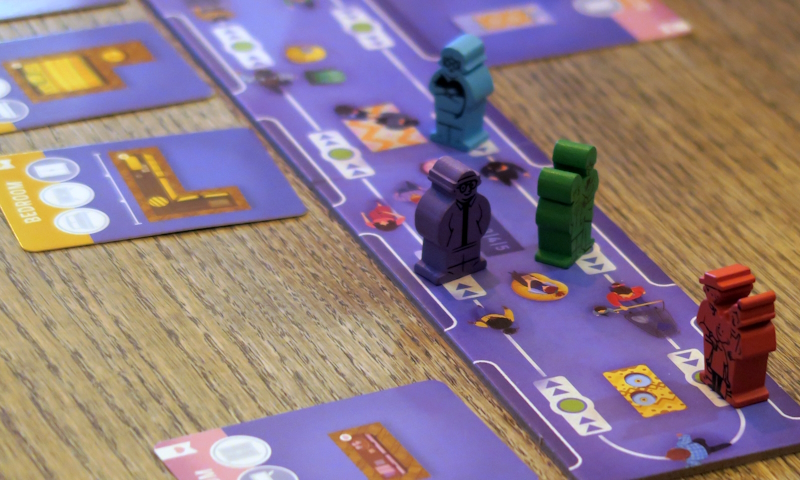
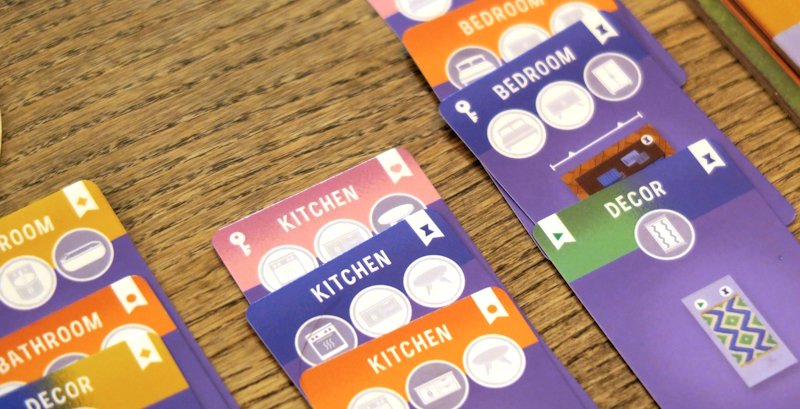
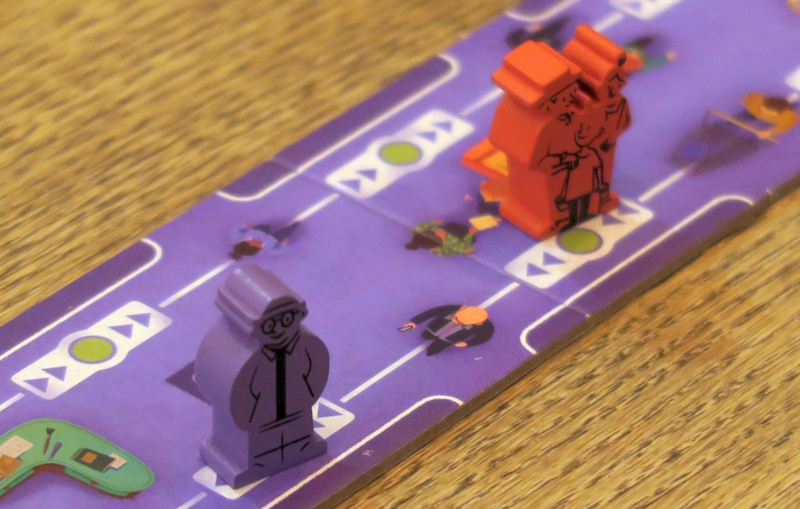
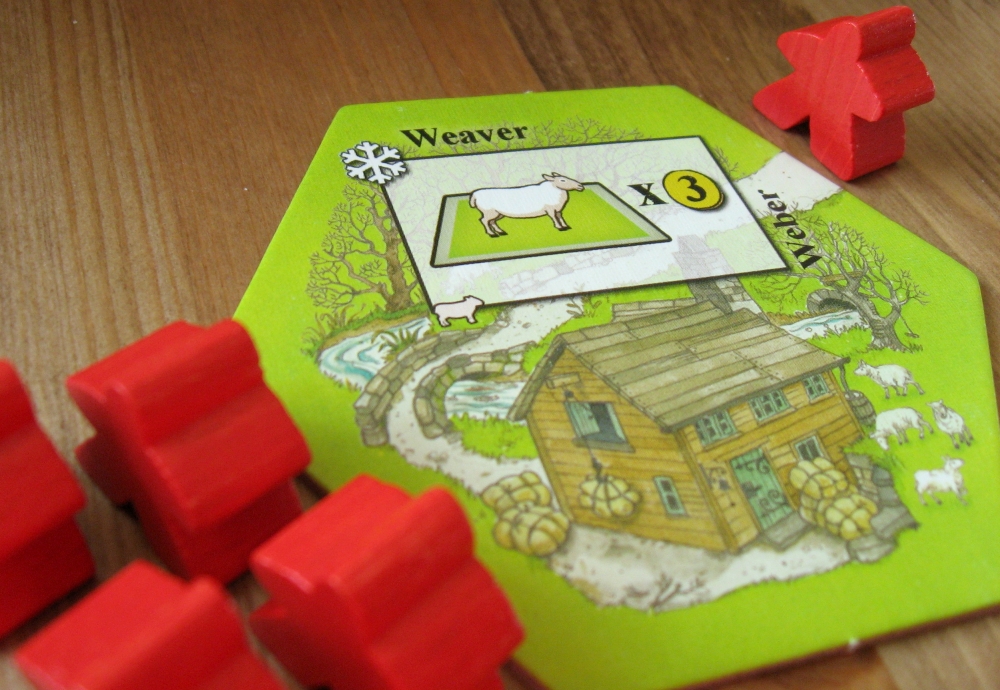
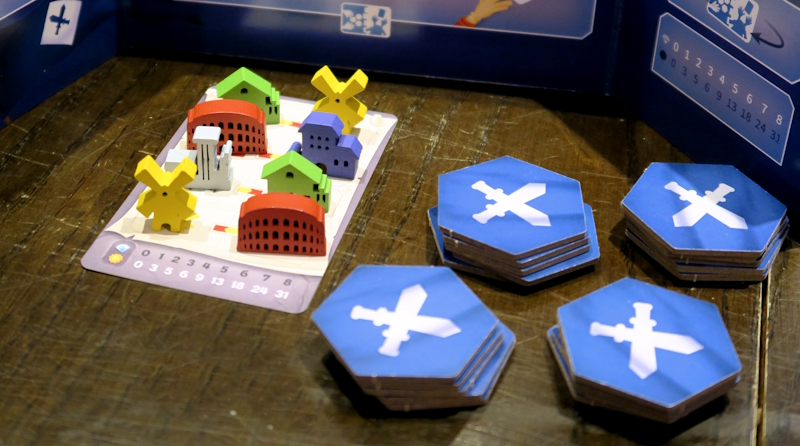
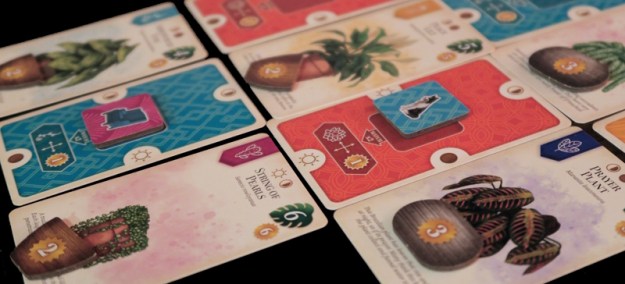
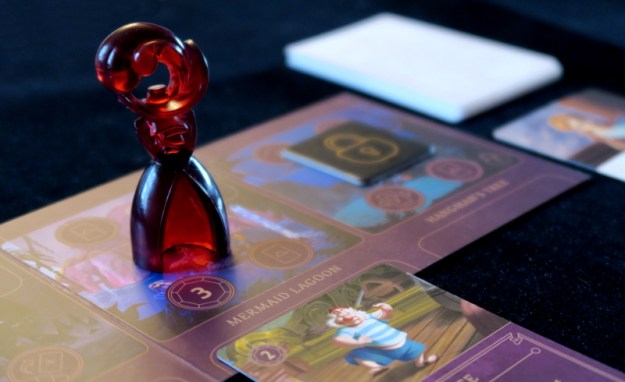
As it was our twelfth birthday party, lots of people arrived early for pizza (or an amazing Mixed Grill in the case of Lime and some lovely veggie curry and fiery chilli for Pine), followed by GOAT cupcakes.  While everyone waited for food, arrivals from Essen were handed out, including Nucleum, Faraway and Flamme Rouge expansions; Let’s Go! To Japan and Cascadia mini expansions, and Die Wandelnden Türme (aka Wandering Towers), Keyflower and Dixit promotional items.   There was a lot of chatter too, about flooding, pot holes, the 34 road closure, full car parks and water leaks, as well as Essen.  Indigo and Navy weren’t eating, so had a play with Villagers while the others entertained themselves.  This is a card game where players “Draft” Villager cards from a market (called the Road) and then add them to their Village.
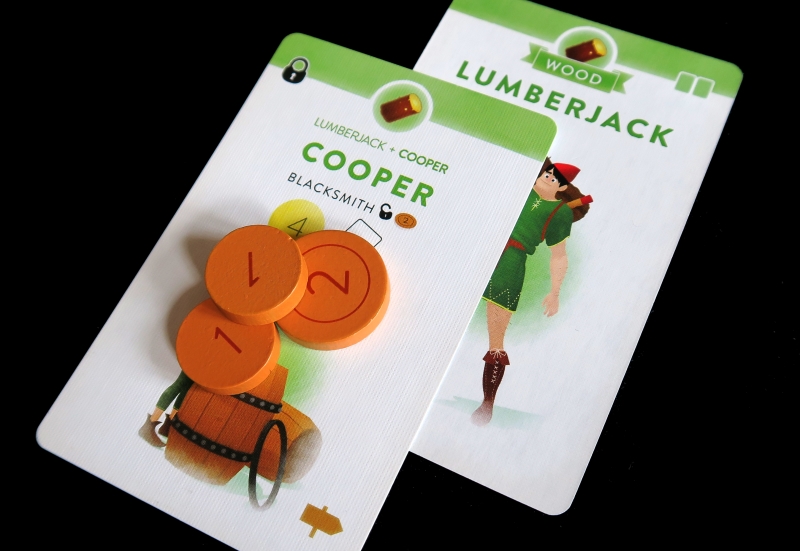
Villagers
– Image by boardGOATS

Some Villagers have prerequisites before they can be “Built”.  These are cards that must exist in the player’s Village before the Villager can be added on top to make a chain, cards that must be unlocked by paying money to other Villagers in their own Village, someone else’s Village or the Bank.  Some cards allow players to draft extra cards, while others enable players to Build extra Villagers and Special Villagers give powerful special actions.  Twice during the game there “Market” Phases when players get income from their cards, and the player with the most money at the end of the game is the winner. Somewhere along the lines, Indigo and Navy had a bit of a rules malfunction, and as everyone else had already started the now traditional birthday “Feature Game“, Crappy Birthday, they abandoned Villagers.
Crappy Birthday
– Image by boardGOATS

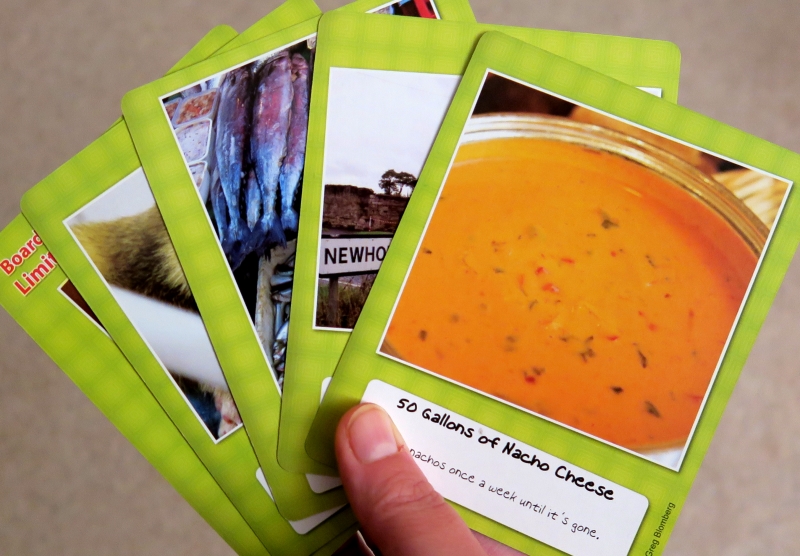
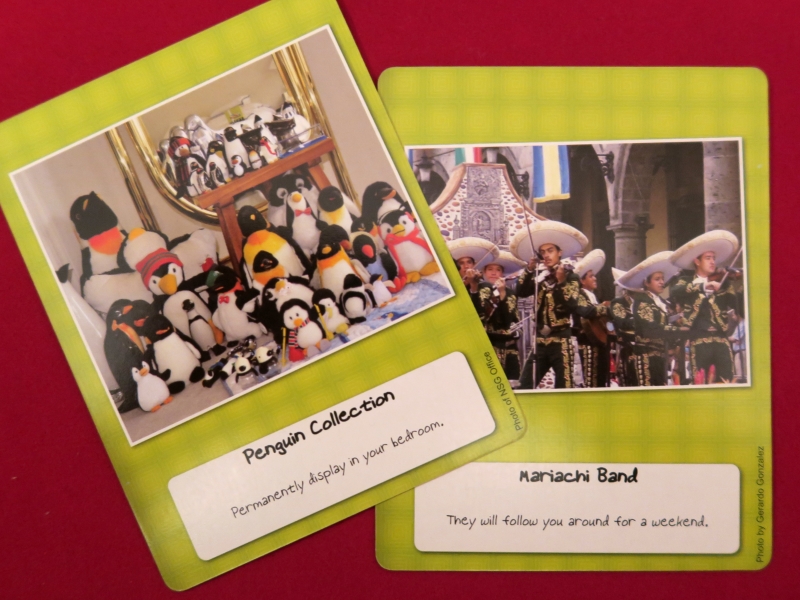
Crappy Birthday is a party game where players give each other comedy birthday presents and the recipient has to decide who gave the best and worst gifts.  We play a slight variant of rules as written, where we play a single year of birthdays with each gamer getting one turn to receive gift cards from everyone else from their hand of five cards.  With lots of players the pile of gifts can get quite substantial and this time everyone was getting thirteen gifts to decide which was the best and which was the worst.  The players who gave these then received a point for knowing the recipient so well and the player with the most points at the end of the year is the winner.
Crappy Birthday
– Image by boardGOATS

One of the reasons this game is so fun is that we learn a bit about each other.  Pink went first as his real birthday was next.  He liked the idea of an Easter Island Mo’ai for the garden (not that Blue was so impressed with the idea), but disliked the idea of cave scuba diving.  Plum chose a haunted castle as her favourite (because she loves castles), but pulled a face at the idea of earlobe stretching rings.  Purple had the matching neck rings, but these weren’t her least favourite gift, that was a giant swing ride, while she loved the idea of a penguin collection.  Byzantium showed his environmental credentials by picking a Global Warming Study as his favourite, while eschewing Jade’s wing suit dive gift.
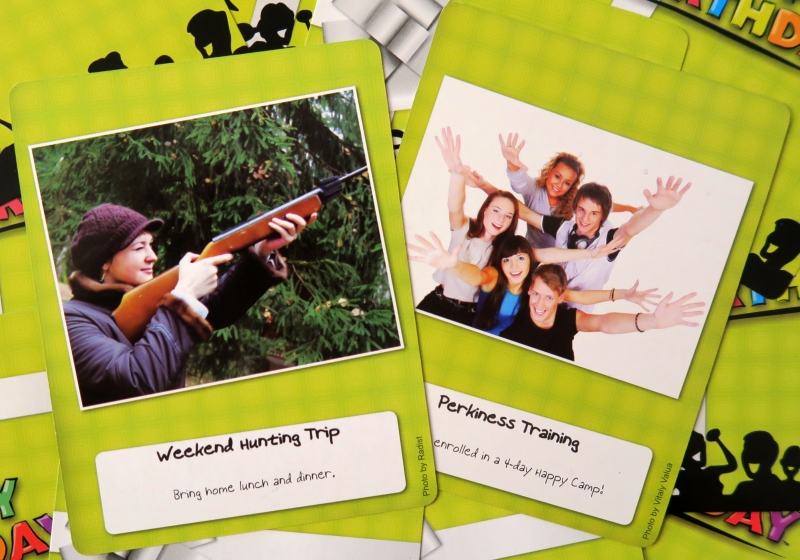
Crappy Birthday
– Image by boardGOATS

Teal felt that trees were quite beautiful enough without being carved, but really liked the idea of a ride-on bike mower.  Jade wasn’t a fan of Cobalt’s offering of Polka lessons, but loved the idea of trip to Mars from Sapphire, while Sapphire felt “perkiness training” wasn’t something he really needed, but the thrill-seeker loved the reciprocal gift from Jade, a roller-coaster ride.  Lime fancied a three day festival trip, but wasn’t keen on a week eating nothing but Spam.  Blue didn’t fancy the creepy baby sculpture to go with the Mo’ai, but fancied Pink’s gift of a Safari (provided she had time to train for the walking element).  Ivory didn’t feel his life would be improved by a free satellite TV dish, but always one to send his meeples into space in Tapestry, grasped the opportunity to join them with a space walk.

Crappy Birthday
– Image by boardGOATS

It turned out that Navy has a problem with bees, so Teal’s gift of a bee keeping which he personally would have loved, didn’t go down well, but much to Pink’s surprise, his gymnastics camp was received really well.  Indigo was quite abrupt in her negative response to the idea of paparazzi following her about, but liked the idea of exploring a volcano while Cobalt didn’t feel he needed his soul to be searched, but fancied flying lessons.  The final birthday of the year was Pine, who didn’t get his usual pile of horses and meat, instead getting the opportunity to run with the bulls, which having known someone who had done it and been gored, wasn’t something he fancied.  Pine’s favourite was Larry the Lobster (not that he has space in his garden for him), one of the Big Things of Australia, that Pink and Blue happened to see on their visit there last year.

Crappy Birthday
– Image by boardGOATS

Lime was the last to break his duck and was very pleased not to end the game without scoring any points, indeed, nobody finished with the dreaded bagel, which was nice.  The runniest of run-away winners was Teal though, with five successful (or unsuccessful) gifts, with Pink and Cobalt joint runners up with three.  It was interesting though, this time there were quite a lot of gifts that people gave “in error” where as Teal commented, he “Gave pressies he thought people would like, but they all hated them!”  With the birthday formalities dealt with, there was time for something relatively short.  First up was Jade who was very keen to give his new Faraway expansion, Le Peuple du Dessous (aka The People Below).
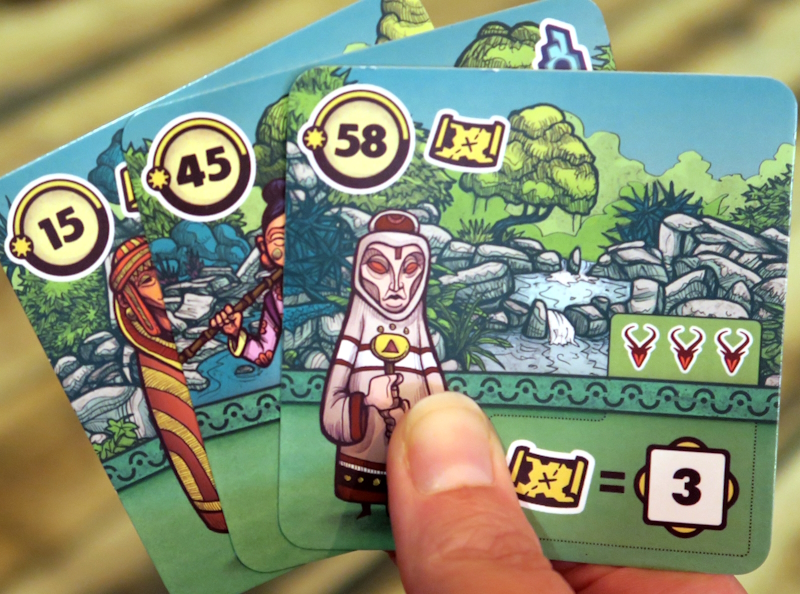
Faraway
– Image by boardGOATS

Faraway is a fairly simple little game, but one that really messes with your head:  players play cards from their hand of three, adding them to a row of cards, left to right, but at the end of they score the eight cards from right to left.  The Peuple du Dessous expansion adds just seventeen cards, but these include the Guides and the Three-Eyed Ones, two new Peoples with more opportunities to score, as well as giving enough cards to play with seven people.  This time there were only five though, with Sapphire, Byzantium, Indigo and Navy joining Jade.  Navy and Indigo were new to the game and, as usual, it took a little bit of getting used to.  That said, the both did really well with Indigo ending up with seventy-seven points, four more than Sapphire in second with Navy taking third, just one point behind.

Faraway
– Image by boardGOATS

Navy and Indigo headed off and took an early night, but the other three had to wait for Plum who’s game on the other side of the room was ongoing.  Faraway is a fun little game though and the expansion adds a little more, so the trio decided to give it another go.  This time, Byzantium was the victor with seventy-three with Sapphire the runner up again.  Meanwhile, Blue, Pink, Pine and Teal, got out Bohnanza.  This is a game that is generally popular with the group, though Teal had somehow only managed to play it the once almost six months ago.  This is a very simple card game, albeit slightly convoluted and very unpromising when explained, but the key is that players must not rearrange the cards in their hand.
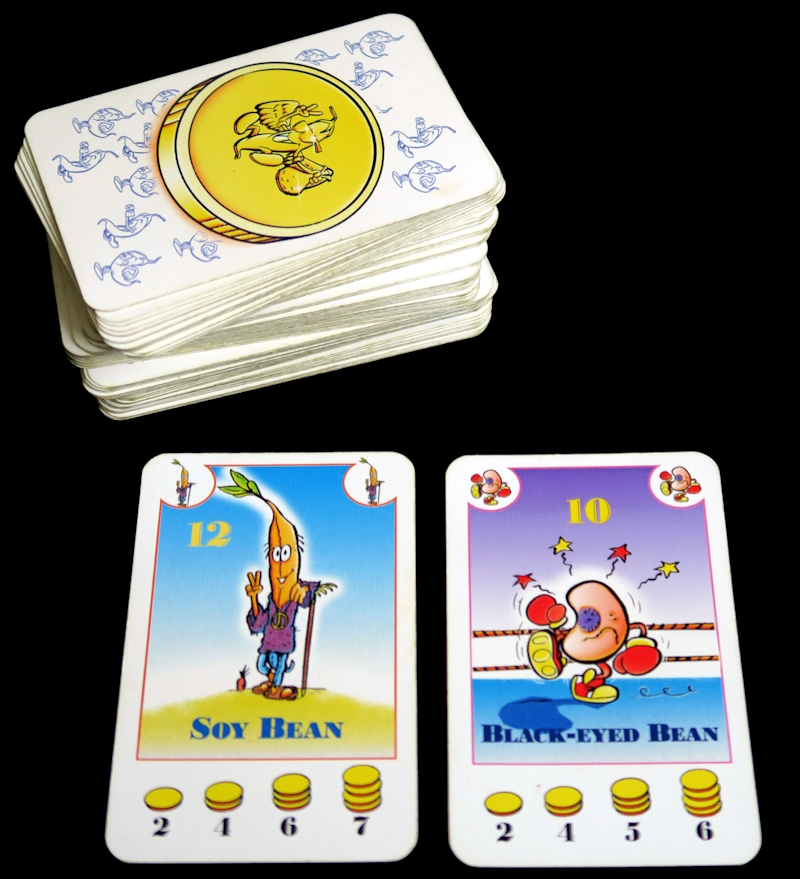
Bohnanza
– Image by boardGOATS

On their turn, players must plant the first card in their hand in one of their two been fields and may plant the second if they choose.  They then turn over two cards from the deck, which must be planted before the player can move on.  Fields can only contain one bean type, but beans can be traded, or even gifted, and it is the trading and negotiation that makes the game such fun.  Once the two cards on the table have been planted, players can trade from their hand, but again all traded cards must be planted.  Players can harvest Fields at any time with some of the bean cards dug up becoming money and larger Fields giving more money and at a better rate.
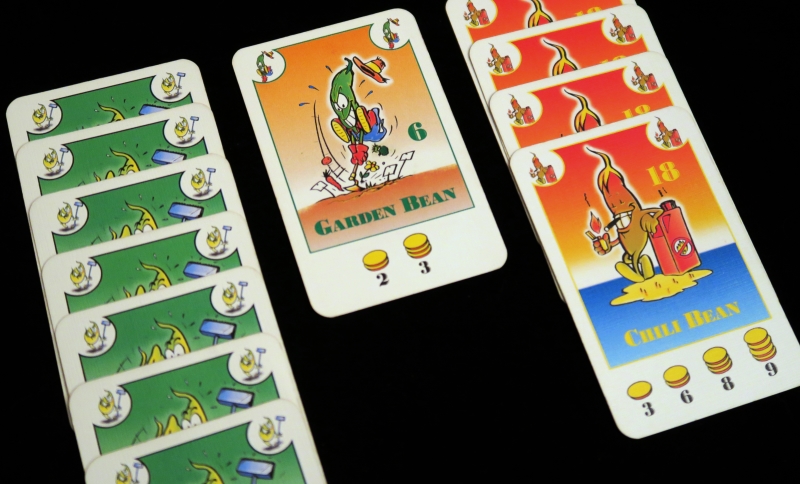
Bohnanza
– Image by boardGOATS

Blue took some high valued Garden Beans and then sold them off to buy a third Bean Field, causing a lot of confusion for Pink who couldn’t believe it when they kept appearing even though there were only six in the deck.  Teal scored well from his Chilli and Wax and Soy beans, while Pine and Blue ended up in competition for Green Beans.  This time with just four, the scores were a little more varied, but Blue was the clear victor with twenty-five Bohn Thaler, five more than Pine who came second.  The final game of the evening was Villagers, which was getting another outing on the other side of the room with Cobalt leading Ivory, Purple and Plum.

Villagers
– Image by boardGOATS

After a reminder of the rules, Purple started and grabbed the Carpenter then Cobalt went next taking the Blacksmith.  Both of these guaranteed their owners an income of coins (and hence points) at the expense of other players paying to use them. However, this did mean that they fell behind on building an engine to Draft and Build more cards (which Plum and Ivory focused on).  From there, the first half of the game went quite quickly with everyone focusing on building their engine. Ivory managed to get a Wine Trader using a Monk as a Graper, as well as playing a Scavenger, enabling him to take slender lead after the first scoring, although the scores were all very close.

Villagers
– Image by boardGOATS

In the second half of the game, Purple and Cobalt were beginning to have to make tough choices, being unable to play as many cards as they would like and not having the building cards they needed, which were also hard to come by. However, they continue gaining coins from all players. Purple had to discard quite a few cards to get starter cards which slowed her down a little, though Plum and Ivory were able to quickly get to the position to Draft and Build the max number of cards allowed; Plum in particular seemed to always have a fist full of cards.  As the game progressed, more people began taking cards that others might want, with Cobalt taking Wool cards that might have been of use to Purple or Ivory.  Ivory, however, was actually more focused on getting a second Vintner, already having a second Wine Trader in hand.

Villagers
– Image by boardGOATS

Towards the end of the game, there was face down Grape card which Ivory debated taking a gamble with, but decided not to take the risk.  Inevitably, when it was flipped over it turned out to be Vintner and Plum grabbed it. Ivory got very lucky during his next draft though, taking a face down Special card that was Monk, which he could then play as Vintner. Elsewhere, Purple played some Wool cards, getting two Weavers, Plum picked up some good end-game scoring cards in the Locksmith and Freemason. Cobalt focused on Solitary cards and Silver end game scoring, doing well from his Priests, Agent and Blacksmith combo. Ivory ended up focusing on the Hay cards, which scored well and that plus the two Wine Traders (and a second Scavenger), gave him a hundred and twenty-six and a two point victory over Cobalt.

2024 Birthday Cupcakes
– Image by boardGOATS

Learning Outcome:  Getting old is not necessarily a bad thing.
20th August 2024

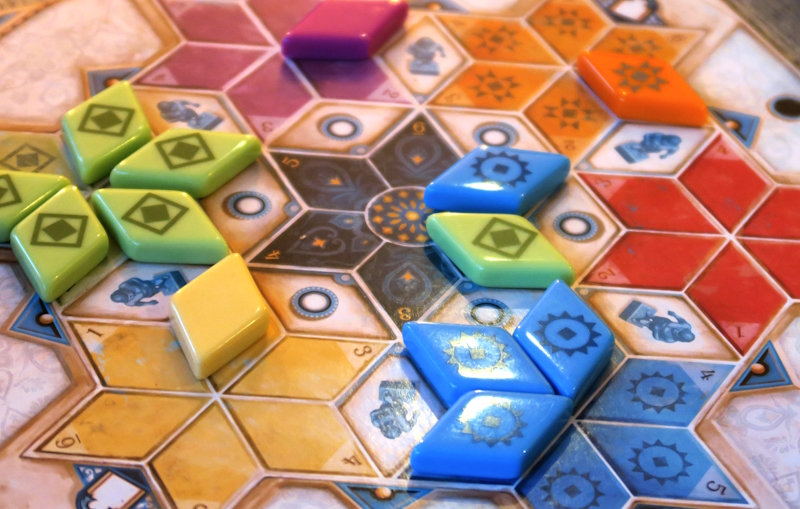
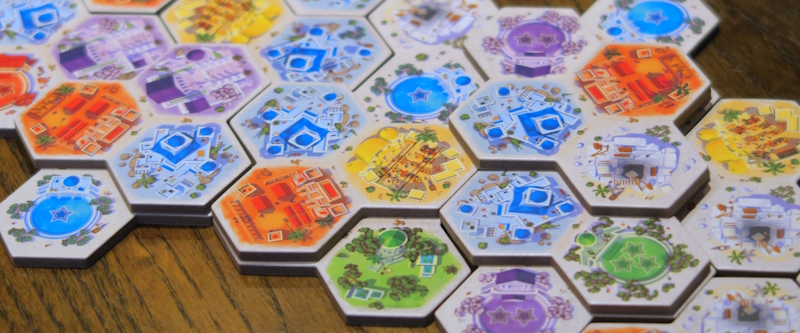
Cobalt was first to arrive.  Pink and Blue weren’t far behind though, and had just ordered their supper when Indigo and her son Navy arrived followed by Jade and Sapphire, then Ivory, Purple, Black, Pine and Teal.  While the others chatted and got drinks, Cobalt began teaching Indigo and Navy Akropolis.  This is a quick little game where each player is building their own acropolis. On their turn, players first take a tile the market. The first tile in the market display is always free, the one after costs one stone (the only resource in the game) the next one two stone and so on.  The tiles comprise three conjoined hexes each either a Quarry (which provide Stone when built over), a Plaza, or a District tile.

Akropolis
– Image by boardGOATS

Plazas and District tiles are in different colours, representing Houses, Markets, Barracks, Temples and Gardens.  Tiles are freely added to the player’s display, either on the base layer or on top of other tiles, so long as any Districts meet the their conditions and as long as there is a matching Plaza present.  At the end of the game, players score for the largest District of each type—each visible hex scores a point for the level it is on (one point for the base layer, two for the first floor etc) multiplied by the number stars shown on the Plazas they have visible.  The game is a sort of cross between Taluva and Cascadia, taking the conjoined triple-hex tiles and layered stacking from Taluva and the tile-placement and individual tableau from Cascadia.

Akropolis
– Image by boardGOATS

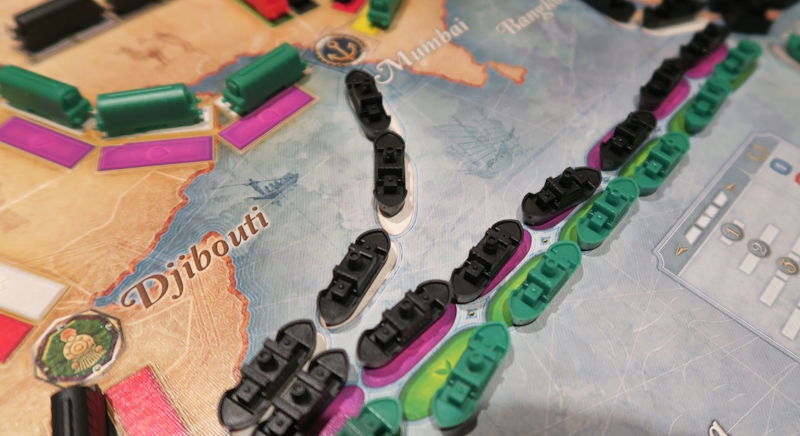
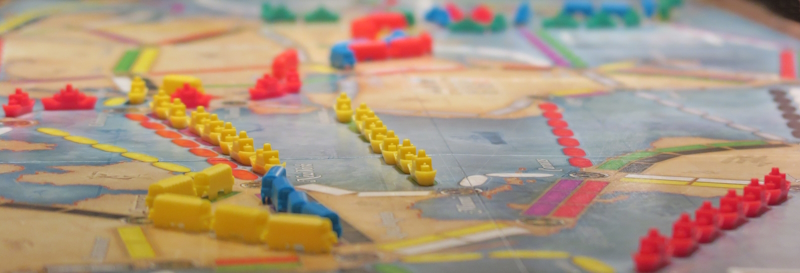
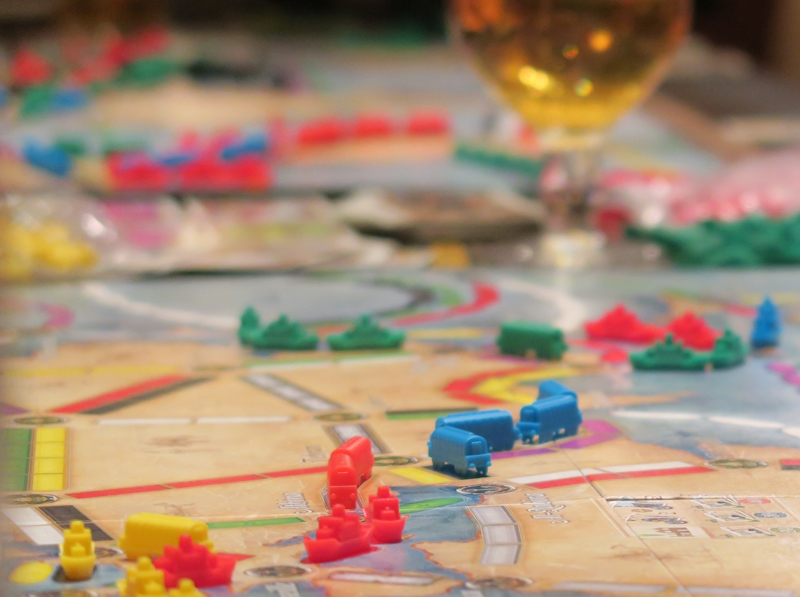
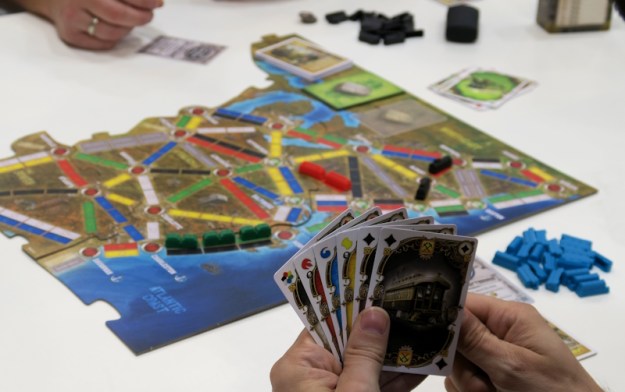
The game was quite tight between Cobalt and Navy, but Navy had the edge, winning his first game in the group with a hundred and eighteen points to Cobalt’s hundred and five.  As the game came to an end, the rest of the group began trying to work out who was going to play what.  In the end, there were two groups setting up to play the “Feature Game” which was Ticket to Ride: Rails & Sails.  This is a variant of the popular train game, Ticket to Ride, but with a considerable step up in complexity. In the original game, players take it in turns to carry out one of three actions:  take train cards, pay train cards to claim Routes on the map by placing train pieces, or take Tickets.  Points are scored for claiming Routes and for successfully connecting the two places shown on their Tickets with negative points scored for failing to complete Tickets.

Ticket to Ride: Rails & Sails
– Image by boardGOATS

In Rails & Sails, however, players build two connected networks, one on land and one on sea covering the whole globe.  Players build these with two separate sets of train cards, giving them two hands to manage, making it a more complex version of the game.  In addition to the usual four possible actions, on their turn, players can also build a Harbour into a city that they have already claimed a route into. To do this, players spend two Train cards and two Ship cards that are all the same color and all have Harbour symbols on them.  At the end of the game, players gain points for each Ticket that lists their Harbour, with players scoring for each Harbour when more than one features on their Ticket.

Ticket to Ride: Rails & Sails
– Image by boardGOATS

Another thing that adds to the complexity is the tension between Ships and Trains:  at the start of the game, players have a set total number of Ship and Train pieces, and choose choose how many of each they will have.  During the game, instead of a normal turn, they can exchange Ship pieces for Trains or vice versa, but at a cost of one point per piece swapped.  There are two different maps in the game, one covering the Great Lakes, and the other covering the whole World—the total number of Ships/Trains players have depends on which of these is used.  This time, both groups used the World map.  In addition to these major rules changes, there are also a couple of minor tweaks.

Ticket to Ride: Rails & Sails
– Image by boardGOATS

For example, there are Double cards in the Ship deck, which allow players to place up to two Ships per card.  There are also Tour Tickets, which feature more than two destinations—these will score a higher number of points if the locations are connected in the right order (and of course, will score negatively if one of the destinations in not connected at all).  On the World map, there are Pair Routes too.  These require the player to place two train cards of the same colour per space, but the whole Route doesn’t have to be the same colour.  There are the usual Double Routes as well, which come into play with four or five players, and multi-colour “Wild” cards which can be used as either Ship or Train cards of any colour.

Ticket to Ride: Rails & Sails
– Image by boardGOATS

Jade, Ivory, Sapphire and Pine made up the first group.  In their game, Jade and Ivory started by focusing on Trains while Pine and Sapphire began with Ships giving them both taking an early lead with Ships generally giving more points. Sapphire went to the front and stayed there for the majority of the game.  There was an initial scrabble in Asia/south east Asia as well as along the east coast of north and central America, and apart from some early commitments from Pine and Sapphire in the latter, in general there was no major “blocking” and everyone at least tried to play nicely.  That said, by the end of the game the board was very congested, perhaps due to the wrap around nature where Routes could fall off one side and come back on on the other.

Ticket to Ride: Rails & Sails
– Image by boardGOATS

Ivory was the first to take more Tickets and it was some time before Jade joined him.  Ivory went for Tickets considerably more times than anyone else and by the end of the game, he had significantly more completed Tickets than anyone else, though his were of lower value.  Pine in particular started with much more ambitious Tickets and happily declared that he had finished his first ticket about half through the game.  That was until Jade pointed out a potential gap in his track which Pine then hurried to fill.  Sapphire was following a similar strategy to Pine with bigger, higher risk Tickets and also focused on long Routes (hence his throughout the game).  It looked like he was going to trigger the end the game, but in the end, that was Pine.

Ticket to Ride: Rails & Sails
– Image by boardGOATS

Jade and Ivory both had shorter scoring Routes, but with more Tickets, predominantly located in Asia, whereas Sapphire and Pine were mapping the rest of the World.  Everyone except Ivory had to take advantage of the Ships/Trains swap and although this cost points and a turn it didn’t feel like it had a large impact on the game.  Both Jade and Ivory had cards at the end allowing for a late grab of high scoring Shipping lanes, but the game ended a little early for Sapphire.  That said, everyone completed all their tickets, including a very complex and high scoring Tour Ticket.  Pine and Sapphire eschewed Harbours, while Jade built just one.  Ivory, on the other hand, went built all three in the south east, despite the fact they were challenging to place.

Ticket to Ride: Rails & Sails
– Image by boardGOATS

After placing the Ships/Trains and scoring the Tickets, the scores were fairly even, but those extra Harbours really made a difference.  Sapphire and Pine took a twelve point penalty for not having any while Jade picked up twelve (an eight point penalty for not using two and twenty points for having one Ticket ending in his Harbour.  Ivory, however, scored a massive ninety points from his, with each of his three Harbours having two of his Tickets finishing in them.  This ultimately give him a total of two hundred and seventy-five eighty-five more than Pine who took second place. On reflection, there was a minor rules malfunction—when the group recounted the Route scoring, they failed to take account of the penalties for swapping Ships for Trains, but this was only a handful of points and wouldn’t have affected the final standings.

Ticket to Ride: Rails & Sails
– Image by boardGOATS

The game on the next table was not as highly scoring, but there was still quite a large spread in the scores.  While Black reacquainted himself with the rules, the others chatted and counted pieces, eventually they got going though.  Pink started in Australia because he liked it there when he visited almost exactly a year ago.  Then, he traveled north to east Asia, visiting exotic places like Bancock, Jakarta, Hong Kong and Tokyo, before crossing the Pacific to Winnipeg.  As the game came to a close, he also traversed the south Pacific to Valparaiso and took the southern coastal route to Rio de Janeiro.  Black also more or less circumnavigated the globe traveling from the UK, east across Europe to Tehran then on to Mumbai.

Ticket to Ride: Rails & Sails
– Image by boardGOATS

From there, he crossed the Pacific to Lima from where he traveled north, around the top of South America also making it to Rio before crossing the  Atlantic to Cape Town.  Part of the reason for Black and Pink choice of Routed (aside from their Tickets of course) was the fact that Teal was monopolising the Atlantic crossings, making it no fewer than five times!  From his Atlantic ports, he spread into North America and across Africa to Dar es Salaam.  Purple in contrast, focused her efforts on a single extended trip across the USA, found one of the few Routes across the north Atlantic not taken by Teal, journeyed across Europe following Black through Iran to the far East.

Ticket to Ride: Rails & Sails
– Image by boardGOATS

There was an unfortunate “Rules malfunction” when it came to scoring Harbours, which would have had quite a large impact on the game, but as everyone played by the same rules, it was at least fair.  Instead of scoring for each Ticket into each Harbour, they simply scored ten points for their first Harbour, twenty for the second and so on.  With this scoring, Pink, with his eight completed Tickets was the victor with two hundred and five points, fifteen points ahead of Teal in second and Black in third.  Both groups had really enjoyed the longer and bigger challenge of Rails & Sails.  The mix of boat and train cards did cause more grumbling than usual about the wrong colours being available, especially when there was an imbalance in favour of trains over boats or vice versa, but that’s just Ticket to Ride.

Ticket to Ride: Rails & Sails
– Image by boardGOATS

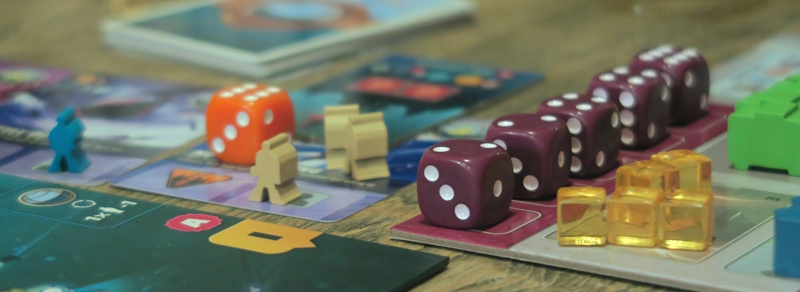
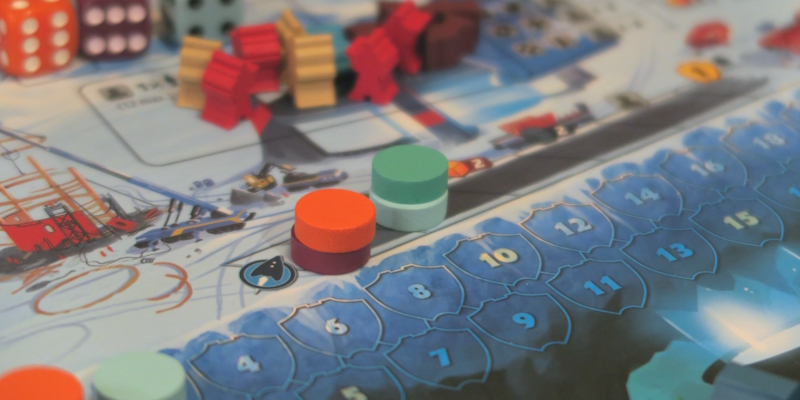
Meanwhile, the remaining group of four, Cobalt, Indigo, Navy and Blue, should really have been playing Azul (!), but after some dithering, Cobalt encouraged them to try The Artemis Project.  This is a game where players are trying to develop colonies on Europa.  The idea is that players roll dice and place them on action spaces to carry out actions.  There are seven Regions and players take it in turns to place their dice in them.  They are: Basecamp, Vents, Quarry, Gantry, Doorstep and Outfitter. At Basecamp, players go on Expedition to earn Expedition Badges and other Rewards. These are a bit like the Quests in the game Lancaster, and like the Squires in that game, dice can be augmented by Colonists.

The Artemis Project
– Image by boardGOATS

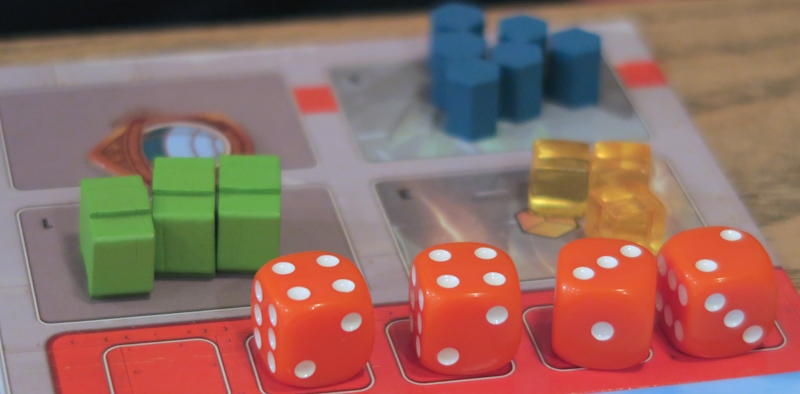
Also similarly, Expeditions are unsuccessful if a certain number of pips isn’t reached, which leaves players without their desired Rewards. In such cases, players don’t come away with nothing, instead they move their Token along the Relief Track and pick up a lesser reward.  However, there is a fixed number of spaces available along the Relief Track for each person, so when they are gone, they are gone.  The Vents and the Quarry provide players with Energy and Minerals respectively.  The level of the action depends on the value of the dice, however, the dice are activated from the lowest to the highest.  So, for example, placing a high value die like a six, will yield six Minerals, but if there are only ten available and two other players place fives, these will be activated first leaving nothing.

The Artemis Project
– Image by boardGOATS

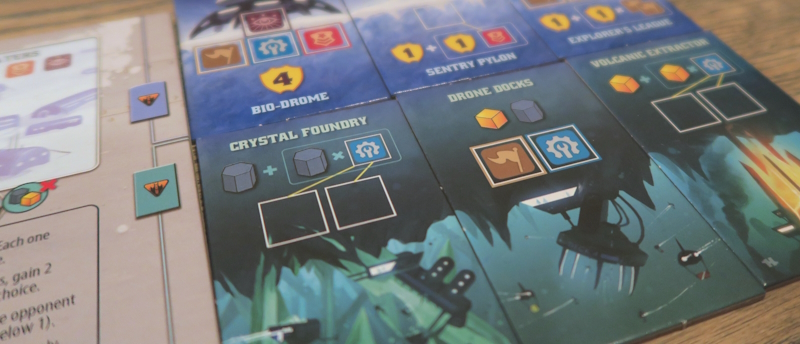
The Gantry provides Buildings, which provide players with long term benefits during the game and points towards the end of the game.  Players bid for these and if they win, they must pay the bid amount in Minerals (the value of dice placed), to build them.  Both the Doorstep and the Academy deal with Colonists.  The Doorstep provides players with Colonists, but like the Vents and the Quarry, players who bid high, go last and may not get what they want (or even anything) while the Academy allows players to upgrade their Colonists if required.  Finally, the Outfitter allows players to gain Toolkits which grease the wheels a little by allowing players to alter the values of their dice.  Once all the dice have been placed, these different Regions are activated in order.

The Artemis Project
– Image by boardGOATS

Thus, for example, Minerals collected can be used later in the same round to build Buildings, however, it is wise not to rely on that as another player can play a lower value die, easily scuppering plans.  In this way, the game can be quite aggressive with intentional and unintentional conflict when players get in each other’s way.  It is played over six rounds marked by Event cards associated with the Regions which are resolved before the relevant Region is activated.  At the end of the game, it is a bit of a “point salad” in that players score for left-over Energy and Minerals, for Fully Staffed Buildings, for the number of Buildings, for each complete set of four different Colonists, for any Colonists not part of a set, for Expedition Badges and for having the most unused Toolkits.

The Artemis Project
– Image by boardGOATS

Indigo clearly found the number of Regions a little bit bewildering and was keen to learn by playing, but The Artemis Project is not really a game that lends itself to that.  Indeed, in spite of understanding what each Region does, there is still an element of learning by playing in order to see how things fit together.  As the only one who had played it before, Cobalt stole a march by targeting the Basecamp early and grabbing one of the Expeditions, and because nobody joined him, taking both Rewards.  Navy opted for the sensible choice and went for Buildings in order to get an engine going.  Blue and Indigo weren’t so quick off the mark and took a little longer to work out how to put a strategy together.
The Artemis Project
– Image by boardGOATS

As the game progressed, Indigo became the Queen of the Resources gathering piles and pales, making god use of the multiplier tokens.  Blue made her way up the Relief Track after rolling some higher numbers and not using them well.  This was a problem made worse by Cobalt trying to muscle in on one of her Expeditions leaving her to walk away with nothing, leaving him with nothing too.  As the game came to a close, Navy had more buildings than anyone else and, as Blue and Cobalt both made a bit of a mess of things, he sailed gracefully into the lead finishing with sixty-eight points, while Blue just pipped Cobalt to second place.

The Artemis Project
– Image by boardGOATS

Learning Outcome:  Who needs Planes when you have Ships and Trains?

9th July 2024

When Blue and Pink arrived, Crimson and Cyan were already there on their first visit, finishing their supper and playing a game of Molehill Meadows.  This is a new game by the designer of Zuuli, that they had picked up at the UK Games Expo (meeting the designer Chris Priscott and his delightful family in the process).  In Molehill Meadows, players take on the personality of Mika the Mole, who has an affinity for shiny things, a hunger for juicy worms and an innate desire to dig  A flip-and-write game, players dig tunnels using polyomino shapes to carefully expand their molehill home.

Molehill Meadow
– Image by boardGOATS

Their game was somewhat interrupted as people arrived and were introduced and they were surrounded by the general chatter of arrival and Blue and Pink munching their pizzas.  Crimson and Cyan carried on playing, flipping polyomino cards and then drawing the shapes on their map.  Extending their tunnel to find Worms gave both players four “Worm Powers”, and fining treasure gave them points.  Cyan collected twice as much treasure and picked up more than twice the number of bonus points than Crimson (for collecting all of the two sets of flowers on the Objective Cards) and thus was the eventual victor by something of a landslide (or should it have been a tunnel collapse?).

Molehill Meadow
– Image by boardGOATS

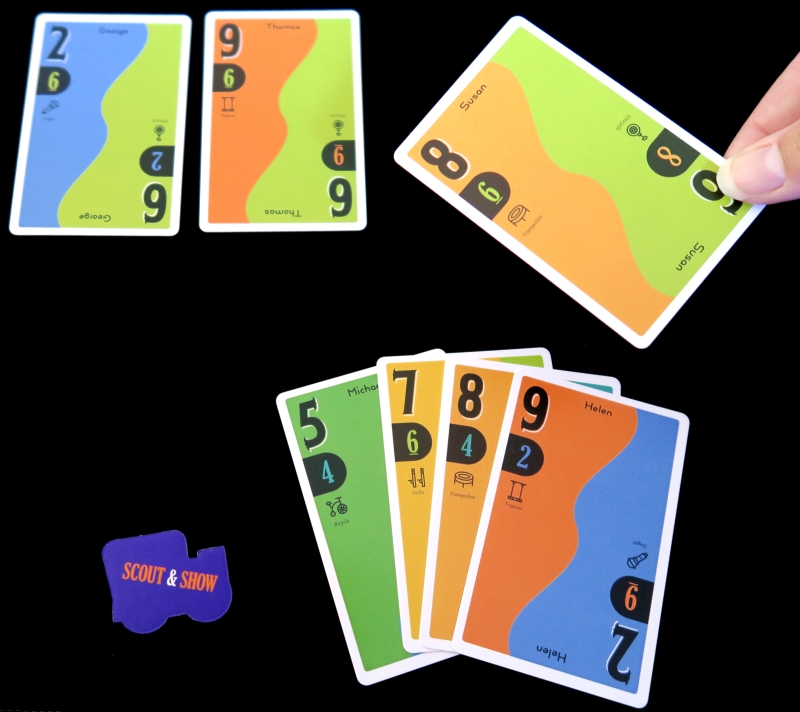
Then, while everyone else generally gossiped and caught up with the events of the last week or so, Jade and Sapphire joined Crimson and Cyan for a quick couple of rounds of the trick-taking, climbing game, SCOUT.  We’ve played this a few times on a Tuesday and everyone has always enjoyed it.  The game is simple in that on their turn, the active player either plays a set of cards to beat and replace the set on the table (a run or a meld), or take one card from either end of the set on the table and add it to their hand.  The round ends if a player plays the last card in their hand, or if it is a player’s turn and they played the current active set of cards on the table.

SCOUT
– Image by boardGOATS

At this point, player score for cards in their scoring pile (cards they have beaten during the round), for “chocolate bars” (rewards given when another player takes a card from their active set), and deducts a point for every card left in hand.  The clever part of the game is that, like Bohnanza, cards cannot be rearranged in hand, this with the fact that cards have different values depending which way up they are make this little card game really clever.  In the interests of time, the group only played two rounds, and although the scores can be very disparate, this time it was really tight with only five points between first and last and Sapphire taking the honours one point ahead of Crimson.

SCOUT
– Image by boardGOATS

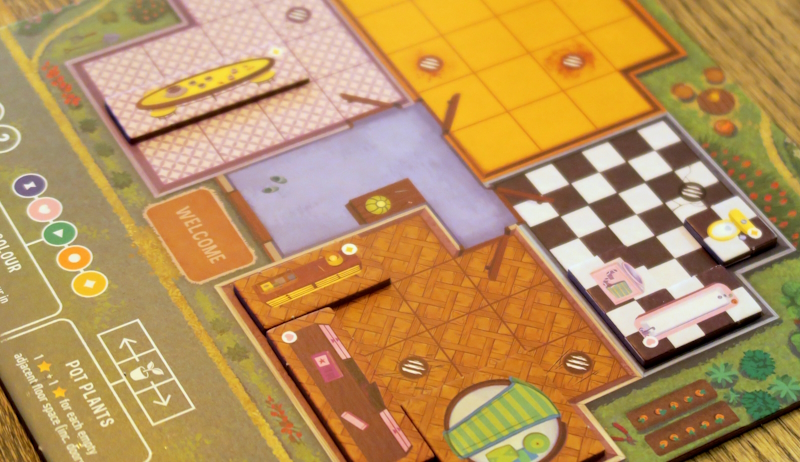
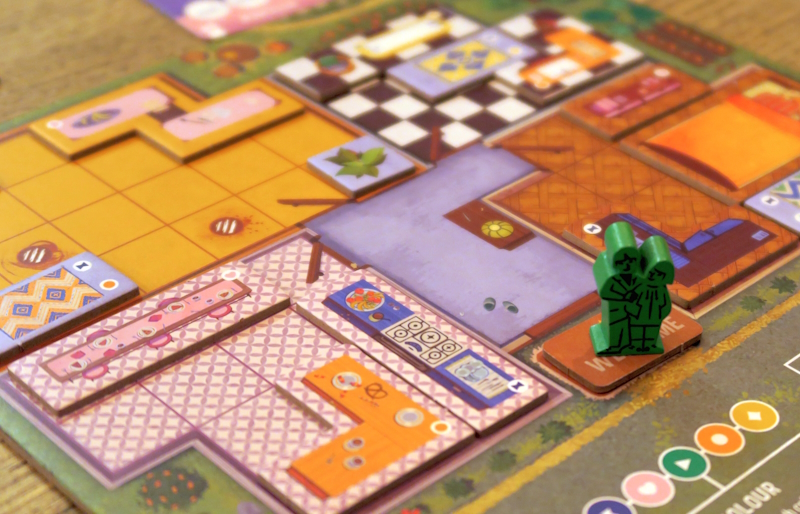
By this time, Blue and Pink had just about finished eating and everyone else had mostly finished chatting, so with twelve, the group split into three groups of four, starting with Pine, Sapphire and Cyan who joined Jade in the “Feature Game“, Happy Home.  This is another polyomino game, with similarities to games like New York Zoo and Bärenpark, but with a theme of home decorating rather than building an animal park.  Like New York Zoo (or indeed Jokkmokk), the game has a central market, in this case representing a Store, which players move their Meeple round.

Happy Home
– Image by boardGOATS

On their turn, the active player moves their Meeple (or should that be Muman?) to an available space, takes the card and matching tile and then adds it to their home.  When all the cards are used up, players instead place a “Welcome Mat” on their doorstep to show they are ready to welcome visitors.  When everyone has finished , the game is over and players score their Home for Furniture, Colours, Pot Plants, their Welcome Mat and Design Objectives, losing points for any scratches still visible and not covered up by Furniture.

Happy Home
– Image by boardGOATS

There was a wee bit of misunderstanding on how the scoring worked even though Jade had done his best to explain it at the beginning.   Each Room scores one, three or six points if it has one, two or all three different core pieces of Furniture in it, and each Pot Plant is worth a point plus a bonus point for each empty space orthogonal to it.  That wasn’t where the problem was however, that was with the Colour scoring. Essentially players need to have the same Colour across at three different rooms to get two points and across four rooms to get five points, but somehow, this caused more confusion than it should have done.
Happy Home
– Image by boardGOATS

The group also made life more difficult for themselves by shuffling the cards and removing twenty-four cards as per the rules for the four-player game, but somehow the bulk of those removed seemed to be Furniture for just one of the rooms, the Bathroom.  It was a good learning game as the value of Rugs, for example, became evident later on—players were a bit confused as they don’t score in their own right, but they add Colour to a Room and thus can score at the end of the game.

Happy Home
– Image by boardGOATS

This time the Design Objective was “Bigger is Better”, so players lost a point for each empty floor space in their Room with the most empty spaces.  The lack of Bathroom fittings, meant Pine didn’t have a loo in his house and had to resort to “wafflestomping“, but he did have what looked like two pink ironing boards furnishing his Lounge.  Next door, Sapphire filled his Living Room with a pink sofa and an enormous matching pink widescreen TV (that was the same size as the sofa!).  In the end, the victor was a bit of a runaway winner.

Happy Home
– Image by boardGOATS

In spite of his lack of toilet facilities, Pine finished with twenty-four points, some seven ahead of Sapphire in second, with Jade taking the last place on the podium.  Before the game, Pine had said he wasn’t sure about it from the description, but in the event he really enjoyed it, as indeed did everyone else.  Meanwhile, there were two other games underway.  The first of these was Keyflower—a very popular game with certain members of the group, but one that hasn’t had an outing for a long time, in fact the last time the group played it was online in 2020, and the much-missed Burgundy was involved.

Keyflower on boardgamearena.com
– Image by boardGOATS from boardgamearena.com

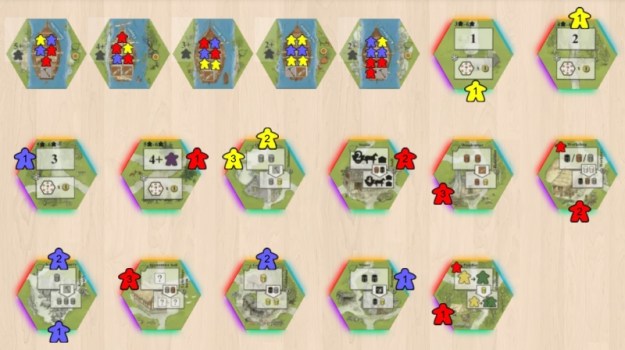
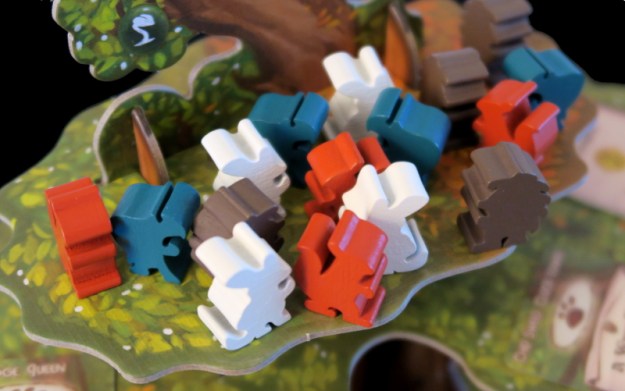
This time, the four players were Blue, Pink, Black and Ivory, all of whom had played Keyflower before (albeit a while ago).  The game is fairly simple in terms of concepts, but like many good games, challenging to play well.  Each round, players take it in turns to bid on a tile, or activate a tile.  The clever part of the game is that both bidding and activating is done with red, blue, yellow or occasionally green Keyples (Meeple-shaped workers).  In each of the four rounds (or Seasons), a set number of tiles are put out for players to bid on.  Players take it in turns to bid or activate and when everyone passes in succession, any tiles won are added to the winner’s village, any losing bids and any Keyples used for activating return to their owner.

Keyflower: The Farmers
– Image by boardGOATS

At the end of each round, a boatload of new Keyples arrive in each village (players can bid to get the one of their choice), before the tiles for the next Season are set out.  In general, tiles are drawn at random, and in the first season, Spring, mostly provide Resources with Summer and Autumn tiles providing special powers and Autumn and Winter tiles providing scoring opportunities.  The Winter tiles are different to those for the other Seasons in that instead of being drawn at random at the start of the Season, they are dealt our to each player at the start of the game.  Then, at the start of Winter, players choose from their pile which ones they want to make available—in this way, the Winter tiles act as sort of objective tiles.

Keyflower
– Image by boardGOATS

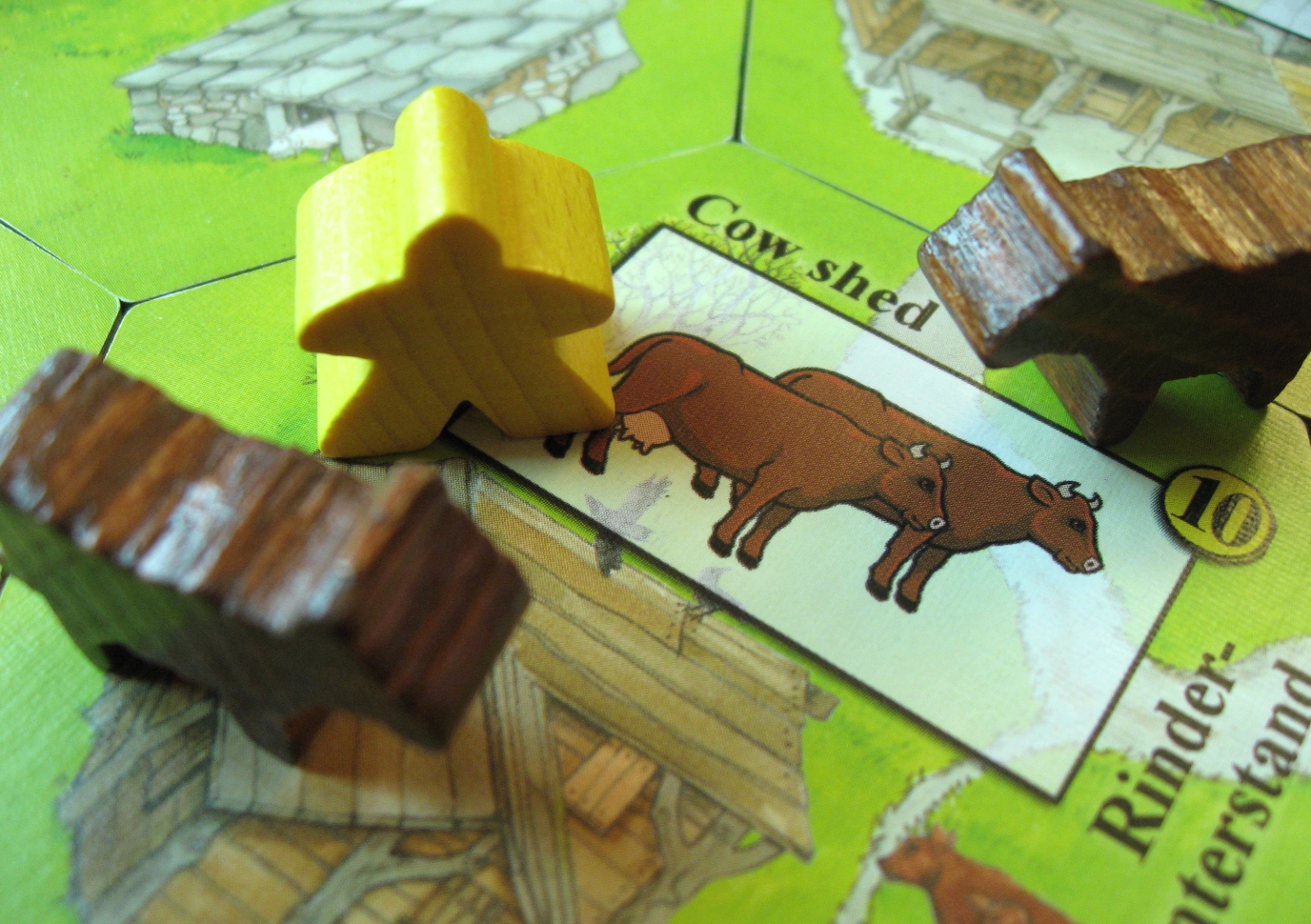
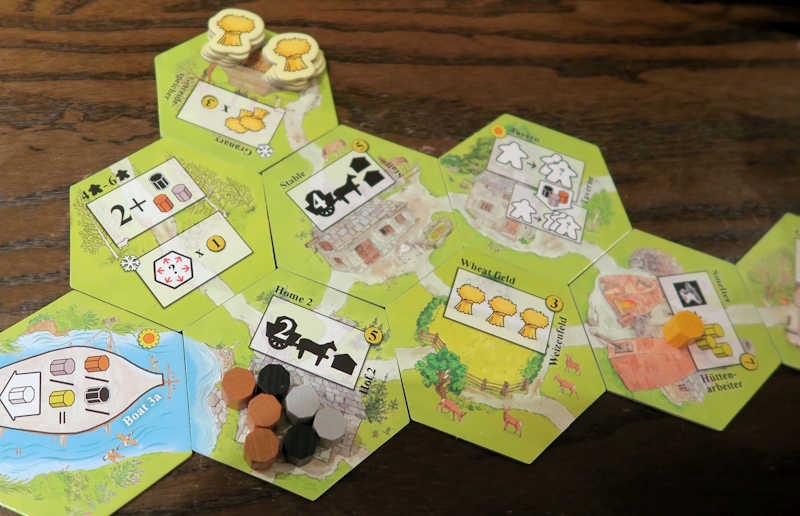
The Keyflower box also contained The Farmers expansion and the question arose whether to include it or not.  Blue, Pink and Ivory were on the fence until Black said he’d never played with the Farmers, so of course that was a problem they had to urgently fix.  In the base game, the different tiles are connected by roads which are used for transporting goods to places where they can be used to upgrade tiles or score points.  In The Farmers expansion, these roads now define fields where animals can be left to graze and with each occupied field scoring points at the end of the game.

Keyflower: The Farmers
– Image by boardGOATS

Additionally, The Farmers expansion introduces wheat as a new resource, which can be used to add distance/quantity to the movement action, enabling players to move more animals and resources further.  There are several ways to set up the game with The Farmers expansion, but this time the group used The Farmers Variant, where all the tiles from the expansion are used and the number made up with tiles from the base game.  After setting up and explaining the additional rules to Black, Ivory went first, taking the waving purple start-player Keyple, and began the bidding.
Keyflower: The Farmers
– Image by boardGOATS

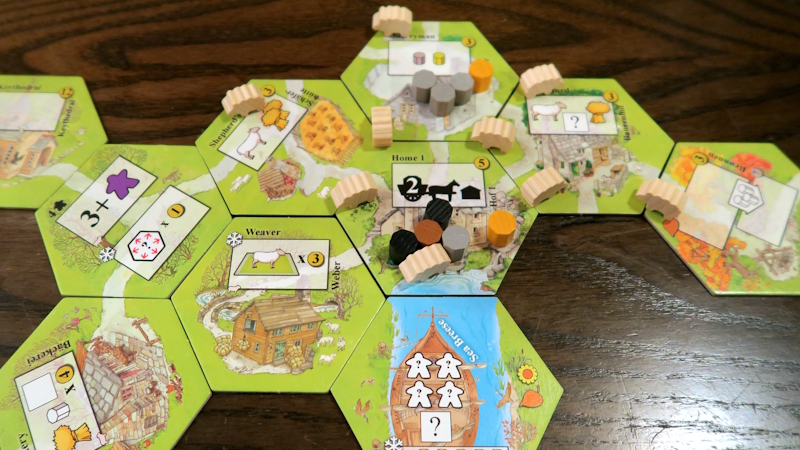
In Spring, Blue failed to get anything useful at the start of the game (or so she thought) taking just the Key Mine tile which gives Coal and didn’t match any of her Winter tiles.  Pink started off taking the Sheep Fold which gave him a source of sheep and the Paddock which gave him more Movement and upgrade ability together with some Wheat.  Then, he took the Workshop which gave him one resource of his choice from Wood, Coal or Stone, upgradeable to three resources, one of each, which matched his Winter tile, the Mercer’s Guild.  Ivory won the Quarryman, which gave him some very useful gold, and in Summer took the Shepherd’s Hut which gave him Wheat and Sheep and then embarked on a concerted breeding and movement programme.

Keyflower
– Image by boardGOATS

Black picked up a few tiles early in the game, which ultimately led to a lightly sprawling Village by the end of the game.  These included the Wheatfield in Spring and the Tavern, the Smelter and Boat 3a in the Summer.  By this time, Pink had decided that the sheep weren’t doing it for him so moved on to pigs, with the Pigsty.  Blue, having missed out on the Tavern which converts one Keyple into two, instead took the only tile that generated green Keyples, the Store which went well with one of her Winter tiles, the Key Market, but gave the added power of preventing other players from following if she was the first to Bid with Green, as they were highly unlikely to have any.

Keyflower: The Farmers
– Image by boardGOATS

In Autumn, Blue discovered the value of the Key Mine tile she had picked up in the first round, when the Blacksmith tile appeared which gave points for each Coal on the tile at the end of the game.  She added the Ranch to this which gave Cows and Wheat, and then began mining Coal in earnest and hoarding large numbers of sheaves for a super-movement move later in the game to get everything where it was needed as efficiently as possible.  Black got the Goldsmith which went well with his Smelter which gave him the Gold he needed to upgrade it and get ten points, while Ivory and Pink continued their procreation programmes.

Keyflower: The Farmers
– Image by boardGOATS

As the game progressed there were several visits from the other gamers in the room, many of whom, much to the people who were playing it’s surprise, had not played Keyflower. It is, of course, Blue’s favourite game and was a favourite of Burgundy’s, as well as being generally very popular with almost all of the regulars pre-2020.  So as the game continued into Winter, it was clear it would have to get another outing or two reasonably soon to rectify the situation. There is also The Merchants expansion which has not been played with the group, so that might be the “Feature Game” in the coming months.

Keyflower: The Farmers
– Image by boardGOATS

Only eight out of a possible sixteen Winter tiles were introduced by the players and the Scribes, which Ivory commented usually ensured victory was not there (it turned out nobody had started with it).  Black took the Granary which gave him points for his Wheat and Pink got his Mercer’s Guild that he’d been working towards.  Ivory won the Cathedral giving him a straight twelve points; the Weaver giving two extra points per sheep field, and the Bakery giving four points for each set of a Resource, a Skills tile and a Wheat Sheaf.  Blue had lots of options, so concentrated on building her piles of resources before bidding for her end of game scoring.
Keyflower: The Farmers
– Image by boardGOATS

This required a lot of nerve as Ivory had there wherewithal to take some of the tiles she obviously wanted.  Ivory hummed and hawed over it and as Black and Pink passed, twice he had the chance to begin a war, but decided not to as “that’s not very nice” and it can also backfire spectacularly.  Instead he generated the odd Gold for a point (“in case it was close”) and waited and watched.  In the end he passed and then Blue passed and that was that bar the counting.  And as it turned out, it was close, very close, but Blue just took victory, by a mere three points, with a total of ninety-five.
Keyflower: The Farmers
– Image by boardGOATS

The jury is out as to whether it was Ivory’s kindness that cost him the game because Blue did, of course, have contingency plans if someone had tried to take some of the tiles she wanted, and she could have cost him a lot of points.  However, by the end, Blue had no Keyples left and Ivory had a couple that he could have used, so depending on how things had panned out, he might have just nicked it or still lost.  Instead, his kindness and generous good nature won him a lot more respect from his fellow gamers, especially given that everyone knew how fond Blue is of Keyflower successfully destroying her plans might have made her just a little bit sad.

Keyflower: The Farmers
– Image by boardGOATS

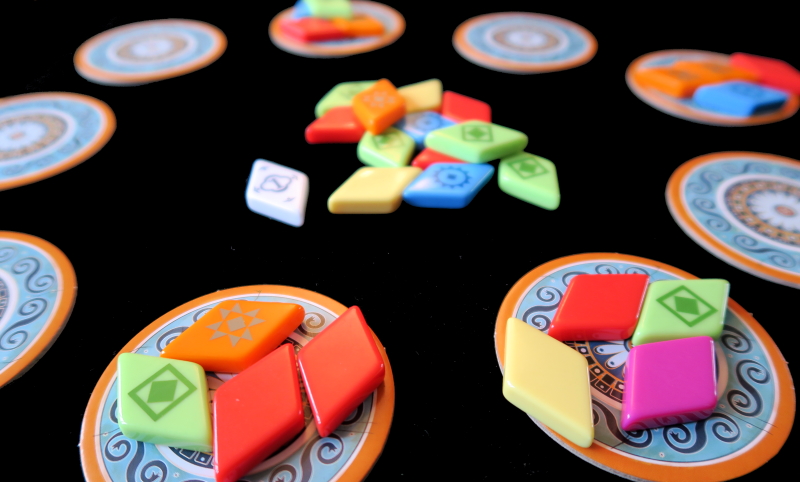
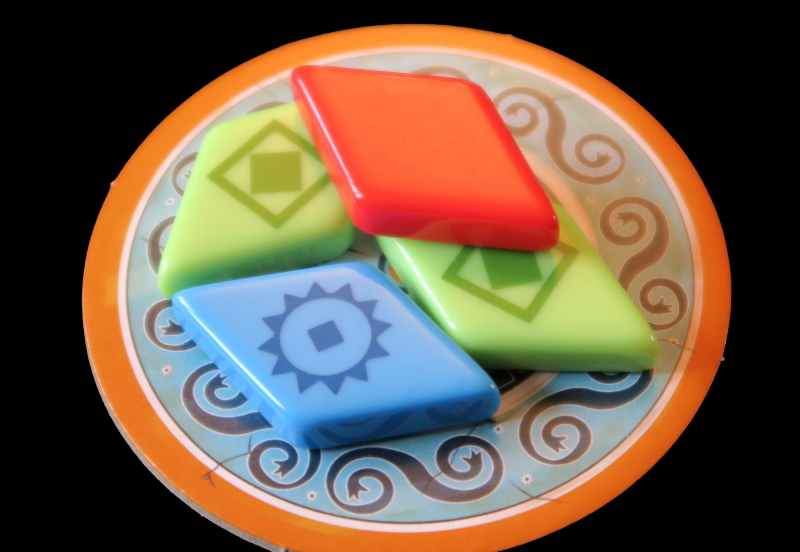
Finally, the third table began their evening with Azul: Summer Pavillion, the third in the series based on the essentially abstract game of tile collecting, Azul.  Crimson kindly obliged in offering to lead the game with Lime, Teal and Purple, none of whom had played this variant before.  This is more similar to the original than the second in the series (Stained Glass of Sintra), but is built on lozenge-shaped pieces that make up hexagons.  Like the original, players take tiles from a central market and add them to their player-boards claiming points as they do so.  In contrast to the original, players store the tiles and add them all to their board at the end of the round (taking it in turns to do so).

Azul: Summer Pavilion
– Image by boardGOATS

After some initial confusion caused by the additional bag and player boards from the Objective Tiles and Glazed Pavillion expansions, the game got underway.  Unfortunately, there was a bit of a rules malfunction:  initially it was thought that every time a tile was placed it scored one point for itself, two for one next to it and three for a third one in sequence (totalling six).  The group soon realised this wasn’t right though.  So they then thought you scored at the end of the round after playing all the tokens, however, they soon realised there was no way anyone could remember when a new tile that round had been placed.

Azul: Summer Pavilion
– Image by boardGOATS

At this point, they then read the rules and from that decided players score one point for the tile and one for each tile it was adjacent to, thus scoring from one to three points per tile as they were placed and this is how they continued to play.  Cyan immediately identified they had come a cropper when he looked at the low end-game scores. He explained that they should have scored one point for the tile placed and one point for each tile connected to that group, so potentially up to six points could be scored for some tiles!

Azul: Summer Pavilion
– Image by boardGOATS

Although it wasn’t played by “the rules as written”, everyone had the same disadvantage, and the group resolved to give it another go again soon, but with the right rules next time.  As it was, it was a very close game with Crimson, beating Lime by a single point and Teal finishing some half a dozen points behind.  It is a very pretty game, and despite the issues, players had enjoyed making patterns and pushing the tactile bright tiles around, which was very therapeutic after a hard day at work.

Azul: Summer Pavilion
– Image by boardGOATS

Keyflower was ongoing (and would be for the rest of the evening), but Happy Home had finished so there was a quick game of musical chairs and Purple began by leading Lime, Cyan and Pine in a game of the group’s currently popular filler, Rome in a Day.  This is a little tile laying game built round the “I divide, you choose” mechanism.  The idea is that players draw five land tiles at random and place two buildings on tiles one and two. They then divide the five tiles into two groups—a bigger and a smaller one (in any ratio), and add a Crystal Gem to the smaller land set before offering the choice to their neighbour.

Rome in a Day
– Image by boardGOATS

During the four rounds that the game is played over this neighbour alternates, right, left, right, left. So, each round, players choose a set from their neighbour and these and the tiles they were left with are added to their domain.  At the end of the game, any building that stands on or adjacent to land of its own colour will score for each tile in the group and then players score for the diamonds they have collected—the player with the most points is the winner.  The game has had a couple of outings recently after Black and Purple picked it up at UK Games Expo a few weeks back.  Pine, Lime and Cyan had not been part of those games, so Purple explained the rules.

Rome in a Day
– Image by boardGOATS

The game was a bit of a struggle, probably not helped by the fact that on both the previous occasions the rules have not been strictly adhered to.  This is partly because the rules are not the best written and partly because when the game was explained to Black and Purple at UK Games Expo they were different to those published online.  Although it wasn’t entirely clear to everyone during the game, it was actually very close.  In fact, Lime and Cyan finished tied for first place with forty-four points each despite quite different tactics with Cyan prioritising collecting Gems and Lime making hay in his Wheat fields and wine in his Vineyards.

Rome in a Day
– Image by boardGOATS

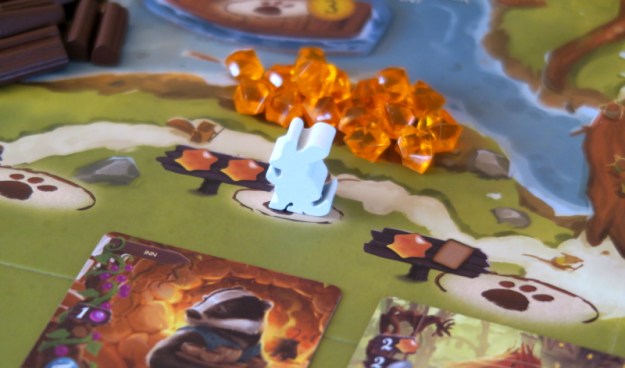
While the group were fighting their way through Rome in a Day and Keyflower was coming to an end, Jade led Sapphire and Crimson in the 2024 Spiel des Jahres recommended game, Harmonies.  This was described by Jade as a sort of cross between Splendor and Cascadia, with an Azul-type market.  On their turn, the active player takes three wooden Tokens from one of the spaces on the central player board and places them on their player board. These Tokens represent Mountains, Trees, Buildings, Water and Fields.  Some tokens can stack, others cannot: the reasons why are thematic (e.g. tall Mountains and Forests, no tall Rivers etc.), but otherwise Tokens can be placed on any empty space.

Harmonies
– Image by boardGOATS

Players may then take an Animal card from the central display—they can have a maximum of four at any one time and each has a number of Animal cubes on them.  Each time the pattern on an Animal card is fulfilled, one of these Animal cubes is removed and placed on the token indicated on the card.  At the end of the game, players score for the highest achieved Animal on each card and for each Mountain, Tree, Building, Field and River (or Island, depending on  which side of the board players are using).  Mountains are made of stacks of up to three Rock Tokens, while Trees are a green Leaf Token on zero, one or two Wood Tokens.

Harmonies
– Image by boardGOATS

Taller Mountains and Trees give more points (one, three or seven points), while Buildings (made of two Tokens, at least one Brick and a Wood, Rock or another Brick), and Fields (two adjacent Wheat Tokens) score five points each.  Finally, depending which side of the board is used, players score points for the length of their River, or five points for each Island they make.  This time, the group played with “Side A” which scores for Rivers.  It was a learning game for Crimson, but was quite close quite between Jade and Sapphire, but Sapphire’s one hundred and eight gave him victory in what is an interesting point-salad tile-placement game that deserves another outing soon.

Harmonies
– Image by boardGOATS

Learning Outcome:  You don’t need a toilet to have a Happy Home.

9th January 2024

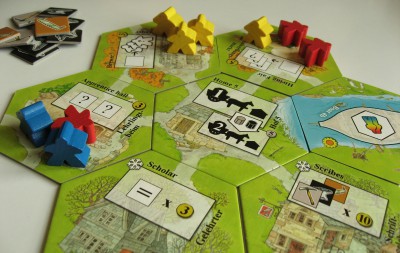
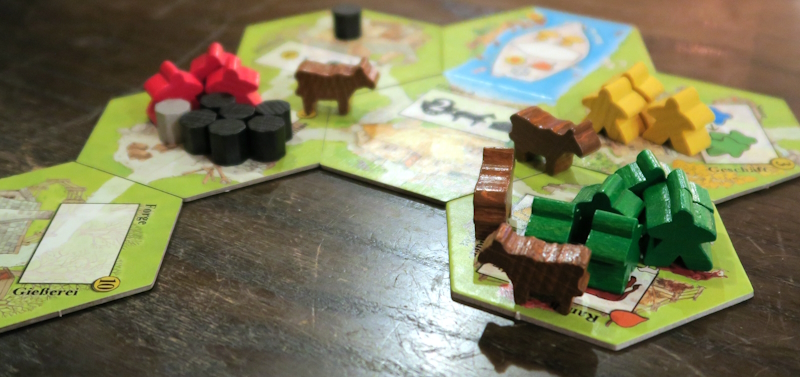
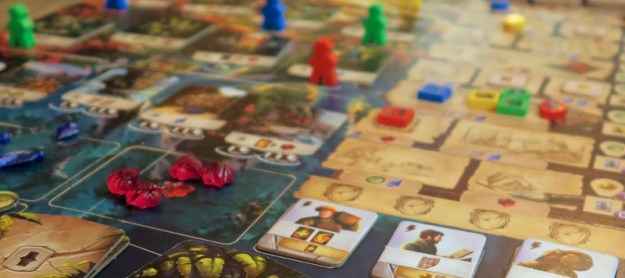
Blue and Pink were just finishing their supper when Pine arrived, soon followed by Cobalt.  There was a lot of discussion about the road closure to the A420 (due to an accident) and whether this would delay those coming from the west, but Jade, Plum, Sapphire and Byzantium soon arrived with their tales of countryside detours in the dark.  Inevitably, that led to more stories of road closures due to accidents and flooding, and the horror-show that driving anywhere has been over the last week or so.  With almost everyone present, with more proactivity than usual, the group split into three, with two tables playing the “Feature Game“, the Landmarks expansion to the 2022 Spiel de Jahres winner, Cascadia.

Cascadia: Landmarks
– Image by boardGOATS

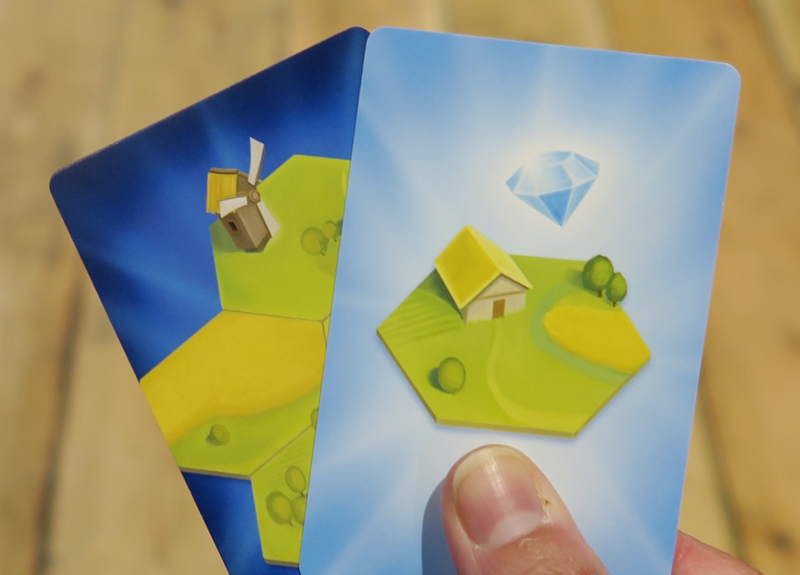
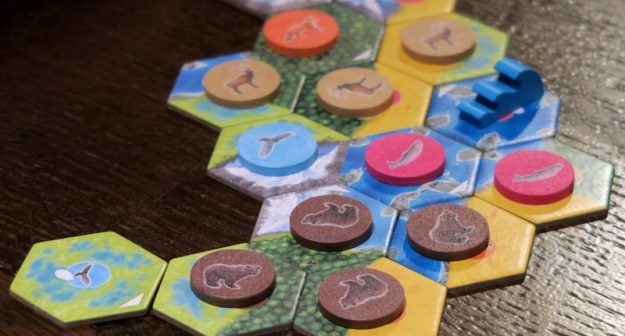
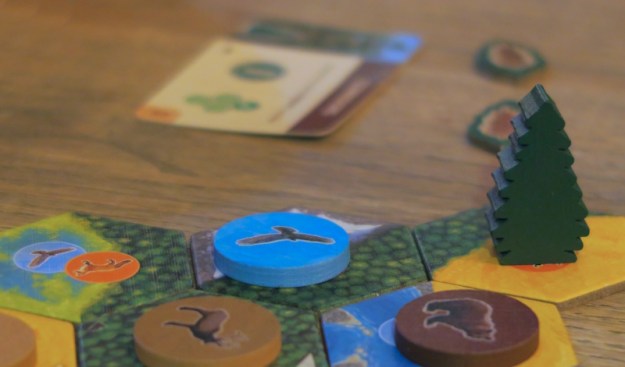
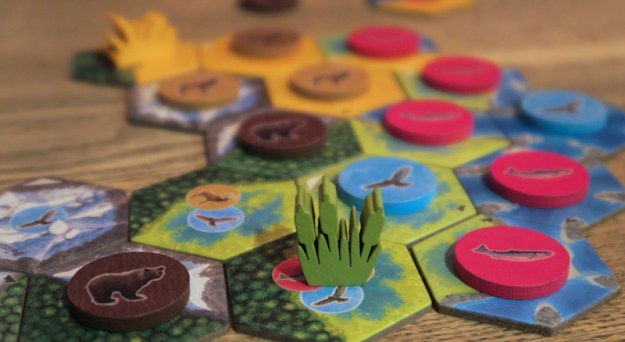
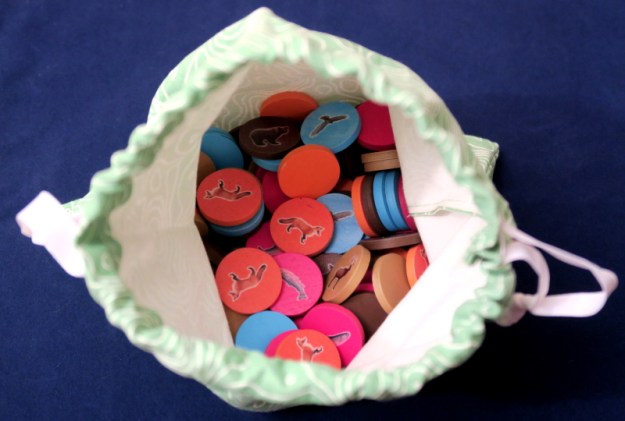
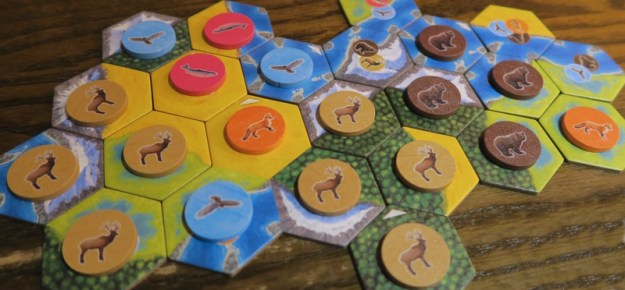
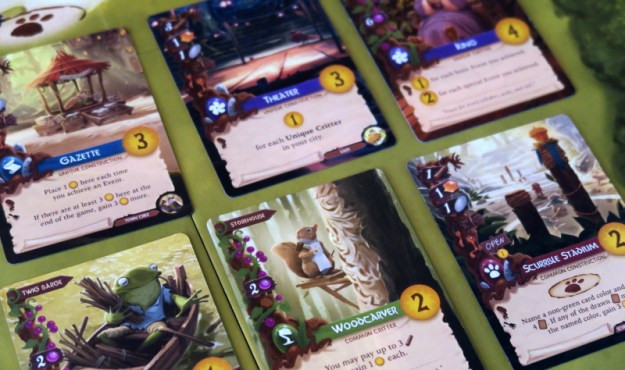
Cascadia is one of the group’s most popular tile laying games.  The mechanisms of the base game are simple enough:  on their turn, players take a Habitat Tile/Animal pair from the market and add them to their territory.  The Habitat Tile can be placed anywhere, but the Animal Token must be placed on a Habitat Tile which depicts that Animal.  The market is then replenished back to four pairs until the Tile pile is depleted and the game ends.  The Tiles and Animals are drawn and paired at random, and players have to take the prearranged pair, they cannot freely mix and match unless they have a Nature Token, which they can spend to either change all the Animals, or to take an Animal from a different pair.

Cascadia
– Image by boardGOATS

Nature tokens are rewards for adding animals to Keystone Habitat Tiles, which, in general, are more difficult to fill because they can only hold one animal type (other tiles can take two or three).  While the mechanism is quite simple, the guts of the game is in the scoring.  Players score for each of the five Animals, Bears, Elk, Foxes, Salmon and Eagles, but the clever part is that the way each of these scores depends on which card is drawn at random from each of the five Animal decks.  Thus, the game plays very differently depending on the combination of Animal scoring cards drawn.

Cascadia
– Image by boardGOATS

In addition to animal scoring, players also score one point for each tile in their largest corridor of each of the five Terrain types, as well as earning bonuses if their largest area is the largest overall.  The Landmarks expansion consists of three new modules, one which increases the the potential player count, one which adds more variety to the scoring (more Animal scoring cards) and finally, the titular Landmarks.  The first of these adds a Personal Market of five Habitat Tile/Animal pairs for each player to give them something to think about (and potentially play) between turns.  This can be played at lower player counts, but is essential in larger numbers as it reduces perceived downtime.

Cascadia: Landmarks
– Image by boardGOATS

The second module is simply some more scoring cards, which adds more variety, but also a little more complexity as some of these are slightly more challenging to work with.  The final module, the Landmarks, changes things a little more.  These can be added to a Habitat Tile when the once the area of Terrain is large enough (spreads over five tiles or more).  These Landmarks also come with a choice of the available cards (drawn at random) which give bonus points at the end of the game, for example, for every Bear in the player’s Forests.  Each player can only build one Landmark on each Terrain type, and because the Landmarks occupy space, players start the game with one additional Keystone Tile.

Cascadia: Landmarks
– Image by boardGOATS

Blue, Pink, Plum, Black and Lime played with all three modules, making a point of choosing scoring cards from the expansion.  In contrast, although the Personal Market can be used for any player count, the four on the other table, Jade, Byzantium, Sapphire and Pine, only added the Landmarks module, choosing scoring cards solely from the base game.  Jade et al. got going first and were four or five rounds in before Blue’s Crew had even started, as the latter had more rules to cover and were a little later to start as they were too busy gossiping.  On the other hand, despite the fact that there were a lot of rules queries, at least they mostly got them right, in contrast, to the little rules malfunction on the other table.

Cascadia: Landmarks
– Image by boardGOATS

The rules for the Landmarks state that players may take a Landmark when they add their fifth or tile to a Terrain, or any subsequent addition, whereas Jade, Byzantium, Sapphire and Pine played that the Landmark had to be taken when the fifth Terrain Tile is added.  It was just a very little thing, but actually had quite a large knock-on effect. The problem was, if a Landmark is added to a Keystone Tile, then players don’t get the Nature token.  Worse, in some cases, players were taking Landmarks when the cards weren’t in-line with their strategy, just because they had to.

Cascadia
– Image by boardGOATS

As the games progressed, both groups realised that taking Landmarks can really restrict a player’s options, especially towards the end of the game when things can get very tight.  And forcing players to take unhelpful Landmarks just exacerbated this effect and meant some Terrains were stuck at four just to avoid some of the issues.  The games both progressed quite merrily, however.  Blue concentrated on a mixture of Animals and Terrain, going for Landmarks early in the proceedings. Plum, misunderstood and didn’t realise that players scored a point for each tile in their largest Terrain, so she concentrated on Animals, but did very well with her Terrain anyhow, by virtue of trying to get bonus points for having the largest areas.

Cascadia: Landmarks
– Image by boardGOATS

Pink asked a lot of questions and got a bit confused between when he could add Landmarks and when he could take tiles from his Personal Market.  So, he ended up concentrating on Foxes instead, “as he was a foxy sort of fellow” (and there aren’t any Pandas in the game).  Black meanwhile collected Elk, but all-round concentrated on animals rather than Terrain.  Lime commented, “Birds are difficult to understand, so I’m not going to bother with them; if I score at the end of the evening, so be it…” though he probably didn’t mean it to come out quite like that!  On the other table, Sapphire was collecting Elk, and Byzantium was focussing on Eagles while Pine concentrated on building his Terrain and Jade capitalised on the Landmarks.

Cascadia: Landmarks
– Image by boardGOATS

With or without the Landmarks expansion, Cascadia is a little bit of a “multi-player solitaire” game, that is to say, players can mostly quietly get on with their own thing without upsetting each others’ plans.  However, with Blue, Black and Plum all having a full set of five salmon, Pink and Lime struggled to get the last few they needed.  In the four-player base game, all the tiles and therefore all the animals are used and Lime hadn’t realised the expansion added more tiles, some of which had been removed and therefore, there was no guarantee that any of the lovely juicy salmon left in the bag were going to come out.  And much to Lime’s chagrin, so it proved, as he was left one short of the full set at the end of the game.

Cascadia: Landmarks
– Image by boardGOATS

The five-player game, despite starting later and having the extra player, finished at much the same time as the four-player game, demonstrating how the new mechanism in the Landmarks expansion really does speed the game up.  Despite the perceived, increased challenge associated with the new Landmark scoring cards, the five-player game was generally more highly scoring, with the Blue and Plum sharing victory, tied on a hundred and seven points (some fifteen more than Black in third) and tied on the tie-breaker too.  The other game was much closer, with a spread of just eleven points and with Pine finishing in first place with ninety-nine, only two points ahead of Byzantium who was the runner up.

Cascadia
– Image by boardGOATS

All in all, both groups liked the base game and enjoyed the game with the Landmarks expansion.  The group playing with all three Landmarks modules felt it was much more of a struggle, though both groups felt the Landmarks didn’t give all that many points unless you knew what you were going for and were able to really make them count.  Certainly, adding lots of Landmarks made things very difficult at the end of the game causing players to reject Animal Tokens, so although the rules say add an extra Terrain Tile, there was some discussion regarding the merits of “house ruling” the addition of a second in future, to encourage people to build Landmarks.

Cascadia: Landmarks
– Image by boardGOATS

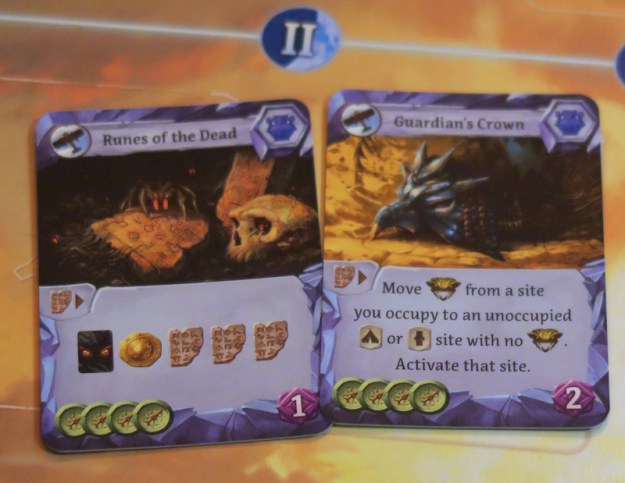
Meanwhile, on the next table, Ivory had enticed Cobalt, Purple and Teal to play his new Christmas acquisition, Lost Ruins of Arnak.  It turns out that he wasn’t the only person in the group to receive this game over the holidays—Green had also been given a copy and would no doubt have been keen to play had he been able to come.  The game is set on an uninhabited island  where explorers have found traces of a great civilization. Players lead an expedition to explore the island, find lost artifacts, and face fearsome guardians in a quest to learn the island’s secrets.

Lost Ruins of Arnak
– Image by boardGOATS

The game combines deck-building and worker placement with resource management.  Players start with six cards in their deck, two Money, two Compasses and two Fear cards, and draw five to play.  As in the original deck-builder, Dominion, or in the racing games, Flamme Rouge and Snow Tails, Fear cards clog up players’ decks and more are acquired as the game progresses.  But also as in Dominion, there are ways to “exile” cards during the game.  So, players can try to keep a tight deck with minimal cards, or try to buy lots of cards that work well together.  Players then have two meeples each that can be sent to locations on the map, to either discover or use an action Location.  These generally give Resources plus some additions like draw a card, or gain a Fear card etc.. Each new site also has a Creature guarding it, which, if beaten, will give points and a small one-time bonus.

Lost Ruins of Arnak
– Image by boardGOATS

The Research Track is where players spend three of the resources, Tablets, Arrows and Jewels. Each player has two tokens which move up the same track giving different rewards as it ascends. Thematically, you can’t write stuff in the notebook until you find it with your magnifying glass, so the former can never overtake the latter on the track. And of course, the notebook gives cooler rewards. Players get one action each per turn, until everyone has passed and the game finishes after five rounds.  At the end of the game, Points are awarded for Cards, for progress on the Research Track, for discovering Locations and for beating Creatures; the player with the most points at the end is the winner.

Lost Ruins of Arnak
– Image by boardGOATS

The first round was very slow as there was only limited spaces to go and everyone had weak cards in hand. Purple, Cobalt and Teal all focused on building up resources and buying tool cards for future rounds where Ivory did something a little different and started progressing along the Research Track as well as opening up new Dig sites. The issue with this was that he picked up a Fear card, though fortunately he had already got rid of one of his initial Fear cards through the site he opened so there was no net negative effect.  In the second round, things picked up and strategies started to become apparent.

Lost Ruins of Arnak
– Image by boardGOATS

Cobalt continued to focus on getting Tools, especially ones that allowed him to draw extra cards (and hence allowed additional actions) and he started making headway on the Research Track and was first to unlock an Assistant. He also did a little exploring, but did not overcome the Guardian. Ivory wasn’t far behind on the Research Track and also continued to explore new areas (and this time overcome the Guardian) and make up for lost ground in getting tool cards. Teal went for a very different strategy and started to focus purely on exploring and overcoming Guardians, netting him three points for exploring and gaining the idol and five points for overcoming the Guardian. Purple, on the other hand, continued to focus mainly on building her supply of resources.

Lost Ruins of Arnak
– Image by boardGOATS

The third round continued in much the same vein with everyone continuing to pick up Tools and starting to gain Artifacts. Ivory focused almost exclusively on the Research Track and was able to catch Cobalt and had picked up all the bonuses, while both unlocked their second assistant. Teal was continuing his exploring strategy to great effect, whilst Purple continued to bide her time building up resources, including a significant amount of Rubies (the most valuable resource).  And so it continued into the next round too, except Cobalt began spending his Compasses on Artifacts while Ivory continued to hoard them for the last round.

Lost Ruins of Arnak
– Image by boardGOATS

And it was in the final round that Ivory’s plan became apparent as, in true Ivory style, he used all his Compasses to explore a level two Dig Site. Hitherto, exploration had been limited to level one sites and Ivory was the first to explore a higher level, thinking this would be a fun thing to do. In the end, this ironically might have been the critical move that influenced the outcome of the game. The level two site gave Ivory valuable resources, helping him complete the Research Track just after Cobalt and also overcome the newly uncovered Guardian. With two idols on a level two site, this gave Ivory eleven points.

Lost Ruins of Arnak
– Image by boardGOATS

Teal continued with his strategy and also explored a level two site and began moving along the Research Track too. Purple used all her carefully collected resources and make a late dash to the top of the Research Track, gaining valuable points.  It should be said the whole work placement element of the game felt very tight with limited spaces at the start and then difficulty knowing whether to take the optimal route planning cards first, but potentially missing out on a valuable space to other players, or taking the sub-optimal route and placing your workers first guaranteeing the activity, but at a cost of efficiency.

Lost Ruins of Arnak
– Image by boardGOATS

Everyone got blocked at some point (except perhaps Teal who was opening up new sites), and certainly towards the end of the game everyone wished they had more than two workers!  Teal with his explore/overcome Guardian strategy led to him defeating a very impressive impressive six Guardians and gave him a total of sixty-eight points.  In the end, however, the fact Ivory completed the Research Track and was also able to explore and overcome Guardians gave him the victory by just three points with a winning total of seventy-one.  It was a very good game though, one greatly enjoyed by all involved.

Lost Ruins of Arnak
– Image by boardGOATS

Learning Outcome:  Now we know what Bears do in the Woods!

Essen 2023

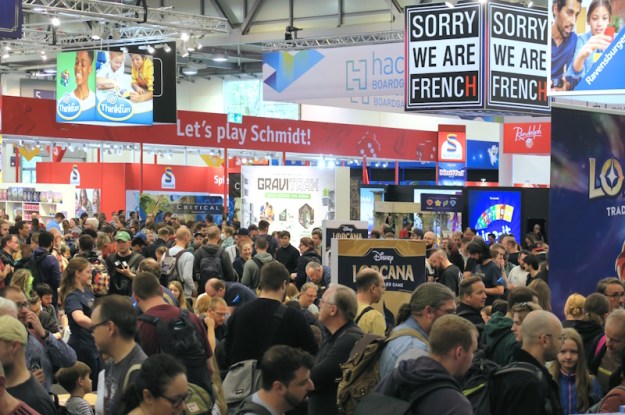
Today is the final day of this edition of the largest games fair in Europe and arguably the world, the Internationale Spieltage.  Known to gamers worldwide simply as “SPIEL” or “Essen”, the annual fair is of particular significance as many new releases are scheduled to coincide with the event just in time for Christmas sales.  Following the recent change in management, this year there were quite a few changes.  Aside from the logo, the most noticeable was the layout in the halls—according to one game designer, every stand except his was in a new location in an effort to theme the halls.  For the most part, this seemed to work, though inevitably some people will feel they lost out in the great shuffle.

Essen 2023
– Image from spiel-essen.com

One thing that hasn’t changed, is the lack of general gaming space, especially when compared with the likes of the UK Games Expo and Gen ConSPIEL is a games fair, not a convention—it’s purpose is to showcase new and up-coming games and sell them to the general public, but also small and medium-sized resellers.  Additionally, there is a lot of business going on behind the scenes, including designers demoing games to publishers, and publishers meeting with producers and other publishers to discuss contracts.  It is arguable that large amounts of playing space are counter to SPIEL’s priorities, but they could definitely do with providing more chairs—not everyone has the stamina of a twenty year old, and the number of people just sitting on the ground suggests more seating is an essential.

Essen 2023
– Image by boardGOATS

Following the cancellation of SPIEL in 2020, there were restrictions on numbers for 2021 and Covid mandates in 2022 leading to reduced numbers (93,600 and 147,000  respectively), so 2023 was the first year when things were back to normal.  One question therefore, has been whether numbers would return to the levels, or even exceed those of 2019, when there were 209,000 entries.  It will be a few days before the statistics for 2023 are reported, but anecdotally, the answer is yes, with some exhibitors commenting that Friday was the busiest it had ever been, and the annual no-ship Maths Trade and Auction was as mad as ever.

My Gold Mine
– Image by boardGOATS

This year there is the usual selection of the latest releases including, The White Castle, Nucleum, Kutná Hora: The City of Silver, Evacuation, The Glade, My Gold Mine, Amygdala, Forest Shuffle and Footprints.  There are also expansions for previous games like Cascadia (Landmarks), Ark Nova (Marine Worlds), Lost Ruins of Arnak (The Missing Expedition) as well as this year’s winners of the Deutscher Spiele Preis, Planet Unknown (Supermoon).

Ticket to Ride Legacy: Legends of the West
– Image by boardGOATS

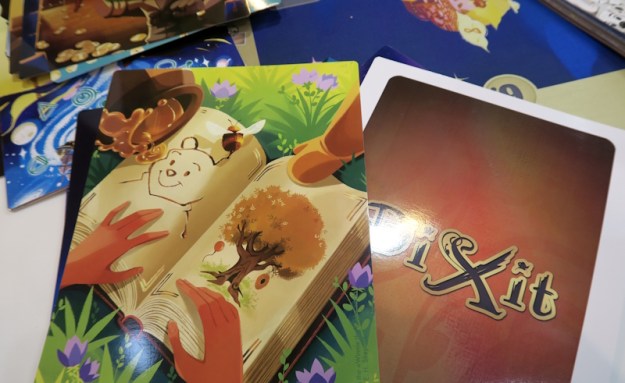
A common theme are the re-releases and reimplementations of old favourites and there are a lot of these this year, like Ticket to Ride (Legacy: Legends of the West) Elfenland, Zooloretto, Dixit (Disney Edition), Shipyard (Second Edition) and NMBR 9.  As usual, there are also loads of mini promotional expansions available for games like Flamecraft, Die Wandelnden Türme, Keyflower, Underwater Cities, Dorfromantik and 2022 Golden GOAT, Praga Caput Regni, amongst others.  There truly is something there for everyone.

Dixit: Disney Edition
– Image by boardGOATS

21st February 2023

With this set to be our last meeting before The Horse and Jockey changed hands, a lot of people turned up early to enjoy the Thai special (a preview of the Thai Night the following day).  As the last of the food was consumed the final couple of people arrived, and then it was all about deciding who was going to play what and how we were going to split up the group of thirteen.  In the end, Ivory took a group of five to play the “Feature Game“, Verdant, while Pink and Lime led a group of four to play Cascadia, and Green gave his copy of Wingspan with all the expansions (Europe, Oceania and Asia) an outing.

Verdant
– Image by boardGOATS

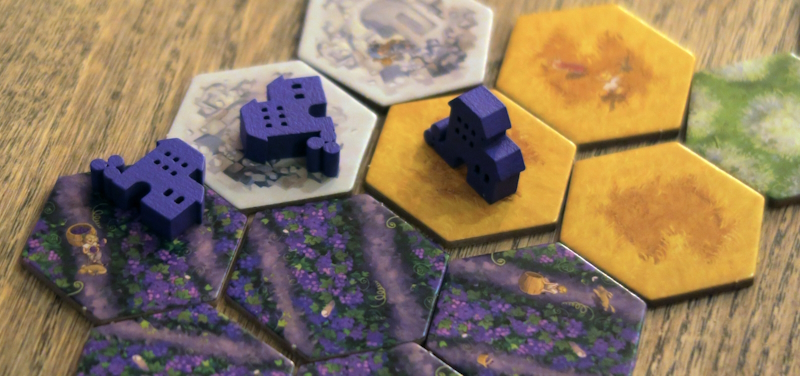
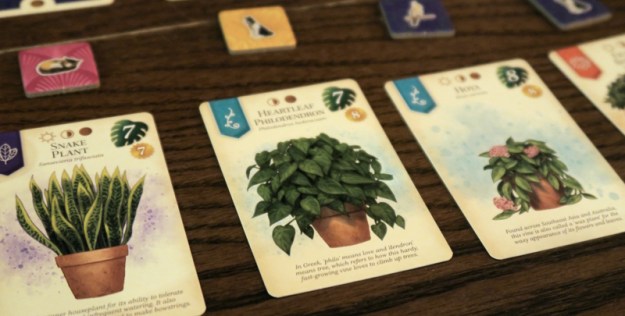
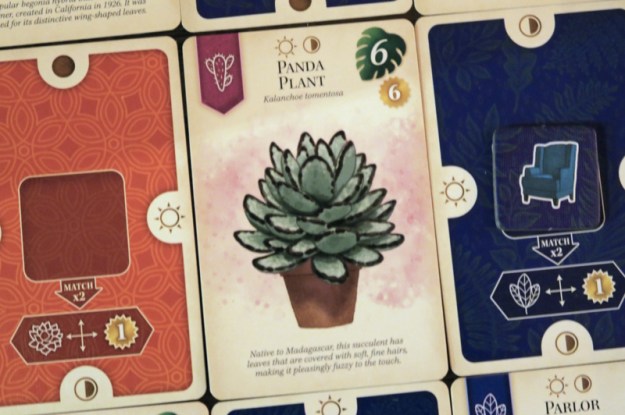
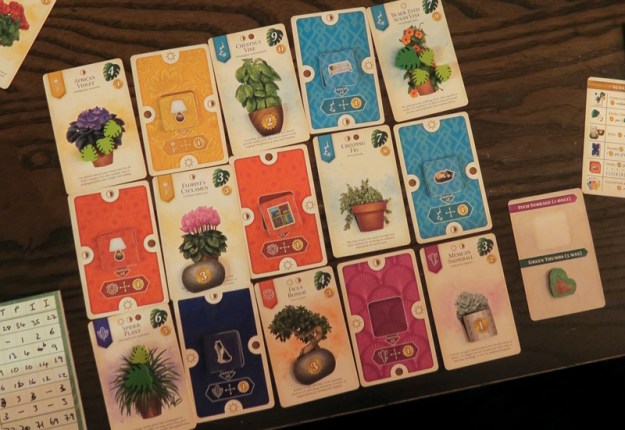
The “Feature Game“, Verdant is a card game where players are trying to match plants to rooms and grow luxurious foliage to give them the most points at the end of the game.  The game is played over fourteen rounds with players taking it in turns to take cards from a central market.  In a similar way to Cascadia where hexagonal tiles are paired in the market with animal tokens, in Verdant, the cards are paired with object tokens.  However, where, in Cascadia players just have to choose which pair to take, in Verdant the decision is a little more complex.  Instead of taking a card and it’s token, in Verdant each tokens is paired with two cards (a room and a plant) and players choose one card to take with the associated token.

Verdant
– Image by boardGOATS

Players then add the card to their three by five array, with plants placed next to rooms and visa versa to form a chequerboard-type arrangement.  Whenever a plant is placed next to a room with matching lighting conditions, it gets a verdancy token; plants which achieve target verdancy are completed and gain a fancy pot (some of which give bonus points) and then score points at the end of the game.  Players then add and/or spend their object tokens.  The objects come in two types, Furniture/Pets and Nurture tokens.  Furniture/Pets are either added to a room or placed their one storage space.  Nurture tokens are particularly useful as they can be spent to add extra verdancy to plants.

Verdant
– Image by boardGOATS

At the end of the game, as well as scoring points for completed plants, players also score for each room with adjacent plants that match their type—one point for each plant, two for each if the room contains an object with a colour that matches the room.  Finally, players are rewarded for any residual verdancy and receive bonus points for having a complete set of each plant type, for having a complete set of each room colour and an increasing number of bonus points based on how many unique Furniture/Pets they have in their home.

Verdant
– Image by boardGOATS

Blue started, and with no idea what she was doing, took a high verdancy plant and passed the problem on to Teal whose turn it was next.  There was quite a lot of “try something and see what happens” going on in the early part of the game, but before long Pine voiced everyone else’s thoughts when he asked of Ivory, “How come you’ve got two pots already?” Then, as everyone shrugged, Pine added, “Oh, I see, you have cheap plants…”  Ivory looked, if not exactly disgruntled, some way from being actually gruntled, and replied, “You make it sound like I got them from a garage on the way here!”  And so the game continued with players taking cards and adding them to their arrays with as much verdancy as possible.

Verdant
– Image by boardGOATS

About halfway through the game, Pine shared a new post on The Jockey Facebook page which said the current business owner would now be leaving in two weeks but Dan (the current manager) would be responsible for the pub for the next couple of months.  So, while there’s still some uncertainty, it seems there WILL be a meeting in two weeks time.  By this time, people were getting into their strides a little, though most people’s main strategy  just seemed to be taking Nurture tokens whenever they had the chance, something which Pine and Indigo seemed to get a lot of and Blue didn’t have until her final tile (which she picked up with a Panda Plant, much to Pink’s delight from the next table).

Verdant
– Image by boardGOATS

And that just left the scores.  A bit of a point salad, it seemed like points came from everywhere.  The bulk of everyone’s points came from completed plants though and rooms scored surprisingly well too.  Most people thought Ivory was going to win, and so it proved, but much to her surprise, Blue was only a couple of points behind his seventy-nine, and took second.  It was really tight for third with everyone else within a couple of points of each other, but it was Pine who just made it onto the podium ahead of the others.  Although the game had taken quite a bit longer than expected and was more of a head-scratcher than its brother Cascadia, Verdant had been universally enjoyed and deserves another go.

– Image by boardGOATS

Speaking of Cascadia, Pink, Lime, Black and Jade were giving last year’s Spiel des Jahres Award winner another outing.  In this game, similar to Verdant, on their turn, players take a terrain tile and animal token from the market and add them to their array.  In this game however, players score points for their largest terrain of each type and also for animals in a specific arrangement.  There is a lot of replayability in the game as each animal has several different scoring motifs on cards with one of each drawn at random at the start of each game.  This time Bears scored for each group not surrounded by bears with larger groups scoring more; Salmon scored for long chains, and Elk scored for groups of one, two, three or four tiles in a particular layout.

Cascadia
– Image by boardGOATS

There was some discussion surrounding the scoring of Foxes, but they scored for each unique animal pairs surrounding them.  The Hawk card was from the Tantrum House Promo Set and gave points for each Hawk that had a direct line of sight with both an Elk and a Fox.  And this proved challenging for most people as Pink spent the first half of the game by taking all the Elks in what was later referred to as “The Great Elk Shortage”.  The others soon got their revenge, however, when Pink was after Bears and everyone else took them just before he could.  The game progressed quite quickly and before long, it was time to score.

Cascadia
– Image by boardGOATS

Despite the Elk and Bear based tussle, the scores for the Wildlife were very close with Jade just three points ahead of Black and Pink. In this game though players ignore the largest areas at their peril, but these need quite a lot of planning to make them work.  With bonus points available to the player with the largest of each type of terrain, going heavily into one or two not only scored per tile, but also an extra three points.  This tactic gave Pink eight more points than anyone else for his Habitats which ultimately gave him a comfortable victory, eight points clear of Black in second.

Cascadia
– Image by boardGOATS

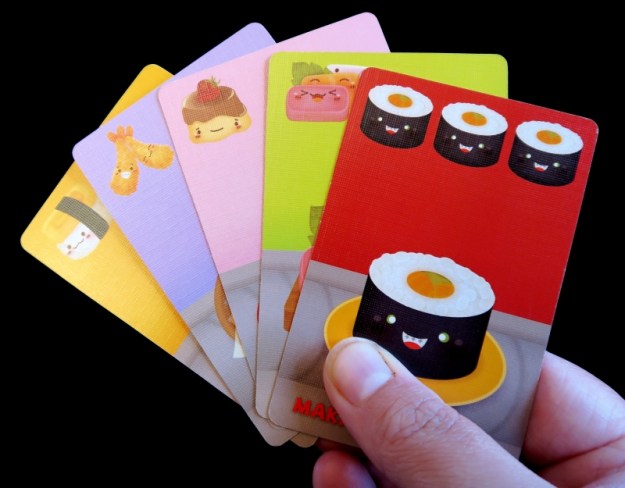
Cascadia was the first game to finish and the group looked around for something quick to play that everyone knew, and quickly settled on Sushi Go!.  This is the archetypal card drafting game, where players are dealt cards, keep one and then pass the hand to their neighbour.  Played over three rounds, players are collecting different types of sushi.  This game was closer than Cascadia and a bit rushed.  There was a big debate as to whether players could play wasabi on top of wasabi and score nine points—the initial response was “that would be silly”, but it was confirmed with a rules check.

Sushi Go!
– Image by boardGOATS

The group played with the Soy Sauce Promo which gave points for having lots of different types of sushi, and variously pretty much everyone had a go at making them score.  Almost everyone eschewed the Chopsticks, which allow players to take two cards instead of one later in the round, but that assumes there is an opportunity to use them later.  Pink gave them a go, but without much real success.  The final round had no Puddings, so there was a three-way tie for Desserts giving each player two points, except for Pink who missed out completely and lost six points.  With a deficit of eight points in such a tight game that probably gave victory to Jade, who finished two points ahead of Pink in second and five ahead of Black in third.

/tr>

Sushi Go!
– Image by boardGOATS

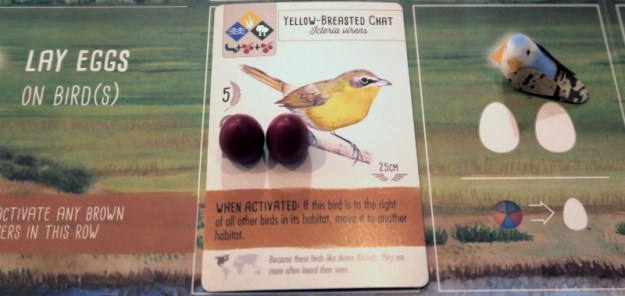
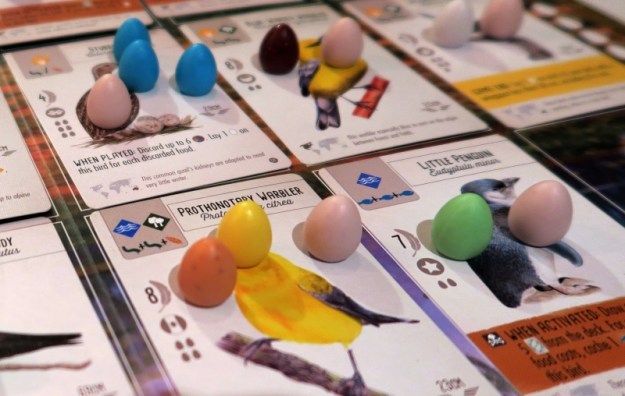
Meanwhile, on the third table, a rather epic game of Wingspan was underway.  This is one of the group’s favourite games and seems to be popular with almost everyone.  The game is a kind of action based card-driven, engine-building game.  Players take it in turns to take one of four actions:  take food; take bird cards; pay food to place bird cards, or lay eggs on bird cards.  Since we enjoy Wingspan and play it a lot, we have all the current expansions within the group, though none of the people playing this time had experienced Oceania or Asia (except solo), so the group decided to put in as much content as they could. This meant using all the bird cards available, creating three huge stacks.

Wingspan
– Image by boardGOATS

There were so many cards that they piled way up beyond the top of the card holder, and by the end of the game, they were still over the top!  The group added the round bonus chits from the European and Oceania expansions to the base game ones, but ended up only pulling out one from Oceania (birds pointing left) and none from Europe.  And of course the group used the nectar (replacing the original set of dice too), and lots of different coloured eggs from the different sets.  The only parts of the expansions the group weren’t able to use were the two player components and the six/seven player components from Asia as there were four in the group, Green, Plum, Byzantium and Sapphire.

Wingspan: Oceania Expansion
– Image by boardGOATS

The group only needed to refer to the rules a couple of times for clarification on how the birds interacted.  Byzantium’s Snowy Owl, did not point left or right, so he could not count it towards the end of round goal, which meant he only tied with Sapphire for first place in round two.  For most of the game there was little egg-laying, but the group managed to fill their boards with lots of birds (ten to thirteen each). Only Green and Sapphire went on an egg laying frenzy in the last couple of rounds, but they still only managed ten and thirteen in total respectively. Plum and Byzantium both managed to collect an almost unheard of total of four bonus cards each.

Wingspan: Asia
– Image by boardGOATS

Although this helped Byzantium towards an extra twelve points from the bonus cards, it was still shy of Sapphire’s thirteen from two cards (seven points of which he gained on his very last turn with a lucky bonus card draw).  Plum, however, really made good with her bonus cards for a whopping total of twenty-five.  This was to prove the clincher for her as she won the game with ninety-six points, some way ahead of Sapphire’s eighty-eight giving him second and Green five points behind in third.  Of the expansions, everyone in the group used lots of Nectar (another aspect where Plum managed to outscore everyone else) and a good smattering of birds from each expansion, except for Asian birds.

Wingspan: Oceania Expansion
– Image by boardGOATS

Only Sapphire placed an Asian bird card with the group using twenty base game birds, ten from the European expansion, fifteen from Oceania and the single Asian bird. Green did manage to get two “flitting” birds and regularly made use of them to flit between habitats. During the after game discussion, the group agreed that they really wanted to try the two player and the large group versions. Having played Wingspan with six last summer without the Asia adjustment, it was clear what needed tightening up, and that seemed to have been done.  As a result, the group all agreed that they looked forward to a Mega-Wingspan game soon.

Wingspan: Oceania Expansion
– Image by boardGOATS

Learning Outcome:  Some board games are prickly and others more succulent.

Boardgames in the News: The Guardian’s 2022 Christmas Choice

Some time ago, The Guardian added a specially dedicated board game section to their online “lifestyle” magazine.  Although they include articles covering jigsaws, role-playing and even Wordle in the mix, over the years, they’ve also published popular articles discussing modern board games—their 2020 “Best Game to Play at Christmas” article has garnered over a thousand comments.  Their latest contribution is a list of seven of the best new board games to play with family.  The most high profile game in the list probably is Cascadia which won the 2022 Spiel des Jahres award (and was a runner up for the Golden GOAT last week), but the list includes a variety of games and is well worth a look.

Cascadia
– Image by boardGOATS

Golden GOAT Award Winners – 2022

As usual, the boardGOATS met just before Christmas for a party and to decide the winners of the GOAT Awards.  After pizza and crackers and the usual mayhem, the group voted for two awards:  the Golden GOAT for our favourite game and the “GOAT Poo” award for our least favourite.  Everyone had the usual three points to hand out for the Golden GOAT Award (plus a bonus if wearing Festive Attire), though a maximum of two points could be given to any individual game.  Everyone could also nominate up to two individual games for the GOAT Poo Prize.

Dice Hospital
– Image by boardGOATS

This year, there were a few games that received the unofficial “Marmite Award”, that is to say they received nominations for both the Golden GOAT and the GOAT Poo prizes.  These included Dice Hospital, Azul, Modern Art and Viticulture.  For the GOAT Poo Prize itself, there were several games that received two or three nominations, but the clear winner was Villainous – The Worst takes it All which received six nominations—quite an achievement since only five people played it and one of those wasn’t present for the vote!  Villainous is a beautiful, asymmetric card game, but one that we struggled with for several reasons, not least the fact that players had to work out how to play their own character, and we were playing it with five people which is two or three more than it needs.

Disney Villainous: The Worst Takes it All
– Image by boardGOATS

Nominations for Moment of the Year included two epic games, one of Viticulture and the other of Tapestry.  The latter nomination included the citation:  “I thought I was doing well until Ivory lapped me… twice!”  Pine also recalled Lilac nobbling him in Turf Horse RacingThe most poignant moment however, with hindsight, was last year’s UnChristmas Dinner, which was the last meeting attended by Burgundy, who very sadly, suddenly passed away just a few days later.  We all still miss him, but the fact we were joined by Jade and Plum and their partners this year is his legacy, and one we think he would have been proud of.

Mike Parker
– Image by
Pushpendra Rishi

And that just left the Golden GOAT Award for the best game of the year.  Previous winners including Wingspan, Altiplano and 6 Nimmt! were ruled out, but there were plenty of options remaining.  Lots of games received three nominations including Endeavor, Cascadia, Old London Bridge, Splendor, Tapestry and Die Wandelnden Türme  But this year, the clear winner was Everdell. This card-driven game was only played for the first time a few weeks ago, but it is planned to play it again soon with one of the expansions being the “Feature Game” early in the new year.

Golden GOAT - 2022
– Image by boardGOATS

15th November 2022

With lots of absentees including Pink, Lemon, Orange and Plum, it was a relatively quiet night, but there were still nine and that left a difficult decision as to how to split up the group.  The “Feature Game” was Everdell, and although it only really plays four, Ivory had the new, Complete Collection which includes the Bellfaire expansion which adds two more players.  Three players seemed a little on the small side, so a four and a five it was, and the five were keen to give Everdell a go.

Everdell
– Image by boardGOATS

Although Ivory had played Everdell with Pink and Blue in the summer of 2020, nobody had seen the new, Complete Collection which was a recent acquisition for Ivory, and what a box it was—It was humongous!   Everyone wondered how Ivory stored it.  That developed into a conversation about where people store their games, and it seems pretty much everyone uses a “Kallax” (though some people didn’t know that’s what they are called). However, it turned out the Everdell box is so big, it doesn’t fit onto a Kallax and Ivory stored it under his bed!

Everdell
– Image by boardGOATS

Everdell is a very good looking game, a card-driven, tableau building and worker placement game set in a woodland glade.  Players take the role of leader of a group of critters constructing buildings, meeting characters and hosting events by placing workers to get resources and spending them to play cards.  Everyone enjoyed the opportunity to choose their own wooden meeple animals out of a selection of over twenty different types.  Ivory went for the purple Platypuss, Purple went for a light purple Owl, Lilac went for orange Foxes, Teal chose the grey Hedgehogs , and Green wanted the Brown Bats.  By random selection using a mobile app, Teal was to go first.

Everdell
– Image by boardGOATS

It took a few turns to get the hang of the game, although it is not overly complex on the face of things.  It is one of those games where there are apparently lots of choices, but in practice they are clear and relatively simple:  players either place a meeple to get a selection of resources, or play a card into their tableau.  And then, when all possible choices have been exhausted, players move onto the next “season”.  The trick is working out how to extend the possible number of turns taken each season. Ivory was the only one of the group who had played it before, so had got it worked out.  Everyone else had moved into spring while he merrily carried on taking his turns in his winter!

Everdell
– Image by boardGOATS

Teal was the first to move onto spring, and this order continued through the rest of the game. At one point it looked as though everyone else would have finished completely, while Ivory was still in summer!  It didn’t quite work out like that, but Ivory did have several more turns after everyone else had finished.  The other trick to Everdell is to pair up the Critters cards with the Construction cards. By building a Construction, a player could then build the corresponding critter for free afterwards, thus giving them extra turns and extra bonuses.  Ivory did well in this, and his starting and early meadow cards fell his way.

Everdell
– Image by boardGOATS

Green and Purple also did well getting pairs of cards and playing them during the game. Unfortunately Lilac and Teal just couldn’t seem to get the pairings they needed. So it seems there is still a certain amount of luck in this game.  The other thing which surprised everyone was how quickly the group got through a very big stack of cards from the meadow draw pile.  After last time where we nearly failed finish Endeavor before the pub closed, the group set an alarm to give them a thirty minute warning before closing time as we were worried we may have the same problem this time.

Everdell
– Image by boardGOATS

By the time the alarm went off nearly two hours later, the game was all but finished—not bad for a new five player game.  Playing it again, the same group could probably do it in ninety minutes or less.  Would it get another outing though?  It certainly has cuteness factor in spades; it is interesting, and the game-play is not overly complicated; it has challenge in random variations, and many good looking expansions to enhance and change the experience. So, it will almost certainly get another outing and Ivory had better not put the box too far under the bed, as we’ll be wanting him to bring it along again in the new year.

Everdell
– Image by boardGOATS

After too much “cards with text” with Villainous last month, it was clear that Everdell was not a game ideally suited to Lime and Pine.  Instead, Blue said she had just the game for them: Cascadia.  Cascadia won this year’s Spiel des Jahres award, and had not yet had an outing within the group.  The game is very simple though:  players have a starting three hex terrain tile, and on their turn, they take a terrain hex and a wooden wildlife token and add these to their tableau.  Each terrain tile has one, two or three types of wildlife depicted on it, and the wooden tokens have to be placed on a terrain tile with matching wildlife symbol and that is more or less all there is to it.

Cascadia
– Image by boardGOATS

The interesting part is the scoring.  Players score points for the largest area they have of each of the five different types of terrain with bonus points for the player with the largest area of each.  That is simple enough, but they also score points for each of the different types of wildlife, and their scoring is different for each game.  The scoring depends on the location of each type of wildlife, for example, this time players scored for each set of three (and only three) adjacent bears.  They also scored points for each different type of wildlife between pairs of hawks.  Ribbons of salmon and groups of elk also scored as did foxes for each different type of wildlife surrounding them.

Cascadia
– Image by boardGOATS

The game play behind Cascadia isn’t very new or terribly original, with the tile laying elements giving a feel similar to games like Kingdomino, or even Carcassonne.  The variation in the wildlife scoring (with more wildlife cards available to add more variety), however, and the fact that the wildlife tokens are finite in number and are drawn from a bag, adds just a hint of something reminiscent of bag-builder games like Orléans or Altiplano.  As the group played and Lime and Pine got into it, Blue and Black started to appreciate the subtlety a little more.  The addition of special Keystone tiles that give players nature tokens when wildlife tokens are placed on them, also help players to mitigate the luck elements.

Cascadia
– Image by boardGOATS

This time, foxes seemed to hide in the corner of the bag when players wanted them, then when they didn’t, they all came out of hiding.  Pine, inevitably put in a good showing and, despite everyone trying to persuade him, Lime succeeded in ignoring the advice to join his two groups of bears together (which would render them pointless).  The scores for the terrain were quite close with a spread of just a handful of points.  However, while Lime, Blue and Black had similar scores for their wildlife as well, Pine was eight points clear of his nearest rival giving him a final score of ninety-eight, ten points clear of Blue who was the best of the rest.  Pine and Lime had clearly enjoyed the game though and it will almost certainly get another outing soon.

Cascadia
– Image by boardGOATS

Lime excused himself, leaving Blue, Black and Pine to play something quick, taking less than an hour.  Although every time we play it, Pine points out that Bohnanza is not quick, this time he was persuaded because there were only three players and he wasn’t given time to think about it too carefully.  Bohnanza is one of the group’s most popular games, yet it hasn’t had an outing for ages.  The game play is very simple, but very interactive with a strong trading element. The active player first plays one or two bean cards from their hand into their fields taking care to keep them in the same order and only play the cards at the front.  They then turn over the top two cards from the deck and plant or trade them.  Finally when everything else has been dealt with, they can trade any cards in their hand with anybody else.

Bohnanza
– Image by boardGOATS

Cards are played into fields—with more players, each person has two fields in front of them and may buy a third, but with three, everyone starts with three fields.  This is important as each bean field can only hold one type of bean at any given time.  Beans can be harvested at any time to give coins and the game ends after three turns through the deck.  There are a few clever things about the game.  Firstly, players cannot harvest a field with a single bean in it unless all their fields have a single bean in them—this prevents players just cycling through beans they don’t want.  The really clever part of the game is that the fact that bean cards turn into coins when fields are harvested.  As the rarer beans are more valuable, this means they get increasingly rare as the game progresses.

Bohnanza
– Image by boardGOATS

This time, Blue planted two lots of Garden Beans early in the game which meant there were none available later.  Pine and Black shared the Black-eyed Beans, Stink Beans and Red Beans between them.  Blue planted lots of Green Beans and took it in turns with Pine to experiment with Soy Beans.  By the end, there were really only Wax Beans, Blue Beans, Coffee Beans and the occasional Green, Soy and Stink Beans.  With three experienced people playing, it was always going to be a tight game.  Pine finished with thirty “Bohnentaler”, a couple of more than Black, and was quite disgusted to find he was pipped by Blue by a single point.

Bohnanza
– Image by boardGOATS

Learning outcome:  Ikea need to sell a bigger Kallax.

Deutscher Spiele Preis – 2022

The Deutscher Spiele Preis awards recognise the “Best Children’s Game” and a top ten list of the “Best Family and Adult Games”, the results of an open vote by games clubs, gamers and people in the industry.  They are awarded annually at the Internationale Spieltage in Essen and the winners are announced in advance.  As annual awards, the games named in the Deutscher Spiele Pris lists often intersect with the winners and nominees of Spiel des Jahres Award, but in many other ways, the awards differ.

Deutscher Spiele Pries 2022
– Image from
spiel-messe.com

The Spiel des Jahres winners are chosen by a committee with a list of strict criteria whereas the Deutscher Spiele Preis is more a list of the most popular games of the preceding year.  As such, games that are not eligible for the any of the Spiel des Jahres Awards often feature in the top ten list of “Best Family and Adult Games”.  For example, games that were considered at the time to be too complex or aggressive for the Spiel des Jahres awards have ranked number one in the Deutscher Spiele Preis list.  These include Tigris & Euphrates (1998), Puerto Rico (2002), Louis XIV (2005), Caylus (2006), The Pillars of the Earth (2007), Agricola (2008), Terra Mystica (2013), Russian Railroads (2014), Voyages of Marco Polo (2015), Mombasa (2016) and Terraforming Mars (2017).

Terraforming Mars: Hellas & Elysium
– Image by boardGOATS

Of all these great games, only Terraforming Mars even received a nomination for the Kennerpiel des Jahres award (though Agricola did receive a special “Complex Game Award”).  In contrast, over the last few years, there has been much more overlap with games like Azul (2018), Wingspan (2019) and The Crew (2020) all ranking highest in the Deutscher Spiele Preis list and winning either the Spiel or Kennerspiel des Jahres award.  Further, all the other winners of both awards including MicroMacro, Cartographers, Paleo, Lost Ruins of Arnak have featured high on the Deutscher Spiele Preis list and/or received Spiel/Kennerspiel des Jahres nominations.

Ark Nova
– Image by boardGOATS

This year, while there is still a lot of overlap between the lists, the top ranked game on the Deutscher Spiele Preis list is a bit of a throwback, being too complex even for the Connoisseur or Kennerspiel des Jahres award.  The Deutscher Spiele Preis winner, Ark Nova has been extremely popular amongst gamers creating a lot of “buzz”, so it is no surprise that it did well.  The strategy revolves round building card combinations and the theme, zoo building is very appealing—everyone loves animals.

The full Deutscher Spiele Preis list is:

  1. Ark Nova
  2. Cascadia (Spiel des Jahres Award Winner)
  3. Dune: Imperium (Kennerspiel des Jahres Award Nomination)
  4. Living Forest (Kennerspiel des Jahres Award Winner)
  5. The Red Cathedral
  6. Witchstone
  7. Beyond the Sun
  8. SCOUT (Spiel des Jahres Award Nomination)
  9. Golem
  10. Terraforming Mars: Ares Expedition
Ark Nova
– Image by boardGOATS