Tag Archives: Concordia: Venus

7th January 2025

Blue and Pink were early for a change and had mostly finished their supper when everyone else arrived.  The “Feature Game” was to be Concordia Venus which is a reimplementation of Concordia, but can also be played with an upgrade-expansion to the original game.  Concordia is a strategy game of economic development in Roman times and although the rules are relatively simple, the game has a lot of depth.  Plum had been super-keen to play this, and, as it turned out, there were several others who were also very keen to give it a go, so as a result, there were soon two games underway.
Concordia: Venus
– Image by boardGOATS

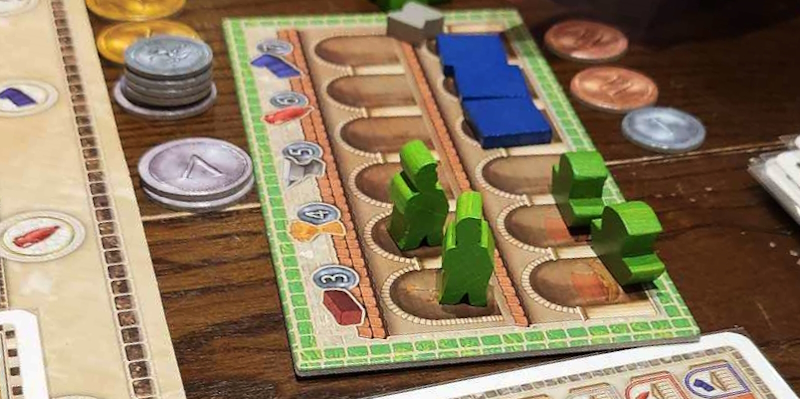
The first of these involved Plum, Sapphire and Teal, playing with Burgundy‘s copy of the original Concordia with the Venus expansion.  This was one of Burgundy‘s favourite games and many people in the group fondly remember being taught it by him.  Game play is super-simple:  each player has a hand of cards, so on their turn, they play one and do what it says.  And that is all there is to it.  Players start with a hand of seven Personality Cards which provide a simple array of actions:  move Colonists and build, produce Resources, trade Resources, use another player’s most recently played Card, buy more Cards, recycle their Card deck.
Concordia: Venus
– Image by boardGOATS

Players use their Consul card to buy more Personality Cards during the game.  As well as providing more and increasingly powerful options, they are also key to scoring.  Each card is related to an ancient god who rewards its owner with victory points according to different scoring criteria.  This reward is then multiplied by the number of Cards the player has that are dedicated to that god.  For example, Saturnus rewards players for having buildings in different provinces.  If a player has built in seven different provinces and has four cards dedicated to Saturnus, they receive twenty-eight points.
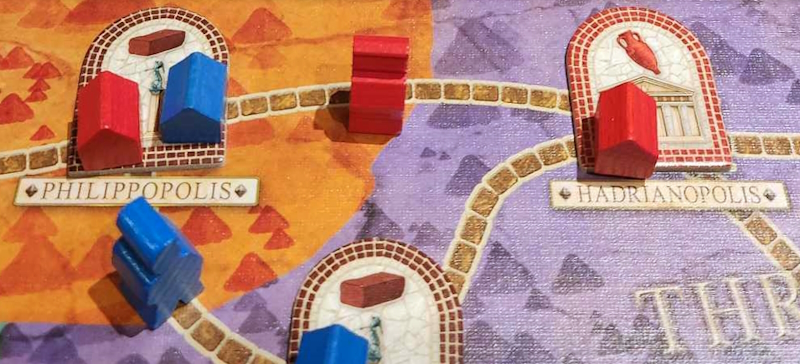
Concordia: Venus
– Image by boardGOATS

The game ends either after a player purchases the last card from the display, or after one player builds their fifteenth house after which everyone else completes their final turn before scoring.  One of the things that is very clever about the game is how much variety is achieved from very little variation.  Players all begin with the same starting cards and the same resources; the only change from game to game is the order the Cards appear in the market and the distribution of City Resource tiles at the start of the game which dictate which cities produce what.  With these small variations the game can change hugely as players fight to control the area that gives the most lucrative cities during the game and when combined with their Cards to give the most points.
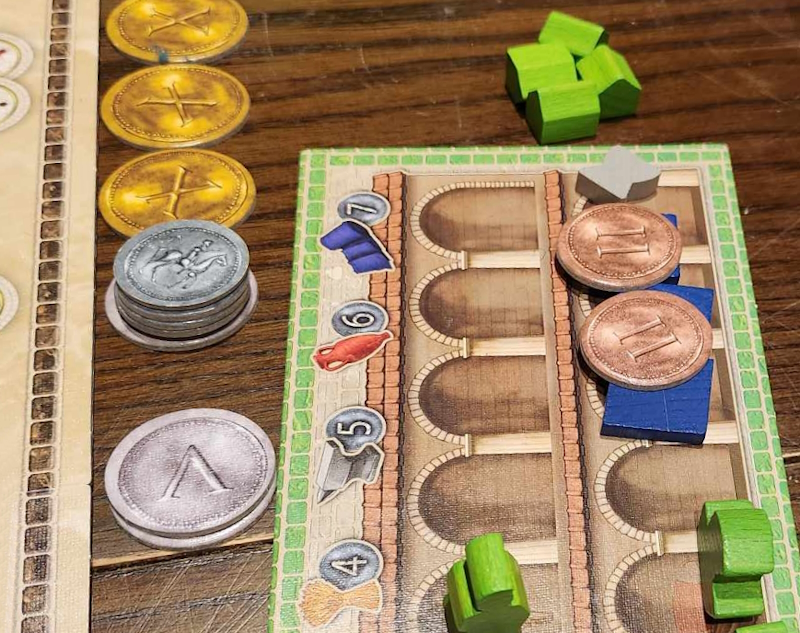
Concordia: Venus
– Image by boardGOATS

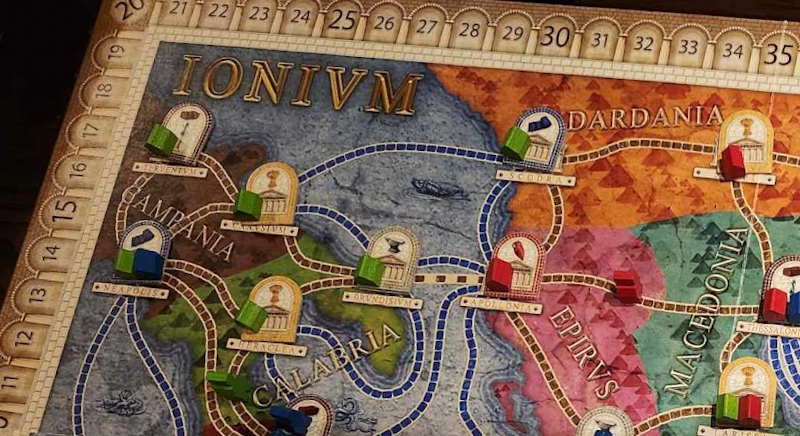
There is even more variation to be had with alternative maps, but the reimplementation of Concordia, Venus, introduces an eighth Card to the starting hand (the Magister, which allows a player to repeat their previous action), the addition of the Minerva scoring Cards (which give players extra points for each city of the type indicated by the specialist), as well as three new maps (Cyprus, Hellas and Ionium).  These can also be added to the base game using a combination of the Venus expansion and the Balearica / Cyprus expansion; this was was the version Plum, Sapphire and Teal played, which meant they started by sorting out what they needed to play the game.

Concordia: Venus
– Image by boardGOATS

The group chose to use the Ionium map from the Venus expansion as it plays well with three.  Sapphire had a positively storming game—he was perhaps helped by the fact that Teal and Plum started the game by heading east leaving Sapphire to explore the west unopposed, but he still had to make it work for him.  And make it work he did, with two turns in which he claimed four cities.  Later in the game, he made good use of his Diplomat Card to copy the Consul Plum had used.  Sapphire had a couple of Provinces to himself so Prefecting in those areas helped only him. Teal and Plum had both built in a couple of Cloth-rich areas, but Plum wasn’t always able to make the best of hers and on two occasions her storage are was full when she could have received goods.
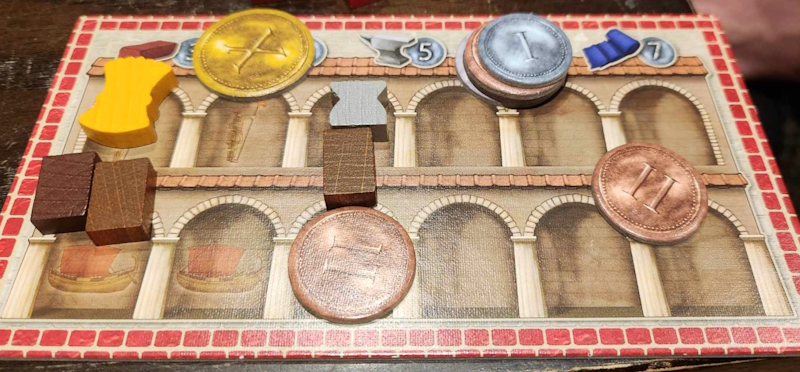
Concordia: Venus
– Image by boardGOATS

In the end game scoring, Sapphire led in the Jupiter, Saturn and Venus scoring and jointly in the Mars scoring.  To top that, he also triggered the end of the game giving him the Concordia Card (and seven points) as well as getting fifteen points for the Minerva scoring with his Smith card.  As a result, he finished with a hundred and twenty-nine points, sixteen more than Teal who finished a very creditable third in a game where it is notoriously hard to to well in the first game.  Meanwhile, Black and Byzantium were leading another game of Concordia, with Purple and Cobalt.
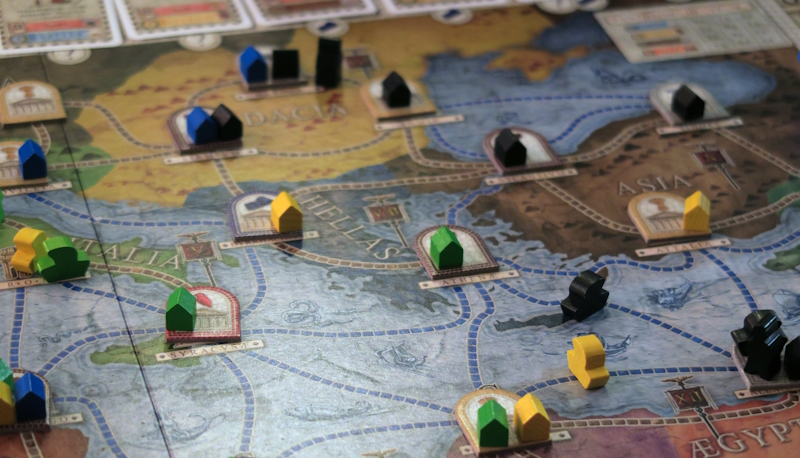
Concordia
– Image by boardGOATS

As Cobalt was new to the game, this group played with the classic Imperium map and included the intermediate individual scoring for each player when they played their Tribune card for the first time.  Black spread out over the board while Purple and Byzantium were more restrained, with Byzantium only spreading his tentacles at the end of the game  Cobalt collected a lot of Cards, although Byzantium had most of the Colonist Cards.  Despite the differences in approach, this game was really tight, so much so that Black and Byzantium tied for victory on one hundred and forty-nine points with Cobalt some fifteen points behind.

Concordia
– Image by boardGOATS

As is always the case when there is a tie, there was a rummage in the rule book for a tie-break.  In this case, the tie is won by the player owning the Præfectus Magnus Card, or by the tied player who would receive him next in the course of the game.  This nominally went to Black, but it was agreed this was a rubbish tie-break rule as players can’t plan for this and just get given it when someone else plays their Prefect Card.  While all this harmony was on-going, Jade was introducing Ivory to Fromage, with the help of Blue and Pink who had both played it once before elsewhere. This is a really cool worker placement game where the actions have a time component to them.

Fromage
– Image by boardGOATS

This sort of thing is not new—Tzolk’in does something similar where players place workers on wheels which are turned at the end of each round and, the longer the workers stay, the more powerful the action they can do.  In the case of Fromage, this is sort of reversed in that players do the action and, if they do a more powerful action, then their workers stay on the board for longer.  The peril here is that, whereas in Tzolk’in players can always do a less powerful action and take workers off early if they have to, in Fromage players only have four workers and it is very easy to end up with all of them sat on the board leaving people unable to do anything at all.  Fromage has proved popular since its release just before Christmas, and as a result, it is on its second Tuesday outing already.

Fromage
– Image by boardGOATS

The actions are tied up in four “mini-games” which players take it in turns to participate in.  It has proven quite a popular little game because once everyone knows how to play, there is relatively little down time and despite playing different areas at different times, quite a lot of interaction.  Players simultaneously choose where to place their workers, in their quadrant of the board, and once everyone is done, the board is turned and then players retrieve any workers they can and then place workers on their next quadrant.  Players score points for occupying tables in the Bistro quadrant, holding the majority in regions in the Villes quadrant, filling different tables in the Fromagerie quadrant, occupying contiguous areas in the Festival quadrant, and for fulfilling Orders.

Fromage
– Image by boardGOATS

This time, the game was very close, especially between Ivory and Pink, despite there being a lot of different strategies at play.  Pink, for example, scored very heavily for the Bistro getting forty-five points (more than half his total) from the one location.  In contrast, Blue scored thirty points for her contracts and nineteen from the Fromagerie, but very little anywhere else, while Ivory and Jade scored much more evenly in the different categories.  There was only one point between Pink and Ivory in the final reckoning, however, with Pink’s eighty-one just giving him victory.  With the rest of the group remembering Burgundy while playing Concordia, it seemed only fitting that this group should move on to another of Burgundy’s favourites: Splendor.
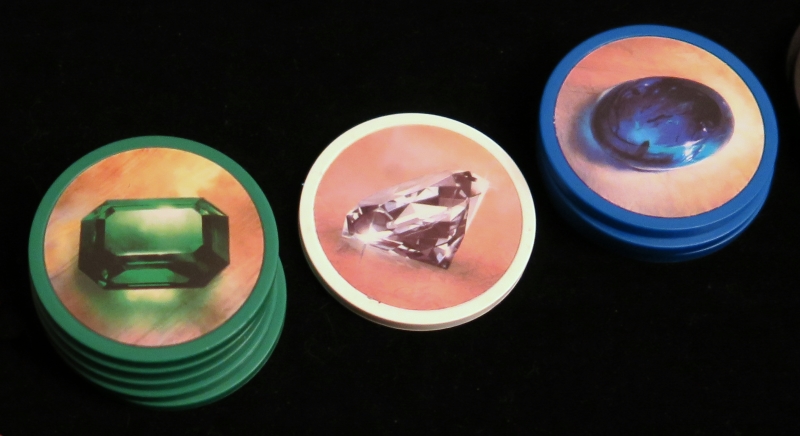
Splendor
– Image by boardGOATS

Burgundy was almost unbeatable at Splendor and at one point had a two-year unbeaten run on Tuesdays—so much so that others in the group would choose to play Splendor when he was occupied elsewhere, just to break the monotony!  The game is quite simple:  on their turn, players either take Gem-stone chips, or use them to buy Cards.  The Cards act as a perpetual source of Gems.  Thus, the aim of the game is to build a robust engine to enable players to buy the more expensive Cards that also give points, or allow players to collect Noble tiles for having sets of Cards associated with particular combinations of Gems.  This was another close game with Jade looking like he was going to end the game for a couple of rounds and Blue and Ivory looking for a couple of large turns.

Splendor
– Image by boardGOATS

That was until Pink did it for him by ending his turn with sixteen points and as he was last in the round, that meant nobody else got another turn.  So Jade finished second with fourteen with Blue in third.  Ivory decided to call it a night there, leaving Blue, Pink and Jade to play one last game, which ended up being Hiroba.  This is a sort of area-control filler game, where players take it in turns to place one of their nine Stones in the nine-by-nine grid following some simple, Sudoku-like rules.  Each Stone is numbered one to nine, but they are numbered on both sides such that the total adds up to ten.

Hiroba
– Image by boardGOATS

After players have placed their first Stone, others must be placed in the same row or column as one they have already placed, while ensuring that none of the Stones in any row, column or Garden has the same number.  There are typically two Gardens on each of the nine, three-by-three tiles that make up the board and players are trying to win control of them.  At the end of the game, the player with the highest total face value in each Garden will score points equal to the total size of that Garden.  However, for each Koi Pond on the board, a “times two” token is awarded to the player with the lowest value orthogonally adjacent pebble.
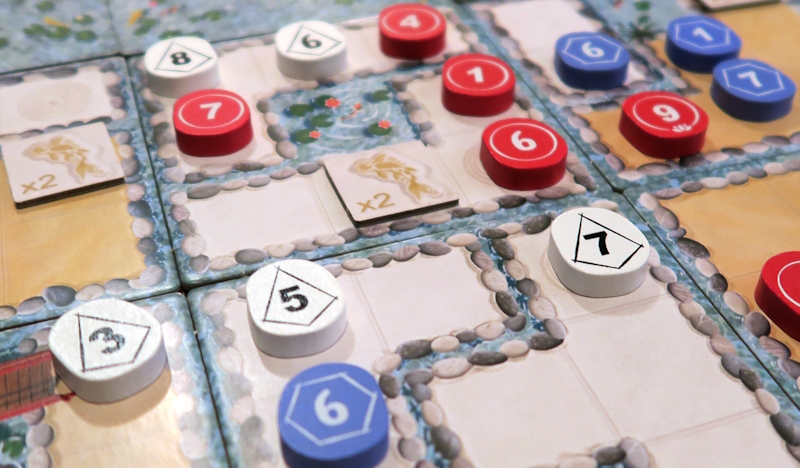
Hiroba
– Image by boardGOATS

Players who are awarded one of these place them in any empty square in any garden on the board, where it will double the points scored for that garden.  Thus, while players want to place the highest value stones to win control of Gardens this is tensioned by the desire to place low value Stones near Ponds in order to gain the multipliers and get a good score.  This game was less close than the previous ones, well—it was close for second place, but Blue who had finally woken up manged to take a couple of large areas and winning a lot of “times two” multipliers, she finished with an unassailable total of thirty-seven points.  This was some twelve more than Pink who won the battle for second.

Hiroba
– Image by boardGOATS

Learning Outcome:  Burgundy had great taste in games.
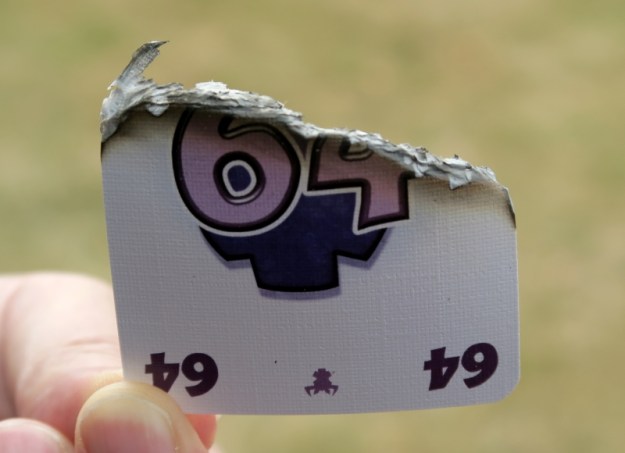
Remembering Burgundy on his Birthday

Burgundy (also known as Mike Parker) was an Oxfordshire gamer who sadly passed away at the end of December 2021 and is much missed.  He would have been sixty-four on Saturday 27th August and a small group decided that we couldn’t let his birthday pass unmarked.  So, at the South Oxford Crematorium, in Garford (where his ashes had been scattered), six people met to remember him and set light to a 6 Nimmt! card in his honour. The idea was a nice one, however, it turned out that a lighter would have been better than matches in the slight breeze, and 6 Nimmt! cards are not as flammable as we thought:  Burgundy would have been highly amused watching or perhaps he was teasing us by blowing out the flames.

6 Nimmt!
– Image by boardGOATS

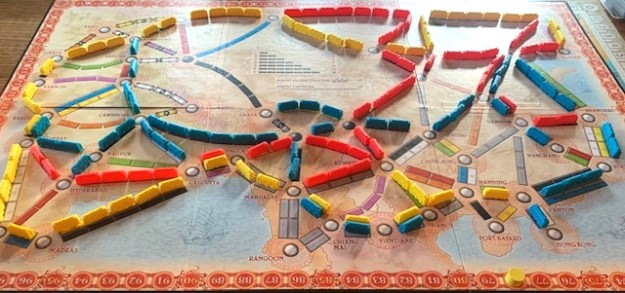
Eventually though, card number sixty-four was successfully burned, or rather charred (or at least most of it was), without doing too much damage to anybody’s fingers or setting fire to the tinder-dry countryside.  From there, the group went to The Fox in Steventon to honour Burgundy’s memory by playing some of his favourite games.  With six, the choices were limited without splitting into two groups, but one of Burgundy’s favourites was Ticket to Ride and the Team Asia expansion allowed everyone to play together.  It was a much tighter game than it had been earlier in the week and everyone played in the “Spirit of Burgundy” with lots of moaning when they picked up a card they didn’t want.  Team Purply-Black ran out the winners, just three points ahead of Team Pinky-Blue (who would have won had Pink let Blue take a chance and draw tickets on her last turn).

Ticket to Ride - Team Asia
– Image by Lilac

The group were going to squeeze in a quick game of 6 Nimmt! while waiting for food, but the cards (now one short of course) had barely been shuffled when food arrived.  Black, who missed out on on Ham, Egg & Chips at Burgundy’s wake, made up for it this time and then the group had to decide what to play next.  Bohnanza and 6 Nimmt! were options of course, but Green and Black were keen to play something heavier, though that would have meant splitting into two groups which somehow just didn’t seem right.  Concordia was another of Burgundy’s favourites and might have been an option with the Venus expansion, but that was moot as we didn’t have it.

Wingspan
– Image by boardGOATS

In the end, the group settled on Wingspan with the European expansion.  Although this only plays five, with two copies the group was able to make it work with an extra player.  This overpowers the “once per turn” (pink) cards, and leads to a lot of down time, but it felt the right thing to do for the occasion.  As a result of the slight unbalancing of the game, Blue got a lot of wheat, Green got an awful lot of worms, Pink and Purple Tucked a lot of cards, and Lilac was left at a bit of a disadvantage as she didn’t get a pink card at all.  Green was the eventual winner by some fifteen points, though it was very close for second with Blue just pipping Purple by a single point.  With the bar closing it was time to go home, but everyone felt that Burgundy would have approved, and would have enjoyed the evening too.

Mike Parker
– Image by Pushpendra Rishi

30th October 2018

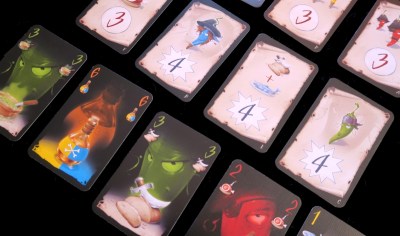
The evening began with the inevitable post-Essen chit-chat and games-mule deliveries (though most of it hadn’t been unpacked so that’s something to look forward to next week too).  Burgundy was very pleased with his substantial pile of Concordia expansion maps though (including the new Venus expansion and older Britania/Germania, Gallia/Corsica packs), and Pine was thrilled to hear there was a copy of Echidna Shuffle on its way for him too.  With food delayed, and a lot of people already arrived, we decided to get going with the  “Feature Game”.  Prior to Essen, we had planned to play Key Flow, however, that was still packed and there hadn’t  been time to learn the rules, so instead the “Feature Game” chosen was Peppers of the Caribbean.  This is  a cute little set collecting card game with a very loose pirate theme.  Each card features a number, a colour and a type of food.  The idea is that there is a face up market and on their turn, players can either take cards from the market, or play cards.

Peppers of the Caribbean
– Image by boardGOATS

To take cards from the market the active player must first discard a card and can then take all the cards of that colour or all the cards of that food type into their hand (discarding down to seven if necessary).  Alternatively, they can play a set of three or four cards where all the cards have different colours and different food types.  Of these, two cards are discarded and the remaining cards are kept for scoring.  At the end of the game, players sum up the face value of the cards in their pile of kept cards, and the highest score is the winner.  There are one or two fine details, for example, as well as “chilli cards” there are also rum cards which feature two colours and no food.  These have a high value (six, compared with one to four for the chilli cards) and can help people make sets more quickly.  However, as they have two colours, this means there can only be one rum card in a set and the maximum set size is then three, so only one card can be kept reducing the scoring opportunity.  There are also bonus points cards which are drawn largely at random from a pile—some of these are end-game bonuses and others reward the first player to reach a goal (e.g. be the first player to have all four different food types in front of them).

Peppers of the Caribbean
– Image by boardGOATS

Blue and Pink had played the game a couple of times in their hotel bar at Essen and on the train home.  They had found it a diverting little game with two players and had wondered how it would play with more people.  Somehow it is one of those games that is slightly confusing at the start and things were made more challenging as we began with three players and ended up with five as more people arrived, meaning the rules got explained several times from different points.  As a result there were slow starters and “fast twitch” players.  It was close at the top though with Burgundy and Ivory some way ahead in a tight finish which Ivory took by just three points.  Although everyone would probably play it again, it was clear that the game would be better with fewer players where there would be less fluctuation in the market and everyone would have more of a chance to get what they want.  It only became clear some time later that there had been a mix-up somewhere along the line and although the side of the box said it was suitable for five, the bottom and the website indicated that the game was only intended to play a maximum of four anyhow…

Peppers of the Caribbean
– Image by boardGOATS

Just as the game was coming to an end, Black and Purple arrived in need of some R&R after what had been a trying day.  They had also brought some of their Essen Loot (including a copy of Las Vegas for Red), and the Essen discussion began again.  Black and Purple had been at the fair for the full four days and felt that a minimum of two was needed to see everything, but three days was a more realistic time.  Blue and Pink had been there for just two days as they can’t cope with the crowds for more than that.  Even they are considering a Thursday-Friday-Sunday strategy for next year though as there are now six halls (some very large indeed), and they felt they had missed a lot of things that they had wanted to see this year.  That said, a lot of games sold out including the expansions for Altiplano and Great Western Trail (Altiplano: The Traveler and Great Western Trail: Rails to the North), Mini Rails (again!), Hanamikoji, Food Chain Magnate, Roll to the Top, Majolica, Spirit Island, Echidna Shuffle, Ceylon and headline releases Teotihuacan: City of Gods, Architects of the West Kingdom, Newton, The River and Everdell.  Some of these went ridiculously fast, for example Everdell apparently sold out in six minutes on Saturday despite its not insubstantial price tag of €70.

Essen 2018
– Image by boardGOATS

Purple and Black were particularly pleased with Solenia, which they had played at the fair and then managed to grab one of the last few copies available.  A beautiful game with a totally over-produced large yellow airship and cards with a hole in the middle, it wasn’t long before it became clear that it was going to be one of the games to make it to the table. The pretext is that several millennia ago, the tiny planet Solenia lost its day-and-night cycle:  its northern hemisphere was forever plunged into darkness, and its southern hemisphere was eternally bathed in bright sunlight. Players travel the world delivering the rarest gems and stones to the “Day People” and take wood and wheat to the “Night People” who need them to survive. In return players receive gold stars and the player with the most of these at the end of the game is the winner.

Solenia
– Image by boardGOATS

In each round, players take it in turns to play one card from their hand onto an empty space on the five-by-five game board. Cards can be played either on a “Floating Island” or a “Floating City”.  Cards played on Floating Islands will give as many resources as the value of the card played of the type corresponding to the City.  Cards played on Floating Islands enable players to fulfil a delivery tile by delivering the resources depicted on it.  Cards must be played adjacent to the airship in the centre of the playing area or adjacent to one of the players previously played cards.  When someone plays a zero card, the airship advances one space along the modular board.  At the end of that turn, the back piece of the game board is removed and players receive resources based on the cards they have on this strip of the playing area.  This strip is then turned over (turning night to day / dawn to dusk or vice versa), and it is placed on the front edge of the game board, and thus the airship moves across the planet.  This constantly changing board rolling from day to night and back to day again gives the game a unique feel.

Solenia
– Image by boardGOATS

Although resources were far from scarce (unlike other resource management games), it still has quite a bit of resource management thanks to a strict resource limit on a players personal board.  Thus, the real problem came in deciding which were the most important resources to keep, a little bit of area control/route planning, and a few paths to victory points. The constantly changing nature of the game doesn’t lend itself to a developing narrative though having played it before, Black and Purple had an edge over Green.  This wasn’t helped when Green misunderstood one of the cards and tried to do something clever to multiply his points.  The first attempt failed, but on the second try he thought he had achieved more points and then the misunderstanding came to light—the bonus points only applied to the card itself not to all types of terrain he had cards on.  It would not have changed the placings though.  It was very tight between Black and Purple until Black managed to gather together three pairs of day and night bonus chits, which hadn’t been looking likely until the last couple of turns.  With that, he just sneaked his nose in front, winning by three points.  Overall Solenia is a clever game that takes a run through to get a feel for how it works and then you then just want to play again—it certainly won’t be long before it gets another outing.

Solenia
– Image by boardGOATS

Meanwhile the other four were giving Azul: Stained Glass of Sintra a try.  This was another Essen release, and one  that had generated a lot of “buzz” in advance as it was produced by the same team that originally published this year’s double award winner, Azul.  Blue, Purple, Black and Pink had all tried it while in Germany and found the scoring sufficiently different and interesting that they had collectively come back with two copies.  Initially the conversation centred around the clear plastic tiles that, largely dependent on age, reminded some people of Spangles (“The sweet way to go gay”) and others of “Tunes” (“Help you breath more easily” and thus “Book a second-class ticket to Nott-ing-ham”) .  Once the subject had moved away from 1980s confectionery, attention focussed on the new game and its similarity and contrast with the original Azul.  As in the original, players take all the tiles of one colour from a “factory” and put the rest in the middle, or they take all the tiles of one colour from the middle.  Tile placement and scoring is rather different however.  All the tiles taken in a turn are placed in a single column of the player’s personal player board.  This board is modular with the double-sided strips laid out  at random so everyone has a different starting setup.

Azul: Stained Glass of Sintra
– Image used with permission of boardgamephotos

Above the board each player has a figure, their Glazier, who marks one strip.  Tiles must be placed in the strip immediately below the Glazier, or in a strip to the right of the Glazier.  The Glazier gives players another option on their turn too, as players can choose to reset his position to the left most strip (instead of taking tiles).  Scoring is very different, with players getting points when strips are completed. The number of points scored is the sum of the score depicted below the strip, plus the score for any strips to the right that have already been completed.  There is also a colour bonus—each round has a colour drawn at random at the start of the game, and any tiles that match the colour for the round score extra.  Once a strip has been completed, it is flipped over; after it has been filled a second time it is removed, reducing the players placement options.  This provides a subtle catch-up mechanism that takes effect towards the end of the game.  Any left over tiles that cannot be placed yield a penalty (as in the original Azul game), but this is also different.  In addition to the positive score track, there is also a negative score track where the steps start off small and then get larger; penalties are accrued for left-over tiles and also for being first to take a tile from the middle (and with it the Start Player token). There are also end-game bonus points with two variants available, one colour dependent and the other rewarding completing adjacent strips. All in all, the game is definitely a step up in complexity, making it more of a challenge for those who have played Azul extensively.

Azul: Stained Glass of Sintra
– Image used with permission of boardgamephotos

As most of the group fall into that category, we had high hopes that Stained Glass of Sintra would be a good fit.  It certainly offers a new challenge, though it was clear that the fact Blue had played it before gave her a significant advantage.  For example, the timing of repositioning the Glazier is very critical.  It doesn’t necessarily prevent a player getting a load of tiles they don’t want (as everyone can reposition their Glazier and the problem will come back round), but players don’t want to be stuck with their Glazier far to the right at the start of a new round as that limits their choice when the options are at their best.  Similarly, player don’t want to reposition their Glazier too frequently as this reduces the number of tiles they take and therefore affects their score.  Behind Blue it was very tight for second place with just five points covering Pine, Burgundy and Ivory.  It was Pine who got his nose in front though, by keeping his negative score down and concentrating on his end-game bonuses.  Unfortunately, the game is not as nicely produced as the original: the broken glass tower is made of very thin card (more like thick paper) as is the score board.  The “glass” pieces are also somehow not as nice as the resin tiles in the original and the colours are less distinct as well.  These negatives are a real shame as they take the edge off what would otherwise be a excellent reimplementation of the superb original game.

Azul: Stained Glass of Sintra
– Image used with permission of boardgamephotos

Green and went home for an early night leaving five others plus Pine who wanted to play something “in about forty-five minutes”.  Deciding what to play took so long that there nearly wasn’t time to play anything at all, but after three new games, everyone was in the mood for something “comfy”, and eventually Bohnanza appeared.  Pink’s new “Fan Edition” was still packed, as was the Jokerbohnen mini-expansion that Blue had acquired.  She had not brought her Spanish copy either, so it was the “boring” Rio Grande Games edition.  Familiarity sometimes has its place though, and this was one of those times. Nobody needed a reminder of the rules (plant the first bean in hand; optionally plant the second; turn over two cards and plant or trade them; trade from hand, and draw cards placed at the back of the hand), but the setup varies for different numbers.  It wasn’t long before we were underway, however, and Purple quickly began to amass a  crazy number of Red Beans.  It felt like nobody else could really compete although Black came very close finishing with thirteen coins, one behind Purple.

Bohnanza
– Image by boardGOATS

Learning Outcome:  New is very exciting, but that comfy pair of old slippers still has its place.