Tag Archives: Dice Hospital

11th June 2024

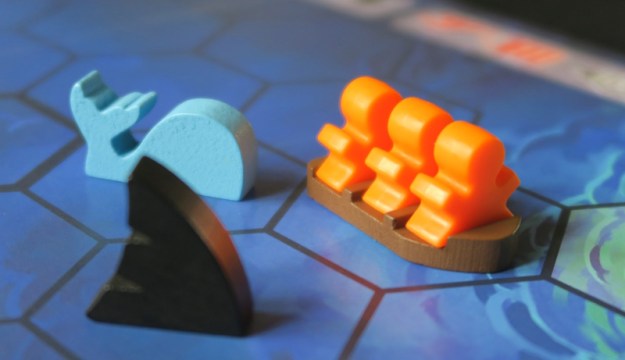
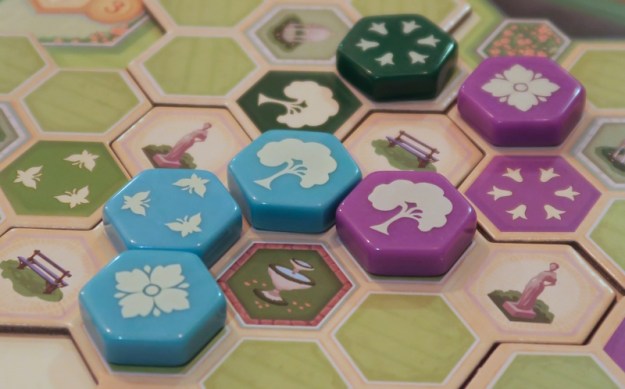
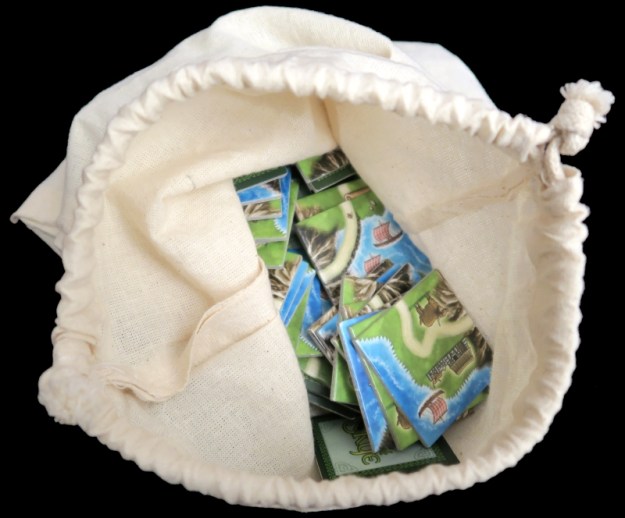
The pub was not as busy as last time, and in any case, Pink, Blue, Black and Purple were there in good time for food.  Once they had finished, they managed to squeeze in a quick game of Rome in a Day while they were waiting for food and eating.  This is a cute little tile-laying game Black and Purple picked up from UK Games Expo as few days back.  It is a bit like Kingdomino with the “I cut, you choose” mechanism to allocate the tiles.  The “I cut, you choose” mechanism is used in a number of other games like, Castles of Mad King Ludwig, Isle of Skye, and Dice Hospital, but it is a more fundamental part of games like San Marco, and particularly …aber bitte mit Sahne and New York Slice.

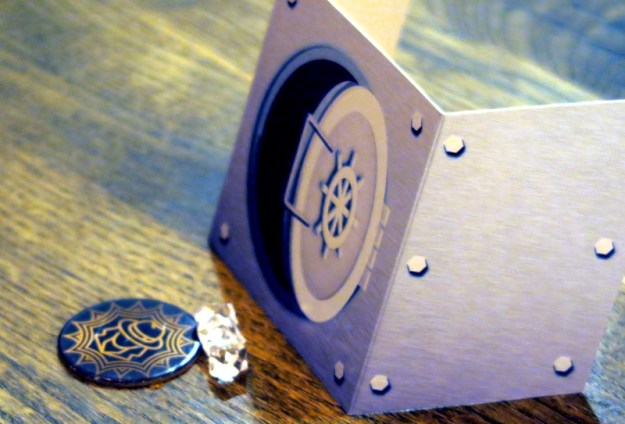
Dice Hospital
– Image by boardGOATS

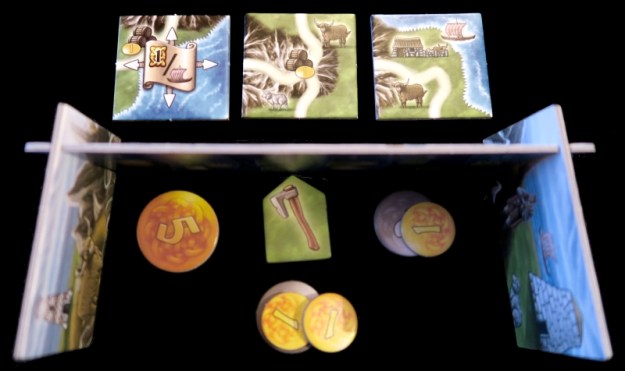
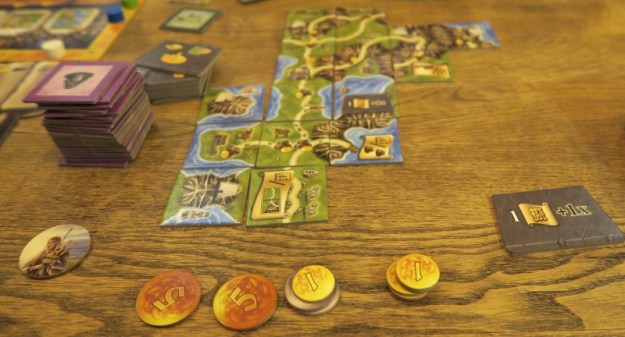
In the case of Rome in a Day, Players start by taking five land tiles drawn at random and place two buildings on tiles one and two.  They then divide the five tiles into two groups—a bigger and a smaller one (in any ratio) and add a crystal to the smaller land set before offering them to their neighbour.  During the four rounds the game is played over this neighbour alternates, right, left, right, left.  So, each round, players choose a set from their neighbour and these and the tiles they were left with are added to their domain.  At the end of the game, any building that stands on or adjacent to land of its own colour will score for each tile in the group and then players score for the diamonds they have collected—the player with the most points is the winner.

Rome in a Day
– Image by boardGOATS

Like in Kingdomino where players score better for a medium number of crowns in a medium sized area than for a combination where one is large and the other small, players benefit more if they can surround one large area of coloured tiles with multiple buildings of the same colour.  The most successful at this was Pink who scored well for three coloured areas, the green Olive Groves, the blue-purple Vineyards and the yellow Wheat Fields, while the others didn’t score at all.  As a result of his ruthless scoring strategy, he finished with fifty four points, eight points clear of second place, which went to black by a single point.
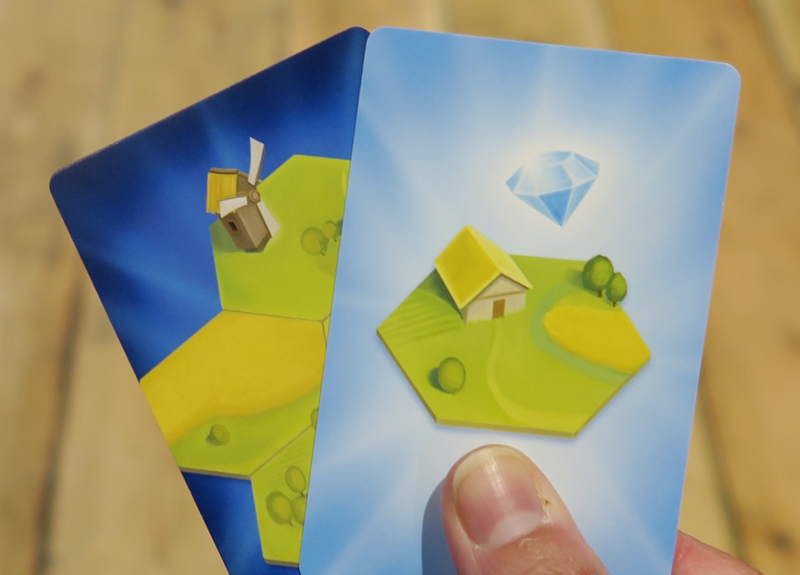
Rome in a Day
– Image by boardGOATS

The game was just coming to an end when Jade, Sapphire, Plum and Byzantium arrived, followed by Pine, Ivory and Teal, and then the inevitable debate as to who would play what began.  In the end, Jade led a group of four including Black, Purple and Sapphire in the “Feature Game“, Courtisans (the French for Courtier as it is spelled with an “i” rather than an “e”), which also came from UK Games Expo.  The first game was essentially a learning opportunity where players tried to understand the learning the mechanics of the game.  On their turn, each player receives and plays three coloured Family cards.
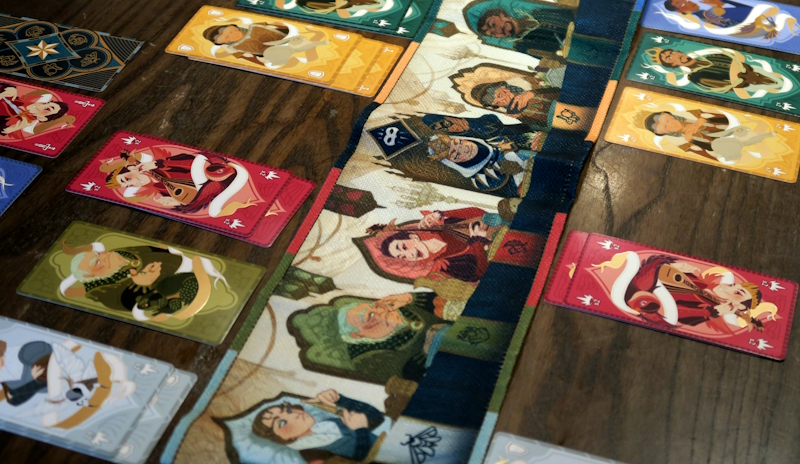
Courtisans
– Image by boardGOATS

One card is played at the Queen’s table to sway a family’s influence in a positive or negative way depending on whether it is placed above the table or below—at the end of the game, those with more cards below than above will have “Fallen from Grace”.  The other two cards are then played, one in the player’s own Domain and the other in an opponent’s Domain. At the end of the game, each card a player has from an “Esteemed” Family is worth a point, while each card from an Family that has “Fallen from Grace” loses them a point.  Thus the cards can be worth positive or negative points, depending on the Family’s status at the end of the game.
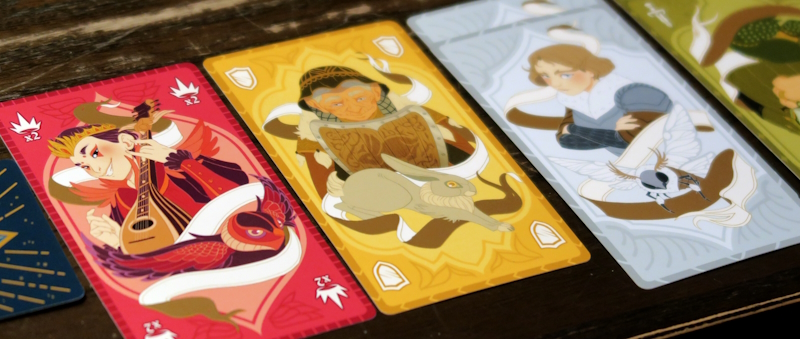
Courtisans
– Image by boardGOATS

Some of the Courtier cards have a special power, for example, Nobles count as two cards, Spies are played face down and their allegiance is only revealed at the end of the game, Assassins can be used to eliminate other Courtier cards, while Guards are not affected by Assassins.  The game ends when the card deck has been exhausted and nobody has any cards left in hand.  Players then total up their score and add any points earned from successful Secret Missions (each worth three) and the player with the most points is the winner.

Courtisans
– Image by boardGOATS

Black went first chosen by an app and began feeling his way forward.  The group only realised there was a slight issue towards the end as they ran out of cards a bit early.  It was then that it was discovered that at some point Black had acquired a second hand which he had placed on the table beside him.  Despite only a few personal objectives being met mostly players scored scored well; the exception was Purple who was the only one to complete both objectives which added six points to her score at the end.  It wasn’t enough for victory though, that went to Sapphire who had fifteen points, with Jade a point behind in second.

Courtisans
– Image by boardGOATS

Having felt their way through the first game, the group decided to play again.  As the winner, Sapphire went first, and from the off, it was like everyone woke up together and all decided to attack.  This time, everyone completed at least one objective, but this second game was a lot more treacherous and this was evidenced in the scoring.  One of Jade’s objectives was to ensure at least one of the Houses had at least five cards bringing them into disrepute—Jade chose yellow which caused others problems.  It didn’t have as much of an effect as his second objective though,which was to have fewer red cards than the player to his left.  As a result of this, Black was the kind recipient of any red cards he acquired.
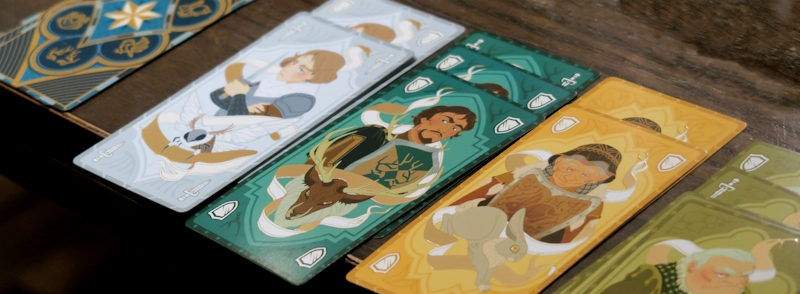
Courtisans
– Image by boardGOATS

While he tried to bring the reds into disrepute too, it wasn’t possible to do both.  So, despite his best efforts they still scored positively and probably helped ensure Black’s victory with seven points, four more than Jade himself.  The scores were much more diverse in the second game though with a range of sixteen points with the person at the back finishing with minus nine!  Although savage, it had been a lot of fun; Jade commented that the game felt a bit like a dance with lots of nuance.  Definitely one to play again, especially given the truly beautiful foiled cards which are a delight to play with.
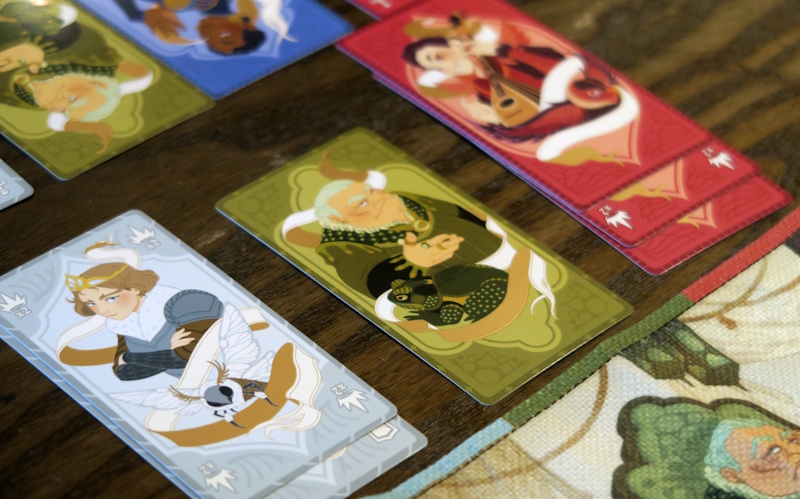
Courtisans
– Image by boardGOATS

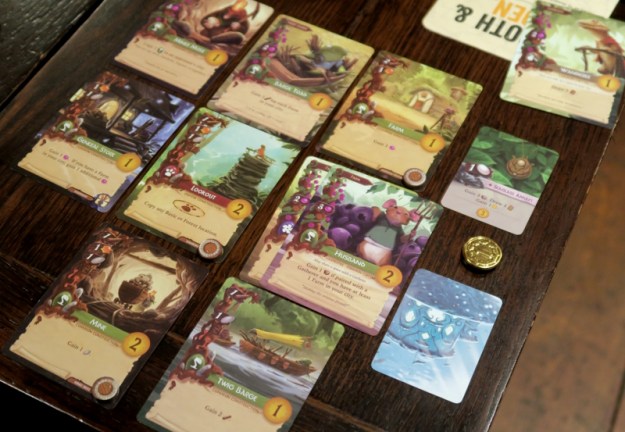
Meanwhile, Teal had picked up the Alpine expansion for one of his favourite games of the moment, Forest Shuffle, and was keen to give it its first outing.  He was therefore joined by Plum, Byzantium and Pink who were also keen to see how it changed things.  Forest Shuffle is mechanically a fairly straight-forward game, but playing it well is comparatively difficult as it requires good, robust strategies and an understanding of how to get the best from the cards.  The idea is that players start with a hand of cards and, on their turn draw two more from the market (or “Clearing”) or play one into their tableau.

Forest Shuffle: Alpine Expansion
– Image by boardGOATS

There are two sorts of card, Trees and “Critters”.  Before playing a Critter, players must have played a Tree, which then has spaces on all four sides.  Birds and Butterflies are played to the canopy (i.e. above tree cards), Fungi and Amphibians are played at the bottom of the tree (i.e. below them) and Mammals are played either side.  The clever part is that Critter cards are split so they show two critters (either left and right or top and bottom), so players choose which they would like to play, and where, tucking the other side under the tree, making the unplayed half invisible.

Forest Shuffle
– Image by boardGOATS

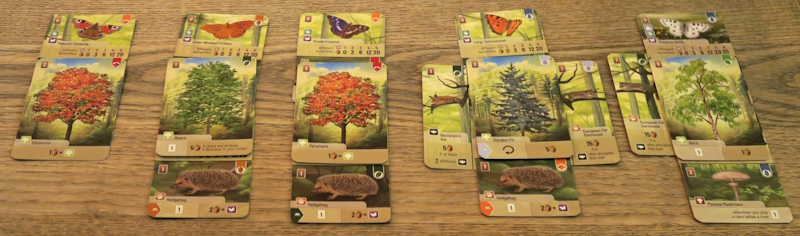
The new Alpine expansion for Forest Shuffle only adds some thirty six cards to the game and, since roughly twenty additional cards are removed during setup, in practice it adds just sixteen to the deck.  Of course, the cards are removed at random so many should be from the base game and the expansion adds new cards like the Mountain Hare, who scores as for the European Hare, but wants to stay alone so can’t share a space with another Hare.  There is an extra Butterfly and more Trees too, which make these easier to score and help to balance the game somewhat.  Additionally, there is the new Alpine Newt provides a new way of scoring, for players who have managed to pick up a lot of cards from the Alpine expansion cards.
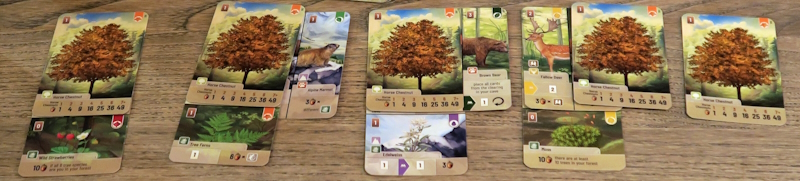
Forest Shuffle: Alpine Expansion
– Image by boardGOATS

This time, Plum went for Trees in a big way with loads Horse Chestnuts which give more points the more you have on them up to forty-nine for seven or more.  While she didn’t quite make the full seven, she scored a total of forty-eight for her Trees, fifteen more than the nearest player (Byzantium) and more than double what anyone else took.  They, of course, got points elsewhere though.  Pink, for example, went for Butterflies and, with the additional Phoebus Apollo Butterfly, took thirty-five points for them alone.  Byzantium opted for a deer strategy and received a total of sixty-one points for all his Critters.
Forest Shuffle: Alpine Expansion
– Image by boardGOATS

The winner was Teal however, with everyone else totally overcome by “The Lynx-Effect”, where each Lynx he had gave ten points as long as he had a Roe Deer to keep them fed.  Perhaps his victory was to be expected as he has played the game quite a bit with family, but his finishing score of a hundred and fifty was some way ahead of Pink and Plum who tied for second place with a hundred and nineteen.  Overall, the Alpine expansion adds some pretty artwork and made a few of the alternative strategies a lot more viable, reducing the apparent dominance of Wolves and Deer which it has often been claimed are overly powerful.

Forest Shuffle: Alpine Expansion
– Image by boardGOATS

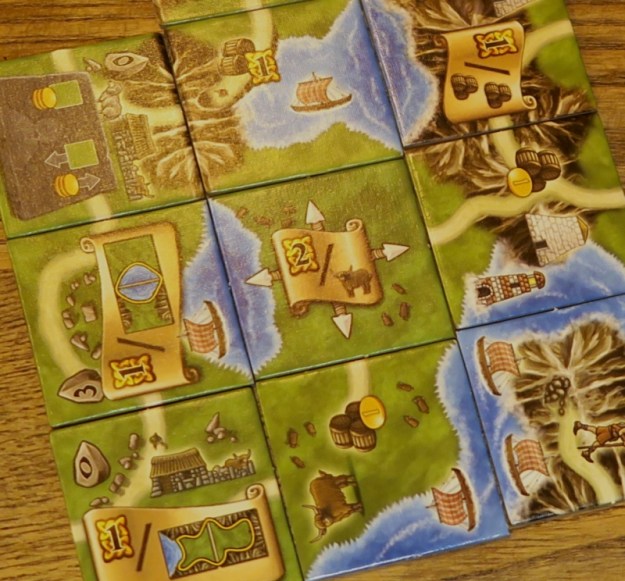
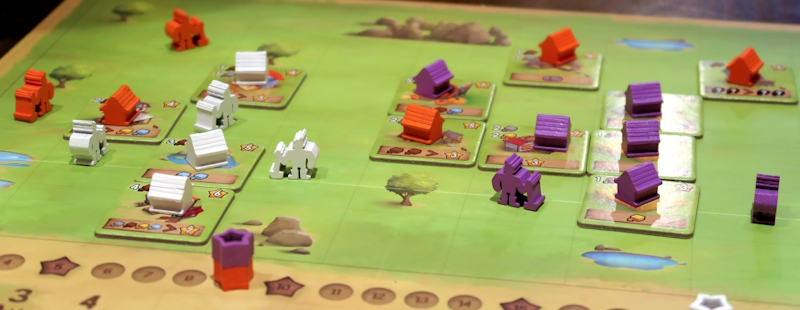
With the Courtisans and Forest Shuffle groups sorted, that left just three players without a game.  Since Ivory and Pine both missed out on playing Little Town last time and neither wanted a particularly late night the decision was made to eschew Key Flow in favour of the lighter, quicker, tile-laying game.  Play is very simple:  players take it in turns to place their Workers in a space on the central board and then activate the eight spaces around them.  These eight spaces could be Buildings, but may also be Trees, Rocks or Lakes pre-printed on the board giving resources (Wood, Rock or fish respectively).  With three players, there are four Workers in each of four rounds and the player with the most points at the end is the winner.
Little Town
– Image by boardGOATS

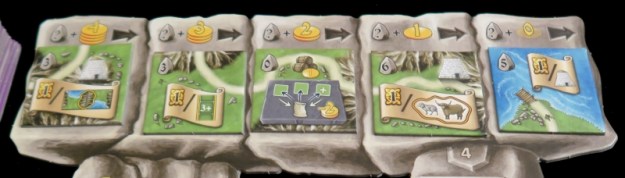
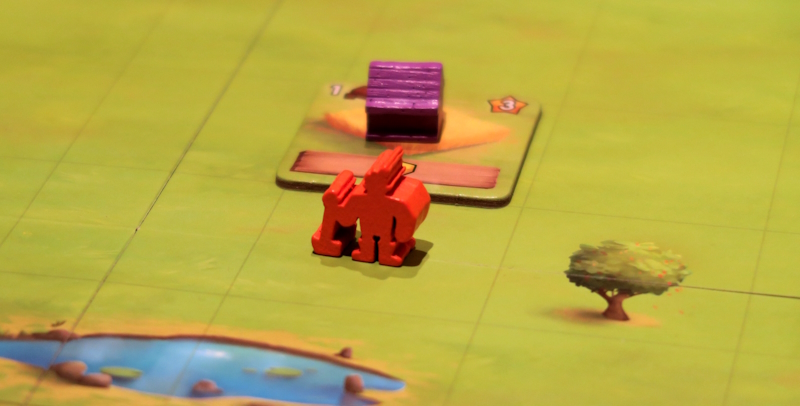
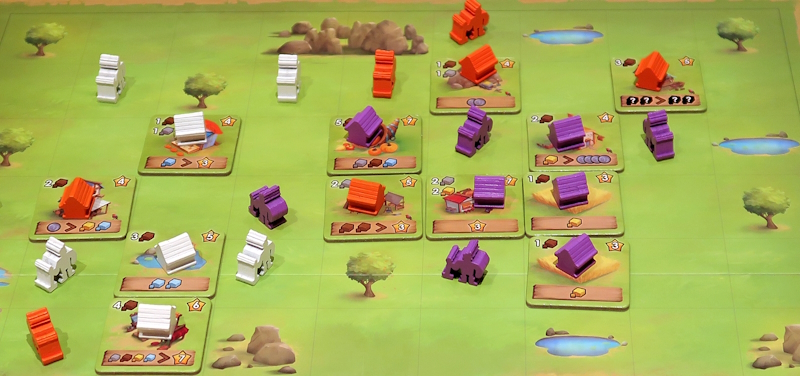
Little Town has had a few outings, but was the “Feature Gamelast time, with two games played simultaneously, both with the starting tile set up.  This time, a random tile setup was used drawn from the full set that included the Pier, the Marketplace, the Bar, from the variant set as well as the Shop, the Workshop, the Goldmine, the Bakery, the Pawnshop, the Quarry and Wheat Fields from the basic set.  The twelve Buildings were completed by the Temple, the Cornucopia, and the Sushi Bar from the Goodie Buildings mini expansion.  Blue and Pine both complained that their Objectives were considerably more difficult than Ivory’s as he claimed all his quite quickly.
Little Town
– Image by boardGOATS

Eventually though, all three managed to complete all their Objectives.  Pine misunderstood the fact that each Worker needs to be fed at the end of every round, rather than just at the end of the game.  As it was a genuine error, rather than cripple his game at the end of the first round, Blue and Ivory let him pay with other resources leaving his unfortunate workers to gnaw on bits of stone, wood and coins.  Other than that, the game proceeded according to the rules.  Ivory majored on trying to convert Fish into points, while Blue tried to do the same with Wheat and Pine played the merchant, building the Gold mine and the Shop.
Little Town
– Image by boardGOATS

As the game came to a close, Ivory had a substantial lead with forty-two, ahead of Blue in second with thirty and Pine with eighteen.  This was without any of the points from the buildings (which Blue had a lot of) or from leftover money (of which Pine had an enormous pile).  As it turned out, money is not worth much at the end of the game, and although Blue’s buildings were worth considerably more than Ivory’s, she still fell two points short of his final total of fifty-seven.  So although we’ve still not been able to use the “sixty point tokens” we were only a handful of points shy.
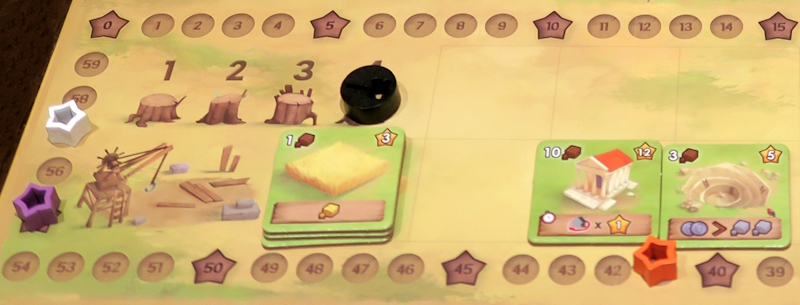
Little Town
– Image by boardGOATS

The others were still playing, so after some discussion, Blue, Pine and Ivory decided to give the 2022 Spiel des Jahres nominee, SCOUT, an outing.  This is a clever little card game with two key features: firstly, as in Bohnanza, players can’t rearrange their hands, and secondly, the cards have different values depending which way up they are.  Like Tichu or Haggis, SCOUT is a climbing game, that is to say, on each turn players are aiming to beat the previous score.  In SCOUT, that means players have to play a higher value or larger meld, or a longer run or one of a higher value (and a meld of the same size always beats a run).

SCOUT
– Image by boardGOATS

These cards are played from hand, but have to be consecutive.  In the event that a player can’t or doesn’t want to play cards from their hand (aka “Showing”), they may instead take a card from either end of the current winning set and add it to their hand anywhere, and either way up (aka “Scouting”).  Additionally, once per round, players can “Scout and Show” which is take a card and then also play cards.  The round ends when either nobody in the round has been able to Show or a player plays their last card and has nothing left in hand. At the end of the round, players lose a point for every card they have left, and this is taken from the total from their scoring cards and points earned when others Scout from their display.
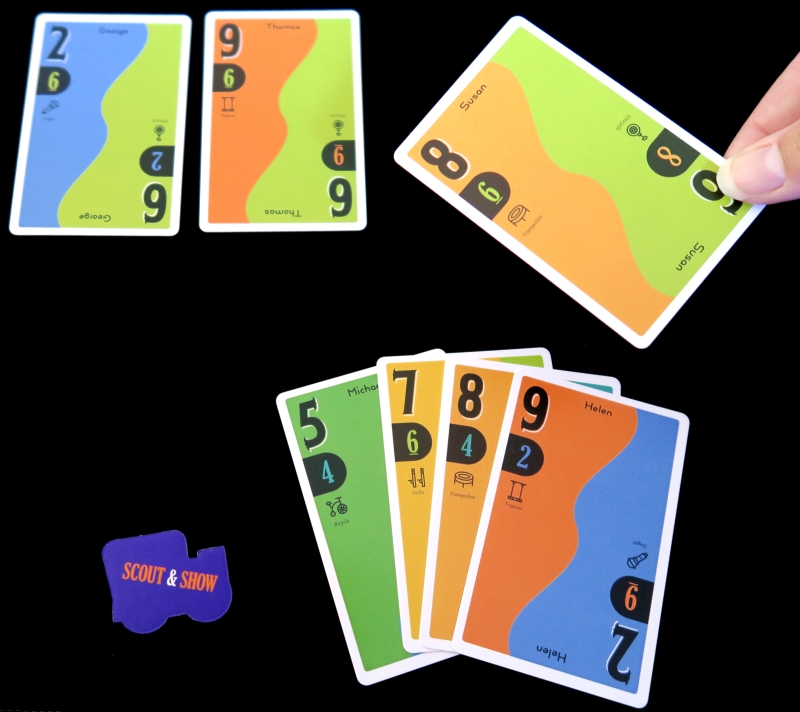
SCOUT
– Image by boardGOATS

With three players, there were three rounds, the first of which was finished by Pine, though Ivory nearly managed to check out, leaving Blue with a large handful.  The second round was much closer with Blue playing a nine-card run (though as cards in front of players at the end don’t score, and very quickly nobody could beat it, she didn’t get the advantage she felt she deserved).  The final round was taken by Pine again, but it was also close again.  The total favoured Pine, who finished with a total of twenty-six, a clear victory with Blue just pipping Ivory to second place by a single point.

SCOUT
– Image by boardGOATS

Forest Shuffle and SCOUT were both still going when the Courtisans finished, so they quickly set about playing a light filler that Jade had picked up from the Hachette UK stand that he had worked on at UKGELine-it, is another card game, played with a deck that consists of cards in four colors, numbered one to a hundred and six “Bet” cards (numbered three to five), which are shuffled together and laid out to create a market consisting of slightly more cards than there are players.  Players then take it in turns to take a card and either add it to their hand or add it to the row of cards in front of them (their Line).  There is a hand limit of two and the row must continue either increasing or decreasing.

Line-it
– Image by boardGOATS

If a player can’t add the card to their hand or their Line (because it would break the ascending/descending pattern), they have to score their Line, then play that card to start a new Line.  After drafting a card, players may choose to add one card from their hand to their Line and then score it. When scoring, if there is a Bet card in the Line, if there are more cards added since the Bet card than the value depicted on the Bet card, players get chips equal to the value of the Bet.  If the Bet is lost, the player takes negative points instead. Finally, three cards are discarded from the Line and the others turned over and placed in the player’s scoring pile.
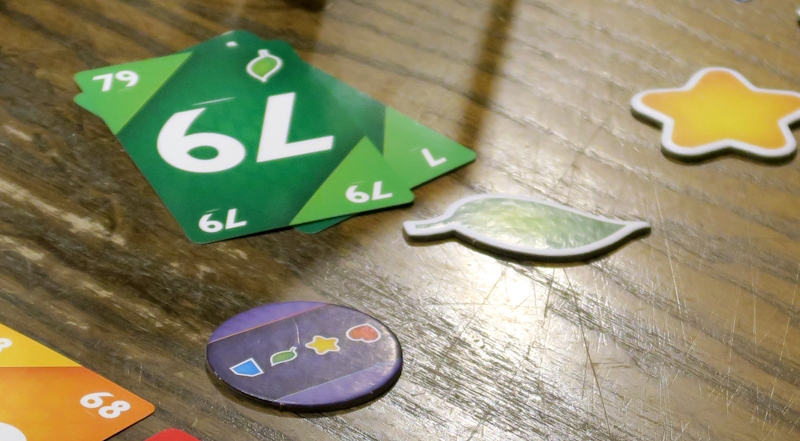
Line-it
– Image by boardGOATS

Once each player has had a turn, all remaining Bet cards are discarded, and the other cards are placed under the Jackpot token that corresponds to their colour—these can be claimed whenever a player adds the third card of the respective color to their Line.  The game ends when the draw deck depleted, and each player plays one last card from their hand, then scores their line and tallies their points, the player with the most points is the winner.  As he had won the second game of Courtisans, Black went first.
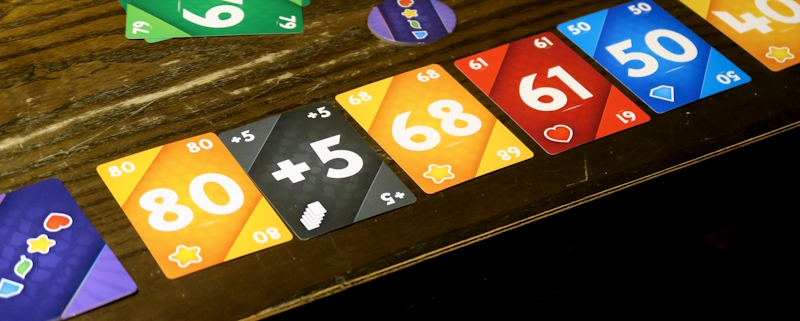
Line-it
– Image by boardGOATS

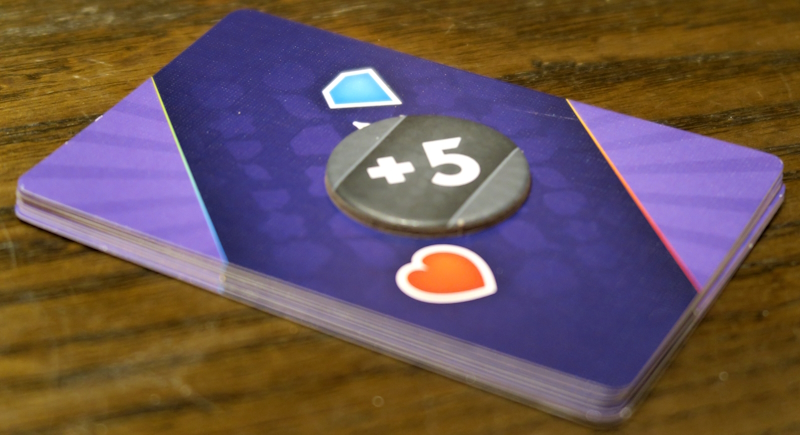
Black and Purple both took (and completed) Bet cards early in the game, whereas Jade didn’t even take because his Lines weren’t right when the Bet cards were available because just didn’t make sense.  Purple won the first jackpot of the game which was a tidy little stack of blue Diamond cards and Sapphire also picked up Jackpot cards later in the game.  The game plays quite quickly and smoothly and this time out, it was close, well, close between Black, Jade and Purple—Sapphire was streets ahead, finishing with twenty-six points, a long way clear of Black in second with fifteen.
Line-it
– Image by boardGOATS

Learning Outcome: UK Games Expo is a good source of new games.

Golden GOAT Award Winners – 2023

The boardGOATS love a good party, so once again, they met just before Christmas for their annual Un-Christmas Dinner and to decide the winners of the GOAT Awards.  After food, crackers and writing GOAT Christmas Cards, the group voted for two awards:  the Golden GOAT for our favourite game played during the year and the “GOAT Poo” award for our least favourite.  Everyone had the usual three points to hand out for the Golden GOAT Award (plus a bonus if wearing Festive Attire), though a maximum of two points could be given to any individual game.  Everyone could also nominate up to two individual games for the GOAT Poo Prize.

7 Wonders
– Image by boardGOATS

This year, there were a handful of games that received the unofficial “Marmite Award”, that is to say they received nominations for both the Golden GOAT and the GOAT Poo prizes.  These included Challengers!, Kites and SCOUT.  For the GOAT Poo Prize itself, this year there were no outstanding candidates, with a tie between 2019 winner 7 Wonders and Dice Hospital, with two votes each.  Nominations for “Moment of the Year included the game of Challengers!, which was likened to “Speed Dating”, and the massacre in Survive: Escape from Atlantis!, but the winner was the three way tie in the epic game of Tapestry with the Fantasies & Futures expansion.

Survive: Escape from Atlantis!
– Image by boardGOATS

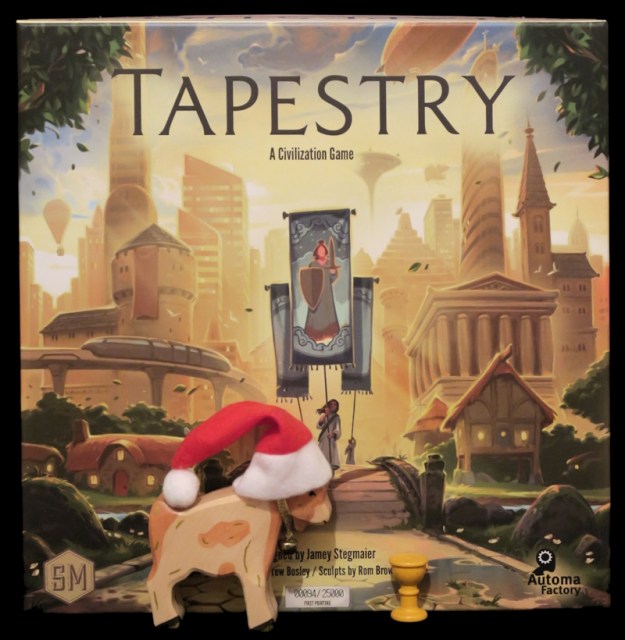
And finally, there was the Golden GOAT Award for the best game played in the year.  Previous winners including Wingspan and 6 Nimmt! were ruled out, but there were plenty of options remaining. Earth, Fantastic Factories, SCOUT and Zoo Break all received three votes, but the clear winner was Tapestry.  Over the years, we’ve played this quite a bit, but it is a game that doesn’t suit a significant number of the group.  This year, however, with a slight shift in those eligible to vote, heavier games were in with a better chance and Tapestry was the beneficiary.  We will have to make sure it gets another outing in the new year.

Golden GOAT - 2023
– Image by boardGOATS

19th December 2023

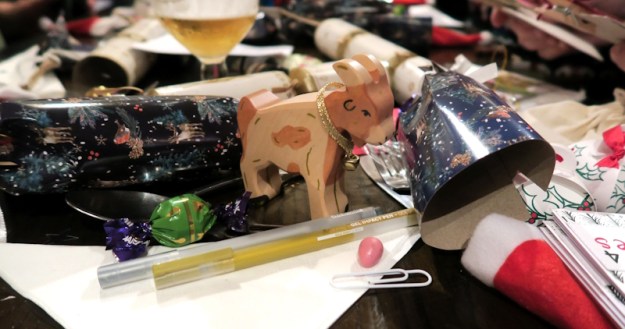
It was party time so everyone was arrived early for the Un-Christmas Dinner—everyone that is, but Blue and Pink who eventually arrived armed with piles of Christmas crackers, party poppers, tree decorations, Christmas cards, raffle prizes, GOAT Award ballot papers, mince pies and festive cake.  Opening the crackers was a necessity before food arrived to avoid the bits landing in people’s supper, so when food arrived, it nestled amongst all sorts of gaming detritus.  As the staff at The Jockey served pizzas, pies, baguettes, cheese with crudités, burgers and chips, gamers called out the awful GOATy jokes from the crackers.

"Un-Christmas Party" 2023
– Image by boardGOATS

During the interval between main courses and dessert, GOAT Award voting forms and Christmas cards were handed out and people began thinking about the games we’ve played over the year.  Ivory collected Christmas Cards and Green collated the ballots before he announced the winners.  The GOAT Poo prize, for the worst game of the year went Dice Hospital when 7 Wonders was relegated as a previous winner.  The Golden GOAT went to Tapestry, while the epic three-way tie in Tapestry won “Moment of the Year”.  With the formalities and food finally complete, there was just the raffle, a copy of Carcassonne: Winter Edition and the Ukraine Map, which were won by Sapphire, then everyone abandoned the carnage (and Purple who helped clean up), to play something festive.

"Un-Christmas Party" 2023
– Image by boardGOATS

There was a bit of the usual indecisiveness, but eventually Blue, Ivory, Pink, Green and Pine settled down to play the “Feature Game” which was Jokkmokk: The Winter Market while Black, Cobalt, Jade, Sapphire and Lime set up Snow Tails.  Jokkmokk is a very simple game that makes use of the time-track mechanism seen in Tokaido and Namiji (played last time)—that is to say, it is an extended game of leap-frog where the player at the back jumps into an empty space of their choice and then carries out the action associated with it.  Like those games, the compromise is between moving to a preferred space which may be further forward and will ultimately will give fewer turns.  It is much simpler than both Tokaido and Namiji, however.

Jokkmokk: The Winter Market
– Image by boardGOATS

Jokkmokk is a card-driven set collecting game and is made more interesting by a large number of mini-decks, five or six of which are combined for each game.  For the first game, the group chose to use the “First Game” selection of decks (Dalecarlian Horse, Antique, Hot Dog, Patchwork, Present).  Blue went for the Patchwork cards while everyone else fought over kettles (Antiques) and Hot Dogs).  Blue’s strategy nearly paid off giving her ninety-nine points and second place, but Ivory was more efficient than everyone else with his mixture of Horses, Hot Dogs and Kettles, which gave him a hundred and one points and victory.  The game was bright and breezy and, although simple, really didn’t outstay its welcome, so the group decided to “do a Lime” and play it again.

Jokkmokk: The Winter Market
– Image by boardGOATS

This time, this time the group played with the “Gift of Giving” selection of decks (Donation, Bell, Sparkler, Snowflake, Mystery Box, Presents).  Pink went for Sparklers, knowing he would lose half his points if he had the most, but hoping to have so many that it wouldn’t matter.  Green started collecting Bells, as did Blue and Ivory, going for different colours.  Lots of Gifts were given and a good time was had visiting the fair.  Pink’s ninety points were just three more than Ivory’s total, but Blue’s hundred and seven points gave her victory at the second attempt.  Meanwhile, on the next table, the others had finally started playing Snow Tails, spectated by Purple, who had finished helping clear the table after dinner.

Snow Tails
– Image by boardGOATS

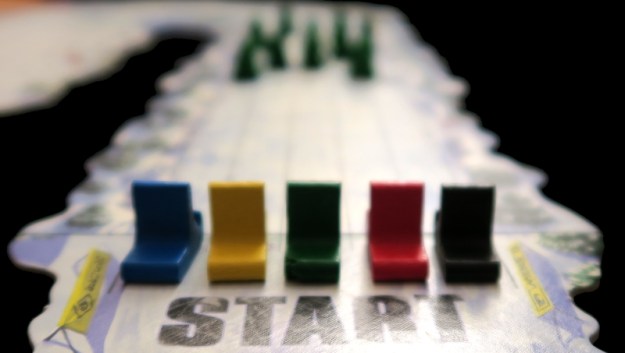
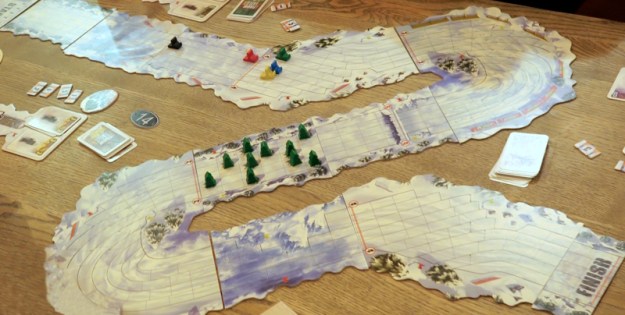
Snow Tails is a very popular game in the group, but somehow, one that is a little tricky to get to grips with.  The games is a card-driven sled-race with the winner the first to navigate the course.  Unfortunately, the course they chose was the one depicted in the main rules, which isn’t really intended to be a course design as it is quite long and features a Chasm right at the start, a couple of hairpins and some Saplings as well.  Each player starts with their own personal deck of cards, with five in hand.  On their turn, players can play up to three cards as they can so long as they are all the same value:  one for each sled dog, and one on the break.

Snow Tails
– Image by boardGOATS

The speed, the number of spaces the sled moves forward, is the total for the dogs minus the value for the Break.  Sleds will additionally drift sideways the difference between the dog speeds, and if the sled is balanced (i.e. the dogs are pulling equally), the player gets a bonus speed equal to the players position in the race.  Each time a sled exceeds the Speed Limit on a corner, hits the side of the track or a Sapling, the player takes a Dent card—a useless card that just blocks the player’s hand making things difficult.  The more Dent cards a player has, the more difficult the game gets, as Black soon demonstrated.  The first game of Jokkmokk had already finished and the sleds were only just off the Start line and through the first Chasm.

Snow Tails
– Image by boardGOATS

Lime claimed the “Big Paws” token for the player with the most “Analysis Paralysis”, though to be fair, everyone suffered a bit.  Jade commented that he’d been planning to play it with his nieces, but was now rethinking the idea.  As a result, the group shortened the track (to give them a chance to finish before midnight), and from there, the game went a bit more smoothly.  Jade was first to cross the Finish line, chased by Cobalt and then Sapphire in what had been a quite epic game.  And with that, the party was over for another year, though people lingered and chatted for quite a while before everyone left the pub staff to lock up.

"Un-Christmas Party" 2023
– Image by boardGOATS

Learning Outcome:  Always plan your Christmas shopping early.

18th April 2023

Blue and Pink were joined for food by Jade, Plum, Byzantium and Sapphire.  As they finished, Pine, Green and Purple showed up (leaving Black under the patio, again), followed by Ivory and a team of Sherpas toting his massive Complete Collection of Everdell.  There were quite a few possible takers for the Pearlbrook expansion, the night’s “Feature Game“, but eventually, after a lot of discussion, Ivory was joined by Plum and Jade and they took themselves over to the other side of the pub and started setting up, which was no small task, though Everdell is functionally a fairly simple game.

Everdell: Pearlbrook
– Image by boardGOATS

Everdell is a dynamic tableau building and worker placement.  On their turn players can do one of three things: place a Worker and carry out any associated actions; pay any associated cost to play a card from their hand, or prepare for the next Season.  The game is played from Winter through to the onset of the following Winter, so each player has four Seasons, though because players can prepare for the next Season whenever they want to, players’ Seasons have different lengths and start their Seasons at different times.  This means one player who takes fewer turns could finish their game much sooner than another player.  At the end of the game, when everyone has finished, the player with the most points is the winner.

Everdell: Pearlbrook
– Image by boardGOATS

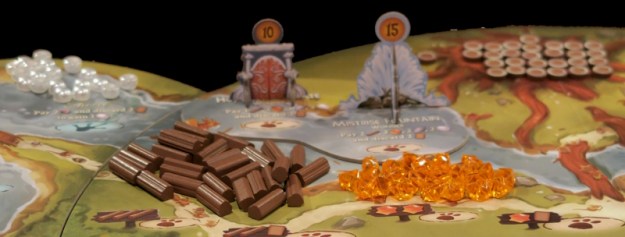
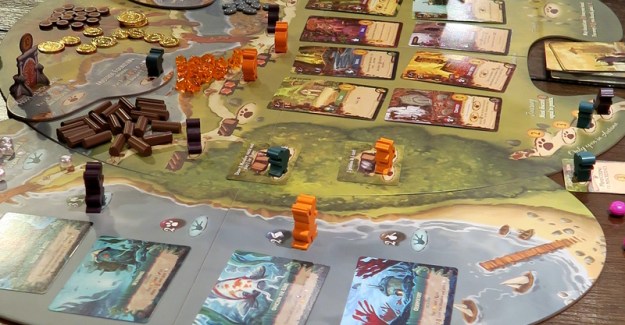
The Pearlbrook expansion adds an extension to the board, which displays River Destination cards and the new Pearl resource that give the brook (and thus the expansion) its name.  The basic event spaces are covered up as these are not used and are replaced by two new Wonder spaces.  Everyone also gets a couple of adornment cards at the start of the game and on their turn can pay a Pearl to play one of these as an action.  The don’t take up any space in the player’s city, but give an instant bonus action and points at the end of the game.  Players also start with a Frog Ambassador which they use to visit the Pearlbrook either to get Pearls or to activate the River Destinations.

Everdell: Pearlbrook
– Image by boardGOATS

The River Destination spaces have a requirement printed on the board (e.g. three production cards in the City) and a player’s Frog Ambassador can only visit, if the player has achieved it and it is unoccupied.  The River Destination cards start the game face down with a Pearl on top and the first player to visit each one takes the Pearl and turns over the card.  Another player can’t visit the Destination until it has been vacated which typically happens at the end of the occupying player’s Season.  The Shoal space allows players to exchange two resources and two cards for a Pearl, but this space is unlimited.

Everdell: Pearlbrook
– Image by boardGOATS

Ivory charged out of the starting blocks, leaving Plum and Jade for dust.  Jade struggled to get his engine going because his starting hand needed three different types of resources.  Plum and Jade commented that it was nearly impossible to get a Pearl in the first Season, Winter, so Ivory made it his business to prove them wrong.  Once he’d got his Pearl, he used it to play his first adornment card giving him more resources and, as a result he was still in winter when Plum and Jade had moved on and were well into Spring.  That meant Ivory didn’t take his Platypus workers back leaving them blocking spaces the others would have liked to use.

Everdell: Pearlbrook
– Image by boardGOATS

As a result Plum and Jade had progressed their Spring before Ivory played his Frog Ambassador, which they hadn’t been able to use at all during Winter.  It was a long time since Jade had played and he was out of practice optimising his seasons, consequently his Spring achieved less than he would have liked.  As the game progressed, the River Destinations were opened up and everyone started to use them, giving everyone more Pearls.  Plum (obviously playing with Kitty workers) had built up quite a pile, so both Ivory and Jade raided her stash by playing Pirate Ship cards which take up space and don’t score points.  That meant she could use one herself in an attempt to wreak her horrific revenge later, though it wasn’t as fruitful.

Everdell: Pearlbrook
– Image by boardGOATS

Both Jade and Plum then played Pirate cards, gambling with discarding cards and hoping to draw cards with a sum of value of seven cards to get another Pearl, but both failed.  Although Plum and Jade had built up a large pile of Pearls, Ivory took the first, and largest monument, the “Light House”, due to his huge pile of resources.  The others weren’t far behind though, taking the “Sunblaze Bridge” and the “Mistrise Fountain” respectively.  Ivory also put his enormous wood pile to good use claiming the first event (“An Evening of Fireworks”).  That triggered Plum to spot that she had already completed “X Marks the Spot”, so she grabbed that quickly followed by Jade who took “Ministering to Miscreants” shortly after.

Everdell: Pearlbrook
– Image by boardGOATS

There was quite a bit of congestion and Jade in particular found Plum and Ivory grabbed spaces just before he could get there.  Throughout the game, Ivory managed to eek every last ounce out of each Season, but in the end, although Ivory dragged out Winter and Spring, after he’d achieved the event and got his Monument, he ran out of things to do.  As a result, everyone finished very close in both time and scores and it was far from the landslide that might have been predicted earlier in the game.  Plum’s prosperity gave her an edge, but that was offset by Jade’s left over Pearls and higher scoring event.  It was Ivory who was the victor, however, with eighty-two points just six ahead of Plum in second.

Everdell: Pearlbrook
– Image by boardGOATS

With Ivory, Plum and Jade playing Everdell, that left seven people to decide what they were going to play and how they were going to split the group or even if they were going to divide into two.  And then Lime arrived, but while that made splitting into two group more sensible, there still wasn’t any consensus about what to play and nobody seemed to want to commit to a group until they knew what was going to be played.  So, in the end Blue made an executive decision and, much to Green’s delight, decreed that one of the games would be Dice Hospital.  Purple, Byzantium and Pine joined him and they started setting up.

Dice Hospital
– Image by boardGOATS

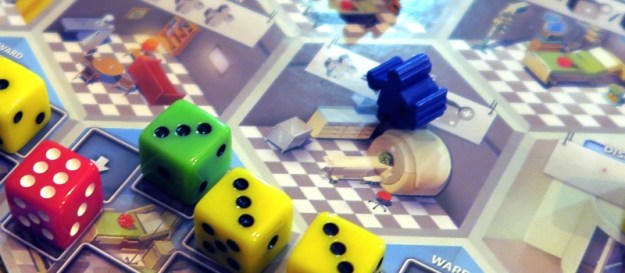
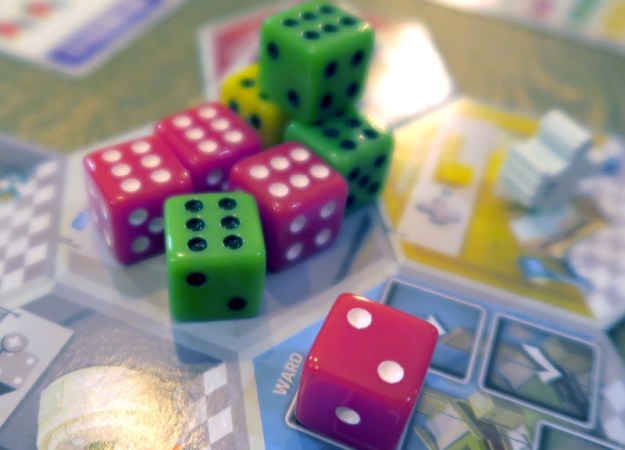
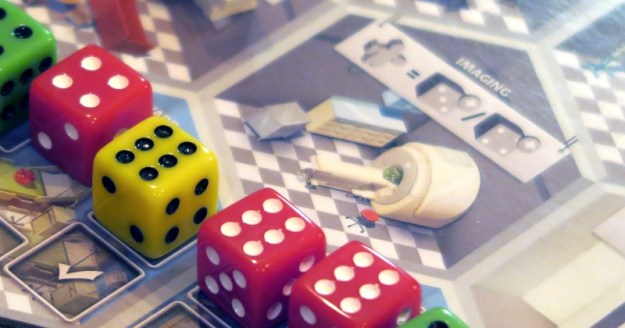
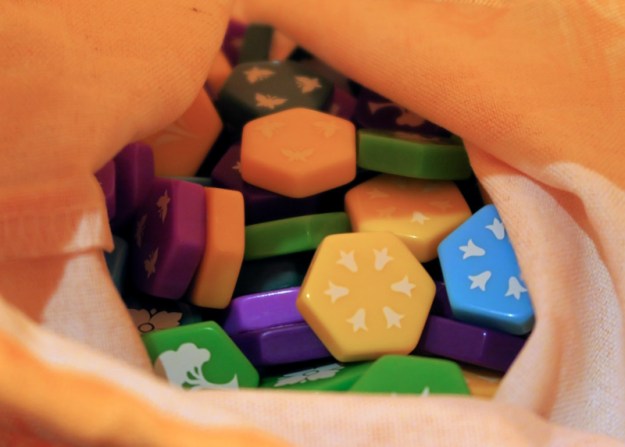
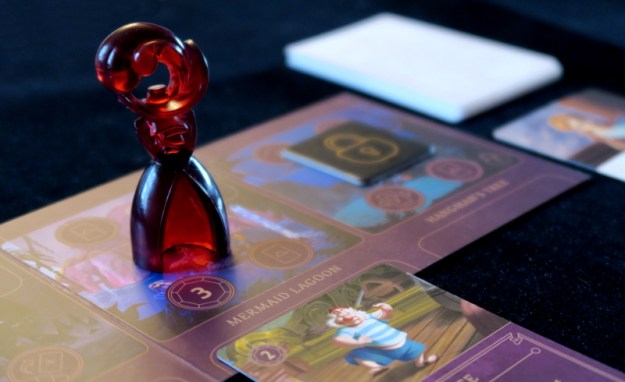
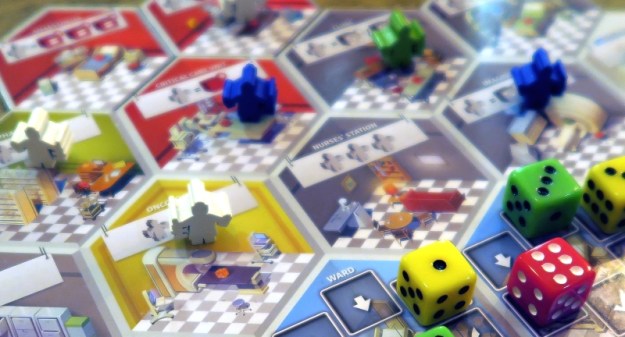
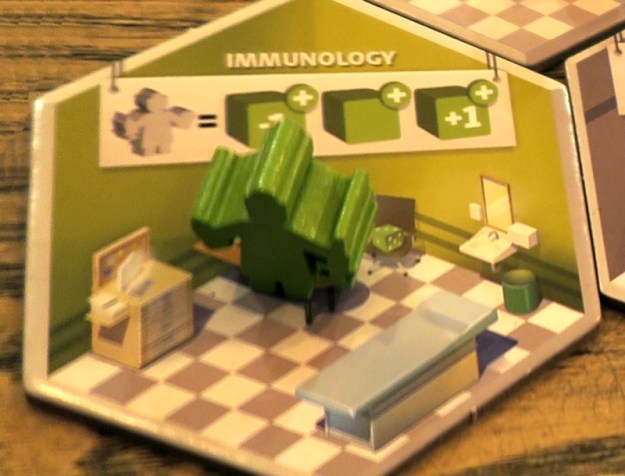
Byzantium and Green had both played this before, so together, they explained the rules to Pine and Purple.  The idea is that each player is the owner of a hospital and starts with an administrator which gives them a special power, three nurses, and three patients—dice drawn at random from a bag.  The colour of the dice represents their illness and the number,  its severity:  six indicates the patient is healthy, but if the number falls below one, the patient dies.  At the start of each round, players take an ambulance with new patients—if there aren’t enough beds available, another patient must make space by moving to the morgue (where each body-bag is a negative point at the end of the game).

Dice Hospital
– Image by boardGOATS

Players can then improve their hospital by adding specialist medics and wards and finally, their medics can visit each patient and improve their health.  Different specialisms can only “heal” certain colours or numbers.  Any patients not treated are “neglected” and their health deteriorates with any that fall below one moving to the morgue while anyone who exceeded six is discharged.  The more that are discharged at the same time, the more points the player scores.  The game ends after eight rounds and the player with the most points is the winner.   The key to the game is knowing which specialists to get and which ambulance of patients to take.

Dice Hospital
– Image by boardGOATS

There was some confusion about what the symbols on the Specialists and Wards meant. The little help cards seemed to cause more confusion as they did not list all the symbols, so in the end, the rule-book was handed out which fixed the problem.  Green had played the game a few times on line, but less often in real life, so needed to keep checking the rules for the set-up and the order of who chose when and did what, but eventually the game got started.  The first round was a little slow with a few restarts as people took a little time while to work out how the game worked and what they could actually achieve.

Dice Hospital
– Image by boardGOATS

During the second round after everyone had finished their “Healings”, Pine was still working his out, but had ended up with one less discharged patient than he expected.  Unfortunately real life doesn’t have a “reset” button like the game on line and you can’t always remember what the hospital looked like before starting healing people.  So in the third round, everyone else kept an eye out for Pine to help him, before sorting out their own hospitals.  Unfortunately, the suggestions, though intended to be helpful were distracting, and as a result, Pine struggled to work out what he was trying to do. By this time everyone was really finding it difficult to discharge patients.

Dice Hospital
– Image by boardGOATS

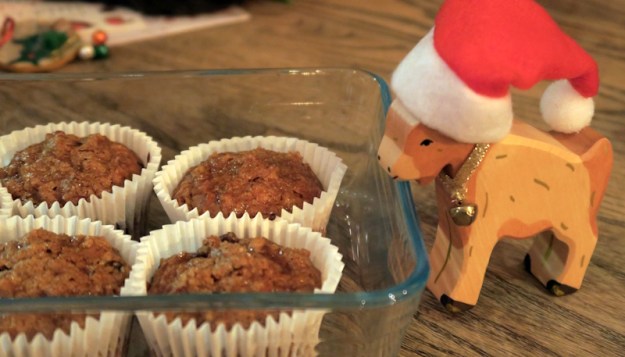
Byzantium was struggling because he had gone heavy on green Doctors and Wards while Green had lots of red Dice and Doctors, but had ended up with Patients which didn’t quite match what they needed.  And so, there were the first fatalities—the Hospitals were in crises! Nothing new there, then…  By the end of the game, Pine and Purple were getting the hang of things. Despite his struggles, Pine did well and came second with thirty-eight points, only beaten by Byzantium who score forty-three.  Even though he did quite well for a first game, Pine did not warm to Dice Hospital and the overall conclusion was that it is a game that plays better on-line as it deals with all those complicated set-up and order issues, as well as having that extremely useful “turn reset” function.

Dice Hospital
– Image by boardGOATS

With everyone else finally sorted out, that just left Blue, Pink, Lime and Sapphire to decide what to play.  Pink suggested Azul: Queen’s Garden, but the only problem was that he’d never played it.  Sapphire had though, so the group nominated him to teach them because, how hard could it be since everyone was very familiar with the original Azul?  Well, as it turned out, quite hard, since in terms of difficulty Queen’s Garden is more on a par with the second and third editions (Stained Glass of Sintra and Summer Pavilion), which are both a very marked step up from the original.

Azul: Stained Glass of Sintra
– Image by boardGOATS

In the original Azul, take all the pieces of one colour from a market and add the rest to the central pool or take all the pieces of one colour from the central pool.  In Queen’s Garden, the Tiles come with different colours and different patterns and the Markets come out gradually through each of the four rounds.  So, instead of taking pieces of the same colour from one market, players can take as many different the pieces of the same colour or with the same pattern from anywhere as long as they are are all different (maximum of six).  Additionally, when a Market is empty, it is turned over and becomes a Garden Extension which players can also take on their turn.

Azul: Queen's Garden
– Image by boardGOATS

Garden Extensions are hold seven tiles—the player mat has space for six Tiles printed on it, but once that is full, players need Extensions to place more.  Each Extension has a single tile printed on it, so once a Market has been emptied and turned over, it can be taken by the active player along with any Tiles matching the colour or pattern.  Like Summer Pavilion, the Tiles and Extensions are then stored before they are added to their Garden display.  Unlike Summer Pavilion however, the amount of storage space is limited, so instead of taking Tiles/Extensions from the market, players can place a Tile or Extension in their player area, or Garden.

Azul: Queen's Garden
– Image by boardGOATS

When placing a Tile in their Garden players must pay.  The price is dictated by the pattern:  trees cost one, eagles cost two, butterflies three and so on.  Like Summer Pavilion, the cost is made up of the Tile placed and Tiles that match the colour or the pattern of the Tile placed, which are dropped into a Tower for recycling later in the game.  Also like in in Summer Pavilion, when a player surrounds marked spaces they get a bonus, in this case, “Wild Tiles” which can be used to match any colour or pattern when paying to place other tiles.  These are essential for some of the higher value patterns, which are very expensive to place and it can be hard to get enough tiles that match, however, Wild Tiles also take up space in storage.

Azul: Queen's Garden
– Image by boardGOATS

When tiles are placed, if they are adjacent to a tile, either the colour or the pattern must match.  Alternatively, Tiles can be placed so they aren’t next to another tile.  At the end of each round, players score all the pieces currently in their Garden, with different colours and patterns scoring points at the end of each round as per the rondel (trees, green and blue tiles scoring at the end of the first round for example).  At the end of the game, players score for each Group of three or more tiles where the colour or the pattern match.  Colour Groups score for each pattern present in it (trees score one point, eagles two and so on), but each pattern can only be included in each Group once giving a maximum Group size of six.

Azul: Queen's Garden
– Image by boardGOATS

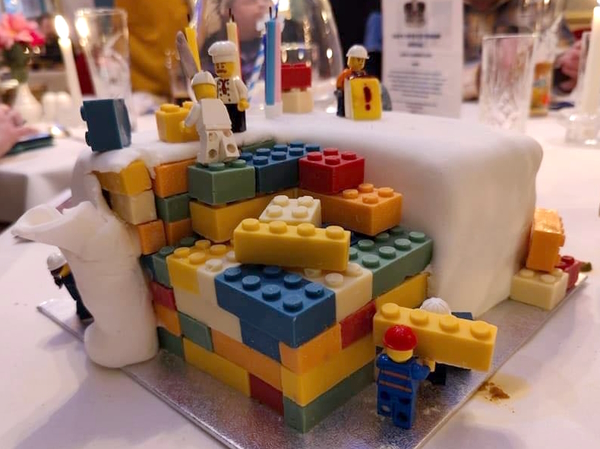
Pattern Groups also score for the pattern (so a Group of trees will score one point per tiles), but in these groups each colour can only feature once, so again there is a maximum size of six.  If any Group has reached its maximum size of six, the player also gets an extra six bonus points.  However, any left-over tiles that have not been placed give negative scores which can be very, very costly indeed.  The group were just getting underway when Jade came round with some birthday cake—pieces cut from an absolutely amazing “Lego Cake” made by the amazingly talented Jason Smith.  Everyone, on all three tables, was very much distracted by the remarkable, solid chocolate Lego bricks and very fine chocolate cake, but eventually attention returned to the games.

Jade's 2023 Birthday Cake
– Image by Jade

With the group feeling their way somewhat, people started without long term plans.  A few rules got missed, the group forgot to score a point for each Pavilion and nobody paid much attention to the option of drawing face-down Garden Extensions because of the six point penalty.  The biggest rules malfunction, however, was that nobody realised that Lime had a duplicate tile in his large dark purple group of tiles in the centre of his garden, giving him a slightly illegal set of seven.  The group let that slide and everyone concentrated trying to find a way of getting points from their gardens.

Azul: Queen's Garden
– Image by boardGOATS

Everyone seemed to have slightly different strategies, collecting different colours or different patterns and covering different areas of their gardens.  While nobody had thought anyone was going to need their “I’ve been round the track already” token, and obviously, nobody was going to have to touch their two-hundred and forty point token, everyone did make it round once and claimed their sixty point tokens.  It was all very, very tight and there were even slight recounts, but in the end, it Blue claimed victory, by just two points (or maybe even one) from Lime who was just two (or maybe three) points ahead of Pink.

Azul: Queen's Garden
– Image by boardGOATS

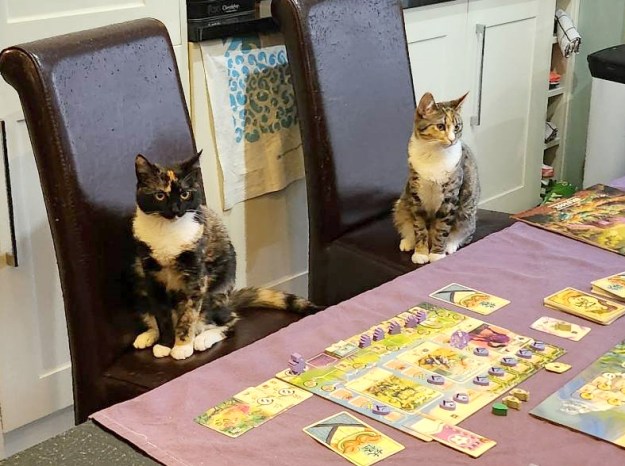
There was a lot of chatter as everyone packed away.  Pink commented that he liked Queen’s Garden—not as much as the original Azul, but at least as much as Summer Pavilion (nobody talks about Stained Glass of Sintra, which Sapphire politely described as a bit of a “mis-step”).  And then everyone wandered over to spectate the great count up and pack-away of Everdell.  It was all a bit rushed and Ivory was definitely going to have some homework to do in terms of sorting it all out, but there was still just enough time to share a few pictures of cake, parties and kitties—it seems they are quite fond of Bitoku

Bitoku
– Image by Plum

Learning outcome:  Goats, like cats, love to play games, and eat cake.

Golden GOAT Award Winners – 2022

As usual, the boardGOATS met just before Christmas for a party and to decide the winners of the GOAT Awards.  After pizza and crackers and the usual mayhem, the group voted for two awards:  the Golden GOAT for our favourite game and the “GOAT Poo” award for our least favourite.  Everyone had the usual three points to hand out for the Golden GOAT Award (plus a bonus if wearing Festive Attire), though a maximum of two points could be given to any individual game.  Everyone could also nominate up to two individual games for the GOAT Poo Prize.

Dice Hospital
– Image by boardGOATS

This year, there were a few games that received the unofficial “Marmite Award”, that is to say they received nominations for both the Golden GOAT and the GOAT Poo prizes.  These included Dice Hospital, Azul, Modern Art and Viticulture.  For the GOAT Poo Prize itself, there were several games that received two or three nominations, but the clear winner was Villainous – The Worst takes it All which received six nominations—quite an achievement since only five people played it and one of those wasn’t present for the vote!  Villainous is a beautiful, asymmetric card game, but one that we struggled with for several reasons, not least the fact that players had to work out how to play their own character, and we were playing it with five people which is two or three more than it needs.

Disney Villainous: The Worst Takes it All
– Image by boardGOATS

Nominations for Moment of the Year included two epic games, one of Viticulture and the other of Tapestry.  The latter nomination included the citation:  “I thought I was doing well until Ivory lapped me… twice!”  Pine also recalled Lilac nobbling him in Turf Horse RacingThe most poignant moment however, with hindsight, was last year’s UnChristmas Dinner, which was the last meeting attended by Burgundy, who very sadly, suddenly passed away just a few days later.  We all still miss him, but the fact we were joined by Jade and Plum and their partners this year is his legacy, and one we think he would have been proud of.

Mike Parker
– Image by
Pushpendra Rishi

And that just left the Golden GOAT Award for the best game of the year.  Previous winners including Wingspan, Altiplano and 6 Nimmt! were ruled out, but there were plenty of options remaining.  Lots of games received three nominations including Endeavor, Cascadia, Old London Bridge, Splendor, Tapestry and Die Wandelnden Türme  But this year, the clear winner was Everdell. This card-driven game was only played for the first time a few weeks ago, but it is planned to play it again soon with one of the expansions being the “Feature Game” early in the new year.

Golden GOAT - 2022
– Image by boardGOATS

24th March 2022

The evening began with Pine arriving first and wondering if he’d got the wrong night as it was gone 7pm before anyone else arrived.  While Blue ate her supper, Pine shared some “worm porn” (a video of a penis fencing flatworm) and Green shared his exploits on Board Game Arena.  Apparently he’d been playing Imhotep and had been doing rather well, rising to thirty-fifth.  After a lot of discussion about which game he was talking about, it turned out that by pure chance, a copy of Imhotep had made it to The Jockey.  In spite of Green’s enthusiastic request for someone to beat him, nobody looked keen to take him up on the offer.

Imhotep
– Image by boardGOATS

While the others discussed the options, Purple and Black joined Blue and Pine setting up the “Feature Game“.  This was the Druids expansion for an old favourite, the 2016 Kennerspiel des Jahres winner, Isle of Skye.  The base game is a tile laying game similar in nature to the popular gateway game, Carcassonne, but with an auction of tiles and objectives that give points. The auctions are extremely clever:  each player draws three tiles from a bag and privately decide how much two are worth, selecting one to be discarded.  Players use their own money to indicate the value and therefore the cost of the tiles.

Isle of Skye: From Chieftain to King
– Image by boardGOATS

After the values are revealed, each player then takes it in turns to buy one tile.  The clever part is that the money used to indicate the cost of each tile is reserved to pay for it until someone else buys it.  Any tiles that have not been bought after everyone has chosen and paid for one, must be paid for by their owner.  The reason this is clever is because of the effect it has on the amount of money that players have to spend.  For example, the first player in the round must make sure they have sufficient uncommitted funds if they want to be able to buy a tile.

Isle of Skye: From Chieftain to King
– Image by boardGOATS

On the other hand, the player at the end of the round has a different calculation to make:  if their tiles are priced to give good value they should sell at least one which will provide them with liquidity to buy other tiles.  However, being last in the round, their choice will be reduced, and if their tiles don’t sell, the fact the other tiles might be on the expensive side, could leave them unable to make a purchase.  It is not compulsory to buy a tile, but players that don’t have enough tiles are unlikely to score as well.  Thus valuing tiles is key—overvaluing their tiles is costly as nobody will buy them leaving their owner with a big bill and less money in the next round, while undervaluing them gives good tiles to an opponent and will leave their owner with less money and fewer tiles.

Isle of Skye: From Chieftain to King
– Image by boardGOATS

Once the tile auction is complete, players add the tiles to their own personal fiefdom.  At the end of the round, one or more of the objectives are scored.  Similar to Cartographers, there are four scoring objectives.  In the early rounds only one scores, with three scored in later rounds, but each one is scored the same number of times during the game.  Although this is an important source of points, it is not the only one as some tiles feature scrolls that score at the end of the game.  Players receive income at the start of each round, with players getting additional funds for each player that is in front of them, with the amount increasing as the game progresses.  As well as being a catch-up mechanism, this also importantly provides an additional channel for money to enter the game.

Isle of Skye: From Chieftain to King
– Image by boardGOATS

In addition to the auctions and the objectives, there are other ways Isle of Skye differs from Carcassonne.  There are no meeples, and players have their own maps instead of sharing one central one.  Even the tile placement rules are slightly different as terrain must match, but not roads (though it is generally useful if they do as it can increase players’ income).  Thus, although there is a superficial similarity with Carcassonne, Isle of Skye is distinctly more complex.  Unlike the first, Journeyman expansion (which we have not yet played), the second, Druids expansion doesn’t really increase the complexity.  It adds more strategy options though, with more scoring opportunities and additional ways to spend money (should you have any spare).

Isle of Skye: Druids
– Image by boardGOATS

The Druids expansion adds a second part to the auction phase where players can choose to buy one from the five displayed on the dolmen board.  These are more powerful as they generally include scoring opportunities or special powers, but are correspondingly more expensive.  The end of round scoring tiles gave A) two points for each tile in players’ largest completed lake; B) a point for each cow or sheep on on or adjacent to a tile with a farm; C) two points for each set of four tiles arranged in a square, and D) one point for each row and column containing a Broch.

Isle of Skye: From Chieftain to King
– Image by boardGOATS

Pine took the first player token and Purple’s first draw gave her one of the promo tiles from the Themenplättchen mini expansion which was immediately thrown back for causing too much brain pain to work out what it did.  Pine and Blue took an early lead at the end of the first round scoring for their lakes, but it was only a handful of points and there was a long way to go.  Purple started building her long thin, rectangular kingdom prioritising income.  It wasn’t until the third round that the importance of this shape became apparent to everyone else however:  since tiles could be used to score multiple times for (C), this meant Purple picked up lots of points.

Isle of Skye: From Chieftain to King – Tunnelplättchen
– Image by boardGOATS

There was a bit of a debate about the Tunnelplättchen tiles from the two mini expansions.  Black checked on Board Game Geek and confirmed that tunnels going into the same mountain range connected together.  This helped Pine considerably, as otherwise he was in a bit of a mess.  Blue bought an exciting looking scroll tile that gave lots of points for enclosed pasture, but when Blue noticed that Black had it too, he commented that it was actually really difficult to enclose pasture, Blue took it as a challenge. It was shortly after this, about half way through the game that the group realised that they’d forgotten about the catch-up mechanism.

Isle of Skye: Druids
– Image by boardGOATS

From the third round, during the income phase at the start of the round, players get gold for every player that is ahead of them on the score track.  The amount of gold they get increases as the game progresses, so in the final round players get four gold for every player ahead of them—for the player at the back in the four player game, this comes to twelve gold, and for a player at the back until the start of the last round this comes to a total of thirty gold more than a player at the front.  Unfortunately, the group remembered this a couple of rounds too late, so everyone who wasn’t in the lead (i.e. everyone but Blue) received a nice little windfall that they could use to increase the price of their tiles or spend on the Dolman.

Isle of Skye: From Chieftain to King
– Image by boardGOATS

Black was making good use of the Dolman board and had some really juicy scoring scrolls in his tidy little kingdom and looked the one to beat, especially as he had plenty of cash too (helped by his windfall).  Pine, on the other hand was struggling to find anything useful and was resorting to using the alternative Dolman option: draw two tiles from the bag and keep one.  Unfortunately despite trying attempts, he wasn’t getting anything he wanted.  It was at the end of round five that things suddenly changed and Purple, hitherto drifting about in third and and fourth leapt forward, landing just one point behind Blue.

Isle of Skye: Druids
– Image by boardGOATS

Blue, having led throughout, knew she didn’t really have enough end-game points to challenge and was expecting Black to catch and overtake.  In the event, it was extremely tight at the front with Purple finishing with one hundred and two points, six more than Blue who just managed to hold on to second, two points ahead of Black.  All in all though, everyone liked what the Dolman board added to the game, as it gave people larger, more exciting kingdoms with something to spend money on (when they had it).

Isle of Skye: From Chieftain to King
– Image by boardGOATS

Meanwhile, the other group started by discussing what to play.  Imhotep was on the table, but Ivory spotted Dice Hospital in a bag and Green was happy to play that instead; as Lilac was familiar with it too she was happy with the switch, as was Teal, though he had not played it.   The explanation of the rules and game play took a little longer than the game itself would indicate.  The idea is that each play is the owner of a hospital and starts with an administrator which gives them a special power, three nurses, and three patients—dice drawn at random from a bag.  The colour of the dice represents their illness and the number on the face shown its severity:  six indicates they are healthy but if the number falls below one, the patient dies.

Dice Hospital
– Image by boardGOATS

At the start of each round, players take an ambulance with new patients – if there aren’t enough beds available, another patient must make space by moving to the morgue (where each body-bag is a negative point at the end of the game).  Players can then augment their own hospital by adding specialist medics and wards and finally, their medics can visit each patient and improve their health.  Different specialisms can only “heal” certain colours or numbers. Any patients not treated are “neglected” and their health deteriorates with any that fall below one moving to the morgue. In contrast, anyone who exceeded six is discharged at the end of the round, but the more that are discharged at the same time, the more points the player scores.

Dice Hospital
– Image by boardGOATS

As the game progresses, players continue to improve their hospital getting more specialists and acquiring blood bags to help treat their patients.  The game ends after eight rounds and the player with the most points is the winner.  When the group finally got underway it became clearer how to play and what actions were available.  The key to the game is knowing which specialists to get and which ambulance of patients to take – admitting healthier patients gives less choice of ward/doctor (and potentially get something which is of little use) , while curing the sickest patients is more difficult, but gives first dibs specialisms.

Dice Hospital
– Image by boardGOATS

The administrators dealt out at the start of the game can provide players with a direction for their strategy.  Teal and Green had ones that meant that they could leave one patient of a specific colour untreated per round without them declining. Teal was able to use his a few times, but Green found that he just could never seem to get enough red dice to make use of it.  Lilac was trying to get at least two red patients healed each turn as her administrator privilege gave her an extra point if she did; she managed it a few times (which was where the red dice kept going).  Ivory’s administrator would give him an extra point if he healed at least one patient of each colour which he managed to good effect several times.

Dice Hospital
– Image by boardGOATS

After a couple of rounds Green commented that he had found it was best to keep a balance of Ward’s and medics otherwise there either wasn’t enough staff to treat the number of patients, or there weren’t enough usable wards to send the your doctors to. Teal and Lilac were quite good at regularly healing patients, but at one at a time they were scoring only one point per round.  Each subsequent patient healed in a round scored an extra two points each With more than six worth three points extra.  Thus holding on to heal more per round, meant more points.  There was also a five point bonus for completely clearing the hospital, but nobody got close to that, except Ivory in the final round.

Dice Hospital
– Image by boardGOATS

Throughout the game, Teal and Lilac kept healing a steady trickle of patients. Green however was having all sorts of trouble:  he found himself with ward’s he couldn’t use, his hospital filing up rapidly, and started losing patients (minus two points)—his was definitely a Failing Trust!  Ivory, however, was romping away, keeping his hospital from getting over crowded and kept amassing points.  Although his start had been slow start and he didn’t score anything until the third round, he made up for it after that.  In the end Ivory proved to have run the best hospital trust, while Teal’s slow steady trickle worked out quite well as his hospital was the second best with Lilac was a close third.

Dice Hospital
– Image by boardGOATS

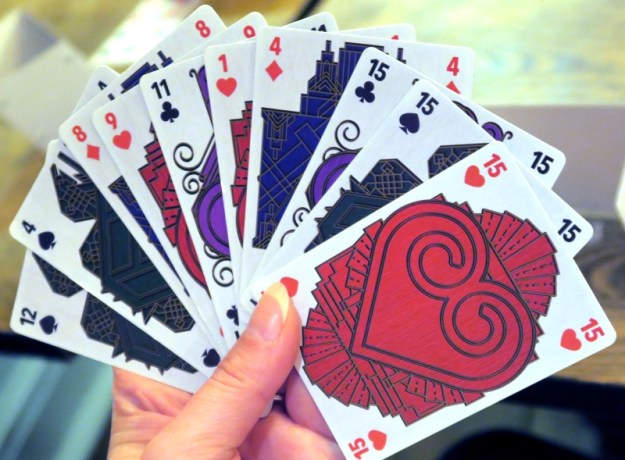
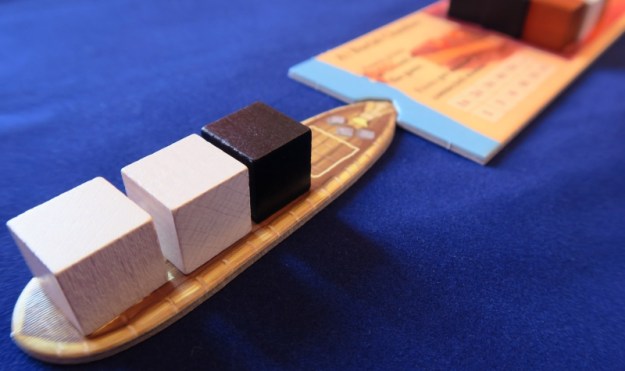
Ivory left for home, but Isle of Skye had not yet finished and, although there wasn’t time for Imhotep, there was still time for something quick.  So Teal introduced Green and Lilac to a game they’d not played before, called Diamonds.  This is a trick-taking game played with normal suited cards from one to fifteen where players are trying to win diamonds—not the suit, but the gemstones.  When players cannot follow suit they get to do a “Suit Action” based on what suit they actually play.  For example, playing a Diamond card gives one diamond gem from the supply placed into the player’s safe while playing a Heart gives one diamond from the supply to the pile in front of their safe.
Diamonds
– Image by boardGOATS

Similarly, playing a Spade allows the player to move one diamond from outside their safe into it, and on playing a Club the player steals one diamond from outside someone else’s safe and places it in front of their own. Additionally, at the end of the round of ten tricks, the player that won the most tricks in each suit gets to do that Suit Action one more time (in the case of a tie no-one does it).  With the game taking six rounds there is plenty of chances to gain diamonds.  It did not take long for the group to understand the game, although the for first few tricks the group were a little uncertain.
Diamonds
– Image by boardGOATS

Several times players found that although they had won, they couldn’t do anything as either the person they were supposed to steal from did not have any diamonds or, when they could move one diamond into their safe (from in front of it), they didn’t have any.  Plus, several times they found they had to steal from themselves so nothing happened.  The group also found that when they started to win tricks, they got control and were able to lead in suits the others didn’t have and so kept winning.  It proved to be a clever little game, but the group felt it probably plays much better with more people, so we might try it with a larger part of the group in future.  At the end of the game, however, Teal was the master diamond merchant with Green the apprentice.

Diamonds
– Image by boardGOATS

Learning Outcome:  A career in diamond trading is not for everyone.