Tag Archives: Dixit

8th October 2024

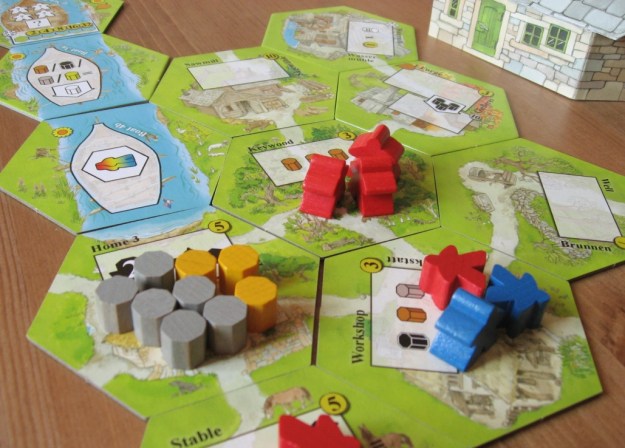
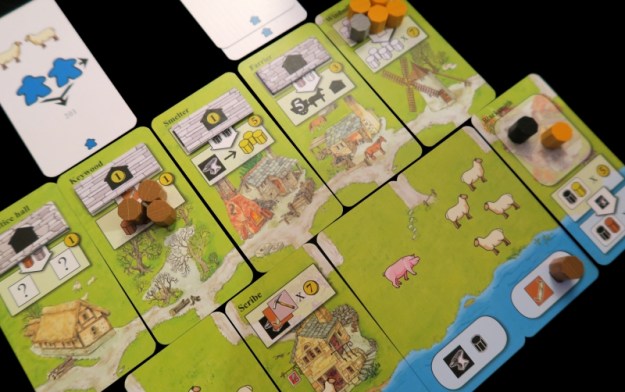
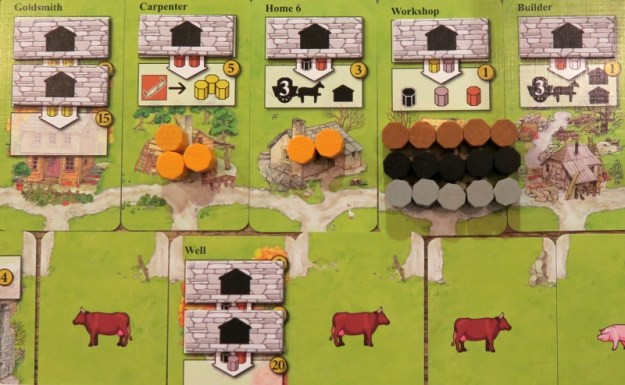
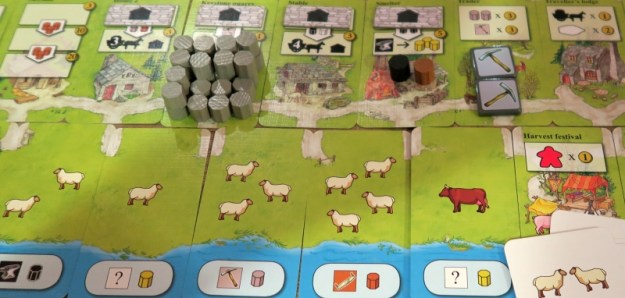
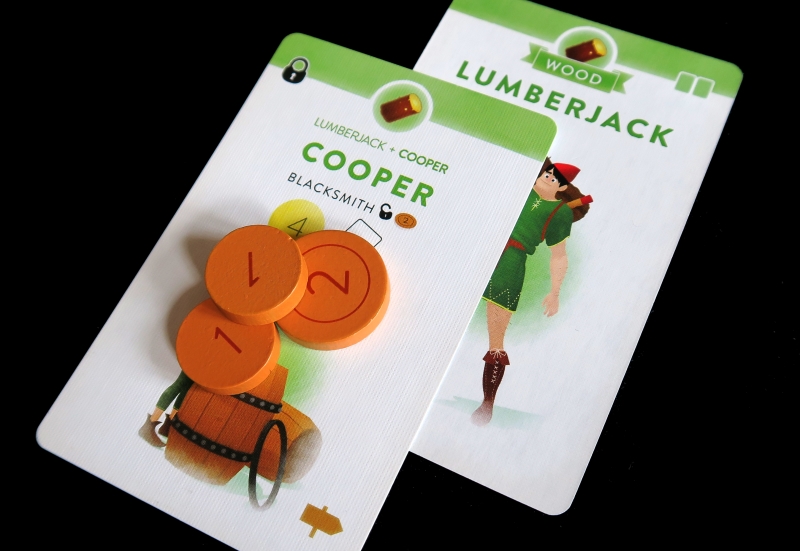
As it was our twelfth birthday party, lots of people arrived early for pizza (or an amazing Mixed Grill in the case of Lime and some lovely veggie curry and fiery chilli for Pine), followed by GOAT cupcakes.  While everyone waited for food, arrivals from Essen were handed out, including Nucleum, Faraway and Flamme Rouge expansions; Let’s Go! To Japan and Cascadia mini expansions, and Die Wandelnden Türme (aka Wandering Towers), Keyflower and Dixit promotional items.   There was a lot of chatter too, about flooding, pot holes, the 34 road closure, full car parks and water leaks, as well as Essen.  Indigo and Navy weren’t eating, so had a play with Villagers while the others entertained themselves.  This is a card game where players “Draft” Villager cards from a market (called the Road) and then add them to their Village.
Villagers
– Image by boardGOATS

Some Villagers have prerequisites before they can be “Built”.  These are cards that must exist in the player’s Village before the Villager can be added on top to make a chain, cards that must be unlocked by paying money to other Villagers in their own Village, someone else’s Village or the Bank.  Some cards allow players to draft extra cards, while others enable players to Build extra Villagers and Special Villagers give powerful special actions.  Twice during the game there “Market” Phases when players get income from their cards, and the player with the most money at the end of the game is the winner. Somewhere along the lines, Indigo and Navy had a bit of a rules malfunction, and as everyone else had already started the now traditional birthday “Feature Game“, Crappy Birthday, they abandoned Villagers.
Crappy Birthday
– Image by boardGOATS

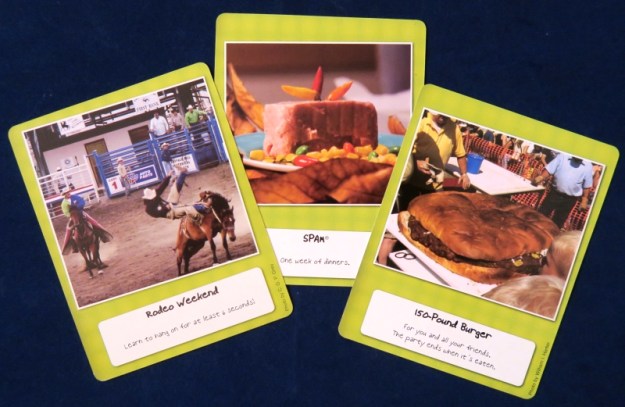
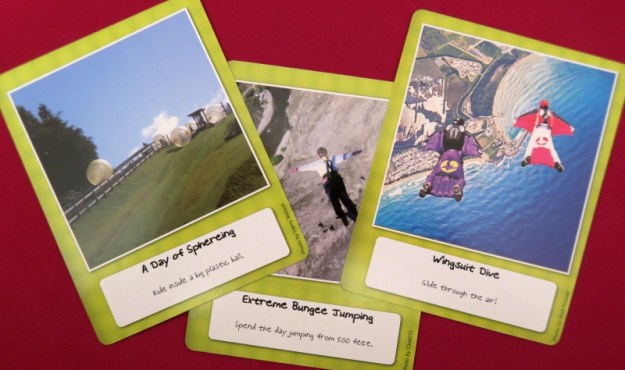
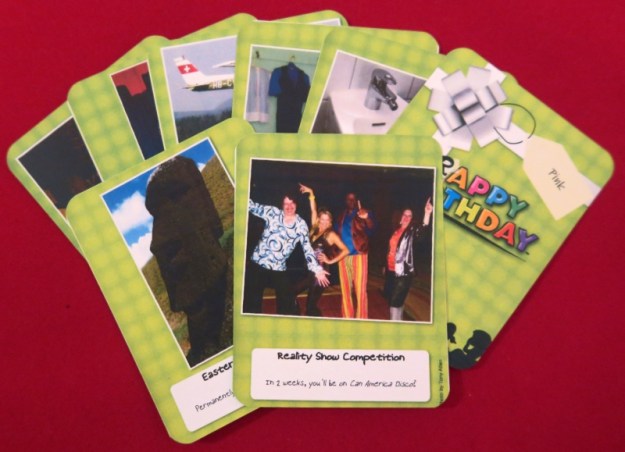
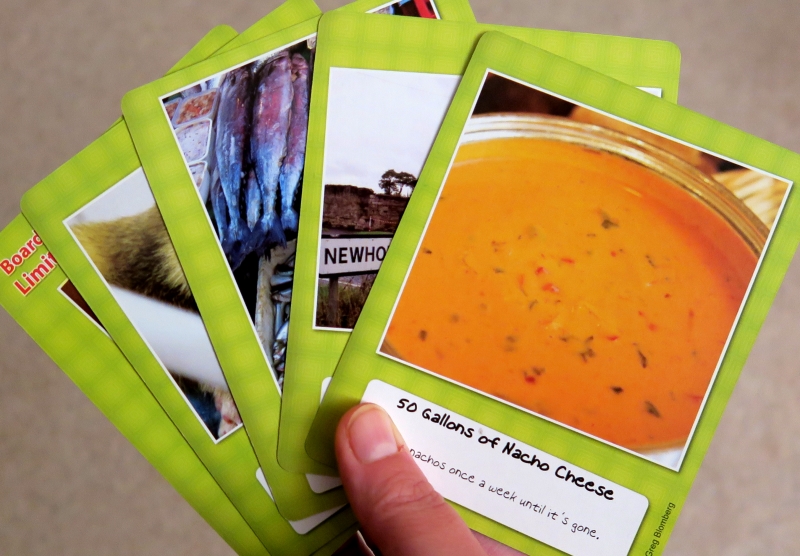
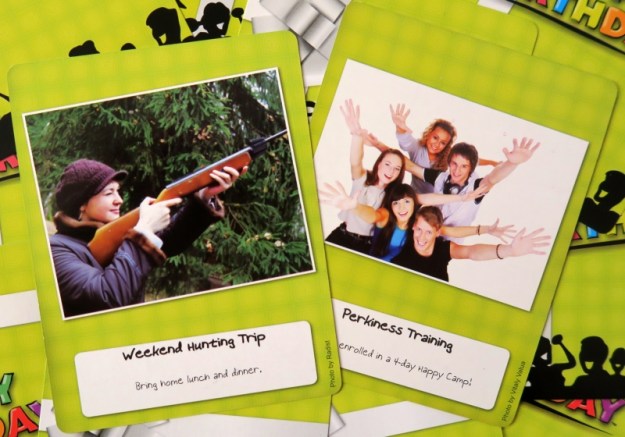
Crappy Birthday is a party game where players give each other comedy birthday presents and the recipient has to decide who gave the best and worst gifts.  We play a slight variant of rules as written, where we play a single year of birthdays with each gamer getting one turn to receive gift cards from everyone else from their hand of five cards.  With lots of players the pile of gifts can get quite substantial and this time everyone was getting thirteen gifts to decide which was the best and which was the worst.  The players who gave these then received a point for knowing the recipient so well and the player with the most points at the end of the year is the winner.
Crappy Birthday
– Image by boardGOATS

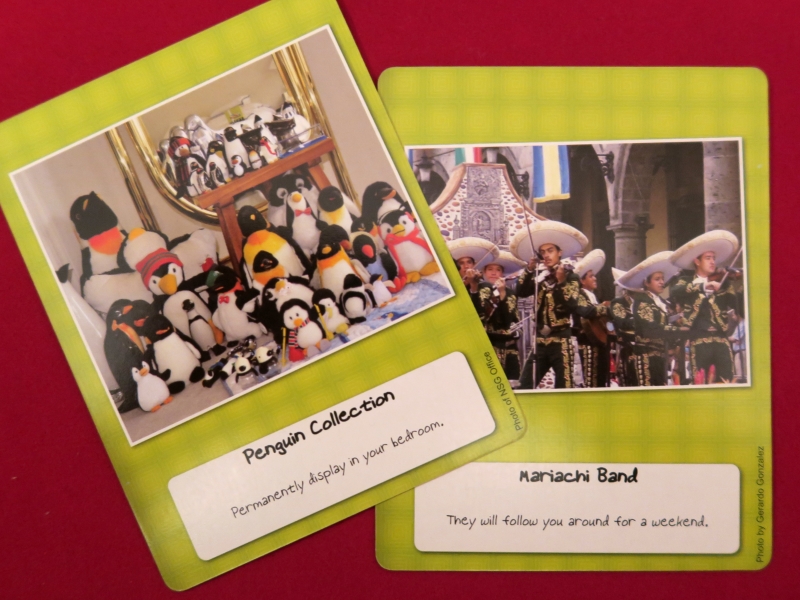
One of the reasons this game is so fun is that we learn a bit about each other.  Pink went first as his real birthday was next.  He liked the idea of an Easter Island Mo’ai for the garden (not that Blue was so impressed with the idea), but disliked the idea of cave scuba diving.  Plum chose a haunted castle as her favourite (because she loves castles), but pulled a face at the idea of earlobe stretching rings.  Purple had the matching neck rings, but these weren’t her least favourite gift, that was a giant swing ride, while she loved the idea of a penguin collection.  Byzantium showed his environmental credentials by picking a Global Warming Study as his favourite, while eschewing Jade’s wing suit dive gift.
Crappy Birthday
– Image by boardGOATS

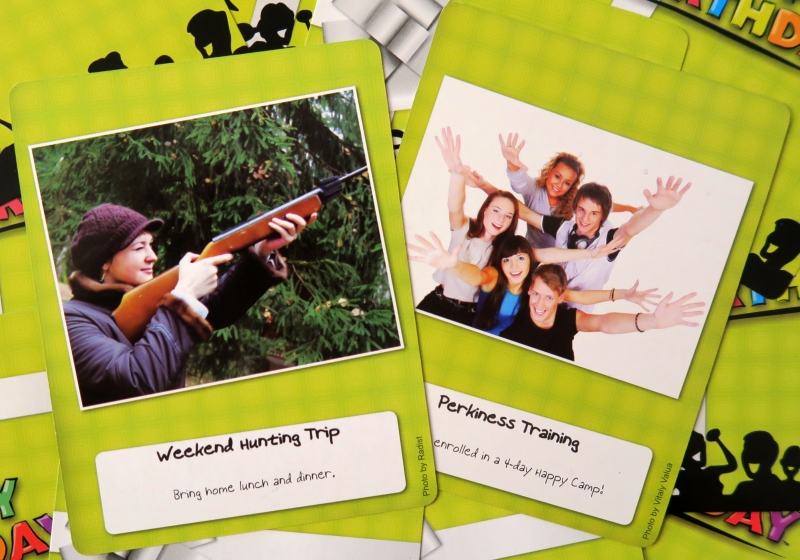
Teal felt that trees were quite beautiful enough without being carved, but really liked the idea of a ride-on bike mower.  Jade wasn’t a fan of Cobalt’s offering of Polka lessons, but loved the idea of trip to Mars from Sapphire, while Sapphire felt “perkiness training” wasn’t something he really needed, but the thrill-seeker loved the reciprocal gift from Jade, a roller-coaster ride.  Lime fancied a three day festival trip, but wasn’t keen on a week eating nothing but Spam.  Blue didn’t fancy the creepy baby sculpture to go with the Mo’ai, but fancied Pink’s gift of a Safari (provided she had time to train for the walking element).  Ivory didn’t feel his life would be improved by a free satellite TV dish, but always one to send his meeples into space in Tapestry, grasped the opportunity to join them with a space walk.

Crappy Birthday
– Image by boardGOATS

It turned out that Navy has a problem with bees, so Teal’s gift of a bee keeping which he personally would have loved, didn’t go down well, but much to Pink’s surprise, his gymnastics camp was received really well.  Indigo was quite abrupt in her negative response to the idea of paparazzi following her about, but liked the idea of exploring a volcano while Cobalt didn’t feel he needed his soul to be searched, but fancied flying lessons.  The final birthday of the year was Pine, who didn’t get his usual pile of horses and meat, instead getting the opportunity to run with the bulls, which having known someone who had done it and been gored, wasn’t something he fancied.  Pine’s favourite was Larry the Lobster (not that he has space in his garden for him), one of the Big Things of Australia, that Pink and Blue happened to see on their visit there last year.

Crappy Birthday
– Image by boardGOATS

Lime was the last to break his duck and was very pleased not to end the game without scoring any points, indeed, nobody finished with the dreaded bagel, which was nice.  The runniest of run-away winners was Teal though, with five successful (or unsuccessful) gifts, with Pink and Cobalt joint runners up with three.  It was interesting though, this time there were quite a lot of gifts that people gave “in error” where as Teal commented, he “Gave pressies he thought people would like, but they all hated them!”  With the birthday formalities dealt with, there was time for something relatively short.  First up was Jade who was very keen to give his new Faraway expansion, Le Peuple du Dessous (aka The People Below).
Faraway
– Image by boardGOATS

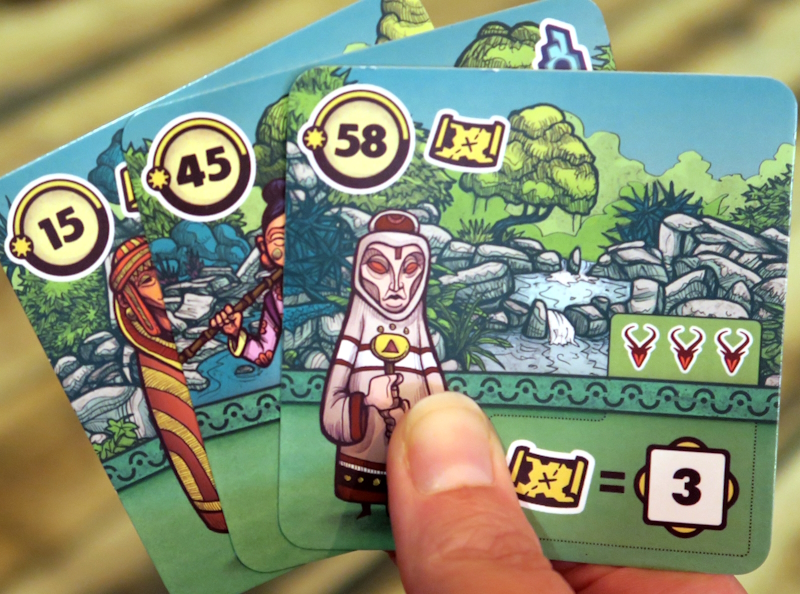
Faraway is a fairly simple little game, but one that really messes with your head:  players play cards from their hand of three, adding them to a row of cards, left to right, but at the end of they score the eight cards from right to left.  The Peuple du Dessous expansion adds just seventeen cards, but these include the Guides and the Three-Eyed Ones, two new Peoples with more opportunities to score, as well as giving enough cards to play with seven people.  This time there were only five though, with Sapphire, Byzantium, Indigo and Navy joining Jade.  Navy and Indigo were new to the game and, as usual, it took a little bit of getting used to.  That said, the both did really well with Indigo ending up with seventy-seven points, four more than Sapphire in second with Navy taking third, just one point behind.

Faraway
– Image by boardGOATS

Navy and Indigo headed off and took an early night, but the other three had to wait for Plum who’s game on the other side of the room was ongoing.  Faraway is a fun little game though and the expansion adds a little more, so the trio decided to give it another go.  This time, Byzantium was the victor with seventy-three with Sapphire the runner up again.  Meanwhile, Blue, Pink, Pine and Teal, got out Bohnanza.  This is a game that is generally popular with the group, though Teal had somehow only managed to play it the once almost six months ago.  This is a very simple card game, albeit slightly convoluted and very unpromising when explained, but the key is that players must not rearrange the cards in their hand.
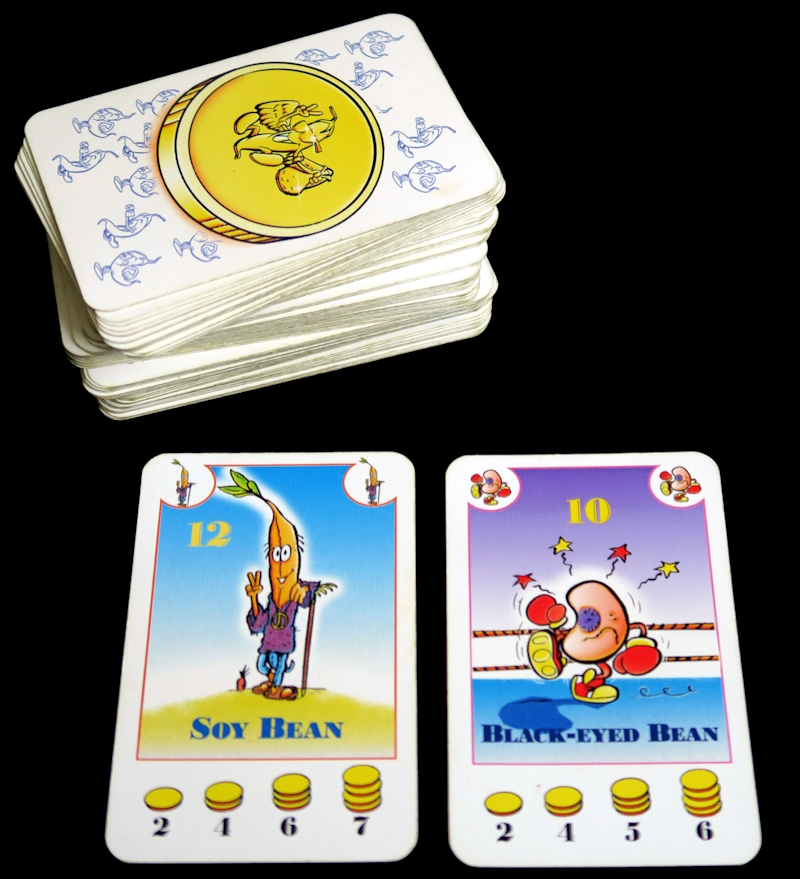
Bohnanza
– Image by boardGOATS

On their turn, players must plant the first card in their hand in one of their two been fields and may plant the second if they choose.  They then turn over two cards from the deck, which must be planted before the player can move on.  Fields can only contain one bean type, but beans can be traded, or even gifted, and it is the trading and negotiation that makes the game such fun.  Once the two cards on the table have been planted, players can trade from their hand, but again all traded cards must be planted.  Players can harvest Fields at any time with some of the bean cards dug up becoming money and larger Fields giving more money and at a better rate.
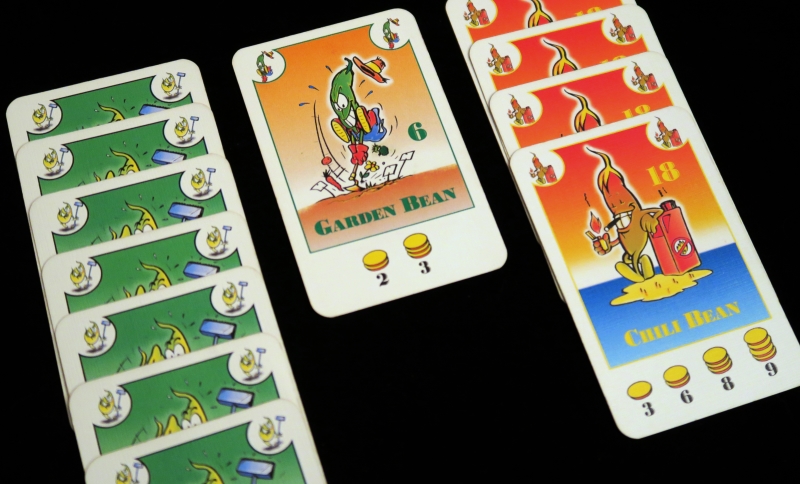
Bohnanza
– Image by boardGOATS

Blue took some high valued Garden Beans and then sold them off to buy a third Bean Field, causing a lot of confusion for Pink who couldn’t believe it when they kept appearing even though there were only six in the deck.  Teal scored well from his Chilli and Wax and Soy beans, while Pine and Blue ended up in competition for Green Beans.  This time with just four, the scores were a little more varied, but Blue was the clear victor with twenty-five Bohn Thaler, five more than Pine who came second.  The final game of the evening was Villagers, which was getting another outing on the other side of the room with Cobalt leading Ivory, Purple and Plum.

Villagers
– Image by boardGOATS

After a reminder of the rules, Purple started and grabbed the Carpenter then Cobalt went next taking the Blacksmith.  Both of these guaranteed their owners an income of coins (and hence points) at the expense of other players paying to use them. However, this did mean that they fell behind on building an engine to Draft and Build more cards (which Plum and Ivory focused on).  From there, the first half of the game went quite quickly with everyone focusing on building their engine. Ivory managed to get a Wine Trader using a Monk as a Graper, as well as playing a Scavenger, enabling him to take slender lead after the first scoring, although the scores were all very close.

Villagers
– Image by boardGOATS

In the second half of the game, Purple and Cobalt were beginning to have to make tough choices, being unable to play as many cards as they would like and not having the building cards they needed, which were also hard to come by. However, they continue gaining coins from all players. Purple had to discard quite a few cards to get starter cards which slowed her down a little, though Plum and Ivory were able to quickly get to the position to Draft and Build the max number of cards allowed; Plum in particular seemed to always have a fist full of cards.  As the game progressed, more people began taking cards that others might want, with Cobalt taking Wool cards that might have been of use to Purple or Ivory.  Ivory, however, was actually more focused on getting a second Vintner, already having a second Wine Trader in hand.

Villagers
– Image by boardGOATS

Towards the end of the game, there was face down Grape card which Ivory debated taking a gamble with, but decided not to take the risk.  Inevitably, when it was flipped over it turned out to be Vintner and Plum grabbed it. Ivory got very lucky during his next draft though, taking a face down Special card that was Monk, which he could then play as Vintner. Elsewhere, Purple played some Wool cards, getting two Weavers, Plum picked up some good end-game scoring cards in the Locksmith and Freemason. Cobalt focused on Solitary cards and Silver end game scoring, doing well from his Priests, Agent and Blacksmith combo. Ivory ended up focusing on the Hay cards, which scored well and that plus the two Wine Traders (and a second Scavenger), gave him a hundred and twenty-six and a two point victory over Cobalt.

2024 Birthday Cupcakes
– Image by boardGOATS

Learning Outcome:  Getting old is not necessarily a bad thing.

3rd October 2023

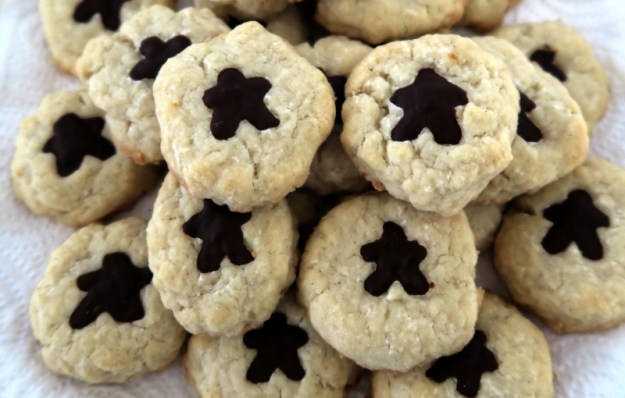
Black, Purple, Byzantium, Plum, Blue and Pink all arrived early for food, and were soon joined by Pine, Lime and finally Ivory.  The “Feature Game“, was to be Crappy Birthday, a party game where players give each other comedy birthday presents and the recipient has to decide who gave them the best and worst gifts.  A bit like the better known game, Dixit, the idea is to be the master of non-mediocrity, with the best and worst gifts netting points for the person who gave them.  It was our birthday party, so as is now traditional, everyone shared cake (this year, meeple topped carrot cup cakes), before Plum started off the year of GOATS crappy birthdays, receiving her first gift from Byzantium.

2023 Birthday Cupcakes
– Image by boardGOATS

This year we discovered that Plum fancied a custom chopper, Byzantium liked the idea of visiting a radioactive swamp (so long as it wasn’t too active) and Lime would gratefully accept a gift Monster Truck weekend.  Unusually, Pine didn’t get horses and a pile of meat, and picked skiing in Alaska (finding the Alaska bit more appealing than the skiing), and Black chose a Safari as his favourite gift.  Plum picked a chick-flick marathon over a litter of puppies and Ivory opted for a catapult over several space-based options.  Finally, much to everyone’s surprise, Blue picked a garden chess set and Pink chose a set of cuddly penguins over a pet vulture (who is very friendly, but stares at you while you are sleeping).

Crappy Birthday
– Image by boardGOATS

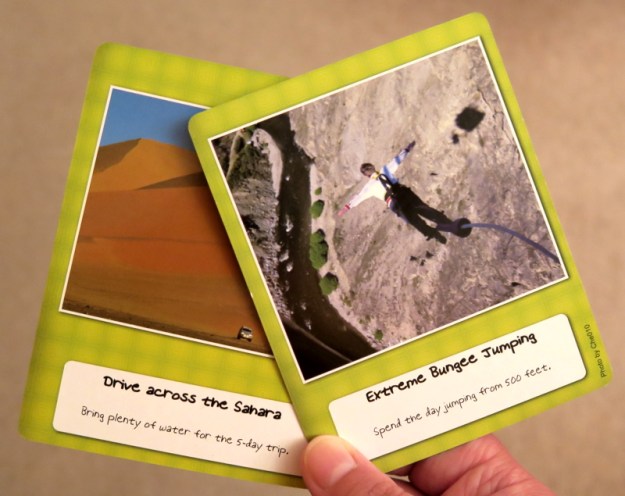
Less popular were singing the national anthem a the baseball, extreme bungee jumping, face piercing, a flexible trainer, and perkiness training.  The horrific baby sculpture was pretty much guaranteed to be rejected (and Lime had the opportunity for a second time), but others were more specific.  For example, Purple eschewed the drive across the Sahara because she dislikes the heat while others felt they would quite like a visit to the desert.  Similarly, Pink couldn’t imagine anything worse than mime camp, although most of the others couldn’t really see his problem.  Most people managed at least one or two loved or loathed gifts, nobody came close to matching Plum, who took a massive six points—a remarkable seventy-five percent of her potential maximum, quite a record for a worthy winner.

Crappy Birthday
– Image by boardGOATS

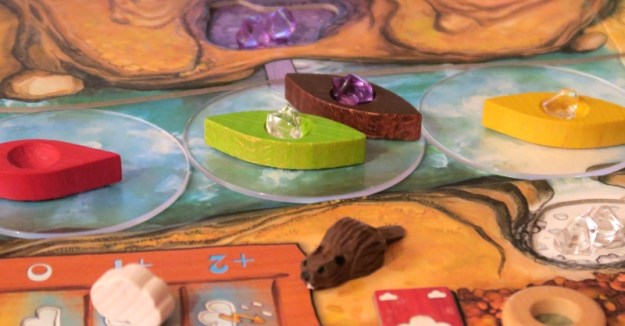
With our birthday suitably marked, the question was whether to continue to play light, large-group games or to break the group up and play something slightly more serious.  Pink suggested Niagara, and although Blue, Black and Purple warned against it, Plum showed an interest and that suckered in Byzantium, Lime and Pine.  The idea of Niagara is that players are rowing their canoes along the river to collect gems and then safely row them back to shore.  Players do this by simultaneously choosing a Paddle tile to play, then taking it in turns to activate their chosen Paddle to move their canoe (or canoes), trying to avoid losing them over the cataract and turning them into match-wood.  The winner is the player who manages to get seven different coloured gems or five gems of the same colour safely to shore.

Niagara
– Image by boardGOATS

The reason for the warnings and large amount of reticence form some of the group was after an online game some two years ago when Pink had the temerity to steal gems from everyone else and collective punishment failed to correct his appalling behaviour, winning the game in spite of it all.  This time, fore-warned and fore-armed the game started mean and got meaner, with the gem stealing starting in the very first round.  As a result, three out of the five finished the game with nothing.  Although Pink ended the game with two red gems, at least he didn’t win—that honour went to Byzantium, who by hook or by crook (mostly crook to be honest), managed to get five purple gems and ended the game.

Niagara
– Image by boardGOATS

Meanwhile, on the next table, Black and Purple were introducing Blue and Ivory to Little Town.  Despite the similarity in names (and inevitable resulting confusion), this is nothing to do with Tiny Towns. In this game, players acquire resources like wood, stone, fish, and wheat from the surrounding squares by placing workers on the board. When a worker is placed, the owner acquires the resources available from all eight surrounding spaces. They can then build buildings by using these resources, and the owner (or indeed any other player), can gain the effect of the building when they place a worker next to it, although when claiming a resource from a building owned by another player, they must pay a them a coin.

Little Town
– Image by boardGOATS

The game is deliciously tight—each player gets one action per turn, three turns per round and the game lasts just four rounds. Players collect victory points by using the powers of buildings, by constructing buildings taken from the market (which is not refilled), and by achieving goals dealt to them at the beginning of the game. After the fourth and final round, whoever has the most victory points wins.  Ivory started building an engine based on turning money into points, but then he realised the flaw in his plan:  there was no additional source of money in the game, so once he’d spent his cash, he was reliant on others paying to use his facilities, a source that rapidly diminished.  So he moved on to collecting wheat instead.

Little Town
– Image by boardGOATS

Blue built an engine to turn fish and wheat into points.  Black also built a wheat into points engine and pinched the last wheat field that both Blue and Ivory had their eye on.  Purple on the other hand did something completely different, converting resources into other resources to satisfy her goal card.  Ultimately though, none of it really mattered as the game was really, really tight and all four players finished within three points of each other.  Black’s experience with the game told and his thirty-two points just edged him one point clear of Blue who took second and she in turn finished one point ahead of Ivory.  It had been an enjoyable game though, definitely deserving of another outing, especially as the variety in the buildings would make it play very differently every time.

Little Town
– Image by boardGOATS

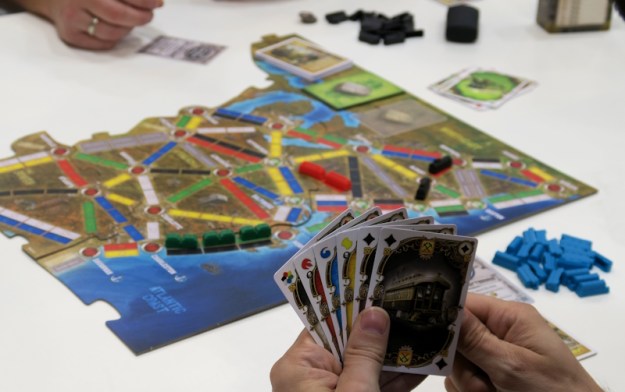
While the Little Town was being explored, Niagara had already finished and Lime, Plum and Byzantium rowed their respective ways home, leaving Pine and Pink to play a quick game of the new mini-version of Ticket to Ride, Berlin.  This is the latest in the “City Series”, smaller versions of the game that play more quickly, but still keep the essence of the original game.  Each game (full-sized or smaller), has some unique “hook” as well as a new map and features designed to bring a flavour of the new location.  Like all the other game, players have a choice on their turn to either take coloured cards from the market, or pay cards to place pieces on the map.

Ticket to Ride: Berlin
– Image by boardGOATS

In the Berlin version, players have both subway trains and trams to place. Tram routes are claimed in the usual way, but only one underground carriage is placed to claim a Subway or U-bahn route. When a player has one or none of their pieces left in their supply (either Tram or U-bahn carriages), each player, including that player, gets one last turn, then tickets are scored as usual.  One of the differences between this game and the other variants is the shape of the map, with it being very elongated in the east/west direction.  Pine built his routes along the north side and into the centre while Pink stretched his network along the south bank and into the centre.

Ticket to Ride: Berlin
– Image by boardGOATS

It was a very enjoyable game, and both Pink and Pine said they would definitely play this one again.  Perhaps part of the reason was that it was very close, but neither player realised how close until the final scoring.  In fact, it was so close that they double checked the score and confirmed that it was a tie with both players finishing with fifty-four points.  After a bit of chat, they had a rummage through the rules to find out what the tie breaker was, only to discover that it was the number of completed tickets, and both had finished with five.  So remarkably, it was a real tie, but while they shared victory this time, there will almost certainly be a rematch in the not too distant future.
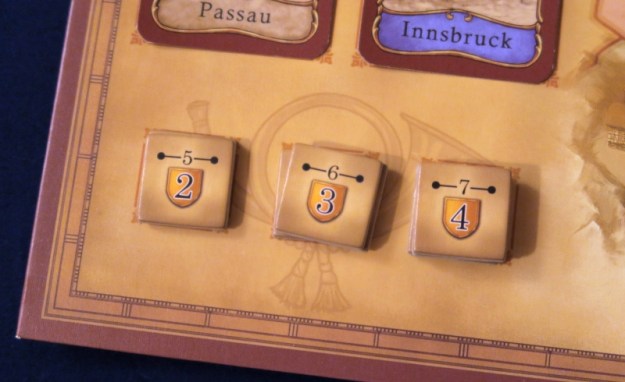
Ticket to Ride: Berlin
– Image by boardGOATS

Learning Outcome: Everyone loves a nice birthday gift.

Essen 2023

Today is the final day of this edition of the largest games fair in Europe and arguably the world, the Internationale Spieltage.  Known to gamers worldwide simply as “SPIEL” or “Essen”, the annual fair is of particular significance as many new releases are scheduled to coincide with the event just in time for Christmas sales.  Following the recent change in management, this year there were quite a few changes.  Aside from the logo, the most noticeable was the layout in the halls—according to one game designer, every stand except his was in a new location in an effort to theme the halls.  For the most part, this seemed to work, though inevitably some people will feel they lost out in the great shuffle.

Essen 2023
– Image from spiel-essen.com

One thing that hasn’t changed, is the lack of general gaming space, especially when compared with the likes of the UK Games Expo and Gen ConSPIEL is a games fair, not a convention—it’s purpose is to showcase new and up-coming games and sell them to the general public, but also small and medium-sized resellers.  Additionally, there is a lot of business going on behind the scenes, including designers demoing games to publishers, and publishers meeting with producers and other publishers to discuss contracts.  It is arguable that large amounts of playing space are counter to SPIEL’s priorities, but they could definitely do with providing more chairs—not everyone has the stamina of a twenty year old, and the number of people just sitting on the ground suggests more seating is an essential.

Essen 2023
– Image by boardGOATS

Following the cancellation of SPIEL in 2020, there were restrictions on numbers for 2021 and Covid mandates in 2022 leading to reduced numbers (93,600 and 147,000  respectively), so 2023 was the first year when things were back to normal.  One question therefore, has been whether numbers would return to the levels, or even exceed those of 2019, when there were 209,000 entries.  It will be a few days before the statistics for 2023 are reported, but anecdotally, the answer is yes, with some exhibitors commenting that Friday was the busiest it had ever been, and the annual no-ship Maths Trade and Auction was as mad as ever.

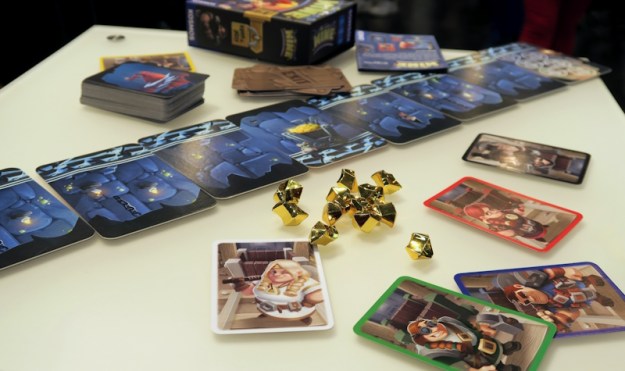
My Gold Mine
– Image by boardGOATS

This year there is the usual selection of the latest releases including, The White Castle, Nucleum, Kutná Hora: The City of Silver, Evacuation, The Glade, My Gold Mine, Amygdala, Forest Shuffle and Footprints.  There are also expansions for previous games like Cascadia (Landmarks), Ark Nova (Marine Worlds), Lost Ruins of Arnak (The Missing Expedition) as well as this year’s winners of the Deutscher Spiele Preis, Planet Unknown (Supermoon).

Ticket to Ride Legacy: Legends of the West
– Image by boardGOATS

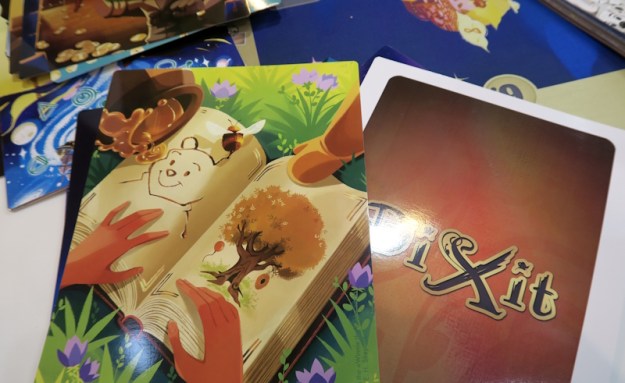
A common theme are the re-releases and reimplementations of old favourites and there are a lot of these this year, like Ticket to Ride (Legacy: Legends of the West) Elfenland, Zooloretto, Dixit (Disney Edition), Shipyard (Second Edition) and NMBR 9.  As usual, there are also loads of mini promotional expansions available for games like Flamecraft, Die Wandelnden Türme, Keyflower, Underwater Cities, Dorfromantik and 2022 Golden GOAT, Praga Caput Regni, amongst others.  There truly is something there for everyone.

Dixit: Disney Edition
– Image by boardGOATS

Boardgames in the News: Games making Cameos on TV

Board games are an integral part of family life and growing up and, as such, they have a long tradition of appearing on TV programs.  For example, Kramer and Newman get wrapped up in a game of Risk in Seinfeld, Scrabble features in the second series of Hamish Macbeth and in The Simpsons, while Stratego was the game Fox Mulder was playing with his sister the night she was abducted in the X-Files.  Often, games are used to highlight something “geeky” or otherwise “cerebral”.  So, Rimmer was known to maintain a “Risk Campaign Diary” and often recounting games turn-by-turn to his crew mates in Red Dwarf, and in Star Trek: Voyager, Tom Paris and B’Elanna Torres were shown playing Quarto (though it is probably known by a different name in the twenty-fourth century).

Escape From Colditz
– Image from bbc.co.uk

More exiting games have started to appear on TV recently though.  A few years ago, we commented on how Mage Knight featured in the BBC romantic drama Last Tango in Halifax but that is by no means the only TV program to use a designer board game to create atmosphere.  The BBC has a bit of a penchant for including board games in their programs, and when they do, they often choose games that are outside the mainstream.  For example, in the 1970s police drama, Life on Mars featured people playing Escape from Colditz, and more recently, the second series of Killing Eve showed Villanelle playing Dixit.

Dixit on Killing Eve
– Image from bbc.co.uk

In this case, it is a plot device, as Villanelle’s protagonist is commented, “You are struggling with the rules of Dixit, a simple story telling game for players aged eight and upwards, and yet you claim to have two philosophy degrees.”  The BBC doesn’t have a monopoly on showing modern board games, however.  The Channel 4 program, The IT Crowd regularly featured a stack of games in the background that variously included Memoir ’44, Ticket to Ride, Shadows over Camelot, Mystery of the Abbey and War on Terror, while Settlers of Catan, Talisman, Ticket to Ride, and Race for the Galaxy are all shown on shelves in The Big Bang Theory, highlighting how games are still often seen as something for “geeks”.

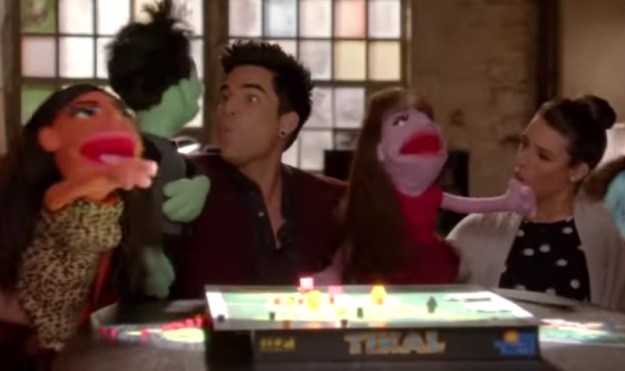
Tikal
– Image from youtube.com

The “geeky” angle may be changing though.  The Amazon thriller Reacher shows people playing Settlers of Catan in a safe-house, and there is a game shown in every series of the Canadian thriller, Orphan Black because co-creator John Fawcett is a gamer and the show has a “Board Game Advisor” (games featured include Gloomhaven, Runewars, Agricola, Descent, Dead of Winter and Scythe)Tikal even appeared in Glee during the fifth season where the cast sing, “What does the Fox Say?”  Some of these appearances may be paid product placement, in particular Arkham Horror in Limitless and Race for the Galaxy in Silicon Valley, with Rio Grande Games allegedly having confirmed that they have paid for games to appear in shows.  That is not the reason in all cases though.

Wingspan
– Image from itv.com

Last week, Wingspan appeared in the ITV soap-opera, Coronation Street with people shown reading the rules and references to having played later.  Designer Elizabeth Hargrave confirmed that this was not a case of product placement, commenting that the show got in touch and no money had changed hands.  It is possible that one of the script writers is a fan of modern board games as “Corrie” did something similar just over a year ago with Billy Mayhew shown struggling to fathom the rules to Mysterium shortly after Christmas. With the appearance of modern board games in programs like this, it is clear they are no longer solely the preserve of the “geeky”, though it would probably help if we could get rid of the “frowning over difficult rules” stereotype.

Mysterium
– Image from itv.com

6th October 2021

For the first time, the group were meeting on a Wednesday to avoid clashing with the Quiz on Thursday.  As Blue and Pink waited for food they decided to squeeze in a quick game of NMBR9 to celebrate our ninth birthday.  This is a quick little tile-laying game that has almost zero setup time, so is very appealing as a filler in this sort of situation.  The tiles are poly-ominos roughly shaped like the numbers zero to nine and there is a deck of cards featuring each number, zero to nine, twice.  Players take the appropriate number from the box following a flip of a card, and add it to their personal play-space.

NMBR 9
– Image by boardGOATS

Tiles have to be placed in layers with tiles on higher layers being more valuable as the number on the tile is multiplied by the “storey” it is on.  Tiles must be placed adjacent to another tile on the same layer and, when placing tiles on higher layers they must not be wholly over one other tile and must be completely supported (no bridging gaps or overhangs).  This time, Pink managed to make it to four layers putting a seven on the top layer, his third “storey” to give twenty-one points.  As a result he was sure he was going to win.

NMBR 9
– Image by boardGOATS

Pink had fewer tiles on the second and, particularly third levels, though, where Blue had concentrated her efforts.  The effect was very similar, so much so that there was only one point in it, but much to his disappointment, even several recounts couldn’t put the deficit in Pink’s favour.  He was cheered up by the imminent arrival of his pizza though and they were still eating when Green, Lilac, and then Teal turned up.  Since Green and Lilac had missed last time, they introduced themselves to Teal and there was some general chit-chat as everyone else turned up.

NMBR 9
– Image by boardGOATS

Appropriately, as we were celebrating our ninth birthday, there were nine of us to play the traditional birthday “Feature Game“, Crappy Birthday, as we ate meeple decorated chocolate cupcakes.  Crappy Birthday is a silly little party game but is a surprising amount of fun.  As we explained the rules to Teal, we reminisced about last year, when we played it over two sessions (one wrapping our parcels and one giving them) in order to be able to play it online.  Lime expressed his astonishment that it was a year ago, and everyone concurred that it didn’t feel like a year.

2021 Birthday Cupcakes
– Image by boardGOATS

Crappy Birthday doesn’t sound like much: the game is played over one “year” and each player takes it in turns to have their birthday, with everyone else choosing a card from their hand as a “gift”.  The birthday boy or girl then chooses their favourite and least favourite gifts and the givers of these each get a point.  As such, those gifting are trying to avoid the mediocre , in a similar way to Dixit, but “not as good” as Purple opined.  While most people around the table would agree that Dixit is the better game, this group tend to get more fun out of Crappy Birthday because of the really silly gifts on the cards.

Crappy Birthday
– Image by boardGOATS

The silliness of the gifts would get stale if we played the game more frequently, but we only play Crappy Birthday once a year and we usually only use around half the cards, so most cards only come out once every two years.  It is a great way to find out about people though, so being new to the group, everyone thought Teal would be at quite a disadvantage.  This year we found out that Pink was unimpressed by 100lb of raw fish, Lilac quite fancied a trying out a wingsuit and Blue would overcome the creepiness of 3am in the Paris catacombs as apparently they were hard to get to visit.  Ivory, was torn between the opportunity to sing the National Anthem before a Major League Baseball game and getting his earlobes stretched, but went for the latter as his least favourite as it was more permanent.

Crappy Birthday
– Image by boardGOATS

We discovered that Teal likes to keep his feet on the ground, so he eschewed a flight in a fighter jet, but really liked the idea of a Viking helmet.  It was about this point that we were joined by one of the former bar staff who stuck about to help Pink with his gift selection.  It seemed she didn’t really help a lot though as he completely failed to get any of his gifts picked as best or worst.

Crappy Birthday
– Image by boardGOATS

From there, Purple nearly ended up instigating divorce proceedings when she received a set of camera scales from Black (a gift nobody else would have been prepared to give to anyone).  Instead of fully justified revenge, however, Purple gave Black’s his favourite gift a campervan.  Lime having just moved house eschewed recycled newspaper wallpaper, instead opting to decorate his new home with some modern art after some classes.  DIY seemed to be in the air, as Green chose a house that needed renovation, though he volunteered Lilac to fix the roof.

Crappy Birthday
– Image by boardGOATS

As usual, Lime’s amazing gift-giving skills meant he did well, but this time he was beaten into third place by Purple and, remarkably, Teal who tied for first place, with four—it seems Teal knows us all surprisingly well after just a couple of weeks!  As people counted their scores and decided what to play next, the group put together a special selection of gifts for Pine who was running late thanks to a group of over-enthusiastic cubs whom he had been showing round his work.  This special selection was tailor-made for a vegan who doesn’t like horses.

Crappy Birthday
– Image by boardGOATS

From there, the group split into three, one led by Lilac who wanted to play Thurn und Taxis, one led by Ivory who wanted to play Key Flow and one led by Green to play with something short that Pine could join in with when he arrived.  Thurn und Taxis is a slightly older, Spiel des Jahres winning game where players build postal routes connecting cities across Bavaria and surrounding regions.  Routes are built city to city to city, so that each city is adjacent to the next city on the route and there is a road connecting these two cities.

Thurn und Taxis
– Image by boardGOATS

Players are building routes by collecting cards and playing them in front of them.  Every turn, the active player takes a city card from the face-up display (or blind from the top of the deck) and then plays a card for a city connected to either end of their existing route.  The card played, must connect to their route, otherwise they have to discard their route and start again.  Then they can score their route if they choose, but each route must consist of at least three cities and players may build only one route at a time.

Thurn und Taxis
– Image by boardGOATS

If after adding to the route, the length of the route is at least three cities, the player may declare it finished and score it.  Players start with a supply of twenty post offices in their colour, each of which is worth minus one at the end of the game. When they score a route, players place post offices in cities on the board, but they have a choice.  Each city is in a region and each region has a colour, when a route is scored, the active player can either place one post office in one city in each of the region their route visits, or in all the cities on one of the regions their route goes to.

Thurn und Taxis
– Image by boardGOATS

When a route is scored, the active player can take a cart card.  These give points, however, in the general case, the cart card must be one more than the previous one and the route must be longer than the cart number.  Thus, if someone is scoring a six leg route, they can only take a level six card if their previous cart was a level five card.  If they enlist the help of the Wainwright, however, if they have a level five card, they would be able to take a level six card with a route of only four legs.  Once a route is scored, the city cards of that route are discarded, and the player begins a new route on their next turn.

Thurn und Taxis
– Image by boardGOATS

The Wainwright is not the only special character in the game: the Postman, Bailiff and Coachman are all there to offer help, allowing players to take a second card, refresh the card market and play a second card respectively.  Players can only enlist aid once per turn though, so they must choose who they call on carefully. When a player exhausts their supply of post offices or acquires a value seven carriage, the end of the game is triggered with players continuing the round—the player with the most points wins.

Thurn und Taxis
– Image by boardGOATS

In addition to points for cart cards, there are also bonus points available for players to connect all the cities in a region or to have a post office in every outer region, as well as for players completing longer routes and for the player who triggers the end of the game.  In general, bonuses score most for the first player to make the achievement with diminishing returns thereafter.  This is therefore a consideration players must take into account, but the fact that players must add at least one city to their route each turn or lose the whole route is probably the most important aspect of planning in the game.

Thurn und Taxis
– Image by boardGOATS

Although Thurn und Taxis is an older game, Purple had not played it before, and it took her a while to get her head round it.  She got to grips with it eventually, however, it was later in the game and Black and Lilac had already got a head start.  It was very close between them though with the scores neck-a-neck until the last.  Lilac triggered the end of the game by taking a level seven cart card and with it took what turned out to be the decisive bonus point, pipping Black with twenty-seven points to his twenty-six.

Thurn und Taxis
– Image by Lilac

On the next table, Teal had looked in the game bags and decided Azul was one he’d like to play.  Green, Lime and Teal had just started without Pine when he inevitably arrived a couple of turns in.  He politely eschewed their kind offers to start again, instead concentrating on his healthy supper of crisps and cake and choosing his gift.  In Pine-like fashion, he chose to redefine the rules and decided his favourite gift was a hunting expedition as long as the subjects of the hunt were the people delivering the perkiness training in his other “choice” gift.

Crappy Birthday
– Image by boardGOATS

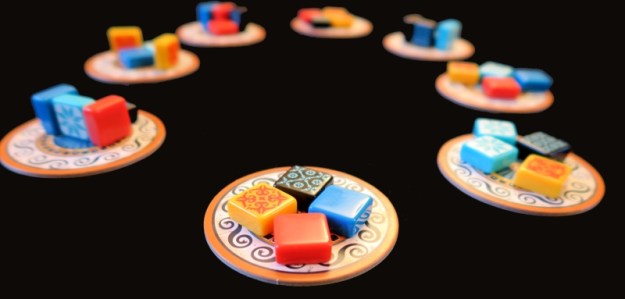
We have played a lot of Azul and its derivatives (Stained Glass of Sintra and Summer Pavilion) over the last three years, but the original is probably still the favourite across the group.  It is really very simple, and despite being an abstract game, the pieces are really nice.  On their turn, the active player either takes all the tiles of one colour from one of the “markets” putting the rest in the centre, or they take all the tiles of one colour from the central pool.  They then add the tiles to one of the rows on their player board.  The catch is that all the tiles placed in any row must be the same colour and if they over-flow, they score negatively.  Additionally, each colour can only score in each row once.

Azul
– Image by boardGOATS

Only complete rows are removed and scored, and then only at the end of the round (when all the tiles in the market and central pool have been taken).  Thus if a player has a nearly complete row at the end of a round, they carry that through to the next round leaving them with less free space to work with.  When a row is scored, one tile is moved to the player’s mosaic and scores for the number of tiles it forms a continuous row/column with.  The game ends when one or more players complete two rows.  This time it was a game of two halves, or rather two games.  It had been a while since we played the original version (or any version for that matter), but it wasn’t long before Teal, Lime and Green were happily playing, filling their boards.

Azul
– Image by boardGOATS

Lime and Teal took an early lead and were soon well ahead of Green as he had concentrated on filling his grid from the bottom up, whereas they had been working from the top down. As the game progressed Green began to catch up.  It was then that he realised that he’d forgotten what the game end trigger was.  He’d thought it was when the markets could no-longer be refilled, but checked the rules to be sure.  Only to find that two full completed rows had happened two turns earlier!  The group decided to finish the round and make it the last.  It was very close between Lime and Teal, with Lime just taking victory by three points.  The other games were still going and it was not yet late, so the group decided to give it another go, and this time finish the game correctly.

Azul
– Image by boardGOATS

In the second game, Green built his grid from the top down and the scores remained fairly similar, until around half way through when Teal began to pull away.  It was at about this point that Green noticed that one row had tiles of a colour he’d already scored for that row.  No-one was quite sure how it had happened, but the mutual decision was that he’d move these tiles down to the next row.  That turn didn’t go quite as expected, but at least it wasn’t a complete disaster.  The following round, he discovered he’d done the same thing again.  This time he worked out what he’d done:  he’d had failed to clear the remaining tiles when he moved one across to the pattern board.  So, on the previous turn, instead of moving tiles, he should have removed them.  It didn’t really matter though as Teal won by a landslide.

Azul
– Image by boardGOATS

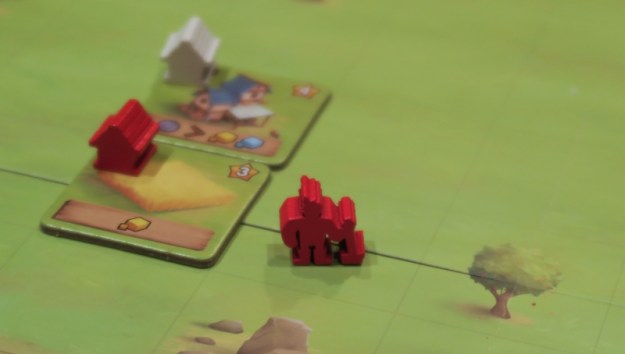
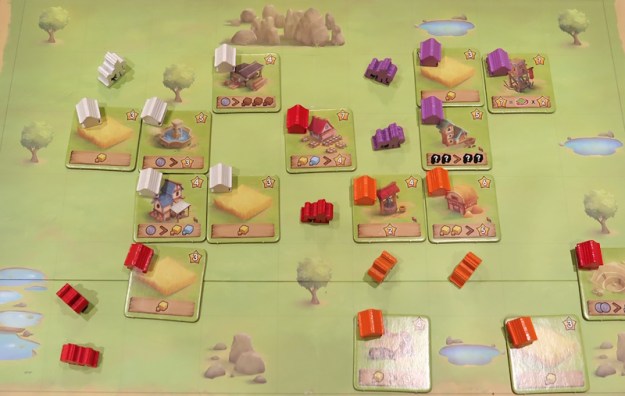
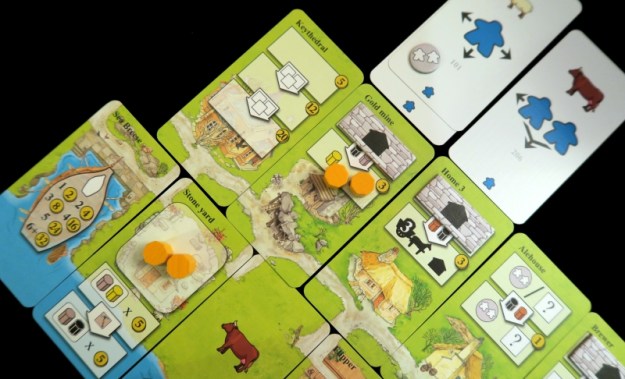
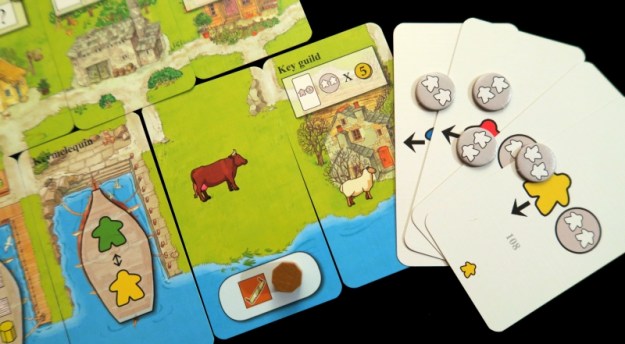
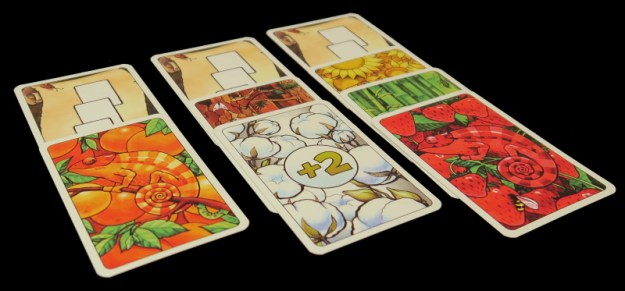
Meanwhile, Ivory, Blue and Pink had revised the rules, completed card set up for Key Flow, and had started playing.  Key Flow is the card game of one of the group’s favourite games, Keyflower.  In both games, players are building villages and activating the buildings in their villages by playing meeples (or rather Keyples) to generate resources and score points.  The games have a lot in common including the artwork, the iconography and the fact both take place over four rounds or seasons.  Fundamentally, the underlying game mechanism is different, however, with players acquiring tiles by auction in Keyflower and by card drafting in Key Flow.
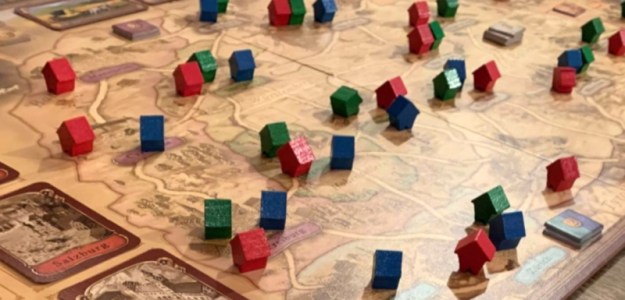
Keyflower
– Image by boardGOATS

Once the card decks have been sorted out, Key Flow is quite straightforward to play, though doing well is a different matter.  Players who start with a hand of cards, choose one and pass the rest on.  They then add their chosen card to their village.  There are three types of card:  Village cards, Riverside cards and “Keyple” cards.  Village cards are buildings that can be activated by playing Keyples above them, while Riverside cards provide instant resources and skill tiles.

Key Flow
– Image by boardGOATS

The cards have to be “connected” together and location can be important.  Buildings for example are more productive if they have been upgraded, but upgrading needs resources and the resources need to be located on the building being upgraded.  Similarly, in autumn there are some buildings which score points for resources they are holding.  Therefore, it is helpful if the building producing the resources is near to the one being upgraded or used for scoring as moving resources can be expensive and sometimes difficult.
Key Flow
– Image by boardGOATS

At the start of both Keyflower and Key Flow players get some winter tiles/cards which can act as objectives to guide players’ strategies.  Whereas in Keyflower these are just added to the tile draw, in Key Flow, players get to keep one of their winter cards with the rest going into the draft.  At the end of the game, at the end of winter, players score for any autumn cards, any buildings with upgrades as appropriate, any winter cards and finally one point for any otherwise unused gold.

Key Flow
– Image by boardGOATS

One of the biggest differences between Key Flow and Keyflower is the way Keyples work.  In Key Flow, they are cards and come in singletons and pairs.  Each card has a small Keyple at the bottom of the card, and the number of Keyples needed to activate a building is one more than the number of small Keyples already there.  So if there is one small Keeple already there, a pair would be needed to activate that building.  Further, only one card is can be played each round, so if two small Keyples are already present, the Keyple card must be augmented with a Keyple token (obtained as a bonus with some cards or from some buildings).

Key Flow
– Image by boardGOATS

Further, the Keyple cards also feature arrows which indicate where they can be played.  Some can be played either in a neighbour’s village or the player’s own village.  Other cards can only be played on one side or cannot be played in their own village.  This is why three players is arguably the sweet-spot for Key Flow—with more players there is at least one village players cannot use, adding a level of randomness that it is difficult to deal with.  With three however, everything in play is accessible, though perhaps at a cost.

Key Flow
– Image by boardGOATS

It had been a while since Key Flow had been given an outing, so although game play is functionally straightforward, it took Blue, Ivory and Pink a while to remember the little features and how to make the game work for themselves.  Pink started off early with an obvious strategy of generating stone, stone and even more stone from his Keystone Quarry.  It was very clear, even to Pine who joined in to spectate about halfway through, that Pink had a winter card that would score for stone.  And so it proved when he produced the Trader in the final round.

Key Flow
– Image by boardGOATS

Things were less clear-cut for Blue and Ivory, however.  Blue started by just playing the cards in her hand, which meant she ended up with a lot of cows (just because).  In summer, Ivory picked up a boat that allowed him to convert sheep into pigs and pigs into sheep, which went nicely with his animal scoring winter cards.  Blue, on the other hand, very out of practice with this sort of game, just played tactically, and played for points.  Her Workshop went well with the Mercer’s Guild she had in her winter cards, but the Well and Goldsmith, both fully upgraded gave her thirty-five points alone.

Key Flow
– Image by boardGOATS

Ivory had a bit of a nightmare and was unable to make the game work for him this time.  This was made worse by a rule we only spotted towards the end which meant each Keyple card could only be used towards one goal and the fact he made a mess of things when he put a Riverside card in the middle of his village and had to make it work retrospectively.  As he said sadly, although he had remembered how to play, he’d forgotten how to win.  Pink, with his massive pile of stone thought he was in with a good chance, but they were actually only worth one and a half points each, so although he had a huge pile, it only gave him thirty-nine points and had taken a lot of work to get them.

Key Flow
– Image by boardGOATS

Pink was a little bit stymied by the fact he was banking on also getting a a sheep scoring card in winter, but Ivory took it before it got round to him.  Blue on the other hand had lucked out when she picked up a lot of Keyple scoring cards that nobody else seemed interested in giving her over a hundred points and a comfortable victory.  With that, Ivory left, as did Lime and Teal, leaving Green, Pink, Blue and Pine waiting for the conclusion of Thurn und Taxis, and time to play a couple of rounds of Love Letter.  In the end, it really was just a couple of rounds and ended with a round a piece for Green and Pink, as the pub was closing and it was time to leave.

Love Letter
– Image by boardGOATS

Learning Outcome:  While camera scales may seem like a good gift idea, in reality the giver will probably end up sleeping on the couch.

31st December 2020

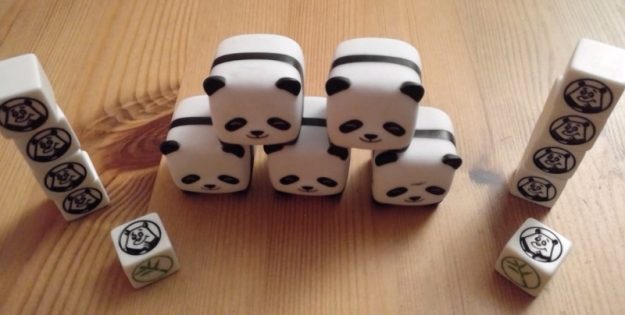
Following the success of all the previous New Year parties, everyone wanted to have one this year too especially given how difficult it has been.  So, the evening began with Pink showing off his new Christmas panda games which were admired as people arrived.  Much to Blue’s horror, Pine then showed off his lack of trousers which he was not wearing in Pink’s honour.  There was much messing about with the new version of Teams and the settings, because Green seemed to be muted in the chat and couldn’t work out how to fix it.

Pass the Pandas & Posing Pandas
– Image by boardGOATS

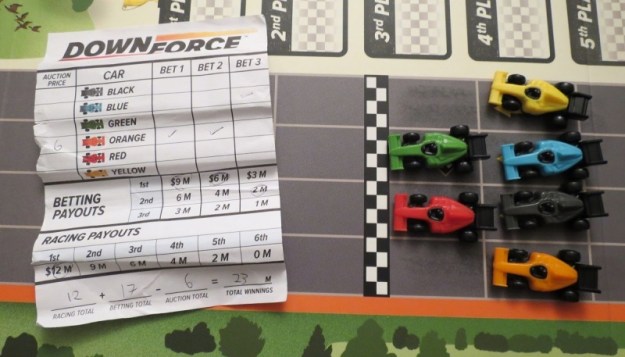
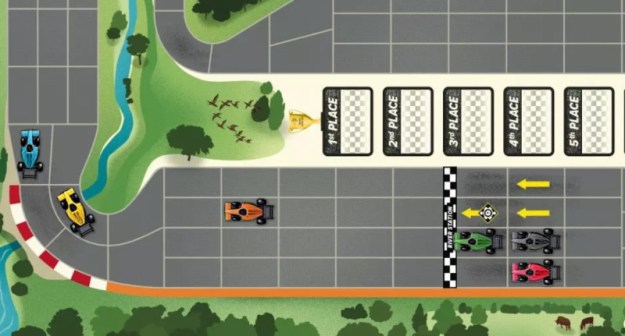
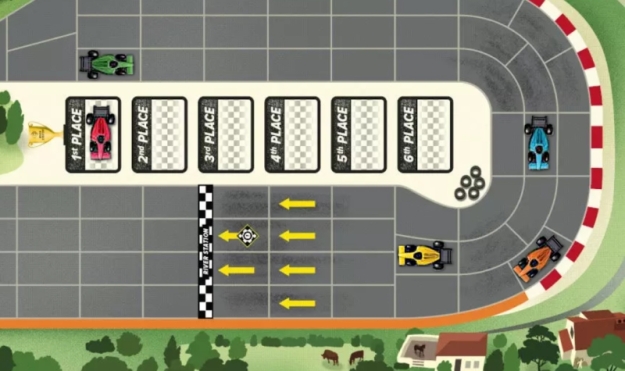
After a lot of messing about, eventually we settled down to the “Feature Game”.  In the absence of our usual New Year game of PitchCar, we opted for the nearest online alternative: Downforce played online using Board Game Arena.  Downforce is a card-driven, bidding, racing, and betting game, based on the older games, Top Race and Daytona 500.  There are lots of different options, but basically, the game comes in two parts.  Firstly there is an auction for the cars, then there is the race when players try to manipulate the race so their cars win, and bet on which car will triumph.

Downforce
– Image by BGG contributor The Innocent

The clever part of the game is the cards which are used for bidding in the first part of the game and then later to move the cars.  These are marked with one to six of the colours corresponding to the six cars in the race.  Each colour has a number which represents the car’s speed, i.e. how far it will travel in a forward direction.  These cards are activated from the top to the bottom, moving the fastest car first, then the next and so on.  The cards show different combinations of colours and numbers, but players know what they have at the start of the game.  This therefore gives the players much more control over what they are doing, compared to games like Formula D for example, where the movement is dependent on rolling dice.

Downforce on Board Game Arena
– Image by boardGOATS from boardgamearena.com

Three times during the game, players have to bet on a car to win or place—this doesn’t have to be a car they own, in fact, betting against a car they own is a good way to limit losses.  The cars are auctioned off at the start of the game and the amount players spend is off-set against their winnings (money for placing in the race, but also for any successful bets).  The winner is the player who finishes with the most money (net).  So the game started with an auction of cars, and as it was our first game, we decided not to include the special powers and chose the River Station track, as it was the simplest (though there are still a couple of pinch points).

Downforce on Board Game Arena
– Image by boardGOATS from boardgamearena.com

With six players, six cars and no special powers, the auction was really for pole position. That was taken by Team Greeny-Lilac, who played their “Superspeed Eight” card first and moved straight into the lead which they held, crossing the first betting line at the front of the pack.  With lots of players the hands are very small, so it is essential that players have at least some cards that match the colour of their car if they are to have any control at all.  That was not something that Pine succeeded in having at all.  Despite that, somehow Pine managed to cross the second betting line first and parked up in the narrow, single car section between the second and third betting lines, blocking it completely.

Downforce on Board Game Arena
– Image by boardGOATS from boardgamearena.com

By the time he left the narrow section, Burgundy and Team Greeny-Lilac had replaced him, effectively obstructing everyone else and amid much hilarity, producing a lot of expletives on screen.  Pine and Burgundy’s cars got in Team Greeny-Lilac’s way and Pine then put on a spurt to cross the third betting line in the lead.  That was a master-stroke, as it gave him space to accelerate round the final corner to the finish line, leaving Burgundy and Team Greeny-Lilac some way behind. Although he crossed the line first, Pine had started with such an appalling hand of cards that he didn’t back himself to win, even when he was ahead at the final betting line.

Downforce on Board Game Arena
– Image by boardGOATS from boardgamearena.com

Just like the one, true, car racing game PitchCar, everyone else stalled on the line in the race for second place.  Eventually, Team Kitty (piloted by Pink), crossed the line in second place while Pine was still struggling to come up with cat-car-racing puns (Niki Meowda was the best he could come up with).  The winner of the game was actually Purple, despite the fact that her car came in third.  This was thanks to her astute early betting and the fact she spent much less on her car than everyone else.  The first game had been a lot of fun, so we decided to give it another go with some of the other options.

Downforce on Board Game Arena
– Image by boardGOATS from boardgamearena.com

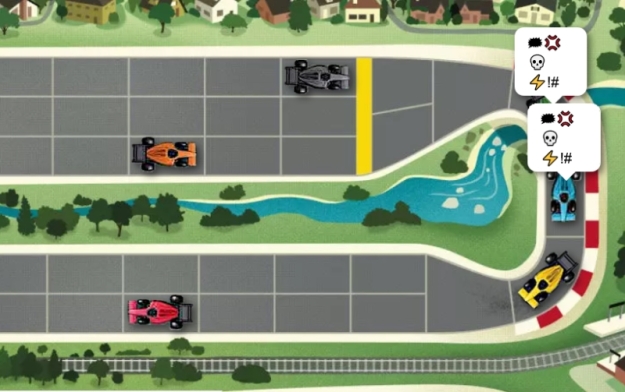
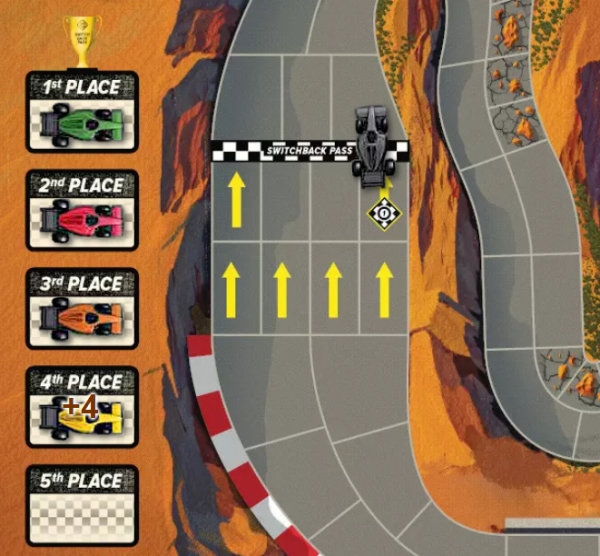
This time, we added the basic special powers to the auction phase and picked a track at random, which turned out to be Switchback Pass (from the Danger Circuit expansion).  This turned out to be an interesting track with no single track sections, but instead featured small, dangerous spaces, with cracked tarmac and rubble from frequent rockfalls.  Players cannot end their movement on these spaces as they are too dangerous; they can only be used for overtaking and players are forced to move back to a regular space as soon as one is available.

Downforce on Board Game Arena
– Image by boardGOATS from boardgamearena.com

This makes it harder for players to actually block others as they have options, though these are can be expensive since the dangerous spaces are smaller and it takes twice as much energy to use them.  Team Kitty bid high and won the first car as they only really had one colour on their cards—as a result, they had a power (Strategic) they could only use once.  The other powers were arguably better, though none really felt like a game changer or breaker.  This time it was Black (who was “Cunning”) who stormed to an early lead and crossed the first betting line way ahead of everyone else.  As a result, everyone except Black, bet on Black to win.  Aside from a brief spell when “Determined Pine” took the lead, “Cunning Black” stayed at the front until he was well past the third betting line.

Downforce on Board Game Arena
– Image by boardGOATS from boardgamearena.com

Then, largely without warning, Black found himself blocked in by the combination of some dangerous track and a load of other cars.  And suddenly, we were in “Echidna Shuffle” territory where everyone was trying to avoid giving victory to anyone else.  This was made worse by the fact that everyone had betted that Black would win, so wanted Black to come in first to maximise their takings.  However, everyone also knew that everyone else had bet on Black, so everyone knew that whether he won or lost it would probably make little difference to the scores.  As a result, it became every car for itself and “Cunning Black” was left to languish on the side of the track like an Alfa Romeo waiting for a recovery vehicle.

Downforce on Board Game Arena
– Image by boardGOATS
from boardgamearena.com

“Determined Pine” was the beneficiary Black’s misfortune and was first to cross the line, eventually followed by “Team Strategic Kitty” in second (by now Pine and Pink had come up with Purrrrling Moss and David Cat-ard…).  “Aggressive Burgundy” and “Team Tricky Greeny-Lilac” came in third and fourth, leaving Black to limp home fifth.  “Cunning Black” was the only one to take anything from the betting, having not learnt from Pine in the first game, and instead bet on Team Kitty at the first betting line.  It wasn’t enough this time though, and in a low scoring game, the winner was Pine, thanks to him winning the race and buying his car cheaply.  Burgundy was second with Team Puss in third.

Downforce
– Adapted by boardGOATS from image
by BGG contributor kalchio

Although we’d all enjoyed it, two games of Downforce were definitely enough for one evening.  So we decided to move on to something else.  For a bit of variety we had planned to play a round of Just One.  As a cooperative, social deduction, word game, Just One ticks all the unpopular boxes for our group, making it the sort of game we very rarely play.  With more than superficial similarities to Codenames (which went down like a lead balloon when we played it a few years ago), Just One is a game we would never have tried had it not been for the current situation.

Just One
– Adapted by boardGOATS from image
by BGG contributor kalchio

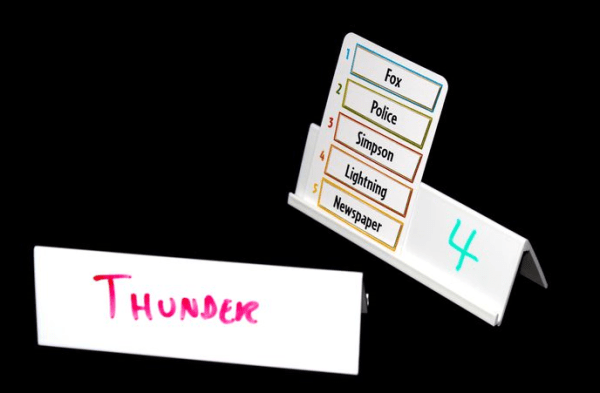
The idea is that one player from the group is nominated to be the Guesser and everyone else gives them clues.  The clues have to be words, or characters and must not be derivatives or homonyms of the target.  The clever part is that any words that are the same are removed before they are shown to the guesser.  So for example, if the target word is “Berry”, clues could include “Straw”, “Black” and “Nick”.  If two people suggest “Straw”, however, this clue is removed which makes the job significantly more difficult for the Guesser.

Just One
– Image by boardGOATS

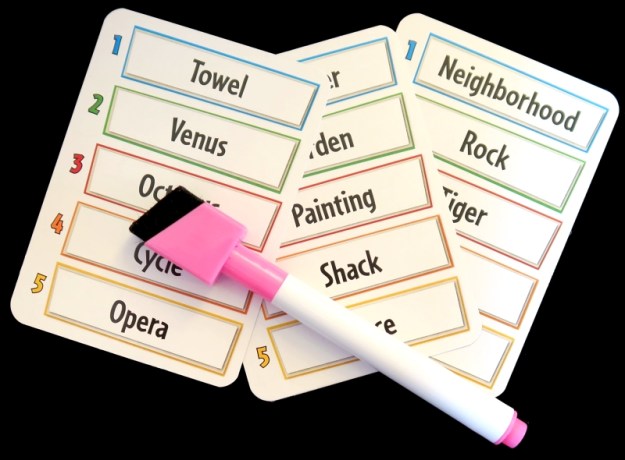
Thus, much like Dixit, in Just One, players are skating a thin line, trying to give an obvious clue, but one that is not so obvious that someone else will give it too and have it removed.  The game is a cooperative game usually played over thirteen rounds, but this time we decided to “house rule” it to play eight rounds, with everyone taking one turn as the Guesser.  Pink started, as he was already in the kitchen doing the washing up.  His word was “Venus”, and people scratched their heads as they tried to think of good clues.  These included “Milo”, “Woman”, “Tennis”, “Planet”, “Williams” and “Love”, but the one that clinched it for Pink was Pine’s clue of “Bananarama“.

Just One
– Image by boardGOATS

With the first one out of the way, everyone understood what they had to do, and Green took his turn to guess.  Even when the clue “Love” appeared twice and was therefore eliminated, “Caddy”, “Surf”, “Derelict”, “Shed” and “Outhouse” were enough for him to correctly guess, “Shack”.  So, it was all going swimmingly and people were just beginning to think it was easy, but then it was Black’s turn.  His clues included “Kylie”, “Area” and “Community”.  He correctly picked up on the “Australia” connection, but even with “Location” or “Locality” (which were ruled out as being too similar), the connection to “Neighbourhood” was just too tenuous.

Just One
– Image by boardGOATS

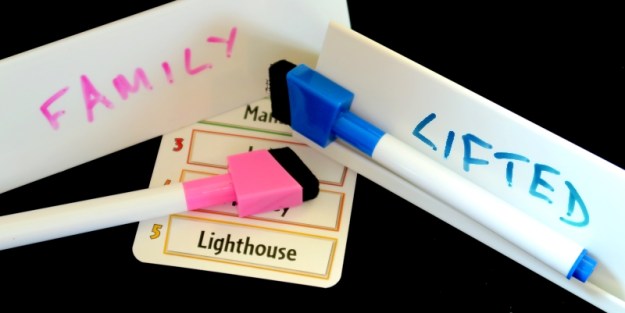
Next it was Pine’s turn and his clues included “Warning” and “Coast”.  Pine being Pine, the clues that most strongly suggested “Lighthouse” were “Family” and “Lifted”.  Although he was pleased to get it right, he is not a fan of the duo, and was very unimpressed when Pink found the track online and shared it with everyone.Burgundy was next and even when “Poll” was eliminated, “Vote” and “Boris” were enough to help him to correctly guess “Election”.

Just One
– Image by boardGOATS

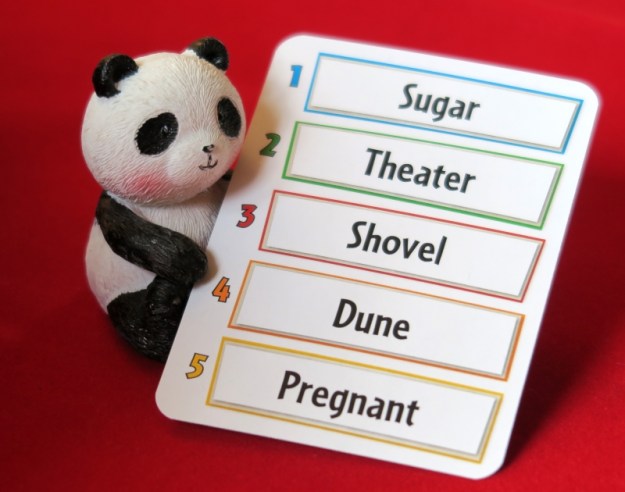
Then it was Blue’s turn, but with clues of “Sand”, “Desert”, “Movie”, “Film”, all she could think of was “Ice Cold in Alex“, which was clearly not right.  “Shoes” might not have been the most helpful clue for someone who hates shoe-shopping, but “Herbert” and “Spice” should really have led her to “Dune”.  As she had not read the book or seen the film, she passed instead.  That left just Purple and Lilac, as it was five to midnight though, we took a break to get drinks to toast the passing of 2020 and sadly bid farewell to the UK membership of the EU.

New Year 2020
– Image by boardGOATS

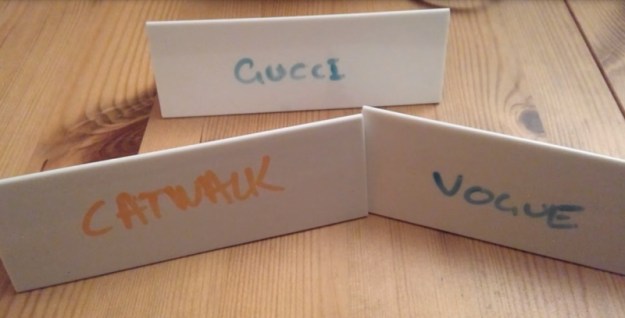
After admiring Squeeze‘s jazzy rendition of “Cool for Cats” on Jools Holland‘s “Hootenanny“, singing “Auld Lang Syne“, a couple of phone calls, and looking for fireworks, we started again.  Purple was given clues including “Gucci”, “Vogue”, “Catwalk”, “Bowie”, “Outfits” and “Clothes” which she quickly correctly guessed as “Fashion”.  Lilac was last up and got clues of “Green”, “Earth”, “Love” (again), “Armistice”, “Nobel”, “Quiet”.  Seeing “Earth” and “Green” together, she excitedly said, “Greenpeace“, but of course that could not be correct as clues could not be contained in the answer.

Just One
– Image by boardGOATS

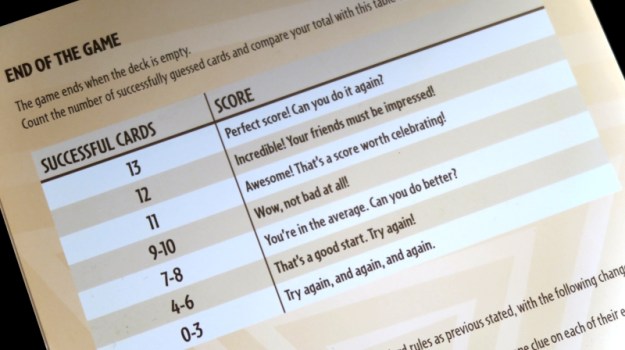
After what seemed like an age she guessed correctly giving us a team effort of six out of eight. Like Hanabi, the collective score at the end corresponds to a comment in a table, so scaling this to thirteen, it corresponded to “Wow, not bad at all!”.  One of the things we really hated about Codenames was the pressure it puts on the clue-giver; worse, if the clue-giver is not naturally good at making those sort of connections, they feel they are failing their team and the whole thing can tank spectacularly.  This is very different in Just One.

Just One
– Image by boardGOATS

In Just One, the stress is shared evenly amongst the clue-givers and although there is a little more pressure on the Guesser, as each person only guesses once or twice and the game is cooperative, no one person takes responsibility for failure and everyone shares in success.  That said, although it is much, much, better in that regard than Codenames, Just One still isn’t really a game for our group.  So there was only really one way to properly welcome in the New Year, and that was with a game of 2020’s Golden GOAT, our old favourite, 6 Nimmt!.

Golden GOAT - 2020
– Image by boardGOATS

In this game, players simultaneously choose cards to play and then add them, in order to the four rows.  When a player adds the sixth card to a row, they take the other five and their card becomes the new starting card.  The “nimmts” they pickup are subtracted from their starting total of sixty-six and the game ends when one player reaches zero.  We now play with the “Professional Variant” where cards can be added to both ends of the row adding a new level of madness, and fun.

6 Nimmt!
– Image by boardGOATS

This time, unusually, we were about a third of the way through the game when someone pointed out that Purple had not yet picked up a card.  This was particularly remarkable because more often than not she is the player to trigger the end of the game.  At the time we thought perhaps this signalled that 2021 was going to be better than, or at least different to, 2020.  On count-back however, it turned out that Purple won the first game of 2020 as well, so maybe that’s not such a good omen after all.  Meanwhile, everyone else was picking up the cards that Purple would normally take.  At one point everyone had around forty-five or forty-six, except Team Greeny-Lilac who had fifty-four, and Purple who had yet to pick up a card so still had sixty-six.

6 Nimmt! on Board Game Arena
– Image by boardGOATS

Purple lasted thirty-five minutes into 2021 before she picked up any nimmts.  It couldn’t continue forever though, and although everyone else continued the inexorable creep towards zero, Purple finally picked up enough cards to move her into second place, leaving Team Greeny-Lilac in the lead.  Inevitably, that made Team Greeny-Lilac a target although nobody has anywhere near enough control in 6 Nimmt! to effect any significant change.  Perhaps it was a matter of collective wishful thinking, but slowly, Team Greeny-Lilac started picking up cards, and at a slightly higher rate than everyone else.

6 Nimmt! on Board Game Arena
– Image by boardGOATS

With the rate everyone was going, we were in serious danger of ending the game with everyone on negative scores.  Black, correctly predicted that there wouldn’t be the extra necessary round to make that happen though, as he picked up once more and brought the game to an end.  Only Team Greeny-Lilac joined him in the red, after so long in the lead.  The winner was really just the player who had managed to hang on the longest, and with one of the lowest winning scores in recent games, it was Pink who won the first game of 2021 with twenty-one points and Purple was just behind with sixteen.  With that, and a little more chatter, it was time for bed.

6 Nimmt!
– Image by boardGOATS

Learning Outcome:  Online racing is much like the real thing:  lots of queuing.
Boardgames in the News: The Truth about Covid and Board Games at Christmas

Over the last couple of days, the Government’s  Scientific Advisory Group for Emergencies (SAGE) are widely reported to have advised people to avoid playing board games this Christmas.  This has been covered by Metro, The Mirror, and The Sun, but also more reputable sources including The Evening Standard, Sky News and The BBC.  This is obviously very bad news for an industry at a time when they would be expecting to maximise their annual sales and instead are struggling.  It would also seem to be at odds with the WHO advice from April this year, which encouraged the playing of games while people were confined to their homes.  So, did SAGE really say that playing games at Christmas will put older people at risk,?
Dixit on Killing Eve
– Image from bbc.co.uk

It is hard to find, but the original article (archived) seems to be one published on 26th November entitled, “EMG and SPI-B:  Mitigating risks of SARS-CoV-2 transmission associated with household social interactions“.  It is sixteen pages long and is a report summarising current evidence on how to mitigate risks of transmission of SARS-CoV-2, with a particular focus on activities in the home when hosting a small number of visitors or larger family celebrations.

Article on Christmas Games & Covid
– Image by boardGOATS from gov.uk

The report extensively analyses the risks in such gatherings and ways these can be mitigated, including avoiding physical contact, and the difficulties associated with gatherings in a crowded, potentially poorly ventilated area, where people are sharing facilities.  The section that covers games is in the appendix, where there is a table covering “Behaviours and Activities”.  This examines a range of scenarios and how transmission may occur.  Games get a mention under “Activities involving fomites” (objects which are likely to carry infection):

“Games that may be traditionally played such as board games, cards, etc, giving of gifts, sharing of objects and vessels during religious observances. Direct evidence for fomite transmission is limited, however viral RNA has been found on high touch surfaces in close proximity to infected people and there is evidence that shared cigarettes and drinking vessels are associated transmission.”

It continues:

“Risks can be reduced through substituting activities for those that minimise sharing of objects, for example through playing quiz-based games rather than those which involved lots of shared game pieces. Any objects which are likely to have direct contact with the mouth pose a particularly high risk.”

So, far from suggesting people should avoid playing board games, the original document indicates the chance of transmission by playing games is small as most people don’t suck the pieces.  Further, this is in the context of people spending a significant amount of time in the same household, in a small space, and sharing other facilities and food so there are many, much higher risks.  Therefore, the bottom line is that if you are sharing Christmas with someone who has the virus, you are likely to caught from them it long before you get out your copy of Pandemic.

Pandemic: Contagion
– Image by boardGOATS

13th October 2020 (Online)

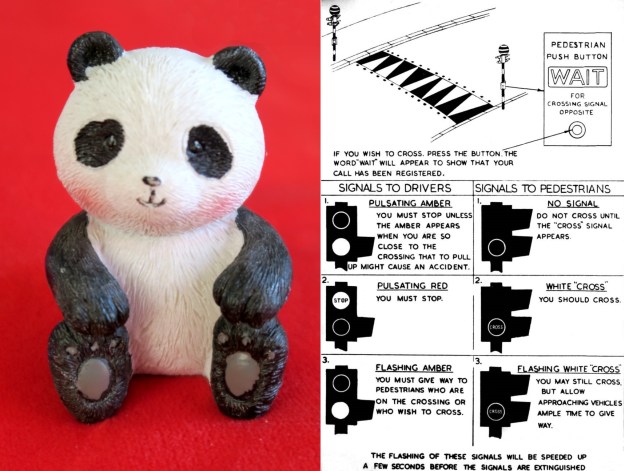
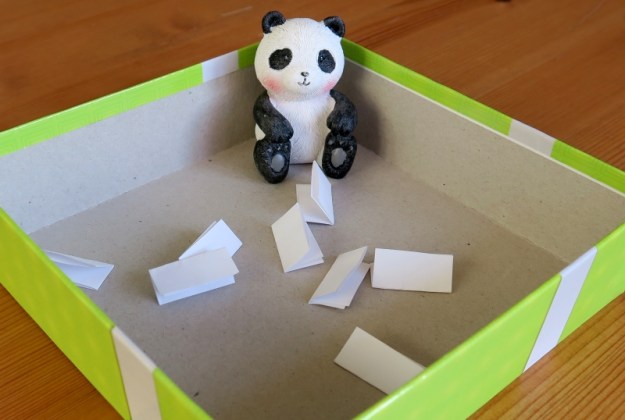
The evening began slowly, with people signing in and confirming they had their parcels and had not yet opened them.  There was a bit of chatter about isolating, and about Green and Lilac’s new house (which had very similar decor to the previous one).  Pink had acquired yet another Panda and proudly had it on display.

A Panda not crossing, with details of a Panda Crossing
– Image by boardGOATS

From there the conversation took a bizarre turn on to the subject of Panda Crossings, which really did exist (along with the other “Animal Crossings”), in the 1960s.  It was no surprise they were phased out after just five years, though, given how complicated they were, and the fact that safe operation relied on the difference between a “Pulsating” Amber and a “Flashing” Amber…

Elizabeth
– Image from cronkshawfoldfarm.co.uk

At 8pm, the Special Guest arrived; Elizabeth and some of her buddies from Cronkshaw Fold Farm in Lancashire joined the meeting.  Elizabeth is very talented and has a particular penchant for yoga.  So much so, in fact that she and her friends have been the subject of a half hour documentary filmed last summer.  As Elizabeth and friends galloped about and showed us their delightful home, everyone sang “Happy Birthday” and then opened their boxes.

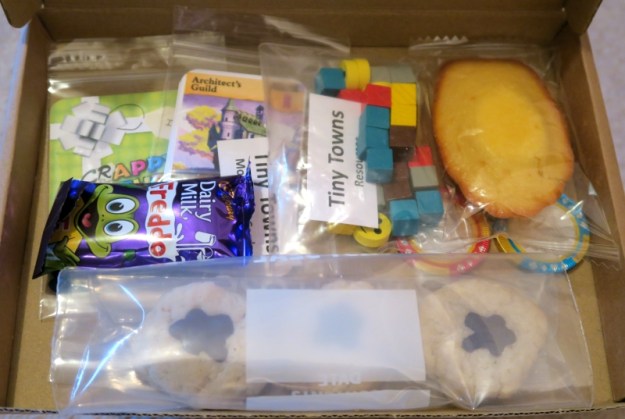
2020 Birthday Box
– Image by boardGOATS

The boxes were part of the celebration of our eighth birthday.  As is now traditional, the “Feature Game” was Crappy Birthday, a silly little filler/party game that is great fun when played very occasionally (and about once a year is perfect).  The idea is that each player takes it in turns to receive gifts from everyone else and then they choose the best and the worst; the players who gifted the selected presents get a point.  So in this game players are aiming for extremes making it almost the opposite of games like Dixit or Just One where players are aiming for the centre-ground.

Crappy Birthday
– Image by boardGOATS

With the current challenge of “remote gaming” we had to play Crappy Birthday a little differently this year.  So, everyone “wrapped their parcels” last time we met and this time everyone took it in turns to unwrap them.  While people ate their treats, names were drawn out of the Crappy Birthday box lid and everyone took it in turns to “open their gifts”, while everyone else ate their cake, biscuits and chocolate.

2020 Birthday Biscuits
– Image by boardGOATS

Blue went first to show those that hadn’t experienced a GOATS birthday party how to play.  As always, it was a learning experience all round.  This time, we learnt that Blue would quite like a trip to the middle east (complete with riding camels), but that Monopoly toilet paper might block her drain and everyone else was concerned about the possibility of paper cuts.  Green and Lilac both dislike smoking and have been to a Star Wars wedding and Lilac would like a ferret.  Black quite fancied unicycle lessons and Purple thought a giant fake bear rug would really add to the ambience in their living room.  Although Black likes fish, a hundred pounds is a lot especially when raw, but as he could put it in the freezer, he decided that the persistence of his own Mariachi band would be worse.

Crappy Birthday
– Image by boardGOATS

Ivory disliked the sound of “Organ Holiday by Ethel Smith”, and would not be swayed even by Pine’s hurt protest that it had pride of place in his collection.  Then he saw the hideous living room tapestry, and although he loves the game (and had really enjoyed playing it with the Plans and Ploys Expansion and Pink and Blue recently), he said it was also not for him.  Since the LP would be for just a year and the tapestry was permanent, the wall covering was therefore rejected as his least favourite.

Crappy Birthday
– Image by boardGOATS

A lot of people seemed to think that Burgundy would really appreciate physical extreme sports but the one he rejected was bungee jumping.  Unlike everyone else who seemed to reject any long term, life-changing experiences, his Burgundy’s preferred gift was a an eagle as a life-long companion, though Blue was concerned it might interfere with Games Night.

Crappy Birthday
– Image by boardGOATS

Mulberry calling in from California fancied a fighter jet ride and rejected a bus ride to Florida, and not only because it was such a long way away.  Meanwhile, animal gifts were quite popular and although Pine would have loved the opportunity to be licked by a giraffe or go on an African safari, those gifts were received by Violet, calling in from Aberystwyth.  She accepted the safari, but, not being a child of the 70s, was unimpressed by the fluffy dice.

Crappy Birthday
– Image by boardGOATS

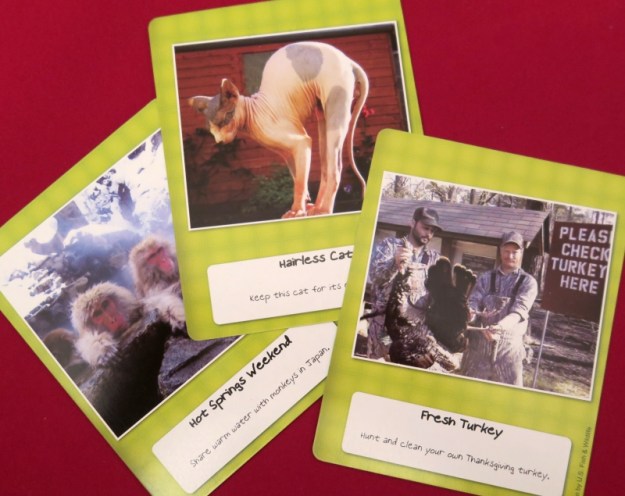
Pine’s wildlife gifts were in the form of hairless cat, a weekend with some monkeys in a hot spring and the chance to hunt and and clean his own Thanksgiving turkey.  Having had a landlady with a cat with galloping alopecia, Pine spurned the unfortunate moggy.  Then, despite the fact the turkey was the vegetarian’s obvious least favourite, that was Pine’s preferred choice as there was nothing to say he couldn’t give it it’s freedom once it’d had a wash.

Crappy Birthday
– Image by boardGOATS

After some rude comments about his taste in clothing, Pink explained that being on the reality show “Can America Disco” was his idea of a nightmare and that he quite fancied an Easter Island moʻai statue for his front garden.  And then, the last player, Lime, also rejected publicity in the form of his own personal paparazzi posting hourly updates on his doings.  Like Pink, he also chose the garden ornament, as Lime wanted a new patio and thought a giant chess board would be just the job.

Crappy Birthday
– Image by boardGOATS

And with that, all that was left was the scores.  This time, we found that Team Greeny-Lilac and Pink were particularly good at this game, but it was Lime who seemed to take a point every time, taking seven out of a possible eleven points.  That said, it was remarkable how many people gave gifts they thought people would like that ended up winning a point for being the most disliked.  That’s half the fun though.  With the birthday celebration dealt with, we then moved on to playing other games.  We are getting better at this, though our repertoire is still quite limited.  There had been a few requests to play Railroad Ink again, however, so we started with that.

Railroad Ink: Deep Blue Edition
– Image by boardGOATS

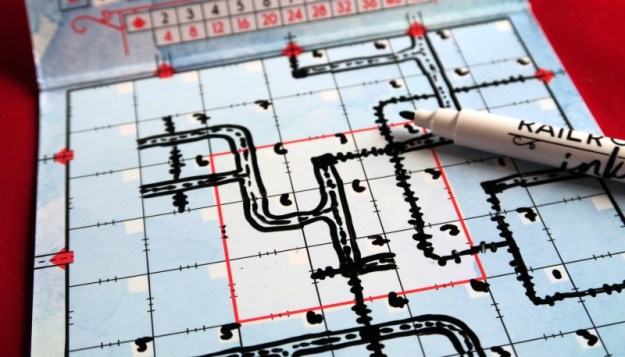
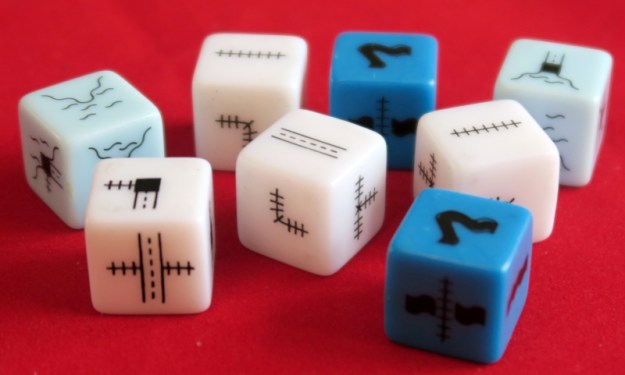
Railroad Ink is a very simple “Roll and Write” route planning game.  The idea is that four dice are rolled and everybody adds all four to their map.  Three of the dice show straight and curved sections and T-junctions for road and rail.  The other, the fourth die shows stations connecting road to rail, and a fly-over (crossing, but not connecting).  The game is played over seven rounds, after which players score points for their longest road segments, their longest rail segments, the number of locations on the edge of the board have been connected, and the number of spaced in the central grid that have been filled.

Railroad Ink: Deep Blue Edition
– Image by boardGOATS

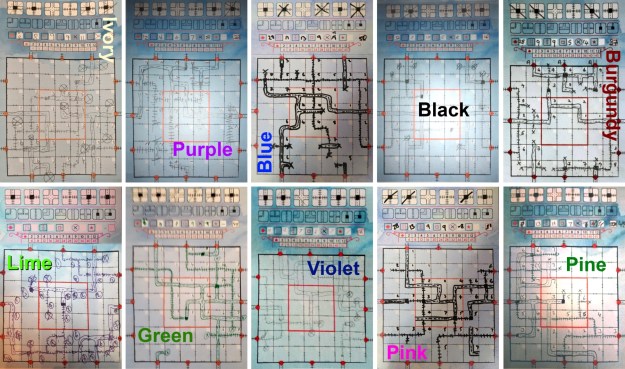
Having played it before, it didn’t take too long to get going and there was a sort of focussed silence as everyone concentrated, punctuated by occasional moans when the dice didn’t give people what they wanted.  Sadly, these games are very much “multiplayer solitaire”, and we really only found out how people did when adding up the scores.  This time, it was really close with just five points separating the top six players.  Initially it looked like it was a tie between Blue and Pink, but a recount pushed Blue into second just ahead of Green and then Pine.

Railroad Ink: Deep Blue Edition
– Image by boardGOATS

Ivory and Lime followed Mulberry taking their leave, and everyone else settled down to something quick and light in the form of Second Chance.  This is a very simple Tetris-style game where two cards are revealed and players chose one of the two shapes to add to their tableau.  Players can add shapes anywhere and in any orientation.  If they can’t use either of the shapes they get a second chance—another card is revealed, but if they can’t add that shape either, then they are eliminated.

Second Chance
– Image by boardGOATS

The winner is the player with the fewest unused spaces, so the winner is not necessarily the player that stays in the longest.  This and the fact that the game is not over-long means that player elimination is not a huge problem.  This time, all the large and awkward shapes came out first which meant there was sudden and catastrophic collapse as almost everyone crashed out together.  As a result, the scores were really close.  Lilac’s beautiful colouring earned her a worthy second place and she was unfortunate to be beaten by the very jammy Pink, who sailed through with several second chances and finished with just three unfilled spaces.

Second Chance
– Image by boardGOATS

By this time, it was starting to get late and people drifted off leaving just five for our, now regular, game of 6 Nimmt! on Board Game Arena.  It is very simple:  simultaneously, players choose a card, then starting with the lowest value, these are added to one of the four rows.  The player who adds the sixth card takes the other five and the player with the most “nimmts” at the end loses.  It is very random, but somehow gives the illusion of control, right until the wheels drop off…

6 Nimmt!
– Image by boardGOATS

We play this so much because it is light and great fun, with no downtime.  And with the “Professional Variant” that we now use where cards are added to both ends of the rows, the game has had a new lease of life for us.  It works really well with fewer players too.  This time, Black was first and second to pick up, and it didn’t get much better as the game wore on and it wasn’t a surprise when he triggered the end of the game leaving Burgundy to taste victory, just ahead of Green.

6 Nimmt! on Board Game Arena
– Image by boardGOATS from boardgamearena.com

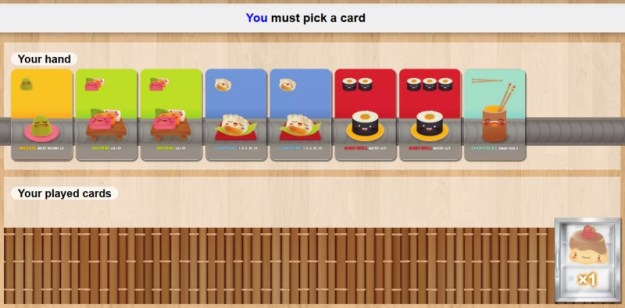
Then, Green said good night leaving just four.  Having enjoyed several games of Sushi Go! last time, we decided to give it another try, this time with the Soy Sauce mini expansion.  This is one of the simplest of the card drafting games—players have hand of cards, keep one and pass the rest on.  With Sushi Go!, players are collecting sets with a sushi theme and trying to collect the most points over three rounds.

Sushi Go!
– Image by boardGOATS

This was another close game.  Burgundy and Blue tied the first round, one devoid of puddings, but Black and Purple weren’t far behind.  The second round was much less even though and was taken by Blue with a massive eighteen points.  She wasn’t able to keep it up for the final round which Black took with sixteen points.  It wasn’t quite enough, to overtake Blue though and she finished with a total of forty-three, just two ahead of Black, in a game where there just wasn’t enough dessert to go round.

Sushi Go! on Board Game Arena
– Image by boardGOATS from boardgamearena.com

There was just time for one more game, so after a brief discussion, the group opted for another set collecting game, Coloretto.  This is another very simple game where players have the simple choice:  Take a card and add it to a truck, or take a truck and add the cards to their collection.  Players score positive points for their three top scoring sets, and negative points for all the others.  Normally, the scoring is according to the Triangular Number Series, where more cards score increasingly more points (one, three, six, ten, fifteen and twenty-one).

Coloretto
– Image by boardGOATS

This time we decided to play with the alternative, “Difficult” scoring, where small sets score the most and their value peaks at eight points for three cards, falling gradually for larger sets.  This changes the game significantly, as taking a fourth or fifth card has the same impact on a player’s score as starting another set.  And everyone has fewer points to play with…  It took a couple of rounds for people to realise the implications of this change to scoring.  Then players started taking trucks when they were almost empty and when a “+2” card came up it was taken straight away.

Coloretto on Board Game Arena
– Image by boardGOATS from boardgamearena.com

As a result, there were more rounds and the game became one of avoiding things going wrong.  And for most people, once it started going wrong, things generally went from bad to worse.  First was Purple, then Black, then just before the end, Blue was landed with pile of cards she didn’t want.  So, it wasn’t a huge surprise that Burgundy, who had managed to avoid falling off the precipice, finished with the most points.  Purple was by far the best of the rest though having been most successful at stemming the flood of unwanted cards.  Then it was time for the last of the birthday boys and girls to go to bed.

Coloretto on Board Game Arena
– Image by boardGOATS from boardgamearena.com

Learning Outcome: A gift’s worth is in the eye of the recipient.

Spiel des Jahres Winners – 2019

The 2019 winner of the coveted German Game of the Year or Spiel des Jahres award is Just One.  This is a cooperative party game where one player guesses a word based on clues given by the rest of the group.  The really clever part is that the clues can’t be too obvious in a way faintly reminiscent of Dixit, the 2010 winner.  However, in Just One, this effect is achieved by the removal of any clues that are given more than once.  Just One was designed by the same people as The 7th Continent, though the two games couldn’t be much more different.

Just One
– Adapted from image by BGG contributor kalchio

The Kennerspiel des Jahres was awarded at the same time.  This honours more challenging games and this year was awarded to Wingspan (known as Flügelschlag in Germany).  This is a very pretty engine-builder card game where players are bird enthusiasts trying to attract the best birds to their network of wildlife preserves.  The Kinderspiel des Jahres award was announced last month and went to Tal der Wikinger (aka Valley of the Vikings) which is dexterity game where players are rolling balls to knock down barrels.

Wingspan
– Image by boardGOATS

Boardgames in the News: How to Spot Fake and Counterfeit Games

Over the last few months, there have been increasing numbers of reports of fake or counterfeit games.  The quality of these forgeries is extremely variable and a huge range of games appear to be affected, from popular gateway games like Ticket to Ride: Europe, 7 Wonders or Dominion to more complex games like Terraforming Mars.  Card games like Codenames might be thought of as an obvious target due to how simple they are to reproduce, however, one of the most affected games is Azul, and some reports suggest that it is the cardboard components that are poor quality—the plastic tiles are indistinguishable from the genuine articles.

Codenames
– Image from czechgames.com

So, how does one spot a counterfeit board game?  The answer is basically the same as for anything else.  Firstly, look at the quality.  This is probably the strongest indicator and if the quality of the fake is particularly high the buyer might not mind so much, or even notice.  Things to look out for include:

Splendor
– Image from imgur.com by BGG contributor ceephour

Some counterfeits are very high quality however.  This can be due to the so-called third shift work“, where a game is made in a factory that is nominally closed overnight, but the workers gain access and create bootleg copies with stolen material or off-cuts. Some of these are very good, but in some cases they also use parts that failed the quality control tests.  In such cases, the seller maybe more of an indication.  If buying on ebay or Amazon market place, beware if the seller has a strange name, claims to be located in the UK but isn’t, and has a very long delivery time.  In such cases, the scam is often to get payment a long time in advance, so that by the time the item is delivered (if at all), they are long gone.

Terraforming Mars
– Image from imgur.com

Thirdly, don’t imagine that Amazon is safe either:  there are three types of transaction, “Shipped from and sold by third-party seller”, “Sold by third-party seller and fulfilled by Amazon” and “Shipped and sold by Amazon”.  Amazon only “sells” authentic items, however due to “commingling“, their stock can become contaminated by fakes.  This is because when an item is sold by a third-party seller and fulfilled by Amazon, the third-party seller ships their item to Amazon who add it to their pile in their warehouse before they ship it on.  If the third-party is dodgy, the person buying from them may get lucky and get a copy from Amazon’s stock which means someone else will be unlucky…

Finally, if it sounds too good to be true, it probably is—caveat emptor: Buyer Beware!