Tag Archives: Downforce: Wild Ride

23rd December 2024

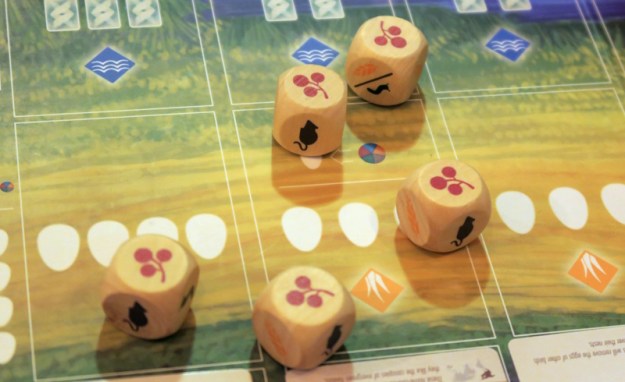
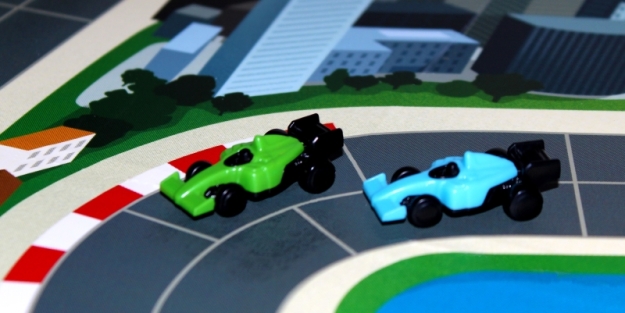
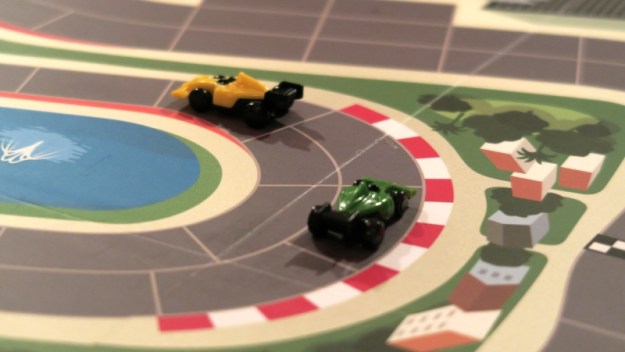
Being an extraordinary Monday meeting and only two days before Christmas, we didn’t really know who or what to expect, so didn’t have a “Feature Game” planned.  In the event, almost everyone expected turned up and we played some of our all-time favourite games.  Pink was first out of the traps, and persuaded Black, Lime and Pine to join him in a game of his favourite race game, Downforce.  This is a fun car racing game where players bet on cars as well as try to win the race.  What makes it special is that players play cards, but, whereas in other race games players can only influence their own car, in Downforce, the cards can be used to play anything from only the player’s own card, to every car on the track (depending on the card).
Downforce: Wild Ride
– Image by boardGOATS

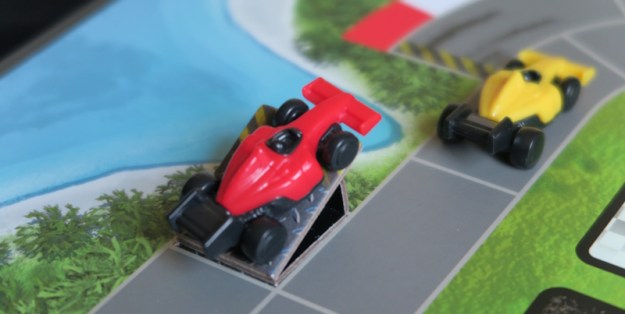
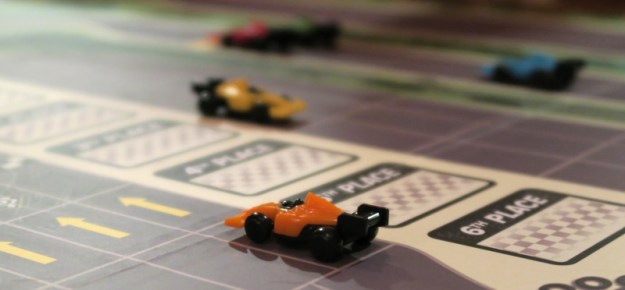
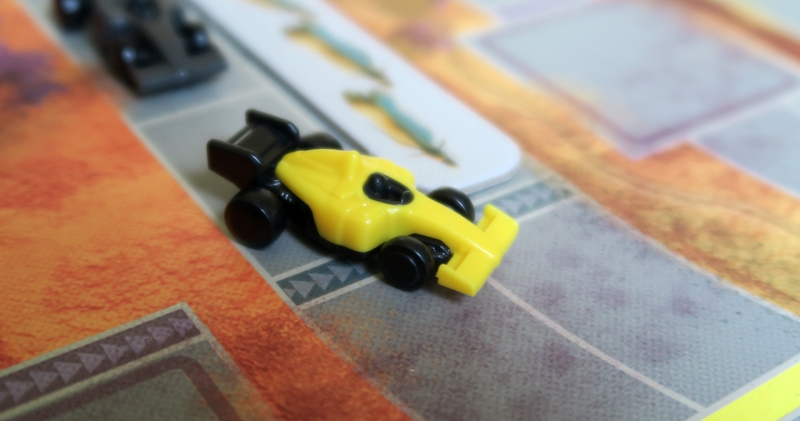
This time, the group played with the Aloha Sands track from the Wild Ride expansion which features water jumps. Cars can use these ramps if they are moving fast enough which lets players pass other cars and move more efficiently. Thus, hand management to take full advantage of the different speed cards is crucial.  The game begins with an auction of cars.  This is after players have been dealt their hand of cards, and this time, the blue car was popular and went to “determined” Lime, who outbid “cunning” Pink.  With six cars on the grid, and four players, there is the possibility of some getting more than one vehicle—although one car (green) went unclaimed, Lime ended up with orange as a second.
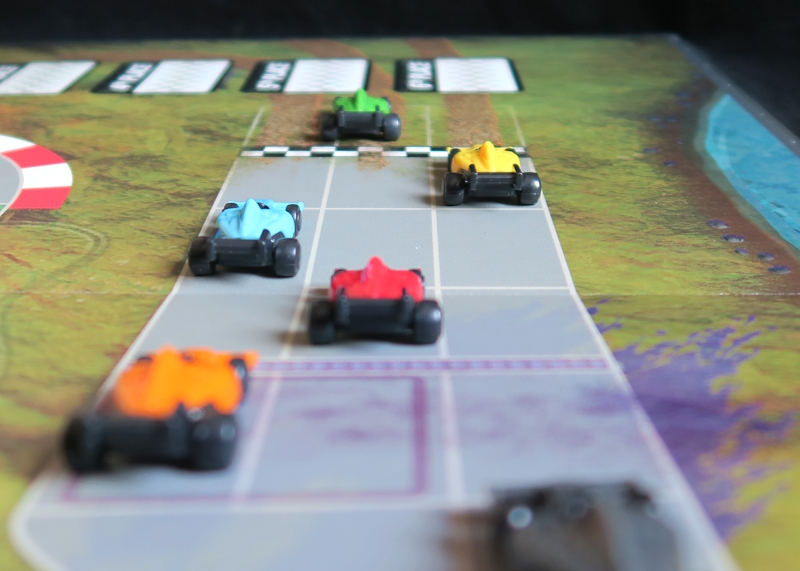
Downforce: Wild Ride
– Image by boardGOATS

The Aloha Sands only has two betting lines, and the group chose to use the first two featuring on the betting variant score sheet.  In this “odds” variant, players get better “odds” for a car that is at placed less well than one that is currently winning.  The red car, owned by Pine took an early lead, but by the time the cars made it to the second (and final) betting line, it had dropped to third.  Pink had a fist full of cards that favoured to the blue car, and although he had been outbid for it, he had decided to push it along anyhow and bet on it.  As a result, with both Lime and Pink favouring it, the blue car moved through the field (aided by some double jumps) and crossed the finishing line first.
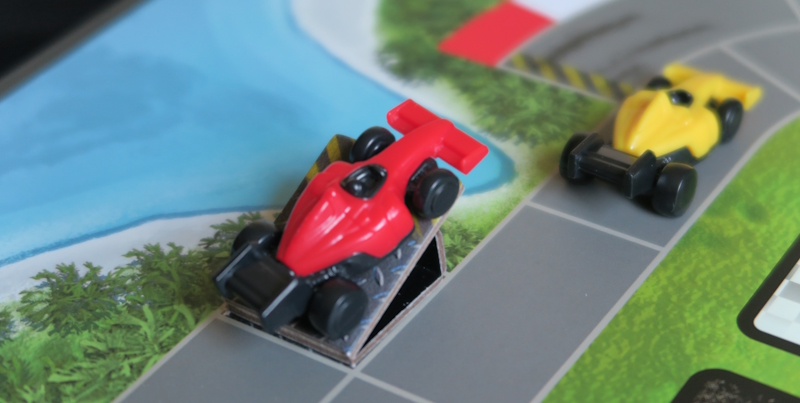
Downforce: Wild Ride
– Image by boardGOATS

Second place went to Black’s little black car with Pine’s red roadster completing the podium.  Betting and car costs have a huge impact on the final scores though, as can the initial outlay for the vehicle.  In this case, despite paying for two cars at the start, the fact that Lime owned the winning car and had also bet on it, meant he had an unassailable twenty-one million dollars, eight million more than Pink in second place.  With the race over, the quartet chose to move onto a more festive game, Jokkmokk—a cute little set collecting game that went down really well when it got its first outing last year.
Jokkmokk: The Winter Market
– Image by boardGOATS

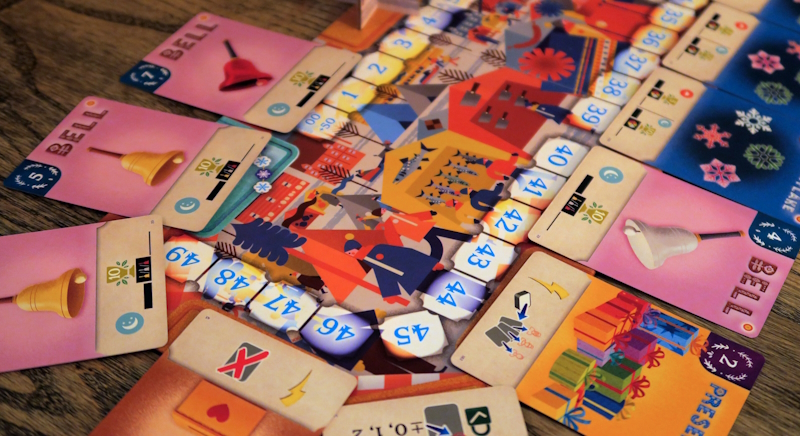
In this game, players move one of their two family members, the one furthest back, to an empty space and claim the associated card before resoling its effect and refilling the empty space.  Some cards score points in the middle, others only at the end, so the sets of cards used can really change the game.  As this was the second game, the group chose to use the “Second Game” set, featuring the Fika (a Swedish custom of enjoying a coffee and a treat with friends), Aurora Borealis, Snowflake, Patchwork, Mystery Box decks.  Of these, the Snowflake cards scored during the game giving Black and early lead with fifteen points, five more than Pine in second.
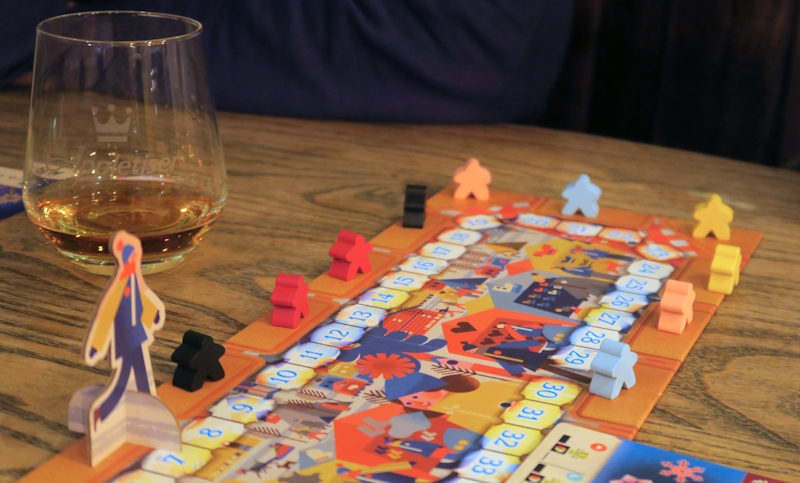
Jokkmokk: The Winter Market
– Image by boardGOATS

The mid-game points were chicken-feed compared to the end game scoring, however, with lots of points available for Fika and Patchwork scoring and for the face value of the cards themselves.  The winner was Pine with a total of one hundred and twenty-eight, eight more than Pink in second and eighteen more than Black in third.  Everyone had enjoyed the game so much, that when Lime inevitably suggested playing again, everyone else agreed.  This time the group used the “Gift of Giving” set of cards, including the Donation, Bell, Sparkler, Snowflake, Mystery Box and Presents decks.
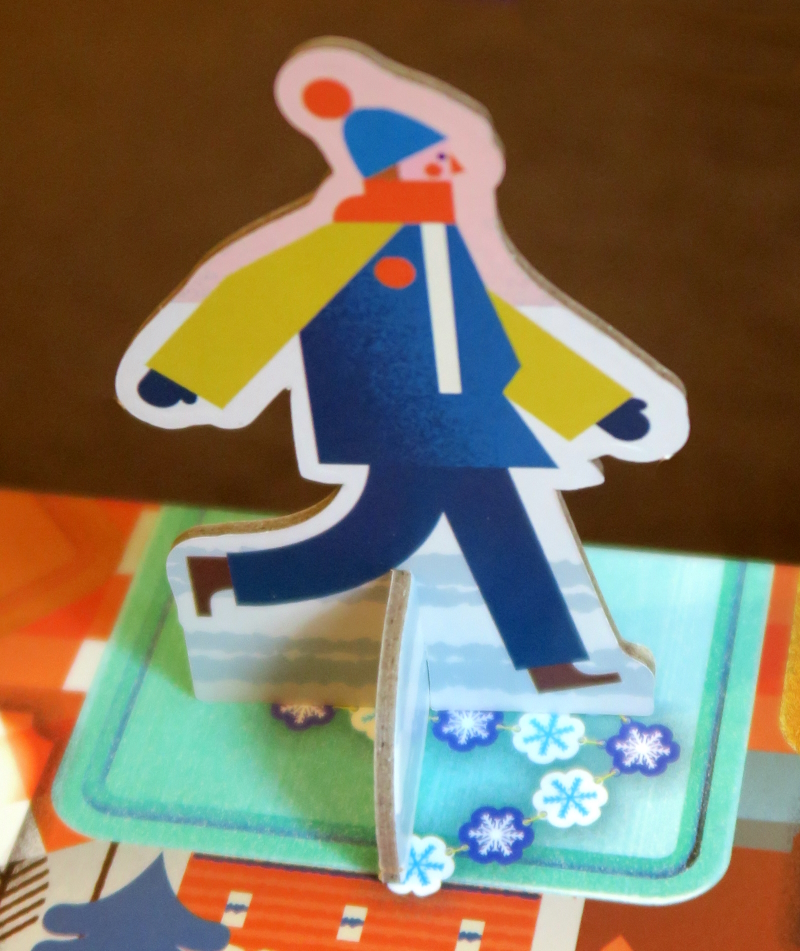
Jokkmokk: The Winter Market
– Image by boardGOATS

The game followed a similar pattern to the first, with Black and leading at the midpoint with Pine in second and Pine taking overall victory.  This time, Lime was the runner-up, however, with Black taking third again.  Meanwhile, on the next table, Blue, Plum, Byzantium and Purple were playing Blue’s favourite game, Keyflower.  This is it’s second outing of the year, but Plum and Byzantium had missed out last time.  They had played it before, but had felt that it didn’t shine with two players and were keen to see how it played with more.
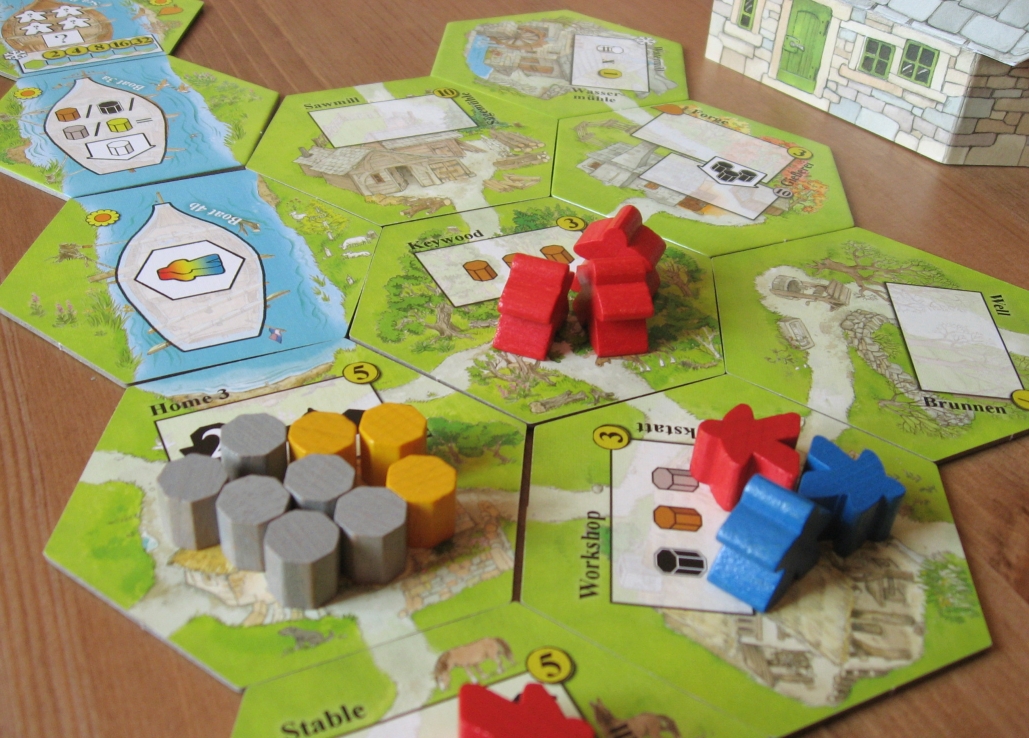
Keyflower
– Image by boardGOATS

Keyflower is an auction and worker placement, with elements of set collection and even network building.  Although everyone had played it before, Blue went through the rules.  The idea is that players use meeples to bid on tiles, but can also use them to activate tiles to gain their benefit (usually Resources, Skill tiles or the ability to move resources around their Village).  At the end of each of the four rounds players add the tiles they have won to their Village and get any meeples back that were used to activate tiles in their own village.
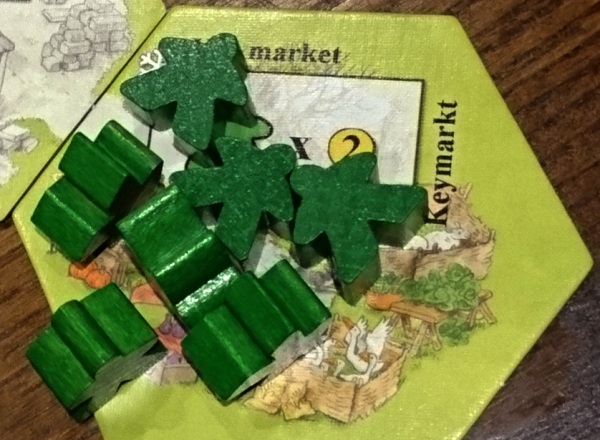
Keyflower
– Image by boardGOATS

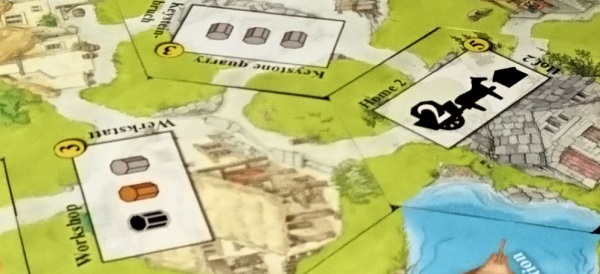
One of the key aspects of the game is the colour of the meeples, as players have to “follow” when bidding or activating a tile. As a result controlling the number of blue, red and yellow meeples they have is a key part of the game.  More, green meeples, which are special and can only be acquired by activating specific tiles, can be really valuable.  Blue had a Winter tile that gave points for having green meeples at the end of the game, so started bidding on the Peddlar which came out in Spring.  Byzantium had other ideas, however, and outbid Blue.  In fact, that was just the start of a tight game where there was a lot of competition for many tiles.
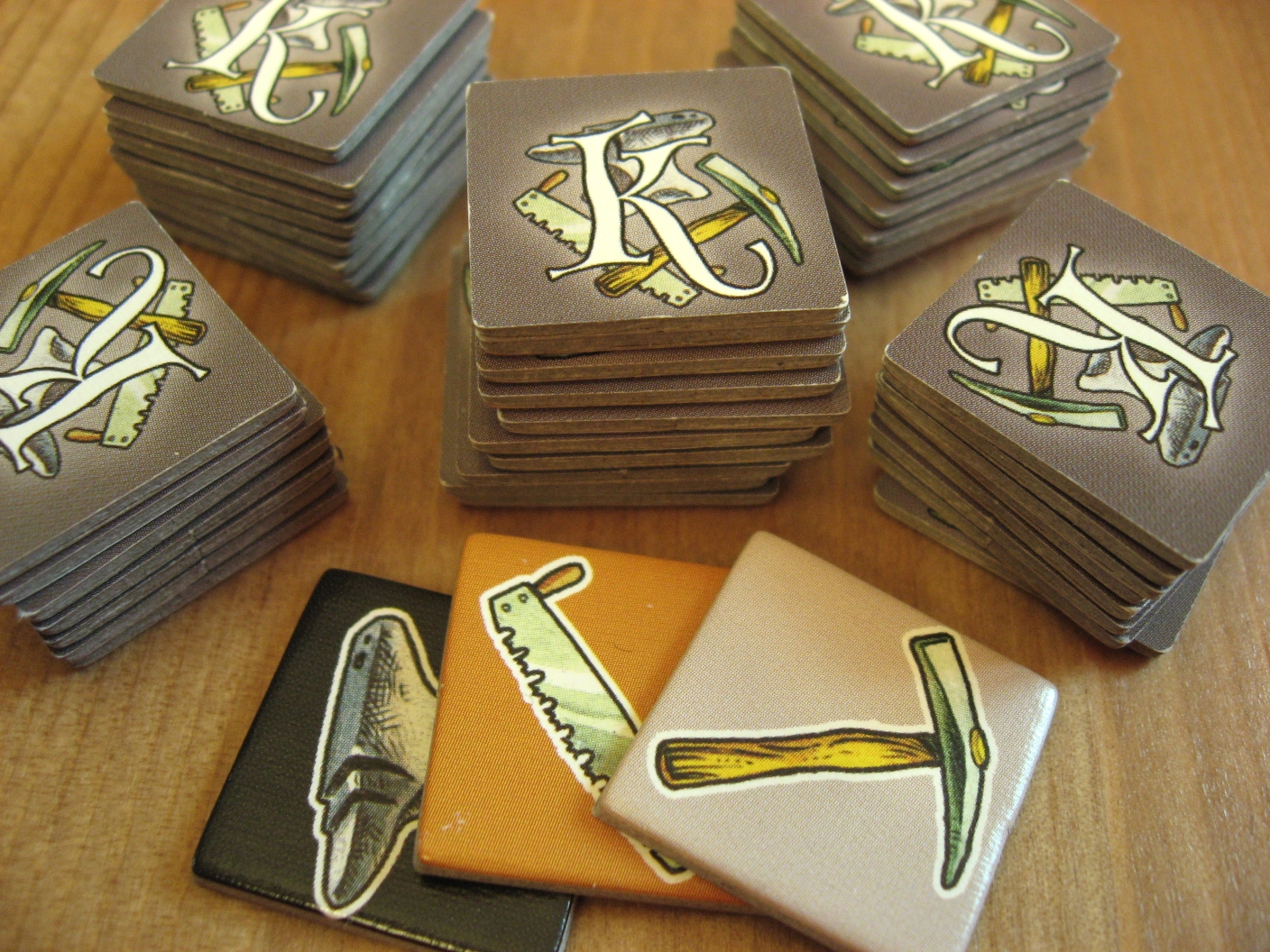
 

Keyflower
– Image by boardGOATS

Keyflower is a game that typically rewards players who keep their options open, but this time, Blue found her options quickly narrowed and ended up going for sets of three Skills tiles.  This can be lucrative, but can also be difficult to make work, so like many things in Keyflower is a bit of a gamble and with all her eggs in the one basket, she had no choice but to ensure she won the Scribes tile by ensuring she went first in the final round and had a large pile of red meeples to back it up.  Tension mounted as players fought for the tiles they needed.  The Keythedral changed hands several times, and the Jeweller, the Village Hall and the Watermill were all strongly contested.
Keyflower
– Image by boardGOATS

In the final scoring, it was clear that the Scribes tiles made all the difference, with Blue finishing with eighty-six points, fifteen more than Byzantium in second with Plum taking third.  As the tiles were packed away, there was some discussion about the game, with Plum and Byzantium commenting that the balance of tiles is less swingy in four-player Keyflower than with two  While they were packing up, the second of two games on the next table was coming to an end.  In the first of these, Jade led Sapphire and Cobalt in the hot-off-the-press game, Fromage, a worker placement game about cheese-making in France.

Fromage
– Image by boardGOATS

This is a clever game with a “time” element, similar in feel to Tzolk’in.  In both these games, workers left on the board for longer give more valuable actions, however, in Tzolk’in, players place their workers and the options become better the longer they stay on the board with players making the decision as to what they get when they remove workers from the board.  Players can also only place workers or remove them, not both.  In Fromage, there is more flexibility, and the action is carried out when the workers are placed and then remain on the board for longer for the more valuable actions.

Fromage
– Image by boardGOATS

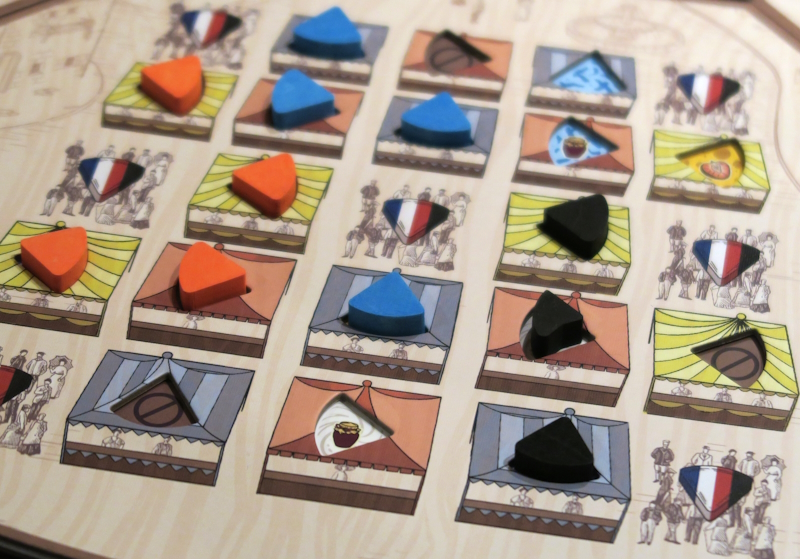
Game play is simultaneous, with all players placing their workers at the same time working on their quarter of the board.  Once everyone has finished, the board is rotated, and any workers who have finished their spell on the board are returned to their owner to be placed again in the next round.  Workers can stay on the board for one, two or three turns, so a key part of the game is planning and with only three workers, making sure that players don’t end up with all of them stuck on the board.  This was another tight game with players scoring fairly evenly in the four areas of the board, the Bistro, Festival, Fromagerie and Ville.
Fromage
– Image by boardGOATS

Cobalt just edged it on Fruit and Orders, however, giving him a four-point victory over Jade in second with Sapphire not far behind.  There was just time for one last game and the choice was another recent popular game, Looot.  This is a clever management game, using a double placement mechanism where Vikings conquer territory on the central player board, allowing players to gain resources, buildings and objective tiles while they build their village on their personal board using tiles from the common board to gain victory points.  This was another tight game, especially between first and second place.

Looot
– Image by boardGOATS

It was backwards and forwards between Cobalt and Jade and finished with just two points between them.  Once again though, Cobalt just had the edge, his hundred and six points just pushing Jade into second again.  It had been a good night though and a fitting end to the evening, and the last meeting of the year at the pub.  As the last Christmas cards were handed out and final Season’s Greetings shared, people headed off into the darkness and with just two sleeps till the big day.

Santa's Workshop
– Image by boardGOATS

Learning outcome:  You don’t have to play Festive games at Christmas to have fun.
30th May 2023

Pink and Blue were late arriving thanks to a debate as to whether the actor Gary Lewis was in the Roland Emmerich film The Day After Tomorrow.  Eventually Blue and IMDb were proved right when Pink found the guy who WAS in the film (Richard McMillan, who bore no resemblance to Gary Lewis whatsoever), but that meant they were late arriving and Plum and Byzantium were already there.  Unfortunately, due to a mix up, the Jockey wasn’t serving food, so Blue headed off to get chips for everyone from Darren at The Happy Plaice.  As the chips were consumed, everyone else arrived and it was just a question of who would play the “Feature Game“, the Wild Ride expansion to our go-to motor racing game, Downforce, and what everyone else would play.

Downforce
– Image by boardGOATS

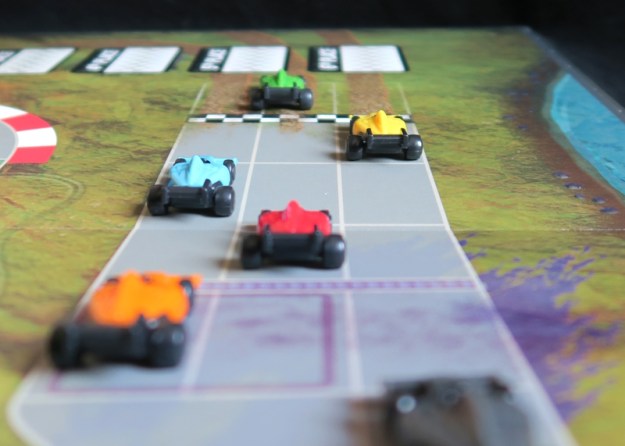
Eventually Pink and Green committed to Downforce, and were joined by Pine (who claimed that after doing well the first time he played, he’d come last ever since), Black and Lime (as long as the other group weren’t playing Wingspan).  Pink and Green reminded people of the rules of the base game, which are simple enough:  after being dealt their hand of cards, players bid for cars, with the player who pays the most deducting the cost from their final score.  Once the bidding is over, the race takes place.  Players take it in turns to play one card from their hand, and then move all the cars depicted on it in turn.

Downforce
– Image by boardGOATS

When the first car crosses a betting line, the race is paused while everyone bets on which car will win the race.  There are three betting lines, but the winnings for betting decrease the closer they are to the finish line.  At the end of the game, players total their winnings from the race with those from the betting, deducting the cost of their car and the player with the most cash is the winner.  The Wild Ride expansion adds two new tracks: Aloha Sands and Savanna Stretch. Aloha Sands adds water jumps which cars can use if they are moving fast enough. The jumps allow players to pass other cars and get round the track more efficiently, but timing is everything.

Downforce: Wild Ride
– Image by boardGOATS

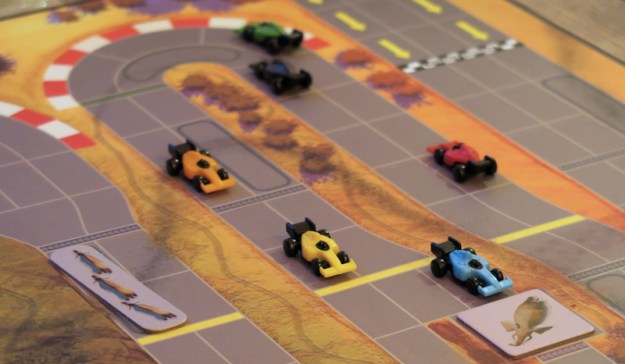
In contrast, Savanna Stretch features wild animals that block the track.  Once the first car has passed an animal, they are moved to another part of the track, as such, they help to prevent the “runaway leader” problem that can sometimes be an issue in the base game.  It was this track that players chose to use this time.  The inclusion of extra animals on the track caused a little confusion initially, but the group soon worked out two of the important features of this track.  Firstly, the animal tile only moves after the first car is fully past it and all other the cars have finished their movements for that card, which means that the animal is really only an impediment for the first few cars.

Downforce: Wild Ride
– Image by boardGOATS

The other the slightly unusual aspect of this track is that the pole position car starts at the rear of the pack.  With five players and six cars, there was always a chance that someone would get two, and that someone was Lime.  While this can be a huge advantage, especially if the cars are cheap, it can also be a risky strategy as it can be difficult to manipulate two cars and they can also become a target for other players.  Unfortunately for Lime, his cars were among the most expensive, leaving him with a deficit of $11M before the racing began, compared with Pink and Green for example, who paid just $2M for theirs.  Once everyone had got to grips with the rules and the cars had been allocated, the race was underway.

Downforce: Wild Ride
– Image by boardGOATS

For a track with so many tight sections it was not surprising that there was a lot of blocking going on—most of it, to be fair, totally deliberate… Pink (in the red car) found his early push to the front to be a mistake, as he was instantly the target for blocking maneuvers from turn two until the final straight.  Green (in orange) used his online experience from Board Game Arena to keep himself in the pack, but not at the front. Luckily for him several other players selected his car to win the race at the first two check points, which helped keep him out of trouble and pushed forwards.

Downforce: Wild Ride
– Image by boardGOATS

However after the halfway mark, Black (driving the blue car) and Pink both surged forward causing Green and Pine to lose their nerve and bet on Black (instead of Green) at the last checkpoint.  However, they should not have worried, as very soon after that, Green’s car surged forward weaving between the cars in front to race for the line and victory.  Pine was close behind, followed by the first of Lime’s cars (the other brought up the rear).  With the race done, there were just the winnings to claim from the bookies.  Because Green had got away with paying little for his car and won the race, he had a significant prize pot even before betting was paid out.

Downforce
– Image by boardGOATS

There wasn’t a huge difference in the results from the betting, but it was enough for Green to extend his lead.  Pine also raked in millions as his betting pattern was the same as Green’s (perhaps someone should investigate them for race fixing).  As a result, Pine come in clear second with Black completing the podium.  Since there was still some time left for a “proper” game, the group hunted around for something that wasn’t too long and could play five.  In the end, they settled on the simple little “push your luck” game, Port Royal, as much because no one could find anything better for five players, than because anyone really wanted it specifically.

Port Royal
– Image by boardGOATS

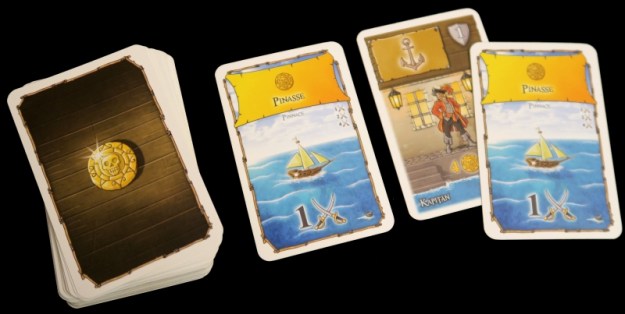
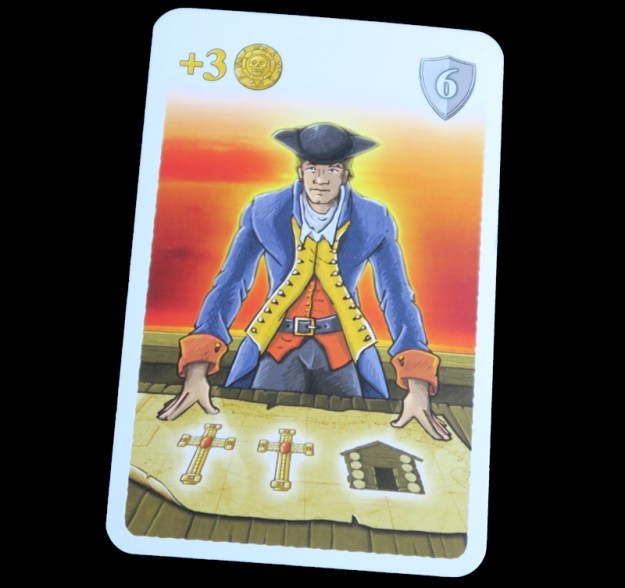
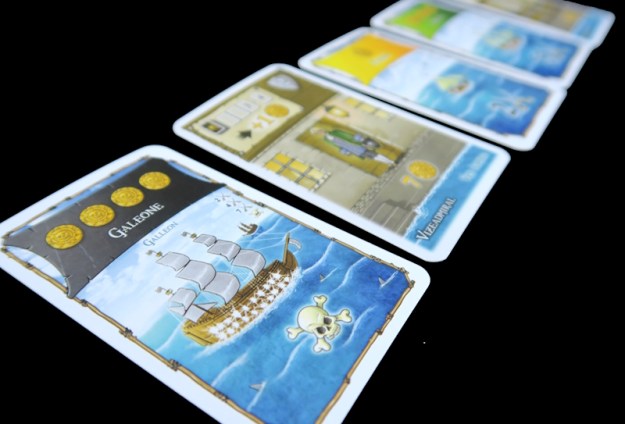
It had been a little while since most of the group had played, though the rules are simple enough.  On their turn, the active player chooses to “twist” and turn over the top card of the deck, or “stick” and keep the current card set.  The deck of cards consist of coloured ship cards and character cards.  The first decision is to decide whether to risk a “twist” because if second ship card of a colour is drawn the player goes bust and their turn ends.  If a player “sticks” they can take a ship and add its treasure to their stash, or they can use their gold to buy the support of characters.  These give players victory points and special powers, but also can be used to claim contracts and give more points.

Port Royal
– Image by boardGOATS

Once the active player has taken a card, players round the table can take a card too.  The cards are double-sided like those in San Juan or Bohnanza, so in the same way, keeping an eye on the discard pile and the money in players’ hoard is also key.  Although Black and Green did their best to quickly explain the rules, Pine and Lime were still both a little unsure, and perhaps with good reason.  Part way through the second round Black and Green realised something was amiss and re-read the rules and spotted a “rules malfunction”:  they had forgotten that when a player takes a card on another player’s turn, they pay the active player one coin, thus encouraging players to push their luck further to give more players more choice.

Port Royal
– Image by boardGOATS

So from the second round on-wards they group started playing correctly.  Pink’s strategy involved ignoring the Sailors and trusting to luck with turning the cards while spending his money on symbols to make up Expedition cards.  That gained him the first Expedition card, but ultimately, this single minded approach wasn’t very successful, at least in this game.  Green went for a strategy of collecting fighting cards, in order to fight off the pirate ships.  This worked initially, but by the time he had five fighters (and seven points), he kept going bust on his turn as he turned up skull bearing Pirate Ships against which there is no defence!

Port Royal
– Image by boardGOATS

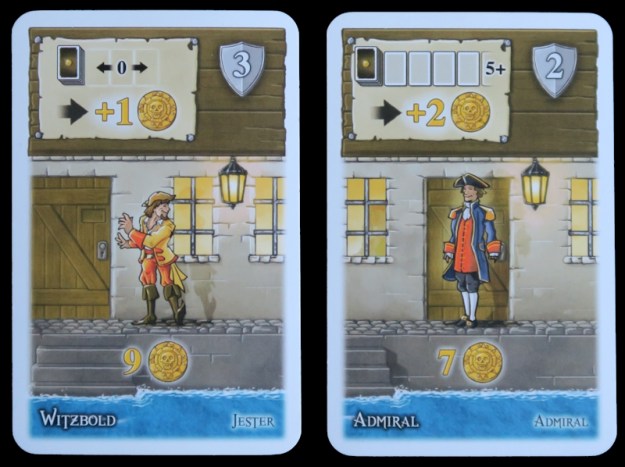
This meant that everyone else was able to gradually build their wealth and cards to catch him up.  Green then collected two more fighters and in preparation for one final attack, but would he get the chance?  Black had managed to accumulate a lot of points, not least because he collected money for both a large array of cards and for when it went bust thanks to the Admiral and the Jester.  If Black could collect another special symbol he could claim an expedition and win the game before Green could make his mega move with a full fighting force.  Unfortunately for Pine, he wasn’t able to collect the symbol he needed to claim a expedition as he went bust.

Port Royal
– Image by boardGOATS

So it was Green’s turn again and he started to pull out cards, with a huge line of cards.  After defeating every lower value Pirate Ship he came across, he managed a full five different coloured ships.  From there he was able to collect another five coins and purchase the two crosses on display, which gave him an expedition card and enough points for victory.  At the conclusion of the game, Pine confirmed his early feelings that he did not really like this game, and Lime felt it was all a bit too confusing, never really sure what he was doing.  This was an older game that we used to play a lot of at the club, but it seems to have lost its lustre now and will probably forever remain an occasional play game.

Port Royal
– Image by boardGOATS

Meanwhile, on the next table there was a lot of debate as to what they’d play.  With five, the options were quite restricted, Burgle Bros. almost made it, until Teal realised it only played four, which left Tiny Towns.  Plum wasn’t so keen, so in the end, the group went for the old favourite Wingspan (having said to Lime that they weren’t going to play it…  Sorry Lime!).  There was some debate as to whether there was time for the game with five players, and options of playing three rounds instead of four were briefly discussed, but since everyone knew what they were doing, the group decided to give it a go and see if they could squeeze in a full-length game.

Wingspan
– Image by boardGOATS

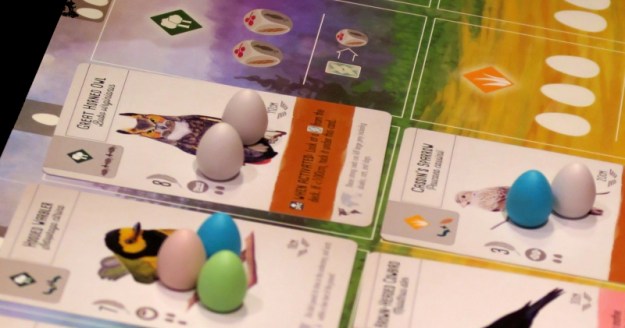
The game is an engine builder that is quite simple in theory, but quite difficult to play well.  Players are collecting birds for their sanctuary, scoring points for exciting birds, eggs, cached food and cards tucked under birds (representing flocks of birds or prey caught), as well as bonus points for achieving particular goals during the game and at the end of the game.  The idea is that, on their turn, players either play a bird card from their hand into their tableau, or carry out the action associated with one of the three habitats (Woodland, Grassland or Wetland) and then activate each bird in that habitat.  While that is all there is to it, it’s all in the cards and getting them to work together.

Wingspan
– Image by boardGOATS

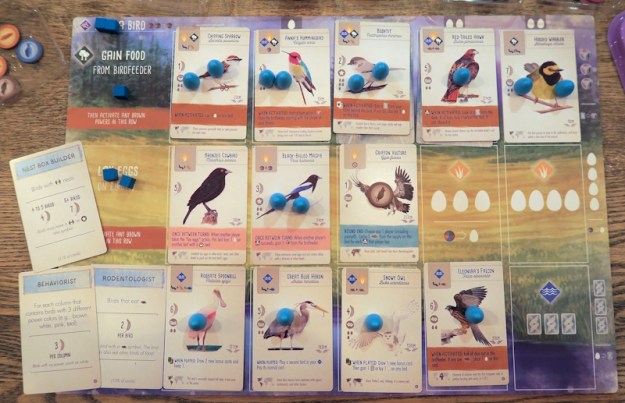
Wingspan can be a little “multi-player solitaire”, that is to say, there can be very little interaction between players in some games.  For some players this is preferred as it means players don’t have their carefully laid plans destroyed by others, while others feel they might just as well be sitting alone and interaction between players is what makes playing games important.  It had been a while since it’s last outing, but the group were quick to get going and were happy to play with the European Expansion which was already mixed in.  Plum in particular, got off to a flying start with her opening hand, four of which were coloured birds and matched her chosen Bonus card (the Photographer).

Wingspan
– Image by boardGOATS

In contrast, Blue had cards that didn’t match at all.  The Rodentologist was her best Bonus card giving her two points for each bird in her sanctuary that ate a rodents, but not one card in her starting hand qualified.  Teal started out with a strategy to maximise his egg production and prioritised birds with brown powers and resource conversion to assist that aim.  The first card Plum played helped him in this, and everyone else too as it happens as it was a very generous Ruby-throated Hummingbird that gave everyone food every time it was activated.  Teal returned the favour as he laid eggs at every opportunity and Plum had a bird that rewarded “once between turns” if anyone laid eggs.

Wingspan
– Image by boardGOATS

As the game progressed, players worked on the end of round bonuses.  Three of the four birds Plum had kept from the start also happened to have bowl nests which contributed towards the fourth round goals, as long she could ensure they had eggs on them.  She didn’t really aim for anything else, but Blue, Byzantium and especially Teal did well in the early rounds.  Plum picked up some more birds with colours in their names, but also managed to play the Yellowhammer end of round card which she was able to use to great effect as it enabled her to play an extra bird card if she had used all four actions during the round.  Byzantium had issues with the dice which repeatedly wouldn’t give him what he wanted.

Wingspan
– Image by boardGOATS

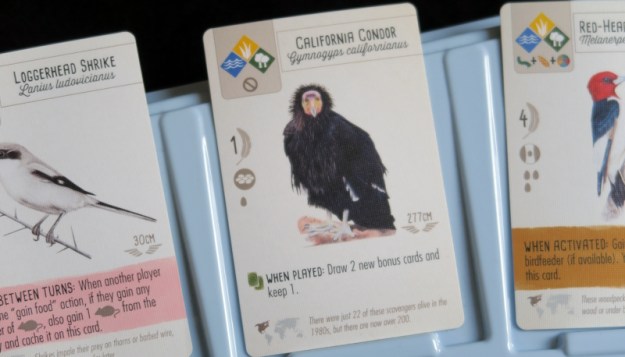
Then to compound Byzantium’s woes, he got himself in a bit of a mess when he played his migrating bird into the wrong habitat meaning he didn’t get the advantage of moving the bird straight away and costing him more eggs into the bargain.  Purple had different dice issues when she rolled five berries and called “Yahtzee!”  Blue had improved her hand and acquired some more helpful cards, including one that gave her an extra Bonus card, the Behaviourist, which gave her three points for each column with three different power colours.  As people sifted through the deck trying to find cards they liked the look of, the California Condor appeared, which everyone agreed looked like a monkey.

Wingspan
– Image by boardGOATS

Towards the end of the game, partly as a result of Plum’s Hummingbird, Byzantium ended up with a surfeit of food and nothing to spend it on.  So, he switched tactics and took the Condor hoping to get a bonus card that would improve his fortunes.  It didn’t.  Blue tried the same and didn’t do any better.  After the final round Plum activated her Yellowhammer again and was left with the choice of playing a bird that gave her a Bonus card or one that gave two extra points.  She also went for the Bonus card, the Fishery Manager, but only one of her birds ate fish.  Time was ticking on, but the game was over well within two and a half hours with just the scoring to go as last orders chimed.

Wingspan
– Image by boardGOATS

Blue had some high scoring birds, but not as many as Plum who took fifty-five points for them alone. Blue had quite a lot of eggs too, but not as many as Teal who had twenty-three.  Everyone else was concentrating on counting, when Purple (aided by Black who had come along to lend a few fingers), gave her score for her bonus cards: thirty-four points, more than twice that of anyone else.  Unfortunately for her though, prioritising her Backyard Birder Bonus which gave her points for birds scoring fewer than four points left her with lots of low scoring birds.  It was a close scoring game, but first place went to Blue who finished a handful of points ahead of Plum with Teal a little way behind in third.

<Wingspan: European Expansion
– Image by boardGOATS

Learning Outcome:  Forget snakes on a train, what about snakes on a race track?!?!

Next Meeting, 30th May 2023

Our next meeting will be Tuesday 30th May 2023.  As usual, we will start playing shorter games from 7.30pm as people arrive, until 8pm when we will start something a little longer.  For those who want to eat, the table is booked from 6.45pm, for the last time under the current chef/management.

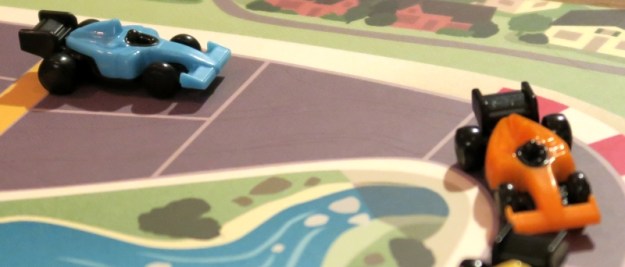
This week, the “Feature Game” will be the Wild Ride expansion (rules; video review) to our go-to motor racing game, Downforce (rules; review; how to play video).  Like Draftosaurus last time, the group first played Downforce online (in this case for our online New Year Party 2020/2021), but since then we have played it several times in person.  The Wild Ride expansion adds two new tracks, one with jumps, the other with animal obstacles.

Downforce: Wild Ride
– Image by boardGOATS

Speaking of car racing…

Jeff and Joe were chatting about one of their favourite subjects, racing cars and their drivers.

Joe commented, “I think the best driver of all time is James Hunt, he just made the 1970s for me—he was just amazing.”

Jeff thought for a moment and then asked, “Who won the 1975 F1 World Championship?”

“Lauda,” replied Joe.

Jeff took a deep breath, then shouted back, “WHO WON THE 1975 WORLD CHAMPIONSHIP?!

30th December 2021

It was a quiet night, but nonetheless very enjoyable.  Blue and Pink were just finishing their dinner when Lime arrived, and after some chit-chat, they were joined by Pine.  In previous years, we’ve held a New Year Party where we play the gorgeous puck-flicking, racing game, PitchCar, so in the absence of this, the “Feature Game” was another classic car racing game, Downforce.

Downforce
– Adapted from image by BGG contributor kalchio

We played this at New Year last year, but that was remotely (through Board Game Arena).  The online rendering of the game is really very good with lots of brilliant sweary graphics when a driver finds their way blocked and we all enjoyed playing it.  Although playing online is infinitely better than not playing at all, it is a poor substitute for the real thing.  So, Pink in particular, was really looking forward to giving an outing to his brand-spanking new Christmas copy, courtesy of the Board Game Geek Secret Santa (great choice Santa—thanks!).

Downforce on Board Game Arena
– Image by boardGOATS from boardgamearena.com

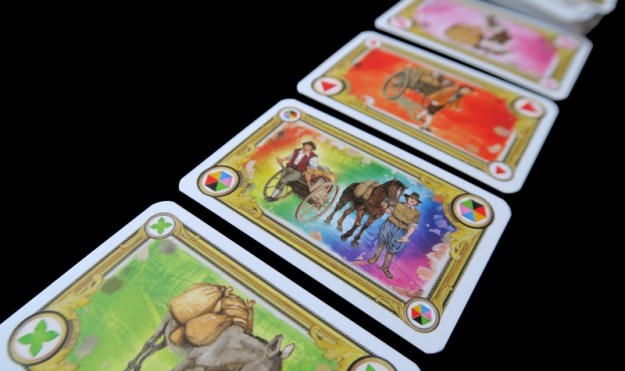
Game play is quite simple, but also very clever.  Players have a hand of cards and on their turn play one and move the cars shown.  The game begins with a car auction, so the card may show their own car, but more than likely shows several and may or may not include their own.  Starting with the fastest card (the one at the top) players then move the cars one at a time.  The player with the winning car wins money, but players also have three opportunities to bet during the race.  The player with the most money at the end of the game is the winner.

Downforce
– Image by boardGOATS

There are a lot of variants and “House Rules” for Downforce, including substituting the auction for random (secret) draw, changing or omitting the betting, and including special power cards (either drawn at random or included in the car auction).  There are also several maps available, two in the base game and two in each of the Danger Circuit and Wild Ride expansions (which also have special rules).  This time we played essentially with the “Rules as Written”, and included the special power cards (auctioned with the cars at the start) and began with the River Station track from the base game.

Downforce
– Image by boardGOATS

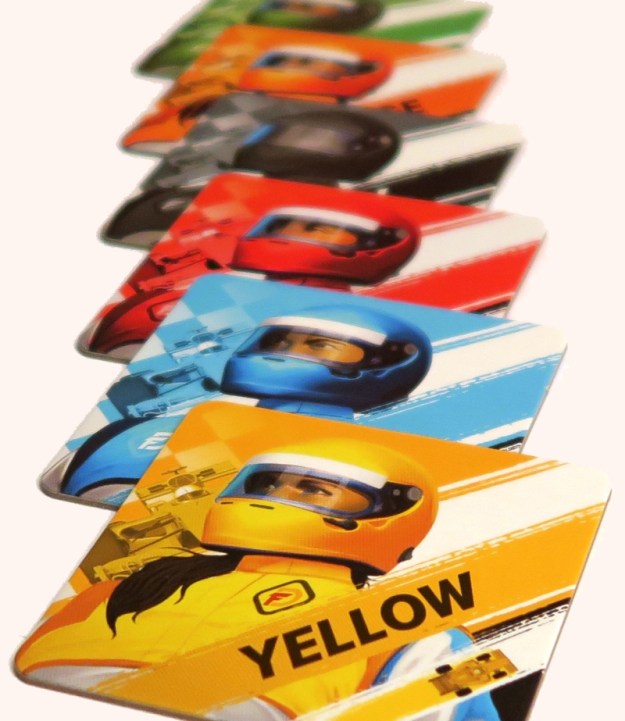
The first hurdle was everyone trying to think up a name for their team—there was a strong feline element with Nikki Meowda, David Cat-tard and Stirling Meowss all being suggested.  Dick Dastardly, Penelope Pitstop and Pat Pending came up as people reminisced about Wacky Races and Pine-erton Fittipaldi, the Green Cross Code Man and Staying Alive all raced too during the evening.  Blue and Pine put their paws in their respective pockets and bought themselves two cars with a choice of special powers, and hoped to dominate the race.

Downforce
– Image by boardGOATS

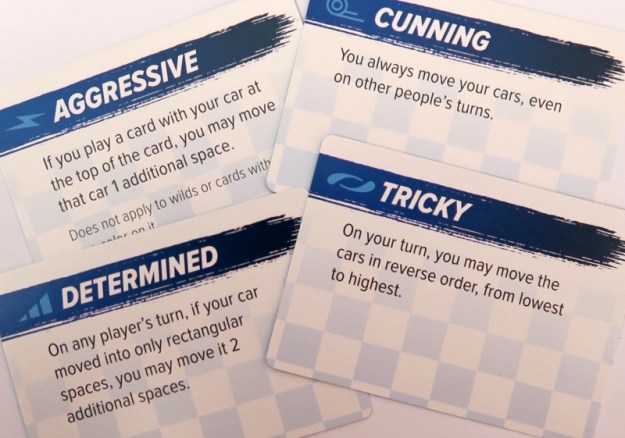
Blue had the Cunning power and made good use of it during the game, though in truth it was rare that she really had a meaningful decision to make.  Pink made better use of his Tricky power which enabled him to move cars in reverse order on his turn—he only used it a couple of times, but made them count.  Lime’s Determined power was also really helpful enabling him to move an extra couple of spaces when he finished on a straight.  Pine, however, was less fortunate and despite winning two auctions was left with an uninspiring special power.

Downforce
– Image by boardGOATS

Crossing the first betting line in front encourages people to bet on your car and then, invested in its outcome, they tend to help it along for the rest of the race.  This is a game where a little help goes a long way so a good start is really important.  Lime’s single car and one of Blue’s two cars got away well and competed for that all important early lead.  Blue led across the first betting line, but Lime was only just behind leaving it all to race for.  And they continued to battle for the lead, leaving the others to fight it out in their wake.  Lime was the first to the all important finish line, but Blue took both the remaining podium places with her two cars, which meant it was all down to the betting and initial expenditure.

Downforce
– Image by boardGOATS

Despite professing to have failed to understand the betting rules, Lime took the magnum of champagne and twenty million, just two million more than Blue.  Pink played a blinder to take the final place on the podium with seventeen million despite his car coming in last, a total helped by his minimal initial outlay and betting on the eventual winner at every opportunity.  It had been fun, and when Lime suggested playing again, everyone was quite happy to oblige, so the map was flipped over to give the Marina Bay track a go.

Downforce
– Image by boardGOATS

Pine again picked up two cars in the auction, but this time Lime joined him with Pink again taking the last car and getting the Determined special power.  Lime once again took an early lead and used his Tricky special power to great effect at key moments.  It was clear in spite of the hidden betting that Lime was likely to be the one to beat.  There was some discussion about whether he should be helped or hindered, but eventually he crossed the line first.  Pink’s solitary, but very Determined car made it home in second and with him betting on himself that left them both of them with a final purse of twenty million and a tie for first place.

Downforce
– Image by boardGOATS

Pine’s second car was still cruising round the final corner while a steward’s inquiry established that Lime was the winner by virtue of his higher placing in the race.  It had been a lot of fun, but undoubtedly, a car that takes an early lead has a big advantage.  There are lots of “House Rules” available to try to mitigate this effect (modifying the betting, blind dealing of cars, and restrictions on when players can play their super-speed card for example), so we might try some of those next time to mix things up.  That said, the expansion maps will change things as well, so we will see.  It is certainly a game that will come out again and again for some time to come.

Downforce
– Image by boardGOATS

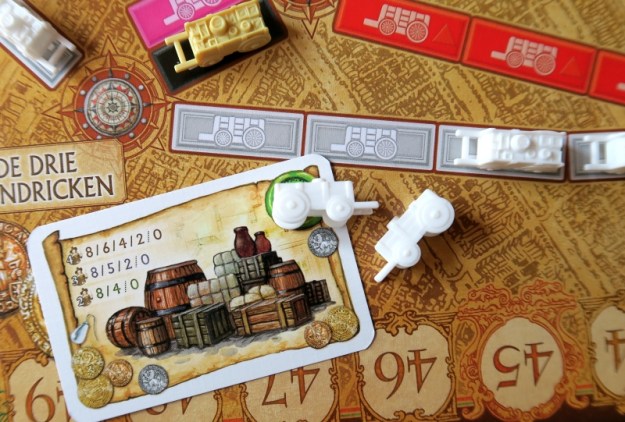
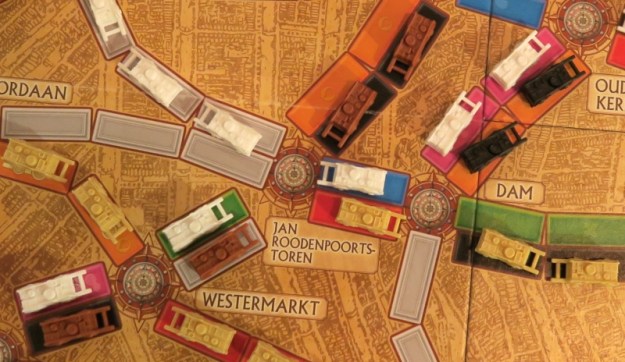
Time was marching on and Lime was concerned that the drawbridge over the Thames might be raised if he left too late, but there was just time for a quick game of Ticket to Ride: Amsterdam.  Everyone in the group loves Ticket to Ride and the little city versions are great in that they capture all the flavour of the full versions, but in a smaller, quicker package.  As in every other edition, on their turn, players can take cards, play cards to place pieces (in this case carts), or take new tickets.  Players score points for placing carts and for completing the routes depicted on their tickets (with any unfulfilled tickets giving negative points).

Ticket to Ride: Amsterdam
– Image by boardGOATS

Each map has its own special little feature and in the Amsterdam version has extra goods cards awarded for completing specific sections of track; these give bonus points for players with more of these at the end of the game.  Pink, Lime and Pine started hard, but Blue soon caught up making for a tight game.  Blue skirted round the north leaving the others to fight over the city centre and particularly Lime and Pine to curse when Pink grabbed a singleton and obstructed their plans from the very first turn.

Ticket to Ride: Amsterdam
– Image by boardGOATS

Towards the end of the game, Pink started picking up tickets and was quickly followed by everyone else except Lime who stuck with his starting hand and concentrated on completing them.  Pine debated whether or not to pick up tickets and in the end went for it only for Blue to promptly trigger the end of the game.  Blue had a significant lead, but as always, tickets would be critical and everyone was in with a shout.  Sadly it was not to be:  Blue had completed all hers and also finished with the most goods cards giving her the bonus for that too and with it a total of forty-five points, eight more than Pink in second place.

Ticket to Ride: Amsterdam
– Image by boardGOATS

Learning Outcome:  Santa is Awesome.