Tag Archives: Stamp Swap

Next Meeting, 11th Movember 2025

Our next meeting will be on Tuesday 11th Movember 2025.  As usual, we will start playing shorter games from 7.30pm as people arrive, until 8pm when we will start something a little longer.  The pub is now doing food again, so those that will be eating will be arriving from around 6.30pm.

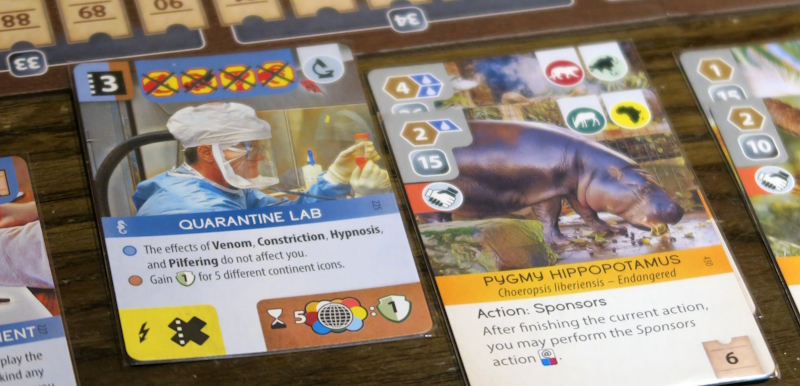
This week, the “Feature Game” will be Origin Story which is a recent release from Stonemaier whose games are very popular within the group and have won an unprecedented three GoldenGOAT Awards for Wingspan, Tapestry and Stamp Swap (in 2019, 2023 & 2024 respectively).  Their latest game, Origin Story (rules, review and video tutorial) is a trick-taking and tableau-building game where players play tricks to develop their inner superhero.

Origin Story
– Image from stonemaiergames.com

And speaking of superheroes…

Jeff and Joe were at the Jockey talking about films they’d like to see.

“I really want to watch the new Iron Man film,” said Jeff, “It’s got the Silver Surfer in it.”

“Are they working together?” asked Joe.

“Well,” replied Jeff, “They sort of start on opposite sides, but by the end of the film they become alloys…”

29th April 2025

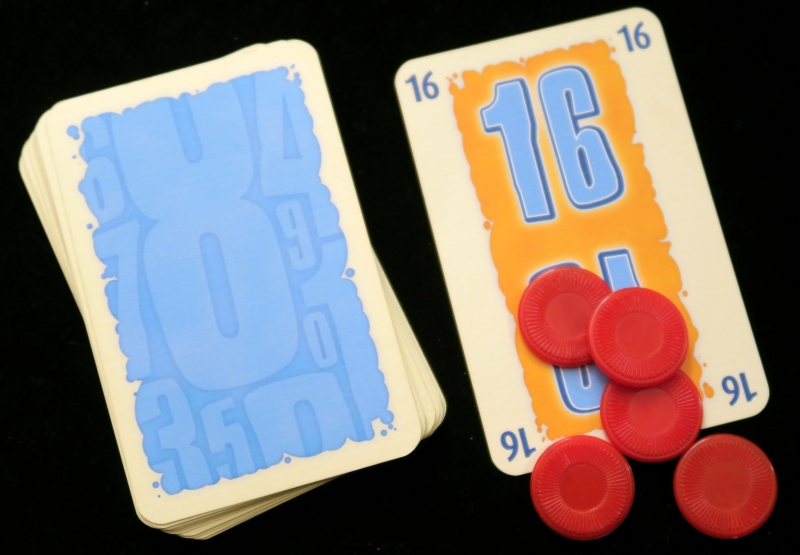
The evening began with a quick game of the popular Blackjack based game, Flip 7.  This is a quick, push-your-luck card game along the lines of Port Royal where players turn over cards and gamble on not revealing the same number twice taking it in turns to decide whether they want to “flip” or ” stick”. The catch is that each numbered card appears in the deck that number of times (i.e there is one one, two twos and so on). Flipping over seven different cards in a succession gives fifteen bonus points.  There are also some action cards in the deck, “Flip Three”, “Freeze”, “Second Chance” and modifier cards which give extra points. The game ends when players have reached the pre-agreed total.

Flip 7
– Image by boardGOATS

Ivory was keen to get in a little practice as “Little-Ivory” was getting it for his birthday in the next few days.  Although the game plays up to eight (with one box), there were just the four as Ivory was joined by Jade, Sapphire and Mint.  Mint went bust early and Sapphire started fast, but the victor was Ivory who didn’t go bust at all during the game.  With that over quite quickly Jade and Sapphire were joined by Pine, Plum and Byzantium to play the “Feature Game“, Creature Comforts.  In this game, players spend Spring, Summer, and Autumn gathering different resources from the forest and spending them to collect items that will home a more inviting place while the world outside is covered in a layer of snow in the Winter.

Creature Comforts
– Image by boardGOATS

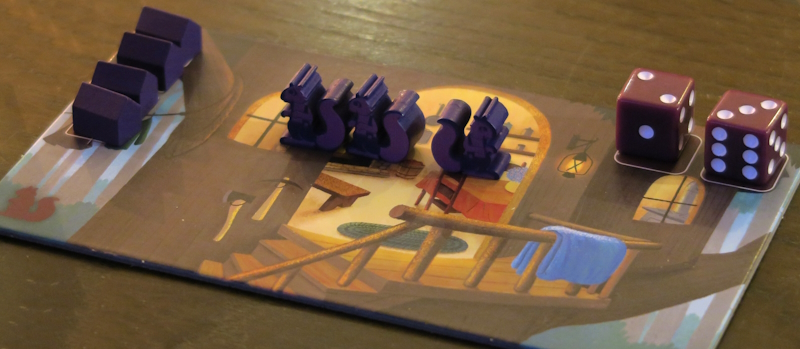
Creature Comforts is a worker placement game with a twist:  the workers can be placed at various locations, but dice of specific values (or sum-totals) are required to activate the locations. Thus, the players need access to dice of specific values when it comes to triggering those workers.  Jade explained the rules to Pine, Plum, Byzantium and Sapphire, some of whom were new to the game.  Played over twelve months, at the start of each month or round, a Traveler “event” card is revealed which either applies an instant effect or one that lasts the duration of the month.  Simultaneously, players then roll their two Family dice and place them on their Home Boards.

Creature Comforts
– Image by boardGOATS

Then, players simultaneously place their Workers at their choice of the twelve locations.  Although the locations can hold any number of Workers, players can only place a single worker at each one.  Each location will either require a dice of a specific value or multiple dice that add to a given sum (or have a particular requirement e.g. feature all odds or evens).  The catch is that at this point, players only know the values of the two dice that they have access to, their Family dice.  So, placing Workers requires some astute planning mixed with some luck when the four communal Village dice are rolled next, by the start player for the month.  Players then take it in turns to allocate the six dice at their disposal to activate as many of the locations their Workers are at as possible.

Creature Comforts
– Image by boardGOATS

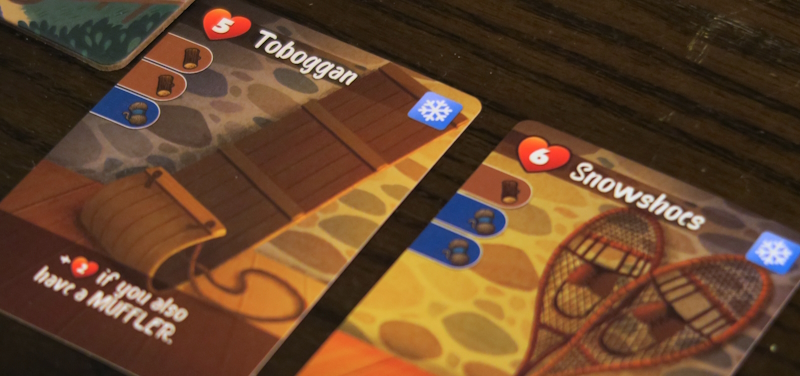
Each Worker that a player cannot activate gets them a Lesson token, which can be used to modify dice values in later turns (for only that player).  Finally, players finish their turn by crafting any creature comfort cards they can, keeping in mind that only three can be carried over to the next round.  After eight months (six if playing a shorter version of the game), players can craft any left-over cards they might have in their hand if they can afford to and then score for their Comfort Cards, Improvement Cards, for empty Cottage spaces and left-over resources.  The first problem was that there were a lot of locations to get to grips with.  Pine, who was new to the game, struggled initially, but by the end was wanting to play again soon!

Creature Comforts
– Image by boardGOATS

Sadly, although the game was a lot of fun and enjoyed by all, it was marred by the fact that “Last Orders” was called sooner than expected.  This meant the last couple of rounds were played at something of a rush and points were missed and some of the scores might not have been correctly counted.  There are a lots of odd points to be counted, but the bulk come from the eponymous Creature Comfort cards.  Byzantium top-scored for these with forty-three points, some ten more than anyone else, so it was no surprise that he ran out the winner by a sizeable margin, with everyone else left fighting for second.  That battle was won by Sapphire with Pine taking third.

Creature Comforts
– Image by BGG contributor hipopotam

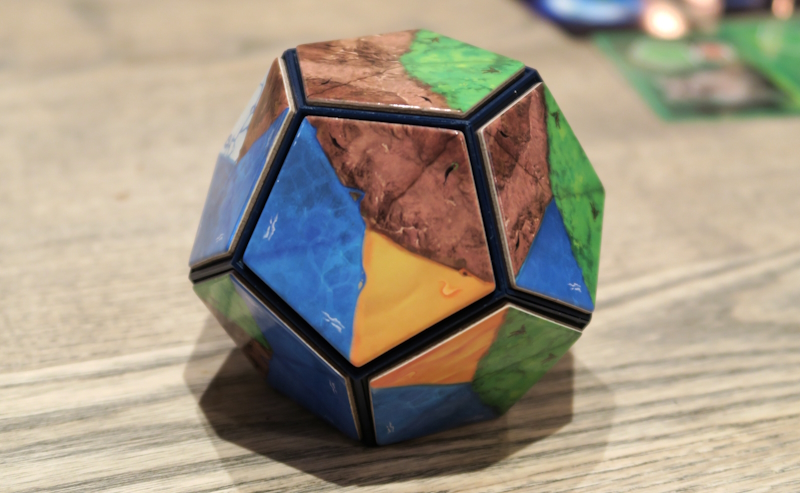
Meanwhile, Mint introduced Blue and Ivory to the really cool, three-dimensional game, Planet.  This is quite a simple game, but really clever:  each player receives a dodecahedral planet core with twelve pentagonal spaces and a magnet in the centre of each one.  On their turn, players choose a pentagonal tile with different terrains (Mountain, Ice, Forest and/or Desert) on them and stick it to their planet. The player who fulfills the most conditions for the appearance of certain animals gains its card.  There are public, animal objectives and each player has a private objective, their “Natural Habitat”.

Planet
– Image by boardGOATS

Players score points for the size of their Natural Habitat, and also for each animal card they claim.  Animals that live in an area that is not the player’s Natural Habitat score extra points which creates sort of opposing incentives to cover the planet with Natural Habitat tiles while also creating the right conditions to score animal cards.  And as the Planet fills up, this gets more and more complex.  Although everyone loved it, the game didn’t quite click for Blue, but it was close between Ivory and Mint.  There were only two points between them in the final totals, with Ivory taking his second victory of the night with twenty points.

Planet
– Image by boardGOATS

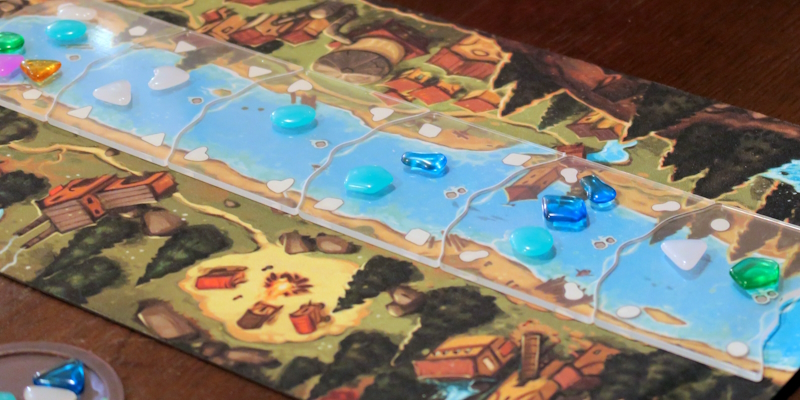
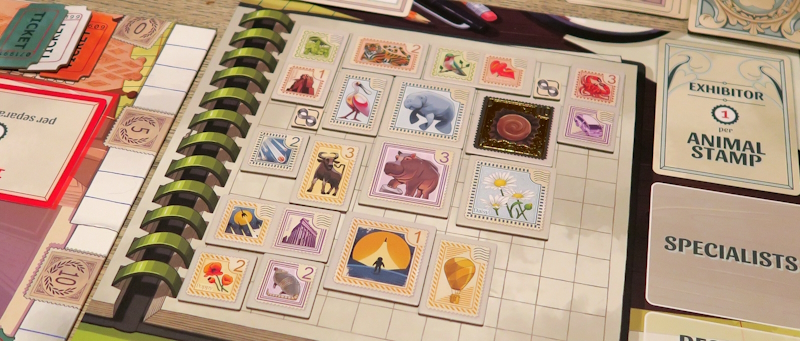
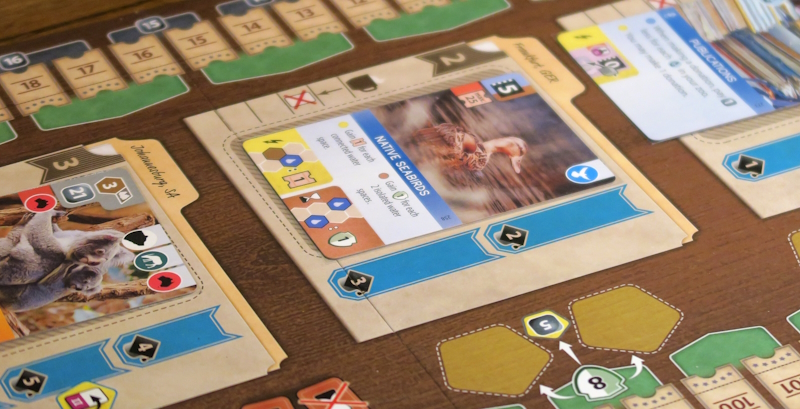
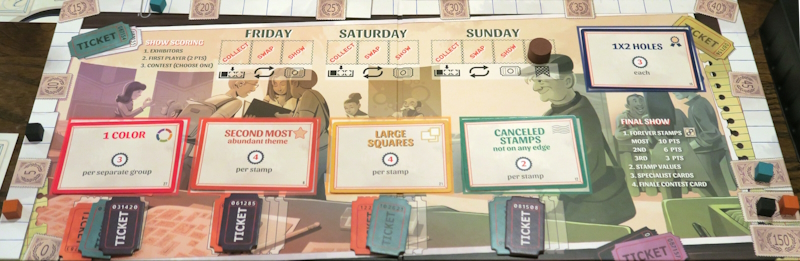
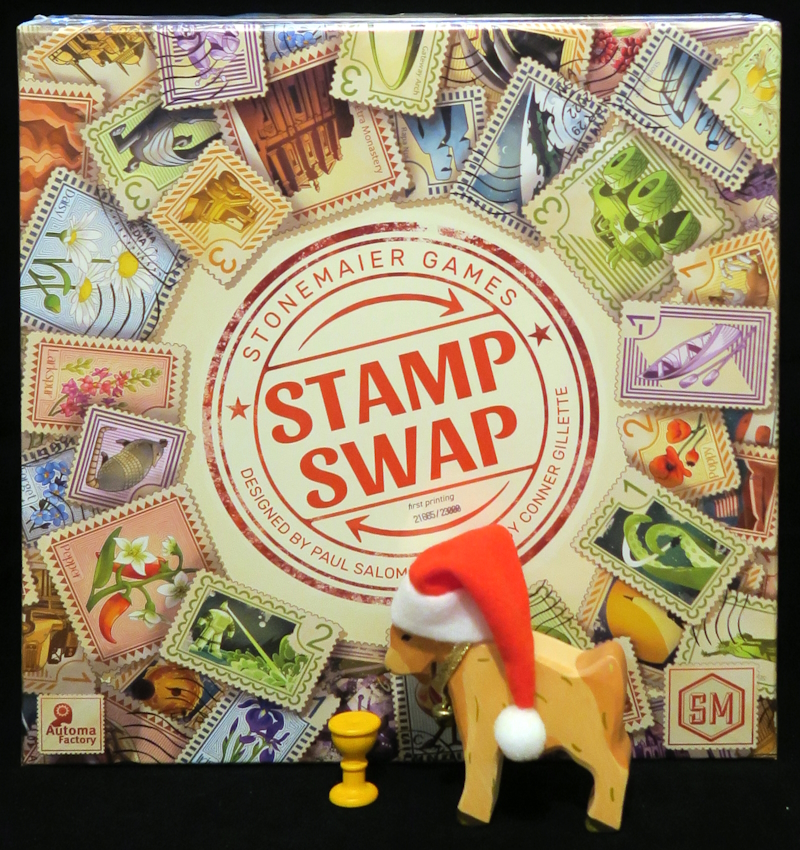
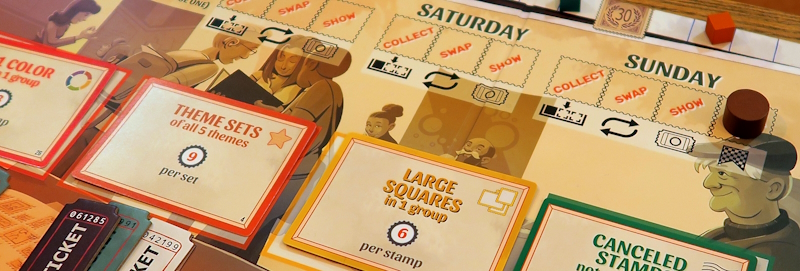
From there, the trio went on to play the Golden GOAT Award winning game, Stamp Swap.  In spite of the theme (which didn’t really set anybody’s imagination on fire), this has proved to be a really popular game within the group—it is just very smooth and doesn’t outstay its welcome.  Everyone had played it before, so there was only the barest minimum of a rules run-down.  The game takes place over three rounds, each split into two parts:  Firstly players take it in turns to choose from a central pool, then players divide their pile into two and the first player chooses one pile from another player to take, who keeps their other pile and chooses one from another play—and thus the piles of stamps are swapped.

Stamp Swap
– Image by boardGOATS

Players score points at the end of each round for their achievements and at the end of the game, for the face-value of the stamps and for end game objectives.  Despite everyone having played it before, there was a rules malfunction that might happened before and could have made a significant difference, to Mint and Blue especially.  Each player has an “Exhibitor” which gives players a point for each stamp they have of a given theme.  The group scored this at the end of the game, however, it is supposed to give points at the end of each round.  Everyone played by the same rules, so Ivory was the deserved winner with a hundred and eighteen points, but the scores would have been closer if the Exhibitors had been played correctly.

Stamp Swap
– Image by boardGOATS

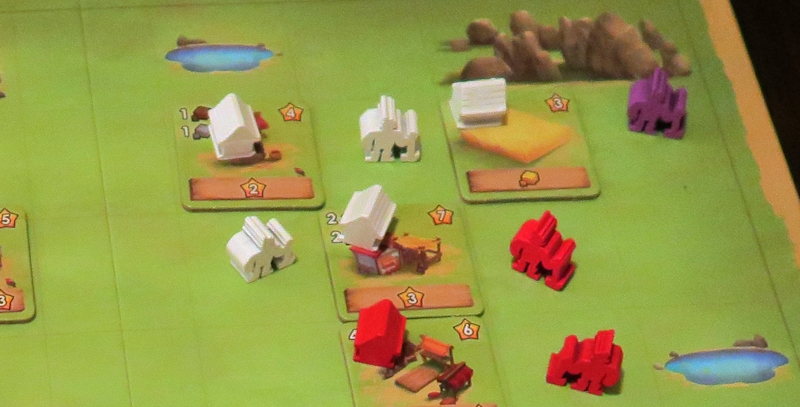
On a night when there were four tables, the third consisted of Pink, Black, Pine and Purple, started with a game of Little Town.  This is a really cute little game of Worker placement, resource collection and management, and building tile placement.  The game lasts for four rounds, during which players collect resources (wood, stones, fish, and wheat) from the eight surrounding squares by placing Workers on central map.  Players can then build buildings using these resources, players can then gain the effect of the building by placing a Worker next to it.  Placing a Worker next to a building owned by another has a cost though, and the player must pay a coin before you can collect resources.

Little Town
– Image by boardGOATS

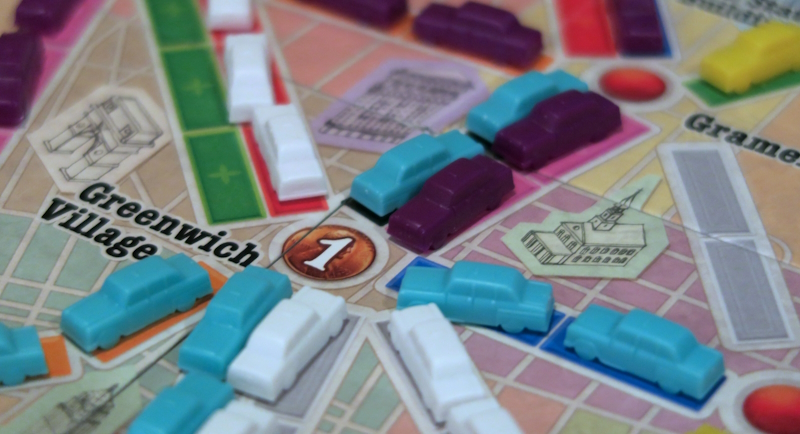
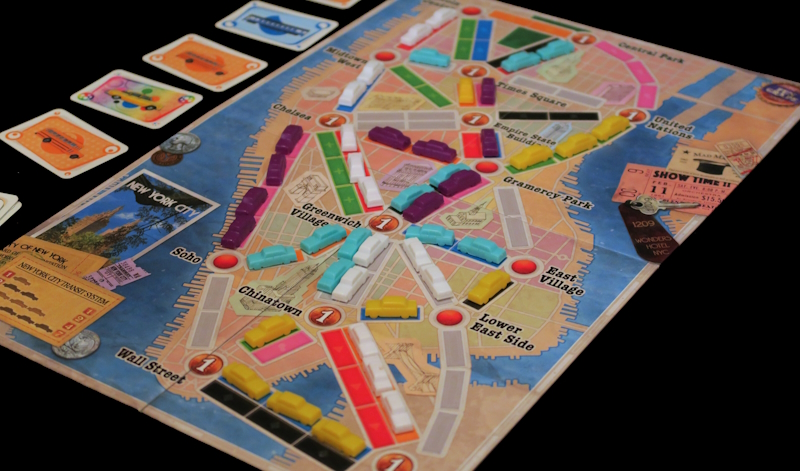
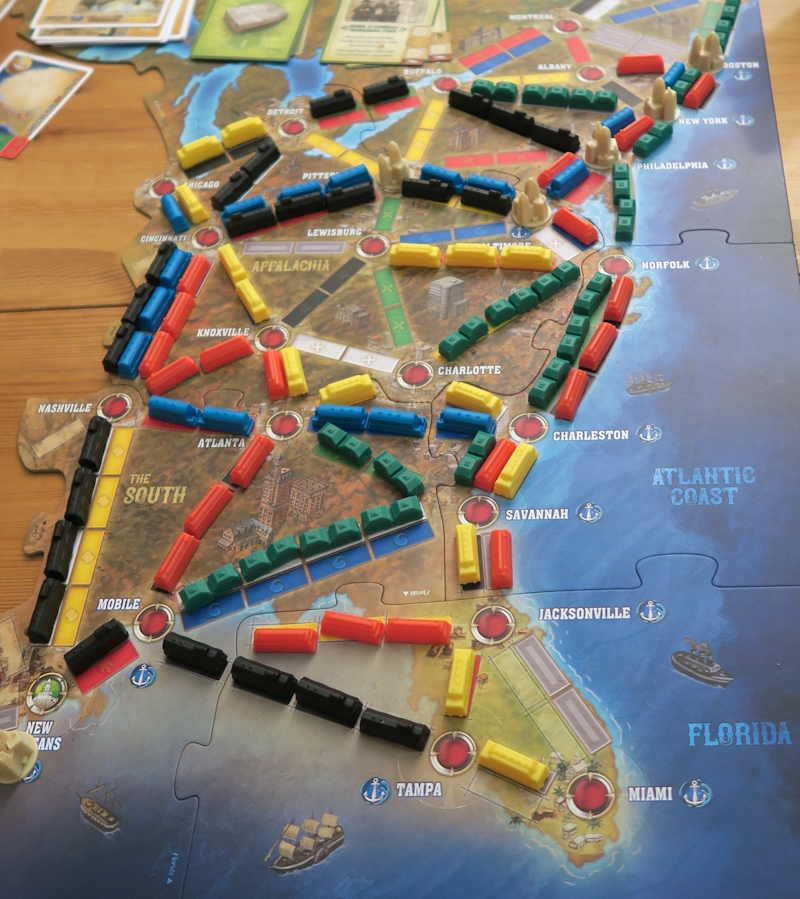
Players collect victory points using the powers of buildings, by constructing buildings, and by achieving objectives dealt at the beginning of the game. This time, Pink played a really pragmatic game essentially simply repeatedly activating the Well and the Bar (giving him two and three points each respectively).  As a result, the game was a bit of a land-slide with Pink taking victory with thirty-nine points, eleven ahead of Black in second with Pine a few points behind that.  With everyone else otherwise engaged, the group went on to play a quick game of Ticket to Ride: New York.  This is one of the first of the very small editions of Ticket to Ride, in fact, the first of the “Cities“, as it was preceded only by the Demo version.

Ticket to Ride: New York
– Image by boardGOATS

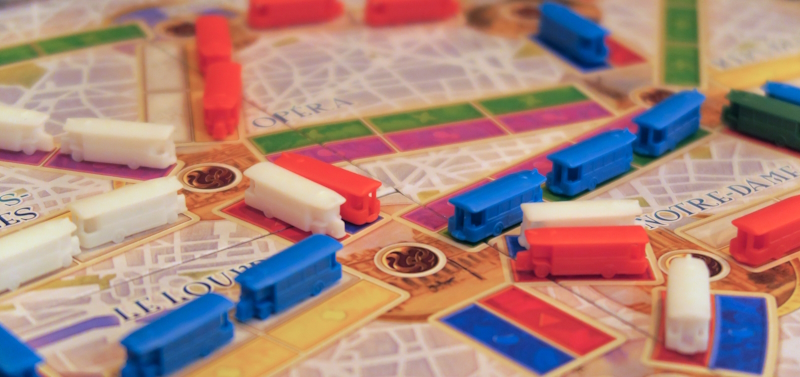
The game is played much the same as the full version of Ticket to Ride, with players taking coloured cards from the market and spending them to place pieces (in this case taxis) with the aim of completing tickets.  Black took the most points for the Tourist Attractions he made connections with, but had a bit of a ‘mare elsewhere, failing to complete a large pile of tickets which left him losing fifteen points.  This almost entirely wiped out the rest of his points, but it was relatively close between the others.  Pink was once again the victor though, taking the most points for placing taxis and for his tickets giving him a total of thirty-four points, with Pine taking second place just ahead of Purple.

Ticket to Ride: New York
– Image by boardGOATS

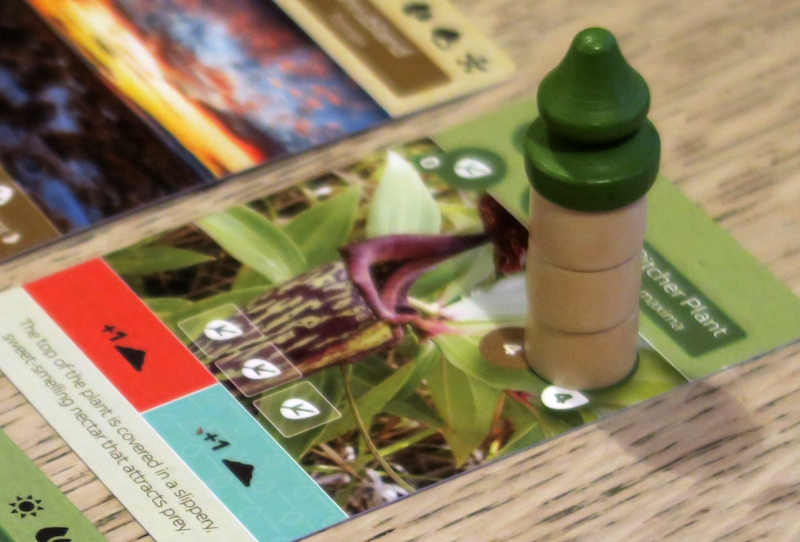
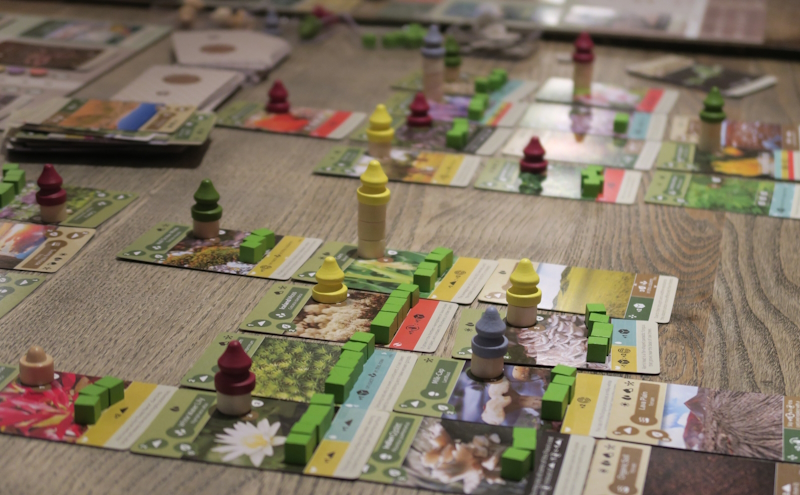
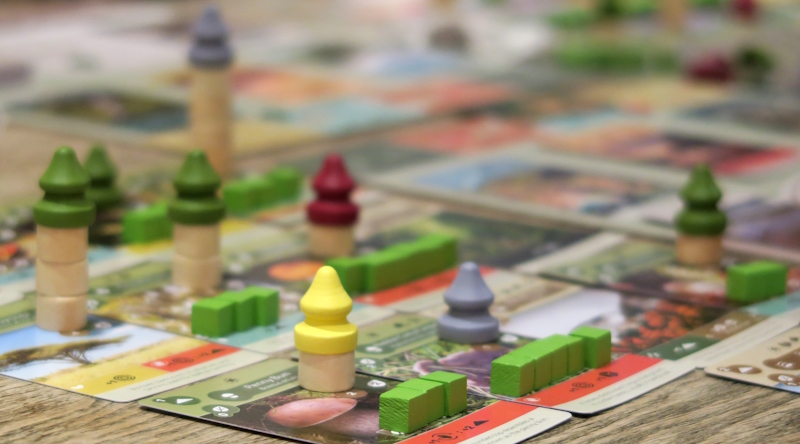
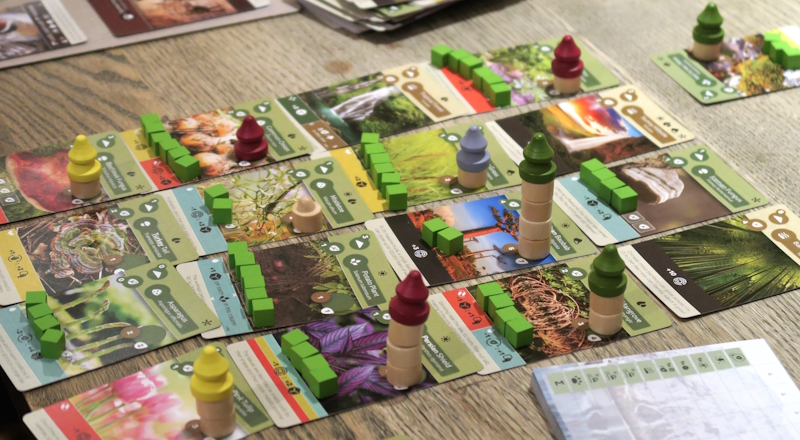
The fourth table consisting of Green, Teal, Salmon and Flint, only played the one game, but it was one of the most beautiful of recent times:  Earth.  This is a card-driven engine-builder where players are building themselves an ecosystem.  Often compared to Wingspan, although there is a lot to understand, the game itself is not actually all that complicated. Players are building a four by four grid of Flora and Terrain cards which represents their island; during the game they will plant flora, water it and allow it to grow.

Earth
– Image by boardGOATS

On their turn, players do one of four things: Planting (paying the cost in Soil tokens), Composting (gaining Soil and placing cards from the deck in their discard pile), Watering (place Sprouts and gain Soil) & Growing (draw new cards and place growth tokens).  A bit like Puerto Rico, once the active player has chosen which action they are taking, everyone else gets to do a subsidiary, slightly weaker version of the same action.  For example, when Planting, the active player plants two cards, draws four and keeps one, while the other players plant one and draw one.

Earth
– Image by boardGOATS

Once everyone has completed the action for the turn, everyone activates all the cards in their island that match the colour of the action chosen, starting with the card in the top left and working across each row in turn.  So, not only is it important which cards are played, but also where they are located in the player’s island.  At the end of the game (which is triggered when one player has completed their island), players score points for each Flora card, any Trunks and Canopies they have grown, their Sprouts and their pile of “Composted” or discarded cards.  Players also score points for achieving objectives on the Fauna cards revealed at the start of the game and for completing their island first.

Earth
– Image by boardGOATS

This was another game that turned out to be a bit of a land-slide.  The base scores for the islands was pretty consistent, but as with many games, it’s about what you do with the cards you get that makes the difference.  Green “Composted” fewer cards, but scored more for his Sprouts.  Players had ups and down, but otherwise it was fairly even.  The biggest difference, however, was the number of Leaf Tokens on the Fauna board—Green had more than twice as many as anyone else with sixty.  As a result, his total of two-hundred and forty-four was nearly fifty more than that of Teal who took second ahead of Flint in third.

Earth
– Image by boardGOATS

Learning outcome:  Rushing the end of a game can take the shine off it.

4th February 2025

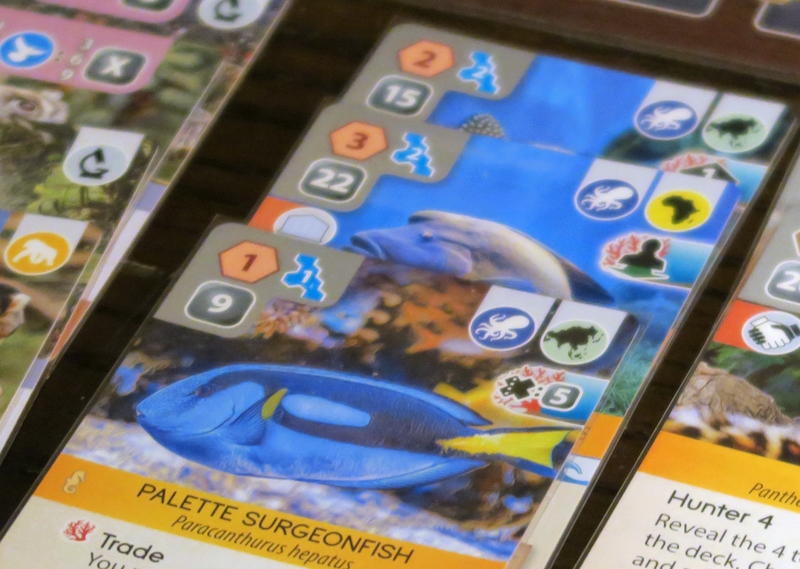
Blue and Pink were just finishing their supper when not one, but three copies of Ark Nova walked in, escorted by Ivory, Cobalt and Green.  This was because the “Feature Game” was to be its Marine Worlds expansion and, as Ark Nova is a substantial game that doesn’t get as many outings as it deserves, everyone was keen to give their copy a bit of an airing.  The game is much longer than those we usually play on a Tuesday so everyone who was keen to play was early and started setting up promptly.  Given the length, we also erred on the lower end of the player count, with just Ivory, Cobalt and Green playing.  The game is all about planning and designing a modern, scientifically managed zoo, but the game-play is more like Terraforming Mars with animals, than Zoo Break or Zooloretto.

Ark Nova
– Image by boardGOATS

Although it is quite a complex game, functionally it is not difficult to play on a turn by turn basis, though there is quite a lot to manage and keep a track of.  On their turn, players take one of six possible actions:  activating one of the five action cards (Cards, Build, Animals, Association and Sponsor) with a strength equal to the number above the card.  When activating a card players perform the action based on its power level which is dictated by its position in the row.  During the game, players can upgrade and turn over the action cards to a more powerful second side using various Bonuses.  The Marine Worlds expansion introduces several new elements to the game.

Ark Nova: Marine Worlds
– Image by boardGOATS

Firstly, there are sea animals that have to be played in new special enclosures that must be built adjacent to water.  Roughly half the sea animals are reef dwellers, and whenever a player adds a reef dweller to their zoo, they trigger the ability of all reef dwellers in that zoo. To deal with the dilution of the deck (caused by adding more cards), all sea cards feature a wave icon, and whenever it is revealed in the display, you discard the first card in the row, then replace it.  For each of the five Action cards there are four alternate versions with a little twist. Players draft these action cards at the start of play, replacing two of their standard action cards with these new ones, increasing the asymmetry in the game.

Ark Nova: Marine Worlds
– Image by boardGOATS

A new fourth University option is also available on the Association board.  If a player takes it, they claim one of six special Universities from the Reserve that feature one Research icon and one of six animal icons.  When a player takes this, they reveal Cards from the top of the deck and keep the first revealed card with an animal icon that matches their chosen University.  There are also new bonus tiles and other little bits and pieces to smooth out the game play.  Although the Marine Worlds expansion comes is modular, the group chose to play with all the components (Marine animals, asymmetric maps and drafted action cards).

Ark Nova: Marine Worlds
– Image by boardGOATS

Ivory took a Sponsor Card that gave him extra money for breaks and an Association Card that gave him the ability to hire workers.  This coupled with the lake map which gave extra money for building around the lake meant Ivory had access to lots of cash as the game developed.  Both Cobalt and Green took a Sponsor and an Animal Card, with Cobalt taking a map that allowed him to discard cards for money while Green had the map with the park restaurant.  While Cobalt was also able to build up a lot of cash, Green spent most of the game playing the poor relation, just scraping by.  The game started slowly, with initial conservation projects devoted to Australian animals, Birds, and African Animals.

Ark Nova: Marine Worlds
– Image by boardGOATS

Both Green and Ivory wound up spending all their early money, trying to get Animals out, whereas Cobalt focused on the Association board and playing Sponsor cards.  After struggling with money for the first couple of rounds, Ivory managed to get two Australian animals, allowing him to put a token on the conservation card, giving an additional Zoo Dollars at each break/income step and from then on, money wasn’t too much of an issue for him. Green however, struggled for money for most of the game, where Cobalt continued to focus on Sponsor Cards and Association Actions, and as a result, he took an early lead on the Research track which gave him a much greater card choice. Cobalt did build an early aquarium, however, and started filling it up with fish.

Ark Nova: Marine Worlds
– Image by boardGOATS

After a quick start, both on the conservation track and appeal track, Ivory’s game slowed down significantly—he was too focused on animals, compared to Green and Cobalt.  They had both spent time taking Association actions, leading them to Upgrade cards and progress up the Reputation track. Cobalt was able to significantly move up the Conservation track in the middle game using his Sponsor Cards, whereas Green focused on one big move by having lots of birds in his zoo.  Much to Pink’s disgust, although the panda was an option at one point in the game, the “wave” added by expansion pushed it on, so nobody got the Panda.  Instead, by the end of the game, Ivory had quite a collection of monkeys, Green had a few some birds and Cobalt had a lot of fish.

Ark Nova: Marine Worlds
– Image by boardGOATS

Going into the end game, Cobalt some way ahead on the Conservation track, followed by Green, while Green and Ivory were fairly similar in Appeal.  Cobalt then started playing lots of animals in his zoo and managed to completely fill it moving rapidly along the Appeal track.  It was clear he was soon going to bring the game to a close, due in part to both his (and Green’s) ability to make donations by upgrading the Association card. Green was also moving forwards on both tracks while Ivory was lagging behind albeit with three conservation cards in hand. Fortunately, Ivory had lots of “x tokens”, allowing him to play all his conservation cards (and gain the additional worker he needed, shooting up the conservation track, though sadly, it was too little too late.  From there, It wasn’t long before Cobalt’s Tokens to crossed, ending the game.

Ark Nova: Marine Worlds
– Image by boardGOATS

Everyone had made some mistakes reading their cards and/or abilities which cost a little bit, but was probably fairly balanced out.  Everyone managed to get the full four Conservation points on their personal scoring cards, but Green picked up quite a few extra points from the Sponsorship cards leaving him level with Cobalt.  Inevitably, this led to a hunt for tie-breakers—the rules state that the tied player who supported the most Conservation Projects wins the game.  As Green and Cobalt had also supported the same number of Conservation projects the rules dictated they should share the victory.  That said, Green magnanimously said he felt Cobalt had the edge by virtue of having way more coin at the end of the game.

Ark Nova: Marine Worlds
– Image by boardGOATS

On the next table, Blue, Pink and Mint had finally got underway playing Kavango.  This is a conservation, card-drafting game.  A bit like games like Sushi Go! and 7 Wonders, players draft cards to build their Reserve.  Like games like Terraforming Mars, however, cards can only be added to a player’s Reserve if they have its requirements.  These might be the food supply, or enough protection (environmental, poaching or climate).  Climate protection is unique because, as in real life, players have to work on that together.  At the end of the game, after three rounds, players add up the value of their animals, and any bonuses together with any points scored during the game for Research, and the player with the most points is the winner.

Kavango
– Image by boardGOATS

Pine joined them briefly and expressed an interest in playing another time, but decided this week he would take himself home to better acquaint himself with his C-vitamins and avoid unnecessarily sharing his bugs.  Mint was the nominal first player, though mostly the game is played simultaneously.  Blue started hard and fast building up lots of income, however, she was forced to invest heavily in Climate protection—honourable, but not necessarily lucrative.  Pink and Mint were a little slower to start, but made good progress.  Both got caught out by a very minor rules malfunction that had a significant impact:  Cards not used at the end of the round are supposed to go into a discard pile, but instead were returned to their decks.

Kavango
– Image by boardGOATS

Towards the end of the game, this suddenly became significant as some types of card are not available in the final rounds.  So, those that needed, for example, termites (like Mint), were unable to get them.  Pink and Mint were most obviously affected, though everyone got caught in some way or another.  The card draw hindered Blue as she struggled to find any migratory animals at all and had to abandon her personal objective as unachievable.  In contrast, Mint and Pink both did really well with theirs (birds and toxic creatures respectively), making the result much closer than it would otherwise have been with Blue the victor with a hundred and seventy-one, a single point more than Mint.

Kavango
– Image by boardGOATS

Meanwhile, Plum and Byzantium had kindly agreed to take Lime to the other side of the room to play the Golden GOAT Award 2024 Winner, Stamp Swap.  Somehow, despite the flurry of outings it received towards the end of last year, Lime had missed out on playing it.  This is also a drafting-type game, but this time with stamps (mostly).  The game takes place over three rounds, each split into two parts:  Firstly players take it in turns to choose from a central pool, then players divide their pile into two and the first player chooses one pile from another player to take, who keeps their other pile and chooses one from another play—and thus the piles of stamps are swapped.

Stamp Swap
– Image by boardGOATS

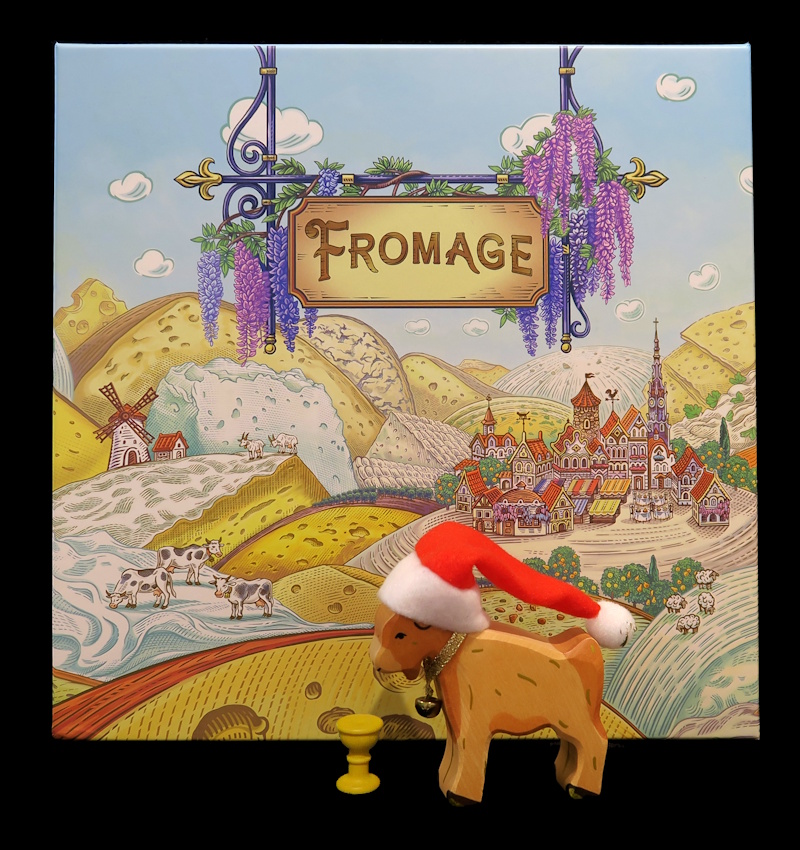
On previous outings, Byzantium had managed to annoy Blue by just beating her.  It had been his birthday at the weekend, so the question was whether he would get another, albeit slightly belated, birthday gift in the form of another victory.  Sadly for Byzantium, it was not to be though.  Plum took ten more points than him during the game and another ten more in the end game scoring between them, giving poor Lime quite a trampling on his first game.  Stamp Swap wasn’t the only popular new game to get an outing this evening.  On the next table, Jade and Sapphire were introducing Purple and Black to Fromage, a sort of cheesy worker placement game with simultaneous play and a time component, not completely unlike Tzolk’in.

Fromage
– Image by boardGOATS

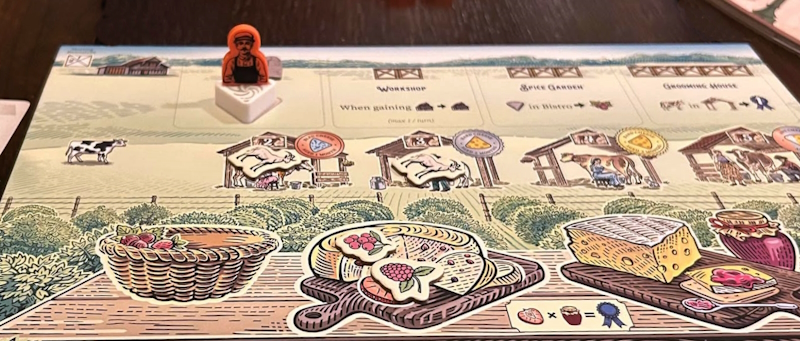
The actions are tied up in four “mini-games” which players take it in turns to participate in.  It has proven quite a popular little game because once everyone knows how to play, there is relatively little down time and despite playing different areas at different times, quite a lot of interaction.  Players simultaneously choose where to place their workers, in their quadrant of the board, and once everyone is done, the board is turned and then players retrieve any workers they can and then place workers on their next quadrant.  Players score points for occupying tables in the Bistro quadrant, holding the majority in regions in the Villes quadrant, filling different tables in the Fromagerie quadrant, occupying contiguous areas in the Festival quadrant, and for fulfilling Orders.

Fromage
– Image by boardGOATS

This time, Purple and Jade made a bit of a killing in the bistro taking nearly thirty points each, while Sapphire took twenty-two points in the Villes.  Black’s strategy was somewhat different, picking up points more evenly across the board and focusing particularly on fruit.  In the end, despite the differences in approaches, the scores were very similar, with only three points covering second to fourth.  The winner was Jade, however, some twenty points clear of Sapphire, who just nicked second, but a single point.  The game had been well received, and the group ended up “Doing a Lime” and playing it a second time.

Fromage
– Image by boardGOATS

The second game was also tight, although everyone was much more even in where they scored their points.  Sapphire just edged it though, again by a single point, again from Black, pushing Jade into third.  There was still time after the second game for something else, something new, something quick—Flip 7.  This is a really simple “Push your Luck” game reminiscent of Port Royal, where players simply turn over cards and gamble on not revealing the same number twice.  The catch is that each numbered card appears in the deck that number of times (i.e there is one one, two twos and so on).  Flipping over seven in a row gives fifteen bonus points.

Flip 7
– Image by boardGOATS

There are also some action cards in the deck, “Flip Three”, “Freeze”, “Second Chance” and modifier cards which give extra points.  Players take it in turns to decide whether they want to “flip” or ” stick”.  The game ends when players have reached the pre-agreed total (two hundred, according to the rules, though games can easily be made longer or shorter as desired).  In the first round, three players scored well, but the rest of the game did not go so well.  In fact, the only player who managed to score in every round was Black with a fairly consistent total around thirty.  It was no surprise that he was the first to pass two hundred and was therefore the winner, ahead of Sapphire and Purple, who were joint second with a hundred and seventy-six.

Flip 7
– Image by boardGOATS

Learning Outcome:  Zoos are even more fun with sea creatures.

21st January 2025

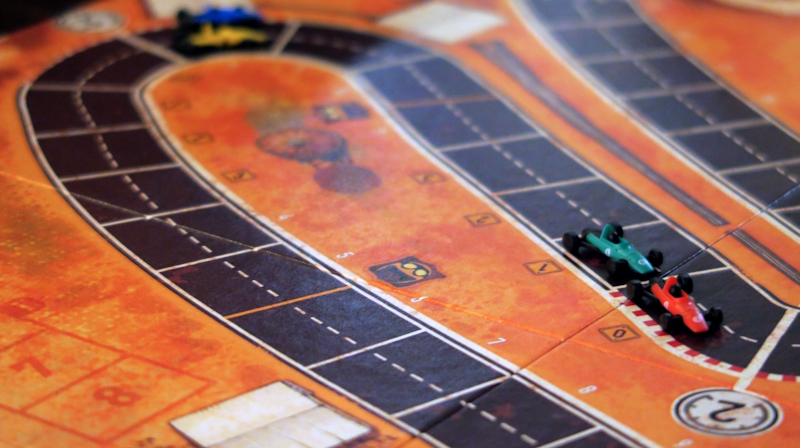
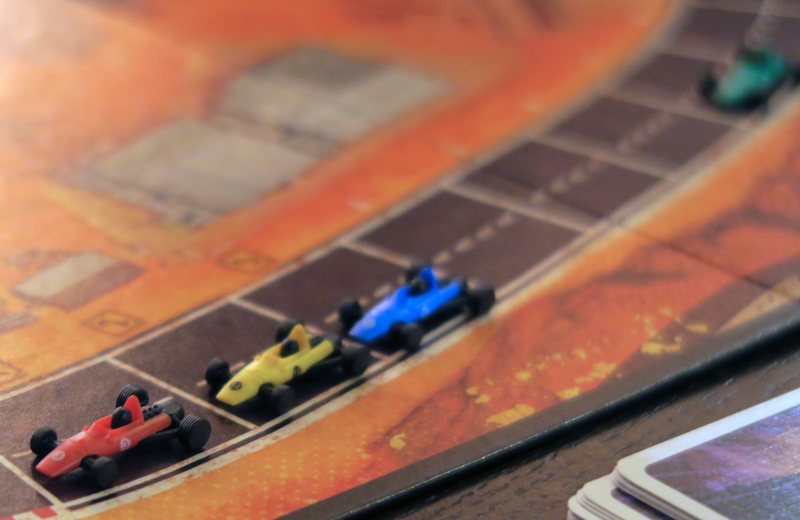
Blue and Pink were still eating as everyone else rolled up.  But as they did, like last time, there was an unusual amount of interest in the “Feature Game“, which, in a change to previous plans, was to be Heat: Pedal to the Metal.  This is a car racing game, in a similar vein to other games popular within the group like Flamme Rouge, Snow Tails, and Downforce.  Like Flamme Rouge and Snow Tails, as well as a racing game, Heat is also a hand management game.  The idea is that players simultaneously choose cards to play and then these are activated from the front of the pack (much like PitchCar).

Heat: Pedal to the Metal
– Image by boardGOATS

Players have a hand of seven cards drawn from their personal deck.  During the game, certain actions that are bad for their engine cause it to heat up meaning they pick up cards that block their hand.  Initially, Heat cards go into players discard pile, simulating the delayed effect engine damage can have, blocking their hand later in the game as the deck is recycled.  There are ways to cool the engine down, but these Heat cards cannot be discarded or played in the normal way.  What makes Heat slightly different to some of the other hand-management-racing games is that there is formally simultaneous play to choose cards and then players take it in turns to activate their cards and take a series of optional mini-actions.

Heat: Pedal to the Metal
– Image by boardGOATS

Players start by simultaneously adjusting their gear, staying put or shifting up or down one without penalty, or shifting two and picking up a Heat card.  The gear dictates how many cards a player must play – second gear means they have to play two cards for example.  Players then take it in turns to reveal their cards and move their car.  There are then five “situational” options: Adrenaline, React, Slipstream, Corner Check, and Discard, before the player replenishes their hand back to seven cards.  Adrenaline is a catch-up mechanism, where the player at the back can move one extra Space while adding one to their Speed value and/or gain one extra “Cool down”.

Heat: Pedal to the Metal
– Image by boardGOATS

“Cool down” is an important aspect of the game because it allows players to remove a Heat card from their hand and return it to their engine deck.  In React, players activate any additional symbols on the cards they have played or from the gear they are currently in or from the Adrenaline.  These include picking up cards because of Stress—players start the game with three Stress cards in the deck which represent lapses of concentration.  When a player plays these, they then have to draw cards from their deck to add an essentially random amount to their speed.  Of course it is not random, and a player who has an idea of what cards are still in their deck will be able to mitigate this.

Heat: Pedal to the Metal
– Image by boardGOATS

Further, Stress cards can also be used to postpone the effects of Heat, as any non-movement cards go straight into the discard pile.  Players can also control their engine heat by spending a period of time in a low gear by “Cooling down” their and removing Heat cards from their hand (three for first gear, two for second).  In contrast, players that have Heat cards available, may add an extra one to their discard pile to boost their speed by drawing an extra card as for Stress cards.  Once all these have been activated, players who end their movement along-side or immediately behind another car can Slipstream, that is move two spaces forward (this does not add to speed, it simply means the car moves further because it is moving more efficiently).

– Image by boardGOATS

If the player has crossed a Speed restriction line typically at a corner, they have to evaluate their Speed by summing the value of their cards and adding one for any Adrenaline bonus if they used it.  If this is more than the limit, players add the difference to their discard pile in Heat Cards.  Players that do not have enough Heat to pay for their excess Speed, pay all the Heat they have and then immediately spin out—move their car back to the last available space before the Speed limit line, take one or two extra Stress cards and change down to first gear.  Once all this is done, players can discard any cards they want that are not Stress or Heat cards before replenishing their hand, shuffling their discard pile if necessary.  The first player to cross the finish line triggers the end of the game and the player that travels the furthest is the winner.

Heat: Pedal to the Metal
– Image by boardGOATS

Although Blue and Ivory were keen to play, numbers meant they missed out and instead, Jade, led Teal, Pink and Lime.  A slight rules malfunction where the group were trying to play all the steps simultaneously meant the safety car did a lap before a restart, then they were off in earnest.  The group were playing on the USA track, which is generally recommended for a first play and is raced over two laps.  One thing that seems to be true for all race games is that once someone has got in front, it is very hard to haul them back, making it critical to get a good fast start.  This time, the good fast start was had by Jade and before long he had built that up and had gone one corner ahead, everyone else felt they were playing for placings and trying to work out how best to approach the corners.

Heat: Pedal to the Metal
– Image by boardGOATS

Instead of playing the end-game as written, the group decided to play it until everyone had crossed the line, so the game continued for some time after Jade had claimed victory.  Lime crossed the line second with Pink in hot pursuit, so much so that although Pink crossed the line in third, he finished his turn ahead of Lime and therefore was awarded runner-up (or first loser) status.  Teal just crossed the line, claiming a sympathy vote ensuring that everyone finished the race.  It had been a bit of a trial and Blue was still keen to give it a go, so Jade, who had been looking to pass it on, sold it to Blue on the spot, which means it will likely get a few more tries over the coming year.

Heat: Pedal to the Metal
– Image by boardGOATS

Blue and Ivory meanwhile, although keen to play Heat, had also been tempted by Roll for the Galaxy.  So, when Byzantium had commented that he hadn’t understood his first and only play, but had enjoyed it, the decision was made.  Roll for the galaxy is a dice game based on the card game Race for the Galaxy, which is itself a sort of space themed, card game version of Puerto Rico.  The thing all these games have in common is “Role (or Action) Selection”—the games have five or six phases or Roles and each player chooses one which will happen in the round.  Thus some things happen, and others do not.  A large part of these games is correctly gambling on others picking certain Roles or Actions and making them happen, so they can be piggy-backed.

Roll for the Galaxy
– Image by boardGOATS

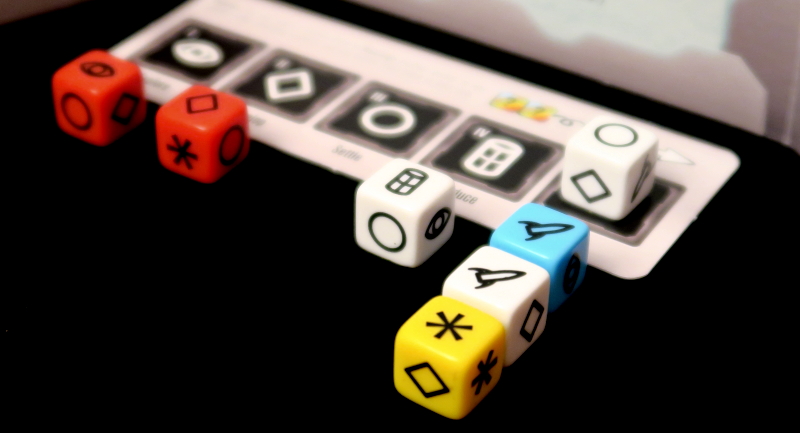
The smaller the number of players, the more critical this can be.  So with just three players in Roll for the Galaxy, at least two will not be happening, possibly more.  The Actions are Explore (acquire world tiles); Develop (progress on building Development worlds); Settle (progress on building Production worlds); Produce (use Production Worlds to produce Goods), and Ship (sell Goods for money, or consume them for victory points).  In this game, the actions are all carried out using dice which are rolled in secret and placed behind the players screen to choose where those dice will get used.  This placement depends on the face shown, though any one die can be used to choose which Action will happen.

Roll for the Galaxy
– Image by boardGOATS

The dice are then moved to the Development or Settlement piles of tiles in their respective phases to progress building those worlds, or placed on Production worlds as goods.  Alternatively, they can be spent to pay for Exploring or Shipping in which case, they (along with any dice from any completed building projects or shipped goods) are placed back in their Citizenry.  Dice can be purchased into the player’s cup at a rate of one dollar each, so it is important for players to ensure their finances are healthy or their game will rapidly stagnate.  The game ends when, either someone has built their twelfth World, or the the pool of victory point chips has been exhausted.

Roll for the Galaxy
– Image by boardGOATS

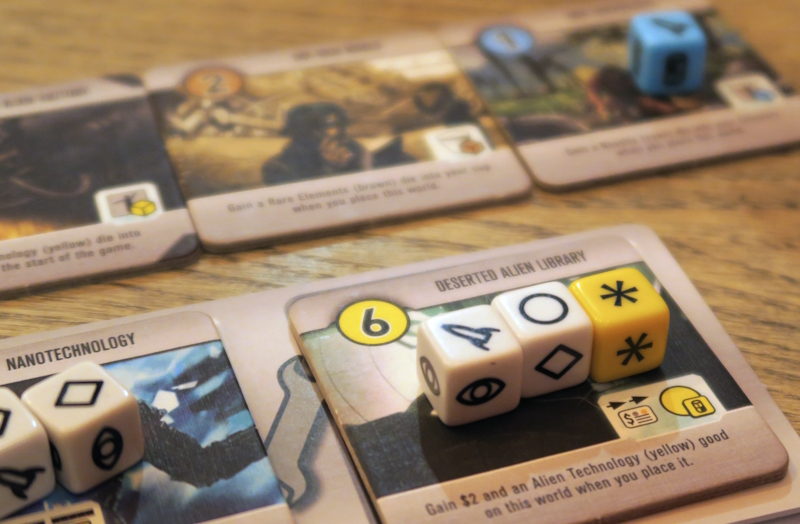
The game was slow to get going at the start, but then Ivory raced to an early lead getting a nice array of Worlds in his tableau leaving Blue and Byzantium trailing in his wake.  But then, instead of finishing the game by building his final World, he appeared to pull up.  This gave Blue and Byzantium the illusion of a chance, but was of course because he had a plan.  Ivory had the Galactic Reserves Development World which gave an extra victory point for every Goods item on a World at the end of the game while also allowing each Production World to hold an extra Goods item.

Roll for the Galaxy
– Image by boardGOATS

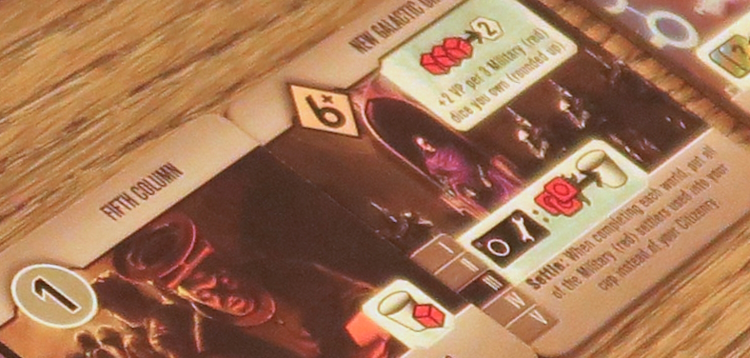
So, the couple of extra rounds was to enable him to fill his Production Worlds and in the end, the game was brought to a close by Byzantium building his twelfth planet, although the victory point chips were also depleted by the end of that round.  Blue had taken a sizeable twenty-four of those victory points through trading goods, but hadn’t been able to build enough.  As a result, her planets were worth only eighteen points, barely twice those of Ivory’s and Byzantium’s thirty.  Byzantium had five victory point chips and a couple of points from his New Galactic Order, but Ivory was some distance in front, thanks to his thirteen points for his Galactic Reserves and Galactic Bankers Developments together with his eight victory point chips.

Roll for the Galaxy
– Image by boardGOATS

There was time to play something else, but rather than go through rules, as Roll for the Galaxy was already out, the trio decided to give it another go.  This time, with an element of time pressure, it was arguable that some of the decisions made weren’t as sharp and the scores were all lower the second time, though that might have been partly because there were notably fewer rounds.  Blue kept dipping into the bag to try to get Rare Element (brown) Worlds to go with her Mining League, but failed repeatedly and eventually gave up.  Ivory triggered the end game with his twelfth World and this time it was Byzantium who struggled to build enough.

Roll for the Galaxy
– Image by boardGOATS

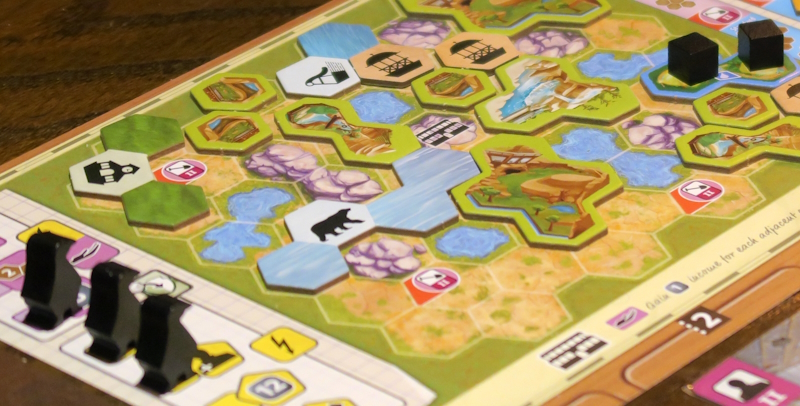
The scores were a bit closer on the second attempt, though the end result was still much the same, with Ivory again taking victory, though with half the winning margin.  By this time, the other games had also finished.  The first of these was Forests of Pangaia, in which Mint was joined by Pine and Plum.  This is a truly beautiful, tactile game, where players are trying to meet objectives to score Life Points; the player with the most Life Points at the end of the game is the winner.  The game has elements of set collection and area control and is played on a central map made of terrain hexagons.  Players take turns to perform three phases: Grow Seeds, take a Spirit Action, and finally add Treetops.  Once Seeds have grown and been turned into Trees, players carry out one of three possible Spirit actions.

Forests of Pangaia
– Image by boardGOATS

These are: Plant (moving their Spirit Pawn to a Lake space and planting seeds in adjacent spaces); Gather (moving their Spirit Pawn back to their player board and receiving a resource), and Prey (moving their Spirit Pawn back to their player board and playing their Ritual Card).  There are fourteen Rituals the Spirits can perform to collect Gaia’s Life Energy.  Once the Ritual card has been scored all the player’s Trees that were involved in the Ritual then partially or fully Decay (depending on the Ritual), either losing a level or rotting back to nothing and leaving a Seed.  The player then discards their Ritual card and draws a new one.  The game ends when the last Ritual card is taken by any player.

Forests of Pangaia
– Image by boardGOATS

Plum went first and spent most of the game collecting Sun tokens.  In contrast, Pine collected lots of Wind tokens inspiring lots of jokes about using wind to spread his seed.  The winner, however, was Mint with a nine point Trail Ritual due to excessive seed spreading giving her a total of twenty-eight points.  Pine just pipped Plum for second place by a single point.  It had been a really enjoyable game, however, made all the better by the gorgeous pieces. Meanwhile, on the other end of the same, albeit long table, Black, Purple and Sapphire played a game of last year’s winner of the Golden GOAT Award, Stamp Swap.

Stamp Swap
– Image by boardGOATS

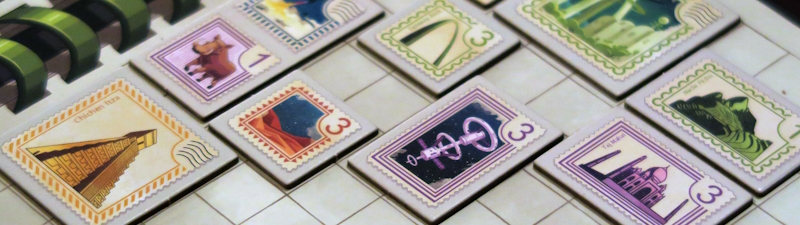
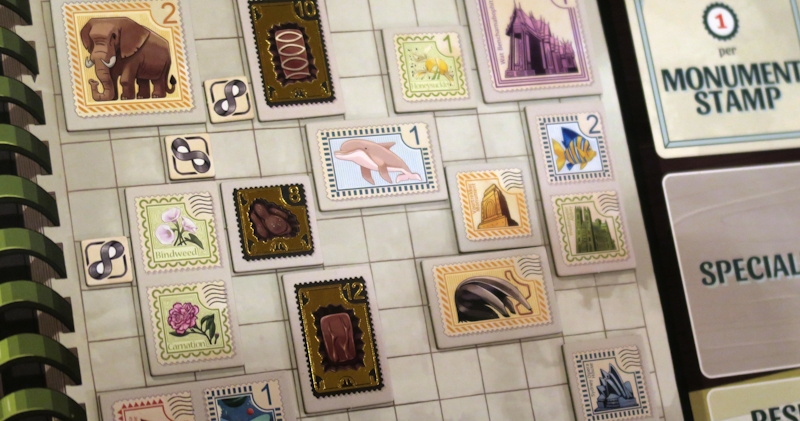
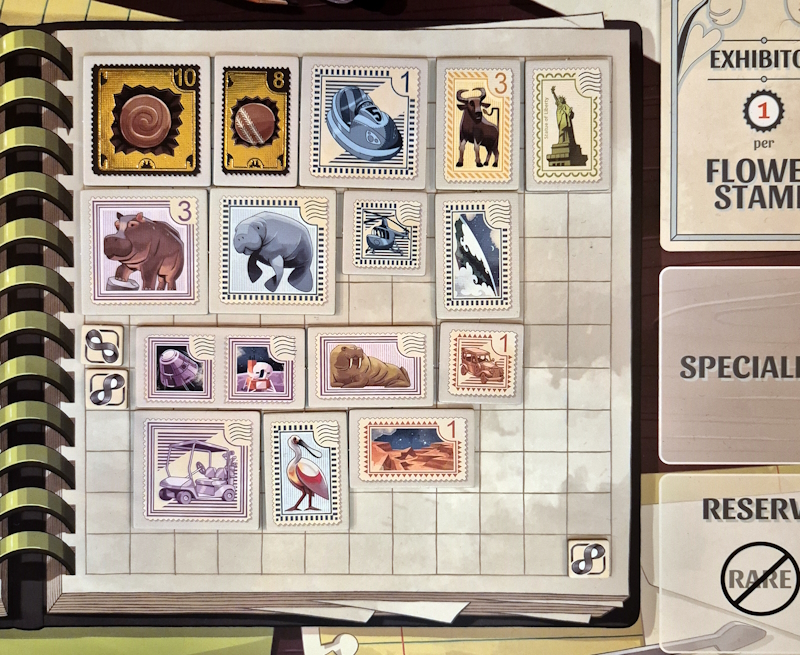
This is a really smooth tile placement centred around stamp collecting.  There is a lot of simultaneous play, which is nice because it minimises down time.  First, players take it in turns to choose items from the central Pool, then simultaneously divide them into two piles of offerings.  The player with the first player token, chooses and takes one of the piles offered by their opponents.  The opponent keeps their other pile and then chooses a pile from one of their opponents and so on.  Once everyone has two piles, players arrange the Stamps in their Album and then choose which of the four available end of round cards to score this time.

Stamp Swap
– Image by boardGOATS

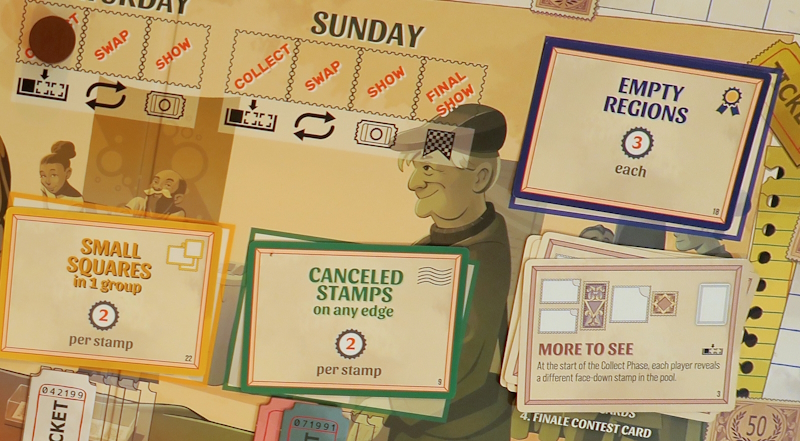
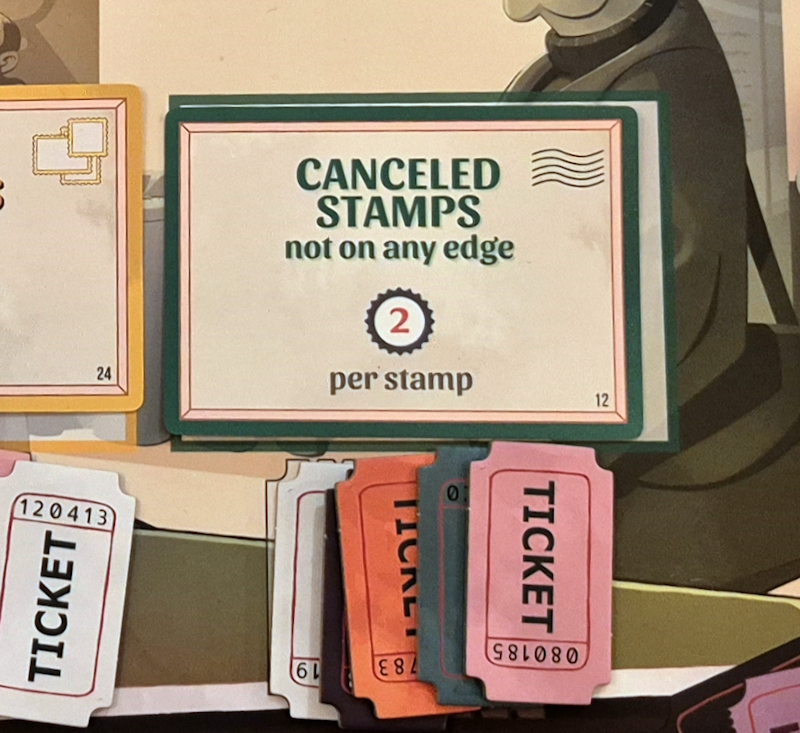
After three rounds, players score the end of game objective card and the player with the most points is the winner.  One of the clever parts about this game is how much difference the objective cards make to the way players arrange their Stamps.  The end-game scoring gave three points for each enclosed gap two spaces in size (i.e. a one-by-two hole).  More points were available during the game for cancelled stamps not on the edge of the page; for large square stamps; for each stamp in a player’s second most abundant theme, and for groups of a chosen colour.

Stamp Swap
– Image by boardGOATS

This time the game was very close.  Purple (specialising in Flowers) struggled to get the stamps she needed and Sapphire (specialising Space stamps) kept getting confused which way the turn went.  It didn’t seem to inconvenience him too much however as he and Black (Monuments) fought it out for first and second place.  Black picked up a lot of his points for Special Stamps—just three accounted for a quarter of his points, which contributed to his total of one hundred and seven points, just four more than Sapphire.

Stamp Swap
– Image by boardGOATS

While everyone else was finishing up, there was some discussion about the continuation of the Ticket to Ride Legacy campaign that Blue, Pink, Black, Purple and Pine embarked on at New Year.  The campaign is played over twelve rounds and the group had managed the first two games on the first outing with the next two more recently on Saturday evening.  Spoiler alert—hover HERE to see details. The winner of the third round was Black, very closely chased by Pink with Blue taking third.  After a break for tea (lamb and vegetable tagines with millet), the group began their fourth game. Spoiler alert—hover HERE to see details.

Ticket to Ride Legacy: Legends of the West
– Image by boardGOATS

This was much less close than the third game. The winner was Pine, with Black six dollars behind and Pink a further fourteen points behind him, in third. Spoiler alert—hover HERE to see details. While chatting with the others, out of curiosity, Pine went through The Book and totaled up the scores for the first four rounds, which gave Black a lead of some twenty dollars. Something the rest of the group need to give some thought to next time, before he gets an unassailable advantage although there is a suspicion that as the campaign progresses, the games get longer and more points will be available in each round giving players a chance to catch up.  We shall see.

Ticket to Ride Legacy: Legends of the West
– Image by boardGOATS

Learning Outcome:  However you roll, when you race you need a fast start.

10th December 2024

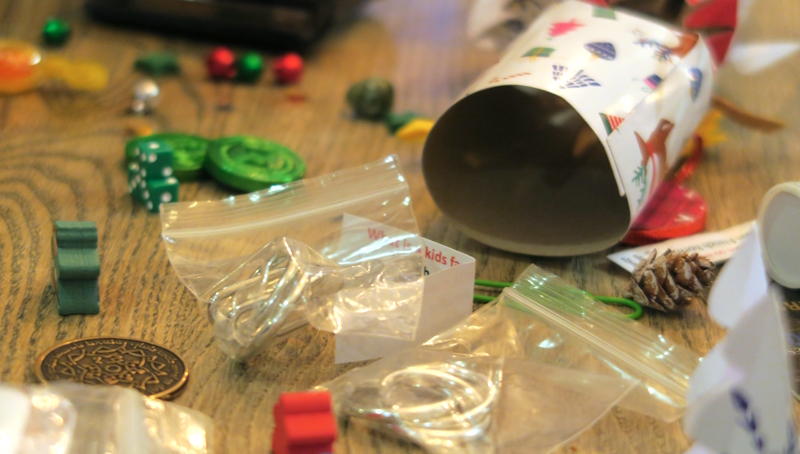
Everyone had already arrived and was waiting in anticipation when Blue and Pink arrived with piles of gamers crackers, Christmas tree decorations, party poppers, paper parcels, mince pies, festive cakes (with carrot meeples on top) and GOAT Award voting forms.  Food quickly followed along with a volley of noise as people tried to pull their crackers and party poppers first so the contents didn’t land in their supper.  As people munched, there was some discussion about the games played and voting forms were filled in.  In the absence of Green, Pine kindly offered to act as returning officer and collate the statistics.

"Un-Christmas Party" 2024
– Image by boardGOATS

While cake and mince meat parcels were shared round, toasts were offered by Lime to the organisers, and in the memory of Burgundy.  He is much missed and will never be forgotten, but we always make a special point of remembering at this time of year, especially as the Un-Christmas Dinner was his last games night with us.  The GOAT Awards were then announced.  Moment of the Year was when Pine got the end game rule wrong for Tonga Bonga, so that Pink thought he’d won, but then didn’t.  The GOAT Poo Prize for the least popular game of the year went to Ca$h ‘n Guns—not a game the group plays often and its only outing over the last year was at the New Year Party.

"Un-Christmas Party" 2024
– Image by boardGOATS

Then it was time for the Golden GOAT.  Previous winners were ruled out, but other contenders included Akropolis, Kavango, Flamme Rouge and Ticket to Ride: Rails & Sails.  The clear winner of the 2024 Golden GOAT Award, however, was Stamp Swap.  There was much discussion about how this was the third winner from Stonemaier Games (after Tapestry last year and Wingspan in 2019) and how we should invite Jamey Stegmaier, to collect the award in person.  Email correspondence over the following few days suggested that while it was unlikely he would be able to come to GOATS, he will be in the UK next year and just might make it as far as Oxford.  In the meantime, he has highlighted the award on his website.

Golden GOAT - 2024
– Image by boardGOATS

With the festive business over, the group broke into three to play some games.  Pink, Blue, Black and Jade began with the “Feature Game“, Courses De Rennes (aka Reindeer Races), a fun little game where players control a team of four reindeer, racing along four different tracks to try to get the highest-scoring tiles.  On their turn, each player can either draw two cards (with a hand limit of seven) or play as many cards of the same type as they can to move one reindeer along one of the tracks.  The cards are numbered and have suit that corresponds to one of the tracks (or are Elfy, and “wild”).  If two and a three of Gifts is played, the player may move one of its reindeer along the Gift track.

Course des Rennes
– Image by boardGOATS

If a reindeer lands on the same space as another reindeer, it slides forward a space.  If that is occupied too, it continues to slide.  If, however, the owner cries “Thump!” as it lands, the reindeer slithers an extra space forward.  The first reindeer to arrive at the end of a track claims the highest value token.  The game ends when two of the tracks have run out of tokens.  Pink too the first points, and with it a strong early lead.  A few rounds later, Jade took the last token from one of the tracks and with it ended the game.  He got very unimpressed looks from Black and Blue as he gifted victory to Pink, so once this was pointed out, Jade revised his move and play carried on.

Course des Rennes
– Image by boardGOATS

Ultimately, however, it didn’t really change things as Pink still took victory with twenty-two points.  He was long way clear of Jade who won the tight fight for second with fifteen just one point ahead of Black who, in turn, took third by a single point.  Everyone else was still playing, so the group looked for something else to play.  Black had won a copy of Ticket to Ride: Paris in the raffle and, although it wasn’t very festive, it seemed appropriate to give it an outing.  Some of the GOATS had played this mini-city variant of the popular train game earlier in the year when we marked the Olympics with sport and France themed games.  However, none of the current quartet had been part of that group.

Ticket To Ride: Paris
– Image by boardGOATS

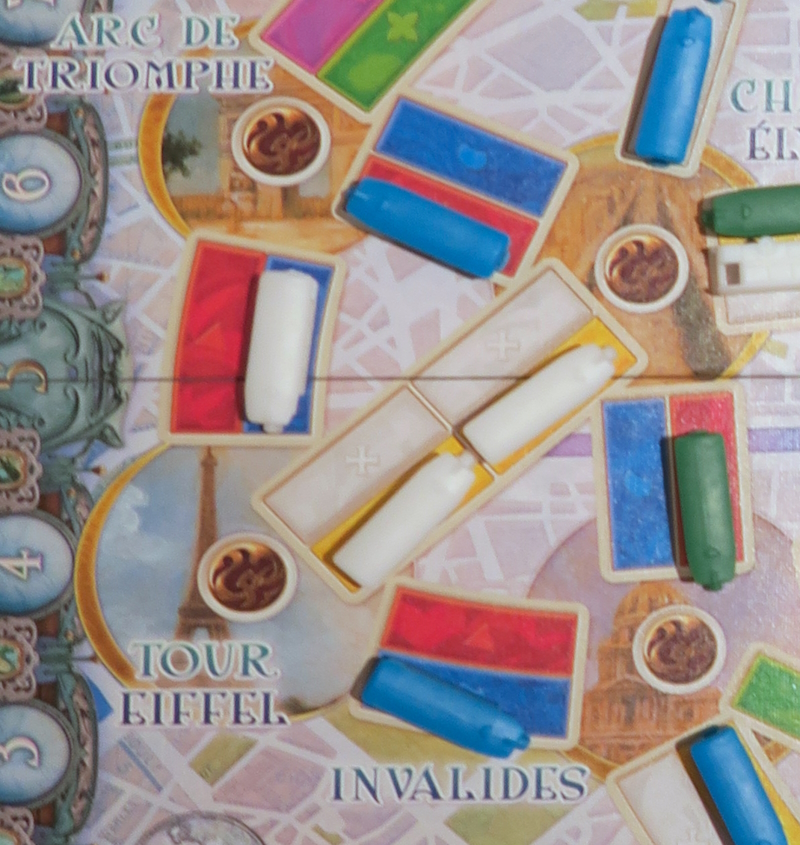
The rules are much the same as all the others (take two cards from the market; play cards to place pieces on the map; collect Ticket cards to score points at the end), but like all the variants, Paris has a special rule.  When players claim a red, white, or blue track, they get a card, when they get all three colours they get four “Tricolore” bonus points.  When the game first came out, there had been comments about how this felt very bolted on, but in practice, it was much more interesting than it sounded.  This time, the in game scoring was quite tight, though Blue, with her trains across the city centre got her nose in front and led by six points.  Tickets can make a huge difference to scores though, as they can give a lot of points, both positive and negative.

Ticket To Ride: Paris
– Image by boardGOATS

Black, Pink and Jade all picked up similar points for their completed Tickets (ten, eleven and eight respectively), though Jade was unlucky and unable to complete his last one.  Blue, however, made good use of concurrent routes and scored a massive twenty-four points for hers giving her something of a landslide victory with a total of forty-six.  It was much closer for second which went to Pink who finished with twenty-nine, two points ahead of Black.  Meanwhile, on the other side of the room, Purple was leading Ivory, Plum and Byzantium in one of her favourite Christmas themed games, Christmas Tree.

Christmas Tree
– Image by boardGOATS

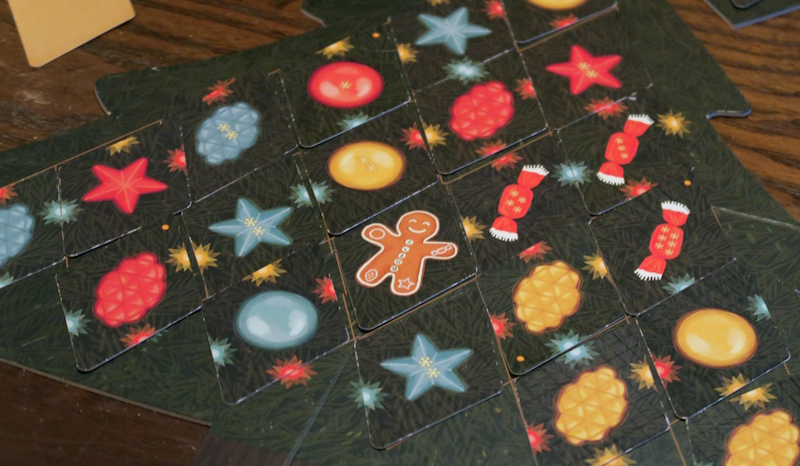
This is a fairly simple little card-drafting game played over thee rounds, where players are “decorating their Christmas Tree” with diamond-shaped cards, where players score points for the Objective cards everyone contributed to a central pool at the start of the round.  This time, the group played from the advanced set of Objective cards (including all three levels) although the first round, the cards were all levels one and two.  These gave one point for each blue or “nobbly” ornament, four points for each pair of ornaments of the same colour and shape arranged in a vertical pair and six points for three specific shapes in a given arrangement.

Christmas Tree
– Image by boardGOATS

The first round started off slowly with everyone looking to fulfill some of the Objectives—everyone was successful, but Plum and Byzantium got off to a better start.  Plum placed her first Gingerbread man and then concentrated on placing vertical pairs although she only managed that once.  In the second round the Objectives were from the more complicated sets, including six points for three specific colours in a given arrangement, six points for the same three shapes or colours in a set pattern, or eight points for four ornaments with the same point value arranged in two set formations.  This time, Byzantium significantly out scored everyone with multiple objectives scored multiple times and, as a result, built a big lead.

Christmas Tree
– Image by boardGOATS

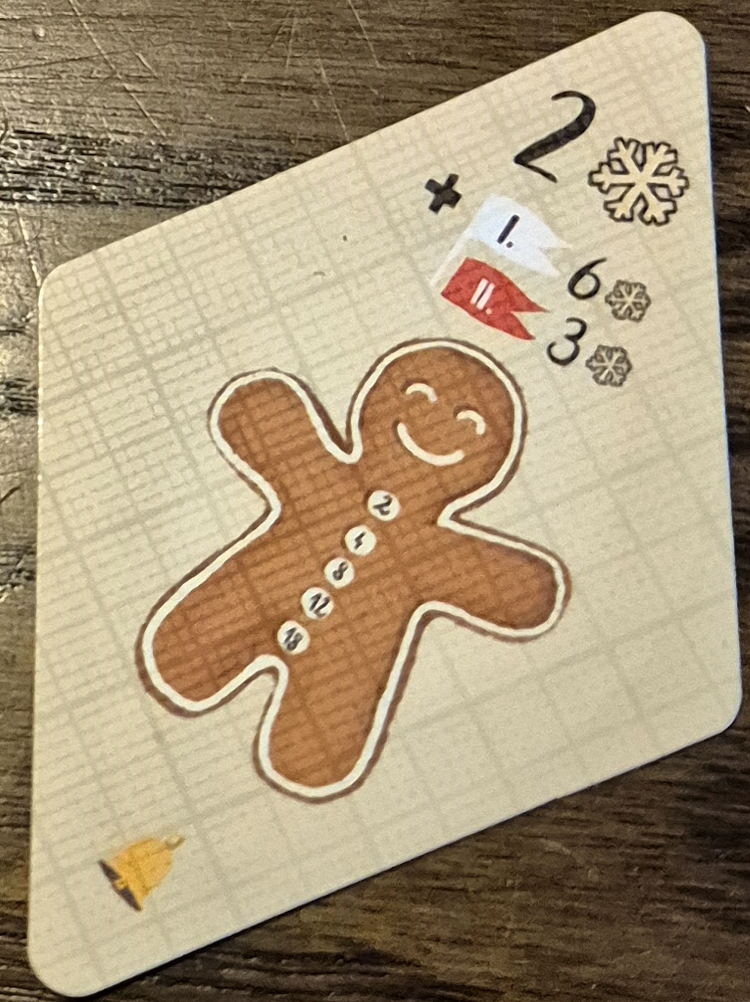
Plum used one of her Biscuits to move baubles around to make a row of four contain the three colours of glass bauble.and thus scored well, whereas Ivory was focusing on picking up high value Sweets and surrounding his Gingerbread men.  The final set of Objectives included six points for a set arrangement of certain point values, eight points for four ornaments with the same point value arranged in a particular arrangement and five points for each row in which the total points of the glass were above the given amount. Finally, there were two points for each Gingerbread man, with bonuses of six and three points for the player with the most/second most Gingerbread men.

Christmas Tree
– Image by boardGOATS

In the third and final round, Byzantium again out scored everyone, scoring multiple times for the set arrangement of certain point values.  At this point, Ivory was full committed to Sweets and Gingerbread men, especially knowing he was putting in the Gingerbread man Objective, which he scored well for.  Plum and Purple also scored well in the final round, with Plum following a strategy similar to Byzantium, whereas was Purple was collecting sweets like Ivory.  It looked like Byzantium was going to win by a large amount, as he was fifty points ahead of everyone else and was scoring more than anyone else for Lights and Baubles too.

Christmas Tree
– Image by boardGOATS

Ivory’s focus on surrounding his Gingerbread men gave him over fifty points and with more than thirty for his sweets he finished with one hundred and seventy one points, pipping Byzantium to victory by just two, with Plume in third some twenty points adrift.  The puzzly nature of the the game had gone down well and with the Christmas theme everyone had enjoyed playing Christmas Tree.  On the next table, the festive link was much more tenuous, however.  Teal, Pine, Sapphire and Indigo had chosen 6 Nimmt!, because there was a twelve in it, representing the Twelve Days of Christmas (or perhaps they had just wanted to play the game and if you can’t play a daft party game at Christmas, when can you?).

6 Nimmt!
– Image by boardGOATS

6 Nimmt! is a popular game with the group at any time of year, though it is usually played with more than four people.  Either way, the game is very simple to play, though tough to play well.  Some say this is because there is a lot of chance in the game, but they are usually the people who do badly…  The idea is that players simultaneously choose a card to play and these are then added, in order, to the rows of cards on the table.  The player adding the sixth card, instead, takes the first five cards into their scoring pile.  Usually, we deal out half the cards for the first round and the rest for the second and the winner is the player with the fewest “nimmts” (or points), at the end of the two rounds.

6 Nimmt!
– Image by boardGOATS

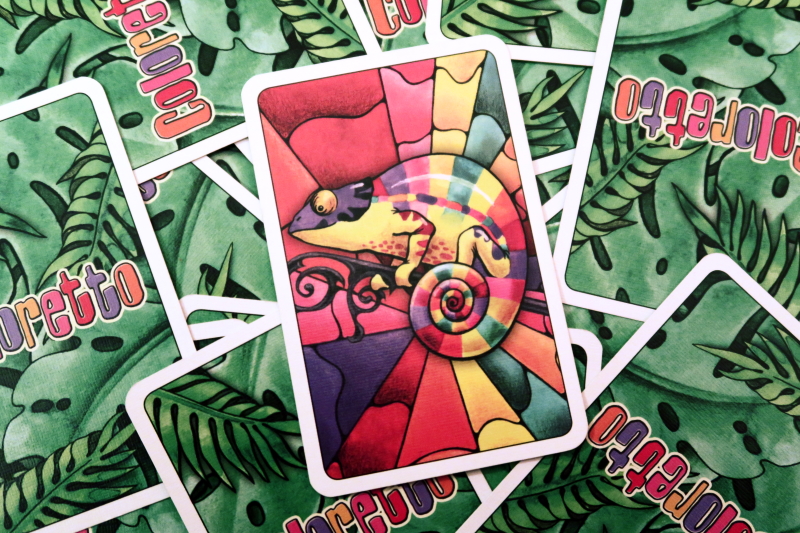
This time, however, the group decided to play the multiple-hand variant where each hand has ten cards, and the game ends when someone’s score passes sixty-six.  And that was Sapphire, who finished with an exceptional total of ninety-five.  The winner was Teal with forty-four, however, who was just two points better off than Pine.  The other games were still ongoing, but there was still time for one last game for this group (who were joined by Navy) before everyone went home warmed by the Christmas Gaming Spirit—and their choice of game was Coloretto (apparently this is a  festive game because it includes red, green and gold Chameleons).

Coloretto
– Image by boardGOATS

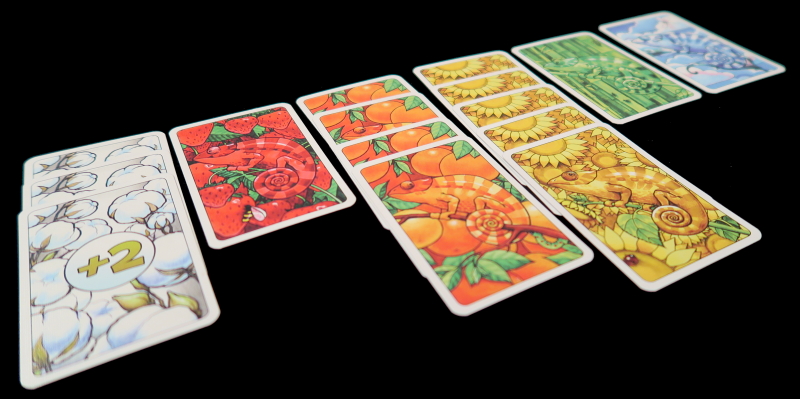
This is another simple filler game, where players either take a card and add it to a truck, or take a truck.  Each truck can take a maximum of three Chameleons, with players collecting coloured sets.  The largest three sets score positive points (according to the Triangular Number Series), while all the others score negative points.  In this way, the bigger the series the more additional cards will score, so the aim is to collect three large sets and ensure the others are as small as possible.  This game was really tight, with Sapphire claiming victory with twenty-seven and Teal and Indigo tying for second on twenty-four.  And with that, people began to drift off, many not to be seen until 2025.

Coloretto
– Image by boardGOATS

Learning outcome:  GOATS love a Cracker!

Golden GOAT Award Winners – 2024

This week was the annual boardGOATS Un-Christmas Dinner including the voting to decide the winners of the GOAT Awards.  There are two main awards:  the Golden GOAT for our favourite game played during the year and the GOAT Poo Prize for our least favourite.  Everyone had the usual three points to hand out for the Golden GOAT Award (plus a bonus if wearing Festive Attire), though a maximum of two points could be given to any individual game.  Everyone could also nominate up to two individual games for the GOAT Poo Prize.

Tonga Bonga
– Image by boardGOATS

This year, the unofficial “Marmite Award” went to Viticulture—something many people seemed to find quite a surprise as it is generally not a divisive game and one that few would usually take offense at.  There had been a lot of fun throughout the year, but one of the more memorable moments was Pine getting the end game rule wrong for Tonga Bonga, so that Pink thought he’d won, but then didn’t.  There were several nominations for the GOAT Poo Prize, including King of Tokyo, Rolling Realms and Ark Nova, but the winner was another surprise: Ca$h ‘n Guns—not a game the group plays often, indeed it doesn’t get played at all at the pub (for obvious reasons), so its only outing over the last year was at the New Year Party.  It can be a lot of fun, but it is also easy to see how some might not like the game.

Ca$h 'n Guns
– Image by boardGOATS

Then finally, there was the Golden GOAT Award for the best game played in the year.  Previous winners were ruled out, but there were plenty of other great games to choose from.  The most popular of these were Akropolis, Kavango, Flamme Rouge and Ticket to Ride: Rails & Sails.  However, the clear winner was Stamp Swap.  This is a new game, only released in September, but was an immediate hit, largely thanks to its silky-smooth game play.  As one person commented, “I wouldn’t have thought a game about stamp collecting would be up my street, and yet…”

Stamp Swap
– Image by boardGOATS

Perhaps more remarkably, this is the third winner from Stonemaier Games after Tapestry last year and Wingspan in 2019—three very different games.  This led to the perhaps slightly tongue-in-cheek suggestion that the group should invite Jamey Stegmaier to visit so we could present him with the actual Golden GOAT in the manner of the Jules Rimet Trophy

Golden GOAT - 2024
– Image by boardGOATS

26th Movember 2024

Plum, Jade, Sapphire and Mint were first arrive, and while they were waiting for food, settled down to a game of Hiroba, a sort of board game “Sudoku” where players place their numbered pebbles to take control of the most gardens.  As in Sudoku, players must never have two pebbles of identical value in the same garden, row or column.  After a couple of false starts the group eventually figured out the rules.  This time, Sapphire got in early with the lowest stone number between two Koi carp ponds, ensuring he got both. Plum only got two ponds, so although she got a reasonable number of areas, others overtook her by using the Koi pond multipliers.

Hiroba
– Image by boardGOATS

Food arrived during the game, and some were still eating when the final count (and recounts) took place.  Despite Sapphire’s great start, Mint’s total of thirty-five gave her victory by a single point pushing Sapphire into second and leaving Plum in third.  Meanwhile, since Hiroba was underway when Cobalt arrived, he settled down to a solo game of Explore & Draw, the Roll & Write version of Isle of Cats.  The game play is similar with players now drawing polyomino shapes on their ship board, but choosing a set of cards each round instead of drafting them.  In the solo game, the player is competing against his “sister” and this time won by forty points to her thirty-six.

Isle of Cats: Explore & Draw
– Image by boardGOATS

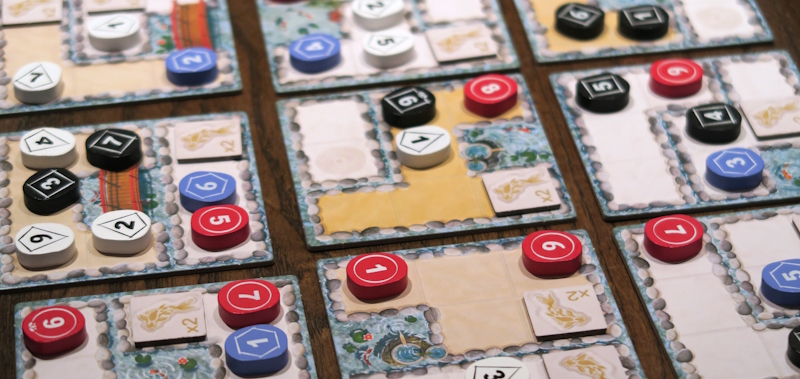
Once everyone had arrived (except Teal who had given up battling the crazy flood-water and gone home) and had finished eating, it was time for the “Feature Game” which was to be Rolling Realms/Rolling Realms Redux. This was advertised as a light roll and write game, but turned out to be rather more involved than everyone expected.  It was developed during the global pandemic as a print-and-play game, but has since been released as two professionally produced games.  Each game consisting of a number of small games based loosely on other games, with more are available to be purchased separately.

Rolling Realms
– Image by boardGOATS

The idea is that players choose three “mini-games”, or “Realms” for each of three rounds.  Then, two dice are rolled and allocated separately to two of the three games.  After nine rolls, players add up the number of starts they’ve achieved in the round.  The winner is the player with the most points after three rounds.  With three copies of the game and several people familiar with it, it should have been a relatively straight-forward game, but with so many different mini-games, players effectively had to learn the rules each round.  As the games play six and there were three copies, the group decided to play one large game. and started with the same three mini-games, based on three of our favourite games, Tapestry, Meadow and Flamecraft.

Rolling Realms
– Image by boardGOATS

And this was where the first problem arose.  The Tapestry mini-game was quite straight-forward, with players trying to fill their grid using polyomino shapes.  However, Meadow and especially Flamecraft, both from the Redux version of the game were more difficult to understand.  The Meadow mini-game was based on the card market with players choosing “cards” and using them to score points and collect resources.  The Flamecraft mini-game caused a lot of confusion with different “Enchant” and “Gather” actions, which are loosely based on the actual game, but it took a while to work out what they did and how to use them.

Rolling Realms
– Image by boardGOATS

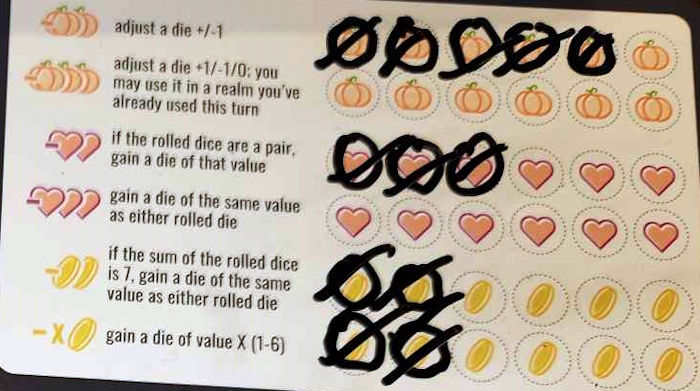
All three games involved players doing things to collect Stars, but the real aim of the game is to collect resources (Pumpkins, Hearts and Coins).  These allow players to modify dice, use them both on the same Realm, and most importantly, gain extra dice to give extra actions—these are essential as without them, players don’t get enough turns to get the more challenging Stars.  With so many people playing and the difficulties in getting heads round rules, the group ended up splitting into three tables.  Plum, Jade, Sapphire and Mint were first to get going and were first to finish the first round.  Plum was the victor, and the group went on to play Dinosaur Island, Stamp Swap and Ark Nova for their second round.

Rolling Realms
– Image by boardGOATS

The second group consisting of Blue, Pink, Ivory, Lime and Pine, were a bit slower as they struggled a bit more with the rules, particularly Pine.  As a result, they were a bit slower to get to the end of the first round, with Blue and Ivory leading the way.  This group decided to reduce the rules overhead by keeping one of the Realms from the first round, the easiest to understand, Tapestry.  To this, they added Between Two Castles and My Little Scythe, both from the original Rolling Realms game, as they thought these might be easier to grok, which they generally were.  In their second round, Ivory and Blue were still fighting it out, but this time they were joined by Pink, with Pine not far behind.

Rolling Realms
– Image by boardGOATS

The comparative success of the second round and keeping one Realm and choosing two from the original game, meant they repeated the strategy for the last round.  This time they kept the Between Two Castles Realm and added Between Two Cities and Scythe.  By the final round, everyone seemed to have got the hang of things as the scores were much closer.  In terms of totals though, Blue just had the edge over Ivory, with Pink in third.  The other table had finished first though, with Tidal Blades, Between Two Cities and Euphoria as the Realms in their final round.  Plum had continued her success in the first round winning both the second and third rounds and therefore, taking overall victory.

Rolling Realms
– Image by boardGOATS

Second place was less clear, however, with Sapphire just beating Mint for second place.  The third table consisted of Cobalt, Black and Purple.  Cobalt had played before, but online while Purple and Black were new to it.  They also struggled a bit and took a more leisurely approach to the game, playing just two rounds.  Their second round Realms consisted of Scythe, Potion Explosion and A Feast for Odin, the last two both add-on packs, and therefore possibly more challenging than those from the base game.  Cobalt won the first round by a bit of a land-slide, but the second round was very close between all three players, with Purple just beating Cobalt (who took overall victory).

Rolling Realms
– Image by boardGOATS

Learning Outcome:  Sometimes, one person’s simple game can be another’s nemesis.

15th October 2024

There were quite a few people eating this week, but the earliest arrivals were finished when Green turned up for the first time in months toting his copy of Lost Ruins of Arnak.  Jade was already preparing to lead the “Feature Game” which was to be Castle Combo, and he was joined by Sapphire, Pine and Lime.  This is a game that was released to coincide with Essen, but like many of the most popular games was sold out within a couple of hours.  The essence of the game is tableau-building where players draft cards from two markets creating a three-by-three square of people interacting with each other triggering instant effects and end-of-game bonuses.
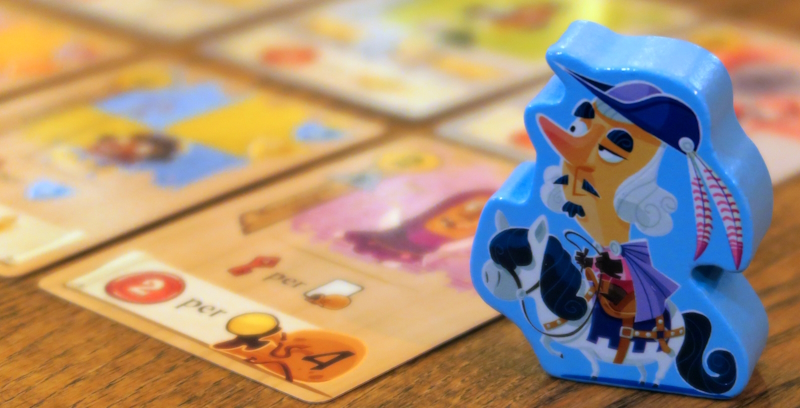
Castle Combo
– Image by boardGOATS

The two markets consist of Castle Cards and Village Cards.  At the start of their turn, players can pay a Key to to carry out a special action, before they buy a Card from whichever market the Messenger token is currently located in and place it in their Tableau. Some card abilities grant a permanent discount when purchasing cards of a specific location (Castle, Village, or both).  If a player can’t afford any of the cards (or choose not to pay for them), they can always take a card without paying its cost, and place it face down in their tableau. In doing so, they ignore its ability, its end game points and any other information printed on it, but immediately gain six Gold and two Keys in compensation.

Castle Combo
– Image by boardGOATS

Each card after the first must be placed orthogonally adjacent to at least one other card in a player’s Tableau and at the end of the game, their Tableau must be a three-by-three grid of Cards. In this way, the final position of the cards in the array is fixed as the game progresses. Once it has been placed, the ability of the Card is applied. Some abilities affect opponents (all other players), while others affect a player’s neighbour (they choose which one). Finally, if the Messenger icon is depicted on the card played, the active player moves the Messenger Token, either to the Castle or to the Village, as appropriate, before refilling the market and ending their turn.
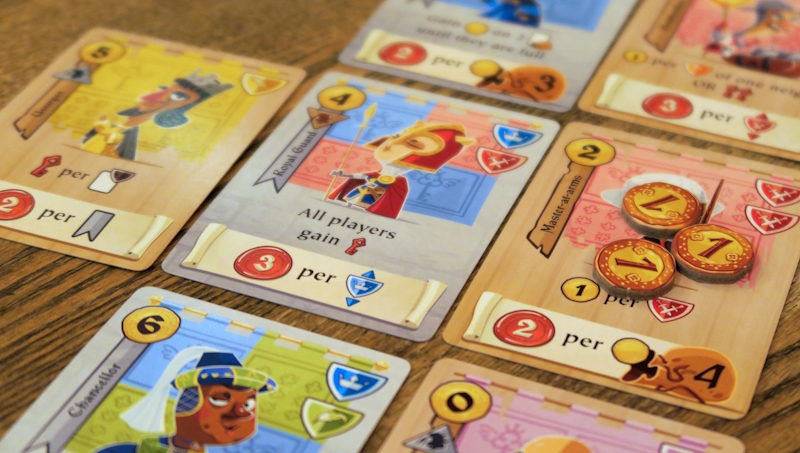
Castle Combo
– Image by boardGOATS

The game ends when everyone has nine Cards in their Tableau and everyone adds up their scores.  This time, Sapphire went first as he’d played before.  The game plays very quickly and smoothly as everyone began building up their displays.  It turned out that playing before wasn’t a great deal of help, however,, as Pine gave everyone else a bit of a trouncing as his final Tableau was worth ninety-six points, seventeen more than Jade who took second place a handful of points ahead of Sapphire in third.  Meanwhile, on the next table, Blue and Byzantium were leading a game of Stamp Swap at the request of Pink who had missed out last time.

Stamp Swap
– Image by boardGOATS

This is another fairly straight forward game, albeit one that takes a bit longer than Castle Combo, though it plays just as smoothly.   There is a lot of simultaneous play, which is nice because it minimises down time.  First, players take it in turns to choose items from the central Pool, then simultaneously divide them into two piles of offerings.  The player with the first player token, chooses and takes one of the piles offered by their opponents.  The opponent keeps their other pile and then chooses a pile from one of their opponents and so on.  Once everyone has two piles, players arrange the Stamps in their Album and then choose which of the four available end of round cards to score this time.
Stamp Swap
– Image by boardGOATS

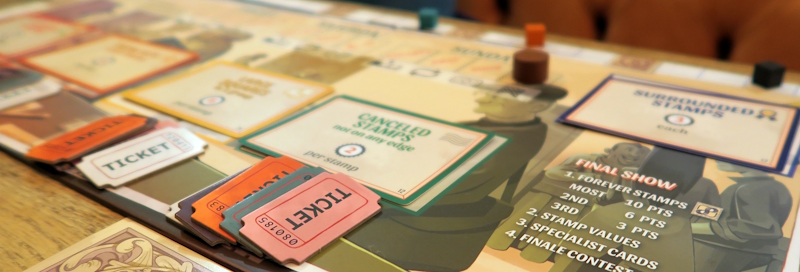
After three rounds, players score the end of game objective card and the player with the most points is the winner.  One of the clever parts about this game is how much difference the objective cards make to the way players arrange their Stamps.  This was very obvious last time when there were two parallel games and one scored Finale Contest gave for points for Stamps completely surrounded by other Stamps, while the other gave points for each empty region.  The former gave lots of Albums where the Stamps were clumped together, while the latter gave spread out Stamps in a lattice-type pattern.  This time, the Finale Contest gave ten points for each completed edge, so players began the game working along the borders of their Album page leaving a hole in the middle that they only filed in later in the game.
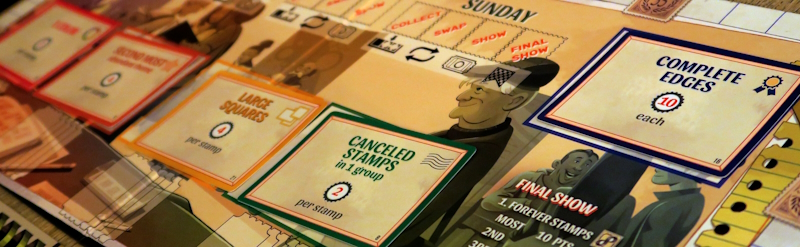
Stamp Swap
– Image by boardGOATS

The end of round scores allowed players to score points for the number of stamps they had in one colour, the number of large square Stamps they had, the number of cancelled Stamps and the number of Stamps in their second most abundant theme.  This artificially increased the value of large square Stamps, which was something that Pink failed to take into account early on.  It led to Blue taking what Pink felt was his obviously less valuable pile and giving her a surprise Special Stamp with a sad face from him.  Still, that was replaced with a big grin when he stole one of Blue’s hidden Stamps later in the game and it turned out to be the one with the Giant Panda on it.
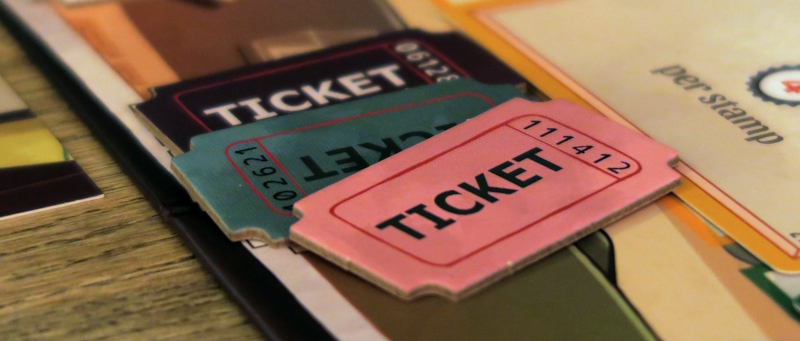
Stamp Swap
– Image by boardGOATS

The first event card was Generous Gifts where players choose one of their Stamps to score and then pass on—always a difficult decision, but more-so at the start of the game.  Slim Pickings was the second event giving players fewer items from the Pool at the start of the round, while Hands to Shake was the final event which made more Attendee Cards available, although by this time, it was too late to really take advantage of them.  That said, Byzantium had made collected quite a few Attendee Cards, using them to great effect to gain extra points and Stamps and took one in the final round as well.

Stamp Swap
– Image by boardGOATS

Aside from the Panda, Purple seemed to collect nearly all the Animal Stamps, while Pink did a good job of collecting Flowers.  The game is a bit of a “Point Salad” though, with points coming in little aliquots from lots of different places, and it perhaps pays not concentrate too much on one aspect.  Byzantium got a fast start and took an early lead, which he just managed to maintain to the end, beating Blue into second place by ten points, for the second time, which Pink taking third.  While packing up, everyone agreed that they really enjoyed the game for its smoothness, and the only part that “jarred” was setting out the starting Pool which was a little laborious.  Discussion online later, however, suggested a away to improve this, so that’s something to try next time.
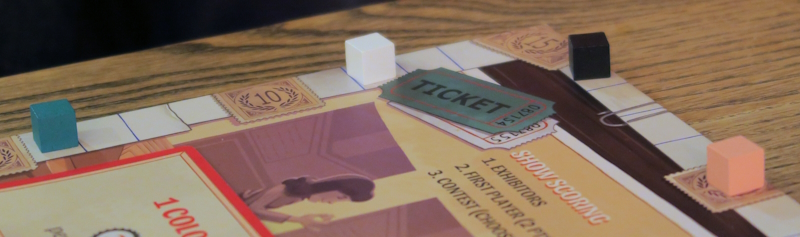
Stamp Swap
– Image by boardGOATS

By the time Stamp Swap finished, Castle Combo had already come to an end and Jade, Sapphire, Pine and Lime had moved on to play Courtisans.  We first played this a few weeks ago, shortly after UK Games Expo.  This is a clever little card game from the same stable as Castle Combo and Faraway, where players are manipulating card values by where they play them.  On their turn, each player receives and plays three coloured Family cards.  One card is played at the Queen’s table to sway a Family’s influence in a positive or negative way depending on whether it is placed above the table or below.  At the end of the game, those Families with more cards below than above will have “Fallen from Grace”.
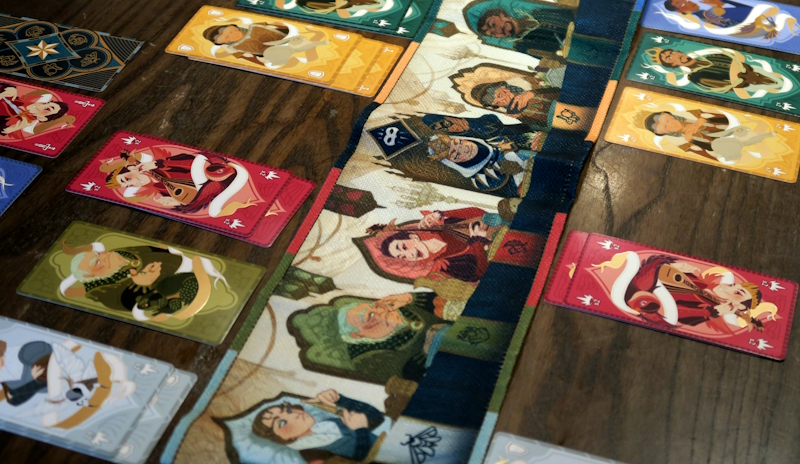
Courtisans
– Image by boardGOATS

One of the other two cards is played in the player’s own Domain and the other in an opponent’s Domain. At the end of the game, each card a player has from an “Esteemed” Family is worth a point, while each card from an Family that has “Fallen from Grace” loses them a point.  Thus, players are trying to increase the value of the cards they have, while decreasing the value of the cards their opponents have. The first game was a game of two parts, Jade and Pine tied for victory with nine points, while Sapphire and Lime also tied with four points.

Courtisans
– Image by boardGOATS

As is often the case with this sort of game, after the first play, once he’d seen how the game works, Lime requested a second game.  This second game was higher scoring with players getting more “Esteem” and fewer Families that had Fallen from Grace.  Both Jade and Lime completed both their objectives as well.  Lime’s massive Esteem scoring of twelve, gave him clear victory with a total of sixteen points, while Jade, who finished with eleven points, just pipped Pine to second by a single point.  There was a bit of chatter with everyone discussing the games, but nobody really had the inclination to play anything else before going home.

Courtisans
– Image by boardGOATS

On the next table, while Blue took a little time out, Pink, Purple and Byzantium played a quick game of the sixteen card filler, Love Letter. This is a sort of multiplayer dueling game where players have a hand of one card, draw a second from the face down deck and then choose one to play, with the aim of being the last player standing, or the player with the highest value card if in the event that the deck runs out first. The trio only played two rounds, but Byzantium managed to get knocked out first turn both times. It was a tie between the other two though, with Purple taking the first round and Pink the second when he knocked out Princess Purple.

Love Letter
– Image by boardGOATS

After two rounds, the trio got bored and moved on to playing Sushi Go!Sushi Go Party! had had a mention earlier in the evening, but as none of them were familiar with the rules changes, they stuck with the smaller, original version.  This is a simple, and one of the purest card drafting games where players start with a hand of cards, keep one and pass the rest on.  The cards are Sushi and players are trying to get sets, or pairs, or as many as possible depending on the Sushi on the card.  The group played the full three rounds, with very mixed outcomes.  At the end of the game, the player with the most Pudding cards gets extra points, but as all three tied so nobody got any.  The winner was Byzantium, with a massive fifty-eight points, seven more than Pink in second in what was a high scoring game.
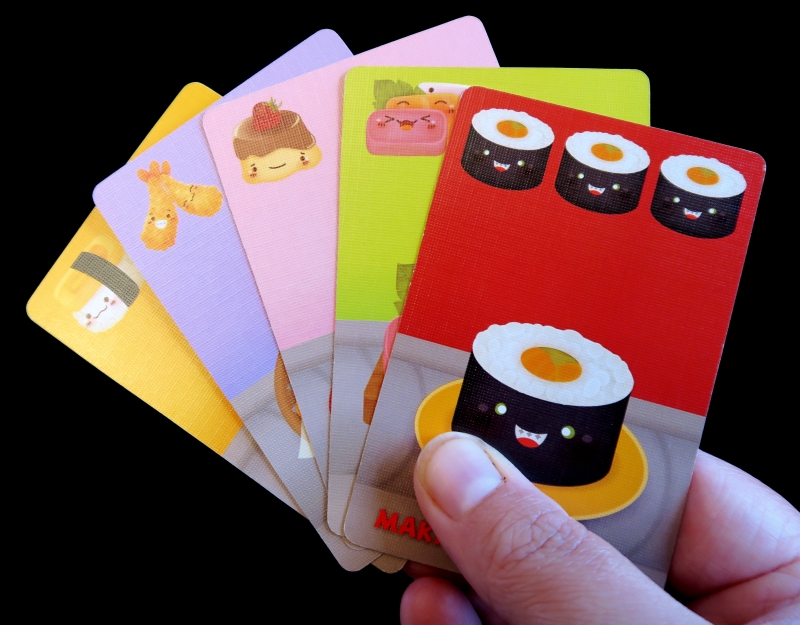
Sushi Go!
– Image by boardGOATS

Byzantium was waiting for Plum to finish on the other side of the room, so Blue rejoined the group for a quick game of something silly—an old game that Blue and Pink acquired at Essen, called Why First?.  The premise of this game is, what’s so important about being first, maybe the winner should be the person who is second.  So in this game, players start with a hand of five number cards and simultaneously, chooses a card to play before, on the count of three giving it to someone.  This player’s piece is then moved that number along the race track.  The round ends after five cards, the last of which must be used to move the payers’ own piece.

Why First?
– Image by boardGOATS

At the end of the round, only the player who is second scores, and that depends on their location on the track.  In the first round, Blue came second (and therefore won the points) and Pink won the second.  Byzantium won the third, but as he finished on the start line, he scored no points, much to his chagrin.  Blue and Purple tied for second in the fourth round so both took a single point, before Purple took the final round.  The winner of the game is, obviously, the player who comes second overall.  Despite a lot of effort by Blue who ultimately finished first and therefore lost, this was Pink who was therefore the winner.

Why First?
– Image by boardGOATS

By this time, the table on the other side of the room had finally finished and were packing up.  Green had clearly arrived wanting to Lost Ruins of Arnak, and Ivory and Plum had kindly joined him.  This had an outing about six months ago, when Green and Plum were also involved.  By this time, however, Green had acquired The Missing Expedition expansion and, having played the game quite a lot solo, wanted to include it to add interest.  The basic game combines deck-building and worker placement with resource management. Players start with six cards in their deck, two Money, two Compasses and two Fear cards (which just clog up players’ hands), and draw five of these to play.
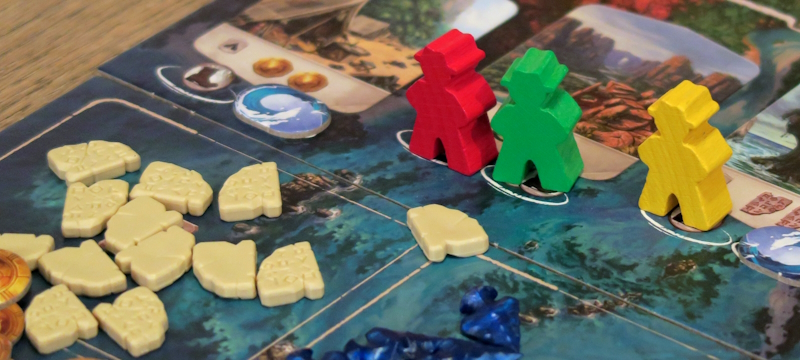
Lost Ruins of Arnak
– Image by boardGOATS

Players then have two meeples each that can be sent to locations on the map, to either discover or use an action Location which generally give Resources plus some extras. Each new site has a Creature guarding it, which, if beaten, will give points and a small one-time bonus.  Players can use resources to move up the Research Track giving different rewards.  Players get one action each per turn, until everyone has passed signalling the end of the round, and the game finishes after five rounds.  The Missing Expedition expansion is modular, but this time the group added the Waterfall Temple and the extra encounter cards. The Waterfall Temple has a couple of steps whose cost changes each time someone Researches past them which can make it a bit unpredictable, though there is a sneaky shortcut to the top of the temple for players prepared to pay the steep cost.
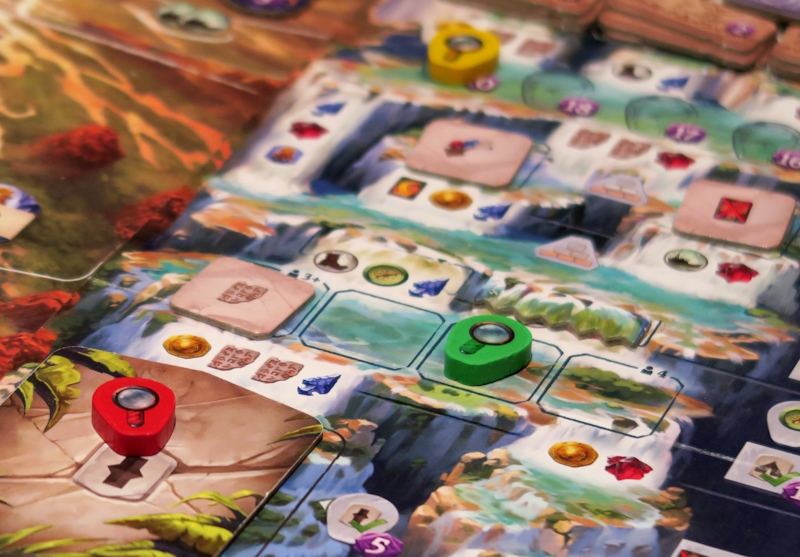
Lost Ruins of Arnak: The Missing Expedition
– Image by boardGOATS

The first round went very quickly with everyone having limited options. Green and Plum began moving up the Research track, looking to gain an Assistant as soon as possible, where Ivory focused on gaining coins and an additional card. Ivory grabbed the Recovered Plane card (from the expansion) that allowed him to recall his explorers and using them again, which felt quite powerful. In the second round, Plum and Green both got their Assistants. They also started getting additional cards with Plum getting the Unreliable Compass card that gave her the benefits from the bottom tile of the exploration track and Green got the Army Knife which gave him flexibility when gaining Resources. Ivory began Exploring, uncovering the first new worked spot, slowly followed by Plum. Ivory managed to use his Plane card to avoid the Guardian, whereas Plum didn’t have that option and gained a Fear card at the end of the round.

Lost Ruins of Arnak: The Missing Expedition
– Image by boardGOATS

In the following rounds, Ivory begin focusing on the research track, catching up with Green and Plum and eventually overtaking them. He reached the part of the track where he could gain the Resources on a set aside exploration tile and got one that gave me an Explore card from the expansion which gave him the choice of something now or something latter. As the third and fourth rounds progressed, the Research track became a core focus Ivory managed to reach the top the first. Everyone continued exploring, and Ivory was also the first to explore a level two tile, gaining additional idols and resources and then subsequently able to recall his explorer to avoid the Guardian and Fear card.
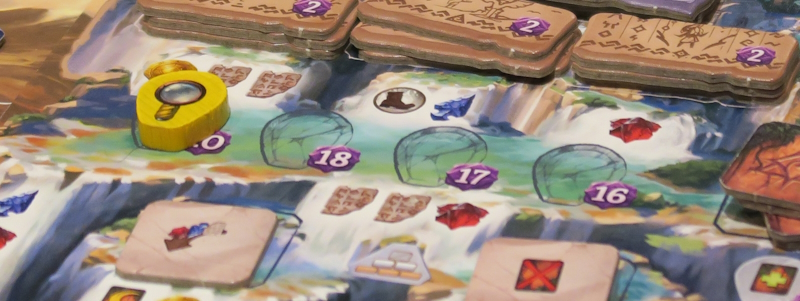
Lost Ruins of Arnak: The Missing Expedition
– Image by boardGOATS

Plum was also Exploring, though at the lower level, but unfortunately the Guardians that she was drawing meant they were very difficult to defeat and she picked up more Fear cards. Green was Exploring less, but was using the engine that he assembled with his Assistants and cards to explore and defeat quite a few Guardians, adding to his engine whilst also gaining points. Towards the end of the game, the question for everyone was how to be most efficient and make the most moves up the Research track. Green joined Ivory at the top, and additionally gained enough Resources to grab an eleven point temple tile. Ivory was looking for an additional Resource to move my notebook up one more step and then remembered he hadn’t gained the bonus tile for reach the top of the Research track, gaining him that valuable Resource.

Lost Ruins of Arnak: The Missing Expedition
– Image by boardGOATS

Plum was also pushing up the Research track, looking to squeeze as much value as possible. Ivory also had accumulated quite a few coins, which allowed him to buy lots of cards during the final round just for their points. With everyone passing in the final round there was just the small matter of the scores. Points for Exploring, Research and Idols were pretty much level. Green’s engine which allowed him to gain the eleven point temple tile and defeat four Guardians (as opposed to Ivory’s and Plum’s one) ultimately gave him victory with seventy-seven points. Ivory’s Artifacts and Item cards gave him second ahead of Plum who had struggled with her Fear (bordering on Terror!) throughout the game.
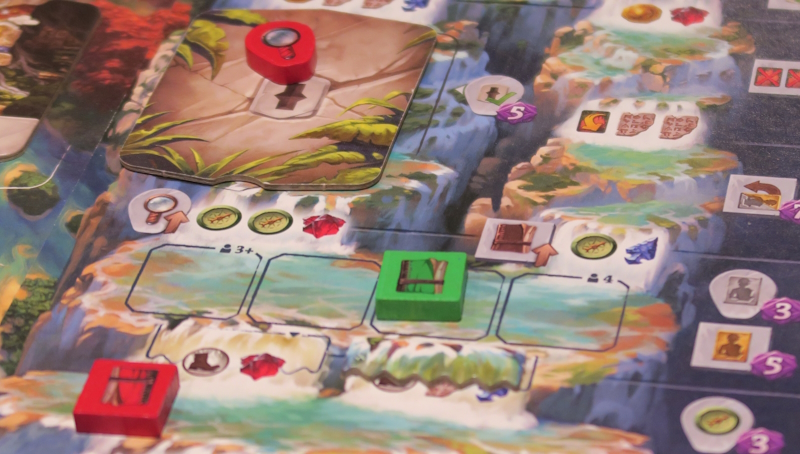
Lost Ruins of Arnak: The Missing Expedition
– Image by boardGOATS

Learning Outcome: Princesses don’t want to live in Ruined Castles.

17th September 2024

After the usual chatter and some food, the interested parties staked their claim to play the “Feature Game“, Stamp Swap.  This is a game where players take on the role of stamp collectors at a convention collecting, trading and then scoring their stamp album.  All the reviews claim it is a light game, but while it is not hugely complex, there is more to the game than appears at first glance.  At its core is the “I cut, You Choose” mechanism that is used in games like Isle of Skye and …aber bitte mit Sahne, but Stamp Swap is nothing like either of these.

Stamp Swap
– Image by boardGOATS

The game takes place over three rounds each with three phases:  Collect, Swap and Show.  In the collect phase, an Event card is revealed and then players take turns to take an item from the central pool.  Once everyone has six items, everyone puts one item aside to Reserve and then splits the rest into two piles for the Swap phase.  Some “I cut, You Choose” games struggle work across a range of player counts, for example, San Marco, really only plays well with three players where one splits the cards into three sets and the others choose.  While the game might work with two, the decisions would be too trivial (though there are variants with a dummy player).

Stamp Swap
– Image by boardGOATS

In contrast, dividing a pile into four would require too many cards and make the decision complex as well as make the game potentially quite “swingy”.  Thus, although the game officially plays three to four players, the mechanism really only works with three.  Stamp Swap avoids this problem with a snake-like mechanism that also negates the need for valuing the hands or the use of money as an intermediate (as in Isle of Skye).  The first player chooses one set and the owner of that set keeps their other set and chooses one from another player.  That player keeps their second set and chooses a set from another player and so on.

Stamp Swap
– Image by boardGOATS

Players then place the stamps in their album and score in the Show Phase.  There are four Goals in each game and each player can score one of these per round, but can only score each only once.  These Goals are different in each game giving a lot of variability, especially as thy combine together in different ways.  At the end of the game, players additionally earn points for the face value of each Stamp, for any Specialist cards they may have, for Stamps that match their personal Theme, and for their achievement in the Finale Contest, while receiving bonus points their place in the Forever Stamp competition.

Stamp Swap
– Image by boardGOATS

The unexpected complexity arises from the stamps themselves.  They come in five different colours, themes and size/shapes.  Some of these stamps are “Cancelled” (and have no face value) and some are “Faded” (and have a negative face value, but may be useful for claiming the Goals).  There is are special gilded Stamps with their own Chocolate theme and a high face value, but cannot be reserved at the end of the Collect phase.  Finally, there are the “Forever” Stamps.  These are Square and are the only Stamps available in the smallest size and have no face value, but are useful for filling tiny holes (should that be required for the Goals) and give bonus points at the end of the game (in much the same way as Pudding do in Sushi Go!).
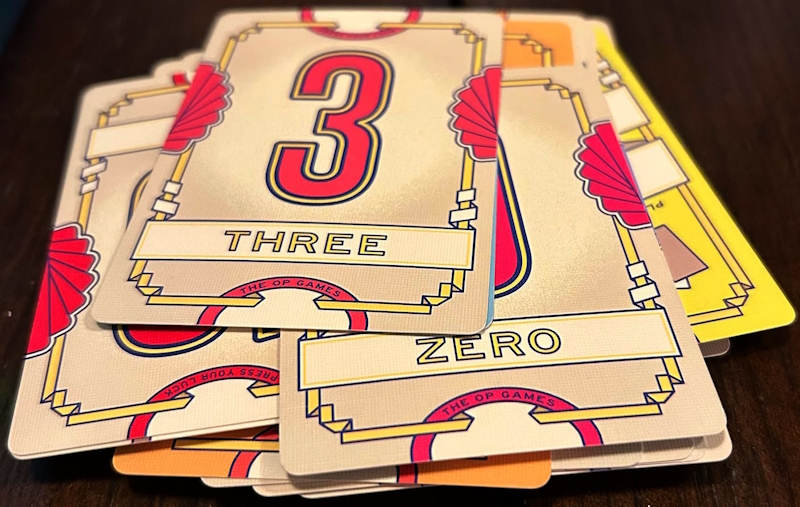
Stamp Swap
– Image by boardGOATS

It turns out that the game takes quite a lot longer with more players, which was a bit of a surprise given that much of the game is played simultaneously.  This time Ivory led a group of five with Plum, Sapphire, Jade and Teal, while Blue led a group of four comprising Byzantium, Purple and Black.  Ivory’s group were quick off the mark and first to get going after the rules explanation.  Their Goals gave points for:  Stamps of one Colour in one Group; sets of all five Theme Stamps; Large square Stamps, and Cancelled Stamps not on the edge, while their Finale Contest gave points for the number of Stamps completely surrounded by other Stamps.  Ivory’s personal scoring objective was Space Themed Stamps, Plum’s were Animals, Sapphire’s were Vehicles, Jade’s were Monuments and Teal’s were Flowers.

Stamp Swap
– Image by boardGOATS

Everyone began by feeling their way a bit, especially as the first round added additional Specialists—cards that give extra powers for the rest of the game.  Plum made a “bee line” for these, while Jade and Teal focused on the Large Square Stamps, scoring the related bonus, and giving them an early lead.  Jade also managed to “hide a gold stamp (face down)” and ended up with it in his collect as no one took it.  Plum scored for the Cancelled Stamps first, as she had picked up a lot of them.  As nobody chose his set, Ivory ended up with all his own Stamps, which he thought was great at first, but then had second thoughts as he ended the first round at the back of the pack.

Stamp Swap
– Image by boardGOATS

In the second round, the event was “Rewarding finds” giving two points immediately for taking a face down Stamp, which everyone was keen to do, especially Plum, who quickly caught up with Jade and Teal as a result.  Plum made good use of her “Swap one for three face down Stamps before splitting your collection” to grab extra Stamps.  Teal managed to hang on to the First Player token for most of the game and also took a lead on the Forever Stamps. Sapphire grabbed an exhibitor for Yellow Stamps and proceeded to take Stamps to match wherever possible (both from the pool and from other peoples piles). Ivory made a point of collecting a full set of five different Theme Stamps, scoring nine points, as well as managing to keep a valuable face-down Gold stamp.

Stamp Swap
– Image by boardGOATS

Going into the final round, Ivory was still trailing significantly behind everyone else who were bunched tightly together.  This time the Event gave bonus points for taking Stamps that matched the Theme of their neighbours, which made the game slightly meaner as everyone was taking Stamps others wanted.  Plum was again using the additional Stamps she was getting from her Specialist to shape what she was going to end up with, managing to get three complete sets for twenty-seven points. Jade also managed to score well for this in the final round, as well as for the coloured Stamp cards he collected. Sapphire was similar with his vehicles and Yellow stamps, as well as scoring scoring for Large Square Stamps.

Stamp Swap
– Image by boardGOATS

Teal fell a little behind, taking fewer points for the Cancelled Stamps on the edge and he also failed to collect any of the Flower Stamps he needed as everyone kept taking them during the swap phase (in order to get complete sets). Ivory meanwhile focused on getting as many Large Square Stamps adding to the three he already had, giving him a massive fourty-two points taking him from behind and giving him a significantly lead.  In the final scoring, Teal took the bonus for the most Forever Stamps giving him ten points while and everyone but Plum tied for second with a single Forever Stamp, giving six points.

Stamp Swap
– Image by boardGOATS

Everyone managed to get at least one gold stamp, but Ivory had the most valuable total face value.  Plum scored most for specialists, although most people had at least one, so this made little difference to the scores. Everyone scored well for the Finale Contest, especially Jade, and Plum, but it was not enough to overhaul Ivory’s lead.  He finished with a total of a hundred and forty-eight, ten more than Plum who took second place, who was a handful of points ahead of Sapphire in third.  On the next table, Blue took longer to explain the rules, but once they got going, they soon caught up with the first group and ended up finishing just before.

Stamp Swap
– Image by boardGOATS

Their first Event card was “Generous Gifts” so after the Collect phase, players choose one collected items to score and then pass on to their neighbour.  Everyone quickly chose their highest scoring Stamp, then realised that meant they would lose it, so had a bit of a re-think.  It was then that the group began to really appreciate the quandary at the centre of the game:  it was all very well taking nice tiles, but they were no use if someone else took them.  This tension was particularly obvious in the final round of the first game where the “Mine not Yours” Event gave points for taking Stamps that matched a neighbour’s theme—while players lost the opportunity to pick up Stamps they wanted in the Collect Phase, they had the chance to take them in the Swap phase.

Stamp Swap
– Image by boardGOATS

The Events in the second and third rounds were “More to See” and “Stamps Forever”.  These had a much smaller impact on the game play, or at least it felt like that, though the Forever Stamps were all collected in the final round.  The Finale Contest was “Empty Regions” which gave three points for each empty region.  Black showed everyone how to to maximise this and from the end of the first round, everyone’s collections began to look like every-expanding checker boards.  Comparing the final album boards between the two games, the layouts were completely different with compact groups for the first game and gappy sprawling displays for the second game.
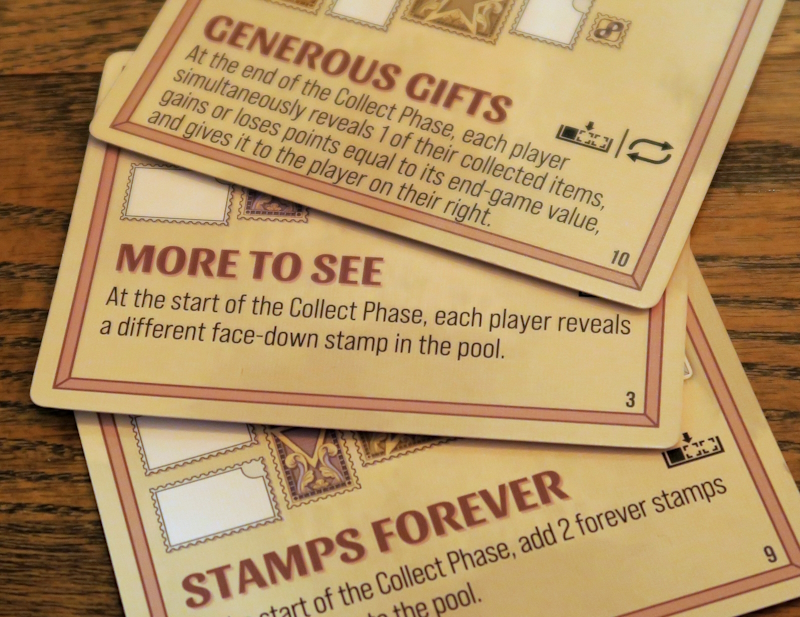

Stamp Swap
– Image by boardGOATS

Black picked up the bonus for having the most the Forever Stamps, and Byzantium, who by his own admission had been “pants during the game” picked up loads of points in the dying stages.  Purple had done the best with her personal Goal—Flowers, while Blue had a plethora of rare, valuable Stamps.  During the game it had been unclear who was really in the lead as the scores seesawed a bit, but Byzantium’s lunge for the line gave him the lead when it mattered and he finished with a hundred and forty-six points, seven more than the runner up, Blue.  All in all, everyone had enjoyed the game, though the overwhelming feel was that there was much more to the game than the reviews claimed, but that’s a good thing.

Stamp Swap
– Image by boardGOATS

Cobalt was the only person with a strong aversion to playing Stamp Swap, but Pine, Lime and Pink were all keep to play one of their favourite games, Zoo Break, another game that wasn’t really his type.  In he end, Cobalt graciously joined in the keepers of Bedlam Zoo, trying to keep the animals under control.  The game is a cooperative game, where players take it in turns to roll a die to determine how many actions they get, take the actions like acquiring
supplies, capturing animals, locking enclosures etc., before cards are drawn to see what animals escape and then move towards the exit.  The aim is to get all the animals back into their cages and lock them before five animals  or anything dangerous gets out.

Zoo Break
– Image by boardGOATS

The group chose to use the standard difficulty (two “Phew” cards), but with the “Faulty Lock” variant.  This is where players roll to see if the lock holds when one of the locked up animals tries to escape; it adds a but of interest to the end of the game, however, unfortunately this time, the group didn’t get that far.  They managed to lock up the Elephants, Tigers and the Rhino, but the mischievous Pandas remained rogue until the end of the game.  They weren’t the problem, however, that was the Snakes.  Three harmless Garter Snakes got out, but they were followed by a Viper, and as it left, so did the group’s zoo license…

Zoo Break
– Image by boardGOATS

With Bedlam Zoo sadly closed prematurely, the group moved on to a couple of quick fillers.  The first of these was No Thanks!, a really clever little “cards with numbers” game.  The idea is that players either take the face up card or pay a chip to pass the problem on to the next player with the aim being to be the player with the lowest total at the end.  The clever part is that if a player has a run, only the lowest value card counts, but the deck also has some cards removed at random.  This makes it a proper gambling and “push your luck” game.  This time, Cobalt was the top scorer, but the winner with eighteen was Pink.

No Thanks!
– Image by boardGOATS

There was just time for one more game, Coloretto.  This is another simple and clever card game, this time the essence of the core mechanism in the bigger game, Zooloretto.  The idea is that players either draw a card and add it to a truck, or take a truck and add its contents to their collection.  At the end of the game players score their three largest sets positively, with negative points for any other sets.  The clever part is the use of the Triangular number sequence which means the first card in a set is worth one point, while the sixth is worth six.  There were the usual questions about Joker cards which resulted in questions being called across the room, but in spite of taking all three Jokers in the deck, Pink was just second by three points behind Lime’s total of forty.

Coloretto
– Image by boardGOATS

Learning Outcome:  A game about Philately can be more than just Stamp Collecting.