Tag Archives: Viticulture

8th July 2025 (Report)

Things were late starting, largely due to the delayed arrival of Blue and Pink with their copy of the “Feature Game“, the the shiny new Emberleaf.  It was Plum’s Special Birthday—there have already been two in the last few weeks (Jade and Pine, with Black a few months ago) and more to come in the not too distant future—so there was a bit of chat, card signing and some amazing chocolate cakes provided by Sapphire.  Eventually, as time was marching on, games were assigned and Blue and Jade started to explain the rules of Emberleaf to Ivory.  This is a “card dancing” and tile placement game from the same stable as The Isle of Cats, where players are trying to re-home their kin in clearings on the central Forest board.

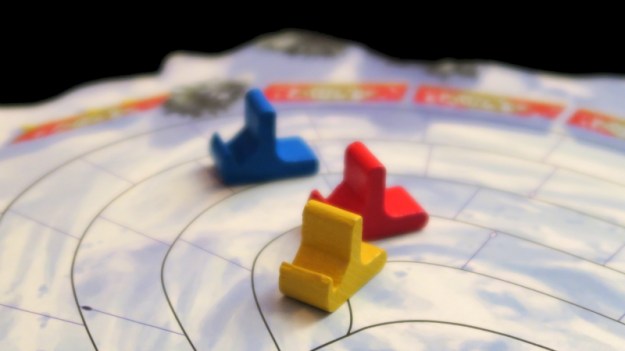
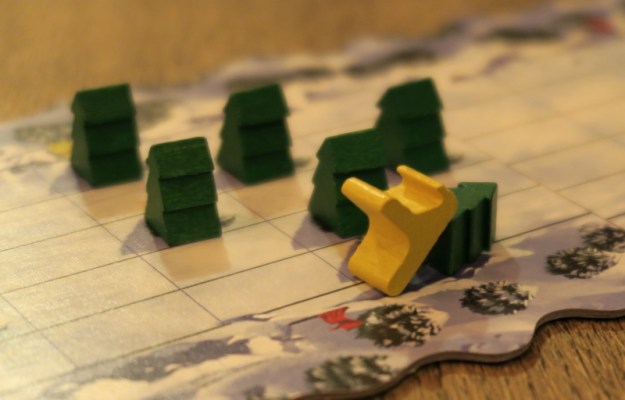
Emberleaf
– Image by boardGOATS

The core mechanic of the game is card placement and movement on the players’ individual Fellowship player boards.  The idea is that on their turn, players carry out one of two possible mandatory actions and as many optional actions as they like.  The two possible mandatory actions are Card Placement and Card Movement (or “Dancing”).  There are five different types of power on the Cards and one of these is the “On Play” action.  This takes effect when they are placed—players start with a two by six space to place cards and can place each card in any empty space.  The other possible mandatory, Card Movement involves starting with the card in the top left corner and progressing down each column, each card is moved left one space and any “Slide” actions are carried out.

Emberleaf
– Image by boardGOATS

When cards reach the left-most column, Sliding moves them off the player’s board (activating any “Drop Off” actions) and back into their hand (not via a discard pile like deck-building games, so there is no probability element; Cards as always available in hand or on the player’s Fellowship board).  The remaining two powers include “Ongoing” and “Charge”.  Ongoing powers are always active as long as the card is on the board, while Charge powers are optional actions that can only be taken a set number of times before they must be refreshed by the Card Sliding off the board.  All these actions broadly come under the categories of Gathering Resources (Wood, Stone, Turnips or Honey), Walking between clearings, Attacking monsters to make dangerous areas in the forest safe, and Building in clearings.

Emberleaf
– Image by boardGOATS

Each player has a space on their Fellowship board to place Resources, which means players have a limited number they can store.  So, for example, Building requires a card to give the action (either placed or moved) and the necessary Resources to be spent, as well their Hero figure at the clearing they are building in.  Each player starts with a super-cute Hero Figure representing their clan chief, located in Hawker’s Crossing—the most westerly clearing, on the edge of the Forest.  From there, players can move their Hero around the board by Walking along paths which go through dangerous areas.  If a player wants to travel through a dangerous area, they need to walk further or, alternatively, they can spend a turn Attacking the monsters in the Dangerous area and make it Safe (which also requires an action either by placing a Card or as part of a Card Movement).

Emberleaf
– Image by boardGOATS

As always, Ivory was on the case, and asked the key question:  Where do the points come from?  In truth, Emberleaf is a bit of a “point salad” with points coming from all sorts of places.  For example, players get points for Building with the number of points equal to the number of different types of building in a neighbourhood.  Players also get points for making Dangerous areas Safe, as well as for collecting Trophies.  There are six Trophies available during the game, and getting these is all about timing with the player who reaches the bottom of the cooperative War Banner Track taking one.  Everyone gets some benefit from this, but the player who takes the Trophy gets an extra bonus.  The game ends at the end of the round when the sixth is taken.

Emberleaf
– Image by boardGOATS

Additionally, in a similar way to the tiny buildings in Tapestry, when players take one of their twenty Emberlings from their Fellowship board and re-home them, they reveal a little bonus and some of these are points (others include Resources etc.).  There is another, more significant way of gaining points, however, and that is through Favour Cards.  These are personal objective cards which can be very lucrative and are scored at the end of the game.  Favour Cards can be acquired as part of rehoming Emberlings, but also by Promising a Favour, one of the optional actions that can be carried out as part of a player’s turn.  Each clearing starts with a Favour token in each player’s colour and if their Hero is currently located in a clearing containing one the player may spend it to take a Favour card.

Emberleaf
– Image by boardGOATS

On the surface, the game is not that complex, though building an engine requires an understanding of what the cards do and how to get the best of them.  Additional Hero cards can be taken from a Card market when a Campfire icon is revealed (likely on re-homing an Emberling).  There are a few little rules niggles as well.  For example, the Card markets (there are two:  Favour and Heros) are refreshed at the end of a player’s turn, but as well as replacing the used cards, the oldest card is also discarded meaning the order cards are drawn in has to be observed.  Similarly, whenever a the bottom of the War Banner Track is reached, the Dangerous Area tiles are refreshed.

Emberleaf
– Image by boardGOATS

Ivory, got a handle on the rules really quickly and was out of the blocks on the “B” of bang.  Jade wasn’t far behind, while Blue was much, much slower as she spent much of her time with her nose in the rules checking queries rather than focusing on her game.  When she finally got round to looking up, the others were distant figures on the horizon and she had a lot of catching up to do.  Ivory had moved quicklywith an initial strategy of building buildings on the areas that gave honey (particularly markets occupied by a mouse for his end game scoring).  This gave him additional spaces on his board and he then picked up a couple of additional Hero Cards and several Favour Cards to further drive his strategy.

Emberleaf
– Image by boardGOATS

The Koala allowed Ivory to battle anywhere whenever he “Danced”, and that gave him a steady stream of points and resources.  Jade and Blue were slow to clear the additional board actions, but Ivory found that opening up the Build Action meant he always had that available and could place a card with only “Dance Actions” at the end, giving me max benefit for that card.  Everyone tried to get end game objective cards early as they give something to aim for.  Ivory was by far the most effective at this however getting cards that gave points for having his mice on markets, mice in at least three different areas and building in exactly four areas, whereas Blue who was slower, found she was trying to take objectives that matched her achievements.

Emberleaf
– Image by boardGOATS

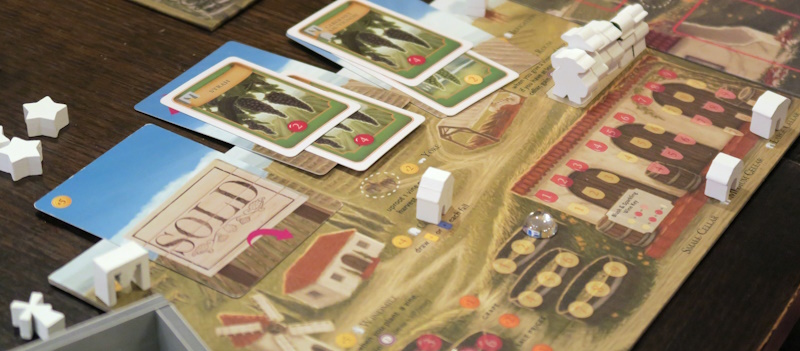
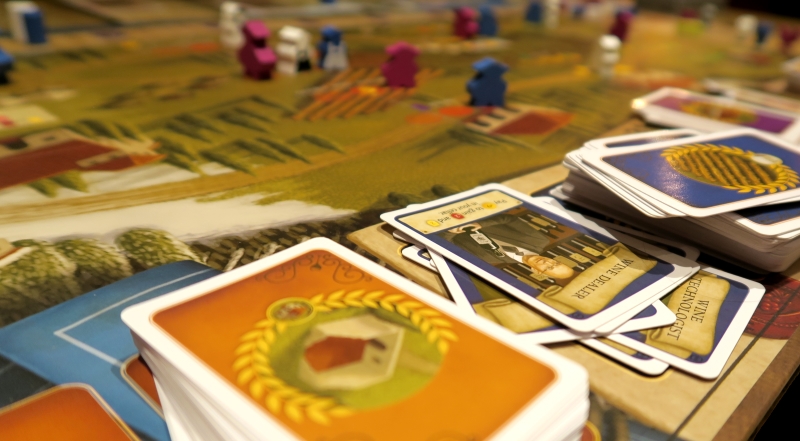
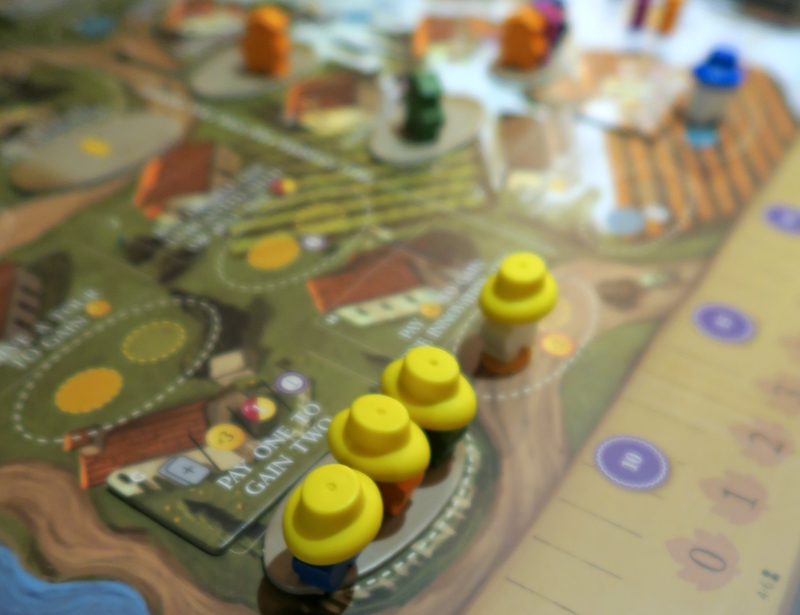
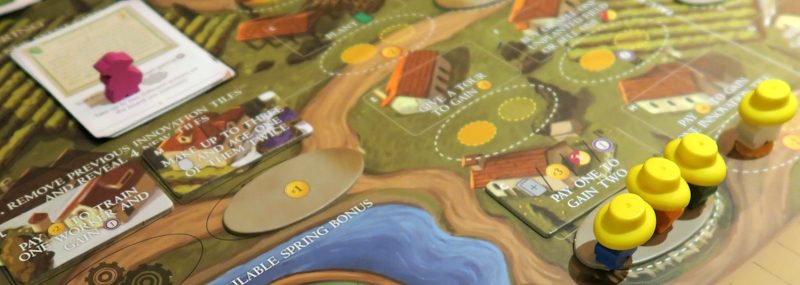
Inevitably, Ivory was the victory by a veritable country mile finshing with one-hundred and thirty-eight, though Blue who had been practically stationary for most of the game, came through strongly in the late stages to take second.  It had been a tough learning game, but everyone had liked it and it definitely deserves anothe outing.  Meanwhile, Plum, the Birthday Girl, was playing one of her favourite games, Viticulture.  This is also one of Pink’s favourites and is also very popular with both Byzantium and Mint who completed the foursome.  There is nothing really innovative about the game—it is “just a standard worker placement game”, but it does the job really, really well, which elvates it above so many other worker placement games, and as a result, it rates highly on ranks very highly on so many lists.

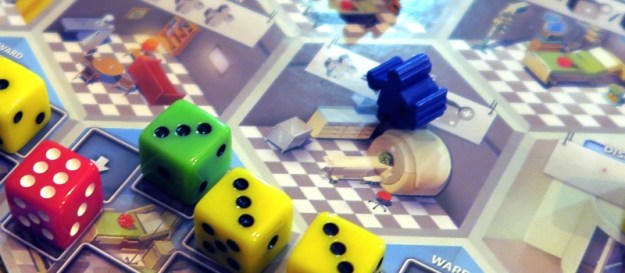
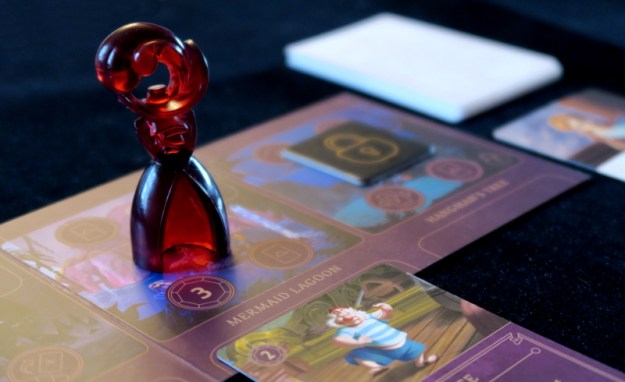
Viticulture
– Image by boardGOATS

The game played over several rounds, which are split into seasons—Players take it in turns to place workers on the Summer part of the board in the first half allowing them to plant grapes and prepare for Winter when players can harvest their grapes, make wine and fulfill contracts for points.  In general, each action has a small number of active spaces, but players also have a Grande worker who can always be used to carry out an action, even when all the usual spaces have been filled.  Winter and Summer are setup phases when turn-order is addressed and Visitors arrive.  Visitors are cards which allow players to bend the rules slightly and/or gain points.

Viticulture
– Image by boardGOATS

This time, however, the group decided play with the Tuscany expansion and the Moor Visitors card deck.  Tuscany replaces the main board with a larger board, but also re-structures the phases so that there are now four seasons to place workers.  It additionally adds a small map where players can place star-eeples to gain a bonus and points at the end of the game for the player with the most influence in this area.  Tuscany also brings in structures, which players can build to enhance their vinyard and use to gain more points.  It also lenghtens the game slightly, ending when a player passes twenty-five points rather than twenty in the base-game.

Tuscany
– Image by boardGOATS

Everyone knew the game well, so after just a few rules clarifications the game was underway with everyone opting for the the now standard trategy of selling a field for an early influx of cash.  Mint started with some really nice building cards including one which enabled her to harvest multiple fields at the same time.  Plum was less enthused by hers and recycled them—as she had begun the game with the Cottage she was picking up extra Visitor cards every Autumn.  She made a concious decision not to choose to “wake up” first, which meant she never went first or last in the turn order and when she chose the start bonus of “age grapes” she forgot to take advantage of it.  This was clearly catching as Byzantium did something similar when he chose the same starting position.

Viticulture
– Image by boardGOATS

The Tuscany expansion also adds Special Workers which have their own special abilities and players can train one of their workers to have each of these.  This time they were the Farmer and the Builder, with the latter from the Special Workers promo.  Respecively, workers with these powers, allow the player to choose a bonus (even if they are not on a bonus space) and save two lira when building.  A priority is always to get more workers early in the game, but whether to upgrade them is a difficult decision as it costs an extra lira and cash is always so tight in this game.  These proved quite popular though as going second in a location with a Farmer still gave a bonus.

Tuscany
– Image by boardGOATS

Pink got his head down making wine early as he picked up two really nice, achievable and valuable contracts early in the game, which gave him a solid start.  However, it was a very long time before anyone actually really started scoring points as everyone concentrated on building their vinyards before putting them into action.  For example, Plum, needed a Trellis for her first grapes, although having a Builder reduced its cost.  Eventually she also built a Penthouse which gave an extra point when making high quality wine over a value of seven and with those in place was in a position to start growing, harvesting and turning grapes into wine.

Tuscany
– Image by boardGOATS

At one point, Plum played a two Visitor card combo that gaver her a grape which she was immediately able to sell at tripple the normal price.  Otherwise, everyone mostly focussed on turning grapes into wine and completing contracts for points, although Pink did turn cash into points as well.  As is always the way with Viticulture, there was a sudden cascade of points, and with four experienced players it was a tight game with all four finishing over the twenty-five point finishing line.  The winner was Pink, however, who finished with thirty one points, three more than Plum who took second (no, Pink wasn’t going to let her win, even on her birthday!), and Byzantium and Mint tied and shared the last spot on the podium.

Tuscany
– Image by boardGOATS

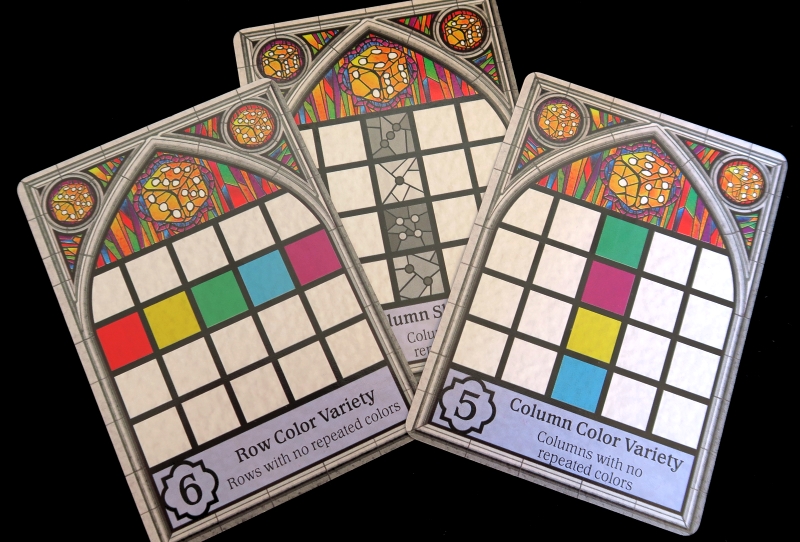
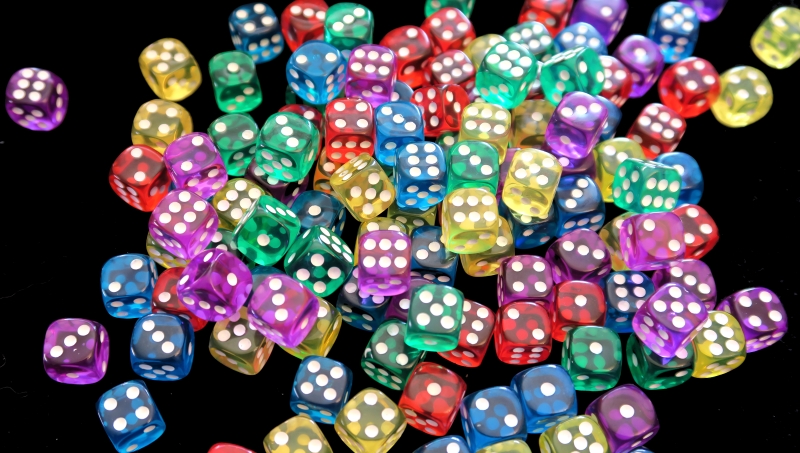
The third table, comprising Black, Purple, Pine, Sapphire and Lime, started with a game of Sagrada (with the 5-6 player expansion).  This is a fairly simple game of dice-drafting, where players are placing dice to create stained glass windows.  Dealt at random, each player begins with a private objective card and two double-sided Window pattern cards, choosing one side to play with and taking the number of Favor tokens marked on the chosen pattern.  Three Tool cards and three public objective cards are placed in the communal central area and the first player rolls all the dice.

Sagrada
– Image by boardGOATS

In “serpentine order” (i.e everyone taking a turn in order then taking a turn in reverse player order), players can use any Tool card (paying one Favour token for the first use, two thereafter) and then choose one die from the pool and place it on an open space in their Window.  The first die must be placed on an edge or corner space and every other must touch another die diagonally or orthogonally.  Dies must match the colour or value depicted on the space if there is one and may never be orthogonally adjacent to a die of same color or value.  Players may choose not to take a die on their turn, but that will leave an empty space and each one costs a point at the end of the game.

Sagrada
– Image by boardGOATS

The game ends after each player has had twenty turns after which players score points for each public and private objective achieved adding one point for each remaining Favour token and and deducting a penalty point for each empty space.  Even though there were five, the group played by these standard rules rather than adding the optional private dice pools from the expansion.  The communal goal cards gave points for placing pairs of dice with a value of three and four; sets of dice with a value of one to six and rows with no repeated numbers.  As is always the case with dice games, this game is all about riding the luck of the roll, but it can play havoc with people’s plans.

Sagrada
– Image by boardGOATS

For example, on Pine’s first turn a roller six of the dice had a value of two, but nobody wanted them.  Later in the game he rolled again, this time rolling no twos when at least two people desperately wanted them!  When the game came to an end, there was just the scoring.  Honours were pretty much even for the first two communal objectives.  Purple managed to score once for the lucrative, one row without repeated numbers objective, while Sapphire and Black scored it twice and Pine three times.  Scores for the private objectives were almost identical for Sapphire, Lime and Pine.  In total that gave Pine victory, nine points ahead of Sapphire in second and sixteen ahead of Black in third.

Sagrada
– Image by boardGOATS

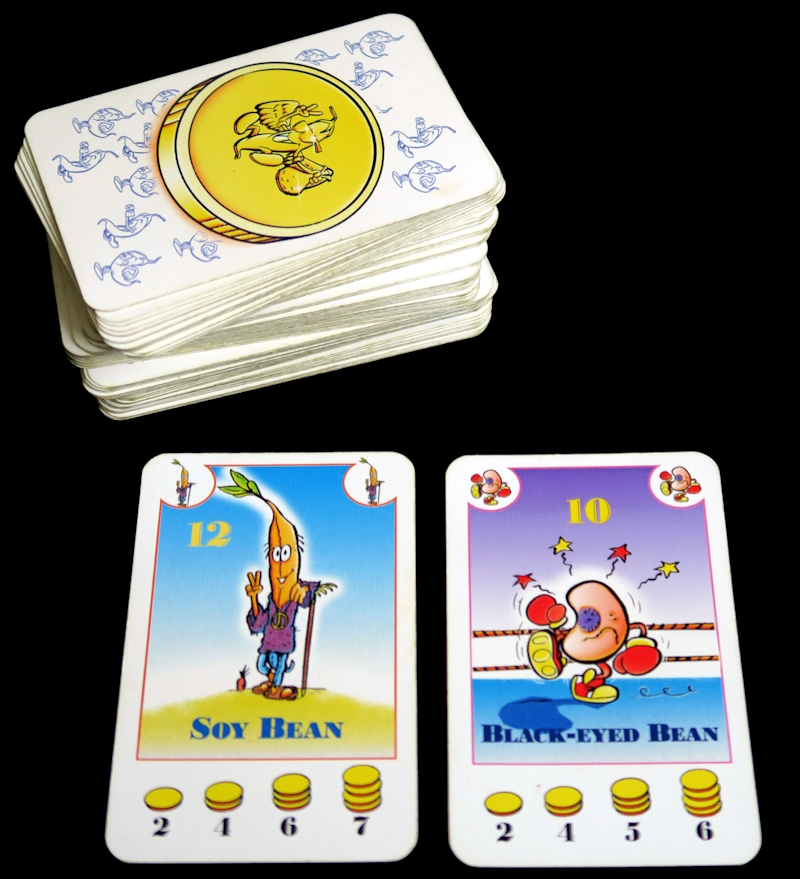
The other games were still going and looking like they were giong to take the rest of the evening, so the group looked around for another game that played five.  From the other side of the room Blue suggested Bohnanza, and as Sapphire thought he’d never played it, the group decided that wasn’t a state of affairs that could continue.  This is a popular game within the group as it is a lot of fun, even though a game about bean farming and trading sounds very unpromising.  Played with cards, the key mechanism is that the order of players’ hands cannot be changed—they can only be manipulated by in-game play.  So, on their turn, players must play the first card in their hand into one of their two “Bean Fields”, and may play a second if they can.

Bohnanza
– Image by boardGOATS

Beans can only be added to empty fields or to fields of the same type.  A field can be harvested at any point, but the aim it to maximise the yield.  Once the active player has played from their hand, there is the flop: two cards are played from the deck onto the table.  These must be planted before the next phase, but can be planted in the active player or by any player with their agreement.  Sometimes these are gifted, sometimes they are traded, and this is how players can manipulate the cards in their hand, by trading away undesirable cards.  Once the cards on the table have been disposed of, then the active player can trade any card in hand before replenishing from the deck to end their turn.

Bohnanza
– Image by boardGOATS

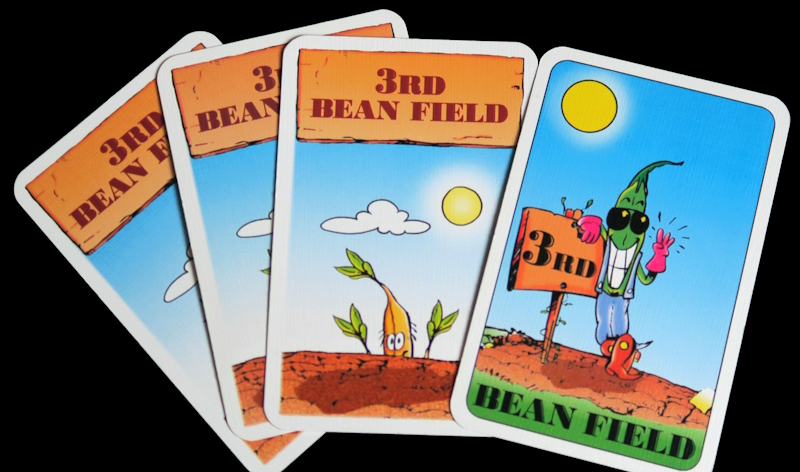
The game ends after three passes threough the deck, but while the first pass seems to take forever, the last always goes like lightening because many of the cards are now in players’ score piles.  Further the balance of the cards changes as the game progresses, with rare cards disappearing as they are turned into “Thaler” and get stuck in players’ stash.  Players can spend some of their riches on a Third Bean Field, but this is only really productive if carried out early in the game.  This was a strategy adopted by Pine this time—unusually for him.

Bohnanza
– Image by boardGOATS

It paid off almost imediately as Pine collected two of the super-rare cocoa beans, and soon added a third.  Black commented that he’d get the fourth, and Pine couldn’t hide his delighted laugh when he immediatly picked it up!  The winner was Lime though who finished three points clear with twenty, leaving Pine to take second and Black to make up the podium.  The question was, however, had Sapphire enjoyed it?  Sadly, the answer was a resounding “no”.  Worse, it turned out that he had played it before, and had disliked it so much that he’d blocked out the experience.  Such a shame, but some games are not for everyone…

Bohnanza
– Image by boardGOATS

Learning outcome:  You don’t have to know how you win, you just have to score more points.

18th February 2025

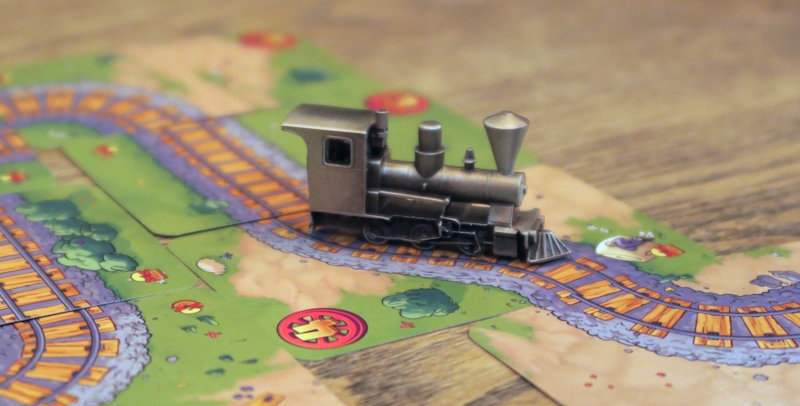
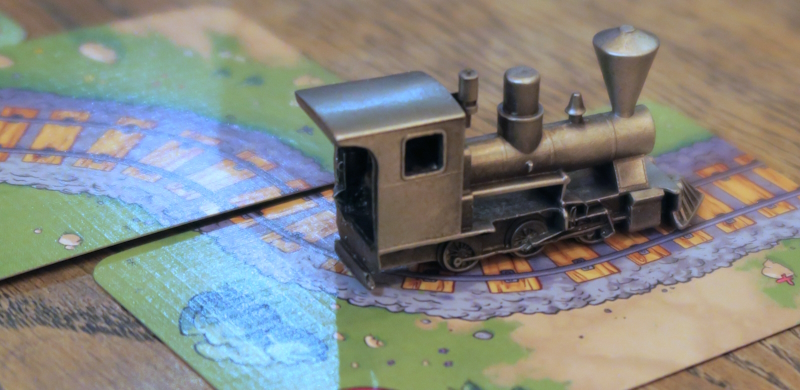
Blue and Pink began the evening, while they waited for their supper to arrive, messing about with a little card game called Rollecate which is about a historic steam locomotive built in 1967 by a famous Dutch engineer.  The idea of this little game is that players take it in turns to play Track cards to extend Rollecate’s line by placing cards.  They can play as many cards as they want, as long as they all have the same number.  When laying new track, the difference between the numbers on the last card and the first new card placed must not have a difference of two (thus one cannot be followed by three and four cannot be followed by two etc.). Cards must not overlap when played and cannot force impossible play.

Rollecate
– Image by boardGOATS

Once the Track cards have been played, the active player rolls dice equal to the sum of all numbers on the cards they played, and Rollecate moves forward one step for each Wheel rolled on the dice.  Thus, if a player places two threes, they roll six dice. If Rollecate reaches the end of the track, she hits the brakes.  For every step she’s short, the player take one card from behind the train places them on their penalty pile one by one in any order they want. Any time the card placed matches the number of the top card on the pile, both are removed from the deck.  At the end of the game the everyone adds up the face value of their cards and the player with the lowest total wins.

Rollecate
– Image by boardGOATS

By the time Blue had explained the rules to Pink, their food had arrived, and by the time they had finished their supper, Cobalt had joined them.  Blue was just finishing explaining the rules when Pine joined them and eventually they all finally managed to play the game.  There were a few “teething issues”, but before long the delightful little metal miniature was progressing along the track.  Blue and Pink got unlucky and picked up a lot of cards, some high scoring, and weren’t able to remove them.  Cobalt and Pin did rather better with Pine finishing with five penalty points and Cobalt with four.

Rollecate
– Image by boardGOATS

By this time, almost everyone had arrived, and Pink began to set up the “Feature Game” which was to be Viticulture World, the cooperative expansion to the popular wine-producing worker placement game, Viticulture.  This is one of Pink’s and Teal’s favourite games, but also very popular with other members of the group.  No-one had played the cooperative expansion, however, but despite some apprehension that the changes might spoil a favourite, there were a lot of interested parties.  In the end, Pink was joined by Teal, Ivory, Plum and Cobalt, all of whom were very familiar with the base game.

Viticulture
– Image by boardGOATS

There isn’t really anything particularly special about the base game, it is just a worker-placement game where players are growing grapes and making and selling wine.  However, it is just done very, very well.  In general, there are two types of worker spaces—restricted, that only a limited number of workers can use per round, and open spaces which can be used by as many workers as players want.  Each player also has one Grande worker who can be placed anywhere, even on fully occupied spaces.  The cooperative game is essentially much the same as the original Viticulture, with some small rules changes and a different target:  players have six years to goal: each player must reach twenty-five victory points and the shared influence token must reach the end of the influence track.

Viticulture World: Cooperative Expansion
– Image by boardGOATS

There are seven different packs of cards and the group began this time with the easiest, Green Gully, which as advertised, is a very good introduction to Viticulture World.  This is designed to make sure everyone is successful on their first time out (though it may be easier with more players).  Each player has four workers plus one Grande and unlike the original, there is no mechanism to get more.  Two of these workers have yellow hats to indicate they are summer workers and two have blue hats and these can only operate in winter, training however, allows them to remove their hat and play in other seasons.  There was a little concern prior to play that as only certain types of workers are able to claim certain bonuses it might make the game a touch fiddly, but this was not the case.

Viticulture World: Cooperative Expansion
– Image by boardGOATS

As the game progresses, there are Event cards which give special action and also increase the number of workers that can be placed on some locations. There was some confusion at the start of the game as to whether the Grande worker could be used to claim the special actions.  It was felt this would make the game way too easy though, because if everyone was able to take advantage of the bonus with their Grande this would make the game too easy; a quick online check confirmed that this was not allowed.  The group found the game fairly straight-forward, though everyone was quit experienced and therefore knew where the areas of tension were, in particular making wine, harvesting grapes and fulfilling orders, so made a point of upgrading these early.

Viticulture World: Cooperative Expansion
– Image by boardGOATS

The group had a lot of fun, and as is not uncommon with this game, there were lots of “getting my cock out now” comments (especially from Ivory), when it came to claiming the turn-order.  Ivory was the first to achieve his required twenty-five points, but he went on to get thirty in order to claim an extra influence point for the team.  Cobalt was next to make his target and everyone else followed the next round.  Despite the initial reservations, everyone enjoyed the game and would be keen to try some of the more challenging regions on another occasion in the not too distant future.

Viticulture World: Cooperative Expansion
– Image by boardGOATS

While the oenophiles were playing Viticulture, the other four were revisiting Kavango.  This is a medium weight card drafting and tableau building game which has something of the feel of Wingspan.  This was the “Feature Gamelast September, when it went down well with those that played it, one of whom was Pine.  It had a second outing two weeks ago, when Blue promised Pine and others it would come back.  Pine was keen to give it another go, and this time they were joined by Purple and Black.  The game is fairly straightforward to play, though a monumental table-hog, so the group started by moving to a larger table on the other side of the room.  Blue outlined the rules:  Players start with a hand of twelve cards and choose one before putting the rest to one side.

Kavango
– Image by boardGOATS

This card is then either added to the player’s tableau if it is an animal card, or activated if it is an action card.  Once the card has been played, players have the opportunity to invest in protection or claim rewards (money and points) for completing targets.  In the early part of the game, the cards that are dealt are mostly from the bottom of the food chain, what the game refers to as “Producers”, rodents and the like.  As the game progresses, the creatures get bigger and require the presence of other animal types or terrain as food and protection (Habitat, Poaching and Climate).  This time, Blue (who was playing the game for the third time) stole a bit of a march, picking up more points during the game than anyone else.

Kavango
– Image by boardGOATS

Pine who was on his second play, did a god job of collecting valuable animals and finished with a massive one hundred and twenty-six points, but failed to pick up the bonuses for the protection.  Purple didn’t do so well with her animals, but had every type and picked up all the bonus points available for protection too, while Black didn’t take any points for that, but did well on his personal objectives.  The winner, (unsurprisingly given her extra experience) was Blue followed by Pine with Purple in third.  The consensus from Purple and Black was that the game (like Wingspan) felt a too random, though Blue and Pine commented that it felt less so after multiple plays.

Kavango
– Image by boardGOATS

Learning outcome:  Making wine is just as much fun as a team.

10th December 2024

Everyone had already arrived and was waiting in anticipation when Blue and Pink arrived with piles of gamers crackers, Christmas tree decorations, party poppers, paper parcels, mince pies, festive cakes (with carrot meeples on top) and GOAT Award voting forms.  Food quickly followed along with a volley of noise as people tried to pull their crackers and party poppers first so the contents didn’t land in their supper.  As people munched, there was some discussion about the games played and voting forms were filled in.  In the absence of Green, Pine kindly offered to act as returning officer and collate the statistics.

"Un-Christmas Party" 2024
– Image by boardGOATS

While cake and mince meat parcels were shared round, toasts were offered by Lime to the organisers, and in the memory of Burgundy.  He is much missed and will never be forgotten, but we always make a special point of remembering at this time of year, especially as the Un-Christmas Dinner was his last games night with us.  The GOAT Awards were then announced.  Moment of the Year was when Pine got the end game rule wrong for Tonga Bonga, so that Pink thought he’d won, but then didn’t.  The GOAT Poo Prize for the least popular game of the year went to Ca$h ‘n Guns—not a game the group plays often and its only outing over the last year was at the New Year Party.

"Un-Christmas Party" 2024
– Image by boardGOATS

Then it was time for the Golden GOAT.  Previous winners were ruled out, but other contenders included Akropolis, Kavango, Flamme Rouge and Ticket to Ride: Rails & Sails.  The clear winner of the 2024 Golden GOAT Award, however, was Stamp Swap.  There was much discussion about how this was the third winner from Stonemaier Games (after Tapestry last year and Wingspan in 2019) and how we should invite Jamey Stegmaier, to collect the award in person.  Email correspondence over the following few days suggested that while it was unlikely he would be able to come to GOATS, he will be in the UK next year and just might make it as far as Oxford.  In the meantime, he has highlighted the award on his website.

Golden GOAT - 2024
– Image by boardGOATS

With the festive business over, the group broke into three to play some games.  Pink, Blue, Black and Jade began with the “Feature Game“, Courses De Rennes (aka Reindeer Races), a fun little game where players control a team of four reindeer, racing along four different tracks to try to get the highest-scoring tiles.  On their turn, each player can either draw two cards (with a hand limit of seven) or play as many cards of the same type as they can to move one reindeer along one of the tracks.  The cards are numbered and have suit that corresponds to one of the tracks (or are Elfy, and “wild”).  If two and a three of Gifts is played, the player may move one of its reindeer along the Gift track.

Course des Rennes
– Image by boardGOATS

If a reindeer lands on the same space as another reindeer, it slides forward a space.  If that is occupied too, it continues to slide.  If, however, the owner cries “Thump!” as it lands, the reindeer slithers an extra space forward.  The first reindeer to arrive at the end of a track claims the highest value token.  The game ends when two of the tracks have run out of tokens.  Pink too the first points, and with it a strong early lead.  A few rounds later, Jade took the last token from one of the tracks and with it ended the game.  He got very unimpressed looks from Black and Blue as he gifted victory to Pink, so once this was pointed out, Jade revised his move and play carried on.

Course des Rennes
– Image by boardGOATS

Ultimately, however, it didn’t really change things as Pink still took victory with twenty-two points.  He was long way clear of Jade who won the tight fight for second with fifteen just one point ahead of Black who, in turn, took third by a single point.  Everyone else was still playing, so the group looked for something else to play.  Black had won a copy of Ticket to Ride: Paris in the raffle and, although it wasn’t very festive, it seemed appropriate to give it an outing.  Some of the GOATS had played this mini-city variant of the popular train game earlier in the year when we marked the Olympics with sport and France themed games.  However, none of the current quartet had been part of that group.

Ticket To Ride: Paris
– Image by boardGOATS

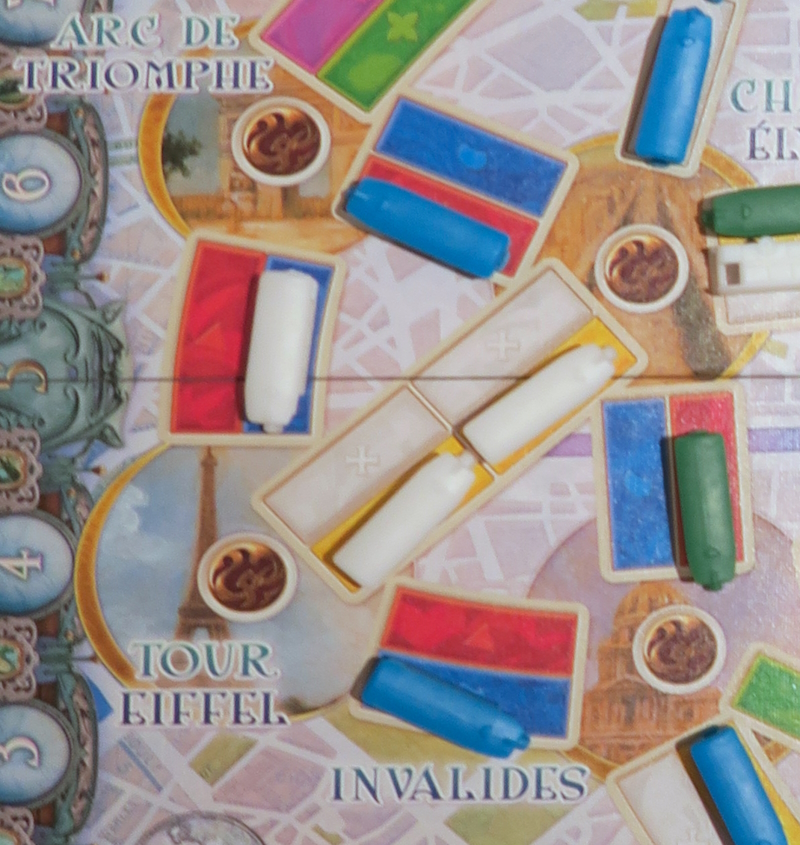
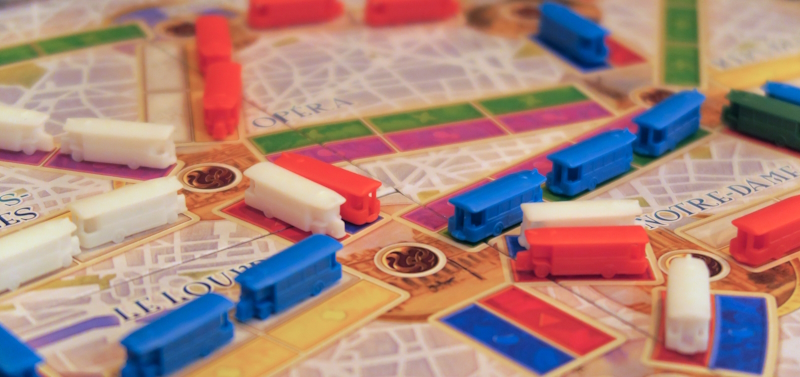
The rules are much the same as all the others (take two cards from the market; play cards to place pieces on the map; collect Ticket cards to score points at the end), but like all the variants, Paris has a special rule.  When players claim a red, white, or blue track, they get a card, when they get all three colours they get four “Tricolore” bonus points.  When the game first came out, there had been comments about how this felt very bolted on, but in practice, it was much more interesting than it sounded.  This time, the in game scoring was quite tight, though Blue, with her trains across the city centre got her nose in front and led by six points.  Tickets can make a huge difference to scores though, as they can give a lot of points, both positive and negative.

Ticket To Ride: Paris
– Image by boardGOATS

Black, Pink and Jade all picked up similar points for their completed Tickets (ten, eleven and eight respectively), though Jade was unlucky and unable to complete his last one.  Blue, however, made good use of concurrent routes and scored a massive twenty-four points for hers giving her something of a landslide victory with a total of forty-six.  It was much closer for second which went to Pink who finished with twenty-nine, two points ahead of Black.  Meanwhile, on the other side of the room, Purple was leading Ivory, Plum and Byzantium in one of her favourite Christmas themed games, Christmas Tree.

Christmas Tree
– Image by boardGOATS

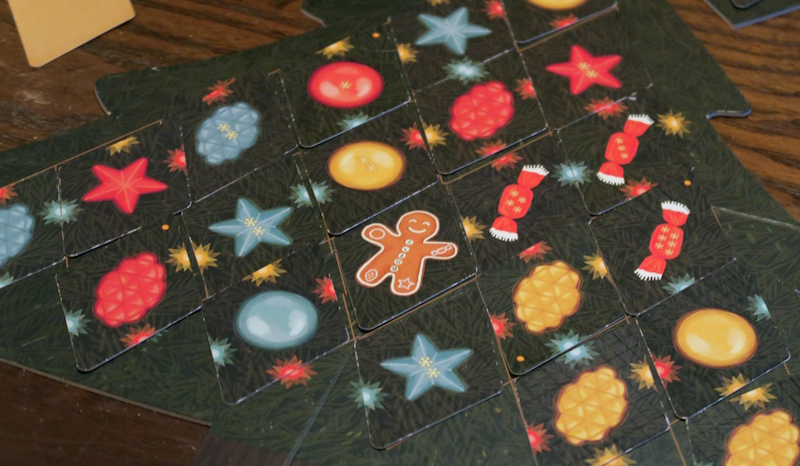
This is a fairly simple little card-drafting game played over thee rounds, where players are “decorating their Christmas Tree” with diamond-shaped cards, where players score points for the Objective cards everyone contributed to a central pool at the start of the round.  This time, the group played from the advanced set of Objective cards (including all three levels) although the first round, the cards were all levels one and two.  These gave one point for each blue or “nobbly” ornament, four points for each pair of ornaments of the same colour and shape arranged in a vertical pair and six points for three specific shapes in a given arrangement.

Christmas Tree
– Image by boardGOATS

The first round started off slowly with everyone looking to fulfill some of the Objectives—everyone was successful, but Plum and Byzantium got off to a better start.  Plum placed her first Gingerbread man and then concentrated on placing vertical pairs although she only managed that once.  In the second round the Objectives were from the more complicated sets, including six points for three specific colours in a given arrangement, six points for the same three shapes or colours in a set pattern, or eight points for four ornaments with the same point value arranged in two set formations.  This time, Byzantium significantly out scored everyone with multiple objectives scored multiple times and, as a result, built a big lead.

Christmas Tree
– Image by boardGOATS

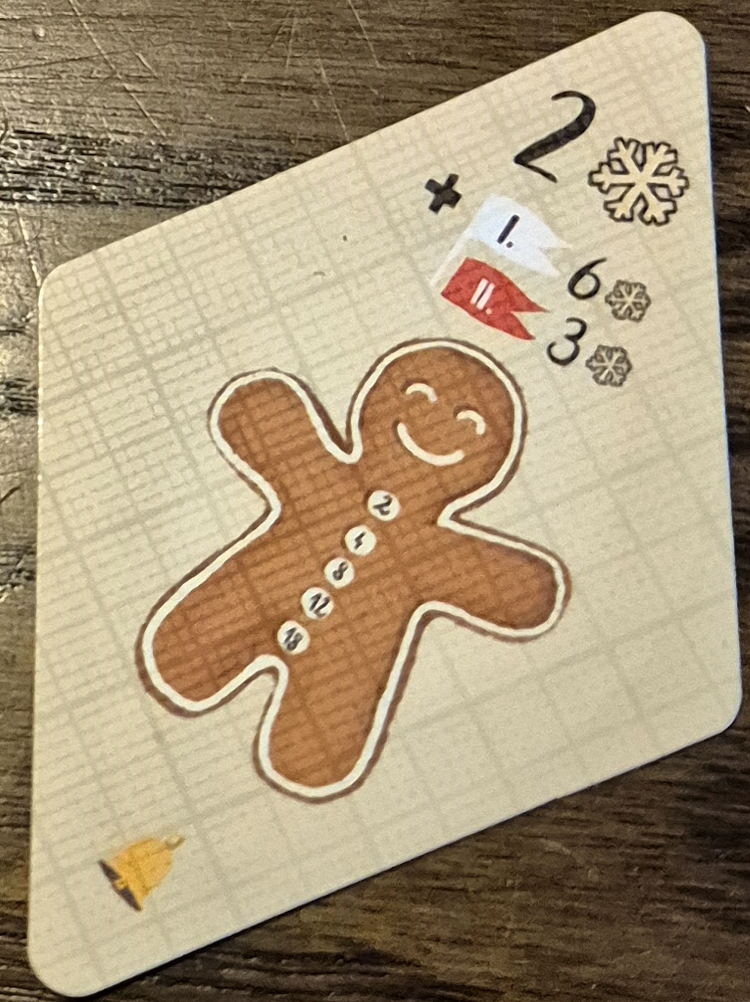
Plum used one of her Biscuits to move baubles around to make a row of four contain the three colours of glass bauble.and thus scored well, whereas Ivory was focusing on picking up high value Sweets and surrounding his Gingerbread men.  The final set of Objectives included six points for a set arrangement of certain point values, eight points for four ornaments with the same point value arranged in a particular arrangement and five points for each row in which the total points of the glass were above the given amount. Finally, there were two points for each Gingerbread man, with bonuses of six and three points for the player with the most/second most Gingerbread men.

Christmas Tree
– Image by boardGOATS

In the third and final round, Byzantium again out scored everyone, scoring multiple times for the set arrangement of certain point values.  At this point, Ivory was full committed to Sweets and Gingerbread men, especially knowing he was putting in the Gingerbread man Objective, which he scored well for.  Plum and Purple also scored well in the final round, with Plum following a strategy similar to Byzantium, whereas was Purple was collecting sweets like Ivory.  It looked like Byzantium was going to win by a large amount, as he was fifty points ahead of everyone else and was scoring more than anyone else for Lights and Baubles too.

Christmas Tree
– Image by boardGOATS

Ivory’s focus on surrounding his Gingerbread men gave him over fifty points and with more than thirty for his sweets he finished with one hundred and seventy one points, pipping Byzantium to victory by just two, with Plume in third some twenty points adrift.  The puzzly nature of the the game had gone down well and with the Christmas theme everyone had enjoyed playing Christmas Tree.  On the next table, the festive link was much more tenuous, however.  Teal, Pine, Sapphire and Indigo had chosen 6 Nimmt!, because there was a twelve in it, representing the Twelve Days of Christmas (or perhaps they had just wanted to play the game and if you can’t play a daft party game at Christmas, when can you?).

6 Nimmt!
– Image by boardGOATS

6 Nimmt! is a popular game with the group at any time of year, though it is usually played with more than four people.  Either way, the game is very simple to play, though tough to play well.  Some say this is because there is a lot of chance in the game, but they are usually the people who do badly…  The idea is that players simultaneously choose a card to play and these are then added, in order, to the rows of cards on the table.  The player adding the sixth card, instead, takes the first five cards into their scoring pile.  Usually, we deal out half the cards for the first round and the rest for the second and the winner is the player with the fewest “nimmts” (or points), at the end of the two rounds.

6 Nimmt!
– Image by boardGOATS

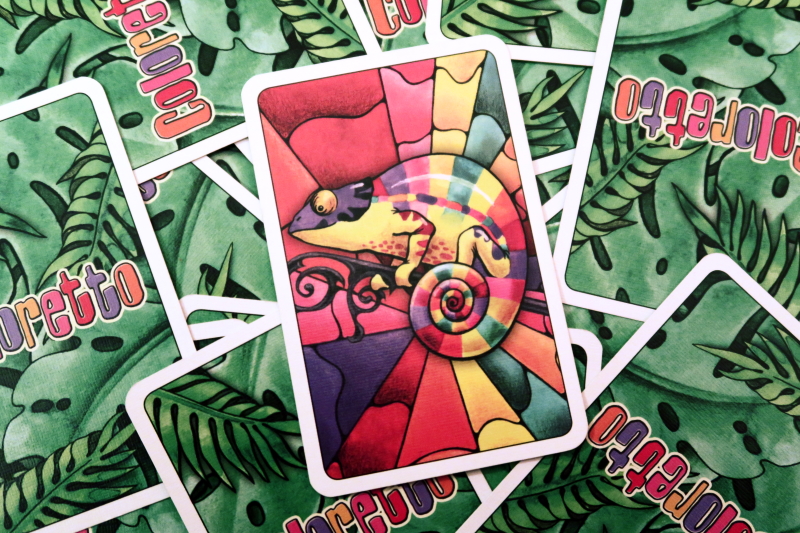
This time, however, the group decided to play the multiple-hand variant where each hand has ten cards, and the game ends when someone’s score passes sixty-six.  And that was Sapphire, who finished with an exceptional total of ninety-five.  The winner was Teal with forty-four, however, who was just two points better off than Pine.  The other games were still ongoing, but there was still time for one last game for this group (who were joined by Navy) before everyone went home warmed by the Christmas Gaming Spirit—and their choice of game was Coloretto (apparently this is a  festive game because it includes red, green and gold Chameleons).

Coloretto
– Image by boardGOATS

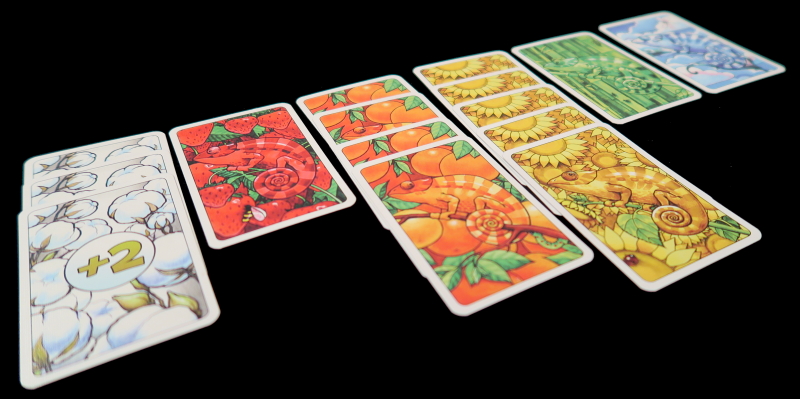
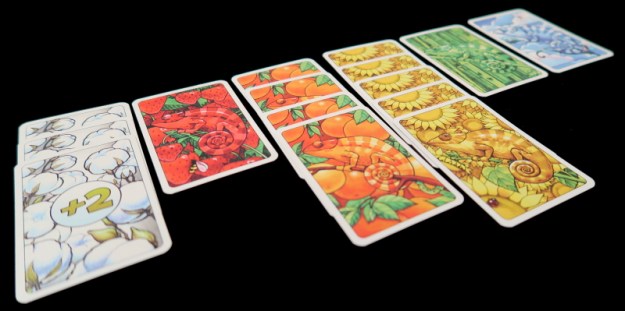
This is another simple filler game, where players either take a card and add it to a truck, or take a truck.  Each truck can take a maximum of three Chameleons, with players collecting coloured sets.  The largest three sets score positive points (according to the Triangular Number Series), while all the others score negative points.  In this way, the bigger the series the more additional cards will score, so the aim is to collect three large sets and ensure the others are as small as possible.  This game was really tight, with Sapphire claiming victory with twenty-seven and Teal and Indigo tying for second on twenty-four.  And with that, people began to drift off, many not to be seen until 2025.

Coloretto
– Image by boardGOATS

Learning outcome:  GOATS love a Cracker!

Golden GOAT Award Winners – 2024

This week was the annual boardGOATS Un-Christmas Dinner including the voting to decide the winners of the GOAT Awards.  There are two main awards:  the Golden GOAT for our favourite game played during the year and the GOAT Poo Prize for our least favourite.  Everyone had the usual three points to hand out for the Golden GOAT Award (plus a bonus if wearing Festive Attire), though a maximum of two points could be given to any individual game.  Everyone could also nominate up to two individual games for the GOAT Poo Prize.

Tonga Bonga
– Image by boardGOATS

This year, the unofficial “Marmite Award” went to Viticulture—something many people seemed to find quite a surprise as it is generally not a divisive game and one that few would usually take offense at.  There had been a lot of fun throughout the year, but one of the more memorable moments was Pine getting the end game rule wrong for Tonga Bonga, so that Pink thought he’d won, but then didn’t.  There were several nominations for the GOAT Poo Prize, including King of Tokyo, Rolling Realms and Ark Nova, but the winner was another surprise: Ca$h ‘n Guns—not a game the group plays often, indeed it doesn’t get played at all at the pub (for obvious reasons), so its only outing over the last year was at the New Year Party.  It can be a lot of fun, but it is also easy to see how some might not like the game.

Ca$h 'n Guns
– Image by boardGOATS

Then finally, there was the Golden GOAT Award for the best game played in the year.  Previous winners were ruled out, but there were plenty of other great games to choose from.  The most popular of these were Akropolis, Kavango, Flamme Rouge and Ticket to Ride: Rails & Sails.  However, the clear winner was Stamp Swap.  This is a new game, only released in September, but was an immediate hit, largely thanks to its silky-smooth game play.  As one person commented, “I wouldn’t have thought a game about stamp collecting would be up my street, and yet…”

Stamp Swap
– Image by boardGOATS

Perhaps more remarkably, this is the third winner from Stonemaier Games after Tapestry last year and Wingspan in 2019—three very different games.  This led to the perhaps slightly tongue-in-cheek suggestion that the group should invite Jamey Stegmaier to visit so we could present him with the actual Golden GOAT in the manner of the Jules Rimet Trophy

Golden GOAT - 2024
– Image by boardGOATS

5th March 2024

The evening started with everyone unsure who was coming, so the nine players present split into three groups of three, with Blue, Pine and Lime starting with the “Feature Game“. This was the very short, light, Make the Difference, a game that is basically “spot-the-difference” in board game form.  The idea is that each player gets a pre-printed picture and simultaneously add five extra “features” to their pictures.  Once everyone has added their “extras”, players take it in turns to place their pictures in the centre of the table (covered with a sheet of acetate to make it a little more difficult to spot the difference between printing and drawing), together with an unadulterated copy.
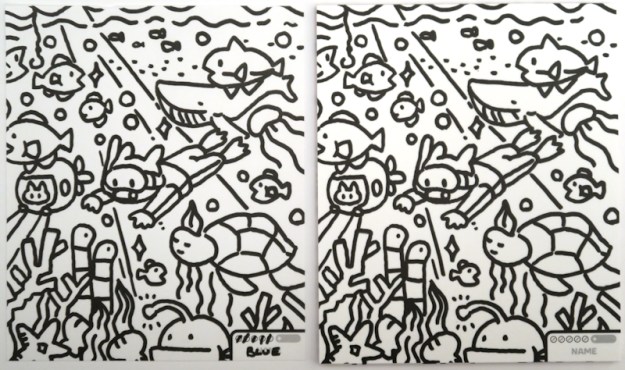
Make the Difference
– Image by boardGOATS

Players have one minute (timed with a slightly grumpy egg-timer), during which a player spotting an addition gets a point, then a second minute, during which both the spotter and the modifier get a point.  After the two minutes, any un-spotted additions are assessed for size, and if they are large enough, the modifier gets two or three points.  The additions have to be a single line, may extend an existing feature, and can’t just increase the width of an existing line.  This time, Pine went first with his picture, and the slightly mardy timer gave Lime and Blue a few extra seconds to spot his additions as Pine encouraged it to behave.  Most of his additions were spotted, partly as a result.

Make the Difference
– Image by boardGOATS

Lime went next, and players were slower to spot his additions giving him extra points.  Blue was the last, but this time Pine and Lime really struggled.  For some reason, Blue seemed to be better hiding hiding her additions, taking six points for lines that weren’t spotted during the two minutes of play.  In contrast, her poor spotting let her down, giving her a total of eight points, and just enough for second place.  The winner was Lime, however, with ten points.  There was a little chatter while they packed away, but as there were no new arrivals, the trio moved on to play something else, and quickly chose to give the recent Northern Lights edition of Ticket to Ride another outing.
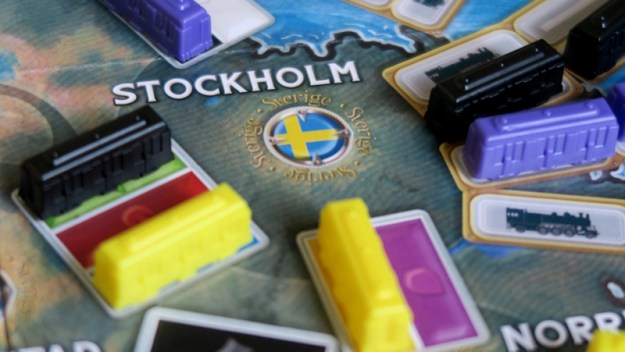
Ticket to Ride: Northern Lights
– Image by boardGOATS

Ticket to Ride: Northern Lights has had a couple of outings since it’s group debut last summer, and has been quite popular in the group.  The game is a fairly standard edition of Ticket to Ride (take cards from the market, or play cards to place trains), but the map is set around the Scandinavian countries of Denmark, Norway, Sweden and Finland.  Like all the variant games, this one has a couple of minor rules tweaks, principally, the addition of bonus cards which give points at the end of the game and bonuses for completing some of the longer Ferry routes.  Locomotives are also handled slightly differently as the market is not refreshed when saturated by them, and for Ferry routes only, they can be replaced by any two cards of the same colour.

Ticket to Ride: Northern Lights
– Image by boardGOATS

This time, the bonus cards drawn at random were the Locomotive Collector (A), International Tycoon (G), Polar Express (H) and the Ferry Master (J).  Pine went first and started placing trains much to Lime and Blue’s horror.  A few turns later, Lime headed up the Norwegian cost, while Blue started building an extended route from Bergen in the west through Stockholm to Tallin in the east.  It was then that Pine, with his north-south route got in her way and began costing her points thanks to the fact that with only three players the double routes weren’t in play.
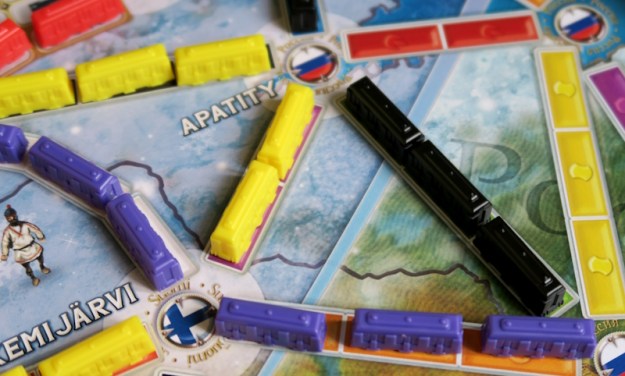
Ticket to Ride: Northern Lights
– Image by boardGOATS

As he had done last time the group played, Lime churned through his trains remarkably quickly catching Pine and Blue on the hop slightly. After the last few turns had been played, the bonus points were allocated with each player winning one (Lime for the most Ferry routes; Pine for the most tickets ending in the Arctic Circle and Blue connecting the most countries while nobody had any Locomotive cards at the end of the game).  Pine claimed a completed Ticket for eighteen points which he had almost completed when he drew it (AGAIN!).  Also like time, Lime finished with a nice round hundred points, and once again was pipped pipped to victory by Pine, albeit by a larger margin (ten points rather than three).
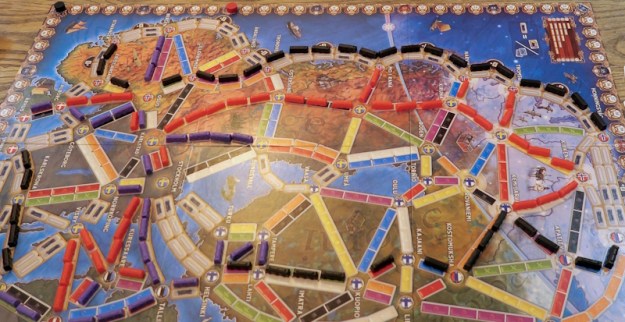
Ticket to Ride: Northern Lights
– Image by boardGOATS

With that over, Lime headed home, leaving Blue and Pine to kill time while waiting for one of the other games to finish.  In this, they played a little “wallet game” called Circle the Wagons.  This is a simple, quick game where players take cards from a market and add them to their player area, building a map, scoring points according to the largest areas of each terrain type and three addition scoring criteria selected at random.  These scoring criteria are printed on the reverse of the cards and are drawn at random at the start of the game.  The first bonus card drawn was “Boom or Bust which gives points for two or fewer Mines/Pickaxes, none for three to six and four or five points for seven or eight (or more).
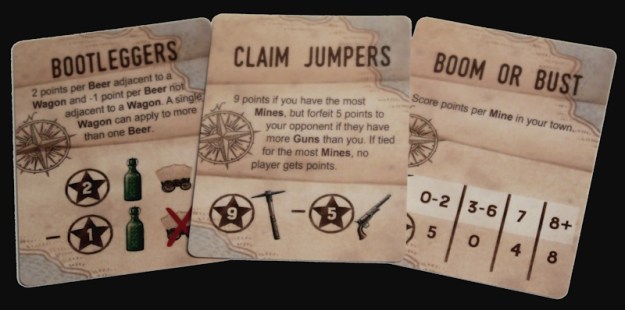
Circle the Wagons
– Image by boardGOATS

The other bonus cards were Claim Jumpers which gives the player with the most Mines/Pickaxes nine points (though they lose five if their opponent as more Guns), and Bootleggers which give two points for each Beer Bottles next to a Wagon (and minus one for any not next to a Wagon).  Once the bonus cards had been picked, the remaining fifteen cards were shuffled and arranged in a circle.  The first player, in this case Pine, could then choose to either take the first card, or take another, later card, leaving any that had been skipped for his opponent, Blue, who then had the same choice.  Play continues until all the cards had been taken.
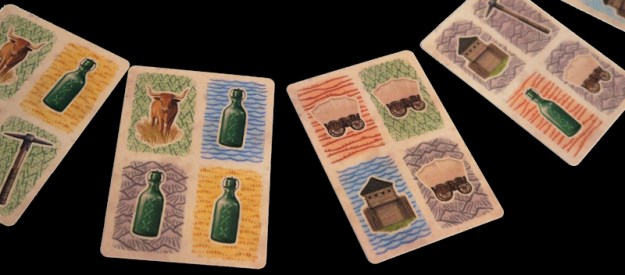
Circle the Wagons
– Image by boardGOATS

This time, Pine started prioritising Pickaxes, given the fact that two of the bonus points scored for them.  Blue was slow to get started with these and ultimately scored nothing for Boom and Bust and for Claim Jumpers.  She collected Beer Bottles instead and prioritised scoring for her terrain.  Blue’s thirteen points for Beer Bottles exactly matched Pine’s for his Pickaxes, though he picked up half a dozen points for his Beer as well.  Blue took six points for her Forest and four for her Plains, while Pine got five points for each of his Desert and Water terrain.  It was closer than it seemed during the game, however, with Pine finishing with thirty-five points, just three more than Blue.
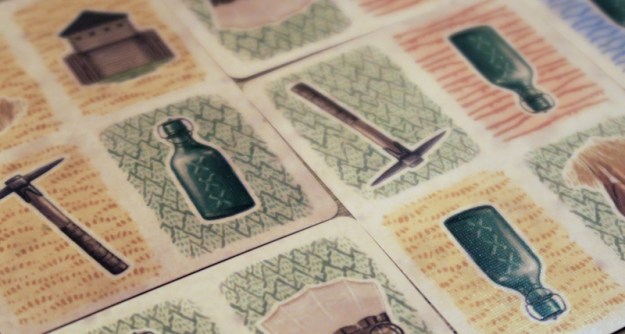
Circle the Wagons
– Image by boardGOATS

By this time, Pink, Teal and Ivory were bringing Viticulture to a close.  This is one of the group’s most popular worker-placement games and a particular favourite amongst Pink and Teal who have been promising each other a game for months.  The game is quite simple and doesn’t really do anything fancy, it just does what it does very well.  The idea is that players are making wine, which they do by placing their workers on spaces on the central board.  Each space has a limit to how many workers can occupy it, with each player having a “Grande” worker who can muscle in anywhere.  This time, the group played with the Tuscany expansion, which adds a few little extras.

Tuscany
– Image by boardGOATS

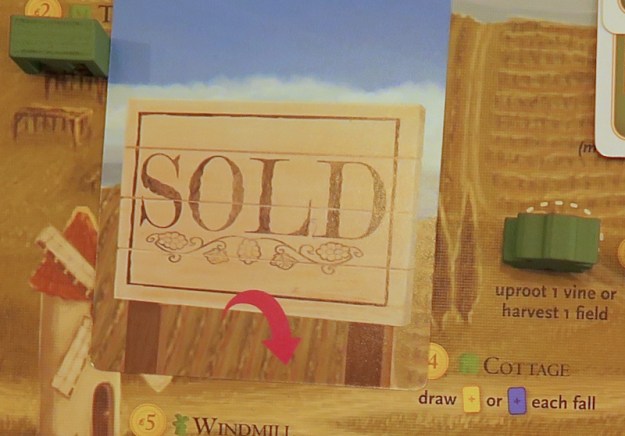
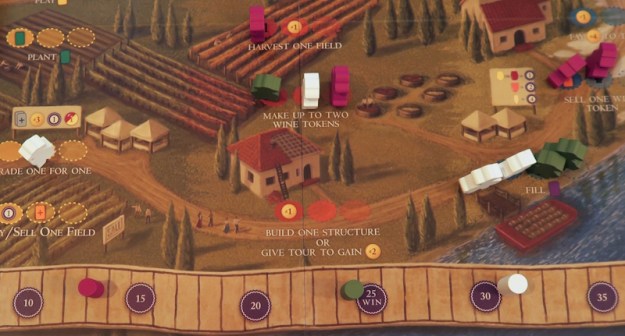
Firstly, whereas the base game has essentially two seasons spring and autumn (with visitors in summer and winter), the Tuscany expansion has actions for all four seasons.  Players can also build special buildings (which give additional powers and special options for those that make the effort to build them), and claim regions to gain influence (and bonuses) which scores points at the end of the game.  The player order works slightly differently to the base game and the end of the game is triggered when someone passes twenty-five points (rather than twenty in the original game).  This time, however, nobody took advantage of the opportunity that Tuscany provides to build buildings, instead focusing on the basics of planting grapes and harvesting them.
Viticulture
– Image by boardGOATS

There is a now a well-known and frequently used tactic of selling a field at the start of the game to provide equity in the early part of the game.  Teal and Ivory both went down this route while Pink decided to try something else, but that didn’t go well for him.  His problems were exacerbated by his inability to get access to fulfilling orders later in the game.  Ivory started acquiring points early taking an early lead.  Teal wasn’t far behind, but never quite managed to overhaul Ivory who triggered the end of the game and finished with thirty-one points, seven more than Teal in second place.
Tuscany
– Image by boardGOATS

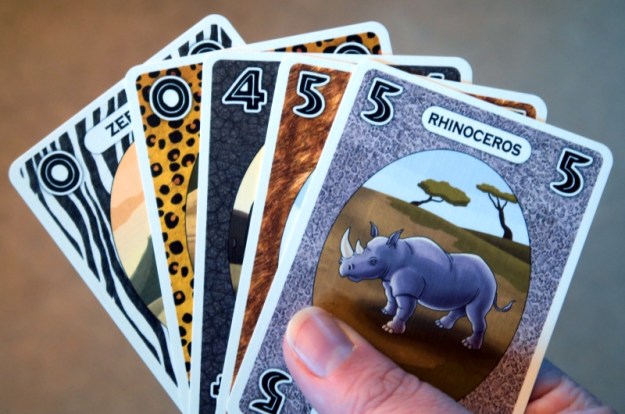
When Viticulture finished, Ivory and Teal headed home, leaving Pink to join Blue and and Pine in a couple of quick games of Botswana.  This is a sort of simple stock-holding game where players are collecting animals.  The idea is that there are five suits of animal cards, each numbered from zero to five—these are shuffled and dealt out to the players with a small number left out for ambiguity.  Matching the suits, there are five sets of five plastic animals.  Players take it in turns to play a card (any card) and then take an animal (any animal) until someone plays the sixth card in any suit.

Botswana
– Image by boardGOATS

When the last card is played in any suit, the game ends immediately and players score points for their animals with each animal being worth the face value of the last card played in that suit.  Thus, Zebras might have been worth five points each, right up until the last card was played which could be a zero, rendering them totally, point-less.  Somehow, it is a hard game to understand—far from random, a bit like 6 Nimmt!, it is very hard to control and manipulate the scoring in a particular direction.  This was quite evident in the two rounds played this time.
Botswana
– Image by boardGOATS

In the first round, Blue held a few key Elephant cards and was able to manipulate the game end to ensure they scored well.  With a couple of high scoring Lions added to her menagerie, she ended the game, ensuring she finished with thirty-five points.  It was very tight between Pink and Pine, but Pink just edged second place with twenty-two.  The second round was also close with just two points between Pink and Pine, but this time they were vying for victory.  In the end it was Pink again, this time triggering the end of the game allowing him to ensure his Leopards scored well.

Botswana
– Image by boardGOATS

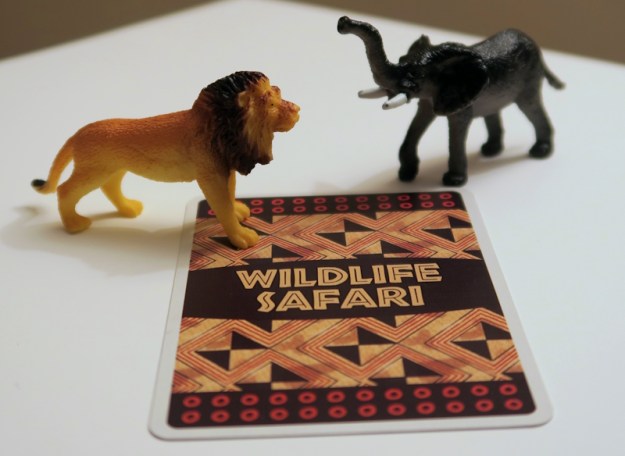
Botswana is a lot of fun and as they packed up, there was quite a bit of chatter.  Pine pointed out that the backs of the cards said “Wildlife Safari” and wondered why.  Blue commented that there were lots of different versions, but couldn’t remember the differences.  A little bit of research shows that the game was originally released as “Flinke Pinke” and then “Quandary” and eventually “Loco!”, all with simple colour suits.  Then, in 2010, the boring colour suits were changed for animals by Eagle-Gryphon Games, who initially republished the game as “Botswana”, before increasing the size of the box and calling it “Wildlife Safari”.  Presumably this particular copy was released when small boxes were still available, but the company had run out of matching cards…
Botswana
– Image by boardGOATS

Meanwhile, on the next table, Cobalt had persuaded Plum and Byzantium to join him playing the rather epic-looking Nightmare Cathedral. This is a card-driven action-selection area-control game set in the fantasy world of late Polish surrealist painter and sculptor Zdzisław Beksiński. The game is adorned with his artwork and beautifully sculpted miniatures. Players control Units, which act as a resource, whilst an imposing Cathedral is built in the centre of the board. Once the Cathedral is completed, two Nightmares (out of a selection of eight) appear next to the Cathedral and can be controlled by a player on their turn if a certain condition is met. Each Nightmare, represented by a unique sculpt, has varying abilities such as converting or devouring units as they move around the map.

Nightmare Cathedral
– Image by boardGOATS

The game ends when a certain number of Units have been devoured, or, less likely, after completing three rounds. The winner is determined by points, which can be obtained from climbing the Ritual track, building Forts, Devouring the most Units, or completing objectives on Dream cards (the latter being the largest source of points). On a their turn, the active player selects an action with their Dreamer from one of five on the day/night action track, although they cannot select an action adjacent to their dreamer’s current space. After performing the action, other players get to follow, either Conforming or Dissenting depending on whether their dreamer is adjacent to the current action space.
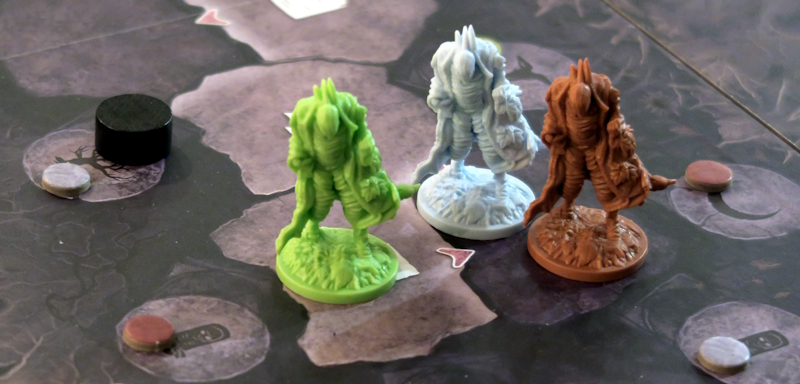
Nightmare Cathedral
– Image by boardGOATS

The active player then moves their Dreamer to the adjacent Night space, a section of the Cathedral is built, the turn marker moves to the subsequent space and the next player takes their turn.  Each player starts with a tableau of five cards, one for each action type, that details how each action can be performed, as well as the Conform/Dissent actions. The players also have a hand of cards, which come in two forms: action Upgrades or one-time Effects; each card also contains combat symbols.  The five basic actions are: Ritual (spending/removing followers to move up the Ritual track); Summon (producing Followers); Fortify (spending Followers to Build/Upgrade Forts); Manoeuvre (moving Units and/or Shaper, performing a conversion and then initial Conflicts); Develop (playing Development cards from hand, either to Upgrade actions or gain one-time benefits).

Nightmare Cathedral
– Image by boardGOATS

A player controls an area if they have a Fort present, or if there is no Fort and they have the most Units in the area. The board is also populated with a “neutral” player, called The Shadows, that can participate in conflicts and be Devoured for benefits. Each area is associated with one of four symbols, with the active symbol being determined by the turn marker (which changes every turn, cycling through each symbol). Certain actions refer to these symbols, for example when moving up the Ritual track, players must spend Units from areas matching the symbol on the next level of the track, or areas marked active by the turn marker produce if that action is selected. When producing Units by marked areas, the unit is produced by the player who controls the area, not by the active player.
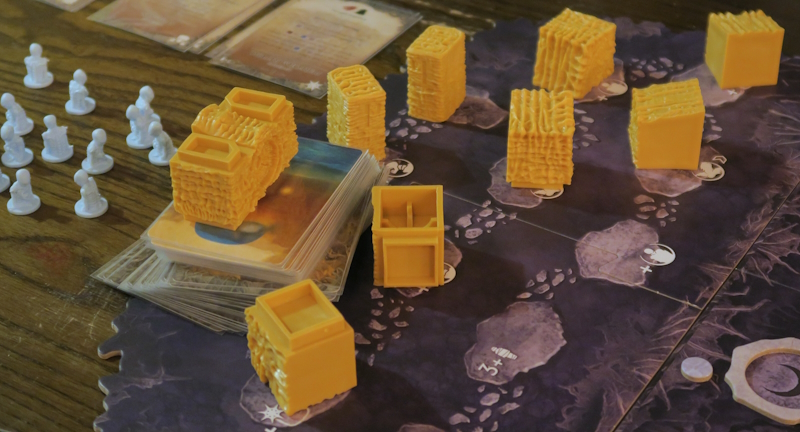
Nightmare Cathedral
– Image by boardGOATS

A player may forgo the action on the card to draw two Development cards to hand. Each player may have up to two Dream (objective) cards at any time, and may complete them on their or another player’s turn provided they match the criteria at the appropriate time as specified on the objective card.  However, they may only draw new cards at a specific point in their turn from a display. Once the Cathedral is nearly complete, the Level II Development and Dream cards are mixed in with the initial Level I cards to provide enhanced benefits and more points. When a player initiates Conflicts, they get to choose which of the valid areas the Conflict(s) occur, and they do not need to participate in the conflict themselves.

Nightmare Cathedral
– Image by boardGOATS

To resolve a Conflict, the two players involved reveal a number of Development cards from hand—the number determined by the number of units present in the Conflict area (plus one if they also have a Fort). Each card depicts claws and shields: a Unit is removed for each claw that was not deflected by a shield. The winner of the Conflict is the player who has a Fort remaining, or, failing that, the most Units in the area; the looser must retreat all remaining Units to adjacent areas.  Each player starts with one action upgraded, drawn at random—each player drew an upgraded summons card.

Nightmare Cathedral
– Image by boardGOATS

Cobalt played first, and was able to complete one of his Dream cards immediately. In the first few turns, Byzantium managed to pin Cobalt in one corner of the board, which severely limited his ability to expand and produce Units, whereas Plum was able to grow relatively peacefully on the opposite side of the board. Byzantium, and to some extent Plum, were able to make use of their expansion to move up the Ritual track. Plum was also able to expand her Forts to several areas. Cobalt was able to upgrade his forts in the limited areas he controlled, as well as draw up to the hand limit of eight development cards over the first half of the game.
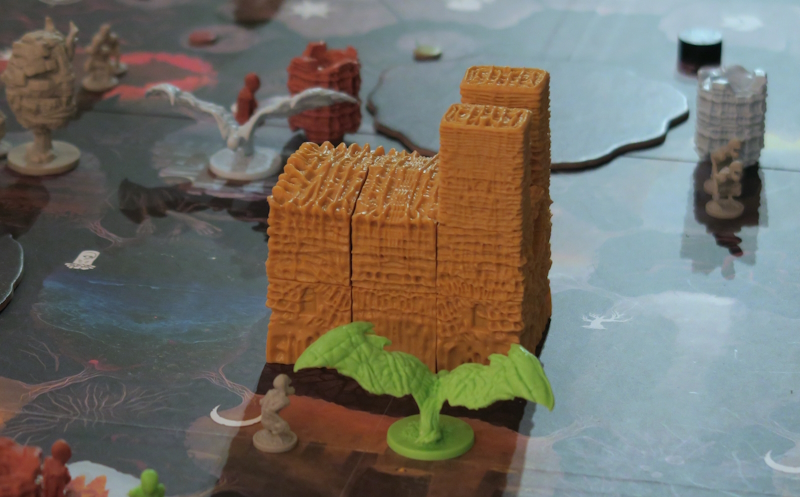
Nightmare Cathedral
– Image by boardGOATS

During the second half of the game, after the Cathedral was built and the Nightmares came out, Cobalt was able to make use of his Development cards (especially due to a very well timed fortunate draw) to control both Nightmares in a single turn to Convert and then Devour a sufficient number of his own Units to claim a high-scoring Dream card as well as ensure he had the most Devoured units for end-game scoring.  Unfortunately, this time, the group ran out of time so had to end the game early, stopping after everyone had completed an equal number of turns (time which Byzantium used to move up the Ritual track and Plum used to built a few more Forts).

Nightmare Cathedral
– Image by boardGOATS

Long before the game finished, it was clear that Cobalt was miles ahead and nobody was going to catch him.  Plum held on to he Dreams for too long, while Cobalt and Byzantium were better at completing theirs.  She did manage to get a Fort in the fourth corner of the map fairly early on which gave her somewhere to spawn her Units from, though.  Ending the game early meant players didn’t get to make as much of their Upgraded Action Cards as they might have done and there were cards left in hand which could have come into play with another few more rounds. As a taster game, it proved quite different, however, and deserving of another try sometime, as long as there is time to complete it.
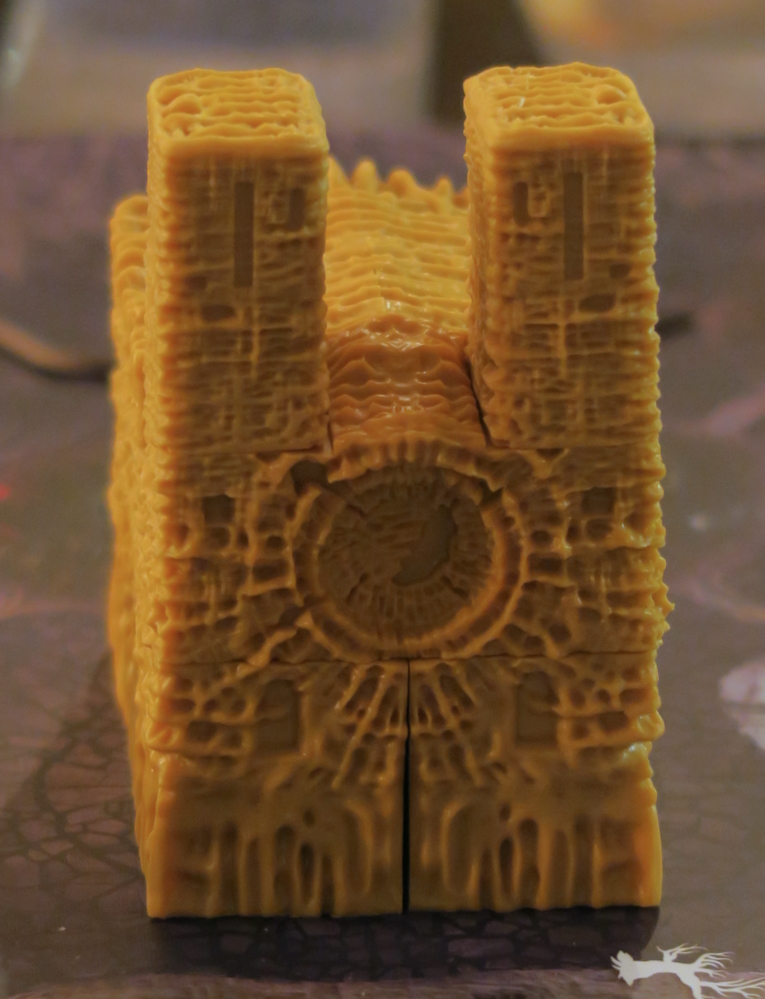
Nightmare Cathedral
– Image by boardGOATS

Learning Outcome:  You are never too old to play “Spot-the-Difference”, but that doesn’t make you good at it.

21st March 2023

Blue and Pink were just setting up Circle the Wagons when Lemon walked in.  As Circle the Wagons is a two player filler game, they quickly packed it away and got out No Thanks! instead.  Lemon hadn’t played it before (or perhaps had forgotten), so Blue gave her a quick rules explanation.  It is a very simple (if clever) game, so it didn’t take long:  the first player reveals the top card of the deck, then makes the choice, either to take it or pay a chip to pass the problem on to the next player.  At the end of the game, the player adds up the face value of all their cards and the player with the lowest total is the winner.

No Thanks!
– Image by boardGOATS

There are two catches, however.  Firstly, if a player has a run of consecutive cards, only the lowest counts to a player’s final score, which encourages players to gamble a little.  However, the second catch is that nine cards are removed from the deck at random before each game, which means the card a player is gambling on getting may not even be present in the deck.  Blue and Pink were half way through their burgers and the trio were halfway through the game when Indigo and then Pine arrived.  Indigo was also new to the game so as they finished the first game Blue explained the rules to her too.

No Thanks!
– Image by boardGOATS

The first game was really close, but Lemon, got lucky and, although everyone scored relatively highly, she had three less than Pink to take victory.  The game plays five well though, so Pine and Indigo joined the other three for a second round.  This time, the top scorer was Indigo who finished just shy of fifty points.  Everyone else was closer, but this time Blue was the winner with seventeen points, some five less then Pine.  By this time, almost everyone else had arrived and the burgers had been dispatched, so it was time to decide who was going to play what.  The “Feature Game” was to be the Visit from the Rhine Valley expansion for one of the group’s most popular games, Viticulture, and the questions were, who wanted to play that, and what would the rest play?

Viticulture
– Image by boardGOATS

Viticulture is one of Pink’s favourite games and Teal was very keen to play it too.  Somewhat surprisingly, Ivory was open to other options, so eventually Indigo and and Green joined them to set that up.  With five people left, Lemon loving Ticket to Ride, and Pine having just acquired Burgundy‘s copy of the Europe edition, it wasn’t really a great surprise when the group decided to give that an outing in his memory.  The game is a very straight forward game of set collecting and network building with players either taking two cards on their turn, or paying sets of cards to place trains on the central map.  Players score points for placing trains on the map (with longer routes giving more points).

Ticket to Ride: Europe
– Image by boardGOATS

At the end of the game, players score extra points for any “completed tickets”, i.e. successfully connected the destinations on ticket cards dealt at the start of the game and perhaps collected during the game.  There is a risk associated with tickets, however, as any that are incomplete, score negatively.  Each version of Ticket to Ride has slightly different rules, so while everyone was very familiar with the basic game, the group had to remind themselves of the specifics of the Europe edition.  The main difference between this version and others is the inclusion of Stations—players can add one of these to a city to enable them to use one line connected to it that someone else has built to help them to complete tickets.

Ticket to Ride: Europe
– Image by boardGOATS

Ivory started and began the game and started on his first move by placing a single train from Bruxelles to Amsterdam.  That caused panic amongst everyone else, and turned out to be completely justified as everyone except Pine got involved in a scrap for the space in central Europe.  Largely as a result of that congestion Purple ended up forced to take tunnel routes.  These are routes where players don’t know the actual cost before they build them, since three cards are turned over from the draw deck and if any match the colour of the track being constructed, these must be matched by the player building the track (or they fail to build it).

Ticket to Ride: Europe
– Image by boardGOATS

This turned out to be costly for Purple who had a couple of attempts knocked back and some that costed considerably more than expected.  Lemon did what she often does and seemly prioritised building tracks she liked the look of, connecting them together later if possible.  Everyone else crossed their fingers and fought for the routes they wanted with most people interfering with somebody else’s plans somewhere along the way.  Ivory claimed the long tunnel route from Stockholm to Petrograd, and much to Purple’s disgust, managed it first time.  Lemon, who was after Pine in turn order kept trying to jump in front of him leading him to wonder whether he was invisible.

Ticket to Ride: Europe
– Image by boardGOATS

Blue seemed to have lots of tickets that didn’t go where her trains were and life got worse and worse as the space became increasingly crowded.  As the number of trains everyone had dwindled, everyone panicked about whether they were going to complete all their tickets.  Then, as everyone else was struggling to complete their tickets, Purple surprised everyone by taking more, and got lucky and finished it the very next turn—just as well, because Ivory had ended the game.  After the obligatory points recount (and a couple of very minor adjustments) the group started evaluating tickets.

Ticket to Ride: Europe
– Image by boardGOATS

Ivory, Pine and Blue had a lot, but Ivory had got lucky with his ticket draws which all fitted together quite nicely.  Blue had been less fortunate and only discovered that she was missing a connection for one of hers when it came to the final count.  Pine and Blue both succeeded in completing eight tickets, but Ivory had the longest continuous connected line, with all but two of his trains conga-ing neatly across the map.  Ivory, who had just been ahead throughout was the victor with a hundred and forty-seven points, twenty ahead of Blue in second and forty ahead of Pine in third.  It had been a good game though, with lots of cut and thrust and everyone (especially Blue) had engaged their inner Burgundy at some point.

Ticket to Ride: Europe
– Image by boardGOATS

Both Ivory and Pine wanted an early night, but there was still time for something else, so long as it wasn’t too long.  Pine rejected Blue’s optimistic suggestion of Bohnanza as always taking too long, so in the end, the group settled on Coloretto.  Lemon was new to this, but it’s a quick game to teach and an easy game to learn as you play too.  Another set collection game, the idea is that players score points for collecting large sets of coloured chameleons.  So, on their turn, players either turn over the top card of the deck and place the card in one of the trucks (each of which can contain a maximum of three cards), or take a truck.

Coloretto
– Image by boardGOATS

The reason this is clever is because while players score positively for the largest three colour groups, the others all give negative points.  The triangular series gives many more points for the later cards, thus, the trick is to have one large set of cards rather than two or three smaller ones.  The game plays well with five and there were lots of difficult tactical decisions with players trying to work out what everyone else would do and then force them to take cards they really didn’t want.  In the end, it was an easy victory for Ivory though, with thirty-four, four points ahead of Blue in second.  It was much tighter with a three way fight for bronze, that Purple just won.

Coloretto
– Image by boardGOATS

Meanwhile, on the next table, Teal, Pink, Ivory and Green were playing the “Feature Game“, the Visit from the Rhine Valley expansion for Viticulture.  Although Viticulture is much more complex than the other games being played in the room, it is a relatively straight forward worker placement game where players are developing their vineyards by building buildings, planting vines, harvesting grapes, making wine and getting help from visitors.  The game is typically a race with the winner being the player with the most points at the end of the round where a player exceeds a set number of points.  The Rhine Valley expansion is very small, just a replacement deck of Visitor cards, but it has a reputation for changing the game quite significantly, making it more about wine making than just getting points.

Viticulture
– Image by boardGOATS

Viticulture is one of Pink’s favourite games and was quite well known to Green and Teal too thanks to them playing regularly on Board Game Arena.  The Tuscany expansion was a new new variation to Green and Teal though and nobody had played with the new Rhine Valley Visitor cards.  Indigo had never Viticulture at all, but Pink and Teal explained the rules, during which Indigo received some well meant general advice on best plays from the others. When Green suggested that five workers was probably optimum, both Teal and Pink were quick to disagree suggesting that more (maximum of six) was always better.  Viticulture is always a slow burner for the first part of the game, and Pine kept looking across from the other table and remarking how the game had been going for ages, but there had only been a single point scored.

Tuscany
– Image by boardGOATS

As Pink, Teal and Indigo inched forward by a point or three, Green remained resolutely on zero for a long time, and then he sacrificed a point to go negative!  As the game progressed the points started to come eventually.  After drawing fulfillment card after fulfillment card, Pink realised he should have planted some higher value grapes rather than just the first ones that came along, which meant it took lots of turns to make them “ready for sale”.  He was the first to complete a wine order though, with Teal just behind.  Green eventually started to move forward and caught Indigo who was struggling a little to get her head around the game a little and with only three workers was really finding it difficult to get much done.

Viticulture: Visit from the Rhine Valley
– Image by boardGOATS

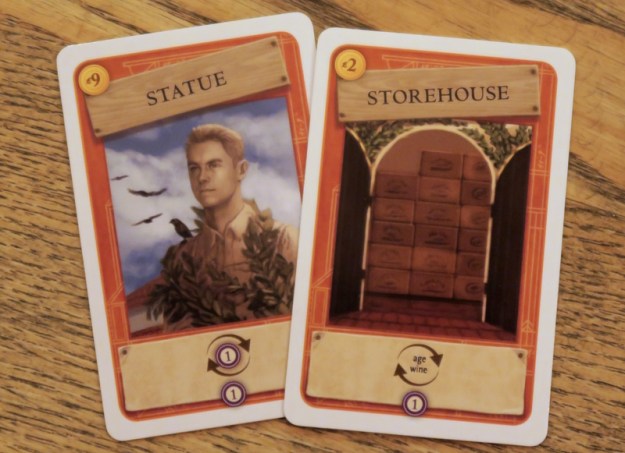
One of the interesting features of Tuscany is the additional buildings that can be constructed.  Green found a Statue which was very expensive, but not only gave him an immediate point, but also an extra point each round.  This, together with his other building, a Storehouse, he had an extra ageing step each round as well—his engine was beginning to build after a slow start.  Green then played a winter Visitor combo, which allowed him to make some wines and fulfill a big six point order with an additional two points.  With the end-game trigger at twenty-five, that was quite a haul in one go, indeed, Green, Teal and Pink were all quite close now.

Viticulture
– Image by boardGOATS

In spite of the sudden flood of points, with time running out, the group soon realised they would not be able to finish in time.  Pink’s more traditional approach of planting, harvesting, making wine and fulfilling orders had kept him at the front of the points track, and would likely have got him over the twenty-five point line in the next round.  However, the group decided that they really needed to finish, just when everyone’s engine was getting into their stride. Nobody will ever know whose would have been be the most successful and by the end of that round it was all very close on the score track.  Pink had his nose in front though, followed by Green and then Teal, but there were still the “Stars” regions to score.

Tuscany
– Image by boardGOATS

This was an area which Teal had really gone for early on in the game. Green had placed a few few early on and then mostly ignored it.  Pink came to the stars late in the game, but as was his usual strategy, made big plays when he did.  In the end Teal narrowly scored most just edging Pink although he still had enough to retain his lead with twenty-one, two ahead of Teal and four ahead of Green.  None of the group quite knew how the end of the evening had snuck up on them so suddenly, they had been so engrossed and it had seemed hardly any time at all—quite a recommendation for a game!
Tuscany
– Image by boardGOATS

Learning Outcome:  If you go into the Wine Business, make sure you know what people want to buy before planting any grapes.

13th December 2022

With this being the annual GOATS UnChristmas Dinner, almost everyone was present for a festival of food and fun, when Blue and Pink arrived with a small car full of party.  There were lots of volunteers to help bring everything in and before long, pizza boxes were being handed round along with crackers stuffed full of bling and GOAT Award voting forms.  The glittery Wingspan eggs from the crackers were especially popular, partly because so many people have a copy, everyone liked the idea of adding them to their game.  As the last of the pizza boxes were being passed around, people started to think about this year’s GOAT awards.

Wingspan
– Image boardGOATS

There was lots of umming and ahhhing as people tried to remember which game was which, but eventually the votes were in and people chatted while the returning officers (Pink and Green) did their counting thing.  Then Green announced the winners.  The GOAT Poo prize for the worst game of the year went to Villainous – The Worst takes it All and the Golden GOAT went to Everdell.  Three epic games, one of Viticulture, one of Tapestry and one of Turf Horse Racing were nominated for “Moment of the Year”, but that somewhat poignantly went to the 2021 UnChristmas Dinner which was the last meeting attended by Burgundy, and the last game he played with us, Santa’s Workshop.

Golden GOAT - 2022
– Image boardGOATS

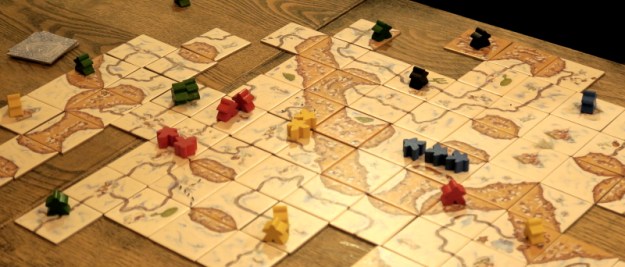
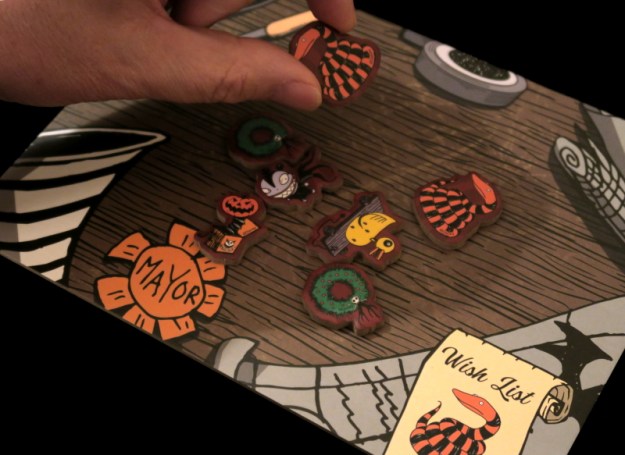
Eventually, we all started thinking about playing games.  Ivory and Indigo were keen to play the “Feature Game“, Merry Madness: The Nightmare Before Christmas, while Jade had specially requested a game of Gingerbread House.  Eventually, largely due to logistics and lethargy (perhaps caused by too much pizza), everyone stayed pretty much where they were and played something with the people they were sat next to.  First underway was Green, Lilac, Pine, Teal and Lime, largely because they were playing a game they were all familiar with, Carcassonne, albeit the Winter Edition.

Carcassonne: Winter Edition
– Image boardGOATS

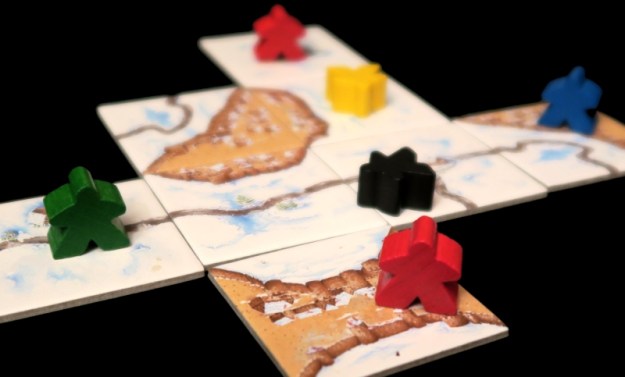
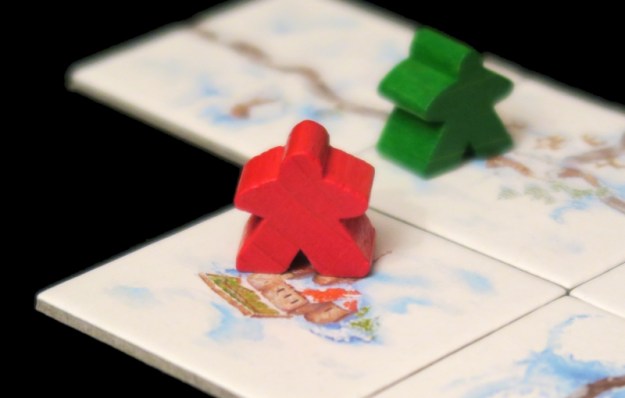
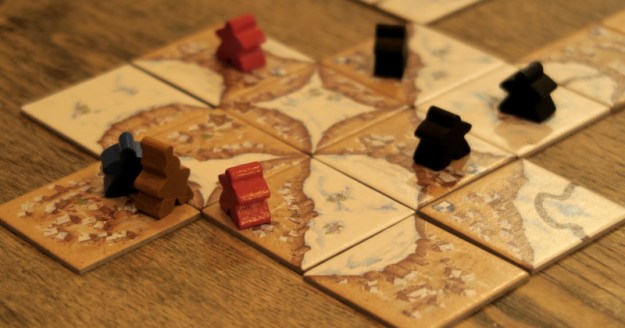
The Winter Edition is essentially the same game as the original “Blue-box” Carcassonne, but with snowy art work.  Thus, players take it in turns to draw and place a tile, add a meeple if desired/possible and then remove any meeples that are ready to score.  As in the original, the features on the tiles include city segments, roads and cloisters. Players score two points for each tile in a city or road they own if it is completed during the game, or one point at the end if incomplete. Similarly, Cloisters score nine points when completely surrounded or one point for the central tile and each surrounding it at the end of the game.

Carcassonne: Winter Edition
– Image boardGOATS

The clever part of the game is that while players cannot add a meeple to a feature that is already owned by another player, features can be joined together and then shared so that both players score.  Green and Lilac had played the same game last year at Christmas, with Der Lebkuchenman (aka Gingerbread Man) mini expansion which consists of additional Gingerbread Man tiles mixed in with the base game; when drawn, the player moves the brown Gingerbread Meeple to an unfinished city of their choice.  Before he is moved, however, the current city containing the Gingerbread Man is scored with each player receiving points for the number of meeples they have in the city multiplied by the number of tiles in the city.

Carcassonne: Winter Edition
– Image boardGOATS

Thus, even players that have only one meeple in the city when their opponents have more score a few points.  This year, in addition to Der Lebkuchenman, the group also added Die Kornkreise (aka Crop Circles) mini expansion. Although they were happy with the Gingerbread Meeple, they were less sure about the crop circles—they looked more like funny shaped snow “angels”.  The expansion consists of six extra tiles which allow each player to place a second follower on a feature that they have already-claimed or return an already-placed follower back to their supply.  Of course, the group did not play the rules quite right, however, initially thinking that each person had a free choice of which action to take and whether to take it or not.

Carcassonne: Winter Edition
– Image boardGOATS

It was only just after the second tile was placed that they realised it was the active player that chose the action (add an extra Meeple to the specific terrain type or pick up a Meeple) and everyone else had to do the same (they decided that if the player had no Meeple in an appropriate area then they just skipped the action).  As a result of the Kornkreise, Lime  ended up with three Farmers on the same tile, which at least it guaranteed him that particular field!  The Crop Circle expansion also led to the biggest coup of the game.  Lilac had started a city with her first tile and Pine positioned himself to muscle in on it a couple of turns later.

Carcassonne: Winter Edition
– Image boardGOATS

Their cities were joined, but they just could not get the city closed before Teal then joined the fray.  This became a very long city and then in the last quarter of the game, Lime also managed to add himself into the action on this game winning city.  Then the final Crop Circle tile came out for Teal. He decided he wanted everyone to add a Meeple to a city, which he, Pine and Lime were able to do. Unfortunately Lilac (who had started the city right at the beginning of the game) had no Meeples left, so couldn’t and found herself locked out of the scoring  at the end of the game as it was never completed.

Carcassonne: Winter Edition
– Image boardGOATS

It was a game where no-one seemed to be able to get the tiles they wanted. Green regularly selected from the pile nearest to him, but only ever got roads. When he tried from different piles, he still got roads and when others selected from the “Green” pile, they got cities!  Pine started to choose tiles from within the middle of the stack, raising cries of “cheat” from Green and Lilac. Pine’s argument was that the tile was still random, which was hard to disagree with and Lime started doing the same later on as well.  In the final scoring, Lime surprisingly edged everyone out for the win, with Teal and Pine not too far behind.

Carcassonne: Winter Edition
– Image boardGOATS

It had been fun though and the Winter edition is certainly the prettiest version of Carcassonne, so Green and Lilac are already looking forward playing it again next Christmas.  Meanwhile, on the next table, Blue, Pink, Ivory and Indigo were playing the “Feature Game“, Merry Madness: The Nightmare Before Christmas, a very quick and light dice chucking game where players are trying to gather together all the spooky-themed gifts in Sandy Claws’ Christmas Bag.  It really is very, very light and quick:  simultaneously players roll their three dice and do what they say (in a similar style to Escape: The Curse of the Temple).  The three dice are different: one shows which of the six gift types is moved, another shows how many, one, two or three, and the final die indicates where: to the player on their left, right or of their choice.

Merry Madness: The Nightmare before Christmas
– Image boardGOATS

The group played with the “Making Christmas Toys” variant.  Players started with the same number of each of the different toys.  The idea is to get rid of all the toys that don’t match the one depicted on their “Wish List” (shown on their player mat).  If they roll the toy on their Wish List, they take that toy from the player indicated, whereas for every other type they roll, they gift one of that type to the recipient indicated.  There really wasn’t a lot to it, and basically the game was all about who was most awake (possibly correlated to the person who had eaten the least pizza).  Blue won the first round, and Pink took the second.  Blue finished the game when she took another two rounds and, although it had been silly fun, it was time for something else and Purple joined the foursome from the next table.

Merry Madness: The Nightmare before Christmas
– Image boardGOATS

Meanwhile, Purple had been explaining Gingerbread House to Plum and Jade and their partners Byzantium and Sapphire, respectively.  In this game players are witches in the Enchanted Forest, building their gingerbread house and attracting hungry fairy tale characters with colorful gingerbread.  Each player has a board with a three-by-three grid of building spaces.  There is a face down stack of rectangular tiles with the top three turned face up (a little like the train cards in Ticket to Ride).  These tiles each feature two squares, similar to Kingdomino tiles.  On their turn, players draw one of the face up tiles and place it on their player board, then carry-out the effect of the symbols they covered up.  The most likely symbol is one of the four different types of gingerbread, which means they collect a token of that type.

Gingerbread House
– Image boardGOATS

Careful placement of pieces is important because if a player is able to cover the same two symbols in one one turn, the player gets the effect three times instead of twice.  Once a tile has been placed, the active player can use some of their gingerbread tokens to capture fairy-tale characters.  If placing tiles completes a level, the active player may also take a bonus card.  The group found the game simple enough once they got going, but it took a while to get there.  The “wilds” caused problems from the first and the group weren’t sure whether covering two at once meant doing three of the same thing.  After re-reading that bit of the rules, it was decided the extra actions didn’t have to be the same, and as a result, Plum was able to make more of her final turn. 

Gingerbread House
– Image boardGOATS

It was close, but despite his super-charged final turn, Byzantium finished two points clear of Plum with Jade coming in third.  Everyone had really enjoyed the game, though, so much so that Jade and Sapphire are now on the lookout for a reasonably priced copy!   Although it took a little while to get going, once Plum, Jade, Byzantium and Sapphire were playing, Purple was at a bit of a lose end.  Nightmare Before Christmas didn’t take long though, so when it was over, Purple joined Blue, Pink, Ivory and Indigo for a game of the husky sled-racing game, Snow Tails.

Snow Tails
– Image boardGOATS

The idea is that each player has a sled led by two dogs.  They start with a hand of five cards drawn from their personal deck.  On their turn, they can play up to three cards as long as they all have the same number.  There are three places a card can be played, two drive the dogs, and one activates the brake.  The idea is that a sled’s speed is the sum of the dogs’ speed minus the current value for the brake.  in addition, the difference between the dog values is the sled’s drift, which causes the sled to move left or right. At the end of their turn, players draw back up to five cards.

Snow Tails
– Image boardGOATS

In general, if players hit something, they pick up a dent card which goes into their hand, blocking space and limiting their options.  The game is quite simple, but as always, how and when to apply the “drift” caused some confusion; Pink certainly benefited from the rules malfunction, but others probably did as well.  The group started out with the “Treemendous” track, but it seemed to take an age to get the game going and everyone was concerned that they might not finish before midnight.  So, about half-way through the game, the track was truncated removing the the final bend and finishing with a straight section just before the finish line.

Snow Tails
– Image boardGOATS

Ivory stole a march in the first couple of turns and looked like he was going to leave everyone miles behind, but when he rammed the first corner it let everyone else catch up.  Ivory was still the first out, but Pink was now not far behind going into the first stand of pines and was taking a different line.  By this time, the damage to Ivory’s sled was starting to take its toll, and Pink was able to take advantage of his balanced sled (his dogs pulling evenly giving him a bonus equivalent to his position in the field) and moved into the lead.

Snow Tails
– Image boardGOATS

It was then that the act of shortening the track played into Pink’s dogs’ paws.  With just the finish line in front, his dogs stretched their legs, he released the brake and shot through the second stand of pines taking out a couple of saplings on his way through.  Everyone could see what was going to happen, but nobody could do anything about it, and Pink crossed the line miles ahead of Ivory who would, no doubt, have taken second had the group played on.  Everyone else was far behind, still working their way through the first plantation.  It had been fun, but it was time for home, so with many “Happy Christmases”, everyone headed off into the cold dark night.

Snow Tails
– Image boardGOATS

Learning Outcome:  Turkey, bacon, sausage, cranberry sauce and stuffing really do make a Pizza taste like Christmas Dinner!

Golden GOAT Award Winners – 2022

As usual, the boardGOATS met just before Christmas for a party and to decide the winners of the GOAT Awards.  After pizza and crackers and the usual mayhem, the group voted for two awards:  the Golden GOAT for our favourite game and the “GOAT Poo” award for our least favourite.  Everyone had the usual three points to hand out for the Golden GOAT Award (plus a bonus if wearing Festive Attire), though a maximum of two points could be given to any individual game.  Everyone could also nominate up to two individual games for the GOAT Poo Prize.

Dice Hospital
– Image by boardGOATS

This year, there were a few games that received the unofficial “Marmite Award”, that is to say they received nominations for both the Golden GOAT and the GOAT Poo prizes.  These included Dice Hospital, Azul, Modern Art and Viticulture.  For the GOAT Poo Prize itself, there were several games that received two or three nominations, but the clear winner was Villainous – The Worst takes it All which received six nominations—quite an achievement since only five people played it and one of those wasn’t present for the vote!  Villainous is a beautiful, asymmetric card game, but one that we struggled with for several reasons, not least the fact that players had to work out how to play their own character, and we were playing it with five people which is two or three more than it needs.

Disney Villainous: The Worst Takes it All
– Image by boardGOATS

Nominations for Moment of the Year included two epic games, one of Viticulture and the other of Tapestry.  The latter nomination included the citation:  “I thought I was doing well until Ivory lapped me… twice!”  Pine also recalled Lilac nobbling him in Turf Horse RacingThe most poignant moment however, with hindsight, was last year’s UnChristmas Dinner, which was the last meeting attended by Burgundy, who very sadly, suddenly passed away just a few days later.  We all still miss him, but the fact we were joined by Jade and Plum and their partners this year is his legacy, and one we think he would have been proud of.

Mike Parker
– Image by
Pushpendra Rishi

And that just left the Golden GOAT Award for the best game of the year.  Previous winners including Wingspan, Altiplano and 6 Nimmt! were ruled out, but there were plenty of options remaining.  Lots of games received three nominations including Endeavor, Cascadia, Old London Bridge, Splendor, Tapestry and Die Wandelnden Türme  But this year, the clear winner was Everdell. This card-driven game was only played for the first time a few weeks ago, but it is planned to play it again soon with one of the expansions being the “Feature Game” early in the new year.

Golden GOAT - 2022
– Image by boardGOATS

Essen 2022

Known to gamers worldwide simply as “SPIEL” or “Essen”, the Internationale Spieltage, the annual German games fair is the largest in Europe and arguably the world.  The fair is of particular significance as many new releases are scheduled to coincide with the event just in time for Christmas sales.  In 2020, like many other events, SPIEL was cancelled.  The online event that replaced it was not as successful, and in 2021 there was a return to the in person fair albeit with restrictions and much smaller than that in 2019.  Today is the first day of this year’s SPIEL which runs from Thursday to Sunday every October.

Essen 2022
– Image from spiel-messe.com

Although many of the Covid restrictions have been lifted, medical grade surgical masks covering mouth and nose are still mandatory for all visitors and exhibitors.  So while SPIEL will likely be larger this year than last, it probably won’t reach pre-pandemic proportions.  The maths trade is back though, a crazy event where hundreds of people agree multiple trades and sales online in advance and then all meet up at 3pm and try to find the people they have made contracts with and make the exchanges.  Remarkably, it works, and very well too, with some people selling hundreds of euros worth of games through this means.

Essen Maths Trade
– Image by Friedhelm Merz Verlag

Despite the number of people involved, the exchanges only take a few minutes and it is usually almost all over in half an hour making it a surprisingly efficient way of making space for the new arrivals.  In addition to the Maths Trade, there will be the usual exhibitors showcasing their wares.  The Spiel des Jahres and Deutscher Spiele Preis winners will also all be available and there will also be lots of games making their SPIEL debut.  These include Uwe Rossenburg’s latest game, Atiwa, and the top of “The Essen Hotness” games:  Tiletum, Revive, Woodcraft, Lacrimosa and Hamlet: The Village Building Game.  Games like Flamecraft, Turing Machine and War of the Ring: The Card Game will be for sale too.

Atiwa
– Image by BGG contributor W Eric Martin

There will be re-implementations, like Richard Breese’s reworking of his 1998 game, Keydom’s Dragons (formerly Keydom), Clever 4Ever (extending Ganz Schön Clever), Skymines (a redevelopment of Mombasa), Amsterdam (formerly Macao) and of course, Ticket to Ride (San Francisco).  Expansions will also be on show for games like The Red Cathedral (Contractors), Galaxy Trucker (Keep on Trucking), Meadow (Downstream), Sagrada (The Great Facades – Glory) and two of our favourites, Viticulture (World) and Wingspan (Asia).  Sadly, no-one from boardGOATS will be there to see them though; maybe next year…

Wingspan: Asia
– Image from stonemaiergames.com

26th July 2022

Blue and Pink were first to arrive and were just finishing their supper when Ivory joined them soon followed by Pine.  Ivory and Pink were keen to play Ark Nova which is longer than our usual fare and therefore needed a quick and early start.  So, when Black and Purple arrived, they grabbed Black and headed over to the other side of the room.  Everyone else conformed to more typical hesitant behaviour and were a lot slower to get going.  This wasn’t helped by Blue who was explaining how Pink had managed to find the “Only Panda Themed Village in Cornwall” and when Lemon and Orange queried it, she felt the need to find the photos to prove it.

The Lanivet Inn
– Image by boardGOATS

Eventually, the group split into two with Purple, Blue, Pine and Teal playing the “Feature Game“, the Spiel des Jahres nominee, SCOUT.  Although this has a nominal and very tenuous “circus theme”, it really is well hidden and “pasted on” to what is otherwise a relatively traditional, though clever little Rummy-esque card game with a Bohnanza-type twist—players cannot change the order of the cards in their hand.  The idea is that players have a hand of cards and on their turn takes an action:  they play a run or a meld (set of cards of the same value à la Rummy), or take a card from the active set (the previously played set).  The first of these actions is called “Show” and players can only Show the set they want to play beats the previously played set (called the Active Set).  A set wins if it has more cards or the same number, but a higher value, and a meld always beats a run.

SCOUT
– Image by boardGOATS

When Showing, the cards played must be consecutive in the player’s hand, so a player can, for example, take a four, five and six from the beginning, middle or end of their hand.  It must beat the current Active Set, and it then becomes the new Active Set with the old one turned face down and added to its owner’s scoring pile.  In this way, the quality of the the Active Set is ever increasing—this mechanism makes SCOUT a ladder-climbing game, of which Tichu and Haggis are probably the best known.  The problem is that of course it will become progressively difficult to play cards (especially with the consecutive constraint), so players can also use the Scout action and take a card from the Active Set, for which it’s owner gets a Scout token as a reward.

SCOUT
– Image by boardGOATS

When Scouting, players can only take a card from the end of the Active Set, ensuring that runs retain their integrity and just become shorter and maybe of lower value.  A card that has been Scouted goes into the player’s hand, anywhere they like, so they can use this to connect two cards in a run, or enhance an already existing meld for example.  The really clever part of the game is that the cards have two values, and which value they take depends on which way up the cards are.  This is clever because it adds just enough flexibility to make the game work, while not making things trivial.

SCOUT
– Image by boardGOATS

At the start of the game, players are dealt a hand of cards and choose which way up the hand goes—not the individual cards, the whole hand.  From this point on, the hand stays the same way up, but when cards are added to a player’s hand (and only then), the added card can be rotated.  The game ends when either, one player runs out of cards, or when it gets to a player’s turn and they were the last person to Show.  In addition to Scout and Show, once during the game, players can also “Scout & Show” which is often used to bring about or prevent the game coming to an end.  Players then add up the number of scoring cards and tokens and subtract the number of cards in the their hand and the player with the most is the winner.

SCOUT
– Image by boardGOATS

The game is one of those games that is a bit odd to understand at first, so Purple (who started), began tentatively, but it wasn’t long before people were Scouting and Showing happily.  There was a bit of confusion when it came to Teal’s turn and he Scouted one of his own cards—a rules check didn’t answer the question of whether he should get a token (we called them Cadbury’s Chocolate Bars because of their colour) or not, so we decided not.  It was only later that we realised that of course players could not Scout from their own set, as a round of Scouting triggers the end of the game.  Pine was the clear winner with fourteen points, more than twice Blue in second, and in spite of forgetting he could Scout & Show which would have given him victory earlier.
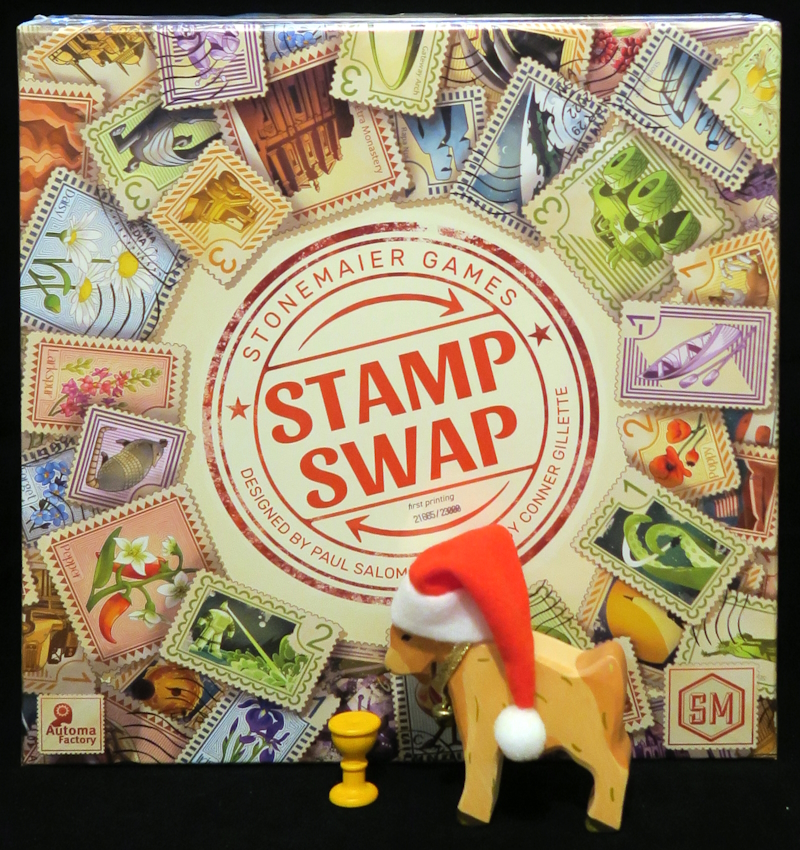
SCOUT
– Image by boardGOATS

The game can be played in campaign mode where players get scoring tokens and add up the total after several rounds, however, we tend to prefer to play games like this as single, short, one-off games.  And this time, everyone wanted to “do a Lime” and give it a second go now they understood what they were doing.  It was about this time that Pine checked his phone for the first time and reported that the England versus Sweden semi-final in the Women’s European football championships was goalless, but that “Sweden were playing well”.  There was a general slightly pessimistic noise around the table and Teal began the second round.

SCOUT
– Image by boardGOATS

A cheer from the bar prompted Pine to check his phone again and everyone relaxed a little when he reported that England had scored their first goal.  This second game of SCOUT was much closer than the first with scores of eleven, twelve, thirteen and fourteen, with Blue the victor, just ahead of Teal.  It had been a lot of fun and everyone really appreciated the cleverness of such a simple little game and found it had really grown on them from the two rounds they’d played.  There were other games people fancied playing, however, so the group moved on to Trek 12: Himalaya, a Roll and Write game we first enjoyed playing a few months ago and was given a “Recommendation” by the Spiel des Jahres Award committee.

Trek 12: Himalaya
– Image by boardGOATS

Trek 12 is similar to On Tour which we played several times online, but is a little more complex.  In On Tour, two d10 dice are rolled and players combine them to make a two digit number, so a five and a four can be combined to make a forty-five and a fifty-four, one of which is then written in a location on the map.  Locations are connected by “roads” and players are aiming to make the longest continuous route of numbers that only increase.  Trek 12 does something similar in that two dice are rolled and the numbers combined to give one, but as the sum, difference, or product, alternatively players may choose one single die (either the larger or the smaller).

On Tour
– Image by boardGOATS

The catch is that each of these operations can only be used just four times each during the game.  The resultant number is then written on the map, but the theme is trekking so chains of ascending or descending numbers represent ropes while groups of the same number represent camps.  Another difference is that in On Tour player can write their numbers anywhere on their map, whereas in Trek 12 numbers have to be added next each other.  This means that it is advisable to start in the centre and work out, advice that Pink eschewed at his cost last time we played.  Scoring is more complex as well, since players score for the highest value in each rope/camp plus one for each other number in the rope/camp with bonuses for the longest rope/largest camp and negative points for any isolated numbers.

Trek 12: Himalaya
– Image by boardGOATS

This time the group  used the Kagkot map, rather than the Dunai map used last time.  Teal, Purple and Pine all started at much the same place putting a five in the middle, but from there things quickly diverged despite the plague of fives that were rolled.  Blue decided to do something different and started with a zero in the middle.  Everyone got themselves into a bit of a tangle, but Purple struggled the most.  Part of the reason might have been distraction caused by the updates on the football as, during the second half of the match, there was a second goal, then a third.  Everyone was still digesting the third which was described as “Outrageous” when a fourth went in just eight minutes later to leave the final score four-nil to England.

Trek 12: Himalaya
– Image by boardGOATS

Teal gambled on getting the high dice rolls he wanted, and jammily got them.  However, the game was won by Blue who put together lots and lots of very short ropes and small camps to give her high base scores, with one long rope to give a decent bonus and a final total just above the target set for the map in campaign mode.  While all this was going on, Lilac and Green were introducing Orange and Lemon to Carcassonne, an older, now classic Euro game that won the Spiel des Jahres award over twenty years ago.  The game is perhaps one of the best known tile-laying games and was the inspiration for the term “Meeple“.

Carcassonne
– Image by boardGOATS

On their turn, players draw a tile and add it to the central map.  The tiles feature some combination of Roads, Cloisters, City and Fields.  Once the tile has been placed, the player can then add a single Meeple from their supply to the tile placing it on one of the features so it becomes a Thief, Monk, Knight or Farmer (respectively).  Finally, any features that are completed are scored and the players gets their Meeples back.  In this context, completed means Roads that end with a junction at both ends, Cloisters that are completely surrounded by other tiles, and Cities without gaps where the wall is closed).  Fields or Farms are only scored at the end of the game.

Carcassonne
– Image by boardGOATS

In this way, players score one point for each tile in a completed Road, nine points for a completed Cloister and two points for each tile in a completed city (plus two for any Pennants).  Although players can’t add a Meeple to a feature that is already occupied, it is possible to end up with shared features.  This happens when two separately owned Roads (say) are joined together.  In this situation, the player with the most Meeples scores the points, or, if there is a tie, both players get the points.  And this is really the crux of the game—players can play nicely or nastily, working together to build big Cities, or muscling in and stealing them from other players just before they score, or even playing tiles to make Features difficult to complete.

Carcassonne
– Image by boardGOATS

At the end of the game, Farms and any still incomplete Features are scored (though they only give only one point for each tile and Pennant in a city and one point for each tile in a Cloister array).  A Farm is a continuous Field, i.e. a green space that a Meeple could “walk” around that might be bordered by Roads, City walls, River or the edge of the map.  Each Farm then scores three points for each City that it “feeds”, i.e. that borders the Farm.  Since Farms can be very high scoring, early Farmers in the right place can be very valuable as they mean other players have to work hard to join fields together if they want to share the points.  On the other hand, an early farmer can be cut off and left scoring very few points.

Carcassonne
– Image by boardGOATS

Additionally, since they are not recovered during the game, Farmers placed early are not scoring points during the game, so part of the skill of the game is timing when to place Farmers to maximise their value.  Scores are kept on a track, and the player with the most points at the end is the winner.  This time, although there were a number of expansions available, with Lemon and Orange were new to the game, the group only added the River expansion, which consists of a small number of tiles played at the start and helps to prevent the formation of one massive Field.  Lilac explained the rules: although it is mostly a simple game, the Farmers always cause a little confusion, in particular where the edges of the Fields were and how you might end up with more than one Farmer in a field.

Carcassonne
– Image by boardGOATS

Lilac placed the second river tile and with little other option available to her placed the first Farmer.  For the next few turns of placing River tiles, the question of when another player could place a farmer was often repeated, until Orange was able to get one with a road and bridge tile.  The River started running along the length of the table, expecting the board to develop more in the that direction than to the edges of the table. Unfortunately, fairly early on the river shifted sideways and the whole board developed across the table rather than along, so they had to shift the tiles a couple of times to make room (this was not meant to be the Discworld!).

Carcassonne
– Image by boardGOATS

Lilac took an early commanding lead on the score board, with Orange next to start scoring. It seemed to take ages before Lemon got her first points and even longer for Green to get going.  However, Lilac’s lead soon disappeared as Green, Lemon and Orange shared the points for one enormous city—they thought they would never complete it, but with three people after one particular tile, it was almost inevitable really.  Lilac meanwhile was after the single bend road tile to complete a roundabout with her Meeple on it.  Everyone else got that tile, everyone except Lilac of course.  It looked like it would never happen, but in the dying moments of the game, she finally got the tile she needed. It was only worth four points, but it gave her a spare Meeple.

Carcassonne
– Image by boardGOATS

With the Farmers now understood, with his last tile, Orange was able to complete a City and then place a Meeple on the field part of that tile to be sole farmer for one complete city. It was only three points, but more than the couple he could have scored by using the tile to complete a Road. Having spotted this useful use of a final Meeple, Lemon and then Lilac both did the same.  In the mêlée of farmers, Orange came out on top, managing to knock out Lilac’s and Green’s farmers, and Lemon scored a few too.  The end result was a victory for Orange, a close second for Lemon, with the veterans of Green and Lilac well behind.  Perhaps they did not play quite as aggressively as they could have done, but mostly they just didn’t get the right tiles and were simply out-played.

Carcassonne
– Image by boardGOATS

Meanwhile, on the other side of the room, Black, Pink and Ivory were playing Ark Nova, but as it was showing no sign of finishing soon, with both Carcassonne and Trek 12 finished, the two groups had a decision to make:  play two games (maybe with a quick game of Musical Chairs first) or play one large game.  Las Vegas was suggested as a possible large game (it plays eight with the Boulevard Expansion), and Living Forest (winner of the Kennerspiel des Jahres this year) was an option if breaking into two groups.  Time marched on, and nobody in the group is very good at decision making and before long it was too late to play Living Forest and Las Vegas can take a while to play.  So in the end, the group decided to introduce Orange and Lemon to an old favourite, 6 Nimmt!.

6 Nimmt!
– Image by boardGOATS

Although 6 Nimmt! didn’t win the Spiel des Jahres Award, we certainly think it should have done; it did get a recommendation from the Jury though and of course it won the Golden GOAT in 2020 (a very difficult year for everyone).  Teal had to play taxi for his family, so headed off leaving seven to play.  The game is very simple:  players simultaneously choose a card from their hand and play it face down in front of them.  Once everyone has chosen a card, the cards are revealed and played in order from lowest to highest.  The cards are added to one of the four rows on the table—they are added to the row that ends with the highest number that is lower than the card itself.

6 Nimmt!
– Image by boardGOATS

If the card added would have been the sixth card, instead the player takes the cards in the row and their card becomes the start of the new row.  If the card is lower than all the cards at the end of the rows, instead the player chooses a row and their card replaces that row.  At the end of the game, players sum the total of Bull’s heads or “Nimmts” shown on the cards in their scoring pile and the player with the least is the winner.  There are a hundred and four cards in the deck, and we play a variant where the game is played over two rounds, each with half the cards.

6 Nimmt!
– Image by boardGOATS

The delicious thing about 6 Nimmt! is that everyone feels that they are in control, until the moment when they aren’t.  Some people argue that it is a random game, but as the same players (like Burgundy) often seem to do well, it can’t be.  That said, and it is especially true for those that often do well (like Burgundy), when it goes wrong it can go catastrophically and spectacularly wrong.  As a result the suspense is murder and the game is loads of fun yet never seems to outstay its welcome.  Orange quickly got to grips with it and clearly quickly appreciated the jeopardy.

6 Nimmt!
– Image by boardGOATS

This time we played without the “Professional Variant” that had become so popular online, partly because it would not be fair on the people new to it, but mostly because everyone was tired and nobody was up to the mathematical gymnastics it required.  This time the first round was unusual, because everyone had similar scores.  Usually, at least one player manages to keep a clean or cleanish sheet and at least one player picks up lots of pretty coloured cards, but the range of scores at half way were between seven and thirteen.  That meant it was all to play for in the second half.

6 Nimmt!
– Image by boardGOATS

The second half was a little more varied with Green only collecting four Nimmts and Blue and Lilac collecting sixteen, but the net effect largely offset the differences in the first round.  Blue top-scored with twenty-seven, Pine was just behind with twenty-six and Lilac after him with twenty-three (she really is going to have to try harder if she is going to compete with the really high scorers).  The winner though was Purple with fifteen, one Nimmt less than the runner up, Green, in what had been a tight game, but a lot of fun, as always.

6 Nimmt!
– Image by boardGOATS

Ark Nova was still on-going, so Orange, Lemon and Lilac killed a few minutes with a quick round of Dobble.  This Snap-a-Like game is simple, but a lot of fun.  This time, players started with a single card and called a match with the central pile and grabbed a card.  Despite playing in English which is not his first language, Orange is remarkably good at this game, taking twenty-two cards, beating Lemon into second place.  From there, that side of the room just deteriorated into random chatter about random pub-type things (including the Voice of Jack and the demise of Frosts at Millets) as people ran out of steam and waited for Ark Nova to finish.

Dobble
– Image by boardGOATS

By this time, Black, Pink and Ivory were rapidly running out of time as last orders had been called some time ago.  Ark Nova is a much longer game than we usually play with an advertised playing time of upwards of two hours and reputedly considerably more with inexperienced players and setup time included.  It is all about planning and designing a modern, scientifically managed zoo—when this was first mentioned at the start of the evening, Pine looked all interested in the theme, but was quickly put off when Ivory added it was “a bit like Terraforming Mars with animals”.  That said, although it is quite complex, functionally it is not difficult to play on a turn by turn basis, though there is quite a lot to manage and keep a track of.

Ark Nova
– Image by boardGOATS

On their turn, players take one of six possible actions:  activating one of the five action cards (Cards, Build, Animals, Association and Sponsor) with a strength equal to the number above the card, or move a card back to the first space and take a cross token instead.  When activating a card players perform the action based on its power level.  The power level is dictated by its position in the row, with the level one power to the left and the level five to the right.  Once a card has been played, it is moved the first space in the player’s five card row (i.e.to the lowest power position on the left) moving the other cards to the right to replace the card removed, effectively incrementing their power by one.  During the game, players can upgrade and turn over the action cards to a more powerful second side using various bonuses.

Ark Nova
– Image by boardGOATS

The Cards action is the simplest action, which lets players draw cards from the deck (the number depending on strength) then advance the marker two spaces along the break track which defines when the round ends.  The Build action allows players to pay to construct one building on their zoo map.  Players can build basic enclosures with a size of one to five, but they can also build a petting zoo for animal storage or pavilions and kiosks (which give players appeal and money respectively based on adjacent filled enclosures).  With the upgraded build action, players can build multiple different buildings and have access to the large bird aviary and reptile house which allow the storage of multiple animals.

Ark Nova
– Image by boardGOATS

There’s no point of having enclosures without animals, and that’s where the animals action comes in:  it allows players to add animals into enclosures in their zoo. Some animals have a special requirement and need a symbol in their tableau and/or the upgraded animal card. Adding an animal to an enclosure has a cost, and then the player turns over the empty enclosure of at least the size needed or places the listed cubes into a special enclosure (an aviary or a reptile house).  The player then adds the animal card to their tableau and resolves the abilities on it and receives ticket sales along with possibly conservation points and reputation.

Ark Nova
– Image by boardGOATS

The association action allows players to take one task on the association board with different tasks available based on their power level.  This allows people to gain reputation points, acquire a partner zoo they don’t already own, gain a partner university, or support a conservation.  Finally the sponsor action allows players to play exactly one sponsor from their hand which offer ongoing abilities.  They can allow players to place unique tiles in their zoo and offer end game conservation point opportunities. Some Sponsor cards have conditions on their play similar to the animal cards.

Ark Nova
– Image by boardGOATS

Players take it in turns to take actions, resetting every time a break occurs, until the end game has been triggered.  There are two tracks, Appeal (Tickets) and Conservation that follow the same course, but in opposite directions.  The game end is triggered when one player’s pair of scoring markers cross, after which, everyone gets one more turn and then the end-game cards are scored.  The player with the largest overlap between their Conservation and Appeal values is the winner.  A player’s tokens can meet and pass at any point, but Conservation points are much harder to get than Appeal, so to compensate, each step on the early part of the Conservation track is equivalent to two Tickets on the Appeal track, while each Conservation step is worth three Tickets.

Ark Nova
– Image by boardGOATS

Pink started hard and fast with a simple animal strategy concentrating on upgrading his action cards to get the more powerful actions and getting extra workers.  In contrast, Ivory and Black started a little slower and focused on getting larger (Size five) pens, like the reptile house and the aviary.  These are more difficult to get, but are also more valuable.  Ivory then added a Stork and a Condor, while Black collected a Horse and engaged the services of a European Hobbit-like Expert.  The game was about half-way through when the other table heard a howl of delight from all three of them:  The Panda card had come out.  From this point forward, Pink’s primary aim was to get the Panda and find it a nice, cosy, bamboo-filled space in his zoo where he could love it and hug it at leisure.

Ark Nova
– Image by boardGOATS

Although Pink got a lot of Tickets early, his Conservation was very low which made him look like he wasn’t a threat.  Maybe Ivory and Black took their eye off him because of this, as they seemed surprised when Pink suddenly got ten Conservation points very quickly using the Association action which triggered the end of the game quite abruptly.  In a similar way to the recent game of Viticulture where Teal did the same thing, this meant everyone else had to make the best of things.  It was probably for the best, however, as by this time it was a real race against the clock.

Ark Nova
– Image by boardGOATS

In the end game scoring, Ivory also managed to get his Appeal and Conservation pieces to cross over, but Black was less fortunate finishing with a negative score.  It was close between Pink and Ivory, but Ivory scored more in the end-game scoring and took victory by a single point.  Even though it finished in a bit of a rush, they had all really enjoyed the game; Black commented that rather than being like Terraforming Mars, to him it felt more like Wingspan, which was probably just as well as he’s not very fond of Terraforming Mars.   As they rushed to pack the game away, Pink gave his Panda one last hug before putting him back in the box and going home.

Ark Nova
– Image by boardGOATS

Learning Outcome:  Pink Likes Pandas.