Tag Archives: Wingspan

Golden GOAT Award Winners – 2025

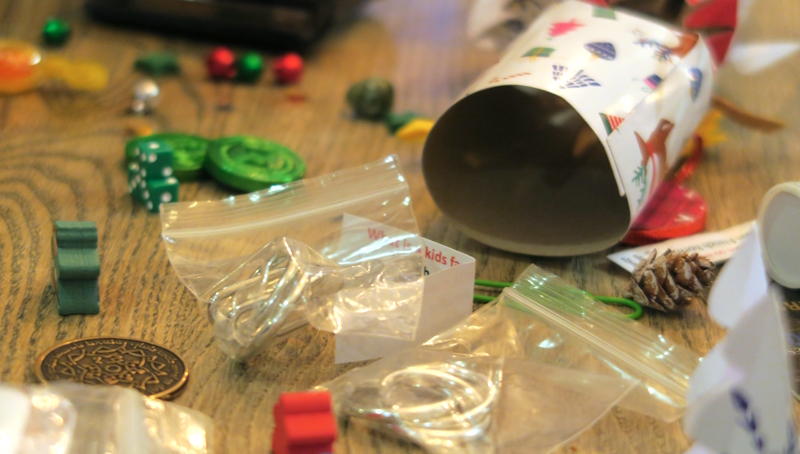
As usual, just before Christmas, the boardGOATS Un-Christamas Dinner was accompanied by the annual voting for the GOAT Awards.  After food and festivities (including the now infamous Gamers’ crackers) the group voted for the two two awards:  the Golden GOAT for our favourite game played during the year and the “GOAT Poo” award for our least favourite.  Everyone had the usual three points to hand out for the Golden GOAT Award (plus a bonus if wearing Festive Attire), though a maximum of two points could be given to any individual game.  Everyone could also nominate up to two individual games for the GOAT Poo Prize and share any special memories as their “Moment of the Year”.

Ticket to Ride Map Collection: Volume 7 – Japan & Italy
– Image by boardGOATS

First up was the Moment of the Year.  This almost always generates a lot of discussion, and this year was no exception, until Blue reminded the people near her of the game of Ticket to Ride with the Japan Map, back in March.  She commented that her Moment of the Year was when Pine galloped across the room to say that Pink had lost fifty-two points thanks to Purple brilliantly claiming a single route from Hiroshima to Okayama and entirely unintentionally preventing Pink from completing his four long Tickets.  Word quickly spread round the room and it was almost a unanimous decision that this was the winner (though opinions differed on whether Purple’s train placement or Pink’s disgust that followed or Pine’s glee was the actual “Moment”).

River Valley Glassworks
– Image by boardGOATS

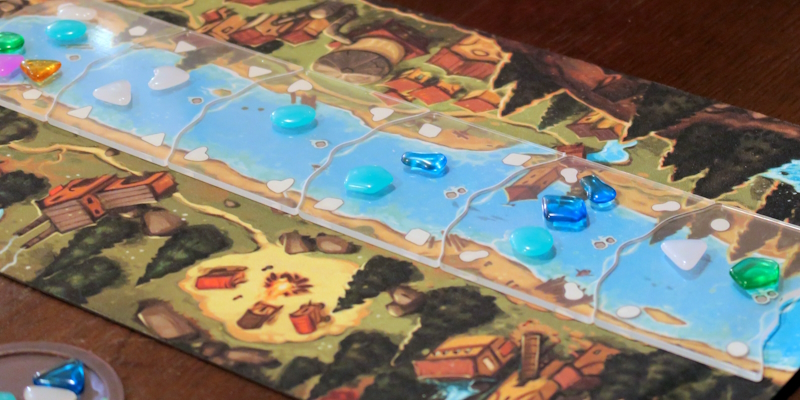
This year, it was agreed that there were no outstandingly awful games this year so it wasn’t awarded, even though Roll for the Galaxy, River Valley Glassworks and Crappy Birthday got a couple of nominations each (clearly the last of these must have been people joking however). The unofficial “Marmite Award” which goes to games with nominations for both the Golden GOAT and the GOAT Poo prizes, went jointly to two older games, Bohnanza and Saboteur, which clearly divide opinion.  And finally, there was the Golden GOAT Award for the best game played in the year.  Previous winners including Stamp Swap, Wingspan and 6 Nimmt! were ruled out, but there were plenty of options remaining.

Intarsia
– Image by boardGOATS

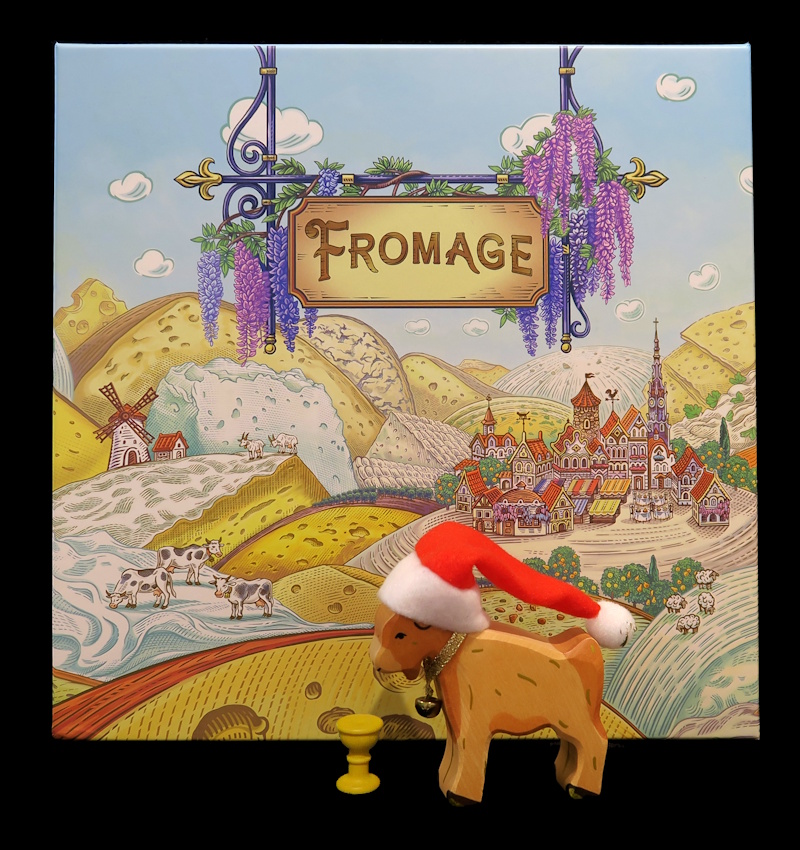
Pink’s gerrymandering in favour of Zoo Break (with various offers of bribes) were largely unsuccessful.  The initial vote gave a three-way tie between Finspan, Intarsia, and Fromage.  Finspan was ruled out as it had received one nomination for GOAT Poo (the first tie-breaker), which meant that for the first time in three years, the winner was not going to be a Stonemaier product.  That left a two game run-off between the beautiful Intarsia and the smooth cheese-themed Fromage.  Victory went to Fromage, which had been so well received that several people had backed the crowdfunding campaign for the follow-up, Formaggio.

Golden GOAT - 2025
– Image by boardGOATS


Next Meeting, 11th Movember 2025

Our next meeting will be on Tuesday 11th Movember 2025.  As usual, we will start playing shorter games from 7.30pm as people arrive, until 8pm when we will start something a little longer.  The pub is now doing food again, so those that will be eating will be arriving from around 6.30pm.

This week, the “Feature Game” will be Origin Story which is a recent release from Stonemaier whose games are very popular within the group and have won an unprecedented three GoldenGOAT Awards for Wingspan, Tapestry and Stamp Swap (in 2019, 2023 & 2024 respectively).  Their latest game, Origin Story (rules, review and video tutorial) is a trick-taking and tableau-building game where players play tricks to develop their inner superhero.

Origin Story
– Image from stonemaiergames.com

And speaking of superheroes…

Jeff and Joe were at the Jockey talking about films they’d like to see.

“I really want to watch the new Iron Man film,” said Jeff, “It’s got the Silver Surfer in it.”

“Are they working together?” asked Joe.

“Well,” replied Jeff, “They sort of start on opposite sides, but by the end of the film they become alloys…”

Essen 2025

Today is the conclusion of the largest annual gathering of gamers in Europe.  The Internationale Spieltage is known to gamers worldwide simply as “SPIEL” or “Essen” and is a four day fair with lots of new releases scheduled to coincide with the event, just in time for Christmas sales.  This year, there have been lots of exciting new games available to be seen including Galactic Cruise, Brick Like This!, Forest Shuffle: Dartmoor, Waddle, Orloj: The Prague Astronomical Clock (which was sold out before the end of the first day) and Origin Story (which was sold out by Friday).

.Orloj: The Prague Astronomical Clock
– Image by boardGOATS

In addition to new games, the rise of crowd funding has had a large impact, and increasingly there are stands presenting current live projects in the hope of seccuring additional backers.  Examples of this included, Eldertide: A Thousand Lights, the Lodges expansion to Kavango, Cascadia: Alpine Lakes, AstroNavigators, and the re-release of Nippon to name just a few.  There have been a lot of really good deals to be had too, and there will be even more on the final day today.  It was with sadness though that the Snowdonia spin-off, Alubari was found at a discounter for €15, as this was a great game released with much fanfare a few years ago.

Cascadia: Alpine Lakes
– Image by boardGOATS

Old favourites typically often get a new lease of life with the release of expansions.  This year, relatively recent releases like SETI (which was confirmed as the winner of the Deutscher Spiele Preis), Faraway, Castle Combo and Windmill Valley recieved new additions, but older games like Underwater Cities and Wingspan also got some love (with the new Data Era expansion and the fan-designed promo packs).  As well as new games and expansions, there were also a number of re-releases of old favourites including Ra, Bohnanza (with Dahlia artwork) and Botswana, and even Ticket to Ride which has had a bit of a face-lift with new artwork.

Botswana
– Image by boardGOATS

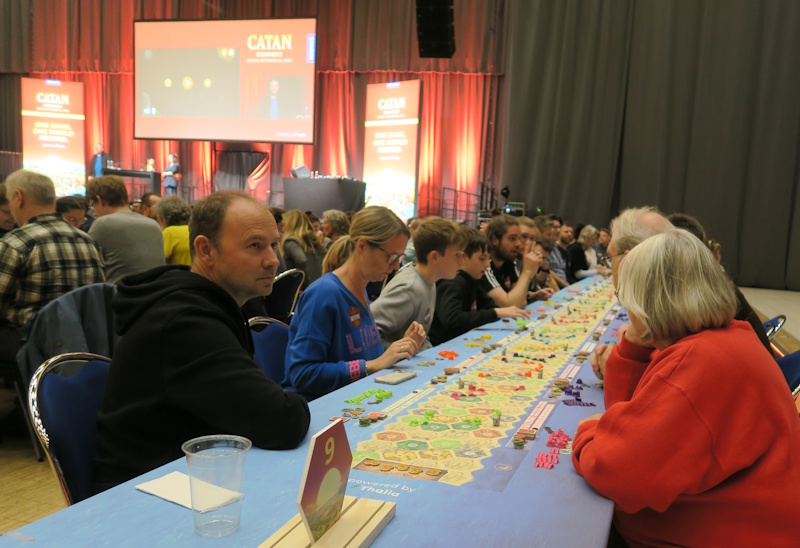
For those that were prepared to stay late on Friday, there was a world record attempt for the most people playing The Settlers of Catan together.  This was achieved with CATAN-Connect, which is a new version of the game designed for large parties that has large groups playing around single islands with elements of simultaneous play and everyone working to one electronic dice roll and a timer.  The record had been set at Essen in 2015 with one thousand and forty, only for Rotterdam to set a new record two years later with one thousand and ninety-six.  At SPIEL, one thousand, one hundred and seventy players joined in the game (watched by a few more who were just curous), successfully bringing the world record back to Germany where it arguably belongs.

CATAN-Connect
– Image by boardGOATS

29th April 2025

The evening began with a quick game of the popular Blackjack based game, Flip 7.  This is a quick, push-your-luck card game along the lines of Port Royal where players turn over cards and gamble on not revealing the same number twice taking it in turns to decide whether they want to “flip” or ” stick”. The catch is that each numbered card appears in the deck that number of times (i.e there is one one, two twos and so on). Flipping over seven different cards in a succession gives fifteen bonus points.  There are also some action cards in the deck, “Flip Three”, “Freeze”, “Second Chance” and modifier cards which give extra points. The game ends when players have reached the pre-agreed total.

Flip 7
– Image by boardGOATS

Ivory was keen to get in a little practice as “Little-Ivory” was getting it for his birthday in the next few days.  Although the game plays up to eight (with one box), there were just the four as Ivory was joined by Jade, Sapphire and Mint.  Mint went bust early and Sapphire started fast, but the victor was Ivory who didn’t go bust at all during the game.  With that over quite quickly Jade and Sapphire were joined by Pine, Plum and Byzantium to play the “Feature Game“, Creature Comforts.  In this game, players spend Spring, Summer, and Autumn gathering different resources from the forest and spending them to collect items that will home a more inviting place while the world outside is covered in a layer of snow in the Winter.

Creature Comforts
– Image by boardGOATS

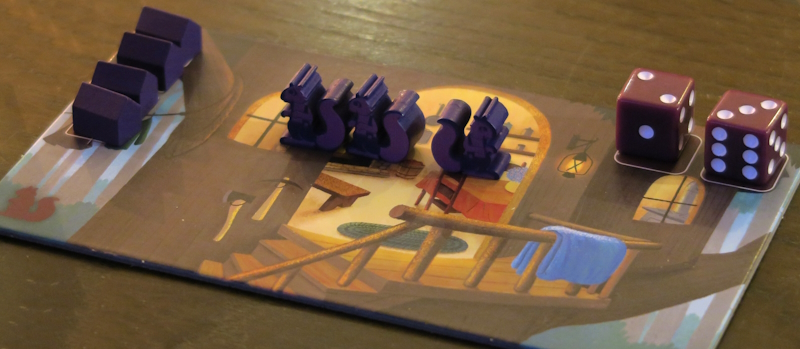
Creature Comforts is a worker placement game with a twist:  the workers can be placed at various locations, but dice of specific values (or sum-totals) are required to activate the locations. Thus, the players need access to dice of specific values when it comes to triggering those workers.  Jade explained the rules to Pine, Plum, Byzantium and Sapphire, some of whom were new to the game.  Played over twelve months, at the start of each month or round, a Traveler “event” card is revealed which either applies an instant effect or one that lasts the duration of the month.  Simultaneously, players then roll their two Family dice and place them on their Home Boards.
Creature Comforts
– Image by boardGOATS

Then, players simultaneously place their Workers at their choice of the twelve locations.  Although the locations can hold any number of Workers, players can only place a single worker at each one.  Each location will either require a dice of a specific value or multiple dice that add to a given sum (or have a particular requirement e.g. feature all odds or evens).  The catch is that at this point, players only know the values of the two dice that they have access to, their Family dice.  So, placing Workers requires some astute planning mixed with some luck when the four communal Village dice are rolled next, by the start player for the month.  Players then take it in turns to allocate the six dice at their disposal to activate as many of the locations their Workers are at as possible.

Creature Comforts
– Image by boardGOATS

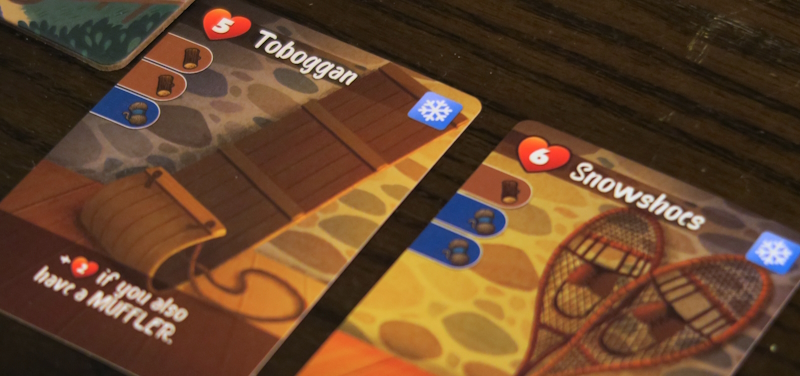
Each Worker that a player cannot activate gets them a Lesson token, which can be used to modify dice values in later turns (for only that player).  Finally, players finish their turn by crafting any creature comfort cards they can, keeping in mind that only three can be carried over to the next round.  After eight months (six if playing a shorter version of the game), players can craft any left-over cards they might have in their hand if they can afford to and then score for their Comfort Cards, Improvement Cards, for empty Cottage spaces and left-over resources.  The first problem was that there were a lot of locations to get to grips with.  Pine, who was new to the game, struggled initially, but by the end was wanting to play again soon!
Creature Comforts
– Image by boardGOATS

Sadly, although the game was a lot of fun and enjoyed by all, it was marred by the fact that “Last Orders” was called sooner than expected.  This meant the last couple of rounds were played at something of a rush and points were missed and some of the scores might not have been correctly counted.  There are a lots of odd points to be counted, but the bulk come from the eponymous Creature Comfort cards.  Byzantium top-scored for these with forty-three points, some ten more than anyone else, so it was no surprise that he ran out the winner by a sizeable margin, with everyone else left fighting for second.  That battle was won by Sapphire with Pine taking third.

Creature Comforts
– Image by BGG contributor hipopotam

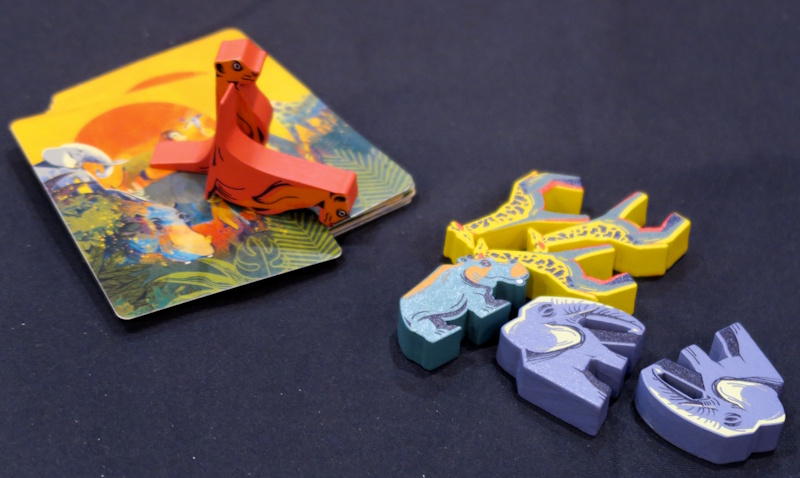
Meanwhile, Mint introduced Blue and Ivory to the really cool, three-dimensional game, Planet.  This is quite a simple game, but really clever:  each player receives a dodecahedral planet core with twelve pentagonal spaces and a magnet in the centre of each one.  On their turn, players choose a pentagonal tile with different terrains (Mountain, Ice, Forest and/or Desert) on them and stick it to their planet. The player who fulfills the most conditions for the appearance of certain animals gains its card.  There are public, animal objectives and each player has a private objective, their “Natural Habitat”.
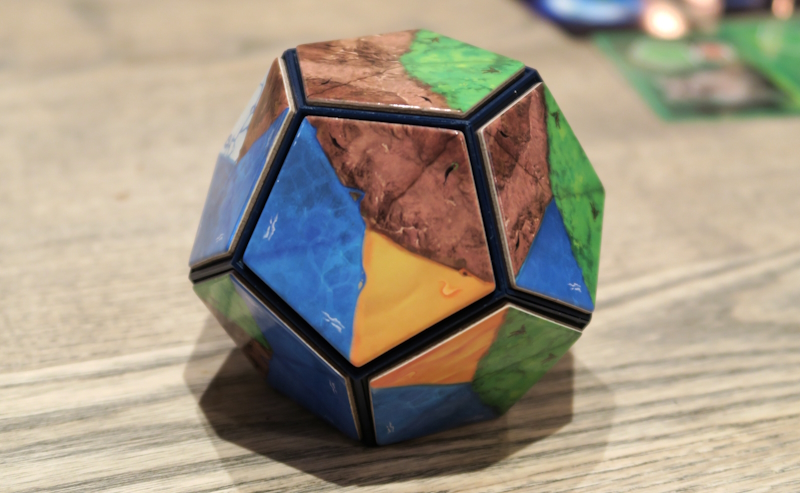
Planet
– Image by boardGOATS

Players score points for the size of their Natural Habitat, and also for each animal card they claim.  Animals that live in an area that is not the player’s Natural Habitat score extra points which creates sort of opposing incentives to cover the planet with Natural Habitat tiles while also creating the right conditions to score animal cards.  And as the Planet fills up, this gets more and more complex.  Although everyone loved it, the game didn’t quite click for Blue, but it was close between Ivory and Mint.  There were only two points between them in the final totals, with Ivory taking his second victory of the night with twenty points.

Planet
– Image by boardGOATS

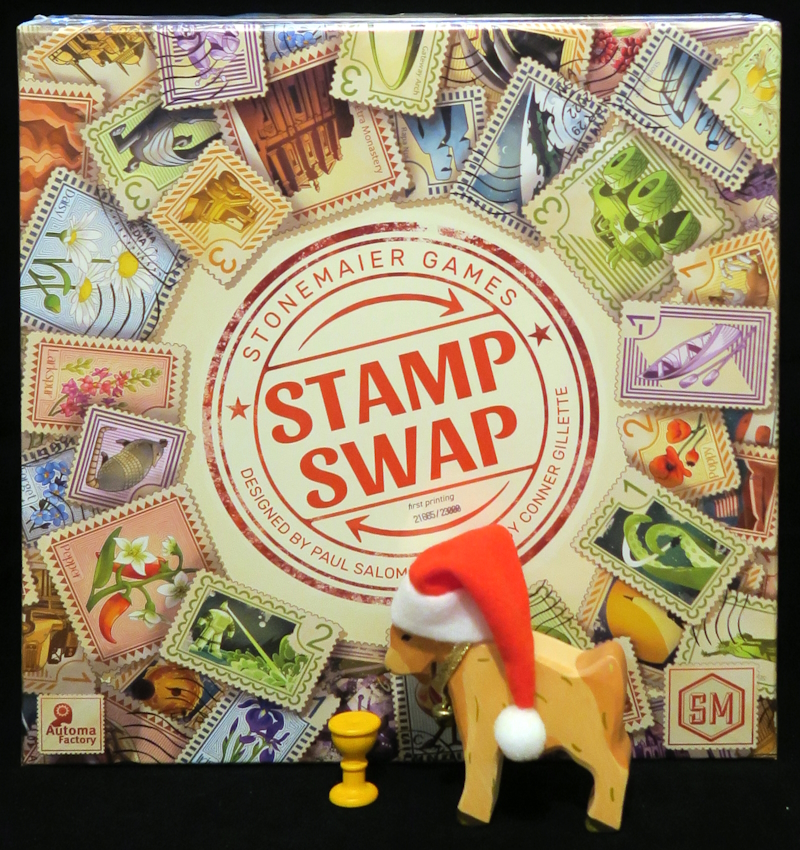
From there, the trio went on to play the Golden GOAT Award winning game, Stamp Swap.  In spite of the theme (which didn’t really set anybody’s imagination on fire), this has proved to be a really popular game within the group—it is just very smooth and doesn’t outstay its welcome.  Everyone had played it before, so there was only the barest minimum of a rules run-down.  The game takes place over three rounds, each split into two parts:  Firstly players take it in turns to choose from a central pool, then players divide their pile into two and the first player chooses one pile from another player to take, who keeps their other pile and chooses one from another play—and thus the piles of stamps are swapped.

Stamp Swap
– Image by boardGOATS

Players score points at the end of each round for their achievements and at the end of the game, for the face-value of the stamps and for end game objectives.  Despite everyone having played it before, there was a rules malfunction that might happened before and could have made a significant difference, to Mint and Blue especially.  Each player has an “Exhibitor” which gives players a point for each stamp they have of a given theme.  The group scored this at the end of the game, however, it is supposed to give points at the end of each round.  Everyone played by the same rules, so Ivory was the deserved winner with a hundred and eighteen points, but the scores would have been closer if the Exhibitors had been played correctly.
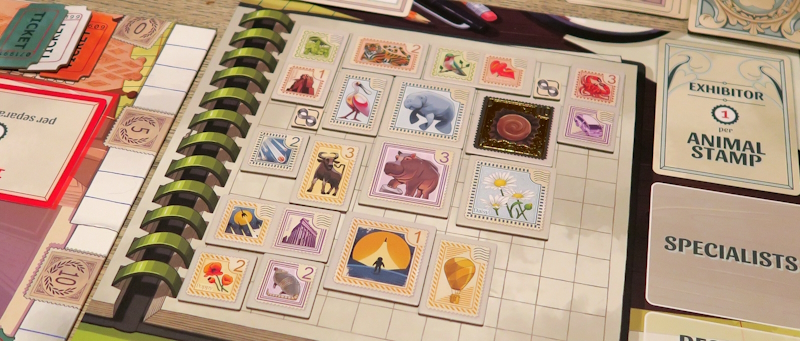
Stamp Swap
– Image by boardGOATS

On a night when there were four tables, the third consisted of Pink, Black, Pine and Purple, started with a game of Little Town.  This is a really cute little game of Worker placement, resource collection and management, and building tile placement.  The game lasts for four rounds, during which players collect resources (wood, stones, fish, and wheat) from the eight surrounding squares by placing Workers on central map.  Players can then build buildings using these resources, players can then gain the effect of the building by placing a Worker next to it.  Placing a Worker next to a building owned by another has a cost though, and the player must pay a coin before you can collect resources.
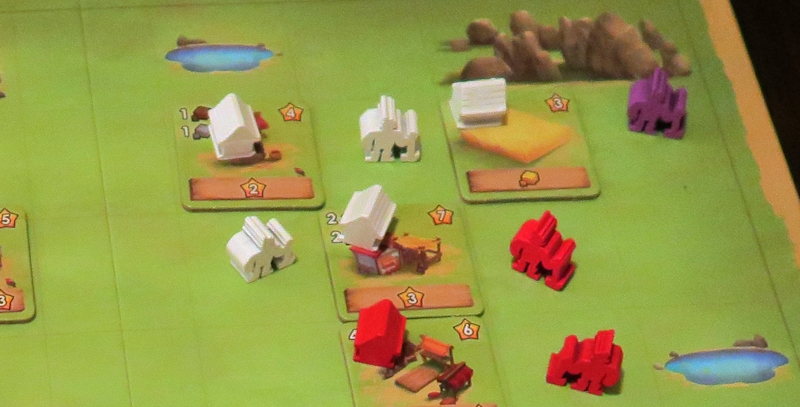
Little Town
– Image by boardGOATS

Players collect victory points using the powers of buildings, by constructing buildings, and by achieving objectives dealt at the beginning of the game. This time, Pink played a really pragmatic game essentially simply repeatedly activating the Well and the Bar (giving him two and three points each respectively).  As a result, the game was a bit of a land-slide with Pink taking victory with thirty-nine points, eleven ahead of Black in second with Pine a few points behind that.  With everyone else otherwise engaged, the group went on to play a quick game of Ticket to Ride: New York.  This is one of the first of the very small editions of Ticket to Ride, in fact, the first of the “Cities“, as it was preceded only by the Demo version.
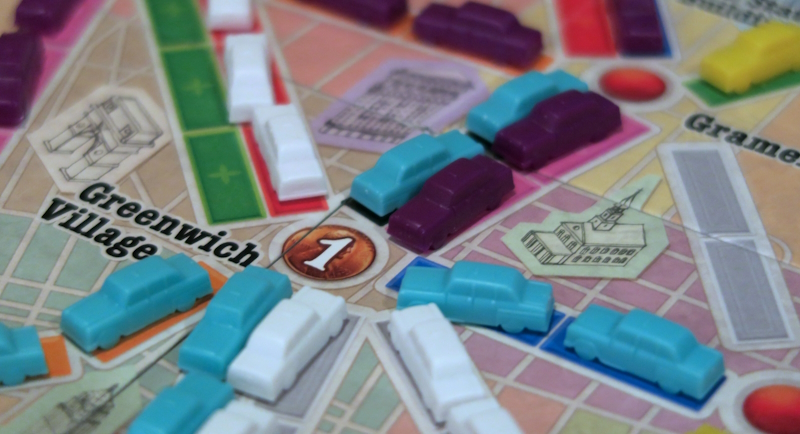
Ticket to Ride: New York
– Image by boardGOATS

The game is played much the same as the full version of Ticket to Ride, with players taking coloured cards from the market and spending them to place pieces (in this case taxis) with the aim of completing tickets.  Black took the most points for the Tourist Attractions he made connections with, but had a bit of a ‘mare elsewhere, failing to complete a large pile of tickets which left him losing fifteen points.  This almost entirely wiped out the rest of his points, but it was relatively close between the others.  Pink was once again the victor though, taking the most points for placing taxis and for his tickets giving him a total of thirty-four points, with Pine taking second place just ahead of Purple.
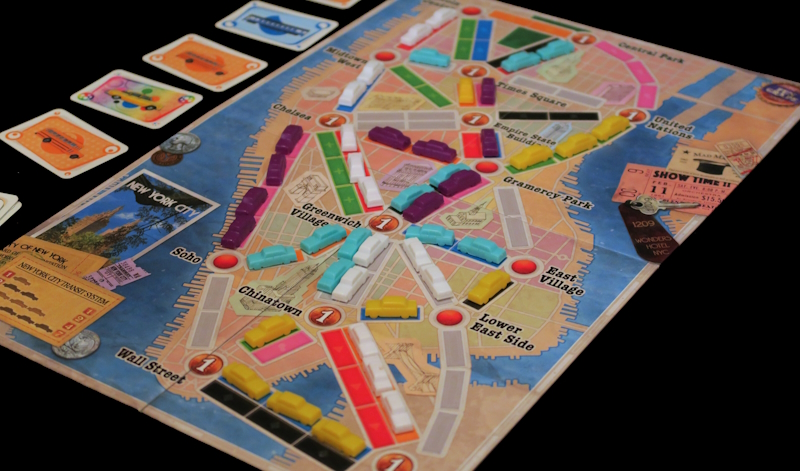
Ticket to Ride: New York
– Image by boardGOATS

The fourth table consisting of Green, Teal, Salmon and Flint, only played the one game, but it was one of the most beautiful of recent times:  Earth.  This is a card-driven engine-builder where players are building themselves an ecosystem.  Often compared to Wingspan, although there is a lot to understand, the game itself is not actually all that complicated. Players are building a four by four grid of Flora and Terrain cards which represents their island; during the game they will plant flora, water it and allow it to grow.
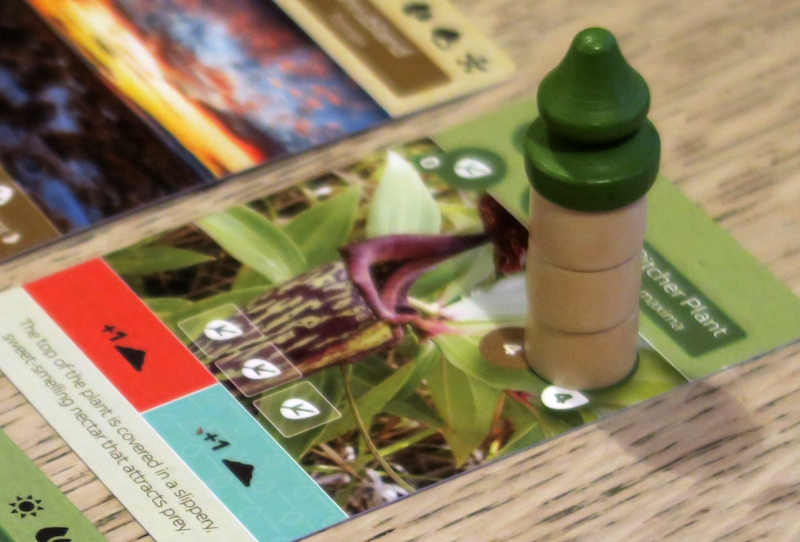
Earth
– Image by boardGOATS

On their turn, players do one of four things: Planting (paying the cost in Soil tokens), Composting (gaining Soil and placing cards from the deck in their discard pile), Watering (place Sprouts and gain Soil) & Growing (draw new cards and place growth tokens).  A bit like Puerto Rico, once the active player has chosen which action they are taking, everyone else gets to do a subsidiary, slightly weaker version of the same action.  For example, when Planting, the active player plants two cards, draws four and keeps one, while the other players plant one and draw one.
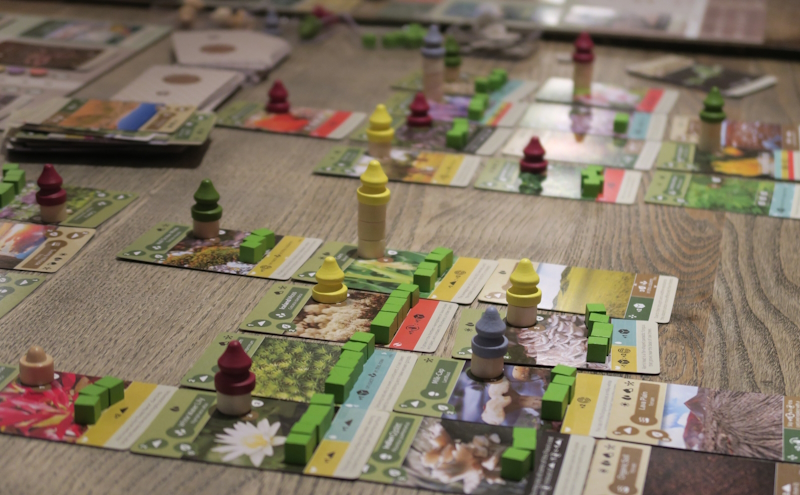
Earth
– Image by boardGOATS

Once everyone has completed the action for the turn, everyone activates all the cards in their island that match the colour of the action chosen, starting with the card in the top left and working across each row in turn.  So, not only is it important which cards are played, but also where they are located in the player’s island.  At the end of the game (which is triggered when one player has completed their island), players score points for each Flora card, any Trunks and Canopies they have grown, their Sprouts and their pile of “Composted” or discarded cards.  Players also score points for achieving objectives on the Fauna cards revealed at the start of the game and for completing their island first.
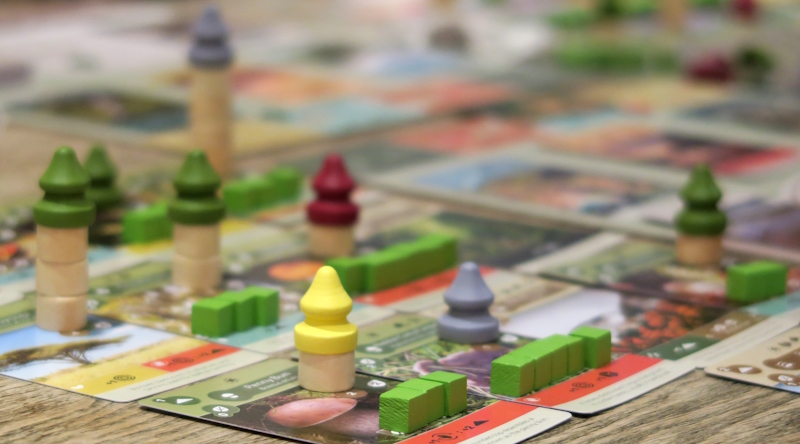
Earth
– Image by boardGOATS

This was another game that turned out to be a bit of a land-slide.  The base scores for the islands was pretty consistent, but as with many games, it’s about what you do with the cards you get that makes the difference.  Green “Composted” fewer cards, but scored more for his Sprouts.  Players had ups and down, but otherwise it was fairly even.  The biggest difference, however, was the number of Leaf Tokens on the Fauna board—Green had more than twice as many as anyone else with sixty.  As a result, his total of two-hundred and forty-four was nearly fifty more than that of Teal who took second ahead of Flint in third.
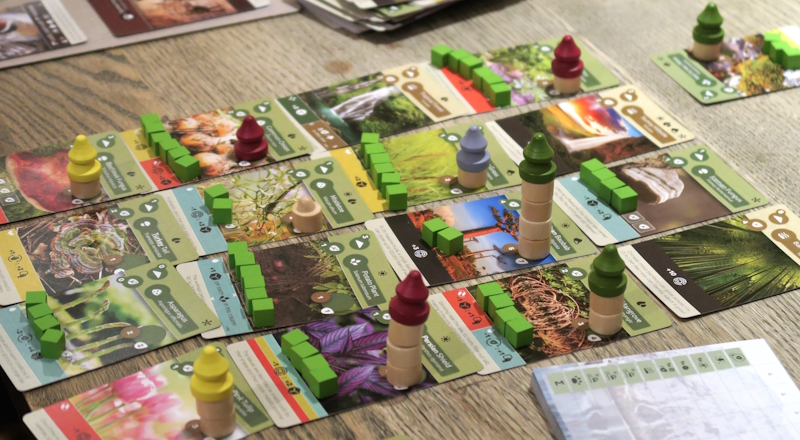
Earth
– Image by boardGOATS

Learning outcome:  Rushing the end of a game can take the shine off it.

8th April 2025

By the time everyone else started to arrive, Cobalt was already most of the way through losing his game of 20 Strong.  This is a solo-player deck-based game where the object is to progress through a shuffled deck of cards, each of which bears a unique challenge. This challenge could be in the form of an enemy, a unique scenario, or some other requirement which are completed by rolling a set of seventeen dice with different odds for a hit.  These dice, along with three adjustable stat dice, make up titular twenty dice.  Cobalt continued rolling his dice while others ordered food, chatted and ate.
20 Strong
– Image by boardGOATS

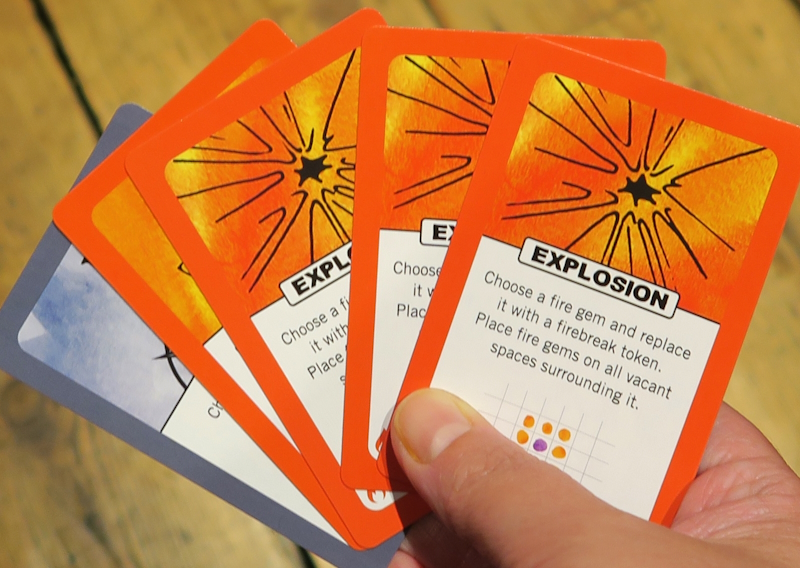
Before long players began splitting into groups, deciding what to play.  The first group was Blue, Pine, Mint and Pink playing the “Feature Game” which was to be Fire Tower.  This is a competitive game where players order air drops of water, and plan the building of firebreaks in order to combat a woodland blaze.  The rules are very simple:  players begin their turn by spreading the fire in the current wind direction then play one card from their hand (or discard all their cards) and replenish their hand.  There are four different types of cards, Wind, Fire, Water, and Firebreak cards.  Wind cards can be used to change the Direction of the Wind which affects which direction the fire spreads in.

Fire Tower
– Image by boardGOATS

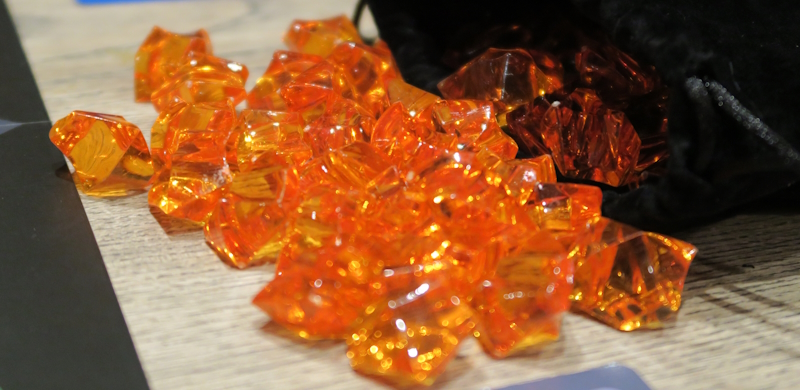
This can either be by playing the card and changing the Wind Direction to that on the card, or by rolling the Wind die and leaving it up to fate.  Alternatively, the player may place a fire gem on one empty space orthogonally adjacent to an existing fire space (or the central Eternal Flame), in the wind direction indicated on the card.  Fire, Water and Firebreak cards give a pattern of spaces that the fire must either spread in, is removed from, or fire break tokens can be placed in.  Firebreaks prevent fire from landing on or jumping over the spaces they occupy and can only be removed using a card that includes the De/Reforest action and cannot be placed in orthogonally adjacent to another Firebreak token.

Fire Tower
– Image by boardGOATS

Each player took the Fire Tower on one corner of the board with Pine sitting opposite Blue and Mint opposite Pink.  Blue went first followed by Mint, then Pine and finally Pink.  The base game is an elimination game, with the winner the being the last player who’s Fire Tower has not be burnt down.  The group decided to play without the events and keep the game as simple as possible to see how things worked.  Pink was the first to get knocked out with Firestorms proving to be disastrous for his Tower.  Pine quickly followed with before there was a long, determined rear-guard action by Blue.

Fire Tower
– Image by boardGOATS

Unfortunately, Mint started in a better position and despite her best efforts, eventually Blue’s Tower was also a moldering ruin.  Since Pink and Pine had spent quite a lot of time as spectators, the group decided to give it a second go, but this time working in pairs.  This time, Blue’s Tower was first to be destroyed with Mint’s next.  Eventually, only Pink’s tower was still standing giving a second victory to Mint, which was shared with Pink.  The game had been quite enjoyable, if very different to the usual fare.  There was still plenty of time left for something else though, so the group had a rummage in the bags and came up with Draftosaurus.
Draftosaurus
– Image by boardGOATS

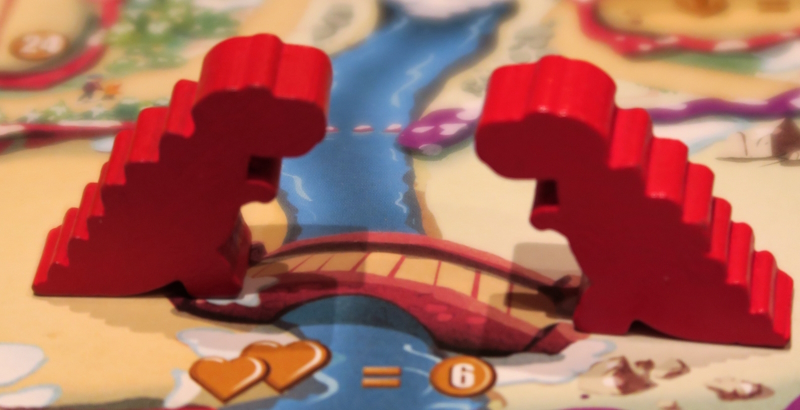
This is a very popular game where players start with a hand of dino-meeples, choose one and pass the rest on before placing them in their dinosaur park.  It frequently gets outings within the group, but on this occasion, for variety, the group decided to play with the winter setting which gives slightly different pens with slightly different placement conditions.  It was very tight, but as is often the case, Pine, who just seems to “get” this game emerged the victor with thirty-six points.  He was only one point ahead of Mint and Pink though, who tied for second place.

Draftosaurus
– Image by boardGOATS

Meanwhile, on the next table, Green putting in a rare, but welcome appearance, was leading Black, Purple and Plum in a game of Discworld: Ankh-Morpork.  In this game, Lord Vetinari has disappeared and players control different factions which are trying to take control of the city.  Game play is quite quick and simple with players playing a card and doing what it says.  Most cards have more than one action on them, and players can choose to do some or all of these actions. Some cards also allow people to play a second card, so they can chain actions together.

Discworld: Ankh-Morpork
– Image by boardGOATS

In this game, Black was the Dragon King of Arms, looking for trouble, Green was Chrysoprase, trying to amass lots of money, Plum was Commander Vimes who was trying to play through the deck and Purple was Lord Rust, with an area control remit.  The game was over quite quickly with Black running out the winner in a game that is much under-rated and sadly very out of print due to IP issues.  This copy was a much cherished one, as it had belonged to Burgundy so it was nice for it to get another outing within the group.  There was time for a second game and this ended up being Faraway, a very clever, much more recent, card-driven game that has had a few outings since its release last year.

Faraway
– Image by boardGOATS

The idea is that players simultaneously chose one of the numbered cards from their hand and starting with the the player that played the lowest card (similar to 6 Nimmt! or Kingdomino), everyone takes it in turns to choose one from the market to add to their hand.  Players then simultaneously choose another card, and again, choose one to add to their hand.  The game ends after everyone has played a total of eight cards, and then everyone scores.  The clever part is that the cards are played left to right, but the scoring is from right to left.

Faraway
– Image by boardGOATS

At first glance, this looks like it makes things easy, because early in the game players find out what they need to get points and can then focus on getting the resources they need as the game progresses, but of course that is not the case.   This time, Purple had a really bad run where she kept getting the highest number cards, which meant she picked last, and then picked up the higher number cards left by others.  Once again, the winner was Black making it two out of two for him, while Plum was second by seven points with Green a little way behind her.

Faraway
– Image by boardGOATS

Meanwhile, the third group comprising Jade (fresh from his birthday celebrations), Sapphire, Teal, Byzantium and Cobalt spent the evening playing a five-playergame of Earth.  This is a is a sumptuously illustrated card-driven engine-builder game that is often compared to Wingspan, where players are building themselves an ecosystem.  The game itself is not actually all that complicated. Players are building a four by four grid of Flora and Terrain cards which represents their island and during the game they will plant flora, water it and allow it to grow.  On their turn, players do one of four things: Planting (paying the cost in Soil tokens), Composting (gaining Soil and placing cards from the deck in their discard pile), Watering (place Sprouts and gain Soil) & Growing (draw new cards and place growth tokens).

Earth
– Image by boardGOATS

A bit like Puerto Rico, once the active player has chosen which action they are taking, everyone else gets to do a subsidiary, slightly weaker version of the same action.  Once everyone has completed the action for the turn, everyone activates all the cards in their island that match the colour of the action chosen, starting with the card in the top left and working across each row in turn.  At the end of the game (triggered when one player has completed their island), players score points for each flora card, any Trunks and Canopies they have grown, their Sprouts and their pile of “Composted” or discarded cards.  Players also score points for achieving objectives on the Fauna cards revealed at the start of the game and for completing their island first.

Earth
– Image by boardGOATS

During the game, Cobalt built up the most points; his forty-two were some five ahead of Byzantium.  By far the most points come in the end-game scoring however.  A bit of a point salad there are seven scoring sections:  Teal scored best for Compost; Jade scored most highly for completing his Canopies; Byzantium top-scored for Terrain, and Cobalt out-scored everyone else for his Fauna.  As well as getting the most points for his Sprouts and Ecosystem Objectives, Sapphire also scored well in many of the other categories giving him a clear victory with one hundred and sixty-eight points, thirteen more than Byzantium who pipped Cobalt for second by a single point.

Earth
– Image by boardGOATS

Learning outcome:  Playing with fire may be fun, but you risk getting burnt.

4th March 2025

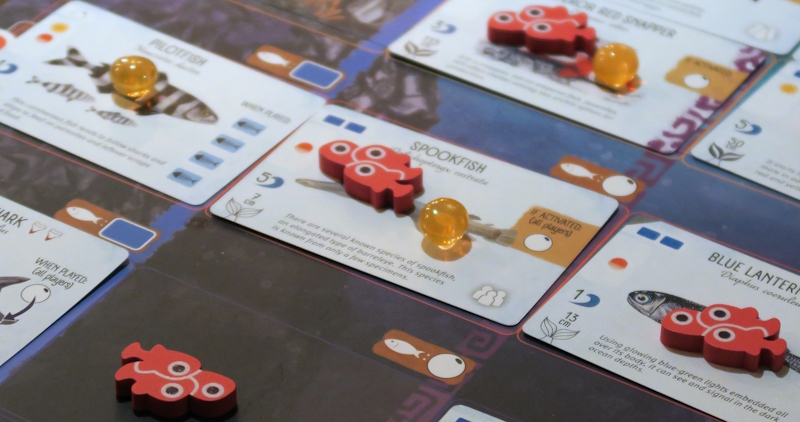
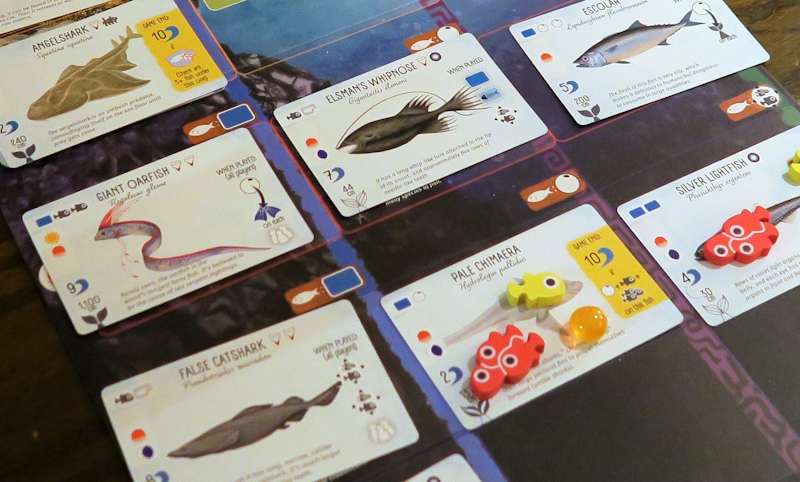
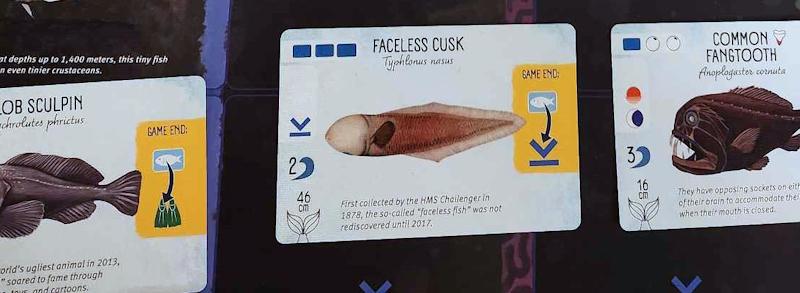
Once people had finished eating, the group settled down to play. There was quite lot interest in the “Feature Game” which was Finspan, a fish-themed version of one of the group’s favourite games, Wingspan.  It is advertised as shorter and lighter than the original, but in the event it was only slightly shorter and not much lighter though it was generally agreed to be a bit smoother and therefore perhaps easier to teach.  Like Wingspan. Finspan is card-based, though the cards are fish instead of birds, albeit just a beautifully illustrated.  As in Wingspan, players have a hand of cards (in this case open) and on their turn can choose to play one from their hand or activate one area or Dive-site of their player board (blue, purple or green), in this case representing the ocean.

Finspan
– Image by boardGOATS

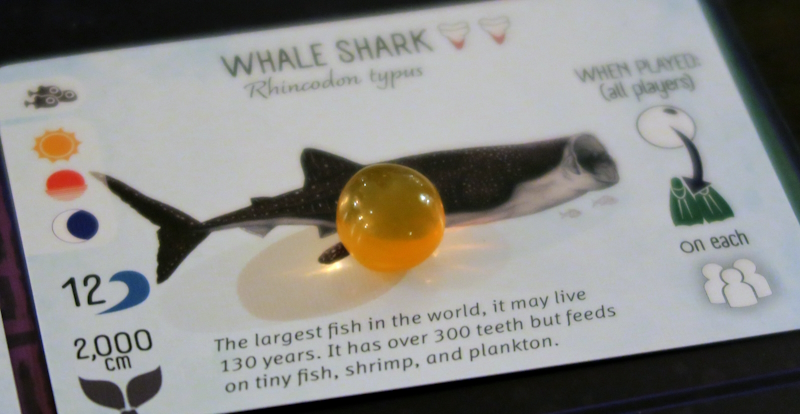
In the case of Finspan, the Dive-sites are arranged vertically (instead of horizontally), but rather than placing cards in order (from left to right in the original), the Fish cards have to be placed at the correct depth for the Fish—some live in the shallows, others in the deep sea, while a small number live in the “twilight” region, between the two.  As in the original, there is a cost for playing cards—fish eggs, Young,Schools and/or other cards. Unlike the original, however, cards spent in this way are placed into players’ own personal discard pile and there are mechanisms for getting them back later in the game.

Finspan
– Image by boardGOATS

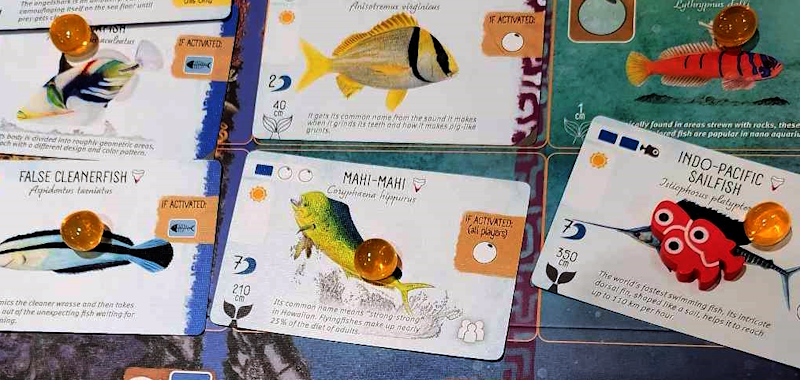
Another way that Finspan is different to the original, is the way the Dive-sites are activated. As in Wingspan, cards are activated in order, in this case, from the shallow “sunlit” zone to the “midnight” deeps. The Fish cards have “when played”, “when activated” and “end of the game” powers, but there are fewer cards that have a power on activation and many of these affect all players too. In addition to the difference in the balance of the cards, when a Dive-site is activated, the three zones each give a benefit as long as they have at least one Fish card in them.  These benefits are capped though, as multiple Fish doesn’t increase the income. The first time each player activates a Dive-site in a round, they also get a bonus benefit.

Finspan
– Image by boardGOATS

There are a small number of Fish pre-printed on players’ boards, which mean than some areas give benefits from the very start of the game.  The effect of all this is to give the game a more friendly feel than Wingspan, without reducing the challenge of the game.  There is another major change which significantly adds to the complexity. In Wingspan, a key part of the game is Egg production with Eggs worth a point each at the end of the game.  In Finspan, players also produce Eggs which are worth a point at the end of the game, but each Fish card can only be used to store one single Egg. Eggs can be hatched to give young (also worth a point) and three young on the same fish form a “School”.

Finspan
– Image by boardGOATS

Schools of fish are worth six points at the end of the game.  And this is where the game gets a little “head-hurty” as Young and Schools can be moved around, but while Young can share a Fish space, once they have formed a School, they can’t share a space with another School—one School can’t even pass through a space containing another School.  The game is played over four rounds (or Weeks) with points for achieving objectives at the end of each one.  These are added points gained for each Fish card, Eggs, Young, Schools and any end game actions to give a final total—the player with the most points is the winner.

Finspan
– Image by boardGOATS

As there was a lot of interest in the game, the group set up two tables. Jade, Sapphire, Plum and Byzantium had played it at a convention over the weekend, so Jade led one game with Blue, Ivory and Sapphire, while Plum led the second with Byzantium, Black and Pine. Jade’s group was the first to complete the rules explanation and got going. Ivory was quite excited by the idea of collecting sharks, and while Blue found Nemo, Sapphire found Dorry.  The points from the end of the Week objectives were pretty even for the first three weeks, though only Ivory got much at the end of the final week taking twenty points for his end game bonuses, largely due to having a lot of sharks.

Finspan
– Image by boardGOATS

Blue top-scored for her fish while Jade scored the most for his Schools. In the end, Blue’s hundred and fifty-five took victory with Ivory in second eleven points behind, three points ahead of Jade. Over the other side of the room, Plum’s game was slower to start, but finished at much the same time.  This game was lower scoring and closer too; almost everyone picked up some end game bonuses, but not as many as Ivory, and there were fewer Schools.  The winner was Byzantium, with one hundred and thirty-one, just two points ahead of Plum who was just a nose in front of Black.  All in all, everyone had enjoyed the game as a nice variant on the well known original.

Finspan
– Image by boardGOATS

Meanwhile, on the next table, Pink, Cobalt, Lime and Purple had begun by playing Tokaido.  This is a sort of time-track game where the player at the back takes their turn moveing forward to an empty space of their choice taking turns until they are no-longer the one at the back at which point the new “Lantern Rouge” takes their turn.  Each space allows players to collect panoramas, chance it with a random draw for points, buy souvenirs, donate at a temple or work on a farm to gain cash.  At intervals, players have to stop for food which costs money, but the last player to arrive at the restaurant last gets the least choice which can be a catastrophe as these meals are usually more expensive with the risk that they are the same as those eaten on previous stops, which means they can’t eat and therefore don’t score.

Tokaido
– Image by boardGOATS

Although it is quite popular within the group, Cobalt was new to the game and commented that it was quite mean when he realised that once a space had been taken it was gone.  The group played with the choice of two character cards at the start—Pink felt that his Traveler, Hiroshige, was a poor choice as, although he got a free panorama card at each food stop, it didn’t give him much money at the start.  On reflection, he felt Purple had made a better decision in choosing Yoshiyasu, who gave her nine Yen.  Lime was the runaway winner with ninety-one, some fifteen more than Purple who just sneaked into second ahead of Pink.

Tokaido
– Image by boardGOATS

As the games of Finspan were still going, Cobalt introduced the group to After Us, aka “The Monkey Game”.  This had an outing within the group about eighteen months ago, but was new to Pink and Lime. It is a deck-building, resource management, engine building game featuring an original card-combo mechanism. The story is that mankind has died out leaving only apes which have kept evolving. As the leader of a tribe, players add new Primate Cards to their starting deck of tamarins. Primate Cards have three rows of “Effects”—the top row will award resources, the middle row will give points (often at the cost of resources) and the the bottom row will have abilities related to the primate type. At the start of a round, players draw four Primate Cards from their deck to be laid out in a row making “Connections”.

After Us
– Image by boardGOATS

The aim is to get the most out of the Connections by closing the open ended “Frames” along the sides of the cards by butting them up against adjacent cards that also have open ended Frames. Players then resolve the now closed Frames following the order of top left to bottom right, trying to gain as many bonuses as they can. Once everyone has simultaneously collected their Resources they can then use them to buy Primate Cards which are added to the top of the draw deck (and thus they come into use on the very next turn). In this way, they are improving the quality of their deck.

After Us
– Image by boardGOATS

One of the good things about the game is that if a player gets a bit “hosed” by the card draw, the frames mechanism allows them to make the best of a bad job.  The Frames have been resolved, the players simultaneously chose one of their Action Discs denoting which primate type they want to recruit.  The game starts slowly with players building their tribe, but it can end in a sudden rush when one player breaks into a gallop and charges past eighty points triggering the end of the round and this game was no exception.  Lime was again the victor, with sixty-nine points, with Pink second, some nine-points behind.

After Us
– Image by boardGOATS

Learning Outcome:  Jaws was not the only shark.

18th February 2025

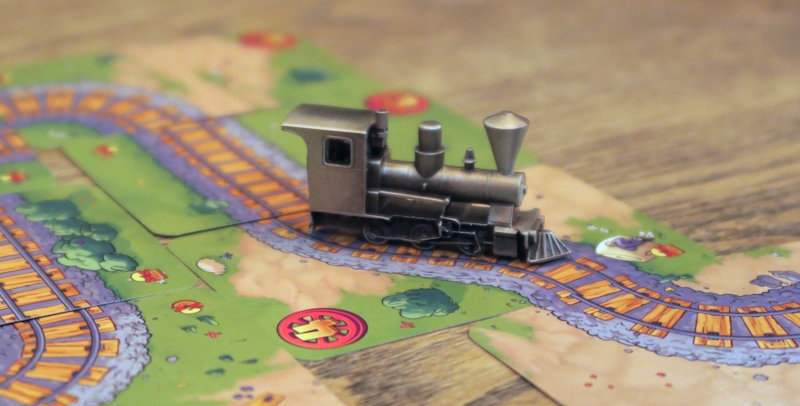
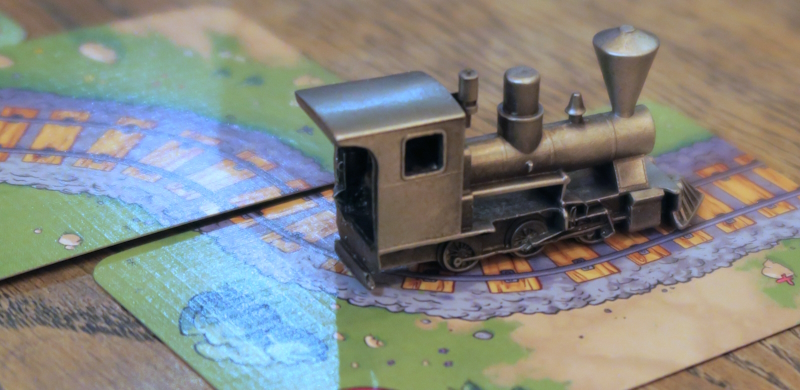
Blue and Pink began the evening, while they waited for their supper to arrive, messing about with a little card game called Rollecate which is about a historic steam locomotive built in 1967 by a famous Dutch engineer.  The idea of this little game is that players take it in turns to play Track cards to extend Rollecate’s line by placing cards.  They can play as many cards as they want, as long as they all have the same number.  When laying new track, the difference between the numbers on the last card and the first new card placed must not have a difference of two (thus one cannot be followed by three and four cannot be followed by two etc.). Cards must not overlap when played and cannot force impossible play.

Rollecate
– Image by boardGOATS

Once the Track cards have been played, the active player rolls dice equal to the sum of all numbers on the cards they played, and Rollecate moves forward one step for each Wheel rolled on the dice.  Thus, if a player places two threes, they roll six dice. If Rollecate reaches the end of the track, she hits the brakes.  For every step she’s short, the player take one card from behind the train places them on their penalty pile one by one in any order they want. Any time the card placed matches the number of the top card on the pile, both are removed from the deck.  At the end of the game the everyone adds up the face value of their cards and the player with the lowest total wins.

Rollecate
– Image by boardGOATS

By the time Blue had explained the rules to Pink, their food had arrived, and by the time they had finished their supper, Cobalt had joined them.  Blue was just finishing explaining the rules when Pine joined them and eventually they all finally managed to play the game.  There were a few “teething issues”, but before long the delightful little metal miniature was progressing along the track.  Blue and Pink got unlucky and picked up a lot of cards, some high scoring, and weren’t able to remove them.  Cobalt and Pin did rather better with Pine finishing with five penalty points and Cobalt with four.

Rollecate
– Image by boardGOATS

By this time, almost everyone had arrived, and Pink began to set up the “Feature Game” which was to be Viticulture World, the cooperative expansion to the popular wine-producing worker placement game, Viticulture.  This is one of Pink’s and Teal’s favourite games, but also very popular with other members of the group.  No-one had played the cooperative expansion, however, but despite some apprehension that the changes might spoil a favourite, there were a lot of interested parties.  In the end, Pink was joined by Teal, Ivory, Plum and Cobalt, all of whom were very familiar with the base game.

Viticulture
– Image by boardGOATS

There isn’t really anything particularly special about the base game, it is just a worker-placement game where players are growing grapes and making and selling wine.  However, it is just done very, very well.  In general, there are two types of worker spaces—restricted, that only a limited number of workers can use per round, and open spaces which can be used by as many workers as players want.  Each player also has one Grande worker who can be placed anywhere, even on fully occupied spaces.  The cooperative game is essentially much the same as the original Viticulture, with some small rules changes and a different target:  players have six years to goal: each player must reach twenty-five victory points and the shared influence token must reach the end of the influence track.

Viticulture World: Cooperative Expansion
– Image by boardGOATS

There are seven different packs of cards and the group began this time with the easiest, Green Gully, which as advertised, is a very good introduction to Viticulture World.  This is designed to make sure everyone is successful on their first time out (though it may be easier with more players).  Each player has four workers plus one Grande and unlike the original, there is no mechanism to get more.  Two of these workers have yellow hats to indicate they are summer workers and two have blue hats and these can only operate in winter, training however, allows them to remove their hat and play in other seasons.  There was a little concern prior to play that as only certain types of workers are able to claim certain bonuses it might make the game a touch fiddly, but this was not the case.

Viticulture World: Cooperative Expansion
– Image by boardGOATS

As the game progresses, there are Event cards which give special action and also increase the number of workers that can be placed on some locations. There was some confusion at the start of the game as to whether the Grande worker could be used to claim the special actions.  It was felt this would make the game way too easy though, because if everyone was able to take advantage of the bonus with their Grande this would make the game too easy; a quick online check confirmed that this was not allowed.  The group found the game fairly straight-forward, though everyone was quit experienced and therefore knew where the areas of tension were, in particular making wine, harvesting grapes and fulfilling orders, so made a point of upgrading these early.

Viticulture World: Cooperative Expansion
– Image by boardGOATS

The group had a lot of fun, and as is not uncommon with this game, there were lots of “getting my cock out now” comments (especially from Ivory), when it came to claiming the turn-order.  Ivory was the first to achieve his required twenty-five points, but he went on to get thirty in order to claim an extra influence point for the team.  Cobalt was next to make his target and everyone else followed the next round.  Despite the initial reservations, everyone enjoyed the game and would be keen to try some of the more challenging regions on another occasion in the not too distant future.

Viticulture World: Cooperative Expansion
– Image by boardGOATS

While the oenophiles were playing Viticulture, the other four were revisiting Kavango.  This is a medium weight card drafting and tableau building game which has something of the feel of Wingspan.  This was the “Feature Gamelast September, when it went down well with those that played it, one of whom was Pine.  It had a second outing two weeks ago, when Blue promised Pine and others it would come back.  Pine was keen to give it another go, and this time they were joined by Purple and Black.  The game is fairly straightforward to play, though a monumental table-hog, so the group started by moving to a larger table on the other side of the room.  Blue outlined the rules:  Players start with a hand of twelve cards and choose one before putting the rest to one side.

Kavango
– Image by boardGOATS

This card is then either added to the player’s tableau if it is an animal card, or activated if it is an action card.  Once the card has been played, players have the opportunity to invest in protection or claim rewards (money and points) for completing targets.  In the early part of the game, the cards that are dealt are mostly from the bottom of the food chain, what the game refers to as “Producers”, rodents and the like.  As the game progresses, the creatures get bigger and require the presence of other animal types or terrain as food and protection (Habitat, Poaching and Climate).  This time, Blue (who was playing the game for the third time) stole a bit of a march, picking up more points during the game than anyone else.

Kavango
– Image by boardGOATS

Pine who was on his second play, did a god job of collecting valuable animals and finished with a massive one hundred and twenty-six points, but failed to pick up the bonuses for the protection.  Purple didn’t do so well with her animals, but had every type and picked up all the bonus points available for protection too, while Black didn’t take any points for that, but did well on his personal objectives.  The winner, (unsurprisingly given her extra experience) was Blue followed by Pine with Purple in third.  The consensus from Purple and Black was that the game (like Wingspan) felt a too random, though Blue and Pine commented that it felt less so after multiple plays.

Kavango
– Image by boardGOATS

Learning outcome:  Making wine is just as much fun as a team.

boardGOATS – 1000 Posts

The idea of our little website, boardGOATS.org, was to create a medium to advertise up-coming games nights as well as log the games played. It has been around as long as the group, over twelve years now, and has just passed one thousand posts. Most of these posts are games-night related, but our series of news articles about games has also proved very popular further afield.

Some statistics…

  • The site has 1,002 posts (this will be 1,003).
  • It is not a high traffic site, but we have had 39,101 visitors with 58,054 views with 83 email subscribers.
  • The most popular links on our site are those to the Board Game Geek website (boardgamegeek.com) with 3,698 clicks.  Internal links come next with 1,174 clicks.
  • 16% of page views happen on a Monday and the most popular time of day to visit the site is around 7-8pm.
  • The most popular day was May 10th 2016 thanks largely to a post about a record breaking Carcassonne game a few days earlier.
  • The most popular post was published in March 2019 and discussed counterfeiting of board games, and has nearly 6,000 views. Some eighteen months later, this was followed by a case study and another article covering a specific retailer.
  • Visits peaked between November 2020 and January 2021, probably due to increased interest in board games as a result of the global pandemic and people looking for ideas for Christmas games.  In those three months the site was viewed nearly four thousand times.
  • The most popular category of post is “News” and the most popular tags are Terraforming Mars, Carcassonne and Wingspan, but the majority of our local gamers get the information by email through subscription—if you would like to receive emails through this channel and would prefer not to create a WordPress account, let us know through the contact form/email and we can add you manually.

We would like to thank everyone who has enjoyed reading.

The boardGOAT

10th December 2024

Everyone had already arrived and was waiting in anticipation when Blue and Pink arrived with piles of gamers crackers, Christmas tree decorations, party poppers, paper parcels, mince pies, festive cakes (with carrot meeples on top) and GOAT Award voting forms.  Food quickly followed along with a volley of noise as people tried to pull their crackers and party poppers first so the contents didn’t land in their supper.  As people munched, there was some discussion about the games played and voting forms were filled in.  In the absence of Green, Pine kindly offered to act as returning officer and collate the statistics.

"Un-Christmas Party" 2024
– Image by boardGOATS

While cake and mince meat parcels were shared round, toasts were offered by Lime to the organisers, and in the memory of Burgundy.  He is much missed and will never be forgotten, but we always make a special point of remembering at this time of year, especially as the Un-Christmas Dinner was his last games night with us.  The GOAT Awards were then announced.  Moment of the Year was when Pine got the end game rule wrong for Tonga Bonga, so that Pink thought he’d won, but then didn’t.  The GOAT Poo Prize for the least popular game of the year went to Ca$h ‘n Guns—not a game the group plays often and its only outing over the last year was at the New Year Party.

"Un-Christmas Party" 2024
– Image by boardGOATS

Then it was time for the Golden GOAT.  Previous winners were ruled out, but other contenders included Akropolis, Kavango, Flamme Rouge and Ticket to Ride: Rails & Sails.  The clear winner of the 2024 Golden GOAT Award, however, was Stamp Swap.  There was much discussion about how this was the third winner from Stonemaier Games (after Tapestry last year and Wingspan in 2019) and how we should invite Jamey Stegmaier, to collect the award in person.  Email correspondence over the following few days suggested that while it was unlikely he would be able to come to GOATS, he will be in the UK next year and just might make it as far as Oxford.  In the meantime, he has highlighted the award on his website.

Golden GOAT - 2024
– Image by boardGOATS

With the festive business over, the group broke into three to play some games.  Pink, Blue, Black and Jade began with the “Feature Game“, Courses De Rennes (aka Reindeer Races), a fun little game where players control a team of four reindeer, racing along four different tracks to try to get the highest-scoring tiles.  On their turn, each player can either draw two cards (with a hand limit of seven) or play as many cards of the same type as they can to move one reindeer along one of the tracks.  The cards are numbered and have suit that corresponds to one of the tracks (or are Elfy, and “wild”).  If two and a three of Gifts is played, the player may move one of its reindeer along the Gift track.

Course des Rennes
– Image by boardGOATS

If a reindeer lands on the same space as another reindeer, it slides forward a space.  If that is occupied too, it continues to slide.  If, however, the owner cries “Thump!” as it lands, the reindeer slithers an extra space forward.  The first reindeer to arrive at the end of a track claims the highest value token.  The game ends when two of the tracks have run out of tokens.  Pink too the first points, and with it a strong early lead.  A few rounds later, Jade took the last token from one of the tracks and with it ended the game.  He got very unimpressed looks from Black and Blue as he gifted victory to Pink, so once this was pointed out, Jade revised his move and play carried on.

Course des Rennes
– Image by boardGOATS

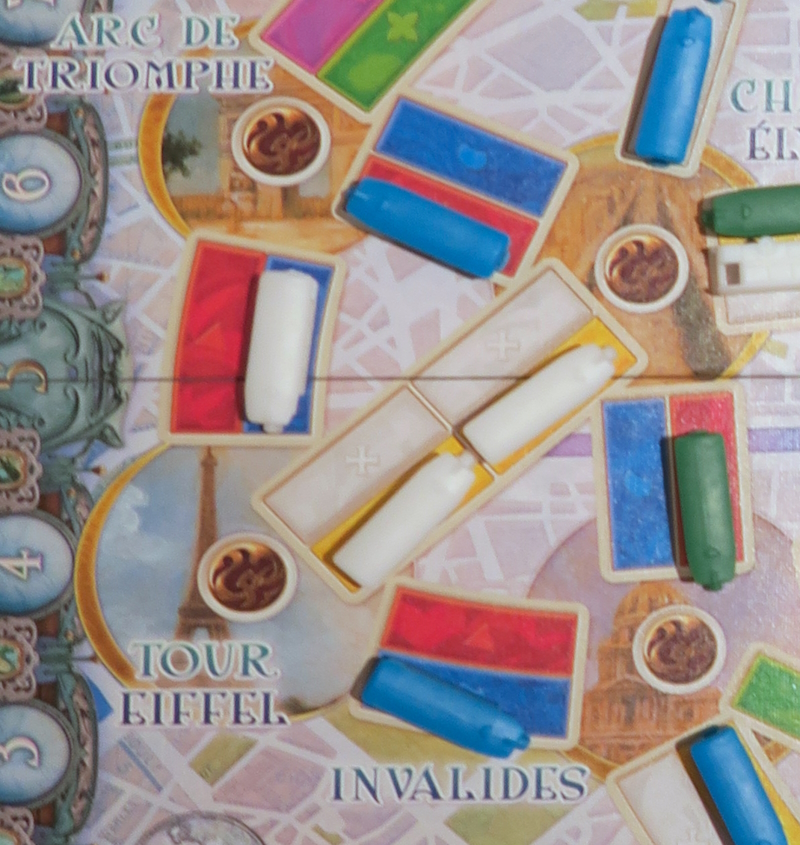
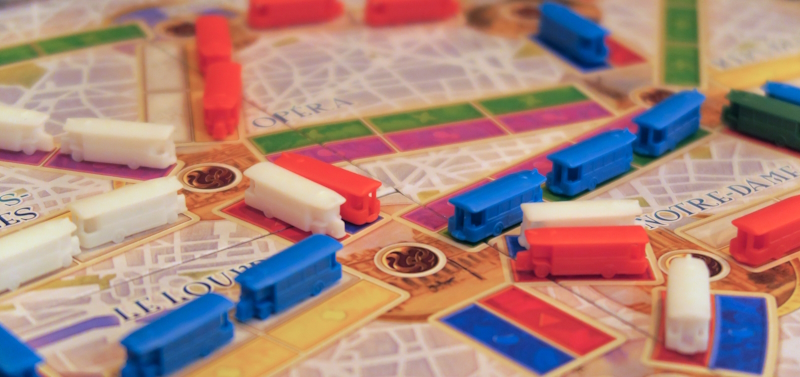
Ultimately, however, it didn’t really change things as Pink still took victory with twenty-two points.  He was long way clear of Jade who won the tight fight for second with fifteen just one point ahead of Black who, in turn, took third by a single point.  Everyone else was still playing, so the group looked for something else to play.  Black had won a copy of Ticket to Ride: Paris in the raffle and, although it wasn’t very festive, it seemed appropriate to give it an outing.  Some of the GOATS had played this mini-city variant of the popular train game earlier in the year when we marked the Olympics with sport and France themed games.  However, none of the current quartet had been part of that group.

Ticket To Ride: Paris
– Image by boardGOATS

The rules are much the same as all the others (take two cards from the market; play cards to place pieces on the map; collect Ticket cards to score points at the end), but like all the variants, Paris has a special rule.  When players claim a red, white, or blue track, they get a card, when they get all three colours they get four “Tricolore” bonus points.  When the game first came out, there had been comments about how this felt very bolted on, but in practice, it was much more interesting than it sounded.  This time, the in game scoring was quite tight, though Blue, with her trains across the city centre got her nose in front and led by six points.  Tickets can make a huge difference to scores though, as they can give a lot of points, both positive and negative.

Ticket To Ride: Paris
– Image by boardGOATS

Black, Pink and Jade all picked up similar points for their completed Tickets (ten, eleven and eight respectively), though Jade was unlucky and unable to complete his last one.  Blue, however, made good use of concurrent routes and scored a massive twenty-four points for hers giving her something of a landslide victory with a total of forty-six.  It was much closer for second which went to Pink who finished with twenty-nine, two points ahead of Black.  Meanwhile, on the other side of the room, Purple was leading Ivory, Plum and Byzantium in one of her favourite Christmas themed games, Christmas Tree.

Christmas Tree
– Image by boardGOATS

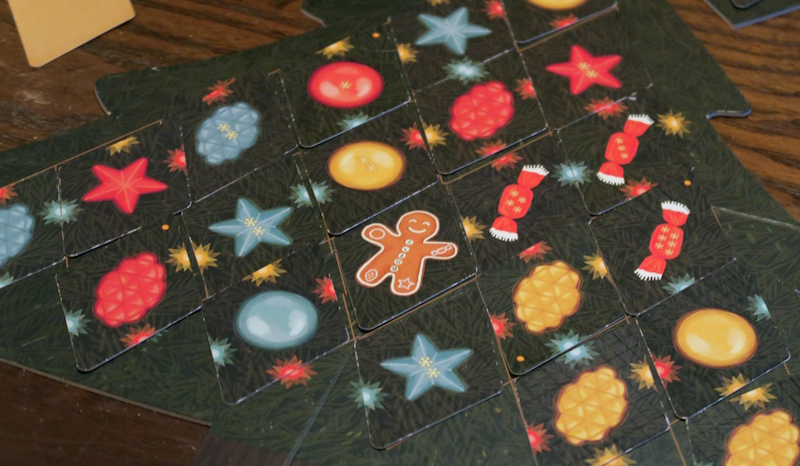
This is a fairly simple little card-drafting game played over thee rounds, where players are “decorating their Christmas Tree” with diamond-shaped cards, where players score points for the Objective cards everyone contributed to a central pool at the start of the round.  This time, the group played from the advanced set of Objective cards (including all three levels) although the first round, the cards were all levels one and two.  These gave one point for each blue or “nobbly” ornament, four points for each pair of ornaments of the same colour and shape arranged in a vertical pair and six points for three specific shapes in a given arrangement.

Christmas Tree
– Image by boardGOATS

The first round started off slowly with everyone looking to fulfill some of the Objectives—everyone was successful, but Plum and Byzantium got off to a better start.  Plum placed her first Gingerbread man and then concentrated on placing vertical pairs although she only managed that once.  In the second round the Objectives were from the more complicated sets, including six points for three specific colours in a given arrangement, six points for the same three shapes or colours in a set pattern, or eight points for four ornaments with the same point value arranged in two set formations.  This time, Byzantium significantly out scored everyone with multiple objectives scored multiple times and, as a result, built a big lead.

Christmas Tree
– Image by boardGOATS

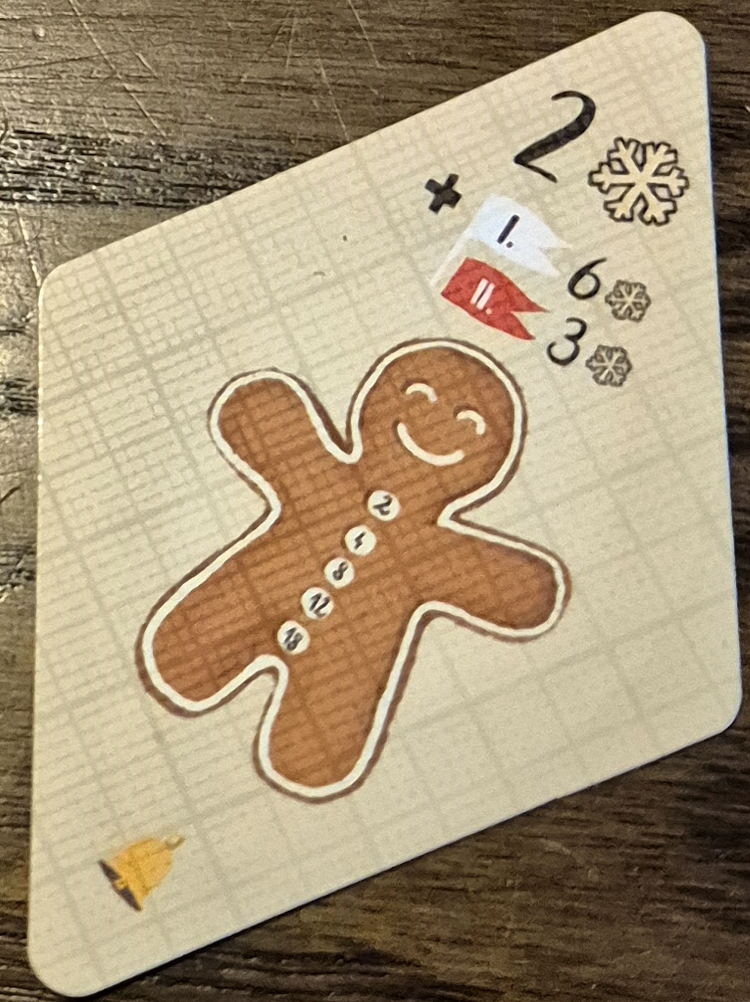
Plum used one of her Biscuits to move baubles around to make a row of four contain the three colours of glass bauble.and thus scored well, whereas Ivory was focusing on picking up high value Sweets and surrounding his Gingerbread men.  The final set of Objectives included six points for a set arrangement of certain point values, eight points for four ornaments with the same point value arranged in a particular arrangement and five points for each row in which the total points of the glass were above the given amount. Finally, there were two points for each Gingerbread man, with bonuses of six and three points for the player with the most/second most Gingerbread men.

Christmas Tree
– Image by boardGOATS

In the third and final round, Byzantium again out scored everyone, scoring multiple times for the set arrangement of certain point values.  At this point, Ivory was full committed to Sweets and Gingerbread men, especially knowing he was putting in the Gingerbread man Objective, which he scored well for.  Plum and Purple also scored well in the final round, with Plum following a strategy similar to Byzantium, whereas was Purple was collecting sweets like Ivory.  It looked like Byzantium was going to win by a large amount, as he was fifty points ahead of everyone else and was scoring more than anyone else for Lights and Baubles too.

Christmas Tree
– Image by boardGOATS

Ivory’s focus on surrounding his Gingerbread men gave him over fifty points and with more than thirty for his sweets he finished with one hundred and seventy one points, pipping Byzantium to victory by just two, with Plume in third some twenty points adrift.  The puzzly nature of the the game had gone down well and with the Christmas theme everyone had enjoyed playing Christmas Tree.  On the next table, the festive link was much more tenuous, however.  Teal, Pine, Sapphire and Indigo had chosen 6 Nimmt!, because there was a twelve in it, representing the Twelve Days of Christmas (or perhaps they had just wanted to play the game and if you can’t play a daft party game at Christmas, when can you?).

6 Nimmt!
– Image by boardGOATS

6 Nimmt! is a popular game with the group at any time of year, though it is usually played with more than four people.  Either way, the game is very simple to play, though tough to play well.  Some say this is because there is a lot of chance in the game, but they are usually the people who do badly…  The idea is that players simultaneously choose a card to play and these are then added, in order, to the rows of cards on the table.  The player adding the sixth card, instead, takes the first five cards into their scoring pile.  Usually, we deal out half the cards for the first round and the rest for the second and the winner is the player with the fewest “nimmts” (or points), at the end of the two rounds.

6 Nimmt!
– Image by boardGOATS

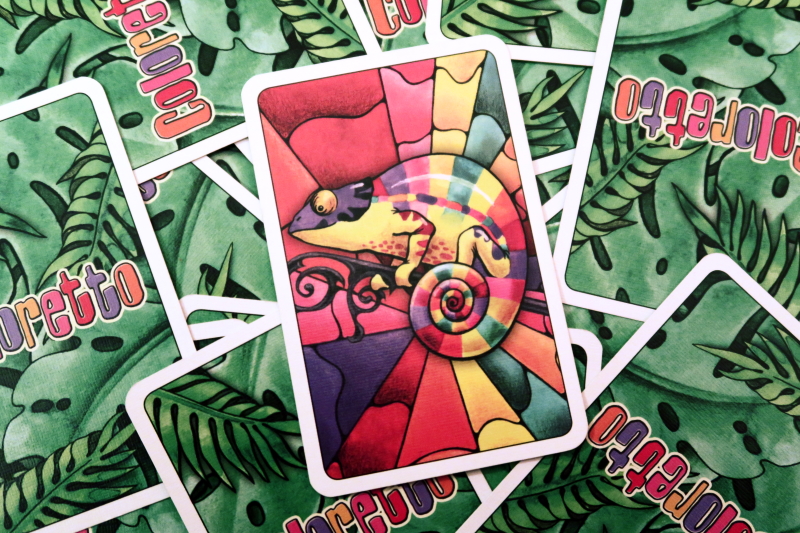
This time, however, the group decided to play the multiple-hand variant where each hand has ten cards, and the game ends when someone’s score passes sixty-six.  And that was Sapphire, who finished with an exceptional total of ninety-five.  The winner was Teal with forty-four, however, who was just two points better off than Pine.  The other games were still ongoing, but there was still time for one last game for this group (who were joined by Navy) before everyone went home warmed by the Christmas Gaming Spirit—and their choice of game was Coloretto (apparently this is a  festive game because it includes red, green and gold Chameleons).

Coloretto
– Image by boardGOATS

This is another simple filler game, where players either take a card and add it to a truck, or take a truck.  Each truck can take a maximum of three Chameleons, with players collecting coloured sets.  The largest three sets score positive points (according to the Triangular Number Series), while all the others score negative points.  In this way, the bigger the series the more additional cards will score, so the aim is to collect three large sets and ensure the others are as small as possible.  This game was really tight, with Sapphire claiming victory with twenty-seven and Teal and Indigo tying for second on twenty-four.  And with that, people began to drift off, many not to be seen until 2025.

Coloretto
– Image by boardGOATS

Learning outcome:  GOATS love a Cracker!

Golden GOAT Award Winners – 2024

This week was the annual boardGOATS Un-Christmas Dinner including the voting to decide the winners of the GOAT Awards.  There are two main awards:  the Golden GOAT for our favourite game played during the year and the GOAT Poo Prize for our least favourite.  Everyone had the usual three points to hand out for the Golden GOAT Award (plus a bonus if wearing Festive Attire), though a maximum of two points could be given to any individual game.  Everyone could also nominate up to two individual games for the GOAT Poo Prize.

Tonga Bonga
– Image by boardGOATS

This year, the unofficial “Marmite Award” went to Viticulture—something many people seemed to find quite a surprise as it is generally not a divisive game and one that few would usually take offense at.  There had been a lot of fun throughout the year, but one of the more memorable moments was Pine getting the end game rule wrong for Tonga Bonga, so that Pink thought he’d won, but then didn’t.  There were several nominations for the GOAT Poo Prize, including King of Tokyo, Rolling Realms and Ark Nova, but the winner was another surprise: Ca$h ‘n Guns—not a game the group plays often, indeed it doesn’t get played at all at the pub (for obvious reasons), so its only outing over the last year was at the New Year Party.  It can be a lot of fun, but it is also easy to see how some might not like the game.

Ca$h 'n Guns
– Image by boardGOATS

Then finally, there was the Golden GOAT Award for the best game played in the year.  Previous winners were ruled out, but there were plenty of other great games to choose from.  The most popular of these were Akropolis, Kavango, Flamme Rouge and Ticket to Ride: Rails & Sails.  However, the clear winner was Stamp Swap.  This is a new game, only released in September, but was an immediate hit, largely thanks to its silky-smooth game play.  As one person commented, “I wouldn’t have thought a game about stamp collecting would be up my street, and yet…”

Stamp Swap
– Image by boardGOATS

Perhaps more remarkably, this is the third winner from Stonemaier Games after Tapestry last year and Wingspan in 2019—three very different games.  This led to the perhaps slightly tongue-in-cheek suggestion that the group should invite Jamey Stegmaier to visit so we could present him with the actual Golden GOAT in the manner of the Jules Rimet Trophy

Golden GOAT - 2024
– Image by boardGOATS