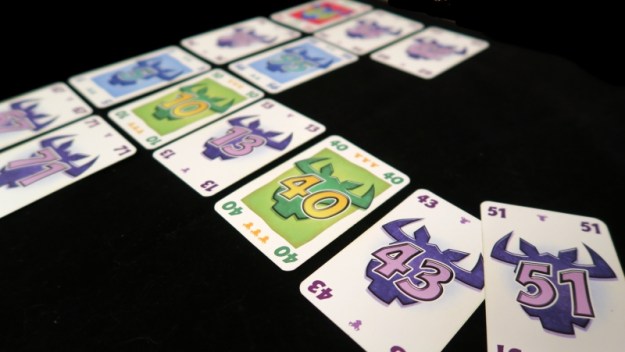
Tag Archives: Wingspan: European Expansion

5th September 2023

The evening began with Green and Purple arriving to find Plum and Cobalt sitting outside the pub chatting.  This was partly because the weather was warm, but also because someone else was sitting at our usual table and we had been relegated to another long table on the other side of the room.  Pine arrived soon after and once introductions between Cobalt and those who had not been about last time were concluded, the group decided to play a short intro game while they waited for everyone else to arrive.  The game settled on was Coloretto, which had only just begun when Ivory arrived, but he was happy to watch.

Coloretto
– Image by boardGOATS

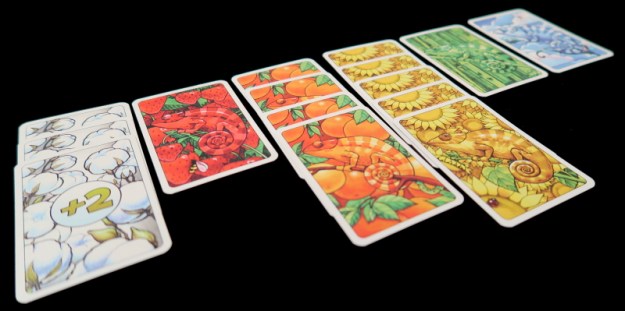
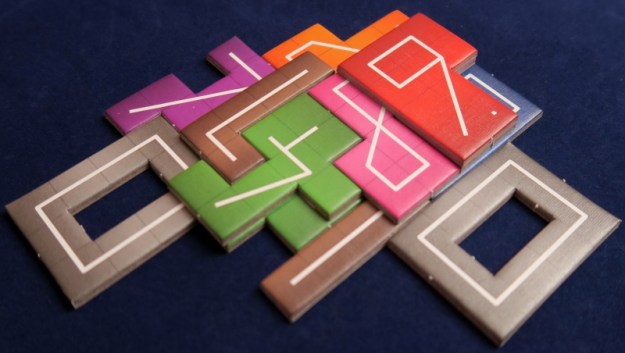
Coloretto is a quick and simple game that is very popular with the group.  Players either turn over the top card and add it to a “Truck”, or take a Truck and add it’s contents to their collection, sitting out until everyone else has taken a Truck.  Players are collecting coloured sets of Chameleon cards, but the key is that only three sets score positive points, with the others scoring negatively.  Thus players are trying to get as many cards in three colour suits, and as few as possible in each of the rest.  This time, everyone started with a different colour, so there were no obvious clashes.  As is usual for this game, it took a few turns for each players position to become clearer.

Coloretto
– Image by boardGOATS

By this time Plum was keeping the number of colour sets she had low with only two, but also had a couple of +2 bonus point cards and a Rainbow Chameleon (a wild) . Purple’s set was similar but with three colours.  Green was making steady progress and Cobalt was low on any particular colour, but only had four sets and a Rainbow Chameleon, so was poised for a good score if the cards fell in his favour. Pine meanwhile seemed to be in the process of collecting at least one of each colour!  By the end of the game, Plum had managed to collect Chameleons in just three colours and so scored no negatives, while Pine just seemed to have sets of everything. Purple had three extra colours, but with only one of each; her Rainbow Chameleon and +2 cards helped to give her a good score.

Coloretto
– Image by boardGOATS

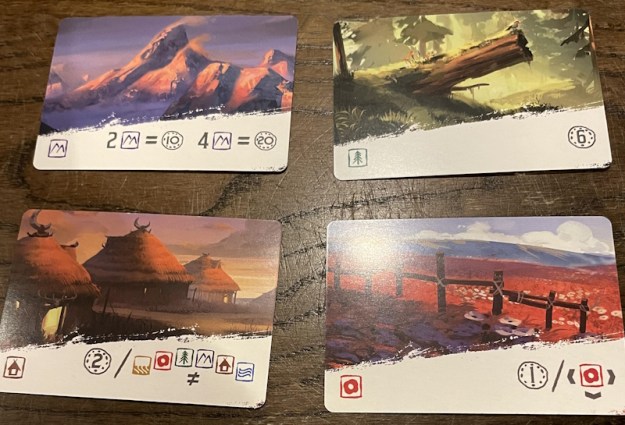
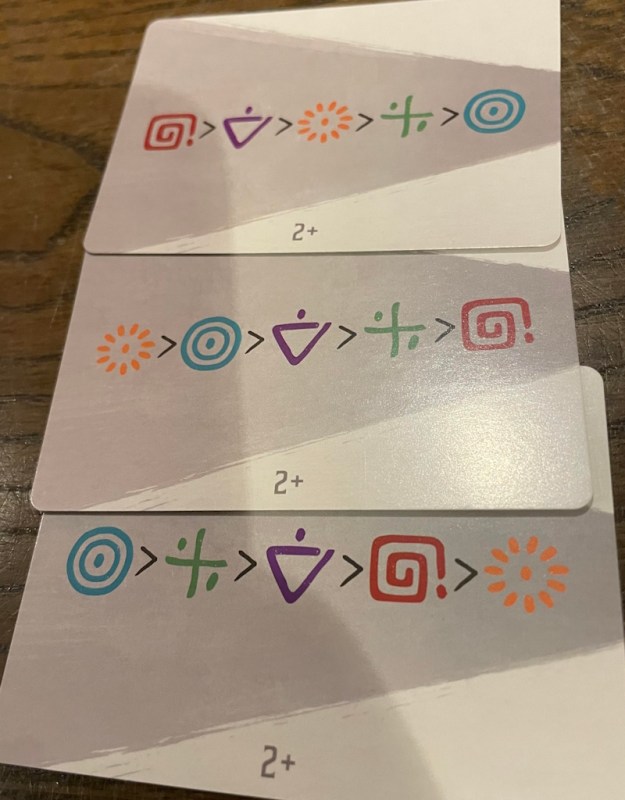
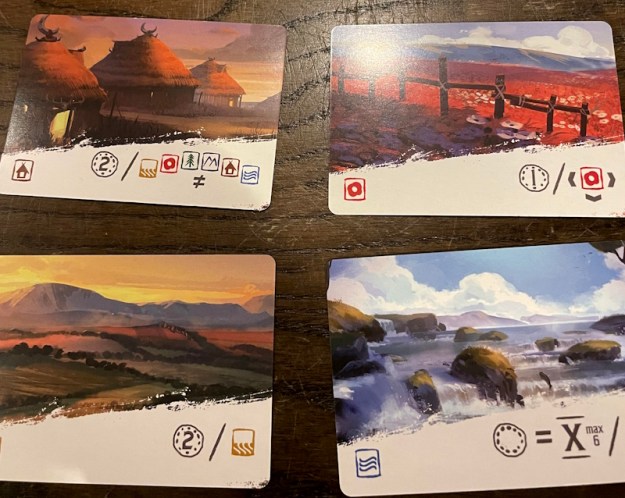
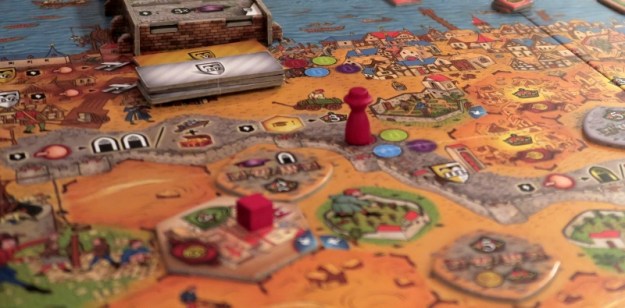
Green managed only one negative point, but had no bonuses, while Cobalt had his cards fall right and ended with a couple of good colour sets and with it, victory.  By the conclusion of Coloretto, Jade and Sapphire had arrived bringing with them the feature game, Vaalbara.  In this game, each player is a clan leader trying to take over some territories with game-play which is vaguely reminiscent of Libertalia/Winds of Galecrest.  Players all have the same deck of twelve cards representing the members of their tribe.  Each turn, players choose secretly one card, then in the order of initiative of the revealed Characters, players activate their powers and take over one of the available Territories. Each type of Territory has its own way of scoring points (Collection, Pair, Diversity, Risk etc.).

Vaalbara
– Image by boardGOATS

Thus the game is about timing and playing the best powers and the high initiatives at the most opportune moments. After nine rounds, the player with the most points wins.  Jade and Sapphire had played Vaalbara about a dozen times together, and Green had played a similar number of games on Board Game Arena with reasonable success. Pine was entirely new to it the game and joined the other three.  Jade and Pine took the Mountains in the first round, and then Jade managed to snatch the only one on offer in the second round.  Green ended up with the final card in the first round—the All Rounder, so scored poorly with it.

Vaalbara
– Image by boardGOATS

By the middle of the game Sapphire was going all out for Fields, Jade was on to his third Mountain and Pine was beginning to get the hang of things.  Green was struggling with his all rounder strategy:  all he could get was a River and several Forests and even after he’d swapped one of those for something else (he’d mixed up the cards and instead of swapping a card between first and second row, it was any card with the top card of the deck) it didn’t work out.  Pine managed to complete his second Mountain, but Jade amazingly managed all four which catapulted his score. It was only then that Pine and Green realised that the fourth Mountain was twenty points on top of the ten for the first three (i.e. a very thirty in total from four cards).

Vaalbara
– Image by boardGOATS

By the end of the game the Poppy Fields were coming out in profusion and started to really score a lot of points.  Unfortunately for Green, Jade managed to nab the Field card ahead of him for a five type bonus and Green was still only on four terrain types.  Once the dust had settled and the final scores were compiled, it was quite close with Jade and Pine were tied for first on seventy points, and Green only three points behind and just ahead of Sapphire. Pine joked that maybe the tie-break would be the player position on the last card back, thinking that would about as arbitrary as some of the other tie breaks had been recently. A quick check of the rules confirmed it and ultimately gave victory to Jade.

Vaalbara
– Image by boardGOATS

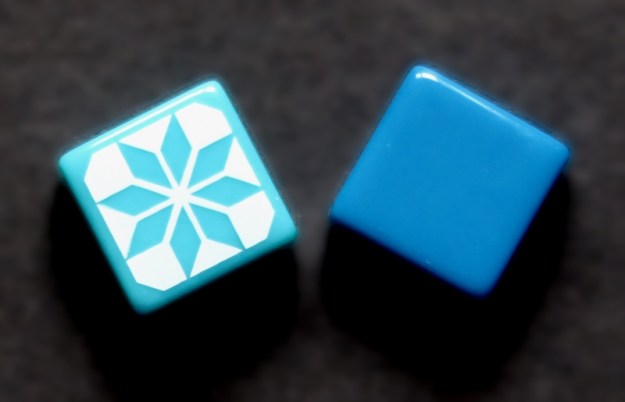
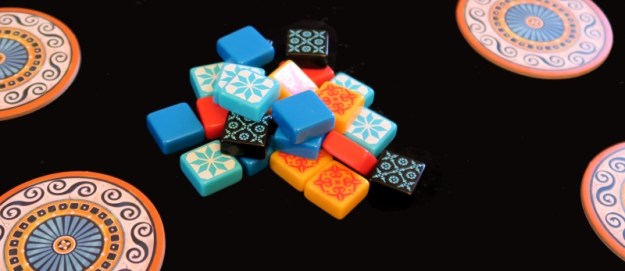
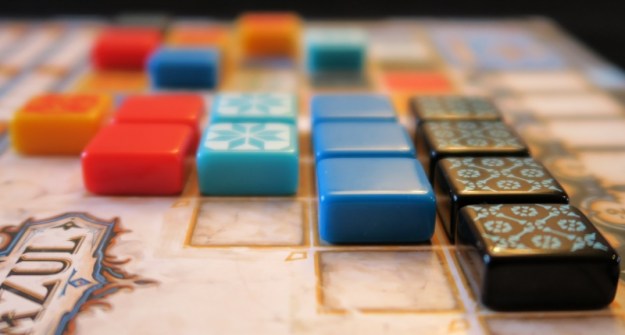
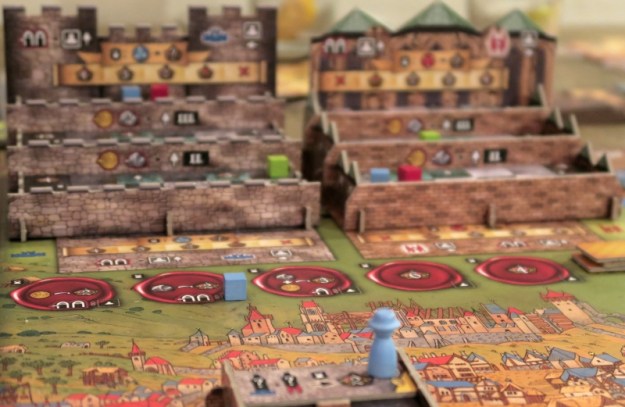
From there, the quartet moved on to play an old favorite, Azul.  In this game, players are tile-laying artists challenged to embellish the walls of the Royal Palace of Evora.  On their turn, players draft colored tiles from the marketplace onto their player board.  At the end of the round, players score points based on how they’ve placed their tiles to decorate the palace with wasted tiles scoring negative points.  Bonuses are awarded at the end of the game for completing rows and columns and sets of the same colour, and then player with the most points is the winner.  A pretty game, the group started with a short discussion about what colour one of the tiles really was.

Azul
– Image by boardGOATS

People wanted to call it blue, but there is already a fully blue tile, and this one was a little more turquoise with a white pattern—they did not come up with answer to the problem.  The game played much as it always does with complaints about the tiles that were not coming out of the bag when needed and at one point there was one Marketplace with four tiles all the same colour (that colour that we could not quite pin a name on).  Mid-way through the game no-one seemed to want the orange tiles, and it ended up with about eight of them in the middle of the table. It finally fell to Pine to take them, but he could not place any of them and they all had to go on his negative score line!

Azul
– Image by boardGOATS

The game was reluctantly brought to a conclusion by Sapphire, at the urging of everyone else.  He did not want to complete his row, wanting to hold out and complete a different colour later, but if he hadn’t taken the tile he would have ended up with a larger negative score and it had already not been possible to fully populate market. After final scoring, Jade and Sapphire shared the lead with ninety-five points with Green, who’d had a much better game than he usually has in third.  Tie break time again, but this time Sapphire won it because he was the only player to have completed a full row (the tile he hadn’t wanted to take).

Azul
– Image by boardGOATS

There was still time for something else, and the group settled on Nimalia, a new, interesting card-laying game where players are designing the best Animal Sanctuary.  Each card has four “Biome” squares on it of potentially different terrain, and different animals.  Players start each round with three cards and draft them, placing the chosen card partly (or wholly) on top the already laid cards in a simlar way to Sprawlopolis or Honshū.  The Sanctuary must remain within a six by six grid made of the squares (not the cards).  The game is played over a series of five rounds, where two or three different conditions are scored at the end of each drafting round.  This time, the first round would score for the largest area of Savannah and for connected Polar Bears and in the second round the scoring switched to Polar Bears and Gorillas next to Water.

Nimalia
– Image by boardGOATS

In the third round it returned to the largest Savannah, but with the complication of scoring maximum for no Giraffes down to scoring nothing with three or more giraffes—of course giraffes live in the Savannah!  Rounds four and five used both the Giraffes and the Gorillas to score while adding in the Savannahs in the fourth round and polar bears in the fifth.  The nature of the scoring meant that any cards with Giraffes were quickly passed on leaving some players with a double giraffe card to lay as the last card on a giraffe scoring round.  Since it wasn’t possible to lay a new card underneath an old one, those giraffes caused scores to tumble!

Nimalia
– Image by boardGOATS

In the first round Pine roared into the lead while everyone else stayed within a point or two of each other.  After the second round, Sapphire was the one who lost out, with Pine retaining his significant advantage. During the third and fourth rounds Jade and Green managed to catch Pine, with Jade pulling into the lead.  Sapphire managed a good score in the fourth round, but he had a lot of ground to make up and he’d left his charge to the finish a little too late.  In the final scoring, Jade and Green pulled ahead in a tight battle, which Jade won by just two points with his total of eighty. Pine was third after flailing around in the final round and having been left with a double giraffe.

Nimalia
– Image by boardGOATS

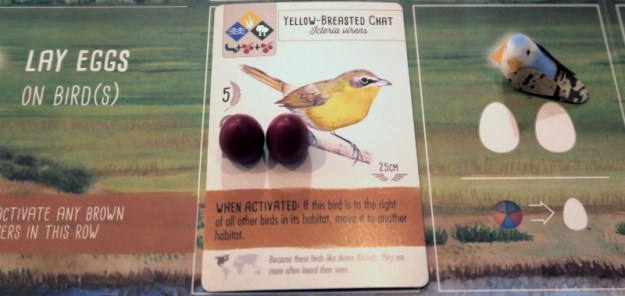
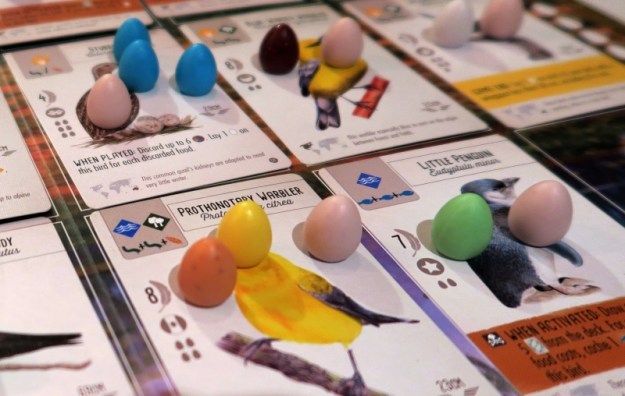
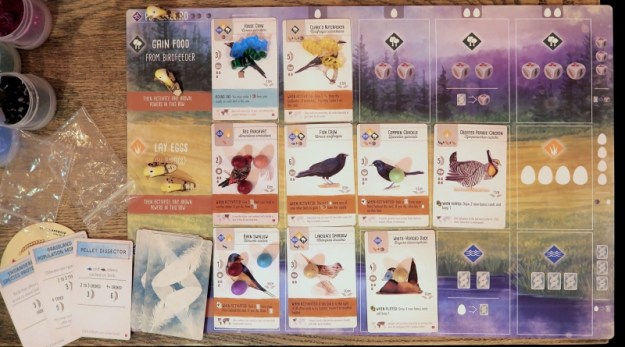
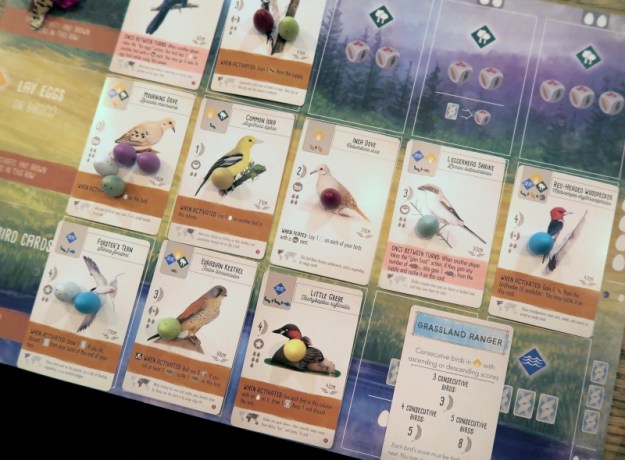
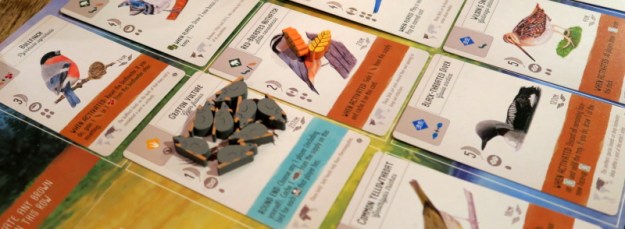
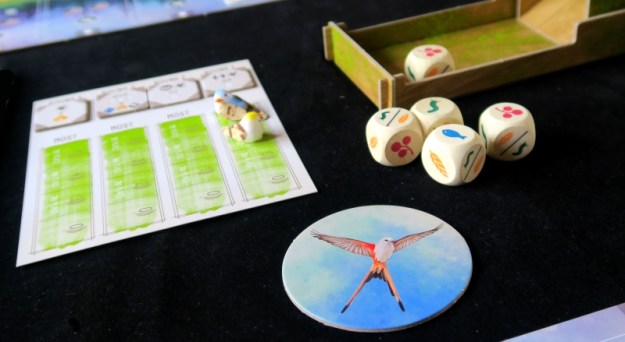
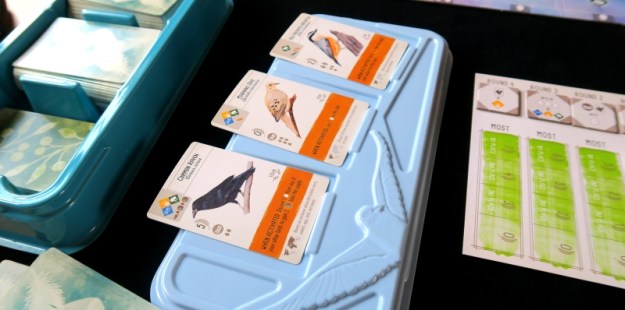
While all that was on-going, the rest of the group, Plum, Ivory, Purple and Cobalt, opted for a club favourite, Wingspan, enhanced by the European Expansion.  This is a card-driven engine-building game where players choose one of four possible actions (activating their Woodland, Grassland or Wetland areas or placing a bird card in one of those locations).  Points come from each individual card end of round goals, and eggs left at the end.  The game is all about building combinations of cards that work together efficiently, so the it took all night as everyone wanted to do their absolute best.

Wingspan
– Image by boardGOATS

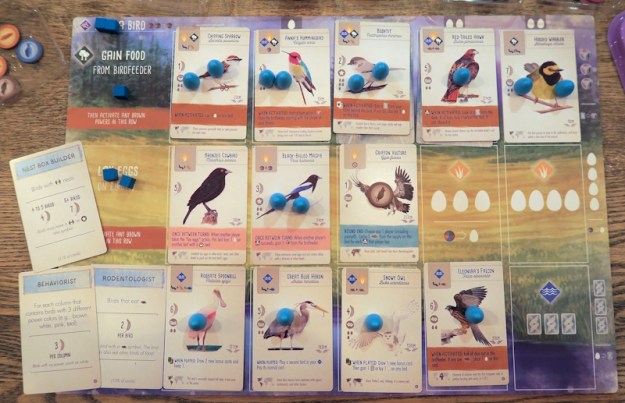
Ivory as always was very good at this, but was also quite generous giving everyone food each time he activated his Woodland area.  Cobalt was the first to get three bird cards in his Reserve, though Ivory  ended up with the most valuable birds on his board, with Plum’s next highest.  One of Plums birds moved at the end of each round though, which was very useful for saving costs and improving yields.  It was Ivory and Cobalt who tended to come out best with the end of round goals.  As is often the case Ivory continued to score well with a good haul of bonus card points too.

Wingspan: European Expansion
– Image by boardGOATS

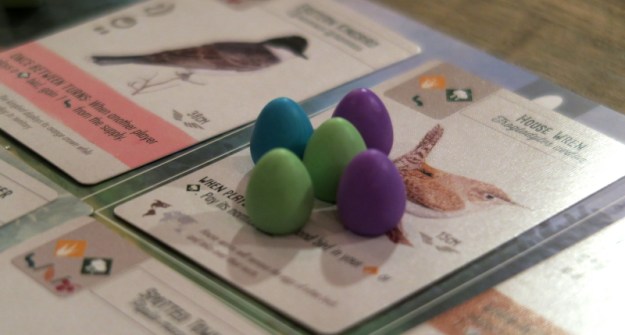
Purple failed to complete any of her bonus cards, but did make sure all her birds laid purple eggs.  Cobalt finished the game with the most eggs, however, inevitably followed by Ivory.  As for cached food and cards, Plum got the most food, but Purple had the most Tucked cards.  With all the scores added up, Ivory was the almost inevitable winner on ninety-three with Cobalt not far behind with eighty-three and Plum taking the battle for third by just three points in what was a hard-fought game.

Wingspan
– Image by boardGOATS

Learning outcome:  Goats love playing with colours.

30th May 2023

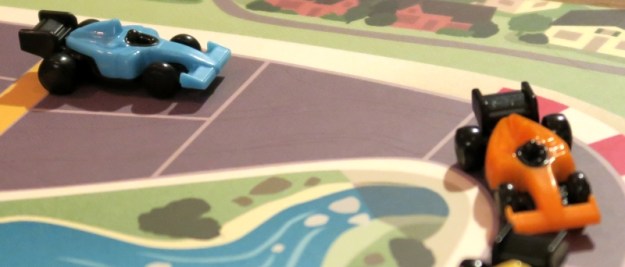
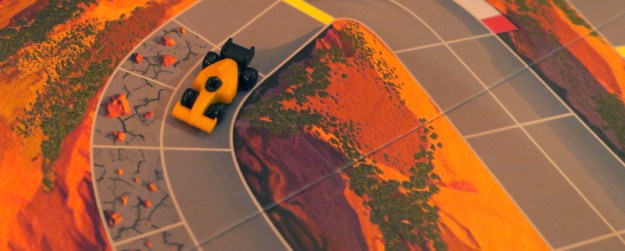
Pink and Blue were late arriving thanks to a debate as to whether the actor Gary Lewis was in the Roland Emmerich film The Day After Tomorrow.  Eventually Blue and IMDb were proved right when Pink found the guy who WAS in the film (Richard McMillan, who bore no resemblance to Gary Lewis whatsoever), but that meant they were late arriving and Plum and Byzantium were already there.  Unfortunately, due to a mix up, the Jockey wasn’t serving food, so Blue headed off to get chips for everyone from Darren at The Happy Plaice.  As the chips were consumed, everyone else arrived and it was just a question of who would play the “Feature Game“, the Wild Ride expansion to our go-to motor racing game, Downforce, and what everyone else would play.

Downforce
– Image by boardGOATS

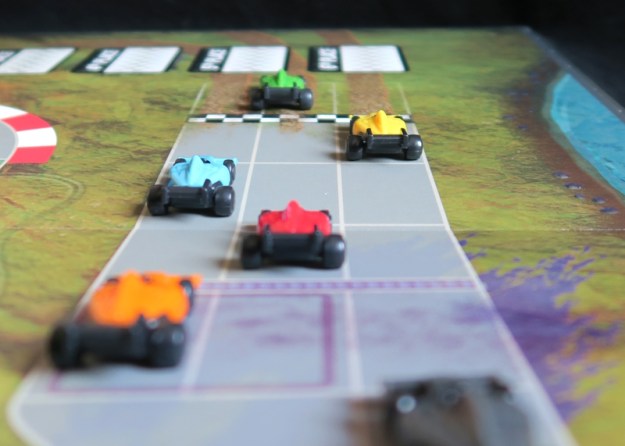
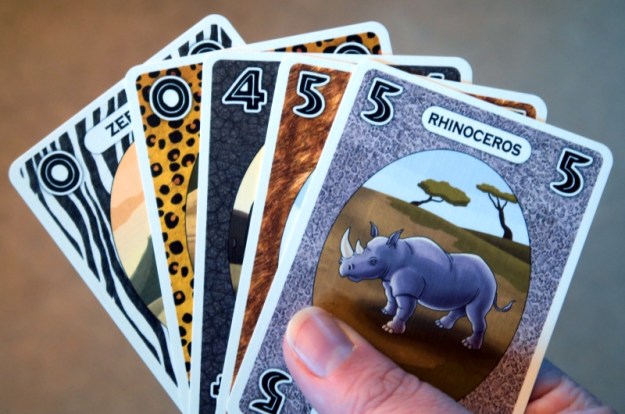
Eventually Pink and Green committed to Downforce, and were joined by Pine (who claimed that after doing well the first time he played, he’d come last ever since), Black and Lime (as long as the other group weren’t playing Wingspan).  Pink and Green reminded people of the rules of the base game, which are simple enough:  after being dealt their hand of cards, players bid for cars, with the player who pays the most deducting the cost from their final score.  Once the bidding is over, the race takes place.  Players take it in turns to play one card from their hand, and then move all the cars depicted on it in turn.

Downforce
– Image by boardGOATS

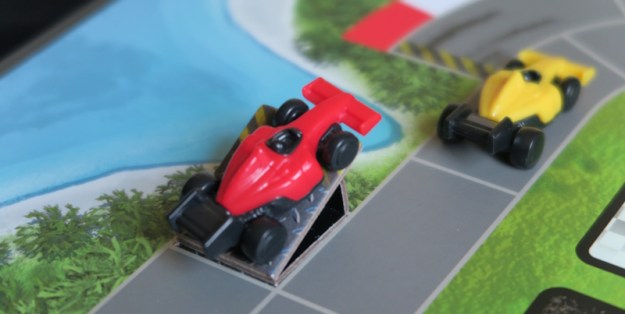
When the first car crosses a betting line, the race is paused while everyone bets on which car will win the race.  There are three betting lines, but the winnings for betting decrease the closer they are to the finish line.  At the end of the game, players total their winnings from the race with those from the betting, deducting the cost of their car and the player with the most cash is the winner.  The Wild Ride expansion adds two new tracks: Aloha Sands and Savanna Stretch. Aloha Sands adds water jumps which cars can use if they are moving fast enough. The jumps allow players to pass other cars and get round the track more efficiently, but timing is everything.

Downforce: Wild Ride
– Image by boardGOATS

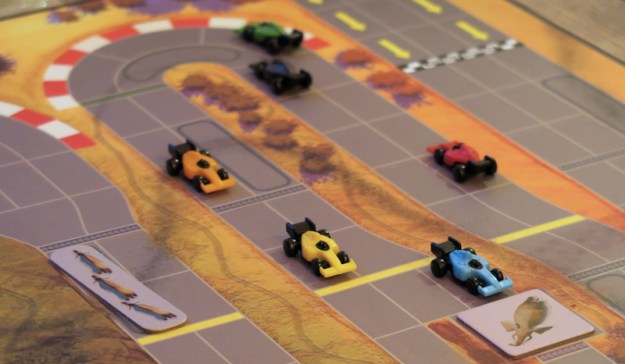
In contrast, Savanna Stretch features wild animals that block the track.  Once the first car has passed an animal, they are moved to another part of the track, as such, they help to prevent the “runaway leader” problem that can sometimes be an issue in the base game.  It was this track that players chose to use this time.  The inclusion of extra animals on the track caused a little confusion initially, but the group soon worked out two of the important features of this track.  Firstly, the animal tile only moves after the first car is fully past it and all other the cars have finished their movements for that card, which means that the animal is really only an impediment for the first few cars.

Downforce: Wild Ride
– Image by boardGOATS

The other the slightly unusual aspect of this track is that the pole position car starts at the rear of the pack.  With five players and six cars, there was always a chance that someone would get two, and that someone was Lime.  While this can be a huge advantage, especially if the cars are cheap, it can also be a risky strategy as it can be difficult to manipulate two cars and they can also become a target for other players.  Unfortunately for Lime, his cars were among the most expensive, leaving him with a deficit of $11M before the racing began, compared with Pink and Green for example, who paid just $2M for theirs.  Once everyone had got to grips with the rules and the cars had been allocated, the race was underway.

Downforce: Wild Ride
– Image by boardGOATS

For a track with so many tight sections it was not surprising that there was a lot of blocking going on—most of it, to be fair, totally deliberate… Pink (in the red car) found his early push to the front to be a mistake, as he was instantly the target for blocking maneuvers from turn two until the final straight.  Green (in orange) used his online experience from Board Game Arena to keep himself in the pack, but not at the front. Luckily for him several other players selected his car to win the race at the first two check points, which helped keep him out of trouble and pushed forwards.

Downforce: Wild Ride
– Image by boardGOATS

However after the halfway mark, Black (driving the blue car) and Pink both surged forward causing Green and Pine to lose their nerve and bet on Black (instead of Green) at the last checkpoint.  However, they should not have worried, as very soon after that, Green’s car surged forward weaving between the cars in front to race for the line and victory.  Pine was close behind, followed by the first of Lime’s cars (the other brought up the rear).  With the race done, there were just the winnings to claim from the bookies.  Because Green had got away with paying little for his car and won the race, he had a significant prize pot even before betting was paid out.

Downforce
– Image by boardGOATS

There wasn’t a huge difference in the results from the betting, but it was enough for Green to extend his lead.  Pine also raked in millions as his betting pattern was the same as Green’s (perhaps someone should investigate them for race fixing).  As a result, Pine come in clear second with Black completing the podium.  Since there was still some time left for a “proper” game, the group hunted around for something that wasn’t too long and could play five.  In the end, they settled on the simple little “push your luck” game, Port Royal, as much because no one could find anything better for five players, than because anyone really wanted it specifically.

Port Royal
– Image by boardGOATS

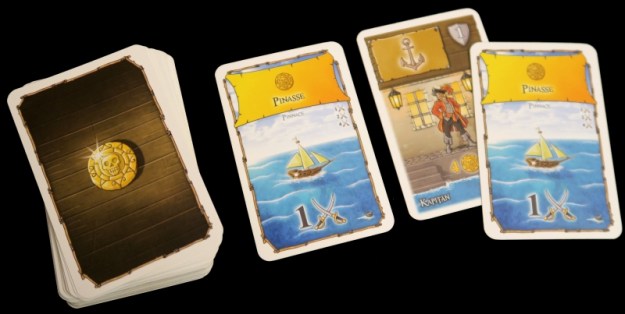
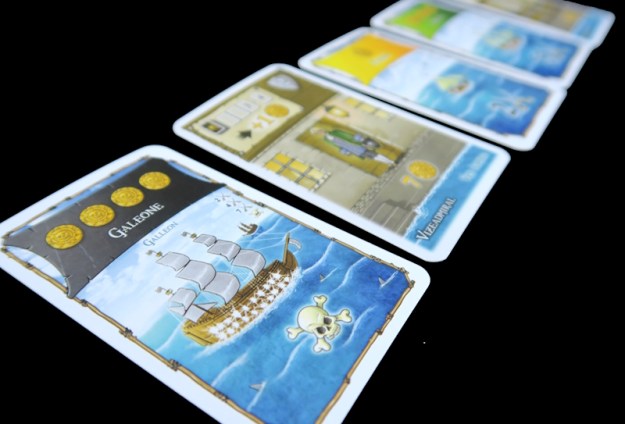
It had been a little while since most of the group had played, though the rules are simple enough.  On their turn, the active player chooses to “twist” and turn over the top card of the deck, or “stick” and keep the current card set.  The deck of cards consist of coloured ship cards and character cards.  The first decision is to decide whether to risk a “twist” because if second ship card of a colour is drawn the player goes bust and their turn ends.  If a player “sticks” they can take a ship and add its treasure to their stash, or they can use their gold to buy the support of characters.  These give players victory points and special powers, but also can be used to claim contracts and give more points.

Port Royal
– Image by boardGOATS

Once the active player has taken a card, players round the table can take a card too.  The cards are double-sided like those in San Juan or Bohnanza, so in the same way, keeping an eye on the discard pile and the money in players’ hoard is also key.  Although Black and Green did their best to quickly explain the rules, Pine and Lime were still both a little unsure, and perhaps with good reason.  Part way through the second round Black and Green realised something was amiss and re-read the rules and spotted a “rules malfunction”:  they had forgotten that when a player takes a card on another player’s turn, they pay the active player one coin, thus encouraging players to push their luck further to give more players more choice.

Port Royal
– Image by boardGOATS

So from the second round on-wards they group started playing correctly.  Pink’s strategy involved ignoring the Sailors and trusting to luck with turning the cards while spending his money on symbols to make up Expedition cards.  That gained him the first Expedition card, but ultimately, this single minded approach wasn’t very successful, at least in this game.  Green went for a strategy of collecting fighting cards, in order to fight off the pirate ships.  This worked initially, but by the time he had five fighters (and seven points), he kept going bust on his turn as he turned up skull bearing Pirate Ships against which there is no defence!

Port Royal
– Image by boardGOATS

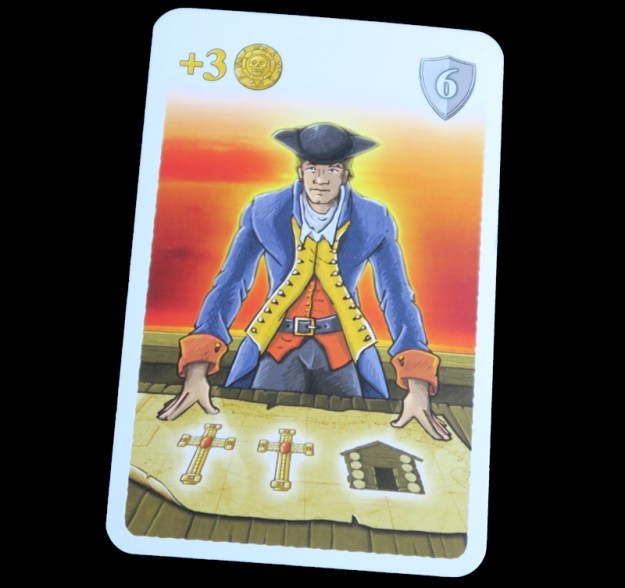
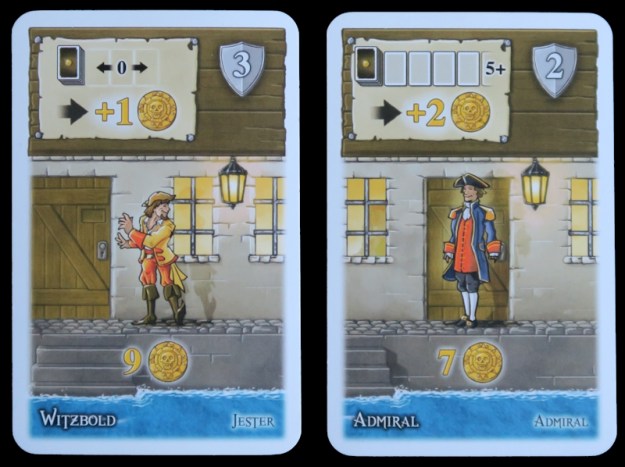
This meant that everyone else was able to gradually build their wealth and cards to catch him up.  Green then collected two more fighters and in preparation for one final attack, but would he get the chance?  Black had managed to accumulate a lot of points, not least because he collected money for both a large array of cards and for when it went bust thanks to the Admiral and the Jester.  If Black could collect another special symbol he could claim an expedition and win the game before Green could make his mega move with a full fighting force.  Unfortunately for Pine, he wasn’t able to collect the symbol he needed to claim a expedition as he went bust.

Port Royal
– Image by boardGOATS

So it was Green’s turn again and he started to pull out cards, with a huge line of cards.  After defeating every lower value Pirate Ship he came across, he managed a full five different coloured ships.  From there he was able to collect another five coins and purchase the two crosses on display, which gave him an expedition card and enough points for victory.  At the conclusion of the game, Pine confirmed his early feelings that he did not really like this game, and Lime felt it was all a bit too confusing, never really sure what he was doing.  This was an older game that we used to play a lot of at the club, but it seems to have lost its lustre now and will probably forever remain an occasional play game.

Port Royal
– Image by boardGOATS

Meanwhile, on the next table there was a lot of debate as to what they’d play.  With five, the options were quite restricted, Burgle Bros. almost made it, until Teal realised it only played four, which left Tiny Towns.  Plum wasn’t so keen, so in the end, the group went for the old favourite Wingspan (having said to Lime that they weren’t going to play it…  Sorry Lime!).  There was some debate as to whether there was time for the game with five players, and options of playing three rounds instead of four were briefly discussed, but since everyone knew what they were doing, the group decided to give it a go and see if they could squeeze in a full-length game.

Wingspan
– Image by boardGOATS

The game is an engine builder that is quite simple in theory, but quite difficult to play well.  Players are collecting birds for their sanctuary, scoring points for exciting birds, eggs, cached food and cards tucked under birds (representing flocks of birds or prey caught), as well as bonus points for achieving particular goals during the game and at the end of the game.  The idea is that, on their turn, players either play a bird card from their hand into their tableau, or carry out the action associated with one of the three habitats (Woodland, Grassland or Wetland) and then activate each bird in that habitat.  While that is all there is to it, it’s all in the cards and getting them to work together.

Wingspan
– Image by boardGOATS

Wingspan can be a little “multi-player solitaire”, that is to say, there can be very little interaction between players in some games.  For some players this is preferred as it means players don’t have their carefully laid plans destroyed by others, while others feel they might just as well be sitting alone and interaction between players is what makes playing games important.  It had been a while since it’s last outing, but the group were quick to get going and were happy to play with the European Expansion which was already mixed in.  Plum in particular, got off to a flying start with her opening hand, four of which were coloured birds and matched her chosen Bonus card (the Photographer).

Wingspan
– Image by boardGOATS

In contrast, Blue had cards that didn’t match at all.  The Rodentologist was her best Bonus card giving her two points for each bird in her sanctuary that ate a rodents, but not one card in her starting hand qualified.  Teal started out with a strategy to maximise his egg production and prioritised birds with brown powers and resource conversion to assist that aim.  The first card Plum played helped him in this, and everyone else too as it happens as it was a very generous Ruby-throated Hummingbird that gave everyone food every time it was activated.  Teal returned the favour as he laid eggs at every opportunity and Plum had a bird that rewarded “once between turns” if anyone laid eggs.

Wingspan
– Image by boardGOATS

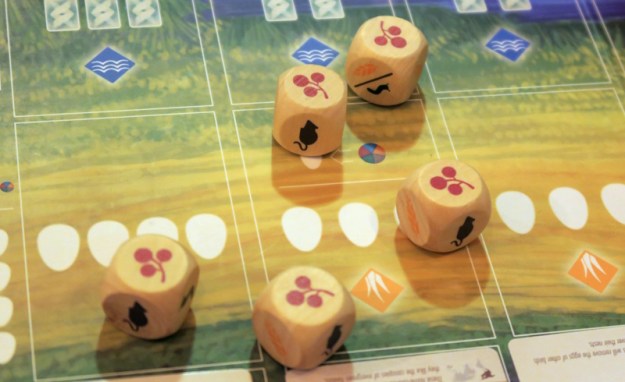
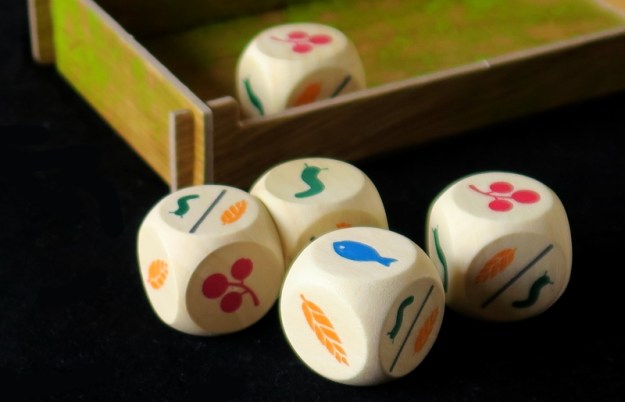
As the game progressed, players worked on the end of round bonuses.  Three of the four birds Plum had kept from the start also happened to have bowl nests which contributed towards the fourth round goals, as long she could ensure they had eggs on them.  She didn’t really aim for anything else, but Blue, Byzantium and especially Teal did well in the early rounds.  Plum picked up some more birds with colours in their names, but also managed to play the Yellowhammer end of round card which she was able to use to great effect as it enabled her to play an extra bird card if she had used all four actions during the round.  Byzantium had issues with the dice which repeatedly wouldn’t give him what he wanted.

Wingspan
– Image by boardGOATS

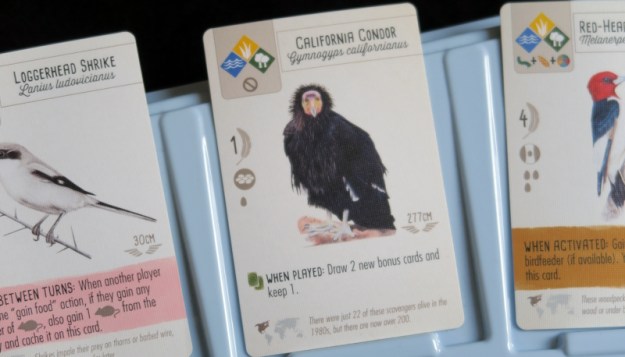
Then to compound Byzantium’s woes, he got himself in a bit of a mess when he played his migrating bird into the wrong habitat meaning he didn’t get the advantage of moving the bird straight away and costing him more eggs into the bargain.  Purple had different dice issues when she rolled five berries and called “Yahtzee!”  Blue had improved her hand and acquired some more helpful cards, including one that gave her an extra Bonus card, the Behaviourist, which gave her three points for each column with three different power colours.  As people sifted through the deck trying to find cards they liked the look of, the California Condor appeared, which everyone agreed looked like a monkey.

Wingspan
– Image by boardGOATS

Towards the end of the game, partly as a result of Plum’s Hummingbird, Byzantium ended up with a surfeit of food and nothing to spend it on.  So, he switched tactics and took the Condor hoping to get a bonus card that would improve his fortunes.  It didn’t.  Blue tried the same and didn’t do any better.  After the final round Plum activated her Yellowhammer again and was left with the choice of playing a bird that gave her a Bonus card or one that gave two extra points.  She also went for the Bonus card, the Fishery Manager, but only one of her birds ate fish.  Time was ticking on, but the game was over well within two and a half hours with just the scoring to go as last orders chimed.

Wingspan
– Image by boardGOATS

Blue had some high scoring birds, but not as many as Plum who took fifty-five points for them alone. Blue had quite a lot of eggs too, but not as many as Teal who had twenty-three.  Everyone else was concentrating on counting, when Purple (aided by Black who had come along to lend a few fingers), gave her score for her bonus cards: thirty-four points, more than twice that of anyone else.  Unfortunately for her though, prioritising her Backyard Birder Bonus which gave her points for birds scoring fewer than four points left her with lots of low scoring birds.  It was a close scoring game, but first place went to Blue who finished a handful of points ahead of Plum with Teal a little way behind in third.

<Wingspan: European Expansion
– Image by boardGOATS

Learning Outcome:  Forget snakes on a train, what about snakes on a race track?!?!

21st February 2023

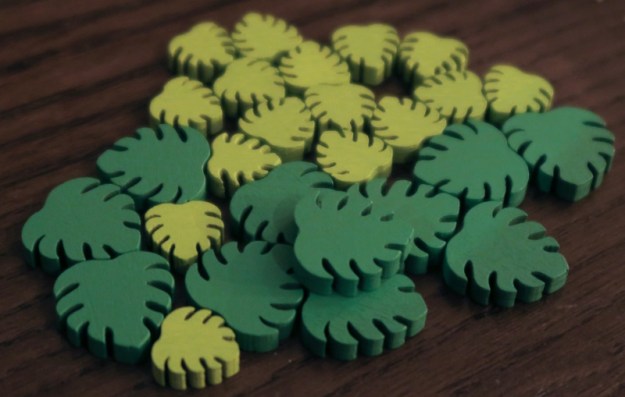
With this set to be our last meeting before The Horse and Jockey changed hands, a lot of people turned up early to enjoy the Thai special (a preview of the Thai Night the following day).  As the last of the food was consumed the final couple of people arrived, and then it was all about deciding who was going to play what and how we were going to split up the group of thirteen.  In the end, Ivory took a group of five to play the “Feature Game“, Verdant, while Pink and Lime led a group of four to play Cascadia, and Green gave his copy of Wingspan with all the expansions (Europe, Oceania and Asia) an outing.

Verdant
– Image by boardGOATS

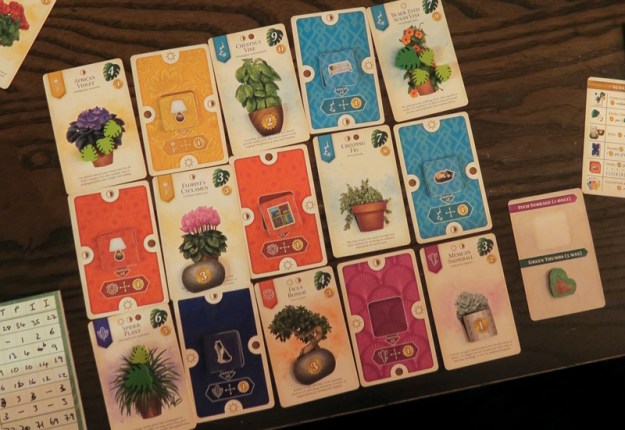
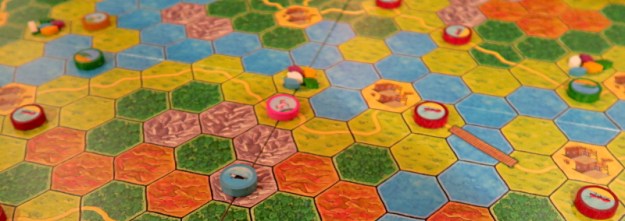
The “Feature Game“, Verdant is a card game where players are trying to match plants to rooms and grow luxurious foliage to give them the most points at the end of the game.  The game is played over fourteen rounds with players taking it in turns to take cards from a central market.  In a similar way to Cascadia where hexagonal tiles are paired in the market with animal tokens, in Verdant, the cards are paired with object tokens.  However, where, in Cascadia players just have to choose which pair to take, in Verdant the decision is a little more complex.  Instead of taking a card and it’s token, in Verdant each tokens is paired with two cards (a room and a plant) and players choose one card to take with the associated token.

Verdant
– Image by boardGOATS

Players then add the card to their three by five array, with plants placed next to rooms and visa versa to form a chequerboard-type arrangement.  Whenever a plant is placed next to a room with matching lighting conditions, it gets a verdancy token; plants which achieve target verdancy are completed and gain a fancy pot (some of which give bonus points) and then score points at the end of the game.  Players then add and/or spend their object tokens.  The objects come in two types, Furniture/Pets and Nurture tokens.  Furniture/Pets are either added to a room or placed their one storage space.  Nurture tokens are particularly useful as they can be spent to add extra verdancy to plants.

Verdant
– Image by boardGOATS

At the end of the game, as well as scoring points for completed plants, players also score for each room with adjacent plants that match their type—one point for each plant, two for each if the room contains an object with a colour that matches the room.  Finally, players are rewarded for any residual verdancy and receive bonus points for having a complete set of each plant type, for having a complete set of each room colour and an increasing number of bonus points based on how many unique Furniture/Pets they have in their home.

Verdant
– Image by boardGOATS

Blue started, and with no idea what she was doing, took a high verdancy plant and passed the problem on to Teal whose turn it was next.  There was quite a lot of “try something and see what happens” going on in the early part of the game, but before long Pine voiced everyone else’s thoughts when he asked of Ivory, “How come you’ve got two pots already?” Then, as everyone shrugged, Pine added, “Oh, I see, you have cheap plants…”  Ivory looked, if not exactly disgruntled, some way from being actually gruntled, and replied, “You make it sound like I got them from a garage on the way here!”  And so the game continued with players taking cards and adding them to their arrays with as much verdancy as possible.

Verdant
– Image by boardGOATS

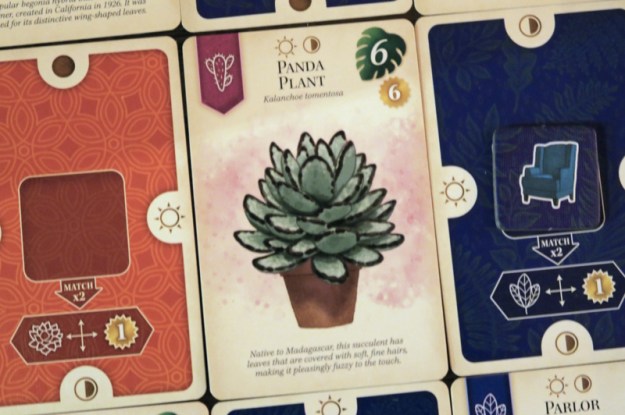
About halfway through the game, Pine shared a new post on The Jockey Facebook page which said the current business owner would now be leaving in two weeks but Dan (the current manager) would be responsible for the pub for the next couple of months.  So, while there’s still some uncertainty, it seems there WILL be a meeting in two weeks time.  By this time, people were getting into their strides a little, though most people’s main strategy  just seemed to be taking Nurture tokens whenever they had the chance, something which Pine and Indigo seemed to get a lot of and Blue didn’t have until her final tile (which she picked up with a Panda Plant, much to Pink’s delight from the next table).

Verdant
– Image by boardGOATS

And that just left the scores.  A bit of a point salad, it seemed like points came from everywhere.  The bulk of everyone’s points came from completed plants though and rooms scored surprisingly well too.  Most people thought Ivory was going to win, and so it proved, but much to her surprise, Blue was only a couple of points behind his seventy-nine, and took second.  It was really tight for third with everyone else within a couple of points of each other, but it was Pine who just made it onto the podium ahead of the others.  Although the game had taken quite a bit longer than expected and was more of a head-scratcher than its brother Cascadia, Verdant had been universally enjoyed and deserves another go.

– Image by boardGOATS

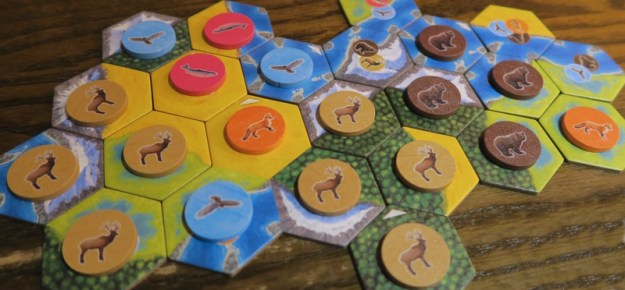
Speaking of Cascadia, Pink, Lime, Black and Jade were giving last year’s Spiel des Jahres Award winner another outing.  In this game, similar to Verdant, on their turn, players take a terrain tile and animal token from the market and add them to their array.  In this game however, players score points for their largest terrain of each type and also for animals in a specific arrangement.  There is a lot of replayability in the game as each animal has several different scoring motifs on cards with one of each drawn at random at the start of each game.  This time Bears scored for each group not surrounded by bears with larger groups scoring more; Salmon scored for long chains, and Elk scored for groups of one, two, three or four tiles in a particular layout.

Cascadia
– Image by boardGOATS

There was some discussion surrounding the scoring of Foxes, but they scored for each unique animal pairs surrounding them.  The Hawk card was from the Tantrum House Promo Set and gave points for each Hawk that had a direct line of sight with both an Elk and a Fox.  And this proved challenging for most people as Pink spent the first half of the game by taking all the Elks in what was later referred to as “The Great Elk Shortage”.  The others soon got their revenge, however, when Pink was after Bears and everyone else took them just before he could.  The game progressed quite quickly and before long, it was time to score.

Cascadia
– Image by boardGOATS

Despite the Elk and Bear based tussle, the scores for the Wildlife were very close with Jade just three points ahead of Black and Pink. In this game though players ignore the largest areas at their peril, but these need quite a lot of planning to make them work.  With bonus points available to the player with the largest of each type of terrain, going heavily into one or two not only scored per tile, but also an extra three points.  This tactic gave Pink eight more points than anyone else for his Habitats which ultimately gave him a comfortable victory, eight points clear of Black in second.

Cascadia
– Image by boardGOATS

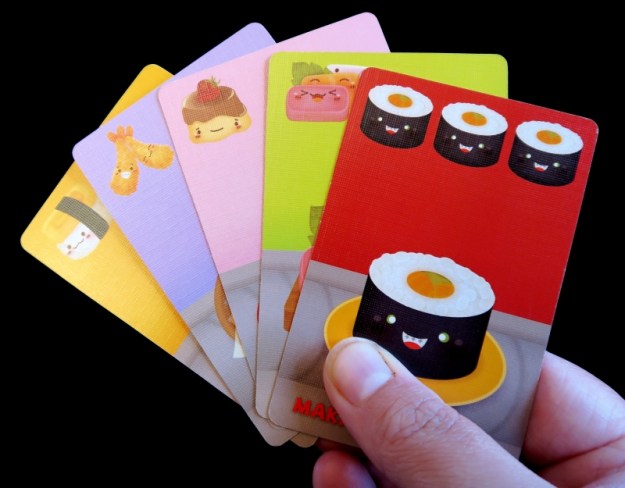
Cascadia was the first game to finish and the group looked around for something quick to play that everyone knew, and quickly settled on Sushi Go!.  This is the archetypal card drafting game, where players are dealt cards, keep one and then pass the hand to their neighbour.  Played over three rounds, players are collecting different types of sushi.  This game was closer than Cascadia and a bit rushed.  There was a big debate as to whether players could play wasabi on top of wasabi and score nine points—the initial response was “that would be silly”, but it was confirmed with a rules check.

Sushi Go!
– Image by boardGOATS

The group played with the Soy Sauce Promo which gave points for having lots of different types of sushi, and variously pretty much everyone had a go at making them score.  Almost everyone eschewed the Chopsticks, which allow players to take two cards instead of one later in the round, but that assumes there is an opportunity to use them later.  Pink gave them a go, but without much real success.  The final round had no Puddings, so there was a three-way tie for Desserts giving each player two points, except for Pink who missed out completely and lost six points.  With a deficit of eight points in such a tight game that probably gave victory to Jade, who finished two points ahead of Pink in second and five ahead of Black in third.

/tr>

Sushi Go!
– Image by boardGOATS

Meanwhile, on the third table, a rather epic game of Wingspan was underway.  This is one of the group’s favourite games and seems to be popular with almost everyone.  The game is a kind of action based card-driven, engine-building game.  Players take it in turns to take one of four actions:  take food; take bird cards; pay food to place bird cards, or lay eggs on bird cards.  Since we enjoy Wingspan and play it a lot, we have all the current expansions within the group, though none of the people playing this time had experienced Oceania or Asia (except solo), so the group decided to put in as much content as they could. This meant using all the bird cards available, creating three huge stacks.

Wingspan
– Image by boardGOATS

There were so many cards that they piled way up beyond the top of the card holder, and by the end of the game, they were still over the top!  The group added the round bonus chits from the European and Oceania expansions to the base game ones, but ended up only pulling out one from Oceania (birds pointing left) and none from Europe.  And of course the group used the nectar (replacing the original set of dice too), and lots of different coloured eggs from the different sets.  The only parts of the expansions the group weren’t able to use were the two player components and the six/seven player components from Asia as there were four in the group, Green, Plum, Byzantium and Sapphire.

Wingspan: Oceania Expansion
– Image by boardGOATS

The group only needed to refer to the rules a couple of times for clarification on how the birds interacted.  Byzantium’s Snowy Owl, did not point left or right, so he could not count it towards the end of round goal, which meant he only tied with Sapphire for first place in round two.  For most of the game there was little egg-laying, but the group managed to fill their boards with lots of birds (ten to thirteen each). Only Green and Sapphire went on an egg laying frenzy in the last couple of rounds, but they still only managed ten and thirteen in total respectively. Plum and Byzantium both managed to collect an almost unheard of total of four bonus cards each.

Wingspan: Asia
– Image by boardGOATS

Although this helped Byzantium towards an extra twelve points from the bonus cards, it was still shy of Sapphire’s thirteen from two cards (seven points of which he gained on his very last turn with a lucky bonus card draw).  Plum, however, really made good with her bonus cards for a whopping total of twenty-five.  This was to prove the clincher for her as she won the game with ninety-six points, some way ahead of Sapphire’s eighty-eight giving him second and Green five points behind in third.  Of the expansions, everyone in the group used lots of Nectar (another aspect where Plum managed to outscore everyone else) and a good smattering of birds from each expansion, except for Asian birds.

Wingspan: Oceania Expansion
– Image by boardGOATS

Only Sapphire placed an Asian bird card with the group using twenty base game birds, ten from the European expansion, fifteen from Oceania and the single Asian bird. Green did manage to get two “flitting” birds and regularly made use of them to flit between habitats. During the after game discussion, the group agreed that they really wanted to try the two player and the large group versions. Having played Wingspan with six last summer without the Asia adjustment, it was clear what needed tightening up, and that seemed to have been done.  As a result, the group all agreed that they looked forward to a Mega-Wingspan game soon.

Wingspan: Oceania Expansion
– Image by boardGOATS

Learning Outcome:  Some board games are prickly and others more succulent.

29th November 2022

Although the numbers were severely dented by holidays, work commitments and norovirus, there were still nine of us, and although everyone was late, timings were perfect and the whole group arrived within moments of each other.  There was the usual chatter, as people bought drinks and shared stories of the week, then everyone finally settled down to play some games.  The “Feature Game” was the shiny new Asia expansion to one of our favourite games, the multi-award-winning bird-themed card game, Wingspan.  But first we had to decide who was playing what.

Wingspan
– Image by boardGOATS

Like last time (when there were also nine people), splitting the group into two or three was quite challenging, but eventually, we decided to go with two tables with Blue, Plum, Black and Ivory playing Wingspan with Pink and Pine leading the rest in a game of Downforce. Downforce has three parts:  a car auction, a race, and betting on the race which occurs during the game.  Downforce has had a couple of outings in the last year, and after last time we played, we concluded that the betting skewed the game a little.  Essentially, when the first car crosses the first betting line which triggers players to place their bets, if several people bet on the same car that tends to lead to a runaway leader.

Downforce
– Image by boardGOATS

After a little research, we found an alternative, “Odds Betting” variant that we thought might be worth a try and Pink was keen to give it a go.  This scheme rewards riskier bets because a player’s winnings depends on the position of the car at the point in the race when the bet is made.  Thus, if a player bets on the leading car at the first betting line and it comes in first, they will win three million dollars ($3,000,000 × 1), however, if they bet on the last car and it defies the odds, they will take eighteen million dollars ($3,000,000 × 6).  Even if that last car comes in third, anyone betting on it will take six million dollars ($1,000,000 × 6)—twice that of betting on the leader if it wins.

Downforce
– Image by boardGOATS

The track chosen was Switchback Pass from the Danger Circuit expansion.  The race began and as the cars weaved around the track, players tried to muscle past each other.  Purple made good use of her power, “Tough” (from the Danger Circuit expansion).  This allowed her to move an extra two spaces every time she finished her move on a space adjacent to a “rumble strip” and she used that a lot, an awful lot.  This was in contrast to Pink who didn’t use his “Determined” power at all.  Despite using her power a lot, sadly, Purple wasn’t able to capitalise on it.  “Ambitious” Lemon was the first to cross the line, shortly followed by “Unpredictable” Orange.  However, the winner is the player with the most cash including income from bets, and in this case, that was Orange who had backed himself from the start.

Downforce: Danger Circuit
– Image by boardGOATS

The consensus was that the “Odds Betting” variant was a definite improvement on the rules as written, though they made things significantly more complicated.  As a result, they weren’t considered a perfect fix.  There are other options still to try though:  the “Simple Odds Betting” variant (where players only bet on the winner with the takings based on position at the time of the bet); the “All Bets are Off” variant (where the betting rules are as written but each player must bet on three different cars, none of which are owned by that player), and the “Three Bets” Variant (which just increases the number of cars everyone has an interest in).

Downforce: Danger Circuit
– Image by boardGOATS

While the race was ongoing, the next table were playing Wingspan.  This is one of the most popular games within the group, so we were keen to give the brand new Asia expansion an outing.  The basic game is simple enough:  on their turn, players either play a bird card in one of the three habitats, or activate one of those habitats and all the birds in it.  The three habitats are Woodland, Grassland and Wetland giving food, eggs and bird cards respectively.  Food and eggs are necessary for playing bird cards, as well as eggs being worth points in their own right at the end of the game.  The European and Oceania expansions both added more cards and the latter also added nectar as a food source.

Wingspan
– Image by boardGOATS

Wingspan: Asia is a standalone two-player game that can also be added to the base game as providing new bird and goal cards.  It also adds a new “flock” mode for playing with six or more players, but with only four players this time, the group decided to make the most of the Asia expansion.  So Ivory, Plum and Black started by removing all the other expansion bird cards from the deck and shuffling in the new ones while Blue sorted out all the other bits needed to play.  That all took longer than expected, but with everyone knowing the game well, there was no need to revise the rules before the game, with just a few edge cases that were checked during play.

Wingspan: Asia
– Image by boardGOATS

Ivory started the fastest, with more birds in his reserve than anyone else by the end of the first round.  The goal at the end of that round was the rather cool “most birds facing right”, and although Ivory won it, everyone else was close behind.  That wasn’t the case in the later rounds though, with somebody struggling to get points in each case, but Ivory taking the top bonus in every round.  Some of the new birds offered a bit more, in particular, those that allowed players to cache food, but gave them a wider choice of options.  Some allowed players to choose which food, and there was another that gave the option of caching food or tucking cards.

Wingspan: Asia
– Image by boardGOATS

Although some of the bonus cards were the same as those in the base game and the other expansions, there were also new ones.  There was one that rewarded having different nest types in the trees. Ivory and Plum both got cards that gave points for playing birds in a given habitat that increased or decreased in value.  Although these were a bit different and added variety, they didn’t fundamentally change the game. As Black pointed out, sometimes the bonuses are a bit too difficult and the other ways of accumulating points much easier.  They are good to give a steer at the start of the game though, when the range of options can be overwhelming.

Wingspan
– Image by boardGOATS

With eggs worth one point each, the final turns involved the usual round of egg-laying.  It felt like it was less of a frenzy than it sometimes is, probably because everyone had other things that they felt they needed to do that were more important.  Towards the end of the game, Plum also picked up a couple of extra goal cards, but had to choose between them.  Both gave points for having birds that increased or decreased in value in a Wetland or Woodland—she went for the Wetland as at least the values were increasing, decreasing values was not ideal at that stage of the game.  Black also picked up a couple of extra goal cards during the game, but from Blue’s perspective, Ivory was where he always was, out in front with a formidable lead.

Wingspan: Asia
– Image by boardGOATS

That was not quite how it turned out in practice, however.  Ivory said he thought Black might have it, and ultimately he was proved right.  The differences in the scores were not quite as anybody expected however.  As the scores came in, it became clear that Ivory had a lot of end of round bonus points (twenty-two in fact) and Black had a lot of points from the bonus cards (fourteen) while Blue had the most from her birds (thirty-eight) and Plum had the most cached food (nine).  Of course it is the total that counts, and in the event, Black was some way ahead of the rest with a total of seventy-seven points.

Wingspan: Asia
– Image by boardGOATS

It was much closer for second than anyone expected as Blue had made an extremely slow start, but Ivory’s total of seventy-two pipped her by a single point.  Everyone had enjoyed the game, but then we always do enjoy Wingspan.  The Asia expansion didn’t change things very much, though it did feel a little different, mainly because of the new goal cards (e.g. the cards that reward placing birds in order of points and for playing birds with different types of nests).  These were the biggest difference, though some of the bird card caching options were a little more flexible and players seemed to like that too.  It is unlikely we’ll play Asia in quite this “Asia strong” way again as it will get mixed in with the other expansions, but it was a good way to introduce it to the group.

Wingspan: Asia
– Image by boardGOATS

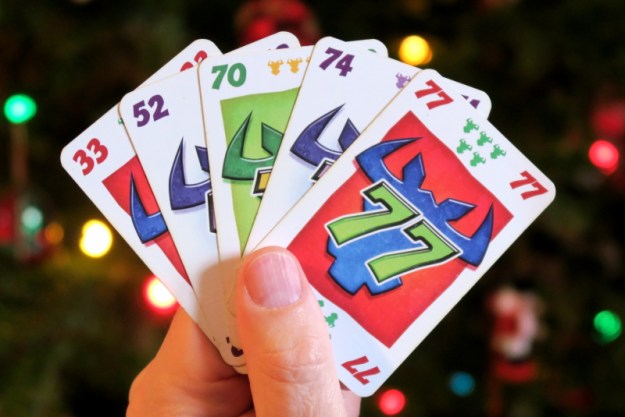
Downforce never takes very long to play and the other group were still only half-way through Wingspan, but rather than something longer, the racing group decided to play something lighter and eventually settled on No Thanks!.  This is a very simple game, but always a lot of fun.  Players take it in turns to either take the card on display, or pay a chip to pass the problem on to the next player.  At the end of the game, players sum up the total of their cards and subtract the number of chips they have left and the player with the lowest total is the winner.

No Thanks!
– Image by boardGOATS

The catch is that if a player has a run of cards only the lowest counts, but some of the cards have been removed…  This time, that rule was really critical.  Lemon managed to collect cards thirty-two to thirty-five, but unfortunately, that still gave her lots of points.  Orange did a bit better with his run from twenty-four to twenty-seven finishing with just thirteen points.  Sadly however, Pine did slightly better and finished with an excellent eight.  Points in the second game were much higher—Lemon’s twenty-six points gave her second place, but Pink just nicked it with twenty-three.  And as Wingspan had finally finished, that was it for the night.

No Thanks!
– Image by boardGOATS

Learning Outcome:  Playing an expansion without other expansions makes its features more obvious.

6th September 2022

Plum and Pine were the first to arrive, shortly followed by Blue with Orange and Lemon.  With nobody eating, the group were in a position to start thinking about games straight away.  Plum had offered to lead Wingspan, with Lime in mind as he had recently acquired a copy of Wingspan and was keen to give it another go.  Pine commented that although he loves birds, he’d never really got on with the game-play of Wingspan so, sadly he’d prefer to play something else.  The “Feature Game” was to be Project L, a sort of Tetris-like, engine-building game and it sounded much more his thing.

Project L
– Image by boardGOATS

So, Plum took herself off to the other side of the pub to set up Wingspan with the European expansion.  The European expansion adds more cards including end of round cards, but doesn’t add any extra mechanisms (like the Oceania expansion), so it was felt that including it wouldn’t cause too much confusion.  As the others rolled up, there was much surprise as Teal and Ivory said they would rather give Project L a go.  Then Pine changed his mind and joined Wingspan (along with Purple and Lime), allowing Black to play the “Feature Game” as he had played Wingspan recently at Burgundy’s Birthday Event.  That left six to play Project L: Orange, Lemon, Blue, Ivory, Teal and Black.
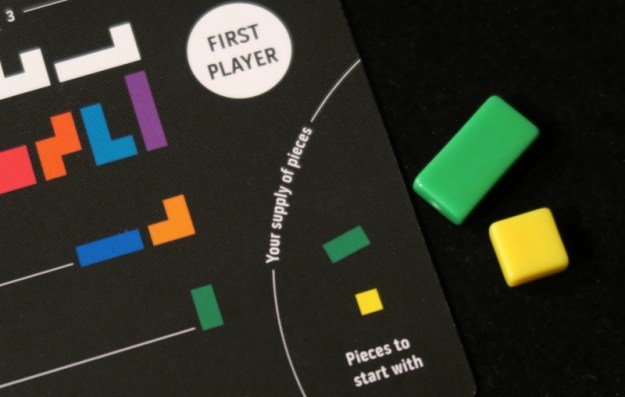
Project L
– Image by boardGOATS

Project L is a very simple game:  players start with two small plastic pieces and use them to complete Puzzles winning more pieces enabling them to complete more complex Puzzles and thus build an engine.  On their turn the active player can do three actions from a list of five things:  upgrade a piece to a larger one, take a Puzzle from the display, recycle the Puzzle display, place a piece in a Puzzle they own, or place one piece in each of their Puzzles (or in as many different Puzzles as they can).  This last, “Master Action” can only be carried out once per turn, and is clearly very powerful once players can get it going, however, to make it work they need lots of Puzzles and lots of pieces.
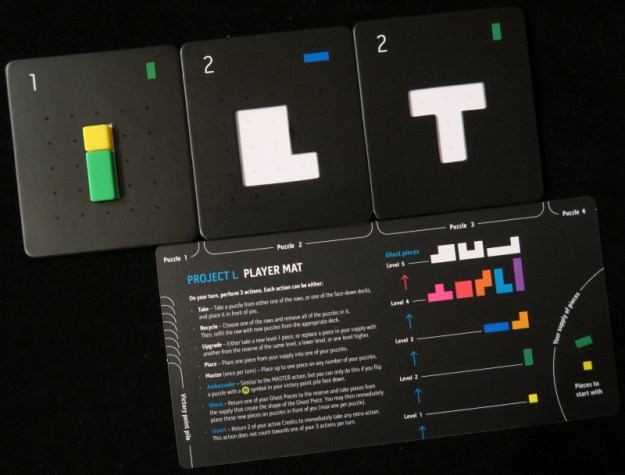
Project L
– Image by boardGOATS

With six, to reduce the amount of down time there is the “Line Clear Variant” available.  In the normal game, there are two rows of four Puzzles, one of White backed Puzzles and one of slightly more advanced and therefore more rewarding, Black backed Puzzles.  In addition to winning pieces for completing Puzzles, players can also get  points—the player with the most points at the end of the game is the winner.  The game end is triggered when the draw deck of Black backed Puzzles is exhausted at which point the round is then finished and one more, final, round is played.  In the Ticket to Ride: Switzerland, there are two rows of each colour, each containing three Puzzles.  One pair of Black and White Puzzle rows are marked with a dark stone and the other pair with a colourless stone.

Project L
– Image by boardGOATS

The idea of the Line Clear Variant is that two players play simultaneously with the active players marked by a dark and a colourless stone that are passed round.  When it is their turn, players can only recycle or take Puzzles from the rows that match the colour of their their stone.  Ivory was picked as the start player (he drew the player aid marked with the start player symbol) and he began with the dark stone, so Orange, sitting opposite, started with the light stone.  Everyone began a little tentatively, but before long players were filling their Puzzles with gay abandon.  The game end is slightly less clear with the Line Clear Variant.  Still triggered by exhausting the Black Puzzle Deck, the game continues until the first player has been passed both of the markers again, in any order).

Project L
– Image by boardGOATS

The Black Puzzles ran out quite quickly—Project L really is just a “Filler Game“, but players still had to finish things off.  The start player was Ivory, which meant that Orange was a little caught out.  Once the game has finished, everyone can place any pieces they have left, but at the cost of a point for each one.  Orange was unlucky, and unable to complete any of his remaining Puzzles, neither could could Lemon.  Teal had managed to finish off all his Puzzles in his last turn, but everyone else placed three of their pieces to finish things off.  It was quite close for a first game:  Blue finished with eighteen points, but Ivory and Black tied with fifteen apiece with Ivory sneaking second place on the tie breaker (the player with the most completed Puzzles).

Project L
– Image by boardGOATS

A lot of the comment was about how nicely produced the game is and it had been enjoyable to play too although not very memorable.  It was time to move on to something else though and with six, the obvious and usual choice would be Bohnanza, but Ivory had other ideas and suggested New York Slice.  This is a reimplementation of …aber bitte mit Sahne which we played recently, but with a pizza theme instead of a cake theme.  In both games, the idea is that one player makes the cake (or pizza) and divides it up into segments equal to the number of players, then players take it in turns to choose one of the segments.

New York Slice
– Image by boardGOATS

When a player takes a segment, they can either eat slices or store them for later.  Those they will eat are worth points at the end of the game with the number dependent on the number of blobs of cream (or pepperoni slices) on top.  The pieces players keep are scored depending on who has the most of each type at the end of the game.  Each piece of cake (or pizza) has a number on it which tells players the number of that type in the game and also what the player with the most will score at the end of the game.  There are a few things that are different about New York Slice, however, which make it a little more competitive and slightly more of a “Gamers’ Game”.
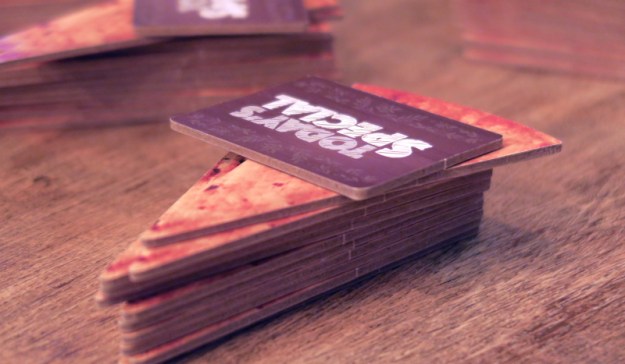
New York Slice
– Image by boardGOATS

Firstly, in the case of a tie for who has the most pieces of a type of pizza, in …aber bitte mit Sahne all players score points whereas in New York Slice nobody gets anything.  Secondly, some of the pizza slices have anchovies on them and any of these that are visible at the end of the game are worth minus one (because everyone hates anchovies on pizzas right?  Well, everyone except Teal it seems…).  Probably the biggest change though, is that in New York Slice, each pizza is served with a Special—a bonus tile with rule-breaking powers.  In most cases, these are added to one of the segments for players to choose. They can be enticing and helpful, or they can be unhelpful and make players’ lives more difficult.
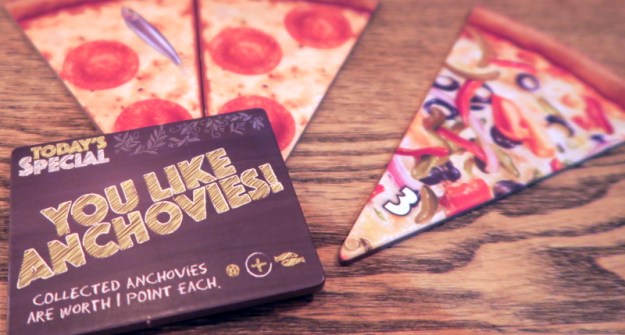
New York Slice
– Image by boardGOATS

Ivory cut the first pizza, leaving Blue to be the first to choose.  The first Special was “Cut in Line”, which Blue took straight away and then promptly forgot about it until the final round.  Ivory went into battle for mushroom pizza, but lost out to Teal.  The front-runner looked to be Black who stored the most BBQ and veggie pizza slices, largely thanks to his “Supersize Combos” Special which meant his two half slices became two whole slices of each type.  That only gave him joint second however, with Lemon who turned out to be quite the carnivore and finished with the most beef and meat feast pizzas.
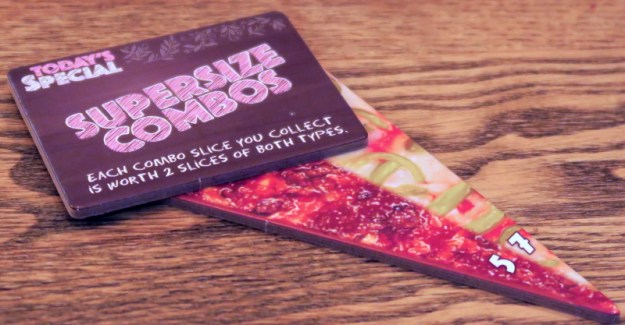
New York Slice
– Image by boardGOATS

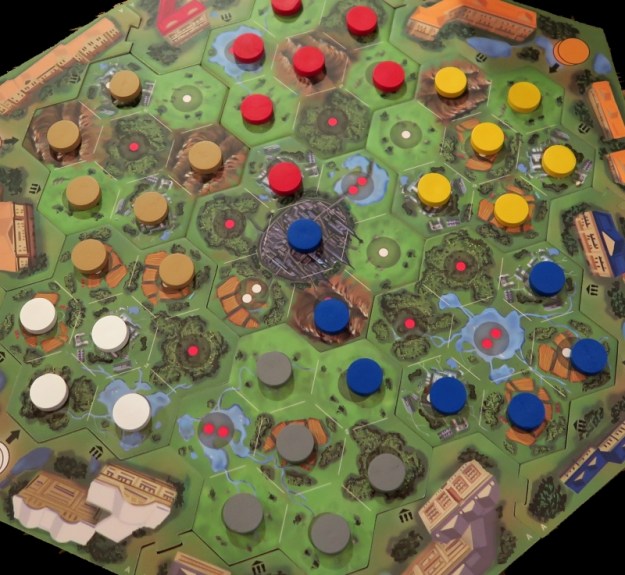
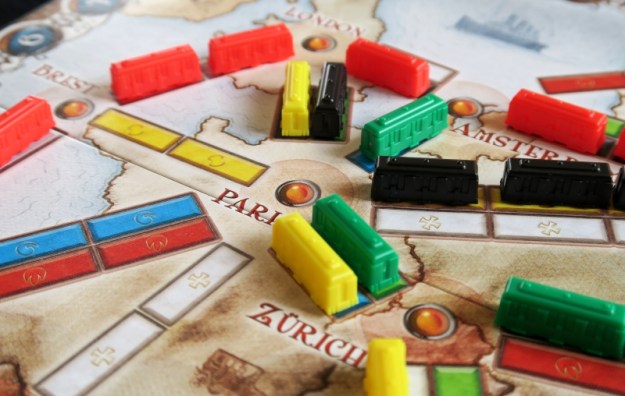
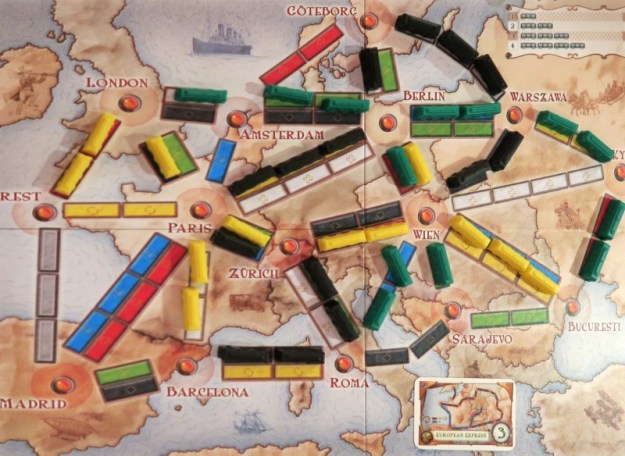
The winner, however, and by a single point, was Blue who picked up a lot of anchovies along with her “You Like Anchovies” Special and coupled that with winning the most lucrative pizza (pepperoni).  Full of pizza, Teal and Ivory decided it was time, leaving Black and Blue with Orange and Lime and a decision to make as to what to play next.  With Wingspan something over half-way through, they were looking for something substantial to play, but not too long.  Blue’s suggestion was Wsiąść do Pociągu: Polska, the Poland map for Ticket to Ride.  This was one that nobody around the table had played before though it had been played in the group two and a half years ago, shortly after it was released at Essen.
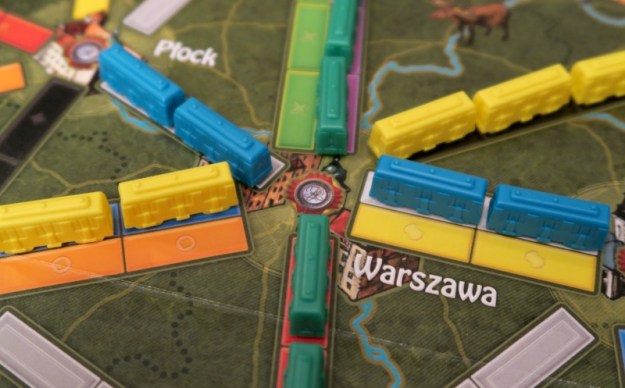
Wsiąść do Pociągu: Polska
– Image by boardGOATS

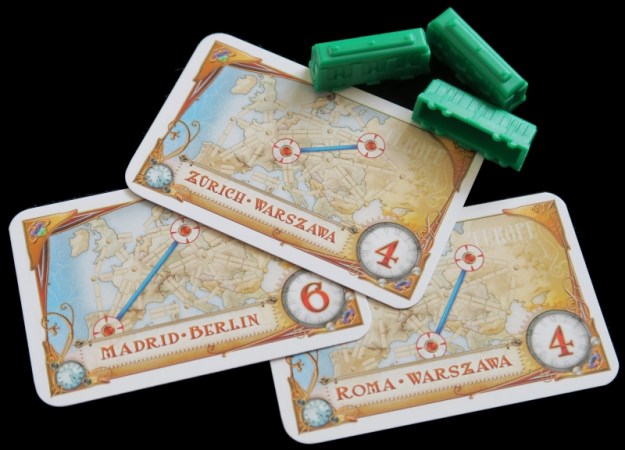
The Poland map works in much the same way as all the Ticket to Ride games; players collect coloured train cards and spend them to place plastic train pieces on the central map scoring points for placing trains, but also completing the route “Ticket” cards that they chose at the start of the game and maybe later too.  In addition to the usual rules, the base game maps all have a little something extra.  As well as the usual city locations, the Poland map also has countries, but unlike the Swiss map, these are not simply locations to connect to.  Instead when a player connects two countries, they collect one Country Card corresponding to each.  These are worth points at the end of the game.
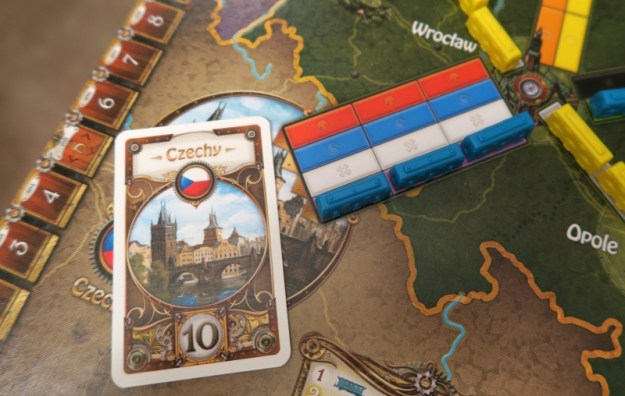
Wsiąść do Pociągu: Polska
– Image by boardGOATS

When a third country is added to the “network”, the player again collects Country Cards, one for each country in the network. When Blue explained the rules, Black commented that that aspect was interesting and he was curious to see how it affected the game.  Blue started and was followed by Orange, Lemon and then Black.  Black started by collecting more Tickets—this was a tactic that was discussed briefly at Burgundy’s Birthday Memorial event.  Black had commented then that this was the way all the best players did it.  The idea is that by collecting Tickets early, players are best placed to make the most efficient use of their trains and know what coloured cards they might need.
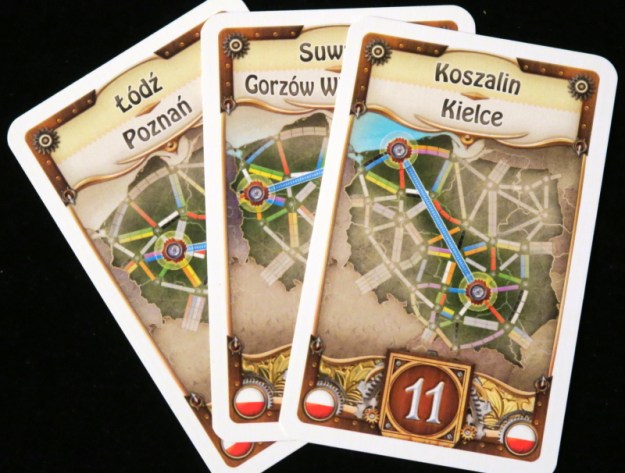
Wsiąść do Pociągu: Polska
– Image by boardGOATS

However, it is a bit of a “Go Big or Go Home” strategy because if something critical goes wrong early, the player could get left with an armful of unfulfilled Tickets leaving them with lots of negative points.  And with the Poland map, this was far from impossible as it turned out to be quite a scrap for the centre of the board.  Lemon asked what she should do when someone had just taken a track she wanted, clearly meaning Orange who had just nabbed a critical route from Bydgoszcz to Płock.  “Kill them,” was the instant reply to much hilarity.  Lemon commented that she would get her revenge, though it was unclear whether that was planned for the game or sometime later…
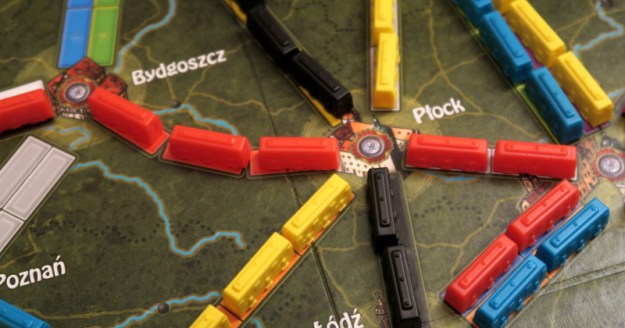
Wsiąść do Pociągu: Polska
– Image by boardGOATS

Eventually, Blue claimed the first Country Cards, connecting Belarus to Germany.  When she added Russia and Lithuania, it was clear how these could add significant points to a player’s tally.  Further, the repeated nature of collecting Country Cards each time the network grew provided a good source of points of a similar magnitude to those gained from Tickets, but without the associated jeopardy.  The Country Cards are stacked in descending order of value so that the ones earnt early in the game are worth more, but although the value decreases, as more countries are added to  player’s network more tickets are picked up.  As a result, value of each additional card pick up (and therefore each country when added) remains fairly constant depending on how many players are fighting for Country Cards.
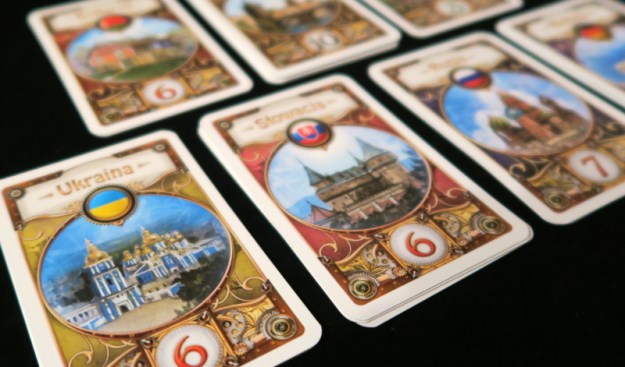
Wsiąść do Pociągu: Polska
– Image by boardGOATS

This time, Blue stole a bit of an early march on the Country Cards in the north, while Black acquired loads of Tickets and Orange got in everyone’s way.  While Blue’s primary route was in the north running east-west, Black and Orange focused on north-south and Lemon had two separate smaller networks which she unfortunately failed to connect together.  As everyone else saw how lucrative Country Cards could be, they joined in, connecting countries to the south.  Lemon pointed out the route they had taken from Ukraine through south Poland to Warsaw where they got a flight to the UK.  It was about then that the pub became an attraction in itself when one of the locals pointed out that the lease was for sale once more.

Wsiąść do Pociągu: Polska
– Image by boardGOATS

The game came to a slightly sudden end when Lemon ran out of trains—the Poland map is played with just thirty-five trains per player instead of the more usual forty-five.  Actual game play time isn’t much shorter than usual because, like the India map, there are fewer longer routes so players have to take more turns placing trains.  At the end of the game though, it was close with Lemon in the lead thanks largely to the fact she had concentrated on the lucrative long routes where possible.  Orange and Black had completed a lot of Tickets though, and when they were added on together with the Country Cards, they tied for second place with eighty-two points.  The winner was Blue, however, thanks to the huge pile of Country Cards.
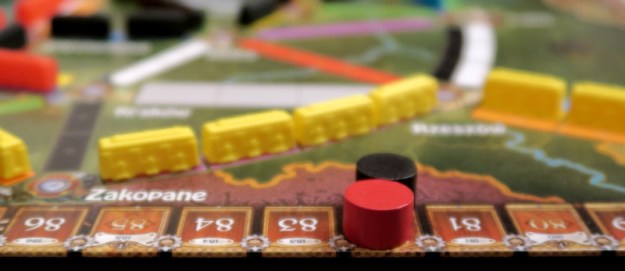
Wsiąść do Pociągu: Polska
– Image by boardGOATS

Meanwhile, over the other side of the room, Plum, Pine, Lime and Purple were playing Wingspan with Blue’s pimped out set.  Wingspan is a beautiful bird-themed game where players are collecting birds in three different habitats.  On their turn, they can “plant” a bird card in one of these habitats, or activate one of the three habitats to collect food, lay eggs or collect more cards.  The clever part of the game is that when players activate a habitat, they also activate any birds within that habitat—in this way, the game is card driven. Played over four rounds, there are bonus points at the end of each round (dependent on tiles drawn at the start of the game).  Otherwise, players score for birds, eggs, tucked cards, and personal bonus cards at the end of the game.
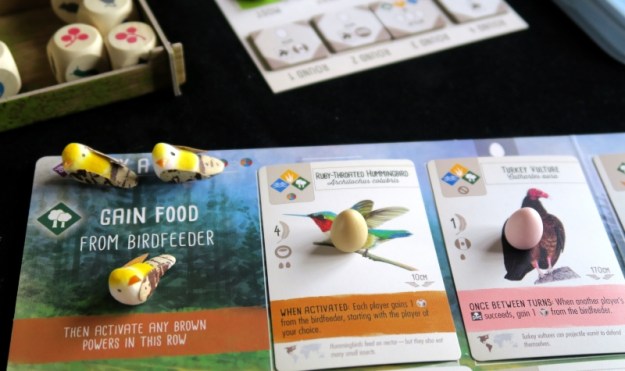
Wingspan
– Image by boardGOATS

Players start with eight actions in the first round, but that decreases by one each round as the game progresses.  However, because players add birds to their habitats during the game, although they get fewer turns in later rounds, they are actually doing more things in each turn as they are activating more cards.  In Blue’s pimped out copy, she had replaced the wooden action cubes with little fluffy birds which are cute, but led to some initial confusion with the phrase “playing a bird” meaning variously take an action (playing a fluffy little bird) or play a bird card into a habitat.
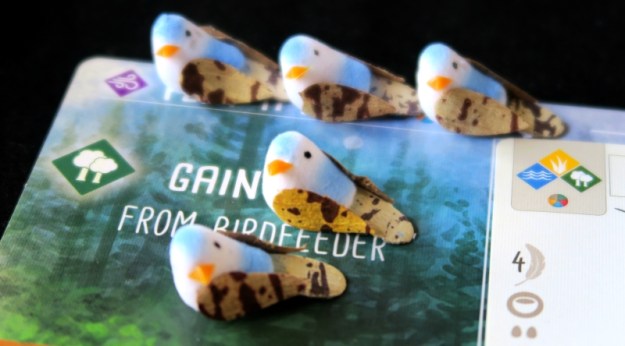
Wingspan
– Image by boardGOATS

This time, everyone was slow to start—the start is almost always slow in Wingspan as players need cards to play and food so they can pay the cost, but this time it was especially true as players found their feet.  Lime began with a woodland bird that gave an extra food after re-setting the bird-feeder, which really helped him out throughout the game.  He also had a once-between-turns card which was triggered when another player tucked a card.   Since Purple had a bird with a tucking action, that looked like a good call.  Considerable merriment was derived from the tucking action:  who was tucking the most, watching out for people tucking etc..  Unfortunately however, Purple’s action required the tucked card to be taken from Purple’s hand so she often passed up the chance meaning she was not the most prolific tucker…

Wingspan
– Image by boardGOATS

Plum’s first two were wetland birds with one-off powers.  As her bonus card rewarded her for having cards left in hand at the end of the game, the fact these early birds increased her card drawing powers from the very start meant they could help towards that too.  Pine’s bonus card rewarded him for having birds with geographical names which he pretty much had in his starting hand. Lime’s bonus was for birds with tucked cards, but he only realised later that it meant multiple birds with tucked cards not the number of cards tucked.  He was able to pick up another bonus card later in the game, which worked slightly better for him though.

Wingspan
– Image by boardGOATS

Pine’s bird hunting for rodents largely went hungry in the early part of the game, though it did better in the later rounds.  Plum, instead of sharing her latest kitty pictures, mimicked her favourite kitty behaviour, and watched hawk-like for a successful hunt to trigger once-between-turns action.   She had a killer “three birds in one go move” set up ready to go—two birds both with a “play a second bird in the grasslands” action.  Although she was a little disappointed to have been unable to deploy it in time for the worms they ate to count towards the second round goal of most eaten worms.  This increased her egg laying power though and the final third bird allowed her to a sacrifice an egg for two new bird cards ensuring she achieved her bonus in the final round.
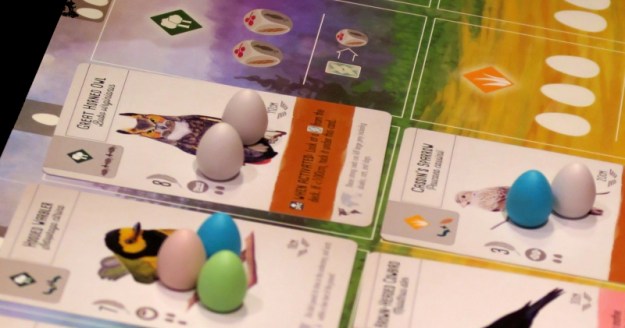
Wingspan
– Image by boardGOATS

With the game finally coming to an end, all that was left was the scores.  Plum and Lime took the most points for their birds while Purple and Pine had the most eggs.  While everything else was fairly close, Lime had his nose in front in most areas and this showed in the final scores which were moderately spread out.  Lime’s score of eighty-seven points was some ten points ahead of Plum in second, who was similarly ahead of Pine.  As always with Wingspan, it had been fun, though it had sadly confirmed to Pine that while he adores the theme, the game play just isn’t for him.  And on that sad note, with everyone else also finished, it was time for home.
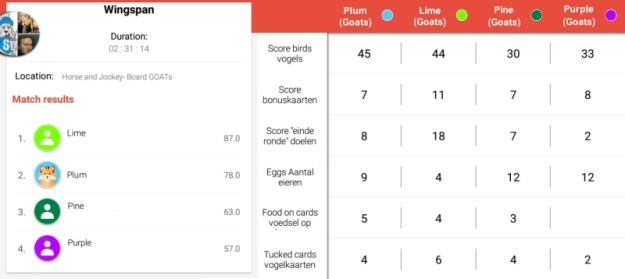
Wingspan
– Image by boardGOATS

Learning Outcome:  Everyone loves Pizza.

Remembering Burgundy on his Birthday

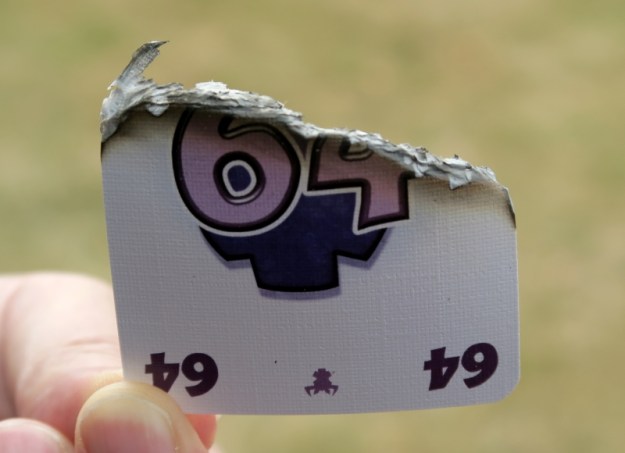
Burgundy (also known as Mike Parker) was an Oxfordshire gamer who sadly passed away at the end of December 2021 and is much missed.  He would have been sixty-four on Saturday 27th August and a small group decided that we couldn’t let his birthday pass unmarked.  So, at the South Oxford Crematorium, in Garford (where his ashes had been scattered), six people met to remember him and set light to a 6 Nimmt! card in his honour. The idea was a nice one, however, it turned out that a lighter would have been better than matches in the slight breeze, and 6 Nimmt! cards are not as flammable as we thought:  Burgundy would have been highly amused watching or perhaps he was teasing us by blowing out the flames.

6 Nimmt!
– Image by boardGOATS

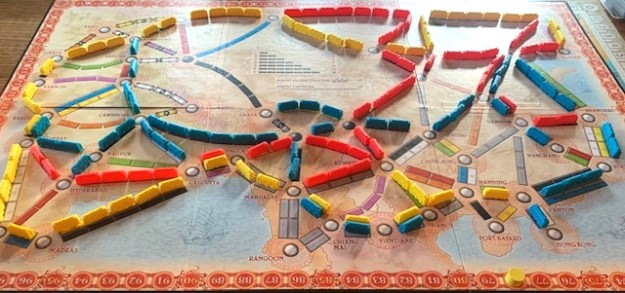
Eventually though, card number sixty-four was successfully burned, or rather charred (or at least most of it was), without doing too much damage to anybody’s fingers or setting fire to the tinder-dry countryside.  From there, the group went to The Fox in Steventon to honour Burgundy’s memory by playing some of his favourite games.  With six, the choices were limited without splitting into two groups, but one of Burgundy’s favourites was Ticket to Ride and the Team Asia expansion allowed everyone to play together.  It was a much tighter game than it had been earlier in the week and everyone played in the “Spirit of Burgundy” with lots of moaning when they picked up a card they didn’t want.  Team Purply-Black ran out the winners, just three points ahead of Team Pinky-Blue (who would have won had Pink let Blue take a chance and draw tickets on her last turn).

Ticket to Ride - Team Asia
– Image by Lilac

The group were going to squeeze in a quick game of 6 Nimmt! while waiting for food, but the cards (now one short of course) had barely been shuffled when food arrived.  Black, who missed out on on Ham, Egg & Chips at Burgundy’s wake, made up for it this time and then the group had to decide what to play next.  Bohnanza and 6 Nimmt! were options of course, but Green and Black were keen to play something heavier, though that would have meant splitting into two groups which somehow just didn’t seem right.  Concordia was another of Burgundy’s favourites and might have been an option with the Venus expansion, but that was moot as we didn’t have it.

Wingspan
– Image by boardGOATS

In the end, the group settled on Wingspan with the European expansion.  Although this only plays five, with two copies the group was able to make it work with an extra player.  This overpowers the “once per turn” (pink) cards, and leads to a lot of down time, but it felt the right thing to do for the occasion.  As a result of the slight unbalancing of the game, Blue got a lot of wheat, Green got an awful lot of worms, Pink and Purple Tucked a lot of cards, and Lilac was left at a bit of a disadvantage as she didn’t get a pink card at all.  Green was the eventual winner by some fifteen points, though it was very close for second with Blue just pipping Purple by a single point.  With the bar closing it was time to go home, but everyone felt that Burgundy would have approved, and would have enjoyed the evening too.

Mike Parker
– Image by Pushpendra Rishi

18th Movember 2021

The evening began with news—the landlord of our beloved Horse and Jockey , Charles, and his wife Anna, who have been trying to retire for years, are finally succeeding.  This time next month, the pub will be under new management.  In due course, we will find out what this means for our little group, but in the meantime, we Keep Calm and Carry On Gaming.  And Blue and Pink, who were first to arrive started off with a quick game of NMBR 9, with Pink aiming to get his revenge for last time (before the Quiz).

NMBR 9
– Image by boardGOATS

NMBR 9 is a very simple tile laying game, but the pieces cleverly fit together, except when they don’t.  The idea is that tiles must be placed in layers with pieces placed on higher levels worth more.  Each tile is a stylised number and the number multiplied by the “storey” is its score.  Each numeral, zero to nine appears twice in the deck of cards, so players can place each twice during the game, with the order dictated by the order the cards are drawn.  This time, Pink scored more than last time and Blue scored less, but sadly for Pink, even with Burgundy’s assistance, he was unable to beat Blue’s score of eighty-eight.

NMBR 9
– Image by boardGOATS

Blue, Pink and Burgundy were joined by Pine who’d had a particularly tiring week, and was therefore delighted to be able to avoid cooking.  As they finished, Green popped up and started setting up Praga Caput Regni.  In this game, players take the role of wealthy citizens who are organizing various building projects in medieval Prague. By expanding their wealth and joining in the construction, they gain favour with the king. Players choose from six actions on the game board, the “action crane”.  The actions are always available, but are weighted with a constantly shifting array of costs and benefits. By using these actions, players can increase their resources, improve the strength of chosen actions, build “New Prague City”, the Charles Bridge, the city walls, or participate in the construction of St. Vitus Cathedral.

Praga Caput Regni
– Image by BGG contributor PZS69

Praga is one of those games with lots of pieces and takes a little while to set up.  Green had agreed to play it with Ivory and Lilac in advance, but were one person down and there was less enthusiasm to play it from the others, so in the end there were just three with Black joining in.  There was quite a lot to explain:  Green had played a few times and Ivory had watched a video, but Black came into it completely cold.  When the game finally started, random selection gave the first turn to the least experienced player, Black.  Although there a lot of things that can be done in this game, each turn usually only provides a small choice (unless you want to pay for the chance to do something specific that isn’t available for free).  With a little advice Black was able to make his choice reasonably quickly and the game was underway.

Praga Caput Regni
– Image by BGG contributor PZS69

Black’s game was a tactical one, trying to do the best that he could each turn rather than following a recognised strategy.  With only one upgrade to his actions tile (building The Kings Road), he ended up with four wall tiles and made it to the top step of the City Walls.  Although he had upgraded his Kings Road tile it was late in the game and he only managed the third step along the road, not quite reaching the Charles Bridge. He did not try for the education tracks, but his mines progressed reasonably well.  Green tried to go for a City Walls/Cathedral strategy, but didn’t manage it very well, reaching only the second tier of the Cathedral and only one step on the City Walls.

Praga Caput Regni
– Image by BGG contributor PZS69

As that strategy just wasn’t working Green switched to completing the King’s Road and managed to get his piece onto the final step of the Bridge.  He upgraded a couple of actions, stone mine and (much later) Town tile actions, but could only manage two walls (rather surprising considering he built his first wall early on). Green did manage to reach the top of the University track and half way up the Knowledge path though.  In contrast, Ivory went very quickly for the Kings Road strategy, which he completed as well.  Like Black he ignored the Learning tracks, but did manage to get his Gold mine to the top, although (strangely) never managed to unlock his six gold bonus cube.  He also only did one Upgrade (the Gold mine action), but completed three walls.

Praga Caput Regni
– Image by boardGOATS

Ivory also concentrated on the City Walls and manage to climb to the top tier, but completely ignored the St. Vitus Cathedral.  Within the Town, Green placed most tiles, but only two plaza’s were ever completed, and no one built on the Old Town section North of the Road.  Ivory won the game, with Green a second on a tiebreaker.  Everyone kept forgetting the extra point bonuses from the Upgrades and Books, but it was clear that Ivory was the victor.

Praga Caput Regni
– Image by BGG contributor PZS69

Everyone enjoyed the game, Black in particular liked it much more than he thought he would. Ivory also liked it as did Green though the fact that players seem unable to do very much through the game frustrates him.  Overall it appealed to the group’s idea of strategy planning. Although it seems complex with lots that can be done, it is actually relatively straight-forward to play, with the complexity coming from working out what they want to do and which route will provide the best outcomes later in the game.  It is possible that the key is getting the Golden Arches and therefore extra free actions, but they seemed very lacking this time.

Praga Caput Regni
– Image by boardGOATS

The prior arrangement to play Praga meant there weren’t enough people to play the “Feature Game” (Nusfjord), particularly as neither Pine nor Purple fancied it.  Unfortunately, there was no alternative mid-weight game that everyone felt up to playing, so, after half an hour of debate, Pine insisted on sitting out leaving the rest to play what is now a bit of an old favourite, Wingspan.  We’ve played this a lot as a group since it was released two years ago, but Pink and Blue had not yet had the opportunity to play the newest, colourful birds expansion, Oceania.
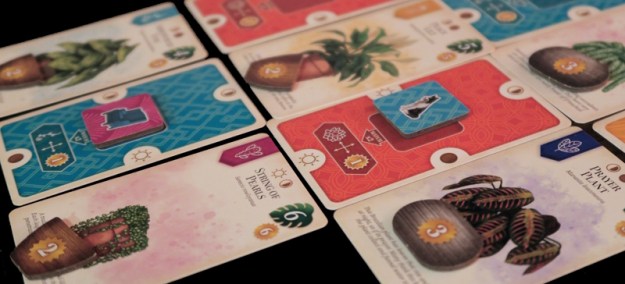
Wingspan: Oceania Expansion
– Image by boardGOATS

Wingspan is a fairly straight forward, card driven engine-builder with players collecting bird cards and playing them into their reserve.  To play bird cards in their reserve, players need to encourage them to stay by providing the right food as payment.  Thus there are four actions that players can take on their turn:  Play a card; Collect food, Lay eggs and Pick up cards.  The last three of these are associated with habitats.  Each card has a special power, some come into force when they are first played, some when the habitat is activated, and others when another player carries out an action.
Wingspan
– Image by boardGOATS

In addition to special powers, each bird card also gives points and holds eggs.  At the end of the game players receive a smorgasbord of points for each bird, for “tucked cards” (those placed under their bird cards as part of an action), for food stored by birds on cards (also as part of an action), for eggs laid on cards, all added to any end of round bonuses achieved and any bonus points from character cards.  The first expansion, with European birds, additionally adds cards which take effect at the end of each round, some of which are very powerful, and the new Oceania Expansion adds a new food type—Nectar.

Wingspan: Oceania Expansion
– Image by boardGOATS

Nectar can be used as a substitute of any other food type, but it is used in a different way and cannot be carried over from one round to the next.  There was no need to go through all the rules because everyone was familiar with the game, it just needed a summary of how Nectar worked and how the game changed, including the scoring with players who use it the most picking up bonus points at the end.  The expansions mostly add more cards, and although these change the flavour of the game they don’t significantly add to the complexity, so both expansions were included this time along with the cards from the Swift-Start Promo Pack.

Wingspan: Oceania Expansion
– Image by boardGOATS

This time, there were almost no birds of prey cards in the game, which was unfortunate for Pink because his Black-Billed Magpie went hungry.  He had the help of Pine, however, who stayed long enough to see his favourite bird, the Black Woodpecker put in an appearance, landing in Blue’s reserve.  Pink went on to concentrate on using Nectar and Character cards, the Omnivore Expert and Fishery Manager, both of which give points for the type of food birds eat.  Burgundy also focused strongly on his bonuses from Character cards (Citizen Scientist and Bird Counter) and both he and Pink scored more than twice Purple’s and Blue’s bonuses.
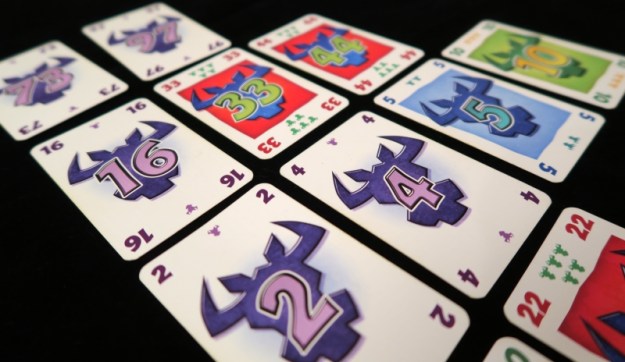
Wingspan: Oceania Expansion
– Image by boardGOATS

This is a relatively small part of the scoring, however.  Purple concentrated on making sure she had plenty of eggs at the end of the game and the purpleness of her reserve with all it’s purple eggs was a sight to behold.  Everyone made good use of Nectar, but Pink cleaned up winning two of the three categories and coming second in the third.  Burgundy took a lot of points for his tucked cards and had lots of his scoring birds in his reserve.  Blue had more birds and more valuable ones too, nearly filling her reserve.  The question was whether her huge pile of eggs was enough to offset the points others had taken elsewhere.  In the event it was, and she finished with just enough to knock Burgundy into second place, slightly ahead of Pink.  And with that, it was home time.

Wingspan: Oceania Expansion
– Image by boardGOATS

Learning Outcome:  Don’t put all your eggs in one nest.

23rd September 2021

Burgundy and Blue were just finishing their supper when Teal introduced himself.  The three were chatting when Lime, who hadn’t been able to come for over a month, also joined the group.  It was expected to be a quiet night with Green and Lilac away on holiday, Pine working late, and Pink stuck somewhere on the Warwick bypass.  So, there was a lot of chat, but eventually, the group decided to play something and settled on Love Letter.

Love Letter
– Image by boardGOATS

This is a very simple little game that we’ve played a lot, but somehow Lime had missed out.  So, there was a very quick rules explanation:  players start with a hand of one card, draw a second and choose one to play and do the action on the card.  The cards are numbered and the aim of the game is to finish the round with the highest card, or more commonly, avoid being knocked out.  There are only sixteen cards in the deck (and one of those is removed at the start of the round), so it doesn’t take long.

Love Letter
– Image by boardGOATS

The group were only three rounds in when everyone else turned up (including Pink who had escaped the roadworks), so Lime was declared the winner with two tokens and everyone else was introduced to Teal and started to discuss what to play.  In the end, Burgundy took matters into his own hands and started a game of Wingspan, so while Pink waited for his pizza to arrive, Blue explained the “Feature Game“, Mini Rails.

Mini Rails
– Image by boardGOATS

Mini Rails is a very simple little stock-buying and track-laying train game that compresses a lot of the game play of long and complicated games like the 18xx series into under an hour.  Players have two turns in each round, on one they buy shares in one of the companies and on the other they extend the “track” of one of the networks.  If it is built on a white space, players with holdings in that colour increase their value by the marked amount.  If the network is built on a red space, the stocks in that company are decreased in value.

Mini Rails
– Image by boardGOATS

The game is very simple, but there are a couple of clever little tweaks.  Firstly, there are two “tracks”, one is the turn-order track, while the other holds train disks drawn at random from a bag.  On their turn, players choose one of tokens and decide which action to use it for, “build track”or “buy shares”.  The position of the token that is taken dictates where they will be in the turn order in the next round.  Manipulating this turn order is one key aspect of the game, as is deciding whether to buy and then build, or build and then buy.

Mini Rails
– Image by boardGOATS

Perhaps the most complicated aspect of the game is the end-game scoring.  At the start of each round train discs are drawn from a bag; one more than there are turns.  This means everyone always has a choice, but the token the last player does not use is put to one side indicating they have paid “taxes”.  For the companies that have “paid taxes” any negative dividends are erased and positive dividends are counted.  For those companies that have avoided paying their taxes the reverse is true and negative points will be scored while positive points are lost.

Mini Rails
– Image by boardGOATS

This means it is in the interest of players with both large positive or significant negative scores to forgo building track or buying shares and leave a potentially valuable token as taxes.  Similarly, if a player is left with a choice of two tokens, it may be in their interest to buy/build a relatively unfavourable track to deprive other players of points.  With three players, the game doesn’t take too long to play, and with more it would likely become quite random.

Mini Rails
– Image by boardGOATS

Lime took an early lead, though of course lots of early points are… pointless, if the company doesn’t pay taxes.  In the end it was extremely tight, but in the end, Blue just pipped Lime by a single point.  With just three there isn’t much downtime and the game rocks along nicely with plenty of interaction, though as Pink said, “That’s one hell of an abstraction for a train game.”  Blue pointed out that this was what a lot of gamers thought of when someone said “Train Game”.  Pink felt disappointed at the lack of actual trains and tracks so to make it up to him, the group moved on to play Ticket to Ride Demo.

Ticket to Ride Demo
– Image by boardGOATS

Ticket to Ride Demo is one of the small games based on the Spiel des Jahres winner, Ticket to Ride Europe.  The Demo game has an interesting history—it was designed as a sales tool and had only a small print run.  It was so popular though, that it ultimately spawned a new range of small “City” games, New York, London and Amsterdam.  These games are essentially played the same way as the full-sized versions, but with fewer pieces on a smaller map which means they typically take less than half the time.

Ticket to Ride Demo
– Image by boardGOATS

On their turn players can do one of three things:  take cards from the market, spend cards to place trains or take tickets.  Players score points for placing trains, but also for connecting the places on their tickets.  The catch is that any tickets that are not completed score negative points.  The small versions of the game are much tighter with less room for error.  Unlike the others, Ticket to Ride Demo has a double sided map, one USA and one Europe.  This time the group played the Europe map.

Ticket to Ride Demo
– Image by boardGOATS

Compared to the full-sized equivalents, all the little games are like a knife-fight in a phone-box, and this game was no exception.  Lime only completed three of his four tickets as Blue brought the game to a quick and sudden end.  Pink completed all four of his tickets and they were high-scoring too.  Blue’s tickets were less lucrative, but she managed to place all her trains and took the European Express bonus points for the longest continuous route, and with it victory, by just two points.

Ticket to Ride Demo
– Image by boardGOATS

Meanwhile, on the next table an epic, five-player game of Wingspan was underway.  We’ve played Wingspan quite a bit since it came out and always found it very enjoyable.  We’ve played it enough that we’ve also explored the European expansion, but thanks to the restrictions over the last year or so, this was the first opportunity to play the new Oceania expansion.  The base game is a reasonably light, card-driven, combination building game.  On their turn, players can place a bird card from their hand in one of the three habitats, or activate all their cards in one of the habitats and carry out the associated action.

Wingspan: Oceania Expansion
– Image by boardGOATS

The habitats are Woodland, Grassland and Wetland and the actions associated with them are collecting food, laying eggs or collecting cards (respectively).  Once the action has been carried out, the active player activates each card in the habitat in turn.  The game is played over four rounds, with a decreasing number of actions per round as the game progresses.  At the end of each round there are goals and each player also starts with a personal bonus card which is evaluated at the end of the game.

Wingspan
– Image by boardGOATS

The European expansion really only adds extra cards, though this includes a number of birds with abilities that are activated at the end of rounds, and others that increase player interaction.  The new Oceania expansion also adds more cards, but additionally mixes things up a little more with the addition of a new food type, nectar.  Nectar can be used as wild food type, although some of the new bird cards have nectar specified in the cost.  Whenever players spend nectar though, they don’t put it back in the supply, instead they store it in the habitat they spent it on.

Wingspan
– Image by boardGOATS

At the end of the game, the player with the most nectar stored in each habitat scores five points at the end of the game with the player coming second scoring two points.  Nectar is therefore a very important resource giving a potential fifteen points at the end of the game, although it requires some skill to use it effectively as it can’t be carried over between rounds.  Burgundy and Black really invested in nectar and managed to make good use of it during the game as well as take the lion’s share of the nectar points at the end of the game.

Wingspan: European Expansion
– Image by boardGOATS

Burgundy and Black also prioritised valuable birds and tried to ensure they stayed in the running for the end of round bonuses.  Three out of the four of these involved eggs, which fitted with Ivory and Teal’s strategies which focused on an end-of-game egg rush.  Ivory also picked up a lot of points from his Common Starling which enabled him to discard up to five bits of food and tuck a card for each one.  With a maximum of twenty points, Ivory did well to take eighteen during the game, but it was only enough for third place this time though.

Wingspan
– Image by boardGOATS

It was very close at the top between Black and Burgundy.  Burgundy had four bonus cards one of which proved quite lucrative.  The big difference was in the value of the bird cards, however, while Black edged it in many departments Burgundy had a ten point head start.  This wasn’t simply because he had high value birds, more that he had lots of them.  In the end, Burgundy finished five points ahead of Black with ninety-five, in a good game that had been enjoyed by everyone round the table.

– Image by boardGOATS

Wingspan was still only on its third round when Ticket to Ride Demo came to an end.  At around the same time, Pine pitched up, so the, now foursome settled down for something else which ended up being a game of Reiner Knitzia’s Botswana (aka Wildlife Safari).  This is an unusual auction-like game made all the better by the inclusion of plastic animals.  Played over several rounds, players are dealt a hand of cards and on their turn play a card and take an animal of their choice.  The cards are numbered zero to five and come in five different animal suits.

Botswana
– Image by boardGOATS

The cards are played in the centre of the table in suits and the game ends when all six cards of one suit have been played.  The top card in any suit is the current value of that animal.  Thus, if the top zebra card is a five, a player that has three zebras will earn fifteen points for them if the game ends.  However, if the zero just before the game ends, the zebras will become worthless.  It is a deceptively simple, yet fun little game.  Blue thought she’d won until a recount docked her ten points and she finished just two points behind a delighted Pink.

Botswana
– Image by boardGOATS

As Botswana came to an end, so did Wingspan, and although time was marching on, and Lime and Ivory took an early night, there was still time for everyone else to play one last game.  After a little discussion, we settled on 6 Nimmt!, a game we all know and love.  Players simultaneously choose a card and these are sequentially added to the end of four rows of cards, specifically the row with the highest number that is lower than the card itself.  If the card is the sixth card in the row, instead, the player takes other five and adds them to their scoring pile.  The player with the lowest score at the end of the game is the winner.

6 Nimmt!
– Image by boardGOATS

We’ve all played this a lot online over the last year, but doing the maths ourselves was a little daunting, so we decided to go back to playing the non-professional version.  We play over two rounds using half the deck in first and the other half in the second.  This time Teal top-scored in the first round with nineteen, while Burgundy kept a clean sheet with Pink just behind.  Blue’s killer thirty-three in the second round gave her a total of forty-eight, but the winner for the second time in the evening was Pink with just four points.  And with that, it was bedtime.

6 Nimmt!
– Image by boardGOATS

Learning Outcome:  Today’s railway industry is no longer about trains and tracks. ☹

4th February 2020

Blue and Pink were first to arrive and, while they waited for others and their pizzas to arrive, they tried to squeeze in a quick game of Ganz Schön Clever (a.k.a. That’s Pretty Clever).  This is a “Roll and Write” game, that is to say, players roll dice and use the values they roll to fill in spaces on their score sheet.  So, it is an abstract game where the active player, rolls all six coloured dice and chooses one to keep and use, discarding all dice with lower pip values.  They then roll any remaining dice, again keeping and using one and discarding the rest before rolling the rest one last time keeping and using one final die.  The other players can then use one of the discards, before play passes to the left.

Ganz Schön Clever
– Image by boardGOATS

Filling in some of the boxes gives a bonus action, enabling players to fill in other boxes or gain the opportunity to re-roll their dice or even use an extra die.  The player who wins is therefore the player who makes the best use of the dice they roll and usually, the player who manages to build the most combinations to take advantage of the bonuses available. This time both Blue and Pink started off slowly, but as they were coming to the last couple of rounds, both food and people arrived and their focus drifted a bit.  Pink managed to keep it together better though and as a result finished with a nice round hundred and fifty, some twenty more than Blue.

Ganz Schön Clever
– Image by boardGOATS

As they finished eating, Green, tried to organise players in an effort get a group together to play Terraforming Mars.  It was quickly clear that it was not going to happen, as Burgundy, Black, Pink, Pine and Mulberry expressed an interest in playing the “Feature Game”, Fast Sloths.   This is a race game where players are sloths travelling around a holiday resort on the backs of other animals.  The rules are quite straight forward:  on their turn the active player takes cards from the face up piles that make the market; optionally play cards, and then discard down to conform to the hand-limit (which varies depending on how players are progressing).  When taking cards, they must all be different animals, and the number they can take depends on their position in the race.

Fast Sloths
– Image by boardGOATS

The game is a pick-up-and-deliver type of game, but unusually the sloths are the cargo being delivered.  Movement on the central board is the heart of the game and each player must try to optimize their movement to win.  When playing cards, they must all be of the same animal – the player then moves the animal corresponding to the cards played towards their sloth, so they can pick it up and drop it somewhere else on the map.  Each animal has their own characteristics, the type of terrain they can cross and how they move etc..  The aim of the game is to collect leaves and the first sloth that can gather eight leaves wins.

Fast Sloths
– Image by boardGOATS

Burgundy got off to a flying start – by both playing first and (even though he was last to pick) securing a good corner tree as his starting location, with a ready-made parade of ants he could bounce over on his way to the next tree.  It was a very tight game, which, after the first few turns while people built up their hand of cards, progressed rapidly with players aiming for a new leaf every turn, or at worst every two turns.

Fast Sloths
– Image by boardGOATS

There was much discussion about the accuracy of the terrains allocated to each transport animal. Donkeys, for example – in Fast Sloths they can’t travel in the mountains or through water, but surely the reasons why donkeys make such good pack animals is that they are great at climbing mountains and wading rivers?  Pink suggested that as this was a “game” perhaps such comparisons weren’t relevant?  However, this suggestion was not received well and went down like a donkey in a river…  Attention then turned to “how true to life” was the representation of unicorn transport.

Fast Sloths
– Image by boardGOATS

The game carried on, with only an occasional call of “Summon the Eagles!” from Mulberry (just imagine Brian Blessed in the film Flash Gordon).  Despite being the first time most people had played the game, all players had clearly got to grips with the mechanism and made speedy progress through the forest – a compliment to the designer it was felt.  In the end, with everyone so closely matched, it came down to marginal differences and Burgundy, after his initial flying start, stayed out in front to win after collecting eight leaves. Hot on his heals were Mulberry, Black and Pine with seven.

Fast Sloths
– Image by boardGOATS

Meanwhile, on the next table, Green and Ivory had settled on Wingspan, and were eventually joined by Purple and Blue.  Since it won the Kennerspiel des Jahres award last year, this has proved a very popular game within the group.  The copy belonged to Burgundy, and he had integrated the European Expansion and Swift-Start Cards, as well as “pimped his bits”; the artwork on the cards is beautiful and the additional pieces just add to the aesthetics.  The game is  functionally very simple, though playing well requires planning and just a little bit of luck.

Wingspan
– Image by boardGOATS

On their turn, the active player can place an action cube to do one of two things:  pay food to play a bird card from their hand, or activate one of their three habitats and all the birds in it.  The three habitats, allow players to collect food, lay eggs or add more bird cards to their hand.  At the end of each round there are bonus points available for players who are most successful with the targets set out; at the end of the game players score points for each bird card they’ve played (value dependent on the bird), food and eggs on their cards, and flocking birds.   The difficult part is to efficiently build combinations of birds with synergistic special powers that will ultimately yield the best score.

Wingspan
– Image by boardGOATS

This time, Blue started by playing a White Wagtail in her Wetland, which gave the opportunity to place a bird card at the end of the round so long as she had activated all three habitats and placed a card during the round.  She still had to pay the food needed, so she concentrated on making sure she had all the bits required to make it work for her every round.  Ivory focused on first playing his Savi’s Warbler and then using it to acquire a lot of cards, many from the face-down draw pile, hoping to draw something good.  Green struggled a bit from the start, partly because he was arguably the player with the least experience, but the fact he was distracted by a bird of a different sort tweeting by phone certainly didn’t help.  Purple on the other hand, quietly concentrated solely on her game, and made excellent use of her Double-Crested Cormorant which allowed her to tuck two cards in exchange for one fish.

Wingspan
– Image by boardGOATS

As the game progressed, Green increasingly needed prompting to take his turn, and explained that he was getting side-tracked because Blue, playing immediately before him, was taking so long on her turn.  While it was true that Blue’s turns were getting longer, this was almost entirely because the number of birds in her reserve was increasing faster than anyone else’s, largely thanks to her White Wagtail which she was busy putting to good use.  The contrast was quite stark Green’s rather meager reserve and Blue’s, although by this time, both Ivory and Purple, also had a good sized reserves.  As the game entered the final round, Fast Sloths was coming to an end and those players wondered over, so the last few turns were played with an audience.

Wingspan
– Image by boardGOATS

At this point, the Wingspan players were putting the finishing touches to reserves.  Green kept commenting how he knew he was coming last and it was clear who had won, but Ivory was not so sure.  In the final accounting every bird in Purple’s reserve had a good point value adding to her points from the tucked birds and Ivory did best in the end of round goals.  Blue had the most birds giving her the same amount of points as Purple (though the individual cards were not as good) and she scored slightly fewer points that Ivory in the end of round goals.  In every other area, however, Blue led the pack giving her the lead overall with ninety-eight points.   Ivory was twenty points behind, and just pipped to second place by Purple.

Wingspan
– Image by boardGOATS

Mulberry, Pine and Ivory Ieft to get an early night, leaving everyone else to play something short;  the game that fitted the bill and was on the top of the pile was For Sale.  This is a very clever property auction game that we played for the first time in years at New Year. The game comes in two parts:  buying properties and then selling them.  So, each player starts the game with $14,000 to spend on property cards.  There are thirty properties, numbered to reflect their relative value and these are auctioned in groups equal in size to the number of players.  The clever part of the auction is that when a player passes and withdraws, they pay half the value of their final bid and take the property with the lowest value; the winner takes the most valuable property, but pays their final bid in full.

For Sale
– Image by boardGOATS

In the second part of the game, cheque cards equal in number to the number of players are laid out, with values from zero to $15,000.  Each player then chooses one property card from their supply and everyone reveals them simultaneously: the highest value property earns the highest value cheque with the second most valuable property earning its owner the second largest cheque and so on.  The winner is the player with the highest total from the sum of their cheques and any left-over cash.  This time, Black took the most valuable property, the space station and with it, on of the $15,000 cheques while Burgundy took the other.

For Sale
– Image by boardGOATS

At the other end of the scale, Pink took both the void cheques, but despite this still managed $33,000 for the rest of his properties.  This was nothing compared to the winner, Green, who finished with $53,000, $2,000 more than Burgundy in second.  The night was still young, however, and there was still time for one of our favourite games, 6 Nimmt!.  Although this is often derided as a game of chance, it is clear that it is not pure luck.  The idea is that everyone has a hand of cards from a deck numbered one to a hundred and four.  Simultaneously, everyone chooses a card from their hand, and, starting with the lowest value card, these are then added to one of the four rows of cards.

6 Nimmt!
– Image by boardGOATS

Each card is added to the row with the highest end card that is lower than the card they have played.  If the card is the sixth card, they take the five cards in the row and their card becomes the first card in the new row.  Each card has a number of bull’s heads on it—this is the number of points they score.  The player with the fewest points at the end of the game wins.  We play with a variant that half the cards are dealt out for the first hand and the rest for the second, which gives us a score at half-time.

6 Nimmt!
– Image by boardGOATS

This time Burgundy and Black were in the lead at the half-time with a single nimmt, with Blue a couple of points behind.  Pink set the competitive high score of thirty-one.  Black picked up a handful of cards in the second half, indeed, only Purple, Blue and Burgundy managed to keep their second half scores to single figures.  In the end, it was Blue who just had the edge, beating Burgundy by three nimmts.  At the other end, however, Pink had no competition finishing with a very respectable high score of forty-five, not a record, but a substantial total nonetheless, and a good end to a fun evening.

6 Nimmt!
– Image by boardGOATS

Learning Outcome:  Donkeys are not as versatile as you might think.

29th October 2019

Blue and Pink were first on the scene, armed with special deliveries from Essen and some new exciting toys to play with.  Burgundy, Pine, Lime and Green weren’t far behind and soon those that hadn’t eaten earlier were tucking in.  Inevitably, the conversation was all about the games fair in Essen and how much it had grown – this year, according the organisers, there were over 209,000 participants, ten percent more than last year.  There were also one thousand two hundred exhibitors from fifty-three nations, occupying six large halls, around twice the hall space when Green last went.

Essen 2019
– Image by boardGOATS

As people arrived, they received their consignments.  Purple and Black got their sadly rather squished copy of the new release, Fast Sloths complete with Expansion and Chameleon promo, a copy of the new portable set of Settlers of Catan (“Catan Traveller“) and a several bags of German lebkuchen biscuits.  Burgundy got his annual Concordia expansion (the Balearica/Cyprus map) and the European Birds expansion for Wingspan.  This last game was one of the sell-out games at Essen, and Blue and Pink had been at the front of what became a very long queue to get it.  That said, the length was probably more to do with the fact that it was also the queue to get a hand on one of the fifty English language copies of Tapestry at the show. Given the fact that Wingspan is very popular at the moment and it would need very little learning, the new expansion was “Feature Game” for the night.

Wingspan
– Image by boardGOATS

The game is relatively simple, with players collecting birds for their reserves.  On their turn, the active player chooses one of four actions/habitats, and then starting with the card furthest to the right in that habitat, activating each card in turn.  The actions associated with the habitats are spending food to play cards; getting food; laying eggs, and more drawing bird cards.  Players start with eight possible actions per turn, which gradually reduces to five over the course of the four rounds of the game.  All the bird cards in the game have actions that fit with their real-life behaviour.  For example, the food needed to play cards closely resembles their diet, the number of eggs each bird has in their nest is proportionately correct and bonus actions are associated with birds that flock and birds of prey.

Wingspan
– Image by boardGOATS

The European Expansion adds more birds that mostly do more of the same thing, but includes birds that have new end of round powers.  There were enough copies for everyone to play, so we set up two games in tandem.  Blue, Green and Pink helped Burgundy christen his new copy, while Black, Purple, Ivory, Pine and Lime gave Blue and Pink’s copy it’s first outing.  After making sure all the new cards were thoroughly shuffled into the deck, Burgundy’s group were first to get started.  The end of round objectives were particularly awkward as the final round rewarded players with the most birds without eggs on nests (one of the new objective tiles).

Wingspan
– Image by boardGOATS

Blue started off very well, but then her game stalled as she struggled to find useful cards.  Burgundy wasn’t far behind and his very hungry Griffon Vulture seemed to be very effective when it came to catching mice.  Blue’s Barred Owl was also successful on almost every occasion it went hunting while Green’s Northern Harrier repeatedly went hungry.  Meanwhile, Pink was building a very fine reserve with lots of high value birds, although he felt they didn’t give him such effective actions.  With Blue struggling to get anything she could play and Green muttering about not understanding the game, it was left to Pink and Burgundy to fight it out.  In the end, although Pink had far more interesting birds, Burgundy did much better with his personal objectives and end of round objectives, giving him a total of seventy-three points, nine more than Pink in second place.

Wingspan
– Image by boardGOATS

On the neighbouring table, everyone started off slowly.  Black grabbed one of the new European birds that allowed him to steal food which he used to great effect.  Black and Lime also took one of the new end of round bonus cards each which allowed them both to tuck cards.  Pine played a Long-tailed Tit, one of the new double space birds, allowing him to get lots of food. Ivory focused on cards with activation powers and in the second round, he and Lime built egg laying engines, with Lime making good use of his Fish Crow which allowed him to exchange eggs for food. Purple struggled due to the lack of fish, clearly having an eye on the last round objective (most birds in wetlands).

Wingspan
– Image by boardGOATS

Both Pine and Lime struggled seeing and understanding the cards, but despite this, both managed to get effective engines going, particularly Lime.  By the end, Black had lots of valuable birds and did well on his objectives and Pine missed out on a seven point objective bonus by just by one corn eating bird (getting three points instead). Black also did well on tucked cards, as did Lime.  Everyone drew for the first end of round objective (most birds in any row), with Ivory followed by Lime for the second (most birds with “brown powers”).  Lime managed to win the third round objective battle (most grassland birds), edging Ivory into second place, but the final round (most wetland birds), was a three-way tie between Ivory (again!), Pine and Purple who all had the maximum number of birds in their wetland.

Wingspan
– Image by boardGOATS

Although he did well on objectives, in the final round Ivory’s primary focus was on getting as many eggs laid as possible and he finished with a massive twenty-seven, a significant contributor to his final, winning score of seventy-nine, seven more than Black in second place and ten more than Lime in third.  There was the inevitable comparisons between the two games, and when Ivory asked whether people felt the expansion had made much difference to the game, opinions seemed divided.  Having birds he could see in his garden had made a big difference to Pine, though to those people who were less interested in our feathered friends and more interested in the game play, the expansion had made less of an impact.  For those that have it though, the European expansion will no-doubt remain a permanent feature.

Wingspan
– Image by boardGOATS

The four-player game including Burgundy, Pink, Blue and Green finished first by some margin, giving them time to play something else.  With Blue and Pink having exchanged last year’s variant on the 2018 Spiel des Jahres winner, Azul (Azul: Stained Glass of Sintra), for this Essen’s latest model, Azul: Summer Pavilion, this seemed a good time to give it an outing.  All three games are based round a clever “market” mechanism:  players take all the tiles of one colour from one of the stalls and put the rest in the central pool, or take all the tiles of one colour from the central pool.  In the original game and in the second iteration, these are placed straight away in a tableau, with the original representing a mosaic and the second a stained glass window.

Azul: Summer Pavilion
– Image by boardGOATS

In the new, Summer Pavilion variant, tiles taken from the market are put to one side for the second phase when players take it in turns to place them on their personal player board.  Where the tiles in the first two versions are square (opaque and clear plastic respectively), in the new edition, they are rhombus-shaped.  Instead of rows, each player’s tableau consists of stars made  up of six rhombi.  In this game, as they add pieces players score points for the size of the block.  For example, adding a piece to an existing partial star consisting of two pieces gives three points.  Thus, increasing the size progressively yields increasing amounts of points.  Although this is an obvious difference, the biggest difference in the game play is the cost of placing tiles and the use of “Wilds”.

Azul: Summer Pavilion
– Image by boardGOATS

Each space on a player’s tableau has a number on it: one to six.  This is the cost to place a tile in that space.  So, placing on a six-space means they place one tile on the board and five in the tile tower.  The tiles must all match the colour being placed, however, every round, one of the six colours is “Wild” and this can be used as a substitute.  The Wild colour affects the tile drawing phase too:  Wilds cannot be chosen from the market, however, if there is are Wilds present in the market, one (and only one) must be taken as well.  For example, if there are two blue tiles, a red and a green (which is Wild), the player can take the two blues and the green, or the red and the green, but cannot take the green alone.

Azul: Summer Pavilion
– Image by boardGOATS

There are several bonuses, both in game and end game.  Players who surround certain features on their tableau get to take extra tiles from a second, special market.  This helps grease the wheels and makes the decision space a little more interesting too.  At the end of the game, players get bonus points for completing stars and for covering all the “ones”, all the “twos” etc..  The stars give different numbers of points depending on the colour.  Each tableau has one of each colour available and one central multicolour star in which every tile must be a different colour.  At the end of the game, the player with the most points is the winner.

Azul: Summer Pavilion
– Image by boardGOATS

Although Blue had found time to punch the pieces in advance, she had not been able to read the rules properly so did it on the fly – the rules are not long, nor are they complex.  That said, this version certainly adds strategic depth compared with the original, without the fiddliness of the second version.  Without any experience, there were no clear strategies.  Blue targeted the bonus points for the must lucrative, purple star and the central star as “low hanging fruit”, while Pink went for the in-game bonus tiles and picked up the extras for completing all the “ones” and “twos”, but didn’t quite make the “threes”.  Burgundy played for some of the less valuable stars and Green struggled to get anything to work at all.  It was really close, with only one point between Blue and Burgundy, and Pink just a handful of points behind him.

Azul: Summer Pavilion
– Image by boardGOATS

This was a brand new game, never played by anyone round the table, so inevitably, something got missed in the rules.  In both the base game, Azul, and the follow-up, Stained Glass of Sintra, the first person to take tiles from the central pool in each round takes the first player marker and a penalty for doing so.  The same is true here, but unlike the base game, the size of the penalty depends on the number of tiles taken with the first player token.  Everyone played by the same rules, so nothing was “unfair” and nobody noticed any balance issues, however, in such a close game it is very likely to have made a difference.  We’ll get it right next time!

Azul: Summer Pavilion
– Image by boardGOATS

Learning Outcome:  Essen is Awesome!