Author Archives: nannyGOAT

11th June 2024

The pub was not as busy as last time, and in any case, Pink, Blue, Black and Purple were there in good time for food.  Once they had finished, they managed to squeeze in a quick game of Rome in a Day while they were waiting for food and eating.  This is a cute little tile-laying game Black and Purple picked up from UK Games Expo as few days back.  It is a bit like Kingdomino with the “I cut, you choose” mechanism to allocate the tiles.  The “I cut, you choose” mechanism is used in a number of other games like, Castles of Mad King Ludwig, Isle of Skye, and Dice Hospital, but it is a more fundamental part of games like San Marco, and particularly …aber bitte mit Sahne and New York Slice.

Dice Hospital
– Image by boardGOATS

In the case of Rome in a Day, Players start by taking five land tiles drawn at random and place two buildings on tiles one and two.  They then divide the five tiles into two groups—a bigger and a smaller one (in any ratio) and add a crystal to the smaller land set before offering them to their neighbour.  During the four rounds the game is played over this neighbour alternates, right, left, right, left.  So, each round, players choose a set from their neighbour and these and the tiles they were left with are added to their domain.  At the end of the game, any building that stands on or adjacent to land of its own colour will score for each tile in the group and then players score for the diamonds they have collected—the player with the most points is the winner.

Rome in a Day
– Image by boardGOATS

Like in Kingdomino where players score better for a medium number of crowns in a medium sized area than for a combination where one is large and the other small, players benefit more if they can surround one large area of coloured tiles with multiple buildings of the same colour.  The most successful at this was Pink who scored well for three coloured areas, the green Olive Groves, the blue-purple Vineyards and the yellow Wheat Fields, while the others didn’t score at all.  As a result of his ruthless scoring strategy, he finished with fifty four points, eight points clear of second place, which went to black by a single point.
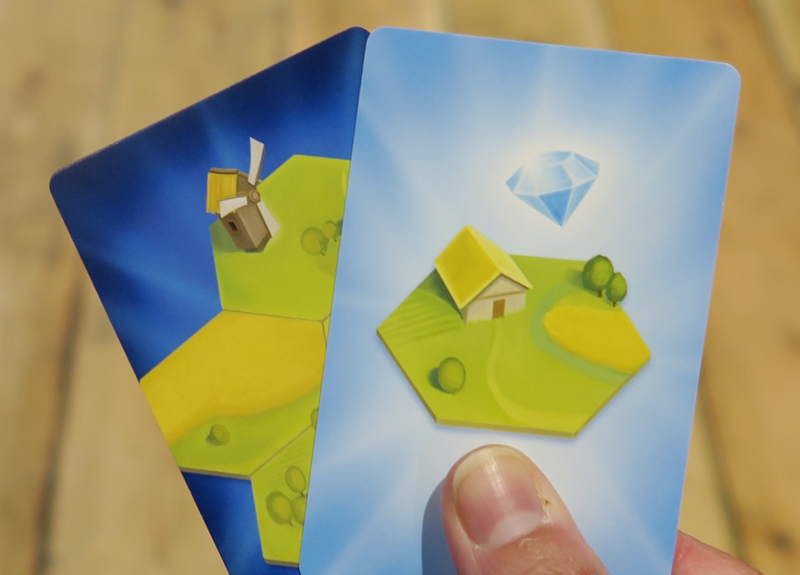
Rome in a Day
– Image by boardGOATS

The game was just coming to an end when Jade, Sapphire, Plum and Byzantium arrived, followed by Pine, Ivory and Teal, and then the inevitable debate as to who would play what began.  In the end, Jade led a group of four including Black, Purple and Sapphire in the “Feature Game“, Courtisans (the French for Courtier as it is spelled with an “i” rather than an “e”), which also came from UK Games Expo.  The first game was essentially a learning opportunity where players tried to understand the learning the mechanics of the game.  On their turn, each player receives and plays three coloured Family cards.
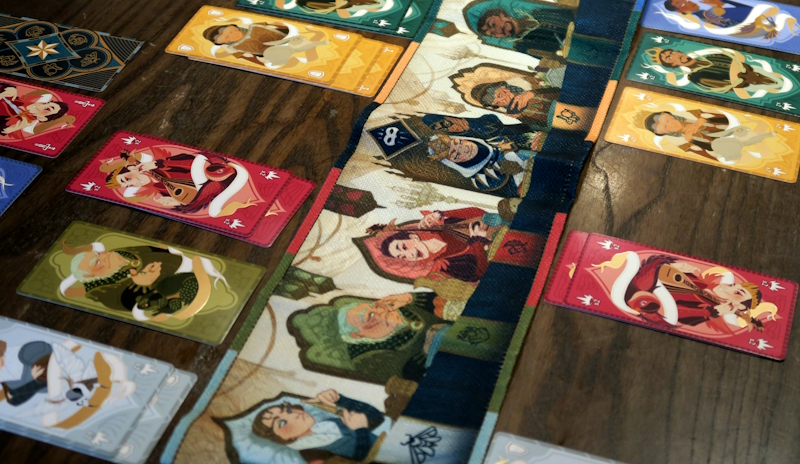
Courtisans
– Image by boardGOATS

One card is played at the Queen’s table to sway a family’s influence in a positive or negative way depending on whether it is placed above the table or below—at the end of the game, those with more cards below than above will have “Fallen from Grace”.  The other two cards are then played, one in the player’s own Domain and the other in an opponent’s Domain. At the end of the game, each card a player has from an “Esteemed” Family is worth a point, while each card from an Family that has “Fallen from Grace” loses them a point.  Thus the cards can be worth positive or negative points, depending on the Family’s status at the end of the game.
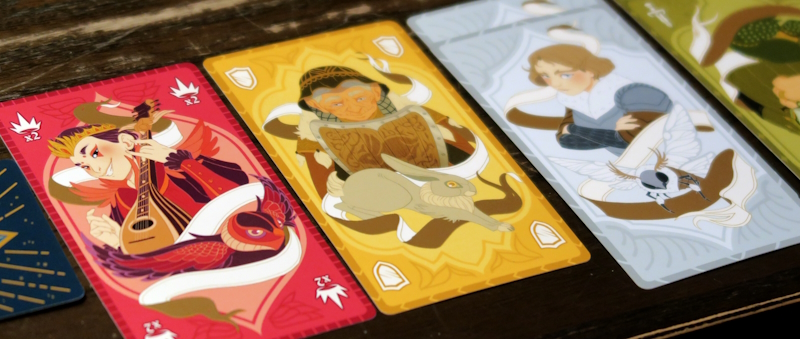
Courtisans
– Image by boardGOATS

Some of the Courtier cards have a special power, for example, Nobles count as two cards, Spies are played face down and their allegiance is only revealed at the end of the game, Assassins can be used to eliminate other Courtier cards, while Guards are not affected by Assassins.  The game ends when the card deck has been exhausted and nobody has any cards left in hand.  Players then total up their score and add any points earned from successful Secret Missions (each worth three) and the player with the most points is the winner.

Courtisans
– Image by boardGOATS

Black went first chosen by an app and began feeling his way forward.  The group only realised there was a slight issue towards the end as they ran out of cards a bit early.  It was then that it was discovered that at some point Black had acquired a second hand which he had placed on the table beside him.  Despite only a few personal objectives being met mostly players scored scored well; the exception was Purple who was the only one to complete both objectives which added six points to her score at the end.  It wasn’t enough for victory though, that went to Sapphire who had fifteen points, with Jade a point behind in second.

Courtisans
– Image by boardGOATS

Having felt their way through the first game, the group decided to play again.  As the winner, Sapphire went first, and from the off, it was like everyone woke up together and all decided to attack.  This time, everyone completed at least one objective, but this second game was a lot more treacherous and this was evidenced in the scoring.  One of Jade’s objectives was to ensure at least one of the Houses had at least five cards bringing them into disrepute—Jade chose yellow which caused others problems.  It didn’t have as much of an effect as his second objective though,which was to have fewer red cards than the player to his left.  As a result of this, Black was the kind recipient of any red cards he acquired.
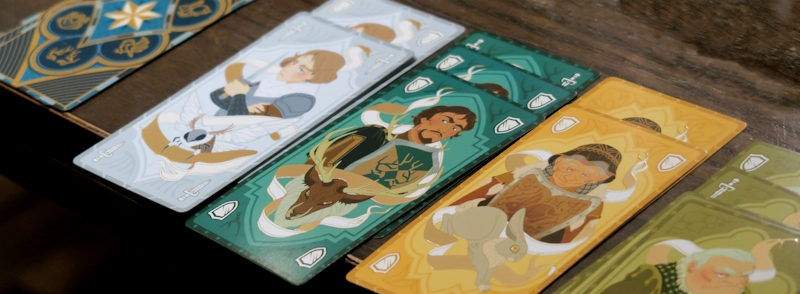
Courtisans
– Image by boardGOATS

While he tried to bring the reds into disrepute too, it wasn’t possible to do both.  So, despite his best efforts they still scored positively and probably helped ensure Black’s victory with seven points, four more than Jade himself.  The scores were much more diverse in the second game though with a range of sixteen points with the person at the back finishing with minus nine!  Although savage, it had been a lot of fun; Jade commented that the game felt a bit like a dance with lots of nuance.  Definitely one to play again, especially given the truly beautiful foiled cards which are a delight to play with.
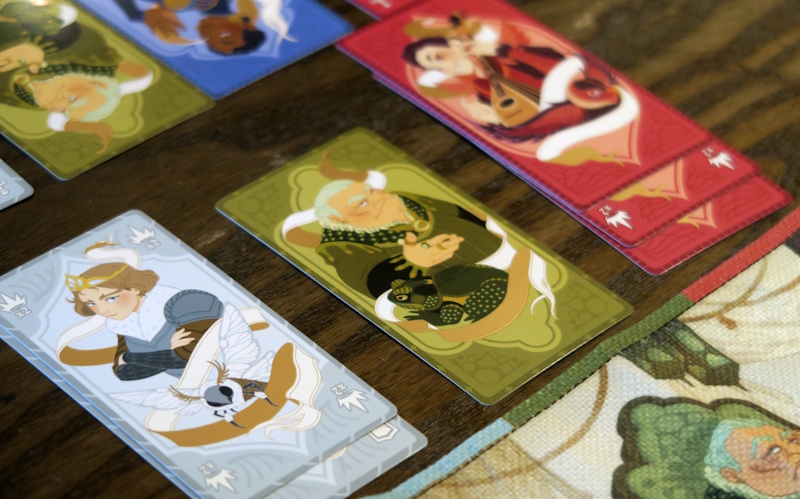
Courtisans
– Image by boardGOATS

Meanwhile, Teal had picked up the Alpine expansion for one of his favourite games of the moment, Forest Shuffle, and was keen to give it its first outing.  He was therefore joined by Plum, Byzantium and Pink who were also keen to see how it changed things.  Forest Shuffle is mechanically a fairly straight-forward game, but playing it well is comparatively difficult as it requires good, robust strategies and an understanding of how to get the best from the cards.  The idea is that players start with a hand of cards and, on their turn draw two more from the market (or “Clearing”) or play one into their tableau.

Forest Shuffle: Alpine Expansion
– Image by boardGOATS

There are two sorts of card, Trees and “Critters”.  Before playing a Critter, players must have played a Tree, which then has spaces on all four sides.  Birds and Butterflies are played to the canopy (i.e. above tree cards), Fungi and Amphibians are played at the bottom of the tree (i.e. below them) and Mammals are played either side.  The clever part is that Critter cards are split so they show two critters (either left and right or top and bottom), so players choose which they would like to play, and where, tucking the other side under the tree, making the unplayed half invisible.

Forest Shuffle
– Image by boardGOATS

The new Alpine expansion for Forest Shuffle only adds some thirty six cards to the game and, since roughly twenty additional cards are removed during setup, in practice it adds just sixteen to the deck.  Of course, the cards are removed at random so many should be from the base game and the expansion adds new cards like the Mountain Hare, who scores as for the European Hare, but wants to stay alone so can’t share a space with another Hare.  There is an extra Butterfly and more Trees too, which make these easier to score and help to balance the game somewhat.  Additionally, there is the new Alpine Newt provides a new way of scoring, for players who have managed to pick up a lot of cards from the Alpine expansion cards.
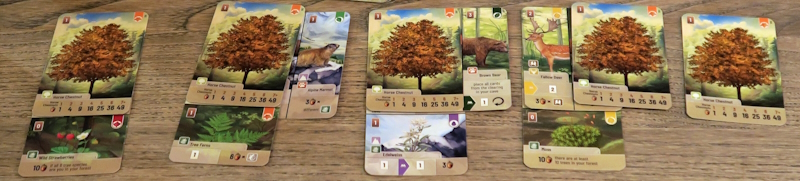
Forest Shuffle: Alpine Expansion
– Image by boardGOATS

This time, Plum went for Trees in a big way with loads Horse Chestnuts which give more points the more you have on them up to forty-nine for seven or more.  While she didn’t quite make the full seven, she scored a total of forty-eight for her Trees, fifteen more than the nearest player (Byzantium) and more than double what anyone else took.  They, of course, got points elsewhere though.  Pink, for example, went for Butterflies and, with the additional Phoebus Apollo Butterfly, took thirty-five points for them alone.  Byzantium opted for a deer strategy and received a total of sixty-one points for all his Critters.
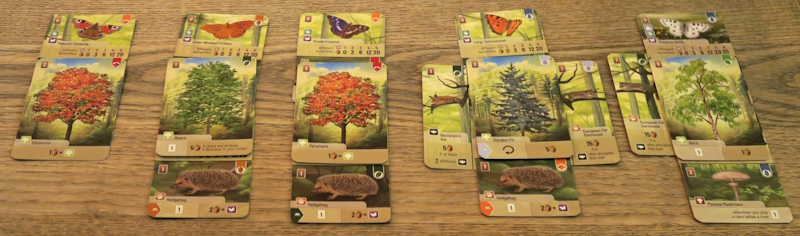
Forest Shuffle: Alpine Expansion
– Image by boardGOATS

The winner was Teal however, with everyone else totally overcome by “The Lynx-Effect”, where each Lynx he had gave ten points as long as he had a Roe Deer to keep them fed.  Perhaps his victory was to be expected as he has played the game quite a bit with family, but his finishing score of a hundred and fifty was some way ahead of Pink and Plum who tied for second place with a hundred and nineteen.  Overall, the Alpine expansion adds some pretty artwork and made a few of the alternative strategies a lot more viable, reducing the apparent dominance of Wolves and Deer which it has often been claimed are overly powerful.

Forest Shuffle: Alpine Expansion
– Image by boardGOATS

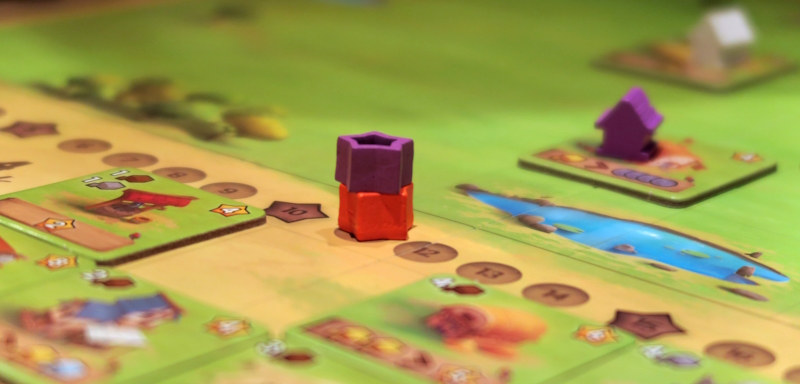
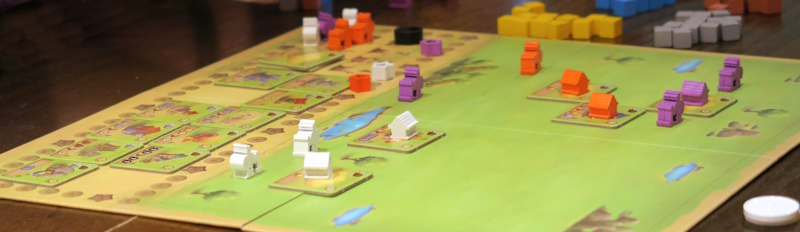
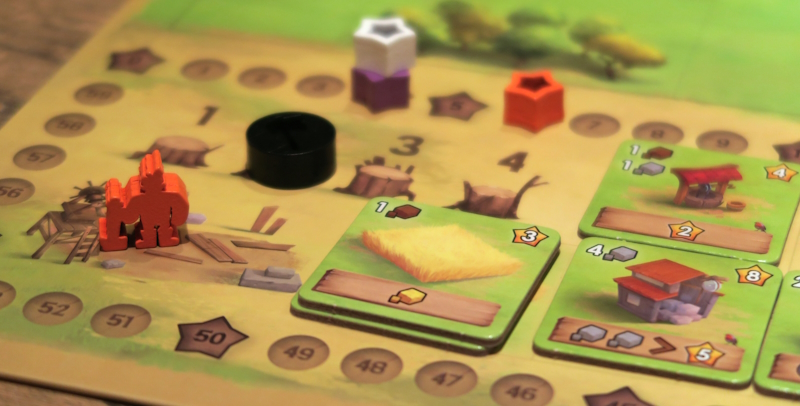
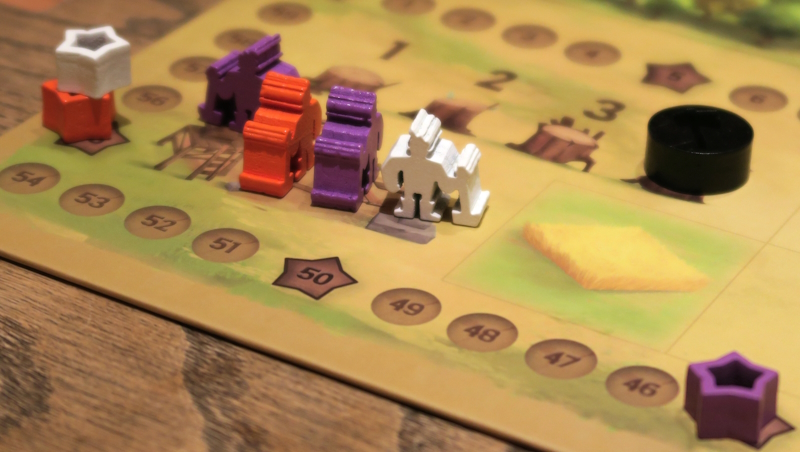
With the Courtisans and Forest Shuffle groups sorted, that left just three players without a game.  Since Ivory and Pine both missed out on playing Little Town last time and neither wanted a particularly late night the decision was made to eschew Key Flow in favour of the lighter, quicker, tile-laying game.  Play is very simple:  players take it in turns to place their Workers in a space on the central board and then activate the eight spaces around them.  These eight spaces could be Buildings, but may also be Trees, Rocks or Lakes pre-printed on the board giving resources (Wood, Rock or fish respectively).  With three players, there are four Workers in each of four rounds and the player with the most points at the end is the winner.
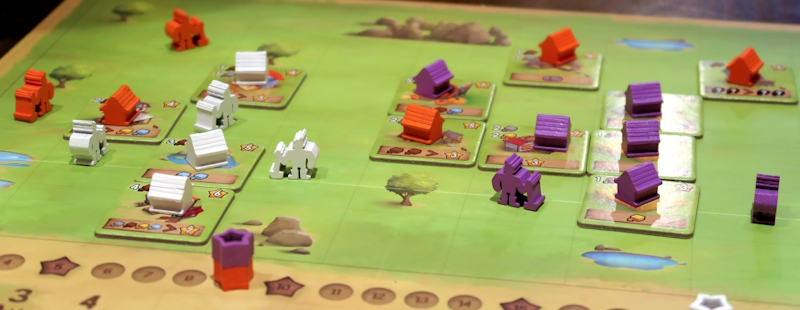
Little Town
– Image by boardGOATS

Little Town has had a few outings, but was the “Feature Gamelast time, with two games played simultaneously, both with the starting tile set up.  This time, a random tile setup was used drawn from the full set that included the Pier, the Marketplace, the Bar, from the variant set as well as the Shop, the Workshop, the Goldmine, the Bakery, the Pawnshop, the Quarry and Wheat Fields from the basic set.  The twelve Buildings were completed by the Temple, the Cornucopia, and the Sushi Bar from the Goodie Buildings mini expansion.  Blue and Pine both complained that their Objectives were considerably more difficult than Ivory’s as he claimed all his quite quickly.
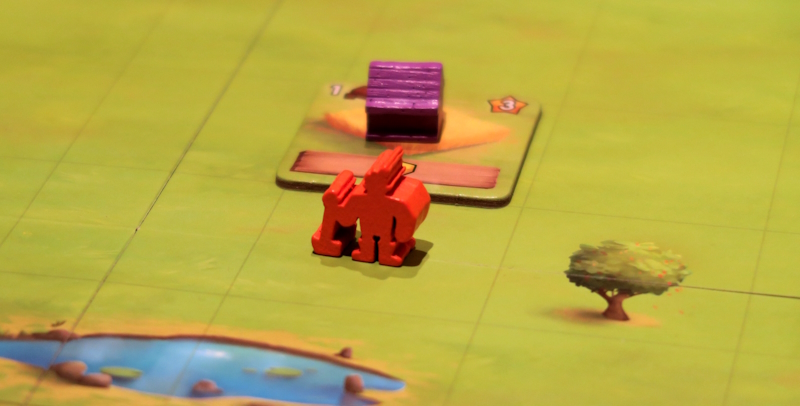
Little Town
– Image by boardGOATS

Eventually though, all three managed to complete all their Objectives.  Pine misunderstood the fact that each Worker needs to be fed at the end of every round, rather than just at the end of the game.  As it was a genuine error, rather than cripple his game at the end of the first round, Blue and Ivory let him pay with other resources leaving his unfortunate workers to gnaw on bits of stone, wood and coins.  Other than that, the game proceeded according to the rules.  Ivory majored on trying to convert Fish into points, while Blue tried to do the same with Wheat and Pine played the merchant, building the Gold mine and the Shop.
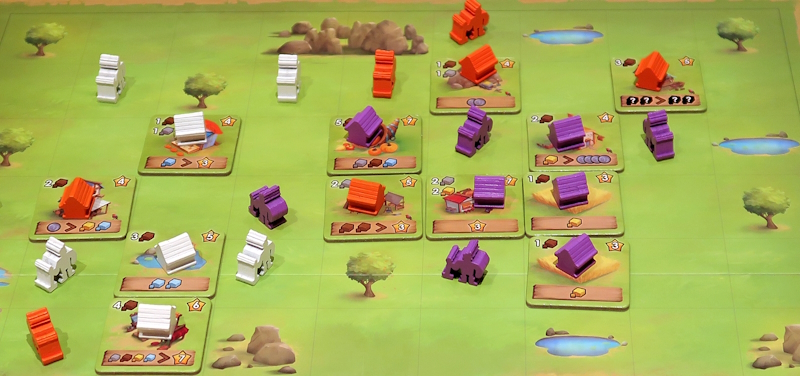
Little Town
– Image by boardGOATS

As the game came to a close, Ivory had a substantial lead with forty-two, ahead of Blue in second with thirty and Pine with eighteen.  This was without any of the points from the buildings (which Blue had a lot of) or from leftover money (of which Pine had an enormous pile).  As it turned out, money is not worth much at the end of the game, and although Blue’s buildings were worth considerably more than Ivory’s, she still fell two points short of his final total of fifty-seven.  So although we’ve still not been able to use the “sixty point tokens” we were only a handful of points shy.
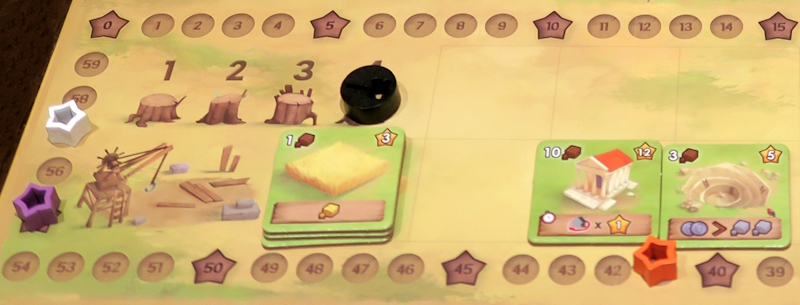
Little Town
– Image by boardGOATS

The others were still playing, so after some discussion, Blue, Pine and Ivory decided to give the 2022 Spiel des Jahres nominee, SCOUT, an outing.  This is a clever little card game with two key features: firstly, as in Bohnanza, players can’t rearrange their hands, and secondly, the cards have different values depending which way up they are.  Like Tichu or Haggis, SCOUT is a climbing game, that is to say, on each turn players are aiming to beat the previous score.  In SCOUT, that means players have to play a higher value or larger meld, or a longer run or one of a higher value (and a meld of the same size always beats a run).

SCOUT
– Image by boardGOATS

These cards are played from hand, but have to be consecutive.  In the event that a player can’t or doesn’t want to play cards from their hand (aka “Showing”), they may instead take a card from either end of the current winning set and add it to their hand anywhere, and either way up (aka “Scouting”).  Additionally, once per round, players can “Scout and Show” which is take a card and then also play cards.  The round ends when either nobody in the round has been able to Show or a player plays their last card and has nothing left in hand. At the end of the round, players lose a point for every card they have left, and this is taken from the total from their scoring cards and points earned when others Scout from their display.
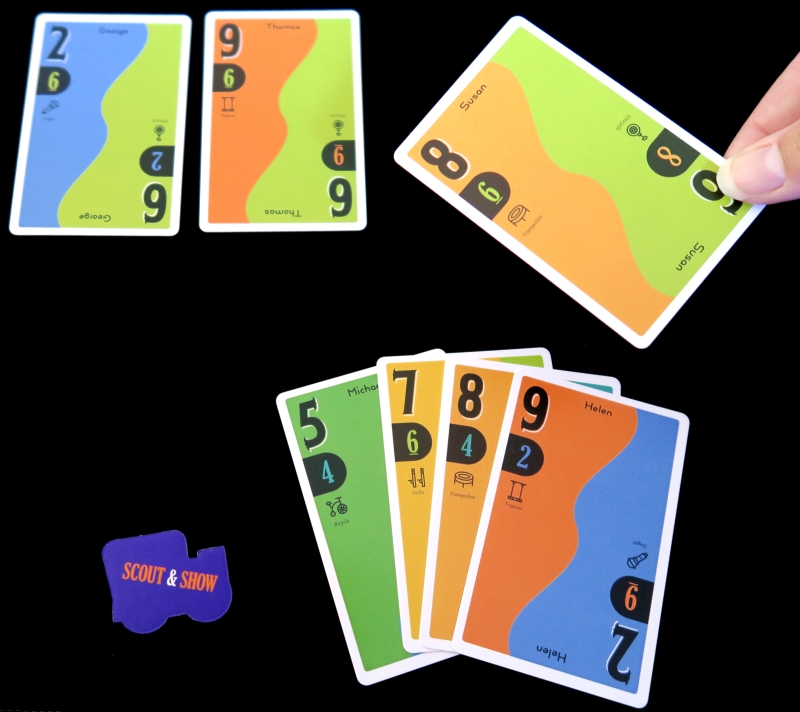
SCOUT
– Image by boardGOATS

With three players, there were three rounds, the first of which was finished by Pine, though Ivory nearly managed to check out, leaving Blue with a large handful.  The second round was much closer with Blue playing a nine-card run (though as cards in front of players at the end don’t score, and very quickly nobody could beat it, she didn’t get the advantage she felt she deserved).  The final round was taken by Pine again, but it was also close again.  The total favoured Pine, who finished with a total of twenty-six, a clear victory with Blue just pipping Ivory to second place by a single point.

SCOUT
– Image by boardGOATS

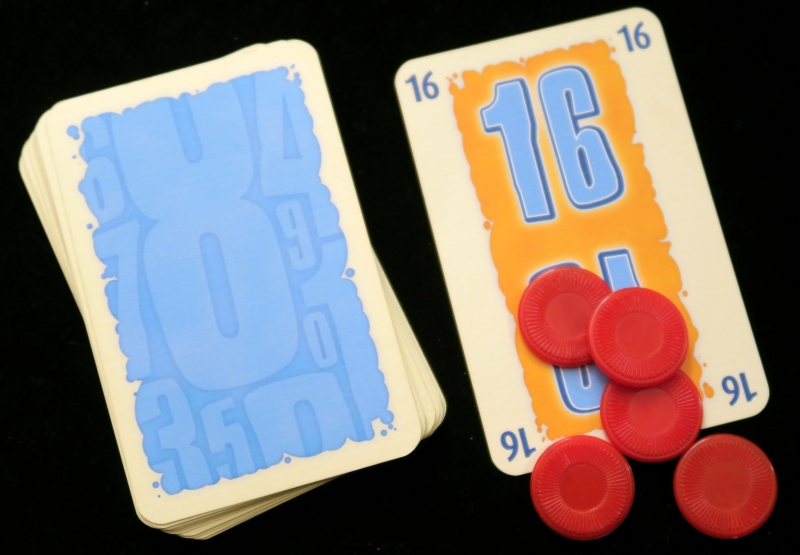
Forest Shuffle and SCOUT were both still going when the Courtisans finished, so they quickly set about playing a light filler that Jade had picked up from the Hachette UK stand that he had worked on at UKGELine-it, is another card game, played with a deck that consists of cards in four colors, numbered one to a hundred and six “Bet” cards (numbered three to five), which are shuffled together and laid out to create a market consisting of slightly more cards than there are players.  Players then take it in turns to take a card and either add it to their hand or add it to the row of cards in front of them (their Line).  There is a hand limit of two and the row must continue either increasing or decreasing.

Line-it
– Image by boardGOATS

If a player can’t add the card to their hand or their Line (because it would break the ascending/descending pattern), they have to score their Line, then play that card to start a new Line.  After drafting a card, players may choose to add one card from their hand to their Line and then score it. When scoring, if there is a Bet card in the Line, if there are more cards added since the Bet card than the value depicted on the Bet card, players get chips equal to the value of the Bet.  If the Bet is lost, the player takes negative points instead. Finally, three cards are discarded from the Line and the others turned over and placed in the player’s scoring pile.
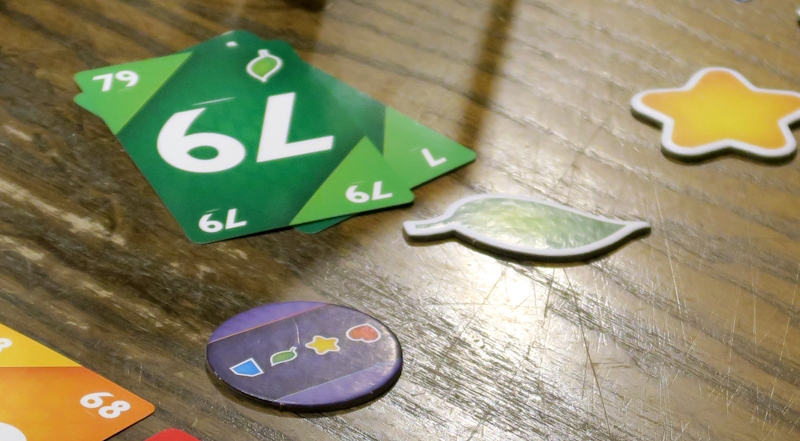
Line-it
– Image by boardGOATS

Once each player has had a turn, all remaining Bet cards are discarded, and the other cards are placed under the Jackpot token that corresponds to their colour—these can be claimed whenever a player adds the third card of the respective color to their Line.  The game ends when the draw deck depleted, and each player plays one last card from their hand, then scores their line and tallies their points, the player with the most points is the winner.  As he had won the second game of Courtisans, Black went first.
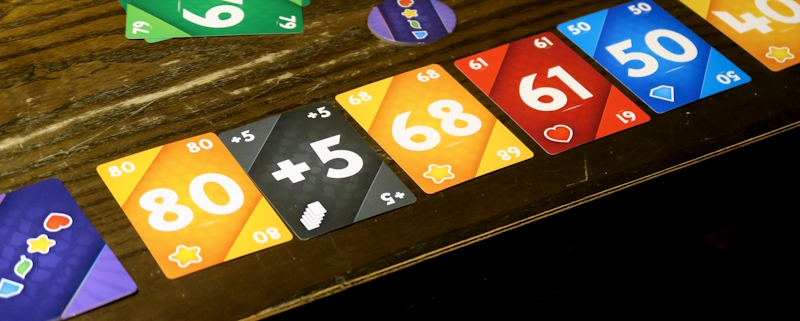
Line-it
– Image by boardGOATS

Black and Purple both took (and completed) Bet cards early in the game, whereas Jade didn’t even take because his Lines weren’t right when the Bet cards were available because just didn’t make sense.  Purple won the first jackpot of the game which was a tidy little stack of blue Diamond cards and Sapphire also picked up Jackpot cards later in the game.  The game plays quite quickly and smoothly and this time out, it was close, well, close between Black, Jade and Purple—Sapphire was streets ahead, finishing with twenty-six points, a long way clear of Black in second with fifteen.
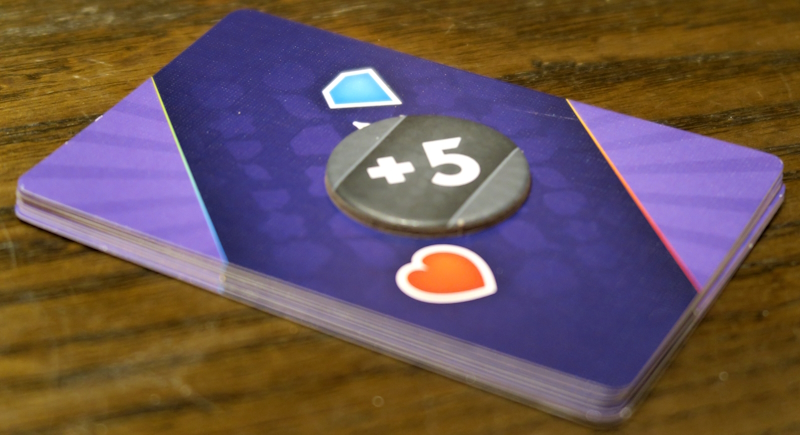
Line-it
– Image by boardGOATS

Learning Outcome: UK Games Expo is a good source of new games.

Jogo do Ana Nominations 2024

Although the Jogo do Ano, the Portuguese Game of the Year Award is less well known than its German counterpart, the Spiel des Jahres, it is perhaps more relevant to experienced gamers as it recognises heavier games, or “gamers’ games”.  Starting in 2006, it is chosen by members of Spiel Portugal with each choosing ten games of their choice. The five nominees of the year are then played again and are evaluated according to defined parameters, namely: production (15%); theme (10%); mechanics (10%); replayability (10%); interaction (5%); time/fun (50%).

Spiel Portugal Logo
– Image from spielportugal.org

Previous winners include Barrage, Root, Lisboa, Great Western Trail, Mombasa, La Granja, Keyflower, Agricola and Brass.  Last year the winner was Carnegie, a game inspired by the life of  nineteenth century Scottish-American benefactor and philanthropist Andrew Carnegie.  This year, the nominees are:

The winner will be announced in October.

Jogo do Ano Logo
– Image from spielportugal.org

Boardgames in the News: When is a Meeple not a Meeple?

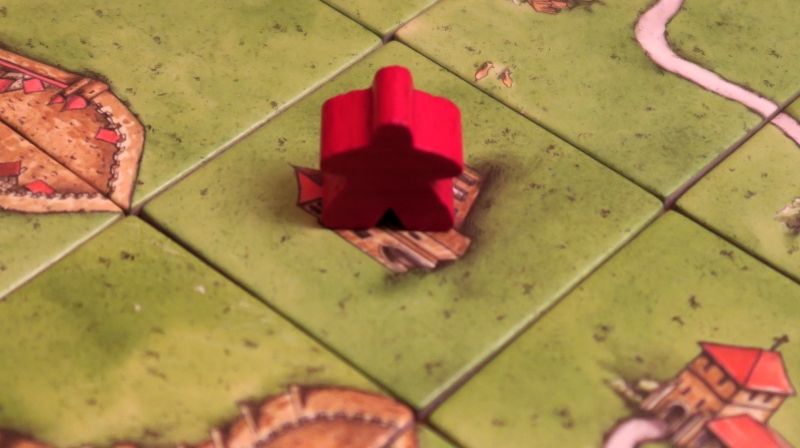
Answer:  When it’s not a Hans im Glück Meeple, apparently.  The term Meeple was allegedly coined nearly quarter of a century ago by Alison Hansel while paying the tile laying game, Carcassonne.  It was a conjunction of “my” and “people” and was used to refer to the characteristic wooden people-shaped pieces.  Since then it has been modified and the suffix “-eeple” has now come to mean game token (usually one that is wooden and shaped).

Carcassonne
– Image by boardGOATS

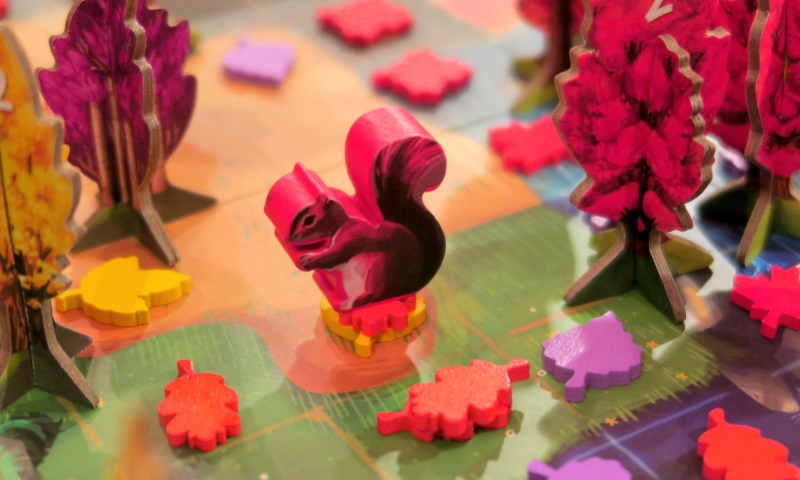
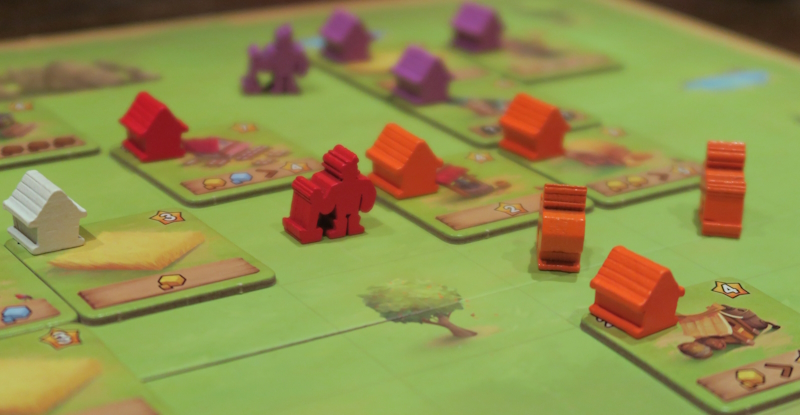
In this way, The term “Meeple” is now used to refer to all sorts of other wooden game pieces.  This includes the sheep, pigs and cows in Agricola or Keyper, which are often collectively referred to as “animeeples”; wheat and vegetable resource tokens which are commonly called “vegimeeples” (or even “vegeeples”), and players of Ice Flow or Salmon Run might talk about “fish-eeples” while those with Bosk might move their “squirreeple”.  As such, one might well be forgiven for thinking that the term Meeple is open source and can be used freely.

Bosk
– Image by boardGOATS

So Cotswold Games (formerly Cogito Ergo Meeple) might be forgiven for thinking the same when they crowdfunded their game, Meeple Inc..  That was until they received a “cease and desist” request from “a company” asking them “to remove all references to ‘meeples’ from the game as they have registered the word (and the shape) as an intellectual property in the EU.”  As a result, the a worker placement game where players compete to build the greatest board games in the world has been renamed Tabletop Inc. and now features “Mumans”.

– Image by boardGOATS

Whether this was necessary and whether Hans im Glück actually have the right to do this would need to be tested in court, but given the nature of the creation ans widespread use of the word “Meeple”, it is questionable.  Further, they only claim it as Intellectual Property in the EU—what about the rest of the world?  This point has exercised Corey Thompson (co-owner of YouTube channel Above Board TV and co-host of the industry-focused Board Games Insider podcast) and Marian McBrine (Gen Con Event Manager), who have responded by applying for the trademark in the US.

– Image by boardGOATS

Although they intend to protect the US trademark from predatory action (should they be successful in their application), Corey Thompson and Marian McBrine also plan to make it available to anyone who wishes to use it.  In the long term, this may prove unnecessary.  The trademark eventually issued in the EU in 2019 was for a range of of products (including software, jewellery, books, tableware and sporting goods), but not for toys and games.  This was limit followed an objection from board game publisher CMON, who argued (with considerable evidence) that the word was already in widespread use for general board game playing pieces.

Glen More
– Image by boardGOATS

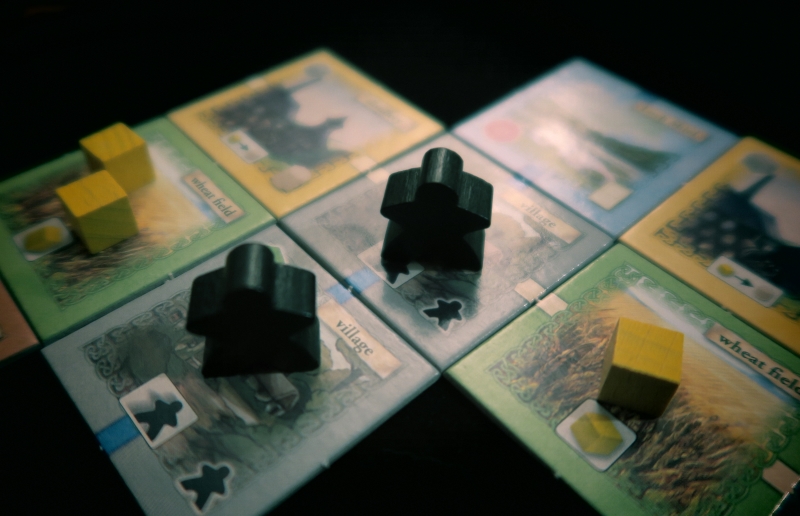
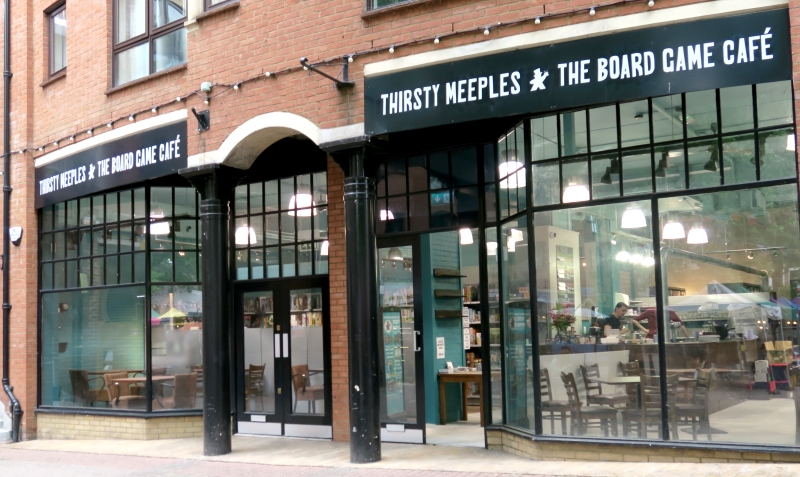
This objection was partially accepted by the EU Intellectual Property Office, but Hans im Glück has since registered “Meeple” as a trademark in Germany covering toys and games.  It was under this and the EU trademark covering the shape of the “original” Meeple figure that they issued the “Cease and Desist” to the folks at Cotswold Games/Cogito Ergo Meeple.  Although they are the first to publicly declare that they have received notification from lawyers, there are a huge number of well known games that could be affected (including Meeple Circus, A Fistful of Meeples, Meeple War, Meeple Quest and Rampage (aka Terror in Meeple City)), but also Oxford’s own board game café, Thirsty Meeples.

Thirsty Meeples
– Image by boardGOATS

There has been considerable community backlash though, so maybe Hans im Glück will adopt a gentler approach going forward.  At some point, however, it is likely that someone will test this in court and, in the meantime, there is a lot of ill-feeling which may lead to a loss of custom.

Goats in the News: The Unexpected Popularity of a Free Goat

Everyone loves a goat, but it seems everyone loves a free goat even more!  As recently reported, a recent census on the tiny five-square kilometre island in Sicily’s Aeolian archipelago, Alicudi, found the human inhabitants were outnumbered by their caprine friends by more than  six-to-one.  So, the island’s mayor, Riccardo Gullo, initiated an “Adopt a Goat” initiative encouraging people to express an interest in providing a goat a new home.  However, the mayor was inundated with offers that exceeded the number of goats available by around three to one.  Now all he has to do is find a way to catch them and transport them to their new homes…

– Image by boardGOATS

Spiel des Jahres Nominations 2024

The 2024 nominations for the three Spiel des Jahres categories have just been announced.  Although there are now other awards, this is arguably still the most prestigious award in board gaming and, certainly the one that carries the most weight when it comes to casual gamers.  There are three categories, the Kinderspiel (children’s game) , the Kennerspiel (“expert’s” game) and the most desirable of all, the family award, the Spiel des Jahres.  The nominees for this year’s awards have been announced as:

In recent years, there has been a shift to light or innovative games.  Although the complexity of this year’s offering is not in the same league as some of the 1990s winners (e.g. El Grande, Tikal and The Settlers of Catan, all of which won the “Red Pöppel” as they preceded the inception of the Kennerspiel award), there is a marked shift away from the novel, internet or app based games of MicroMacro: Crime City (from 2021) and Detective: A Modern Crime Board Game (from 2019) and the party games like Just One (from 2019), Pictures (from 2020), Top Ten (from 2022) and Challengers! and Fun Facts (both from 2023).

Forest Shuffle
– Image by boardGOATS

In addition to the nominees, there are a number of recommended, including Harmonies and Forest Shuffle (aka Mischwald) both of which have peaked interest in the group, with the latter having been enjoyed on a Tuesday evening shortly after its release at Essen.  As always, the Deutscher Spielepreis is likely to be a better fit for more dedicated gamers, but we will no-doubt play many more of the nominations and recommendations over the coming weeks.  The Spiel des Jahres Awards are still the industry’s headline award and therefore are of great significance; it will be interesting to see what the winners are when they are announced on Sunday 21st July in Berlin.

The Spiel des Jahres Awards
– Image from spiel-des-jahres.de

Next Meeting, 11th June 2024

Our next meeting will be on Tuesday 11th June 2024.  As usual, we will start playing shorter games from 7.30pm as people arrive, until 8pm when we will start something a little longer.  The pub is doing food, and the table is booked from 6.30pm for those that would like to eat first.

This week, the “Feature Game” will be Courtisans (review, rules, “How to Play” video).  This is a tableau-building and set-collecting game where players are attending the Queen’s banquet and trying to raise the status of their family.

– Image by BGG contributor The Innocent

And speaking of courtesans…

Jeff was vising a “lady of the night”. As he sat on the bed, he realised he only had £5 on him, so he asked the lady, “What will £5 get me?”

“Well, let’s see… I suppose I can give you a penguin job?” she replied.  Jeff was delightedly agreed and the call girl unzipped his trousers went to work.

“Oh wow, this is fantastic!” breathed Jeff, clearly enjoying himself.  Before long, as the end was approaching the courtesan suddenly stopped, got to her feet, and walked towards the door.

“Wait, wait, wait! Where are you going?” asked Jeff, and trousers still around his ankles, he waddled after the lady as fast as he could.

“Well, that’s a penguin job, and that’s why it’s worth £5!” she said, with a laugh.

28th May 2024

When Blue, Pink and Cobalt arrived for food, the pub was really busy and they struggled to find a table, ending up in the Bar.  Their food had arrived by the time the others started to turn up, and although there was another free table by this time, it wasn’t conducive to playing games.  Green, who we’d been missing in recent weeks arrived with Lilac for the first time in absolutely ages so there was a lot of catching up to do.  It wasn’t long before more tables began to clear, and the group managed to find several together in the restaurant area, and once the feeders had bolted the remains of their supper they joined the group and everyone began to decide what they’d play.

Little Town
– Image by boardGOATS

First up was the “Feature Game“, Little Town, a resource management, worker placement and tile placement game where players take on the role of architects guiding teams building a small town.  There were two games of this—one with Blue, Pink and Teal, and the other with Black Purple and Lime.  It is quite a simple little game:  players start with a set number of Workers (four in the three-player game) and building Markers (six for three players).  On their turn, they can place a Worker in an empty space on the central player board/map, or spend resources and build a Construction, placing a Marker on it.

Little Town
– Image by boardGOATS

When they place a Worker, the player activates the eight spaces surrounding it.  These can include Woodland, Mountain, or Lake to get Wood, Rock or Fish.  Wood and Rock are useful to build, while Fish is important for players to feed their Workers at the end of the round (one Fish or Wheat per Worker, every round).  Players can also activate Constructions, their own for free, and another player’s by paying them one Coin.  There are twelve Buildings and five Wheat fields available for construction at the start of the game—once they are built, they are not replaced.

Little Town
– Image by boardGOATS

There are twenty-nine buildings in the base game which can be drawn at random, but this time, both groups used the basic set (marked with a robin).  This meant that some of the Objective cards which are Building dependent could not be used, so in the end, only the cards that didn’t require specific Buildings were used.  The Objectives therefore included things like “Gather at least five resources in the same turn” or “Have more Buildings than Workers”—these are scored during the game.  Buildings come in two types:  Those that give Resources when activated, and those that can be used to convert Resources into other Resources, Coins or Points.  The game lasts four rounds, after which players score for each of their Buildings and one point for any three unused Coins.

Little Town
– Image by boardGOATS

Once the rules had been outlined, both groups started playing.  Before they’d got more than a turn in, however, Cobalt commented that he was surprised that Blue hadn’t got metal coins to go with the game, at which point, Blue produced her utility set and both groups swiftly made the substitution.  Unfortunately, these new coins were a little slippery leading to a couple of rounds of “Hunt the Game Piece”.  Little Town is a really good little game though, accessible, but with meaningful decisions and one that doesn’t outstay its welcome.  Despite starting with essentially the same setup, the two games, progressed quite differently.

Little Town
– Image by boardGOATS

Pink and Blue built Points engines converting Coins and Wheat respectively, while Cobalt converted a Coin into Wheat and Fish, then and Wheat into lots of Coins.  On the neighbouring table, however, the Coin to Wheat and Wheat to Coins buildings were owned by different people, Black and Lime respectively while Purple was busy converting Wood into Points.  Both games were quite tight, with Lime’s forty-two beating Black into second place by just two points.  The other game was even tighter though.  Pink rolled back his final move following a suggestion by Blue to pick up an extra point, but she would have done better to keep her mouth shut as that extra point meant he tied for the lead with Blue on fifty-five.

Little Town
– Image by boardGOATS

It was as players were discussing the game and starting to pack away that Pink spotted a way of getting another extra point, but this was deemed too late and the game was deemed a tie.  Packing away, there was some confusion as the manifest indicated there should be twenty-nine Objective cards, whereas Blue’s copy had thirty.  Despite several recounts (and confirmation that there weren’t any in the Goodie Buildings mini expansion), the issue couldn’t be solved, and the group came to the conclusion that one more than expected was better than one less…

Little Town
– Image by boardGOATS

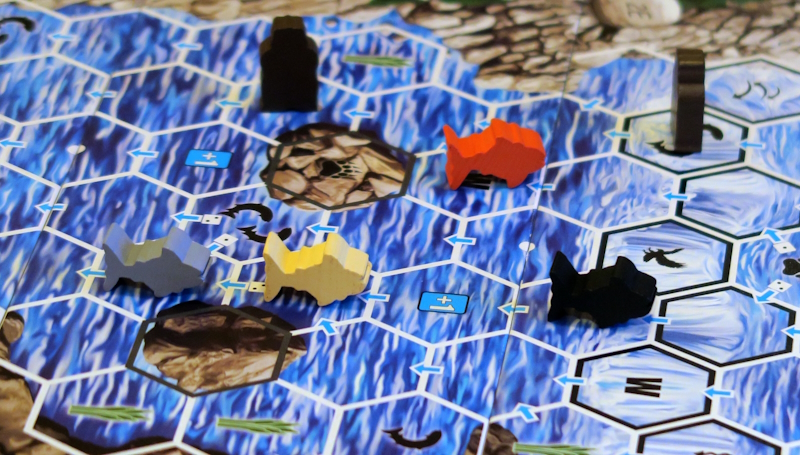
Meanwhile, on the next table Teal was leading a game of Salmon Run with Green, Pine and Lilac.  This is a game that was played quite a few times in the group some years ago when it was first released, but the last time it got an outing was in 2015—nearly ten years ago.  Teal had decided that his copy had been sitting on the shelf unplayed and unloved for too long and it was time for it to move on.  It got a stay of execution though, and as a result, it got a Tuesday night outing.  A fast paced, deck-building, race game, Salmon Run is a sort of cross between Dominion and Flamme Rouge.  Although the game is not particularly complex, the first game was a learning game.

Salmon Run
– Image by boardGOATS

The idea is players are Salmon, racing to be first to get to the Spawning Pool.  The board is modular and therefore the River can be changed to give variety and replayability.  Players start with a deck of cards containing three Swim Forward, three Swim Right, three Swim Left, one Wild and one Bear and draw four of these.  On their turn, players can play up to three cards, however, playing three means they will draw a Fatigue card.  These will ultimately reduce players’ choice and slow their Salmon down, so mostly players stick to playing two, replenishing their hand to four cards at the end of their turn.

Salmon Run
– Image by boardGOATS

Depending on the modules used, the River includes obstacles like Rocks, Currents and Rapids, as well as special spaces which allow players to pick up special cards (that can be used to counter Currents, Rapids and Eagles) to add to their Swim deck.  Teal began by moving a Bear onto the space with Pine’s Salmon, giving him a Fatigue card.  Then, much to Pine’s annoyance, Lilac and then Green did the same before fianally Lilac did it again.  Pine was very unimpressed—for one who loves wildlife, he really wasn’t happy about repeated visits from all those bears!

Salmon Run
– Image by boardGOATS

Green I played a Rapids card and there was some discussion where the card should be discarded to, but in the end there was no catching Teal, who was first to the Spawning Pool, and was some four spaces ahead Lilac, his closest challenger.  As Little Town was still going on both tables, the group decided to play a second time now they knew how to play as they thought they’d be quicker (which they were). The River was a changed a little to make it a bit more challenging and then the Salmon began their second run.  This time, Pine, Teal and Lilac went one way round the rapids, while Green went the other.

Salmon Run
– Image by boardGOATS

This time the bear was moved away from players by Teal so nobody got caught. As the River took a bend to the right, Green ended up with only Swim Left cards so had to just discard and bang his salmonny head against the rocks, falling behind. Teal and Pine had both picked up a lot of Fatigue cards, but they both got to the Spawning Pool.  As Pine had one less though, he was the winner of the second game.  It had been a lot of fun (despite the Bear attacks, and the headaches from banging against the rocky bank), so maybe the stay of execution deserves to be extended a while longer.

Salmon Run
– Image by boardGOATS

With both games finished and the late start, there wasn’t time for something long, so as is often the case in such circumstances, instead of lots of discussion, the group decided to play the old favourite, 6 Nimmt!.  With ten, the group decided to play the game over one round, which meant everyone started with ten cards, a lot more than usual.  This didn’t seem to improve the quality, however, a sentiment that was epitomised by one comment, “These are all bad with a capital F…”  The first few rounds were a little slower than usual as everyone had more cards to choose from than usual.

6 Nimmt!
– Image by boardGOATS

Once everyone had chosen their card, they were simultaneously revealed and added to the end of the appropriate row, with players picking up cards when theirs was the sixth card to be added.  Nobody managed to avoid picking up cards, but unusually, the scores were all quite close—so close that the winners, Green and Blue, tied with nine, while Pink took third place with eleven and Cobalt top-scored with twenty-three.  One game is rarely enough when it comes to 6 Nimmt!, and everyone was keen for another mad ten-player game.  This time the scores were more diverse: Lilac succeeded in avoiding the chaos and won with a clear round, while Teal added thirty-six to his first round twenty two to finish with the most points overall (Cobalt only took seventeen in the second game).

6 Nimmt!
– Image by boardGOATS

Blue took second place in the second game with five (giving her the best combined game total of fourteen), while Pine came in third with ten points.  Green was the most consistent with nine and eleven, but Lilac claimed the nearest to a “Mike Game” with one exceptional round and one awful one, though her bad wasn’t as bad as his usually were.  Everyone was just packing up when the evening came to a smashing end as the wine glass that Lime had carefully put safely to one side bit the dust.  Oh well, less washing up…

6 Nimmt!
– Image by boardGOATS

Learning Outcome:  Little Towns can give quite big games.

UK Games Expo 2024

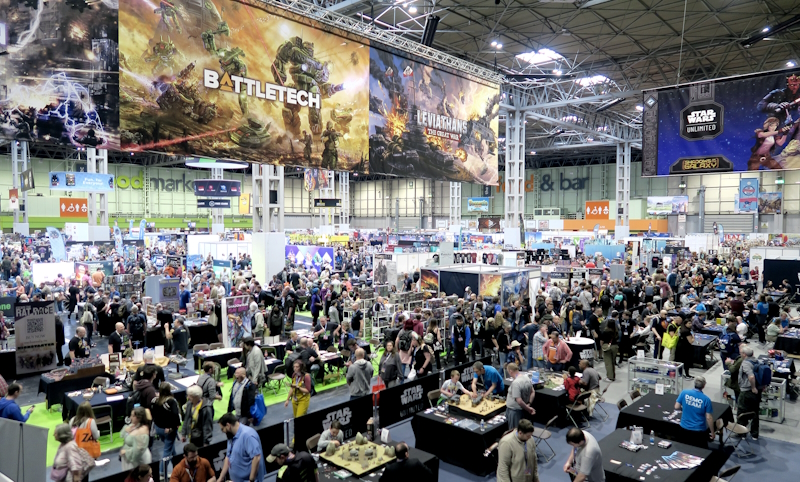
Today is the final day of the seventeenth UK Games Expo at the NEC in Birmingham, which is bigger and better than ever this year.  Arriving from Resort World, visitors are greeted by Vikings and Romans, and a family of geese living next to the lake.  Spread over three large halls, there are nearly six hundred exhibitors and a vast amount of table space for open gaming (both in the halls and at the nearby Hilton) and organised play-testing.

UKGE 2024
– Image by boardGOATS

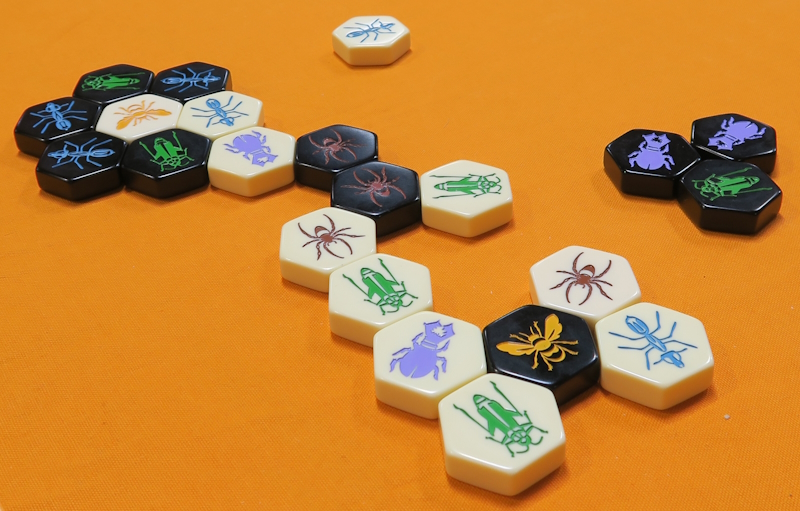
Most games companies have a stand at UKGE, some with sales, some just demoing and many with both.  Exhibitors include Czech Games Edition, Oink Games, Hachette, Birdwood Games, Zeogenesis, and Asmodee (including demos of games from their distribution network like Bezier Games and Stonemaier Games).  Unusually, Waterstones have a large stall with a wide range of modern board and card games, including recent releases.  This suggests that they are keen to expand their position in the market, which can only be a good thing.

UKGE 2024
Rafter Five
Hive
– Images by boardGOATS

Board and card games are not the only things on display at UKGE, however.  In addition, there are also lots of stands selling scenery for miniature games and props for role and cosplay.  Accessories for general gaming feature as well, with dice, game storage inserts furniture.  One of the largest of these was and Geeknson who sell gaming tables, where one of the main attractions includes a giant’s dice tower.

UKGE 2024
– Image by boardGOATS

This year, lots of the regular and occasional boardGOATS made the trip to the NEC in Birmingham and it really felt like home-from-home.  Some visited just for the day while others helped on stands (Hachette and Zeogenesis) or at the Play Testing.  The event is so vast now though that you can no-longer guarantee accidentally bumping into people you know, but SMS is a great way to communicate onsite.

Parachute Panda
– Image by boardGOATS

The general consensus is that this year, although the feel is more like that of SPIEL (Essen), there aren’t the high profile, large-game new releases that there have been in previous years, instead, there seemed to be more expansions re-releases.  There are still a lot of exciting smaller new games to be had though and the event is great fun and well worth a visit.  UK Games Expo continues at the NEC in Birmingham until 4pm Sunday 2nd June.

UKGE 2024
– Image by boardGOATS

Next Meeting, 28th May 2024

Our next meeting will be on Tuesday 28th May 2024.  As usual, we will start playing shorter games from 7.30pm as people arrive, until 8pm when we will start something a little longer.  The pub is doing food, and the table is booked from 6.30pm for those that would like to eat first.

This week, the “Feature Game” will be Little Town (review, rules, “How to Play” video).  This is a resource management, worker placement and tile placement game where players take on the role of architects guiding teams building a small town.

Little Town
– Image by boardGOATS

And speaking of architects…

Jeff was flying in a hot air balloon and realized he was lost. He spotted a man below so lowered the balloon and shouted, “Excuse me, can you tell me where I am? I promised a friend I would be back in a half hour!”

The man below replied, “Yes, you’re in a hot air balloon, hovering 30 feet above a wheat field at 45 degrees latitude and 123 degrees longitude.”

“You must be an architect,” said Jeff.

“I am,” answered the man. “How did you know?”

“Well,” said Jeff, “Everything you have told me is technically correct, but it’s of no use to anyone.”

The man below said, “You must be a contractor.”

“I am,” replied Jeff, “But how did you know?”

“Well,” said the man, “You are totally lost, have no idea how to proceed, made a promise you cannot keep, but you expect me to be able to help. I answered your question in detail, but you’re still lost, and now it’s my fault!”

14th May 2024

Pine was already sitting outside marking his birthday, when Blue and and Pink rocked up and ordered their tea.  Jade and Sapphire soon joined the group, ferried by newcomer, Tangerine who not only brought gamers, but also his shiny new copy of the “Feature Game“, Faraway, which he had won at Gweeplefest a few days earlier.  This game is has been a bit of a hidden gem whose popularity is rapidly gaining traction as more people play it.  It is quite a simple game, but one which really messes with the head.  Some of the group played it a few weeks back and it was so popular that it seemed a good idea to Feature it so more of the group could try it.

Faraway
– Image by boardGOATS

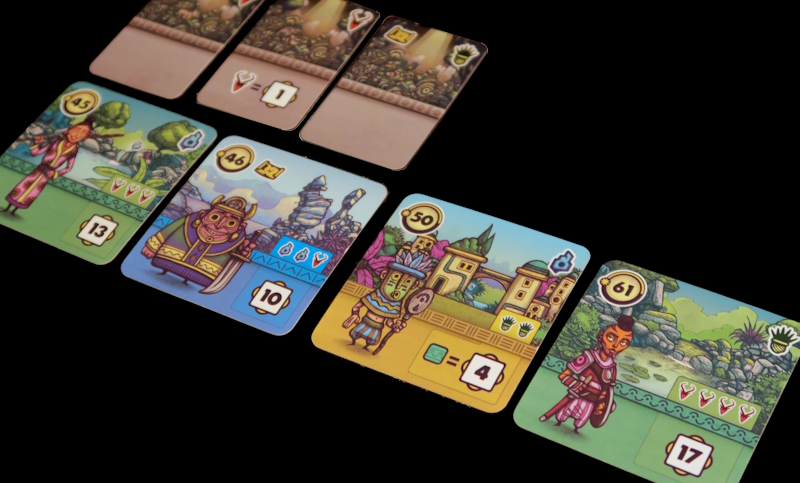
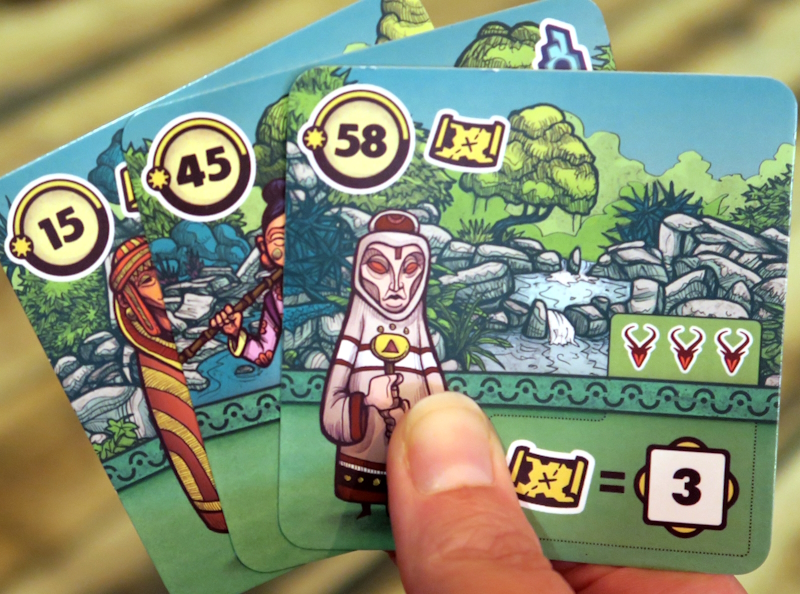
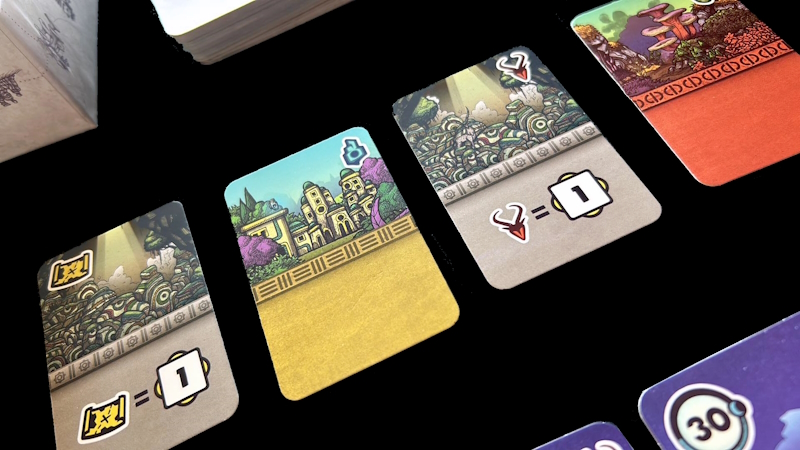
The story is that players are exploring the mysterious land of Alula in search of its secrets, meeting its inhabitants and listing its wonders in order to gain more fame than everyone else.  In practice, however, it is a fairly simple little card game with a market with a trick-taking type element.  Players simultaneously chose one of the numbered cards from their hand and starting with the the player that played the lowest card (similar to 6 Nimmt! or Kingdomino), everyone takes it in turns to choose one from the market to add to their hand.  Players then simultaneously choose another card, and again, choose one to add to their hand.  The game ends after everyone has played a total of eight cards, and then everyone scores.

Faraway
– Image by boardGOATS

There are a couple of very clever things about the game.  Firstly, if the card someone plays is numbered higher than their previous card, they take a card from the Sanctuary deck.  These cards a really important because of the second clever element, the scoring.  Each card has a number and a colour, while some also have resources and some have also have scoring conditions.  The scoring is clever because the cards are played left to right, but the scoring is from right to left—at first glance, this looks like it makes things easy, because early in the game players find out what they need to get points and can then focus on getting the resources they need as the game progresses.

Faraway
– Image by boardGOATS

However, the scoring is tensioned against the ability to get Sanctuary bonus cards. This is because the scoring cards are generally those that have a higher number and are therefore the ones players want to play first (following them with resource cards which generally have a lower face value).  To get a Sanctuary card though, players have to play a higher value card than the immediately preceding one, and Sanctuary cards are very useful because they are eligible for scoring regardless of when they are played.  Thus, trying to play cards increasing and decreasing in value to score the most points backwards really messes with players’ heads!

Faraway
– Image by boardGOATS

Tangerine, started one game and explained the rules to half the group, comprising Plum, Byzantium, Blue, Pink and Pine, while he ate his supper.  Meanwhile, Jade and Sapphire took their copy to a neighbouring table where they were joined by Teal, Black and Purple, and started a second game.  Although it is a very simple game, the backwards forwards up and down thing got to several of the group at various points, including Blue (who lost the ability to count), Teal (who did all his scoring forwards instead of backwards), Pine (who struggled with the how maps worked) and Purple (who couldn’t get her head round the reverse scoring).  Jade’s game was the first to finish, with Sapphire beating jade into second place by a single point and Black taking third.

Faraway
– Image by boardGOATS

There was a general appreciation of the art and the mechanism though the theme was a bit invisible.  There had been such confusion, however, that the group decided to “do a Lime” and play again.  This time, the finishing order was exactly the same, but the game wasn’t as close with Sapphire’s eighty-two being the highest score of the evening.  On the other table, Plum was the victor with seventy, followed by Tangerine and Byzantium in third.  This game had taken a little longer, and with six, there is a lot of downtime, so although everyone had enjoyed it, the group decided to split into two groups of three.  Blue tempted Plum and Sapphire to a game of Calico with cries of “Kittens!”, while Pink and Pine lured Tangerine into a game of Ticket to Ride: San Francisco.

Ticket to Ride: San Francisco
– Image by boardGOATS

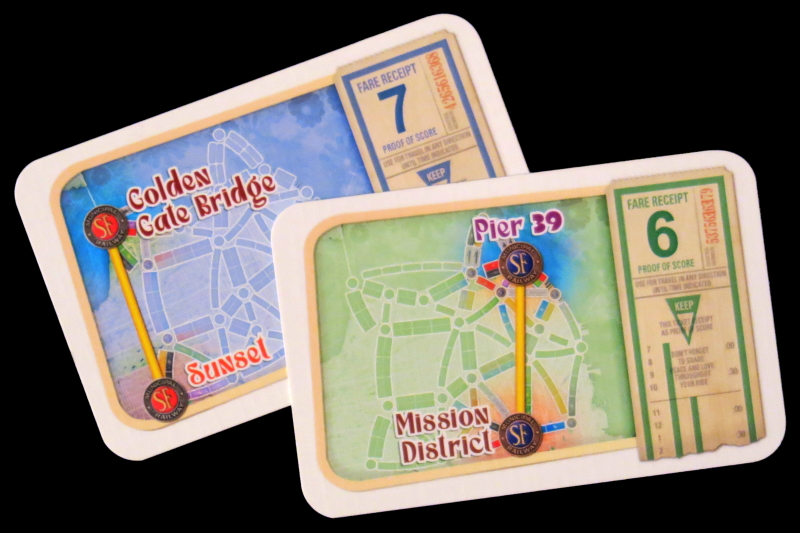
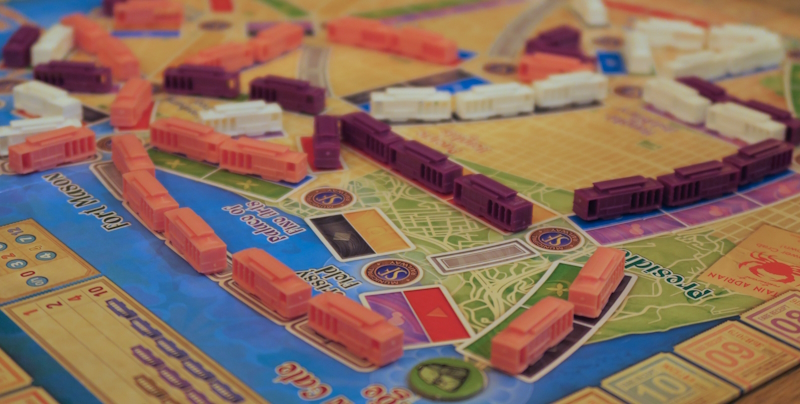
San Francisco is one of the smaller city versions of Ticket to Ride.  The game play is much the same as the original, but the maps are smaller, players have fewer pieces and they only play a maximum of four.  In all the games, players take it in turns to take coloured cards into their hand from the market, or play cards to place pieces on the board connecting locations to satisfy tickets and score points.  Each version of the game has its own specific unique rules, and this one is no exception with players collecting Souvenirs which give points at the end of the game.  Players collect these by building a route (in this case made of trolley cars rather than trains) to the cities where they are available.

Ticket to Ride: San Francisco
– Image by boardGOATS

Each player can only collect one of each Souvenir, but a full set of seven gives twelve points, which is a lot.  Tickets are also always key though.  This time, Pink escaped early from Alcatraz to Twin Peaks which gave him a high scoring eight points.  Unlike Pine (who always seems to draw routes he’s already completed), Tangerine was unlucky and and instead picked up some negative points late in the game.  It was very close between Pink and Pine though, but the Souvenirs made the difference and Pink (with five) just edged it, beating Pine (who only had two Souvenirs) by three points.

Ticket to Ride: San Francisco
– Image by boardGOATS

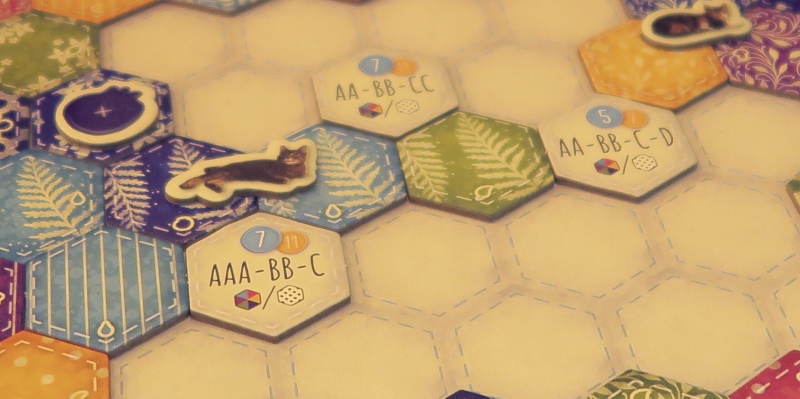
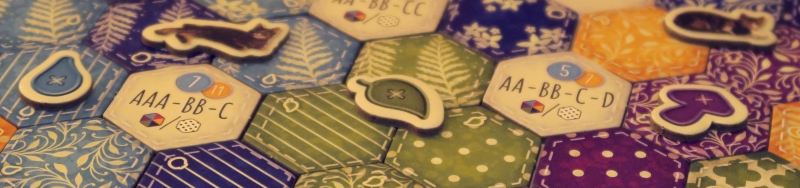
Meanwhile, the kitty-philes were playing the extremely frustrating game Calico, which is all about trying to entice cats to come and sleep on a patchwork quilt by making it with the patterns they like.  In this game, players take it in turns to place a coloured, patterned tile from their hand into their quilt board before taking a replacement from the market.  Everyone had played it before, but it had been a while, so the rules needed a bit of revision.  Each player starts with three tiles in a fixed location with scoring criteria for the neighbouring tiles—satisfying these for either colour or pattern gives points, with more points for for those that satisfy both (which is not easy).

Calico
– Image by boardGOATS

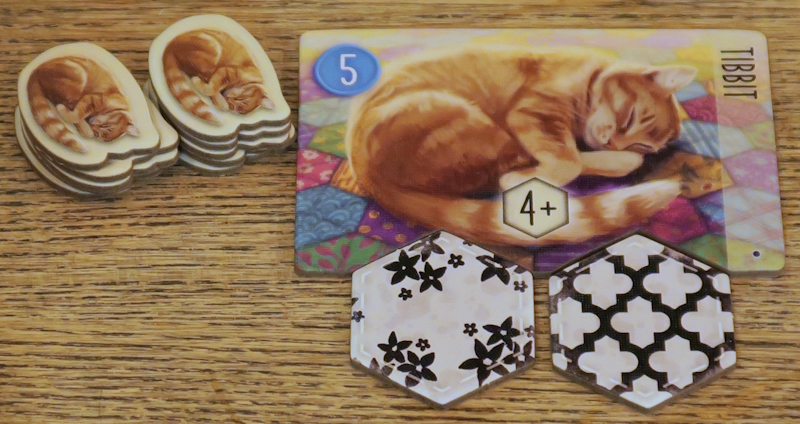
Players then also receive a coloured button for every group of three adjacent tiles of the same colour (with a bonus if they get all six possible colours).  Finally, there are the cats that give Calico its name.  This time the cats in question were Almond, Tibbit and Shop Cat (from the Kickstarter Promo).  Almond was attracted by a group of five tiles of one of the patters in a close packed predefined shape while Tibbit found a set of four tiles of one of the given patterns in any shape most appealing.  Shop Cat was lured to the player with the longest connected chain of tiles in one of the given patterns with the player with the second longest attracting a smaller cat (worth fewer points).

Calico
– Image by boardGOATS

This last one was the subject of some debate as Byzantium ended up with both the longest and second longest chain and it was unclear from the rules whether he would get both.  In the end he allowed the smaller Shop Cat to wander off, but fortunately it didn’t make any difference to the placings.  Almond looked by far the most challenging kitty to attract and initially it looked impossible without failing on the fixed starting challenges.  Plum thought she had made a mess of things, but Byzantium pointed out how Almond could be enticed  using some of the partial tiles around the border of her player board and she was the only one to ultimately have that particular kitty to cuddle.

Calico
– Image by boardGOATS

Blue started badly, and in this game, when that happens things usually only get worse, which they did.  Byzantium and Plum both picked up twenty-seven points for their buttons, but in both starting tiles and kitties, Byzantium had the edge (even without the second Shop Cat).  In the end his final score of sixty-one points gave him a significant margin of victory, by seven points.  Everyone agreed that Calico is a good game, but a very frustrating one when players can’t get the tiles they need.  So Byzantium echoed everyone’s feelings when he commented, “That was fun, but very frustrating—I’ll be ready to play it again in another eighteen months…”

Calico
– Image by boardGOATS

As Faraway and Ticket to Ride had both finished, Tangerine took Jade and Sapphire home and Teal also headed off.  That left Black, Purple, Pine and Pink to play a quick game of the old favourite, Coloretto.  This is a very simple set collecting game, that makes a great filler.  The idea is that players either take the top coloured chameleon card from the deck and place it on a cart, or take a card and add the cards to their collection.  Players score points for their largest three sets (up to six cards, worth twenty-one points), while everything else scores negatively.  The player with the most points is the winner.  Playing with the Jubiläumsausgabe edition, as usual, there was a discussion about what the Golden Joker does and how it differs from the normal Joker.

Coloretto
– Image by boardGOATS

In the end, Pink was the victor and, for the second game in a row, pushed Pine into second place, this time with Black just behind.  The evening looked to be ending there, when a couple of people from the bar came over and asked what we were doing.  That led to a fairly wide-ranging discussion about Monopoly, Cluedo and Mystery of the Abbey amongst other games.  The evening really did come to an end eventually, after Pink and Blue had dragged one of the interested parties into a quick game of No Thanks!.  Unfortunately, there was a misunderstanding and he top-scored with ninety-three, but hopefully he understood that some of the games we play are not that complicated.

No Thanks!
– Image by boardGOATS

Learning Outcome:  Playing forwards and backwards at the same time makes heads hurt.