Author Archives: nannyGOAT

23rd July 2024

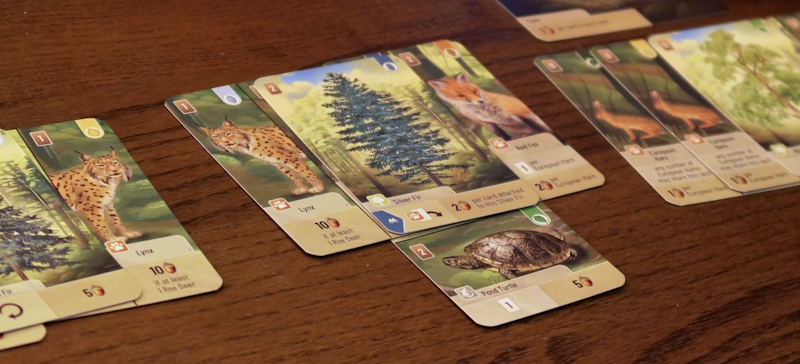
Blue and Pink were still eating when everyone else rolled in and seemed quite content to chat.  It took Blue two attempts to get the first game rolling, with Jade leading Cobalt, Crimson and Plum to the other side of the room.  Pink moved to join Pine who wanted to play his new acquisition with Black and Purple, which left Blue and Lime to lead Byzantium, Sapphire and Cyan in the “Feature Game“, the Alpine expansion for Forest Shuffle.  This is was chosen to mark the announcement of the Spiel des Jahres Awards, as Forest Shuffle, featured on the recommended list and has been popular with the group.
Forest Shuffle
– Image by boardGOATS

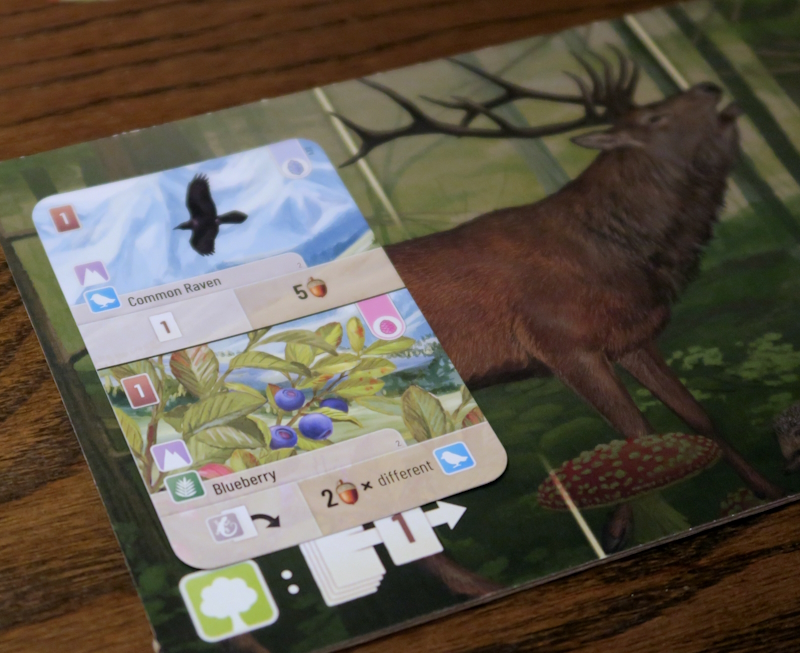
Blue made a bit of a meal of explaining the rules, but really they are very simple.  On their turn, players either take two cards from the market and add them to their hand (with a hand limit of ten), or play a card from their hand into their tableau.  There are three different types of cards.  Tree cards are the central cards around which Critter cards are played.  Then there is the first set of Critter cards which are divided into two, left and right with an animal on each half.  Finally, there are Critter cards which are divided into two, the canopy at the top and the undergrowth at the bottom.  The Critter cards are half-tucked under the Tree cards, so only one animal, flora or fauna is visible.

Forest Shuffle
– Image by boardGOATS

The difficult part of the game is getting the cards to work together efficiently to give extra actions and, ultimately, points.  The Alpine expansion doesn’t change the game significantly, just adding more variety to the cards, adding more opportunities for scoring.  For example, it adds an extra Butterfly which give players more points if they have a complete the set.  This time, Blue started with a hand full or Hares, making her initial strategy obvious.  Sapphire was less fortunate, so Blue and Lime suggested that starting with Trees was always a good way to go as players can’t do anything without them.  He also had some Butterflies, so that was where he went next.
Forest Shuffle: Alpine Expansion
– Image by boardGOATS

Lime built up a collection of Birds, and since he advertised his strategy to the group, everyone else was able to take cards he wanted.  This is a key part of the game:  some cards give points for the number of something you have, so having more of both multiplies the score.  For example, Hares give one point for every Hare a player has.  Thus, one Hare gives one point, but Blue’s seven Hares mean that first Hare scored seven points.  More to the point, every other Hare also scored seven points giving her forty-nine points just for her Hares.  Meanwhile, Byzantium was going Bats, and Cyan was experimenting with Deer.

Forest Shuffle: Alpine Expansion
– Image by boardGOATS

The game ends when the third Winter card is drawn from the deck, so after the second, everyone got very nervy as they tried to complete all their plans and play all the cards they wanted to.  Each time someone drew a card from the deck, it was with bated breath.  The final stage seemed to last forever, and although the third Winter card wasn’t the last card in the deck, it was close, and when it was drawn the game ended immediately. And then it was time for the scores:  everyone assumed that Blue’s husk of Hares would give her victory, but it was actually quite much closer than they thought.  Although Blue finished with a hundred and sixty-five, Byzantium was only twenty points behind.

Forest Shuffle: Alpine Expansion
– Image by boardGOATS

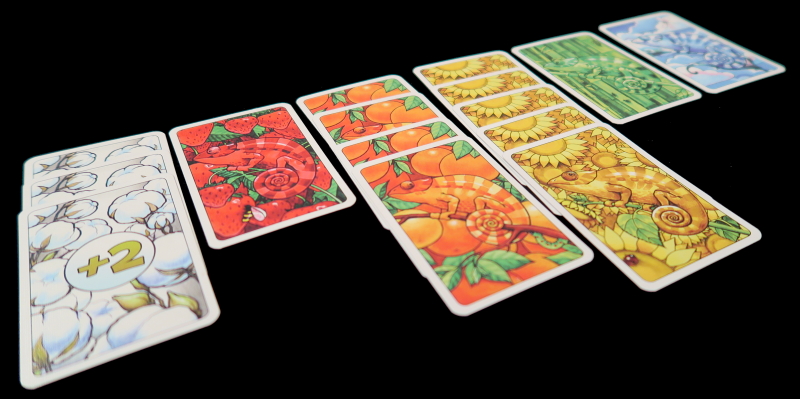
Byzantium was ready to leave, but for everyone else there was just time for something really quick.  So as everyone else was still playing, the remaining four decided on a quick game of Coloretto.  This is an old game, but one that was on the Spiel des Jahres Award “Recommended List” in 2003.  Remarkably, Cyan and Sapphire were new to it, but it is a super easy and quick game to play, but with tactical decisions to make.  It is also one that can essentially be taught as you go:  either turn over the top Chameleon card and add it to one of the Trucks, or take one Truck.  Each Truck can contain a maximum of three Chameleons and once everyone has taken a Truck, the round ends.

Coloretto
– Image by boardGOATS

At the end of the game, players score each group of coloured Chameleons, with the largest three groups giving positive points and any others scoring negatively.  There are a small number of cards that just give straight points and balancing these with Chameleons is part of the challenge.  The end is triggered when the end of game card is drawn and then the round is played to completion.  This time, everyone kept their negative scores down, while Cyan went for the pure point cards, collecting fourteen points, more than half his score, by that route.  The winner was Lime, however, who was imperious and won by some distance with a total of thirty-three.
Coloretto
– Image by boardGOATS

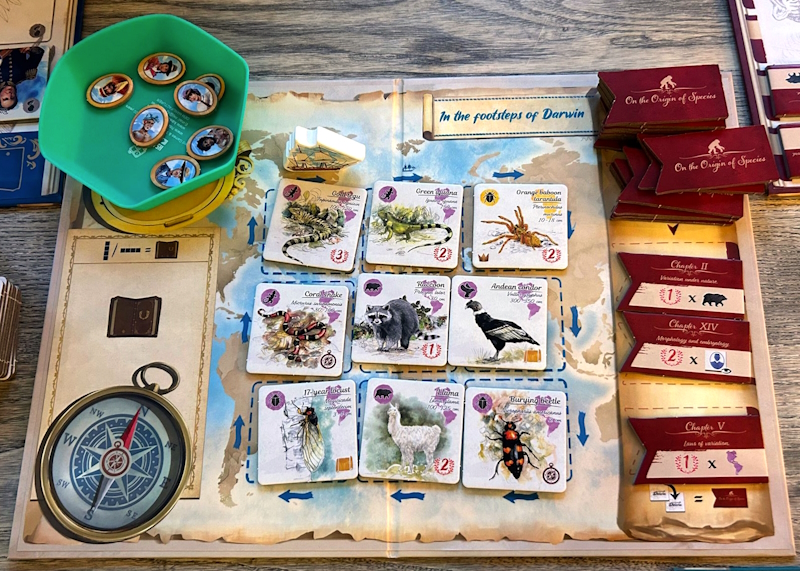
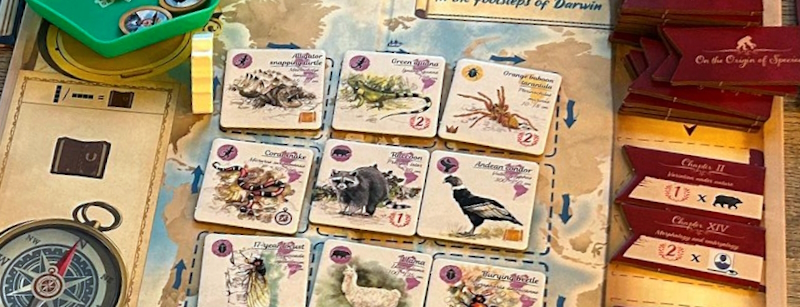
Meanwhile, on the next table Jade was teaching Cobalt, Crimson and Plum the Spiel des Jahres 2024 nominee, In the Footsteps of Darwin.  The premise of this is that players are naturalists aboard the Beagle helping Charles Darwin finish his book On the Origin of Species, studying animals, carrying out cartographic surveys, publishing their findings, and developing theories. On their turn, players study an animal or take inspiration from a character by choosing one of the three tiles in the row or column marked by the Beagle, and placing it onto their naturalist’s Notebook. This may be an animal to study or a character from the Beagle’s previous journey and will give an immediate bonus or a scoring bonuses.
In the Footsteps of Darwin
– Image by boardGOATS

After placing the tile, the Beagle is moved round the market, with the distance dependent on the tile chosen and a new tile is drawn to fill the empty space on the journey board.  At the end of the game, the player who contributed the most to On the Origin of Species wins.  At it’s heart, In the Footsteps of Darwin is a fairly simple set collection and “make the most of what’s available” game. Players obtain an additional scoring objective when they place a tile on top of a previous one, covering up any icons, so a key part of the game is the conflict between points being gained verses points being lost.

In the Footsteps of Darwin
– Image by boardGOATS

There’s also quite a bit of luck invoiced, as a player may need one or two specific tiles that don’t come out, or that get taken by someone else before they have the opportunity to do so.  The group found it was very quick to play, taking just forty minutes including teaching.  Plum’s  starting goal was points for tiles in the upper right quadrant, but in the absence of tiles that fitted that criteria she focused instead on collecting Charts and Compasses as these score points equal to the number of these multiplied together.
In the Footsteps of Darwin
– Image by boardGOATS

One advantage of these is that once a Compass has been collected, the tile can be covered without loosing any points. Cobalt didn’t worry about that at all, covering loads of tiles to get more Theories banners which give points.  Ultimately, everyone’s score was pretty similar at the end of the first game but Jade took victory as he was most effective with the Chart/Compass scoring.  As it was so quick, the group decided to give it a second try—this the scores all improved.  This time the victor was Crimson, who was again the most effective with the Charts/Compasses, but also scored well in other areas, as did Cobalt who came second again.

In the Footsteps of Darwin
– Image by boardGOATS

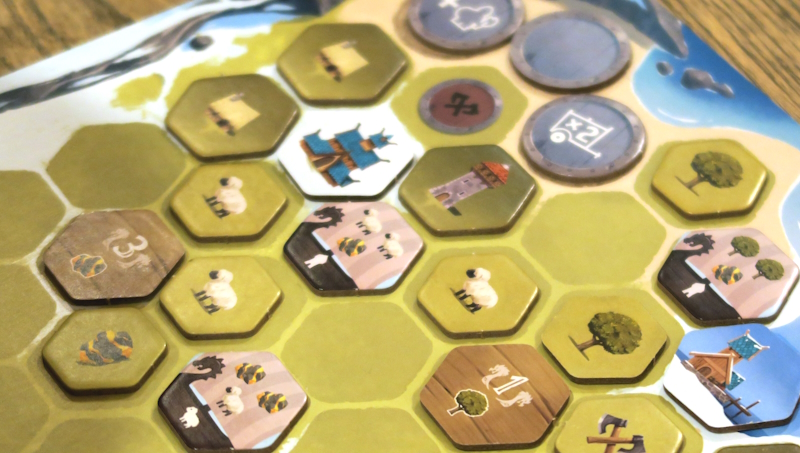
From there, the group moved on to a game of Looot, which is too recent a release to have been acknowledged in the Spiel des Jahres awards.  It has been popular amongst the members of the group that have played it so far, however, and may well get an award next year.  In this game, players gain points by gathering resources and capturing buildings to try to develop their Fjord, fill their long ships and complete buildings. The winner is the player with the most riches and is crowned Jarl of the Vikings. The game is played over several rounds until each player has played all their Vikings, giving a maximum of thirteen turns, each with a simple structure.

Looot
– Image by boardGOATS

Players start by placing their Viking on a Resource tile on the central board adjacent to another Viking of any colour.  They then take the associated Resource and place it on their personal board.  If possible, they then use their Resources to capture a Building and place that on their board, take a Long Ship and also place it on their board, use a Shield, or complete a Construction Site and finally grab a Trophy.  Looot is quite a light game, but with enough decision space to be interesting.  Last time was a three-player game, but this time, with four, players get another map area, which the group arranged to give a wide play area.
Looot
– Image by boardGOATS

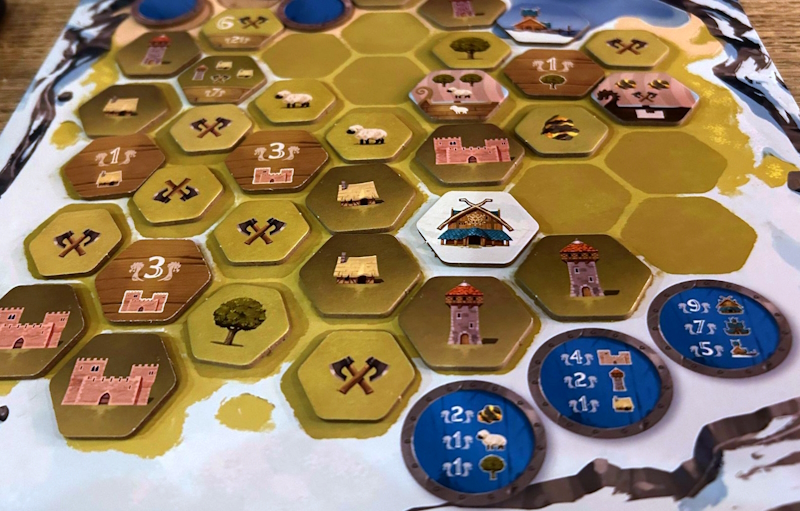
The board layout made it easier to get to more areas of the map relatively early in the game, but there was still plenty of competition for the Towers.  Like last time, Plum decided not to worry about all the home tiles and focused on gold, which was good, but not enough on its own.  Cobalt scored massively for Castles by getting plenty of them plus the equivalent Long Boats.  Cobalt started on that strategy largely by accident, before he had got a real understanding of game-play and a full appreciation of how they increased the Castle scoring and matched the requirements he could fulfill.

Looot
– Image by boardGOATS

Crimson had a nice balance of increased score for Towers and Houses, while Jade built up a huge pile of Wood.  Unlike last time, things didn’t just come together at the end for Plum, and nobody else could compete with Cobalt’s Castles and he took victory with one hundred and twenty-one, fourteen points ahead of Crimson in second.  It had been a good game though, and as players become more experienced, they will be increasingly able to determine the best scoring opportunity from the start and how to optimise the mini game that is building their Fjord. With experienced players, this could be quite ruthless with players trying to block each other and prevent objectives.
Looot
– Image by boardGOATS

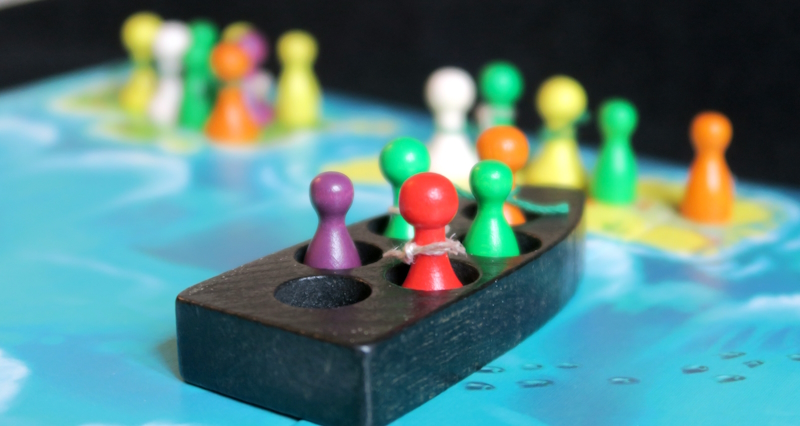
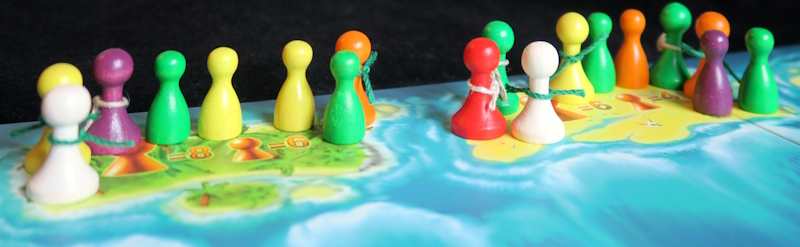
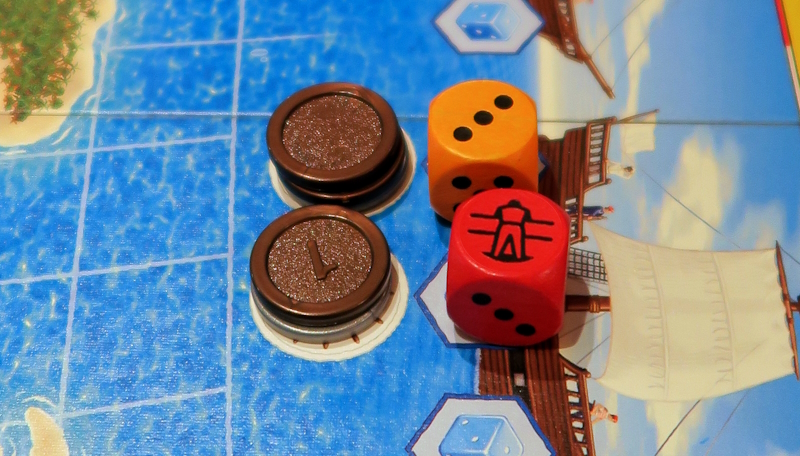
In the third group, meanwhile, Pine was introducing his new acquisition, the old game, Tonga Bonga, to Pink, Black and Purple.  This is a sailing race game a bit like the 2008 Spiel des Jahres recommended Jamaica.  In Tonga Bonga, players pilot their ship around the archipelago with the goal of visiting four of the five remote islands and returning to Tonga Bonga Bay.  Each player has room for three sailors on their ship, each of which represented by dice and indicate how fat the ship will move.  At the start of the round, players decide how much they are prepared to pay for the sailors who will serve as their captain and first mate that round (the Cabin Boy always works for nothing).

Tonga Bonga
– Image by boardGOATS

Players then simultaneously roll their dice, and take it in turns assign their dice to the other players’ ships, in return for the money offered.  In a mechanism vaguely reminiscent of that in the really rather vicious game, Vanuatu, if a player tries to place a higher value die where someone has already assigned a die, the lower value one is displaced and bumped to a lesser and usually less lucrative role.  Thus, all things being equal, the ship offering the most money will get the highest value dice and the most moves, though of course, players can work together to disrupt this behaviour. One side of each die has a Seasick Sailor (effectively zero), so the maximum value dice are five.
Tonga Bonga
– Image by boardGOATS

Once all the dice have been assigned, players move their ships racing to reach the islands, leaving one of their tokens there.  Landing on an island, earns $25 from the bank, but the player has to pay $5 to each player who landed there ahead of them.  Pine explained the rules and before long, everyone was sailing.  Pink got a bit of a lead by using his winnings to buy more moves and visit more islands.  He had been feeling that the game was maybe a bit “broken”, but as is usually the case when a game feels like that, it was all down to the “rules malfunction”, but it wasn’t until the final round that the rules were “clarified”.

Tonga Bonga
– Image by boardGOATS

Instead of the winner being the player to cross the line first with any left over money used as a tie-breaker, once a player has visited four islands they return to Tonga Bonga Bay and trigger the game end—and whoever has the most money wins.  Pink crossed the line and claimed the moral victory, as he was playing by the original rules.  Everyone else was quite happy with the “updated rules” though, which left Pine the victor with Purple in second and Black just behind.  Pink blamed “Evil Pine” for the mishap, but was eventually won round with a bottle of dubiously flavoured cider.

Tonga Bonga
– Image by boardGOATS

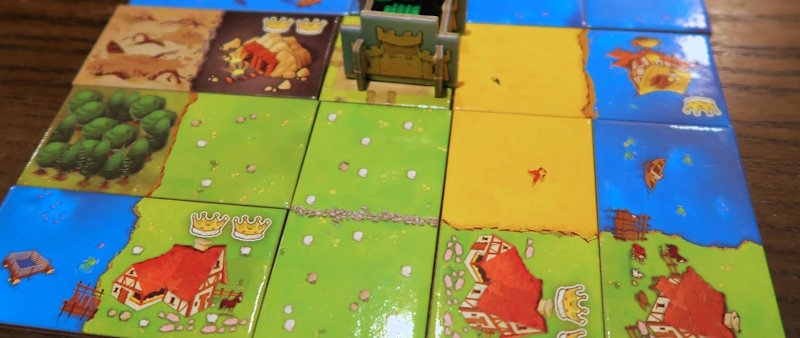
Although the debate had been audible by the players at the neighbouring tables, ultimately it was all taken in good part and the game had been a lot of fun and showed its age less than Lifeboats that was played a few weeks back and was only five years older.  From there though, the group moved on to a game of the 2021 Spiel des Jahres winner, Kingdomino.  This is a clever little game where players are building a kingdom made out of double-headed, domino-like tiles.  As in Dominoes, the ends of the tiles have to match, or at least it has to match with one tile tile already in the player’s kingdom.
Kingdomino
– Image by boardGOATS

The really clever part of the game is the double market, where the tiles are taken in reverse order of value.  The double market means that when a player takes the tile for the current round, they choose which tile they will get in the next round.  Thus, taking the lowest value tile this round means they will have first choice next round.  Players score for each contiguous area of Terrain—the number of points is equal to the number of squares multiplied by the number of Crowns featuring in it.  This time, Pink concentrated on Wheat Fields and Sea, Pine focused on Sea and Meadow while Black concentrated on Woodland with a smattering of points from Marsh, Mountain and Wheat fields.

Kingdomino
– Image by boardGOATS

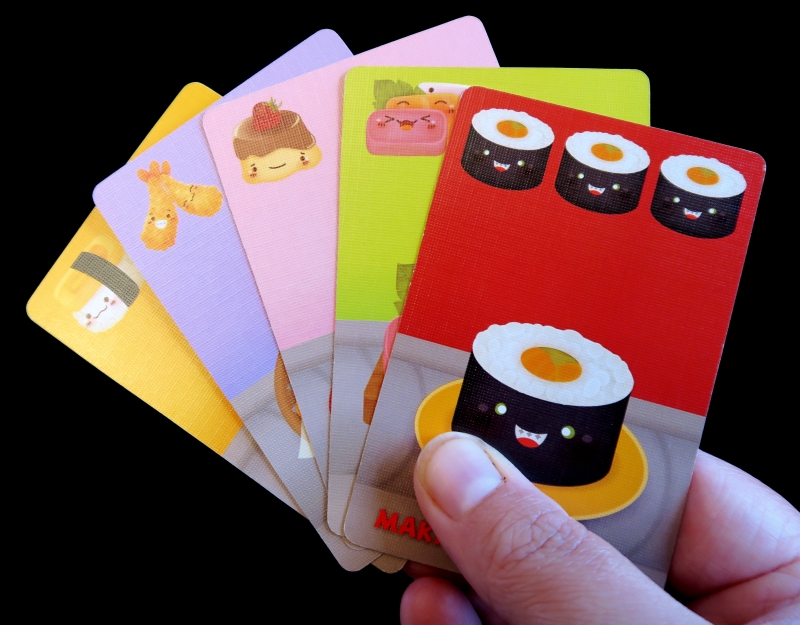
In contrast, Purple prioritised her four contiguous areas forfeiting the “Harmony” and “Middle Kingdom” bonus points for using all the tiles to give a square kingdom with a central castle.  Pine took victory with a massive seventy-three with Pink and Black tying for second with sixty points.  This group wasn’t done by any means and swiftly moved on to a quick game of Sushi Go!.  This is one of those games that takes a mechanism that is a relatively minor part of other games and distills it into its purest form in the game.  Coloretto does the same for the central market mechanism used in the 2007 Spiel des Jahres winner, Zooloretto, and Sushi Go! does it for the card drafting mechanism in the 2011 Kennerspiel des Jahres winning game, 7 Wonders.
Sushi Go!
– Image by boardGOATS

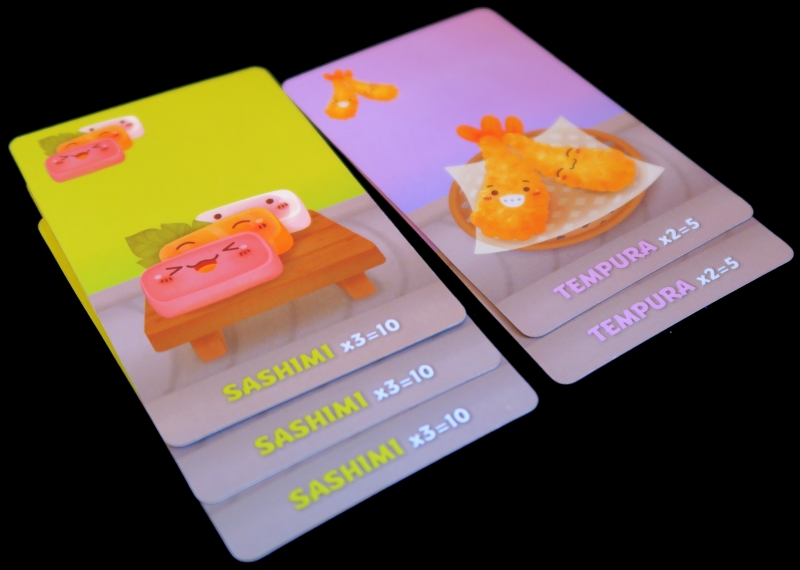
In Sushi Go!, players start with a hand of cards, keep one and pass the rest on, repeating until all the cards have been distributed.  As well as being a core mechanism in 7 Wonders, this “Card Drafting” is also often used to try to reduce the luck of the draw at the start of games like Terraforming Mars and Agricola (both also acknowledged by the Spiel des Jahres committee).  In Sushi Go!, players are using the card drafting to collect sushi and, most importantly Pudding!  The game is played over three rounds, with cards drafted to the left, then right and then left again, scoring points at the end of each round.
Sushi Go!
– Image by boardGOATS

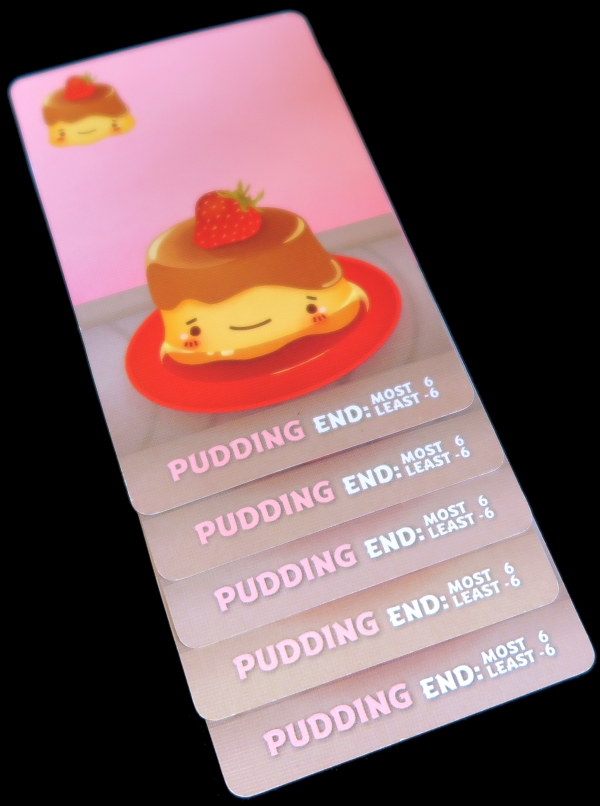
This time, Pink and Black tied for the high-scoring first round, with Pine just behind.  Pine made up for it on the second round by taking it convincingly, however, with everyone else scoring very badly.  The third round was more even again, this time won by Black with Purple taking second.  That resulted in a three-way tie between Black, Pink and Pine, but at the end of the game, the player with the most Pudding cards gains six points, with the one with the fewest losing six points.  Unusually for Pink (as he has quite a sweet tooth), he had eschewed Puddings, while Black had the most giving him what ended up being a quite convincing victory.
Sushi Go!
– Image by boardGOATS

There was just time for a single round of Love Letter (a game from the 2014 Spiel des Jahres recommended list).  This is a sixteen card game where players start with a card, draw a second and then play one.  The idea is to try to be the last play in or the player with the highest value card when the deck runs out.  The theme is all about getting as close as possible to the Princess card, which has the highest value.  This led to a discussion about real princesses and how close people had been to them.  It turns out that Purple has met a real one, Princess Nina who lives in a massive house in Cheltenham.  During the game, Pink was the Princess, but was spotted and knocked out, leaving Black to take another win.

Love Letter
– Image by boardGOATS

Learning Outcome:  The Spiel des Jahres committee may reward lighter games, but they are good games.
Boardgames in the News: Monopoly Takes Over in Leeds

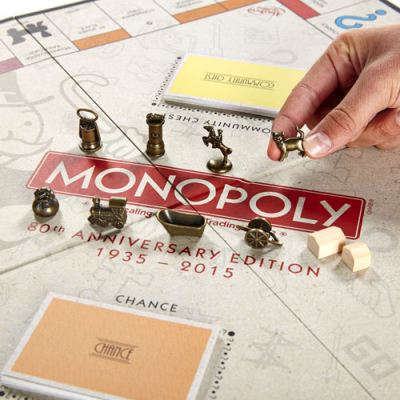
Monopoly was developed from The Landlord’s Game in 1933 and launched in the USA in 1935.  It was introduced to the UK in the following year when Norman Watson (the then Managing Director of John Waddington Ltd playing card division) played a game at his home in Horsforth, Leeds. That led to Waddingtons being granted a licence to manufacture the game, which it did from its factory on Wakefield Road, Hunslet, Leeds. To mark this connection to the city, “Monopoly Leeds Takeover“, a city-wide version of the iconic board game started this weekend, organised by “Welcome to Leeds“.
Monopoly
– Image of unknown origin

According to their website, “Monopoly Leeds Takeover” is “a free, family friendly immersive experience brings the best-selling property trading game to life, using key locations and landmarks as the gameboard with life-size tokens, clues and puzzles.”  In addition to the game, there will be various Monopoly/Waddingtons-related exhibitions, board-game-design workshops for kids, and a blue plaque will be placed on the former home of Norman Watson to mark the location of that first game of Monopoly in the UK.

Monopoly Leeds Takeover
– Image from monopolyleeds.com

The events, will be running from 27th July until 1st September and details of the Monopoly Leeds Takeover Game are available online.

Boardgames in the News: Games on Radio 4

BBC Radio 4 often has short articles on games and from occasionally has longer programs that are dedicated to games or playing.  Recent examples include the “Why we Play” series and an episode of “Start the Week” discussing Videogames.  There has also been an episode of the magazine program “All Consuming“, dedicated to board games.  This is presented by Charlotte Stavrou and Amit Katwala and discusses everything from the Ancient Egyptian game of Senet to more recent classics like Azul, Monopoly and The Settlers of Catan.

Azul
– Image by boardGOATS

During the program, there are interviews with Dan Jolin, co-founder of the magazine, Senet and the World Monopoly Champion, Nicolo Falcone; there is also a visit to the Orc’s Nest in Covent Garden.  Traditional and historical games like Mancala, Chess, The Game of the Goose, Snakes and Ladders and Backgammon are discussed at length together with their history.  Moving on to more modern games, Articulate!, Splendor, Ticket to Ride, and Pandemic all get a mention.  The presenter, Amit Katwala also visits the hugely prolific designer Reiner Knizia in his office in Munich where he keeps a library of all his games including The Quest for El Dorado, Samurai, Lost Cities, Gold Rush, and Lord of the Rings.  There, they discuss how “critical mass” is important for success—reaching enough people is the key Dr. Knizia explains, and is why games like Go and Chess are so popular.

All Consuming
– Image from bbc.co.uk

Last week there was also an episode of the comedic science program, “The Infinite Monkey Cage” with presenters Brian Cox and Robin Ince featuring Marcus de Sautoy from the Maths Department in Oxford, games designer Dave Neale and comedienne Jessica Fostekew. This begins with an introduction about playing Cluedo, moving on to a discussion about the definition of a game—something the philosopher Ludwig Wittgenstein apparently struggled with.  One possible definition discussed is that playing a game is a voluntary attempt to overcome unnecessary obstacles.  From there, conversation progresses to how people often refuse to play with those who are perceived as being good at playing games; Marcus de Sautoy explaining the maths behind his strategy for winning at Monopoly, and why Snakes and Ladders is so popular.

Senet
– Image by boardGOATS

There is also a game of Rock-Paper-Scissors (which makes interesting radio) with discussion about the World Championships, how to win and the fact that it isn’t as random as one might think.  There is a lot of discussion about modern Euro games as well as more traditional games and historical games, with Senet, The Mind, Cheat, Escape from Colditz, Rummikub, Royal Game of Ur, Scrabble and some of those mentioned above amongst those featuring.  The discussion touches on John Nash and Game Theory, the Prisoner’s Dilemma, The Ultimatum Game and the Golden Ratio.  For those who are interested in board games and gaming, this episode of The Infinite Monkey Cage is well worth a listen and both it and the episode of All Consuming are currently available on BBC Sounds.

The Infinite Monkey Cage
– Image from bbc.co.uk

Next Meeting, 23rd July 2024

Our next meeting will be on Tuesday 23rd July 2024.  As usual, we will start playing shorter games from 7.30pm as people arrive, until 8pm when we will start something a little longer.  The pub is doing food, and the table is booked from 6.30pm for those that would like to eat first.

This week, to mark the announcement of the Spiel des Jahres Awards, the “Feature Game” will be the Alpine expansion for Forest Shuffle, which featured on the recommended list (base game:  rules, review and “How to Play” video; expansion: overview video).  Other games available will be Harmonies and In the Footsteps of Darwin from this year’s list and a selection of previous winners like Dorfromantic, Living Forest, Dixit and Istanbul.

Forest Shuffle: Alpine Expansion
– Image by boardGOATS

And speaking of forests…

Jeff lived in the a forest. As he grew older and older, he started losing his hair, until one day, on his deathbed, he was completely bald. That day, he called his children to a meeting…

He said, “Look at my hair. It used to be so magnificent, but it’s completely gone now. My hair can’t be saved. But look outside at the forest. It’s such a lovely forest with so many trees, but sooner or later they’ll all be cut down and this forest will look as bald as my hair.”

“What I want you to do,” Jeff continued, “Is, every time a tree is cut down or dies, plant a new one in my memory. Tell your descendants to do the same. It shall be our family’s duty to keep this forest strong.”

And so they did. Each time the forest lost a tree, the children replanted one, and so did their children, and their children after them. And for centuries, the forest remained as lush and pretty as it once was, all because of Jeff and his re-seeding heirline.

Spiel des Jahres Winners – 2024

This afternoon, the 2024 Spiel des Jahres (German Game of the Year) winner was announced as the cooperative two-player game, Sky Team.  In this game, the players are the pilot and co-pilot at the controls of an airliner working together as a team to land the airplane in different airports around the world.  Cooperative games can operate in different ways, but this is a limited communication game that runs over a fixed number of turns as the plane descends.  Before the descent, the pilot and copilot discuss the strategy.  Once the players have agreed their plan, they are on their own until the end of the turn, throwing their own dice and carrying out their own actions.

Sky Team
– Image by BGG contributor JuiceNeutron

There has been some precedent for cooperative games over the years, with Hanabi, Paleo and last year’s winner Dorfromantic, receiving prizes as well as Pandemic Legacy: Season 2 which was given a special award.  What makes Sky Team unusual as a Spiel des Jahres winner, however, is the fact is is a two player game.  Although there have been a number of games that play particularly well with two (Scotland Yard or Lord of the Rings for example) and there has been a special awards for Seti (which is a two player game), this is the first time the Spiel des Jahres (or indeed the Kennerspiel des jahres) Award, traditionally a family prize, has gone to a two player game.

Sky Team
– Image by BGG contributor The Innocent

The winner of the Kinderspiel and Kennerspiel des Jahres, the “Children’s” and “Expert” (or “Connoisseur’s”) games were announced at the same time.  The first of these went to Die Magischen Schlüssel (aka Magic Keys), which is a simple and beautiful push-your-luck game of collecting gems.  The winner of the Kennerspiel des Jahres Award was e-Mission (aka Daybreak), which, like Sky Team, is also a cooperative game, but with elements of the mechanisms inspired by card games like Wingspan and Terraforming Mars.

Daybreak
– Image by BGG contributor The Innocent

In Daybreak, one to four players work together to battle climate change with each player controlling a World Power.  If too many people from any World Power are in crisis, everyone loses, but if if by working together global emissions are reduced to net-zero, everyone wins.  This concept has been used previously in a game, in particular CO2, but Daybreak is far more accessible.  Daybreak also focuses on the the human cost of climate change and the benefits to humans that the solutions might bring, as such, as well as a good game in its own right, it also delivers an important message.

9th July 2024

When Blue and Pink arrived, Crimson and Cyan were already there on their first visit, finishing their supper and playing a game of Molehill Meadows.  This is a new game by the designer of Zuuli, that they had picked up at the UK Games Expo (meeting the designer Chris Priscott and his delightful family in the process).  In Molehill Meadows, players take on the personality of Mika the Mole, who has an affinity for shiny things, a hunger for juicy worms and an innate desire to dig  A flip-and-write game, players dig tunnels using polyomino shapes to carefully expand their molehill home.

Molehill Meadow
– Image by boardGOATS

Their game was somewhat interrupted as people arrived and were introduced and they were surrounded by the general chatter of arrival and Blue and Pink munching their pizzas.  Crimson and Cyan carried on playing, flipping polyomino cards and then drawing the shapes on their map.  Extending their tunnel to find Worms gave both players four “Worm Powers”, and fining treasure gave them points.  Cyan collected twice as much treasure and picked up more than twice the number of bonus points than Crimson (for collecting all of the two sets of flowers on the Objective Cards) and thus was the eventual victor by something of a landslide (or should it have been a tunnel collapse?).

Molehill Meadow
– Image by boardGOATS

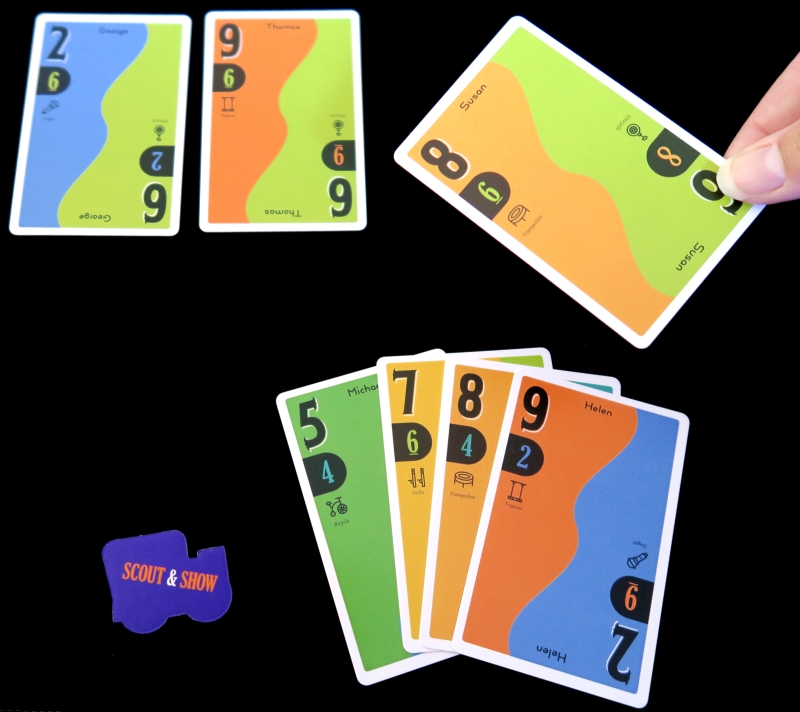
Then, while everyone else generally gossiped and caught up with the events of the last week or so, Jade and Sapphire joined Crimson and Cyan for a quick couple of rounds of the trick-taking, climbing game, SCOUT.  We’ve played this a few times on a Tuesday and everyone has always enjoyed it.  The game is simple in that on their turn, the active player either plays a set of cards to beat and replace the set on the table (a run or a meld), or take one card from either end of the set on the table and add it to their hand.  The round ends if a player plays the last card in their hand, or if it is a player’s turn and they played the current active set of cards on the table.

SCOUT
– Image by boardGOATS

At this point, player score for cards in their scoring pile (cards they have beaten during the round), for “chocolate bars” (rewards given when another player takes a card from their active set), and deducts a point for every card left in hand.  The clever part of the game is that, like Bohnanza, cards cannot be rearranged in hand, this with the fact that cards have different values depending which way up they are make this little card game really clever.  In the interests of time, the group only played two rounds, and although the scores can be very disparate, this time it was really tight with only five points between first and last and Sapphire taking the honours one point ahead of Crimson.

SCOUT
– Image by boardGOATS

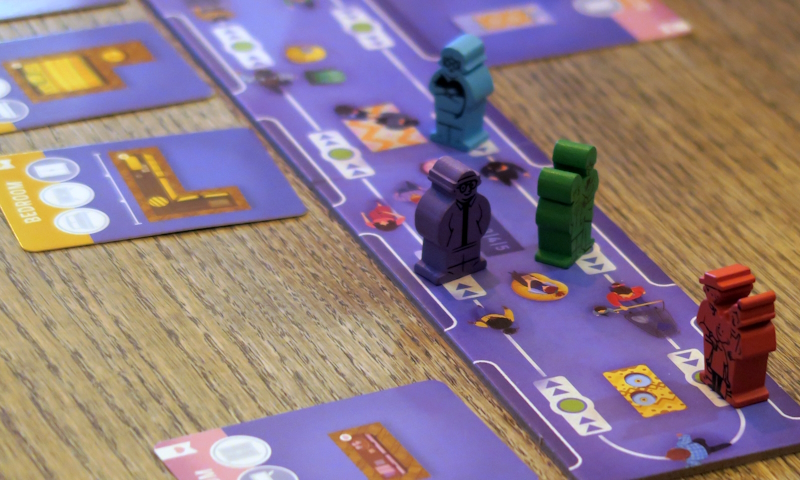
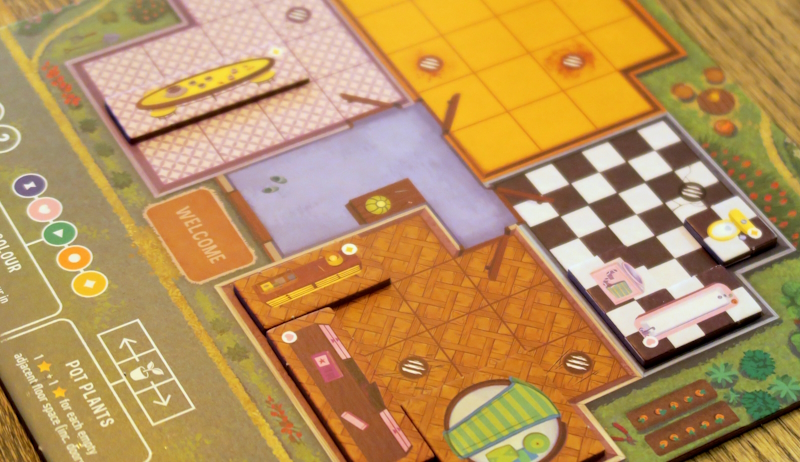
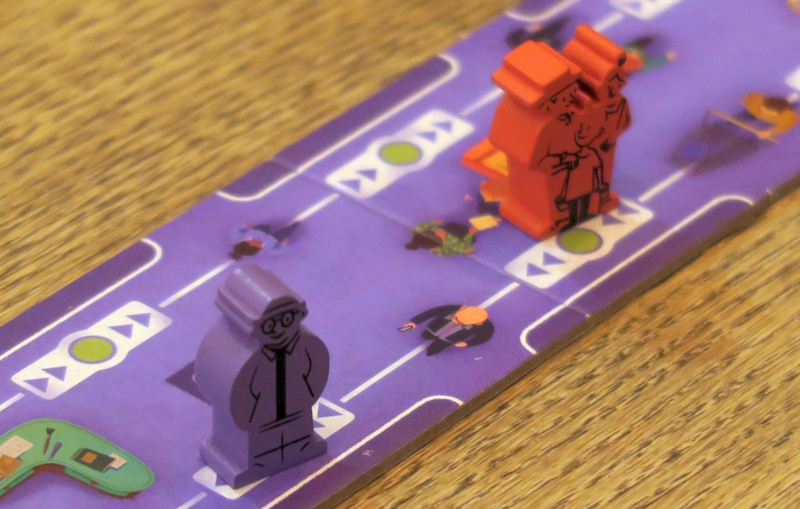
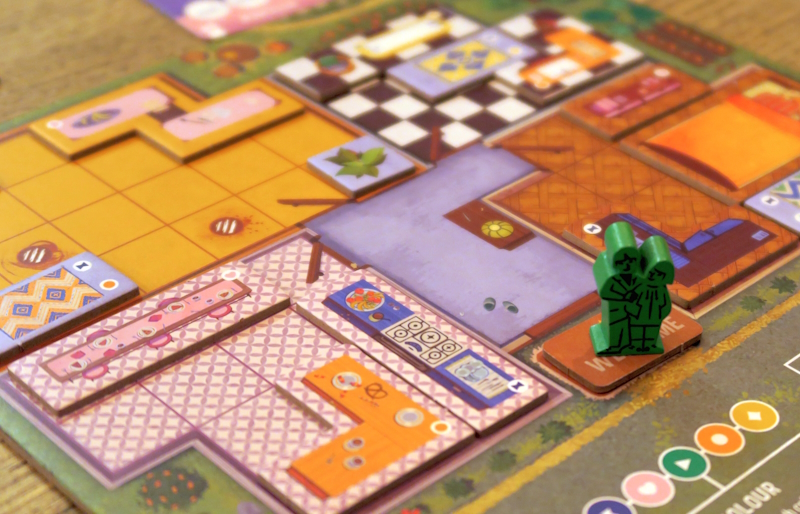
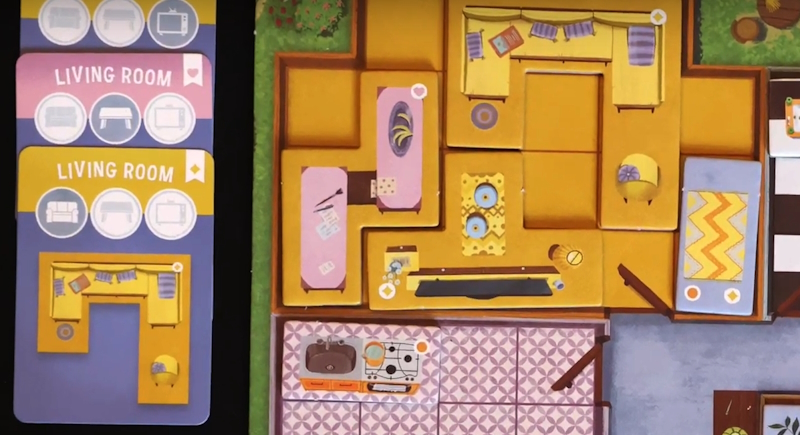
By this time, Blue and Pink had just about finished eating and everyone else had mostly finished chatting, so with twelve, the group split into three groups of four, starting with Pine, Sapphire and Cyan who joined Jade in the “Feature Game“, Happy Home.  This is another polyomino game, with similarities to games like New York Zoo and Bärenpark, but with a theme of home decorating rather than building an animal park.  Like New York Zoo (or indeed Jokkmokk), the game has a central market, in this case representing a Store, which players move their Meeple round.

Happy Home
– Image by boardGOATS

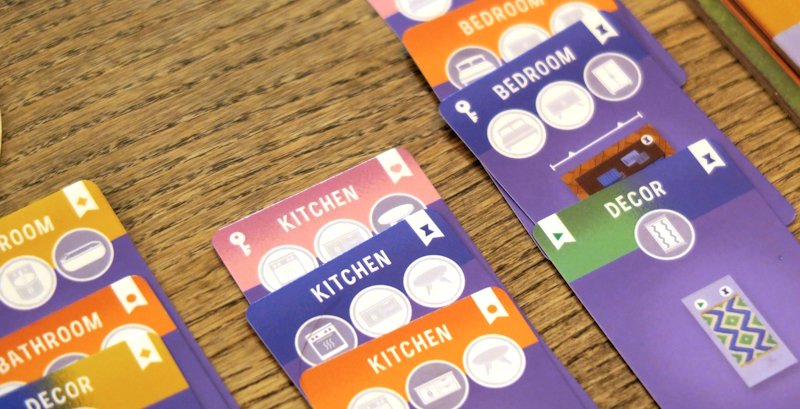
On their turn, the active player moves their Meeple (or should that be Muman?) to an available space, takes the card and matching tile and then adds it to their home.  When all the cards are used up, players instead place a “Welcome Mat” on their doorstep to show they are ready to welcome visitors.  When everyone has finished , the game is over and players score their Home for Furniture, Colours, Pot Plants, their Welcome Mat and Design Objectives, losing points for any scratches still visible and not covered up by Furniture.

Happy Home
– Image by boardGOATS

There was a wee bit of misunderstanding on how the scoring worked even though Jade had done his best to explain it at the beginning.   Each Room scores one, three or six points if it has one, two or all three different core pieces of Furniture in it, and each Pot Plant is worth a point plus a bonus point for each empty space orthogonal to it.  That wasn’t where the problem was however, that was with the Colour scoring. Essentially players need to have the same Colour across at three different rooms to get two points and across four rooms to get five points, but somehow, this caused more confusion than it should have done.

Happy Home
– Image by boardGOATS

The group also made life more difficult for themselves by shuffling the cards and removing twenty-four cards as per the rules for the four-player game, but somehow the bulk of those removed seemed to be Furniture for just one of the rooms, the Bathroom.  It was a good learning game as the value of Rugs, for example, became evident later on—players were a bit confused as they don’t score in their own right, but they add Colour to a Room and thus can score at the end of the game.

Happy Home
– Image by boardGOATS

This time the Design Objective was “Bigger is Better”, so players lost a point for each empty floor space in their Room with the most empty spaces.  The lack of Bathroom fittings, meant Pine didn’t have a loo in his house and had to resort to “wafflestomping“, but he did have what looked like two pink ironing boards furnishing his Lounge.  Next door, Sapphire filled his Living Room with a pink sofa and an enormous matching pink widescreen TV (that was the same size as the sofa!).  In the end, the victor was a bit of a runaway winner.

Happy Home
– Image by boardGOATS

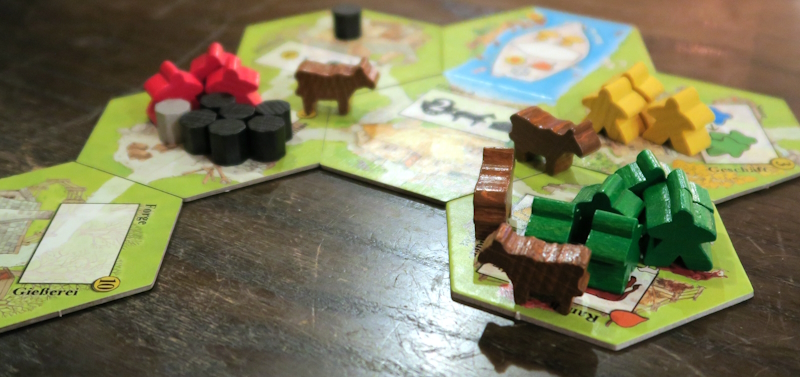
In spite of his lack of toilet facilities, Pine finished with twenty-four points, some seven ahead of Sapphire in second, with Jade taking the last place on the podium.  Before the game, Pine had said he wasn’t sure about it from the description, but in the event he really enjoyed it, as indeed did everyone else.  Meanwhile, there were two other games underway.  The first of these was Keyflower—a very popular game with certain members of the group, but one that hasn’t had an outing for a long time, in fact the last time the group played it was online in 2020, and the much-missed Burgundy was involved.

Keyflower on boardgamearena.com
– Image by boardGOATS from boardgamearena.com

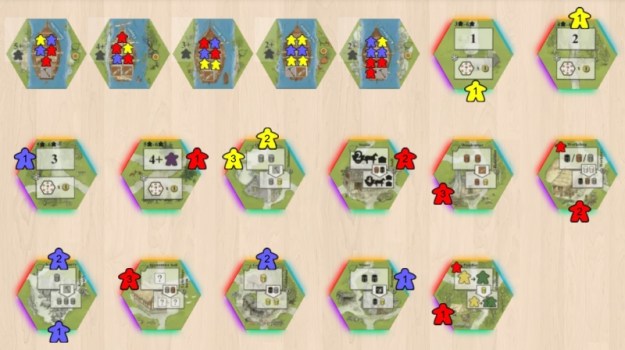
This time, the four players were Blue, Pink, Black and Ivory, all of whom had played Keyflower before (albeit a while ago).  The game is fairly simple in terms of concepts, but like many good games, challenging to play well.  Each round, players take it in turns to bid on a tile, or activate a tile.  The clever part of the game is that both bidding and activating is done with red, blue, yellow or occasionally green Keyples (Meeple-shaped workers).  In each of the four rounds (or Seasons), a set number of tiles are put out for players to bid on.  Players take it in turns to bid or activate and when everyone passes in succession, any tiles won are added to the winner’s village, any losing bids and any Keyples used for activating return to their owner.

Keyflower: The Farmers
– Image by boardGOATS

At the end of each round, a boatload of new Keyples arrive in each village (players can bid to get the one of their choice), before the tiles for the next Season are set out.  In general, tiles are drawn at random, and in the first season, Spring, mostly provide Resources with Summer and Autumn tiles providing special powers and Autumn and Winter tiles providing scoring opportunities.  The Winter tiles are different to those for the other Seasons in that instead of being drawn at random at the start of the Season, they are dealt our to each player at the start of the game.  Then, at the start of Winter, players choose from their pile which ones they want to make available—in this way, the Winter tiles act as sort of objective tiles.

Keyflower
– Image by boardGOATS

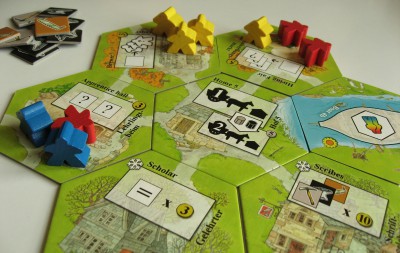
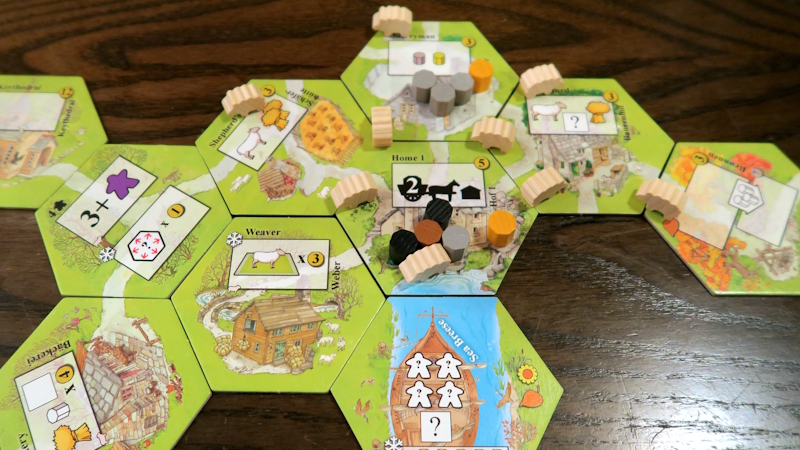
The Keyflower box also contained The Farmers expansion and the question arose whether to include it or not.  Blue, Pink and Ivory were on the fence until Black said he’d never played with the Farmers, so of course that was a problem they had to urgently fix.  In the base game, the different tiles are connected by roads which are used for transporting goods to places where they can be used to upgrade tiles or score points.  In The Farmers expansion, these roads now define fields where animals can be left to graze and with each occupied field scoring points at the end of the game.

Keyflower: The Farmers
– Image by boardGOATS

Additionally, The Farmers expansion introduces wheat as a new resource, which can be used to add distance/quantity to the movement action, enabling players to move more animals and resources further.  There are several ways to set up the game with The Farmers expansion, but this time the group used The Farmers Variant, where all the tiles from the expansion are used and the number made up with tiles from the base game.  After setting up and explaining the additional rules to Black, Ivory went first, taking the waving purple start-player Keyple, and began the bidding.

Keyflower: The Farmers
– Image by boardGOATS

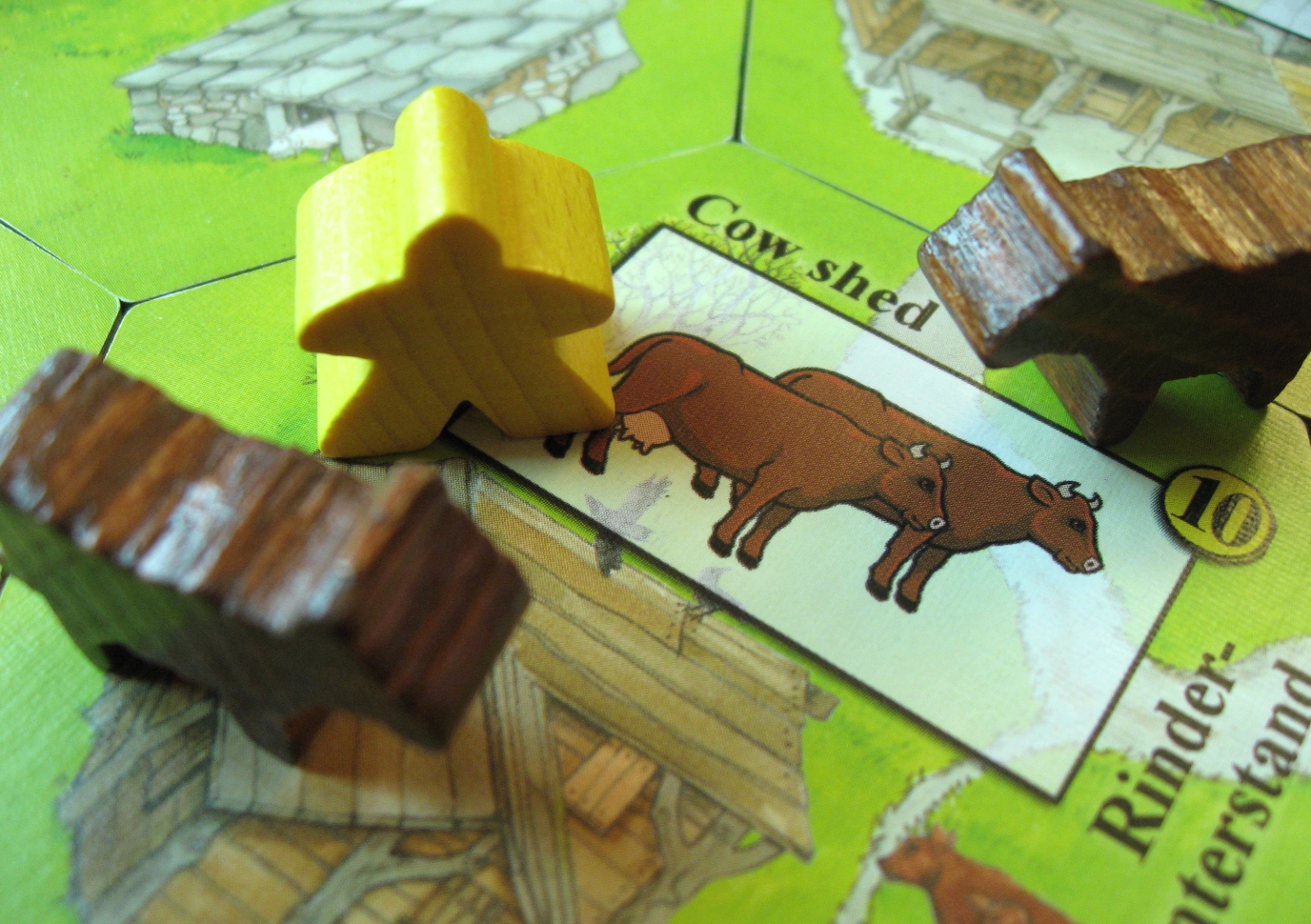
In Spring, Blue failed to get anything useful at the start of the game (or so she thought) taking just the Key Mine tile which gives Coal and didn’t match any of her Winter tiles.  Pink started off taking the Sheep Fold which gave him a source of sheep and the Paddock which gave him more Movement and upgrade ability together with some Wheat.  Then, he took the Workshop which gave him one resource of his choice from Wood, Coal or Stone, upgradeable to three resources, one of each, which matched his Winter tile, the Mercer’s Guild.  Ivory won the Quarryman, which gave him some very useful gold, and in Summer took the Shepherd’s Hut which gave him Wheat and Sheep and then embarked on a concerted breeding and movement programme.

Keyflower
– Image by boardGOATS

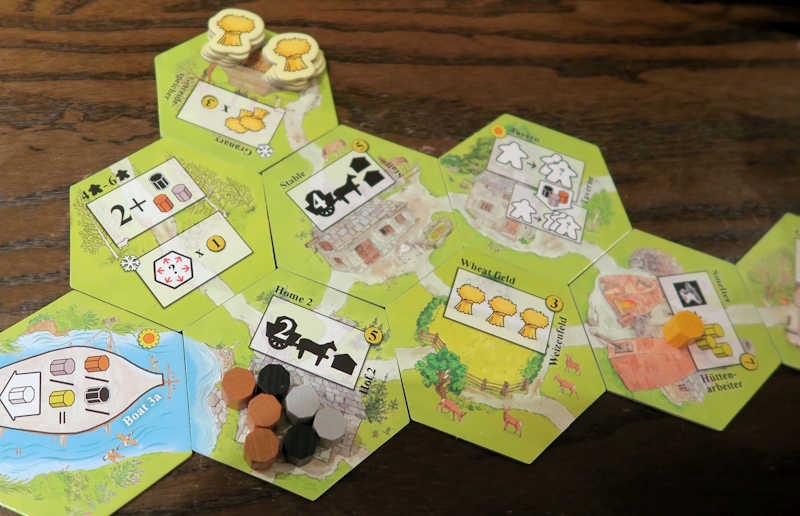
Black picked up a few tiles early in the game, which ultimately led to a lightly sprawling Village by the end of the game.  These included the Wheatfield in Spring and the Tavern, the Smelter and Boat 3a in the Summer.  By this time, Pink had decided that the sheep weren’t doing it for him so moved on to pigs, with the Pigsty.  Blue, having missed out on the Tavern which converts one Keyple into two, instead took the only tile that generated green Keyples, the Store which went well with one of her Winter tiles, the Key Market, but gave the added power of preventing other players from following if she was the first to Bid with Green, as they were highly unlikely to have any.

Keyflower: The Farmers
– Image by boardGOATS

In Autumn, Blue discovered the value of the Key Mine tile she had picked up in the first round, when the Blacksmith tile appeared which gave points for each Coal on the tile at the end of the game.  She added the Ranch to this which gave Cows and Wheat, and then began mining Coal in earnest and hoarding large numbers of sheaves for a super-movement move later in the game to get everything where it was needed as efficiently as possible.  Black got the Goldsmith which went well with his Smelter which gave him the Gold he needed to upgrade it and get ten points, while Ivory and Pink continued their procreation programmes.

Keyflower: The Farmers
– Image by boardGOATS

As the game progressed there were several visits from the other gamers in the room, many of whom, much to the people who were playing it’s surprise, had not played Keyflower. It is, of course, Blue’s favourite game and was a favourite of Burgundy’s, as well as being generally very popular with almost all of the regulars pre-2020.  So as the game continued into Winter, it was clear it would have to get another outing or two reasonably soon to rectify the situation. There is also The Merchants expansion which has not been played with the group, so that might be the “Feature Game” in the coming months.

Keyflower: The Farmers
– Image by boardGOATS

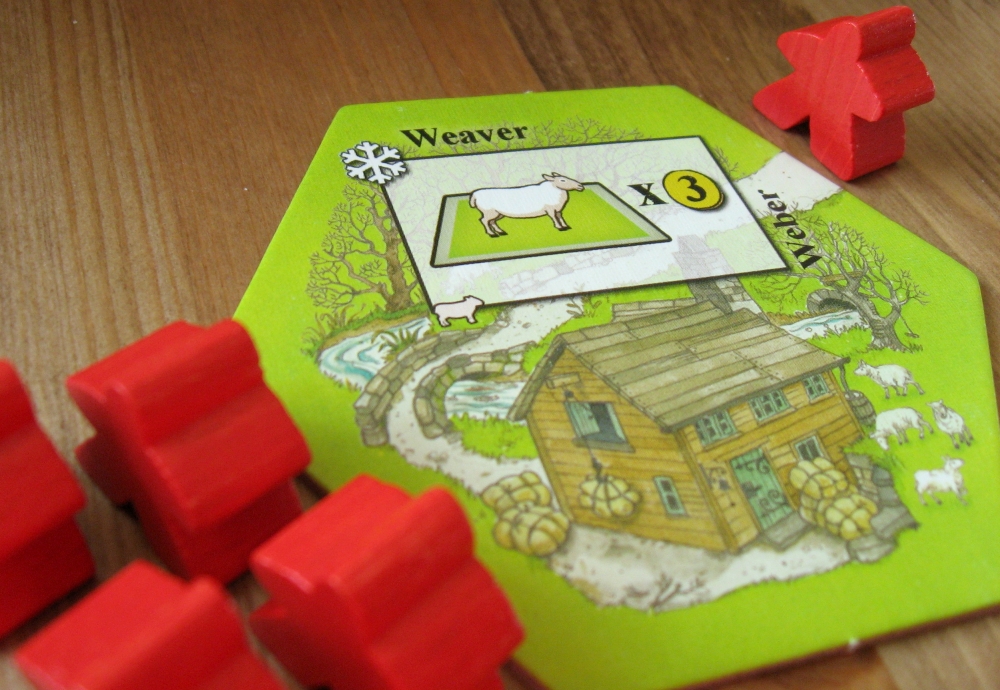
Only eight out of a possible sixteen Winter tiles were introduced by the players and the Scribes, which Ivory commented usually ensured victory was not there (it turned out nobody had started with it).  Black took the Granary which gave him points for his Wheat and Pink got his Mercer’s Guild that he’d been working towards.  Ivory won the Cathedral giving him a straight twelve points; the Weaver giving two extra points per sheep field, and the Bakery giving four points for each set of a Resource, a Skills tile and a Wheat Sheaf.  Blue had lots of options, so concentrated on building her piles of resources before bidding for her end of game scoring.

Keyflower: The Farmers
– Image by boardGOATS

This required a lot of nerve as Ivory had there wherewithal to take some of the tiles she obviously wanted.  Ivory hummed and hawed over it and as Black and Pink passed, twice he had the chance to begin a war, but decided not to as “that’s not very nice” and it can also backfire spectacularly.  Instead he generated the odd Gold for a point (“in case it was close”) and waited and watched.  In the end he passed and then Blue passed and that was that bar the counting.  And as it turned out, it was close, very close, but Blue just took victory, by a mere three points, with a total of ninety-five.

Keyflower: The Farmers
– Image by boardGOATS

The jury is out as to whether it was Ivory’s kindness that cost him the game because Blue did, of course, have contingency plans if someone had tried to take some of the tiles she wanted, and she could have cost him a lot of points.  However, by the end, Blue had no Keyples left and Ivory had a couple that he could have used, so depending on how things had panned out, he might have just nicked it or still lost.  Instead, his kindness and generous good nature won him a lot more respect from his fellow gamers, especially given that everyone knew how fond Blue is of Keyflower successfully destroying her plans might have made her just a little bit sad.

Keyflower: The Farmers
– Image by boardGOATS

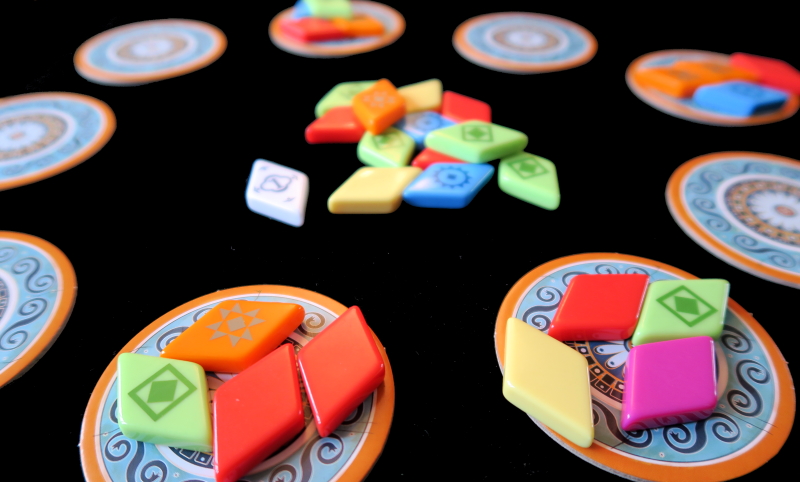
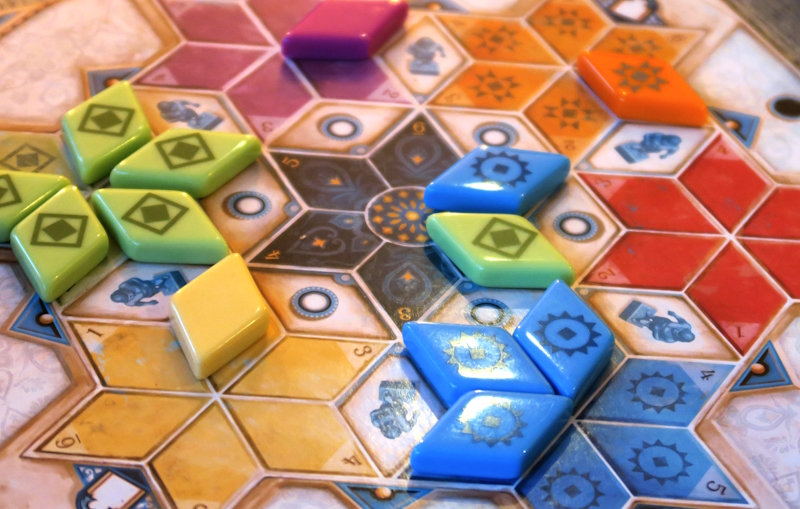
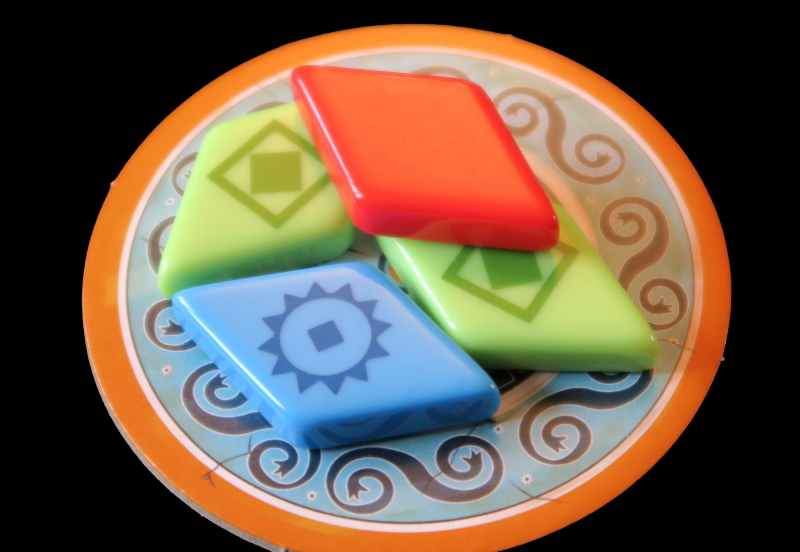
Finally, the third table began their evening with Azul: Summer Pavillion, the third in the series based on the essentially abstract game of tile collecting, Azul.  Crimson kindly obliged in offering to lead the game with Lime, Teal and Purple, none of whom had played this variant before.  This is more similar to the original than the second in the series (Stained Glass of Sintra), but is built on lozenge-shaped pieces that make up hexagons.  Like the original, players take tiles from a central market and add them to their player-boards claiming points as they do so.  In contrast to the original, players store the tiles and add them all to their board at the end of the round (taking it in turns to do so).

Azul: Summer Pavilion
– Image by boardGOATS

After some initial confusion caused by the additional bag and player boards from the Objective Tiles and Glazed Pavillion expansions, the game got underway.  Unfortunately, there was a bit of a rules malfunction:  initially it was thought that every time a tile was placed it scored one point for itself, two for one next to it and three for a third one in sequence (totalling six).  The group soon realised this wasn’t right though.  So they then thought you scored at the end of the round after playing all the tokens, however, they soon realised there was no way anyone could remember when a new tile that round had been placed.

Azul: Summer Pavilion
– Image by boardGOATS

At this point, they then read the rules and from that decided players score one point for the tile and one for each tile it was adjacent to, thus scoring from one to three points per tile as they were placed and this is how they continued to play.  Cyan immediately identified they had come a cropper when he looked at the low end-game scores. He explained that they should have scored one point for the tile placed and one point for each tile connected to that group, so potentially up to six points could be scored for some tiles!

Azul: Summer Pavilion
– Image by boardGOATS

Although it wasn’t played by “the rules as written”, everyone had the same disadvantage, and the group resolved to give it another go again soon, but with the right rules next time.  As it was, it was a very close game with Crimson, beating Lime by a single point and Teal finishing some half a dozen points behind.  It is a very pretty game, and despite the issues, players had enjoyed making patterns and pushing the tactile bright tiles around, which was very therapeutic after a hard day at work.

Azul: Summer Pavilion
– Image by boardGOATS

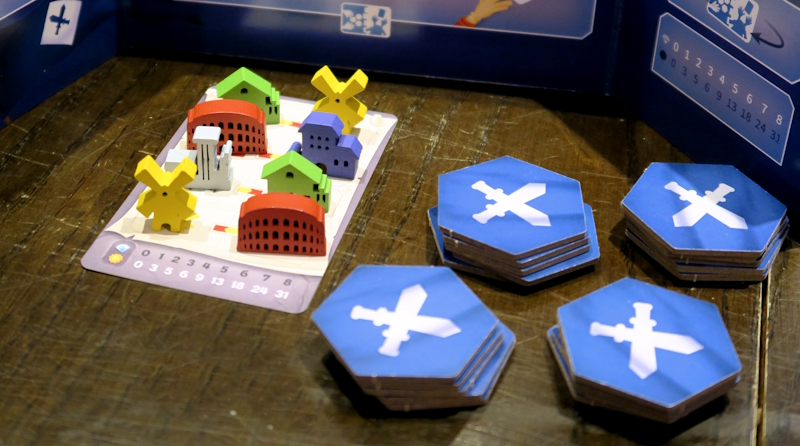
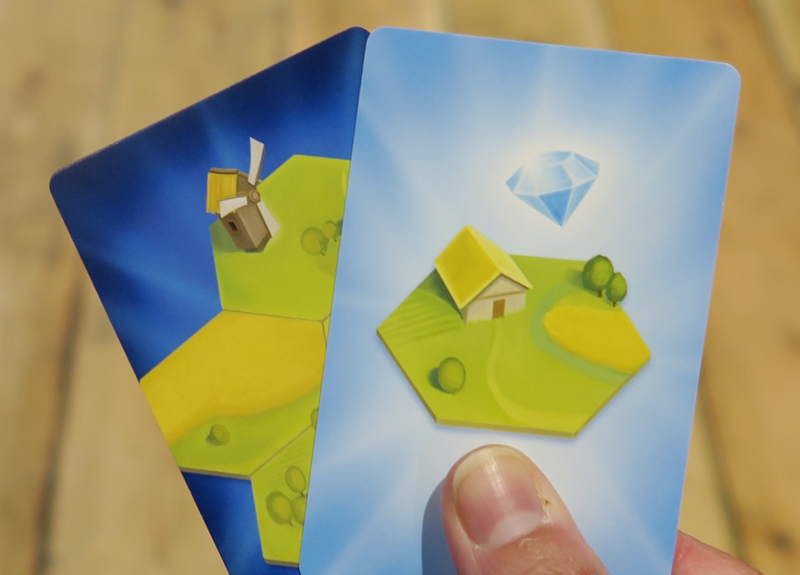
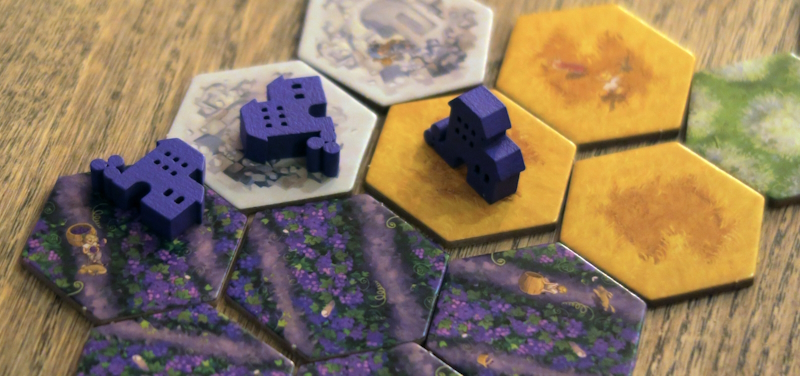
Keyflower was ongoing (and would be for the rest of the evening), but Happy Home had finished so there was a quick game of musical chairs and Purple began by leading Lime, Cyan and Pine in a game of the group’s currently popular filler, Rome in a Day.  This is a little tile laying game built round the “I divide, you choose” mechanism.  The idea is that players draw five land tiles at random and place two buildings on tiles one and two. They then divide the five tiles into two groups—a bigger and a smaller one (in any ratio), and add a Crystal Gem to the smaller land set before offering the choice to their neighbour.

Rome in a Day
– Image by boardGOATS

During the four rounds that the game is played over this neighbour alternates, right, left, right, left. So, each round, players choose a set from their neighbour and these and the tiles they were left with are added to their domain.  At the end of the game, any building that stands on or adjacent to land of its own colour will score for each tile in the group and then players score for the diamonds they have collected—the player with the most points is the winner.  The game has had a couple of outings recently after Black and Purple picked it up at UK Games Expo a few weeks back.  Pine, Lime and Cyan had not been part of those games, so Purple explained the rules.

Rome in a Day
– Image by boardGOATS

The game was a bit of a struggle, probably not helped by the fact that on both the previous occasions the rules have not been strictly adhered to.  This is partly because the rules are not the best written and partly because when the game was explained to Black and Purple at UK Games Expo they were different to those published online.  Although it wasn’t entirely clear to everyone during the game, it was actually very close.  In fact, Lime and Cyan finished tied for first place with forty-four points each despite quite different tactics with Cyan prioritising collecting Gems and Lime making hay in his Wheat fields and wine in his Vineyards.

Rome in a Day
– Image by boardGOATS

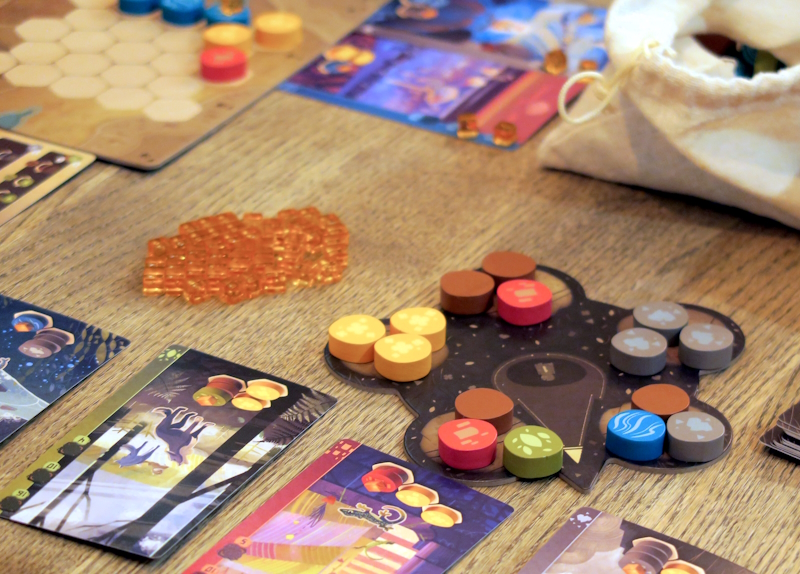
While the group were fighting their way through Rome in a Day and Keyflower was coming to an end, Jade led Sapphire and Crimson in the 2024 Spiel des Jahres recommended game, Harmonies.  This was described by Jade as a sort of cross between Splendor and Cascadia, with an Azul-type market.  On their turn, the active player takes three wooden Tokens from one of the spaces on the central player board and places them on their player board. These Tokens represent Mountains, Trees, Buildings, Water and Fields.  Some tokens can stack, others cannot: the reasons why are thematic (e.g. tall Mountains and Forests, no tall Rivers etc.), but otherwise Tokens can be placed on any empty space.

Harmonies
– Image by boardGOATS

Players may then take an Animal card from the central display—they can have a maximum of four at any one time and each has a number of Animal cubes on them.  Each time the pattern on an Animal card is fulfilled, one of these Animal cubes is removed and placed on the token indicated on the card.  At the end of the game, players score for the highest achieved Animal on each card and for each Mountain, Tree, Building, Field and River (or Island, depending on  which side of the board players are using).  Mountains are made of stacks of up to three Rock Tokens, while Trees are a green Leaf Token on zero, one or two Wood Tokens.

Harmonies
– Image by boardGOATS

Taller Mountains and Trees give more points (one, three or seven points), while Buildings (made of two Tokens, at least one Brick and a Wood, Rock or another Brick), and Fields (two adjacent Wheat Tokens) score five points each.  Finally, depending which side of the board is used, players score points for the length of their River, or five points for each Island they make.  This time, the group played with “Side A” which scores for Rivers.  It was a learning game for Crimson, but was quite close quite between Jade and Sapphire, but Sapphire’s one hundred and eight gave him victory in what is an interesting point-salad tile-placement game that deserves another outing soon.

Harmonies
– Image by boardGOATS

Learning Outcome:  You don’t need a toilet to have a Happy Home.

Boardgames in the News: The Infinite Monkey Cage on Radio 4

Every now and then, the BBC broadcast special programs on gaming and board games.  In the past we have had the playing with history article on BBC Radio Oxford and the “why we play” series on BBC Radio 4, as well as a number of other shorter articles.  More recently, there was a Start the Week episode—although this was varied and interesting, it was more about video games than board games.

The Infinite Monkey Cage
– Image from bbc.co.uk

This week, however, BBC Radio 4‘s Infinite Monkey Cage with Brian Cox and Robin Ince are doing a special on board games featuring Marcus de Sautoy from the Maths Department in Oxford, games designer Dave Neale and comedienne Jessica Fostekew.   Although it is scheduled to be broadcast on Radio 4 tomorrow at 11am, it is already available on BBC Sounds and will be for at least a year.

Next Meeting, 9th July 2024

Our next meeting will be on Tuesday 9th July 2024.  As usual, we will start playing shorter games from 7.30pm as people arrive, until 8pm when we will start something a little longer.  The pub is doing food, and the table is booked from 6.30pm for those that would like to eat first.

This week, the “Feature Game” will be Happy Home (rules, review and “How to Play” video).  This is another new game, this time a polyominoes game, with similarities to games like New York Zoo and Bärenpark, but with a theme of home decorating rather than building an animal park.

Happy Home
– Image from youtube.com

And speaking of decorating…

Jeff was sick and tired of how people constantly made jokes about him and the fact he was perceived as a bit thick and generally a little bit hopeless. So, he decided to show his wife that he was really smart and could pull his weight, by painting a couple of rooms in the house.

The next day, after his wife had left for work, he got on with the task at hand. Some hours later, when his wife arrived home she could smell the distinctive aroma of paint. She walked into the living room and found Jeff lying on the floor in a pool of sweat, wearing a ski jacket and a fur coat, one over the other.

She went over and asked Jeff if he was OK. Jeff nodded, so his wife asked what he was doing. Jeff replied that he wanted to prove to her that he wasn’t dumb and he wanted to do it by painting the house. Jeff’s wife then asked why he was wearing a ski jacket over his fur coat. Jeff explained that that he had read the directions on the side of the paint can which said, “For best results, put on two coats.”

25th June 2024

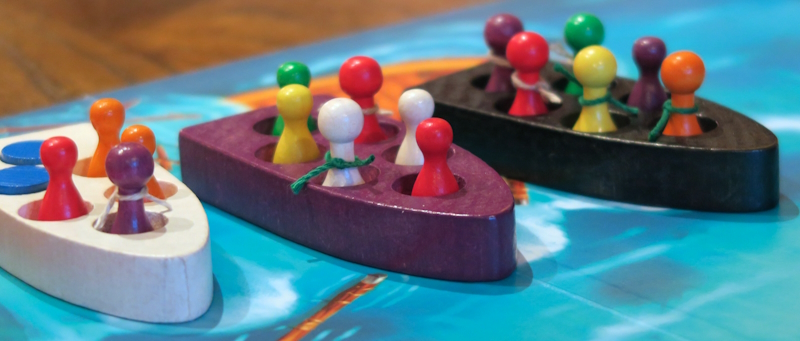
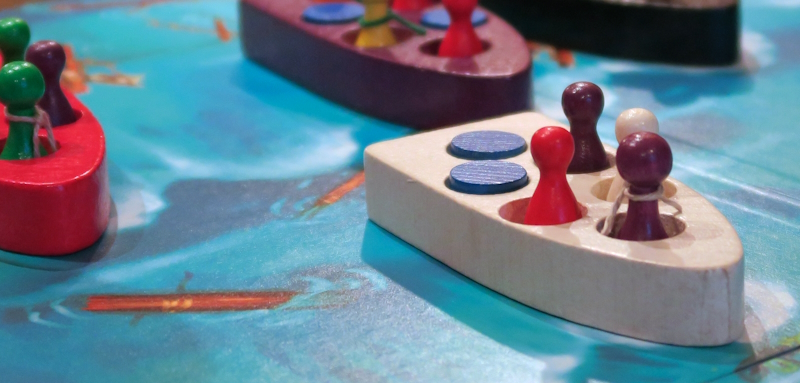
To mark the upcoming General Election, the “Feature Game” was to be Lifeboats, an older game which features lots of voting (as well as boating…).  Blue and Pink were still eating as the others arrived, so those that wanted to join them staked their claim and waited and the others took themselves off to play something else, but it wasn’t long before the voting and boating was underway.  Lifeboats is a fairly simple, if savage game, where players are trying to get their sailors from the sinking wreck of the Santa Timea to shore.  Unfortunately, the lifeboats are old and leaky and as the water comes in and the boats begin to sink, players vote to decide which boats to move and who to throw overboard.

Lifeboats
– Image by boardGOATS

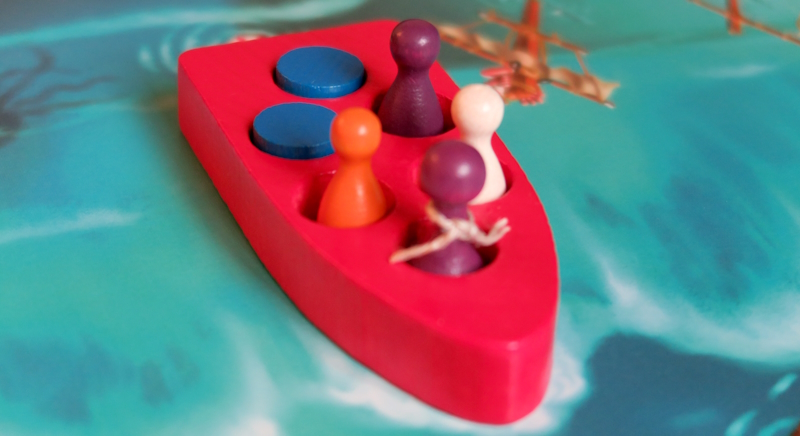
There are three phases to each round in Lifeboats:  firstly one boat develops a leak, then one boat moves forwards, and then finally, one seaman in each boat jumps overboard and then climbs back into a different boat.  In the first phase, players vote to decide which craft develops a leak and a blue wooden disk is placed in an empty spot in that boat—if there isn’t an empty space, the occupants vote to decide who is going over the side.  Once that has been resolved, players vote again, this time to decide which boat is going to move; it’s only three spaces to reach land, but that can seem an awfully long way.

Lifeboats
– Image by boardGOATS

In the final phase of the round, beginning with the start player, players take it in turns to take one of their seamen from a boat into the water and then in reverse order the swimmer climbs into a different boat.  And it must be a different boat—if there isn’t a different boat with space, the unfortunate sailor drowns in the attempt.  All that is quite straight forward, but there are a some little tweaks that add interest to the game.  Firstly, each player has two Officers and a number of Sailors:  deciding who is going to be thrown overboard, players have one vote per Sailor in the boat and two per Officer.  Seamen that make it to land score points, but Officers score more, all this also makes them a target though.

Lifeboats
– Image by boardGOATS

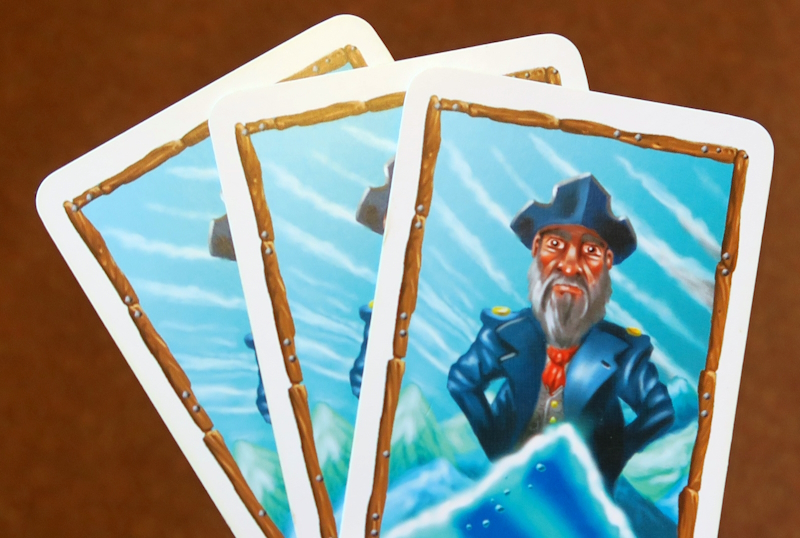
Even though the Santa Timea is headed for Davey Jones’ Locker, the Captain is still in command.  So, during any vote, players may invoke his name to get their way by playing a Captain’s Hat card.  Players only have three of these though, and they are single use so must be used with care.  Worse, if more than one player plays a Captain’s Hat, they cancel out, and a bit like ties in Las Vegas all the tied players lose out, so they also have to be well timed to be effective. The winner is the player to score the most points by getting their seamen back to land before the last boat sinks (and the different islands give different numbers of points for Sailors and Officers).

Lifeboats
– Image by boardGOATS

A key part of the game is the negotiation before votes, so the group played with “The Stick Variant” whereby the Start Player controls how long players have for debate.  The other advantage of being the Start Player is they have the casting vote in the event of a tie.  This time, Ivory went first and began with the Start Token.  As he was playing white, to maintain the election theme, he was representing Independent candidates.  Blue played with orange who were therefore the Liberal Democrats; Lime had purple UKIP pieces; Pine directed the Greens, Black Labour and Pink the SNP.

Lifeboats
– Image by boardGOATS

Nobody was quite sure what to do at the start, but Ivory’s Independent boat was the first to spring a leak.  Although players have no control over boats of their colour, they are a tie-break at the end of the game where players finish with equal points.  In the second round, Black opined that there were too many boats and rather than share the leaks around, the group should concentrate on sinking one boat.  Everyone else obligingly agreed and the vote was carried, so before long the Independent boat was heading to the bottom of the deep-blue sea.  In contrast, the Liberal Democrat boat danced over the waves making it to shore first, carrying two Green Sailors, and one Sailor each for UKIP and the Independents, all led by one SNP and one Independent Officer.

Lifeboats
– Image by boardGOATS

From there, things got more savage as the spaces in the boats became more scarce and everyone realised that the SNP (Pink) was on course for a landslide.  Ivory “spoiled his ballot” when he chose to throw his own Sailor overboard, and Lime was sufficiently confused by proceedings that he wound up voting to move a candidate forward when it had already withdrawn (by sinking).  The last boat to go down was Labour, but by that point, it was already clear that the Greens (in the guise of Pine) had the majority with a vote share of thirty-two, six more than the SNP (Pink) in second and twelve more than the third party, the Liberal Democrats (Blue).

Lifeboats
– Image by boardGOATS

It had been a lot of fun, if quite nasty, and as such, is a game with an older feel to it, as befits a game that is thirty years old.  It wasn’t the only thing that was showing it’s age, as the Blackadder quote got several outings too (“Lord Nelson has a vote…”  “He has a BOAT, Baldrick…”).  There had also been an large element of gerrymandering leading to Pine’s victory which, as he said, would not have happened if Lilac had been there as she would have really enjoyed drowning all his seamen.  As it was, he was the only player to get all his men to safety, so deserved his term in Parliament.

Lifeboats
– Image by boardGOATS

The other games were still underway, so the group played a couple of quick rounds of the old favourite, No Thanks!.  This is a super-quick filler, where players choose to take the face-up card, or pay a chip to pass the problem on to the next player.  At the end of the game, players score for the lowest card in each run, minus the number of chips they have left—the player with the lowest total is the winner.  In the first game, Black top-scored with forty-eight and the winner was Lime with nine, pipping Blue by one.  In the second game, Pine finished with the highest total (though it wasn’t a patch on Black’s).  Blue thought she had this one when her total came to just three, but much to her chagrin, Lime finished with two, again beating her by a solitary point.

No Thanks!
– Image by boardGOATS

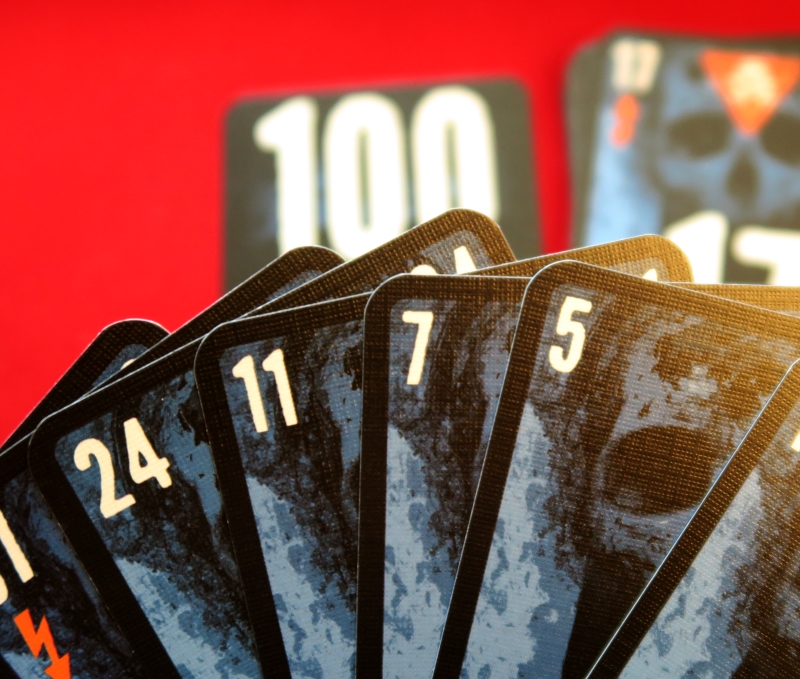
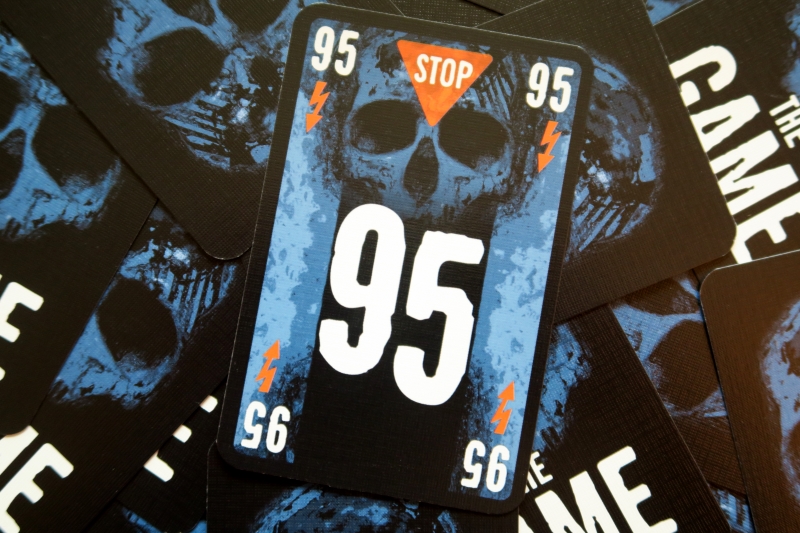
Ivory took his leave, and the remaining five managed one more game, this time of The Game.  This cooperative effort used to be a popular filler in the group, though it is a few years since it last got an outing.  The team have a deck of cards numbered from two to ninety-nine (in our case, from a copy of The Game: Extreme, but ignoring the special symbols), and play each card on one of four piles, two ascending and two descending.  There are just three rules:  the active player can play as many cards as they like, but must play at least two cards before replenishing their hand, and players can say anything they like but must not share “specific number information”.

The Game: Extreme
– Image by boardGOATS

There is the so-called “Backwards Rule” where players can reverse a deck as long as the card they play is exactly ten above or below the previous card played on that pile. The game ends when, either all the cards have been played onto the four piles, or a player cannot play a card. As is often the way, things started to go wrong from the start and pretty much kept going wrong.  The game finally cam to an end when, shortly after depleting the draw deck several people said there wasn’t anything they could play, and after the last possible card had been played the group had seventeen cards left.

The Game: Extreme
– Image by boardGOATS

Meanwhile, Jade, Plum and Byzantium had started out playing one of Jade’s acquisitions from the recent UK Games Expo.  Middle Ages (a reimplementation of Majesty: For the Realm) is a quick little game where players are the head of a fiefdom.  The idea is that players use their Lord-eeple (or perhaps that should be lord-muman) to take tiles, placing them on their player board and gain its rewards, which change depending on the type of the piece.  The game is based around a market, similar to that in Kingdomino, where tiles are arranged in ascending order with players taking tiles in that order and placing their Lord-eeple on their chosen tile from the next row.  Thus, the player has to choose between an early choice in the next round and a low value tile, or a high value tile, with less or no choice.

Middle Ages
– Image by boardGOATS

Players then carry out the tile’s special effect and take the associated income.  The payout increases payout the more tiles of the same type a player has.  Every four rounds, there is an event and the game ends after the sixteenth round when players lose ten points for each type of tile they don’t have in their city and the person with the most points is the winner.  This time, Byzantium went all in for Windmills (players with fewer Windmill tiles had to give him two Coins) while Jade built some Barracks.  The Barracks enabled Jade to attack everyone with fewer Rampart tiles than he had Barracks tiles forcing them to give him money.  Plum opted for a more balanced approach that allowed her to improve her income stream significantly due to the Churches and Palace buildings she played.

Middle Ages
– Image by boardGOATS

Plum’s Church gave her a coin bonus which she placed on a Village, which enabled her to repair a broken building. There was some discussion about whether that was voluntary or not, but it didn’t seem to be written like it was a choice. Although not planning for it, Plum did well out of the third Event, “Restoration”, giving her coins for having three broken buildings.  Jade, on the other hand, had interpreted the rule as compulsory and had therefore mended his broken building a turn earlier so wasn’t able to benefit from the Event.  It was close between Jade and Byzantium with Jade just edging it.  Someway ahead, however, was Plum, who finished with one hundred and thirty-one points.

Middle Ages
– Image by boardGOATS

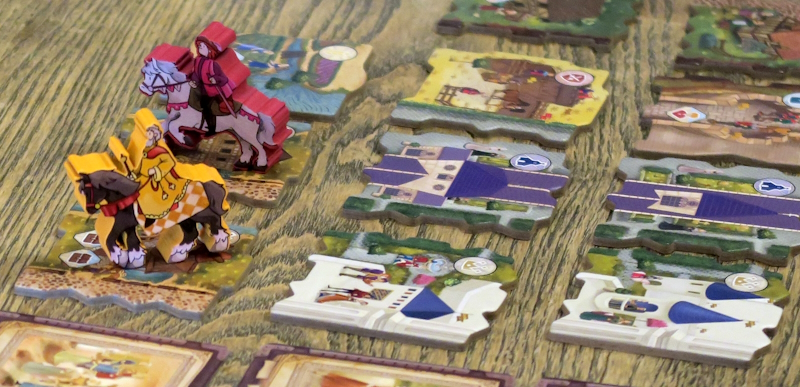
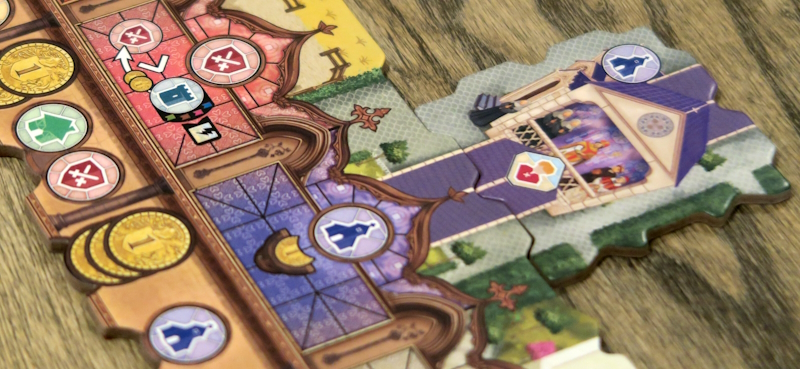
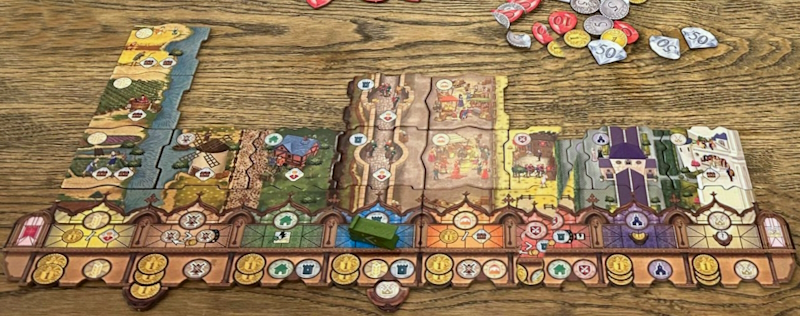
Middle Ages is a quick little game, and the trio then moved on to another UK Games Expo game, the slightly meatier Looot.  This is a game where players gather resources and capture buildings to develop their fjord, fill their longships and complete buildings to rack up victory points. The player with the most riches is crowned Jarl of the Vikings.  Like Middle Ages, this was new to both Plum and Byzantium, so after teaching the group got down to the serious pillaging. The game is played over several rounds until each player has played all their Vikings, giving a maximum of thirteen turns, each with a simple structure.

Looot
– Image by boardGOATS

First, a player places their Viking on a Resource tile on the central board adjacent to another Viking of any colour and take the Resource and place it on their personal board. If possible, they then capture a Building and place that on their board, take a Long Ship and also place it on their board, use a Shield, complete a Construction Site and finally grab a Trophy.  Plum felt she wasn’t going to be able to complete all three of her initial goal hexes, but hedged her bets and left space, just in case.  She used the “occupy the same space as another” option fairly early on to make sure she connected at least two Towers—Towers were the more difficult requirements for the two easier home hexes.

Looot
– Image by boardGOATS

Byzantium’s higher scoring home hex needed two Castles. He failed to complete one of his hexes, but did achieve the most difficult one giving him only slightly fewer points than the other two for this aspect. Jade thought the others were likely to take the spots he was aiming for a few times, but he needn’t have worried as a closer look at the others’ boards would no doubt have told him.  Byzantium got quite a good engine going early game with optimal placements of his first four to five Long Ships, which give bonuses for Resources and Buildings on the player’s map.  In order to complete a Long Ship it needs to be adjacent to three specific resources, however.

Looot
– Image by boardGOATS

Each Long Ship taken and left incomplete leads to a five point penalty, so it is important not to over commit, but equally players don’t want to leave prime location Long Ships for their opponents either.  Byzantium’s Long Ships made great use of the Looot he had pillaged, but for some reason he lost his way a little and ended up with a lot of low scoring Looot at the end of the game.  It felt really close, but Jade thought he would just sneak it as he had increased his Castle scoring to seven points per Castle and had he three of them.  In the end though, Plum ended up winning by quite a significant margin, her hundred and eleven were eight points more than Jades total for second place.

Looot
– Image by boardGOATS

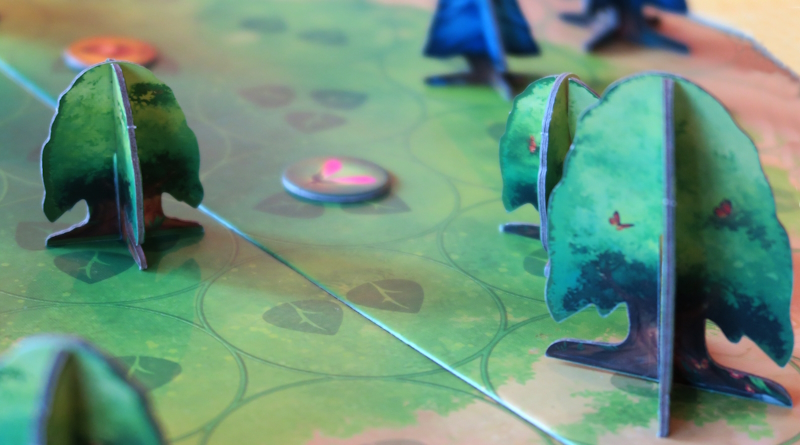
It was an evening for playing games from Expo, as Teal led Purple and Sapphire in a game of Photosynthesis.  This game is a few years old now, but Teal had been really delighted to find a copy for a very good price in the “Bring and Buy”.  In Photosynthesis, players collect light points based on the trees they have on the board and the direction of the sun gaining light points for any of their trees that aren’t in the shadow of another tree.  By collecting light, players can grow and further their species’ dominance over the forest.  Each round, the sun moves creating the direction of light for the round.   Players begin by placing two small trees on the board.

Photosynthesis
– Image by boardGOATS

Small trees collect one light point and cast a shadow over one space. Players can then spend light points to grow a tree, plant a new seed, and eventually harvest a tree once it has reached full size.  As well as a unique spacial puzzle, the game is quite beautiful with mechanics that fit the theme giving simple but meaningful choices.  Like a lot of puzzle-games, Photosynthesis can be quite hard to get one’s head round on the first play.  This time the game was really quite tight between Teal and and Sapphire, but Sapphire just had the edge, beating Teal by one point with final total of fifty-four.

Photosynthesis
– Image by boardGOATS

Lifeboats and Looot were still going, so Purple pulled out another Expo special, that first got a run-out last time, a game called Rome in a Day.  This is a cute little “I divide, you choose” game, where players draw five land tiles at random and place two buildings on tiles one and two. They then divide the five tiles into two groups—a bigger and a smaller one (in any ratio) and add a crystal to the smaller land set before offering the choice to their neighbour. During the four rounds the game is played over this neighbour alternates, right, left, right, left.  So, each round, players choose a set from their neighbour and these and the tiles they were left with are added to their domain.

Rome in a Day
– Image by boardGOATS

At the end of the game, any building that stands on or adjacent to land of its own colour will score for each tile in the group and then players score for the diamonds they have collected—the player with the most points is the winner.  It was a really close game, in fact, it was a tie for second place between Purple and Teal who both scored twenty-seven points. Sapphire did rather better, however, finishing with thirty-five points having concentrated on yellow Wheat Fields and green Olive Groves to the complete exclusion of blue-purple Vineyards and red Towns.

Rome in a Day
– Image by boardGOATS

Learning outcome:  Politics can be savage, but it is important everyone votes.

Next Meeting, 25th June 2024

Our next meeting will be on Tuesday 25th June 2024.  As usual, we will start playing shorter games from 7.30pm as people arrive, until 8pm when we will start something a little longer.  The pub is doing food, and the table is booked from 6.30pm for those that would like to eat first.

This week, the “Feature Game” will be Lifeboats (review, rules, “How to Play” video).  This is an older game and picked to mark the up-coming General Election as it features lots of voting as well as boating…

– Image by BGG Contributor PandaEskimo

And speaking of lifeboats…

Jeff was part of a group of survivors who were in a lifeboat when suddenly, one of the other passengers, a boy, fell out of the boat and straight into the drink.

Everyone watched as the boy struggled to float to the surface, when much to everyone’s surprise, Jeff jumped in. He grabbed the boy and brought him back to the lifeboat.

As Jeff and the boy clambered back over the gunwales, the other survivors were praising Jeff for his bravery.  That was when he turned around and said, “So, who pushed me in?”