Author Archives: nannyGOAT

11th June 2019

It was clear from the off that there were going to be two games, the “Feature Game” (the Exploits Expansion from Endeavor: Age of Sail) and something else.  That meant there were two things to establish, what the second game was going to be and who was going to play what. Red, on her first visit for ages, had brought the product of a recent successful KickStarter projectVillagers is a card game that has proven quite popular since fulfilment and Red thought the others would enjoy playing it.  Most people had played Endeavor and, although it is not usually a very long game, with the expansion there were a few people who ruled themselves out, ultimately making the groups relatively self-selecting.

Villagers
– Image by boardGOATS

There were two candidate games for the “alternative” table, but as Black pointed out, it was quite possible they would have time to play both if they got on with it, so they did.  The first game therefore was Villagers, a card-drafting and tableau building card game.  The idea is that players take it in turns to take villager cards from the “road”, then add them to their village tableau.  Different villager cards have different advantages; some give money at the end of the game, while others enable players to draw more cards from the road per round or place more cards in their village per round.

Villagers
– Image by boardGOATS

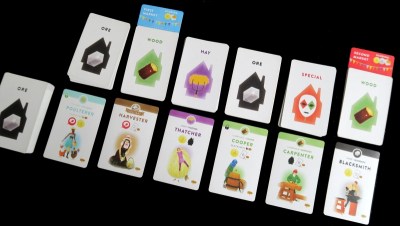
The clever part of the game are the conditions required before cards can be played.  For example, a Blacksmith cannot be added to a village unless there is a miner already present.  The cards are then played in a tree structure such that the Blacksmith is placed over the Miner card, superseding any icons depicted on it.  There are four types of card, basic villagers (the start of a tree), standard villagers (can only be played on other villager cards), solitary villagers (cards that are not played on other cards and do not support other cards, but are useful in their own right), and special cards that allow players to do special things and break all the rules.

Villagers
– Image by boardGOATS

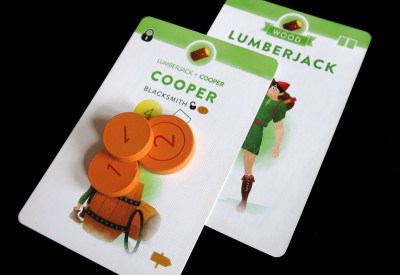
The tree structure isn’t the only dependency players have to watch for when placing cards in their village; many villager cards, especially the more valuable ones, require a payment of two gold to another specific villager.  The required villager depends on the card, but it could, for example, be a Cooper.  The money then sits on that villager card until a scoring round.  Ideally, the Cooper would be in the player’s own village, so that the money ultimately remains theirs.  If nobody has a Cooper in their village though, the money goes to the bank.  The worst situation is where the active player does not have the necessary Cooper and someone else has one in their village, as then the money is given to the opponent,
Villagers
– Image by boardGOATS

There are two scoring rounds, one at the end, and one a third of the way through – only the simple “gold” scores in the latter, while the final scoring is more comprehensive and includes conditional scoring cards leading to potentially high scores.  So, some cards just give gold, while others give an amount of gold for, say, the number of food or cottage icons in the village.  The game started quite slowly as people struggled to get their heads round the requirements for playing villager cards.  It gradually became clear that increasing the number of cards drawn from the road per round by getting food is critical, an aspect Pine and Lime, failed to appreciate early on in the game.  Players can also get a bit stymied if they have high value cards, as they generally don’t then have anything else.  Thus, Pine’s village with with a jeweller and nothing much else was pretty useless as the Jeweller gives money (and quite a lot of it too), but only twice during the game.
Villagers
– Image by boardGOATS

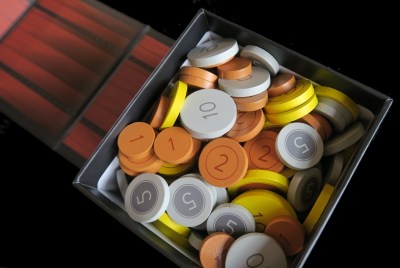
The tree structure seemed to cause some frustration too, as it’s not helpful if one player has a Milkmaid and needs a Grazier (Pine, say) and the person next to them has a Grazier and needs a Milkmaid (not Pine, obviously…).  While everyone seemed to struggle, Purple just collected lots and lots of villager cards which she ultimately managed to add to her village giving her lots and lots of money totalling a score of seventy-one.  Pine, despite all his moaning about the poor quality of his village, came second with sixty-four.
Villagers
– Image by boardGOATS

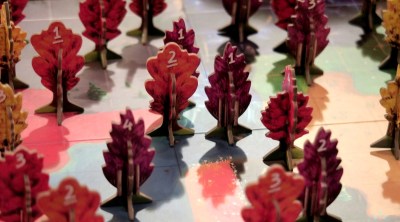
As Endeavor was still underway, the group moved on to the alternative game, Bosk.  This was an “Expo Special”, picked up a couple of weeks back at the UK Games Expo at the NEC in Birmingham.  Bosk is an archaic term for a small wood or thicket and in the game, players spend the spring, carefully growing their trees, scoring points as hikers enjoy travelling the trails during the summer months.  When autumn comes, leaves fall in the ever-changing direction of the wind, guided to cover the terrain and other players’ leaves. Points are awarded in winter for the most coverage of each area in the park.  So the game is played in two parts, the first involves placing trees on the game board at the intersections of the grid (spring).
Bosk
– Image by boardGOATS

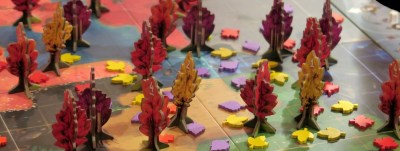
Each player has eight trees, each numbered one to four.  At the end of spring, each row and column on the board is scored with the player with the highest total in each row or column scoring two points and the player in second place in each case gets one point.  The player in last place at this point (in our case, Pine as everyone else was joint first), chooses where to place the wind guide and then chooses one of their number one tree to start shedding its leaves.  As it does so, the player chooses one of their “leaf cards” (numbered one to eight) to decide how many leaves it drops.  Little wooden leaf-eeples are then placed to form a path from one of the squares next to the tree in the direction wind is blowing, dropping as many leaves as given on the tile, after which, the tree is removed.
Bosk
– Image by boardGOATS

The wind blows eight times (twice in each of the four different directions), and in each case, the player who went last last time, goes first next time.  When paths cross, a leaf is placed on top of previously placed leaves, with a penalty of one leaf paid to the “bank”.  Players can also place a squirrel which means players cannot place anything on top, so much hilarity ensued when Pine commented, “I think I’m going to have to put my squirrel down,” to which someone on the next table asked, “Why? Is it ill?!?!”  When all the trees are gone, players count up the number of leaves in each of the scoring areas, with five points going to the player with the most leaves in a region, three points to the player with the second largest number of leaves in an area, and if a player is the only one with leaves in an area they get all eight points.
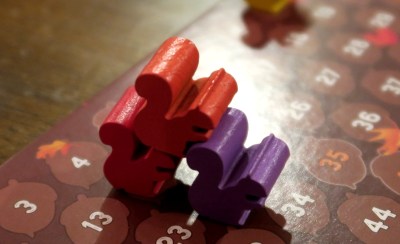
Bosk
– Image by boardGOATS

Bosk is really beautiful little game and plays quickly with a nice feel.  For a really very simple idea there is an awful lot of strategy to consider making it a really solid little game.  This was its first outing on a Tuesday, but it is certain it will get more.  This time round, Pine won with thirty-eight points, but he was only just ahead of Lime who finished with thirty-six.  As they packed up Pine commented that he might have screwed up the scoring or maybe he just did much better on his leaf strewing…  Meanwhile on the next table, Endeavor was just coming to an end as well.  Playing with the recent Commodore edition, this is another beautifully produced game, that has actually had a few outings in this version and the original edition.

Endeavor: Age of Sail
– Image by boardGOATS

The game is played over eight rounds, each consisting of four basic phases: Build, Populate, Payment and Action.  There are four technology tracks roughly corresponding to each phase, which dictate what a player can do during that phase.  For example, how far along the building track a player is dictates what they can build: the further along they are, the more buildings they have to choose from.  Similarly, a player who is further along the population (or culture) track, can move more people into their harbour for use in the Action phase.  Payment also increases the number of people available as it moves population markers from the action spaces into the harbour.  More importantly, however, it makes the action spaces available again for use later in the round.

Endeavor: Age of Sail
– Image by boardGOATS

The first phase consists of passing round the tray of buildings rather like a box of chocolates, but after that, the second and third phases are more or less carried out simultaneously.  The guts of the game, however, is the Action phase.  In this round, players can place population markers on their buildings to activate them and carry out one of the five actions:  Colonise, Ship, Attack, Plunder Assets, and Pay Workers.  These are generally based round the central board which is divided up into seven regions representing the seven continents.  Each continent comprises several cities, a shipping route and a deck of cards. At the start of the game there is a Trade token on each city and each shipping space, but also on many of the connections between cities (these are taken if a player occupies both cities either side).

Endeavor: Age of Sail
– Image by boardGOATS

Players cannot Colonise a city until they have a presence in a region, which they can do by Shipping.  In this case, they activate their building that provides the shipping action by placing one population marker on it, then place a second population marker on the shipping track.  Thus, players need to have two markers available to be able to Ship.  The second population marker is placed in the furthest unoccupied space from the deck of Asset cards in the region of their choice, and the player takes the Trade token on that space.  Most trade tokens add to one of the four technology tracks, though a small number provide one off actions instead.
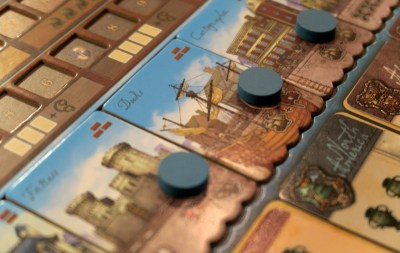
Endeavor: Age of Sail
– Image by boardGOATS

Players also need two population markers to Colonise (one for the action and one to occupy the city) and three if they are going to attack an already occupied city (one is collateral damage).  Once a player has a presence in a region they can take an Asset card, so long as the number of the top card is not higher than the number of population markers that player has in the region.  This is one of the few areas where there has been a rule change between this edition and the first edition:  it used to be necessary for the shipping track to have been completely occupied (i.e. the region was “open”) before the Assets of a region could be plundered.  This rule changed with the new edition, and now players can plunder at will, as long as they have a presence in the region (they still cannot Colonise until the region is “open” however).

Endeavor: Age of Sail
– Image by boardGOATS

Essentially, that’s all there is to the game, but the rules are deceptively simple and, for a game with so very little randomness (only the layout of the Trade tokens on the map), there is a surprising amount of variability.  However, with the new interest in the game that came with the new edition, a new Expansion primarily comprising a new set of buildings is currently subject to a crowd funding campaign.  The new, Commodore edition came with a couple little extras though, Exploits and Charter Companies, and we wanted to try more of these before considering any new buildings. The Exploits are special conditions that only come into force when both of the regions involved are opened.  The idea is that three of these are drawn at random at the start of the game, however, we picked three that were not used last time we played on a Tuesday:  Spanish Main (North & South America); Manila Galleons (Far East & North America), and Spice Trade (Africa & India).

Endeavor: Age of Sail - Charter Companies
– Image by boardGOATS

This time, we additionally made the Charter Companies available for the first time.  These are special, powerful buildings that a player can build (instead of the usual buildings) as long as they have at least six of their population markers in the given region.  Green began by going for cards and targetted North America as it appeared on two of the Exploits and he thought everyone else would be keen to help him out.  Blue, who normally focusses on getting buildings first decided to try something a little different and instead went for Population in a very big way.  This meant she really struggled getting good buildings, but made up for it with lots of Asset cards.  In order to keep them, she had to focus on increasing her influence (the blue and white shields), but this meant she neglected both the building track and Colonising.  Black also missed the “building boat” and without the more powerful actions that come with the more advanced buildings, really struggled to make any headway.
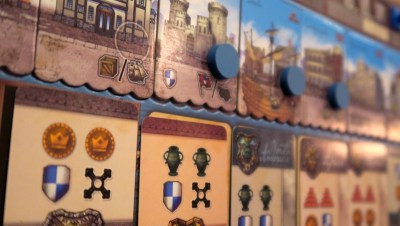
Endeavor: Age of Sail
– Image by boardGOATS

Ivory had been a little sceptical about playing having played the original edition where the maps were not as “tight” making it less of a struggle.  This time it was clear that that was not going to be a problem.  Accelerating his Build ability meant that Ivory was able to take a Cartographer which gave him a double Ship action which he used to great effect getting a particularly strong presence in Africa, India and the Far East.  This was critical because with the exploit activated, players with one marker in the open sea space for Africa would score an extra point for each disk of his on the Africa shipping track.  Moreover, this scoring was also applied to India and the Far East, making very lucrative for him indeed.

Endeavor: Age of Sail
– Image by boardGOATS

Ivory was quite convinced that Blue had the game in the bag as she had a lot of points from her Asset cards, however, she knew she had a shortage of Colonies compared to everyone else.  As things hadn’t been going according to plan for Green, and nobody seemed to be targetting Asset cards in Europe, he resorted to Slavery so it seemed appropriate that he wasn’t quite in the running for the top spot.  Blue who was having a bit of a blonde day, recounted her scores three times, to convince herself that it was in fact a draw as she finished level with Ivory on sixty-nine points.  Although both Bosk and Endeavor finished at much the same time, it was too late to play anything else, and as the group settled their bills and packed up, someone pointed out that the next meeting is 25th June – exactly six month till Christmas.  And with that cheery thought, everyone went home.
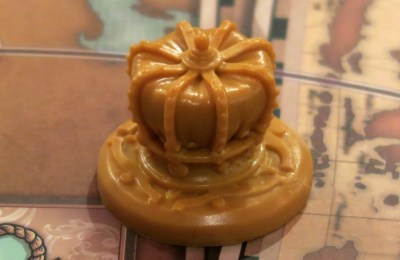
Endeavor: Age of Sail
– Image by boardGOATS

Learning Outcome:  Some villages are very inbred.
Next Meeting – 11th June 2019

Our next meeting will be on Tuesday, 11th June, at the Horse and Jockey pub in Stanford-in-the-Vale. As usual, we will be playing shorter games from 7.30pm as people arrive, until 8pm when we will start something a little longer.

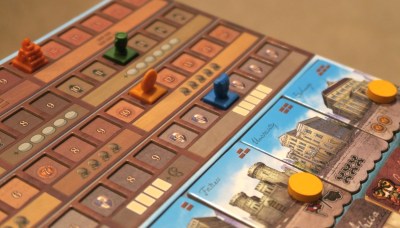
This week the “Feature Game” will be the Exploits Expansion from Endeavor: Age of Sail. Each player represents a growing empire engaged in a glorious endeavour to expand their influence and status at home and across the great oceans of the world. Players earn glory by increasing their scores in Industry, Culture, Finance, and Politics, as well as by occupying cities, controlling connections between cities, and by holding certain Asset Cards and Building Tiles. This deluxe edition of one of our favourite games, Endeavor, was released last year with an expansion, the Exploits, which give players another way of getting points. Although some of the group have played it with the Exploits, we would like to give it another try before the KickStarter for the new, Age of Expansion starts later this month.

Endeavor: Age of Sail
– Image by boardGOATS

And speaking of Captain Cook…

Jeff was at chic gathering and struggling to make polite conversation. The person he was talking to was a psychiatrist, so, after a minute or two, Jeff asked him, “Would you mind telling me, how you detect a mental deficiency in somebody who appears completely normal?”

“Nothing is easier,” the doctor replied. “I ask him a simple question, which everyone should answer with no trouble at all. If he hesitates, that tells me just what I need to know.”

“What sort of question?” Jeff asked.

“Well,” replied the psychiatrist, “I might ask a question like ‘Captain Cook made three trips around the world and died during one of them. Which one?'”

Jeff paused a minute and thought for a moment before he replied, “You wouldn’t happen to have another example, would you? I must confess I don’t know much about history.”

28th May 2019

While Pink, Blue and Khaki finished their pizzas, the other early arrivals played a quick game of Coloretto.  This is a relatively short game of set collecting which is very popular with the group; it was new to Lime though so needed a quick rules explanation.  The idea of the game is that on their turn, players can either pick up a chameleon card from the face down deck and add it to a “truck”, or take a truck (passing for the rest of the round).  The innovative part of the game is the scoring which uses the triangular number sequence (one point for the first card, three points for two cards, six points for three cards etc.), with positive points for three sets and negative for the rest.  Thus, players need large sets in three different colours and small sets in all the rest.

Coloretto
– Image used with permission of BGG contributor punkin312

With five players, it was relatively hard to make trucks particularly unappealing to everyone, so the negative scores were kept to a minimum.  It was quite close at the top as a result, with Black, Lime and Mulberry all in the running.  Lime finished with the highest score for his sets totalling thirty, with Mulberry a handful of points behind, but Black had four bonus points and no negatives.  In the end, Lime pipped Black by a single point with Mulberry just a couple of points behind that.

Coloretto
– Image by BGG contributor SergioMR

With Coloretto over, everyone finished with their supper and the stragglers all arrived, there was the usual discussion over who would play what.  The “Feature Game”, Viticulture with the Tuscany expansion, was always likely to take most of the night, so the question was really who was going to play that and what else was on offer.  One of the options suggested was Ticket to Ride with the India map, which was described by Pine as an game where you “just pile people on top of the trains and pack the inside with goats!”  Clearly none of our GOATS fancied the inside of a hot carriage and the discussion continued as Ivory, Pink and Blue started setting out Viticulture and Mulberry (having spent some time as a oenologist) dragged Khaki along for the ride.

Viticulture
– Image by boardGOATS

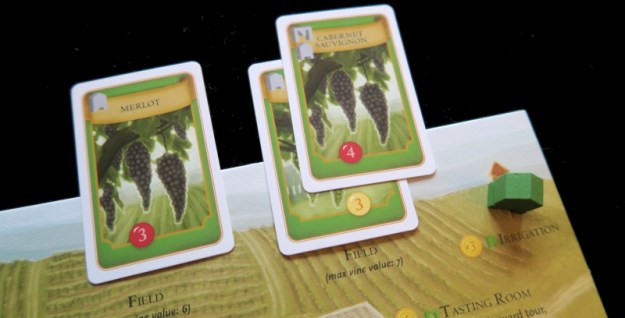
Viticulture is a worker placement game where players plant and harvest grapes then make and trade wine.  Although there is nothing especially innovative about the game itself, it is an exceptionally good example of its type and is considered bit of a modern classic as a result.  There are two editions, the original Viticulture, and the “Essential Edition“.  We usually play with Essential Edition which includes some of the smaller expansions from the original Tuscany (like the Mama and Papa set up cards), and, as the revised edition, is considered to be the definitive version.  In this base game, the actions are split into two seasons, Summer and Winter, with visitor cards arriving in the Autumn and extra cards arriving in the Spring.  Visitor cards come in two varieties, yellow Summer and blue Winter cards which are played in the different seasons as a special action.

Tuscany
– Image by boardGOATS

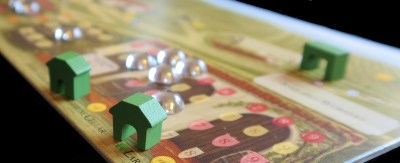
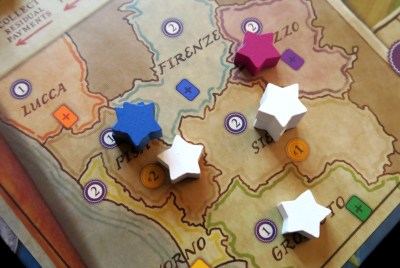
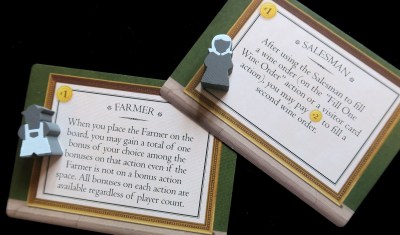
The Tuscany expansion messes about with this arrangement with actions in all four seasons, so players have to eke out their meagre supply of workers to last the whole year.  In addition to the larger, “expanded” and restructured board, the Tuscany expansion also adds an extra deck of building cards that players can use to create a personal action space or increase the effectiveness of other actions.  These can be very powerful if used effectively.  Additionally, there is a “influence” board that depicts the regions which players can place “Star-eeples” on to get an instant bonus.  If they have the majority in a given region at the end of the game, they also get a small number of bonus points. Finally, Tuscany also adds workers with a special ability, these cost a little more to train, but if used efficiently can more than pay for that over the course of the game.

Tuscany
– Image by boardGOATS

The other major difference between Viticulture and Tuscany is that the game tends to start slower, with players building their vineyard getting all the pieces of their engine together.  The game is not terribly complicated in terms of taking actions, but planning is tough and as people new to the game, Mulberry and Khaki struggled a bit to get going.  Blue, on the other hand, was out of the traps like a rabbit and got vines planted and harvested with remarkable speed, but then promptly stalled as she desperately needed money, more contracts, and more space in her wine cellar.  In contrast, Ivory and Pink were slower to get going because they were carefully planning their strategies.

Viticulture
– Image by boardGOATS

In the early part of the game, nothing much seemed to happen.  Blue’s simple, but fast start, got her well in front, while Khaki began by actually going backwards, sacrificing victory points to try to build up his team of workers.  Everything else was pretty quiet though, as Ivory was collecting cards and Mulberry concentrated on building.  Pink started with the intention of building an irrigation tower and no trellis (to save money), but that was quickly scuppered when every vine he draw after the first required a visit from “Mrs. Trellis of North Wales“.  There were plenty of sarcastic comments from the next table as they felt they were well on the way to finishing, while it looked like nobody had made any positive progress except Blue, despite playing for well over an hour.

Tuscany
– Image by boardGOATS

Then suddenly, things began to happen.  Pink had sorted out the vine situation, and had purchased a large cellar (to go with the medium cellar he’d started with) which meant he could fulfil some valuable contracts, increasing his residual payments at the end of the round giving him a substantial income in a game where money is always very tight.  Then Ivory began his charge for the finish, setting his Wine Press and Guest House to work.  He was particularly adept at leveraging his Guest House for points, finding ways to take Visitor cards from other players and turn them into points, and then playing other Visitor cards that enabled him to repeat the action.  Mulberry built an Academy that would give her money whenever another player trained a worker, but it was too late in the game as most people had finished training by that point.  Khaki’s Fountain was more effective though giving him money every time someone else gave a tour.

Tuscany
– Image by boardGOATS

As the game approached the end, the question was whether Blue was going to get over the line before Pink and Ivory, really started raking in the points.  With her trained Salesman who enabled her to full-fill two contracts as part of one action, but had proved fairly useless for most of the game, it looked like she might just make it.  Pink was coming up fast and screwed up Blue’s plans on the influence board just for good measure.  Khaki and Mulberry suddenly started to make real progress as well, with Khaki making a rapid shift from negative points to lots of points over just a couple of turns.  It was Ivory though, who stormed ahead, full-filling several orders in the final round as well picking up an extra five bonus points from the influence board.  He finished with a grand total of forty points, ten more than Blue in second place who, in turn, was a single point ahead of Pink.

Viticulture
– Image by boardGOATS

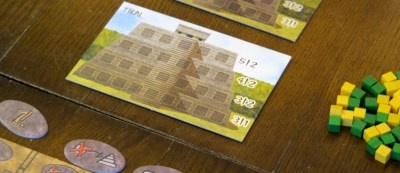
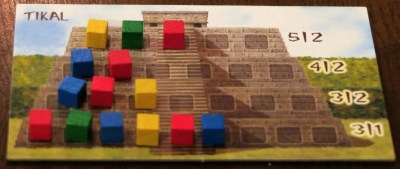
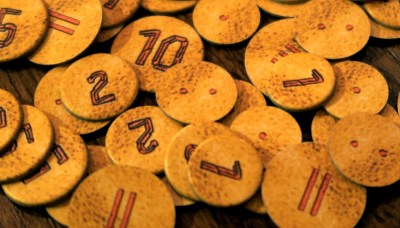
Meanwhile, the second group were playing Maya, an older game where players are taking part in the construction of pyramids in places like Chichen Itza and Palenque.  The game is a combination of semi-blind bidding mechanics, special actions, and building up “influence” by building pyramids in the ancient Mayan civilization.  The greater the influence, the more gold players get from the Mayan leaders and the aim of the game is to have the greatest pile of gold.  Each player starts with an identical hand of cards, ranging from three to eight, representing workers.  Players start by using their worker cards to bid for actions.  These actions come with a pile of stones, and this is one of the clever parts of the game – players must have enough workers left to move the stones they win or forfeit some of their prize.

Maya
– Image by boardGOATS

Players then take turns placing them on the different pyramid locations, placing one stone at a time and starting on the lowest levels.  In general, players can only place a single stone per turn, though they can place a second stone if they discard a third stone back into the supply (quarry).  When a player completes a level of a pyramid and has the majority of stones on that level, they get a free stone from their supply to place on the next level of that pyramid, thus, clever players can discard a stone to play two, and then receive that discarded stone back immediately to place it higher.

Maya
– Image by boardGOATS

Once all the stones have been placed, the pyramids are evaluated. Each level of a pyramid is scored separately, and only those in first and second place receive gold. Where there is a tie, all players get the gold as if they had placed first.  At the end of the round, the pyramids decay, and all players who scored gold on any level of has to return one block from that level back to the supply. If this leaves a player with no blocks on a level, all of that player’s stones on higher levels also go back to the supply. The game ends after three rounds.

Maya
– Image by boardGOATS

Everyone started off building in Tikal, while Pine and Lime developed Copan and Black and Purple struggled in Uxmal.  Palenque was all but ignored by everyone except Purple until the last round when everyone joined her because they were unable to build in the other areas.  It was a very tight game and the nature of it meant nobody knew who was wining until the totals had been calculated.  There was just six points between first and last, but it was Pine who came out on top this time, one point ahead of Lime who took second place.

Maya
– Image by boardGOATS

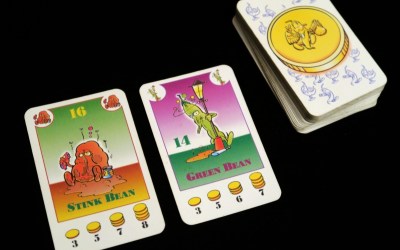
Viticulture was still going on, so after enjoying a bit of heckling about how the scoreboard hadn’t changed, the group decided to re-visit Bohnanza, this time with an English deck, to reduce Lime’s confusion.  This is one of our most played games, with almost everyone very familiar with it.  The key part of the game is that players must plant their bean cards in the order they receive them.  The only way this fundamental rule can be violated is by trading bean cards with other players.  As everyone knows the game so well, it is often very tight with frequent multi-player ties.  This time it was also very close, but there was more spread than there often is.  On this occasion, the tie was for first place, and it was Black and Pine who finished top with a total of twenty.

Bohnanza
– Image by boardGOATS

Learning Outcome:  Sometimes slow and steady wins the race.

UK Games Expo 2019 – Not as Hot as Last Year, but that’s a Good Thing…

Last weekend was the thirteenth UK Games Expo (sometimes known as UKGE, or simply Expo), the foremost games event.  Every year it grows bigger, and this was no exception. Historically, Expo is focused on gamers playing games rather than publishers selling new games, however, the exhibition aspect has been growing, and this year there were two halls full of vendors selling games and demoing wares.  Last year, there was an issue with the air conditioning on the Friday which, combined with the thousands of “hot water bottles” walking about looking at games, made it unbelievably hot.  This year, working facilities and a little more space made it much, much more pleasant, although Saturday was busier than ever!

UKGE 2019
– Image by boardGOATS

This year the hot games included Wingspan, copies of which were flying off the slightly wobbly shelves following it’s recent Kennerspiel des Jahres nominationFoothills, a two player Snowdonia game by UK designers Ben Bateson and Tony Boydell (designer of the original Snowdonia, Ivor the Engine and Guilds of London) was another extremely popular game.  Foothills is produced by Lookout Spiele, but there were sixty copies available from the designer’s Surprised Stare stand, which sold out in less than forty minutes (though there were a small number of copies to be had elsewhere for those that kept their eyes peeled).

Foothills
– Image by boardGOATS

Surprised Stare were also demoing Foothills and another Snowdonia-based game, Alubari, which is due for release later in the year (hopefully).  There was a new Ticket to Ride game available (London) as well as another instalment in the Catan series (Rise of the Inkas); the new expansion for Endeavor: Age of Sail was also available to see (coming to KickStarter later in June) and “old” favourites like Echidna Shuffle were there to be played and bought too.  There were some very good deals to be had from some of the third party sellers as well, including some of the Days of Wonder games for just £15.

Horticulture Master
– Image by boardGOATS

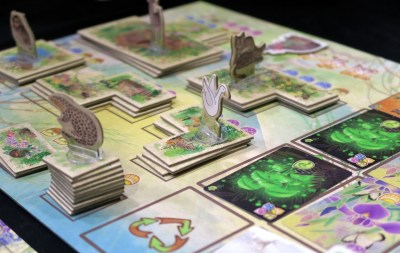
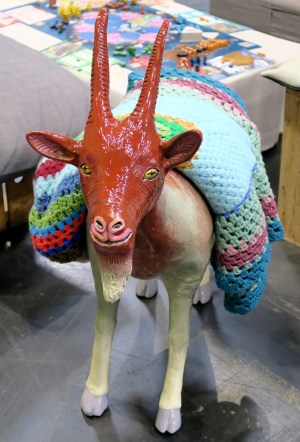
One of the reasons for attending conventions is the opportunity to see and play games that are not available elsewhere.  One example was Horticulture Master, a cute little Taiwanese game with beautiful artwork, which combined card collecting elements from Splendor with Tetris-like tile laying from games like Patchwork and Bärenpark.  Another cute little game was Titans of Quantitas from Gingerbread Games, a clever two player strategy game based round the old fashioned digital rendering of the number eighty-eight.  What really made this game special though was the fact that the stall was guarded by a fiberglass goat!  Not everything was quite as wholesome though, as one Games Master was thrown out and banned for life for including content in a role-playing game that allegedly involved sexual violence and played on the shock factor.  This is definitely the exception rather than the rule, however, and UK Games Expo is a great place for family and friends to spend a weekend.

UKGE 2019
– Image by boardGOATS

Boardgames in the News: The Million Pound Lost Lewis Chess Piece

The iconic Lewis Chess pieces were found nearly two hundred years ago in the Outer Hebrides.  Also known as the Uig Chess pieces, they were made in the twelfth century and were carved from walrus ivory and whale teeth.  The “set” consists of seventy-eight pieces, most of which are exhibited at the British Museum, with the rest housed at the National Museum of Scotland in Edinburgh.  The British Museum suggests the pieces were made in Norway and belonged to a traveling merchant who lost them on his way to Ireland.

Lewis Chess men
– Image from britishmuseum.org

Although the collection is often referred to as a Chess “set”, the pieces show a large variation in size suggesting they may actually comprise several different sets, albeit with several pieces missing.  Six months ago, one of these turned up in a drawer in a family home in Edinburgh.  The walrus tusk “Warder” (the equivalent of a Rook) had been bought in 1964 for £5.  Now that authenticity has been confirmed, it is due to be auctioned at Sotheby’s on 2nd July and is expected to fetch up to a million pounds.  The original hoard contained a total of ninety-three artifacts, the whereabouts of four of which remain unknown. The moral?  Have a clear out – you never know what may be hiding in your sock drawer!

Lewis Chess men
– Image from Sotheby’s

Boardgames in the News: Is Rape a Suitable Subject for a Game?

If asked whether rape is a suitable subject for a game, most people would answer, “No, of course not!”  But not all, it would seem.  Sadly, the UK Games Expo made the national news yesterday when one individual was thrown out and banned for life thanks to the unsuitability of the material he was presenting.  The game in question was Things from the Flood, a role-playing game or “RPG”, where the players take on the roles of young teens in the 1990s where players were trying to balance everyday life with solving mysteries with their friends in an alternate time-line.  Unfortunately, the game master concerned (widely rumoured to be Kevin Rolfe), saw fit to include kidnap and gang rape in the scenario he was leading.  Perhaps worse, he allegedly found the shock-factor entertaining.  The floor manager, John Dodd investigated and the organisers released an official statement saying:

“The content was not set out in the game description. If it had been included in the submission it would have been rejected as unacceptable even for a game with an 18 rating. … We immediately halted the game the GM was currently running and cancelled all of the games he was due to run. …  He has also been banned from submitting any games for the foreseeable future.” 

The unequivocal nature of the response from UK Games Expo clearly demonstrates that sexual assault is not a subject matter that is acceptable for games at the event, nor indeed in the wider hobby.  However, it has undoubtedly done damage, not only to the convention (where there are many children and young people present), but also to the image of board gamers in society where there is already the perception that gaming is full of misfits and weirdos with a personal hygiene problem.  This is very sad given how family-friendly, sociable and open most gamers and game groups are.

UKGE 2018
– Image by boardGOATS

UK Games Expo 2019

Once again, gamers are converging on Birmingham for three days of fun at the thirteenth UK Games Expo (sometimes known as UKGE, or simply Expo).  This event is focused on gamers playing games rather than publishers selling new games, so has a different feel to “Essen” in October. The event used to be held in the NEC Hilton Metropole, but now also occupies a large chunk of the NEC and as the event expands it is becoming increasingly commercial.  In addition to Euro Games, there are a lot of cos players miniatures games, and war games, with tournaments as well as plenty of “open gaming” space, talks and play testing.  Several of the GOATS are planning to go this year, some for just a day, others for several days, and it is certain that it will be a fun weekend.

UKGE 2019
– Image from
ukgamesexpo.co.uk

Next Meeting – 28th May 2019

Our next meeting will be on Tuesday 28th May, at the Horse and Jockey pub in Stanford-in-the-Vale.  As usual, we will be playing shorter games from 7.30pm as people arrive, until 8pm when we will start something a little longer.

This week the “Feature Game” will be Tuscany, the expansion to the Viticulture, a worker placement game about planting vines, harvesting grapes and making wine.  The Tuscany expansion provides changes to the seasons wherein the actions occur in and provides a couple of extra mechanisms for getting points.

Tuscany
– Image by boardGOATS

And speaking of wine…

Jeff was driving down a country lane when he met a car coming the other way.  Unfortunately both drivers were going a bit quickly and as they came round a blind corner they collided.  Both cars involved were completely wrecked, but amazingly neither Jeff nor the young lady driving the other vehicle were hurt.

After they climbed out of their cars, the young lady said, “Just look at our cars! There’s nothing left, but fortunately we are both unhurt. This must be a sign from God that we should meet and be friends and live together in peace for the rest of our days.”

The lady was very good looking and her car looked very valuable, so Jeff, thinking his luck was in, replied, “I agree with you completely.”

The woman continued, “And look at this, here’s another miracle. My car is completely demolished, but this bottle of wine didn’t break.  Surely God wants us to drink this wine and celebrate our good fortune.”

She handed the bottle to Jeff, who, mentally checking whether it was his birthday, opened it, drank half and then handed it back. The woman took the bottle, screwed the cap back on and handed it back to Jeff.

Jeff looked a little confused and asked, “Aren’t you having any?”

The woman replied, “No. I think I’ll just sit here and wait for the police…”

14th May 2019

A lot of the usual suspects weren’t about, so it looked like it was going to be a really quiet  night.  This was due to be offset by Pink, who was putting in one of his rare appearances from the frozen north, but at 6pm he was stuck at Leicester Services with a “limping” car.  While Pink’s arrival looked in doubt, he also lost the unofficial title of “furthest traveled” with Mulberry bringing along her other-half, newly arrived from California.  He had been awake for some forty hours traveling, so was reluctant to actually play anything, but we really appreciated his company all the same.  We were just starting the “Feature Game” when Pink arrived (thanks to a couple of very nice AA men), so as he scoffed his pizza we went through the rules for Powerships.

Powerships
– Image by boardGOATS

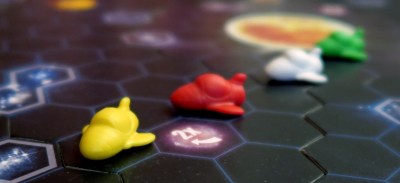
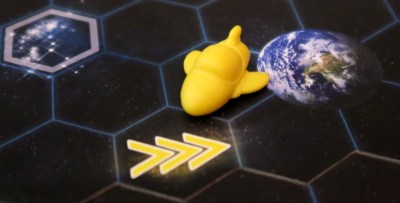
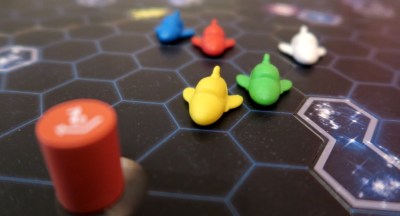
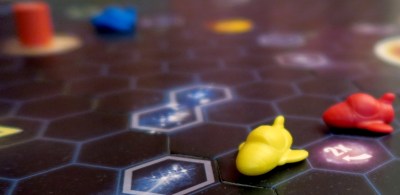
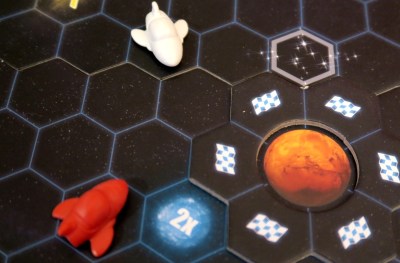
Powerships is not a complex game:  Black described it as “roll and move”, which is a little harsh if arguably accurate.  The game is played on a hexagonal grid representing the solar system and featuring the planets.  On their turn, players may take or return a single die, and then re-roll as many of their dice as they choose.  They may then rotate their space ship sixty degrees left or right and then move it the total number of spaces shown on their dice.

Powerships
– Image by boardGOATS

The movement rules are slightly more complex.  A crash is hitting a planets, a dust cloud or the “Trumpian” wall surrounding the solar system (there is a problem with alien immigrants in 2345 apparently).  Players may only crash if they have no choice, and if they crash, the penalties are severe: they must go in the direction that means they travel the furthest (even if that is unfavourable), they lose all their dice, and they move their damage maker left by a space for every unused movement (leading to a reduction in the maximum number of dice they can have).

Powerships
– Image by boardGOATS

Although ships can pass others, spaces cannot be occupied by more than one ship—they don’t crash though (fortunately), they just pull-up short, just behind. There are a number of special spaces:  yellow chevrons apply drift to a ship as they pass; space currents cause ships to change direction and warp speed and hyperspace enable ships to briefly go twice as fast.  What really makes the game, however, is the course:  players have to travel round three planets in a specific order and in a particular direction as marked by three orange bollards, before arriving at the finishing planet.

Powerships
– Image by boardGOATS

This time, as it was Tuesday, Mercury was the  starting planet. Random chance selected Purple as start player, but as spaceship placement is in reverse player order, Mulberry chose pole position and Blue placed her ship next.  Perhaps it was because he was still focusing on his pizza or maybe he decided to be a gentleman, but Pink placed his ship on the opposite side of the starting planet and just for good measure pointed it away from the first corner on Venus so that he was not forced to crash into Mercury on his first turn.  Green, Lime, Black and Purple placed their ships in turn order, with their start positions increasingly obstructed until Purple was left with no choice but to start on the planet itself surrounded by everyone else, and hope to avoid rolling a one on her first turn.

Powerships
– Image by boardGOATS

Purple was lucky and managed to escape from the ring of ships, parking herself squarely in front of Mulberry.  As everyone else rolled their first die and moved towards the first corner, the unfortunate consequences of Pink’s initial position became apparent.  Rolling a three, forced him to move his ship away from the first bollard and directly towards the walled edge of the solar system, where he stayed for the next few turns, trapped between some space dust, Saturn and a hard place, shuffling about in a strange many-point turn.

Powerships
– Image by boardGOATS

The rest of the fleet made good progress towards the first check-point, Venus, and then Blue foolishly rolled an extra dice and was forced to head off-course.  Green and Mulberry were pulling away a little as the pack headed into the farthest reaches of the solar system and approached the second corner located on Uranus, and that was where the mayhem really began. Purple went the wrong way round the bollard, so had to go back for a second shot; Mulberry hit the planet head on at full speed and was forced to maneuver slowly, and carryout repairs before she could build up speed again; Lime overshot and had to pirouette to get back on course while Black carefully dodged the debris, but struggled to find a clear course.

Powerships
– Image by boardGOATS

Meanwhile, Green sailed on serenely, finding the unobstructed path to the third marker on Pluto, on his first attempt.  It was perhaps just as well, as he was so busy advising Lime and fiddling with his phone that he missed his turn.  He suddenly realised he had missed out, but as everyone else unanimously agreed that turn order had been scrupulously observed and it was all in his imagination, he had no choice to but to acquiesce.  When Pink was about to taking his next move there was much hilarity when Green suddenly noticed he had missed out again! It was much harder for everyone to deny him a second time, and Green paid more attention for the rest of the game.

Powerships
– Image by boardGOATS

Pink had finally escaped from the combined gravitational pull of the starting planet and the  wall and Blue was moving back up the field as everyone else struggled to avoid calamity.  As Green headed towards the finish at Neptune, Black and Blue engaged in fierce struggle for second place (which Blue ultimately won by one turn) and Lime led the rest of the pack round the final corner.  It was coming into the home straight that Lime snatched defeat from the jaws of victory when he failed to decelerate and careered off for what looked like a second lap.  Mulberry was the beneficiary closely followed by Purple, with Pink and Lime bringing up the rear in what had been a mad, chaotic race, but a lot of fun.

Powerships
– Image by boardGOATS

With Powerships taking more than an hour longer than the advertised half-hour, Mulberry signed Pine’s birthday card and then took her jet-lagged husband home leaving six.  Inevitably as Pink was around, someone raised the subject of Bohnanza.  Other games were discussed, including 6 Nimmt! and Saboteur, but someone pulled a face for all of them, and in the end as Lime hadn’t played it, “Beans” won the day. This is one of our all-time favourite games, and everyone else was very familiar with it, especially Pink who claims to dislike the game while owning several copies of it in multiple languages.

Bohnanza
– Image by boardGOATS

Black explained the rules to Lime as everyone else tried to work out the game set up for six.  The game itself is actually very simple: each player starts with two bean fields in front of them.  On their turn, the active player must plant the first card in their hand and may plant a second before turning over the top two cards from the draw deck.  These two bean cards must be planted before play can continue, but they can be planted in the active player’s field or in someone else’s if a trade can be agreed.  Once these cards have been dealt with, the active player can freely trade as many cards as they want from their hand (all of which must be planted) before drawing cards and ending their turn.

Bohnanza
– Image by boardGOATS

At any time, a player can harvest a field of beans, at which point some of the beans are retained with the cards turned face down, becoming “money”.  The player with the most money after three trips through the deck is the winner.  There are two key rules: firstly, players cannot rearrange their hand – it has a front and a back and cards are played from the front and arrive at the back.  Thus the game is all about manipulating the order of the cards in hand by trading the unwanted ones for something more helpful.  Secondly, although players can harvest a field whenever they want, they cannot harvest a field with only one bean card unless all that player’s fields are singletons.  While the rules of the game are not difficult, things were complicated considerably by the fact that the only version available was in Spanish – a special gift from Red to Pink.

Bohnanza
– Image by boardGOATS

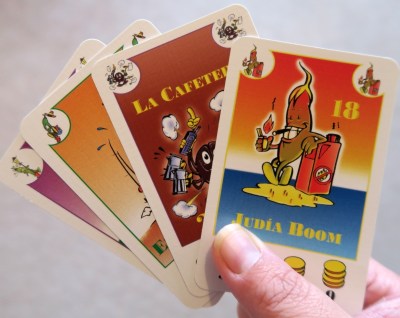
Although Blue’s Spanish was up to the job, the fact that everyone else (familiar with the English version) used the English names for the beans instead of those on the cards, confused Lime utterly.  Despite that, Lime got stuck in to what turned out to be a very tight game.  Green, Pink and Purple bought a third bean field; Green was adamant that he gained no advantage from his though Purple and her “Judías Colora” may have done a little better and Pink thought he might have got an extra coin out of it.  In the end, Blue and her seemingly never-ending stream of “Pochas” had the edge and she finished in first place with a total of fifteen coins, some way ahead of a five-way, eleven-point tie for second place.

Bohnanza
– Image by boardGOATS

Learning Outcome:  Pay attention or you might miss a turn (or two).

Spiel des Jahres Nominations 2019

Every year, in May, the nominees are announced for the most prestigious award in board gaming, the Spiel des Jahres.  There are typically three categories, the Kinderspiel (children’s game) , the Kennerspiel (“expert’s” game) and the most desirable of all, the family award, the Spiel des Jahres.  The nominees for this year’s award have been announced as:

Last year the group picked out the eventual winner, Azul, after playing it at Essen, but this year nobody really had much idea of what would be nominated.  While we enjoyed the sequel to Azul, Stained Glass of Sintra, we felt it was not in the same league as its predecessor.  This year the games generally seem to be light, almost party games.  Our personal favourite for the “Red Poppel” was probably Echidna Shuffle, but we knew that was unlikely to make the cut for other reasons.  Those who had played it felt that Teotihuacan: City of Gods was in with a shout for the Kennerspiel award, but in truth, that it was probably a little too complex.  Wingspan was the only game from this year’s nominees that the group had really picked up on, and is planned as a “Feature Game” for later in the year.

Usually the Kennerspiel Prize winners are a good fit to our group, but this year they are also largely unknown to us, so there is clearly a lot to discover before the winners are announced in Berlin on 22nd July (Kinderspiel des Jahres winners will be announced a month earlier in Hamburg on 24th June).

Spiel des Jahres
– Image from spieldesjahres.de